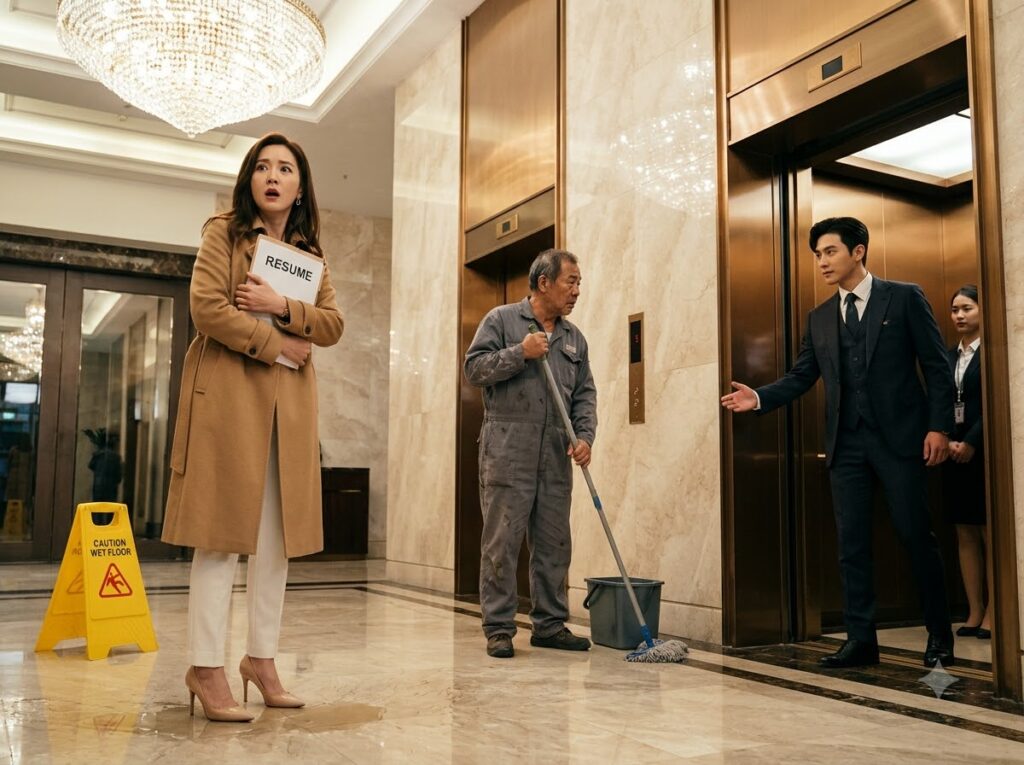
Vanessa Hale stood frozen in the middle of the marble lobby.
For several seconds, she could hear nothing but the sound of water dripping from the edge of the reception desk.
Then she turned toward the receptionist.
“What did you just say?”
The older woman slowly removed her glasses.
“Mr. Whitmore asked for you by name before you arrived.”
Vanessa tightened her grip on the leather folder.
“Why would the chairman of this company ask for me?”
The receptionist hesitated.
“That is something you should have thought about before you kicked his bucket.”
Vanessa’s cheeks burned.
She had spent three weeks preparing for this interview. She had bought a new designer handbag, borrowed money to purchase her heels, and practiced answers to every question she thought the executives might ask.
The position was supposed to change her life.
Senior Director of Corporate Strategy.
A six-figure salary. A private office. A company car.
And, most importantly, the opportunity to prove to everyone who had ever looked down on her that she belonged among the powerful.
She wasn’t going to let an old janitor ruin that.
“Listen,” Vanessa said, lowering her voice. “I think there’s been a misunderstanding. I was startled when he got in my way. Surely the chairman understands that people get frustrated sometimes.”
The receptionist looked at her for a long moment.
“Mr. Whitmore has worked in this building for forty-two years.”
“So?”
“He started here as a maintenance assistant.”
Vanessa blinked.
The receptionist continued.
“He used to mop these floors himself. He knows exactly what it feels like when people look through you as if you don’t exist.”
Vanessa swallowed.
“Well, he doesn’t have to take it personally.”
The receptionist said nothing.
Then she reached beneath the desk and pulled out a white envelope.
“Mr. Whitmore asked me to give you this if you came back looking for an explanation.”
Vanessa snatched it from her hand.
Inside was a single sheet of paper.
INTERVIEW CANDIDATE: VANESSA HALE
FINAL ASSESSMENT: NOT APPROVED
Beneath those words was a handwritten note.
Your qualifications impressed us.
Your behavior told us what your qualifications could not.
Vanessa crumpled the paper.
“This is ridiculous!”
She marched toward the executive elevators and pressed the call button repeatedly.
When the doors finally opened, she stepped inside and jabbed the button for the top floor.
She was not leaving without speaking to the chairman.
On the thirty-second floor, the atmosphere was completely different.
Executives moved between glass-walled offices. Assistants carried documents into conference rooms. Through the windows, the city stretched beneath a pale morning sky.
At the end of the corridor, an oak door stood open.
The nameplate read:
EDWARD WHITMORE — CHAIRMAN
Vanessa approached it, straightened her jacket, and knocked.
“Come in.”
Edward Whitmore sat behind a broad wooden desk. His gray hair was neatly combed, and his maintenance uniform had been replaced by a charcoal suit.
The transformation was startling.
But what caught Vanessa’s attention was the photograph beside his computer.
A young Edward stood in front of the same building decades earlier, wearing an inexpensive work uniform and holding a mop.
Beside him stood a smiling woman holding a little girl.
Vanessa recognized the woman immediately.
It was the receptionist.
Before Vanessa could ask, Edward closed the folder in front of him.
“Miss Hale. You have five minutes.”
She forced a smile.
“Thank you for seeing me, Mr. Whitmore. I want to apologize for what happened downstairs. I was nervous about the interview, and the water caught me by surprise.”
Edward folded his hands.
“You kicked the bucket.”
“I didn’t mean to cause a scene.”
“You splashed water onto an employee.”
“He should have been more careful.”
Edward leaned back in his chair.
“And there it is.”
Vanessa frowned.
“What?”
“The reason you’re here isn’t to apologize. You’re here because you believe your behavior has consequences only when someone important witnesses it.”
Her smile disappeared.
“That’s not fair.”
“Isn’t it?”
He opened another folder.
“Your résumé is excellent. Your previous employer described you as ambitious, persuasive, and exceptionally capable. Your references also mentioned that you could be difficult to work with.”
Vanessa’s expression tightened.
“They were threatened by my success.”
“Perhaps.”
Edward looked at her directly.
“But I don’t hire people based on how impressive they appear on paper. I hire people based on what they do when they believe nobody important is watching.”
He paused.
“This morning, you believed the old man holding the mop was beneath you.”
Vanessa shifted in her chair.
“I didn’t know who you were.”
“Exactly.”
Edward’s voice remained calm.
“If I had been an ordinary janitor, would that have made your behavior acceptable?”
She opened her mouth, then closed it.
For the first time that morning, she had no prepared answer.
Edward stood.
“Our conversation is over.”
Vanessa’s desperation finally broke through her pride.
“Please. I need this job.”
He stopped beside the window.
“Why?”
The question caught her off guard.
“What?”
“Why do you need this particular job so badly?”
Vanessa looked down at her hands.
For a moment, the anger disappeared from her face, revealing something else.
Fear.
“My mother is sick,” she said quietly. “Her treatment is expensive. I’ve been paying her bills for months, and I’m running out of money. I thought this position would finally give us some stability.”
Edward studied her.
“Why didn’t you say that in your application?”
“Because I didn’t want anyone to think I was asking for sympathy.”
He nodded slowly.
“That is understandable.”
Hope flickered across her face.
“So you’ll reconsider?”
“No.”
Her face fell.
Edward returned to his desk.
“Your circumstances explain why you’re desperate. They don’t excuse how you treated someone you believed had nothing to offer you.”
Vanessa rose abruptly.
“Then what am I supposed to do? Go back to being poor? Watch my mother suffer while people like you sit in offices and lecture me about kindness?”
Edward’s expression changed.
Not to anger.
To disappointment.
“You think I was born into this office?”
He pointed toward the old photograph.
“That picture was taken when I was twenty-six. I worked nights cleaning this building and attended business classes during the day. My wife worked two jobs. We sometimes ate dinner from a paper bag because we couldn’t afford a restaurant.”
He paused.
“One evening, a senior executive dropped a wallet full of cash near the elevators. I returned it the next morning. He asked me why I hadn’t kept it.”
Vanessa remained silent.
“I told him that being poor was difficult enough. I wasn’t going to make myself someone I couldn’t respect.”
Edward looked out at the city.
“That executive became my mentor. Years later, when I had the opportunity to buy this company, he invested in me.”
He turned back toward her.
“My life changed because someone gave me an opportunity. But he didn’t give it to me because I pretended to be a good person. He gave it to me because I showed him who I was when I thought nobody could reward me for it.”
Vanessa’s eyes filled with tears.
“I made a mistake.”
“Yes.”
“People make mistakes.”
“They do.”
“Then why can’t you give me another chance?”
Edward was quiet for a moment.
Finally, he picked up his telephone.
“Ask Human Resources to bring in the next candidate.”
Vanessa stared at him.
“You can’t be serious.”
“I am.”
She grabbed her handbag and headed for the door.
Before leaving, she turned around.
“I hope you never find yourself in my position.”
Edward met her eyes.
“I hope you never have to learn humility by losing everything.”
The door closed behind her.
Twenty minutes later, Vanessa stood outside the building beneath the gray October sky.
Her phone buzzed.
A message from her landlord.
Your rent is overdue. I need payment by Friday.
Another message followed.
Her mother’s hospital had called twice.
Vanessa pressed her palms against her eyes.
For the first time in years, she had no idea what to do next.
Then she noticed a man standing near the entrance, struggling to lift a heavy box into the back of a delivery van.
He wore a faded jacket and appeared to be in his sixties.
Several people walked past him.
Vanessa almost did, too.
Then she stopped.
She looked at her expensive heels, the leather handbag she had bought on credit, and the crumpled rejection letter still sticking out of her folder.
She put her bag down.
“Here,” she said. “Let me help.”
The man looked surprised.
Together, they lifted the box into the van.
“Thank you,” he said, smiling. “Most people don’t stop.”
Vanessa managed a small smile.
“You’re welcome.”
She started walking again.
She had barely reached the corner when a black sedan pulled alongside her.
The rear window lowered.
Edward Whitmore sat inside.
Vanessa froze.
“Mr. Whitmore?”
He studied her for a moment.
“I have a question for you.”
She swallowed.
“Yes?”
“If I offered you a position in this company, would you accept it?”
Vanessa stared at him.
“Are you serious?”
“Very.”
She almost laughed from relief.
“Of course I would.”
Edward nodded toward the delivery van disappearing down the street.
“Even if the position involved working alongside the people you walked past this morning?”
Her smile faltered.
“What do you mean?”
“I’m not offering you the director position.”
He handed her a business card through the open window.
“I’m offering you a six-week paid placement with our facilities and operations team. You’ll work with the people who keep this company running. You’ll learn how the building operates, how our staff are treated, and what leadership looks like from the other side of the desk.”
Vanessa stared at the card.
“You’re asking me to become a janitor?”
“No. I’m asking you to understand the people you once considered beneath you.”
She looked at him in disbelief.
“And after six weeks?”
“If you complete the placement successfully, demonstrate that you’ve learned something, and still want to pursue a management role, you may interview again. You won’t be promised the job.”
He paused.
“But this opportunity is real.”
Vanessa’s eyes filled with tears.
“Why would you do that for me after what happened?”
Edward gave her a faint smile.
“Because I saw you help that man with his box.”
He closed the window.
“Don’t mistake one good decision for a transformed character, Miss Hale. Prove it through the next hundred.”
The sedan pulled away.
Vanessa stood on the pavement, holding the business card with trembling fingers.
For the first time that morning, she wasn’t thinking about her heels, her handbag, or the position she had lost.
She was thinking about the old man with the mop.
And how easily she had decided he didn’t matter.
The following Monday, Vanessa arrived at the building at six thirty in the morning.
She wore inexpensive black trousers, flat shoes, and a plain white shirt.
A facilities supervisor named Marcus met her in the lobby.
He was a broad-shouldered man in his fifties with tired eyes and a patient manner.
“You’re the new placement candidate?”
“Yes. Vanessa Hale.”
Marcus checked his clipboard.
“All right. First lesson. We start with the basement.”
Vanessa followed him downstairs.
For the next six hours, she helped inspect maintenance equipment, document repair requests, clean storage areas, and listen to employees explain the problems they faced every day.
Nobody treated her like an executive.
Nobody cared about her résumé.
And nobody made her feel special.
At noon, she sat in the staff break room with a paper cup of coffee.
An older cleaner named Mrs. Collins sat across from her.
“First day?” she asked.
Vanessa nodded.
“Is it that obvious?”
Mrs. Collins chuckled.
“You’ve been looking at the clock every three minutes.”
Vanessa smiled weakly.
“I suppose I’m not used to this.”
“Nobody is used to hard work until they’ve had to do it.”
The words stung, but Vanessa didn’t argue.
After a moment, she asked, “Do you know Mr. Whitmore well?”
Mrs. Collins nodded.
“He visits us every month. Sometimes he brings lunch. Sometimes he just sits and listens.”
“Why?”
“Because when he was young, people treated him like he was invisible. He promised himself he would never build a company where the people at the bottom felt that way.”
Vanessa stared into her coffee.
Then Mrs. Collins added something that made her look up.
“He also asked me to tell you something.”
“What?”
Mrs. Collins reached into her pocket and unfolded a small note.
It was written in Edward’s handwriting.
The first person you must learn to respect is not the chairman.
It is the person you become when nobody is watching.
Vanessa read it twice.
Then she folded the note carefully and put it in her pocket.
She didn’t cry.
She simply stood up, picked up her clipboard, and returned to work.
Five weeks passed.
Vanessa learned the names of the maintenance staff, the security guards, and the receptionists. She learned which elevator broke down most often, why the heating system failed in the west wing, and how many employees worked overtime without receiving proper recognition.
She also learned something far more uncomfortable.
The company had a serious problem.
A contractor responsible for building maintenance had been overcharging the company for months. Employees had reported missing equipment and falsified service records, but their complaints had repeatedly disappeared before reaching senior management.
Vanessa noticed the pattern while reviewing invoices.
At first, she assumed it was a bookkeeping error.
Then she found three invoices for the same repair, each approved by a different manager.
She brought the documents to Marcus.
He examined them and frowned.
“I’ve reported this twice.”
“To whom?”
“The operations director.”
“And what happened?”
“He told me to stop looking for problems that weren’t mine to solve.”
Vanessa felt a familiar anger rise in her chest.
The old version of herself would have used the discovery to make herself look indispensable.
Instead, she asked Marcus to help her gather the records and prepare a formal report.
Together, they documented every discrepancy.
Vanessa then requested a meeting with the internal audit team.
Two days later, the contractor’s payments were suspended pending an investigation.
The following morning, Edward Whitmore summoned Vanessa to his office.
She entered carrying a thick folder.
He gestured toward the chair.
“Sit down.”
Vanessa did.
Edward opened the report and read several pages.
“Who discovered this?”
“I did.”
“Who helped you verify it?”
“Marcus and the facilities team.”
“Who deserves credit?”
Vanessa met his eyes.
“The people who reported it before me. I was only the person who finally put their reports together.”
Edward closed the folder.
For the first time since she had entered the building, he smiled.
“That’s a good answer.”
Vanessa exhaled.
“Does this mean I’ve passed?”
“It means you’ve learned to ask better questions.”
He stood and walked to the window.
“There’s something else you should know. The senior director position you originally applied for is still open.”
Vanessa’s heart began to race.
Edward turned toward her.
“But before I make any decision, I want you to meet someone.”
He pressed a button on his desk telephone.
“Send her in.”
The door opened.
A woman in her early thirties entered carrying a thin folder.
She wore a simple navy suit and flat black shoes.
Vanessa recognized her immediately.
It was the receptionist from the morning she had humiliated Edward.
The woman smiled politely.
“Hello, Miss Hale.”
Vanessa rose so quickly that her chair scraped the floor.
“Mrs. Collins? I thought you worked at reception.”
“I do,” the woman replied. “Part-time.”
Edward nodded toward the photograph on his desk.
“The woman you met in the lobby is Margaret Collins. She has worked here for thirty-one years. But she is also the person who trained me when I first became chairman.”
Vanessa looked from Margaret to Edward.
He continued.
“Margaret has been offered a promotion to lead our employee experience and workplace standards division. She will be responsible for ensuring that every employee, regardless of position, is treated with dignity.”
Margaret opened her folder.
“And one of my first responsibilities is to help select the next senior director of corporate strategy.”
Vanessa’s stomach tightened.
Margaret looked at her calmly.
“I have reviewed your work over the past five weeks. Your report was thorough, and your willingness to credit the people who helped you was noted.”
She paused.
“But I also reviewed the incident in the lobby.”
Vanessa lowered her eyes.
“I understand.”
“No,” Margaret said gently. “I don’t think you understood it that morning. But perhaps you do now.”
Vanessa looked up.
“I am sorry. Not just for what I did to Mr. Whitmore, but for how I treated you afterward. I spoke to you as though your job made you less important than mine. You didn’t deserve that.”
Margaret studied her face.
“Thank you for saying that.”
Then she placed a document on the desk.
“Now I have a question. If you become a senior director, and one of your employees makes a mistake that costs the company a million dollars, what will you do?”
Vanessa considered the question.
“I’ll investigate what happened, determine who was responsible, and make sure the mistake doesn’t happen again.”
Margaret nodded.
“And if that employee is a cleaner who cannot afford to lose their job?”
Vanessa took a breath.
“I would still hold them accountable if they were responsible. But I would also make sure they were treated fairly. Their financial situation wouldn’t automatically excuse the mistake, just as mine didn’t excuse how I behaved in the lobby.”
Margaret said nothing.
Vanessa continued.
“And I would ask whether our procedures, training, or management contributed to the problem before deciding what action to take.”
Edward glanced at Margaret.
Margaret closed her folder.
“That’s the answer I wanted to hear.”
Vanessa looked at her in surprise.
“Does that mean—”
“It means you have earned another interview,” Margaret replied. “Not the job. The interview.”
Vanessa laughed nervously.
“Fair enough.”
Edward extended his hand.
“Miss Hale, I believe you have potential. But potential is not a reward. It’s a responsibility.”
She shook his hand.
“I understand.”
As Vanessa left the office, Margaret called after her.
“One more thing.”
Vanessa turned.
“Yes?”
“Tomorrow morning, the lobby floor needs to be cleaned before the board meeting.”
Vanessa blinked.
Then she smiled.
“I’ll be there at six thirty.”
Margaret returned her smile.
“Good. Bring comfortable shoes.”
The next morning, Vanessa arrived before sunrise.
She found Marcus near the maintenance closet and asked him to show her how to prepare the floor-cleaning equipment.
He handed her a mop.
“Ever used one of these?”
Vanessa looked at it.
“Not properly.”
Marcus grinned.
“Then you’re about to learn.”
She was halfway through the lobby when the executive elevator opened.
Edward Whitmore stepped out.
He stopped when he saw Vanessa pushing the mop across the marble floor.
For a moment, neither spoke.
Then he glanced at the yellow warning sign beside her.
“Careful, Miss Hale. Someone might ruin their designer heels.”
Vanessa froze.
Then she recognized the gentle humor in his voice.
She looked down at her practical black shoes and laughed.
“I think I’ve learned my lesson, Mr. Whitmore.”
Edward studied her for a moment.
“Have you?”
Vanessa rested both hands on the mop handle.
“No,” she admitted. “I think I’ve learned where the lesson begins.”
Edward nodded.
“That’s a better answer.”
He walked toward the elevators.
Just before the doors closed, he turned back.
“Your interview is at nine.”
Vanessa stared at him.
“My interview?”
“Nine o’clock. Don’t be late.”
The doors shut.
Vanessa stood in the empty lobby, holding the mop.
For the first time in her life, she understood that earning respect wasn’t about convincing powerful people that she belonged among them.
It was about becoming someone who didn’t need to make other people feel small to feel important.
She picked up the mop again.
Outside, the sun rose over the city.
And for the first time, Vanessa Hale was ready to walk into a room without believing she was better than anyone standing outside it.
But when she arrived for her nine o’clock interview, there was already someone sitting in the conference room with her résumé in hand.
Someone who had worked for the company for twenty years.
Someone who had applied for the same position three times.
And someone who had a very different opinion about whether Vanessa deserved a second chance.





