A whole town watched Clara Whitmore walk into the wilderness… and quietly waited for her to break.
They expected the pregnant woman to abandon her half-built cabin before winter. They expected hunger, snow, and exhaustion to drive her back to the husband she had fled.
What they did not expect was the sound of a hammer echoing through the pines every morning. They did not expect Clara Whitmore to keep building.
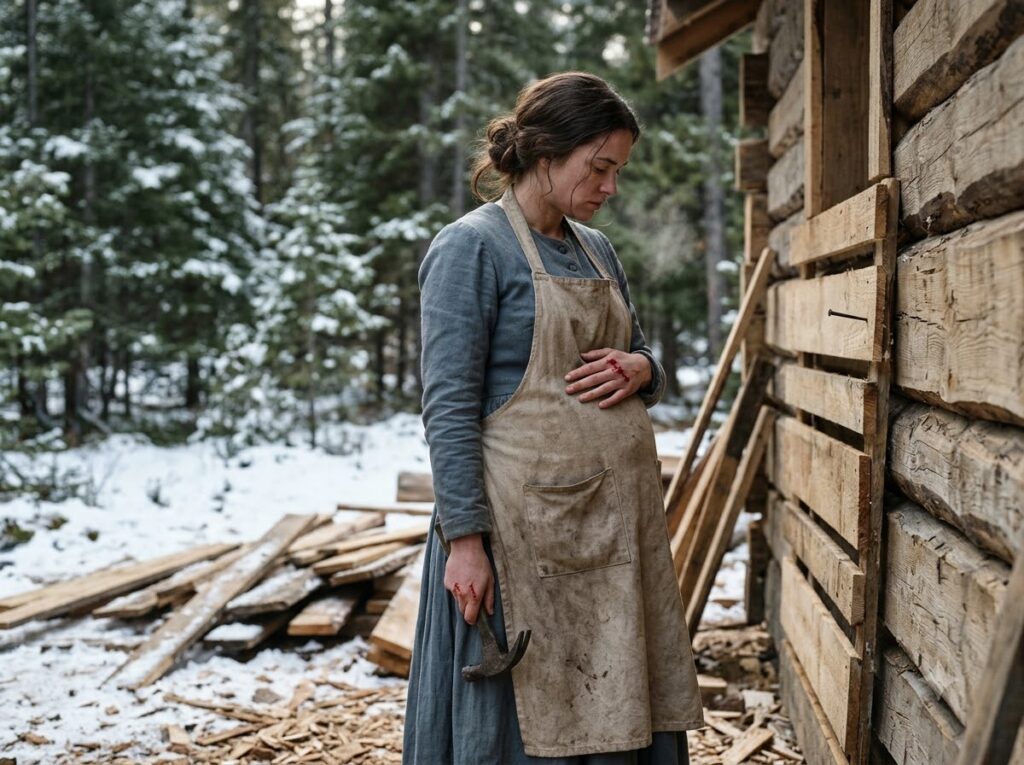
They did not expect her to look at forty acres of rough timber and rocky soil and see something they could not. A beginning. Blood streaked Clara’s knuckles as she reached for another nail. She did not bother bandaging the cut. Bandages were scarce. Nails mattered more.
At thirty-one years old and seven months pregnant, Clara was building a cabin alone outside Harland Creek. The land was everything people warned her about: miles from town, difficult access to water, thick trees that fought every swing of an axe, and ground that seemed determined to reject every post she placed.
But Clara had not come here because it was easy. She had come because it was hers. Nobody could order her out. Nobody could decide where she slept. Nobody could tell her what kind of mother she would become.
That evening, beneath a roof that was still unfinished, Clara sat beside a small fire. The wind slipped through the gaps in the walls, carrying the smell of pine and cold earth into the cabin. She rested one aching hand against her belly. Her daughter kicked.
Clara looked down and smiled despite the exhaustion pulling at her face.
“They think we won’t make it,” she whispered.
Another kick answered her. Her smile grew faint but certain.
“Your mother kept building while everyone else stood around waiting for her to fall.”
Before this place, Clara had lived a life that looked comfortable from the outside.
She had owned fine china, elegant curtains, and a respectable home with her husband, Edward Whitmore. Neighbors saw polished floors and a successful marriage.
They never saw how small Clara had begun to feel inside those walls. Edward never needed to shout. His cruelty came quietly.
He corrected every choice she made until she questioned her own judgment. When she spoke about starting a bookkeeping service, he calmly explained why she would fail before she even began.
When she asked for her own bank account, he told her it was unnecessary. He always made his control sound like concern. Then Clara became pregnant.
For a brief moment, she believed the child might soften him. She imagined Edward holding their baby and finally understanding that their family mattered more than his pride.
Instead, he waited until one evening after dinner, folded his napkin, and spoke as if discussing a simple household arrangement.
“After the child arrives,” Edward said, “we’ll discuss what happens next.”
Clara stared at him.
“With the baby?”
Edward looked directly at her.
“With you.”
The meaning settled over her slowly. He was not talking about their future together. He was deciding what would happen to her. Clara left before sunrise.
She took half their household money, the clothes that still fit her, and her late mother’s tin box. Inside were old letters, mysterious documents, and a deed Clara barely understood. She had no clear plan beyond one thing. She would not return. She filed a homestead claim and started building.
The first weeks nearly broke her.
Posts had to be pulled and reset. Green timber twisted as it dried. More than once, she worked until darkness covered the property because there was no one else coming to finish the job.
A falling beam crushed her foot badly enough that she bit down on her sleeve to keep from crying out. The next morning, she limped back outside. The town noticed. Some people admired her quietly. Others waited for the day she finally admitted they had been right.
When the twelve-foot ridge beam seemed impossible to raise alone, Clara refused to accept defeat. She studied the problem, gathered scrap lumber, and created a system of gin poles that allowed her to lift what no one believed she could move. After several failed attempts, the beam finally rose into place.
Clara stood beneath it, staring upward.
For the first time, the cabin looked less like a dream and more like a home. Tears filled her eyes. Not because someone had rescued her—but because nobody had. A week later, hoofbeats sounded among the pines. Clara froze.
The nearest town was miles away, and strangers rarely came this deep into the property. She reached for the rifle resting against the cabin wall. A rider emerged through the trees.
He sat tall in the saddle, broad-shouldered beneath an expensive weathered coat. His horse was powerful and well cared for, the kind of animal that belonged to a man who owned more land than he could see from one place. The stranger stopped near the cabin.
His eyes moved from Clara’s pregnant belly to the enormous ridge beam above her.
“You put that up?” he asked.
Clara kept one hand on the rifle.
“No,” she said. “The angels came down Tuesday evening and handled it.”
For a moment, the stranger stared. Then he laughed. It was the first real laugh Clara had heard in weeks.
“Nathaniel Cross,” he said.
The name meant something immediately. Everyone in Montana knew Cross.
He owned nearly twelve thousand acres, cattle, timber rights, and freight contracts. He was one of the wealthiest unmarried ranchers in the territory. Nathaniel looked over the cabin again.
“You know there’s a storm coming.”
“I know.”
“An early one.”
“I know that too.”
His gaze moved to the unfinished roof.
“If that roof isn’t sealed in three days, leave.”
Clara lowered the rifle slightly but did not step back.
“This is my home.”
Nathaniel’s expression hardened with concern.
“A home isn’t worth dying inside.”
Clara stared at him.
“I don’t need rescuing.”
For a moment, she expected the same reaction she always received from men who thought they knew better. Instead, Nathaniel simply looked at her.
“I didn’t offer.”
Then he turned his horse and rode away. Three days later, snow struck Montana in September. The storm arrived like a warning nobody had wanted to hear.
Wind screamed through the pines. Snow covered the ground faster than Clara could clear it. Still, she climbed onto the unfinished roof, fighting to secure the final covering before the storm destroyed everything she had built. Her fingers shook from cold. Her breath came in short bursts.
Then pain tore through her abdomen. Once. Again. Far too early. Clara gripped the roof beam and closed her eyes.
“No,” she whispered.
She tried to climb down. Her boot slipped. The world turned sideways. She hit the frozen ground hard. For several seconds, she could not breathe. Then she felt warmth beneath her dress. Blood. Fear finally reached the place determination had kept locked away.
“Please,” she whispered, clutching her belly. “Not yet.”
Through the storm came another sound. Hoofbeats.
Nathaniel Cross appeared through the blowing snow with two ranch hands and a packhorse loaded with food, blankets, lumber, and canvas. He jumped down before the horse had fully stopped. He reached Clara just as her knees gave way.
“I told you,” she whispered, “I don’t need rescuing.”
Nathaniel wrapped his coat around her shoulders.
“No.”
He looked directly into her eyes.
“You need a neighbor.”
Then his attention shifted. Something had fallen from the open tin box lying nearby. Papers were scattered across the snow. The wind grabbed at them. Nathaniel caught one before it disappeared into the storm. Clara saw the document in his hand. Her face changed.
“Give me that.”
But Nathaniel was already looking at the signature at the bottom. He knew it instantly. The storm seemed to disappear around him. The name belonged to his father. Nathaniel slowly looked back at Clara.
“Why do you have a deed signed by my father?”
And for the first time since she had arrived at the forty acres, Clara wondered if she had not escaped into a new life at all.
Perhaps she had walked directly into a secret someone had spent thirty years trying to bury.
Nathaniel did not answer immediately.
The document shook slightly in his gloved hand, though Clara could not tell if it was from the wind or from something deeper. The ranch hands moved closer, but Nathaniel lifted a hand.
“Give us room,” he said.
They obeyed, stepping back toward the horses while the storm swallowed the distance between them. Clara pushed herself upright despite the pain cutting through her body.
“Where did you get that?” Nathaniel asked.
“It was my mother’s.”
“That is not what I asked.”
Her eyes narrowed.
“And I am not answering questions while I am bleeding in the snow.”
For a moment, Nathaniel looked as if he might argue. Then he saw the color leaving her face and the way one hand stayed protectively over her stomach. Whatever questions he had, they could wait. He carefully folded the paper and placed it inside his coat.
Clara noticed.
“You are keeping it.”
“I am keeping it dry.”
“You are keeping evidence.”
Nathaniel looked at her.
“You think I came here to take something from you?”
“I think powerful men have taken enough from me.”
The words landed harder than the storm. Nathaniel said nothing. Because he knew that kind of loss.
Not the same loss. Not the same wound. But he knew what it meant to inherit a name that carried more weight than the person beneath it.
“Can you walk?” he asked.
Clara tried to stand. Her legs failed. Nathaniel caught her before she fell.
“I can walk,” she said.
“You are not walking.”
“I said—”
“And I heard you.”
His voice remained calm.
“That is the first thing you should know about me, Clara. I listen. I just do not always agree.”
She wanted to fight him.
She wanted to tell him she had built walls with her own hands because she was tired of waiting for someone else to decide what she needed.
But another wave of pain crossed her face, and Nathaniel tightened his hold. This time, Clara did not argue. They carried her to the small cabin through the storm.
The place that had once felt like proof of her independence suddenly felt frighteningly fragile. Snow pushed through the unfinished sections of the roof. Wind rattled the walls she had fought so hard to raise. Nathaniel’s ranch hands worked quickly. One sealed gaps with canvas. Another brought in blankets and stacked fresh wood near the stove.
The packhorse carried more supplies than Clara had seen in weeks. Food. Medicine. Lumber. Things she had been calculating and rationing every day. Nathaniel stayed near the door, watching the storm outside. Clara noticed.
“You can leave.”
He looked back.
“Is that what you want?”
“Yes.”
He studied her face.
“No, it is not.”
Clara almost laughed, but exhaustion stopped her.
“You barely know me.”
“I know enough.”
“You know I am stubborn.”
“Yes.”
“You know I do not like being helped.”
“Yes.”
“You know I might still tell you to leave tomorrow.”
Nathaniel nodded.
“Yes.”
“Then why are you still here?”
He glanced toward the paper hidden inside his coat.
“Because I need answers too.”
The truth sat between them.
For the first time, Clara saw that Nathaniel was not only a wealthy rancher arriving on a magnificent horse.
He was a man who had just discovered a piece of his own family history lying in the snow. The storm continued through the night. By morning, the worst of it had passed. The world outside was covered in white, but the cabin still stood.
Clara woke beside the small stove to find Nathaniel sitting at the table with the document spread before him. Her mother’s tin box rested beside it. She immediately sat up.
“Careful,” Nathaniel said.
“Do not tell me what to do.”
A faint smile crossed his face.
“There she is.”
Clara ignored the comment and looked at the papers.
“What did you find?”
Nathaniel tapped the deed.
“This is not a normal land transfer.”
“I knew that.”
“No, Clara. I mean it was never supposed to be filed the way it was.”
She frowned.
“What does that mean?”
“My father’s signature is here. His full name. His seal.”
He pointed to the bottom corner.
“But the date is thirty-two years ago.”
Clara said nothing.
“My father would have been twenty-three.”
“Was that unusual?”
Nathaniel leaned back.
“For him? Yes.”
“Why?”
“Because at twenty-three, my father had no reason to own this land.”
He looked toward the window, toward the forty acres covered in snow.
“He was already wealthy. He was expanding the ranch. He bought valuable property. Timber. Water rights. Grazing land.”
His eyes returned to Clara.
“This place was considered worthless.”
Clara felt a chill that had nothing to do with the weather.
“Then why sign it?”
“That is what I intend to find out.”
She reached for the document. Nathaniel allowed her to take it. Her mother’s handwriting appeared on one of the attached pages. Clara knew it instantly.
Her mother had written hundreds of letters, but Clara had never seen this one. The paper was older than anything else in the box. She unfolded it carefully. The first line made her stop. My dear Margaret, Clara’s breath caught. Margaret was her mother’s name.
She read silently for several seconds before Nathaniel noticed the change in her expression.
“What does it say?”
Clara lowered the page.
“I don’t know.”
“That is not true.”
Her fingers tightened around the paper.
“It says my mother knew your father.”
Nathaniel went still.
“How?”
“I don’t know.”
“Clara.”
She looked up.
“And I said I don’t know.”
The frustration in her voice surprised him. Because beneath it was fear. Not fear of Nathaniel.
Fear of discovering that the one thing she had carried from her old life—the one thing she believed belonged only to her mother—was connected to a family with enough power to destroy everything she had built. Before Nathaniel could ask another question, a sound came from outside.
A horse. Not one of his. Both of them turned. The cabin door opened. A man stood outside in a dark coat, snow covering his shoulders. Clara recognized him immediately. Her face hardened.
“Edward.”
Her husband stepped inside without waiting for permission. His eyes moved over the cabin. The blankets. The supplies. Nathaniel standing beside the table. Then he smiled. A polite, controlled smile Clara knew too well.
“There you are,” Edward said.
Nathaniel’s expression changed.
“You know this man?”
Clara did not take her eyes off Edward.
“Unfortunately.”
Edward ignored the answer.
“Clara, you have caused enough trouble.”
The old feeling returned for a moment. The feeling of being corrected. Of being made smaller. But she was not standing in Edward’s house anymore. She was standing in the cabin she built.
“My home is not trouble.”
Edward looked around again.
“This?” he said softly. “This is what you call a home?”
Nathaniel stepped forward.
“Choose your next words carefully.”
Edward finally looked at him. Recognition appeared.
“Cross.”
“Yes.”
A small smile returned to Edward’s face.
“How interesting.”
Nathaniel’s eyes narrowed.
“What is that supposed to mean?”
Edward looked from Nathaniel to the papers on the table. Then he smiled wider.
“I suppose you have not told him yet.”
Clara felt her stomach tighten.
“Told him what?” Nathaniel asked.
Edward reached for the deed. Clara grabbed it first.
“You do not touch anything here.”
For the first time, Edward looked genuinely surprised. Then he laughed quietly.
“There she is.”
He stepped closer.
“Still pretending you can make decisions without me.”
Nathaniel’s voice was cold.
“She is not pretending.”
Edward looked at him.
“You have no idea what you are involved in.”
Nathaniel glanced at the deed.
“Then explain it.”
The smile disappeared from Edward’s face. Outside, the wind moved through the pines. Inside, Clara held the paper that connected two families.
And for the first time, Edward realized she was no longer the woman who left before sunrise carrying only a small bag and a broken heart.
She was the woman standing on land that might have belonged to a secret powerful men had spent decades protecting. Edward straightened his coat.
“I came here to take my wife home.”
Clara looked at him.
“No.”
Her answer was quiet. But it filled the cabin.
“You came here because you thought I would still be waiting for permission to live.”
Edward’s face hardened.
“You do not understand what you have found.”
Clara looked down at the deed. Then back at him.
“Maybe not.”
She took a breath.
“But I intend to.”
And when Edward left the cabin with a promise that this was not over, Clara knew the storm outside was no longer the greatest danger facing her. The real battle had finally arrived.
The morning after Edward left, Clara found the cabin quieter than it had ever been. Not peaceful. Quiet. There was a difference.
Peace came when a person felt safe. Quiet came when they were waiting for the next storm.
Nathaniel stood outside near the edge of the property, studying the land with the same careful expression he wore when examining cattle or a contract. The snow had softened overnight, but the damage from the storm remained. Broken branches covered the ground. The unfinished roof needed repair. The creek path was nearly buried.
Clara stepped outside, holding the tin box beneath her arm.
“You stayed.”
Nathaniel looked back at her.
“I said I was your neighbor.”
She almost smiled.
“Most neighbors do not stand outside before sunrise staring at someone’s land like they are solving a murder.”
Nathaniel glanced toward the cabin.
“Maybe I am trying to solve one.”
The humor faded between them.
Because they both knew the deed was not just a piece of paper. It was a question. And someone had spent thirty years making sure nobody asked it.
Inside the cabin, Nathaniel carefully unfolded the document again. Clara watched him trace the faded ink without touching the signature.
“My father’s name is here,” he said.
“You said he was a good man.”
Nathaniel was silent.
“He was,” he finally answered. “At least, that is what everyone believed.”
Clara opened the tin box and removed the old letters one by one. Some were worn almost beyond reading. Others still carried the faint marks of the person who had written them.
“My mother never spoke about this land,” Clara said. “Not once.”
“Then why keep the deed?”
“I think she was waiting for someone to find it.”
Nathaniel looked at her.
“Or waiting for someone to be strong enough to use it.”
That afternoon, they traveled to the small county records office near Harland Creek. Clara expected doors to close the moment they entered. She was right. The clerk behind the desk froze when he saw the deed.
“Where did you get that?” he asked.
“My mother left it to me,” Clara replied.
The clerk looked nervous.
“Mrs. Whitmore, some records are complicated.”
Nathaniel stepped forward.
“Complicated because they are old, or complicated because someone wants them hidden?”
The clerk looked between them. Finally, he reached beneath the counter and pulled out a dusty ledger.
“This was never supposed to leave the archive.”
Clara opened it carefully. Inside was a record from more than thirty years earlier. Her mother’s name. Nathaniel’s father’s name. And a note beside the property claim. A private agreement. Clara’s breath caught.
“What does it say?” Nathaniel asked.
She read the faded words aloud.
“‘The land shall remain protected until the rightful heir chooses freedom over inheritance.’”
Neither of them spoke. Because the sentence raised more questions than it answered.
“Rightful heir?” Nathaniel said.
Clara looked at the deed.
“My mother was never wealthy. She never owned anything like this.”
Nathaniel studied the paper again.
“Maybe she did.”
A cold feeling settled in Clara’s chest.
All her life, she had believed she was running away from a man who wanted control over her.
Now she wondered if she had been running toward something her mother had spent decades protecting. Before they could continue searching, the office door opened. A familiar voice filled the room.
“You always were stubborn, Clara.”
She turned.
Edward stood there with two men behind him, both dressed in expensive coats and carrying themselves like they belonged in every room they entered. Nathaniel’s expression hardened.
“Edward.”
Edward smiled.
“I see you have made new friends.”
Clara closed the ledger.
“What do you want?”
Edward stepped closer.
“What I wanted from the beginning. To protect my family’s reputation.”
Nathaniel’s eyes narrowed.
“Your family?”
Edward ignored him.
“Clara, you do not understand what you are holding. Give me the deed, and this embarrassment can end.”
Clara stared at the man who once convinced her she could not survive without him. Then she looked at Nathaniel. Then at the old ledger.
“No.”
Edward’s smile disappeared.
“You should be careful.”
Clara lifted the deed.
“I have spent months building a home with my own hands.”
Her voice grew steadier.
“I am not handing over the only thing I ever built because you are afraid of what the truth will reveal.”
For a moment, nobody moved. Then one of Edward’s companions leaned forward.
“Mr. Whitmore, perhaps she needs to understand that the claim can be challenged.”
Nathaniel looked at him.
“Is that a threat?”
The man smiled slightly.
“No. It is a warning.”
But Clara noticed something. They were not angry because she was wrong. They were afraid because she was close.
That evening, back at the cabin, Nathaniel placed the ledger beside the tin box.
“We need to find every record connected to this agreement.”
Clara nodded.
“And if Edward tries to take my home?”
Nathaniel looked toward the dark forest beyond the window.
“Then we make sure the truth reaches town before he can bury it.”
Outside, the wind rose again. But this time Clara did not look toward the storm. She looked toward the road. Because she knew Edward would return. And next time, he would not come asking. He would come prepared to fight.
The following morning, Clara and Nathaniel rode into Harland Creek before sunrise. The town had already heard whispers.
By the time they reached the courthouse, people had gathered outside the wooden building, watching from porches and beside wagons. Some looked curious. Others looked certain they already knew how the story would end. For years, Clara had been the woman people expected to disappear.
Today, she walked through the crowd carrying the deed in her own hand.
Nathaniel rode beside her but did not lead. He noticed the difference immediately.
Months earlier, Clara would have followed anyone who sounded confident. Now she walked with the quiet certainty of someone who had built something from nothing. Inside the courthouse, the town clerk arranged the documents across the desk. Edward Whitmore was already there.
He stood beside two lawyers, dressed perfectly, as though he had come to a business meeting rather than a fight over the future of a woman he once controlled. When Clara entered, his expression tightened.
“Still determined to make this difficult?” Edward asked.
Clara placed the deed on the desk.
“No. I am determined to make it honest.”
A murmur moved through the room. Edward glanced around at the gathered townspeople.
“Everyone here knows how these things work. A woman alone cannot simply claim land because she wishes it so.”
Nathaniel stepped forward.
“This is not about wishing.”
Edward turned toward him.
“And you would know? You just arrived in the middle of this mess.”
Nathaniel’s expression remained calm.
“I arrived when the truth was buried under it.”
The clerk opened the old ledger Nathaniel had found among his father’s papers.
“The records show an agreement dated thirty-two years ago.”
Edward’s confidence faded slightly. The clerk continued.
“A payment was made. A land transfer was promised. The agreement was signed by Thomas Cross.”
The room went quiet. Nathaniel stared at the page.
He had spent days preparing himself for what he might find, but seeing his father’s name written there still felt like a blow.
Thomas Cross had been remembered as a powerful rancher. A man who built an empire through cattle, timber, and determination. But nobody in town had known about this. The clerk looked toward Clara.
“Your mother’s name appears as the recipient of the agreement.”
Edward quickly interrupted.
“That proves nothing. A private agreement is not a legal claim.”
“No,” Nathaniel said quietly.
Everyone looked at him.
“But it proves my father intended something.”
Edward smiled coldly.
“Intention does not change ownership.”
Nathaniel looked down at the papers.
“No. But a witness might.”
The room shifted. Clara turned toward him.
“What witness?”
Nathaniel hesitated.
“Someone I found mentioned in my father’s old letters.”
Before anyone could ask more, the courthouse doors opened. An elderly man stepped inside, leaning heavily on a wooden cane. Several people recognized him immediately.
Samuel Reed had worked for Thomas Cross decades earlier. He had been the ranch foreman before age and injury forced him away from the land. Nathaniel walked toward him.
“You came.”
Samuel nodded.
“Your father made me promise I would speak if the time ever came.”
Edward’s face changed.
“You knew about this?”
Samuel looked at him.
“I knew your father was trying to correct a mistake.”
The old man slowly approached the desk.
“Thirty-two years ago, Thomas Cross purchased those forty acres from Clara’s grandfather. But before the papers were finalized, he discovered something.”
Clara held her breath.
“What?”
Samuel looked at the deed.
“The land had never truly belonged to the Whitmore family alone. It was part of an old boundary agreement between the Cross and Whitmore properties. Your families had been fighting over it for years.”
Nathaniel listened carefully.
“My father found out the original survey was wrong.”
Samuel nodded.
“He did. He planned to correct it publicly. But before he could, pressure came from people who wanted the land kept quiet.”
Clara looked at Edward. He looked away. Nathaniel noticed.
“Who pressured him?”
Samuel’s voice lowered.
“Your uncle. And others who believed the land was worth more than the truth.”
A wave of whispers crossed the room. Edward stepped forward.
“That is an old man’s story.”
Samuel looked directly at him.
“It is a story written in letters, signed documents, and your own father’s handwriting.”
Edward’s jaw tightened. Clara reached for the tin box she had carried with her.
“I have something else.”
She opened it carefully and removed one of her mother’s old letters.
“I never understood why she kept these.”
Nathaniel moved closer as Clara unfolded the paper. The handwriting was faded, but the message was clear.
Her mother had written about Thomas Cross visiting their family after discovering the mistake. She wrote that he promised the land would belong to Clara one day because he believed freedom mattered more than money. At the bottom was another signature. Thomas Cross. The room fell silent.
Edward looked around, searching for anyone who would support him. But the certainty he had walked in with was gone. One of the town elders stepped forward.
“Edward Whitmore, did you know about these documents?”
Edward said nothing. The silence answered for him. Clara watched him carefully.
For years, Edward had controlled conversations by making her doubt herself. He had convinced her that she was too inexperienced, too fragile, too dependent to make decisions.
But standing there, surrounded by the truth, she finally saw what he had always feared. Not losing the land. Losing control over her. Edward’s voice hardened.
“You think this changes everything?”
Clara met his eyes.
“Yes.”
He laughed bitterly.
“You are still alone.”
Clara looked around the room. Nathaniel stood beside her. Samuel stood behind the evidence. The town watched.
“No,” Clara said.
Her voice was calm.
“I was alone when I built the walls. I was alone when I lifted the beams. I was alone when I survived the storm.”
She picked up the deed.
“But I am not alone because I need someone to save me.”
She looked at Edward.
“I am not alone because I finally know who I am.”
For the first time, Edward had no answer.
The courthouse meeting continued for hours. Every record was examined. Every signature was compared. Every claim was questioned. By afternoon, the town had heard the full story. The forty acres were not abandoned land. They were not a mistake.
They were the result of a promise that had waited more than thirty years to be honored.
But before Clara could celebrate, one final document was placed on the desk. The clerk unfolded it slowly.
“This was attached to the original agreement.”
Nathaniel leaned forward. Clara saw the concern cross his face.
“What is it?” she asked.
The clerk looked between them.
“It appears Thomas Cross left instructions that the land should pass to Clara Whitmore only under one condition.”
Everyone waited. Nathaniel looked at the paper. His expression changed. Because whatever his father had written next was not about ownership. It was about a secret neither family had known existed.