Arizona Territory, 1878.
The desert wind struck the cabin walls like it was searching for a way inside.
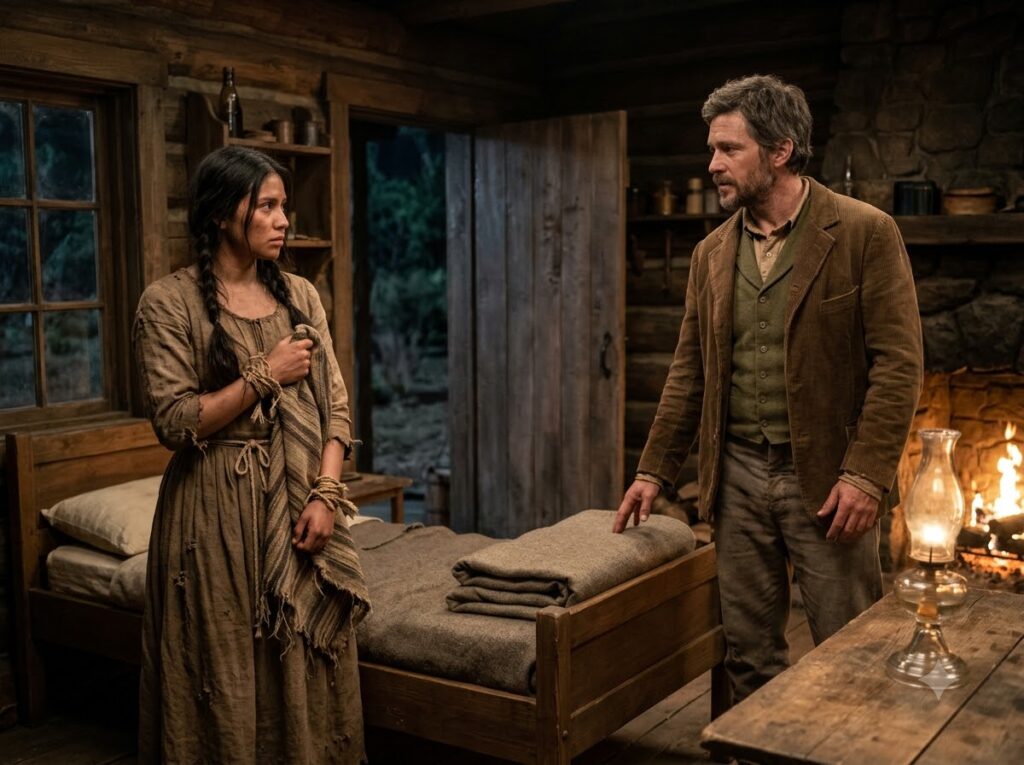
Naira stood beside the small cot with her back stiff and her hands hidden beneath the torn sleeves of her shawl. The room was nothing like the places she had known before. It held no voices she trusted, no familiar faces, no sign that anyone would come if she cried out.
Only a cold cabin. And the man she had been forced to marry.
Twenty-year-old Naira still carried the pale marks left by the ropes that had bound her during the journey. The skin around her wrists had healed enough to close, but the memory of the rope had not faded. Every movement, every unfamiliar sound, every step from the man across the room reminded her that she was far from everything she had ever called home.
She had learned a hard lesson before reaching this place. Silence could protect her. Fear could keep her alive. Trust could disappear in a single heartbeat.
Elias Ward watched her from a careful distance. He did not move like a man claiming what had been given to him. He moved like someone approaching a wounded animal that might run if he stepped too quickly.
He was nearly forty years old, with a weathered face shaped by years under the sun, gray beginning to touch his dark hair, and tired eyes that looked older than the rest of him. Naira had expected cruelty. She had expected pride. She had expected a man who saw this marriage as a victory.
Instead, she saw exhaustion. She saw a man carrying something heavy. But she did not trust what she saw.
Their marriage had never been her choice. It had been arranged as part of a fragile agreement between her captured Apache people and settlers who held the power to decide their future. To those who created the agreement, it was a solution. A way to stop fighting.
To Naira, it was another path chosen for her by people who never asked where she wanted to go. Elias looked toward the small bed, then back at her.
For a moment, Naira’s body tensed, ready for the danger she believed was coming. Elias noticed. And something in his expression changed. Not anger. Pain.
He stepped toward the cot slowly, making sure every movement was visible. Naira held her breath as he placed a folded blanket on the bed. Then he stepped away. Farther than he needed to.
“You can take the bed,” he said softly.
Naira did not answer. She watched his hands instead.
Elias kept them where she could see them. Then he crossed the room, lit the oil lamp, and lowered himself near the fireplace. He added wood to the flames and checked the fire without once moving toward her again. The gesture confused her more than cruelty would have.
Cruelty was something she understood. Kindness from a stranger was dangerous because it asked her to hope. Elias sat across the room, leaving the space between them untouched.
“I know you don’t believe me,” he said.
Naira looked at him but remained silent.
“I don’t blame you.”
The fire cracked between them. Outside, the desert wind continued to scrape against the cabin walls. Elias looked down at his hands.
“I have seen what people do when they stop seeing someone as a person.”
His voice became quieter.
“I won’t do that to you.”
Naira studied his face, searching for the hidden meaning behind the words. Men had promised many things before. Promises were easy when no one had to keep them. She turned toward the door again. But this time, she stopped.
Because she realized she had been looking at Elias for several moments without thinking about escape.
It was the first time since arriving that she looked at him instead of the door.
Hours passed. The cabin grew darker as the fire burned lower. The silence between them changed, though neither of them spoke about it. Elias reached toward the lamp. The movement was small. But Naira’s body reacted before her mind could stop it. She flinched. Elias froze instantly.
His hand lowered. The room became completely still.
Naira stared at the floor, ashamed that the fear had escaped so easily. She wanted to take the reaction back, but she knew she could not. Elias did not move closer. He simply waited.
And after a long moment, Naira finally let the words leave her mouth.
“It hurts… It’s my first night.”
Elias lowered his hand slowly. He understood. Not the whole story. Not yet. But enough.
And in that quiet cabin, with the desert pressing against the walls and two wounded people sitting on opposite sides of the room, Elias made a choice that would change the life they had both been forced into.
The words stayed between them for a long moment.
Elias looked into the fire instead of at her. He knew there were questions he had no right to ask yet. He knew there were wounds that did not open because someone demanded to see them. So he simply said, “I believe you.” Naira lifted her eyes.
The answer surprised her more than any question could have.
Most people wanted explanations. They wanted proof. They wanted details they could carry away and use to judge whether someone deserved kindness. Elias asked for none of that. He remained in his chair, leaving the distance between them untouched.
“My sister used to say fear has a memory of its own,” he said quietly. “Sometimes a person leaves a place, but the fear follows them there.”
Naira watched the flames move across the logs.
“You have fear too,” she said.
Elias’s expression changed slightly. Not anger.
Not surprise. Recognition.
“Yes,” he answered.
The honesty caught her off guard.
She had expected him to deny it. Men who held power often pretended they had never been afraid. They hid behind their strength until everyone believed the mask was their real face. But Elias did not.
“The war taught me something,” he said. “A person can survive a battle and still lose everything afterward.”
The cabin became quiet again.
Naira did not ask about the wife and son she sensed he carried like ghosts. She understood grief. She carried enough of her own.
Eventually, Elias stood and walked toward the small table. He took a cup, poured water, and placed it near her without stepping closer.
“You should rest,” he said.
Naira looked at the bed. The same bed that had terrified her when she entered the cabin. Now it was only a bed. That small difference felt impossible.
She moved carefully, never taking her eyes completely away from him. Elias noticed, but he pretended not to, giving her the dignity of not being watched while she tested this new kind of safety.
When she finally sat on the edge of the cot, Elias turned away and began preparing his own place near the fireplace.
“You sleep there?” she asked.
He looked over his shoulder.
“Yes.”
“On the floor?”
“It is only for tonight.”
Naira studied him.
“Why?”
Elias was silent for a moment.
Then he answered, “Because I know what it feels like when someone else decides you have no choice.” The words struck deeper than he intended. Naira looked down at her hands.
For the first time, she wondered what kind of pain had created a man who would give away his own comfort to protect someone who did not trust him. Morning came slowly.
The desert sun pushed through the cracks in the wooden walls, revealing a cabin that looked different in daylight. Less like a prison. Not a home. Not yet. But something between the two.
Elias was already awake when Naira opened her eyes. He stood near the door, checking the outside through a narrow gap in the wood. His posture changed when he saw movement beyond the cabin. Naira noticed immediately.
“What is it?” she asked.
Elias did not answer at first. That silence told her enough. Outside, distant voices carried through the morning wind. Not neighbors. Not travelers. Men who had come looking. Elias stepped away from the door and reached for his coat.
“Stay inside,” he said.
Naira’s expression hardened.
“I am not a child.”
“No,” Elias replied. “You are someone who has already been treated like one.”
The answer stopped her.
He opened the door only slightly, looking toward the figures gathered near the edge of the property.
Three settlers stood there, their horses restless behind them. Their faces carried suspicion, not welcome. One of them called out.
“Ward!”
Elias remained still.
“What do you want, Carter?”
The man stepped forward.
“We want to know if this agreement is real.”
Naira moved closer despite herself. Agreement. The word followed her everywhere. Carter looked past Elias toward the cabin interior.
“And we want to see the woman they sent you.”
Elias’s hand tightened at his side.
“She is not something to be inspected.”
The man’s expression darkened.
“You forget who made this arrangement possible.”
For a moment, something unreadable crossed Elias’s face. Naira saw it. A flicker of anger. And something else. A secret. Because Elias knew more about the arrangement than he had told her. When the men finally rode away, the cabin remained silent. But the silence was different now.
Naira turned toward him.
“What agreement?”
Elias looked at her, knowing the question had finally arrived. And knowing that the answer would change the way she saw him.
“I should have told you sooner,” he said.
Naira did not move. “But you did not.”
Elias lowered his eyes for a moment. The fire behind him cracked softly, filling the space where an answer should have been.
“When I agreed to this marriage, I was told it was the only way to stop more fighting along the border. A union between two sides that had spent years taking from each other.”
Naira’s voice was quiet, but sharp. “You make it sound like I was a piece placed between two armies.” Elias looked at her.
“Because that is what they tried to make you.”
The words struck harder than she expected.
He walked to the wooden table and pulled out a small leather pouch. From inside, he removed a folded paper, worn at the edges from being carried too many miles.
“I was given this before you arrived.”
Naira did not reach for it.
“By whom?”
“Men who claimed they spoke for the settlers. Men who said your people had agreed to everything.”
“And you believed them?”
Elias was silent. That silence answered her.
Naira turned away, anger fighting with the fear she had carried since the first night.
“You knew there was more.”
“Yes.”
“Then why protect me?”
Elias looked toward the window, where the desert stretched endlessly beyond the glass.
“Because I saw what happened on the road here.”
Her expression changed.
“The men escorting you were not keeping you safe,” he continued. “They were making sure you arrived afraid enough to obey.”
Naira’s hands tightened around her shawl.
“I thought no one noticed.”
“I noticed.”
The answer was simple. Almost painful. Elias took a slow breath.
“When I found out they had hurt you, I changed the route. I made sure you had water. I made sure they understood you would arrive alive.”
Naira stared at him.
“Why?”
“Because someone had to remember you were a person.”
For a moment, neither of them spoke. Then a sharp crack came from outside. Not thunder. A gunshot.
Elias moved instantly, stepping between Naira and the window. The gentle man who had placed a blanket on her bed disappeared, replaced by the scout who had survived war. Another shot echoed across the land.
“They are not here to ask questions anymore,” Elias whispered.
Naira saw him reach for the rifle near the door.
“Who are they?” she asked.
Elias looked toward the hills beyond the cabin.
“People who cannot afford peace.”
The words had barely left his mouth when a flaming arrow struck the wooden wall outside. The cabin filled with smoke.
Elias grabbed a blanket and threw it over the flame before it could spread.
“Naira, we leave now.”
She froze.
“Leave?”
“Yes.”
“You said this place was safe.”
Elias looked at the burning mark on the wall.
“I was wrong.”
For the first time, Naira saw fear in his eyes. Not fear for himself. Fear that he had failed to protect her.
Outside, horses moved through the darkness. More than three men. More than the settlers who had come that morning. Elias grabbed his coat and handed Naira a heavier cloak.
“There is an old trading path behind the cabin. It leads into the canyon.”
She hesitated at the door.
“Where will we go?”
Elias looked back at the paper on the table.
“To find the truth about why you were sent here.”
Another shot shattered the night.
And as the two of them disappeared into the desert darkness, neither knew they were walking toward the one secret that connected their families, their losses, and the reason their marriage had been arranged in the first place.
The canyon swallowed the sound of the horses behind them.
For hours, Naira and Elias moved through the darkness without speaking. The narrow path twisted between black stone walls, hiding them from anyone who might follow. Elias walked ahead, rifle ready, while Naira held the cloak tighter around her shoulders and tried to understand the man leading her into the unknown.
Before this night, she had believed every step taken by another person was a step that could bring danger.
But Elias had stepped away.
He had given her the bed.
He had protected her without asking for anything in return.
Now, as they crossed the desert together, she wondered what else she did not know.
When the first light of morning touched the canyon walls, Elias stopped near an abandoned trading shelter hidden beneath the rocks.
“We rest here,” he said.
Naira watched him carefully as he searched the area.
“You knew where to go.”
Elias paused.
“Yes.”
“How?”
His silence answered before his words did.
“I spent years mapping these lands.”
“That is not what I asked.”
Elias looked back at her.
For a moment, the soldier and scout disappeared, leaving only the man who carried too many regrets.
“I knew this path because I used it years ago.”
Naira stepped closer.
“For what?”
Elias reached into his coat and pulled out a small leather pouch. Inside was a folded piece of paper, worn from years of being carried.
“I was given this before the agreement was signed.”
Naira’s expression changed.
“The agreement?”
Elias unfolded the paper carefully.
“It was supposed to protect your people and the settlers who lived beside them. Land boundaries. Trade rights. Safe passage. A promise that neither side would be forced to surrender everything they had.”
“Then why was I sent here?” Naira asked.
Elias looked away.
“That is what I have been trying to understand.”
The wind moved through the canyon opening.
Naira noticed the paper was not complete. A section had been torn away.
“Someone removed part of it.”
Elias nodded.
“Before it reached the people who were meant to witness it.”
A cold feeling settled in her chest.
“Who had the power to do that?”
Elias did not answer immediately.
Instead, he reached into the same pouch and pulled out a second item. A small silver pendant. Naira froze. She knew it.
“My mother had one like that.”
Elias stared at the pendant in his hand.
“Your mother gave this to someone she trusted.”
“Who?”
“My wife.”
The silence between them changed. Naira looked at him, trying to understand.
“Your wife knew my family?”
Elias nodded slowly.
“Before the war took everything from me, she worked with people trying to keep this agreement alive. She believed there was another way.”
“And you?”
“I was sent to protect the records.”
Naira stepped back.
“Then why marry me?”
Elias looked down at the damaged document.
“Because someone changed the agreement before it was delivered. They turned a promise into a bargain. They made it look like your people offered you as a symbol of peace.”
His voice became heavier.
“But that was never the truth.”
Naira felt anger rise beneath the fear she had carried for so long.
“Someone used my life to hide what they did.”
“Yes.”
“Who?”
Before Elias could answer, a sound came from the edge of the canyon. A horse. Then another. Elias immediately moved in front of her.
But the rider who appeared from the morning mist did not raise a weapon.
He carried an old military coat and a familiar scar across his cheek.
“Elias Ward,” the stranger called.
Elias tightened his grip on the rifle.
“Caleb.”
Naira looked between them.
“You know him?”
Elias’s face hardened.
“I used to.”
The stranger dismounted slowly.
“You still carry the missing pages, don’t you?”
Elias said nothing. Caleb looked at Naira.
“And she still does not know the truth about who arranged this marriage.”
The words struck harder than the desert wind. Naira turned toward Elias.
“You knew there was more.”
Elias lowered his eyes.
“I knew someone was hiding something.”
“No,” Caleb said quietly. “He knew exactly what was stolen.”
Elias looked at the man he once fought beside.
“Careful.”
But Caleb continued.
“The missing records were not lost, Naira.”
He reached inside his coat and pulled out a sealed envelope.
“They were hidden.”
Naira stared at the envelope.
“By whom?”
Caleb looked toward the distant desert where the settlement waited.
“By the same man who convinced both sides that this marriage was the only way to keep the peace.”
Elias’s expression changed. Because he already knew the name.
And when Caleb finally spoke it aloud, the truth they had been chasing became far more dangerous than either of them expected.
“Silas Mercer.”
The name hung in the air between them.
Naira watched Elias carefully. She had seen anger in his face before. She had seen fear. But this was different. This was recognition.
“The settlement’s negotiator?” she asked.
Caleb nodded.
“The man who stood between your people and the settlers, claiming he alone could prevent another war. The man who carried the agreements from one side to the other.” He looked at the envelope in his hand. “The man who made sure the truth never reached either side.”
Elias stepped forward.
“Where did you get those pages?”
Caleb did not hand them over immediately.
“Before I answer, you need to understand something. Silas did not simply hide papers. He changed the story everyone believed.”
Naira’s fingers tightened around the edge of her shawl.
“Changed it how?”
Caleb looked at her with regret.
“By making both sides believe they had no choice.”
The words cut deeper than she expected. Elias glanced toward the distant settlement.
“We need to go back.”
“That is exactly what he wants,” Caleb warned. “He knows the records are missing. He knows someone is close to exposing him.”
“Then we do not give him time to destroy what remains,” Elias replied.
Caleb studied him.
“You still think this is about the papers.”
Elias’s expression hardened.
“It is about proving what happened.”
“No,” Caleb said. “It is about proving what he did to her.”
Silence followed. Naira looked at Elias.
“What is he talking about?”
Elias did not answer immediately. That was answer enough.
“Elias.”
He finally looked at her.
“When your people were captured during the fighting, Mercer claimed the marriage agreement was the only way to stop retaliation. He told the settlers it would secure the land. He told your leaders it would protect their families.”
Naira’s eyes narrowed.
“And what did he not tell them?”
Elias swallowed.
“That he had already promised portions of that land to investors from outside the territory.”
Caleb opened the envelope and removed several folded pages.
“The marriage was never meant to create peace. It was meant to make everyone believe peace had already been purchased.”
Naira stared at the documents.
The journey. The fear. The cabin. The feeling that her life had been traded away by people who never asked what she wanted. It all felt heavier.
“So I was just another piece on his board.”
Elias moved closer, but stopped before crossing the distance between them. The same distance he had respected from the beginning.
“No.”
Her eyes lifted.
“That is what he wanted you to believe.”
For a moment, neither spoke. Then Naira looked toward the settlement beyond the canyon.
“If we return, he will deny everything.”
Caleb gave a humorless smile.
“Of course he will. That is why he made sure the records disappeared. A man’s word can be questioned. Paper is harder to argue with.”
Elias took the pages from Caleb and examined the seals. His face changed slightly.
“These are not copies.”
“No,” Caleb said. “They are the originals.”
A gust of wind swept through the canyon, carrying dust across the ground. Naira looked at the two men.
“Then we bring them back.”
Elias looked at her.
“You do not have to stand there and face him.”
A small, bitter smile crossed her face.
“That is what everyone has told me since the day I was taken. Where I should stand. Where I should go. What I should accept.”
She stepped toward the horse.
“I am finished being silent.”
Elias watched her for a moment, then nodded. Not as a man giving permission. As someone finally recognizing her choice. They returned to the settlement before sunset.
The news of their arrival spread quickly. People gathered outside the meeting hall where Silas Mercer had spent months presenting himself as the voice of reason between two communities. He stood on the wooden steps when he saw them approaching. His confident expression lasted only a second.
Then his eyes fell on the envelope in Elias’s hand. And for the first time, Naira saw fear in his face.
“Elias,” Mercer called. “You should be careful with accusations.”
Elias stopped in front of him.
“Good. Then you will have no problem answering questions in front of everyone.”
The crowd grew quiet.
Apache leaders stood on one side of the gathering. Settlers stood on the other. For months, they had been told different versions of the same story. Now they would hear the truth together. Mercer forced a calm smile.
“Whatever you found, I am certain it has been misunderstood.”
Caleb stepped forward.
“That is what you always counted on.”
Mercer’s eyes narrowed.
“A former soldier with a grudge is hardly reliable.”
“Then listen to the documents,” Caleb replied.
Elias opened the envelope. The first page carried the signatures of leaders from both sides. The second carried something different. A private agreement. A promise of land transfers. A payment arrangement.
A plan that depended on keeping everyone afraid enough to accept a false choice. Murmurs moved through the crowd. Mercer’s face tightened.
“Those papers prove nothing.”
Naira stepped forward.
“They prove you knew.”
Every eye turned toward her. She held his gaze.
“You knew people were suffering. You knew families were being forced to accept something they did not understand. And you called it peace.”
Mercer looked around, searching for support.
But the people who had once listened to him were now reading the truth on their faces.
“You think this changes anything?” he said quietly. “Without me, there would have been war.”
Elias stepped forward.
“No. Without you, there might have been a chance for people to speak for themselves.”
The silence that followed was heavier than any argument.
Then one of the settlement elders took the document from Elias and read the signatures again.
“These are real.”
Another voice came from the Apache side.
“And this was hidden from us.”
Mercer’s control over the crowd began to break. He looked toward the land beyond the settlement. The land he believed was already his. The future he thought he had purchased. It was slipping away in front of him.
“You have no idea what you are destroying,” he said.
Naira looked at him.
“No. We know exactly what you tried to destroy.”
The crowd moved closer. Not violently. Not with revenge. With questions. And for the first time, Silas Mercer had no prepared answer.
As the sun disappeared behind the desert ridge, the documents passed from hand to hand, and the agreement that had been buried in silence was finally brought into the light. But when Elias looked down at the final page, his expression changed. There was one last seal.
One final signature. And a truth neither he nor Naira had expected to find.
The page beneath it was older than the others, the edges worn from years of being folded and hidden. Elias held it carefully, as if the paper itself carried a weight heavier than ink. Naira stepped closer.
“What is it?” she asked.
Elias did not answer immediately. His eyes moved across the writing, then stopped at the bottom where the final seal rested.
“My father’s name,” he whispered.
The words moved through the crowd like a sudden wind. The settlement elder leaned in. “Your father?”
Elias nodded slowly. “He was one of the men who helped create the first agreement. Before the war. Before everything fell apart.” Naira looked at the document, then back at Elias.
“You knew?”
“No,” Elias said. His voice was quiet. “I knew my father believed there was another way. I knew he spent years trying to stop people from turning this land into something worth killing for. But I never knew he finished this.”
The elder lifted the page carefully.
The final section explained what had been hidden: the agreement was never meant to give one side control over the land. It was meant to protect shared use of the territory, recognize the rights of the Apache families who had lived there, and create a path where both communities could survive without surrendering who they were.
Silence spread across the gathering.
All the years of suspicion. All the fear. All the anger. Built on words someone had buried. Naira reached for the document, her fingers resting beside the signatures.
“My people were told this was a surrender,” she said.
Elias looked at her.
“And the settlers were told it was a victory.”
She nodded slowly.
“Yes,” Elias said. “A promise.”
Behind them, Silas Mercer stepped backward.
For the first time, he looked smaller than the power he had carried for so long.
“You think a piece of paper changes what happened?” Mercer asked.
No one answered.
Because everyone knew it did not erase the fear, the loss, or the years stolen from them. But it changed what came next.
The council members took the documents into their care. Witnesses from both communities gave their statements. The claims Mercer had made over the land were challenged, and the influence he had built through deception began to disappear. He had wanted people divided because division made him powerful.
Now they were standing together. And he had nothing left to control. Weeks later, the cabin was quiet again. But it was no longer the same quiet. It was not the silence of grief. It was the silence of a place healing.
Elias stood outside repairing the fence while the morning sun crossed the desert. When he looked toward the cabin, he saw Naira watching him from the doorway. She no longer looked like someone waiting for the next danger. She looked like someone choosing where she wanted to stand.
“You know,” Elias said, setting down the tool in his hand, “you do not have to stay here because of an agreement.”
Naira walked closer.
“I know.”
The answer surprised him.
She looked across the land, toward the mountains where her people had walked for generations, then back at the cabin they had once entered as strangers.
“That is why I can stay.”
Elias lowered his eyes, carrying emotions he had spent years refusing to show.
“I spent a long time believing everything I loved would eventually be taken from me.”
Naira studied him.
“And now?”
He looked at the cabin, the land, and the woman who had once been afraid to stand near him.
“Now I think maybe some things are given back.”
A small smile appeared on her face. Not the smile of someone forgetting the past. The smile of someone who had survived it.
The marriage that began as a bargain had become something neither of them expected: a choice.
And in the Arizona desert, where so many promises had been broken, Naira and Elias finally began building one that belonged to them.