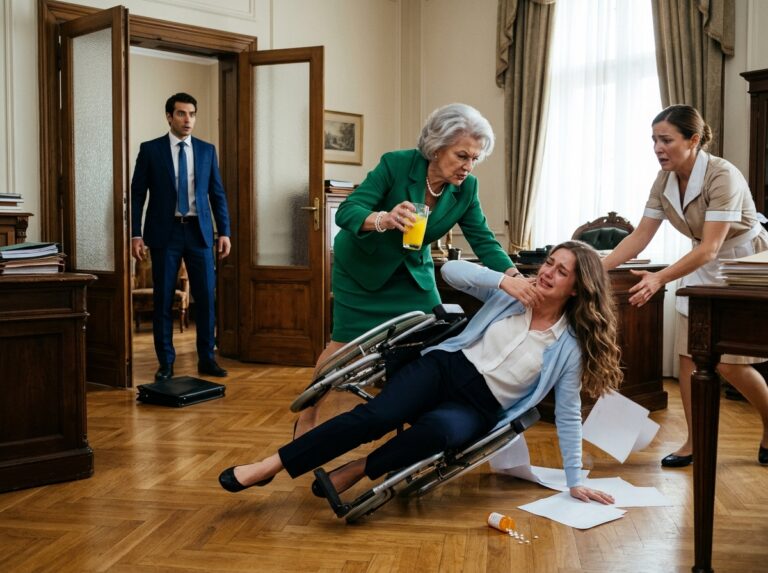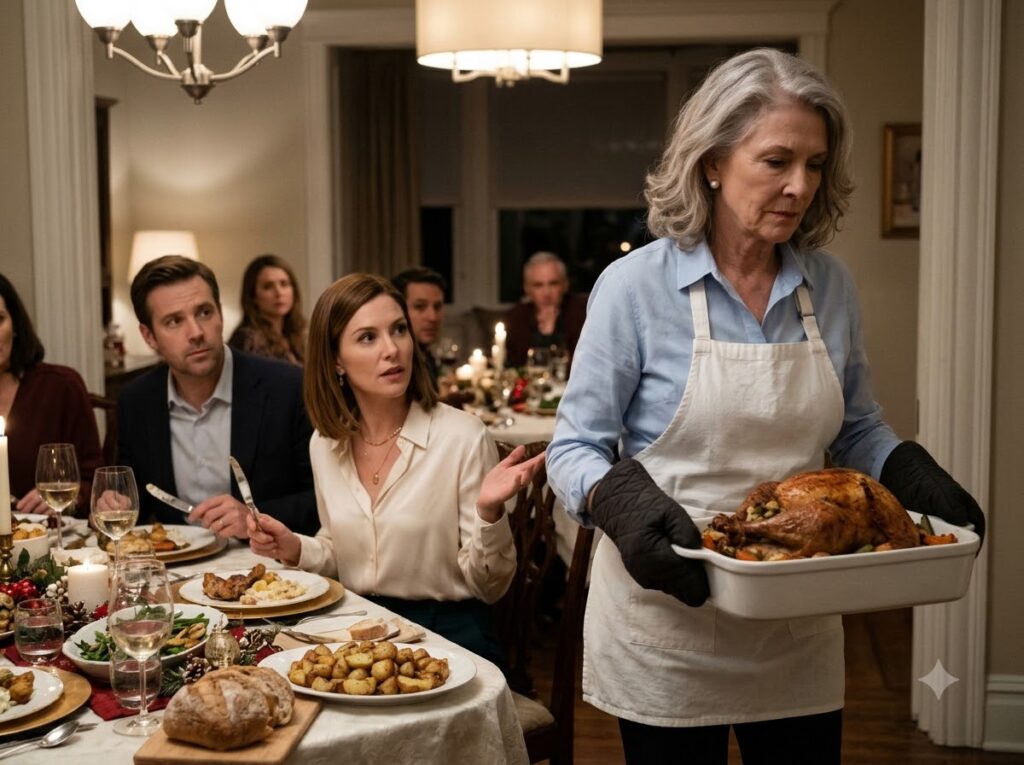
My daughter made me spend eight hours preparing Sunday dinner.
Then, in front of twelve people eating the food I had cooked, she smiled at me and said,
“Mom, why don’t you eat in the kitchen after everyone else is finished?”
Nobody laughed.
Nobody gasped.
Nobody said, Claire, what is wrong with you?
And somehow, that silence hurt more than her words.
For years, I had wondered how a woman disappeared.
That Sunday afternoon, standing beside a dining table covered with my best dishes while my own family refused to meet my eyes, I finally understood.
You disappear one favor at a time.
One surrendered decision.
One swallowed insult.
One moment when everyone in the room decides that keeping the peace matters more than protecting your dignity.
My name is Margaret Bennett.
I was sixty-eight years old, widowed for four years, and until that Sunday I believed I was still the center of a family I had spent nearly five decades holding together.
I was wrong.
The roast in front of Claire had been in my oven since six that morning.
I had rubbed it with garlic, rosemary, salt, cracked pepper, and the little bit of mustard Graham always insisted made the crust better.
Graham had been my husband for forty-three years.
He used to hover behind me whenever I cooked Sunday dinner, stealing carrots from the cutting board and pretending surprise when I smacked his hand with a dish towel.
“Quality control,” he would say.
“Thievery,” I would answer.
Then Claire would come racing into the kitchen, seven years old, pigtails flying, demanding a taste too.
Those memories had kept me cooking long after Graham died.
Maybe that was why I kept doing too much.
Maybe feeding people was the last language of love I still trusted.
That Sunday I had baked two pans of rolls, peeled five pounds of potatoes, made gravy from scratch, glazed carrots, prepared green beans with almonds, and brought a lemon cake because Claire’s husband, Daniel, liked it.
By three o’clock, my lower back was aching.
By four, my fingers had swollen enough that removing my wedding ring hurt.
I said nothing.
Claire had been “busy.”
She was always busy.
She moved around her house in expensive flats, phone in hand, issuing instructions as if life were a board meeting.
“Mom, can you check the potatoes?”
“Mom, Daniel’s brother doesn’t eat onions.”
“Mom, could you polish those glasses? They look cloudy.”
“Mom, could you take the trash out before people arrive?”
It was never cruel enough to challenge.
That was Claire’s gift.
She understood exactly how to make exploitation sound like efficiency.
At six fifteen, everyone sat down.
Everyone except me.
I was pouring gravy when Claire noticed the empty place setting at the far end of the table.
For one hopeful second, I thought she would say, Mom, sit down.
Instead she glanced toward the kitchen.
Then she smiled.
That polished little smile.
The one that made strangers think she was gracious.
“Mom,” she said, raising her voice just enough to reach every corner of the room, “why don’t you eat after everyone’s finished? It’ll be easier if you stay in the kitchen.”
I stared at her.
“What?”
She gave a tiny laugh.
“Someone needs to keep things moving. Coffee, dessert, extra gravy. You know.”
Her husband kept buttering his bread.
My sister-in-law Ruth stared down at her napkin.
Claire’s neighbor Melissa shifted uncomfortably.
Someone’s fork clicked against china.
Claire tilted her head.
“It’s just easier this way.”
Something inside me went perfectly still.
I looked down at my hands.
There was gravy on my thumb.
A tiny burn marked my wrist where I had touched the roasting rack that morning.
My apron smelled like rosemary and butter.
I had spent eight hours making dinner for these people.
And my daughter was asking me to wait in the kitchen like hired help.
No.
Not even hired help.
A hired person would have been paid.
A hired person might have been thanked.
I looked at Daniel.
He avoided my eyes.
Then Ruth.
Nothing.
Then the neighbors.
Nothing.
Finally I looked back at Claire.
For one strange second, I saw her at five years old during a thunderstorm, barefoot in the hallway, crying until I lifted her into my bed.
I remembered brushing tangles from her hair.
Making costumes for school plays.
Sitting beside her hospital bed when she had pneumonia.
Driving through sleet at midnight when she called from college because her boyfriend had abandoned her at a party.
Paying the deposit on her first apartment.
Watching Graham walk her down the aisle.
The little girl I remembered had once wrapped both arms around my neck and whispered, I’ll always take care of you when you’re old, Mommy.
I wondered where she had gone.
“I made this meal for all of you,” I said.
Claire’s smile tightened.
“Yes, Mom. And everybody appreciates it.”
Nobody said they did.
She gestured toward the kitchen.
“Why make a thing out of it?”
That sentence ended something.
Not dramatically.
There was no explosion.
No shattered plate.
No screaming.
Just a quiet internal click.
I untied nothing. Explained nothing. Asked permission for nothing.
I walked into the kitchen.
Claire resumed talking behind me.
“Anyway, Daniel was saying—”
I lifted the roasting pan.
It was heavy.
Hot even through the folded towels around the handles.
Then I carried it through the dining room.
Conversation died instantly.
Claire blinked.
“Mom?”
I kept walking.
“Mom, what are you doing?”
I reached the foyer.
Someone pushed a chair back.
Claire laughed nervously.
“Okay, seriously.”
I put one hand on the door.
Then I looked back at her.
“You said dinner would be easier if I stayed out of the way.”
Claire stared at me.
“So I’m getting out of the way.”
I opened the door.
Daniel finally spoke.
“Margaret, don’t be ridiculous.”
That almost made me laugh.
Not Claire, apologize.
Not Sit down, Margaret.
Not Thank you for cooking.
Just don’t be ridiculous.
I stepped outside.
The evening air was cool against my face.
Behind me, nobody followed.
I waited three seconds.
Maybe five.
Long enough to learn everything I needed to know.
Then I shut the door.
The soft click sounded louder than every laugh that had filled that house.
I drove home with the roast belted into the passenger seat.
That detail still makes me smile.
I had set the pan on two folded towels, pulled the seat belt around it, and fastened it as carefully as if I were transporting a child.
The car smelled like rosemary.
At the first red light, my hands started shaking.
Not from anger.
From the delayed realization that I had actually left.
Margaret Bennett—the woman who apologized when other people bumped into her grocery cart—had walked out of her daughter’s dinner carrying the main course.
For four years after Graham died, I had behaved as though losing my husband meant I had also forfeited the right to inconvenience anyone.
Claire encouraged that.
At first, subtly.
“You shouldn’t drive downtown anymore, Mom.”
“You’re not good with online accounts.”
“Why stress yourself over investments?”
“Just give me the password.”
“Let me handle the taxes.”
“You’re overwhelmed.”
“You forget things.”
The first few times, I argued.
Then I stopped.
Grief makes certainty expensive.
After Graham died, there were mornings when I opened my eyes and needed five seconds to remember why his side of the bed was empty.
I misplaced keys.
Forgot an appointment.
Paid the electric bill twice one month.
Claire noticed everything.
Every mistake became evidence.
Eventually I began asking her questions I could have answered myself.
“What do you think?”
“Should I?”
“Would it be easier if you handled it?”
She always said yes.
By the time I pulled into my driveway that Sunday night, I realized I could not remember the last major decision I had made without consulting my daughter.
That frightened me.
Inside my house, everything was quiet.
Graham’s coat no longer hung beside the door, but sometimes I still expected it to.
I carried the roast into the kitchen.
Then I opened the cabinet above the dishwasher and took down two pieces of blue-flowered china.
I paused.
Put one back.
For years, that small act had hurt.
One plate instead of two.
One glass.
One chair.
That night it felt different.
Not empty.
Deliberate.
I sliced the roast.
Spooned potatoes beside it.
Added carrots.
Poured gravy.
Then I filled one of Graham’s heavy old glasses with iced tea.
I carried everything to the little breakfast table beneath the window.
No one told me I had forgotten the rolls.
No one complained the gravy needed salt.
No one asked me to refill anything.
I took one bite.
Then another.
Halfway through dinner, I realized something astonishing.
I was relaxed.
I ate slowly.
I tasted the food.
I watched darkness gather beyond the kitchen window.
And when I finished, I whispered into the quiet room,
“That was good.”
I wasn’t talking only about the roast.
The folder was still on my side table the next morning.
Brown leather.
Gold clasp.
Claire had brought it over two days earlier.
“Just paperwork,” she had said.
Usually I did not look through paperwork anymore.
Claire managed “the complicated things.”
That was what she called them.
Bills.
Bank forms.
Insurance documents.
Property records.
Passwords.
“Mom, you hate this stuff.”
Maybe I did.
But I had run the bookkeeping for Graham’s contracting company for twenty-two years.
I had reconciled payroll, negotiated vendor disputes, caught billing errors, managed tax records, and once discovered an employee stealing small amounts from fuel reimbursements because seven dollars and forty cents refused to balance.
Somehow, over four years, I had allowed my daughter to convince me I could barely understand a utility statement.
I sat down.
Opened the folder.
The first page was harmless.
A gas account.
The second was not.
My utility service address appeared at the top.
Below it was Claire’s name.
PRIMARY AUTHORIZED ACCOUNT HOLDER.
I frowned.
Turned the page.
A bank authorization form.
Most of it had been completed.
My name.
Date of birth.
Account number.
Claire listed as authorized representative.
The signature line was blank.
The next page contained handwritten notes.
My certificate of deposit amounts.
Estimated investment balances.
Property tax figures.
The value of my home.
I felt a small cold movement in my stomach.
Then I found photocopies of my passport, driver’s license, Social Security card, and the deed to my house.
I did not remember giving Claire copies of all four.
There were more notes.
Mom getting confused.
Possible POA.
Need physician confirmation?
My fingers stopped.
I read that line twice.
Then a third time.
Possible POA. Need physician confirmation?
Power of attorney.
I knew exactly what those letters meant.
Suddenly, Claire’s comments over the previous year sounded different.
You forgot that appointment.
Are you sure you paid this?
You seem tired lately.
Maybe I should talk to your doctor.
Mom, sometimes people don’t realize they need help.
I pushed myself away from the table.
My first instinct was panic.
My second was shame.
Had she already done something?
Had I signed something without understanding it?
Claire had brought papers before.
“Initial there.”
“Sign here.”
“It’s just for the insurance.”
“This lets me speak to them for you.”
How many times had I trusted her?
I turned on my computer.
My password still worked.
My checking account opened.
Balance intact.
Savings.
Intact.
Investment portal.
Intact.
Mortgage.
There was none.
Graham and I had paid the house off eleven years earlier.
I checked the county property record.
Margaret Bennett. Owner.
My breath came out in a rush.
Everything was still mine.
Relief nearly made me laugh.
Then another feeling took its place.
Anger.
Slow.
Clean.
Unlike the wild anger I had imagined other people felt, mine sharpened rather than burned.
Claire had not stolen my life.
Not yet.
She had done something more subtle.
She had convinced me that I was no longer capable of protecting it.
Emma arrived at two twenty that afternoon.
My granddaughter was twenty-six, with Claire’s dark hair and Graham’s habit of pushing her glasses up whenever she was nervous.
She carried two coffees.
“Peace offering,” she said.
“For what?”
She looked at me.
“For being part of a family that made you leave with a roast.”
I almost smiled.
“You weren’t there.”
“I heard.”
Of course she had.
Family news traveled faster than weather alerts.
Emma sat at my kitchen table.
I placed the folder in front of her.
Her face changed instantly.
Not surprise.
Fear.
“You’ve seen this before,” I said.
She looked up.
“Grandma—”
“Emma.”
Her hands closed around the coffee cup.
For several seconds, she said nothing.
Then she whispered,
“Good.”
I stared.
“What?”
Her eyes filled.
“I said good.”
She nodded toward the folder.
“Good that you opened it.”
Something in her voice made my chest tighten.
“What do you know?”
Emma stood abruptly and began pacing.
“Mom’s been talking about you for months.”
“What kind of talking?”
“She says you’re slipping.”
I almost laughed.
Instead I waited.
Emma continued.
“She tells people you repeat yourself. That you forget conversations. That you leave appliances on.”
“I don’t.”
“I know.”
“She told you those things?”
“She tells everyone those things.”
The room seemed to narrow.
“Why?”
Emma stopped pacing.
“I think she wants people used to the idea.”
“What idea?”
“That you can’t manage things anymore.”
There it was.
The sentence I had been afraid to form.
Emma sat beside me.
“A few weeks ago, she asked me if I thought you should stop living alone.”
My mouth went dry.
“What did you say?”
“I said no.”
“And?”
“She got angry.”
Emma looked at the folder.
“Then she asked if I would sign something saying I’d noticed memory problems.”
I stared at her.
“You’re joking.”
“I wish I was.”
“Did you?”
“No.”
She reached for my hand.
“Grandma, I need you to listen to me. Do not sign anything Mom brings you. Nothing.”
A strange calm settled over me.
“What exactly is she planning?”
“I don’t know.”
That answer came too quickly.
“Emma.”
She looked away.
“I really don’t know everything.”
“Everything?”
Her lower lip trembled.
That was when I realized my granddaughter was frightened of her own mother.
I squeezed her hand.
“Tell me what you do know.”
Emma inhaled.
“Mom and Dad have money problems.”
That surprised me.
Daniel earned well.
Claire never seemed worried.
They renovated their kitchen eighteen months earlier.
Bought a new SUV.
Went to Italy.
“What kind?”
“I don’t know how bad. Dad’s business lost a client. There are credit cards. Mom borrowed against something. I heard them fighting.”
“About me?”
Emma’s silence answered.
I stood.
Walked to the telephone.
“What are you doing?”
“Calling my bank.”
“Today?”
“Right now.”
For the first time that afternoon, Emma smiled.
“Good.”
The bank transferred me twice before connecting me to a fraud-prevention specialist named Mr. Alvarez.
I explained that my daughter had been helping with accounts but that I wanted every permission she possessed revoked immediately.
“Every one?” he asked.
“Every one.”
He verified my identity.
Changed security questions.
Removed an authorized verbal access code I did not remember creating.
That discovery turned my hands cold.
“When was that added?”
“Approximately eight months ago.”
“Who added it?”
“I can’t determine that from this screen, Mrs. Bennett.”
“But someone could call pretending to be me?”
“With the correct credentials, someone might have been able to obtain limited information.”
Emma covered her mouth.
I continued.
“Remove it.”
“Yes, ma’am.”
“Add a note that no information is to be released without in-person identification.”
He did.
Then I called Samuel Keene.
Samuel had handled legal work for Graham’s company years ago.
He was seventy-four now and supposedly semi-retired, although Graham used to joke that Samuel would die arguing with a filing deadline.
His secretary recognized my name.
Twenty minutes later, Samuel called me personally.
“Margaret?”
“Sam.”
“What happened?”
I told him.
Not everything.
Just enough.
He went silent.
Then he said something unexpected.
“Come to my office.”
“When?”
“Now.”
His tone changed my mind about waiting.
Emma drove.
Samuel’s office still smelled like leather, old books, and coffee.
He listened without interrupting.
Examined every page in Claire’s folder.
When he reached the handwritten note about physician confirmation, his expression hardened.
“Has Claire asked you to see a doctor recently?”
“She scheduled an appointment for next month.”
“For what?”
“She said a general checkup.”
“With your normal physician?”
I thought.
“No.”
Samuel looked at Emma.
Then back at me.
“Cancel it.”
My stomach dropped.
“Sam, what are you thinking?”
“I’m thinking I don’t like coincidences.”
He opened a legal pad.
“Margaret, I’m going to ask you several questions. Some may feel intrusive.”
“Ask.”
“Have you signed a durable power of attorney naming Claire?”
“I don’t think so.”
“That isn’t good enough.”
He was right.
“I don’t know.”
“Healthcare proxy?”
“Possibly.”
“Joint ownership on accounts?”
“No.”
“Access to your investment logins?”
“She knew some passwords.”
“Property deed?”
“No.”
“Safe-deposit box?”
I froze.
“What?”
“Does Claire have access?”
I had not visited that box since Graham’s funeral.
“I don’t know.”
Samuel leaned back.
Then he exhaled slowly.
“Margaret, we’re going to do three things today.”
He counted them on his fingers.
“First, revoke any power of attorney that may exist and execute a new one naming someone you choose.”
I looked at Emma.
She immediately shook her head.
“Not me.”
That surprised me.
“Why?”
“Because if Mom’s accusing you of being manipulated, giving me control creates another family fight.”
Samuel gave her an approving look.
“Smart.”
He suggested an independent professional fiduciary with Emma listed only as emergency successor.
I agreed.
“Second,” Samuel said, “we amend your estate documents.”
I swallowed.
“Remove Claire?”
“That decision is yours.”
I thought about Sunday dinner.
Then the folder.
Then years of quiet humiliation.
“No,” I said.
Emma looked surprised.
“I don’t want revenge.”
I paused.
“I want protection.”
Samuel nodded.
“Then we structure protection.”
He drafted changes that would prevent anyone from gaining control through claims of incapacity without independent medical review.
He created strict procedures for financial authority.
He documented my wishes.
Then came the third item.
Samuel placed a separate document before me.
“What’s this?”
“Authorization for a forensic review.”
“Of what?”
“Your financial accounts, property records, insurance access history, and any attempted credit activity using your identity.”
My pulse accelerated.
“Do you think that’s necessary?”
He looked directly at me.
“I think you have spent too long assuming your daughter stopped at the line simply because you haven’t found footprints beyond it.”
I signed.
Every page.
Slowly.
Clearly.
With my own pen.
When I finished, Samuel gathered the papers into a red folder.
“Margaret?”
“Yes?”
“Claire is going to know something changed.”
“How soon?”
He glanced at the clock.
“Probably before dinner.”
He was right.
My phone began ringing at 5:47.
Claire.
I let it ring.
A message appeared.
MOM, WHAT DID YOU DO?
Thirty seconds later:
Answer me right now.
Then:
Did you call the bank?
Then:
You are making a huge mistake.
Emma stared at the screen.
“How does she know that fast?”
I looked at Samuel.
His expression told me he had the same question.
I did not reply.
By eight o’clock, Claire had called fourteen times.
Daniel called twice.
Ruth sent:
Everything okay? Claire seems upset.
I did not answer that either.
At ten fifteen, another message arrived.
You are confused and letting people manipulate you. We need to talk tomorrow.
I read it twice.
There was that word.
Confused.
Not angry.
Not impulsive.
Not unfair.
Confused.
As though she had been practicing it.
I slept badly.
At eight twelve the next morning, someone began pounding on my front door.
Not knocking.
Pounding.
I looked through the peephole.
Claire.
Her hair was pulled into a severe ponytail.
No polished smile.
I opened the door but kept one hand on the frame.
“What?”
She pushed past me.
“You contacted the bank behind my back?”
“Good morning to you too.”
“Do you have any idea what you’ve done?”
“I protected my accounts.”
“From your own daughter?”
“Yes.”
She stared at me as though I had slapped her.
Then came the laugh.
Short.
Disbelieving.
“You’re being ridiculous.”
That word again.
Something about it strengthened me.
I folded my arms.
“Leave.”
“What?”
“You came into my house without permission and started shouting. Leave.”
Claire’s face went pale.
“You don’t understand.”
“Then explain.”
She paced into the living room.
“For four years I have handled everything for you.”
“I never asked you to take over my life.”
“You absolutely did.”
“I asked for help.”
“You needed more than help!”
Her voice echoed against the walls.
“You forget things! You panic over paperwork! Half the time you don’t understand what you’re signing!”
I felt something cold pass through me.
“What exactly have I signed?”
Claire stopped.
A fraction of a second.
But I saw it.
Fear.
Then she recovered.
“That’s not the point.”
“It’s exactly the point.”
She stepped closer.
“Who have you been talking to?”
“My attorney.”
Her eyes widened.
“Samuel?”
Interesting.
I had never said his name.
“You know Samuel?”
“Dad used him.”
“That doesn’t answer my question.”
Claire turned away.
For the first time, she looked genuinely rattled.
I let the silence work.
Finally she said,
“If you keep this up, I’ll make sure everyone knows you’re destroying this family.”
I almost pitied her.
She still believed reputation was the leash around my neck.
Four years earlier, it might have worked.
I would have imagined cousins whispering.
Church friends judging.
Neighbors staring.
I would have surrendered to avoid embarrassment.
Not anymore.
“You do that.”
She faced me sharply.
“What?”
“Tell everyone.”
I opened the front door.
“Tell them I changed my passwords.”
“Mom—”
“Tell them I hired a lawyer.”
Her jaw tightened.
“Tell them I decided my own money belongs to me.”
She did not move.
I smiled.
Not sweetly.
Not cruelly.
Just calmly.
“And while you’re telling them, Claire, ask yourself why any of that frightens you.”
For the first time in my life, my daughter had no answer.
She walked out.
I shut the door.
Then I looked toward the side table.
Beneath a stack of mail sat the red folder containing the papers I had signed.
Claire had no idea what was inside.
Neither, as it turned out, did I.
Not completely.
Samuel called two days later.
“Can you come in?”
My stomach dropped.
“You found something.”
“Yes.”
“How bad?”
“I’d rather explain in person.”
Emma drove me again.
When we entered Samuel’s conference room, another man was waiting.
Mid-fifties.
Gray suit.
Laptop open.
Samuel introduced him as Peter Shaw, a forensic accountant.
Peter did not waste time.
“Mrs. Bennett, someone has been gathering the information necessary to establish financial control over you.”
My mouth went dry.
“How?”
He turned the laptop.
A timeline filled the screen.
Eight months earlier: bank verbal authorization added.
Seven months: utility billing authority changed.
Six months: copy of property record ordered.
Five months: inquiry with long-term-care facility.
Four months: online request for home valuation.
Three months: attempted credit-monitoring enrollment.
Six weeks: inquiry with an elder-law practice.
I stared.
“Elder law?”
Samuel nodded.
“Someone contacted a firm asking what evidence would be needed to obtain guardianship over an aging parent who resisted assistance.”
Emma whispered,
“Oh my God.”
I could barely breathe.
“Can you prove it was Claire?”
Peter hesitated.
“Not yet.”
Then he clicked another file.
“We found something else.”
An email address.
I recognized Daniel’s company domain.
Emma went white.
“Dad.”
The email itself had not been recovered, but metadata connected Daniel’s office network to one inquiry.
My mind flashed back to Sunday dinner.
Daniel buttering bread while Claire told me to eat in the kitchen.
His silence had not been cowardice.
Maybe it had been complicity.
Peter continued.
“There’s more.”
Of course there was.
A credit inquiry had been attempted against my identity.
It failed.
“Why?”
“You froze your credit years ago.”
I blinked.
“I did?”
Samuel looked strangely emotional.
“Graham did.”
The room became very still.
“What?”
“After his identity was compromised in that contractor breach.”
I remembered.
Seven years earlier.
Graham had spent weeks dealing with fraudulent credit cards.
He had insisted we freeze both files.
I had forgotten completely.
Peter nodded.
“That freeze prevented anyone from opening a line of credit under your name.”
My knees weakened.
“How much?”
“We can’t know what they intended.”
He closed one window.
“But we found a draft home-equity application in cached data from an account linked to your email.”
“I don’t have a mortgage.”
“No.”
“How much?”
Peter looked at Samuel.
Then me.
“Four hundred and fifty thousand dollars.”
Emma made a choking sound.
I felt nothing.
That scared me more than anger would have.
“Using my house?”
“Yes.”
“Without telling me?”
“It appears someone was preparing the documentation.”
I stared at the table.
Forty-three years.
That house had been where Graham and I raised Claire.
Where he built bookshelves crooked the first time and rebuilt them because I teased him.
Where Claire took her first steps.
Where Graham died in the downstairs bedroom because he had wanted to hear rain against our own windows.
Four hundred and fifty thousand dollars.
To Claire, perhaps it was equity.
To me, it was the physical shape of my life.
“Why?” I asked.
Peter closed the laptop.
“We believe Daniel’s business may be in significantly worse financial condition than anyone knows.”
Emma covered her face.
Samuel spoke gently.
“There are tax liens.”
“How much?”
“Over three hundred thousand.”
My chest hurt.
“There’s also a lawsuit.”
“For what?”
“Misrepresentation involving a commercial contract.”
Emma stood suddenly.
“I need air.”
She left.
I remained seated.
There was a strange buzzing inside my ears.
Samuel touched my hand.
“Margaret.”
I looked at him.
“Did Graham know?”
The question surprised both of us.
“Know what?”
“That Claire could do something like this.”
Samuel did not answer immediately.
That was when I knew.
“Sam.”
He leaned back.
“There’s something I’ve debated telling you.”
“Tell me.”
“Not yet.”
I nearly shouted.
“Everyone has spent four years deciding what I should know!”
His expression softened.
“You’re right.”
He stood.
Walked to a locked cabinet.
Opened it.
Inside were several document boxes.
He removed one.
My name was written across the front.
MARGARET BENNETT — PERSONAL
My heart began pounding.
“What is that?”
“Something Graham left with me.”
Samuel did not open the box.
Instead, he returned it to the cabinet.
“Not today.”
I stared at him in disbelief.
“You just said—”
“I said I would stop deciding what you should know. I mean that.”
“Then open it.”
“There’s a condition.”
Of course there was.
Graham loved conditions.
He could turn taking out the trash into a five-step engineering problem.
“What condition?”
Samuel folded his hands.
“He instructed me to give you the contents if one of two things happened.”
I waited.
“You asked for them.”
“That’s one.”
“Or someone attempted to remove your control over your own affairs.”
A chill moved down my arms.
“When did he do this?”
“Three months before he died.”
I could not speak.
Samuel continued.
“He came here alone.”
“Why didn’t he tell me?”
“I asked him that.”
“And?”
Samuel looked toward the cabinet.
“He said you had enough grief coming.”
My eyes burned.
“That sounds like him.”
“There’s another issue.”
“What?”
“One item in that box is a sealed blue envelope addressed to Claire.”
I stared.
“What does it say?”
“I don’t know.”
“You didn’t read it?”
“No.”
“Did Graham tell you?”
“Only that if Claire ever tried to take control of your life, she was to receive the envelope after you had read everything else.”
My skin prickled.
Emma came back into the room just in time to hear the last sentence.
Her face changed.
“Grandpa knew?”
Nobody answered.
Samuel finally asked,
“Margaret, do you want the box?”
“Yes.”
“Are you certain?”
I almost laughed.
“For four years, everyone has asked whether I’m certain about every decision I make.”
I stood.
“Give me my husband’s box.”
Samuel did.
It weighed less than I expected.
But on the drive home, it felt heavier than the roast.
I did not open it immediately.
That surprised Emma.
She sat across from me at the kitchen table.
“You’re not curious?”
“I’m terrified.”
“Of Grandpa?”
“No.”
I touched the lid.
“Of finding out he saw something I refused to see.”
Emma reached across the table.
“You don’t have to do it alone.”
I looked at her.
That was when I realized something else.
Emma had been carrying fear for months too.
“When did your mother ask you to sign the statement?”
“Five weeks ago.”
“Why didn’t you tell me?”
“She said if I interfered, I’d destroy the family.”
I closed my eyes.
Same threat.
Different generation.
Claire had built an entire family structure around silence.
I opened the box.
The first thing inside was Graham’s handwriting.
Maggie,
Nobody had called me Maggie since he died.
I stopped breathing for a second.
Emma squeezed my hand.
I continued.
The letter was six pages long.
Graham wrote about ordinary things first.
How he loved me.
How angry he was about dying.
How scared he was that I would become lonely.
Then halfway down page three, his tone changed.
There is something I never told you because I hoped I was wrong.
My heart hammered.
Claire has started asking questions about what happens to the company accounts, the house, and the investment portfolio after I’m gone.
I swallowed.
Questions are not a crime. But the way she asks them worries me.
Below that:
Last month, while you were getting coffee, she asked whether I thought you could “handle everything” after I died.
My eyes filled.
Emma whispered, “Keep going.”
I told her you had handled more of our finances than she ever understood.
A laugh escaped me through tears.
She said, “Mom isn’t who she used to be.”
The letter blurred.
That sentence had begun before Graham died.
Not after.
He wrote that Claire had also asked Samuel about wills.
Asked whether a child could intervene if an elderly parent made “bad decisions.”
Asked how incapacity was determined.
Graham noticed.
Graham worried.
Graham prepared.
Then came the paragraph that changed everything.
I have not changed what belongs to you, Maggie. Everything we built together remains yours to control for the rest of your life. But I have changed what happens after you.
I looked at Samuel’s attached documents.
A trust agreement.
Amendment dated four years and three months earlier.
I read slowly.
Then again.
Emma leaned closer.
“What does it mean?”
“I’m not sure.”
We called Samuel.
He came to the house.
When he arrived, he explained.
Graham had placed his half of several investment assets and proceeds from the sale of his contracting business into an irrevocable family trust.
I had known the trust existed.
I had not understood its structure.
The income was mine for life.
After my death, I had assumed the remainder passed equally to Claire and Emma.
That had once been true.
Graham changed it.
“Why?” I asked.
Samuel looked at the letter.
“Because of the questions Claire was asking.”
“What did he change?”
Samuel turned the document toward me.
“If Claire behaved normally, nothing changed. She remained a beneficiary.”
I frowned.
“And if she didn’t?”
“There’s a protective provision.”
“What kind?”
“If she attempted through fraud, coercion, undue influence, fabricated incapacity, or unauthorized financial access to gain control over you or trust assets…”
He paused.
“Her interest terminates.”
Emma stared.
“What happens to it?”
“It goes to the next beneficiary.”
Emma went completely still.
“No.”
Samuel nodded.
“You.”
She pushed away from the table.
“No. Absolutely not. I don’t want it.”
“It’s not your decision today.”
“How much?”
I asked the question quietly.
Samuel told me.
The room disappeared.
Three million, eight hundred and forty thousand dollars.
Emma actually stood up.
“What?”
I stared at Graham’s letter.
Claire had been trying to gain control over my house for four hundred and fifty thousand dollars.
All this time, nearly four million dollars sat in a trust she expected to inherit eventually.
And if Graham’s clause applied, her attempt to control me could cost her every penny.
I should have felt satisfaction.
Instead I felt sick.
“Did she know?”
Samuel shook his head.
“She knew there was a trust. She did not know the exact value or protective language.”
Emma whispered,
“Grandpa set a trap.”
“No,” I said.
I looked at Graham’s handwriting.
“He built a fence.”
Samuel nodded.
“That’s exactly what he told me.”
My heart stopped.
“What?”
“When he signed it, I told him the provision was unusually strict.”
Samuel smiled sadly.
“He said, ‘I’m not setting a trap for my daughter. I’m building a fence around my wife. Claire only hits it if she decides to climb over.’”
I cried then.
Harder than I had cried since Graham’s funeral.
Claire escalated quickly.
Three days later, Ruth called me.
“Margaret, I think you should know what she’s saying.”
“Claire?”
“She called everyone.”
“What did she say?”
“That you’re having some sort of episode.”
I laughed.
Ruth did not.
“She says Emma and some lawyer are manipulating you.”
“Of course she does.”
“She wants us to sign a letter.”
My grip tightened around the phone.
“What letter?”
“Saying we’ve noticed cognitive changes.”
There it was.
The family was not merely being prepared.
They were being recruited.
“Did you sign?”
“No.”
“Why?”
Ruth went quiet.
Then said,
“Because of Sunday.”
I waited.
“I should have said something.”
“Yes.”
“I was embarrassed.”
“So was I.”
“That’s not what I mean. I was embarrassed by Claire.”
Ruth began crying.
“She spoke to you like you weren’t a person and I stared at my napkin because I didn’t want a scene.”
I closed my eyes.
“I’m sorry.”
I believed her.
But forgiveness and trust are different things.
“Send Samuel the letter.”
She did.
It was worse than expected.
The document claimed several relatives had observed memory impairment, confusion, declining judgment, and “increasing vulnerability to outside influence.”
Outside influence.
Meaning Emma.
Meaning Samuel.
Meaning anyone who threatened Claire’s control.
At the bottom were eight signature lines.
Mine was not among them.
My daughter was building a case against me.
That afternoon, Samuel filed formal notices revoking any prior authorizations and sent preservation letters to relevant institutions.
Peter continued digging.
Two days later he found the appointment Claire had scheduled with the unfamiliar physician.
The doctor specialized in geriatric cognitive assessment.
Claire had described me as:
“Increasingly paranoid about finances.”
The appointment had been made before Sunday dinner.
Before I changed passwords.
Before I hired Samuel.
Before any supposed “paranoia.”
That detail mattered.
It showed the story had been written before my behavior could justify it.
Daniel’s financial trouble also deepened.
His company was near collapse.
Their home had a second mortgage.
Two credit cards were past due.
Claire’s new SUV was leased.
The Italy trip had been charged.
The beautiful life I had watched from the outside was a stage set.
And behind it was panic.
Still, I struggled with one question.
Why didn’t Claire simply ask me for money?
I would have helped.
That was the tragedy.
Before Sunday, she could have said, Mom, we’re in trouble.
I might have written a check.
Maybe even a large one.
But asking would have required admitting weakness.
Claire did not want help.
She wanted control.
A week later, she demanded a family meeting.
I almost refused.
Samuel surprised me.
“Go.”
“Why?”
“Because people reveal themselves when they believe they still control the room.”
We met at Claire’s house.
The same dining room.
The same chandelier.
The same table.
But this time, I brought nothing.
No roast.
No potatoes.
No apron.
I wore navy trousers, a cream sweater, and Graham’s old watch.
Claire had invited Ruth, Daniel’s brother, two cousins, Emma, and three neighbors who had known us for years.
A lawyer sat beside Daniel.
Not Samuel.
Claire’s.
That told me everything.
She began gently.
“Mom, we all love you.”
I nearly laughed.
“We’re worried.”
I looked around.
Some people appeared ashamed.
Others confused.
Claire folded her hands.
“The last week has been alarming.”
Emma shifted beside me.
Claire continued.
“You’ve abruptly cut off people who have helped you for years.”
“One person.”
“You hired attorneys.”
“An attorney.”
“You accused your own family of stealing.”
“No.”
Claire faltered.
I smiled.
“I accused nobody.”
Daniel interrupted.
“You froze accounts.”
“My accounts.”
“Margaret, you’re proving the point.”
“What point?”
“That you’re reacting emotionally.”
I looked at him.
“The man whose company is facing tax liens wants to lecture me about financial judgment?”
Silence detonated across the room.
Daniel’s face drained.
Claire stood.
“How dare you!”
Samuel had warned me not to reveal everything.
Only what Peter could document.
I remained seated.
“Sit down.”
Claire actually obeyed.
Maybe because my voice sounded unfamiliar.
Calm.
“Your company owes more than three hundred thousand dollars in taxes,” I said to Daniel. “You’re being sued. Your house has two mortgages. And someone connected to your office network researched guardianship over me.”
Daniel turned toward Claire.
That movement was tiny.
But I saw it.
So did Emma.
Claire said, “That proves nothing.”
“No.”
I nodded.
“That part doesn’t.”
I removed a copy of the home-equity draft.
“This interests me more.”
Daniel stared at it.
Claire didn’t.
Another tiny detail.
She already knew what it was.
Ruth whispered,
“What is that?”
“A preliminary application to borrow four hundred and fifty thousand dollars against my house.”
Gasps moved around the table.
Claire’s lawyer leaned toward her.
She ignored him.
“Mom, we never submitted that.”
My blood turned cold.
I had never said it was unsubmitted.
Samuel, sitting quietly at my other side, looked up.
Claire realized too late.
Emma whispered,
“Mom…”
Claire closed her eyes.
Daniel cursed under his breath.
I leaned back.
“Thank you.”
“For what?” Claire snapped.
“For confirming you knew about it.”
Her lawyer stood.
“I think this meeting should end.”
“No,” Claire said.
He repeated more firmly,
“Claire.”
She ignored him.
Years of control were collapsing, and she could not tolerate losing the audience.
“You want everyone to think I’m some monster?”
Her voice cracked.
“I have spent years taking care of you!”
“You spent years teaching me to doubt myself.”
“Because you needed help!”
“You scheduled me for a cognitive examination without telling me why.”
Several heads turned.
Claire’s face twisted.
“You forgot things!”
“So do you.”
“That’s different.”
“Why?”
“Because you’re nearly seventy!”
The cruelty finally came without polish.
No smile.
No sweetness.
Just contempt.
I looked at the people around the table.
“Do you hear her now?”
Nobody looked away.
Claire was breathing hard.
“I sacrificed for you.”
“What did you sacrifice?”
“My time!”
“You mean the hours you spent trying to access my money?”
“That is not fair!”
“Then explain the guardianship questions.”
Silence.
Daniel stood.
“I’m leaving.”
Claire wheeled toward him.
“Sit down.”
“No.”
“You are not leaving me alone in this.”
His face changed.
And suddenly I understood there were fractures inside their marriage too.
Daniel looked at me.
“I told her not to do the doctor thing.”
Claire went white.
Emma whispered,
“Dad.”
He continued.
“I told her this went too far.”
Claire slapped the table.
“You were fine with the loan!”
There it was.
The room erupted.
“What loan?”
“Jesus Christ.”
“Claire!”
Her lawyer packed his papers.
Daniel shouted,
“Because you told me Margaret agreed!”
Claire shouted back,
“She would have!”
The sentence hung in the air.
I stood.
“No.”
Everyone went quiet.
“You never asked.”
Claire looked at me.
“And that is the entire difference between help and theft.”
What followed was ugly.
Truth usually is when it has been kept buried too long.
Daniel claimed Claire told him I had agreed to provide collateral once my “paperwork was organized.”
Claire claimed Daniel pressured her because his business was collapsing.
Emails proved both had participated.
Neither was innocent.
The home-equity application had not been submitted because they still needed information and signatures.
But the guardianship preparation was real.
So was the plan to build a record of incapacity.
Then Peter found the part that broke my heart.
The Sunday dinner had not been ordinary.
Claire had invited those particular neighbors and relatives intentionally.
One email to Daniel read:
Sunday gives people another chance to see how much Mom struggles. Don’t correct her unless necessary.
Another said:
If she gets overwhelmed, even better.
I stared at those words for a long time.
My daughter had expected me to fail publicly.
The dinner I spent eight hours preparing was supposed to become evidence against me.
Then suddenly the kitchen insult made sense in a new, terrible way.
Perhaps Claire had hoped I would cry.
Shout.
Become confused.
Create a scene.
Instead, I took the roast and left.
I laughed when Samuel explained that.
Not because it was funny.
Because sometimes reality becomes too cruel for any other sound.
“She wanted evidence that I couldn’t manage myself.”
Samuel nodded.
“And I managed to transport a fourteen-pound roast home without spilling the gravy.”
Emma laughed first.
Then I did.
We laughed until both of us cried.
Two weeks later, Claire received formal notice from the trust attorney.
Not yet termination.
An investigation.
The protective clause required documented findings.
Samuel wanted everything careful.
Claire called me thirty-one times that day.
I answered the thirty-second.
“What?”
Her breathing was ragged.
“What did Dad do?”
I closed my eyes.
So she knew.
“You’ll need to be more specific.”
“The trust.”
I said nothing.
“He changed it.”
Still nothing.
“Mom!”
“What do you want from me?”
“You knew?”
“No.”
“I don’t believe you.”
“That’s become a problem for you, Claire. You’ve spent so many years assuming I’m incompetent that you can’t understand how I can know something you don’t.”
She began crying.
Real crying this time.
Not polished.
Not controlled.
“Dad wouldn’t do this.”
“He did.”
“He loved me.”
“Yes.”
“How can you say that?”
“Because protecting me did not mean he stopped loving you.”
She was silent.
Then came the sentence I had expected.
“It’s Emma, isn’t it?”
“What?”
“You’re giving everything to Emma.”
“No.”
“She turned you against me.”
I laughed softly.
“You truly cannot imagine a world in which my decisions belong to me.”
“Mom—”
“Goodbye, Claire.”
“Wait.”
I paused.
Her voice changed.
Smaller.
“What’s in the blue envelope?”
I looked toward the locked drawer in my desk.
Samuel had given it to me the previous afternoon.
I had not opened it.
“It’s addressed to you.”
“Then give it to me.”
“Not yet.”
“Why?”
“Because your father instructed me to read everything else first.”
Claire inhaled sharply.
“Mom, please.”
It was the first time she had said please in weeks.
“Please don’t open it.”
That surprised me.
“Why?”
She said nothing.
And in that silence, I realized something.
Claire knew more about the envelope than she had admitted.
I called Samuel.
Then Emma.
We met at my house that evening.
The blue envelope lay in the middle of the kitchen table.
Graham’s handwriting crossed the front.
CLAIRE
The seal was still intact.
I stared at it.
Emma whispered,
“Why would Mom be scared of a letter?”
Samuel looked troubled.
“I don’t know.”
“Did Grandpa tell her about it?”
“He wasn’t supposed to.”
That wording caught me.
“Wasn’t supposed to?”
Samuel frowned.
“Only I knew.”
A thought moved through me.
“Unless Claire saw him here.”
Samuel became very still.
“What?”
“Did she ever come to your office around that time?”
He thought.
Then his eyes narrowed.
“Yes.”
“When?”
“About a week after Graham signed the amendment.”
“Why?”
“She said he had left his reading glasses.”
“Had he?”
“No.”
My stomach dropped.
Emma whispered,
“She was looking for something.”
Samuel stood abruptly.
“I need to check an old file.”
He returned to his office.
An hour later he called.
Security footage no longer existed.
Too old.
But an archived reception log did.
Claire had visited twice.
Not once.
The second visit happened while Samuel was in court.
She told the receptionist she needed copies of documents for Graham.
The receptionist refused.
But Claire had been left alone near the conference room for almost seven minutes.
Seven minutes.
Long enough to see a blue envelope.
Maybe long enough to read something else.
But not enough to take it without being noticed.
That night I placed the envelope in front of me.
Emma said,
“You don’t have to open it.”
“Yes.”
I touched the seal.
“I do.”
I slid my finger beneath the flap.
Inside were four pages.
The first began:
Claire, if you are reading this, then you did exactly what I begged myself to believe you never would.
I stopped.
Emma covered her mouth.
Samuel looked away.
I continued.
Graham wrote that he knew Claire had visited Samuel’s office.
He knew because the receptionist mentioned it later.
He confronted Claire privately.
She denied looking at anything.
Then Graham did something I never expected.
He tested her.
He told Claire that after his death, I would control everything, but that if I became unable to manage things, Claire would likely receive authority over the family assets.
That statement was false.
He wanted to see what she did.
In the weeks after, Claire began asking more questions about incapacity.
More about powers of attorney.
More about my medical history.
Graham wrote:
That was when I knew my fear was not imaginary.
Tears slid down my face.
But the next page contained the true shock.
Graham had confronted her again.
This time, Claire admitted it.
Not all of it.
But enough.
She told him:
Mom has never been strong with this stuff.
When you’re gone, somebody will have to take over.
It should be me.
According to Graham, he replied:
“Helping your mother is not the same as owning her.”
Claire became furious.
Then she said something Graham never told me while he was alive.
Something he carried alone into his final months.
She told him:
“If Mom controls everything after you die, she’ll waste years sitting on money that should already be helping the family.”
I lowered the pages.
Emma was crying.
Samuel whispered,
“Margaret…”
I forced myself to continue.
The final page was shorter.
Graham told Claire that he loved her.
That nothing could erase the fact she was his daughter.
But love did not require blindness.
He wrote:
If your mother chooses to help you, accept it with gratitude. If she says no, respect it. If she becomes sick, care for her. If she becomes lonely, sit with her. If she becomes afraid, hold her hand.
Then:
But if you ever try to make her feel small enough that you can take what belongs to her, you will lose what I intended to leave you. Not because money matters more than family, but because anyone willing to destroy family for money should not be rewarded with more of it.
I thought that was the end.
It wasn’t.
There was one final paragraph.
And when I read it, I understood why Claire had begged me not to open the envelope.
One more thing, Claire. Your mother does not know that you asked me for three hundred thousand dollars six months before I died. She does not know you told me Daniel’s business was already in trouble. She does not know I gave you the money.
My hands began trembling.
Three hundred thousand dollars.
Four years earlier.
Before Daniel supposedly had financial trouble.
Before the tax liens.
Before the guardianship scheme.
Graham continued:
I gave it to you because you promised me it would save the business and because you begged me not to worry your mother while I was dying. You also promised it would be the last time.
Emma whispered,
“No…”
The final line felt like my husband speaking directly into the kitchen.
If you are reading this because you came after your mother’s home too, then the three hundred thousand dollars did not save you. It only taught you that taking from us was easier than changing yourself.
I set the letter down.
Nobody spoke.
For four years, I had wondered whether Graham died peacefully.
Now I knew he died worried about me.
And somehow, beneath the grief, I felt something else.
Protected.
He had been gone four years.
Yet he had still found a way to stand beside me.
The three-hundred-thousand-dollar transfer changed everything.
Peter traced it.
Daniel’s business had been failing far longer than anyone knew.
Much of Graham’s money had not gone to business expenses.
Almost ninety thousand paid personal credit-card balances.
Forty thousand funded home renovations.
Nearly thirty thousand went toward vehicles.
There were vacations.
Private school tuition.
Luxury purchases.
And one transfer that made Emma sit down hard when she saw it.
Fifty thousand dollars into an account solely in Claire’s name.
Claire had not merely been rescuing Daniel.
She had been building security for herself.
Samuel’s trust investigation concluded two months later.
The evidence was overwhelming.
The attempted unauthorized access.
The false incapacity narrative.
The physician appointment.
The guardianship inquiries.
The home-equity preparation.
The family witness letter.
And Graham’s contemporaneous documentation showing the same pattern had begun before his death.
Claire’s beneficial interest under Graham’s trust was terminated.
Three million, eight hundred and forty thousand dollars shifted under the trust terms.
Not to me.
It was already mine to use during my lifetime.
The remainder beneficiary became Emma.
Emma cried when Samuel told her.
“I don’t want money that comes from this.”
I understood.
“Then don’t think of it as coming from this.”
“How else can I think about it?”
“As coming from your grandfather.”
She looked at me.
“He trusted you to do something better with it.”
“What?”
“That part is yours to decide.”
Emma eventually decided.
But not for years.
Claire and Daniel separated six months later.
I did not celebrate.
Their marriage had been damaged long before I understood it.
Daniel cooperated with investigators during the financial dispute and admitted his role.
No forged loan had actually been funded, which prevented the situation from becoming even worse legally, but their attorney fees and existing debts nearly destroyed them.
Daniel sold his business assets.
They sold the renovated house.
The SUV disappeared.
Italy existed only in photographs.
For the first time in her adult life, Claire lived in a rented two-bedroom apartment.
People expected that would satisfy me.
It didn’t.
Watching your child fall is not satisfying, even when she built the staircase herself.
Claire and I did not speak for almost nine months.
Then one rainy Thursday she appeared at my door.
No makeup.
No expensive coat.
No polished smile.
She looked older.
I did not invite her in immediately.
“What do you want?”
“To talk.”
“About money?”
Her face flinched.
“No.”
“Then talk.”
She looked at the porch floor.
“I’m sorry.”
Two words.
I had imagined them many times.
They sounded smaller in reality.
“For what?”
Her eyes lifted.
“Everything.”
“That isn’t an answer.”
She began crying.
“I don’t know where to start.”
“Start with Sunday dinner.”
Claire closed her eyes.
“I wanted you to react.”
I already knew.
But hearing her admit it hurt differently.
“Why?”
“I wanted people to see you as unstable.”
There it was.
Clean.
Ugly.
True.
“You spent eight hours cooking.”
“Yes.”
“And I used it.”
“Yes.”
“I’m sorry.”
I nodded.
“Continue.”
She told me about the debts.
Her fear.
The first money Graham gave her.
How easy it became to justify the second lie after surviving the first.
How every year she and Daniel looked wealthier while becoming poorer.
How she began seeing my paid-off house not as my home but as a solution.
“At some point,” she whispered, “I stopped thinking of your money as yours.”
“That was obvious.”
She wiped her face.
“I told myself it would be mine eventually.”
“That sentence nearly cost you your mother.”
“I know.”
“No.”
I shook my head.
“You lost money. You lost your house. You lost your marriage. Those are consequences.”
I pressed my hand against my chest.
“But this is what you nearly lost.”
Claire sobbed.
I wanted to hold her.
Every part of me that had once rocked her through fevers wanted to reach forward.
I did not.
Not yet.
Love can survive betrayal.
Trust requires different work.
“I don’t know if you’ll ever forgive me,” she whispered.
“I already have.”
Her head snapped up.
She stared.
“Then…”
“Forgiveness is not permission to come back into my life exactly as you were.”
Her face crumpled.
I continued.
“I will not hate you. I will not spend my remaining years poisoning myself with anger.”
I opened the door wider.
“But if you want a relationship with me, you build a new one.”
“How?”
“One truthful day at a time.”
She nodded.
Then she stepped inside.
Not as the woman who managed me.
Not as the daughter who controlled everything.
Just Claire.
For the first time in years, she asked before sitting down.
A year after the Sunday dinner, I hosted dinner at my house.
Not twelve people.
Six.
Emma.
Ruth.
Samuel, who complained that I had overcooked the carrots and then ate three servings.
Claire came too.
She arrived early.
Carrying flowers.
“Where do you want these?”
I almost laughed.
“In water.”
She smiled nervously.
Then she stopped near the kitchen.
“Can I help?”
Not I’ll handle it.
Not Move, Mom.
Not You’re doing that wrong.
Can I help?
“Yes.”
I handed her the potatoes.
We worked beside each other quietly.
At one point she reached toward the roast.
Then stopped.
“Do you want me to take it out?”
“Not yet.”
She nodded.
No argument.
When dinner was ready, Claire began carrying plates into the dining room.
I untied my apron.
She froze.
“Mom.”
“What?”
Her eyes filled.
“Sit down.”
I looked at her.
She pulled out the chair at the head of the table.
“Please.”
I sat.
Claire served the roast.
Emma watched from across the table, smiling.
Ruth raised her glass.
“To Margaret.”
I shook my head.
“No speeches.”
Samuel lifted his glass anyway.
“To the woman who saved her estate with a roast.”
Everyone laughed.
Even Claire.
Especially Claire.
For the first time, the laughter did not feel like something happening around me.
It included me.
Two years later, Emma asked to meet me at Samuel’s office.
She had made a decision about Graham’s trust.
“What decision?”
“I want to change what happens eventually.”
“You can’t alter everything.”
“I know.”
She had spoken with Samuel about her future inheritance.
She wanted a portion, when the time came, directed into a foundation supporting older adults facing financial exploitation by family members.
I stared at her.
“How much?”
“Half.”
My mouth dropped open.
“Emma.”
“I don’t need four million dollars.”
“You don’t have it yet.”
She smiled.
“You know what I mean.”
I thought of Graham.
His fence.
His blue envelope.
The ugly way money had nearly destroyed three generations.
“What will you call it?”
Emma slid a paper across the desk.
At the top was a proposed name.
THE GRAHAM AND MARGARET BENNETT FAMILY DIGNITY FUND
I began crying before I reached the last word.
“No,” I said.
Emma’s face fell.
“You don’t like it?”
“I love it.”
“Then why no?”
I picked up a pen.
“Take my name off.”
“What?”
“Put Claire’s on it too.”
Emma stared.
“Grandma…”
“Your mother did something terrible.”
“Yes.”
“She also did something most people refuse to do.”
“What?”
“She admitted it.”
I thought of Claire working now at a small accounting office.
Paying debts.
Going to counseling.
Living more quietly.
Calling me every Wednesday.
Asking rather than assuming.
Never touching my finances.
Never once telling me what I was too old to understand.
“She is doing the work,” I said.
Emma looked toward Samuel.
He stayed wisely silent.
Finally Emma nodded.
“What name?”
I smiled.
THE BENNETT FAMILY DIGNITY FUND.
Because families are not only the worst thing they have done.
Sometimes they are what happens after someone finally says:
Enough.
I am seventy-two now.
I still live in my house.
Still drive.
Still manage my accounts.
I have forgotten appointments.
I once left milk in a cabinet and cereal in the refrigerator.
Emma laughed so hard she had to sit down.
I laughed too.
Because forgetting something does not erase your adulthood.
Aging does not cancel ownership.
Needing help does not mean surrendering authority.
And love—real love—does not require becoming smaller so someone else can feel powerful.
The roast pan from that Sunday still sits in my kitchen.
It has a dent near one handle from where I bumped it against Claire’s front door on the way out.
I could replace it.
I never will.
Sometimes Claire sees it when she visits.
Neither of us mentions it.
We don’t need to.
That dent is a marker.
Before.
After.
The moment I carried my own dinner out of a house where I had allowed myself to become invisible.
There is one last thing almost nobody knows.
Not Claire.
Not Ruth.
Not Samuel until much later.
I learned it from Emma three years after everything happened.
We were sitting in my kitchen one afternoon when she suddenly said,
“Grandma, I need to confess something.”
My heart sank.
“What?”
She looked toward the side table.
The same table where I had found Claire’s folder.
“Mom didn’t leave that folder there.”
I stared at her.
“What?”
“Not exactly.”
Emma swallowed.
“I did.”
For a moment, I could not understand the words.
She explained.
Several days before the Sunday dinner, Emma had visited her parents.
Claire was upstairs.
Daniel was out.
Emma saw the brown folder on the dining table.
She recognized my name.
She opened it.
Saw the bank forms.
The property information.
The notes about cognitive decline.
She panicked.
She did not know what to do.
If she confronted Claire, her mother would destroy the documents or explain them away.
If she called me, Emma feared I would defend Claire.
She knew how much I trusted my daughter then.
So Emma waited.
Two days later, while helping Claire bring things to my house, she quietly slipped the folder onto my side table.
She hoped I would open it.
I didn’t.
Not immediately.
Then came Sunday dinner.
Then came the roast.
Then came silence.
And finally, Monday morning, I opened the folder.
I stared at Emma for a long time.
“You saved me.”
She shook her head.
“No.”
Tears filled her eyes.
“You saved yourself. I just left the door unlocked.”
That sentence stayed with me.
Because she was right.
Graham had built a fence.
Emma had left a warning.
Samuel had given me tools.
But eventually, I had to choose.
Nobody can reclaim your voice for you.
Nobody can walk out the door in your place.
Nobody can decide that enough is enough except the person who has finally had enough.
I reached across the kitchen table and took Emma’s hand.
“You know something?”
“What?”
“If Claire had never told me to eat in the kitchen, I might have handed that folder back unopened.”
Emma stared at me.
We both slowly looked toward the dented roasting pan hanging beside the stove.
Then we laughed.
Because life has a cruel sense of humor.
My daughter believed humiliating me publicly would help prove I could no longer control my own life.
Instead, that humiliation became the exact moment I took my life back.
Claire wanted me in the kitchen.
She wanted me quiet.
Useful.
Grateful.
Invisible.
What she got instead was a mother who picked up the roast, walked through the front door, changed every password, called an attorney, uncovered the truth, protected her home, reclaimed her dignity, and finally understood the lesson Graham had tried to protect me long enough to learn:
Being loved does not mean being owned.
And sometimes the most important thing a woman can carry out of a house is not a roast.
It is herself.