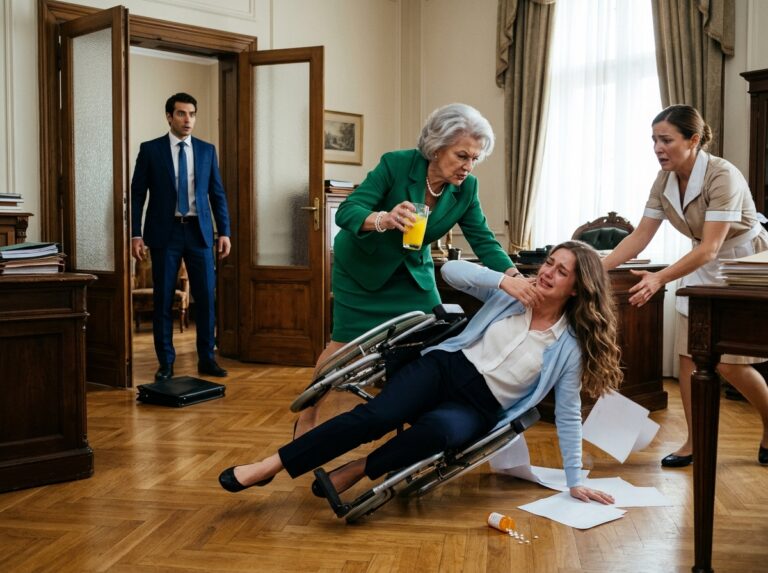
The slap came less than a minute before the pinning ceremony was supposed to begin.
Five hundred people heard it.
For one impossible second, the sound seemed to hang beneath the chandeliers of Memorial Hall, sharp and bright as a rifle crack.
Then everything went silent.
My cheek burned.
My father stood six inches from me, his right hand still raised, his face crimson with a rage I had known since childhood.
“You’re not one of us.”
His voice carried from the front row to the marble columns at the back of the hall.
Every conversation stopped.
Generals turned.
Spouses lowered their phones.
Children stared.
A senator who had been speaking with an Army chief of staff froze with a champagne glass halfway to his mouth.
My father didn’t seem embarrassed.
He seemed vindicated.
He pointed at the medals on my chest.
“Take it off.”
I said nothing.
His finger moved closer.
“That uniform. Remove it.”
I could feel hundreds of eyes on us.
My mother sat three chairs away, pale and rigid, both hands gripping her purse.
My younger brother Daniel stared at the floor.
My father looked around the hall as though he were waiting for agreement.
“You are a disgrace to this family’s name,” he said. “You do not belong here.”
The words should have humiliated me.
Maybe once they would have.
But after ten years of deployments, funerals, classified flights, freezing nights on mountain ridges, and long hours in places my family would never find on a map, humiliation had changed shape.
I had learned what mattered.
And what didn’t.
So I stood straight.
Hands at my sides.
Eyes forward.
I did not touch my cheek.
I did not argue.
I simply looked at him.
That unsettled him more than anger would have.
My father, Thomas Mercer, had spent my entire adult life telling people I was a liar.
To our hometown, I was a desk clerk who embellished stories.
To distant relatives, I was the daughter who had invented a glamorous military career because she couldn’t bear being ordinary.
To his friends at the veterans’ club, I was proof that “modern military standards had fallen.”
He had repeated the story for so long that eventually he stopped presenting it as opinion.
It became history.
His history.
And because I never defended myself, people believed him.
What could I have said?
That the reason my records looked empty was because much of my work had been sealed?
That the photographs he demanded didn’t exist because cameras had been forbidden?
That the missions he called imaginary had cost real people their lives?
No.
Silence had been part of the job.
So I let him talk.
For ten years.
Now he had chosen the worst possible room in America to repeat the lie.
Behind him were men and women who knew exactly who I was.
And still, for a few seconds, no one moved.
My father mistook their silence for agreement.
A smile touched the corner of his mouth.
“You see?” he said quietly. “Nobody here believes you either.”
Then a boot struck marble.
Clack.
My father turned.
A soldier in the third row had risen.
Master Sergeant Caleb Reid.
He had a scar running from his left temple to his jaw and a prosthetic hand hidden beneath a formal glove.
He looked directly at me.
Not at my father.
At me.
Then another soldier stood.
And another.
Five.
Ten.
Twenty.
Rows began rising.
The movement spread through the hall like a wave.
No shouting.
No dramatic gestures.
Just men standing.
Calmly.
Precisely.
Four hundred members of the special operations community rose from their chairs.
Some wore Army green.
Some Navy white.
Some Air Force blue.
Some Marine dress uniform.
A few wore civilian suits because their current assignments did not allow photographs in uniform.
They had flown in from six countries and thirteen states.
Some had not seen one another in years.
Others had seen one another three nights earlier in places my father would never hear about.
They stood because they knew.
Because they remembered.
Because some debts cannot be expressed in words.
My father’s smile disappeared.
“What is this?” he whispered.
Nobody answered.
The soldiers stepped forward.
One row.
Then another.
They formed a wall behind me.
Four hundred people moving with the quiet synchronization of those trained to trust one another without instruction.
My father looked from face to face.
His certainty began to crack.
For the first time all evening, fear entered his eyes.
Then the center aisle opened.
An admiral walked toward us.
Admiral Nathaniel Cole.
Silver hair.
Three rows of ribbons.
A face the country knew from televised briefings and congressional hearings.
He did not acknowledge my father.
He walked straight to me.
Stopped.
Straightened.
And saluted.
A four-star admiral saluted me in front of five hundred witnesses.
Gasps rippled through the hall.
My mother covered her mouth.
Daniel finally looked up.
My father stood motionless.
I returned the salute.
Admiral Cole lowered his hand.
Then he turned toward my father.
He did not raise his voice.
He stepped close enough that only the first few rows should have been able to hear him.
But Memorial Hall was so silent that every syllable carried.
“She brought my son home alive.”
Five words.
That was all.
My father’s knees almost buckled.
He stared at me.
Then at the admiral.
Then at the soldiers standing behind me.
Admiral Cole pointed toward the enormous screen above the stage.
Static filled it.
My father released a tiny, nervous laugh.
Maybe he thought there was a technical problem.
Maybe he believed whatever revelation had been planned had failed.
He was wrong.
I wasn’t looking at the screen.
I was looking at Caleb Reid.
And when Caleb gave me the smallest nod, my stomach tightened.
Because I suddenly understood.
They weren’t going to show my father a commendation.
They were going to show him the mission.
TEN YEARS EARLIER
My father had never wanted a daughter in uniform.
He had wanted sons.
That was not something I imagined.
He told me when I was twelve.
We were standing in our garage while Daniel, eight years old at the time, struggled to lift a wooden practice rifle my father had carved for him.
Dad had been in the Army for six years in his twenties, never deployed, and had built the rest of his identity around those years.
His medals hung in a shadow box above his workbench.
His discharge photograph sat beside them.
He told war stories at barbecues despite never having been closer to combat than a training range in Louisiana.
To Daniel, those stories were sacred.
To me, they were theater.
“Hold it tighter,” Dad told him.
Daniel’s arms shook.
I reached over and corrected his grip.
Dad slapped my hand away.
“Leave him.”
“He’s holding it wrong.”
“He’s learning.”
“So am I.”
Dad laughed.
“You?”
“Yes.”
He looked at me with genuine amusement.
“Emily, soldiers aren’t made from good grades and stubbornness.”
“What are they made from?”
“Something you don’t have.”
I remember staring at him.
“What?”
He nodded toward Daniel.
“The right instinct.”
Years later, I would remember that sentence while bleeding inside a helicopter over northern Iraq.
But at twelve, I simply walked away.
I joined the Army at eighteen.
My father didn’t attend basic training graduation.
Mom did.
Daniel did.
Dad said he had work.
When I earned my commission, he came only because relatives expected him to.
He shook hands with my instructors and joked that I was destined for administration.
“She organizes things,” he told them. “That’s Emily’s gift.”
I smiled.
I had learned early that correcting him only fed him.
At twenty-four, I volunteered for intelligence support to special operations.
At twenty-six, I entered a selection pipeline that technically did not exist on most organizational charts.
At twenty-seven, I disappeared from my family’s understanding of the military.
My official paperwork became boring.
Generic duty titles.
Administrative postings.
Temporary assignments without detail.
Nothing my father could brag about.
So he did what he always did when reality refused to flatter him.
He rewrote it.
“Desk job,” he told people.
“Mostly paperwork.”
Then came the deployment that changed everything.
We called the operation Nightglass.
The public never heard the name.
Most people inside the Department of Defense never heard it either.
A terrorist network operating across the Syrian-Iraqi border had acquired something more dangerous than weapons.
Names.
Safe-house locations.
Families.
Informants.
Local interpreters.
Intelligence officers.
The network had stolen part of a coalition database containing identities of people who had quietly helped American forces.
If released, hundreds would die.
Our mission was simple in wording.
Impossible in execution.
Find the server.
Recover the data.
Destroy the network’s ability to distribute it.
We had forty-eight hours.
The assault team included eighteen operators.
I was attached as mission intelligence lead because I had spent eight months mapping the network.
Among the men on the team was Lieutenant Commander Michael Cole.
Admiral Cole’s only son.
Michael was thirty-two.
Funny.
Reckless in conversation.
Meticulous in combat.
He carried packets of instant coffee in every pocket and had the irritating habit of humming old rock songs before dangerous operations.
The first time I met him, he looked at my thin file and said, “You’re the ghost?”
“What?”
“The analysts keep referring to some ghost who knows the network better than they do.”
“That’s flattering.”
“It wasn’t meant to be.”
“I like you already.”
He grinned.
We became friends.
Not romantic.
Never that.
Something closer to siblings forged under pressure.
He trusted my instincts.
I trusted his.
That mattered three months later when every plan collapsed.
The target compound was supposed to contain twelve armed men.
There were thirty-seven.
The server room was supposed to be underground.
It had been moved.
The extraction road was supposed to be clear.
It was mined.
Within six minutes, we were trapped.
Within twelve, two men were dead.
Within twenty, Michael was bleeding from his femoral artery.
I remember kneeling beside him in a dark stairwell while gunfire shook dust from the ceiling.
Caleb Reid was covering the doorway.
“Emily,” Michael gasped.
“Don’t.”
He laughed weakly.
“Was going to say you look terrible.”
“You’re hilarious.”
“Coffee?”
“You’ve been shot.”
“So that’s a no?”
I pressed harder against the wound.
Blood soaked through my gloves.
The evacuation route was gone.
Radio traffic was fragmented.
We had wounded.
Enemy fighters were closing in.
The correct decision, according to our original contingency plan, was to destroy the site and withdraw on foot.
But withdrawal meant leaving Michael.
And two others.
I knew something the team didn’t.
An old irrigation tunnel ran beneath the compound.
I had seen it in satellite imagery three months earlier.
Nobody had included it in the final mission package because engineers believed it had collapsed.
I didn’t believe them.
“Caleb!”
He glanced back.
“Tunnel beneath the east wall.”
“Blocked.”
“Maybe.”
“Maybe gets people killed.”
“Staying definitely does.”
He looked at me for half a second.
Then nodded.
“Show me.”
We moved.
That tunnel saved eleven lives.
But not because it was open.
It wasn’t.
Twenty meters in, the passage was collapsed exactly where engineers predicted.
Caleb swore.
Behind us, gunfire approached.
Michael was fading.
That was when I noticed airflow.
Very slight.
Dust moving sideways near the floor.
There had to be another opening.
I crawled through a gap barely wider than my shoulders.
On the other side was a secondary maintenance shaft.
I found an exit.
Then came back.
Michael later told people that was the moment he knew I was insane.
Because any rational person would have continued toward safety.
Instead, I crawled back toward gunfire.
We carried the wounded out one at a time.
The last person through was me.
Seconds later, the compound exploded.
The blast threw me into a concrete wall.
I woke in a helicopter.
Michael was beside me.
Alive.
His first words were, “Told you the coffee mattered.”
I laughed so hard I tore two stitches.
Nightglass remained classified.
The official report was buried.
The survivors received awards in private ceremonies.
I refused mine twice.
I eventually accepted because my commander said refusal was becoming administratively irritating.
Then I came home for Christmas.
Dad asked if I had enjoyed “sitting behind a computer in Germany.”
I looked at him across the dining table.
My ribs still hurt when I breathed.
There was shrapnel in my left shoulder doctors had decided not to remove.
Three families had buried sons because of that mission.
Eleven men were alive because we found a tunnel.
And my father was smirking.
“Something like that,” I said.
He laughed.
“Thought so.”
That was the first time Daniel looked at me differently.
Not with disbelief.
With curiosity.
THE LIE GROWS
Over the following years, my career became even harder to explain.
I deployed repeatedly.
Sometimes for weeks.
Sometimes for months.
Sometimes I returned without telling my family I had left.
Dad interpreted secrecy as evidence.
“No pictures,” he told relatives. “No stories. No proof.”
Mom avoided the subject.
Daniel joined the Navy.
That changed everything.
At first, Dad was ecstatic.
Finally, his son was doing something worthy.
When Daniel was selected for a special warfare support role, Dad printed photographs, bought unit stickers, and told everyone at church.
He attended every ceremony.
Every graduation.
Every promotion.
The difference would have been funny if it hadn’t hurt.
I remember standing in Mom’s kitchen while Dad showed a neighbor Daniel’s newest photograph.
“That’s my boy,” he said.
Then he noticed me.
“And Emily still works in offices.”
The neighbor smiled awkwardly.
Daniel looked embarrassed.
Later he found me outside.
“Why don’t you tell him?”
“Tell him what?”
“The truth.”
“You don’t know the truth.”
“I know enough.”
I looked at him.
He had recently gained access to compartmented programs.
He had seen my name on something.
Maybe more than one thing.
“I know you’re not a clerk,” he said.
“That’s already too much.”
“He treats you like garbage.”
“That’s his choice.”
“You could stop it.”
“No. I could violate orders to win an argument. Those are different things.”
Daniel stared at the ground.
“I used to believe him.”
“I know.”
“I’m sorry.”
I shrugged.
“I did nothing to correct you.”
“You couldn’t.”
“Same result.”
He looked toward the house.
“Does Mom know?”
“No.”
“Nothing?”
“Nothing.”
Daniel exhaled.
“How do you stand it?”
I thought about that.
“By remembering that truth doesn’t need everyone’s permission.”
He smiled slightly.
“That sounds rehearsed.”
“It is.”
For the next three years Daniel never asked another question.
But he changed.
When Dad mocked me, Daniel stopped laughing.
When relatives called me a liar, he left the room.
When Dad exaggerated Daniel’s service, Daniel corrected him.
Their relationship deteriorated.
Mine with Daniel quietly repaired.
Then, two years before the pinning ceremony, Daniel disappeared overseas.
Officially, his unit was conducting exercises.
Unofficially, a hostage rescue operation had gone catastrophically wrong.
I learned about it before our parents.
I was in Virginia when a secure phone rang at 2:17 in the morning.
“Mercer?”
“Yes.”
“Your brother’s team is compromised.”
Those words turned my blood cold.
Daniel’s convoy had been ambushed.
Three killed.
Two captured.
One missing.
Daniel was missing.
I sat on the edge of my bed, gripping the phone.
“Location?”
Silence.
Then coordinates.
I knew the region.
I knew the network operating there.
And within twenty minutes I knew something else.
The people who had attacked Daniel’s team were connected to remnants of the same organization we had targeted during Nightglass.
History had circled back.
I requested deployment.
Denied.
I requested again.
Denied.
Conflict of interest.
Family involvement.
Operational risk.
I went to Admiral Cole.
Michael’s father.
By then Michael had left active duty after complications from his Nightglass injuries.
Admiral Cole listened without interrupting.
When I finished, he asked, “If Daniel weren’t your brother, would you still be the best person for this?”
“Yes.”
“Can you prove it?”
I placed a folder on his desk.
He read it.
Then closed it.
“I can get you attached as an adviser.”
“I need field authority.”
“No.”
“Sir—”
“Emily, I owe you my son’s life. Don’t make me repay that debt by sending you after your brother.”
“It’s not about debt.”
“It is for me.”
I leaned forward.
“With respect, sir, that’s exactly why you should understand.”
He stared at me for a long time.
Then said, “If you go, your family can never know.”
“I understand.”
“If something happens, the official story will not explain it.”
“I understand.”
“If you find your brother—”
“When.”
He paused.
“When you find your brother, he may never be allowed to tell them how.”
“I understand.”
Admiral Cole looked tired.
“You say that too easily.”
“No. I’ve just had practice.”
Sixteen hours later, I was on a plane.
THE SECOND RESCUE
We found Daniel after six days.
He had been moved three times.
His captors were preparing to transfer him across a border where recovery would become nearly impossible.
The operation used twenty-seven people.
Four helicopters.
Two drones.
One surveillance aircraft.
And an intelligence picture built mostly from fragments.
I spent seventy-two hours awake.
On the final night, Caleb Reid walked into the command room carrying coffee.
“You look worse than Nightglass.”
“You always know what to say.”
He placed the cup beside me.
“Your brother’s alive.”
“For now.”
“He’s alive.”
I stared at the overhead image.
“You see this building?”
“Warehouse.”
“No.”
“What?”
“School.”
“It’s abandoned.”
“Not entirely.”
I enlarged a thermal image.
“There.”
Two small heat signatures appeared in a rear room.
Caleb leaned closer.
“Children?”
“Probably.”
“Hostages?”
“Maybe families.”
“Our strike plan puts breaching charges on that wall.”
“Not anymore.”
He rubbed his jaw.
“We’re changing entry six hours before execution?”
“Yes.”
“You’re very popular.”
“I know.”
The altered entry route added forty seconds.
Forty seconds in a hostage rescue is an eternity.
But it saved two children.
And when the team reached Daniel, he was chained to a pipe, dehydrated, bruised, and conscious.
His first question after they cut him free was not about himself.
“Who found us?”
Caleb reportedly smiled.
“Your sister.”
Daniel thought he was joking.
He didn’t believe it until he saw me at the forward base.
He walked into the medical tent with an IV hanging from his arm.
Stopped.
Stared.
Then said, “You have got to be kidding me.”
I hugged him.
He shook once.
Then again.
My little brother, whom Dad had spent years holding up as the family’s real warrior, cried into my shoulder.
“I thought I was dead.”
“I know.”
“They told me nobody was coming.”
“They were wrong.”
He pulled back.
“Dad can never know, can he?”
“No.”
His face hardened.
“He’s going to keep treating you like—”
“Daniel.”
“No. This is insane.”
“This isn’t why we went.”
“I know why you went.”
“Then leave it.”
He looked furious.
But he nodded.
When Daniel returned home, the official story described a multinational recovery effort.
Dad told everyone Daniel had escaped through “sheer toughness.”
Daniel never corrected him.
That silence ate at him.
I could see it.
Eventually, it poisoned the entire family.
THE INVITATION
The pinning ceremony that would change everything was supposed to honor a newly established joint special operations command.
I had been selected as its deputy director.
The role itself was public.
Much of the career behind it was not.
For the first time, my family could legally attend a ceremony connected to my actual work.
I almost didn’t invite them.
Mom called two weeks beforehand.
“Your father heard about the ceremony.”
“How?”
“Daniel.”
I closed my eyes.
“Mom.”
“He thought Dad should know.”
“Of course.”
“He wants to come.”
That surprised me.
“Dad?”
“Yes.”
“Why?”
“He says he wants to support you.”
I almost laughed.
Mom lowered her voice.
“Emily, maybe he’s trying.”
I wanted to believe her.
That was the stupid part.
After all those years, after every insult and dismissal, a small piece of me still wanted my father to look at me and say he had been wrong.
Not because I needed his approval.
Because children never fully stop wanting their parents to see them.
“Fine,” I said.
Mom exhaled with relief.
“Thank you.”
The morning of the ceremony, Daniel called.
“You sure about this?”
“No.”
“That’s comforting.”
“Why did you tell him?”
Silence.
“Daniel?”
“He found the invitation.”
“That isn’t what Mom said.”
“I know.”
I frowned.
“What aren’t you telling me?”
“Nothing.”
“You’re a terrible liar.”
“I learned from Dad.”
“Daniel.”
He sighed.
“I’ll see you tonight.”
Then he hung up.
That should have bothered me more.
Instead, I blamed nerves.
By six o’clock, Memorial Hall was nearly full.
I wore dress uniform.
Not combat camouflage.
Not the plain clothes I usually worked in.
Dress uniform.
Medals.
Ribbons.
Insignia.
Things my father had spent a decade claiming I hadn’t earned.
When I saw my parents arrive, Mom cried.
Dad didn’t.
He stared at my chest.
Then at the people greeting me.
A brigadier general hugged me.
A colonel shook my hand.
Michael Cole, walking with a slight limp from Nightglass, kissed my cheek.
Dad watched all of it.
His face grew darker by the minute.
I should have recognized the pattern.
When reality contradicted him, he didn’t reconsider.
He attacked.
Five minutes before the ceremony, he cornered Daniel near the aisle.
I saw them arguing.
Daniel’s face was pale.
Dad jabbed a finger at him.
Then turned toward me.
That was when he shouted.
“You’re not one of us!”
And struck me.
THE SCREEN
Static flickered above the stage.
The hall remained silent.
Admiral Cole stood beside me.
My father stared upward.
Then the first image appeared.
A grainy infrared photograph.
A compound at night.
Timestamp in the corner.
Coordinates blurred.
My stomach dropped.
No.
I turned toward the admiral.
“Sir.”
He didn’t look at me.
On the screen, a title appeared.
OPERATION NIGHTGLASS — SELECTED RECORD DECLASSIFIED BY AUTHORITY OF THE SECRETARY OF DEFENSE.
A murmur swept through the room.
I whispered, “You declassified it?”
“Parts.”
“Why?”
He finally looked at me.
“Because some truths cost too much when buried forever.”
The video began.
Helmet-camera footage.
Dust.
Gunfire.
Men shouting.
My own voice on the radio.
“East corridor compromised! Move wounded to stairwell!”
My father stared.
The video cut.
A body camera showed Michael Cole on the ground.
Me kneeling beside him.
Blood everywhere.
My mother made a sound like she had been punched.
Dad turned toward me.
I didn’t look at him.
On-screen, the younger version of me shouted at Caleb.
“Tunnel beneath the east wall!”
Caleb’s voice:
“Blocked!”
“Maybe.”
“Maybe gets people killed.”
“Staying definitely does.”
The audience watched us disappear underground.
They watched the collapsed tunnel.
They watched me crawl into the narrow opening alone.
They watched the camera lose sight of me.
Then three agonizing seconds of darkness.
Then my voice:
“I found air! There’s another shaft!”
My father gripped the back of a chair.
The footage skipped ahead.
Michael was being carried.
Then another wounded operator.
Then another.
Finally I crawled through.
The screen flashed white as the compound exploded.
The recording ended.
Nobody applauded.
That would have felt wrong.
Instead, the room remained silent.
A silence filled with recognition.
Admiral Cole looked at my father.
“That was ten years ago.”
Dad swallowed.
“I…”
The admiral raised one finger.
The screen changed.
Another title.
OPERATION LANTERN KEEP — SELECTED RECORD DECLASSIFIED.
Daniel shut his eyes.
I turned toward him.
“What did you do?”
He didn’t answer.
The footage began.
Not combat this time.
Surveillance.
Maps.
Briefings.
My voice.
My brother’s photograph on a screen.
Dad looked at Daniel.
Then me.
“What is this?”
Daniel stepped forward.
His voice shook.
“The truth.”
The rescue footage played.
The warehouse.
The altered breach route.
The two children being carried out.
Then Daniel.
Chained to a pipe.
Barely conscious.
A helmet camera caught the moment Caleb cut him loose.
Daniel looked up.
“Who found us?”
Caleb’s voice:
“Your sister.”
The video froze.
My father stopped breathing.
He looked at Daniel.
“No.”
Daniel’s eyes filled with tears.
“Yes.”
“No.”
“She found me.”
Dad shook his head.
“She couldn’t have.”
“She did.”
“I was told—”
“You were told what they were allowed to tell you.”
Dad backed away.
Daniel stepped closer.
“You spent years calling her a liar while she kept people alive.”
Dad looked at me.
His expression was no longer angry.
It was shattered.
“Emily.”
I had imagined this moment many times.
In some versions, I screamed.
In others, I listed every insult.
Every Christmas.
Every humiliation.
Every time he had called me worthless.
But standing there, I felt only exhaustion.
“I never asked you to believe impossible things,” I said. “I asked you to believe me.”
His face crumpled.
“I didn’t know.”
“You didn’t want to know.”
That landed harder.
He lowered his eyes.
Mom stood.
She crossed the distance between us.
For one second I thought she was coming to me.
Instead, she stopped beside Dad.
And slapped him.
The sound wasn’t as loud as his slap had been.
But the entire hall heard it.
Mom’s hands trembled.
“You hit our daughter,” she whispered.
Dad stared at her.
“You stood there,” he said.
“Yes.”
Her voice broke.
“And I will hate myself for that for the rest of my life.”
Then she walked to me.
She touched my cheek carefully.
“I’m sorry.”
I nodded.
I wasn’t ready to say more.
Then something strange happened.
Admiral Cole did not return to the stage.
Instead, he looked toward Daniel.
Daniel looked toward Caleb.
Caleb looked at me.
And suddenly I understood there was more.
“What did you do?” I asked again.
Daniel swallowed.
“Em…”
“What did you do?”
Admiral Cole said, “There is one final item.”
My stomach tightened.
“I did not authorize—”
“You don’t have authority over this portion.”
The room changed.
Not visibly.
But I felt it.
Something beneath the ceremony.
Something planned.
The screen went black.
Then a photograph appeared.
Old.
Faded.
A young soldier stood beside a helicopter.
I recognized him immediately.
My father.
Age twenty-two.
Army uniform.
Smiling.
Dad looked up.
All the blood left his face.
“No.”
My mother turned.
“What?”
Another photograph.
Dad beside three other soldiers.
One of them had been circled.
A name appeared beneath.
SERGEANT JOSEPH MERCER.
I frowned.
I had never heard that name.
Dad whispered, “Turn it off.”
Admiral Cole’s expression hardened.
Nobody moved.
“Turn it off!”
For the first time that night, Dad looked truly afraid.
Not ashamed.
Afraid.
I stared at the screen.
“Who is Joseph Mercer?”
Dad didn’t answer.
Daniel did.
“Our uncle.”
I turned.
“We don’t have an uncle Joseph.”
“Yes,” Daniel said quietly. “We did.”
Mom looked just as confused.
Admiral Cole stepped forward.
“This next material was discovered during a records review associated with the declassification requests.”
Dad grabbed his arm.
“Don’t.”
Four hundred soldiers shifted almost simultaneously.
Dad released him.
The screen displayed a scanned military report.
I could not read all of it from where I stood.
But one line was large enough.
TRAINING FATALITY — FORT POLK — 1984.
Dad whispered, “It was an accident.”
Admiral Cole said nothing.
The next page appeared.
Witness statements.
Redactions removed.
Joseph Mercer had died during a live-fire training exercise.
Official cause: procedural failure.
But new records had been attached.
A disciplinary investigation.
Dad had been present.
More than present.
He had been responsible for checking the range.
My stomach turned.
“No,” I said.
Dad looked at me.
For the first time in my life, he looked small.
“I was twenty-two.”
Admiral Cole spoke.
“You signed the clearance.”
Dad’s voice rose.
“The range officer told me it was clear!”
“The range officer stated you never completed the inspection.”
“He lied!”
Admiral Cole looked toward the screen.
A recording began.
Audio only.
Old cassette quality.
A young man’s voice.
My father’s.
“I know.”
Another voice.
“You knew there was unexploded ordnance?”
“I thought it was probably safe.”
“You signed the form.”
Silence.
Then young Thomas Mercer said:
“I didn’t want to look scared in front of the others.”
The hall seemed to tilt.
I stared at my father.
All those years.
All those lectures about courage.
All those accusations.
All that obsession with proving who belonged and who didn’t.
Dad covered his face.
“I was a kid.”
Joseph Mercer had entered the uncleared section of the range ten minutes later.
An unexploded round detonated.
He died instantly.
The Army disciplined my father.
Reduced his rank.
Then quietly discharged him after a later incident.
Our family had never been told.
My grandparents apparently told everyone Joseph died overseas.
Dad rebuilt himself afterward.
Invented a cleaner service record.
Eventually, maybe even believed parts of it.
But the story wasn’t finished.
The screen changed again.
A letter appeared.
Handwritten.
Dated three days before Joseph’s death.
Addressed to my grandmother.
Admiral Cole read only one line aloud.
“Tom keeps trying to prove he’s tougher than everybody. I wish he understood that courage isn’t the same thing as never admitting fear.”
My father began crying.
Not loudly.
Just tears.
He sat down.
No one mocked him.
That somehow made it worse.
I thought the revelation explained everything.
His insecurity.
His obsession with masculinity.
Why he idolized Daniel.
Why he despised my silence.
Why my career threatened him.
Because every time he looked at me, maybe he saw something he had failed to become.
I thought that was the twist.
I was wrong.
Daniel stepped beside me.
“There’s more.”
I closed my eyes.
“Of course there is.”
“This part isn’t about Dad.”
The screen went dark again.
A new file appeared.
No title.
Only a date.
My date of birth.
Mom gasped.
I turned toward her.
She looked terrified.
“Mom?”
She sat down.
Dad lifted his head.
“No.”
Daniel stared at me.
“I found it accidentally.”
“Found what?”
He couldn’t say it.
Admiral Cole did.
“Your father is not your biological father.”
The words did not register.
They reached my ears but stopped somewhere before meaning.
I laughed.
A reflex.
“That’s ridiculous.”
Mom started crying.
My laugh died.
“Mom.”
She shook her head.
“I wanted to tell you.”
“When?”
“Emily—”
“When?”
Dad whispered, “Don’t.”
I turned on him.
“You knew?”
He looked at the floor.
Suddenly every memory rearranged itself.
The distance.
The contempt.
The constant insistence that I did not belong.
“You knew.”
Dad nodded.
The hall disappeared.
All I could hear was my heartbeat.
“Who?”
Mom stood.
She could barely speak.
“Joseph.”
For several seconds, nobody moved.
I looked toward the photograph on the screen.
The young soldier standing beside my father.
Sergeant Joseph Mercer.
My uncle.
Except he wasn’t my uncle.
He was my father.
My biological father.
Mom had been seventeen when she met him.
Joseph was twenty.
They planned to marry.
Then he died.
Mom discovered she was pregnant three weeks after the funeral.
Thomas—Joseph’s younger brother—married her.
He gave me his name.
Raised me.
And spent the rest of my life resenting me for reminding him of the brother whose death he believed he had caused.
I couldn’t breathe.
Mom approached me.
“Emily.”
I stepped back.
“Don’t.”
Her face broke.
“Please.”
“Everyone knew except me?”
“No.”
“Dad knew.”
She flinched at the word.
Daniel whispered, “I only found out last month.”
I looked at him.
“How?”
“Genealogy records.”
I almost laughed again.
Of all the classified databases and intelligence systems in the world, the secret that shattered my family had been found through a genealogy search Daniel ordered as a birthday gift for Mom.
A flagged discrepancy led him to old records.
Then military files.
Then Joseph.
Then the declassification review.
I looked at Thomas.
I didn’t know what to call him anymore.
He stood slowly.
“I loved your mother.”
“That doesn’t answer anything.”
“I loved you too.”
“No.”
“I did.”
“You spent thirty years telling me I wasn’t good enough.”
His face twisted.
“Because you were him.”
The room went silent again.
He pointed at the photograph.
“You walked like him. You stared at people like him. You never backed down. Every time you did something brave, I saw him.”
His voice cracked.
“And every time I saw him, I remembered that he died because I was too afraid to admit I was afraid.”
I felt something cold settle inside me.
“So you punished me.”
“Yes.”
The honesty stunned me more than denial would have.
He wiped his face.
“I hated myself. And you looked like the person I had killed.”
“You didn’t kill him deliberately.”
“No.”
“But you made sure I paid for it deliberately.”
He closed his eyes.
“Yes.”
No one spoke.
Then Caleb stepped forward from the wall behind me.
He removed his formal glove.
His prosthetic hand gleamed beneath the hall lights.
“Colonel.”
I turned.
He had never called me that in private.
Only officially.
He looked toward Joseph’s photograph.
“You once told me something underground in Syria.”
I frowned.
“What?”
“You said fear was useful if you stopped pretending you didn’t have it.”
I remembered.
Nightglass.
The collapsed tunnel.
Caleb had asked if I was scared before crawling through.
I had said, “Terrified. That’s why I’m paying attention.”
He nodded toward the screen.
“Sounds like maybe you got that lesson from someone you never met.”
I looked at Joseph’s letter.
Courage isn’t the same thing as never admitting fear.
A chill moved through me.
Same idea.
Almost the same words.
I had never read the letter.
Never knew it existed.
Genetics could explain a face.
Maybe posture.
Maybe temperament.
But not a sentence.
Unless…
I turned toward Mom.
“Did he write anything else?”
She stared.
“What?”
“Joseph. Letters.”
“Yes.”
“How many?”
“Dozens.”
“Where?”
Her face changed.
“At home.”
“Did I ever see them?”
“No.”
“Are you sure?”
“Yes.”
A memory surfaced.
I was eight.
Rain outside.
Dad away for work.
Mom cleaning the attic.
A cardboard box split open.
Papers everywhere.
I had picked up a notebook.
Handwriting.
I remembered one sentence because I copied it into a school journal.
Bravery is being scared enough to notice everything and going anyway.
At eight, I hadn’t understood it.
At twenty-seven, crawling into a tunnel, I had lived by it.
I looked at Mom.
“I saw them.”
She covered her mouth.
“Maybe once.”
I laughed softly.
All those years I had believed I created my own philosophy.
Maybe I had inherited part of it through a forgotten afternoon.
Maybe Joseph had spoken to me after all.
The realization hurt.
But it also healed something I hadn’t known was wounded.
I turned toward Thomas.
He waited.
Not for forgiveness.
I think he finally understood he had no right to ask.
“You said I wasn’t one of you.”
He nodded miserably.
“You were right.”
He looked up.
I continued.
“I’m not.”
A murmur moved through the hall.
“I am not the person you spent your life pretending to be.”
His eyes closed.
“I am not the coward you thought you saw when you looked in the mirror.”
He flinched.
“And I am not Joseph either.”
I looked at the photograph.
“I’m me.”
Then I turned toward the four hundred soldiers behind me.
Men and women who had known me in deserts, mountains, aircraft, hospitals, briefing rooms, funerals, and the unbearable hours between bad news and worse possibilities.
“These people did not stand because of my bloodline.”
Caleb nodded.
“They stood because of what we survived together.”
I looked toward Daniel.
“He is not my brother because we share genetics.”
Daniel’s eyes filled.
“He is my brother because when everything else in this family turned into lies, he chose the truth.”
Then I looked at Mom.
“And you are my mother.”
She sobbed.
“That one was never complicated.”
She crossed the distance and hugged me.
For a moment I let myself be a daughter.
Not an officer.
Not a survivor.
Not a secret.
Just a daughter.
When she stepped away, Thomas remained alone.
He looked older than he had an hour earlier.
I touched my cheek.
Still tender.
He saw the movement.
“I’m sorry.”
I believed him.
That was the difficult part.
He meant it.
But meaning it did not erase anything.
“You should leave.”
He nodded.
No argument.
No anger.
He turned.
Walked toward the doors.
Then stopped.
Without facing me, he said, “Joseph would have been proud of you.”
I felt anger rise again.
“You don’t get to tell me what he would have felt.”
His shoulders dropped.
“You’re right.”
He left.
The doors closed behind him.
THE PINNING
The ceremony should have been canceled.
Admiral Cole asked if I wanted it postponed.
I said no.
Maybe that surprised everyone.
It surprised me.
But there are moments when continuing is not denial.
It is reclamation.
Five minutes later, I stood on the stage.
My cheek was still red.
My family history had exploded in front of five hundred people.
My biological father had been revealed.
The man who raised me had walked out.
And yet the reason we had gathered remained.
Service.
Not mythology.
Not blood.
Not family pride.
Service.
Admiral Cole stood beside me.
He held the new insignia.
Before pinning it, he quietly asked, “Ready?”
I looked out at the hall.
Four hundred operators had returned to their seats.
Mom sat with Daniel.
Caleb gave me a crooked smile.
Michael Cole sat beside his father’s empty chair, looking suspiciously emotional.
I said, “Yes.”
The admiral pinned the insignia to my uniform.
Applause began.
Not polite applause.
Thunder.
It rolled through Memorial Hall.
I stood there and let it happen.
For once, I didn’t feel the urge to disappear into silence.
Afterward, people formed a reception line.
Some hugged me.
Some said nothing.
Some simply squeezed my shoulder.
Michael waited until almost everyone had left.
He approached with two cups of coffee.
I stared at them.
“You cannot be serious.”
“Tradition.”
“Your coffee nearly killed me during Nightglass.”
“My coffee saved morale.”
“It tasted like burnt socks.”
He handed me a cup.
“To Joseph.”
I looked at him.
Then clinked cups.
“To people we bring home.”
Michael smiled.
“Even the ones we never met.”
WHAT HAPPENED TO THOMAS
For three months, I did not speak to the man who raised me.
He wrote letters.
Real letters.
By hand.
I did not open them.
Mom moved out.
Not permanently at first.
Then permanently.
Daniel visited Thomas once.
He returned quiet.
“How is he?” I asked.
“Bad.”
I hated the little stab of concern I felt.
“Drinking?”
“No.”
“Angry?”
“No.”
“That’s worse.”
“Yeah.”
Six months after the ceremony, I opened the first letter.
Emily,
I have started this sentence twenty-three times.
There is no version where I am the victim.
There is no explanation that makes what I did acceptable.
So I will not explain.
I will only tell the truth.
I loved Joseph.
I was jealous of him.
He was better at almost everything without trying to prove it.
When he died, everyone called it an accident.
I knew better.
I had been afraid to admit I had not inspected the range correctly.
One sentence would have saved him.
“I’m not sure.”
That was all I needed to say.
I was too proud.
Then you were born.
You had his eyes.
Every time you succeeded, I felt the world accusing me.
So I tried to make you smaller.
That is the ugliest truth I have.
I am sorry.
Not because I was exposed.
Because I finally understand that I spent thirty years making you carry guilt that belonged to me.
You owe me nothing.
—Thomas
I read it twice.
Then put it away.
The second letter was shorter.
I started therapy.
I laughed when the counselor suggested it.
Then I remembered what Joseph wrote about admitting fear.
So I went.
That one I kept.
A year after the ceremony, I visited him.
He had aged.
Or perhaps I had stopped seeing the myth and finally saw the man.
He made coffee.
We sat in silence.
Eventually he said, “What do I call you?”
I almost smiled.
“What?”
“Daughter feels like something I forfeited.”
I looked at him.
“You raised me.”
“Badly.”
“Sometimes.”
He nodded.
“I don’t know if I can forgive you.”
“I know.”
“I don’t know if I ever will.”
“I know.”
“But I don’t want your worst act to be the only thing that exists.”
He stared at the coffee.
“Why?”
“Because I spent my career believing people are more complicated than their worst day.”
He looked at me.
“You sound like Joseph.”
I shook my head.
“No.”
He corrected himself.
“You sound like Emily.”
That was the first right thing he said.
THE FINAL SECRET
Three years later, Admiral Cole retired.
His farewell ceremony was smaller than mine.
He preferred it that way.
Afterward, he asked me to stay.
Michael was there.
So was Caleb.
Admiral Cole handed me a sealed envelope.
“What is this?”
“Something I promised not to give you until I retired.”
“Promised whom?”
He smiled.
“That’s the question.”
Inside was a photograph.
Three soldiers.
Joseph Mercer.
Thomas Mercer.
And a third man I didn’t recognize.
On the back, written in Joseph’s handwriting:
Nathan Cole — owes me twenty dollars.
I looked up.
The admiral laughed.
“You knew him?”
“Knew him? Joseph saved my life.”
My mouth opened.
Cole leaned back.
“Training exercise, 1983. Helicopter accident. I was trapped. Your father—Joseph—went back into a burning aircraft.”
Everything inside me went still.
“He saved you.”
“Yes.”
“And a year later he died.”
“Yes.”
I looked at the photograph again.
“So when you met me…”
“I knew exactly who you were.”
I felt a strange anger.
“You never said anything.”
“I didn’t know Thomas had hidden the truth from you. I thought Mercer was simply your married family name.”
Michael looked equally stunned.
His father continued.
“Then Nightglass happened.”
He smiled faintly.
“Joseph Mercer saved my life in 1983.”
He looked at Michael.
“And thirty years later, Joseph Mercer’s daughter saved my son.”
Nobody spoke.
My skin prickled.
The coincidence was absurd.
Almost impossible.
But Cole wasn’t finished.
He pulled out one more page.
“When Daniel requested declassification, I found this in Joseph’s personnel effects.”
It was another letter.
Unsent.
Dated the night before Joseph died.
Cole handed it to me.
I read.
Nathan,
If you ever have children, tell them they owe me twenty bucks too.
And if I ever have a kid, God help the poor thing. Maybe our children will meet someday and settle the debt.
I laughed.
Then cried.
Michael looked over my shoulder.
“No way.”
Caleb said, “That’s unsettling.”
Admiral Cole smiled.
“I always wondered what Joseph would have thought.”
Michael picked up his coffee.
“Technically, Emily owes my family twenty dollars.”
“Technically,” I said, “your father owes mine.”
“Your father’s deceased.”
“So is the original debt.”
“We need arbitration.”
Caleb sighed.
“I’ve survived explosions for less complicated problems.”
We laughed.
The laughter faded slowly.
I read the final line of Joseph’s letter.
It was different from the rest.
Serious.
If I have a daughter, I hope she never spends her life trying to prove she belongs anywhere. I hope she walks into a room and knows she belongs because she knows who she is.
I stopped breathing.
My vision blurred.
All those years.
All those accusations.
All those rooms.
All those battles.
I had spent half my life proving myself to a man who could not see me because he was looking at his own guilt.
Yet the father I never knew had written exactly what I needed decades before I would need it.
I folded the letter carefully.
Then slipped it inside my jacket.
That night, I went home alone.
No uniform.
No medals.
No audience.
I stood in front of the mirror.
For years, I had looked at my face and wondered which parts came from my mother.
Now I could see Joseph.
The eyes.
The shape of the jaw.
Maybe the stubbornness.
But I also saw Thomas.
Not in blood.
In habits.
In the way I checked doors twice.
In the way I hated wasting food.
In the way I drank coffee too strong because that was how he made it on cold mornings when I was a child.
We inherit people in more ways than biology.
Some inheritance is love.
Some is damage.
Some is choice.
I touched the faint place on my cheek where he had struck me years earlier.
The bruise was long gone.
The lesson remained.
Belonging was never something he had the power to give me.
And that was the truth I had missed.
The four hundred soldiers did not stand because an admiral ordered them.
They did not stand because my biological father had once been brave.
They did not stand because of medals, rank, blood, or reputation.
They stood because years earlier, in dark places where nobody was watching, I had stood for them.
That is how belonging works.
Not inherited.
Not announced.
Not demanded.
Earned quietly.
Then proven when it matters.
Two weeks later, I visited Joseph’s grave for the first time.
Thomas came with me.
We stood several feet apart.
He placed an old unit coin on the headstone.
I placed Admiral Cole’s twenty-dollar bill beside it.
Thomas stared.
“What’s that?”
“A debt.”
“To Joseph?”
“Long story.”
He almost smiled.
Wind moved through the cemetery.
After a while, Thomas said, “Do you think he would forgive me?”
I looked at the name carved in stone.
“I don’t know.”
Thomas nodded.
“I suppose that’s fair.”
I turned toward him.
“But I think he would want you to stop making the same mistake.”
“What mistake?”
“Thinking punishment is the same thing as accountability.”
He looked at me.
I continued.
“You punished yourself for forty years. Then you punished everyone around you. None of it brought him back.”
His eyes lowered.
“What would accountability look like?”
I thought about Joseph’s letter.
“Admitting you were afraid.”
Thomas gave a broken laugh.
“That simple?”
“No.”
I looked toward the grave.
“That hard.”
He nodded.
And for the first time in his life, the man who had built his entire identity around appearing fearless said the words that might have saved his brother decades earlier.
“I was afraid.”
The wind moved softly through the trees.
Nothing miraculous happened.
No voice answered.
No past changed.
But Thomas exhaled as though he had been holding that breath since 1984.
Then he looked at me.
“I’m afraid you’ll never forgive me.”
“I might not.”
He nodded.
“I’m afraid you’ll leave and never come back.”
“I might.”
Another nod.
“I’m afraid I wasted my whole life.”
I looked at him.
“You haven’t finished it yet.”
He began to cry.
This time, I did not rescue him.
I did not comfort him.
I simply stood beside him.
Sometimes that is enough.
We remained there until sunset.
Before leaving, I looked once more at Joseph’s name.
For most of my life, I thought my story began with a father who refused to believe in me.
I was wrong.
It began with a young man I never knew, writing letters about courage.
It continued through another young man who made one terrible cowardly choice and then built an entire life around hiding from it.
It crossed deserts.
Survived bullets.
Saved sons.
Recovered brothers.
And finally led to a marble hall where one slap exposed decades of secrets.
People later told the story differently.
Some remembered the four hundred soldiers.
Some remembered Admiral Cole’s salute.
Some remembered the classified footage.
Some remembered Thomas walking out.
But that was never the most important moment to me.
The most important moment came years later, at a quiet graveyard, when I finally understood something neither medals nor bloodlines could teach.
You do not discover who belongs to you by asking who shares your name.
You discover it by noticing who stands when the room turns against you.
And on the worst night of my family’s life, four hundred people stood.
Not because I was Joseph Mercer’s daughter.
Not because I was Thomas Mercer’s failure.
Not because I was Daniel’s sister or Nathan Cole’s friend.
They stood because I was Emily.
And at last—
that was enough.