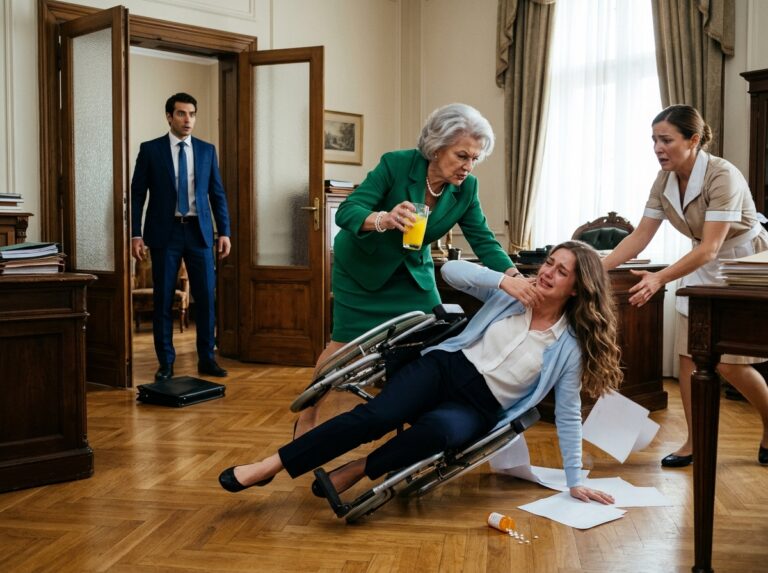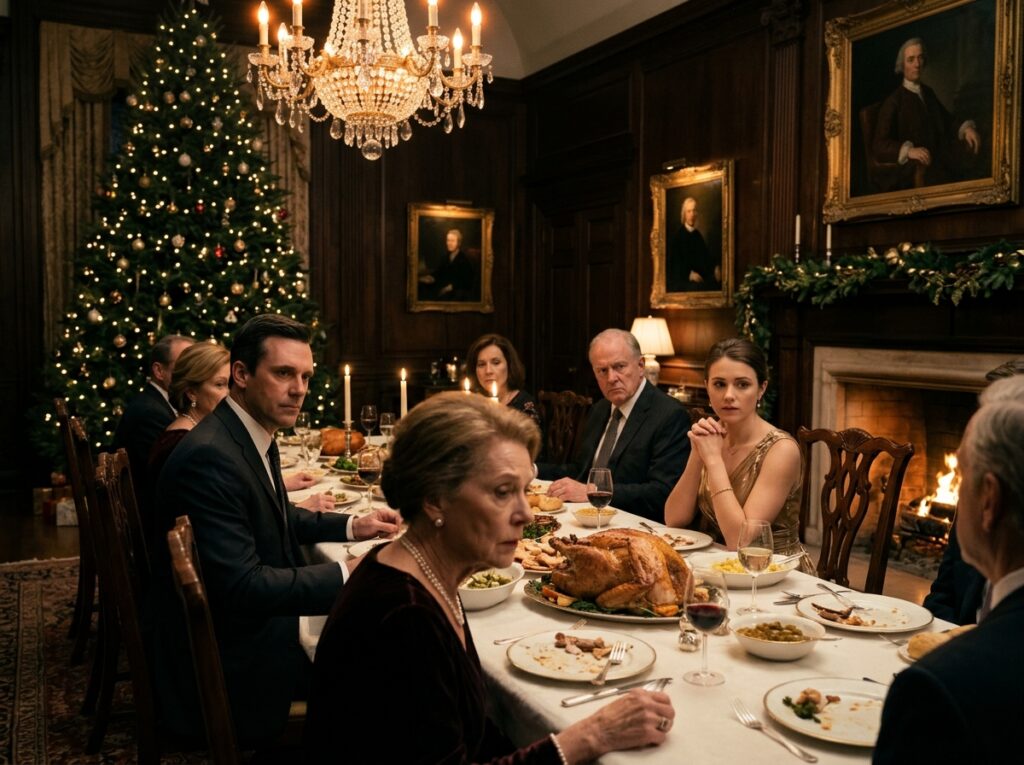
Christmas morning began in darkness.
At 4:30 a.m., while the rest of the house slept, I stood alone in my kitchen with flour on my apron, my hands buried in stuffing, and one foolish belief still alive inside me:
I was the heart of this family.
By dinner, my daughter-in-law had decided I did not even deserve a chair at the table.
“Maybe you should eat upstairs,” Sasha said.
She spoke lightly, almost kindly, as though she were suggesting I rest instead of banishing me from Christmas dinner inside the home I had owned for thirty-one years.
The turkey roasted in the oven. Cranberry sauce cooled on the counter I had wiped nearly every day since 1993. The air smelled of rosemary, melted butter, and Gerald’s favorite stuffing—the scent of traditions you never imagine someone could steal from you.
Sasha stood beside my dining table in a cream sweater, holding a wineglass. Her face remained calm.
Calm as snow settling over a grave.
“We didn’t really plan this as your thing, Beverly,” she continued. “You’d probably be more comfortable upstairs.”
Twelve guests went silent.
Some stared at their plates.
My son, Trevor, sat halfway down the table with his shoulders stiff and his eyes lowered.
He said nothing.
That silence cut deeper than Sasha’s words.
Because this was not her house.
It was mine.
My name had been on the deed since 1993. My late husband, Gerald, had sanded those floors himself. Trevor had taken his first steps between the kitchen and hallway. Every birthday, anniversary, argument, and apology had happened beneath that roof.
Yet Sasha spoke as though I were an inconvenience in someone else’s celebration.
I looked around the table.
My china. My silverware. My candles.
At the head sat Gerald’s chair, empty for six years but still sacred. I had never allowed anyone else to sit there. Some places continue to belong to the people we loved.
Then I looked at Trevor again.
He still would not meet my eyes.
Fourteen months earlier, he had called from outside his apartment building. His contract job had ended unexpectedly, and Sasha had quit her position to start a business. Their savings were disappearing.
“Only three or four months, Mom,” Trevor had promised. “We’ll contribute. We’ll help around the house. You won’t even notice us.”
I had said yes before he finished asking.
He was my only child. Gerald was gone, and the house had felt painfully quiet. Of course I opened my door.
At first, Trevor and I drank coffee together in the mornings. Sasha worked from her laptop at the dining-room table. I gave them the largest guest bedroom, washed the curtains, folded fresh towels, and placed flowers on the dresser.
I wanted them to feel welcome.
That was my first mistake.
By May, Sasha had rearranged the living-room pillows. The handmade ones Gerald gave me for our twenty-fifth anniversary were tossed onto a corner chair. A week after I moved them back, they disappeared into a closet.
Then the watercolor in my hallway vanished. My friend Patricia had painted it after Gerald died. Sasha replaced it with a gray-and-pink abstract print.
When I complained, Trevor sighed.
“She’s only trying to make the space feel more like home.”
Home.
As though it had not already been mine.
By June, Sasha reorganized my kitchen cupboards. My favorite mug—the uneven ceramic one Trevor made when he was twelve—was shoved behind matching white cups.
“It looks cleaner this way,” she said.
By August, she held business meetings in my dining room without asking. By October, neighbors praised “Sasha’s beautiful updates.” By December, Christmas invitations had gone to her friends, clients, and relatives.
My name was nowhere on them.
Still, I woke at 4:30 that Christmas morning.
I prepared the turkey, polished the silver, arranged the candles, and cooked the meal Sasha now served as though she had created it herself.
And after all that, she told me to eat upstairs.
I untied my apron and folded it over a chair.
No one moved.
My footsteps echoed as I crossed the dining room. I stopped behind Gerald’s chair and placed both hands on its worn wooden frame.
Then I looked at Sasha, the twelve silent guests, and finally my son.
Trevor’s face had gone pale.
I took a slow breath.
“There appears to be some confusion,” I said. “So before anyone eats the dinner I prepared, there is something everyone at this table needs to know.”
Sasha’s smile vanished.
Trevor finally raised his eyes.
And as every person in the room stared at me, I reached into my pocket for the envelope I had been carrying all morning.
1
The envelope was cream-colored and ordinary.
That was what made everyone watch it.
People expect life-changing truths to arrive in leather folders, locked briefcases, or thick stacks tied with ribbon. But the paper in my hand looked like something that might contain a Christmas card.
Sasha recovered first.
“If this is about the seating arrangement,” she said, giving the guests a small apologetic laugh, “I think we can discuss it privately.”
“This is not about a seating arrangement.”
I placed the envelope against the back of Gerald’s chair.
“It is about a document filed at the county recorder’s office eleven days ago.”
The room changed.
The candles continued burning. Snow brushed softly against the windows. Somewhere in the kitchen, the oven timer began beeping.
No one moved to silence it.
Trevor’s knuckles whitened around his napkin.
Sasha’s mother, Elaine, sat near the far end of the table in a red velvet jacket. She was a narrow-faced woman in her early sixties who rarely spoke to me except to correct the way I pronounced the name of a wine.
Now she leaned forward.
“What document?”
I looked at Sasha.
“Would you like to tell them?”
Sasha’s face remained composed, but I saw her thumb tighten around the stem of her glass.
“I have no idea what you’re talking about.”
“That is interesting.”
I removed three sheets from the envelope and unfolded them.
“The recorder’s office received a quitclaim deed transferring this house from me to Trevor.”
A woman near the fireplace gasped.
Trevor closed his eyes.
“And attached to that deed,” I continued, “was a durable power of attorney bearing my signature. It claimed I had become unable to manage my own affairs.”
Sasha set down her wineglass.
“You’re confused.”
“No,” I said. “For the first time in months, I am not confused at all.”
Her business partner, a polished man named Grant Mercer, looked from her to me.
“Sasha told us the property had already been transferred.”
Several guests turned toward her.
Grant had visited the house twice during the autumn. Sasha introduced him as a consultant for her interior-design company, Hearth & Heritage. I had served him tea while he examined my ceilings, windows, and garden as though measuring them.
At the time, I thought he admired old houses.
Now I understood he had been pricing mine.
Sasha’s voice sharpened.
“Grant, this is a family misunderstanding.”
“No,” I said again. “It is forgery.”
Trevor pushed back his chair.
“Mom—”
“Sit down.”
I had never spoken to my son that way.
He obeyed.
The oven timer stopped beeping, leaving an even more terrible silence.
I slid the first page onto the table.
“My attorney filed an affidavit of fraud yesterday morning. The transfer has been frozen. The title cannot be sold, refinanced, or used as collateral.”
Grant’s expression drained of color.
“Collateral?”
A second guest, a blond woman named Laurel, whispered, “You said the house was securing the first expansion loan.”
Sasha looked at them with disbelief, as though they were betraying her by repeating her own promises.
“I said it would be available if needed.”
“You said your husband owned it,” Grant replied.
“My husband is the sole heir.”
“I am still alive,” I said.
Sasha turned to me, and for the first time her sweetness disappeared completely.
“You told me Trevor would receive the house.”
“After my death.”
“The difference is timing.”
A chair scraped violently against the floor. Patricia had just entered from the kitchen carrying the turkey platter.
She was seventy-one, with iron-gray curls and the kind of gaze that made dishonest people feel unclothed. I had invited her to dinner weeks before, but Sasha had somehow neglected to include a place setting for her.
Patricia set down the platter with deliberate care.
“The difference,” she said, “is also Beverly’s consent.”
Sasha’s jaw clenched.
“This is a private family matter.”
“You made it public when you invited investors into her dining room.”
Grant rose.
“I want to see the filing.”
I handed him the pages.
His eyes moved rapidly over the text. Laurel stood beside him. Another man took out his phone.
Sasha’s control began to fracture.
“Everyone needs to calm down.”
“No,” Grant said. “You need to explain why your business proposal lists this property as a company asset.”
Trevor stared at her.
“You listed the house?”
She rounded on him.
“Don’t pretend you didn’t know.”
“I knew you wanted to use it for events. I didn’t know you put it in the proposal.”
A strange sound escaped Elaine’s throat—not quite a cough, not quite a warning.
Sasha heard it.
Her expression reset.
Then she smiled.
It was not a warm smile.
It was the look of someone who had reached the point where pretending no longer served her.
“Beverly,” she said, “perhaps you should show them the rest of the envelope.”
My fingers went cold.
She knew.
I had expected denial, rage, even tears. I had not expected confidence.
Sasha opened her handbag and removed a blue folder.
“Since we’re discussing documents,” she said, “the family deserves the full picture.”
Trevor whispered, “Sasha, don’t.”
She ignored him.
“Three weeks ago, Trevor filed a petition requesting emergency guardianship over his mother.”
Every face turned toward my son.
I did not.
I already knew.
The envelope in my pocket had contained a copy of that petition too.
But hearing Sasha say it aloud was different.
It made the betrayal breathe.
“She has become forgetful,” Sasha continued. “She misplaces objects, accuses people of moving them, and becomes agitated when routines change. Last month she left the stove on.”
“I was simmering stock.”
“For six hours.”
“On low heat.”
“She also wandered outside after midnight.”
“My smoke alarm malfunctioned.”
“Without a coat.”
“The house was full of smoke.”
Sasha tilted her head sympathetically.
“You see how she rationalizes everything?”
I looked at Trevor at last.
“Did you sign it?”
His lips parted.
No sound came.
That was answer enough.
My only child had asked a court to declare me incapable inside the house I had given him shelter in.
The pain was so sudden that I felt it in my teeth.
Patricia stepped closer to me, but I raised one hand.
I would not collapse.
Not there.
Not before Sasha.
“Tell her why,” Trevor said hoarsely.
Sasha’s eyes flashed.
“Why what?”
“Tell her what you told me would happen if I refused.”
“Trevor.”
“What did she threaten?” I asked.
He looked at his wife, then at the guests.
Fear crossed his face.
Sasha spoke before he could.
“He is emotional. His mother is clearly distressed, and this spectacle is proving our concern.”
Grant shut the folder.
“I’m leaving.”
Sasha turned.
“Grant, wait.”
“I invested based on representations you made about this property.”
“The company has other assets.”
“Name one that is not leased, financed, or owned by your mother-in-law.”
She could not.
One by one, the guests began standing.
Coats were gathered. Napkins were abandoned. No one touched the turkey I had woken before dawn to prepare.
Laurel paused beside me.
“I am sorry,” she whispered. “Sasha told us you had already moved into assisted living.”
The room tilted.
“I live here.”
“I know that now.”
She left.
Within minutes, only Patricia, Trevor, Sasha, Elaine, and I remained.
The candles burned lower.
The food cooled.
Snow covered the front path.
Sasha walked to the head of the table and rested her fingertips on Gerald’s chair.
“You think freezing the title changes anything?” she asked quietly. “The guardianship hearing is on Friday. Once the judge reviews the evidence, Trevor will control your affairs. Then he can authorize the transfer.”
Trevor stood.
“I never agreed to that.”
“You signed the petition.”
“You said it was to protect her from scammers.”
“And who do you think the scammer is?” I asked.
His face crumpled.
Sasha’s hand tightened around Gerald’s chair.
“You have no idea what is inside this house,” she said.
Something in her tone stopped me.
Not what this house is worth.
Not what this house means.
What is inside this house.
Elaine rose abruptly.
“We should go.”
Sasha did not move.
Her gaze remained on Gerald’s chair.
Then she leaned close enough for only me to hear.
“Your husband hid something before he died,” she whispered. “And when I find it, this house will belong to me whether your name is on the deed or not.”
She straightened.
Trevor stared at her.
“What are you talking about?”
But Sasha only smiled, picked up her coat, and walked away from the Christmas dinner she had destroyed.
At the doorway, Elaine looked back at me.
For one fleeting second, her face held something colder than embarrassment.
Recognition.
Then the door closed behind them.
I stood beside Gerald’s empty chair, surrounded by untouched food, extinguishing candles, and the wreckage of my family.
Patricia reached for my hand.
“What did she say to you?”
I looked down at the worn wood beneath my fingers.
“She said Gerald hid something in this house.”
Patricia’s expression changed.
Not surprise.
Fear.
And suddenly I understood that my daughter-in-law was not the only person who had been keeping secrets from me.
2
“What do you know?” I asked.
Patricia turned away.
It was a small movement, but after forty-two years of friendship, I recognized it.
She was buying time.
“Patricia.”
“I know Gerald worried during his final year.”
“About what?”
“He never told me directly.”
“But he told you something.”
She walked to the window and watched Sasha’s car disappear through the snow.
“Three weeks before he died, Gerald came to my studio carrying the watercolor I painted for you.”
The painting Sasha had removed from my hallway.
My breath caught.
“Why?”
“He asked me to replace the backing.”
“With what?”
“Plywood. Thin, but stronger than cardboard.”
“And you never thought to mention that?”
“He made me promise.”
“Gerald is dead.”
“I know.”
“Then your promise died with him.”
She turned.
“No, Beverly. Some promises become heavier after a person dies.”
I stared at her.
“Did he hide something in the painting?”
“I don’t know. He never let me remove the old backing. He brought it already sealed and asked me to build a second layer over it.”
The dining room seemed to shrink around me.
Sasha had removed that watercolor in May.
“Where is it now?”
“I thought it was in the upstairs closet.”
“No. I looked.”
Patricia’s mouth tightened.
“Then Sasha has it.”
I remembered the gray-and-pink print she installed in its place. I remembered my irritation, Trevor’s tired defense, Sasha’s casual shrug.
She had not been decorating.
She had been searching.
We checked the closets anyway.
The watercolor was gone.
So were three of Gerald’s ledgers from the bookcase in his study, the brass key he kept in his desk, and a cedar box filled with old business correspondence.
By midnight, I had discovered eleven missing objects.
None were valuable in the usual sense.
All had belonged to Gerald.
Trevor returned alone shortly after one in the morning.
His coat was dusted with snow, and a red mark crossed one cheek.
I looked at it.
“Did she hit you?”
He touched his face.
“No.”
“You have never lied well.”
He sank into a kitchen chair.
Patricia placed coffee in front of him but did not sit.
“Where is Sasha?”
“At a hotel with her mother.”
“Good.”
“Mom—”
“Do not call me that until you explain why you signed a guardianship petition.”
He lowered his head.
For a moment he looked seven years old again, waiting for punishment after breaking Gerald’s workshop window.
Then he spoke.
“Six months ago, Sasha found bank statements from Dad’s old company.”
“Wren & Voss?”
He nodded.
The name pulled a thread through memories I had not touched in years.
Gerald had founded Wren & Voss Fine Furnishings with his college friend, Calvin Voss. They built handcrafted tables, cabinets, and chairs. Their work appeared in hotels, museums, and private estates.
Then, in 2008, nearly half a million dollars vanished from the company.
Calvin blamed accounting errors. Gerald blamed himself. The business survived, but their friendship did not. Calvin disappeared from our lives and died two years later in what newspapers called a boating accident.
Gerald sold the company soon afterward.
He almost never spoke about it again.
“What did the statements show?” I asked.
“Transfers with my initials.”
Patricia went still.
“What kind of transfers?”
“From the company’s operating account into three shell accounts.”
“How much?”
“Four hundred and eighty thousand dollars.”
My stomach tightened.
“Trevor, you were twenty-four.”
“I had access to Dad’s office. I knew his passwords.”
“Did you take the money?”
“No.”
The answer came too quickly.
I waited.
He covered his face.
“I took twelve thousand.”
The confession sat between us.
“I was in debt,” he continued. “Sports betting. Credit cards. I thought I could replace it before Dad noticed.”
“Did he?”
“Yes.”
“What did he do?”
“He paid it back and told me never to touch the company again. But when the larger amount disappeared, Calvin showed me transfer records with my login credentials. He said if Dad learned what I had done, I would go to prison.”
“Calvin blackmailed you?”
“He made me sign statements saying I had authorized transactions. I didn’t understand what they were. I was terrified.”
“Did Gerald know?”
“I thought he did.”
“You thought?”
Trevor stared into his coffee.
“A week before Dad died, he called me and said he had discovered something about the old accounts. He wanted to meet. I was traveling for work. I told him we would talk when I got back.”
Gerald died of a heart attack two days later.
The guilt on Trevor’s face was ancient.
Raw.
He had carried it for six years without telling me.
“What does Sasha know?” Patricia asked.
“Everything. Or she says she does. She found copies of the transfers in Dad’s desk. She told me if I refused to sign the guardianship petition, she would give them to the police and tell Mom I destroyed Dad’s company.”
“Why would she care about documents from sixteen years ago?”
“She believes Dad recovered the missing money.”
My thoughts returned to her whisper.
You have no idea what is inside this house.
“How did she know to look for those records?”
Trevor shook his head.
“I don’t know.”
“Where is the watercolor?”
His eyes flickered.
“Sasha took it to a storage unit.”
“Which unit?”
“I don’t know the address.”
“Then find it.”
He flinched.
“Mom, I’m sorry.”
“You signed a document saying I could not control my own life.”
“She said it was temporary.”
“So is a knife wound, if you survive it.”
His face twisted.
Patricia touched my arm, but I stepped away.
I loved my son.
That was the worst part.
Love does not disappear when someone betrays you. It remains inside the wound, making every movement hurt.
“Pack your things,” I said. “You will leave tomorrow.”
“Please.”
“You had fourteen months to protect me. You chose silence.”
“I was scared.”
“So was I when your father died. So was I when you lost your job. So was I every night this house creaked and I remembered I was alone. Fear did not give me permission to destroy you.”
He began crying then.
Quietly.
Gerald used to say Trevor cried like rain against a locked window—soft enough that only people who loved him noticed.
I noticed.
I did not change my mind.
At two in the morning, Patricia and I locked Gerald’s study and carried the most important documents to her car.
Before leaving the dining room, I stopped beside the empty chair.
One carved arm was smoother than the other from years beneath Gerald’s hand. A narrow scratch crossed the left leg where Trevor’s toy truck had struck it in 1988. On the underside of the seat, Gerald had once carved his initials.
At least, I thought he had.
I crouched and ran my fingers beneath the wood.
The initials were gone.
In their place was a shallow rectangular seam.
My heart began pounding.
“Patricia.”
She knelt beside me.
Together, we examined the underside.
A panel had been fitted so precisely into the chair that I had never noticed it.
At its center was a small brass keyhole.
The brass key from Gerald’s desk was missing.
Sasha had taken it.
But she had left the chair.
Which meant one thing.
She had not yet discovered what it opened.
3
The next morning, I woke in Patricia’s guest room to the sound of my phone vibrating against the nightstand.
Thirty-seven missed calls.
Eleven messages from Trevor.
Six from people who had attended dinner.
Four from unknown reporters.
And one email from Sasha.
The subject line read:
FOR YOUR OWN GOOD
Inside was a single paragraph.
You embarrassed yourself last night. The hearing will proceed Friday. Until then, you should avoid making financial decisions or speaking publicly. Trevor and I remain committed to helping you transition into appropriate care.
Attached was a photograph of an assisted-living facility.
I read the message twice.
Then I laughed.
Patricia appeared in the doorway wearing a robe and carrying tea.
“What?”
“She thinks I’m going to a facility called Golden Meadow.”
“Sounds like a cemetery.”
“The rooms have beige carpet.”
“Definitely a cemetery.”
My laughter stopped as quickly as it began.
“What if the judge believes her?”
“Then we make sure the judge sees more than Sasha’s version.”
At nine, we met my attorney, Miriam Cole.
Miriam was fifty-eight, small, precise, and incapable of wasting a word. Her office overlooked the courthouse. She read the guardianship petition without changing expression.
“They have submitted video clips,” she said.
“What clips?”
She turned her laptop.
The first showed me standing in the kitchen, asking where my ceramic mug had gone.
The second showed me accusing Sasha of moving the watercolor.
The third showed me outside after midnight during the smoke-alarm incident.
Each clip had been edited.
My explanations were removed. Sasha’s provocations were missing. I appeared confused, angry, and unstable.
“They recorded me in my own home.”
“Apparently for months.”
Trevor had signed an affidavit stating that I had exhibited “progressive memory loss and paranoid suspicion.”
The words blurred.
“I raised him.”
Miriam closed the laptop.
“Love does not make people brave.”
“No. But I thought it might make him decent.”
“We can request an independent medical evaluation. Your physician will testify. The title-fraud complaint also helps establish motive.”
“What about the forged power of attorney?”
“A handwriting expert is examining it. The notary listed on the document died eight months before the supposed signing.”
Patricia leaned forward.
“So the transfer will fail?”
“Almost certainly. But the guardianship is separate. If Sasha convinces the court Beverly lacks capacity, Trevor could receive temporary authority while the forgery case proceeds.”
“And then?”
“Then he could access accounts, records, and the house, although the title freeze would remain.”
I thought of the hidden panel beneath Gerald’s chair.
“Can I retrieve personal property?”
“From your own home? Yes.”
“Sasha and Trevor still have keys.”
“Change the locks.”
“They are residents,” Miriam warned. “Do not create an illegal eviction issue. But you may secure private rooms and documents.”
“Can we open a chair?”
Miriam stared at me.
Patricia explained.
When she finished, Miriam removed her glasses.
“You believe Sasha has been searching for assets hidden by Gerald?”
“I believe she knows something about his former company.”
“Then do not touch the panel without witnesses.”
“Why?”
“If it contains evidence related to financial crimes, we need a clear chain of custody.”
By noon, we had arranged for a licensed locksmith and a retired detective named Luis Ortega to meet us at the house.
Trevor’s car was gone.
Sasha’s was in the driveway.
She opened the door before I reached it.
“You moved out,” she said.
“I slept elsewhere.”
“You cannot wander in and out while we are preparing the property.”
I stared at her.
“Preparing it for what?”
She smiled faintly.
“Evaluation.”
I stepped inside.
The gray-and-pink print had been removed from the hallway.
A pale rectangle marked the wallpaper.
“Where is Patricia’s watercolor?”
“In storage.”
“Give me the address.”
“I don’t remember.”
“You told a court I was forgetful.”
Her smile thinned.
Elaine appeared at the top of the stairs.
She wore black trousers and one of my cardigans.
The sight of it filled me with a strangely pure rage.
“Take that off.”
She glanced down.
“Sasha said you never wear it.”
“It was a gift from my husband.”
Elaine removed it slowly and draped it over the banister.
“You always did place too much value on objects,” she said.
The words stopped me.
“Always?”
Her face changed.
Only slightly.
But enough.
“People your age often do.”
“You have known me five years.”
“Long enough.”
Luis entered behind me, followed by the locksmith and Patricia.
Sasha folded her arms.
“Who are these people?”
“Witnesses.”
“To what?”
I walked into the dining room.
Gerald’s chair was gone.
The empty space at the head of the table looked like an extracted tooth.
I turned.
“Where is it?”
Sasha leaned against the doorway.
“We sent several old pieces for appraisal.”
My blood roared.
“You removed Gerald’s chair?”
“It is furniture.”
“It is mine.”
“We’re trying to protect the value of the estate.”
Luis stepped forward.
“Where was it taken?”
Sasha looked at him.
“And you are?”
“Luis Ortega. Former financial-crimes investigator. Now a licensed private consultant.”
Elaine’s hand tightened around the banister.
Luis noticed.
So did I.
Sasha recovered quickly.
“The chair is at Mercer Auction House.”
Patricia swore.
Grant Mercer did not merely invest in Sasha’s company. His family owned one of the largest antique auction businesses in the state.
We drove there without another word.
The chair stood in a photography room beneath white lights.
A paper tag hung from one arm:
Early American revival armchair. Provenance unknown. Estimated value: $1,200–$1,800.
Provenance unknown.
Gerald had chosen the oak himself. He had shaped the arms in his workshop and spent three weeks carving the back.
I tore off the tag.
Grant appeared from an office.
“Beverly, I had no idea this was removed without permission.”
“Did Sasha ask you to examine the underside?”
His expression sharpened.
“She asked whether the chair contained hidden compartments.”
Luis and Miriam exchanged a look.
The locksmith turned the chair carefully onto a padded table.
The brass keyhole was visible.
“I can open it,” he said, “but I may damage the lock.”
“Do it.”
The drill made a thin, vicious sound.
Metal filings scattered.
After forty seconds, the lock released.
The panel dropped half an inch.
No one breathed.
Luis put on gloves and lowered it fully.
Inside the compartment was a flat parcel wrapped in oilcloth.
A small digital recorder.
A bank key.
And a photograph.
Luis lifted the photograph first.
It showed Gerald standing outside the old Wren & Voss workshop.
Beside him was Calvin Voss.
And beside Calvin stood a teenage girl with chestnut hair, sharp brown eyes, and a familiar controlled smile.
On the back, Gerald had written three words:
Alexandra Voss. Watch her.
Patricia gripped the table.
Grant whispered, “Sasha’s full name is Alexandra.”
I looked at the girl in the photograph.
Then at the woman in my memory who had entered my son’s life seven years earlier using her mother’s maiden name.
Sasha Lane.
Elaine Lane.
Calvin Voss’s daughter and widow.
They had not stumbled into our family.
They had come looking for it.
4
Luis played the recorder in Miriam’s office that afternoon.
Gerald’s voice filled the room.
For one impossible second, I forgot to breathe.
It had been six years since I heard him say my name.
“Beverly,” the recording began, “if you are hearing this, I either lost my nerve or ran out of time. Knowing me, probably both.”
A soft laugh followed.
His laugh.
Warm, embarrassed, familiar.
I pressed my fist against my mouth.
Gerald continued.
“I need to tell you the truth about Wren & Voss. Calvin stole the money. Trevor did not.”
I closed my eyes.
“He did take twelve thousand dollars. He confessed, and I repaid it. Calvin discovered what he had done and used it to force Trevor into signing transfer authorizations. Trevor believed he had enabled the larger theft. I let him believe that longer than I should have because I was angry and ashamed.”
Trevor had spent sixteen years believing he ruined his father’s company.
Gerald had died before freeing him.
“The shell accounts were controlled by Calvin and Marlene Voss. After Calvin’s death, Marlene changed her surname back to Lane. Their daughter, Alexandra, later approached Trevor at a charity event. I do not believe it was accidental.”
Patricia bowed her head.
The recording crackled.
“Alexandra believes I recovered the stolen funds and hid them. She is partly right.”
My heart accelerated.
“I traced the money into an investment account. Calvin had purchased shares through a shell corporation. I was able to secure control after his death, but I did not liquidate them because doing so would alert Marlene.”
Miriam paused the recording.
“What company?”
Luis examined a document from the oilcloth parcel.
“Northstar MicroSystems.”
Grant inhaled sharply.
I knew the name. Everyone did.
Northstar had begun as a small semiconductor manufacturer. Its stock had multiplied dozens of times over the previous decade.
Luis continued reading.
“The account currently contains four hundred and twelve thousand shares.”
Miriam calculated silently.
“At today’s value?”
“Just over eighteen million dollars.”
Patricia sat down.
I heard the number, but it had no shape.
Eighteen million dollars belonged to a world of private airplanes, marble foyers, and people who did not compare grocery prices.
It did not belong inside Gerald’s chair.
Luis resumed the recording.
“The account is legally held by the Wren Restitution Trust. Beverly is the primary beneficiary. Trevor becomes secondary beneficiary upon her death, provided neither he nor a spouse participates in fraud, coercion, or financial abuse against her.”
Miriam looked at me.
“Gerald anticipated this.”
“No,” I whispered. “He feared it.”
His voice continued.
“The bank key accesses the original trust documents and evidence against Marlene. I intended to tell Beverly after Christmas. If I failed, the chair would keep the truth until she needed it.”
The recording ended with a long pause.
Then Gerald spoke again, more softly.
“One more thing, Bev. The chair was never mine. You insisted I sit at the head because you said I built the table. But I built the chair for you. Look under the right arm.”
The recording clicked off.
No one spoke.
Grant helped turn the chair.
Under the right arm, beneath decades of polish, was a line carved in Gerald’s handwriting.
FOR BEVERLY—THE WOMAN WHO CARRIED US ALL.
My knees weakened.
For six years, I had left the chair empty because I believed it belonged to him.
All that time, it had been waiting for me.
Patricia wrapped her arms around my shoulders.
I cried then.
Not delicately.
Not quietly.
I cried for Gerald, who had loved me in ways I had never fully understood. I cried for Trevor, who had carried guilt his father meant to remove. I cried for the Christmas dinner cooling in an empty house.
And beneath the grief, something else took shape.
Resolve.
Sasha had not come for my home because she liked its windows or believed she deserved more space.
She had married my son because she believed eighteen million dollars was hidden beneath my roof.
Every pillow she moved, every cupboard she reorganized, every picture she removed had been part of a search.
Her business meetings gave strangers access to the property.
Her design updates covered damage from opening walls and inspecting floors.
The guardianship petition was not simply about controlling the deed.
It was about gaining legal authority to search everything.
“She knows about the trust?” I asked.
“Probably not the terms,” Miriam said. “But she knows the money exists.”
“Will the fraud clause remove Trevor as beneficiary?”
“His signature on the guardianship petition creates a problem.”
“He acted under blackmail.”
“He will need to prove that.”
I stared at Gerald’s chair.
“Then he will have to tell the truth.”
Luis gathered the evidence.
“We should contact the financial-crimes unit.”
“Not yet.”
Everyone looked at me.
“Sasha believes she is winning. If police approach her now, she will deny everything and blame Trevor.”
“What do you propose?” Miriam asked.
“The guardianship hearing is Friday.”
“Yes.”
“Let her come.”
Patricia studied my face.
“What are you planning?”
I ran my fingertips over Gerald’s carved message.
“For fourteen months, Sasha has treated my silence as surrender.”
I straightened.
“On Friday, I am going to show her the difference.”
5
The courtroom was smaller than I expected.
No carved balconies. No dramatic jury box. Just pale walls, fluorescent lights, and rows of wooden benches polished by decades of anxious hands.
Sasha arrived wearing navy blue.
Not cream, not red, not anything that might appear aggressive. Navy conveyed stability. Responsibility. Trust.
She had tied her hair back and carried a folder labeled BEVERLY CARE PLAN.
Elaine sat behind her in gray.
Trevor entered separately.
He looked exhausted.
When he saw me beside Miriam, he stopped.
“Mom.”
I said nothing.
Sasha’s attorney, Andrew Pike, approached with the solemn expression of a man preparing to rescue an old woman from herself.
“Mrs. Wren, my client hopes today’s proceeding can remain compassionate.”
“My compassion is reserved for people who do not forge my signature.”
His smile faltered.
At ten o’clock, Judge Naomi Ellis entered.
The hearing began.
Andrew presented the videos.
He described my “fixation on household objects,” “increasing paranoia,” and “inability to distinguish ordinary changes from personal attacks.”
Sasha testified that she loved me.
That was the hardest part to hear.
“I moved into Beverly’s home because she was lonely,” she said. “At first she seemed grateful. But over time, she became suspicious. She accused me of stealing pillows and paintings. She wandered outside at night. She forgot conversations.”
“Did you benefit financially from the proposed guardianship?” Andrew asked.
“No. Trevor and I only wanted to keep her safe.”
“What about the property transfer?”
“A misunderstanding. Beverly previously stated she wanted Trevor to own the house. I believed the paperwork reflected her wishes.”
“Did you forge her signature?”
“Absolutely not.”
Her eyes glistened.
She looked wounded by the accusation.
If I had not lived with her, I might have believed her.
Then Elaine testified.
She introduced herself as Elaine Lane.
Not Marlene Voss.
She told the judge she had witnessed my decline.
“She often confused me with other people,” Elaine said.
Miriam rose.
“Mrs. Lane, have you ever used another name?”
Sasha’s head snapped toward her mother.
Andrew objected.
“Relevance?”
“Credibility and motive.”
Judge Ellis allowed the question.
Elaine’s face hardened.
“I was married before.”
“To Calvin Voss?”
Silence.
Sasha looked at Trevor.
He stared straight ahead.
Elaine answered carefully.
“Yes.”
“Was your legal name Marlene Voss?”
“Yes.”
“Why did you testify under the name Elaine?”
“It is the name I use socially.”
“Is it your legal name?”
Andrew objected again.
The judge ordered Elaine to answer.
“No.”
A murmur moved through the courtroom.
Miriam approached the witness stand.
“Did your late husband co-own Wren & Voss Fine Furnishings with Gerald Wren?”
“Yes.”
“Did four hundred and eighty thousand dollars disappear from that company?”
“I would not know.”
“Did you control an account at Halcyon Commercial Bank under the name Voss Holdings Three?”
Elaine’s composure cracked.
“I don’t remember.”
Miriam looked toward the judge.
“How interesting.”
Andrew stood.
“This hearing concerns Mrs. Wren’s capacity, not ancient business disputes.”
Judge Ellis nodded.
“Ms. Cole, connect this quickly.”
Miriam placed the teenage photograph of Sasha on the display screen.
“Mrs. Lane and her daughter concealed their identities while entering the Wren family. They then searched Mrs. Wren’s home for financial documents connected to the missing company funds.”
“That is absurd,” Sasha said.
The judge looked at her.
“Do not speak unless questioned.”
Miriam presented photographs of opened wall panels behind Sasha’s abstract prints, scratches beneath floorboards, and correspondence with Grant Mercer asking him to identify hidden compartments in Gerald’s furniture.
Grant had provided everything after learning Sasha used his company in the fraudulent proposal.
Then Miriam produced the forged power of attorney.
A handwriting expert testified that my signature had been traced from a Christmas card.
The notary seal belonged to a dead woman.
Andrew’s confidence began dissolving.
But Sasha remained composed.
Even when the financial-crimes investigator entered the courtroom, she did not flinch.
That frightened me more than anger would have.
She still believed she possessed one final weapon.
Then Andrew called Trevor.
My son walked to the witness stand.
He swore to tell the truth.
Sasha watched him with a tiny smile.
Andrew began gently.
“Mr. Wren, have you observed changes in your mother’s behavior?”
Trevor looked at me.
“Yes.”
My chest tightened.
“Please describe them.”
“She became quieter after my father died.”
“Did she become forgetful?”
“Sometimes.”
“Did she accuse your wife of moving her belongings?”
“Yes.”
“Did she ask the same questions repeatedly?”
Trevor hesitated.
“Yes.”
Andrew picked up the guardianship petition.
“Is this your signature?”
“Yes.”
“Did anyone force you to sign it?”
The courtroom became perfectly still.
Sasha’s gaze held Trevor’s.
He looked down at his hands.
“No,” he said.
Pain tore through me.
Patricia made a sound behind me.
Andrew smiled.
“No further questions.”
Trevor began to stand.
Miriam rose.
“Mr. Wren, remain seated.”
He sank back.
She approached slowly.
“You testified that no one forced you to sign the petition.”
“That’s correct.”
“Did anyone threaten you?”
His eyes shifted toward Sasha.
Andrew objected.
“Asked and answered.”
“Force and coercion are not identical,” Miriam replied.
Judge Ellis allowed it.
Trevor breathed in.
“Yes.”
Sasha’s smile vanished.
Miriam’s voice remained calm.
“Who threatened you?”
“My wife.”
The words struck the room like breaking glass.
Andrew objected again, but the judge silenced him.
“What threat did she make?” Miriam asked.
Trevor looked at me.
“She said she would give police documents making it appear I stole four hundred and eighty thousand dollars from my father’s company.”
“Did you steal that money?”
“No.”
“Did you steal any money?”
“Twelve thousand dollars. When I was twenty-four.”
I closed my eyes.
He was doing it.
He was finally choosing the truth, even though it humiliated him.
“Why did you tell Mr. Pike no one forced you?”
“Because Sasha did not physically force my hand. I signed it. I was afraid, but the choice was mine.”
Sasha whispered, “You coward.”
Judge Ellis warned her.
Miriam continued.
“When did you first suspect your wife had forged Beverly’s signature?”
“November seventeenth.”
“What did you do?”
“I contacted the county recorder anonymously.”
I stared at him.
The fraud alert that had reached my attorney had not been accidental.
Trevor had triggered it.
“I also contacted the state financial-crimes unit,” he said.
Sasha stood so abruptly that her chair overturned.
“You lying bastard.”
Two officers moved toward her.
Judge Ellis ordered her to sit.
Trevor’s voice trembled.
“Investigators asked me not to confront her. They believed Sasha and her mother would destroy evidence or move the investment account if they knew we had identified them.”
Miriam held up a small black device.
“Did you make recordings?”
“Yes.”
“Did Sasha know?”
“No.”
Sasha lunged toward him.
The officers caught her before she reached the witness stand.
Her calm disappeared at last.
“You would be nothing without me!” she screamed. “You were weak when I found you. You were drowning in your father’s guilt. I gave you a life!”
“You gave me a lie,” Trevor said.
Miriam connected the recorder to the courtroom audio system.
Sasha’s voice filled the room.
Once the guardianship is approved, we get access to every account and every box. Your father did not leave eighteen million dollars to rot under an old woman’s control.
Elaine’s voice followed.
The key must be in the chair or the painting. Calvin said Gerald always hid important things inside his own work.
Then Sasha:
If Trevor becomes a problem, the theft records will bury him. He has spent half his life believing he is guilty. Men like that are easy to manage.
Trevor closed his eyes.
The recording continued.
After we recover the trust, the house can be sold. Beverly will be comfortable in a facility. She will probably be dead within five years anyway.
I thought hearing those words would hurt.
Instead, they freed me.
Sasha had spent months making me question whether I was selfish, suspicious, or too attached to the past.
Now everyone heard the truth.
I had never imagined the cruelty. I had underestimated it.
Elaine tried to leave.
Luis Ortega was waiting by the courtroom doors.
He stepped aside as two investigators entered.
“Marlene Voss,” one said, “you are being detained in connection with conspiracy, identity fraud, forgery, and theft.”
Elaine’s face collapsed.
Sasha stopped struggling.
For the first time, genuine fear appeared in her eyes.
The investigator turned toward her.
“Alexandra Voss Lane, you are also being detained.”
“You cannot arrest me for trying to recover money my father earned.”
“The account did not belong to your father.”
“It was his!”
“No,” Trevor said.
Everyone looked at him.
He held up one final document.
“My father’s recording led investigators to the original company audit. Calvin did not merely steal from Wren & Voss.”
He looked at Sasha.
“He stole the four hundred and eighty thousand from my mother.”
I stared at him.
“What?”
Trevor’s eyes filled.
“The money came from Grandma Evelyn’s inheritance. You invested it in the company to save the workshop during the recession. Dad put the funds into the operating account under your name.”
Memories broke open.
My mother had left me money in 2007. Gerald asked whether we could temporarily use part of it to cover payroll and preserve forty-two jobs. I agreed.
When the company later stabilized, Gerald told me the money had been repaid into a retirement account.
I never checked.
I trusted him.
Trevor continued.
“Calvin stole Mom’s investment and forged company records to make it look like business revenue. Dad recovered the shares because the original money legally belonged to her.”
The eighteen million dollars had not been Gerald’s secret fortune.
It had not been Trevor’s inheritance.
It had been mine all along.
Sasha had spent years trying to steal money from the very woman she considered useless.
Judge Ellis looked down at the guardianship petition.
“Petition denied.”
She turned to the clerk.
“Refer all submitted evidence to the district attorney. Freeze any business accounts connected to Hearth & Heritage pending investigation.”
Sasha was handcuffed.
As officers led her away, she stopped beside me.
Her hair had fallen loose. Her face no longer looked polished or controlled.
“You think you won because you found the chair?”
“No,” I said. “You lost because you mistook kindness for stupidity.”
Her mouth twisted.
“You will forgive him.”
She glanced at Trevor.
“You always do. That is your weakness.”
I looked at my son, then back at her.
“No. Love and forgiveness are not the same thing.”
For once, Sasha had nothing to say.
The courtroom doors closed behind her.
6
The criminal investigation lasted eleven months.
By spring, Hearth & Heritage had collapsed.
Investigators discovered Sasha had used false property claims to secure investments from fourteen people. Three clients had given her deposits for renovation projects that did not exist. She and her mother had also opened credit lines using documents stolen from my study.
The guardianship petition had been their final move.
Once Trevor controlled my affairs, Sasha planned to transfer the house into a shell company and use the trust account as collateral.
She believed Gerald’s money was hidden in a safe-deposit box.
She had been right.
She was simply wrong about who owned it.
Elaine—whose legal name remained Marlene Voss—accepted a plea agreement and testified against her daughter.
Sasha refused every offer.
She insisted she had only pursued what Calvin had intended for her.
At trial, prosecutors played Trevor’s recordings, displayed the forged deed, and presented surveillance footage from my hallway camera showing Sasha photographing private documents at three in the morning.
The jury deliberated for four hours.
Sasha was convicted of conspiracy, attempted theft, forgery, identity fraud, elder financial exploitation, and investor fraud.
She received twelve years in prison.
Marlene received four.
Trevor and Sasha’s divorce became final the following month.
None of it repaired what had happened between my son and me.
People expected a courtroom confession to erase his betrayal.
It did not.
He had warned the authorities, yes. He had helped expose Sasha. He had ultimately told the truth.
But he had also signed the petition.
He had watched his wife erase me room by room.
He had lowered his eyes when she told me to eat upstairs.
Some wounds close slowly because love keeps reopening them.
Trevor moved into a small apartment across town. He found work managing inventory for a building supplier. Every Sunday, he called.
At first, I did not answer.
Then I began answering once a month.
Later, twice.
He never asked for money.
That mattered.
He attended counseling for gambling addiction and coercive relationships. He paid back the twelve thousand dollars he had taken from Gerald’s company, even though the debt had been legally settled years earlier.
The payments arrived in envelopes containing fifty or one hundred dollars.
I deposited each one into an account bearing his name.
Not because I had forgiven him.
Because I wanted proof that restoration could happen one careful piece at a time.
Patricia helped me return the house to itself.
We found Gerald’s pillows in a box labeled DONATE. We rehung her watercolor in the hallway. Behind the reinforced backing, we discovered one more note from Gerald.
It contained only a sentence:
When the picture disappears, look to the chair.
Patricia cried when she read it.
“He trusted me to keep it safe,” she said.
“You did.”
“I nearly failed.”
“No. Sasha removed the picture, and that led us to the chair.”
The things meant to erase me had revealed the truth instead.
I sold Sasha’s abstract prints and donated the money to a legal-aid organization for older adults facing financial abuse.
I changed the guest room.
Not angrily.
Not to punish Trevor.
I painted the walls pale green, replaced the curtains, and turned it into a reading room. The flowers I had placed there when he and Sasha arrived were long dead, but I kept the blue vase.
I learned that reclaiming a home does not mean freezing it exactly as it was.
It means choosing what remains.
The trust account was transferred fully into my control.
Eighteen million dollars still felt unreal. I kept expecting someone to explain there had been a mistake.
There had not.
I established the Gerald and Beverly Wren Foundation, funding legal services for seniors targeted by relatives, caregivers, and fraudulent guardianship petitions.
The first grant went to Miriam’s nonprofit clinic.
The second helped Patricia convert part of her studio into an art program for widows and widowers.
The third restored the old Wren & Voss workshop.
Not as a luxury design company.
As a training center where people recovering from debt, addiction, incarceration, or family crisis could learn carpentry.
I named its first classroom after Trevor.
When I told him, he stared at me across a café table.
“You shouldn’t have.”
“It is not a reward.”
“What is it?”
“A responsibility.”
His eyes lowered.
This time, however, he did not hide.
“I understand.”
“No, you don’t. But perhaps one day you will.”
He nodded.
Then he said the words I had needed for almost a year.
“I knew Sasha was changing your house. I knew it hurt you. I told myself it was easier to keep peace than challenge her. I let your kindness protect me from consequences.”
I said nothing.
He continued.
“Even after investigators told me to stay quiet, I could have found another way to protect you from that dinner. I didn’t. Part of me was still afraid of her. Part of me was ashamed. And part of me was used to you forgiving me.”
The truth was ugly.
That was why it mattered.
“I am sorry,” he said. “Not because Sasha was caught. Not because Dad cleared my name. I am sorry because you opened your home when I had nowhere else to go, and I helped make you feel homeless inside it.”
My throat tightened.
“I am not ready to forget.”
“I’m not asking you to.”
“I may never trust you the way I did.”
“You shouldn’t.”
I looked at him then.
Really looked.
He was forty-two. Gray had appeared at his temples. Gerald’s eyes looked back at me from a face shaped by regret.
Forgiveness did not arrive like lightning.
It arrived like dawn.
Quietly.
Not all at once.
I reached across the table and placed my hand over his.
“I am willing to see what you do next.”
He began to cry.
So did I.
7
The next Christmas morning began at seven.
I did not wake in darkness.
I did not cook alone.
Patricia arrived wearing a sweater covered in embroidered reindeer. Miriam brought rolls from a bakery because she claimed yeast distrusted her. Luis appeared with three bottles of wine and a pecan pie that had slid sideways in his car.
At eight-thirty, Trevor knocked.
He stood on the porch holding my uneven ceramic mug.
The one he had made when he was twelve.
“I found it in Sasha’s storage unit,” he said.
The glaze was chipped near the handle. The blue letters spelling MOM had faded.
It was the most beautiful object I had ever seen.
I took it from him.
“Come inside.”
He hesitated.
“Are you sure?”
“No one enters this house without being invited anymore.”
A small smile crossed his face.
“Then thank you.”
We cooked together.
Trevor peeled potatoes. Patricia criticized his technique. Miriam set the table. Luis burned the first batch of onions and insisted the smoke added complexity.
Laughter filled the kitchen.
Real laughter.
Not the careful sound people make when hiding conflict.
At four, twelve people sat around my dining table.
Not Sasha’s investors.
Not strangers who believed I had moved into assisted living.
They were friends, foundation volunteers, former clients of Miriam’s clinic, and two apprentices from the workshop.
Every chair was occupied except the one at the head.
Gerald’s chair.
For seven years, I had kept it empty.
Even after discovering the words carved beneath its arm, I could not bring myself to sit there.
The chair had held too much.
Grief.
Secrets.
Evidence.
A dead man’s voice.
As everyone settled, Trevor remained standing.
“Mom.”
He touched the chair.
“I think this is yours.”
The room grew quiet.
I looked at the carved oak.
In my mind, I saw Gerald shaping the arms in his workshop. I saw him carrying it through the front door with sawdust in his hair.
“Made us something,” he had announced.
I remembered insisting he sit there.
“You built the table,” I told him. “The head belongs to you.”
He had smiled strangely.
Now I understood why.
The chair had never been a throne.
It had been a love letter I failed to read.
I placed my hand beneath the right arm and felt the carved words.
FOR BEVERLY—THE WOMAN WHO CARRIED US ALL.
Then I sat down.
The chair fit me perfectly.
Not approximately.
Not comfortably enough.
Perfectly.
The curve supported my back. The arms met my hands at precisely the right height. My feet rested naturally against the floor.
Gerald had measured it for me.
A laugh broke through my tears.
“What?” Patricia asked.
“He really did build it for me.”
Trevor smiled.
“He always knew where you belonged.”
We raised our glasses.
Before I could speak, the doorbell rang.
Luis glanced toward the hallway.
“Expecting anyone?”
“No.”
Trevor stood, but I stopped him.
“I’ll answer it.”
Snow drifted beyond the porch.
A young woman stood outside holding a padded envelope.
She appeared to be in her late twenties, with dark hair tucked under a knit cap.
“Mrs. Wren?”
“Yes.”
“My name is Rachel Mercer. Grant Mercer is my uncle.”
I recognized the surname.
“Is something wrong?”
“No. We completed an inventory of items recovered from Sasha Lane’s storage units. This was found inside the frame of one of your husband’s old workshop photographs. My uncle thought you should receive it personally.”
She handed me the envelope.
Inside was a sealed letter.
The paper had yellowed.
Across the front, Gerald had written:
FOR TREVOR—WHEN HE IS READY TO KNOW WHY I FORGAVE HIM.
My heart stopped.
Trevor came to the doorway.
“What is it?”
I gave him the letter.
His hands shook as he opened it.
Gerald’s handwriting filled three pages.
Trevor read silently at first.
Then his knees weakened, and he sat on the hallway bench.
“Read it aloud,” I whispered.
His voice broke.
Son, you believe forgiveness is something I gave you because I was your father. That is not true. I forgave you because I once did worse.
Trevor looked at me.
I did not understand.
He continued.
Before you were born, I took money from Beverly’s inheritance without telling her. I used it to save the workshop because I was too proud to admit the company was failing. Calvin discovered what I had done. That secret gave him power over me for years.
The hallway seemed to narrow.
Gerald had told me I agreed to invest the money.
But according to the letter, he had taken it first.
He confessed only after the business stabilized, disguising his theft as a mutual decision.
When you took twelve thousand dollars, I saw my own weakness in you. I was furious because I recognized it. Calvin later used both our secrets to steal the larger amount.
Trevor’s tears fell onto the page.
You did wrong, Trevor. Fear does not erase responsibility. But shame is not the same as accountability. Shame tells a man he is permanently broken. Accountability asks him to repair what he damaged.
I sat beside my son.
Gerald’s final paragraph was addressed to both of us.
Beverly, if you are reading this, then I failed to tell you the whole truth while I was alive. I loved you, but I also depended on your goodness to protect me from the full cost of my mistakes. I am sorry.
The words hurt.
Even after death, Gerald was becoming more human.
Less saint.
More man.
More complicated than the empty chair I had worshiped.
Trevor finished.
Do not leave my chair empty forever. Empty places become altars, and altars can turn love into a prison. Sit down. Eat. Argue. Laugh. Let someone spill gravy on the wood. A home is not preserved by keeping it untouched. It survives because life continues inside it.
Silence filled the hallway.
For a long time, neither of us spoke.
Then Patricia called from the dining room.
“If you two don’t come back, Luis is going to carve the turkey, and he has already demonstrated what he does to onions.”
Luis protested loudly.
Trevor laughed through his tears.
I took Gerald’s letter and returned to the table.
As I sat in the chair, Trevor placed the turkey in front of me.
“Would you like to carve it?”
I looked around at the faces waiting for me.
For years, I believed being the heart of a family meant waking first, serving everyone, giving up space, smoothing every conflict, and asking for nothing.
Sasha had exploited that belief.
Trevor had hidden behind it.
Even Gerald, in his own way, had trusted my love to absorb truths he feared to face.
But a heart does not exist merely to be used.
It sets the rhythm.
I lifted the carving knife.
Before making the first cut, I looked at Trevor.
“There is something everyone at this table should know.”
His face tightened, perhaps remembering the previous Christmas.
I smiled.
“This house belongs to me.”
Patricia raised her glass.
“The money belongs to me.”
Miriam raised hers too.
“The chair belongs to me.”
Luis grinned.
“And the burnt onions belong to Luis.”
Everyone laughed.
Then I looked at the people around me and finished.
“But this dinner belongs to all of us—because I invited you.”
Trevor’s eyes filled again.
We ate until the candles burned low.
Someone spilled gravy on Gerald’s chair.
For one startled second, every person froze.
Then I began laughing.
Not politely.
Not carefully.
I laughed until tears ran down my cheeks and Trevor laughed with me.
Later, after everyone had gone home, snow covered the garden in silver.
Trevor helped me carry dishes into the kitchen.
At the doorway, he paused.
“Mom?”
“Yes?”
“Last year, when Sasha told you to eat upstairs—what was really in the envelope?”
“The fraud filing. The eviction notice. The guardianship petition.”
“All of it?”
I thought back to that night.
The humiliation. The cold food. The guests leaving. Gerald’s empty chair beneath my hands.
“Not all of it.”
“What else?”
I opened the drawer beside the sink and removed the final page.
I had carried it for a year without showing anyone.
It was a handwritten note from Gerald, found with the first title-fraud documents by Miriam’s investigator.
Only one sentence appeared on it:
The person who tries hardest to remove Beverly from the table is the person who came for the trust.
Trevor stared at the words.
“Dad knew Sasha would do that?”
“He knew she would reveal herself once she believed she had control.”
“So the Christmas dinner…”
“Was not only her celebration.”
Understanding spread across his face.
“You knew she planned to humiliate you?”
“I knew she wanted me isolated. I did not know she would tell me to eat upstairs.”
“Why didn’t you confront her before everyone arrived?”
“Because Grant, Laurel, and the others needed to hear her claim ownership. Until then, she could argue the forged deed was filed by someone else.”
Trevor sat down.
“You used the dinner to make her expose herself.”
“I hoped she would.”
“And the envelope?”
I folded the note.
“The envelope was evidence.”
A small smile touched my lips.
“But the chair was the trap.”
That was the final truth Sasha never understood.
She believed she had removed me from my own Christmas.
In reality, she had placed herself exactly where Gerald’s warning predicted she would stand—beside the stolen table, before the deceived investors, claiming possession of a home that was never hers.
Her cruelty had not defeated me.
It had identified her.
I returned Gerald’s note to the drawer and switched off the kitchen light.
Trevor kissed my cheek before leaving.
Outside, he walked carefully through fresh snow toward his car.
I stood at the window until his taillights disappeared.
Then I returned to the dining room.
The chair waited at the head of the table.
Not Gerald’s chair.
Mine.
I sat beneath the fading Christmas lights and rested my hands on the oak arms shaped for me decades earlier.
For the first time since my husband’s death, the house did not feel haunted by what had been lost.
It felt alive with what remained.
My name was still on the deed.
My voice was still my own.
My place at the table had never belonged to anyone else.
And the woman they tried to send upstairs had finally come home.