The shove was not the cruelest thing my daughter-in-law did to me that morning.
The cruelest thing was the smile she wore afterward—as if hurting a seventy-year-old woman in public were not a loss of control, but the successful completion of a plan.
My shoulder struck the marble wall outside Courtroom 4B with a sound I felt in my teeth.
Pain shot down my spine. My handbag slipped from my fingers, hit the polished floor, and opened. A lipstick, a folded handkerchief, my reading glasses, and an old brass key scattered beneath the merciless courthouse lights.
For one suspended second, no one moved.
Attorneys stopped in the middle of conversations. A clerk froze with three case files balanced against her chest. The elevator doors began to close, met the arm of a startled security officer, and opened again with a soft metallic chime.
Twenty people had seen Clara shove me.
My son was the only one who looked away.
“You filthy old woman,” Clara whispered.
She stepped so close that her perfume filled my lungs—jasmine, cold roses, and money. Everything about her had been chosen to communicate control: the navy dress fitted to perfection, the pearls at her throat, the dark hair pinned into an immaculate knot, the crimson lipstick that never seemed to smudge.
“You are an embarrassment to this family.”
Three feet behind her stood David.
My only child.
He wore the charcoal suit I had bought him when he passed the bar examination twenty years earlier. He had replaced the buttons and altered the waist since then, but I recognized the faint hand stitching near the left pocket. I had sewn it myself after he caught the fabric on a courthouse railing the morning of his first trial.
He had been twenty-six then.
He had kissed my cheek on these very steps and said, “Everything I become is because of you.”
Now he watched his wife press me against a wall.
And he did nothing.
“David,” I said.
His eyes lifted for barely a second.
I saw fear in them.
Not concern. Not anger. Fear.
Clara glanced over her shoulder. “Get her out of here. She’s making a scene.”
A murmur moved through the corridor.
I bent to retrieve my glasses, but pain tightened around my ribs. A young clerk hurried forward.
“Ma’am, let me—”
Clara’s heel came down on the corner of my handkerchief.
The clerk stopped.
Clara looked at me with the faint amusement of someone watching an animal struggle beneath a gate.
“You should have stayed home, Helen. This hearing has nothing to do with you.”
The hearing had everything to do with me.
But Clara did not know that yet.
I straightened slowly, using the wall for support. My shoulder throbbed beneath my cream sweater. The loose strand of silver hair against my cheek trembled with every breath.
I looked past Clara toward David.
For one foolish instant, the corridor disappeared.
I saw him at seven years old, racing through the rain with a paper crown from school. I saw him at thirteen, pretending he was not crying after his father vanished. I saw him asleep over law books at our kitchen table while I worked a second job translating court transcripts late into the night.
I had skipped meals for him.
I had worn the same winter boots until the soles split.
I had sat beside his bed through fevers, failures, heartbreaks, and the long seasons when he believed poverty was a permanent stain on his skin.
I had given him every form of courage I possessed.
Yet standing before me was a man who could not find enough courage to cross three feet of marble.
“Mom,” he said softly, “maybe you should wait downstairs.”
Several people lowered their eyes.
Clara smiled.
But something in David’s voice caught beneath my pain.
Not the words themselves.
The rhythm.
The pause after Mom.
A memory stirred at the edge of my mind, too faint to grasp.
I nodded once.
“Of course.”
Clara’s smile widened in triumph.
She believed she had broken me.
She believed the elderly woman in the modest beige coat had finally understood her place.
I picked up the old brass key, closed my handbag, and walked toward the side corridor.
Behind me, Clara said, “Honestly, David, I don’t know how you survived being raised by her.”
He answered too quietly for me to hear.
At the private chamber door, Bailiff Marcus Reed saw me coming.
He was a broad-shouldered man with a calm face and a voice powerful enough to silence a courtroom without effort. He looked at my twisted sweater, the whiteness around my mouth, and the hand pressed against my shoulder.
His expression hardened.
“Judge Warren?”
“I’m fine.”
“You are not.”
“I will be for the next hour.”
His eyes shifted toward the corridor behind me, where Clara and David were disappearing through the public entrance to Courtroom 4B.
“Was that your daughter-in-law?”
“Yes.”
“Do you want courthouse security?”
“Not yet.”
“Judge—”
“Marcus.” I lowered my voice. “Not yet.”
He had worked with me for nine years before my retirement. He knew that tone.
He stepped aside.
Inside the private chamber, the noise of the courthouse softened to a distant hum. The room smelled of old books, coffee, and polished wood. A mirror hung above a narrow table. Beside it waited a black judicial robe.
I had not worn one in eleven months.
When I retired from the Cook County Circuit Court, I believed I was finished with benches, motions, emergency petitions, and the solemn ritual of asking frightened people to trust the law.
Then, three weeks earlier, Chief Judge Alvarez had called.
A professional guardianship company named Vale Protective Services was petitioning for reinstatement after the state suspended its license over missing funds. Its owner, Clara Vale Warren, claimed the allegations were fabricated by disgruntled employees.
Clara.
My daughter-in-law.
The assignment should never have reached me. The regular administrative judge had suffered a heart attack the previous evening, and the emergency rotation had automatically selected my name from the retired-judge recall list.
When I saw Clara listed on the sealed docket, I immediately told Chief Judge Alvarez I would recuse myself from deciding the merits.
He agreed.
But he asked me to open the hearing, preserve the existing evidence, disclose the conflict on the record, and transfer the case to him personally.
“There’s something wrong with this petition,” he had said. “Something larger than a licensing dispute.”
He did not know how right he was.
I removed my coat.
A purple bruise was already blooming beneath the shoulder of my sweater.
Marcus saw it when he entered with a glass of water.
His jaw tightened.
“She assaulted a sitting judge inside a courthouse.”
“A recalled judge.”
“That distinction will not improve her morning.”
Despite the pain, I almost smiled.
Marcus set the water down. “There’s another issue.”
“What?”
“The state investigator arrived five minutes ago. She says one of the witnesses is missing.”
“Which witness?”
“Naomi Bell.”
The name chilled me more effectively than the marble wall had.
Naomi Bell was a twenty-four-year-old accounts clerk who had worked at Vale Protective Services for six months. According to her confidential affidavit, Clara’s company had been forging medical evaluations, obtaining emergency guardianships over elderly people, selling their homes, and transferring their savings through shell corporations.
Naomi claimed she possessed the original ledgers.
Without her, the state’s case might collapse.
“When was she last seen?”
“Last night.”
“Does Clara know she was cooperating?”
“She wasn’t supposed to.”
That answer disturbed me more than if Marcus had said yes.
I turned toward the mirror.
The woman looking back at me appeared tired and older than she had that morning. Her face was softly lined. One strand of silver hair had escaped its pins. Her mouth looked pale.
But her eyes were steady.
I fixed my hair.
I straightened my cream sweater.
Then I lifted the robe from its hook and slipped my arms into the sleeves.
The weight settled across my shoulders like an old promise.
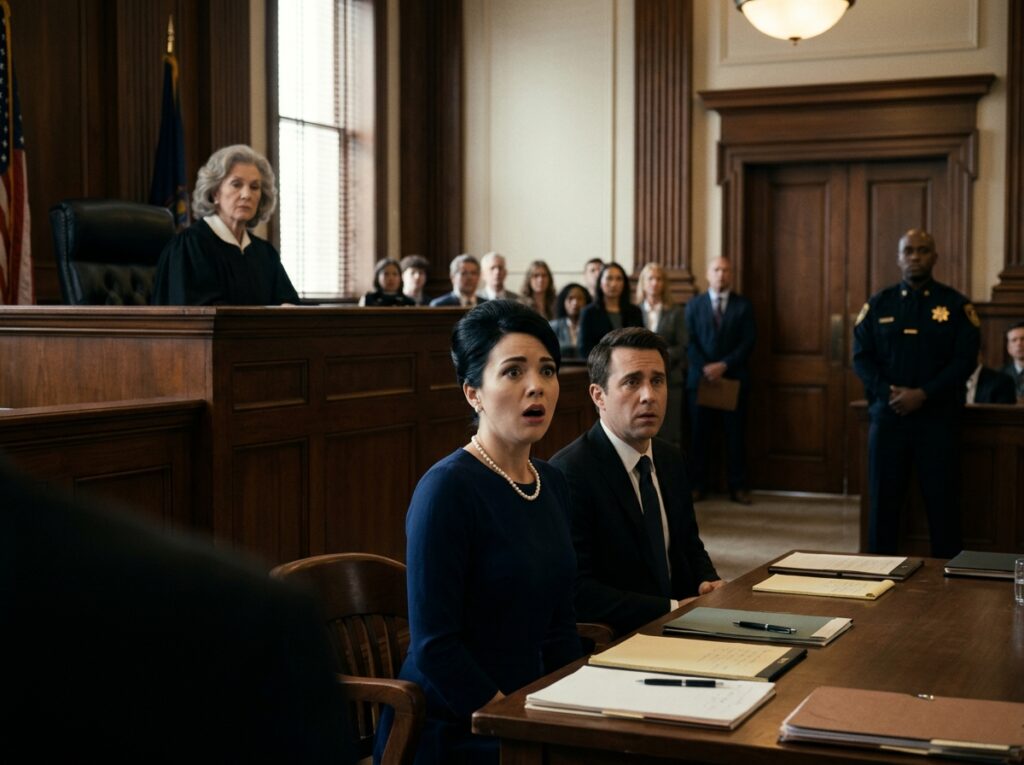
Ten minutes after Clara shoved me against a wall, every person in Courtroom 4B rose when I entered.
“All rise,” Marcus commanded.
Chairs scraped backward.
Clara lifted her eyes casually.
The color left her face so quickly that for a moment I thought she might faint.
David stood beside her. He looked pale, but not surprised.
That mattered.
Clara’s lips parted.
“No,” she breathed.
I walked toward the bench.
The courtroom was filled beyond capacity. State investigators occupied the first row. Attorneys crowded the aisle. Several elderly former clients of Vale Protective Services sat together near the rear, their hands clasped tightly in their laps.
I recognized eighty-two-year-old Samuel Owens, whose house had been sold while he was recovering from pneumonia.
Beside him sat Rose Bell, Naomi’s grandmother.
Rose’s eyes were red.
I took my seat.
“Please be seated.”
Everyone obeyed except Clara.
She remained standing, one hand gripping the table.
“You’re a judge?”
The words came out raw and incredulous.
David closed his eyes.
I looked at Clara from the bench.
“In this courtroom, counsel will address the court as ‘Your Honor.’”
A ripple moved through the gallery.
Clara’s lawyer, a silver-haired man named Everett Shaw, caught her wrist and pulled her into her chair.
“Sit down,” he hissed.
She sat.
Her confidence had not vanished entirely, but it had cracked.
I opened the file before me.
“For the record, this is the matter of the Illinois Department of Financial and Professional Regulation versus Vale Protective Services and Clara Vale Warren. I am Helen Warren, recalled associate judge, temporarily assigned to open this emergency hearing.”
Clara turned toward David.
“You knew?”
He stared straight ahead.
“You knew she was a judge?”
David said nothing.
Her nails dug into his sleeve.
I continued.
“The respondent, Mrs. Warren, is my daughter-in-law. Mr. David Warren, seated beside her, is my son. I therefore have a direct familial conflict and will not rule on the merits of this petition.”
Clara exhaled sharply.
Relief flickered across her face.
She believed recusal had saved her.
“However,” I said, “before transferring the matter, the court must address an incident that occurred outside this courtroom approximately twelve minutes ago.”
The relief vanished.
Marcus stepped forward.
The young clerk who had witnessed the shove entered through the side door. Behind her came the courthouse security officer and two attorneys from the corridor.
Clara’s mouth tightened.
I looked at her.
“Mrs. Warren, you are alleged to have physically assaulted me in a public courthouse hallway in the presence of multiple witnesses and surveillance cameras.”
“That is ridiculous,” Clara said quickly. “She stumbled.”
A voice from the gallery said, “No, she didn’t.”
Samuel Owens had risen.
His hands shook, but his voice did not.
“She pushed you.”
“Mr. Owens,” I said gently, “please sit. You may be called as a witness later.”
He lowered himself into the seat.
Everett Shaw leaned toward Clara. “Say nothing else.”
Clara ignored him.
“This is exactly why she shouldn’t be here,” she said. “She hates me.”
I felt no satisfaction in what happened next.
Only a cold, profound sadness.
“Mrs. Warren,” I said, “you are in a courtroom, not a drawing room. The truth will not change because you pronounce it with confidence.”
Her face hardened.
I turned to Marcus.
“Preserve the corridor surveillance footage. Obtain written statements from all available witnesses. Notify courthouse security that Mrs. Warren is not to leave the building pending review by the criminal division.”
Clara surged to her feet.
“You can’t detain me!”
Chief Judge Elena Alvarez entered through the side door.
She was sixty-three, small in stature, and formidable enough to make seasoned trial lawyers forget their own names. Her black robe moved behind her as she approached the bench.
“Actually,” she said, “we can.”
The courtroom fell silent.
I stood and moved to the adjacent chair.
Judge Alvarez took the center seat.
“The conflict has been disclosed,” she said. “Judge Warren is recused from all further rulings in this matter. I am assuming jurisdiction.”
Her gaze moved to Clara.
“Mrs. Warren, sit down.”
This time Clara obeyed.
Judge Alvarez opened a second folder.
“The state has filed an emergency motion to freeze all assets belonging to Vale Protective Services, its subsidiaries, and its controlling officers. The motion alleges the theft of approximately forty-three million dollars from thirty-one elderly wards.”
Gasps broke across the courtroom.
Clara’s face went still.
David looked down at the table.
Judge Alvarez continued.
“The state also reports that a confidential witness connected to this matter has disappeared.”
Rose Bell made a small broken sound.
I looked toward her.
She clutched a photograph of Naomi against her chest.
Clara turned just enough to see the older woman’s grief.
For half a second, something appeared in Clara’s eyes.
Not compassion.
Calculation.
Judge Alvarez saw it too.
“Mrs. Warren,” she said, “do you know where Naomi Bell is?”
“No.”
“Did you know she intended to testify?”
“No.”
“Have you had contact with her in the past forty-eight hours?”
“No.”
Judge Alvarez looked toward the state investigator.
A woman in a gray suit stood.
“Your Honor, the state requests permission to play an audio recording recovered this morning.”
Everett Shaw rose immediately.
“Objection. We have not authenticated—”
“This is a preliminary emergency proceeding,” Judge Alvarez said. “I will hear it subject to later authentication.”
The investigator placed a small speaker on counsel’s table.
Static filled the courtroom.
Then Clara’s voice emerged.
Calm. Distinct. Unmistakable.
“If Naomi reaches the courthouse, everything changes.”
A man answered, his voice distorted.
“She won’t.”
Clara said, “And Helen?”
A pause.
Then: “Helen will do what she always does. She’ll protect David.”
The recording ended.
Every person in the courtroom seemed to turn toward me.
But I was looking at my son.
David’s face had gone gray.
Clara whispered, “That recording is fabricated.”
Judge Alvarez looked at the investigator.
“Who was the man?”
“We are still analyzing the audio.”
Clara’s eyes found David’s.
He did not look at her.
Judge Alvarez ordered the assets frozen. She suspended Clara’s professional license, placed travel restrictions on her, and directed federal investigators to join the search for Naomi Bell.
Then Marcus received a message on his radio.
He crossed the courtroom and handed a note to Judge Alvarez.
She read it once.
Then again.
Her expression changed.
“Mr. Warren,” she said, looking at David, “where is your daughter?”
My heart stopped.
David’s head snapped up.
“What?”
“Your daughter, Lily Warren. Where is she?”
“At school.”
“No,” the investigator said. “She was signed out forty minutes ago.”
“By whom?”
The investigator’s silence answered before her words did.
“By her mother.”
Every head turned toward Clara.
Clara stared at David.
He stared back.
For the first time that morning, the mask between them disappeared.
What remained was not marriage.
It was war.
“Where is Lily?” David asked.
Clara’s lips curved faintly.
“I don’t know what they’re talking about.”
David stood so quickly his chair struck the floor.
“Where is my daughter?”
Everett Shaw grabbed his arm.
Judge Alvarez struck the gavel.
“Mr. Warren!”
But David was no longer listening.
He leaned across the table toward Clara.
“If you touched her—”
Clara smiled.
It was the same smile she had worn after shoving me.
“You should have thought of that before you chose your mother.”
David went utterly still.
The courtroom erupted.
Marcus and another officer moved between them. Judge Alvarez ordered Clara taken into temporary custody on the courthouse assault and possible witness-tampering charges.
As officers approached, Clara turned toward me.
“You still don’t understand,” she said.
Her eyes shone with something close to delight.
“Your son is the reason all of this happened.”
Then she was led away.
David watched her go.
I stepped down from the bench.
“David.”
He did not answer.
“Look at me.”
He turned.
The man before me no longer looked weak.
He looked hunted.
“Mom,” he said, “I need you to remember something.”
“What?”
“Summer of 1994. The grocery store.”
The memory struck like a match in a dark room.
David had been nine.
A man with a knife entered the neighborhood grocery store while we were buying milk. I had seen the weapon before David did. I had knelt beside him and whispered, Wait downstairs, though there was no downstairs.
It was our code.
It meant: Danger. Do not react. Keep walking. Trust me.
I stared at my son.
The corridor.
His lowered eyes.
“Mom… maybe you should wait downstairs.”
The words had not been cowardice.
They had been a warning.
“David,” I whispered, “what have you done?”
He looked toward the doors through which Clara had disappeared.
“I married a woman I thought I understood.”
“And then?”
“Then I discovered she was stealing from people who couldn’t fight back.”
“How long have you known?”
“Eight months.”
“Why didn’t you come to me?”
“Because she showed me a photograph of Lily sleeping.”
The words seemed to drain the air from the courtroom.
David swallowed.
“She told me that if I contacted law enforcement, if I spoke to you, or if I tried to leave, Lily would disappear. She had people watching the house. Watching the school. Watching you.”
My hands went cold.
“The man on the recording?”
“I don’t know.”
“You were working with Clara?”
“I pretended to.”
Judge Alvarez approached us.
“Mr. Warren, you need to speak to investigators now.”
David nodded.
Then he reached inside his jacket.
Three officers moved instantly.
David froze.
“It’s only a key.”
He removed a small brass key.
It matched the one in my handbag.
I stared at it.
My key had belonged to my mother. She had given it to me when David was born and told me it opened a box that should never be opened unless our family was in danger.
I had assumed the box no longer existed.
David placed his key in my palm.
“Dad gave me this.”
The courthouse disappeared around me.
“What did you say?”
“Dad gave it to me three months ago.”
My fingers closed around the key so tightly that the edges cut my skin.
“Your father has been gone for forty-two years.”
“No,” David said. “He hasn’t.”
My husband, Richard Warren, vanished when David was thirteen.
There had been no body, no farewell, and no explanation beyond a letter placed beneath our apartment door.
Helen, I was never meant for this life. Don’t look for me.
I had spent years hating him.
Then more years pretending I no longer cared.
I raised our son alone. I attended law school at night. I built a career from exhaustion and fury. I became a judge because I had learned what happened to families when powerful people disappeared without consequences.
Now David was telling me Richard had been alive all along.
“Where is he?” I asked.
“I don’t know.”
“You just said he gave you the key.”
“He found me outside my office. He looked older, but I knew him from the photographs. He said Clara was connected to something he had started years ago.”
Judge Alvarez’s face sharpened.
“What did he start?”
David looked toward the elderly victims seated in the gallery.
“A guardianship network.”
Rose Bell covered her mouth.
David continued.
“He said it began as a legal service. Then the money grew. Lawyers, doctors, social workers, property appraisers—everyone took a percentage. They identified isolated elderly people, declared them incompetent, took control of their estates, and moved them into facilities owned by the same companies.”
“And Richard?” I asked.
“He said he tried to leave.”
“Did you believe him?”
“No.”
The answer came without hesitation.
“Why not?”
“Because he knew too much. He knew names Clara had never mentioned. Bank routes. Judges. Closed cases. And he didn’t ask about you.”
That hurt in a place I thought time had numbed.
David looked at the brass key.
“He told me there was a box at Union Station. He said the contents could destroy the organization.”
“Why didn’t you open it?”
“I tried. It requires both keys.”
My mother’s key.
Richard’s key.
Two halves of a secret buried for four decades.
Judge Alvarez summoned federal agents.
Within twenty minutes, David, two investigators, Marcus, and I were traveling through Chicago in an unmarked vehicle toward Union Station.
Rain had begun to fall.
The city blurred beyond the windows—glass towers, traffic lights, pedestrians disappearing beneath umbrellas.
I sat beside David.
Neither of us spoke for several minutes.
Finally, I said, “You let her shove me.”
His face twisted.
“I didn’t know she would.”
“You saw her raise her hand.”
“I saw the federal investigator behind you. I knew the corridor cameras were active. I knew if I moved too soon, Clara might realize the hearing was a trap.”
“So you chose evidence over me.”
“I chose Lily.”
The answer struck hard.
Then he lowered his head.
“And I will hate myself for it every day.”
I wanted to remain angry.
A judge learns to hold emotion at a distance. A mother never does.
I reached across the seat and touched his hand.
“We find Lily first,” I said. “Then we decide what forgiveness looks like.”
He nodded.
Union Station was crowded with afternoon travelers.
The brass keys opened a locker hidden behind a row of newer steel compartments near an abandoned service hallway.
Inside was a black metal box.
No money.
No weapon.
Only documents.
Hundreds of them.
Guardianship orders. Medical declarations. Property deeds. Photographs. Bank records. Lists of names stretching back more than thirty years.
At the bottom lay a small cassette recorder and an envelope addressed to me.
HELEN—WHEN YOU LEARN THE TRUTH, DO NOT TRUST THE MAN WHO BRINGS YOU THIS.
I looked at David.
He had read the sentence too.
His face changed.
“Mom, I didn’t know that was there.”
The federal investigator took the envelope with gloved hands.
Inside was a single photograph.
Richard stood beside Clara.
She appeared to be about fourteen years old.
He had one hand on her shoulder.
On the back, in Richard’s handwriting, were the words:
Clara Vale. The daughter I chose.
David sat down heavily on the bench outside the locker room.
“Chosen?”
The investigator searched the documents.
“She was raised in foster care,” she said. “Her biological parents died when she was six. Richard Warren became trustee of a private foundation that funded her education.”
I stared at the photograph.
Richard had not simply met Clara.
He had shaped her.
Years before she met David.
Years before she entered my home, called me provincial, mocked my clothes, and gradually isolated my son from me.
He had sent her.
The realization was so monstrous that my mind resisted it.
“Why?” David whispered.
I knew the answer before anyone said it.
“To reach me.”
Richard had vanished when I was a struggling court reporter attending night law school.
He could not have known I would become a judge.
Unless he had been watching.
Unless every promotion, every important case, every public victory had made me more valuable to him.
A respected judge was not merely an enemy.
She was a shield.
A connection.
A source of legitimacy.
Clara had married David to place herself near my name.
Near my reputation.
Near the judicial system.
The investigator found a ledger page with three initials repeated beside dozens of payments.
C.V.
R.W.
D.W.
Clara Vale.
Richard Warren.
David Warren.
My son stared at his initials.
“I never received any money.”
The investigator looked at him carefully.
“Then someone wanted it to appear that you did.”
A phone rang.
Marcus answered.
His expression tightened.
“What location?”
He listened.
Then looked at us.
“They found Naomi Bell.”
Rose Bell had received a message from Naomi’s phone containing an address on the South Side.
An abandoned private nursing facility called Lakecrest House.
It had closed eight years earlier after a fire inspection.
The property records showed it was owned by a shell company listed in Richard’s ledgers.
Lily might be there too.
Federal agents ordered David and me to remain at Union Station.
Neither of us did.
By the time the tactical team entered Lakecrest House, rain was hammering the broken windows and turning the rear courtyard into black mud.
The building rose from the darkness like something forgotten by the city. Its brick walls were stained. Half the windows were boarded. A rusted sign swung over the entrance.
Marcus remained beside me as agents moved through the corridors.
The air inside smelled of mildew, disinfectant, and old fear.
Empty wheelchairs stood against the walls.
Patient-room doors had numbers but no names.
On the second floor, we heard a child crying.
David ran.
“Lily!”
He reached Room 214 before the agents could stop him.
The door was locked.
He struck it with his shoulder once, twice, then stepped back as an officer forced it open.
Lily was inside.
She sat on a narrow bed with her arms wrapped around her knees. Her dark hair was tangled. There was tape residue around one wrist, but no visible injuries.
“Daddy!”
David crossed the room and gathered her into his arms.
The sound he made was unlike anything I had ever heard from him.
It was grief, relief, guilt, and love breaking loose all at once.
I knelt beside them.
Lily reached for me.
“Grandma.”
I held them both.
For several seconds, the entire case—the money, the lies, the courthouse, Richard—ceased to exist.
There was only my son.
My granddaughter.
And the terrible knowledge of how close we had come to losing one another.
Naomi Bell was found in a storage room across the hall, dehydrated and frightened but alive.
Three elderly people were discovered on the third floor.
They had been kept under false names after their legal deaths were recorded.
One of them was Samuel Owens’s sister, Margaret, whom he believed had died two years earlier.
The organization had not merely stolen estates.
It had erased human beings.
Then agents found the control room.
Six monitors displayed live feeds from hidden cameras.
David’s house.
Lily’s school.
My apartment building.
The courthouse entrance.
We had been watched for months.
On the central desk sat a telephone.
It rang.
Every agent in the room froze.
The lead investigator activated the speaker.
“Hello?”
A man’s voice answered.
Older.
Cultured.
Familiar enough to stop my heart.
“Helen.”
I gripped the edge of the desk.
Richard.
Forty-two years disappeared in a breath.
I heard him laughing in our first apartment. I heard him singing badly while he painted David’s nursery. I heard the argument we had the night before he vanished.
“You were always stubborn,” he said.
“You were always a coward.”
He chuckled.
The sound made my skin crawl.
“You found the box.”
“Yes.”
“And the boy?”
David stepped toward the phone.
“I’m not a boy.”
Richard ignored him.
“Helen, Clara has become unstable.”
“You made her.”
“I educated her.”
“You trained her to destroy elderly people.”
“I taught her that the law is only a machine. Machines belong to the people who understand how they work.”
I looked at the monitors.
“At least thirty-one people lost everything because of you.”
“Thirty-one people the state noticed.”
The room went silent.
Richard continued.
“Do you know why I chose guardianships? Because no crime is easier than stealing from someone the court has already decided not to believe.”
Even the agents looked shaken.
“Where are you?” I asked.
“You know where.”
“No.”
“The place where you first told me you were pregnant.”
The old lakeside courthouse in Evanston.
It had been converted into a private legal museum years ago.
A building Richard’s foundation had recently purchased.
“Come alone,” he said.
“No.”
“Then you will never learn why David’s name appears in the ledger.”
David leaned toward the phone.
“My name appears because you put it there.”
Richard laughed softly.
“Did I?”
The call ended.
Federal agents refused to let me go alone.
So we made him believe I had.
At midnight, I entered the old courthouse wearing a wire beneath my sweater.
Rainwater dripped from the carved stone lions outside. The building was dark except for a light glowing inside the original courtroom.
Richard stood before the empty jury box.
He was eighty-one.
Time had narrowed his shoulders and whitened his hair, but I recognized the posture immediately. Richard had always stood as though the room owed him attention.
He wore a dark suit and held a cane he did not appear to need.
“Helen.”
I stopped inside the doorway.
He smiled.
“You became exactly what I expected.”
“A judge?”
“Lonely.”
The word struck with surgical precision.
I refused to show it.
“Why Clara?”
“She was brilliant. Angry. Unclaimed. Children without families are very easy to shape.”
“You made her marry David.”
“I introduced them.”
“You told her to use him.”
“I told her that love is useful when properly managed.”
My hands curled at my sides.
“She kidnapped your granddaughter.”
“She forced David to reveal himself.”
“He was working against you.”
“Yes.” Richard’s face tightened. “A disappointment.”
“You left him when he was thirteen.”
“I left because you were becoming inconvenient.”
“I was a court reporter.”
“You were curious. You had started asking why certain guardianship files disappeared from the archive.”
The memory returned.
Missing case files.
Repeated physician names.
Emergency orders signed after midnight.
I had noticed the patterns months before Richard vanished, but I had never understood their significance.
“You thought I knew,” I said.
“I thought you would eventually.”
“So you abandoned us.”
“I protected the organization.”
“And watched us afterward.”
His silence confirmed it.
I took another step.
“Why is David’s name in the ledger?”
Richard smiled again.
“Because David signed the transfers.”
“No.”
“You want to believe your son is noble because you sacrificed for him. Parents are vain that way.”
“He was being threatened.”
“Some signatures predate Lily’s birth.”
The certainty in his voice unsettled me.
“Show me.”
Richard opened a leather folder and placed documents on the counsel table.
There were wire transfers bearing David’s electronic signature.
Corporate registrations.
Emails.
One message read:
My mother will never suspect me. She sees what she needs to see.
My chest tightened.
Richard watched me.
“There is your real son.”
I studied the pages.
The timestamps stretched across twelve years.
Long before David claimed he discovered Clara’s crimes.
Long before Lily was threatened.
For a moment, the old courthouse seemed to tilt.
Had my son lied?
Had his coded warning been merely another performance?
Richard moved closer.
“You know what judges learn, Helen. Evidence is cruel because it does not care whom you love.”
Behind my wire, the agents were listening.
I forced myself to breathe.
Then I looked again at the email.
Not the words.
The punctuation.
David always used two spaces after a period. A habit I had tried to correct since college.
These messages used one.
That proved nothing by itself.
But the signatures did.
David signed his middle name with a sharp upward stroke through the final letter.
The documents showed a downward stroke.
Richard had forgotten something important.
I had taught David to write.
“These are excellent,” I said.
Richard’s smile deepened.
“You believe them?”
“No.”
His expression changed.
“You forged my signature for years,” I continued. “You forged doctors’ reports, death certificates, deeds, and court orders. Of course you forged David’s.”
“You cannot prove that.”
“I don’t have to.”
I removed the old brass key from my pocket.
His eyes dropped to it.
“You made one mistake,” I said.
“What mistake?”
“You trusted paper more than memory.”
I placed the key on the table.
“My mother gave me this when David was born. You told him you had the matching key. But you never possessed it.”
Richard’s face went still.
“The second key belonged to my father,” I said. “He died before you and I met.”
Silence filled the courtroom.
Richard looked toward the doors.
The trap had closed.
“You didn’t give David that key,” I said. “Someone else did.”
Richard lunged for the leather folder.
Agents entered from every doorway.
Marcus reached him first, knocking the cane aside and forcing him against the counsel table.
Richard shouted as officers handcuffed him.
But I barely heard him.
One question remained.
If Richard had not given David the key, who had?
The answer arrived the following morning.
Naomi Bell asked to speak with me privately from her hospital room.
Her grandmother sat beside the bed. David stood near the window with Lily asleep against his chest.
Naomi looked exhausted, but her eyes were clear.
“I’m sorry,” she said.
“For what?”
“I lied about how I found the ledgers.”
“Who gave them to you?”
She looked at David.
Then at me.
“Clara.”
No one spoke.
I thought I had misheard.
“Clara gave you the evidence?”
Naomi nodded.
“Eight months ago.”
David went pale.
“That’s when she started threatening me.”
“She wasn’t threatening you to protect the organization,” Naomi said. “She was trying to keep Richard from discovering you were investigating.”
My mind rejected the possibility.
“Clara kidnapped you.”
“No. Richard’s men did. Clara arranged the anonymous message that led agents to Lakecrest House.”
“And Lily?”
“Clara signed her out of school because Richard had already sent someone else. She reached Lily first.”
David slowly sat down.
Naomi continued.
“Clara knew the courthouse hearing was being monitored. She needed Richard to believe she was still loyal. Everything she did in public was for his cameras.”
The shove.
The insults.
The cruelty.
I remembered the live feed trained on the courthouse entrance.
But the corridor camera belonged to the court, not Richard.
Unless one of the people nearby had carried a hidden camera.
The young clerk.
The security officer.
One of the attorneys.
Anyone.
“She assaulted me,” I said.
Naomi’s expression tightened.
“She told me she had to make Richard believe she hated you.”
“She could have pretended without putting me into a wall.”
“Yes.”
Naomi did not excuse her.
Neither did I.
“Why didn’t she tell David?”
“Because Richard had someone inside the federal investigation. Clara didn’t know whom she could trust.”
David stared at the floor.
“Did she love me?”
Naomi’s eyes softened.
“I don’t know.”
That was the cruelest answer because it was honest.
Clara remained in custody.
When investigators confronted her with Richard’s arrest, she asked for one person.
Not David.
Me.
We met in an interview room beneath the federal courthouse.
She wore a gray detention uniform. Without the navy dress, pearls, and red lipstick, she looked younger. Smaller.
But not harmless.
A bruise darkened my shoulder beneath my blouse.
I sat across from her.
“You shoved me.”
“Yes.”
“You called me filthy.”
“Yes.”
“You let David believe you had taken Lily.”
“Yes.”
“Why?”
“Because Richard was watching.”
“You could have warned me.”
“He would have known.”
“You could have chosen another way.”
Her eyes filled, but she did not look away.
“I chose the way I thought would work.”
“That is what cruel people always say.”
She flinched.
Good.
Some truths should hurt.
“Did you marry David because Richard told you to?”
“At first.”
The words cut even though I expected them.
“And later?”
“I loved him.”
“You controlled him.”
“I was trying to keep him alive.”
“You isolated him from me.”
“Richard demanded it.”
“You obeyed.”
“Yes.”
“Until when?”
“Until Lily was born.”
Something in her face changed.
“When I held her,” Clara said, “I understood what he had done to me. He had taken a child who belonged to no one and taught her that love was weakness. I realized he would do the same thing to Lily.”
“So you gathered evidence.”
“For nine years.”
Nine years.
Not eight months.
Not twelve.
Nine.
“You had enough evidence years ago.”
“No. I had fragments. Richard never placed his name on anything. He used people, then erased them.”
“You could have come to me.”
Clara gave a broken laugh.
“You were the last person I could approach.”
“Because you hated me?”
“Because Richard did.”
She leaned forward.
“You still don’t understand why he watched you.”
“He feared I would expose him.”
“No.”
Her eyes held mine.
“He was waiting for you to become chief judge.”
I felt cold.
“I was never chief judge.”
“You were on the final selection list three years ago. If you had accepted, Richard planned to release evidence implicating David. He would have offered to make it disappear in exchange for judicial appointments and access.”
My stomach turned.
“I declined the nomination.”
“Yes. You said you wanted to spend more time with Lily.”
A decision I had considered small had saved the court from infiltration.
Clara looked down at her hands.
“Richard was furious.”
“Is that when he ordered you to take control of Vale Protective Services?”
“Yes.”
“Why name it Vale?”
“It was the surname on my first foster placement. Richard liked the irony of building an empire from the name of people who abandoned me.”
I studied her.
She had committed crimes.
She had lied, manipulated, threatened, and assaulted me.
But she had also spent nine years collecting the evidence that destroyed Richard.
She was both victim and perpetrator.
The law prefers clean categories.
Life rarely provides them.
“Did you arrange Naomi’s abduction?” I asked.
“No.”
“Did you authorize theft from the wards?”
“I signed documents.”
“Knowing what they did?”
“At first, yes.”
“How many people lost their homes because of your signature?”
She closed her eyes.
“Seventeen.”
“How many died believing no one would help them?”
“I don’t know.”
“That answer will follow you longer than any sentence.”
A tear slid down her cheek.
“I know.”
I stood.
“Helen.”
I stopped at the door.
“Tell David I loved him.”
“Tell him yourself.”
“He won’t come.”
“That is his choice.”
Her voice broke.
“And Lily?”
“You saved her.”
Clara looked up.
“Will you tell her that?”
“I will tell her the truth.”
All of it.
That was the only promise I could make.
Richard’s trial lasted four months.
The evidence filled an entire secured room.
He had corrupted doctors, attorneys, social workers, property managers, and court clerks. More than ninety elderly people had been stripped of their assets. Eleven had been hidden under false identities after being declared dead. Four had actually died in facilities he controlled.
Clara pleaded guilty to conspiracy, fraud, unlawful restraint, and evidence tampering. In exchange for her cooperation, prosecutors recommended a reduced sentence.
David attended every day of Richard’s trial.
He did not attend Clara’s sentencing.
I did.
The courtroom was not 4B.
I did not wear a robe.
I sat beside Rose Bell and Samuel Owens as an ordinary woman with a healing shoulder and a family that would never again fit its original shape.
Clara received twelve years.
Before the marshals led her away, she turned toward the gallery.
Her eyes found me.
I gave her one nod.
Not forgiveness.
Recognition.
Sometimes that is all justice can offer.
Richard received six consecutive life sentences.
He smiled while the judge spoke.
Then the prosecution presented its final witness.
A ninety-one-year-old woman entered using a silver cane.
I recognized her before anyone said her name.
Margaret Warren.
My mother.
The woman I had buried twenty-seven years earlier.
I stood so suddenly my chair struck the bench behind me.
The courtroom blurred.
My mother looked at me.
Her face was thinner. Her hair was white. But her eyes were the same eyes that had watched me leave for law school each evening, the same eyes that had looked into mine when she gave me the brass key.
“Helen,” she said.
I could not breathe.
The woman buried under my mother’s name had been an unidentified victim Richard substituted after arranging Margaret’s legal death.
My mother had discovered the guardianship network before I did.
Richard had taken her.
He had kept her in private facilities under false names for nearly three decades because she knew where the original records were hidden.
The brass key had not opened a family box.
It had opened the first ledger.
My mother had given David the second key.
She had escaped a facility three months earlier, found him, and sent him toward the truth.
Richard had assumed she was dead.
Clara had found her first and hidden her in a protected federal residence.
That was why Clara had known the location of the ledgers.
That was why the note inside the box warned me not to trust the man who brought the key.
It did not refer to David.
It referred to Richard.
After court adjourned, my mother and I stood facing each other in an empty witness room.
Twenty-seven stolen years existed between us.
I wanted to ask why she had not escaped sooner.
I wanted to demand how she could let me mourn her.
Then I saw the scars around her wrists.
All my questions became grief.
“I tried to come home,” she whispered.
I crossed the room and held her.
She felt impossibly light.
I pressed my face against her shoulder and wept like a child.
David entered quietly with Lily.
My mother looked at him and smiled.
“You kept the code,” she said.
David nodded.
“Wait downstairs.”
She had taught it to me when I was young.
I had taught it to David.
Three generations had carried the same hidden language through danger.
Lily looked up at us.
“What does it mean?”
I knelt and took her hands.
“It means that when someone you love tells you to keep walking, sometimes they are not abandoning you.”
David’s face crumpled.
I looked at my son.
For months, I had believed his silence outside Courtroom 4B was cowardice.
Then I believed it was strategy.
The truth was more painful and more beautiful.
He had seen a hidden camera clipped inside Clara’s pearl brooch.
He had known Richard was watching.
He had known one wrong movement could cost Lily her life.
So he had used the oldest warning our family possessed.
Mom… maybe you should wait downstairs.
He had not chosen Clara over me.
He had trusted me to remember who we were.
I stood and embraced him.
“I’m sorry,” he whispered.
“So am I.”
“For what?”
“For doubting the boy I raised.”
He held me tighter.
Across the room, my mother watched us with tears in her eyes.
Lily wrapped her arms around all three of us.
We must have looked ridiculous—four generations tangled together beneath fluorescent lights, laughing and crying while federal agents waited politely outside.
But after a lifetime inside courtrooms, I had learned that the most important verdicts are rarely announced from a bench.
They arrive quietly.
In a son returning to his mother.
In a stolen woman reclaiming her name.
In a child learning that family courage can survive even the people who try to weaponize love.
Six months later, I returned to Courtroom 4B for the final time.
I had decided not to renew my recall appointment.
The room was empty except for Marcus, who stood near the doors while I packed a few books into a box.
On the bench lay my black robe.
I ran my hand across the fabric.
For years, I had believed power lived in that robe.
Clara had believed power lived in money, beauty, fear, and control.
Richard had believed power belonged to whoever could make the law doubt the vulnerable.
We had all been wrong.
Power had been an old woman standing beneath harsh courthouse lights and refusing to disappear.
It had been a frightened son speaking five coded words.
It had been a missing clerk preserving a ledger.
It had been victims rising one by one to say, “I was here. This happened to me. You will not erase me.”
Marcus lifted the box.
“Ready, Judge?”
I looked once more at the bench.
Then I removed the robe and folded it carefully.
“Yes.”
Outside Courtroom 4B, attorneys hurried past. Clerks carried files. Families whispered anxiously near the doors.
A few people recognized me.
Most did not.
I wore the same modest beige coat Clara had mocked.
The bruise on my shoulder had faded, but I could still remember the cold marble and the sound of my handbag striking the floor.
I could still remember Clara’s smile.
I could still remember David looking down.
But now I understood what no one else in that corridor had known.
The frail elderly woman they overlooked had never been powerless.
She had been surrounded by secrets, betrayal, and danger.
She had been wounded by the people she loved.
She had nearly lost her son, her granddaughter, her mother, and her faith in her own judgment.
Yet she had walked into that courtroom.
And when the bailiff ordered everyone to rise, they were not rising for a robe.
They were rising for every person the powerful had mistaken for invisible.
My mother waited for me at the courthouse entrance, one hand resting on her silver cane.
David stood beside her.
Lily ran toward me, her red coat flying open behind her.
“Grandma!”
I bent and caught her.
She kissed my cheek and whispered, “Wait downstairs.”
I laughed.
“That is only for emergencies.”
“I know,” she said solemnly. “I just wanted to make sure you remembered.”
I looked over her shoulder at David.
He smiled.
This time, he did not look away.
I carried Lily down the courthouse steps as snow began to fall over Chicago.
Behind us, the great stone building remained—cold, solemn, imperfect.
Ahead of us waited a family that had been broken, deceived, and rebuilt around truths none of us could have imagined.
Richard had spent forty-two years believing he had erased us.
Instead, he had bound us together through the very secret meant to destroy us.
And that was the final judgment he never saw coming:
The women he made invisible became the witnesses who ended his empire, the son he abandoned became the man who exposed him, and the family he tried to corrupt walked away carrying the one power he could never steal—trust restored by truth.