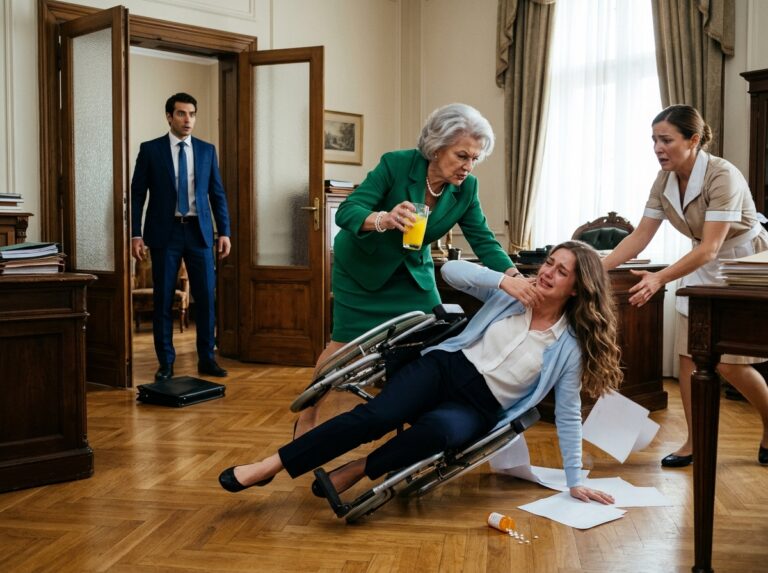
At exactly 2:13 on Easter Sunday, Arthur Miller heard the one word capable of dragging a father straight into hell.
“Dad…”
The voice coming through his phone barely sounded like Lily. It was small, fractured, trembling beneath the desperate effort of a grown woman trying not to cry.
“Please come get me.”
Arthur stood frozen beside the kitchen sink. Soap slid from his wrists and pattered onto the worn linoleum. A cup of coffee had gone cold near his elbow. His modest house smelled of lemon cleaner, smoked ham, and the heavy loneliness that had followed him through every room since his wife died.
He had prepared Easter dinner out of habit.
Two plates still sat in the cupboard.
Only one had been placed on the table.
Since Helen’s death, Arthur had learned to eat alone.
Sleep alone.
Wake from nightmares without calling anyone’s name.
He had learned how to carry grief the way some men carried old shrapnel—quietly, permanently, and without allowing anyone to see how deeply it hurt.
But he had never learned how to hear his daughter sound afraid.
“Lily,” he said, forcing his voice to remain steady. “Where are you?”
A faint clatter sounded through the phone.
She whispered, “Richard’s house.”
Not home.
Not our house.
Richard’s house.
Arthur understood the distinction immediately.
“What happened?”
For three seconds, he heard only her shallow breathing and the faint notes of a violin concerto playing somewhere in the background.
Then Lily spoke the five words that turned his blood to ice.
“He hit me again, Dad.”
Arthur’s hand tightened around the phone.
A father never forgot certain sounds.
His baby’s first cry.
Her first laugh.
Tiny feet racing across the porch.
A little girl shouting “Daddy!” with absolute faith that he could repair broken toys, frightened birds, bad dreams, and every unfair thing in the world.
Then another sound exploded through the phone.
A scream.
A heavy thud.
The scrape of furniture.
Silence.
“Lily?”
Faint classical music continued playing.
Children laughed somewhere nearby. Glasses clinked. A woman called cheerfully for someone named Sophie to find the golden Easter egg.
The holiday continued as though Arthur Miller’s entire world had not just been torn open.
“Lily!”
The line remained connected, but she did not answer.
Arthur was inside his truck before he remembered grabbing his keys.
Richard Whitmore’s estate stood behind towering black iron gates in the wealthiest part of Bellweather, a town where money did not merely purchase comfort.
It purchased memory.
Silence.
Loyalty.
Sometimes innocence.
The lawns looked painted. Every hedge had been cut into obedient symmetry, and every polished window reflected generations of old wealth. White tents covered the garden. Women in pastel dresses raised champagne glasses beneath strings of ivory ribbons. Men in linen jackets laughed beside the stone patio while children ran across the grass with wicker baskets, hunting brightly painted eggs.
Everything looked perfect.
Arthur had lived long enough to know that perfection was often where rot hid best.
He drove through the open gates without slowing and stopped crookedly in the circular driveway. Tires ground against white gravel. Several guests turned toward the noise, but Arthur was already out of the truck.
He climbed the marble steps two at a time.
Before he could ring the bell, the front door opened.
Margaret Whitmore stood there wearing pearls, diamonds, and an expression of pure contempt. A mimosa rested elegantly in one hand. Her silver-blonde hair had been arranged so carefully that not even the spring wind dared disturb it.
Richard’s mother had always looked at Arthur as though his working-class clothes and widower’s grief might stain her carpet.
“Go back to your lonely little house, Arthur,” she said. “Lily is resting. Don’t ruin our holiday with your drama.”
Arthur’s voice remained dangerously calm.
“I’m here for my daughter.”
“She isn’t leaving.”
Margaret took a delicate sip from her glass.
“She’s having one of her little episodes.”
Arthur stared at her.
“What kind of episode leaves blood on a man’s cuff?”
For the first time, Margaret’s gaze flicked toward the interior of the house.
It lasted less than a second.
It was enough.
She stepped forward and shoved him.
Hard.
Arthur’s heel scraped across the stone porch. Behind Margaret, several guests stopped speaking.
For one dangerous second, something buried deep inside Arthur awakened.
Something disciplined.
Something ruthless.
Something trained to identify a threat, calculate the quickest route through it, and neutralize it before anyone else understood what had happened.
He had locked that part of himself away fifteen years earlier.
For Lily.
For Helen’s memory.
For the promise he had made beside an empty grave.
Arthur did not touch Margaret.
He simply stepped around her and entered the house.
The living room fell silent.
A woman near the buffet stopped with a deviled egg halfway to her mouth. A man lowered his champagne glass. Somewhere near the fireplace, a fork struck a porcelain plate with a single sharp tap.
Outside, children continued laughing.
Inside, no one moved.
And no one looked surprised enough.
That was how Arthur knew they had heard everything.
Lily lay in the center of a spotless white rug.
His little girl—the child who once slept against his chest during thunderstorms, rescued injured birds from the garden, and cried at television commercials about elderly dogs.
Now one side of her face was swollen. Her left eye was turning purple. Her lip was split, and her arms were wrapped tightly around her ribs as though she were desperately trying to hold herself together.
A thin line of blood stained the rug beneath her mouth.
Standing over her was Richard Whitmore.
Arthur’s son-in-law.
The celebrated real estate heir. The generous church donor. The man who shook hands with governors, funded children’s hospitals, and had once appeared on the cover of Bellweather Monthly beneath the words The Future of Our City.
Richard wore a tailored cream suit.
His teeth were perfect.
His eyes contained absolutely no guilt.
He adjusted his silk cuff and smiled.
“Arthur,” he said smoothly. “You’re making a scene.”
Arthur looked at Lily’s throat.
Four fingerprints.
One thumb mark.
“She fell,” Richard continued. “She gets clumsy when she drinks.”
“She doesn’t drink,” Arthur replied.
Margaret entered behind him.
“Don’t be vulgar. This is a family matter.”
A family matter.
His daughter was bleeding on the floor while a room filled with Easter guests stared at the walls like cowards.
Arthur’s gaze traveled carefully around the room.
Lily’s phone was half-hidden beneath the sofa. Its cracked screen still glowed.
Still recording.
There was blood on Richard’s cuff.
Scotch on his breath.
Witnesses beside the buffet.
Margaret blocking the doorway.
Open windows leading toward the patio.
And through those windows, laughing beside the barbecue, stood Bellweather’s Chief of Police, Malcolm Dorsey.
Richard followed Arthur’s gaze and chuckled.
“Go ahead,” he said. “Call the police.”
He stepped closer, lowering his voice just enough to make it intimate while keeping it loud enough for every guest to hear.
“My family owns this town. The Chief is eating in my backyard. Judges attend my Christmas parties. Half the city council owes my mother favors.”
His grin widened.
“So call whoever you want. Let’s see who ends up in handcuffs.”
Arthur said nothing.
Men like Richard always mistook silence for fear.
Arthur knelt beside Lily.
She flinched before recognizing him.
That tiny movement hurt him more than anything Richard could have said.
“Dad,” she whispered, gripping his sleeve. “Don’t let him make me stay.”
“I won’t.”
Arthur slipped one arm beneath her knees and the other around her back.
“Not one more minute.”
Richard laughed.
“Carry her out, and I’ll have you arrested for kidnapping my wife.”
Arthur rose with Lily in his arms.
She weighed far too little, as though fear had been feeding on her for months.
The guests stepped aside.
Not out of respect.
Cowards always moved away when consequences finally entered the room.
As Arthur reached the door, Richard called after him.
“You think this changes anything?”
Arthur stopped.
He did not turn around.
Richard’s voice sharpened.
“She’ll come back. They always come back when they realize nobody else wants the damage.”
Lily went rigid in Arthur’s arms.
Arthur looked over his shoulder.
Richard’s smile faltered.
There are expressions that announce anger.
Arthur’s did not.
His face became still.
Empty.
Professional.
Richard had spent his entire life around men who threatened loudly because they needed witnesses to their power.
He had never met a man whose silence had once made armed people surrender.
Arthur carried Lily outside.
At the truck, he laid her carefully across the passenger seat.
Her trembling fingers clung to his shirt.
“Dad,” she whispered. “He’ll come after us.”
Arthur opened the driver’s door.
For fifteen years, he had lived as Arthur Miller—widower, father, retired logistics consultant.
He repaired gutters.
Paid taxes.
Drank cold coffee.
Remembered birthdays.
He had buried the rest of himself so Lily could have a normal father.
But normal fathers called lawyers.
Normal fathers begged corrupt officers for justice.
Normal fathers waited for systems owned by men like Richard Whitmore to decide whether their daughters mattered.
Arthur reached beneath the dashboard and pulled out a black case he had not opened since Lily was ten years old.
Inside were three objects Richard never knew existed.
A military-grade satellite phone.
An emergency authentication card.
And a laminated contact sheet linked to a life buried so deeply that even Lily did not know its name.
Arthur inserted the card.
The encrypted line clicked awake.
On the mansion steps, Richard stood with Margaret and several guests. His arms were folded. He was still smiling, still convinced the whole town belonged to him.
Arthur lifted the phone.
“We have a Code Black,” he said. “Burn it all down.”
For three seconds, there was nothing but static.
Then a calm female voice from Arthur’s former life answered.
“Confirm the target.”
Arthur looked directly at Richard.
“Whitmore.”
The silence on the line changed.
Not confusion.
Recognition.
The woman asked, “Which one?”
“All of them.”
Arthur removed the authentication card, turned it over, and inserted it again with the black stripe facing upward.
“Full resurrection authority,” he said.
For the first time that afternoon, Richard Whitmore stopped laughing.
Every phone inside the mansion began ringing at once.
Guests pulled devices from pockets and handbags. A councilman near the front window went pale as he read his screen. Margaret’s mimosa tilted in her hand. Chief Dorsey stepped away from the barbecue and stared toward the house.
Richard looked at his phone.
Whatever he saw erased the color from his face.
Arthur climbed into the truck.
“Who was that?” Lily asked.
“Someone I used to trust.”
“Used to?”
Arthur started the engine.
“That’s what we’re about to find out.”
They had traveled less than two miles when the first police cruiser appeared behind them.
Its lights flashed without a siren.
Arthur glanced in the mirror.
Then another cruiser entered from a side road.
A third waited ahead.
Lily pressed herself against the seat, one hand still guarding her ribs.
“He told you.”
“No,” Arthur said. “He told the Chief.”
The road narrowed between rows of flowering dogwoods. Arthur slowed.
“Dad, they’ll arrest you.”
“Probably.”
“For kidnapping me?”
“For whatever story Richard paid them to believe.”
The cruiser ahead turned sideways, blocking both lanes.
Chief Dorsey stepped from the passenger side.
He had removed his linen Easter jacket. His police uniform shirt was visible beneath it, as though he had dressed for both hospitality and intimidation.
Two officers drew their weapons.
Arthur stopped the truck thirty feet from the barricade.
Dorsey approached with one hand resting near his holster.
“Arthur!” he called. “Turn off the engine and show me your hands.”
Lily’s breathing quickened.
Arthur pressed a button on the satellite phone.
A small green light appeared.
“What are you doing?” she whispered.
“Making sure someone outside Bellweather is listening.”
Dorsey stopped beside the hood.
“Richard says you assaulted his mother, threatened his family, and abducted Lily during a psychological crisis.”
Arthur lowered the window.
“My daughter is injured.”
“Then she can receive medical attention after you surrender.”
Lily leaned toward the opening.
“Chief, Richard attacked me.”
Dorsey did not look at her.
“Mrs. Whitmore, your husband says you’ve been unstable.”
“My husband is lying.”
“Your medical history suggests—”
“I don’t have a psychiatric history.”
Dorsey finally met her eyes.
His expression held no concern.
Only warning.
Arthur understood.
The Chief was not there to investigate.
He was there to return property.
Arthur removed the emergency card from the phone and held it near the window.
Dorsey glanced at it.
Something changed in his face.
The card contained no name.
Only a black eagle embossed above a sequence of numbers.
Dorsey swallowed.
“Where did you get that?”
Arthur said, “Tell your officers to lower their weapons.”
“You’re retired.”
“That wasn’t an answer.”
Dorsey looked toward the officers.
Neither had heard the exchange.
He stepped closer.
“That authority no longer exists.”
“Then you have nothing to fear from the transmission currently being recorded by the Office of Federal Integrity.”
Dorsey’s jaw tightened.
Arthur continued.
“You are detaining an injured witness while attempting to return her to the man she has accused of assault. You are doing so without a warrant, without medical personnel, and while wearing barbecue sauce on your sleeve from the suspect’s private party.”
One of the younger officers glanced at Dorsey.
The Chief lowered his voice.
“You don’t know what you’re stepping into.”
Arthur looked at Lily’s bruised face.
“I know exactly what I’m stepping into.”
Dorsey’s radio crackled.
A dispatcher spoke rapidly.
“Chief, be advised, the state attorney’s office is requesting immediate preservation of all departmental communications related to the Whitmore family. Federal agents are asking for your location.”
The younger officers looked at one another.
Dorsey’s face hardened.
Arthur watched the calculation happen.
If the Chief ordered them to fire or drag Lily from the truck, the act would be recorded.
If he stepped aside, Richard would know his protection had limits.
Dorsey moved away from the window.
“Let them through,” he said.
The cruiser blocking the road pulled aside.
Arthur drove forward.
As they passed, Dorsey stared through the window at Lily.
Not with guilt.
With fear.
Lily waited until the cruisers vanished behind them.
“Dad, what is the Office of Federal Integrity?”
“A name I invented.”
She turned toward him.
“What?”
“The transmission is real. The office isn’t.”
Despite the pain in her face, a breath of astonished laughter escaped her.
Then she winced and held her ribs.
Arthur’s relief vanished.
“We need to get you examined.”
“Not at Bellweather General.”
“No.”
Richard’s family had donated the east wing.
Arthur drove toward the old industrial district.
Dr. Lena Shaw operated a private trauma clinic above a closed pharmacy on Mercer Street.
The exterior sign claimed the building contained accounting offices.
The reinforced windows suggested otherwise.
Lena opened the rear door before Arthur knocked.
She was sixty, sharp-eyed, and wore her silver hair in a braid down her back. The last time Arthur had seen her, they had been standing in a desert airfield beside a helicopter that did not officially exist.
She took one look at Lily and stepped aside.
“Treatment room. Now.”
Lily looked from Arthur to Lena.
“You know each other?”
“We worked logistics together,” Arthur said.
Lena snorted.
“Your father once transported six diplomats through a civil war in a vegetable truck.”
Arthur gave her a warning look.
“What?” Lena said. “That was logistics.”
She examined Lily beneath bright white lights.
Two cracked ribs.
A concussion.
Severe bruising.
Finger-shaped marks around the throat.
A deep cut inside the lower lip.
No internal bleeding.
Lena documented everything with photographs, measurements, and sealed medical reports.
When she finished, she touched Lily’s shoulder gently.
“How long has this been happening?”
Lily stared at the floor.
Arthur stood near the door, every muscle in his body rigid.
“Six months,” Lily whispered.
The answer struck him harder than any weapon ever had.
“Six months?”
She nodded.
Arthur’s voice cracked despite his effort to control it.
“Why didn’t you tell me?”
Lily’s eyes filled.
“He said he’d ruin you.”
“Lily—”
“He knew about your mortgage. Your pension. He showed me photographs of your house. He said accidents happen to lonely old men.”
Arthur felt the room tilt.
“Why would he threaten me?”
“Because I found something.”
Lena closed the door.
Arthur moved closer.
“What did you find?”
Lily looked toward the black case on the table.
“Files in Richard’s study. Bank transfers, property records, payments to judges, police officers, council members. At first I thought it was bribery.”
“At first?”
“There were medical invoices too. Monthly payments to a private institution called Saint Orison.”
Arthur had heard the name before.
A neurological treatment center located forty miles north of Bellweather. Exclusive. Secretive. Owned through three layers of shell companies.
“Who were the payments for?” he asked.
“The patient was identified only by initials.”
Lily swallowed.
“H.M.”
Arthur stopped breathing.
Helen Miller.
Lena looked sharply at him.
Arthur said, “That could mean anything.”
“I thought so too,” Lily replied. “Then I found a photograph.”
She reached into the torn lining of her lavender dress and removed a tiny memory card wrapped in clear plastic.
Arthur stared.
“I copied everything I could. This card has the photograph, the payment records, Richard’s ledgers, emails between Margaret and Chief Dorsey, and a list of people receiving money.”
“You had this while he attacked you?”
“He was looking for it.”
Lily’s hand trembled.
“I hid it before I called you.”
“Where?”
“In my dress.”
“No. This is a decoy.”
Arthur knew from the way she avoided his eyes.
Lily looked up.
“The full copy is still at the mansion.”
Lena muttered something in Arabic that Arthur remembered was not a blessing.
“Where?” he asked.
“Richard came into the bedroom while I was transferring the files. I heard him outside the door, so I took the main drive downstairs. The children were hunting eggs.”
Arthur understood before she finished.
“You hid it in an Easter egg.”
“A gold one. I placed it in Sophie Whitmore’s basket.”
“Richard’s niece?”
“She’s eight. He won’t search her in front of guests.”
“He will now.”
Lily closed her fingers around the memory card.
“This copy has enough to show corruption. The gold drive has everything, including the original image of Patient H.M.”
Arthur’s voice became quiet.
“What did the woman in the photograph look like?”
Lily began crying.
“Like Mom.”
Helen Miller had been dead for fifteen years.
Arthur had watched her coffin lowered into the ground beneath a sky the color of old steel.
He had stood beside ten-year-old Lily while rain soaked through his black suit and his daughter’s hand disappeared inside his.
The car had been found at the bottom of a ravine.
Burned beyond recognition.
The coroner had identified Helen through dental records and the wedding ring recovered beside the driver’s seat.
Arthur had been overseas when it happened.
Not officially.
Officially, he had been attending a logistics conference in Brussels.
In reality, he had been part of an intelligence unit called the Strategic Recovery Office, a division created to retrieve stolen government assets, compromised agents, abducted witnesses, and information too dangerous to admit existed.
Arthur had designed extraction routes.
Emergency networks.
Fail-safe procedures.
Code Black had been his final protocol.
It was never intended to destroy buildings or kill people.
It destroyed concealment.
When activated, dormant archives awakened. Data copied itself beyond local control. Accounts were flagged. Communications were preserved. Trusted contacts received fragments of information that could be assembled only if the system had been triggered by someone with Arthur’s authentication card.
Burn it all down meant:
No secrets survive.
Three days after Helen’s funeral, Arthur resigned.
His superior, Mara Vale, had accepted his decision with unusual calm.
“You have a daughter,” she had said. “Choose what remains.”
Arthur chose Lily.
He closed every account.
Burned every contact sheet except one.
Sealed the satellite phone beneath his dashboard.
And became ordinary.
Now, in Lena’s clinic, Lily placed a memory card on the steel table and told him his dead wife had been photographed alive.
Arthur could not touch it.
Lena inserted the card into an isolated computer.
Folders appeared.
Property transfers.
Encrypted payment lists.
Photographs of meetings.
Scanned medical forms.
Then the image opened.
The photograph had been taken through a partially open door.
A thin woman sat beside a barred window in a pale blue room. Her hair, once dark and thick, had turned almost completely white. Her face was angled away from the camera.
But one hand rested against the glass.
On the third finger was a narrow gold band engraved with a tiny pattern of leaves.
Arthur had designed that ring himself when he was twenty-seven.
He knew every scratch.
Every curve.
Every imperfect line.
His knees nearly failed him.
Lena caught his arm.
“No,” Arthur whispered.
Lily covered her mouth.
The photograph was dated eight months earlier.
Helen had been forty-six when her car went over the ravine.
The woman in the photograph looked older.
Not fifteen years dead.
Fifteen years imprisoned.
Arthur stared until the pixels blurred.
Then the satellite phone rang.
Only one person possessed the number.
Mara Vale.
Arthur answered.
“Where are you?” she asked.
“Safe.”
“Nothing is safe after a full resurrection.”
“Did you access the Whitmore archive?”
“We’re pulling fragments. Several servers wiped themselves the moment your protocol activated.”
“Can you recover them?”
“Possibly.”
Mara paused.
“Arthur, why Whitmore?”
He looked at the photograph of Helen.
“You tell me.”
Silence.
Very faint.
But present.
Arthur felt the same instinct that had saved him in hostile rooms across four continents.
The warning was not in what Mara said.
It was in the breath she took before answering.
“I don’t know what you mean.”
Arthur’s voice cooled.
“That’s disappointing.”
“Arthur—”
He disconnected.
Lena studied him.
“You think she knows.”
“I think she recognized the name before I explained anything.”
Lily wiped tears from her face.
“Who is Mara?”
“The woman who signed my retirement papers.”
“And you trusted her?”
“With my life.”
Lena looked toward Helen’s photograph.
“Maybe you trusted her with more than that.”
By four o’clock, Richard Whitmore had transformed himself from an abuser into a victim.
Local television stations interrupted Easter programming with a photograph of Arthur taken from his driver’s license.
The headline read:
RETIRED MAN ABDUCTS DAUGHTER FROM EASTER CELEBRATION
Richard stood outside his mansion with one arm protectively around Margaret.
A bruise had appeared on Margaret’s wrist.
Arthur knew he had never touched her there.
Richard looked directly into the cameras.
“My wife has struggled privately with emotional instability. Her father has encouraged her paranoia for years. Today he entered our home, assaulted my mother, threatened our guests, and removed Lily against her will.”
He lowered his eyes with perfect restraint.
“We simply want her safe.”
Chief Dorsey stood beside him.
“We consider Arthur Miller armed and dangerous.”
Lena turned off the television.
“Predictable.”
Lily stared at Richard’s image.
“He always said nobody would believe me.”
Arthur crouched in front of her.
“Look at me.”
She did.
“They don’t need to believe you because he smiles better. They need evidence.”
“The full evidence is in Sophie’s basket.”
“Then we get it.”
Lena shook her head.
“The estate will be full of police.”
“Not all police.”
“Arthur.”
“I’m not planning to storm the house.”
Lena folded her arms.
“You used to say that immediately before doing something that required helicopters.”
The satellite phone vibrated.
A text appeared from an unknown encrypted contact.
SOUTH GATE. 17:20. COME ALONE.
Below it was a name.
JONAH REED.
Arthur had not seen Jonah in fourteen years.
He had also never known Jonah to use the word alone unless he expected someone to disobey it.
Arthur put on his jacket.
Lily caught his sleeve.
“You can’t go back there.”
“I’m not going inside.”
“You don’t know who to trust.”
Arthur glanced toward Helen’s photograph.
“That list is getting shorter.”
Jonah waited beside an abandoned loading dock in a gray sedan.
He was older, heavier, and walked with a cane, but his eyes remained alert.
“You look terrible,” Jonah said.
“So do you.”
“I worked hard on it.”
They embraced briefly.
Then Jonah’s expression changed.
“Is it true?”
“Lily was assaulted.”
“I meant Helen.”
Arthur’s hand moved before he thought.
He seized Jonah’s coat and pushed him against the car.
“You knew?”
“No.”
“You said her name.”
“Mara called me thirteen minutes after Code Black. She asked whether I’d ever seen Helen’s remains.”
Arthur released him slowly.
Jonah straightened his coat.
“That’s not a normal question.”
“No.”
“Mara is mobilizing the old team.”
“For what?”
“She says we’re protecting you.”
Arthur looked across the empty industrial yard.
“And what do you think?”
“I think three former analysts are already missing.”
Arthur turned.
“Missing?”
“Within an hour of your activation. One was taken from his home. Another’s car was found empty. The third stopped answering after telling me someone had accessed the Resurrection files from inside our old command network.”
“Mara.”
“Maybe.”
Jonah opened the sedan’s trunk.
Inside were surveillance photographs of Saint Orison, blueprints of the Whitmore estate, and a tablet displaying financial transactions.
“Code Black flagged seventy-two accounts,” Jonah said. “Whitmore money is flowing into shell companies connected to our former office.”
Arthur stared at him.
“The Strategic Recovery Office was federally funded.”
“Officially.”
“And unofficially?”
“Private money. Hidden appropriations. Operations that never reached Congress.”
Jonah tapped the screen.
“Whitmore Holdings moved millions through those accounts for twenty years.”
Arthur felt something cold settle in his chest.
“The Whitmores financed the office.”
“Part of it.”
“Did Helen know?”
“Your wife was a forensic accountant, Arthur. She knew how to follow money better than any of us.”
Arthur remembered Helen sitting at the kitchen table late at night, papers spread around her, telling him that numbers were honest even when people were not.
“What did she find?”
“I think she found the source of our funding.”
“And Mara protected it.”
“Or controlled it.”
Arthur looked toward the distant hills where Saint Orison stood beyond the city.
“What about the Easter egg?”
Jonah smiled without humor.
“I intercepted the estate security feed before it went dark. Richard has locked the guests inside the main ballroom. His men are searching bags, cars, children’s baskets—everything.”
“Sophie?”
“Still inside.”
Arthur’s face hardened.
Jonah continued quickly.
“But the child gave the golden egg to someone else.”
“Who?”
“The Chief of Police.”
Arthur stared.
“Why?”
“He announced a prize for whoever found it. Sophie handed it to Dorsey before Richard realized what it contained.”
“Where is Dorsey now?”
Jonah turned the tablet.
A tracker blinked near Bellweather Police Headquarters.
“The Chief left the estate six minutes ago.”
“With the drive?”
“We don’t know whether he opened it.”
Arthur headed toward the sedan.
Jonah called after him.
“You said you weren’t storming anything.”
“I’m adapting.”
Chief Dorsey entered the police station through the underground garage.
Arthur and Jonah watched from a service alley across the street.
Dorsey carried a gold plastic Easter egg in his left hand.
“He hasn’t opened it,” Jonah said.
“How can you tell?”
“He’s still alive.”
Arthur looked at him.
“Richard doesn’t strike me as patient.”
Dorsey glanced behind him and entered the building.
Jonah handed Arthur a small earpiece.
“The station’s internal cameras are on an independent grid.”
“Can you access it?”
“Already did.”
Arthur put in the earpiece.
Lena’s voice came through.
“I’m watching from the clinic.”
“Lily?”
“Angry that she isn’t with you.”
“That means she’s improving.”
A second voice joined the channel.
Lily.
“I can hear you.”
Arthur closed his eyes briefly.
“Lena.”
“She threatened to crawl after you.”
Lily said, “Dad, the egg opens by twisting the top twice and pressing the painted cross.”
“Anything else?”
“Yes. Richard’s study had a private elevator behind the bookcase. The files referenced a lower archive beneath the mansion.”
Jonah raised an eyebrow.
“Old families love basements.”
Arthur watched the station.
“What was stored there?”
“I don’t know. But the archive was labeled ORPHEUS.”
Jonah’s face lost its humor.
Arthur noticed.
“What?”
Jonah looked toward the building.
“Orpheus was the operation you were running when Helen died.”
Arthur felt the past opening beneath him.
Operation Orpheus had involved the recovery of a compromised ledger containing the names of officials, corporations, and intelligence contractors funding unauthorized foreign operations.
The ledger had disappeared.
Two agents died.
Arthur had been ordered to leave the country before identifying the buyer.
Three days later, Helen’s car went over the ravine.
Arthur whispered, “The ledger was in Bellweather.”
“It may still be.”
A movement flashed on Jonah’s tablet.
Inside the station, Dorsey entered his office and locked the door.
He placed the Easter egg on his desk.
Then his phone rang.
Richard.
The station microphone captured the call.
“Tell me you found it,” Richard said.
Dorsey stared at the egg.
“I have something.”
“Bring it back.”
“No.”
Arthur and Jonah exchanged a glance.
Richard’s voice sharpened.
“What did you say?”
“I said no. Federal preservation orders are arriving. My officers are asking questions. You told me Miller was harmless.”
“He is.”
“He showed me a federal authentication card.”
Silence.
Richard said, “That card should not exist.”
Arthur’s pulse slowed.
Richard knew about the card.
Dorsey leaned closer to the phone.
“What is on this drive?”
“Bring it to me.”
“I want double.”
Richard laughed.
“You want to renegotiate?”
“I want enough to disappear.”
“You were a patrolman with gambling debts when my mother bought you. Don’t confuse payment with partnership.”
Dorsey’s expression changed.
He picked up the gold egg.
“I’ll call the state police.”
“You won’t make it to the elevator.”
A shadow moved behind the frosted glass of Dorsey’s office.
Arthur saw it.
So did Jonah.
“Chief,” Arthur said into the open surveillance channel, though Dorsey could not hear him. “Move.”
The office door opened.
A uniformed lieutenant entered and fired twice.
The sound was muffled.
Dorsey fell behind his desk.
Lily gasped through the earpiece.
The lieutenant stepped inside, closed the door, and reached for the egg.
Arthur was already moving.
He crossed the alley, entered through the garage as an ambulance pulled out, and climbed the service stairs.
Jonah cursed and followed.
They reached the second floor as the lieutenant exited Dorsey’s office.
Arthur struck once.
A short, controlled movement beneath the man’s arm.
The lieutenant collapsed without understanding how.
Jonah caught him and lowered him behind a filing cabinet.
Arthur entered the office.
Dorsey lay bleeding beside the desk.
His eyes found Arthur.
“Miller.”
Arthur knelt and pressed a hand against the wound.
“Medical help is coming.”
Dorsey laughed weakly.
“No, it isn’t.”
He pushed the golden egg toward Arthur.
“I didn’t know about your wife.”
“What do you know now?”
Dorsey coughed.
“Margaret kept saying the patient was insurance. I thought she meant a politician.”
“Where?”
“Saint Orison.”
“Why keep Helen alive?”
Dorsey’s face tightened with pain.
“She knows the cipher.”
“What cipher?”
“The Orpheus ledger.”
Dorsey’s fingers closed around Arthur’s sleeve.
“Richard isn’t the one you should fear.”
“Mara Vale?”
The Chief’s eyes widened.
That was answer enough.
Footsteps thundered in the corridor.
Jonah picked up the egg.
“We have to go.”
Dorsey held Arthur’s sleeve.
“There’s something else.”
Arthur leaned closer.
Dorsey whispered, “Richard Whitmore isn’t Margaret’s son.”
“Who is he?”
Dorsey’s mouth filled with blood.
“The office placed him with her.”
Then the station doors burst open.
They escaped through the evidence garage as police flooded the upper floor.
Inside Jonah’s sedan, Arthur opened the golden egg.
A black drive rested beneath pink candy.
Jonah connected it to an isolated tablet.
The first folder was labeled ORPHEUS MASTER.
The second contained medical records.
The third bore Richard’s full name.
RICHARD ELIAS VALE.
Arthur stared at the middle name.
Jonah said nothing.
They opened the file.
Richard had been born thirty-eight years earlier in Virginia.
Mother: Mara Vale.
Father: classified.
At six months old, Richard had been placed under the guardianship of Margaret Whitmore through a sealed federal arrangement.
Arthur felt the shape of the conspiracy changing.
“Mara’s son,” he said.
Jonah nodded.
“Raised inside the family financing the office.”
“Why?”
“To inherit control without connecting Mara publicly to the money.”
The tablet displayed photographs of Richard at different ages—boarding school, military academy, university, Whitmore charity events.
Mara had watched from the background of several images.
Never close enough to appear maternal.
Always close enough to supervise.
Arthur opened the medical folder.
Patient H.M.
No photograph this time.
The record contained neurological evaluations, medication schedules, and annual cognitive assessments.
Patient demonstrated intact long-term memory.
Patient continued refusing cipher cooperation.
Patient became agitated when shown photographs of spouse and daughter.
Arthur’s hand shook.
The final note had been entered three days earlier.
Recommend terminal resolution following Easter transfer.
“They plan to kill her,” Lily said through the earpiece.
Arthur had forgotten she was listening.
“Dad, they’re moving Mom.”
Arthur looked at the timestamp.
Transfer scheduled for 7:00 p.m.
Less than two hours away.
Then another file opened automatically.
A video.
Helen appeared on the screen.
Not old.
Not imprisoned.
This recording had been made fifteen years earlier.
She sat at their kitchen table wearing the green sweater Arthur had given her for Christmas. Her eyes were red, but her voice remained steady.
“Arthur, if you’re seeing this, then I failed to stop them.”
Arthur gripped the tablet.
Helen continued.
“Operation Orpheus was never about recovering stolen intelligence. The office created the ledger to control everyone who accepted its money. Politicians, judges, companies, police departments. The Whitmores were the bankers, but Mara Vale was the architect.”
Jonah looked away.
“I found the accounts by accident,” Helen said. “When Mara realized what I knew, she offered me a choice. Help maintain the cipher or watch you and Lily die.”
Arthur could hardly breathe.
“I agreed to meet her,” Helen continued. “I’m leaving this recording because I don’t know whether I’ll return. Please understand that whatever happens next, I did it to keep our daughter alive.”
She leaned closer to the camera.
“And Arthur, there is something I never told you.”
The image distorted.
Static crossed the screen.
Then the video ended.
Arthur stared at the blank display.
“What didn’t she tell me?”
Jonah shook his head.
“The remaining segment is encrypted.”
“With what?”
“The Orpheus cipher.”
A message appeared across the tablet.
UNAUTHORIZED ACCESS DETECTED. REMOTE PURGE IN 90 SECONDS.
Jonah disconnected the drive.
Too late.
Files began disappearing.
Photographs vanished.
Financial records erased themselves.
The medical folder emptied.
Arthur seized the tablet.
“Stop it.”
“I can’t.”
“You said Code Black copied everything.”
“It should have.”
Lena’s voice cut through the earpiece.
“Arthur, someone is overriding the resurrection network.”
Mara called the satellite phone.
Arthur answered.
Her voice was calm.
“You always were stubborn.”
“You kept Helen alive.”
“I kept your daughter alive.”
“Where is my wife?”
“You need to understand the scale of what she threatened.”
“Where is she?”
“Saint Orison is being evacuated. Give me the drive, and I’ll ensure Lily remains protected.”
Arthur looked at the purge countdown.
Thirty seconds.
“You trained Richard.”
“I gave him a purpose.”
“He beats my daughter.”
For the first time, Mara’s composure cracked.
“Richard was never supposed to marry Lily.”
Arthur went still.
“What?”
“He was instructed to observe her. Margaret believed marriage would secure access to anything Helen had hidden with her family.”
“And you allowed it.”
“I underestimated his need to possess what he was assigned to watch.”
Arthur’s voice dropped.
“You made him.”
“No, Arthur. Men make themselves.”
The files vanished.
The screen went black.
Mara said, “Bring me the drive.”
Arthur looked at the authentication card.
Then he looked at the black stripe facing upward.
A memory returned.
Fifteen years earlier, he had designed Code Black with two authorization directions.
White stripe upward initiated preservation.
Black stripe upward activated something else.
Something even Mara had never approved.
A blind copy.
A resurrection beyond the office’s network.
Arthur had inserted the card black-side up at the mansion.
Mara thought she was erasing everything.
Arthur said, “You taught me never to keep only one exit.”
He disconnected.
Across the city, data began arriving at newspapers, federal inspectors, international watchdogs, and six attorneys whose names had never appeared in any office file.
Jonah’s phone filled with alerts.
He stared at Arthur.
“What did you do?”
“I burned it down.”
At 6:18 p.m., Arthur, Jonah, Lena, and Lily left Bellweather in two vehicles.
Lily refused to remain behind.
“You have cracked ribs,” Arthur said.
“My mother has been imprisoned for fifteen years.”
“You could be killed.”
“So could she.”
Arthur had no argument that did not sound like the same fear that had silenced Lily for six months.
He nodded once.
Lena drove Lily in the clinic van.
Arthur rode with Jonah.
Saint Orison stood beyond a pine forest on a hill surrounded by stone walls. Officially, the institution treated wealthy patients requiring privacy.
Unofficially, it held people who could not be permitted to speak.
As darkness settled, the facility’s windows glowed against the trees.
A convoy waited near the rear entrance.
Two black SUVs.
An ambulance.
A fuel truck.
Jonah studied the scene through binoculars.
“They’re moving someone.”
Arthur watched orderlies wheel a covered stretcher toward the ambulance.
A woman in a dark coat stood beside it.
Mara Vale.
Fifteen years had changed her hair from black to silver, but not her posture. She remained straight-backed and perfectly still, a woman who never wasted movement because she had spent her life making other people move for her.
Richard stood nearby.
His cream Easter suit was gone. He wore a dark jacket and held a pistol at his side.
Margaret emerged from the building.
Arthur stared.
The Whitmore matriarch had exchanged pearls for a black scarf, but she still carried herself like someone arriving late to a gala.
Lily leaned forward in the van.
“That’s them.”
Lena caught her arm.
“Wait.”
A helicopter sounded in the distance.
Jonah looked upward.
“No federal markings.”
“Mara’s extraction team,” Arthur said.
The ambulance doors opened.
The stretcher moved closer.
Arthur stepped from the trees.
“Mara!”
Every weapon turned toward him.
Mara raised one hand.
“No one fires.”
Arthur walked into the service road alone.
Richard aimed at his chest.
“You should have stayed ordinary.”
Arthur looked at him.
“You should have stayed away from my daughter.”
Richard smiled, but desperation now lived beneath it.
“She came into my life carrying secrets she didn’t even know she had.”
Lily emerged from the van behind Arthur.
Richard’s expression changed.
“Lily.”
She stood with one arm around her ribs.
“You told the whole town I was unstable.”
“You are confused.”
“You broke my ribs.”
“I was trying to stop you from destroying our family.”
“There was never an our.”
Richard flinched as though she had struck him.
Margaret approached the stretcher.
“Enough. We have indulged this vulgarity for too long.”
Arthur looked at her.
“You arranged Helen’s death.”
Margaret smiled faintly.
“We arranged a funeral.”
The words tore through him.
“Why keep her alive?”
“Because your wife possessed a remarkable memory. Mara’s cipher was divided into sequences. Helen memorized the final key before destroying the paper copy.”
Mara said, “Margaret.”
But the older woman continued.
“She believed refusing to speak would protect you. Such loyalty is beautiful at first. After ten years, it becomes tedious.”
Arthur moved toward the stretcher.
Richard raised the gun higher.
“Stop.”
Lily stepped between them.
“Shoot him and every file reaches the public.”
Mara looked at her.
“Those files are gone.”
“No,” Arthur said. “Your copies are gone.”
For the first time, Mara’s face revealed uncertainty.
Arthur held up the authentication card.
“Black-side resurrection.”
Jonah stepped onto the road behind the van.
Mara stared at the card.
“You built that without authorization.”
“I built it because I knew authorization could become corrupted.”
Sirens echoed far below the hill.
Not Bellweather police.
Dozens of vehicles.
Federal.
State.
Media helicopters.
Mara’s eyes narrowed.
“What did you release?”
“Everything.”
Margaret’s composure broke.
“You fool. Governments will fall.”
“Then they should have stood on better foundations.”
Richard seized Lily from behind and pressed the pistol against her neck.
Arthur stopped breathing.
Richard pulled her against him.
“You always choose her,” he said.
His voice sounded young now.
Wounded.
Not the polished heir.
Not the town’s golden prince.
A frightened child wearing a powerful man’s body.
Mara took one step forward.
“Richard, release her.”
He looked at Mara.
Something passed between them.
Recognition without affection.
“Mother,” he said.
Margaret turned sharply.
Lily froze.
Richard laughed bitterly.
“You see? We’re all sharing secrets tonight.”
Mara’s face remained stone.
“You were not supposed to know.”
“Margaret told me when I was twelve. She wanted me to understand that love was irrelevant.”
He tightened his grip on Lily.
“She said you gave me away because the mission mattered more.”
Mara replied, “I placed you where you would be protected.”
“You placed me where I would be useful.”
Richard’s hand trembled.
Arthur saw it.
So did Lily.
Richard pressed the gun harder against her throat.
“And then you ordered me to watch Arthur’s daughter.”
“I ordered you to monitor her.”
“She loved me.”
Lily closed her eyes.
Richard’s voice cracked.
“She loved me before she started looking at me like I was a monster.”
“You became one,” Lily whispered.
Richard’s face twisted.
Arthur moved half a step.
Richard swung the weapon toward him.
Lily drove her heel down onto Richard’s foot and threw herself sideways.
The gun fired.
The bullet struck the ambulance door.
Arthur crossed the distance before Richard recovered.
He struck Richard’s wrist.
The pistol fell.
Richard lunged.
Arthur turned, redirected his momentum, and drove him onto the pavement without throwing a single unnecessary blow.
Richard gasped beneath Arthur’s knee.
Arthur could have killed him.
Fifteen years earlier, he might have.
Six months of bruises on Lily’s body demanded it.
Helen’s stolen life demanded it.
But Lily stood nearby watching.
Arthur released Richard and stepped back.
“No,” he said. “You live long enough to hear every witness testify.”
Federal vehicles reached the gate.
Mara drew a small pistol from beneath her coat.
Not at Arthur.
At the stretcher.
Arthur saw the angle.
Helen was still alive, and Mara intended to silence her.
Margaret moved first.
She seized Mara’s wrist.
The gun fired into the ground.
Mara struck her across the face.
Margaret collapsed.
Jonah rushed forward, but two extraction agents blocked him.
Chaos erupted.
Federal officers shouted from the lower road.
Mara tore free and reached for the stretcher.
Lily grabbed the hanging edge of the sheet and pulled.
The covering fell away.
The woman beneath it opened her eyes.
Arthur’s world stopped.
Helen was thinner than memory.
Older.
A white scar crossed her temple. Her dark hair had faded to silver, and years of confinement had hollowed her cheeks.
But her eyes were the same.
Brown with a ring of gold near the center.
The eyes that had watched him hold Lily for the first time.
The eyes he had seen every night in dreams.
Helen looked directly at him.
“Arthur?”
His name emerged as barely more than breath.
Arthur could not move.
Fifteen years of grief broke inside his chest all at once.
“Helen.”
Mara raised the gun again.
Helen’s hand shot from beneath the blanket and closed around Mara’s wrist.
The movement was weak but precise.
Arthur remembered.
Helen had never been merely an accountant.
She had trained beside him during the early years of the Strategic Recovery Office.
Mara’s expression changed from control to shock.
Helen whispered, “You should have let me die when I still feared you.”
She twisted.
The pistol fell beneath the ambulance.
Federal officers flooded the service road.
Mara was forced to her knees.
Richard lay handcuffed beside the van.
Margaret sat against the wall, blood at the corner of her mouth, staring at the empire collapsing around her.
Arthur reached the stretcher.
Helen lifted one trembling hand and touched his face.
“You got old,” she whispered.
He laughed and sobbed at the same time.
“So did you.”
Lily approached slowly.
Helen looked at her daughter.
For one terrible second, no one spoke.
Lily had been ten the last time Helen saw her.
Now she was thirty-two, bruised and trembling in a torn lavender dress.
Helen’s face collapsed.
“My baby.”
Lily leaned over the stretcher.
Their embrace was awkward because of cracked ribs, restraints, IV lines, and fifteen stolen years.
It was also the most beautiful thing Arthur had ever witnessed.
The exposure of the Orpheus ledger became the largest corruption investigation in the state’s history.
Within forty-eight hours, Chief Dorsey’s surviving records led to the arrests of twelve Bellweather officers, three judges, five council members, two state senators, and several Whitmore executives.
Dorsey survived the shooting.
From his hospital bed, he negotiated protection in exchange for testimony.
Margaret Whitmore was charged with conspiracy, unlawful imprisonment, bribery, fraud, and attempted murder.
Her mansion was seized.
The Easter guests who had watched Lily bleed found courage only after federal subpoenas arrived.
Some claimed they had been frightened.
Others insisted they had not understood what they were seeing.
One woman admitted the truth.
“We knew,” she told investigators. “We simply believed the Whitmores would always win.”
Richard was charged with assault, attempted murder, conspiracy, and kidnapping connected to Helen’s confinement.
He continued calling himself a victim.
The cameras no longer loved him.
Mara Vale’s arrest exposed a hidden network of privately funded intelligence operations spanning three decades.
Governments did not fall.
But careers did.
Fortunes vanished.
Institutions issued apologies written by lawyers.
Arthur ignored all of them.
For seven weeks, Helen remained in a secure hospital while doctors reduced the medications she had been forced to take for years.
Some memories returned clearly.
Others arrived in fragments.
She remembered Arthur.
Lily.
Their small kitchen.
The song playing during their first dance.
She did not remember every year of confinement.
The mind, Lena explained, sometimes hid what the heart could not carry.
Arthur visited each morning.
He never asked whether Helen still loved him.
Love had become too small a word for what remained between them.
They had lost fifteen years.
No court could return them.
No arrest could rebuild every stolen morning.
So they began with minutes.
Coffee beside the hospital window.
Lily reading aloud.
Arthur telling Helen about ordinary things—the leaking roof, the pear tree that finally produced fruit, the neighbor’s dog that still hated mail carriers.
One rainy evening, Helen asked him for the black case.
Arthur placed it on her bed.
She touched the satellite phone.
“You kept it.”
“I almost threw it away a hundred times.”
“But you didn’t.”
“No.”
Helen looked toward Lily, who had fallen asleep in the chair beside the window.
“Because some part of you knew?”
Arthur shook his head.
“Because some part of me couldn’t accept that the last chapter had been written by someone else.”
Helen smiled.
Then her expression became serious.
“There is something I need to tell you.”
Arthur remembered the interrupted recording.
“The thing you never told me.”
“Yes.”
He sat beside her.
Helen folded her hands.
“When I found the Orpheus accounts, I knew Mara would come for us. I created a second copy of the ledger, but I couldn’t keep it anywhere connected to the office.”
“Where did you hide it?”
“With someone Mara would never suspect.”
Arthur glanced at Lily.
Helen followed his gaze.
“Lily was ten.”
“You gave it to our daughter?”
“Not knowingly. I embedded the cipher in a children’s story I wrote for her.”
Arthur remembered a handwritten book Helen had made for Lily’s tenth birthday.
A story about a blackbird traveling through thirteen locked kingdoms.
Lily had read it every night after her mother’s funeral.
Arthur felt a chill.
“The blackbird story.”
Helen nodded.
“Each chapter contained a sequence. Mara searched our house after my disappearance, but she ignored it because it looked like a mother’s gift.”
Arthur looked toward Lily.
“Does she know?”
Helen’s eyes filled with tears.
“She figured it out years ago.”
Arthur turned slowly.
Lily was no longer asleep.
She sat very still beside the window.
“How long?” Arthur asked.
Lily looked at her hands.
“Three years.”
The room became silent.
Arthur stood.
“You knew your mother might be alive?”
“I suspected.”
“And you didn’t tell me?”
“I needed proof.”
“You married Richard.”
“I met him before I understood who he was. By the time I decoded the first part of the story, we were already engaged.”
Arthur struggled to breathe evenly.
“You could have come to me.”
“I tried.”
“When?”
“Five years ago. I asked about your old work. You told me never to mention it again.”
Arthur remembered the conversation.
Lily had found an old photograph of him with Jonah and Mara. Arthur had taken it from her and burned it in the fireplace.
He had believed he was protecting her.
Instead, he had taught her that the truth was forbidden.
Lily continued.
“After I married Richard, I saw Margaret use the same blackbird symbol on a private folder. I realized the Whitmores were connected. I started searching.”
Helen whispered, “Lily.”
“I thought I could gather evidence and leave. Then Richard changed.”
“He didn’t change,” Arthur said. “He stopped pretending.”
Lily nodded.
“The first time he hit me, I almost called you. Then he showed me pictures of your house and said he knew about the black case under your dashboard.”
Arthur stared.
“He knew?”
“Mara had told him.”
That explained why Richard’s smile vanished when Arthur activated the satellite phone.
Lily looked directly at her father.
“On Easter morning, I found the Saint Orison photograph. I knew I finally had proof. I copied everything, placed the full archive in Sophie’s egg, and called you at exactly 2:13.”
Arthur’s chest tightened.
“Why that time?”
Helen answered.
“Because 2:13 was the emergency activation time in the blackbird story.”
Arthur looked between them.
The first chapter of Helen’s book had begun:
At two thirteen, when the bells are quiet, the blackbird remembers its wings.
He had read it dozens of times and never understood.
Lily’s eyes filled.
“I didn’t call only because I needed you to rescue me.”
Arthur felt pain cross her face.
“I called because Mom’s story said that when every lawful door had been purchased, there was one person who could still open the hidden one.”
She reached into her bag and removed the worn children’s book.
The cover showed a small blackbird flying over thirteen golden towers.
Lily placed it in Arthur’s hands.
“You were never the weapon, Dad.”
Arthur opened the final page.
A sentence had been written beneath the illustration in Helen’s handwriting.
The blackbird does not burn the kingdom. It teaches the walls to speak.
Arthur looked up.
Lily continued.
“Richard believed he forced me to call you. Margaret believed the assault destroyed our evidence. Mara believed Code Black was an old system she could purge.”
A faint, tired smile appeared through Lily’s bruises.
“But Mom built the cipher.”
Helen took Arthur’s hand.
“You built the exits.”
Lily placed her hand over theirs.
“And I chose the moment to open every door.”
Arthur had spent weeks believing Easter Sunday was the day his old life returned.
He had been wrong.
The black case had not awakened him.
Richard’s cruelty had not accidentally exposed the Whitmores.
Code Black had not begun in the mansion driveway.
It had begun fifteen years earlier, inside a bedtime story written by a mother who knew she might disappear.
Helen had planted the truth.
Arthur had protected the mechanism.
Lily had completed the mission.
The Whitmores had never been destroyed by Arthur Miller’s hidden power.
They had been destroyed by the three people they had spent fifteen years underestimating.
A wife they imprisoned.
A husband they deceived.
And a daughter they mistook for helpless.
Six months later, Arthur stood beneath the pear tree behind his little house.
The roof had finally been repaired.
The second plate had returned to the kitchen table.
Helen sat on the porch wrapped in a blue shawl, her face turned toward the late-afternoon sun. Some days she could walk to the garden without help. Other days, fifteen years of medication dragged heavily through her body.
Lily was healing too.
The bruises faded first.
The fear took longer.
She moved into the room where she had slept as a child. She filed for divorce, attended every hearing, and testified without lowering her eyes.
When Richard received his sentence, he looked toward her from the defense table.
He expected hatred.
Lily gave him nothing.
Not forgiveness.
Not rage.
Not one final piece of herself.
Outside the courthouse, reporters surrounded her.
“How did you survive?” one asked.
Lily considered the question.
Then she said, “I stopped believing survival meant remaining quiet.”
Arthur had never been prouder.
Now, beneath the pear tree, Lily carried three cups of coffee onto the porch.
Helen accepted hers.
Arthur tasted his and grimaced.
“It’s cold.”
Lily smiled.
“You’ve been drinking cold coffee for fifteen years.”
“I thought your mother’s return might improve standards.”
Helen looked at him over the rim of her cup.
“I was imprisoned, Arthur. I did not attend barista training.”
They laughed.
The sound was unfamiliar at first.
Then natural.
A breeze stirred the leaves above them.
On the porch table rested Helen’s blackbird book, now sealed inside a protective cover.
The federal government had requested it as evidence.
Lily refused.
Some truths belonged in archives.
Others belonged to families.
The town of Bellweather was changing slowly. New elections were scheduled. The Whitmore estate would become a shelter and legal center for survivors of domestic violence.
Lily had chosen its name.
The Blackbird House.
Arthur looked toward the distant hills.
For years, he had believed strength meant knowing how to fight, escape, endure, and destroy.
Helen had taught him that strength could wait inside a locked room for fifteen years without surrendering the truth.
Lily had taught him that courage was not the absence of fear.
It was the moment a trembling voice finally said:
Please come get me.
Helen reached for his hand.
Lily rested her head against his shoulder.
The sun moved lower, painting the garden gold.
Arthur listened to the women he loved breathing beside him.
No encrypted radios.
No footsteps approaching in darkness.
No static.
No lies.
Just home.
At exactly 2:13, the old clock inside the house chimed.
Arthur looked at Lily.
She looked at Helen.
And Helen smiled.
The blackbird had remembered its wings.
This time, no one would ever cage it again.