Andrew James knew something was wrong before the private elevator doors had finished opening.
It was not the darkness.
It was not the silence of the marble entrance hall, nor the faint green glow of the security panel, nor the fact that he had returned to Manhattan twenty-six hours earlier than anyone expected.
It was the laughter.
A child’s high, breathless squeal floated through the penthouse, followed by another burst so joyful and uncontrolled that Andrew’s body reacted before his exhausted mind could understand it.
His fingers loosened around the leather briefcase in his hand.
The case struck his leg.
Inside it were contracts worth nearly two billion dollars, the remains of a merger that had collapsed at three fifteen that morning in a Chicago boardroom.
Andrew no longer cared.
His five-year-old son had not laughed in four months.
For nine weeks, Alex had barely spoken at all.
“Alex?”
No answer came.
Only another squeal.
Andrew dropped the briefcase and ran.
His black shoes struck the marble hard enough to echo. His loosened tie snapped against his white shirt as he crossed the living room and turned toward the kitchen.
He imagined a broken window.
A stranger.
A weapon.
Something terrible enough to explain the impossible sound coming from the room where his wife had spent the final minutes of her life.
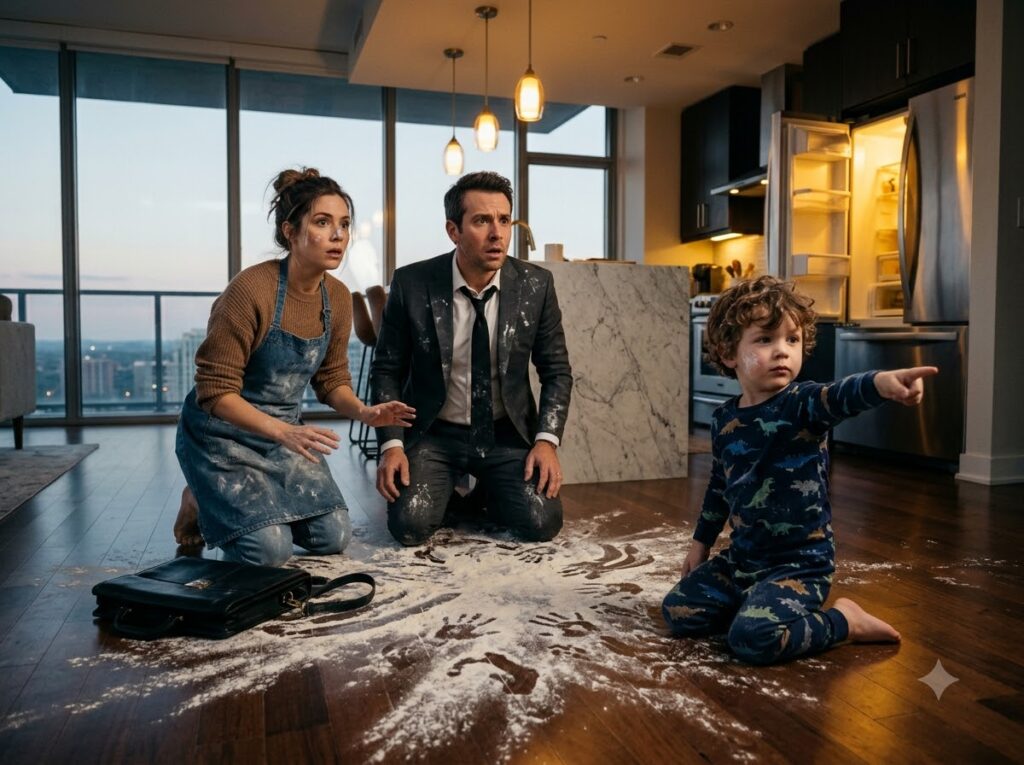
Then Andrew ran into a cloud of flour.
White powder drifted through the kitchen like snow, suspended in the first gold light of dawn. It coated the polished floor, the lower cabinets, the stools, and the stainless-steel refrigerator. A torn paper bag lay on its side beneath the marble island.
In the center of the chaos, Alex lay flat on his back.
He was sweeping his arms and legs through the flour, creating the uneven outline of an angel.
His navy dinosaur pajamas had turned white from the shoulders down. Powder clung to his dark curls and eyelashes. Small fingerprints marked his cheeks.
And he was laughing.
Not politely.
Not nervously.
He laughed until his stomach tightened and his legs kicked against the floor.
Beside him knelt Elizabeth Brown, the housekeeper Andrew had hired three weeks earlier.
She was barefoot. A faded blue apron covered her gray sweater and jeans. Flour coated her hands, and a white streak marked the end of her nose. One loose strand of chestnut hair had escaped her bun and rested against her cheek.
When she saw Andrew, she did not leap up.
She did not apologize for the kitchen.
She stayed beside Alex, watching the child as though his laughter were more valuable than everything Andrew owned.
Andrew tried to speak.
Nothing came.
Alex turned his head.
For several seconds, father and son stared at each other across the flour-covered floor.
Andrew saw joy in his son’s face.
But he also saw uncertainty.
Alex seemed to be waiting to discover whether happiness was another thing his father would not allow inside their beautiful, silent home.
Then the boy lifted one flour-covered hand.
“Again,” he whispered.
The word struck Andrew with more force than any accusation.
After months of silence, Alex had chosen that word.
Not stop.
Not help.
Not Mommy.
Again.
Andrew’s knees hit the floor before he knew he had moved.
He had once negotiated the purchase of a railway network while six attorneys shouted across a conference table. He had watched markets erase hundreds of millions from his company’s value without changing expression.
Now he knelt in flour, unable to breathe because his son had asked to play again.
Alex’s laughter faded into a shy smile.
Elizabeth looked at Andrew.
The warmth in her eyes remained, but behind it was something deeper.
Relief.
Not ordinary relief.
Relief so painful that it resembled grief.
“What is this?” Andrew finally asked.
His voice sounded raw.
“Sensory play,” Elizabeth replied.
“With two bags of flour?”
“One and a half. The second fell when Alex tried to pour it.”
Andrew looked at the boy. “He poured it?”
“He reached for it himself.”
The sentence would have sounded meaningless to anyone else.
Andrew understood.
Since Emma’s funeral, Alex had refused to touch the kitchen floor. He avoided certain tiles. He walked around the pantry hallway and pressed himself against the wall whenever anyone carried a mixing bowl.
Andrew had noticed those things.
But he had not truly seen them.
Elizabeth had.
“The flour is quiet,” she explained. “It has almost no smell. It moves when he moves, but it doesn’t trap him. He decides what happens.”
Andrew stared at her.
“And this is supposed to help him speak?”
Elizabeth did not answer.
Alex stopped moving.
His smile disappeared.
His fingers curled into the flour.
He looked first at Elizabeth, then toward the narrow pantry door, and finally back at his father.
His lips trembled.
Elizabeth’s face lost all color.
“Alex,” she said softly, “you don’t have to say anything.”
The boy pushed himself upright.
Andrew had never seen such fear in his child’s eyes.
Alex raised one shaking hand and pointed at Elizabeth.
Then, in a broken voice louder than anything he had said since his mother died, he spoke the sentence that turned the flour beneath Andrew’s knees to ice.
“She came because Mommy told her where he hid it.”
The penthouse fell silent.
Even the city beyond the windows seemed to stop.
Andrew looked at Elizabeth.
She did not deny it.
That frightened him more than anything.
“What did he say?”
Elizabeth lowered her eyes.
“Andrew—”
“What did my son just say?”
Alex flinched.
Andrew instantly hated himself for raising his voice, but fear had already transformed into something harder.
He rose from the floor.
Flour marked the knees of his charcoal trousers.
“Who told you to come here?”
Elizabeth remained beside Alex.
“Emma.”
The name landed between them like glass.
Andrew stared at her.
“My wife is dead.”
“I know.”
“No.” His voice sharpened. “You don’t get to say her name like that. You worked here for three weeks. You never met her.”
Elizabeth looked toward Alex.
The boy had drawn his knees to his chest.
“I did meet her.”
Andrew felt the room tilt.
He took one step closer.
“When?”
“Before she married you.”
His watch vibrated against his wrist.
The penthouse security system had registered his dropped briefcase near the elevator and automatically notified the building’s private response team. Three guards would already be coming up.
Andrew ignored the alert.
“What did Emma tell you?”
Elizabeth slowly stood.
She kept herself between Andrew and Alex—not aggressively, but instinctively.
That movement did not escape him.
“She told me that if anything happened to her, Alex would stop speaking.”
Andrew’s jaw tightened.
“She told you that before she died?”
“She told me three days before.”
A cold sensation moved through Andrew’s chest.
Emma’s death had been ruled an accident.
The official report said a damaged gas connector behind the pantry wall had filled the small room with fumes. A faulty electrical switch had sparked when Emma entered.
The explosion had shattered the pantry door and set part of the kitchen ablaze.
Alex had been found beneath the dining table, silent and covered in soot.
Emma had been identified by her wedding ring, dental records, and the emerald bracelet Andrew had given her on their tenth anniversary.
The casket had remained closed.
Andrew had buried her beneath white roses.
He had watched Alex place a toy dinosaur beside the coffin.
Now a barefoot stranger stood in his kitchen claiming Emma had predicted everything.
The elevator chimed.
Elizabeth turned toward the sound.
For the first time since Andrew had entered, she looked frightened.
“Send them away.”
“Why?”
“Because I don’t know who Emma was afraid of.”
Three security officers entered the hallway.
At their head was Owen Mercer, Andrew’s personal security director.
Owen was forty-five, broad-shouldered, precise, and almost unnaturally calm. He had protected Andrew for eleven years. He had been present at the hospital after Emma’s death. He had carried Alex from the emergency room when Andrew had been too numb to move.
His gaze swept across the flour, Elizabeth, and the child.
“Mr. James?”
Andrew did not look away from Elizabeth.
“Secure the apartment.”
Owen’s hand moved subtly beneath his jacket.
“Is she a threat?”
Alex made a small sound.
Elizabeth lowered herself immediately.
“No one is going to hurt you,” she told him.
Andrew saw Owen watching her with sudden intensity.
Not confusion.
Recognition.
It lasted less than a second, but Andrew caught it.
“Do you know her?” he asked.
Owen’s expression did not change.
“No.”
Elizabeth looked at him.
A muscle moved in her jaw.
Andrew turned to the other guards.
“Wait outside.”
“Sir,” Owen said, “we should remove Ms. Brown until—”
“Outside.”
The guards obeyed.
Owen did not move.
Andrew faced him.
“That includes you.”
For the first time, a faint hesitation crossed the security director’s face.
Then he nodded and left.
The kitchen door closed.
Andrew looked at Elizabeth.
“You have five minutes.”
She removed her apron.
Beneath it, tucked into the waistband of her jeans, was a folded envelope.
Andrew reached for it.
Elizabeth pulled back.
“Not in front of the cameras.”
He looked toward the small black dome above the refrigerator.
“The cameras are mine.”
“Emma didn’t think so.”
Andrew’s blood cooled.
He went to the control panel beside the pantry and disabled the kitchen feed.
The red indicator vanished.
Elizabeth handed him the envelope.
His name appeared on the front in Emma’s handwriting.
Andrew stopped breathing.
He knew every curve of those letters. Emma had written notes on napkins and tucked them into his luggage. She had labeled Alex’s first drawings and left reminders on mirrors.
The handwriting was hers.
He tore the envelope open.
Inside was a single sheet of paper.
Andrew,
If you are reading this, Elizabeth reached Alex before they did.
Do not call your father.
Do not trust the cameras.
Listen to our son.
He saw more than anyone knows.
And when he is ready, ask him where he hides the thunder.
I am sorry I could not tell you sooner.
I love you beyond whatever comes next.
Emma.
Andrew read it twice.
Then a third time.
The final line blurred.
“My father?”
Elizabeth nodded.
“Emma believed Richard was involved.”
Andrew laughed once, but there was no humor in it.
“My father adored her.”
“People can adore what they still destroy.”
“You expect me to believe Richard murdered my wife?”
“I expect you to believe Emma was afraid.”
He looked at the letter.
“Where did you get this?”
“It arrived at a post-office box sixteen days after the funeral. The envelope had been scheduled through a legal service.”
“Why didn’t you contact me?”
“Because the letter told me not to.”
Andrew’s voice hardened.
“And you entered my home under a false identity.”
“Yes.”
“You lied during the interview.”
“Yes.”
“You have been alone with my son.”
Elizabeth glanced toward Alex.
“He was never alone.”
Andrew stepped closer.
“Who are you?”
Her eyes shone, but she did not look away.
“My name is Elizabeth Hale Brown.”
The surname meant nothing to him.
Then she added, “Emma’s mother was also my mother.”
Andrew stared.
“Emma had no sister.”
“She had one she never spoke about.”
“You expect me to believe that too?”
“No.” Elizabeth’s voice cracked for the first time. “I expect you to verify it.”
Andrew took out his phone.
Elizabeth caught his wrist.
“Not on that.”
He pulled away.
“Stop telling me what I can trust.”
“Then ask yourself why your merger failed in Chicago twelve hours before the vote.”
The sudden change struck him.
“What?”
“Emma wrote that if you ever came home early, it would mean someone had activated the safeguard.”
“What safeguard?”
“I don’t know.”
The elevator chimed again.
This time Richard James entered without waiting for permission.
At sixty-seven, Richard still carried himself with the rigid elegance of a man accustomed to rooms becoming quiet around him. His silver hair was perfectly combed. He wore a navy overcoat over a dark suit, and a black cane tapped lightly against the marble.
Andrew had not called him.
That fact mattered immediately.
Richard stopped at the kitchen entrance.
His gaze moved over the flour.
Then to Alex.
Then to Elizabeth.
The hand gripping his cane tightened.
“Who is she?”
Alex recoiled.
The boy’s entire body folded inward.
Elizabeth moved closer to him.
Richard noticed.
“Andrew,” he said, “take Alex out of the room.”
“No.”
His father’s eyebrows rose.
Andrew held up Emma’s letter.
“Did you know she had a sister?”
Richard looked at the page but did not answer.
That was answer enough.
“You knew.”
Richard entered the kitchen slowly.
“Emma’s childhood was complicated.”
“That isn’t what I asked.”
“Yes,” Richard said. “I knew.”
Elizabeth stood.
“You knew my father too.”
Richard’s face became still.
Andrew looked between them.
“Who was her father?”
Elizabeth’s voice was barely audible.
“Samuel Brown.”
The name struck something buried in Andrew’s memory.
Old company records.
A photograph in a forgotten annual report.
A lawsuit settled before Andrew was old enough to join the company.
“Brown Dynamics,” he whispered.
Elizabeth nodded.
Richard’s cane stopped tapping.
“Andrew,” he said, “this woman is dangerous.”
Alex whimpered.
Richard turned toward him.
The boy stared at the silver head of the cane.
His face went white.
Then he whispered, “No clicking.”
Everyone froze.
Richard looked down at the cane.
Alex pressed both palms against his ears.
“No clicking,” he repeated. “Mommy said stop.”
Andrew moved between his father and son.
“What happened in this kitchen?”
Richard’s eyes sharpened.
“Your child is traumatized. Do not build accusations from fragments.”
“Why did he react to your cane?”
“Because it makes noise.”
Elizabeth spoke behind Andrew.
“Emma’s death report noted three circular bruises on her right forearm.”
Richard turned toward her.
“Those details were sealed.”
“So was the photograph.”
Andrew looked at Elizabeth.
“What photograph?”
She took a second envelope from inside her sweater.
This one contained an enlarged image from the medical examiner’s file.
Emma’s forearm was marked by three dark, evenly spaced circles.
The silver handle of Richard’s cane had three ornamental studs.
Andrew felt nausea rise.
His father saw the comparison.
“You think I beat her with a cane?”
“I think she was afraid of you,” Andrew said.
Richard’s expression changed.
Not guilt.
Pain.
“You know nothing about what she feared.”
“Then tell me.”
Richard looked toward the pantry.
The glance was brief.
Alex saw it.
His fingers dug into Elizabeth’s sleeve.
“He looked,” the boy whispered.
Andrew crouched.
“Who looked, Alex?”
The child shut his mouth.
Richard stepped backward.
“We need to remove this woman.”
“No one is removing anyone.”
“She has manipulated your son, forged a letter, and entered your home under false pretenses.”
“The handwriting is Emma’s.”
“So was every document she signed before she betrayed you.”
Andrew stood.
“What does that mean?”
Richard’s eyes remained on Elizabeth.
“Ask her why Emma contacted a Brown.”
Elizabeth went still.
Richard gave a bitter smile.
“Tell him.”
She lowered her gaze.
Andrew felt the first warning tremor of another truth.
“Tell me what?”
Elizabeth knelt beside Alex.
Her hand trembled as she touched his hair.
“Emma had ovarian cancer when she was twenty-four.”
Andrew knew that. She had survived surgery and chemotherapy before they met.
“She could carry a child,” Elizabeth continued, “but she could not produce viable eggs.”
Andrew’s mouth went dry.
They had used an anonymous donor.
Emma had chosen the agency. She had insisted she did not want to know the donor’s identity.
Elizabeth looked up at him.
“I donated eggs through that agency six years ago.”
The kitchen became unbearably quiet.
Andrew shook his head.
“No.”
“Emma found out after Alex was born.”
“No.”
“She recognized a hereditary marker in his medical records. She investigated.”
Richard watched without interruption.
Andrew stared at Elizabeth’s eyes.
Warm brown.
Alex’s eyes were blue-gray like his.
But the shape of his mouth—
The softness of his face—
“DNA tests can confirm it,” Elizabeth said. “Alex is your son.”
Andrew’s lungs tightened.
“And biologically,” she whispered, “he is mine.”
Alex looked between them, unable to understand.
Andrew took several steps backward.
His heel struck the marble island.
The room seemed to twist around him.
“You entered my house to take him.”
“No.”
“You lied to get near him.”
“I came because Emma asked me to protect him.”
“You expect me to believe you don’t want your biological child?”
Elizabeth’s expression broke.
“I have wanted him every day since I learned he existed.”
The honesty hurt more than a lie.
“But Emma was his mother,” she continued. “She loved him before he had a heartbeat. She carried him. She gave birth to him. She stayed awake through fevers and sang to him when he was afraid. I did not come to replace her.”
“Then why didn’t she tell me?”
“Because she was afraid you would see Alex differently.”
Andrew looked at his son.
Alex had begun drawing circles in the flour.
One circle.
Then another.
Then a third.
The same pattern as the bruises on Emma’s arm.
Richard took a slow breath.
“This has gone far enough.”
Andrew faced him.
“You knew Elizabeth was the donor.”
“I learned after Emma did.”
“Did you arrange it?”
“No.”
“Did you kill Samuel Brown?”
Richard’s eyes darkened.
“That accusation destroyed enough lives thirty years ago.”
Brown Dynamics had developed an early energy-storage system that later became the foundation of James Meridian, the industrial empire Andrew now controlled.
Samuel Brown had died in a warehouse fire shortly before Richard acquired his patents.
The official story claimed Brown had sold them willingly.
Rumors had followed Richard for years.
Andrew had dismissed them as envy.
Elizabeth did not.
“My father mailed evidence to Emma,” she said. “He knew her mother had another daughter. He believed one of us might eventually find it.”
“Your father was unstable,” Richard replied.
“My father was murdered.”
Alex suddenly pushed himself to his feet.
Flour fell from his pajamas.
He walked toward the pantry.
Each step appeared to cost him something.
Andrew followed.
“Alex?”
The boy reached the narrow door and touched the brass handle.
Then he pulled his hand back as though burned.
Elizabeth crouched beside him.
“You’re safe.”
Alex shook his head.
“Mommy fell asleep.”
Andrew’s heart stopped.
“Where?”
Alex pointed inside.
The pantry had been rebuilt after the explosion. White shelves lined the walls. New stone tiles covered the floor. Nothing remained from the fire except a faint discoloration near the ceiling.
Andrew opened the door.
Alex screamed.
It was not loud.
The small, strangled sound was worse.
He threw himself against Elizabeth and buried his face in her chest.
Richard turned away.
Andrew noticed.
“Why can’t you look at him?”
His father said nothing.
Andrew entered the pantry.
The air smelled of fresh wood and stone.
He remembered standing there with Emma when they designed the apartment. She had wanted a blue ceramic tile shaped like a bird placed above the bottom shelf.
“For luck,” she had said.
The bird had cracked in the explosion.
Andrew had ordered it replaced exactly.
Now he looked at it.
A blue swallow flew across the white tile.
He reached up and pressed it.
Nothing happened.
Behind him, Alex whispered, “Not bird.”
Andrew turned.
The boy pointed downward.
“Baby bird.”
Andrew lowered himself.
Near the floor, partly concealed behind a shelf support, was a smaller blue shape.
A second bird.
He had never noticed it.
He pressed the tile.
A faint click sounded.
A section of the baseboard opened.
Inside lay an empty cavity.
Nothing else.
Elizabeth stared.
“She said something would be there.”
Richard exhaled.
It sounded almost like relief.
Andrew heard it.
“You knew about this compartment.”
“No.”
“You looked at it before I did.”
Richard’s face hardened.
“Because I know how frightened people behave when they believe they have discovered a secret.”
Andrew reached inside.
His fingers touched scratches along the wood.
Something had been removed recently.
Fine black fibers remained in one corner.
Suit fabric.
Owen’s security uniforms were black.
Andrew closed his hand around the fibers.
At that moment, the lights went out.
The penthouse plunged into darkness.
Alex screamed.
Emergency illumination flickered red along the floor.
Andrew heard movement behind him.
A heavy impact.
Elizabeth cried out.
He spun and saw Richard collapsing beside the kitchen island, his cane striking the floor.
A dart protruded from his neck.
Andrew ran toward him.
The elevator doors opened.
Owen Mercer stepped into the apartment holding a compact tranquilizer pistol.
Two guards stood behind him.
“Step away from Mr. James,” Owen ordered.
Andrew stared.
Richard lay unconscious.
“Why did you shoot him?”
“For his protection.”
“From whom?”
Owen looked at Elizabeth.
“Her.”
Elizabeth held Alex tightly.
“She didn’t touch him.”
“We have evidence she entered this residence to steal proprietary material.”
Andrew stood.
“You erased the pantry footage.”
Owen’s expression did not move.
“I don’t know what you’re talking about.”
“Then why are you here? I ordered you outside.”
“The building detected a system breach.”
“You caused it.”
Owen raised the weapon slightly.
“Sir, you are exhausted and emotionally compromised.”
Andrew had heard men use that tone before.
It was the voice used when power was about to be taken while pretending nothing had changed.
He looked at the two guards.
Neither met his eyes.
“How much is he paying you?”
Owen smiled faintly.
“You still think this is about your father.”
The words landed with terrible precision.
Elizabeth tightened her arms around Alex.
Owen noticed.
“Give me the child.”
Andrew moved in front of them.
“No.”
“Mr. James, I will not ask again.”
The old Andrew would have calculated.
He would have measured distance, leverage, risk.
The man kneeling in flour no longer cared about any of those things.
He grabbed the torn flour bag from the floor and hurled it.
White powder exploded across Owen’s face.
The weapon fired.
The dart struck the refrigerator.
Andrew drove his shoulder into Owen’s chest.
They crashed into the marble island.
One guard lunged toward Elizabeth.
She kicked the pantry door into his knees. He fell, and Alex crawled beneath the breakfast table.
The second guard seized Andrew from behind.
Andrew slammed backward into the counter.
Glass shattered.
Owen wiped flour from his eyes and reached for a pistol beneath his jacket.
A silver cane struck his wrist.
Richard James, barely conscious, lay on one elbow and swung again.
The gun skidded across the floor.
“Take Alex!” Richard shouted.
Elizabeth ran.
She pulled the boy from beneath the table and raced toward the service corridor.
Andrew kicked one guard away and followed.
Behind him, Richard struggled to stand.
Owen recovered first.
A shot cracked through the kitchen.
Richard jerked.
A dark stain spread across his coat.
Andrew stopped.
His father looked at him across the flour-filled room.
For all his power, Richard suddenly appeared old.
“Go,” he whispered.
Andrew went.
He followed Elizabeth into the service corridor and slammed the fire door behind them.
The corridor had no windows. Red emergency lights pulsed along the walls.
Alex clung to Elizabeth’s neck.
Andrew entered a code on the stairwell panel.
Access denied.
Owen had locked the building.
“Where can we go?” Elizabeth asked.
Andrew thought of the penthouse plans.
“There’s a mechanical room behind the laundry suite.”
They ran.
The mechanical room smelled of metal and warm dust. Andrew locked the door and pushed a storage cabinet in front of it.
Alex shook violently.
Elizabeth sat on the floor and held him.
Andrew checked his phone.
No signal.
The internal network had been disabled.
“What did Emma hide?” he asked.
Elizabeth stroked Alex’s hair.
“I don’t know.”
“Owen knows.”
“Yes.”
“Did Emma ever mention him?”
“She called him the shadow.”
Andrew remembered Owen standing behind him at funerals, board meetings, hospital corridors.
Always present.
Never noticed.
The shadow.
Alex lifted his head.
“Thunder.”
Andrew crouched.
“What did you say?”
The boy pointed toward his own chest.
“Thunder here.”
He touched the front of his dinosaur pajamas.
Elizabeth carefully examined the fabric.
One dinosaur near the hem had a raised edge.
She pulled at the stitching.
A tiny brass key fell into her palm.
Andrew stared.
Alex had hidden it inside the pajamas he wore nearly every night.
“Mommy gave it,” he whispered. “Bad man wanted it.”
“Which bad man?”
Alex squeezed his eyes shut.
“Shadow man.”
Owen.
Andrew touched the key.
It was too small for a door.
A deposit box.
A diary.
A lock hidden inside the penthouse.
Elizabeth examined the dinosaur.
“There’s something else.”
She reached deeper into the seam and pulled out a narrow black memory card.
Andrew’s pulse quickened.
Emma had hidden the evidence on their son.
Not because she wanted Alex involved.
Because no one searched the silent child.
A crash sounded outside the mechanical room.
Owen had reached the corridor.
Andrew looked around.
An old maintenance tablet was mounted beside the ventilation controls.
He removed the memory card from its casing and inserted it.
The screen requested a password.
A single clue appeared.
WHERE I FIRST HEARD YOUR HEART.
Andrew knew.
The fertility clinic had given them a recording of Alex’s first heartbeat.
Emma played it every year on his birthday.
The date flashed in his memory.
The file opened.
Emma appeared on the screen.
She sat in Andrew’s study, wearing a cream sweater, her dark hair pulled behind one ear.
She looked tired.
Alive.
Andrew touched the screen.
“If you are watching this,” she said, “then I was right to be afraid.”
Elizabeth closed her eyes.
Alex stared at his mother.
“Mommy.”
The word nearly destroyed Andrew.
Emma continued.
“Andrew, I need you to understand that I did not hide this because I doubted your love. I hid it because the people around you have spent your entire life deciding which truths you were allowed to know.”
A file appeared beside her image.
Documents.
Bank transfers.
Photographs.
Samuel Brown’s original patent diagrams.
Richard James’s signature on an acquisition contract dated two days after Brown’s death.
Andrew felt sick.
“Your father stole the foundation of James Meridian,” Emma said. “Samuel Brown did not sell it. He was threatened. When he refused, a warehouse fire was arranged.”
Elizabeth covered her mouth.
Emma’s voice trembled.
“Samuel was Elizabeth’s father.”
The video shifted to another document.
A birth certificate.
Emma’s name appeared.
Father: blank.
Then a DNA report.
“Samuel was also my biological father,” Emma said.
Andrew turned toward Elizabeth.
Tears streamed down her face.
“Sisters,” she whispered. “We were really sisters.”
Emma continued.
“Our mother kept the truth from us. She believed Richard would destroy anyone connected to Samuel’s claim. She was right.”
A pounding began against the mechanical-room door.
Owen’s voice came through the metal.
“Andrew, open the door.”
Emma’s image remained calm.
“But Richard is not the person who killed me.”
Andrew stopped breathing.
Elizabeth stared at the screen.
Emma looked directly into the camera.
“Richard helped cover Samuel Brown’s murder. He profited from it. He deserves judgment. But he did not plan the warehouse fire.”
The door shuddered.
A hinge bent.
Emma raised a photograph.
It showed a much younger Richard standing beside another man.
The second man was Owen Mercer’s father.
Thomas Mercer.
Former chief counsel of James Meridian.
“Owen’s father designed the fraud,” Emma said. “When Richard tried to withdraw years later, Thomas blackmailed him. After Thomas died, Owen inherited every secret—and every account.”
Andrew understood.
Owen had not merely protected the family.
He had managed it.
Controlled it.
Preserved the stolen empire.
“Three months before my death,” Emma continued, “Owen learned I had found Samuel’s original files. He told me that Andrew would lose everything. I told him the truth mattered more than the company.”
Her eyes filled with tears.
“He said Andrew would never choose truth over his father.”
Andrew looked toward the broken door.
“I believed you would,” Emma said.
The final words were almost a whisper.
“I still do.”
The door burst inward.
Owen entered with blood on his sleeve and a pistol in his hand.
Andrew stepped in front of Alex and Elizabeth.
“You killed her.”
Owen’s expression remained calm.
“I protected what your family built.”
“It was never ours.”
“It became yours. That is how history works.”
“You shot my father.”
“Richard became sentimental.”
Andrew looked at the phone in Owen’s pocket.
“Is he dead?”
“Not yet.”
Owen raised the pistol.
“Give me the card.”
“No.”
“You have no signal. No one knows what is happening.”
Andrew glanced at the ventilation tablet.
The building network was down.
But the mechanical system operated on an independent emergency channel.
Emma had known that.
Andrew pressed the red fire-control button beside him.
Alarms erupted through the building.
Steel vents opened automatically.
Sprinklers activated in every corridor.
More importantly, the emergency system transmitted a live diagnostic feed to the fire department and building management.
Audio included.
Owen realized it a second too late.
Andrew stepped closer.
“Tell them why you killed Emma.”
Owen smiled.
“You think a recording matters? My father recorded Richard ordering Samuel’s death. Richard signed every transfer. Richard paid every witness. The world will believe the billionaire patriarch, not the employee who served him.”
“Then why did you attack Emma?”
“Because she found the original patent.”
“And where is it?”
Owen’s eyes shifted toward Alex.
The child noticed.
He pressed closer to Elizabeth.
Owen’s voice softened.
“Your wife gave it to the boy before the explosion. I searched the pantry. I searched her office. I searched every toy in this apartment.”
Andrew understood.
That was why Alex had stopped speaking.
Owen had questioned him.
Perhaps frightened him night after night while Andrew was away or drugged by grief.
“You hurt my son.”
“I encouraged him to forget.”
Andrew moved before Owen could respond.
He seized a metal wrench from the wall and struck the gun aside.
The shot tore into a pipe.
Steam exploded into the room.
Elizabeth pulled Alex behind the machinery.
Andrew and Owen collided against the controls.
Owen drove a fist into Andrew’s ribs.
Andrew struck back.
They slipped on water from the sprinklers.
Owen was stronger than Andrew remembered, trained and ruthless. He forced Andrew against a metal rail and wrapped one hand around his throat.
“You were never fit to hold this empire,” he said. “Your father knew it. Emma knew it. She simply believed she could make you decent.”
Andrew’s vision darkened.
Then Alex screamed.
Not in fear.
In fury.
“LET GO OF MY DADDY!”
The sound stunned everyone.
Alex picked up the brass key and threw it.
It struck Owen’s cheek.
The distraction lasted less than a second.
It was enough.
Andrew drove the wrench into Owen’s injured wrist.
The pistol fell.
Elizabeth kicked it beneath the machinery.
Sirens rose somewhere far below.
Owen ran toward the corridor.
Richard stood there.
One hand pressed against the wound in his side.
In the other, he held his silver cane.
Owen stopped.
Richard looked at his son.
“I am sorry,” he said.
Then he swung the cane across Owen’s knees.
Owen fell.
Andrew rushed forward and pinned him to the wet floor.
Building security officers appeared behind Richard, followed by firefighters and police.
This time, they were not Owen’s men.
The live transmission had reached every emergency channel in the tower.
Owen looked up at Andrew as handcuffs closed around his wrists.
“You will lose everything.”
Andrew thought of Emma.
He thought of Samuel Brown.
He thought of Alex speaking through terror.
Then he answered with absolute calm.
“Then I will finally know what belongs to me.”
Richard survived the gunshot.
He was arrested from his hospital bed forty-eight hours later.
The evidence on Emma’s memory card exposed more than a murder.
It revealed shell companies, falsified patent transfers, bribed officials, and three decades of payments to witnesses connected to Samuel Brown’s death.
Owen Mercer was charged with Emma’s murder, attempted murder, conspiracy, fraud, and obstruction.
Richard James faced charges for participating in the original theft and concealing the warehouse killing.
James Meridian’s stock collapsed by forty-two percent in two days.
The board demanded Andrew deny everything.
His attorneys begged him to destroy the memory card.
His advisers warned that thousands of employees could lose their jobs.
Andrew listened.
Then he walked into a live press conference and placed Samuel Brown’s original patent diagrams on the podium.
“My family built an empire on stolen work,” he said. “I did not commit the original crime. But I benefited from it every day I refused to question the story I was given.”
Cameras flashed.
Reporters shouted.
Andrew continued.
“Effective immediately, the Brown family will receive controlling ownership of the energy patents and restitution from my personal holdings. A worker trust will receive an additional twenty percent of James Meridian.”
The board chairman stood.
Andrew ignored him.
“I am resigning as chief executive.”
The room erupted.
Andrew looked into the cameras.
“My son taught me that silence does not always mean ignorance. Sometimes silence means the truth has been made too dangerous to speak.”
At the penthouse, Alex watched the press conference from Elizabeth’s lap.
When Andrew returned, he expected anger.
Instead, Alex ran across the living room and wrapped both arms around his legs.
“You came back,” the boy whispered.
Andrew knelt and held him.
“I will always come back.”
Elizabeth stood near the window.
She had packed her suitcase.
Andrew noticed it.
“You’re leaving.”
“The danger is over.”
“No. The danger changed.”
She looked at Alex.
“He needs stability.”
“He needs you.”
Elizabeth’s eyes filled.
“He has a father.”
“He also has a woman who taught him he could touch the floor again.”
Andrew stood.
“I don’t know what your place in this family should be. I don’t know how to explain biology and motherhood to a five-year-old. I don’t know how to forgive Emma for keeping this from me.”
Elizabeth nodded slowly.
“But I know Alex loves you,” he continued. “And I know Emma trusted you when she trusted almost no one.”
“I am not asking to replace her.”
“I know.”
Andrew looked toward the kitchen.
The flour had been cleaned, but one faint white handprint remained beneath the island.
He had ordered the staff not to remove it.
“Stay,” he said. “Not as an employee.”
Elizabeth closed her eyes.
“For how long?”
Andrew looked at Alex.
“For as long as he needs you.”
The boy took Elizabeth’s hand.
“Again,” he said.
This time, they all understood.
Again did not mean repeat the game.
It meant try again.
Try to speak.
Try to trust.
Try to become something after grief had destroyed the family they once understood.
Elizabeth unpacked.
Three weeks later, Andrew received a package with no return address.
Inside was a small brass box.
The key Alex had hidden inside his pajamas fit perfectly.
Andrew placed it into the lock.
Elizabeth stood beside him. Alex sat between them on the living-room rug, holding his dinosaur.
The box opened.
Inside lay Samuel Brown’s original handwritten notebook.
Beneath it was a second memory card.
A note rested on top.
For Andrew, after he chooses the truth.
The handwriting was Emma’s.
Andrew’s hands trembled.
He inserted the card into his laptop.
A video began.
At first, the screen showed only darkness.
Then a woman’s voice whispered, “Is it recording?”
Andrew froze.
Elizabeth gripped the back of the chair.
The camera shifted.
Emma appeared.
But this video was not recorded before her death.
A newspaper lay on the table beside her.
The headline covered Andrew’s press conference.
The date was yesterday.
Andrew stopped breathing.
Emma’s face was thinner than before. A pale scar crossed her left temple. Her hair had been cut short.
But she was alive.
Alex slid from the couch.
“Mommy?”
Emma looked into the camera.
“If you are watching this,” she said, “then Owen has been arrested, Richard has been exposed, and Andrew did exactly what I believed he would do.”
Andrew touched the screen.
“No.”
Elizabeth began to cry.
“You knew?” he asked.
She shook her head violently.
“No. I swear.”
Emma continued.
“The woman buried under my name was Lena Ortiz, the forensic accountant who helped me collect the evidence. Owen attacked us both in the pantry. The explosion killed Lena.”
Andrew’s mind raced.
The body.
The bracelet.
The closed casket.
“Owen believed I died because Lena was wearing my coat and jewelry. She had agreed to act as me while I left the building with the original files.”
Emma’s voice broke.
“I survived through the service stairwell, but I had a skull fracture. Richard found me before Owen did.”
Andrew stared.
His father.
“Richard moved me to a private clinic under another name,” Emma said. “It was the first honest thing he had done in thirty years. He knew Owen watched you constantly. If I contacted you, Owen would have killed Alex.”
Andrew remembered Richard’s pain in the kitchen.
His refusal to explain.
His willingness to take suspicion.
“He helped me stay dead,” Emma said. “Not to protect the company. To protect our son.”
Elizabeth covered her mouth.
Emma looked exhausted.
“I could not return until Owen exposed himself. He would never confess while he believed the evidence was lost. Elizabeth had to enter the house. Alex had to lead you to the card. And you had to choose the truth without knowing I was alive.”
Andrew stood so suddenly that the chair fell.
“Where is she?”
The video continued.
“I am sorry,” Emma whispered. “I know what this cost you.”
Alex pressed both hands to the screen.
“Mommy, come home.”
Emma’s eyes filled with tears, as though she could hear him across time.
Then she said, “Turn around.”
Andrew stopped.
The private elevator chimed.
No one moved.
The doors opened.
A woman stood inside.
She wore a long gray coat and leaned on a wooden cane. Her dark hair ended at her jaw. A pale scar traced her temple.
For one impossible second, Andrew’s mind refused to recognize the face his heart had known before the doors opened.
Emma looked at him.
Her lips trembled.
Alex crossed the room first.
He ran so fast that one slipper came off behind him.
“Mommy!”
Emma dropped the cane.
She fell to her knees as Alex crashed into her arms.
The sound that escaped her was part laugh, part sob.
She buried her face in his flourless curls and held him as if the world might try to take him again.
Andrew could not move.
He had imagined Emma returning a thousand times.
In dreams, she appeared untouched, wearing the green dress from their anniversary, smiling as though death had been a misunderstanding.
The woman kneeling by the elevator was thinner.
Scarred.
Real.
She looked over Alex’s shoulder.
“Andrew.”
He crossed the distance.
He did not ask why.
He did not accuse her.
He knelt and wrapped his arms around his wife and son.
Emma clung to him.
“I’m sorry,” she whispered against his neck.
Andrew shook his head because language had become too small.
Elizabeth stood several feet away, crying silently.
Emma reached one hand toward her.
“Sister.”
Elizabeth joined them.
For a moment, four people knelt together on the marble floor of the penthouse entrance.
Not a perfect family.
Not an ordinary one.
A family built from grief, secrecy, biology, sacrifice, betrayal, and the stubborn decision to remain.
Later, after Alex fell asleep between his parents, Andrew sat with Emma beside the kitchen window.
The city glittered beneath them.
“You caused the merger to fail,” he said.
Emma smiled faintly.
“I leaked one document to the Chicago board.”
“You knew I would come home.”
“I knew you hated losing.”
He almost laughed.
“Twenty-six hours early.”
“That was the margin Elizabeth needed.”
Andrew looked toward the faint white handprint beneath the island.
“You planned the flour?”
“No.”
Emma’s smile became real.
“That was Elizabeth.”
Across the room, Elizabeth slept in a chair beside Alex, one hand still resting near his.
Andrew took Emma’s hand.
“So the safeguard wasn’t a legal document.”
“No.”
“What was it?”
Emma looked at their son.
“Love,” she said. “I needed to know whether it was stronger than the empire.”
Andrew followed her gaze.
Alex stirred.
His eyes opened.
For one frightened moment, he searched the room.
Then he saw his mother, father, and Elizabeth.
His body relaxed.
“Mommy?”
“I’m here,” Emma said.
“Daddy?”
“Here.”
He looked toward Elizabeth.
“Lizzie?”
She woke immediately.
“I’m here too.”
Alex smiled.
Then he lifted his blanket and made space beside him.
“Again,” he whispered.
Emma lay beside him.
Andrew joined her.
Elizabeth sat near his feet.
Outside, Manhattan woke beneath a pale golden sky.
Inside, the house that had survived lies, murder, silence, and grief finally filled with voices.
And beneath the marble island, one flour-covered handprint remained—small, imperfect, impossible to erase.
It was the mark left by the morning a silent child saved his mother, exposed an empire, and taught three broken adults that the truth does not always arrive as a scream.
Sometimes, it begins with a whisper.
Again.





