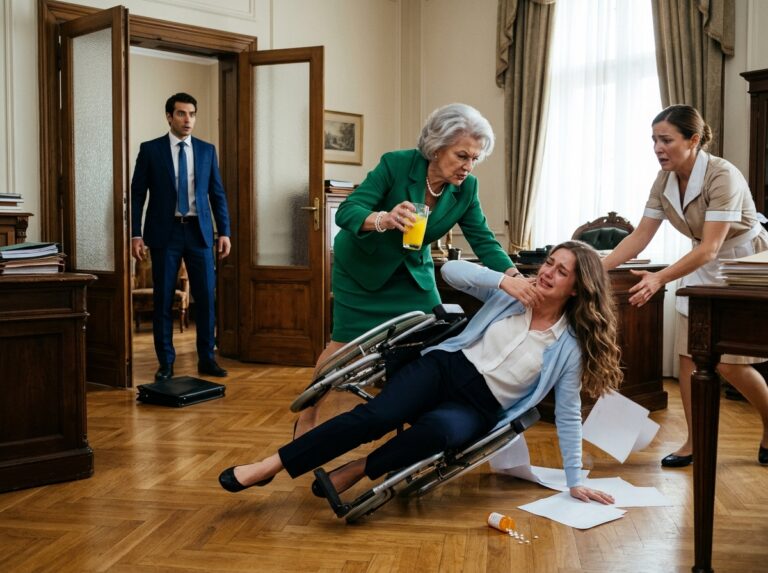
The morning my new housemaid walked into my mansion, I recognized the necklace in her hand before I recognized the daughter I had abandoned thirty years earlier.
And when she told me what her mother had said before dying, I realized that the greatest mistake of my life was not abandoning my child.
It was believing the people who told me she was dead.
My name is Richard Harper. I was sixty-one years old, worth more than eighty million dollars, and considered one of the most successful property developers in North Carolina.
I owned shopping centers, apartment buildings, luxury hotels, and enough land to build a small town.
But I had no wife.
No children.
No family photographs hanging in my enormous mansion.
And until the morning Emily Carter appeared at my door, I believed that was exactly what I deserved.
People often imagine wealthy men living extraordinary lives.
They picture private jets, expensive dinners, beautiful women, and rooms filled with laughter.
My reality was considerably less impressive.
Every morning, I woke at five-thirty in a bedroom large enough to accommodate an entire family. I exercised alone, ate breakfast alone, and drove to work in a car whose passenger seat had remained empty for years.
My mansion stood on twelve acres outside Charlotte, surrounded by ancient oak trees and an imposing black iron fence.
It had nine bedrooms.
Eight bathrooms.
A library with more than three thousand books.
An indoor swimming pool I had used exactly four times.
And a dining room with twenty-four chairs.
I had spent millions building a home for a family I no longer believed I would ever have.
That October morning began like countless others.
Rain tapped against the windows of my study while I reviewed construction contracts for Harper & Cole Developments.
My coffee had gone cold.
The grandfather clock in the hallway struck eight.
Then someone knocked.
“Come in.”
Linda Matthews, my housekeeper of five years, stepped through the doorway.
She was fifty-four, soft-spoken, and possessed the remarkable ability to keep my enormous house running without ever making me feel that another person lived there.
Usually, she greeted me with a smile.
That morning, she looked nervous.
“Mr. Harper, may I speak with you?”
I removed my reading glasses.
“Of course, Linda. Is something wrong?”
She sat opposite me, folding her hands in her lap.
“I’ve decided to leave my position.”
For several seconds, I simply stared.
“Leave?”
She nodded.
“Yes, sir.”
“Have I done something to upset you?”
“Good heavens, no.” She laughed nervously. “You’ve always been very generous.”
“Then why?”
Her expression changed.
For the first time since I had known her, I saw something almost youthful in her eyes.
Hope.
“I’ve been saving money for years,” she explained. “Last week, I enrolled in a healthcare training program. I’ve always wanted to become a certified caregiver.”
I leaned back.
“You’ve been planning this for years?”
“Since before I started working here.”
“And you never mentioned it?”
“I didn’t want to talk about it until I knew I could afford it.”
I looked at the woman who had quietly maintained my home for half a decade.
Suddenly, I felt ashamed.
I knew how she took her coffee.
I knew she preferred the kitchen windows open when cooking.
But I had never asked about her dreams.
“Linda,” I said, “that’s wonderful.”
Her shoulders relaxed.
“Really?”
“Absolutely. I’m proud of you.”
Tears filled her eyes.
“Thank you, sir.”
I cleared my throat.
“I suppose I’ll have to find someone else to keep this place from falling apart.”
She smiled.
“Actually, I know someone.”
“Someone you trust?”
“Completely.”
“Experienced?”
“She’s hardworking, respectful, and very responsible. She’s been looking for a stable position for some time.”
“What’s her name?”
Linda hesitated.
Just for a fraction of a second.
“Emily Carter.”
The name meant nothing to me.
“Bring her tomorrow morning,” I said. “Nine o’clock.”
Linda stood.
“Thank you, Mr. Harper.”
At the doorway, she paused.
“Sir?”
“Yes?”
She looked at me strangely.
“Sometimes life gives people a second chance when they least expect one.”
I frowned.
“What’s that supposed to mean?”
But Linda merely smiled.
“Nothing, sir. Just something I’ve learned.”
Then she disappeared into the hallway.
I returned to my contracts.
I had no idea that Linda had just arranged the most important meeting of my life.
Chapter One: The Woman With My Eyes
The following morning, rain hung over Charlotte like a gray curtain.
At exactly nine, the doorbell rang.
I heard Linda speaking in the foyer.
A woman’s voice answered.
Then footsteps approached my office.
“Mr. Harper?”
I looked up.
Linda stood in the doorway beside a young woman carrying a worn brown leather handbag.
She was slender, perhaps thirty years old, with dark hair pulled into a neat bun.
Her clothes were simple but carefully pressed.
A pale blue blouse.
Black trousers.
A gray cardigan.
She looked like someone who had learned to make inexpensive things last.
But none of that mattered.
Because the moment I saw her face, my heart gave a strange, painful lurch.
Her eyes were gray. Exactly the same shade as mine.
Not blue-gray.
Not green-gray.
The peculiar storm-cloud gray my mother had once described as the Harper family curse.
And her smile—
Dear God.
Her smile reminded me of someone I had spent thirty years trying to forget.
“Mr. Harper,” Linda said, “this is Emily Carter.”
The young woman stepped forward.
“Good morning, sir.”
I stood slowly.
“Good morning.”
She studied me.
There was something unusual about the way she looked at my face.
Not curiosity.
Not admiration.
Recognition.
“Please,” I said, gesturing toward a chair. “Sit down.”
She didn’t.
Instead, she reached into her handbag.
“Before we discuss the position, there’s something I need to tell you.”
Linda became very still.
My stomach tightened.
“Go ahead.”
Emily’s voice trembled.
“My mother used to say I have your eyes.”
The room seemed to tilt.
“What?”
She withdrew a small object wrapped in faded blue velvet.
Her fingers shook as she unfolded the fabric.
Inside lay a silver necklace.
A delicate chain.
A small oval pendant.
And engraved on its surface were three tiny words.
Forever, my Eleanor.
My breath stopped.
I knew that necklace.
I had bought it from a pawnshop in downtown Charlotte when I was twenty-nine years old.
It had cost seventy-eight dollars.
At the time, seventy-eight dollars represented almost half my weekly wages.
I had given it to the woman I loved on a rainy December evening.
Her name was Eleanor Bennett.
And thirty years earlier, I had been told that Eleanor and our unborn daughter had died in a car accident.
“Where did you get that?” I whispered.
Emily swallowed.
“It belonged to my mother.”
I gripped the edge of my desk.
“Your mother’s name?”
“Eleanor Bennett.”
The clock ticked.
Rain struck the windows.
Somewhere in the house, a telephone rang.
But I heard only one name.
Eleanor.
“That’s impossible,” I said.
Emily’s expression tightened.
“That’s what I thought you might say.”
I shook my head.
“Eleanor died.”
“No.”
“Thirty years ago. There was an accident.”
“My mother died eleven months ago, Mr. Harper.”
I stumbled backward into my chair.
Emily continued, her voice becoming stronger.
“She raised me in a small house outside Asheville. She worked two jobs. Sometimes three. She told me stories about you when I was little.”
I could barely breathe.
“Stories?”
“She said you loved old jazz records. That you couldn’t cook anything except scrambled eggs. That you used to put sugar in your coffee until she convinced you to stop.”
I closed my eyes.
All three things were true.
“She said you once drove forty miles through a thunderstorm because she wanted peach ice cream.”
A broken sound escaped my throat.
I remembered that night.
Eleanor had been seven months pregnant.
She had laughed so hard when I returned soaked to the skin that she spilled ice cream down the front of her maternity dress.
I remembered kneeling in front of her, placing my hand against her swollen stomach.
And whispering to the child inside:
“Daddy’s going to give you the whole world.”
I opened my eyes.
Emily was crying now.
“She told me you left before I was born.”
I stared at her.
“What?”
“That you chose your career. That you didn’t want a child.”
“No.”
The word came out too loudly.
Emily flinched.
I stood.
“No, that’s not what happened.”
She looked at me with thirty years of hurt in her eyes.
“Then what happened?”
My hands trembled.
“I was told you were dead.”
Silence.
Emily’s lips parted.
“What?”
I looked at Linda.
She was standing beside the door, tears streaming down her cheeks.
And suddenly, something about her expression frightened me.
“Linda,” I whispered, “what do you know about this?”
She lowered her eyes.
“More than I ever wanted to, sir.”
Chapter Two: The Lie That Built an Empire
Thirty-one years earlier, I had been a struggling construction supervisor earning just enough to pay rent on a one-bedroom apartment.
I owned a secondhand pickup truck.
Two good suits.
And an engagement ring hidden inside a kitchen drawer.
Eleanor Bennett was twenty-seven.
She worked as a nurse at a community clinic.
She had dark hair, gray-blue eyes, and a laugh that could make strangers smile.
We met when I accidentally knocked over her coffee in a diner.
She called me an idiot.
I bought her another cup.
Three months later, we were inseparable.
Eleanor believed in me long before anyone else did.
When I talked about starting my own construction company, she listened as though I were describing something inevitable.
“You’ll do it,” she would say.
“How can you be so sure?”
“Because you’re the most stubborn man I’ve ever met.”
Then she would kiss me.
When she became pregnant, I was terrified.
Not because I didn’t want the baby.
Because I wanted that child so desperately that the responsibility frightened me.
I began working longer hours.
Taking extra contracts.
Saving every dollar.
I thought money would protect our family from the poverty I had known as a boy.
I didn’t understand that while I was trying to build our future, someone else was planning to destroy it.
My business partner was a man named Charles Cole.
Charles was five years older than me, charming, polished, and born into a family with considerable money.
He had connections.
I had construction experience.
Together, we planned to establish Harper & Cole Developments.
But we needed investors.
Charles arranged a meeting in Atlanta with a wealthy property syndicate.
The deal could change everything.
Eleanor was eight months pregnant.
I remember kneeling beside our bed before leaving.
“Three days,” I promised.
She smiled.
“Don’t come back without good news.”
I kissed her stomach.
“Behave for your mother.”
Then I drove away.
On the second evening, Charles knocked on my hotel room door.
His face was pale.
“Richard, sit down.”
I knew something was wrong.
“What happened?”
He swallowed.
“It’s Eleanor.”
My heart stopped.
“There was an accident.”
I remember very little after that.
Only fragments.
Charles saying a truck had crossed the center line.
A hospital.
A fire.
The words “Neither of them survived.”
I drove back to Charlotte through the night.
When I arrived, Charles told me Eleanor’s mother had already arranged a private cremation.
He said the family blamed me.
That they didn’t want me at the service.
He handed me a sealed envelope.
Inside was a short letter.
Richard,
You chose your work over my daughter. Please respect our wishes and stay away.
Margaret Bennett.
I read those words until the paper became soft.
Then I drank myself unconscious.
For months, I barely functioned.
Charles managed the business.
He negotiated contracts.
He told people I was recovering from a family tragedy.
And eventually, he convinced me that the only way to survive was to work.
So I worked.
Sixteen hours a day.
Seven days a week.
I poured every ounce of grief into concrete, steel, and land.
Harper & Cole grew.
Then it grew again.
And again.
By forty, I was a millionaire.
By fifty, I was worth more than twenty million.
At sixty, my company controlled developments across three states.
People admired my discipline.
They called me a visionary.
They said I had sacrificed everything for success.
They never knew that I was trying to outrun a grave that didn’t exist.
Chapter Three: The Daughter Who Hated Me
Emily sat opposite me while I told her everything.
She listened without interrupting.
Only her hands betrayed her emotions.
They were clenched so tightly that her knuckles had turned white.
When I finished, she looked down at the necklace.
“My mother told me something different.”
I swallowed.
“What did she tell you?”
“That you knew about me. That you gave her money to disappear.”
I shook my head.
“Never.”
“She said you sent a lawyer with papers. That you wanted her to sign an agreement promising never to contact you.”
“Emily, I swear—”
“She showed me the papers.”
I froze.
“What papers?”
“An agreement. Your name was on it.”
My pulse hammered.
“Do you still have them?”
She nodded.
“They’re at my apartment.”
I leaned forward.
“Emily, whoever sent those papers wasn’t me.”
She looked away.
“I don’t know what to believe.”
I couldn’t blame her.
For thirty years, she had believed her father rejected her.
For thirty years, I had believed my daughter was buried beside her mother.
Two lives.
Two versions of the same tragedy.
And somewhere between them, a lie.
“Why did you come here?” I asked.
Emily wiped her cheeks.
“Because Mom told me something before she died.”
“What?”
“She said, ‘When I’m gone, find Richard Harper. Ask him why he never came for us.’”
I closed my eyes.
Eleanor had died believing I abandoned her.
That thought hurt more than anything I had experienced since the day Charles told me she was gone.
“How did she die?”
“Cancer.”
The word struck like a hammer.
“Was she sick long?”
“Almost two years.”
“Did she suffer?”
Emily looked at me.
“Yes.”
I lowered my head.
“Was she alone?”
“No,” Emily said quietly. “She had me.”
I nodded, grateful and devastated.
“Did she ever remarry?”
“No.”
“Did she love anyone else?”
Emily hesitated.
“She had people who cared about her. But she never married.”
A terrible thought came to me.
“Did she hate me?”
Emily studied my face.
“Sometimes.”
I deserved that.
“Other times,” she continued, “she’d look at an old photograph of you and cry.”
I pressed my fist against my mouth.
Emily opened her handbag again.
She removed a faded photograph.
It showed Eleanor standing outside a small white house, holding a baby wrapped in a yellow blanket.
She looked exhausted.
But she was smiling.
I stared at the child.
Tiny fingers.
A round face.
Dark hair.
My daughter.
The first photograph I had ever seen of the baby I believed died before birth.
I touched the picture with trembling fingers.
“May I?”
Emily handed it over.
I held it carefully.
For the first time in thirty years, I allowed myself to imagine what my life might have been.
First steps.
Birthdays.
School plays.
Graduations.
A thousand ordinary moments.
All stolen.
“Mr. Harper?”
I looked up.
Emily’s voice was soft.
“Are you alright?”
I laughed bitterly.
“No.”
Then I began to cry.
Not politely.
Not quietly.
I cried like a man who had spent thirty years holding his breath.
Emily watched me.
And after a long moment, she reached across the desk.
Her hand rested on mine.
It was the first time my daughter had ever touched me.
I would have given away every building I owned to make that moment last forever.
Chapter Four: Linda’s Confession
After Emily left that afternoon, I summoned Linda to my office.
She entered slowly.
Her eyes were red.
“Close the door,” I said.
She obeyed.
“Sit down.”
“Mr. Harper—”
“How long have you known?”
She stared at the carpet.
“Five years.”
The words hit me harder than I expected.
“Five years?”
She nodded.
“You knew Emily was my daughter when you started working here?”
“Yes.”
I stood so abruptly that my chair rolled backward.
“Why?”
Linda flinched.
“Please let me explain.”
“Explain what? That you’ve been living in my house for five years while knowing my daughter was alive?”
Tears slid down her face.
“Yes.”
I turned toward the window.
The garden outside blurred.
“Who sent you?”
“No one.”
“Then why?”
“Because Eleanor asked me to find you.”
I faced her.
Linda twisted her hands.
“I met Eleanor when she was undergoing treatment. I was working as a nursing assistant at a clinic in Asheville.”
“Eleanor was alive five years ago?”
“Yes.”
“And she knew where I lived?”
Linda nodded.
“She knew about your company. She knew you were wealthy.”
“Then why didn’t she come?”
“Because she was afraid.”
“Of me?”
“Of what would happen if she did.”
My anger faltered.
Linda reached into her pocket.
She withdrew a folded letter.
“Eleanor gave me this before her final surgery.”
I stared.
“She asked me to give it to you when the time was right.”
“When the time was right?” I repeated incredulously. “She’s been dead eleven months!”
Linda began crying harder.
“I know.”
“Then why wait?”
“Because she made me promise something else.”
“What?”
“That Emily would find you only when she was ready.”
I sank into my chair.
Linda placed the letter on my desk.
The envelope was yellowed.
Across the front, in handwriting I recognized immediately, were two words.
For Richard.
I opened it.
Inside was a single sheet of paper.
Richard,
If you are reading this, then Linda has done what I was too frightened to do.
I don’t know whether you ever loved our daughter. I don’t know whether the papers I signed truly came from you.
But there is something I never told Emily.
Something I was afraid would destroy her.
I have carried this secret for thirty years.
And if the truth ever reaches you, I need you to understand one thing.
I did not disappear because I stopped loving you.
I disappeared because someone threatened to take our daughter away.
The man who came to me knew everything about us.
He knew where you were staying in Atlanta.
He knew about the engagement ring.
He knew what you planned to name our baby.
And he told me that if I contacted you, our child would die.
Richard, please forgive me.
I was twenty-eight years old and terrified.
I thought I was saving her.
Perhaps I was only helping someone else destroy us.
There is a second letter. Linda knows where it is.
But before you read it, you must find out who signed the papers that separated us.
With all the love I never stopped carrying,
Eleanor.
I read the letter twice.
Then a third time.
Finally, I looked at Linda.
“Who was the man?”
She shook her head.
“Eleanor never told me his name.”
“Did she describe him?”
“Only once.”
“What did she say?”
Linda hesitated.
“She said he wore an expensive watch and had a scar across his left hand.”
I stopped breathing.
Charles Cole had a thin white scar across his left hand.
He had received it in a boating accident when he was twenty-two.
I knew because he told the story at nearly every business dinner.
The man who told me my daughter was dead might have been the same man who threatened to kill her.
Chapter Five: The Partner I Trusted
Charles Cole had been my business partner for thirty-four years.
He was sixty-six now.
Silver-haired.
Elegant.
A man who wore tailored suits and never raised his voice.
He lived in a mansion overlooking Lake Norman with his third wife.
He owned vintage cars, donated generously to hospitals, and served on the boards of several charitable foundations.
People considered him a pillar of the community.
I had considered him my brother.
That evening, I drove to his house.
I didn’t call first.
Charles answered the door wearing a cashmere sweater.
“Richard!” he exclaimed. “What a surprise.”
“Can we talk?”
“Of course.”
He led me into a sitting room overlooking the lake.
A fire burned in the marble fireplace.
He poured two glasses of whiskey.
“What’s wrong?”
I remained standing.
“Do you remember Eleanor Bennett?”
His hand paused.
Just slightly.
“Of course.”
“Do you remember telling me she died?”
His expression changed.
“Richard, where is this coming from?”
“Answer me.”
He placed the whiskey down.
“Yes. It was a terrible tragedy.”
I took a photograph from my pocket.
Emily at age three, sitting on Eleanor’s lap.
I placed it on the table.
Charles stared.
For one brief second, I saw something in his eyes.
Not confusion.
Fear.
“Who is that?” he asked.
“My daughter.”
He didn’t move.
“Eleanor didn’t die,” I said.
Charles swallowed.
“Richard—”
“She lived another thirty years.”
He lowered himself into a chair.
“That’s impossible.”
“Is it?”
“Someone must be deceiving you.”
I leaned forward.
“Someone certainly deceived me.”
His eyes hardened.
“Be careful what you’re suggesting.”
“Did you threaten Eleanor?”
“Of course not.”
“Did you send her legal papers?”
“No.”
“Did you tell her I’d abandoned our baby?”
Charles stood.
“This is absurd.”
I grabbed his left wrist.
He tried to pull away.
I turned his hand over.
The scar was still there.
A thin white line crossing the back of his hand.
“Did you do it?” I whispered.
Charles stared at me.
For several seconds, neither of us moved.
Then he said something I would never forget.
“You were supposed to leave the past buried.”
The room went silent.
I released his wrist.
“What?”
He closed his eyes.
“Richard, listen to me.”
“You knew?”
He rubbed his forehead.
“Things were complicated.”
My voice rose.
“YOU KNEW?”
“Keep your voice down.”
“Thirty years!”
He moved toward me.
“Richard, you don’t understand what was happening back then.”
“Then explain it.”
He looked toward the doorway.
“Not here.”
“Why?”
“Because some things are bigger than you and me.”
I stared at the man I had trusted with my business, my money, and my life.
“Did you arrange the accident story?”
Charles looked exhausted.
“I helped create it.”
The words nearly knocked me over.
I grabbed the back of a chair.
“Why?”
He swallowed.
“Because someone made me.”
“Who?”
Charles shook his head.
“I can’t tell you.”
I laughed bitterly.
“You destroyed my family.”
“I saved your life.”
I stared.
“What?”
He stepped closer.
“Richard, if I hadn’t done what I did, you would have been dead before your thirtieth birthday.”
“Who wanted me dead?”
Charles opened his mouth.
Then his phone rang.
He glanced at the screen.
His face drained of color.
He answered.
“Yes?”
A pause.
“No. He’s here.”
Another pause.
Charles looked at me.
His expression became one of naked terror.
Then he whispered:
“He knows about the girl.”
The call ended.
Charles grabbed my arm.
“Go home.”
“Who was that?”
“Go home, Richard. Now.”
“Charles—”
“Listen to me!”
His voice cracked.
“Whatever you do, don’t let Emily out of your sight.”
A cold sensation spread through my body.
“Why?”
Charles looked toward the dark windows.
“Because the people who wanted her hidden thirty years ago have just discovered she’s back.”
Chapter Six: The Price of the Truth
I drove home faster than I had driven in years.
My hands shook against the steering wheel.
Charles’s words echoed in my head.
Don’t let Emily out of your sight.
At a red light, I called Linda.
“Where’s Emily?”
“At her apartment, sir.”
“Call her. Tell her not to go anywhere.”
“What’s happened?”
“Just do it.”
I hung up and called Emily.
She answered after four rings.
“Mr. Harper?”
“Emily, listen carefully. Are you home?”
“Yes.”
“Lock your doors.”
A pause.
“Why?”
“I think someone may be looking for you.”
“What?”
“I’ll explain when I get there.”
“Mr. Harper, you’re frightening me.”
“I’m sorry. Just stay inside.”
Then she said something that made my blood run cold.
“There’s already someone outside.”
I nearly drove through the red light.
“What do you mean?”
“A black car has been parked across the street for almost an hour.”
“Do not open the door.”
“Okay.”
“Emily, promise me.”
“I promise.”
I reached her apartment twenty-three minutes later.
It was a modest building in a quiet neighborhood west of Charlotte.
The black car was gone.
I ran upstairs.
Emily opened the door before I knocked.
Her face was pale.
“What is going on?”
I stepped inside.
“Pack a bag.”
“Excuse me?”
“You’re coming to my house.”
She folded her arms.
“I’m not a child.”
“No,” I said softly. “You’re my daughter.”
The words surprised both of us.
Emily looked away.
I took a breath.
“Please.”
She studied me.
Then she nodded.
“Give me ten minutes.”
While she packed, I examined her apartment.
There were books stacked beside the sofa.
A sewing machine near the window.
A framed photograph of Eleanor on the mantel.
I picked it up.
Eleanor looked older.
Her dark hair had silver strands.
Fine lines surrounded her eyes.
But her smile was exactly the same.
I touched the glass.
“I’m sorry,” I whispered.
Emily returned carrying a small suitcase.
She saw the photograph in my hands.
“She used to sit right there,” she said, pointing toward the sofa. “When she visited, she’d make tea and tell me I needed more plants.”
I smiled faintly.
“She always loved plants.”
“She loved roses.”
“White ones.”
Emily stared.
“How did you know?”
I swallowed.
“She told me white roses reminded her of fresh beginnings.”
Emily looked toward the photograph.
“She planted them everywhere.”
I set the frame down.
“Would you bring that picture?”
Emily hesitated.
Then nodded.
We drove back to my mansion in silence.
Halfway there, she spoke.
“Mr. Harper?”
“Richard is fine.”
She looked out the window.
“I don’t think I can call you Dad.”
The words hurt.
But I nodded.
“I understand.”
“I spent my whole life wondering why you didn’t want me.”
“I know.”
“And now you’re telling me you did.”
“Yes.”
She turned toward me.
“How am I supposed to believe that?”
I kept my eyes on the road.
“Don’t believe it because I say so.”
“Then what?”
“Give me a chance to prove it.”
She said nothing.
After a while, I added:
“I can’t give you back thirty years.”
My voice trembled.
“But if you’ll let me, I’d like to spend whatever years I have left trying to make the next ones better.”
Emily wiped her eyes.
And for the first time, she didn’t look away.
Chapter Seven: A House That Finally Had a Heart
Emily moved into the east guest suite.
Linda prepared fresh sheets, placed flowers on the dresser, and made a pot of tea.
I stood awkwardly in the doorway while Emily examined the room.
It was larger than her entire apartment.
“This is ridiculous,” she whispered.
“Too much?”
She laughed nervously.
“A little.”
“We can find you something smaller.”
“No. It’s beautiful.”
She walked toward the window.
Beyond the glass stretched the gardens, glowing beneath the last light of evening.
“You live here alone?”
“Yes.”
“In this whole place?”
“Yes.”
She turned.
“Why?”
I almost smiled.
“I suppose I kept thinking one day I’d have someone to share it with.”
Emily looked at me for a long moment.
Then she said quietly:
“Mom used to say you were always building houses for other people.”
I swallowed.
“She was right.”
That night, we ate dinner together.
It was the first time in years that someone had sat across from me at my dining table.
Linda served roast chicken, potatoes, and green beans.
Emily looked around the enormous room.
“Do you always eat here?”
“Usually.”
“At this table?”
“Yes.”
She counted the chairs.
“Twenty-four seats.”
I nodded.
“Seems excessive, doesn’t it?”
She smiled.
“Just slightly.”
For the first time in a very long while, I laughed.
We talked about ordinary things.
Her childhood.
Her favorite books.
Her job history.
She had worked as a receptionist, waitress, home-care aide, and cleaner.
She had studied part-time at community college but never finished because Eleanor became ill.
“What did you want to study?” I asked.
“Architecture.”
I nearly dropped my fork.
“Architecture?”
She nodded.
“I love buildings. Especially old houses.”
I stared.
Eleanor used to tease me that our daughter would become an architect.
“What’s wrong?” Emily asked.
“Nothing.”
“You’re looking at me strangely.”
I smiled sadly.
“Your mother once told me she hoped you’d design buildings.”
Emily blinked.
“Really?”
“She said someone in the family needed to make them beautiful, because all I cared about was making them stand.”
Emily laughed.
And suddenly, I heard Eleanor’s laughter inside my dining room.
It was so unexpected that my eyes filled.
Emily noticed.
“Are you okay?”
“Yes,” I whispered.
“For once, I think I am.”
Later, I showed her the library.
She ran her fingers along the shelves.
Then she stopped in front of an old photograph hanging near the fireplace.
It showed me at twenty-nine, standing beside a half-finished apartment building.
Charles Cole stood next to me.
Emily pointed.
“Who’s that?”
“My business partner.”
She studied the photograph.
Then frowned.
“That man came to our house once.”
My entire body went cold.
“What?”
She leaned closer.
“When I was little. Maybe six or seven.”
“Are you sure?”
“I remember because Mom made me stay in my room.”
I stepped beside her.
“What happened?”
Emily frowned, searching her memory.
“They argued.”
“About what?”
“I couldn’t hear everything.”
“Try.”
She closed her eyes.
Then opened them.
“I remember him saying something about a promise.”
My pulse quickened.
“And Mom told him to get out.”
I gripped the mantel.
“Anything else?”
Emily looked at me.
“Yes.”
“What?”
“After he left, Mom packed a suitcase. We moved the next morning.”
Charles had known where Eleanor and Emily were for years.
And he had kept that knowledge from me.
Chapter Eight: The Papers That Should Never Have Existed
The following morning, Emily brought me a folder.
It contained the documents Eleanor had kept for thirty years.
At the top was a legal agreement dated June 14, 1996.
The title read:
Confidential Family Settlement and Waiver of Parental Claims.
My name appeared on the first page.
Richard James Harper.
The agreement stated that Eleanor would receive a financial settlement in exchange for agreeing not to pursue child support, inheritance rights, or contact with me.
The amount was seventy-five thousand dollars.
At the bottom was a signature.
Mine.
Except it wasn’t.
I knew my handwriting.
The letters were close.
Convincing.
But the final stroke of the H was wrong.
“This is forged,” I said.
Emily sat opposite me.
“Are you sure?”
“Absolutely.”
She looked at the paper.
“Mom believed it.”
I felt sick.
“Of course she did.”
I examined the notary seal.
The document had been notarized by a woman named Patricia Voss.
I recognized the name.
Patricia had worked as a legal secretary for Charles’s family attorney.
I called my current lawyer, Daniel Mercer.
Daniel was fifty-eight, sharp-minded, and one of the few people who could tell me I was being foolish without losing his job.
He arrived that afternoon.
After examining the papers, he frowned.
“This is serious.”
“Can you prove it’s forged?”
“Possibly. But we need the original records.”
“Find them.”
He studied me.
“Richard, if Charles was involved, this could become a criminal investigation.”
“Good.”
“Your company could be affected.”
“I don’t care.”
He looked surprised.
“Harper & Cole is your life’s work.”
I glanced toward the window.
Emily was outside with Linda, laughing about something near the rose garden.
“No,” I said.
“It isn’t.”
Daniel followed my gaze.
Then nodded slowly.
“I’ll start immediately.”
Three days later, he returned with disturbing news.
Patricia Voss had died twelve years earlier.
Her notary records had disappeared.
The law firm that prepared the agreement had dissolved.
And the attorney listed on the document had never been licensed in North Carolina.
But Daniel had discovered something else.
A bank account opened in Eleanor’s name had received exactly seventy-five thousand dollars in 1996.
The money came from a holding company called Briarwood Capital.
I recognized that name too.
Briarwood Capital had been one of Harper & Cole’s earliest investors.
“Who owned it?” I asked.
Daniel hesitated.
“That’s the strange part.”
“Tell me.”
“The ownership records are sealed behind several corporate entities.”
“Can you trace them?”
“I’m trying.”
He leaned forward.
“Richard, I need to ask you something.”
“What?”
“Did Charles ever tell you how he obtained the initial investment for Harper & Cole?”
I frowned.
“He said it came from his family.”
Daniel shook his head.
“It didn’t.”
“Then where?”
He placed a document on my desk.
A thirty-year-old transfer record.
The amount was five million dollars.
My eyes widened.
“Five million?”
Daniel nodded.
“Transferred to Harper & Cole Developments three weeks after Eleanor supposedly died.”
I stared.
Five million dollars had transformed our struggling company into a serious development firm.
At the time, Charles told me it was a private investment.
I had been too consumed by grief to ask questions.
“Who sent it?”
Daniel looked at me gravely.
“That’s what I’m trying to find out.”
Chapter Nine: The Man in the Black Car
Four days later, Emily disappeared.
It happened on a Thursday afternoon.
She had gone shopping with Linda.
They were supposed to return before three.
At three-thirty, Linda called.
Her voice shook.
“Mr. Harper, Emily’s gone.”
I stood.
“What do you mean, gone?”
“We were at the pharmacy. She went outside to take a phone call. When I came out, she wasn’t there.”
“Did you call her?”
“Her phone is switched off.”
I grabbed my keys.
“Stay where you are.”
I drove to the pharmacy.
Linda was waiting outside, pale and trembling.
Police officers were already speaking to the manager.
Security footage showed Emily stepping onto the sidewalk.
A black sedan pulled up.
A man emerged.
He spoke to her.
She looked frightened.
Then she got into the car.
I stared at the screen.
“Can you identify him?”
The officer shook his head.
“His face is partially obscured.”
But I recognized something.
The man wore a dark coat.
And when he reached for the car door, his left hand became visible.
A thin white scar crossed the back.
“Charles,” I whispered.
I called him immediately.
No answer.
I drove to his mansion.
The gates were locked.
His housekeeper told me he had left town.
I called Daniel.
“Emily’s been taken.”
“Richard, call the police.”
“They’re already involved.”
“Where are you?”
“At Charles’s house.”
“Don’t do anything reckless.”
I looked at the dark mansion.
“Find Charles.”
“Richard—”
“Find him.”
I hung up.
Then my phone rang.
Unknown number.
I answered.
“Hello?”
A woman’s voice spoke.
“Mr. Harper?”
“Yes.”
“If you want your daughter alive, stop investigating Briarwood Capital.”
My blood turned cold.
“Who is this?”
“Destroy the papers. Tell your lawyer to stop.”
“Where is Emily?”
“She’s safe for now.”
“Let me speak to her.”
A pause.
Then Emily’s voice.
“Richard?”
I nearly collapsed.
“Emily!”
“I’m okay.”
“Where are you?”
“I don’t know.”
Her voice trembled.
“Please don’t—”
The line went dead.
I stood beside my car, shaking.
Then another message arrived.
A photograph.
Emily sat in a wooden chair, frightened but apparently unharmed.
Behind her was a window overlooking a lake.
Under the photograph were six words.
“Your empire was never really yours.”
Chapter Ten: The Secret Beneath the Company
I returned home and found Daniel waiting.
He had brought another man.
A retired federal investigator named Samuel Price.
Samuel was in his late sixties, with closely cropped gray hair and the watchful expression of someone who had spent decades recognizing lies.
Daniel explained that Samuel had been investigating financial misconduct connected to Briarwood Capital.
“How long?” I demanded.
“Nearly two years,” Samuel answered.
“Why wasn’t I told?”
“Because we didn’t know whether you were involved.”
I stared.
“Involved in what?”
Samuel placed a folder on my desk.
“Richard, Harper & Cole Developments was built with money connected to a financial fraud operation.”
I felt the floor shift.
“What?”
“Thirty years ago, a group of investors used shell companies to conceal stolen pension funds.”
I looked at Daniel.
“That’s impossible.”
Samuel continued.
“Briarwood Capital was one of those shell companies.”
“Charles told me the money came from his family.”
“He lied.”
I sank into my chair.
Samuel opened the folder.
Inside were old bank records.
Transfers.
Contracts.
Names.
“Your company received five million dollars from Briarwood in 1996,” he said.
“I know.”
“That money was part of a much larger fraud.”
“How much larger?”
“Approximately two hundred million dollars.”
I stared.
“Two hundred million?”
Samuel nodded.
“Most of it disappeared through real estate investments.”
I looked toward the window.
Everything I had built.
Every building.
Every project.
Could it all have begun with stolen money?
“Why would Charles do this?” I whispered.
Samuel’s expression darkened.
“Because Charles wasn’t the person controlling Briarwood.”
“Who was?”
He hesitated.
“That’s what we need to establish.”
I leaned forward.
“My daughter has been kidnapped. I don’t care about the money. Tell me who took her.”
Samuel exchanged a glance with Daniel.
Then he said:
“There’s something else you need to know.”
He removed a photograph.
It showed Charles standing outside a courthouse in 1995.
Beside him was a younger man wearing a dark suit.
I recognized him immediately.
My father.
Thomas Harper.
I stared at the photograph.
“That’s impossible.”
Samuel watched me carefully.
“Why?”
“Because my father died in 1993.”
Samuel shook his head.
“No, Richard.”
I looked up.
“Your father didn’t die in 1993.”
He slid another document across the desk.
A death certificate.
Dated 2018.
Twenty-five years after I had buried an empty coffin.
My father had been alive for another quarter of a century.
And apparently, he had been connected to the same people who destroyed my family.
Chapter Eleven: The Father Who Never Died
My father was not a good man.
Thomas Harper had been a contractor in Charlotte when I was a boy.
He was charming in public.
Cruel in private.
He drank heavily, gambled recklessly, and treated my mother as though she were an inconvenience.
When I was sixteen, I watched him slap her across the kitchen.
I stepped between them.
He struck me hard enough to knock me into the refrigerator.
I remember tasting blood.
Then he leaned close and whispered:
“Never forget, boy. Everything you have belongs to me.”
My mother died when I was twenty-three.
Three years later, my father supposedly died of a heart attack while traveling overseas.
I attended a small memorial service.
There was no body.
Only a sealed urn.
I never questioned it.
I was relieved he was gone.
Now Samuel was telling me that Thomas Harper had lived until 2018.
“Where?” I asked.
“Various places. Florida. Nevada. The Caribbean.”
“Under his own name?”
“Several identities.”
I stared at the photograph.
“What did he have to do with Eleanor?”
Samuel sighed.
“We believe your father was connected to Briarwood Capital.”
“Connected how?”
“He helped establish the network that moved the money.”
I shook my head.
“He was a small-time contractor.”
“That was one part of his life.”
I looked at Daniel.
“Did Charles know?”
Daniel nodded grimly.
“Almost certainly.”
My mind raced.
My father had always hated Eleanor.
He called her unsuitable.
Too ordinary.
Too independent.
He believed I should marry someone wealthy.
When Eleanor became pregnant, he was furious.
I remembered one particular argument.
He came to our apartment and demanded that Eleanor terminate the pregnancy.
She ordered him out.
He looked at her with such hatred that I nearly struck him.
Then he turned toward me.
“You’ll regret choosing her.”
I told him to leave.
He smiled.
“You’ll come crawling back when she’s gone.”
At the time, I thought he meant she would abandon me.
Now those words carried an entirely different meaning.
“Did my father arrange everything?” I asked.
Samuel was silent.
“Did he threaten Eleanor?”
“We have evidence suggesting he was involved.”
I stood.
“Then why take Emily now? He’s dead.”
Samuel looked troubled.
“Because someone inherited his operation.”
“Who?”
“We don’t know.”
I laughed bitterly.
“You’ve investigated for two years and don’t know?”
“We have suspicions.”
“Tell me.”
Samuel hesitated.
Then said:
“Charles Cole may have been protecting someone all these years.”
“Who?”
“Someone with a direct connection to your family.”
Before I could respond, my phone rang.
Unknown number.
I answered immediately.
“Where is my daughter?”
A man’s voice replied.
“Richard.”
I froze.
I knew that voice.
Older.
Rougher.
But unmistakable.
“Charles?”
“Listen carefully.”
“Where’s Emily?”
“She’s alive.”
“If you’ve hurt her—”
“I haven’t.”
“Then bring her home!”
Charles exhaled.
“I wish I could.”
“What does that mean?”
A pause.
Then he whispered:
“Richard, your daughter wasn’t taken because of what she knows.”
“Then why?”
“Because of who she really is.”
The call ended.
Chapter Twelve: Eleanor’s Second Letter
That night, Linda came to my office carrying a small wooden box.
I hadn’t seen her enter.
She looked exhausted.
“Mr. Harper, there’s something I need to give you.”
I stood.
“What is it?”
“The second letter.”
I stared.
“Why didn’t you give it to me before?”
“Because Eleanor made me promise I would wait until you knew about Thomas Harper.”
My breath caught.
“You knew about my father?”
Linda nodded.
“Eleanor told me enough to be afraid.”
She placed the box on my desk.
It was made of dark walnut.
A small brass lock secured the lid.
Linda handed me a key.
“Eleanor said you would recognize what’s inside.”
I opened it.
There were photographs.
A hospital bracelet.
A faded newspaper clipping.
And a sealed envelope.
I picked up the hospital bracelet.
It was tiny.
Pink.
The printed name read:
Baby Girl Bennett.
Date of birth: July 2, 1996.
My daughter.
I held it against my palm.
Then I opened the envelope.
Richard,
If you’ve reached this letter, then the truth has begun to surface.
I wish I could be there to explain everything myself.
There is something I need you to know about Emily.
When she was born, there were complications.
I was unconscious for several hours.
When I woke, a nurse told me my baby had been transferred for observation.
But later that evening, a man came into my room.
He said he represented your father.
He told me that if I ever contacted you, our daughter would disappear.
He placed legal documents beside my bed.
I signed them because I was terrified.
The following morning, a baby was placed in my arms.
I believed she was ours.
For thirty years, I raised her as my daughter.
And I loved her more than life itself.
But shortly before my diagnosis, I found something among the old hospital papers.
Something that made me question everything.
Richard, I never told Emily because I couldn’t bear to hurt her.
Please understand that whatever the truth may be, she is innocent.
She is my daughter in every way that matters.
And I hope, if you can find it in your heart, she will become yours too.
There is one final document beneath the lining of this box.
I was too afraid to investigate it.
Perhaps you will be braver than I was.
Eleanor.
My hands shook.
I removed the velvet lining.
Underneath was a folded medical report.
A genetic comparison.
Two names.
Eleanor Bennett.
Emily Carter.
At the bottom, a conclusion.
“The tested individuals are excluded as a biological mother-daughter pair.”
I stared at the words.
Again.
And again.
Emily was not Eleanor’s biological daughter.
The baby Eleanor raised for thirty years was not the baby she had given birth to.
I felt sick.
Then I noticed something else.
A handwritten note attached to the report.
Find the original birth records.
There were two baby girls.
One was taken.
One was left behind.
I looked at Linda.
She was crying.
“Did Eleanor know?”
“She suspected.”
“Why didn’t she tell Emily?”
“Because Emily was her whole world.”
I sat slowly.
“Then who is Emily?”
Linda shook her head.
“I don’t know.”
I looked at the hospital bracelet.
Baby Girl Bennett.
My daughter had been born.
But someone had taken her.
And another child had been placed in Eleanor’s arms.
The woman I had welcomed into my home might not be my biological daughter at all.
Yet somewhere out there, the child Eleanor and I had created might still be alive.
Chapter Thirteen: Two Daughters, One Terrible Secret
I didn’t sleep that night.
I sat in my study until dawn, staring at the medical report.
Every few minutes, I looked at Emily’s photograph.
The gray eyes.
The dark hair.
The familiar smile.
Had I imagined the resemblance?
Was grief so powerful that it could make a stranger look like family?
Then I remembered her laughter.
Her love of architecture.
The way she tilted her head when thinking.
Those things were real.
But biology could not be negotiated.
At seven, Daniel arrived.
I showed him the report.
He read it silently.
Then looked at me.
“Richard, this changes everything.”
“I know.”
“Does Emily know?”
“No.”
“You’re going to have to tell her.”
I closed my eyes.
“Not until she’s safe.”
Daniel nodded.
“We should arrange independent testing.”
“Do it.”
He hesitated.
“There’s something else.”
“What?”
“Samuel found a second birth registration.”
My heart began pounding.
“For whom?”
“A baby girl born at the same hospital on the same day.”
I stared.
“Another girl?”
“Yes.”
“Who was her mother?”
Daniel looked at the document.
“Margaret Anne Cole.”
I frowned.
“Margaret Cole?”
“Charles’s younger sister.”
I stood.
“Charles had a sister?”
“Apparently.”
I searched my memory.
Charles had once mentioned a sister who died young.
He rarely spoke about her.
“Where is she now?”
“She died in 1998.”
“And the baby?”
Daniel swallowed.
“According to the records, the child was adopted.”
“By whom?”
“The adoption was sealed.”
I stared at him.
“Find out.”
“We’re trying.”
He lowered his voice.
“Richard, we believe the babies may have been switched.”
I looked at the report.
Emily wasn’t Eleanor’s biological daughter.
Another girl had been born that same day.
A child connected to Charles.
The man who had lied about Eleanor’s death.
The man who had helped my father destroy my family.
I felt a terrible possibility forming.
“What if Emily is Margaret’s daughter?” I whispered.
Daniel said nothing.
“And my daughter was given to someone else?”
He nodded.
“That’s one possibility.”
I stared at the ceiling.
Somewhere, a woman approximately thirty years old was living her life.
Perhaps she had children.
Perhaps she had spent years wondering about her origins.
Perhaps she had no idea that a wealthy stranger in Charlotte was searching for her.
And Emily—the woman I had already begun loving as my daughter—might have been stolen from another family.
I buried my face in my hands.
“How many lives did they destroy?”
Daniel’s voice was quiet.
“We’re going to find out.”
Chapter Fourteen: The Woman Behind the Curtain
At noon, Samuel called.
“We found something.”
My heart leaped.
“Emily?”
“Not yet. But we have a location.”
“Where?”
“A private property near Lake Norman.”
“Charles’s house?”
“No. Another estate.”
“Who owns it?”
Samuel hesitated.
“On paper, a trust.”
“And in reality?”
“We believe it’s controlled by a woman named Victoria Vale.”
The name meant nothing to me.
“Who is she?”
“She runs a private investment firm. Very wealthy. Very discreet.”
“What does she have to do with Charles?”
“We think she inherited control of Briarwood Capital.”
I gripped the phone.
“From my father?”
“Possibly.”
“How old is she?”
“Thirty.”
My heart skipped.
Thirty.
“Where was she born?”
“Charlotte.”
I closed my eyes.
“July 2, 1996?”
Samuel was silent.
Then he said:
“How did you know?”
The room spun.
“Because that’s my daughter’s birthday.”
Samuel exhaled.
“Richard, don’t jump to conclusions.”
“Does she have gray eyes?”
“Yes.”
I sat down hard.
“Send me a photograph.”
A moment later, my phone vibrated.
I opened the image.
A woman stood outside a glass office tower wearing a cream-colored suit.
Her dark hair fell over her shoulders.
Her expression was composed.
Confident.
Beautiful.
And her eyes—
My mother’s eyes.
My eyes.
I stared at the photograph until tears blurred it.
“That’s her,” I whispered.
Samuel’s voice came through the phone.
“We don’t know that.”
But I knew.
Or perhaps I wanted to know.
The resemblance was overwhelming.
“Where is she?”
“Richard, listen carefully. Victoria Vale is not an ordinary businesswoman.”
“What does that mean?”
“She’s connected to some very dangerous financial networks.”
“Then she’s in danger.”
Samuel hesitated.
“Possibly.”
I stood.
“I’m going to find her.”
“Don’t.”
“She’s my daughter.”
“We need proof.”
“Then get it.”
I hung up.
For the first time in thirty years, I felt something stronger than grief.
Hope.
Terrible, frightening hope.
My biological daughter might be alive.
And she might be the woman holding Emily prisoner.
Chapter Fifteen: The House by the Lake
Samuel and Daniel insisted I wait for the police.
I refused to sit at home while Emily was missing.
But I agreed not to approach the property alone.
By late afternoon, investigators had obtained enough evidence to search the estate.
The property sat behind tall stone walls near Lake Norman.
A long driveway led to a modern house overlooking the water.
Police vehicles surrounded the entrance.
I waited beside Samuel while officers entered.
Every second felt like an hour.
Then a voice crackled over the radio.
“Female located. Conscious. No apparent injuries.”
My knees weakened.
“Emily?”
Samuel nodded.
“They found her.”
I tried to run toward the house.
He stopped me.
“Wait.”
A few minutes later, Emily emerged through the front doors.
She was wrapped in a blanket.
Her hair was disheveled.
Her face was pale.
But she was alive.
I rushed forward.
“Emily!”
She looked up.
“Richard!”
I caught her in my arms.
For a moment, she stiffened.
Then she clung to me.
I held her as though someone might take her away again.
“I’m sorry,” I whispered. “I’m so sorry.”
She began crying.
“I thought I wasn’t going to see you again.”
I pulled back.
“Did they hurt you?”
She shook her head.
“No.”
“Who took you?”
“A man. He said he worked for someone who wanted to talk to me.”
“Did you see who?”
Emily hesitated.
“Yes.”
My heart hammered.
“Who?”
Before she could answer, a woman’s voice spoke behind us.
“That would be me.”
I turned.
Victoria Vale stood on the front steps.
The woman from the photograph.
She wore a dark coat.
Her hair moved in the cold breeze.
Her gray eyes met mine.
For a moment, the world seemed to stop.
She looked so much like my mother at thirty that I could barely breathe.
“Richard Harper,” she said calmly.
I stared.
“Victoria?”
She smiled faintly.
“I’ve been waiting a long time to meet you.”
I took a step forward.
“Are you my daughter?”
Her expression changed.
Not surprise.
Not confusion.
Something colder.
“That’s a complicated question.”
I swallowed.
“Please.”
She descended the steps.
Police officers watched carefully.
Then she stopped three feet away.
“My name is Victoria Vale,” she said.
“And for the past twelve years, I’ve been trying to uncover what happened to the two babies born at St. Catherine’s Hospital on July 2, 1996.”
I stared.
“You know about the switch?”
“Yes.”
“Then you know who I am.”
She looked at me for a long moment.
Then said:
“I know you’re the man whose family destroyed mine.”
Chapter Sixteen: The Girl Who Grew Up With a Lie
Victoria agreed to speak at the police station.
She insisted she had not ordered Emily’s abduction.
According to her, a private security contractor had been instructed to bring Emily in for questioning, but had acted without consent when he pressured her into the car and kept her from leaving.
The contractor was arrested.
Victoria’s lawyers arrived within an hour.
She voluntarily provided records connected to Briarwood Capital.
I barely listened to the legal arguments.
All I could think about was the woman sitting across the table.
My possible daughter.
Victoria watched me with guarded eyes.
“You’re staring,” she said.
“I’m sorry.”
“People usually are.”
I almost smiled.
She didn’t.
“Do you know who raised me?” she asked.
“No.”
“A woman named Margaret Vale.”
“Was she your mother?”
“She adopted me when I was six months old.”
“Was she kind?”
Victoria’s expression softened.
“Yes.”
“Is she still alive?”
“No. She died when I was nineteen.”
“I’m sorry.”
Victoria looked away.
“She told me I was adopted when I was twelve.”
I waited.
“She said my biological mother died shortly after childbirth.”
“Margaret Cole?”
Victoria looked sharply at me.
“You know that name?”
“Yes.”
She leaned back.
“Then you’ve discovered more than I expected.”
I told her about Eleanor.
About Emily.
About Charles.
About the forged documents.
About my father.
Victoria listened without interruption.
When I finished, she looked toward the window.
“My adoptive mother left me a collection of papers,” she said. “Most of them were financial documents. Some were medical records.”
“From the hospital?”
“Yes.”
“Did they mention Eleanor?”
She nodded.
“Several times.”
My chest tightened.
“Victoria, I believe you may be my daughter.”
She looked at me.
“I know.”
I froze.
“What?”
“I had a genetic test done three months ago.”
My pulse thundered.
“And?”
She opened her handbag.
Removed a folder.
And slid it across the table.
I stared at the results.
My name was listed as the potential father.
Victoria’s name appeared below.
The probability of paternity was greater than 99.99 percent.
I couldn’t speak.
I looked at her.
She looked back.
Then I whispered:
“You’re my little girl.”
Victoria’s face tightened.
“Don’t.”
The word stopped me.
“Please,” she said. “Don’t call me that.”
I nodded slowly.
“I’m sorry.”
She looked down at her hands.
“For thirty years, I thought my father was some stranger who didn’t want me.”
My eyes burned.
“I didn’t know.”
“I know that now.”
She swallowed.
“But knowing doesn’t erase everything.”
“No.”
She looked at me.
“Do you understand what it’s like to spend your entire life wondering why you weren’t enough?”
I nodded.
“More than you might think.”
She laughed bitterly.
“Maybe.”
For a long moment, neither of us spoke.
Then I said:
“I can’t change what happened.”
“No.”
“But I would like to know you.”
Victoria studied me.
“Why?”
“Because you’re my daughter.”
She looked away.
“That’s not enough.”
I nodded.
“Then I’ll have to find something that is.”
Her eyes filled with tears.
She blinked them away.
And for the first time, I saw the frightened child beneath the powerful businesswoman.
Chapter Seventeen: The DNA Test That Changed Everything
Two days later, Daniel arranged independent DNA testing for all three of us.
Emily.
Victoria.
Me.
The results arrived the following week.
Victoria was confirmed as my biological daughter.
Emily was not biologically related to me.
And Emily was not biologically related to Eleanor.
The truth was undeniable.
I sat with both women in my study.
Emily held the report in trembling hands.
Victoria stood beside the window.
I watched Emily’s face as she read.
At first, she looked confused.
Then frightened.
Then devastated.
“No,” she whispered.
I reached toward her.
“Emily—”
She pulled away.
“No.”
Her voice broke.
“Mom was my mother.”
“She was,” I said.
“She raised me.”
“I know.”
“She loved me.”
“Of course she did.”
Emily looked at Victoria.
Then back at me.
“So what am I?”
The question shattered me.
I stood.
“You’re Emily.”
She laughed through tears.
“That’s not what I mean.”
“I know.”
She pressed the report against her chest.
“For thirty years, I thought Richard Harper was the father who abandoned me.”
I nodded.
“Then I found you.”
Her voice trembled.
“And for one week, I thought maybe I finally had a father.”
I took a step closer.
“Emily—”
“But now you’re telling me I’m not your daughter.”
I looked at her.
Then at Victoria.
Then back.
“No.”
Emily froze.
“What?”
I swallowed.
“I’m telling you that you’re not my biological daughter.”
Tears slid down her cheeks.
“What’s the difference?”
I stepped closer.
“The difference is that biology tells me where you came from.”
My voice broke.
“But it doesn’t tell me who you are.”
Emily stared.
I continued.
“You walked into this house carrying Eleanor’s necklace. You told me about your childhood. You showed me pictures of the woman I loved.”
I took another step.
“You sat at my table. You laughed in my library. You made this house feel alive for the first time in thirty years.”
Emily covered her mouth.
“And when you disappeared, I was more frightened than I’ve ever been.”
I reached for her hand.
This time, she let me take it.
“I don’t care what that paper says about our blood.”
Tears filled my eyes.
“If you’ll let me, I would still like to be your father.”
Emily began sobbing.
I pulled her into my arms.
She held me tightly.
Then whispered something against my shoulder.
“Mom always said family was who stayed.”
I closed my eyes.
“Then I’m staying.”
Across the room, Victoria watched us.
Her expression was impossible to read.
But I saw her wipe a tear from her cheek.
Chapter Eighteen: Charles Cole’s Final Confession
Charles surrendered to authorities three days later.
His lawyers arranged a meeting with investigators.
He agreed to cooperate in exchange for consideration regarding his role in the financial crimes.
I was allowed to speak with him under supervision.
When he entered the interview room, he looked ten years older.
His hair was disheveled.
His expensive suit hung loosely from his shoulders.
He sat opposite me.
“Richard.”
I stared at him.
“Why?”
He lowered his head.
“I’m sorry.”
“Thirty years, Charles.”
“I know.”
“You told me Eleanor died.”
He closed his eyes.
“I know.”
“You let me mourn my daughter.”
His face crumpled.
“I know.”
I slammed my palm against the table.
“WHY?”
Charles began crying.
I had never seen him cry.
Not once in thirty-four years.
“Because your father threatened my family.”
I froze.
“What?”
Charles wiped his face.
“Thomas Harper controlled Briarwood Capital. He had connections to people who could destroy anyone who crossed him.”
“Then why help him?”
“Because my sister was involved.”
“Margaret?”
He nodded.
“She was pregnant.”
My stomach tightened.
“With Emily?”
Charles looked at me.
“Yes.”
I stared.
“Margaret was Emily’s mother?”
He nodded again.
“She was young. Frightened. She wanted to keep her baby.”
“Then why was Emily given to Eleanor?”
Charles closed his eyes.
“Because your father needed to separate Eleanor from her child.”
“Why?”
“He believed your daughter would inherit something he couldn’t control.”
I frowned.
“What?”
Charles swallowed.
“Your mother left a trust.”
I stared.
“My mother?”
“Yes.”
“She had nothing.”
Charles shook his head.
“That’s what your father wanted you to believe.”
I leaned forward.
“What trust?”
“Your mother’s family owned land outside Charlotte. A lot of land. She inherited it before marrying Thomas.”
I remembered my mother mentioning farmland belonging to her grandparents.
I had assumed it was worthless.
Charles continued.
“Your father tried to sell it, but the property was protected by a trust.”
“Who was the beneficiary?”
“You were.”
“Then why didn’t I know?”
“Because Thomas controlled the paperwork.”
I stared.
“That doesn’t explain the babies.”
Charles looked sick.
“When Eleanor became pregnant, Thomas discovered that the trust would eventually pass to your children.”
My blood chilled.
“He couldn’t sell the land himself,” Charles said. “But he believed he could manipulate the inheritance through a child under his control.”
“Victoria.”
Charles nodded.
“He arranged for Victoria to be placed with a family connected to his business interests.”
“And Emily?”
Charles began trembling.
“My sister Margaret had just given birth. Thomas convinced her to surrender the baby temporarily. He said Eleanor needed a child to keep her quiet.”
I stared.
“Why would Eleanor believe the child was hers?”
“She was sedated after a difficult delivery. The records were altered.”
I closed my eyes.
The cruelty was almost unimaginable.
“Did Margaret know?”
Charles shook his head.
“Not at first.”
“And later?”
“She found out.”
“What happened?”
Charles’s face collapsed.
“She threatened to expose everything.”
I stared.
“Then she died.”
He nodded.
“Two years later.”
“How?”
“An overdose.”
“Accidental?”
Charles began crying harder.
“I don’t know.”
I leaned forward.
“Did my father kill her?”
Charles shook his head.
“I never found proof.”
I sat back.
My father had destroyed two families to control an inheritance.
But something still didn’t make sense.
“Why did you stay silent?”
Charles looked at me.
“Because I was a coward.”
I stared.
He continued.
“Your father gave me money. He made me a partner. He told me that if I kept quiet, everyone would survive.”
“And you believed him?”
“I wanted to.”
I stood.
“You’re going to prison.”
Charles nodded.
“I know.”
I walked toward the door.
Then he spoke.
“Richard?”
I stopped.
“There’s one more thing.”
I turned.
Charles’s eyes filled with terror.
“Your father wasn’t the only person involved.”
I felt a chill.
“Who else?”
Charles swallowed.
“Someone who knew Eleanor before you ever met her.”
“Who?”
He looked toward the observation window.
Then whispered:
“Linda Matthews.”
Chapter Nineteen: The Woman Who Had Been There All Along
I drove home with Charles’s accusation burning inside my mind.
Linda.
The woman who had worked in my house for five years.
The woman who had brought Emily to me.
The woman who had carried Eleanor’s letters.
Could she have been involved from the beginning?
When I arrived, Linda was in the kitchen.
She looked up.
“Mr. Harper?”
I stood in the doorway.
“How did you know Eleanor?”
Her smile faded.
“I told you.”
“Tell me again.”
She placed the dishcloth down.
“I met her at the clinic.”
“When?”
“About six years ago.”
“Charles says you knew her before that.”
Linda went pale.
I stepped closer.
“Is that true?”
She closed her eyes.
“Yes.”
The room went silent.
“How long?”
“Since 1996.”
I stared.
“You were at the hospital?”
She nodded.
My stomach turned.
“What were you doing there?”
Linda began crying.
“I was a nursing assistant.”
I felt sick.
“You helped switch the babies.”
She covered her mouth.
“Yes.”
For a moment, I couldn’t speak.
Then anger exploded through me.
“You stood in my house for five years knowing what you did?”
Linda sobbed.
“Richard, please—”
“Don’t call me that!”
She flinched.
I gripped the kitchen counter.
“Why?”
Her voice trembled.
“Because I was nineteen years old, and your father threatened to kill my mother.”
I stared.
Linda wiped her cheeks.
“He told me to move the babies. He said it was temporary. He said both mothers would get their children back.”
“And you believed him?”
“I wanted to.”
I laughed bitterly.
“Everyone wanted to believe him.”
She lowered her head.
“I know.”
“Then why come here?”
Linda looked at me.
“Because Eleanor found me.”
I froze.
“What?”
“Six years ago, she came to the clinic where I worked. She recognized me.”
“From the hospital?”
Linda nodded.
“She remembered my face.”
I stared.
“What happened?”
“She asked me if I knew anything about her daughter’s birth.”
Linda began trembling.
“I lied at first.”
“Of course you did.”
“But she kept asking.”
Linda looked up.
“Finally, I told her.”
I felt my chest tighten.
“Everything?”
“Almost.”
“What did you leave out?”
She swallowed.
“That her biological daughter was alive.”
I stared.
“You knew where Victoria was?”
Linda nodded.
“Yes.”
“Then why didn’t you tell Eleanor?”
“Because Victoria was being watched by Thomas Harper.”
I felt sick.
Linda continued.
“Eleanor wanted to find you. She wanted to tell you everything. But she was afraid that if Thomas knew, he’d hurt Emily.”
I looked away.
“And you helped her?”
“Yes.”
“By getting a job in my house?”
Linda nodded.
“She asked me to learn whether you were still the man she remembered.”
I stared.
“What did you tell her?”
Linda’s voice softened.
“That you were lonely.”
My throat tightened.
“That you worked too much. That you never brought anyone home. That you kept a photograph of a young woman hidden in your desk.”
I froze.
Eleanor’s photograph.
The one I had kept beneath my financial records for thirty years.
Linda continued.
“I told her you sometimes sat in your study with that picture in your hands.”
Tears filled her eyes.
“And she cried.”
I couldn’t breathe.
“She still loved you,” Linda whispered.
I covered my face.
For thirty years, I had believed Eleanor was dead.
For thirty years, Eleanor had believed I abandoned her.
And while we lived separate lives, the love between us had never entirely disappeared.
Linda stepped closer.
“I wanted to make things right.”
I lowered my hands.
“You can’t.”
She nodded.
“I know.”
“Nothing can give us those years back.”
“I know.”
I looked at her.
“But you can tell the truth.”
She wiped her eyes.
“I will.”
“All of it.”
“Yes.”
I stepped aside.
“Then call Daniel.”
Linda nodded.
And for the first time in thirty years, one of the people who helped destroy my family began telling the whole story.
Chapter Twenty: The Inheritance Nobody Expected
The investigation lasted six months.
During that time, everything changed.
Charles pleaded guilty to conspiracy, fraud, and falsifying records.
Linda cooperated fully, providing testimony about the hospital switch and the threats made against her family.
The authorities uncovered evidence linking Thomas Harper to decades of financial crimes.
Briarwood Capital had moved stolen money through real estate developments, private trusts, and offshore accounts.
Several executives were arrested.
Assets were frozen.
My company came under investigation.
For weeks, newspapers carried headlines about Harper & Cole.
BILLION-DOLLAR PROPERTY NETWORK LINKED TO HISTORIC FRAUD.
DEVELOPER CLAIMS HE WAS DECEIVED BY BUSINESS PARTNER.
SECRET FAMILY TRUST AT CENTER OF INHERITANCE DISPUTE.
My reputation collapsed.
Investors withdrew.
Contracts were canceled.
For the first time in forty years, I faced the possibility of losing everything.
Daniel came to my office one afternoon.
“Richard, we need to discuss the company.”
I looked up.
“What about it?”
“There’s a real possibility that significant assets will be seized.”
I nodded.
“Then let them.”
He stared.
“Richard—”
“If the money was stolen, it belongs to the people who lost it.”
“That could cost you tens of millions.”
I looked toward the garden.
Emily was outside planting roses.
Victoria stood beside her, holding a watering can.
They had become friends.
Not immediately.
At first, the relationship had been awkward.
Two women.
Two stolen childhoods.
Two mothers.
One biological.
One through love.
But slowly, they began talking.
They compared memories.
Shared photographs.
Discovered strange similarities.
Both loved old houses.
Both hated olives.
Both cried at sentimental movies.
And both had spent their lives searching for something they couldn’t name.
I watched them laugh.
Then I turned back to Daniel.
“Money can be replaced.”
He sighed.
“Not all of it.”
I smiled faintly.
“Enough.”
Three weeks later, Samuel arrived with extraordinary news.
The trust established by my mother had finally been located.
It contained property purchased decades earlier by her grandparents.
At the time, the land had been mostly farmland.
But Charlotte had expanded.
Highways had been built.
Businesses had moved in.
The property now sat in one of the most valuable development corridors in the state.
Its estimated value was more than three hundred million dollars.
I stared at Samuel.
“Three hundred million?”
He nodded.
“And the trust?”
“Still legally intact.”
“Who owns it?”
Samuel looked at me.
“Your mother’s trust names you as the original beneficiary.”
I closed my eyes.
“But there’s a condition.”
I opened them.
“What condition?”
Samuel handed me the trust documents.
“Your mother anticipated that Thomas might try to exploit the property.”
I frowned.
“How?”
“She included a clause stating that if the beneficiary knowingly participated in fraud or coercion involving the trust, their interest would pass to their descendants.”
I stared.
“Then what happens now?”
Samuel smiled faintly.
“Since you were not involved in the fraud, the trust remains valid.”
I looked down.
“And Victoria?”
“She is your biological daughter.”
My eyes filled.
“Then she inherits.”
“Eventually, yes.”
I shook my head.
“Not eventually.”
Samuel frowned.
“What?”
I stood.
“Transfer my beneficial interest to her.”
“Richard, that’s an enormous decision.”
“I know.”
“Three hundred million dollars.”
I looked toward the garden.
Victoria was laughing.
Emily had dirt on her cheek.
For the first time, my mansion looked like a home.
“I spent thirty years believing wealth was the only thing I had left.”
I smiled sadly.
“Turns out it was the least important thing.”
Chapter Twenty-One: The Letter My Mother Hid
Before the transfer could be completed, Daniel discovered one final document.
It had been stored in a sealed archive belonging to the law firm that originally drafted my mother’s trust.
The envelope was addressed to me.
In my mother’s handwriting.
I opened it alone.
My dearest Richard,
If you are reading this, then something has happened that I feared might happen.
Your father has always believed that money is power.
He believes people can be bought, frightened, or controlled.
But I know you are different.
I have watched you grow into a kind young man, even when kindness has cost you dearly.
The land my family left me is not simply an inheritance.
It is a responsibility.
I want it used to build homes for people who need them.
Not monuments to wealth.
Not palaces.
Homes.
Places where children can sleep safely.
Where mothers can begin again.
Where families can stay together.
If you ever have children, teach them that the worth of a person is not measured by what they own.
And if life ever gives you a chance to repair a terrible wrong, take it.
Even if doing so costs you everything.
Love always,
Mom.
I sat with the letter for a long time.
Then I cried.
Not because I was sad.
Because for the first time, I understood what my mother had been trying to teach me.
I had spent my life building an empire when I should have been building a home.
The next morning, I called Daniel.
“I want to change the plan.”
He sighed.
“Richard, what now?”
“Create a foundation.”
“For what?”
“Affordable housing. Family shelters. Scholarships. Healthcare training.”
Daniel was silent.
“And the trust?”
“Use a significant portion of the proceeds to fund it.”
“How much?”
I looked at my mother’s letter.
“Enough to make a difference.”
He exhaled.
“And who will run it?”
I smiled.
“I have two people in mind.”
Chapter Twenty-Two: The Daughters I Never Expected
Victoria accepted the news with suspicion.
“You want me to run a charitable foundation?”
“Yes.”
She stared at me across the breakfast table.
“Why?”
“Because you’re brilliant.”
“That’s not a reason.”
“Because you understand finance.”
“Still not enough.”
I smiled.
“Because I trust you.”
Her expression changed.
“You barely know me.”
“Then perhaps it’s time I started.”
She looked down at her coffee.
I continued.
“I don’t expect you to forgive me for something I didn’t know about. And I don’t expect you to call me Dad.”
Victoria swallowed.
“But I’d like to build something with you.”
She looked up.
“What kind of foundation?”
“One that helps families stay together.”
Her eyes filled.
I continued.
“Affordable housing. Emergency shelters. Education grants. Support for young mothers.”
Victoria was silent.
Then she whispered:
“Why those things?”
I smiled sadly.
“Because your grandmother wanted me to build homes.”
A tear slid down Victoria’s cheek.
She wiped it away quickly.
“I’ll think about it.”
I nodded.
“That’s all I ask.”
Emily was easier to convince.
When I told her I wanted her to oversee housing design and community projects, she stared at me.
“Me?”
“Yes.”
“But I never finished architecture school.”
“Then finish.”
She laughed nervously.
“Richard, I’m thirty.”
“So?”
“I’d be older than most students.”
I shrugged.
“I was nearly forty when I learned how to use a computer properly.”
She laughed.
I leaned forward.
“Emily, you have talent. I’ve seen your sketches.”
Her smile faded.
“You looked at them?”
“Yes.”
“Without asking?”
I winced.
“That was rude, wasn’t it?”
“Very.”
“I’m sorry.”
She laughed again.
Then grew serious.
“You really think I could do it?”
“I know you can.”
Tears filled her eyes.
“Mom always wanted me to go back to school.”
I nodded.
“Then let’s make her proud.”
Emily looked at me.
For a long moment, she said nothing.
Then she whispered:
“Thank you, Dad.”
I froze.
She froze too.
Her eyes widened.
“I didn’t mean—”
I shook my head.
“No.”
My voice cracked.
“Please don’t take it back.”
Emily began crying.
I stood and pulled her into my arms.
After thirty years of silence, someone had finally called me Dad.
And it was the daughter I had chosen to love.
Chapter Twenty-Three: The Grave I Should Have Visited
In the spring, I traveled to Asheville.
Emily came with me.
We drove through rolling hills and quiet country roads until we reached a small cemetery overlooking the mountains.
Eleanor was buried beneath a white marble headstone.
Eleanor Bennett Carter.
Beloved Mother.
1968–2025.
I stood before it holding a bouquet of white roses.
For a long time, I couldn’t move.
Then I knelt.
“Hello, Ellie.”
The nickname slipped out naturally.
I hadn’t spoken it aloud in thirty years.
Emily stood a few feet away.
I placed the roses against the stone.
“I’m sorry I took so long.”
The wind moved through the trees.
I swallowed.
“I thought you were gone.”
My voice broke.
“They told me you were dead.”
I touched the engraved name.
“I would have come, Ellie. I swear I would have come.”
Tears fell onto the grass.
“I would have found you. I would have held our little girl. I would have loved her every day.”
I closed my eyes.
“But they took that from us.”
For several minutes, I simply cried.
Then I felt a hand on my shoulder.
Emily knelt beside me.
“She knew,” she whispered.
I looked at her.
“What?”
“At the end, I think she knew you hadn’t abandoned us.”
I shook my head.
“How?”
Emily reached into her coat pocket.
She removed a small envelope.
“Mom gave me this a week before she died.”
I stared.
“Another letter?”
Emily nodded.
“She told me to read it only after I found you.”
I watched as she unfolded the paper.
Her voice trembled as she read.
My darling Emily,
If you are reading this, then I hope you have finally met Richard.
There is something I need you to understand.
The man I loved was not cruel.
He was stubborn, proud, and sometimes foolish.
But he had a good heart.
For many years, I believed he abandoned us.
Now I am no longer certain.
I have discovered things that make me believe we were both deceived.
If Richard tells you he never knew you were alive, please listen.
I cannot ask you to forgive him.
But I hope you will give him the chance to explain.
And Emily, whatever anyone tells you about your birth, remember this.
You were never a mistake.
You were the greatest gift of my life.
Love, Mom.
Emily’s voice broke.
I pulled her close.
We knelt together beside Eleanor’s grave.
A father who had lost thirty years.
A daughter who had lost the mother who raised her.
And between us, the memory of a woman who had loved us both.
Chapter Twenty-Four: A Wedding and a Promise
By the following autumn, life had changed beyond recognition.
Harper & Cole had been reorganized.
The fraudulent investments were separated and subjected to restitution proceedings.
I stepped down as chief executive.
The company survived, smaller but cleaner.
I sold my private jet.
Several investment properties.
And most of my vintage cars.
I kept the mansion.
Not because I needed nine bedrooms.
But because it had finally become a place where people wanted to gather.
Victoria visited every Sunday.
Emily lived nearby while attending architecture school.
Linda completed her caregiver training, though her involvement in the hospital switch had been publicly disclosed and addressed through the legal process.
Our relationship remained complicated.
I could not forget what she had done.
But I also recognized that she had spent years trying to make amends.
One evening, Emily arrived with a young man.
His name was Noah Bennett.
He was thirty-two, worked as a schoolteacher, and looked absolutely terrified when I opened the door.
“Mr. Harper,” he said, extending his hand.
I shook it.
“Noah.”
Emily smiled.
“We have something to tell you.”
I looked between them.
Then at the ring on Emily’s finger.
My heart leaped.
“You’re engaged?”
Emily nodded.
Noah smiled nervously.
“Yes, sir.”
I pulled Emily into my arms.
“Congratulations!”
She laughed.
Then stepped back.
“There’s something else.”
I looked at her.
“What?”
Her eyes filled.
“Would you walk me down the aisle?”
For a moment, I couldn’t speak.
I had missed her first steps.
Her first day of school.
Her graduation.
Every birthday.
Every scraped knee.
Every heartbreak.
But here was one moment I could still share.
I nodded.
“Emily, it would be the greatest honor of my life.”
She hugged me.
And I held her tightly.
The wedding took place the following June.
White roses lined the aisle.
Victoria stood beside Emily as her maid of honor.
Linda sat in the second row.
I wore a dark suit and carried Eleanor’s necklace in my pocket.
Before the ceremony, I found Emily standing alone in the bridal suite.
She looked beautiful.
Her dress was simple ivory silk.
Her dark hair fell in soft waves.
For a moment, I saw Eleanor.
I stopped in the doorway.
Emily turned.
“Dad?”
I smiled.
“Just checking on the bride.”
She laughed nervously.
“How do I look?”
I swallowed.
“Like your mother.”
Her eyes filled.
“Really?”
I nodded.
“Exactly like her.”
Then I removed the necklace from my pocket.
Emily gasped.
“Mom’s necklace.”
I stepped closer.
“I thought you might want to wear it.”
She held it carefully.
“Are you sure?”
I smiled.
“It belongs with you.”
I fastened it around her neck.
The silver pendant rested against her heart.
Emily turned toward the mirror.
Then looked at me.
“Thank you.”
I kissed her forehead.
“Ready?”
She nodded.
I offered my arm.
Together, we walked toward the doors.
And when the music began, I escorted my daughter down the aisle.
Thirty years too late for her first steps. But exactly on time for one of the most important steps of her life.
Chapter Twenty-Five: The Woman Who Wasn’t Supposed to Exist
I thought the wedding would be the final chapter of our family’s extraordinary story.
I was wrong.
Three months later, on a cold September morning, a woman appeared at my office.
She was elderly.
Perhaps eighty.
Her hair was white.
Her hands trembled.
She carried a battered leather suitcase.
My assistant announced her.
“Mr. Harper, there’s a woman here who insists she needs to speak with you.”
“What’s her name?”
“Margaret Bennett.”
I froze.
Eleanor’s mother.
The woman who had supposedly written the letter telling me to stay away.
The woman I believed had died twenty years earlier.
I stood.
“Send her in.”
The door opened.
Margaret Bennett stepped inside.
She looked frail.
But her eyes were sharp.
She studied me.
“Richard.”
I stared.
“Margaret?”
She nodded.
“Hello, son.”
The word struck me.
“Son?”
She smiled sadly.
“That’s what Eleanor always hoped I’d call you.”
I helped her into a chair.
“Where have you been?”
She looked down.
“Hiding.”
My stomach tightened.
“From whom?”
“Thomas Harper.”
I stared.
“He’s dead.”
“I know.”
“Then why come now?”
She reached into her suitcase.
“I’ve spent thirty years carrying something that belongs to you.”
She removed a small metal box.
I recognized the hospital logo stamped on its lid.
St. Catherine’s.
My pulse quickened.
“What is that?”
Margaret looked at me.
“Evidence.”
I sat slowly.
“Of what?”
She opened the box.
Inside were hospital records.
Photographs.
A small cassette tape.
And a sealed envelope.
Margaret’s hands trembled.
“Your father wasn’t the only one who planned the baby switch.”
I stared.
“Who else?”
She looked at me.
“Your mother.”
The room went silent.
“My mother died in 1991.”
Margaret nodded.
“Yes.”
“Five years before Emily and Victoria were born.”
“I know.”
I stared at her.
“Then what are you saying?”
Margaret leaned forward.
“Your mother discovered Thomas’s plans years before she died.”
My heart hammered.
“Plans?”
“To steal the trust. To control your children. To use them as legal instruments.”
I swallowed.
“How?”
Margaret opened the envelope.
“She left instructions.”
I stared.
“Instructions for what?”
Margaret’s eyes filled with tears.
“To protect the children if Thomas ever tried to use them.”
I shook my head.
“Why didn’t anyone tell me?”
“Because your mother didn’t trust Thomas.”
“But she trusted me.”
“Yes.”
“Then why keep it secret?”
Margaret looked down.
“Because there was something about your birth that you didn’t know.”
A chill spread through my body.
“My birth?”
She nodded.
“Richard, Thomas Harper was not your biological father.”
I stared.
“What?”
“Your mother was pregnant when she married him.”
The room seemed to tilt.
I gripped the desk.
“Who was my father?”
Margaret’s eyes filled.
She whispered a name.
“James Bennett.”
I stared.
“Bennett?”
She nodded.
“My husband.”
I felt the blood drain from my face.
“Eleanor’s father?”
Margaret shook her head quickly.
“No.”
My pulse thundered.
“Then who?”
She swallowed.
“James was Eleanor’s uncle.”
I stared.
For a moment, I couldn’t breathe.
Then I whispered:
“You’re telling me Eleanor and I were related?”
Margaret nodded sadly.
“Distantly. Through marriage and an old family connection, not by blood.”
I closed my eyes.
Relief and confusion collided.
Margaret continued.
“James was my first husband’s brother. Eleanor was my daughter from my second marriage.”
I stared at her.
“Then why does this matter?”
She looked at me.
“Because James Bennett was the original beneficiary of the land trust.”
My mind raced.
“My mother inherited it.”
Margaret nodded.
“From James.”
I stared.
“Because he was my father.”
“Yes.”
I leaned back.
For sixty-one years, I had believed Thomas Harper was my father.
The man who abused my mother.
The man who destroyed my family.
The man who stole my daughter.
But he wasn’t my father at all.
He had been a stranger who married my mother for her inheritance.
And when he couldn’t control the trust through me, he tried to control it through my child.
The entire nightmare had begun before I was even born.
Chapter Twenty-Six: The Voice From the Past
Margaret placed the cassette tape on my desk.
“Your mother recorded this shortly before she died.”
I stared at it.
“Why?”
“Because she was afraid Thomas would destroy the evidence.”
I found an old cassette player in the storage room.
It took several minutes to get it working.
Then I pressed play.
Static hissed.
A click.
And suddenly, I heard my mother’s voice.
“Richard, my darling boy.”
My eyes filled instantly.
I hadn’t heard her voice in thirty-five years.
“If you’re listening to this, then I may not have been able to protect you from Thomas.”
I covered my mouth.
“I need you to know that he is not your father.”
A pause.
“I married him because I was frightened and alone. I thought he would give us security.”
Her voice trembled.
“I was wrong.”
I closed my eyes.
“Your real father was a kind man named James Bennett. He died before you were born.”
Tears streamed down my face.
“He left property in trust for you. Thomas discovered it and became obsessed with controlling it.”
The tape crackled.
“I’ve arranged protections. But I fear they won’t be enough.”
Another pause.
“Richard, if you ever have children, please protect them from Thomas.”
I gripped the edge of the desk.
“He’s capable of things you cannot imagine.”
Then her voice softened.
“And remember something, my darling.”
I held my breath.
“Blood does not make a father. Love does.”
I began sobbing.
My mother continued.
“The man who raises you with kindness is your father. The child you love and protect is your child.”
A long silence.
Then:
“Don’t let Thomas convince you that family is something he can own.”
The tape clicked off.
I sat motionless.
Margaret watched me quietly.
After several minutes, I looked at her.
“Why didn’t you come sooner?”
She wiped her eyes.
“Because I was afraid.”
“Of Thomas?”
“Yes.”
“He’s been dead for eight years.”
She looked down.
“Fear doesn’t always die with the person who caused it.”
I nodded slowly.
I understood that better than most.
Then Margaret said something unexpected.
“There’s one final thing.”
I looked up.
“What?”
She reached into her suitcase again.
And removed a photograph.
It showed a young woman holding a newborn baby.
The woman was Eleanor.
The baby was wrapped in a yellow blanket.
I recognized the picture.
But Margaret turned it over.
On the back, written in Eleanor’s handwriting, were six words.
“The baby they gave me back.”
I stared.
“What does that mean?”
Margaret’s face crumpled.
She whispered:
“Richard, the babies weren’t switched only once.”
Chapter Twenty-Seven: The Truth Hidden in Plain Sight
My heart pounded.
“What are you talking about?”
Margaret opened another folder.
Inside were medical records.
Three birth certificates.
Three hospital identification numbers.
And a handwritten note.
I stared.
“Three?”
Margaret nodded.
“There were three baby girls involved.”
I felt dizzy.
“Who was the third?”
Margaret’s eyes filled.
“That is what Thomas spent thirty years trying to hide.”
I looked at the documents.
One baby was Eleanor’s.
One was Margaret Cole’s.
And the third—
I stopped breathing.
The third baby was listed under the name:
Baby Girl Harper.
I stared.
“Harper?”
Margaret nodded.
“Born the same day.”
“But Eleanor only had one baby.”
“Yes.”
“Then whose child was this?”
Margaret looked at me.
“Thomas’s.”
I froze.
“What?”
She swallowed.
“Thomas had a daughter with another woman.”
My stomach turned.
“A daughter?”
“Yes.”
“Born the same day as Victoria and Emily?”
Margaret nodded.
I stared at the papers.
“Who was the mother?”
She hesitated.
Then whispered:
“Patricia Voss.”
The notary.
The woman whose signature appeared on the forged agreement.
I felt sick.
Margaret continued.
“Thomas arranged for all three babies to be delivered at St. Catherine’s. He used the hospital switch to conceal his own child and control the other two.”
I stared.
“Why?”
“Because he was dying financially. He needed leverage over the trust.”
I looked down.
Three babies.
Three families.
Thirty years of lies.
“Where is the third girl?”
Margaret’s hands trembled.
“She was raised by someone Thomas trusted.”
“Who?”
Margaret looked toward the door.
Then back at me.
“Richard, the third child grew up believing she was someone else.”
I swallowed.
“Who is she?”
Margaret’s eyes filled.
“Her name is Linda.”
I stared.
“Linda Matthews?”
Margaret shook her head.
“No.”
I felt the room tilt.
“Then who?”
She whispered:
“The woman you know as Victoria Vale.”
I stared.
“No. Victoria is my biological daughter. We tested.”
Margaret nodded.
“Yes.”
I looked at her.
“Then how can she be Thomas’s daughter?”
Margaret leaned forward.
“Because the test was not what you believed.”
My heart hammered.
“What?”
She placed a laboratory report on the desk.
“Victoria’s sample was substituted.”
I stared.
“By whom?”
Margaret looked devastated.
“By Victoria herself.”
Silence.
I couldn’t move.
“What?”
Margaret wiped her eyes.
“Victoria knew the truth before she ever met you.”
I shook my head.
“No.”
“She knew she was Thomas’s daughter.”
“That’s impossible.”
Margaret pointed toward the report.
“The sample used in the paternity test belonged to Eleanor’s biological daughter.”
My breath stopped.
“Then where is my daughter?”
Margaret began crying.
“Richard, she’s been beside you for years.”
I stared.
“Who?”
Margaret whispered:
“Linda Matthews.”
Chapter Twenty-Eight: The Daughter Who Came Home First
I laughed.
Not because anything was funny.
Because the truth had become too enormous to comprehend.
“Linda is fifty-four.”
Margaret nodded.
“That’s what she told you.”
I stared.
“She looks fifty-four.”
“She’s thirty.”
I shook my head.
“No.”
Margaret reached into her suitcase.
She removed a photograph.
It showed Linda without the gray wig, aging makeup, and thick glasses she had worn in my house.
The woman in the picture looked thirty.
Dark-haired.
Gray-eyed.
Beautiful.
And unmistakably related to me.
I felt the blood drain from my face.
“How?”
Margaret’s voice trembled.
“Linda was raised by Thomas’s associates. They taught her to conceal her identity. When she became an adult, she discovered the truth.”
I stared.
“She knew?”
“Yes.”
“She knew she was my daughter?”
Margaret nodded.
“For years.”
I couldn’t breathe.
“Then why pretend to be my housekeeper?”
Margaret looked at me.
“Because she wanted to know whether you were the monster Thomas said you were.”
I closed my eyes.
Five years.
Five years Linda had lived in my house.
Cooked my meals.
Cleaned my rooms.
Watched me sit alone.
Listened to me speak.
And all that time—
My biological daughter had been standing right in front of me.
I staggered toward the desk.
“Why didn’t she tell me?”
Margaret wiped her eyes.
“Because she was afraid you would reject her.”
I stared.
“Reject her?”
“Thomas raised her to believe you were cruel. That you hated children. That you abandoned Eleanor.”
I shook my head.
“She knew that wasn’t true.”
“Eventually.”
I looked at Margaret.
“Then why bring Emily?”
Margaret’s expression softened.
“Because Emily was the daughter Eleanor raised.”
I stared.
“Linda wanted you to meet the woman who had grown up without you.”
I sank into my chair.
“She arranged everything.”
Margaret nodded.
“Yes.”
I remembered Linda’s nervous expression the morning she resigned.
Her words.
Sometimes life gives people a second chance when they least expect one.
I remembered the way she cried when Emily showed me the necklace.
The way she stood beside the door.
The way she watched us embrace.
And suddenly, I understood.
Linda had spent five years helping me prepare to become a father before daring to tell me she was my daughter.
I covered my face.
“Where is she?”
Margaret looked toward the window.
“She left this morning.”
My heart stopped.
“What?”
“She knew I was coming.”
I stood.
“Where did she go?”
Margaret handed me an envelope.
My name was written across the front.
I tore it open.
Inside was a letter.
Dad,
I don’t know whether I have the right to call you that.
For five years, I watched you live alone in this enormous house.
I saw the photographs you kept hidden.
I heard you whisper Eleanor’s name when you thought no one was listening.
I came here believing you were a cruel man.
But I found someone very different.
You were lonely.
You were kind.
You were broken.
And somehow, without knowing who I was, you gave me a home.
I wanted to tell you.
Every day, I wanted to tell you.
But I was afraid.
Then I found Emily.
She had lost Eleanor. You had lost thirty years. And I thought perhaps the two of you could heal each other.
I never expected you to love her so quickly.
And when you did, I realized something.
You didn’t need to know someone shared your blood to love them.
That’s when I knew Thomas had lied about you.
I’m sorry I deceived you.
I’m sorry I waited so long.
I hope one day you can forgive me.
Love,
Your daughter.
Linda.
I read the letter three times.
Then I stood.
“Where did she go?”
Margaret shook her head.
“I don’t know.”
I grabbed my phone.
Called Linda.
No answer.
Called again.
Voicemail.
I left a message.
“Linda, it’s Richard.”
My voice broke.
“No.”
I swallowed.
“It’s Dad.”
Tears streamed down my face.
“Please come home.”
Chapter Twenty-Nine: The Last Door
For two weeks, Linda remained missing.
I searched everywhere.
Her old apartment.
The clinic.
Her training program.
Friends.
Former colleagues.
No one knew where she had gone.
Emily helped me search.
Victoria—who had admitted to manipulating the test as part of her effort to expose the trust fraud—cooperated with investigators and faced the consequences of her deception. Her relationship with me was deeply damaged, but I could not stop caring about the frightened young woman she had been beneath her carefully constructed identity.
One evening, Emily found me sitting in the library.
I was holding Linda’s letter.
She sat beside me.
“Still nothing?”
I shook my head.
“No.”
Emily looked at the fireplace.
“She’ll come back.”
“How can you be sure?”
She smiled sadly.
“Because she loves you.”
I looked at her.
“How do you know?”
“Because she talked about you constantly.”
I frowned.
“When?”
“Before I came here.”
Emily smiled.
“She said you were stubborn. That you worked too much. That you were secretly kind.”
I laughed through tears.
“That sounds like her.”
Emily took my hand.
“Dad, Linda spent five years trying to find the courage to tell you who she was.”
I nodded.
“Maybe now she needs you to find the courage to show her you want her.”
I looked at her.
“How?”
Emily smiled.
“Do something only a father would do.”
That night, I wrote a letter.
Not a business letter.
Not a legal document.
A letter from a father to his daughter.
I gave it to Daniel and asked him to place it in every newspaper and online publication Linda might read.
It said:
To the daughter who came home before I knew she was mine,
For five years, you made my coffee.
You reminded me to eat.
You opened the curtains when I forgot there was sunshine outside.
You kept my house warm when I didn’t know how to make it a home.
I thought I was employing a housekeeper.
But you were teaching me how to live again.
I don’t care what name you used.
I don’t care what secrets you carried.
I care that you’re my daughter.
And I love you.
Please come home.
Dad.
Three days later, the doorbell rang.
It was seven in the morning.
Rain tapped against the windows.
Just as it had on the day Emily arrived.
I opened the door myself.
A young woman stood on the porch.
Dark hair.
Gray eyes.
No wig.
No glasses.
No disguise.
She carried a small leather bag.
For a moment, we simply stared at each other.
Then she whispered:
“Hi, Dad.”
My knees nearly gave way.
“Linda?”
She nodded.
Tears filled her eyes.
“I’m sorry.”
I stepped forward.
“Don’t.”
She looked frightened.
“Are you angry?”
I shook my head.
“No.”
“Do you hate me?”
I pulled her into my arms.
“I’ve been waiting thirty years to hold you.”
She began sobbing.
I held her tightly.
Rain fell around us.
The morning light spread across the gardens.
And for the first time in my life, I understood what it meant to have everything.
Not money.
Not property.
Not power.
A daughter in my arms.
A home filled with love.
And a second chance I had never believed I deserved.
Epilogue: The House With All the Lights On
Two years later, the Harper Family Foundation opened its first residential community outside Charlotte.
It provided affordable housing for struggling families, scholarships for young adults, and support services for single parents.
Emily designed the buildings.
Linda—who chose to reclaim her birth name, Lily Harper—directed the foundation’s family support programs after completing her professional training.
Victoria, following a lengthy legal process and full disclosure of her role in the deception, eventually joined a financial restitution initiative that helped victims of Briarwood Capital recover stolen funds.
Our relationships weren’t perfect.
They never would be.
Thirty years of lies had left scars that couldn’t disappear overnight.
But we learned something important.
A family doesn’t become whole because the past is forgotten. It becomes whole when people choose to face the past together.
On the second anniversary of Lily’s return, we gathered at my mansion for dinner.
The dining room that had once echoed with silence was filled with conversation.
Emily and Noah had brought their newborn daughter.
A little girl with dark hair and bright gray eyes.
They named her Eleanor.
When Emily placed the baby in my arms, I began crying.
“Careful, Dad,” she laughed. “You’re going to make her cry too.”
I smiled down at my granddaughter.
“Hello, little Ellie.”
The baby opened her eyes.
And for a moment, I saw the woman I had loved thirty years earlier.
I kissed her forehead.
Then I looked around the table.
Emily.
Noah.
Lily.
Victoria.
Margaret, now living comfortably in a nearby assisted-living community, had joined us for the evening.
People who had once been strangers.
People who had been separated by cruelty, fear, and greed.
Now gathered beneath one roof.
Lily raised her glass.
“To second chances.”
Emily smiled.
“To family.”
Victoria looked at me.
“To the truth.”
I raised my glass.
And for a moment, I couldn’t speak.
Then I said:
“To Eleanor.”
Everyone grew quiet.
I looked toward the portrait hanging above the fireplace.
It showed Eleanor at twenty-seven, smiling beneath a white rose arbor.
Beside it hung a photograph of my mother.
Two women who had loved me.
Two women who had tried to protect their children.
Two women whose courage had outlived them.
I swallowed.
“To the people who loved us even when the world tried to keep us apart.”
We drank.
Then laughter returned.
The baby cooed.
Someone spilled wine.
Emily complained that Noah had eaten the last dinner roll.
Lily teased me about my terrible cooking.
And I sat at the head of the table, listening.
Not to silence.
But to life.
Later that evening, after everyone had gone to bed, I walked into my study.
The old grandfather clock struck midnight.
I opened the bottom drawer of my desk.
Inside lay the photograph I had hidden for thirty years.
Eleanor and me.
Young.
Smiling.
Certain that love would be enough to protect us.
I touched her face.
“We did it, Ellie,” I whispered.
My eyes filled.
“We found our girls.”
Then I looked toward the window.
Beyond the glass, lights glowed in the bedrooms upstairs.
Emily and Noah were staying the night.
Little Eleanor slept in the nursery.
Lily was reading in the east wing.
Victoria had fallen asleep on the library sofa.
The mansion was no longer quiet.
And I never wanted it to be quiet again.
I placed Eleanor’s photograph on my desk, where everyone could see it.
Then I turned off the lamp.
As I reached the doorway, I heard a small voice behind me.
“Grandpa?”
I turned.
Emily stood in the hallway holding little Eleanor.
The baby was awake.
“She won’t sleep,” Emily whispered. “Would you mind holding her for a few minutes?”
I smiled.
“Of course.”
Emily placed the baby in my arms.
I carried her toward the rocking chair beside the window.
As I sat, little Eleanor curled against my chest.
I began humming an old melody.
A song her grandmother had once sung to me.
Outside, rain whispered through the oak trees.
Inside, the house was warm.
And as the baby slowly drifted to sleep, I thought about the extraordinary journey that had brought us here.
I had once believed the greatest tragedy of my life was losing my family.
But now I understood.
The greatest tragedy would have been refusing to open the door when my family finally came home.
I kissed my granddaughter’s forehead.
And whispered the promise I had made thirty years earlier to a baby I thought I would never meet.
“Daddy’s going to give you the whole world.”
Then I smiled through my tears.
Because I finally understood what those words should have meant.
Not mansions.
Not money.
Not an empire.
Just a place where you are loved.
A place where you are safe.
A place where someone will always open the door.
A home.
And after sixty-one years, I finally had one.
THE END.