Chapter 1: The Night I Interrupted a King
The night I saved Roman D’Amico from signing away his empire, I had exactly eleven dollars and forty-three cents in my bank account, two months of overdue rent, and a hospital bill threatening to stop my mother’s dialysis.
I was twenty-six years old, exhausted, and wearing a black uniform that smelled faintly of coffee and expensive perfume.
I was also the only person in a room full of millionaires who knew their two-hundred-million-dollar deal was a lie.
Rain lashed against the windows of The Gilded Sturgeon, one of Manhattan’s most exclusive restaurants. Beyond the glass, New York glittered beneath the storm, its skyscrapers dissolving into ribbons of gold and silver. Inside, crystal chandeliers illuminated a private dining room where twenty executives, six attorneys, and one of the most feared men in America were preparing to sign a contract that could change the entire East Coast shipping industry.
Or send everyone at the table to prison.
I was carrying a silver coffee pot when I noticed the first discrepancy.
Five minutes later, I would speak three words that made twenty powerful men turn toward me.
“It’s not clean.”
And before midnight, I would learn that the fraudulent contract on the table was connected to the reason my father had died in federal prison.
But I didn’t know any of that yet.
At that moment, all I knew was that the man sitting at the head of the table was Roman D’Amico.
Thirty-four years old. Dark hair. Gray eyes. An immaculate black suit.
He possessed the kind of stillness that made other people nervous. He never fidgeted, never raised his voice, and never repeated a question. Men who had spent their lives intimidating others found themselves speaking carefully around him.
His family owned legitimate shipping companies, construction firms, luxury hotels, and warehouses stretching from New Jersey to the Bronx. According to newspaper investigations, the D’Amico organization also controlled businesses that nobody could explain.
According to the people who whispered about him after two drinks, Roman had inherited a criminal empire and made it considerably more dangerous.
I had no interest in discovering which rumors were true.
My interest was in finishing my shift without getting fired.
My mother needed dialysis on Friday.
My landlord had left a notice on our apartment door that morning.
And my manager, Henri Bell, had informed me that one more mistake would cost me my job.
So I kept my head down.
Invisibility had become my survival strategy.
Three years earlier, I had been studying forensic accounting at Baruch College. I loved numbers because numbers didn’t care who you were. A balance sheet could be manipulated, but eventually, the manipulation left fingerprints. Money traveled through accounts, companies, and transactions, leaving a trail that someone patient enough could follow.
My father had taught me that.
He had been a forensic accountant, too.
Then he was accused of helping conceal millions of dollars in fraudulent shipping transactions. The government called him a criminal. The newspapers called him a mastermind. My mother sold her wedding ring to pay for his legal defense, and I abandoned university when her health began to deteriorate.
My father died in federal prison three years ago.
He maintained his innocence until his final day.
I had learned to stop telling people that.
Nobody wanted to hear that the daughter of a convicted financial criminal believed her father had been framed.
Especially when that daughter was pouring their coffee.
“Careful with that pot,” Henri whispered as I approached the private dining room. “Those people are paying more for dinner than you earn in a month.”
“I’ll try not to bankrupt them with the coffee.”
His expression hardened.
“That attitude is why you’ll always be a waitress, Cassidy.”
I looked down.
“Yes, Henri.”
He stepped aside.
“Now move.”
I entered the room.
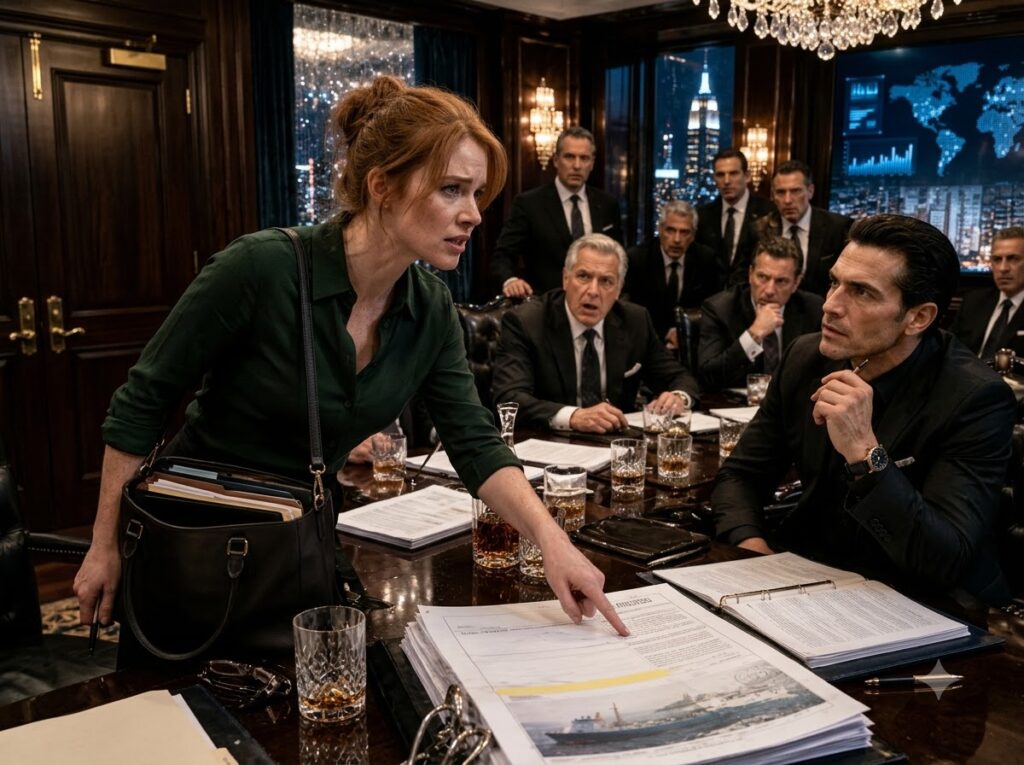
The table was crowded with leather folders, laptop computers, mineral water, whiskey glasses, and documents thick enough to stop a bullet. At the center lay the acquisition agreement for Bain Shipping, a company that owned several strategically positioned cargo terminals along the Newark waterfront.
Roman intended to purchase the company for two hundred million dollars.
The seller, Harrison Blake, had spent twenty years competing against the D’Amico family. He had publicly accused Roman’s father of bribery, sued three D’Amico subsidiaries, and once attempted to block a major shipping development through a federal injunction.
Now Blake was offering to sell his most valuable terminals.
The offer seemed too generous.
That was the first thing I noticed.
The second was the tension.
Roman’s lead attorney, a silver-haired man named Preston Hale, was sweating despite the cool room.
“All outstanding compliance issues have been resolved,” Preston said. “Our independent review confirms that the vessel inventories match the valuation schedules.”
Roman swirled the whiskey in his glass.
“And the environmental liabilities?”
“None that affect the transaction.”
“Outstanding litigation?”
“Disclosed and accounted for.”
“Beneficial ownership?”
“Verified.”
Roman placed his glass on the table.
“Then why has Harrison Blake spent the last six weeks insisting this agreement must be signed before midnight?”
Nobody answered immediately.
A man near the far end of the table cleared his throat.
“Tax treatment, primarily. The transaction is structured around a financing window.”
Roman turned his head.
“Your name?”
“Martin Voss. Bain’s chief financial officer.”
“I know your name, Mr. Voss. I asked why you believe the deadline matters.”
Voss adjusted his tie.
“Because the financing commitment expires.”
Roman regarded him for a moment.
“Convenient.”
The executive’s mouth tightened.
I poured coffee into Roman’s cup.
He didn’t look at me.
None of them did.
I was halfway through the room when I glanced down at the open valuation schedule.
And saw the name of a ship that should not have existed.
Osprey Dawn.
At first, I thought I had misread it.
I set the coffee pot down beside an empty glass and leaned slightly closer, pretending to straighten the silverware.
The ship was listed as a modern cargo vessel, built in 2018 and registered under a Liberian flag. Its estimated value was twenty-eight million dollars.
But the identification number printed beside its name was wrong.
Not slightly wrong.
Impossible.
The vessel’s identification sequence did not match the ship’s supposed age or registration history. The format belonged to an older generation of records.
My heart began to pound.
I knew that pattern.
Three years earlier, I had spent nights studying my father’s trial documents, searching for the discrepancy he had insisted would prove his innocence.
The same registration pattern had appeared in a shipping manifest submitted by the prosecution.
My father had circled it in red ink.
Beside it, he had written six words.
THE SHIPS ARE REAL. THE OWNERS AREN’T.
I had never understood what he meant.
Now I was staring at the same kind of discrepancy on a two-hundred-million-dollar acquisition agreement.
I turned the page.
An environmental compliance certificate had supposedly been issued on October 14 of the previous year.
That date was wrong, too.
The certificate claimed that a federal agency had inspected the vessel and cleared it for operation. But the document’s metadata, visible in the supporting audit schedule, showed that its final authorization had been entered after the vessel’s supposed inspection.
Worse, the date printed on the certificate fell on a federal holiday when the relevant offices were closed.
That alone did not prove fraud.
The registry discrepancy did.
I looked at the ship’s name again.
Osprey Dawn.
My fingers went cold.
Three years earlier, I had found a maritime database entry stating that a vessel with that identification number had been dismantled in Bangladesh.
The dismantling had been completed long before the supposed inspection.
The contract was valuing a dead ship as though it were a living asset.
And if one vessel had been falsified, how many others were hiding inside the paperwork?
I glanced toward Roman.
His hand rested beside the signature line.
The pen was already uncapped.
“Preston,” he said, “anything else I should know before I sign?”
“Nothing material,” the attorney replied.
I looked around the table.
Twenty executives. Six attorneys. Several financial analysts. Men who had spent decades buying companies, selling companies, and paying other people to find problems before they became disasters.
Not one of them had noticed.
Or perhaps somebody had noticed and decided not to say anything.
I thought of my father sitting behind a glass partition in a federal courtroom, insisting that the evidence against him had been manufactured.
I remembered the last time I visited him.
He had pressed his palm against the glass.
“Cassidy, listen to me. Never trust a document because someone important signed it.”
I had cried all the way home.
Now a man worth billions was about to sign a document that could destroy him.
I could remain invisible.
I could refill the water glasses, collect my tips, and go home to my mother.
Nobody would blame me for staying quiet.
Nobody would even know I had seen anything.
Then I looked at the signature line again.
And I heard my father’s voice.
Never trust a document because someone important signed it.
I set the coffee pot down.
“It’s not clean.”
Twenty heads turned.
Roman slowly lifted his eyes.
And the room became so silent that I could hear the rain striking the windows.
Chapter 2: Ten Seconds to Save My Life
For one terrible second, I thought Roman D’Amico was going to have me killed.
A broad-shouldered executive pushed his chair backward.
“Who allowed the waitress to speak?”
Henri appeared in the doorway as if summoned by the sound of his own impending unemployment.
“Mr. D’Amico, I sincerely apologize. Cassidy is new to the private dining service. I’ll remove her immediately.”
“Sit down,” Roman said.
Henri stopped.
He wasn’t speaking to him.
He was speaking to the executive who had risen from his chair.
The man sat.
Roman looked at me.
“Your name?”
“Cassidy Bennett.”
“What isn’t clean, Miss Bennett?”
I could feel every eye in the room measuring me, searching for a reason to dismiss me. My uniform was cheap. My shoes pinched. My hands were shaking badly enough that I had to clasp them together.
“The vessel records,” I said.
One of the attorneys laughed.
“She’s a waitress.”
Roman didn’t move.
“That wasn’t my question.”
I swallowed.
“The Osprey Dawn is listed as a 2018 vessel, but the identification number doesn’t match that registration period. The number belongs to a much older record. And the vessel associated with that number was dismantled three years ago.”
Martin Voss leaned forward.
“That’s absurd.”
“Then you won’t mind checking.”
Voss’s face reddened.
“Mr. D’Amico, this is precisely why we hired independent auditors. We cannot allow an unqualified employee to disrupt a transaction of this magnitude because she misread a number.”
“I didn’t misread it.”
“Do you have any idea how many ships use similar registration formats?”
“Yes.”
The answer came out more confidently than I felt.
I had studied maritime accounting for two years before leaving university. Vessel identification was not simply a matter of matching names. Names could change. Owners could change. Flags could change. Identification numbers, however, followed specific rules, and the records surrounding a vessel’s construction, ownership, and retirement had to make sense together.
This one did not.
Roman turned toward his lead attorney.
“Preston?”
The attorney had already opened a laptop.
“One moment.”
His fingers moved quickly.
Then stopped.
He clicked again.
His expression changed.
“Mr. D’Amico.”
“What?”
“I need to verify something.”
“Verify it.”
Preston picked up his phone and made a call.
The rest of the room began whispering.
I caught fragments.
“Impossible.”
“Check the other vessels.”
“Who approved the schedule?”
“Blake must have known.”
Roman raised one hand.
The whispers died.
Preston listened to the person on the other end of the call, then asked a question so quietly I couldn’t hear it.
He listened again.
Then his face went white.
“Oh, God.”
Roman set down his pen.
“What did you find?”
Preston ended the call.
“The vessel associated with that identification number was dismantled in Bangladesh in 2023. The record is in the maritime database.”
Silence.
Then Roman asked, “How many other vessels?”
Preston stared at the screen.
“We’re checking.”
“Check all of them.”
The order was delivered without anger.
That somehow made it more frightening.
Within seconds, laptops opened across the table. Attorneys began calling their offices. Analysts compared spreadsheets, registries, and certificates.
I stepped backward, hoping to disappear before someone remembered I was standing there.
Roman noticed.
“Stay.”
My feet stopped moving.
“Me?”
“You saw the discrepancy. You’re going to explain how.”
“I already did.”
“No. You explained what you saw. I asked how.”
I looked at the contract.
“I recognized the identification pattern.”
“From where?”
“My studies.”
“Where did you study?”
“Baruch College.”
“Degree?”
“I didn’t finish.”
“Why?”
“My mother got sick.”
It was the truth, but it sounded painfully small in that room.
Roman watched me for a moment.
Then he looked at the papers again.
“Continue.”
I approached the table.
My hands had stopped shaking. Fear was still there, but something stronger had taken its place: the cold, familiar concentration I used to feel when solving a complicated accounting problem.
I pointed to the vessel schedule.
“The Osprey Dawn isn’t the only problem. Look at the valuation methodology. The acquisition price assumes the listed ships are active assets. Their values are being used to support the purchase price and the financing package.”
I traced the relevant columns with one finger.
“These vessels are supposed to generate revenue, provide collateral, and justify the debt. If the records are false, the assets may be worthless or already owned by somebody else.”
One analyst leaned closer.
“That’s right.”
I looked at the environmental certificates.
“These documents are also suspicious. Their issue dates, inspection dates, and authorization records don’t align. A forged certificate doesn’t automatically prove the whole acquisition is fraudulent, but combined with the dead vessel, it means the entire compliance package needs to be treated as compromised.”
Roman studied the pages.
“And if I had signed?”
“The lender could have advanced money against assets that don’t exist as represented. The company could have inherited undisclosed liabilities. Regulators might investigate the transaction, and the false documents could expose everyone involved to fraud charges.”
“Everyone?”
“Potentially. Depending on who knew what and who signed what.”
I hesitated.
“Your lawyers would have to determine the legal consequences.”
Roman’s mouth twitched.
It wasn’t quite a smile.
“You are careful with your words.”
“My father taught me to be.”
“Your father?”
I regretted saying it immediately.
“He’s dead.”
Roman’s expression didn’t change.
“What was his name?”
I looked at him.
“Daniel Bennett.”
Something shifted in his eyes.
It was brief. So brief that I might have imagined it.
But he knew the name.
I was certain of it.
Before I could ask why, a young analyst near the end of the table made a strangled sound.
“Mr. D’Amico?”
Roman turned.
The analyst rotated his laptop.
“Of the twenty-seven vessels listed in the acquisition schedule, nine have major discrepancies. Four appear to have been scrapped. Three are registered to companies unrelated to Bain Shipping. Two have ownership records that don’t match the seller’s disclosures.”
“Total valuation?”
“Approximately eighty-six million dollars, potentially more if the other discrepancies are material.”
A low murmur swept through the room.
Roman’s expression became unreadable.
“That’s forty-three percent of the purchase price.”
“At least.”
The analyst swallowed.
“And that’s before we examine the terminal deeds.”
Roman looked at Preston.
“Did your firm certify these records?”
Preston didn’t answer quickly enough.
“Did you?”
“We relied on materials supplied by the seller and cross-checked the principal documents.”
“That wasn’t what I asked.”
“Yes,” Preston said finally. “Our firm signed the due-diligence certification.”
Roman leaned back.
For the first time that evening, he looked tired.
Not frightened.
Not angry.
Tired.
As though someone had finally confirmed a suspicion he had carried for years.
“Who prepared the original valuation schedule?”
Preston checked his notes.
“An outside consulting firm called Northstar Advisory.”
“Who owns it?”
“That information should be in the disclosure packet.”
Roman looked toward Martin Voss.
“Mr. Voss?”
Voss had stopped sweating.
Now he was pale.
“I don’t handle the consulting contracts personally.”
“Then you won’t mind if we investigate them.”
“Of course not.”
Roman nodded.
Then he reached for the acquisition agreement.
Before anyone could stop him, he struck a match.
The flame illuminated his face as he held it beneath the corner of the contract.
“Mr. D’Amico!” Preston exclaimed.
Roman watched the paper catch fire.
“Nobody signs anything tonight.”
He dropped the burning document into an empty silver serving dish.
The fire curled through the signature pages, consuming the ink and the elegant corporate letterhead.
“Call the seller,” Roman ordered. “Tell him the transaction is suspended pending independent verification. Preserve every email, every draft, and every financial record associated with this agreement.”
His gaze moved around the table.
“Nobody deletes anything. Nobody contacts the press. Nobody leaves this building without giving our legal team a complete account of their role in preparing these documents.”
Then he looked at me.
“Miss Bennett, you are going to have dinner with me.”
I stared at him.
“I have a shift to finish.”
Henri made a noise that sounded suspiciously like a swallowed scream.
Roman’s eyes remained on mine.
“Your shift is over.”
“I can’t afford to lose my job.”
“You just saved me two hundred million dollars.”
“That doesn’t mean I can afford to be unemployed tomorrow.”
For the first time, a genuine smile appeared on his face.
It changed him in a way I hadn’t expected. He looked younger. Almost human.
“Fair enough.”
He turned toward Henri.
“She will receive her full wages for tonight, plus whatever overtime she is owed. You will not penalize her for this interruption. Is that understood?”
Henri nodded so rapidly that I worried his neck might hurt.
“Absolutely, Mr. D’Amico.”
Roman looked back at me.
“Now, Miss Bennett. Would you prefer to discuss the fraud over dinner or over coffee?”
I glanced at the destroyed contract.
“Coffee.”
“Excellent. I was hoping you’d say that.”
He gestured toward the empty chair beside him.
And for the first time in three years, I had the strange feeling that my life was moving toward something rather than merely away from disaster.
I sat down.
I should have known better.
Because Roman D’Amico had just discovered that a waitress could recognize a fraud his entire team had missed—and he had also discovered the name of the man who had taught her.
He was not going to let either discovery go.
Chapter 3: The Man Who Knew My Father
The private dining room emptied slowly.
Executives departed in pairs, whispering urgently into their phones. Attorneys carried boxes of documents into an adjoining conference room. Security personnel appeared at the doors, and the restaurant manager ordered the remaining staff to avoid the corridor outside Roman’s private suite.
I sat at the table with a cup of coffee that had gone cold.
Roman stood by the window, speaking quietly to a man I had not seen enter.
The newcomer was in his fifties, with silver hair, a navy suit, and the kind of face that looked as though it had never been surprised by anything.
“Have the building logs preserved,” Roman said. “Every entry and exit. I want copies of the security footage from the past six hours.”
“Already being handled.”
“And find out who knew we were signing tonight.”
The older man nodded.
“Do you think Blake is behind it?”
“I think Blake wants me to believe he’s behind it.”
“That’s not an answer.”
“It’s the only one I have.”
The man glanced at me.
“And her?”
Roman followed his gaze.
“She’s the reason we aren’t discussing this in a federal holding cell.”
“Or the reason someone knows we have a problem.”
“Then we’ll find out which.”
The older man nodded once and left.
Roman returned to the table.
“That was Gabriel Shaw,” he said. “My chief of security.”
“Should I be worried?”
“Probably.”
I stared at him.
He pulled out the chair opposite mine.
“That was a joke.”
“It wasn’t a very good one.”
“No,” he admitted. “It wasn’t.”
He sat.
For a moment, neither of us spoke.
Then he placed a thin folder on the table.
“Daniel Bennett.”
My father’s name stared up at me from the cover.
I felt the blood drain from my face.
“Where did you get that?”
Roman opened the folder.
Inside were photocopies of newspaper articles, corporate filings, and a photograph of my father leaving a courthouse in a dark overcoat. He looked thinner than I remembered, but his expression was unmistakable: tired, stubborn, and furious.
I reached for the photograph.
My fingertips trembled.
“Why do you have this?”
“Because your father worked on a financial investigation involving my family.”
I looked up sharply.
“My father investigated your family?”
“Not directly. He was hired by an insurance consortium examining losses connected to several shipping companies. Some of those companies did business with my father’s organization.”
“You’re saying my father worked for the mafia?”
“I’m saying he was hired to investigate financial irregularities. He didn’t know who ultimately controlled every company involved.”
I pushed the photograph away.
“My father wasn’t a criminal.”
“I didn’t say he was.”
“Everyone else did.”
Roman’s eyes hardened.
“Everyone else was wrong about several things that night.”
The words landed between us.
“What night?”
He looked at the folder.
“Three years ago, your father was convicted of helping conceal forty-seven million dollars in fraudulent shipping transactions. The prosecution argued that he had created false ownership records for a network of shell companies.”
“He didn’t.”
“Your father maintained that the records had been altered after he submitted them.”
“He told me that until he died.”
Roman was silent.
I laughed bitterly.
“Of course you know about him. My father’s name must be in half the files your lawyers keep locked away.”
“His name is in more files than that.”
“Why?”
“Because the investigation that destroyed him also affected my family.”
I felt something cold settle in my stomach.
“What are you saying?”
Roman opened another document.
It was a list of transactions between shipping companies, investment funds, and several offshore entities. The dates stretched across nearly a decade.
At the bottom was a signature.
Daniel Bennett.
But the signature looked wrong.
I knew my father’s handwriting. I had seen it on birthday cards, school permission slips, grocery lists, and the notes he left beside my breakfast when he worked late.
His signature always leaned slightly to the right, and the final stroke of his surname curved upward.
This one didn’t.
“That’s not his signature,” I whispered.
Roman watched me carefully.
“You can tell?”
“Of course I can tell.”
“Then we may have a problem larger than either of us realized.”
I looked at the document again.
“Where did you get this?”
“From a file my father kept before he died.”
“Your father?”
“Salvatore D’Amico.”
The name was familiar from newspaper articles. Roman’s father had been a powerful businessman with a reputation for ruthlessness. He had died of a heart attack four years earlier, leaving behind an empire divided between legitimate holdings and rumors of criminal influence.
Roman continued.
“Shortly before his death, my father ordered an internal review of several shipping accounts. He believed someone was using our companies to move money without authorization.”
“Did he find out who?”
“No.”
“Then how do you know this is connected to my father?”
“Because Daniel Bennett was the last independent accountant to request the original records.”
I stared at him.
The room seemed to tilt.
My father had never mentioned the D’Amicos.
Not once.
“Maybe he was investigating you.”
“Perhaps.”
“Maybe he found evidence against your family, and that’s why he went to prison.”
Roman didn’t flinch.
“Perhaps that is exactly what happened.”
I stood so abruptly that my chair scraped against the floor.
“Then why am I sitting here?”
“Because I need to know what he found.”
“You think I’m going to help you?”
“I think you want the truth.”
“You don’t know anything about what I want.”
“Then tell me.”
I stared at him.
I wanted my father back.
I wanted my mother healthy.
I wanted to wake up one morning without calculating which bill could be ignored for another week.
I wanted the world to stop treating my father’s conviction as proof that I was somehow guilty by association.
But most of all, I wanted to know why a man who had spent his life teaching me that numbers never lied had died insisting that numbers had been used to destroy him.
“I want his name cleared,” I said.
Roman nodded.
“Then we have the same objective.”
“No, we don’t. You want to protect your empire.”
“I want to know who used it.”
“And if the evidence leads to you?”
He met my gaze without hesitation.
“Then I want to know that, too.”
I searched his face for a lie.
I found something worse.
He appeared to mean it.
“Why should I trust you?”
“You shouldn’t.”
The blunt answer surprised me.
Roman closed the folder.
“Trust is earned, Miss Bennett. I have not earned yours. But I can offer you access to the records my father preserved, independent legal counsel, and enough money to ensure your mother receives proper care while you investigate.”
I stiffened.
“I don’t need charity.”
“Good. I wasn’t offering charity.”
“Then what are you offering?”
“A contract.”
I almost laughed.
“After what happened tonight, you want me to sign a contract?”
“A consulting agreement. You identify financial discrepancies. My attorneys verify your findings. You receive payment for your work. Your mother receives treatment through a medical fund that will not be tied to your findings or your continued employment.”
“Why would you separate those things?”
“Because I don’t want you wondering whether your mother’s health depends on what you discover.”
For the first time, I had no immediate answer.
Roman slid a business card across the table.
“Think about it. If you decline, Gabriel will arrange a safe ride home. If you accept, we begin tomorrow.”
I took the card.
“One more question.”
“Go ahead.”
“Why did you look like you recognized my father’s name before I told you who he was?”
Roman’s expression changed.
It was subtle, but I saw it.
“Because I recognized your surname.”
“From the files?”
“Yes.”
He was lying.
I didn’t know how I knew, but I was certain.
And as I left The Gilded Sturgeon that night, carrying a business card that could change my life, I made myself a promise.
I would find out what happened to my father—even if the truth destroyed Roman D’Amico, his empire, and everyone who had helped bury the evidence.
I had no idea that the first person I would have to confront was the man who had just offered to help me.
Chapter 4: The Files Beneath the City
At 8:17 the next morning, I arrived at D’Amico Maritime’s headquarters wearing the only blazer I owned.
The building occupied forty-two floors of glass and polished stone overlooking the Hudson River. A receptionist in a cream-colored suit asked for my identification, checked her screen, and looked at me with an expression that suggested someone had entered the wrong building.
“You’re expected?”
“I hope so.”
She checked again.
“Ms. Bennett?”
“Yes.”
Her expression changed.
“Mr. D’Amico is expecting you on the thirty-eighth floor.”
The elevator required a security badge. A guard escorted me through a corridor lined with framed photographs of ships, ports, and construction projects.
At the end stood Roman’s office.
The walls were glass, the furniture dark wood, and the windows overlooked a city that looked strangely peaceful from forty stories above the street.
Roman was standing beside his desk, reading a document.
“You came.”
“You offered a job.”
“I did.”
“I have conditions.”
He placed the document down.
“Let’s hear them.”
“First, I get access to the original records, not summaries prepared by your lawyers. Second, I choose an independent attorney to review anything involving my father’s conviction. Third, nobody threatens my mother or uses her medical care to pressure me.”
Roman listened without interruption.
“Agreed.”
“Fourth, if I find evidence implicating you, I can give it to my attorney.”
“Agreed.”
“Fifth, I don’t lie for you.”
He tilted his head.
“That one should be obvious.”
“Not in your line of work.”
A brief smile touched his mouth.
“Fair point.”
He opened a drawer and removed a thick folder.
“Your contract will be reviewed by independent counsel. You will receive a salary, not a percentage of recovered assets. Your mother’s treatment will be paid through a separate medical trust administered by an outside provider.”
I examined the papers.
The salary was more money than I had ever earned in a year.
I could pay the rent. I could cover my mother’s medication. I could return to university if I wanted.
It frightened me more than I expected.
Money could solve problems, but it could also make people dependent.
“I want the medical trust to be irrevocable,” I said. “And I want the agreement to state that my mother’s care continues regardless of whether I finish the investigation.”
Roman looked at me for several seconds.
Then he called his attorney.
“Amend the agreement.”
The attorney began to object.
Roman cut him off.
“She made a reasonable request. Put it in writing.”
When the call ended, he handed me a security badge.
“Welcome to D’Amico Maritime.”
“I haven’t signed anything.”
“You’ll sign when your attorney approves it.”
“Then I’m not your employee yet.”
“Then welcome to the building.”
I almost smiled.
Almost.
He led me to a conference room where Gabriel Shaw had arranged three computers, several boxes of documents, and a whiteboard covered in names.
At the center was a photograph of Harrison Blake.
Beside it were the words:
BAIN SHIPPING — $200 MILLION — DEADLINE: MIDNIGHT
Gabriel pointed to the board.
“We have twenty-seven vessels, six terminal properties, nine shell companies, and approximately thirty-four million dollars in outstanding liabilities that may not have been disclosed.”
“Thirty-four million?”
“That’s the preliminary estimate. It could be higher.”
I examined the company names.
Several looked familiar from the papers I had seen the previous night.
One stood out.
Northstar Advisory.
“Who hired them?”
Gabriel glanced at Roman.
“That’s what we’re trying to establish.”
I moved closer to the board.
“What about the terminal deeds?”
“Three are clean on their face. Two have unresolved liens. One appears to have been transferred between affiliated companies several times in eighteen months.”
“Appears?”
“We haven’t obtained the originals.”
I picked up a marker.
“Then stop treating this as a shipping problem.”
Roman folded his arms.
“Explain.”
“It’s an ownership problem. The ships are only the visible part. If someone created shell companies to disguise who owned the vessels, the same network may have been used to transfer the terminals, borrow against them, and hide the money.”
I wrote three words on the board.
ASSETS. OWNERS. CASH.
“Every asset has an ownership trail. Every owner has a source of funds. Every transfer leaves an accounting record somewhere. We need to connect all three.”
Gabriel studied the board.
“How long will that take?”
“To establish whether the records are fraudulent? A few days, if the source files are available.”
“And to identify who did it?”
I looked at the names.
“Longer.”
Roman nodded.
“Then begin.”
For the next six hours, I forgot to be afraid.
I compared shipping manifests, bank statements, corporate filings, and insurance records. I built spreadsheets that connected the same vessel numbers to different companies, then tracked payments between those companies.
The pattern emerged slowly.
A vessel would be listed as collateral for one loan. Its ownership would then be transferred to another company. The new owner would borrow against the same vessel, while the original company continued reporting it as an asset.
In some cases, the same ship appeared in three separate financing packages.
The paper value multiplied.
The actual ships did not.
By early afternoon, I had identified a network of shell companies linked to Bain Shipping’s consulting firm.
By three, I had found a series of payments to an account belonging to a company called Meridian Ledger Group.
By four, I had found the name of the person who had authorized those payments.
Martin Voss.
I leaned back.
“Roman?”
He approached my desk.
“What have you found?”
“Voss authorized payments to Meridian Ledger Group. The payments were described as consulting fees, but the invoices don’t correspond to any identifiable services.”
“How much?”
“Just under four million dollars over eighteen months.”
Gabriel leaned over my shoulder.
“Could be kickbacks.”
“Could be. We need the underlying records before we make that conclusion.”
Roman examined the entries.
“Who owns Meridian Ledger?”
“That’s the problem. The company is registered through an intermediary, and the beneficial ownership declaration lists a trust.”
“Which trust?”
I pointed to the screen.
“The Ashford Foundation.”
Roman’s expression changed.
It was the second time I had seen that look.
Recognition, followed by something like anger.
“What is it?” I asked.
He straightened.
“Nothing. Keep going.”
“Roman.”
He met my eyes.
“The Ashford Foundation was created by my father twenty years ago.”
I stared at him.
“Why is a charitable foundation connected to a company receiving suspicious consulting payments?”
“I don’t know.”
“You recognize the name.”
“Because I know the foundation.”
“Then you know who controls it.”
“My father established it. After his death, its trustees changed.”
“Who are they?”
Roman didn’t answer.
Gabriel looked uncomfortable.
I closed the spreadsheet.
“You’re withholding information.”
“I’m trying to verify it.”
“That isn’t the same thing.”
“No,” Roman said quietly. “It isn’t.”
He turned toward Gabriel.
“Get me the foundation’s current trustees and the original trust documents. Not the summaries. The originals.”
Gabriel nodded and left.
I watched Roman return to the window.
“You said you wanted the truth,” I reminded him.
“I do.”
“Then stop deciding which parts I can handle.”
He turned back.
For a moment, the cold authority disappeared from his face.
“My father established the Ashford Foundation to support families of maritime workers killed or injured on the job. It paid medical bills, funded scholarships, and helped children whose parents disappeared into the legal system.”
“That sounds admirable.”
“It was.”
“Was?”
Roman looked out over the river.
“After my father died, I discovered that millions of dollars had moved through the foundation without proper documentation. I assumed the trustees were stealing from it. I ordered an audit, but before we could finish, the records disappeared.”
“And you never reported it?”
“I reported the missing records to the board.”
“That isn’t what I asked.”
His jaw tightened.
“I was told the discrepancies had been resolved. I accepted that explanation.”
“Because you trusted them?”
“Because I had a company employing twelve thousand people, three major construction projects, and a family organization under federal scrutiny. I chose to believe the explanation that required the least damage.”
I thought of my father.
“Sometimes the easiest explanation is the one that destroys the wrong person.”
Roman looked at me.
“Yes.”
Something in his voice made me pause.
He seemed to be thinking of a man he had failed.
Perhaps his father.
Perhaps someone else.
Before I could ask, Gabriel returned with a thin folder.
“The current trustees of the Ashford Foundation are listed here.”
Roman opened it.
He read the first page.
Then the second.
His hand tightened around the paper.
“That’s impossible.”
I stood.
“What?”
He turned the folder toward me.
The names were listed beneath the heading BOARD OF TRUSTEES.
One belonged to a retired shipping executive.
Another belonged to a prominent New York attorney.
The third was a woman named Eleanor Vale.
The fourth was a man who had died five years earlier.
And the fifth—
I stopped breathing.
Daniel Bennett.
My father’s name.
Listed as an active trustee of a foundation he had supposedly helped defraud, despite having been dead for three years.
I stared at the document.
Then I looked at Roman.
“Tell me that’s a clerical error.”
He didn’t answer.
I took the page and examined it carefully.
The document bore an electronic filing stamp from six months earlier.
My father had been dead for more than two years when the filing was submitted.
Someone had used his identity to authorize a foundation’s activities.
And if his name was being used after his death, then the question was no longer simply whether he had been framed.
The question was whether someone had continued using his identity to steal money long after the government declared him guilty.
I took a photograph of the page.
“Now we have a starting point.”
Roman looked at me with an expression I couldn’t decipher.
“No,” he said.
“We have something much more dangerous.”
Chapter 5: The Woman in the Photograph
Eleanor Vale lived in a townhouse on the Upper East Side, three blocks from Central Park.
She was seventy-two, impeccably dressed, and possessed the sort of quiet elegance that made people lower their voices without knowing why.
She had been a friend of Roman’s father for decades. According to the foundation’s public records, she had served as its treasurer before becoming its chairwoman.
Roman insisted on accompanying me to meet her.
I insisted on bringing my attorney.
We compromised by bringing Gabriel and my attorney, a sharp-eyed woman named Miriam Cole, who had spent twenty years defending people accused of financial crimes.
Eleanor received us in a drawing room filled with antique furniture, fresh flowers, and photographs of charity galas.
When she saw Roman, she smiled.
“Roman. You should have called.”
“I did.”
“Yes, but I was in the garden.”
“You have an intercom.”
“I do, don’t I?”
Her smile widened.
Then she looked at me.
“And who is this?”
“Cassidy Bennett.”
The smile vanished.
Not slowly.
Instantly.
Her fingers tightened around the handle of her teacup.
“Daniel’s daughter?”
I felt the room change.
“You knew my father?”
Eleanor placed the cup down.
“Of course I did.”
“How?”
She looked toward Roman.
He said nothing.
“Your father was an extraordinarily talented accountant,” she said. “A very unfortunate man.”
“Unfortunate?”
“He became involved in matters beyond his control.”
“My father was framed.”
Eleanor’s expression softened into something that looked almost like pity.
“Perhaps.”
I hated that word.
Perhaps was what people said when they wanted to appear sympathetic without accepting responsibility.
Miriam opened her notebook.
“We’re investigating the use of Mr. Bennett’s identity in recent foundation filings. Can you explain why his name appears on a document submitted six months ago?”
Eleanor folded her hands.
“I cannot. I haven’t reviewed every filing personally.”
“You’re the chairwoman.”
“And I have staff.”
“Who?”
Eleanor named two administrators and a legal secretary.
Miriam wrote down their names.
I placed the copy of the filing on the table.
“Did my father authorize this?”
“No.”
The answer came too quickly.
Eleanor seemed to realize it.
“I mean, not to my knowledge. Daniel died before the filing was submitted.”
“Then someone forged his authorization.”
“That would be a serious allegation.”
“It’s a serious document.”
Eleanor looked at Roman.
“Your father would be very disappointed to see what this investigation has become.”
Roman’s voice was cold.
“My father is dead. His disappointment isn’t our primary concern.”
For the first time, Eleanor looked afraid.
Only for a second.
Then she recovered.
“Of course.”
I studied her face.
She was hiding something.
I didn’t know what, but I had seen the expression before: the slight delay before answering, the careful shift in posture, the way her eyes moved toward the person most likely to interrupt.
“Mrs. Vale,” I said, “did you ever meet my father outside a professional setting?”
She looked at me.
“Yes.”
“When?”
“Many years ago.”
“Where?”
“At a foundation event.”
“Was he working for the foundation?”
Eleanor hesitated.
“Not officially.”
“What does that mean?”
“It means your father helped us with a few complicated financial matters. He was generous with his time.”
“Was he paid?”
“Not by the foundation.”
“Then who paid him?”
She stood.
“I believe this conversation has gone on long enough.”
Roman didn’t move.
“Sit down, Eleanor.”
The room froze.
She stared at him.
“Excuse me?”
“You heard me.”
“I have known your family for thirty years.”
“And I have spent three years discovering that people I trusted used my father’s name to hide money. Sit down.”
Eleanor slowly returned to her chair.
I could hear my own heartbeat.
Roman placed the foundation filing on the table.
“Who authorized the payments to Meridian Ledger Group?”
“I don’t know.”
“Who controls the trust behind the company?”
“I don’t know.”
“Who submitted the false filing?”
“I don’t know.”
Roman leaned forward.
“Then tell me what you do know.”
Eleanor’s hands trembled.
For several seconds, she said nothing.
Then she looked directly at me.
“Your father came to see me the week before he was arrested.”
My chest tightened.
“What did he say?”
“He told me he had found something in the foundation’s accounts. Something that could destroy several people.”
“Who?”
“He didn’t say.”
“Did he give you evidence?”
“No.”
“Did he tell you where it was?”
Eleanor looked away.
“Yes.”
The word barely escaped her lips.
I gripped the edge of my chair.
“Where?”
She shook her head.
“I can’t tell you.”
“Why?”
“Because the person who took those records is still alive.”
“Who?”
Eleanor closed her eyes.
For a moment, she looked much older than seventy-two.
Then she whispered a name.
“Your mother.”
I couldn’t move.
The room seemed to collapse around those two words.
“My mother?”
Eleanor nodded.
“Daniel gave her something the night before he was arrested. I never knew what it was. But I know she had it.”
I stood so abruptly that my chair struck the wall.
“You’re lying.”
“I wish I were.”
“My mother has spent three years believing my father was guilty. She never said anything about hidden records.”
“Perhaps she was trying to protect you.”
“From what?”
Eleanor looked at Roman.
Then at Gabriel.
Then back at me.
“From the people who arranged his conviction.”
She reached for her teacup, but her hand shook too badly to lift it.
“Daniel believed the fraud involved more than money. He thought someone was deliberately creating false records to transfer ownership of legitimate assets, then using those false records to implicate people who had no knowledge of the scheme.”
“Like him.”
“Yes.”
“Who arranged his conviction?”
Eleanor swallowed.
“I don’t know all of them. But one person was involved in every stage—the foundation, the shipping companies, the legal filings, and the investigation.”
“Who?”
She opened her mouth.
A sharp sound came from the hallway.
Glass breaking.
Gabriel was on his feet instantly.
Roman pulled me away from the window.
“Down!”
The first gunshot shattered the drawing-room glass.
Someone screamed.
Roman shoved me behind a marble fireplace as a second shot tore through the curtains.
Gabriel drew his weapon and moved toward the doorway.
Miriam crouched beside me, gripping my arm.
“Don’t move.”
I couldn’t have moved if I wanted to.
Outside, a car engine roared.
Then another gunshot cracked through the house.
Silence followed.
Roman stayed between me and the window until Gabriel returned.
“He’s gone,” Gabriel said. “One shooter. We have security footage of a vehicle leaving the rear alley.”
“Eleanor?”
She was sitting on the floor, blood running from a cut on her forehead.
Roman knelt beside her.
“Are you hit?”
She shook her head.
“No.”
“Who was he?”
“I don’t know.”
But she was looking at me.
Not Roman.
Me.
Her expression held something far more frightening than fear.
Regret.
She reached into the pocket of her cardigan and pressed a small brass key into my hand.
“Daniel told me that if anything happened to him, I should give this to his daughter.”
My fingers closed around it.
“What does it open?”
Eleanor’s eyes filled with tears.
“The place where your father hid the truth.”
Before she could say anything else, she collapsed.
Chapter 6: The Key in My Mother’s Bible
Eleanor Vale survived the shooting, but she refused to speak to the police until her attorney arrived.
The shooter was never identified.
The security footage showed a dark sedan leaving the alley, but its plates had been stolen. No fingerprints were recovered from the broken window, and the bullet fragments offered little useful information.
By the following morning, three news outlets were reporting that Roman D’Amico’s acquisition of Bain Shipping had collapsed amid allegations of financial misconduct.
One article mentioned an unnamed waitress who had interrupted the negotiations.
My photograph appeared beneath the headline.
WAITRESS THWARTS MAFIA BILLIONAIRE’S $200 MILLION DEAL.
I looked at the picture in disbelief.
Someone had taken it from the restaurant’s staff directory.
My phone rang before I finished reading.
It was my landlord.
“Cassidy, I saw you on the news.”
“Good morning to you, too.”
“Does this mean you’re rich now?”
“No.”
“Because I need the rent by Friday.”
“I know.”
He hung up.
I stared at the screen, then laughed once.
It wasn’t funny.
But sometimes the alternative to laughing is screaming.
Roman had arranged a security detail outside my mother’s apartment. I hated the idea, but after the shooting at Eleanor’s townhouse, I couldn’t pretend the danger was imaginary.
My mother was sitting at the kitchen table when I arrived.
Her dialysis bag was beside the refrigerator. The small apartment smelled of chamomile tea and the lavender detergent she used on her sheets.
She looked up from her Bible.
“Cassidy? What’s wrong?”
I sat across from her.
“I need to ask you something.”
Her expression changed.
“What is it?”
“Did Dad ever give you anything before he was arrested?”
She went completely still.
The silence lasted long enough for me to hear the refrigerator motor click off.
Then she closed the Bible.
“Why are you asking me that?”
“Because someone told me he did.”
“Who?”
“Eleanor Vale.”
My mother’s face drained of color.
I had never seen her look like that.
Not when the doctors diagnosed her kidney disease. Not when the prison called to tell us my father had died. Not even when we buried him beneath a gray sky while reporters waited outside the cemetery gates.
“Mom?”
She stood and walked to the sink.
“I don’t want to talk about Eleanor.”
“She said Dad gave you something.”
“Your father gave me many things.”
“Mom.”
She gripped the edge of the counter.
“Please.”
I felt anger rising through my fear.
“For three years, you’ve let me believe Dad died with nothing but his word. I’ve spent every night wondering whether I missed something, whether there was a document I should have found, whether I could have saved him if I’d understood the numbers sooner.”
She turned.
Tears stood in her eyes.
“You were twenty-three.”
“I was his daughter.”
“And I was his wife!”
Her voice cracked.
For a moment, neither of us spoke.
Then she covered her mouth with one hand.
“I’m sorry.”
I rose and crossed the kitchen.
She leaned against me, trembling.
“I thought I was protecting you,” she whispered.
“From what?”
“From the people who killed your father.”
My blood turned cold.
“You told me he died in prison.”
“He did.”
“Then who killed him?”
She closed her eyes.
“I don’t know.”
“Mom, I need you to tell me everything.”
She sat down slowly.
Then she reached for her Bible.
“I didn’t know what Daniel had discovered until the night before his arrest. He came home after midnight. He was frightened, Cassidy. Your father was never a frightened man, but that night he checked the locks three times before he would sit down.”
I could picture it.
My father had always been the calmest person in our family. When a pipe burst in our old apartment, he fixed it while my mother panicked. When I failed my first university accounting exam, he made pancakes and told me that mistakes were simply numbers asking better questions.
The thought of him being afraid hurt more than I expected.
“He told me someone had been using his credentials,” my mother continued. “They were creating shipping records, authorizing transfers, and submitting documents in his name. He said that if he reported it, the people responsible would know he had found them.”
“Why didn’t he go to the police?”
“He said he couldn’t trust the people investigating the case.”
“Which people?”
“He didn’t tell me.”
She opened the Bible to the Book of Psalms.
A thin strip of paper had been tucked into the binding.
She pulled it free.
“Your father gave me a key and told me to hide it. He said I should only give it to you if someone came asking questions about the Ashford Foundation.”
My hands went numb.
“You had the key this whole time?”
“Yes.”
“Why didn’t you tell me?”
“Because I didn’t know whether the people who framed him were watching us. And because I was terrified that if you found the evidence, you’d follow him into the same danger.”
She placed the key in my palm.
It was brass, small and old, with the number 317 stamped into its head.
“Where does it go?”
“I don’t know.”
I stared at the key.
“Mom, how can you not know?”
“Daniel told me it opened a storage box. He said the box was in a place he had used before he married me. He wouldn’t tell me where because he thought someone might force me to reveal it.”
I closed my fingers around the metal.
“What else did he say?”
My mother looked at me through tears.
“He said that if you ever found the box, you must remember one thing.”
“What?”
She took my hand.
“The person who appears to benefit from a crime is not always the person who planned it.”
I felt a chill move through me.
It sounded like something my father would say.
It also sounded like a warning.
Roman arrived twenty minutes later.
When I told him about the key, he immediately contacted Gabriel.
They traced the number to a private storage facility in lower Manhattan, one that had been operating for more than fifty years.
Box 317 was registered under a company that no longer existed.
The facility manager allowed us into the archive room after Miriam presented a legal authorization and documented the chain of custody.
The box was smaller than I expected.
Inside were three ledgers, a flash drive, a sealed envelope, and a photograph.
I picked up the photograph first.
My father stood beside a younger Roman D’Amico.
They were outside a warehouse, both looking toward the camera.
Roman appeared to be in his early twenties. My father looked perhaps forty-five.
On the back, in my father’s handwriting, were the words:
THE FIRST MAN WHO TRIED TO WARN HIM.
I turned toward Roman.
He was staring at the picture as though it had reached out and struck him.
“You knew my father before the investigation.”
He nodded slowly.
“Yes.”
“When?”
“Fourteen years ago.”
“Why?”
Roman looked down at the photograph.
“Because your father saved my life.”
Chapter 7: The Night Roman D’Amico Nearly Died
Roman had been twenty years old when he first met my father.
At the time, he was not the composed executive I had seen in the restaurant. He was the only son of a powerful shipping magnate, a young man who had grown up surrounded by bodyguards and people who wanted something from his family.
He had also been reckless.
According to Roman, he believed that being born into power meant he was entitled to use it without understanding its consequences.
One winter evening, he had gone to a warehouse in Newark to confront a shipping manager accused of stealing from his father’s company.
The manager was not alone.
Several men were waiting inside.
Roman’s security detail had been diverted by a false emergency call, and the warehouse doors had been locked from the outside.
The men intended to force Roman to sign documents transferring ownership of several properties to a shell company.
When he refused, they attacked him.
My father happened to be reviewing shipping records at a nearby office.
He heard the commotion, found a side entrance, and called for help before entering the warehouse.
He pulled Roman out through a loading bay while the men were distracted.
Roman had been stabbed in the side.
My father drove him to a hospital and stayed until Salvatore D’Amico arrived.
“Why didn’t you tell me?” I asked.
“Because I didn’t want you to think I expected gratitude.”
“That isn’t what I meant.”
“I know.”
He turned the photograph over again.
“Your father refused a reward. He told my father that the best way to repay him was to stop letting people use the family name to intimidate honest employees.”
I looked at the picture.
“And you listened?”
“Eventually.”
“That sounds like a long way of saying no.”
Roman gave a small, humorless smile.
“Your father was very good at making me feel stupid.”
I could almost hear Dad laughing.
For the first time, Roman looked less like a mafia boss and more like a man remembering someone who had once believed he could become better.
“What happened after the warehouse incident?” I asked.
“My father hired Daniel to review the company’s shipping records. Not as an employee. As an independent investigator.”
“And that’s when he discovered the fraud.”
“Yes.”
Roman opened the first ledger.
The pages contained dates, company names, transfer amounts, and short handwritten notes.
I recognized my father’s meticulous handwriting immediately.
The first entries concerned ordinary shipping transactions.
Then, gradually, the pattern changed.
Payments were being routed through shell companies. Vessel ownership records were being duplicated. Insurance claims were being filed against assets that had already been transferred elsewhere.
Some transactions involved D’Amico subsidiaries.
Others involved companies connected to Bain Shipping.
Still others involved the Ashford Foundation.
I sat beside Roman and began building a timeline.
The earliest suspicious entry dated back sixteen years.
The latest was dated six weeks before my father’s arrest.
“Look at this,” I said.
Roman leaned closer.
The same account number appeared in three separate ledgers, each associated with a different company.
But the routing instructions were identical.
The account belonged to a financial institution that had since been acquired by another bank.
I entered the number into the database.
A result appeared.
Meridian Ledger Group.
The same company we had identified in the Bain Shipping investigation.
My stomach tightened.
“This network has existed for at least sixteen years.”
Roman nodded.
“Longer than I realized.”
I opened the sealed envelope.
Inside was a letter addressed to me.
My father’s handwriting covered the page.
Cassidy,
If you are reading this, then someone has finally found the records I could not safely give to the authorities.
I wish I could tell you that the truth will set everything right. It may not. The people involved have money, influence, and access to information that most ordinary people never see.
But remember what I taught you: every false entry must be supported by another false entry. Every hidden payment must pass through an account. Every lie has a cost, and someone must pay it.
Do not confuse the person who signed a document with the person who created it.
Do not confuse the person who received the money with the person who controlled it.
And never trust anyone who tells you that the investigation must end before the truth is known.
I love you more than anything in this world.
Dad.
I read the letter twice.
Then a third time.
The words blurred.
Roman said nothing.
He simply sat beside me while I cried.
When I finally wiped my face, I looked at the ledgers again.
“These records can clear his name.”
“They can help.”
“Help?”
“We need to authenticate them. We need the underlying bank records, the original filing metadata, and testimony establishing how the documents were obtained.”
I stared at him.
“Why are you so determined to find reasons they might not be enough?”
“Because if we take incomplete evidence to the authorities, whoever did this will know exactly what we have. They’ll destroy whatever remains.”
He was right.
I hated that he was right.
I gathered the papers.
“Then we find the rest.”
Roman looked at me.
“There’s something else you should know.”
I waited.
“My father didn’t die of a heart attack.”
The room became very quiet.
“What?”
“That was the official cause of death. But the medical records were incomplete. He had been preparing to testify about the foundation’s missing money. Two days before he died, he told me he had found the person responsible.”
“Who?”
“He never said.”
“Why not?”
“Because he believed someone was listening.”
Roman looked at the photograph again.
“I thought he was being paranoid. I thought he was trying to protect the family from embarrassment. After he died, I stopped asking questions.”
His voice became harder.
“That was my mistake.”
I thought of my father in prison, my mother hiding a key inside a Bible, and the dead man’s name on a foundation filing.
Two men had tried to uncover the same fraud.
Both were dead.
And the people responsible were still operating.
I closed the ledger.
“Then we don’t stop.”
Roman nodded.
“No.”
He looked at the letter in my hand.
“Not until we know who did this.”
At that moment, Gabriel entered the archive room.
He carried a tablet.
“We have a problem.”
Roman stood.
“What now?”
“Someone accessed the original Bain Shipping data room at 2:14 this morning.”
“Who?”
“An account belonging to one of our outside counsel’s employees.”
Miriam frowned.
“That account was supposed to be disabled.”
“It was.”
Gabriel turned the tablet toward us.
“The login came from inside this building.”
I stared at the screen.
The access log showed the user ID.
Martin Voss.
Roman’s face hardened.
“Find him.”
Gabriel shook his head.
“He’s already gone.”
“Where?”
“We don’t know.”
I looked at the ledger.
Then at the photograph of my father and Roman.
The fraud was not simply an old crime being repeated.
Someone had known we were investigating it.
Someone had known exactly where to look.
And someone had decided that the best way to stop us was to make sure we never found the person behind it.
The man who had signed the false acquisition documents had disappeared, but the real architect of the scheme was still close enough to watch us work.
Chapter 8: A Million Dollars for a Lie
By the next morning, Martin Voss had become the most wanted man in Roman’s private investigation.
His apartment was empty. His bank accounts had been drained. His passport had been used to book a flight to Lisbon, but airport footage showed no one matching his description boarding the plane.
Gabriel believed he had left New York by road.
Roman believed he had never left the city.
I wasn’t sure.
I was more interested in the payments.
Using the ledgers, I traced a series of transfers from Meridian Ledger Group to a company called Vale Strategic Holdings.
The company had been established in Delaware, used to purchase a small office in Manhattan, and then dissolved without filing a final report.
Its registered agent was the same intermediary used by the Ashford Foundation.
I showed the records to Miriam.
“Can we get the original bank statements?”
“With a subpoena, yes. But if the accounts have been closed, the process may take time.”
“What if the money moved through multiple banks?”
“Then we follow it through each institution.”
I pointed to the dates.
“The transactions are too regular. Every six weeks, money moves from Meridian Ledger to Vale Strategic Holdings. Two days later, an almost identical amount appears in a foundation account.”
Miriam studied the pattern.
“That’s consistent with layering, but it doesn’t prove who controlled the transfers.”
“Could the foundation be laundering the money?”
“It could be. It could also be a victim of the same scheme.”
I thought of Eleanor Vale.
“Which do you think it is?”
Miriam closed the file.
“I think we should avoid deciding what the evidence means before we have all of it.”
I sighed.
“Everyone keeps telling me that.”
“Because it’s how you avoid becoming the person you’re investigating.”
That silenced me.
My father had believed in the same principle.
He had refused to falsify a report even when his employer threatened to ruin his career.
I would not betray that lesson simply because I wanted answers.
I continued the analysis.
By noon, I found a payment that made my blood run cold.
One million dollars.
It had been transferred from Meridian Ledger Group to a private account belonging to a man named Thomas Reed.
The payment was described as a consulting fee.
Thomas Reed had been the lead federal investigator in my father’s case.
I stared at the screen.
Then I called Miriam.
She arrived ten minutes later and read the entry in silence.
“Do not make accusations yet,” she said.
“I’m not making an accusation. I’m asking why a company connected to the fraudulent records paid the investigator who prosecuted my father.”
“That’s exactly the question we need to answer.”
I sent the supporting records to her.
She secured copies, documented their source, and began preparing a formal request for the original bank records.
Roman arrived while she was still working.
When I told him about the payment, his expression became dangerously calm.
“Where is Reed now?”
“Retired,” Miriam said. “He lives in Westchester.”
Roman reached for his phone.
Miriam stopped him.
“No.”
He looked at her.
“Excuse me?”
“If you send people to confront a former federal investigator before we establish the facts, we risk contaminating the evidence and alerting anyone still involved.”
Roman’s jaw tightened.
“You expect me to do nothing?”
“I expect you to let the legal process work.”
He stared at her for several seconds.
Then he put the phone down.
“Fine.”
I looked at him.
“You agreed to let us do this properly.”
“I remember.”
“Then act like it.”
For a moment, I thought he might explode.
Instead, he gave a short laugh.
“You are remarkably comfortable telling dangerous men what to do.”
“I’m remarkably tired of dangerous men deciding that their feelings are more important than the evidence.”
Roman looked at me.
Then he smiled.
“Your father must have been very proud of you.”
The words hurt.
I looked away.
“I hope so.”
That evening, I returned to my mother’s apartment and found a man standing outside the building.
He wore a dark coat and held an envelope.
“Cassidy Bennett?”
I stopped several feet away.
“Who are you?”
“I was asked to give you this.”
“By whom?”
He held out the envelope.
I didn’t take it.
“Who asked you?”
“A person who believes you should stop investigating your father’s death.”
My stomach tightened.
“Why?”
“Because some truths are more expensive than they’re worth.”
I stepped backward.
“Then tell that person I can’t afford to stop.”
He left the envelope on the steps and walked away.
I waited until he disappeared around the corner before picking it up.
Inside was a photograph of my mother leaving the dialysis clinic.
Taken that morning.
On the back, someone had written:
YOU HAVE ALREADY LOST ONE PARENT. DO NOT MAKE THE SAME MISTAKE TWICE.
I couldn’t breathe.
For several seconds, I stood on the sidewalk staring at the photograph.
Then I called Roman.
He answered immediately.
“What’s wrong?”
I told him.
He was silent for one second.
Then his voice changed.
“Go inside. Lock the door. Don’t let anyone in except Gabriel or the police.”
“Roman—”
“I’m sending security now.”
“I don’t want to live like this.”
“Neither do I.”
His voice softened.
“But until we know who sent that photograph, we have to take it seriously.”
I went upstairs.
My mother was watching television when I entered.
I held the photograph behind my back.
“Everything okay?” she asked.
I forced a smile.
“Yes.”
She studied me.
“You’re a terrible liar, Cassidy.”
I almost laughed.
“Apparently.”
She reached for my hand.
“Your father used to say the same thing.”
I sat beside her.
For the first time, I understood why she had hidden the key.
She had not been trying to protect herself.
She had been trying to protect me from the truth.
And now the truth had found us anyway.
Chapter 9: The Account That Shouldn’t Exist
The next morning, Roman’s security team found a camera hidden in the hallway outside my mother’s apartment.
It had been installed three days earlier.
The device was small enough to fit inside a smoke detector, and it transmitted images to an encrypted server.
Gabriel arranged for the police to collect it.
The threat was no longer a warning.
Someone had been watching my mother.
Roman offered to move us into a secure residence.
I refused.
“My mother has dialysis appointments, neighbors, routines. If we disappear overnight, whoever is watching us will know we’ve found something.”
“Or they’ll know you’re vulnerable.”
“Then we make sure they can’t use that vulnerability.”
Roman looked at me.
“You sound like my father.”
“Was he stubborn?”
“Infuriatingly.”
“Then perhaps he was right.”
Roman smiled faintly.
“Perhaps.”
We spent the day reviewing the ledgers with Miriam.
By late afternoon, I had found a second account associated with Meridian Ledger Group.
Unlike the first, this account was not listed in the corporate filings. It appeared only in the transaction records of two dissolved companies.
The account number had been partially obscured in the scanned documents, but the final digits were visible.
I compared them with the banking records in the storage box.
They matched.
The account had been opened sixteen years earlier by a company called Northstar Maritime Services.
I searched the corporate registry.
Northstar Maritime had been dissolved nine years ago.
Its listed director was a woman named Evelyn Hart.
I recognized the name.
Not from the investigation.
From my childhood.
Evelyn Hart had been my mother’s closest friend.
She had attended my birthday parties, brought casseroles when I was sick, and helped my mother after my father was arrested.
She had held my hand at the funeral.
She had told me that my father had loved me more than anything.
I stared at the screen.
“No.”
Roman approached.
“What is it?”
I showed him the record.
He read the name.
Then he looked at me.
“Who is Evelyn Hart?”
“My mother’s friend.”
“Could it be another person with the same name?”
“Maybe.”
But I knew the address.
It was the house where I had spent countless afternoons as a child.
The company had been registered there.
I called my mother.
She answered on the second ring.
“Cassidy?”
“Mom, I need to ask you something about Evelyn.”
There was a pause.
“What about her?”
“Did Dad ever work with her?”
Another pause.
Then my mother said, very quietly, “Why are you asking?”
“Because her name appears in the shipping records.”
I heard her take a breath.
“Your father trusted Evelyn.”
“Did she know about his investigation?”
“I don’t know.”
“Did she ever visit him before his arrest?”
“Yes.”
“How often?”
“I can’t remember.”
“Mom.”
My mother began to cry.
“She was there the night he came home frightened.”
The room seemed to go silent around me.
“She was?”
“She arrived just after midnight. Your father asked me to take you into your bedroom. They talked for nearly an hour.”
“What did they say?”
“I don’t know. When she left, your father looked as though someone had died.”
I closed my eyes.
“Why didn’t you tell me?”
“Because I thought she was helping him.”
I ended the call and sat very still.
Roman pulled out a chair.
“Do you think she was involved?”
“I don’t know.”
“Do you want me to find her?”
“No.”
He looked surprised.
“Why not?”
“Because if she’s involved, she’ll know we’re coming. And if she isn’t, I don’t want you frightening an innocent woman.”
Roman studied me.
“You’re giving her the benefit of the doubt.”
“I’m giving the evidence the benefit of the doubt.”
For several seconds, he said nothing.
Then he nodded.
“All right.”
I opened a new spreadsheet.
We had the names of the companies, the account numbers, the transfer dates, and the signatures.
Now we needed to know who had controlled the accounts.
I traced the payments backward.
Northstar Maritime had received money from a shipping insurance pool. That money moved to Meridian Ledger Group. From there, it was distributed among shell companies, including Vale Strategic Holdings.
Some of the funds eventually returned to the Ashford Foundation.
Others disappeared.
But one transfer stood out.
Sixteen years earlier, three days after the warehouse incident in which my father had saved Roman’s life, Northstar Maritime received a payment of $250,000.
The description read:
EMERGENCY RESOLUTION — D.A.
I stared at the letters.
D.A.
Daniel Bennett?
D’Amico Associates?
District attorney?
The initials could mean anything.
I enlarged the transaction record.
There was a reference number beneath the payment description.
It matched a handwritten note in my father’s ledger.
I turned to the relevant page.
Beside the number, my father had written:
DO NOT LET THEM CALL THIS A SETTLEMENT.
My hands began to shake.
“Roman.”
He leaned over my shoulder.
He read the entry.
Then he sat down slowly.
“What is it?” I asked.
“I know that payment.”
“How?”
“Because my father told me about it.”
Roman stared at the screen.
“After the warehouse incident, he said someone had paid to make the problem disappear. He told me it was a settlement with the men who attacked me.”
“Who paid?”
“He never said.”
“And you believed him?”
“I was twenty. My father told me the matter had been handled, and I accepted it.”
I felt a cold, creeping dread.
The money had been transferred three days after my father saved Roman’s life.
Someone had paid a quarter of a million dollars to make the incident disappear.
But the payment had gone through a shell company connected to the same network that later framed my father.
I looked at Roman.
“What if the warehouse attack wasn’t about stealing your father’s company?”
He stared back at me.
“What do you mean?”
“What if it was about forcing you to sign something? What if the attack was part of a larger plan, and my father interrupted it before the paperwork was completed?”
Roman’s expression changed.
For the first time, I saw genuine fear in his eyes.
Not fear for himself.
Fear of what he might discover.
He rose and walked to the window.
“My father told me the men wanted me to transfer ownership of three properties.”
“Did you ever find out which properties?”
“No.”
“Do you remember their names?”
He closed his eyes.
Then he turned.
“One was a warehouse in Newark. One was a terminal on the Hudson. The third was a property called Ashford House.”
I looked at the foundation records.
Ashford House was not a house.
It was a legal entity that held title to a network of properties, including a storage facility, two office buildings, and a small commercial pier.
Its registered owner had changed repeatedly over sixteen years.
The most recent transfer had occurred six months before my father’s arrest.
And the authorization carried his signature.
I opened the scanned document.
There it was.
The signature that wasn’t his.
The same false signature appeared on the foundation filing submitted six months ago.
Someone had been using my father’s identity to transfer ownership of properties for years.
Someone had also used his credentials to create the false shipping records that sent him to prison.
And if the money trail was accurate, the scheme had begun before Roman’s father died.
I looked at the last column of the spreadsheet.
There was one name I had not yet investigated.
The person who had approved the final transfer.
The person whose authorization appeared on every major property document.
The person who had signed the foundation’s most recent filing.
Eleanor Vale.
Chapter 10: The Confession That Came Too Late
Eleanor was discharged from the hospital four days after the shooting.
She agreed to meet us at Miriam’s office, provided that no one from Roman’s security team entered the room.
Roman accepted.
Gabriel waited outside with two officers from a private security firm.
Miriam recorded the meeting with Eleanor’s consent.
I placed copies of the transaction records on the table.
Eleanor looked at them without speaking.
“Did you authorize these transfers?” I asked.
“No.”
“Your signature appears on the documents.”
“Then someone forged it.”
“Who?”
She looked at me.
“I don’t know.”
“Did you know my father was investigating the foundation?”
“Yes.”
“Did you know someone was using his identity?”
“Not until recently.”
“Recently?”
Eleanor’s hands trembled.
“I found discrepancies in the foundation’s accounts six months ago. I reported them to the board.”
“Which board members?”
She named two.
One was a retired shipping executive.
The other was a former federal prosecutor.
Miriam wrote down the names.
“What happened after you reported the discrepancies?” she asked.
Eleanor swallowed.
“I was told the transactions were legitimate. I was given documents showing that Daniel Bennett had authorized them.”
“Did you believe that?”
“No.”
“Why not?”
“Because Daniel had been dead for years.”
The answer was so simple that it hurt.
I looked at her.
“Then why didn’t you report the forgery?”
“Because I received a letter.”
“What did it say?”
Eleanor reached into her handbag and removed a folded sheet of paper.
She slid it across the table.
The letter was typed.
It warned her that publicizing the irregularities would expose the foundation to a criminal investigation, jeopardize the medical funds of hundreds of families, and destroy the reputations of everyone connected to the organization.
At the bottom was a single sentence.
YOUR SILENCE IS THE ONLY THING KEEPING THESE FAMILIES SAFE.
I read it twice.
“Who sent this?”
“It arrived without a return address.”
“Did you recognize the wording?”
Eleanor nodded.
“Daniel used to say something similar when he was explaining the foundation’s mission. He believed that the organization existed to protect families who had no one else to protect them.”
“Someone used his words to threaten you.”
“Yes.”
“Did you tell anyone?”
“No.”
I leaned forward.
“Why?”
Eleanor began to cry.
“Because I was afraid.”
The words were quiet, but they filled the room.
“I had known your father for twenty years. He was the most honest man I had ever met. When he was arrested, I believed the prosecution had evidence I hadn’t seen. Then, after he died, I began finding discrepancies. I told myself they were administrative errors. I told myself that if I asked too many questions, the foundation would collapse.”
She wiped her face.
“I was wrong.”
Roman sat motionless beside me.
“Who had access to the foundation’s original records?” he asked.
Eleanor looked at him.
“Your father. Daniel. Me. And one other person.”
“Who?”
She hesitated.
Then she whispered, “Your uncle, Anthony D’Amico.”
Roman went completely still.
Anthony was Salvatore D’Amico’s younger brother, a man who had served on several company boards and retired from public life shortly after Salvatore’s death.
He was also the person Roman had trusted to help manage the family’s legitimate businesses.
“Anthony died five years ago,” Roman said.
Eleanor nodded.
“He did.”
“Then how could he have authorized the recent transfers?”
“He couldn’t.”
I felt the pieces shifting.
“Someone has been using his identity, too.”
Eleanor nodded again.
“Anthony’s signature appears on several of the original trust documents. After he died, I assumed the records had been updated. I never checked.”
Roman rose and walked to the window.
For a long moment, he stood with his back to us.
Then he turned.
“Who knew about the investigation?”
“Several people.”
“Names.”
Eleanor listed the trustees, the legal advisers, the outside accountants, and the employees who had handled the financial records.
One name appeared repeatedly.
Thomas Reed.
The former federal investigator who had led my father’s prosecution.
Miriam closed her notebook.
“We have enough to request the original bank records and reopen the investigation into the use of Mr. Bennett’s identity. We do not yet have enough to establish who directed the entire scheme.”
Eleanor nodded.
“I understand.”
I stared at her.
“There’s something else, isn’t there?”
She looked at me.
“Yes.”
“What?”
“Your father came to see me the night before his arrest. He told me he had found the person responsible for the fraud.”
“Who?”
“He said he would reveal the name to the authorities the following morning.”
“But he was arrested before he could.”
“Yes.”
I felt my throat tighten.
“Did he tell you where the evidence was?”
Eleanor closed her eyes.
“He said the original records were safe. He said that even if he were arrested, the truth would eventually come out.”
“Did he say who had the records?”
“No.”
“Did he mention my mother?”
Eleanor nodded.
“He said she was the only person he trusted completely.”
I looked down at my hands.
My mother had carried the key for three years, afraid to tell me what it meant.
She had not been hiding the evidence because she doubted my father.
She had been hiding it because she believed the people who destroyed him would come for me next.
I could hardly blame her.
I was still trying to understand what this meant when Eleanor reached across the table and touched my wrist.
“Cassidy, there is one more thing I must tell you.”
I looked up.
“Your father was not the only person who tried to expose the fraud.”
“Who else?”
Eleanor’s eyes filled with tears.
“Salvatore D’Amico.”
Roman stopped moving.
“My father?”
Eleanor nodded.
“He discovered the false records shortly before his death. He intended to turn over the evidence to federal investigators. He believed that if he did, he could save the legitimate businesses and protect the families who depended on them.”
Roman’s voice was barely audible.
“Who stopped him?”
Eleanor looked at him.
“I don’t know.”
But this time, I believed her.
Because the fear in her face was unmistakable.
She wasn’t protecting a secret.
She was terrified of the person who had spent years making sure nobody else could reveal it.
Chapter 11: The Dead Man’s Voice
For two days, Roman barely slept.
He canceled meetings, postponed construction negotiations, and ordered a comprehensive audit of every company connected to his father. His executives complained that the investigation was destabilizing the business.
Roman told them that if the business could not survive an honest investigation, it deserved to collapse.
I had never seen anyone change so quickly.
The man who had calmly burned a two-hundred-million-dollar contract now spent hours examining old documents, listening to recordings, and calling people he had not spoken to in years.
He was not trying to protect his reputation anymore.
He was trying to understand whether the man who had raised him had been betrayed by the people closest to him.
I understood that kind of grief.
It was the grief of discovering that a person’s death had left questions instead of answers.
On the third evening, Gabriel brought us an old laptop recovered from a storage unit formerly rented by Anthony D’Amico.
“The storage company is closing the unit because the account hasn’t been paid in years,” he explained. “We obtained the contents through the estate’s legal representatives.”
Roman stared at the laptop.
“Did you open it?”
“No. We photographed the unit and documented everything before moving it.”
“Good.”
The machine was old, with a cracked screen and a faded sticker from a shipping conference held nearly two decades earlier.
Miriam examined the device before allowing it to be powered on.
The hard drive contained spreadsheets, scanned documents, and several audio files.
One recording was dated three days before Salvatore D’Amico’s death.
Roman sat down.
“Play it.”
The recording began with the sound of a door closing.
Then came Salvatore’s voice.
Older than Roman’s, rougher, but unmistakably authoritative.
“If you’re hearing this, something has happened to me, and I haven’t been able to finish what I started.”
A pause.
“The Ashford Foundation was created to protect families. Somewhere along the way, someone learned how to use that purpose as a shield. Money was moved through accounts belonging to people who never authorized the transactions. Assets were transferred using signatures that didn’t belong to their supposed owners.”
Paper rustled.
“Daniel Bennett found the pattern. He believes the records are being manipulated to create a false chain of ownership. He’s right.”
Roman closed his eyes.
The recording continued.
“I have made mistakes. I have allowed people to operate under my name without asking enough questions. I told myself that my brother understood the business, that our advisers were competent, and that our employees were loyal.”
Salvatore’s voice hardened.
“Those assumptions may cost innocent people their lives.”
Then he said a name.
“Anthony knows about the accounts. He says he can explain them, but I don’t believe him.”
Roman’s eyes opened.
Gabriel leaned forward.
The recording continued.
“If Anthony is involved, he is not working alone. Someone with access to the legal system has been protecting the scheme. Someone has been ensuring that investigations stop whenever they approach the source of the money.”
Salvatore exhaled.
“I have asked Daniel to prepare a complete record of the transactions. He believes we should go directly to federal authorities. I agree.”
A long silence followed.
Then came the final words.
“Roman, if this recording ever reaches you, remember this: the most dangerous person in a criminal organization is not always the person who gives the orders. Sometimes it is the person who convinces everyone that the orders came from someone else.”
The recording ended.
Nobody spoke.
Roman stared at the dark screen.
“Anthony was my uncle,” he said eventually.
“I know,” Gabriel replied.
“He taught me to swim. He took me to my first baseball game. When my mother died, he stayed with me for weeks.”
His voice cracked on the final word.
I sat beside him.
“People can be more than one thing.”
Roman looked at me.
“Does that make betrayal easier to forgive?”
“No.”
I thought of the photographs in my father’s prison file. The signatures that had destroyed his life. The people who had told me he was guilty because accepting the truth would have required them to admit that they had been wrong.
“It makes it harder,” I said. “Because you have to grieve the person you loved and the person they really were.”
Roman looked back at the laptop.
Then he stood.
“Find every record Anthony left behind.”
Gabriel nodded.
“And contact the federal prosecutor’s office,” Roman added. “Not the people involved in the original investigation. Someone outside New York. Someone with no connection to our companies.”
Miriam approved the idea.
“If we want the evidence to survive, we need independent investigators and a documented chain of custody.”
Roman turned to me.
“Can you finish tracing the accounts?”
I nodded.
“Yes.”
“Then do it.”
He walked toward the door, stopped, and looked back.
“Cassidy?”
“Yes?”
“Your father was right to trust you.”
For a moment, I could not answer.
Then he left.
I turned back to the computer.
There were still hundreds of files to examine.
And somewhere among them was the answer to a question that had haunted me for three years.
Who had decided that my father was the perfect man to sacrifice?
Chapter 12: The Numbers Beneath the Numbers
The answer began with a discrepancy so small that I nearly missed it.
A payment of $18,750.
It appeared in a ledger from sixteen years earlier, listed as an administrative expense associated with the Ashford Foundation.
The description was ordinary.
The recipient was a legal services company.
The amount was insignificant compared with the millions that had moved through the fraudulent network.
But the date bothered me.
The payment had been made on the same day that a property held by Ashford House changed ownership.
I checked the next transfer.
The same amount appeared again.
Then again.
Every time a major asset changed hands, a payment of $18,750 appeared in an account associated with a different legal services company.
The amounts were too consistent to be incidental.
I plotted the transactions on a timeline.
The payments formed a pattern.
They appeared before ownership transfers, after ownership transfers, and immediately before several key filings in my father’s criminal case.
I showed the results to Miriam.
“These look like recurring legal fees,” she said.
“They do. But the companies receiving them are unrelated on paper. Different addresses, different directors, different registration dates.”
“Could they be legitimate subcontractors?”
“Possibly. But they all route their money through the same clearing account.”
I pointed to the account number.
“It belongs to a trust that was established before the foundation was created.”
Miriam studied the record.
“Who established it?”
I enlarged the document.
The name was listed in tiny type at the bottom of the page.
Evelyn Hart.
My mother’s closest friend.
Again.
I felt a strange mixture of anger and exhaustion.
“She keeps appearing in these records.”
“Then we need to interview her.”
“I don’t want Roman sending anyone to frighten her.”
“He won’t. We’ll arrange a formal interview through counsel.”
I nodded.
But before we could contact Evelyn, another document appeared in the archive.
It was a letter from my father to an attorney named Samuel Price, dated six weeks before his arrest.
The letter was brief.
Samuel,
I have completed the reconciliation you requested. The discrepancies are not random. The same source is creating false ownership records and using those records to authorize transfers.
I have identified the clearing account, but I cannot yet establish who controls it.
Do not contact the foundation’s trustees. One of them is involved.
I will bring the original records to our meeting on Friday.
Daniel.
The meeting had been scheduled for the day my father was arrested.
Samuel Price had been the attorney who represented him during the first week of the investigation.
He had withdrawn from the case shortly afterward, citing a conflict of interest.
I looked up his current address.
He lived in Connecticut.
Miriam found his professional history.
He had retired twelve years earlier.
And three years ago, he had died.
I stared at the screen.
Another dead man.
Another missing witness.
Another person who might have known the truth.
“Can we obtain his estate records?” I asked.
Miriam nodded.
“We can request them through the appropriate legal process.”
“Do it.”
While she made the call, I examined the letter’s metadata.
The original file had been created on my father’s computer. Its modification history showed that it had been opened twice after his arrest.
The last access had occurred from a device registered to an address in Manhattan.
I entered the address into the company database.
It belonged to a private office suite used by several financial consulting firms.
One of them was Northstar Advisory.
The firm that had prepared the fraudulent Bain Shipping valuation.
I felt my stomach tighten.
The same network had operated for sixteen years.
It had survived investigations, corporate restructurings, and the deaths of key participants.
It had also adapted.
The people who created the false shipping records had not simply continued stealing money. They had built a system capable of manufacturing its own evidence.
When a vessel needed to be valued, they created a false ownership record.
When a loan required collateral, they created a false asset schedule.
When a transaction was questioned, they produced a certificate or legal opinion.
And when someone discovered the discrepancies, the same system could produce a paper trail suggesting that the investigator had created them.
My father had been trapped inside that system.
The $200 million Bain Shipping agreement was not an isolated fraud.
It was the newest version of the same operation.
I called Roman.
“I think I’ve found the structure.”
He arrived within minutes.
I showed him the timeline, the clearing account, and the links between Northstar Advisory, Meridian Ledger Group, and the Ashford Foundation.
He studied the screen.
“How much money has moved through this network?”
“I can establish at least $143 million in suspicious transfers from the records we have. That’s not the total amount stolen, and some transactions may have legitimate explanations.”
“Who benefited?”
“That’s the difficult part.”
I pointed to the account summaries.
“Money moves into the network from several sources, then gets distributed among shell companies. Some of it goes to property acquisitions. Some returns to the foundation. Some disappears into accounts we haven’t identified.”
“Can you trace the final recipients?”
“Not without the original bank records.”
Roman nodded.
“Then we obtain them.”
I hesitated.
“There’s something else.”
I showed him the letter from my father.
He read it carefully.
“Samuel Price,” he said.
“He was your father’s attorney.”
“I know.”
“Did you ever meet him?”
Roman shook his head.
“No. But my father knew him.”
I looked at the address associated with the file.
“Northstar Advisory used the same office suite where this document was last accessed.”
Roman’s expression hardened.
“Then the people who prepared the Bain Shipping agreement may have had access to my father’s original records.”
“Yes.”
“Which means they knew we were investigating.”
“Yes.”
He looked at the timeline.
Then he asked a question I hadn’t expected.
“Why would they try to sell me a fraudulent company if they could simply steal the money directly?”
I considered the question.
“Because the acquisition would have made the fraud much harder to detect.”
“Explain.”
“The deal would have transferred ownership of the terminals and vessels into your corporate structure. The false assets would become part of a legitimate acquisition. The lenders would rely on the due-diligence reports, and the seller could argue that any discrepancies were inherited problems.”
“And when regulators discovered the fraud?”
“They’d investigate the people who signed the acquisition documents.”
Roman’s jaw tightened.
“Me.”
“And everyone who certified the records.”
He looked at the list of attorneys and executives who had been in the dining room.
“Twenty people.”
“Possibly more.”
Roman leaned back.
The truth settled over us.
The deal had been designed to do more than steal two hundred million dollars.
It had been designed to make Roman D’Amico the public face of a criminal conspiracy he had not created.
The acquisition would have given the scheme legitimacy, while the false records would have made him appear responsible for years of fraudulent transactions.
The people who had built the network could have disappeared behind the collapse.
I looked at Roman.
“Someone wanted you to sign.”
“Yes.”
“Someone wanted you to inherit the evidence.”
“Yes.”
“And someone wanted you to take the blame.”
Roman looked at the photograph of my father.
Then he said, very quietly, “The question is why they wanted us both involved.”
I didn’t have an answer.
But the next file we opened would change everything.
Chapter 13: The Daughter of the Wrong Man
Evelyn Hart agreed to meet us at a small law office in Midtown.
She arrived wearing a dark green coat and carrying a leather handbag. Her hair had gone almost entirely white, but her face was familiar enough to make my chest ache.
She had been part of my childhood.
She had baked me birthday cakes and helped me prepare for university exams. When my father was arrested, she brought groceries to our apartment and sat with my mother while I met with lawyers.
She had held my hand at the funeral.
Now I sat across from her with copies of the financial records between us.
“Cassidy,” she said softly. “You look so much like Daniel.”
I kept my hands folded.
“Did you know my father was investigating the Ashford Foundation?”
Evelyn looked at the papers.
“Yes.”
“Did you know someone was using his identity?”
She closed her eyes.
“Yes.”
My heart began pounding.
“Who?”
“I don’t know.”
I almost laughed.
It was the same answer Eleanor had given us.
But Evelyn’s voice carried something different.
Not fear of being caught.
Fear of what might happen if she spoke.
“Did you establish Northstar Maritime Services?” I asked.
“Yes.”
“Why?”
“Your father asked me to.”
I stared at her.
“What?”
“He needed a company to hold certain records while he investigated the shipping transactions. He didn’t trust the people who controlled the foundation, and he believed the original documents might disappear.”
“Then why was the company used to transfer money?”
“Because someone took control of it.”
“Who?”
“I don’t know.”
“How can you not know?”
Evelyn’s eyes filled with tears.
“Because I was never the person who controlled the accounts, Cassidy. I established the company, signed the incorporation documents, and provided the registered address. Daniel told me it would be used to preserve records. I believed him.”
“Did you know money was moving through it?”
“Not at first.”
“When did you find out?”
“After Daniel was arrested.”
She reached into her handbag and removed a small notebook.
“I discovered these entries in my office. I recognized several company names, but I couldn’t understand the transactions. I took the notebook to Samuel Price.”
“What did he say?”
“He told me to destroy it.”
I looked at Miriam.
She took the notebook and examined it carefully.
“Did you destroy it?”
“No.”
Evelyn looked at me.
“I hid it.”
“Where?”
“In a bank deposit box.”
“Do you still have access?”
“Yes.”
I felt a surge of hope.
“Then we need to get it.”
Evelyn nodded.
But she did not move.
“There’s something else you need to know.”
I waited.
“Daniel didn’t trust me completely.”
The words hurt more than I expected.
“Why?”
“Because I had been married to Anthony D’Amico.”
Roman went still.
“What?”
Evelyn looked at him.
“Your uncle and I were married for eleven years.”
I stared at her.
I had never heard this before.
Not from my mother.
Not from Roman.
Not from any of the records we had examined.
“Why didn’t you tell us?”
“Because the marriage ended badly. Anthony was controlling, and I left him after I discovered he had been using my name on financial documents I had never seen.”
Roman’s face had gone pale.
“Did my father know?”
“Yes.”
“Did he know Anthony was involved in the accounts?”
Evelyn nodded.
“He suspected it.”
“Then why didn’t he report him?”
“Because Anthony threatened to destroy the foundation. He claimed he could prove that the money had been diverted to support the D’Amico organization. He said that if your father exposed him, he would make sure the investigation implicated everyone connected to the family.”
Roman’s hands clenched.
“Was that true?”
“Some of it.”
The room became very quiet.
Evelyn continued.
“Anthony had been moving money through shell companies for years. Some of the money supported legitimate projects. Some was used to pay people who protected the organization. Some went to people who had nothing to do with the family at all.”
“Who?”
“I don’t know.”
“Did he arrange my father’s arrest?”
Evelyn looked at me.
“I believe he did.”
I felt as though the air had been knocked out of my lungs.
“Then why did you help him?”
“I didn’t know what he was doing until it was too late.”
“You’re telling me you created a company that was used to frame my father, and you didn’t know?”
Evelyn began to cry.
“I know how it sounds.”
“It sounds like you want me to believe that everyone around my father was innocent while he went to prison for a crime he didn’t commit.”
She flinched.
“I understand.”
“No, you don’t.”
I stood.
“For three years, my mother believed she had failed her husband. I dropped out of university. We sold everything we could. My father died alone, and people wrote articles about what a monster he was.”
My voice broke.
“And you knew someone had used his identity.”
Evelyn bowed her head.
“Yes.”
“Why didn’t you come forward?”
“Because I was afraid.”
I looked at Roman.
He had not moved.
Then I looked back at Evelyn.
“Fear explains what you did. It doesn’t make it right.”
She nodded through her tears.
“No. It doesn’t.”
Miriam closed her notebook.
“We will need a complete statement, and the records in your deposit box must be preserved as evidence.”
“I understand.”
Evelyn looked at me one last time.
“Your father asked me to protect you.”
I felt my anger flare.
“Then you failed.”
She accepted the words without defending herself.
“Yes.”
For a long moment, nobody spoke.
Then Evelyn reached into her handbag again and removed a small photograph.
It showed my father standing beside a woman I didn’t recognize.
The woman was holding a baby.
On the back, my father had written a date.
The date was sixteen years earlier.
And beneath it were four words.
THE CHILD MUST SURVIVE.
I stared at the photograph.
“Who is this woman?”
Evelyn’s face changed.
She looked at Roman.
Then at me.
And for the first time since we had met, she appeared truly terrified.
“That’s what I was trying to tell you,” she whispered.
“The money was never the real secret.”
Chapter 14: The Child in the Ledger
The photograph was old enough that the edges had begun to curl.
The woman appeared to be in her late twenties. She had dark hair, tired eyes, and a small scar beneath her chin.
The baby in her arms was wrapped in a white blanket.
I turned the picture over again.
The date was clear.
Sixteen years earlier.
The handwriting belonged to my father.
But the four words made no sense.
THE CHILD MUST SURVIVE.
“Who is the baby?” I asked.
Evelyn shook her head.
“I don’t know.”
“Then why did my father write this?”
“Because he believed the child was in danger.”
“From whom?”
She looked toward Roman.
“From Anthony.”
Roman’s expression hardened.
“Why would my uncle care about a child?”
“Because the child was connected to the foundation’s money.”
I stared at her.
“How?”
Evelyn drew a slow breath.
“Sixteen years ago, the Ashford Foundation received a large donation from a shipping company that had recently been sold. The donation was supposed to fund medical care for injured workers and scholarships for their children. But the money disappeared before it could be distributed.”
“How much?”
“Nearly twelve million dollars.”
Roman looked at the photograph.
“That was the year my father discovered the first irregularities.”
Evelyn nodded.
“Anthony claimed the money had been invested. He produced documents showing that the funds had been transferred to a medical trust. The trust supposedly provided care for a group of children whose parents had died in maritime accidents.”
“Supposedly?”
“Some of the children existed. Others did not. Their records had been created using false identities.”
I felt a chill move through me.
“Was the baby one of those children?”
“I believe so.”
“Why?”
“Because Daniel discovered that one child’s medical records had been altered. The child had been assigned a new identity after the death of its mother.”
I stared at the picture.
“Who was the mother?”
Evelyn looked down.
“I don’t know her full name. I knew her as Anna.”
“Anna what?”
“I never learned her surname.”
“Where is she now?”
“I don’t know.”
“Where is the child?”
Evelyn’s voice became a whisper.
“Alive, I hope.”
I sat back.
The investigation had begun with a fraudulent shipping contract. It had led to shell companies, missing money, forged signatures, a dead accountant, and a photograph of a baby whose identity had apparently been changed.
Now we were being told that the entire financial network might have been used to conceal the existence of a child.
It seemed impossible.
And yet, the photograph was real.
My father’s handwriting was real.
The date was real.
I looked at Roman.
“Did your father ever mention a child connected to the foundation?”
He shook his head.
“No.”
“Did Anthony?”
“Never.”
Miriam examined the photograph.
“We need to establish who the woman is before drawing conclusions. The photograph may be connected to the foundation, but it doesn’t establish that the child was part of the financial scheme.”
I nodded.
“Then we find the original records.”
Evelyn agreed to retrieve the notebook from her bank deposit box under the supervision of Miriam and an independent evidence custodian.
The notebook contained names, dates, and account references.
Most of the entries were financial.
But several referred to children.
Each child had a number.
Each number corresponded to a medical trust.
And beside one entry, someone had written a name.
CASSIDY BENNETT.
I stared at the page.
My mouth went dry.
“What does that mean?”
Evelyn looked as though she might faint.
“I don’t know.”
Roman reached for the notebook.
Miriam stopped him.
“Don’t touch the original until the evidence custodian has documented it.”
He withdrew his hand.
I forced myself to examine the entry.
The number beside my name matched the reference number on a medical trust established sixteen years earlier.
The same trust had received funds from the Ashford Foundation.
The same trust had paid for medical treatment at a hospital in Queens.
The same trust had been closed shortly after my father was arrested.
I looked at the date.
Sixteen years earlier, I had been ten years old.
My mother had undergone emergency surgery after a serious infection. We had no insurance that covered the full cost. My father had told us that a charitable program had paid the remaining bill.
I remembered the paperwork.
I remembered my mother crying with relief.
I remembered my father saying that there were still good people in the world.
I looked at the notebook again.
The medical trust had been connected to the fraudulent network.
I felt sick.
“Roman.”
He came to my side.
“My mother’s surgery was paid for by a trust connected to the foundation.”
He read the entry.
“That doesn’t mean the payment was fraudulent.”
“No, but it means someone used the foundation’s money to pay a bill associated with my family.”
“Your father may have arranged legitimate assistance.”
“Or someone may have used us as part of the scheme.”
Roman looked at me.
“We’ll find out.”
I wanted to believe him.
But the photograph of the baby had changed the investigation.
Until now, I had assumed my father had discovered a financial fraud and been framed by the people responsible.
Now I wondered whether the fraud had been built around something far more personal.
Something my father had tried to protect.
Something that had caused him to risk everything.
I took the photograph from the evidence sleeve and studied the woman’s face.
There was something familiar about her.
Not the eyes.
Not the hair.
The shape of her mouth.
I had seen that expression before.
I searched my memory.
Then I remembered a photograph my mother kept in an old album.
A woman standing beside my father at a charity dinner.
The same scar beneath her chin.
The same dark hair.
The same tired eyes.
I called my mother.
“Mom, I need you to look at something.”
I sent her a photograph of the woman.
For nearly a minute, she did not respond.
Then my phone rang.
“Cassidy,” she whispered. “Where did you get that picture?”
“Who is she?”
My mother began to cry.
“Her name was Anna.”
“Anna what?”
“I never knew her last name.”
“Did Dad know her?”
“Yes.”
“Who was she?”
My mother struggled to speak.
Then she said something that made the entire investigation collapse into a new shape.
“She was your father’s daughter.”
Chapter 15: The Secret My Father Took to His Grave
I didn’t speak for several seconds.
Then I said, “What?”
My mother was crying so hard that I could barely understand her.
“Your father told me about Anna after we married. He said she was the daughter of a woman he had known before he met me. He had tried to help her when she became ill.”
“Why didn’t you tell me?”
“Because I didn’t know the whole story.”
“Mom, the woman in the photograph is holding a baby.”
“I know.”
“Was that baby my father’s child?”
“I don’t know.”
I closed my eyes.
The investigation had just become something I could barely comprehend.
My father had another daughter.
A woman named Anna.
She had a child.
The child had been assigned a false identity and connected to a medical trust funded by the Ashford Foundation.
And my father had written that the child must survive.
“Mom,” I said carefully, “did Dad ever tell you why he was helping Anna?”
She was silent for a long time.
Then she answered.
“Because her mother died in a shipping accident.”
I looked at Roman.
He was watching me closely.
My mother continued.
“Your father had been investigating the accident for an insurance company. He discovered that the company had falsified the maintenance records for the vessel involved. The accident killed several workers, including Anna’s mother.”
“Was it connected to the D’Amicos?”
“I don’t know. Daniel said the shipping company was owned through several shell corporations. He believed someone had deliberately concealed who was responsible.”
“Was Anna’s child in danger?”
“Yes.”
My mother drew a shaky breath.
“Daniel said the child had inherited something that someone wanted. He never told me what it was.”
I looked at the photograph.
The baby was the reason.
Not necessarily the money.
Not necessarily the shipping companies.
The child.
“Did Dad ever say where Anna went?”
“No.”
“Did he tell you why he was protecting her?”
“He said he had made a promise.”
“What promise?”
My mother was crying again.
“He promised her mother that he would protect the child if anything happened to her.”
I ended the call and sat very still.
Roman waited until I looked at him.
“What did she say?”
I told him.
He listened without interruption.
When I finished, he leaned back.
“My father investigated the same shipping accident.”
I stared at him.
“What?”
“The accident that killed the workers. I remember hearing about it. My father was furious because one of his companies had been blamed for the vessel’s maintenance failures.”
“Was it his company?”
“It was a subsidiary. The ownership records were complicated. At the time, I believed the company had been sold to an independent operator.”
I felt the pieces shifting again.
“Was the sale legitimate?”
“I don’t know.”
I looked at the ledgers.
“Then we need to find the original ownership records.”
Roman nodded.
Gabriel began searching the archived corporate files.
Within hours, he found the transaction.
The vessel had been owned by a company called Northstar Maritime Services.
The same company Evelyn Hart had established.
The same company used to move money through the fraudulent network.
The vessel had been transferred to a new owner three weeks before the accident.
The transfer documents carried the signature of Anthony D’Amico.
And the insurance policy had been issued through a company controlled by the Ashford Foundation.
I stared at the screen.
The same names kept appearing.
The same accounts.
The same false documents.
My father had not simply stumbled upon a financial fraud.
He had discovered a network that had concealed the ownership of a vessel involved in a fatal accident.
A network that had used charitable funds to pay medical bills.
A network that had created false identities for children.
And a network that had apparently decided that the best way to protect itself was to frame the man who had found it.
I looked at Roman.
“Your uncle was involved in the shipping accident.”
“Possibly.”
“Your father knew about it.”
“Yes.”
“Mine knew about it.”
“Yes.”
“And the child in the photograph may be connected to the accident.”
Roman’s expression hardened.
“Then we need to find Anna.”
Gabriel searched hospital records, immigration documents, and the foundation’s archived medical files.
The search led to a hospital in Queens.
Sixteen years earlier, a woman named Anna Hartwell had given birth to a baby girl. The child’s records were later transferred to a private medical trust.
The trust listed the baby’s name as Emily.
No surname.
No birth certificate attached.
No recorded father.
The last entry in the medical file showed that the child had been discharged into the care of a guardian.
The guardian’s name had been redacted.
But the authorization number matched the reference in my father’s notebook.
I felt my heart pounding.
“Can we identify the guardian?”
Gabriel shook his head.
“Not from the hospital file alone. The original records were sealed.”
Miriam began the legal process to obtain them.
While we waited, I studied the financial entries again.
The payments associated with the child’s medical trust were not random. They were made on specific dates, often within hours of major ownership transfers.
The pattern suggested that the trust had been used to conceal money.
But it also suggested something else.
Someone had deliberately ensured that the child received medical care.
Someone had protected her identity.
Someone had paid to keep her alive.
I looked at my father’s letter.
The child must survive.
For the first time, I understood that the words were not merely an instruction.
They were a promise.
And my father had died trying to keep it.
Chapter 16: The Woman Who Wasn’t Anna
We found the guardian’s name in a sealed probate record.
Margaret Bennett.
My grandmother.
My mother’s mother.
She had died when I was fifteen.
I stared at the document.
“That’s impossible.”
Roman came closer.
“What is it?”
“The child was placed with my grandmother.”
He read the record.
“Could your grandmother have been a legal guardian?”
“She was a schoolteacher. She lived in Queens. She never mentioned another child.”
I felt as though the floor had shifted beneath me.
My grandmother had been the warmest person in my childhood. She baked apple pies, kept emergency cash in a tea tin, and believed that every problem could be solved with enough patience and a clean kitchen.
She had also been a terrible liar.
Whenever I asked why she had a locked cabinet in her bedroom, she told me it contained old tax documents.
I had never questioned her.
Now I wondered what else she had hidden.
I called my mother.
“Did Grandma ever take care of another child?”
My mother went silent.
Then she whispered, “Yes.”
I gripped the phone.
“Who?”
“Her name was Emily.”
The name from the medical record.
“Why didn’t you tell me?”
“Because your grandmother made me promise not to.”
“Mom, what is going on?”
My mother began to cry.
“Emily was brought to us when she was a baby. Your father said she was the daughter of a woman who had died. He asked your grandmother to care for her while he arranged a safe placement.”
“Where is she now?”
“I don’t know.”
“How can you not know?”
“Because she was taken away when she was three.”
I felt sick.
“Taken away by whom?”
My mother struggled to answer.
“Your father said it was necessary. He told us the child would be safer if we didn’t know where she was going.”
“Did you ever see her again?”
“No.”
I looked at the photograph of Anna.
The baby in her arms was Emily.
My father had placed the child with my grandmother.
My family had helped protect her.
But why?
I called Roman.
He listened carefully.
Then he said, “We need to find the adoption records.”
Miriam obtained a court order to examine the sealed files.
The records revealed that Emily had been placed with a family in upstate New York under a new surname.
The adoption had been handled through a private agency that no longer existed.
The adoptive parents had died several years earlier.
But the child had survived.
She had grown up, attended college, and become a financial analyst.
Her current name was Emily Hart.
I stared at the record.
Hart.
The surname of Evelyn Hart.
“Is she related to Evelyn?” I asked.
Gabriel checked the records.
“No biological relationship listed.”
“Then why Hart?”
“The adoption agency may have assigned the surname.”
I studied the photograph of Anna again.
The child in her arms had been protected by my father, hidden by my grandmother, and placed with an adoptive family.
She had been given a new identity.
And the financial network that framed my father had continued to use the child’s medical trust for years.
I felt a sudden, terrible suspicion.
“What if the people who stole the money believed Emily was entitled to it?”
Roman looked at me.
“Why would they?”
“Because the money may have belonged to her mother. Or because she was the beneficiary of a trust that someone wanted to control.”
We examined the original trust documents.
The beneficiary’s name had been removed from the public filings.
But the underlying trust agreement contained a clause that had been overlooked for years.
The trust was established to provide medical care and financial support to the surviving child of a deceased maritime worker.
The child’s identity was protected.
The funds could not be transferred to another beneficiary without court approval.
And the trustee was required to preserve the original ownership records.
I looked at Roman.
“If someone stole the money, they couldn’t simply take it. They needed to hide who the beneficiary was.”
“By creating false records.”
“Yes.”
“And if they could make the beneficiary appear to be fictitious?”
“The trust could be treated as abandoned.”
Roman nodded slowly.
The scheme was beginning to make sense.
The fraudulent shipping records had concealed the ownership of the vessel.
The false legal filings had concealed the ownership of the companies.
The false medical records had concealed the identity of the child.
And the money had moved through a network designed to make it impossible to establish who owned what.
But the person who created the network had made one mistake.
They had used the same accounts repeatedly.
The numbers had preserved the truth.
I turned toward the computer.
“We need to contact Emily Hart.”
Chapter 17: The Woman Who Knew Nothing
Emily Hart agreed to meet us in a café near Grand Central Terminal.
She was thirty-two, with dark hair, sharp brown eyes, and a quiet manner that reminded me of my father.
She arrived carrying a laptop bag and ordered tea.
When Roman introduced himself, she looked startled.
“I know who you are.”
“I imagine you do.”
“You’re the owner of D’Amico Maritime.”
“Among other things.”
She looked at me.
“And you’re Cassidy Bennett.”
“Yes.”
“The waitress who stopped the Bain Shipping deal.”
I winced.
“Apparently, that story has traveled.”
Emily smiled faintly.
“Financial people talk.”
We explained the investigation carefully, beginning with the shipping records and ending with the medical trust.
When I showed her the photograph of Anna holding the baby, she went pale.
“Who is that?”
“We believe the baby is you.”
She stared at the photograph.
For a long moment, she did not speak.
Then she whispered, “I was adopted.”
“We know.”
“My parents told me I was adopted when I was twelve. They said my birth mother died shortly after I was born. They didn’t know much about her.”
“Did they tell you her name?”
“Anna.”
I felt my throat tighten.
Emily looked at the photograph again.
“How did you find this?”
“My father kept it.”
“Who was your father?”
“Daniel Bennett.”
Her expression changed.
She looked from me to Roman.
“Wait.”
She opened her laptop and searched for something.
After a moment, she turned the screen toward us.
It was a scanned newspaper article about my father’s conviction.
Emily read the headline silently.
Then she looked at me.
“Your father was convicted of financial fraud.”
“Yes.”
“Was he guilty?”
“No.”
She studied me for a long moment.
Then she closed the laptop.
“I believe you.”
I had expected questions.
Suspicion.
Perhaps even anger.
Instead, she seemed relieved.
“My adoptive parents spent years trying to find my birth records. They were told the files had been sealed because of a criminal investigation. My father hired an attorney, but the case went nowhere.”
“Did they know about the trust?”
“No.”
“Did you ever receive money from the foundation?”
Emily shook her head.
“Not that I know of.”
I showed her the trust agreement.
She read it carefully.
Then she looked up.
“Am I entitled to these funds?”
“We don’t know yet. The trust may have been depleted, and any claim would need to be reviewed by an independent attorney.”
“I don’t care about the money.”
Her answer surprised me.
“What do you care about?”
She looked at the photograph.
“I want to know who my mother was.”
I felt something in my chest loosen.
For the first time since the investigation began, we had found someone who was not asking how much money could be recovered or how much damage could be avoided.
She simply wanted to know who she was.
I understood that better than anyone.
“We’ll help you find out,” I said.
Emily nodded.
Then she looked at Roman.
“Why are you involved?”
He considered the question.
“Because my father was involved. Because my uncle may have been involved. And because the fraud nearly destroyed my company.”
“That’s not the whole reason.”
Roman looked at her.
“No,” he admitted. “It isn’t.”
Emily folded her hands.
“Then tell me the rest.”
Roman was silent for a long moment.
“Because your mother may have died in an accident my family helped conceal. Because Daniel Bennett tried to expose the truth and paid for it with his life. And because I have spent years benefiting from an empire I never fully understood.”
Emily looked at him.
“That sounds like a difficult thing to admit.”
“It is.”
She nodded.
“Good.”
Roman frowned.
“Good?”
“If you want the truth, you should find it uncomfortable.”
For the first time, I saw Roman smile without reservation.
Emily agreed to provide a DNA sample so that her identity could be confirmed through independent testing.
She also agreed to let Miriam review the adoption records and the trust agreement.
Before we left, she asked me a question.
“Did your father ever say anything about my mother?”
I thought of the letter.
The photograph.
The words written on the back.
The child must survive.
“No,” I said. “But I think he cared about her.”
Emily looked down.
“Then perhaps he was the only person who did.”
I wanted to tell her that she was wrong.
That my father had loved people fiercely, that he had spent his life trying to protect those who had no power.
But I couldn’t promise that the world had been kinder to her than it had been to me.
So I simply said, “I think he would have wanted you to know the truth.”
Emily nodded.
Then she closed her laptop and stood.
“Let’s find it.”
Chapter 18: The Last Transfer
The DNA results confirmed that Emily Hart was Anna’s biological daughter.
They also revealed that Anna had been related to my father through a branch of his extended family.
She was his niece.
Not his daughter, as my mother had mistakenly understood from the photograph.
The distinction mattered, but it did not explain why the child had been hidden.
We needed the original trust records.
Evelyn’s notebook provided the first clue.
The trust had been established by a shipping insurer after Anna’s mother died in the accident. The money was meant to compensate the surviving family and provide for Emily’s care.
But the insurance payout had been diverted through a chain of shell companies.
The amount was substantial: twelve million dollars, plus interest and investment returns.
By the time the trust should have been distributed, the money had disappeared.
Emily had been raised by adoptive parents who knew nothing about the inheritance.
The foundation’s public filings claimed that the trust had been closed because no eligible beneficiary could be located.
But the original agreement stated that the funds could not be transferred without identifying the beneficiary and obtaining court approval.
The closure had been fraudulent.
The money had not simply been stolen.
It had been stolen from a child who had been deliberately made invisible.
I stared at the account records.
“That’s why they used false identities.”
Roman nodded.
“They needed the beneficiary to disappear.”
“And my father found out.”
“Yes.”
“Then they framed him to make the records look legitimate.”
Miriam shook her head.
“That is a plausible theory. We still need evidence linking the people who controlled the accounts to the forged documents and the prosecution.”
I knew she was right.
The financial pattern was compelling, but a pattern was not the same as proof.
We needed the person who had directed the scheme.
The last transfer in the ledger occurred six weeks before my father’s arrest.
It moved $4.8 million from the Ashford Foundation into a holding company registered in Delaware.
The holding company then transferred the funds to an account in Switzerland.
The account’s beneficial owner was hidden behind a trust.
But the transfer authorization included a reference number.
The same reference appeared on a document in the Bain Shipping acquisition package.
I opened the file.
It was a certificate stating that the seller had no undisclosed beneficial owners.
The certificate had been signed by a lawyer named Richard Vale.
Eleanor’s late husband.
He had died eight years earlier.
I looked at Roman.
“Another dead man.”
He nodded.
“Can we establish who used his signature?”
Miriam began reviewing the records.
Within hours, she discovered that the certificate had been submitted through an electronic account that belonged to a senior attorney at Northstar Advisory.
The attorney’s name was Peter Langford.
He had represented the Ashford Foundation for twenty years.
He had also advised the legal team that prosecuted my father.
And he was currently the chairman of the foundation’s board.
I stared at the screen.
“He’s still there?”
Miriam nodded.
“Yes.”
“Then he had access to everything.”
“Potentially.”
Roman rose.
“Let’s go see him.”
Miriam stood immediately.
“No.”
Roman turned.
“He may be the person responsible.”
“Which is why we do not confront him without a legal strategy. If he’s involved, he could destroy records or coordinate stories with other witnesses.”
Roman looked furious.
Miriam didn’t flinch.
“We have evidence of suspicious transfers, forged signatures, and false filings. We are preparing a formal referral to federal investigators. Let them handle the interview.”
I looked at the document.
Langford’s signature appeared at the bottom of the certificate.
It was neat, confident, and perfectly ordinary.
The kind of signature nobody would question.
The kind of signature that could turn a lie into an official record.
I thought of my father sitting in court while lawyers presented false documents as evidence.
I thought of the years he had lost.
The years we had lost.
“Then let’s make sure the evidence is impossible to ignore,” I said.
We prepared a detailed forensic report.
It documented the false vessel registrations, the shell-company transfers, the fraudulent trust closure, the forged signatures, and the suspicious payments to the former federal investigator.
It also included the records showing that Emily had been the intended beneficiary of the missing trust funds.
Miriam submitted the report to an independent federal prosecutor outside New York.
Three days later, we received confirmation that a formal investigation had been opened.
For the first time, the case was no longer being handled by people connected to the original prosecution.
The truth had a chance.
But the moment we received that confirmation, Roman’s phone rang.
He listened in silence.
Then his face changed.
“What happened?” I asked.
He ended the call.
“Peter Langford is dead.”
I felt the room go cold.
“How?”
“His driver found him in his office this morning.”
“Was it natural causes?”
Roman shook his head.
“The police haven’t released the cause of death.”
I stared at the forensic report.
We had finally identified a man who had access to the records, the accounts, and the legal filings.
And now he was dead.
I looked at Roman.
“Someone knows we’re close.”
He nodded.
“Yes.”
Then he said something that made my stomach tighten.
“And I think I know who they’re trying to protect.”
Chapter 19: The Name at the Bottom of the Page
Roman took me to a secure office beneath one of his company’s warehouses.
It was not the sort of place I expected to find in a legitimate business. The walls were reinforced, the doors required two separate access codes, and a bank of monitors displayed the security feeds from several buildings.
Gabriel was waiting beside a table covered in documents.
Roman placed a file in front of me.
“Read the last page.”
I opened it.
The document was a private memorandum written by Salvatore D’Amico shortly before his death.
Most of the pages described the shipping fraud and the missing trust funds.
The final page contained a handwritten note.
I have discovered the person who controls the clearing account. It is not Anthony. It is not Eleanor. It is not Langford.
Below that, Salvatore had written a name.
DANIEL BENNETT.
I stared at the page.
“No.”
Roman said nothing.
“That’s impossible.”
“Yes.”
“My father was the person who discovered the fraud.”
“That’s what we believed.”
“He was framed.”
“That’s what we believed.”
I pushed the document away.
“You’re suggesting he was involved?”
Roman looked at me.
“I’m suggesting we don’t yet know what this document means.”
I felt anger rise.
“Then why show it to me?”
“Because I promised you the truth.”
I looked back at the page.
The handwriting appeared genuine.
The date was consistent with the other documents.
But the statement contradicted everything we had learned.
My father had been investigating the clearing account.
He had documented the false transfers.
He had written letters warning that someone was using his identity.
And now we had a memorandum suggesting that he controlled the account himself.
I wanted to reject it.
But I knew better.
A forensic accountant cannot decide which evidence is acceptable based on how much it hurts.
I forced myself to read the memorandum again.
There was a reference number beside my father’s name.
I compared it with the ledgers.
The number matched an account that had received several large transfers.
But the account was not in my father’s name.
It belonged to a company called Bennett Maritime Consulting.
The company had been established twelve years earlier.
I had never heard of it.
“Did my father own this company?”
Gabriel shook his head.
“We haven’t found a direct ownership record.”
“Then how did Salvatore connect him to the account?”
“We don’t know.”
I opened the corporate filings.
The company had been registered through an intermediary in Delaware. Its directors were listed as nominees. Its beneficial ownership declaration was missing.
The company had no employees, no physical office, and no reported revenue.
It existed only on paper.
I felt a cold dread spreading through me.
“What if someone created a company using my father’s name?”
Roman nodded.
“That’s possible.”
“Then why would Salvatore write that he controlled the account?”
“Perhaps he believed it was true.”
“Or perhaps someone wanted him to believe it.”
I turned to the memorandum.
The note had been written in blue ink.
The other pages were written in black.
I examined the handwriting more closely.
The letters were similar, but not identical.
I pointed to the signature.
“This page may not have been written by your father.”
Roman leaned closer.
“Can you tell?”
“I’m not a handwriting expert. But the ink is different, the spacing is different, and the final stroke in his signature doesn’t match the other documents.”
Gabriel nodded.
“We’ll have it examined.”
I looked at Roman.
“Someone may have inserted this page into the memorandum.”
“Yes.”
“And they may have done the same thing with the financial records.”
Roman’s expression hardened.
“Which means we need to find the original.”
I returned to the ledger.
The clearing account was listed under a code rather than a company name.
The code appeared in several records, but the account holder was never identified.
Then I noticed something.
Every time the account received a payment, another transaction appeared within twenty-four hours.
A small amount.
Usually less than a thousand dollars.
The recipient varied, but the account number remained the same.
I enlarged the record.
The small payments were not random.
They were fees charged by a data-processing service.
The service belonged to a company called Crown Registry Systems.
I searched the corporate database.
Crown Registry Systems had been dissolved eleven years earlier.
Its former director was Peter Langford.
Its registered agent was Samuel Price.
And its original accountant was Daniel Bennett.
I sat back.
“Roman, I think I understand.”
He waited.
“The company wasn’t simply moving money. It was maintaining the false records. Every time a transaction occurred, the system generated a supporting document, a new ownership filing, or an updated account entry.”
“An automated paper trail.”
“Exactly. The documents were designed to agree with one another. If someone checked a single record, it looked legitimate. If they checked ten, they all seemed to confirm the same story.”
“And if the original data were altered?”
“Then every document generated from that data would repeat the same lie.”
I looked at the memorandum again.
“Someone could have created the account in my father’s name, then used the records generated by the system to make it appear that he controlled the money.”
Roman nodded slowly.
“Which means the person who built the system could have framed him without ever touching the original evidence.”
I looked at the company filings.
The system had been designed sixteen years earlier.
It had been used to conceal the trust funds.
It had been used to transfer shipping assets.
It had been used to create the false documents that led to my father’s conviction.
And now someone had used the same system to prepare the Bain Shipping deal.
The person who controlled it had access to every stage of the scheme.
The accounts.
The legal filings.
The corporate records.
The evidence.
I looked at Roman.
“Whoever built Crown Registry Systems could have made my father look guilty of almost anything.”
Roman’s face hardened.
“Then we find out who built it.”
I turned to the original corporate filing.
There were three signatures.
Daniel Bennett.
Samuel Price.
And a third name, listed beneath the heading SYSTEM ARCHITECT.
I read it once.
Then again.
The name was so familiar that my mind refused to accept it.
Gabriel Shaw.
I slowly looked up.
Gabriel was standing at the far end of the room.
He wasn’t looking at the documents.
He was looking at me.
And he had gone completely pale.
Chapter 20: The Man Who Had Been Watching Us
For several seconds, nobody moved.
Roman turned toward Gabriel.
“Explain.”
Gabriel’s face remained pale.
“I was a junior systems analyst when Crown Registry was established.”
“You never mentioned that.”
“Because the company closed years before I joined your organization.”
“That doesn’t answer the question.”
Gabriel looked at me.
“I didn’t know Daniel Bennett was connected to the case until the investigation began.”
I stood.
“Did you build the system?”
“No.”
“Your name is on the original filing.”
“I was assigned to the technical documentation. I didn’t design the ownership structure or control the accounts.”
“Who did?”
Gabriel swallowed.
“I don’t know.”
Roman’s voice became dangerously quiet.
“Gabriel.”
“I swear to you, I don’t know.”
I looked at the documents again.
The filing showed that Gabriel had helped design the software used to generate corporate records.
He had worked with my father.
He had worked with Samuel Price.
And years later, he had become Roman’s chief of security.
It was an extraordinary coincidence.
Or a carefully arranged one.
“Why did you become Roman’s security chief?” I asked.
Gabriel looked at me.
“Because I was good at the work.”
“That’s not an answer.”
He sighed.
“After Crown Registry closed, I worked for several financial technology firms. I was hired by D’Amico Maritime to improve its internal security systems. Roman promoted me after I identified an employee who was stealing company records.”
“Did you know my father?”
“Yes.”
“How well?”
Gabriel looked down.
“He taught me how to audit transaction logs. He believed that if you could understand how a system recorded its own activity, you could identify the person who was manipulating it.”
I felt a strange, painful recognition.
That sounded exactly like my father.
“Why didn’t you tell us?”
“Because I didn’t want my past to interfere with the investigation.”
“Or because you knew what we would find?”
Gabriel flinched.
Roman stepped between us.
“Enough. We are not going to decide this by shouting.”
He turned toward Gabriel.
“You’re going to give Miriam a complete statement. You’ll surrender every record you have from Crown Registry. And until the investigation is complete, you are suspended from your position.”
Gabriel nodded.
“I understand.”
He placed his security badge on the table.
Then he looked at me.
“Your father was a good man, Cassidy.”
I felt my throat tighten.
“Then help us prove it.”
Gabriel left without another word.
For the next several hours, we examined every document connected to Crown Registry Systems.
The company had been created to automate financial recordkeeping for a group of shipping firms. Its original purpose was legitimate.
But the system had been designed with an unusual feature.
An administrator could alter the underlying ownership data without automatically updating the historical records.
That meant a company could appear to have owned an asset for years even if the ownership record had been changed after the fact.
The system would continue generating documents based on the altered data.
The false documents would agree with one another.
And anyone auditing the system without access to the original logs would see a consistent record.
It was an elegant method of manufacturing evidence.
It was also a catastrophic flaw.
Because the system kept an internal audit trail that could not be altered through the ordinary administrator interface.
The audit trail recorded every change, every login, and every export.
If we could recover the original logs, we could establish who had manipulated the records.
Gabriel had helped design the system.
He knew where the logs were stored.
But he claimed he had never accessed them after Crown Registry closed.
Miriam obtained a warrant for the relevant archives.
The following day, an independent forensic team recovered a backup drive from a server that had been stored in a commercial data center for more than a decade.
The drive contained thousands of records.
Most were ordinary transactions.
But one folder was labeled:
FINAL AUTHORIZATION — BENNETT CASE.
I stared at the screen.
“Open it.”
The forensic examiner checked the file integrity, documented the access, and opened the folder.
Inside were several scanned documents, a transaction log, and an audio recording.
The first document was a list of accounts associated with the original shipping fraud.
The second was a memo from Samuel Price.
The third was a handwritten note.
It contained a single sentence.
DANIEL MUST BE THE ONLY NAME THEY REMEMBER.
I felt the room tilt.
The note had been written by someone who understood exactly what they were doing.
The fraud was not merely about money.
It was about controlling the story.
If the investigators believed Daniel Bennett had created the false records, they would stop searching for the person who had built the system.
If the courts accepted the forged documents, the shell companies would remain hidden.
If the public believed the conviction, nobody would question the financial trail.
My father had not been chosen because he was the most powerful person involved.
He had been chosen because he was the person whose reputation could be destroyed without threatening the entire network.
I looked at the audio file.
“Play it.”
Miriam nodded.
The recording began with a faint hum.
Then a man’s voice spoke.
“Once the case is closed, the trust can be dissolved. The child will have no standing to challenge the transfers.”
A second voice answered.
“And Bennett?”
“The evidence will point to him.”
“Will it hold?”
“It doesn’t need to hold forever. It only needs to hold long enough.”
A pause.
Then the first voice said something that made my blood run cold.
“By the time anyone discovers the truth, Bennett will be dead, the money will be gone, and the girl will have no idea what belongs to her.”
The recording ended.
Nobody spoke.
I looked at Roman.
“The girl was Emily.”
He nodded.
“And my father was the obstacle.”
“Yes.”
I closed my eyes.
For three years, I had believed my father died because the system failed him.
Now I understood something worse.
The system had worked exactly as someone intended.
It had concealed the money, manufactured the evidence, convicted an innocent man, and protected the people who controlled it.
The only thing it had failed to do was erase every trace of the truth.
And that failure was about to cost someone everything.
Chapter 21: The Voice Behind the Fraud
The audio recording contained a clue.
The forensic examiner identified the date of the conversation from the file’s metadata. It had been recorded six weeks before my father’s arrest.
The voices were partially distorted, but the recording could be enhanced.
Miriam arranged for an independent audio specialist to examine it.
The first speaker was identified as Samuel Price.
The second remained uncertain.
But the recording contained another sound: a faint electronic chime.
The specialist compared it with archived recordings from several corporate offices.
The chime matched the security system used in the former Northstar Advisory suite.
That suite had been occupied by three firms over the years.
One was Northstar Advisory itself.
Another was a legal services company associated with Peter Langford.
The third was a private financial office operated by a man named Charles Whitmore.
Whitmore was a former senior official in the federal financial crimes division.
He had retired twelve years earlier and later worked as a consultant for several shipping companies.
He had also served as an adviser to the task force that prosecuted my father.
I stared at the name.
“Could he have influenced the investigation?”
Miriam answered carefully.
“He may have had access to people involved. We need evidence establishing whether he participated in the fraud or simply encountered the records through his work.”
Roman called Gabriel.
Despite his suspension, Gabriel agreed to help identify the archived system.
He confirmed that the Northstar suite had hosted the original Crown Registry server.
He also confirmed that Whitmore had visited the office regularly during the final year of the system’s operation.
“Why?” I asked.
Gabriel shook his head.
“He said he was reviewing compliance procedures.”
“Was he?”
“I don’t know.”
I examined the access logs.
Whitmore’s credentials had been used to open the same folder that contained the false shipping records.
They had also been used to export the documents submitted during my father’s prosecution.
The access occurred two days before the records were delivered to the federal task force.
I felt a wave of anger.
“He handled the evidence before it was submitted.”
Miriam nodded.
“That is a serious concern. But we need to determine whether he altered the records or simply transferred them.”
We prepared a second report.
It documented Whitmore’s access to the system, his connections to the consulting firms, and the suspicious payments to the former investigator.
The report was submitted to the independent federal prosecutor.
This time, the response was immediate.
Investigators requested the original server logs and opened a formal inquiry into Whitmore’s role in the case.
For the first time, we had a living person who could explain how the false records had entered the prosecution.
But before the investigators could interview him, Whitmore disappeared.
His home was empty.
His office had been cleared.
His car was found abandoned near the Hudson River.
No body was recovered.
Roman believed he had fled.
Miriam believed he was hiding.
I believed he had been warned.
Someone was still protecting the network.
And that person knew exactly which evidence we had found.
The next morning, I received a package at my mother’s apartment.
It contained a copy of my father’s prison medical file.
Several pages had been marked in red.
The final page was a death report.
The official cause of death was listed as cardiac arrest.
But the attending physician had written a note that had never appeared in the public record.
PATIENT REPORTED FEAR OF BEING POISONED. REQUESTED INDEPENDENT TOXICOLOGY REVIEW.
The request had been denied.
I read the note several times.
My father had feared that someone was trying to kill him.
He had asked for an independent examination.
And the request had been denied by the same administrative office that had processed his original conviction.
I felt physically ill.
I called Miriam.
She arrived within an hour.
“This changes things,” she said.
“Can we reopen the death investigation?”
“We can request it. The medical records provide a basis for further review, but they do not prove poisoning.”
I looked at the page.
“Who denied the request?”
Miriam examined the signature.
The authorization bore the name of a prison medical administrator.
The administrator had retired shortly after my father’s death.
His pension records showed that he had received several large transfers from a company connected to Meridian Ledger Group.
I closed my eyes.
The network had reached into the prison.
It had reached into the medical records.
It had reached into every institution that might have protected my father.
And now, for the first time, I understood why my mother had been so afraid.
This was not simply a group of criminals trying to protect stolen money.
It was a network of people who had learned how to make their crimes look like ordinary administration.
A signature.
A filing.
A routine transfer.
A denied request.
A closed case.
Each action appeared small.
Together, they had destroyed a life.
I looked at Roman.
“We need to find the person who controlled all of this.”
He nodded.
“Yes.”
“And we need to find out whether my father was murdered.”
Roman’s expression hardened.
“We will.”
He paused.
“But there is something else.”
“What?”
He placed a document on the table.
It was a corporate ownership record from Crown Registry Systems.
The original administrator account had been assigned to a company called Northstar Holdings.
The company’s beneficial owner was listed in a sealed declaration.
Miriam opened the attachment.
She read the name.
Then she looked at Roman.
For the first time since I had met her, she appeared genuinely shaken.
“What is it?” I asked.
She turned the screen toward me.
The beneficial owner was not Anthony D’Amico.
It was not Peter Langford.
It was not Charles Whitmore.
It was a woman.
A woman who had never appeared in the investigation.
A woman whose name had been hidden beneath layers of shell companies and false declarations.
Margaret Bennett.
My grandmother.
The woman who had raised me.
The woman who had taken Emily into her home.
The woman who had supposedly known nothing about the fraud.
The woman who had died when I was fifteen.
I stared at the screen.
“No.”
Roman said nothing.
I looked at the ownership record again.
The date was sixteen years earlier.
My grandmother had been alive.
She had controlled the company that owned the system used to manufacture the false records.
She had also been the legal guardian of the child whose trust funds had been stolen.
And my father had trusted her enough to leave Emily in her care.
I felt as though the entire world had turned upside down.
“She couldn’t have done this,” I whispered.
Miriam closed the file.
“We need to establish whether the ownership declaration is authentic.”
“But if it is—”
“Then we have to investigate it.”
I looked at Roman.
He had become very still.
“Why would your grandmother be involved?” he asked.
I had no answer.
Then I remembered something.
The locked cabinet in her bedroom.
The tax documents she never let anyone touch.
The afternoon I had found her crying over a stack of papers, only for her to insist that she had allergies.
The way my father used to go quiet whenever she entered the room.
And the words he had written in the ledger.
THE PERSON WHO APPEARS TO BENEFIT FROM A CRIME IS NOT ALWAYS THE PERSON WHO PLANNED IT.
I closed my eyes.
What if my grandmother had been involved in the fraud?
What if she had helped create the system?
What if my father had discovered her role and had been forced to choose between exposing her and protecting Emily?
The possibilities were unbearable.
But there was one thing I knew.
I would not stop.
Not now.
Not when the truth was finally close enough to touch.
Chapter 22: My Grandmother’s Last Letter
The ownership declaration was authentic.
The forensic examiner confirmed the signature, the filing date, and the associated banking records.
Margaret Bennett had controlled Northstar Holdings.
But the records also showed that she had transferred her ownership interest to another person eleven months before my father’s arrest.
The recipient’s name was concealed.
Only a reference number remained.
I searched the archives.
The number matched an account in the original Crown Registry database.
The account belonged to a trust established in my grandmother’s name.
The trust had been dissolved after her death.
Its assets had been transferred to a charitable organization.
The charitable organization was the Ashford Foundation.
I stared at the documents.
“She didn’t simply own the company. She transferred it into the foundation.”
Roman nodded.
“Which means she may have been trying to return the assets.”
“Or hide them.”
“Yes.”
The ambiguity was maddening.
We needed to know why she had established Northstar Holdings in the first place.
Miriam obtained the probate records from my grandmother’s estate.
Most of the documents were ordinary: bank statements, property deeds, tax filings, and letters from relatives.
But one envelope had been sealed and marked:
FOR CASSIDY, IF SHE EVER ASKS ABOUT EMILY.
I felt my heart stop.
My grandmother had anticipated this moment.
The envelope had been held by her estate attorney for more than a decade.
Inside was a letter.
My dearest Cassidy,
If you are reading this, then your father was right. Someone has finally followed the records far enough to find me.
I need you to understand that I did not create Northstar Holdings to steal money. I created it because I discovered that someone was using the Ashford Foundation to hide the ownership of a ship involved in a fatal accident.
I was a bookkeeper at the time. I had access to the foundation’s accounts because I helped manage its medical assistance program. I noticed that the same money appeared under different names in different reports.
I told Daniel.
He asked me to preserve the records while he investigated. We established Northstar Holdings as a temporary holding company. The original plan was to identify the people responsible and return the missing funds to the rightful beneficiaries.
But someone discovered what we were doing.
They threatened your mother. They threatened you. They threatened Emily.
Daniel insisted that we continue the investigation. I wanted to go to the police, but he believed the people involved had influence inside the system. He told me we needed evidence strong enough that no one could dismiss it.
Then the false records appeared.
Someone used Northstar Holdings to create documents suggesting that Daniel controlled the accounts. They changed the ownership data and generated a trail of transactions that made him look guilty.
I knew the records were false. I tried to tell the investigators, but I was warned that if I came forward, the case would be redirected toward you and your mother.
I was a coward, Cassidy.
I let your father stand trial without telling the world what I knew.
I thought I was protecting you.
Instead, I helped create the silence that destroyed him.
I stopped reading.
My hands were shaking so badly that I had to place the letter on the table.
Roman sat beside me.
“Keep going,” he said gently.
I wiped my face and continued.
There is one thing I have never told anyone.
Your father did not know that I had transferred control of Northstar Holdings before his arrest. I did it because the people responsible were trying to force me to authorize another transfer. I believed that if I gave them the company, I could prevent them from reaching Emily.
I was wrong.
The transfer was not a surrender. It was a trap. I left a record of every transaction in the original audit system. The records cannot be altered without leaving evidence.
The key to that system is not in a computer.
It is in the person who has spent her life believing she is ordinary.
I stopped again.
Roman leaned closer.
“What does that mean?”
I shook my head.
I didn’t know.
The letter continued.
Cassidy, your father never wanted you to become part of this investigation. He wanted you to live a normal life, to study, to fall in love, to make mistakes that did not involve people who believed money made them untouchable.
But I know you. You will keep looking.
If you do, remember that the truth is not always hidden in a document. Sometimes it is hidden in the person who knows how to read it.
I have kept one final record outside the system. It contains the original ownership data, the account instructions, and the names of everyone who authorized the transfers.
I have entrusted it to the only person who cannot be bribed, threatened, or persuaded to change the numbers.
I love you, Cassidy.
Grandma.
I read the final paragraph again.
Then I looked at Roman.
“The key isn’t a physical key.”
He frowned.
“What do you mean?”
“She says it’s in the person who knows how to read the records. She says she entrusted the final record to someone who cannot be bribed or threatened.”
I thought about my childhood.
My grandmother teaching me arithmetic at the kitchen table.
My father showing me how to balance a ledger.
The way both of them encouraged me to question every number that didn’t make sense.
Then I remembered the small brass key.
The key to storage box 317.
The box that had contained the ledgers, the photograph, and my father’s letter.
I looked at the key’s number.
317.
It wasn’t a storage number.
It was a reference number.
I searched the original Crown Registry database.
The number matched a hidden audit file.
The file had been created sixteen years earlier.
Its access permissions were restricted to one user.
CASSIDY BENNETT.
I stared at the screen.
My grandmother had created the file before I had even finished university.
She had named me as the only person authorized to access it.
But how?
I had been a child.
I had never worked for Northstar Holdings.
I had never signed any corporate documents.
I had never been given access to the system.
I looked at Roman.
“Someone created this file using my identity.”
He nodded.
“Yes.”
“Then the final record may be hidden inside the audit system.”
“Can we access it?”
I opened the file.
The system requested a verification code.
I entered the number stamped on the brass key.
The screen changed.
A message appeared.
IDENTITY CONFIRMED. ORIGINAL RECORDS AVAILABLE.
For several seconds, I couldn’t breathe.
Then the files began opening.
There were thousands of entries.
Every transaction.
Every ownership change.
Every authorization.
Every time someone had altered a record.
Every time a document had been generated from false information.
And beside each change was the original user ID.
I felt tears fill my eyes.
My grandmother had preserved the truth.
My father had tried to expose it.
The people who framed him had failed to erase the evidence.
I looked at Roman.
“We have it.”
He stared at the screen.
“All of it?”
I nodded.
“Every transaction.”
Then I saw the first entry.
The original administrator account.
The account that had created the false ownership records.
The account that had generated the documents used to prosecute my father.
The account that had authorized the transfers involving Emily’s trust.
Its user ID was listed beneath the heading:
PRIMARY CONTROLLER.
I read the name.
And felt the room disappear around me.
Evelyn Hart.
Chapter 23: The Woman Who Had Been Protecting the Monster
For a long time, I couldn’t speak.
Evelyn Hart had been the person who helped my mother after my father’s arrest.
She had brought food to our apartment, helped pay bills, and sat beside me at the funeral.
She had also established Northstar Maritime Services, maintained the records, and served as the primary controller of the system that generated the false documents.
She had told us that someone else had taken control of the company.
The audit trail proved otherwise.
I looked at Roman.
“She lied.”
He nodded.
“Yes.”
“She knew my father was innocent.”
“Yes.”
“She knew the records were false.”
“Yes.”
“And she let him die in prison.”
Roman looked away.
For the first time, I saw anger on his face that was not directed at anyone else.
He was angry at himself.
He had trusted Gabriel.
He had trusted the foundation.
He had trusted the people who managed his father’s legacy.
And now he was discovering that the network had been operating inside his own organization for decades.
I called Miriam.
She arrived within an hour and examined the audit trail.
The records were comprehensive.
They showed that Evelyn had created the original administrator account, authorized the first false ownership transfer, and approved the documents later used to prosecute my father.
But the records also showed something unexpected.
Evelyn had repeatedly attempted to reverse the transfers.
She had created hidden backups, preserved original ownership records, and moved money into accounts intended to protect the beneficiaries.
The same system she had used to conceal the fraud had also been used to preserve evidence of it.
Miriam studied the timeline.
“She appears to have been involved in both the original scheme and the effort to expose it.”
“Why would she do that?” I asked.
“She may have been coerced. She may have changed her mind. We need her testimony.”
Roman stood.
“Find her.”
Gabriel was still suspended, but he had access to several old security records. He located Evelyn’s last known address in a small town outside Albany.
We traveled there the following morning with Miriam and an independent investigator.
The house was empty.
The furniture had been removed.
The electricity had been disconnected.
On the kitchen table lay a sealed envelope addressed to me.
I opened it.
Inside was a single page.
Cassidy,
If you have found the audit trail, then you know what I did.
I cannot ask you to forgive me.
I helped create the system that destroyed your father. I believed I could control it. I believed I could protect the people I loved while keeping the money hidden from the people who wanted it.
I was wrong.
Your father discovered the truth and demanded that I turn over the original records. I agreed. But before I could do so, the people controlling the investigation threatened Emily.
They told me that if I exposed them, she would disappear.
I chose silence.
I have spent every day since then knowing that my choice cost Daniel his life.
The person who directed the scheme is not Anthony D’Amico. Anthony was a participant, but he was not the architect.
The person who built the network was someone who understood both the financial system and the legal system.
Someone who knew that the easiest way to hide a crime was to make the evidence point toward the person who discovered it.
I cannot give you the name in writing. I have already been watched, followed, and threatened.
But there is one place where the original records remain untouched.
The old registry server was never destroyed.
It is stored beneath the first Ashford terminal, in the archive room that was sealed after the fire.
If you find it, you will find the final proof.
I am sorry.
Evelyn.
I read the letter twice.
Then I looked at Roman.
“The first Ashford terminal.”
He nodded slowly.
“Newark.”
The old terminal had been closed after a warehouse fire fourteen years earlier. The property was still owned by a company connected to the Ashford Foundation, but the buildings had been partially demolished.
The archive room was listed as inaccessible because the lower level had been damaged by water.
Miriam arranged for the property to be inspected under a legal preservation order.
We arrived the following afternoon.
The terminal stood beside a narrow stretch of the river, surrounded by chain-link fencing and abandoned warehouses. Rain clouds gathered overhead, and the wind carried the smell of wet concrete and salt.
Roman walked beside me as we approached the building.
“Are you ready?”
“No.”
“Good. That means you’re thinking.”
I gave him a tired smile.
“Is that your idea of reassurance?”
“It’s the best I have.”
We entered through a side door with the assistance of a structural engineer and a court-appointed evidence specialist.
The lower level was dark and damp.
Old filing cabinets stood against the walls. Several had been crushed by fallen ceiling panels. The floor was covered in dust and broken glass.
At the far end was a steel door.
The lock had been replaced recently.
Miriam examined the paperwork authorizing the search.
The engineer cut the lock.
Inside was a small archive room.
A server cabinet stood against the back wall.
Beside it was a metal desk, a chair, and a cardboard box filled with old documents.
I approached the server.
The equipment was old but intact.
The evidence specialist connected a forensic imaging device.
The system powered on.
A green light blinked.
Then a message appeared on the monitor.
WELCOME, CASSIDY BENNETT.
I felt my breath catch.
Roman stared at the screen.
“Your grandmother built this for you.”
I shook my head.
“No. She built it so someone could find it.”
The system began loading.
A list of archived records appeared.
The first file was dated sixteen years earlier.
The last had been created six weeks before the Bain Shipping deal.
The system had recorded every transaction connected to the network.
And it contained a complete list of the people who had authorized the transfers.
Miriam leaned closer.
“Can we identify the primary controller?”
I clicked the file.
The screen displayed a name.
Not Evelyn Hart.
Not Anthony D’Amico.
Not Peter Langford.
A different name.
A name I had seen on the Bain Shipping contract.
A name that had appeared in every major financial document we had examined.
A name that had been signed on the acquisition agreement’s final page.
PRESTON HALE.
Roman’s lead attorney.
The man who had certified the due-diligence records.
The man who had sat beside Roman as the fraudulent deal was prepared.
The man who had nearly watched him sign away two hundred million dollars.
I stared at the screen.
The system had recorded his authorization on the original fraudulent transfers.
It had recorded his access to the false documents.
It had recorded his approval of the records used in my father’s prosecution.
And it had recorded the final instruction that had triggered the creation of the false Bain Shipping acquisition package.
I felt a cold, terrible clarity settle over me.
The person who had directed the scheme had not been hiding in the shadows.
He had been sitting at the table.
He had been advising Roman.
He had been telling everyone that the documents were clean.
Preston Hale had been trying to make Roman D’Amico sign the evidence of his own destruction.
Chapter 24: The Attorney Who Signed Everything
Preston Hale was arrested two days later.
The independent federal investigators moved quickly once they had the original server records, the financial audit trail, and the supporting corporate filings.
They obtained warrants for his office, his home, and several bank accounts connected to the shell-company network.
The searches uncovered millions of dollars in unexplained transfers, original documents that had never been submitted to the court, and correspondence showing that Preston had coordinated with several people involved in the original fraud.
He had not acted alone.
Anthony D’Amico had helped establish the network.
Evelyn Hart had maintained the original system and later attempted to preserve the evidence.
Peter Langford had used his legal position to legitimize false ownership transfers.
Charles Whitmore had helped route the documents through the federal investigation.
But Preston had been the person who connected the financial scheme to the legal system.
He had ensured that the records generated by Crown Registry would appear consistent.
He had helped create the evidence that implicated my father.
He had advised the foundation on the fraudulent trust closure.
And he had prepared the Bain Shipping agreement that would have transferred the remaining assets into Roman’s legitimate corporate structure.
The two-hundred-million-dollar deal had been designed to do more than enrich the people behind the fraud.
It had been designed to eliminate the last remaining evidence.
If Roman had signed, the acquisition would have created a new ownership trail. The false assets would have become part of a legitimate transaction, and the fraudulent records would have been reinforced by the signatures of twenty executives and six attorneys.
When the scheme collapsed, Preston could have argued that Roman and his company had knowingly acquired the assets.
The people who had built the network would have disappeared behind a wall of legal responsibility.
But I had noticed the dead ship.
And because I had spoken, the entire structure had begun to unravel.
Preston requested a meeting with Miriam after his arrest.
He agreed to speak only if I attended.
I went.
The interview room was small, with a metal table and three chairs. Preston wore a gray prison uniform, and his expensive glasses had been replaced by a cheap pair with thick frames.
He looked older than he had at the restaurant.
For the first time, he appeared afraid.
“Cassidy,” he said.
I sat across from him.
“Mr. Hale.”
He studied my face.
“You have your father’s eyes.”
I felt my throat tighten.
“Don’t.”
He lowered his gaze.
“I deserve that.”
“You deserve a great many things. I’m not here to discuss your feelings.”
He nodded.
“Of course.”
Miriam sat beside me.
The interview was being recorded.
Preston folded his hands.
“Your father was an extraordinary accountant. He was also a difficult man to control.”
“Why did you frame him?”
He looked down at the table.
“Because he discovered the system.”
“That isn’t an answer.”
“No,” he admitted. “It isn’t.”
He drew a slow breath.
“Sixteen years ago, Anthony D’Amico approached me with a problem. Money was missing from the Ashford Foundation, and several shipping companies were using false ownership records to obtain financing. He wanted the transactions concealed until the assets could be transferred.”
“Why?”
“Because the people involved believed they were entitled to the money. They had spent years building the network, and they were unwilling to let an audit destroy it.”
“Who were the people involved?”
“Anthony, Evelyn, several executives, and a group of financial advisers. Later, other people became involved.”
“Did you create Crown Registry Systems?”
“No. The system already existed. I helped design the legal structure that allowed its records to be used as evidence.”
I felt a wave of disgust.
“You made the lies look legitimate.”
“Yes.”
“And my father discovered them.”
“Yes.”
“Then you framed him.”
Preston closed his eyes.
“Yes.”
The word was so quiet that I almost didn’t hear it.
“Why him?”
“Because he was the only person who understood the system well enough to expose it. He had access to the original records, and he knew how the transactions had been altered.”
“So you made it look as though he had altered them.”
“Yes.”
I stared at him.
“Did you know he would go to prison?”
“I knew the prosecution would seek a conviction.”
“Did you know he would die there?”
Preston’s face crumpled.
“No.”
“Did you know he had requested an independent toxicology review?”
He looked up sharply.
“What?”
I placed the medical report on the table.
He read it.
Then his expression changed.
“I didn’t know about this.”
“Who denied the request?”
“I don’t know.”
“You’re telling me you controlled the legal records, coordinated the prosecution, and don’t know what happened to the man you framed?”
He looked at me helplessly.
“I didn’t control everything.”
“No. You just controlled enough.”
He lowered his head.
For a long time, nobody spoke.
Then Preston said something that made me sit up.
“Your father knew who the real beneficiary was.”
I stared at him.
“Emily?”
He shook his head.
“Emily was the legal beneficiary of the trust. But she was not the person who ultimately controlled the funds.”
“What does that mean?”
Preston looked at Miriam.
Then back at me.
“It means the trust was created to protect more than money. It was created to protect the identity of the person who had the legal right to challenge the entire network.”
I felt a chill move through me.
“Who?”
Preston hesitated.
Then he said, “You.”
I stared at him.
“No.”
“Your grandmother established a separate trust using funds that had been diverted from the Ashford Foundation. The trust was designed to preserve the original ownership records and provide legal standing to challenge the fraudulent transfers.”
“Why would she do that?”
“Because she discovered that the network had used her company to conceal the money. She wanted to make sure that someone outside the organization could recover the assets.”
“And she chose me?”
“Yes.”
“Why?”
“Because your father was the only person she trusted to teach you how to read the records.”
I felt as though I had been struck.
My grandmother had not simply hidden the truth.
She had built a path to it.
The brass key.
The storage box.
The audit file.
The original server.
Every piece had been placed where I could find it.
But why?
Preston seemed to understand the question.
“Your grandmother believed that if the truth were ever uncovered, it would have to be uncovered by someone who had no financial interest in the outcome.”
I looked at him.
“I work for Roman D’Amico.”
“Now you do. But when the system was created, you were a child. You had no connection to the companies, no position within the foundation, and no reason to protect the people involved.”
I thought of the words in my grandmother’s letter.
I have entrusted it to the only person who cannot be bribed, threatened, or persuaded to change the numbers.
I had assumed she meant someone incorruptible.
She had meant someone who had been deliberately kept outside the network.
Someone who could not be implicated in the original fraud.
Someone whose independence could survive scrutiny.
Me.
I stared at Preston.
“Why did you agree to the Bain Shipping deal?”
“Because I believed Roman would sign it.”
“Even after I pointed out the discrepancy?”
He gave a bitter laugh.
“I thought you had noticed one mistake. I didn’t realize you would find the entire system.”
“Then why didn’t you stop the deal?”
“Because the deadline was part of the plan. If Roman signed before midnight, the financing would be released. The false assets would be transferred. The acquisition would be completed.”
“And if he didn’t?”
“Then we would have had to find another way.”
I leaned forward.
“Who was supposed to receive the money?”
Preston hesitated.
Then he gave us the name of a private investment trust registered in Switzerland.
The trust’s beneficial owner was hidden behind a series of companies.
But the original server records identified the person who had established it.
The name was not Anthony D’Amico.
It was not Preston Hale.
It was not Evelyn Hart.
It was Charles Whitmore.
The former federal official who had disappeared after the investigation began.
Preston looked at me.
“He was the one who made sure the system could survive a criminal investigation. He knew how to keep the evidence moving through the right offices. He knew which records would be accepted and which would be ignored.”
“Where is he?”
“I don’t know.”
“You’re lying.”
Preston shook his head.
“I wish I were.”
He leaned forward.
“There’s something else you need to know. Whitmore did not simply want the money. He wanted control of the system. He believed that if he controlled the records, he could control the people who depended on them.”
I thought of my father.
The trust funds.
The false documents.
The prison medical report.
The people who had been frightened into silence.
Preston’s voice dropped.
“Your father discovered that Whitmore had been using the system to create false identities for people who had died, disappeared, or never existed. He was not just hiding money. He was manufacturing legal reality.”
I felt a cold pressure in my chest.
“How many people?”
“Dozens. Possibly hundreds.”
“And Emily?”
“One of them.”
“Was my father trying to protect her?”
“Yes.”
“Was he trying to protect me?”
Preston looked at me for a long time.
Then he nodded.
“Yes.”
I stood.
I had wanted to hear him confess.
I had wanted him to admit that my father had been innocent.
But now that he had said the words, I felt no relief.
Only grief.
Because a confession could not give my father back his life.
It could not return the years I had lost.
It could not erase the fear my mother had carried.
It could only establish what should never have been in doubt.
My father had been innocent. And the people who knew it had allowed him to die anyway.
Chapter 25: The Final Ledger
The investigation into Charles Whitmore expanded beyond New York.
Federal authorities traced his financial interests through several countries, identified accounts connected to the Ashford Foundation, and recovered documents from a storage facility in New Jersey.
But Whitmore remained missing.
His last confirmed sighting was at a small airport outside Albany, where he had boarded a private aircraft under a false name.
Investigators believed he was heading overseas.
Roman offered to help locate him.
Miriam refused to let him conduct an independent pursuit.
“We have the evidence,” she told him. “Now we need to let the investigators do their work.”
Roman looked at her.
“And if he disappears?”
“Then we use the evidence we have.”
It was a reasonable answer.
I hated it.
I wanted Whitmore found.
I wanted him brought into a courtroom.
I wanted him to look at the evidence and explain why he had spent years destroying innocent people to protect a financial network.
But I had learned something from my father.
Justice could not depend on getting the ending you wanted.
It had to depend on establishing the truth.
The original server records were authenticated by independent experts. The forged documents were compared with the originals. The bank transfers were traced. The ownership records were reconstructed.
The evidence established that the false Bain Shipping contract had been designed to conceal assets worth more than eighty-six million dollars and to transfer liabilities that had never been disclosed.
The investigation also uncovered a much larger scheme involving the Ashford Foundation, Crown Registry Systems, and several shipping companies.
The total amount of suspicious transactions exceeded $300 million.
Not all of that money had been stolen, and some transfers involved legitimate business activities. But investigators identified tens of millions of dollars in diverted trust funds, fraudulent loans, and unauthorized asset transfers.
The original records also proved that my father had not created the false documents.
In several cases, they showed that he had explicitly flagged the discrepancies and attempted to report them.
The evidence used against him had been generated after his reports were submitted.
Someone had altered the records, then used the altered documents to accuse him of the very crime he had tried to expose.
Three months after the Bain Shipping deal collapsed, the federal prosecutor filed a motion to vacate my father’s conviction.
I attended the hearing with my mother.
She wore the blue dress she had worn at my father’s funeral.
I wore the black blazer I had worn on my first day at D’Amico Maritime.
The courtroom was crowded with reporters, lawyers, and investigators.
The judge reviewed the evidence in silence.
Then she spoke.
“The record establishes that the evidence used to convict Daniel Bennett was materially compromised. The court further finds that the government was not provided with exculpatory records that should have been disclosed during the original proceedings.”
My mother’s hand tightened around mine.
The judge continued.
“The conviction is vacated. The charges are dismissed with prejudice.”
For a moment, I could not breathe.
Then my mother began to cry.
I held her as she wept.
Three years of grief poured out of her in the space of a few seconds.
She had spent so long believing that my father had died with a stain on his name that she had forgotten what it felt like to be relieved.
I cried, too.
Not because the past had been repaired.
It hadn’t.
My father was still dead.
The years we had lost were still gone.
But the lie had finally been removed from his name.
Outside the courthouse, reporters shouted questions.
I ignored them.
My mother and I walked toward the waiting car.
Halfway down the steps, she stopped.
“Cassidy?”
I turned.
She looked up at the courthouse.
“Your father would be proud.”
I swallowed.
“I hope so.”
She took my hand.
“He always was.”
For the first time in three years, I believed her.
That evening, Roman invited us to dinner.
Not at The Gilded Sturgeon.
At a small Italian restaurant in Queens, where the tables were close together, the wine was inexpensive, and the owner greeted Roman by asking why he looked so serious.
Roman smiled.
“I’m trying to learn how to be a normal person.”
The owner laughed.
“Then order the lasagna and stop looking like you’re attending a funeral.”
My mother laughed so hard she had to wipe her eyes.
It was the first time I had heard her laugh like that in years.
After dinner, Roman walked me to the car.
“How do you feel?”
I considered the question.
“Relieved. Angry. Exhausted. Happy. I don’t know.”
“That sounds about right.”
I looked at him.
“What happens now?”
“The legal investigation continues. The foundation will be restructured. The legitimate businesses will be audited. The people responsible will face charges.”
“And you?”
“I will cooperate.”
I studied his face.
“Even if the evidence implicates your family?”
“Especially then.”
I smiled faintly.
“Your father would be proud.”
Roman looked away.
For a moment, I thought he might cry.
Instead, he nodded.
“Thank you.”
Then he reached into his coat and handed me a small envelope.
Inside was a letter from D’Amico Maritime’s board.
The company had established an independent forensic accounting division to investigate the remaining financial records and recover misappropriated assets.
The position of director had been offered to me.
The salary was generous.
The authority was substantial.
And the contract included a clause guaranteeing that the division would report directly to an independent oversight committee rather than to Roman.
I looked up.
“You built this for me?”
“No,” Roman said. “I built it because the company needs someone who understands that a clean set of books is more important than a convenient story.”
He paused.
“You happen to be the best person for the job.”
I folded the letter.
“I’ll consider it.”
“I expected nothing less.”
For the first time, I felt that my future belonged to me.
I could return to university.
I could help my mother.
I could build a career that had nothing to do with my father’s conviction.
But before I made any decisions, there was one final matter to resolve.
The missing trust funds.
Emily’s inheritance.
And the last account in my grandmother’s ledger.
The account that had never been opened.
The account that contained the original source of the money.
The account that had been created before Crown Registry Systems existed.
I had assumed it belonged to the Ashford Foundation.
I was wrong.
The account belonged to a trust established in my name.
And when the independent auditors finally opened it, they discovered something that would change every assumption we had made about the case.
The trust did not contain stolen money. It contained the original shares of the companies that had been used to build the entire network.
The shares had been transferred into the trust sixteen years earlier, before the fraudulent records were created.
They had never been sold.
They had never been pledged as collateral.
And they had never been used to finance the scheme.
They had simply remained untouched.
The trust owned a controlling interest in several legitimate shipping companies, a portion of the Ashford Foundation’s assets, and a series of waterfront properties that had been transferred through the shell-company network.
The current valuation exceeded $410 million.
I stared at the report.
“Who established this trust?”
The auditor pointed to the original document.
My grandmother.
“Why would she put the shares in my name?”
The auditor turned to the final page.
The answer was written in my father’s handwriting.
BECAUSE THE PERSON WHO CONTROLS THE RECORDS SHOULD NEVER BE THE PERSON WHO BENEFITS FROM THE FRAUD.
I sat back.
The truth had been hidden in plain sight.
My grandmother had established the trust to preserve the assets.
My father had protected the records.
The fraudulent network had been built to conceal the ownership.
And the final account had been placed in my name because I was the only person outside the organization who could challenge the transfers without being implicated in the original scheme.
I had spent three years believing my father had left me nothing but grief.
He had left me the truth.
And the truth was worth more than money.
But the most astonishing part of the discovery was still to come.
When the auditors examined the original trust documents, they found a clause that had never been included in any public filing.
The clause stated that if the fraudulent network were exposed, the trust’s controlling shares would be transferred to an independent charitable organization dedicated to protecting the families of workers killed in maritime accidents.
The organization had already been established.
It had a name.
The Daniel Bennett Foundation.
My father had created it sixteen years earlier.
He had never told me.
He had never told my mother.
He had not even told Roman’s father.
The foundation’s purpose was to ensure that no child would lose access to medical care or financial support because someone had hidden the money meant for them.
The same purpose that had supposedly motivated the Ashford Foundation.
The difference was that my father’s foundation had been designed to survive the very people who might try to corrupt it.
The trust was not a reward.
It was a responsibility.
I looked at Roman.
“Did you know about this?”
He shook his head.
“No.”
“Did your father?”
“I don’t think so.”
I examined the original document.
The signatures were authentic.
The filing date was correct.
The trust had existed before the fraud began.
My father had spent years trying to expose a network that stole money from vulnerable families.
He had also built a separate structure to protect those families if he failed.
He had known that the truth might not emerge in his lifetime.
So he had created a way for it to survive.
I began to cry.
Roman sat beside me.
For a long time, neither of us spoke.
Then he said, “Your father was a remarkable man.”
I wiped my face.
“Yes.”
“And your grandmother.”
“Yes.”
He looked at the trust documents.
“They left you quite a responsibility.”
I nodded.
“I know.”
Then I looked at the final page.
The page that listed the original trustees.
My grandmother.
My father.
And one final name.
A name that had not appeared in any of the financial records.
A name that had never been connected to the fraud.
A name that made me stop breathing.
Roman D’Amico.
Chapter 26: The Final Signature
Roman stared at the document.
“That can’t be right.”
I looked at the signature.
It was not his current signature.
It was the signature of a twenty-year-old man who had signed a trust agreement sixteen years earlier.
The date was correct.
The handwriting matched the signature on the photograph of him and my father outside the Newark warehouse.
Roman sat down slowly.
“I don’t remember this.”
I believed him.
The trust had been established when he was eighteen, shortly before the warehouse incident in which my father had saved his life.
He had been a young man, still under the influence of his father and uncle, signing documents he did not fully understand.
The trust agreement included a clause appointing him as a contingent trustee.
He would assume responsibility only if the original trustees were unable to act.
My father had died.
My grandmother had died.
The remaining trustee had disappeared.
The responsibility had fallen to Roman.
But the document contained one more provision.
The contingent trustee could not control the assets, alter the records, or benefit personally from the trust.
His only duty was to ensure that the assets were transferred to the charitable organization established by Daniel Bennett.
Roman read the clause twice.
Then he laughed once, without humor.
“My father knew.”
“Maybe.”
“He knew the network was corrupt. He knew Daniel was investigating it. He knew the assets had to be protected.”
“Yes.”
“And he put me on the trust because he didn’t trust anyone else.”
I thought of Salvatore’s recording.
The most dangerous person in a criminal organization is not always the person who gives the orders.
Perhaps he had been trying to protect his son.
Perhaps he had been trying to make amends.
Perhaps he had simply been afraid.
We might never know.
But the trust documents established one thing.
Roman had not been chosen because he was powerful.
He had been chosen because my father had once seen him as a young man who could still become something better.
The discovery changed the investigation’s final stage.
Roman voluntarily transferred his contingent authority to an independent trustee, ensuring that neither he nor D’Amico Maritime could benefit from the recovered assets.
The charitable foundation received the controlling shares.
Emily’s trust was restored.
The missing medical funds were recovered where possible, and the families whose claims had been concealed were notified.
The legitimate shipping companies continued operating under independent oversight.
The Bain Shipping acquisition was permanently abandoned.
And the two-hundred-million-dollar deal that had nearly destroyed Roman’s empire became the starting point for the largest recovery of misappropriated maritime trust funds in New York history.
Charles Whitmore was eventually located in Portugal.
He was arrested under an international warrant and extradited to the United States.
His trial revealed that he had coordinated the fraudulent records, manipulated the original investigation, and arranged payments to officials who had helped conceal the scheme.
He was convicted on multiple counts of fraud, conspiracy, and obstruction.
Preston Hale pleaded guilty and agreed to cooperate.
Several other defendants were charged.
Evelyn Hart was found in a small apartment in Vermont.
She surrendered voluntarily and provided a complete account of the network’s creation, her role in maintaining it, and her later attempts to preserve the evidence.
She was not innocent.
But her testimony helped establish how the scheme had operated and why my father had been targeted.
At her sentencing, she apologized to my mother and to me.
I listened without speaking.
I did not forgive her that day.
I wasn’t sure I ever would.
But I understood that her fear had been real, and that she had made choices that caused terrible harm.
Understanding was not the same as absolution.
It simply meant I no longer needed to carry the burden of imagining every possible explanation.
The truth was enough.
A year after the Bain Shipping deal collapsed, I returned to The Gilded Sturgeon.
The restaurant had changed very little.
The chandeliers still glittered. The windows still overlooked Manhattan. The private dining room still smelled faintly of polished wood and expensive coffee.
Henri Bell had been promoted to general manager.
He looked almost ill when he saw me.
“Ms. Bennett.”
I smiled.
“Hello, Henri.”
“I hope you know how sorry I am about everything that happened.”
“I do.”
He swallowed.
“Would you like a table?”
“Actually, I’d like a coffee.”
He looked confused.
“Of course.”
I sat beside the window.
A young waitress brought me a cup.
She looked exhausted, and there was a small tear in the cuff of her uniform.
I recognized the expression on her face.
The careful movements.
The lowered eyes.
The determination not to be noticed.
I knew that kind of invisibility.
I had lived inside it for years.
I left a generous tip.
Then I opened the envelope I had brought with me.
Inside was a photograph of my father.
He stood outside the Newark warehouse, younger than I remembered him, one hand resting on Roman’s shoulder.
On the back, he had written:
THE TRUTH DOES NOT BELONG TO THE PERSON WHO DISCOVERS IT. IT BELONGS TO EVERYONE WHO HAS BEEN HURT BY THE LIE.
I read the words once.
Then I folded the photograph and placed it in my bag.
Roman arrived ten minutes later.
He had come straight from a board meeting, still wearing his dark suit and carrying a folder of documents.
He sat across from me.
“How was your coffee?”
“Excellent.”
“Good. I was worried you’d criticize the service.”
“I considered it.”
He smiled.
For a while, we talked about the foundation, the recovered assets, and the independent audit of D’Amico Maritime.
Then he asked, “Do you ever think about what would have happened if you hadn’t spoken that night?”
I looked at the window.
Rain was falling over Manhattan again.
I remembered the contract.
The signature line.
The dead ship.
The moment I had decided that silence was no longer an option.
“Sometimes,” I admitted.
“What do you think would have happened?”
I considered the question.
Roman might have signed the deal.
The fraudulent assets would have been transferred.
The lenders would have advanced the money.
The false records would have become part of a legitimate acquisition.
The people responsible might have disappeared.
My father’s name might have remained disgraced forever.
Emily might never have learned who her mother was.
And the families whose money had been stolen might never have received it back.
I looked at Roman.
“I think the lie would have survived.”
He nodded.
“And what would have happened to you?”
I smiled faintly.
“I would probably still be serving coffee.”
He looked around the restaurant.
“There’s nothing wrong with serving coffee.”
“No. There isn’t.”
I took a sip.
“But there is something wrong with being told that your voice doesn’t matter because you’re the person carrying the pot.”
Roman regarded me for a moment.
Then he lifted his cup.
“To the waitress.”
I touched my cup to his.
“To the people nobody expects to speak.”
We sat together as the rain softened against the windows.
For the first time in years, I did not feel invisible.
I felt free.
And I finally understood the most important lesson my father had tried to teach me.
The world does not change because powerful people decide to tell the truth. It changes when ordinary people refuse to keep repeating a lie.
My father had been one of those people.
My grandmother had been another.
And when the moment came, I had become one, too.
The money had been recovered.
The guilty had been exposed.
The innocent had been given back their names.
But the greatest victory was not the fortune, the foundation, or the fall of a criminal network.
It was the fact that the truth had survived.
And it had survived because a waitress had noticed that a dead ship was listed as a living asset.
Because she had dared to interrupt a room full of powerful men.
Because she had refused to be invisible.
And because the man who had taught her to question every number had left behind one final truth.
A signature can be forged. A record can be altered. An entire system can be corrupted. But the truth always leaves a trail—and sooner or later, someone will follow it.





