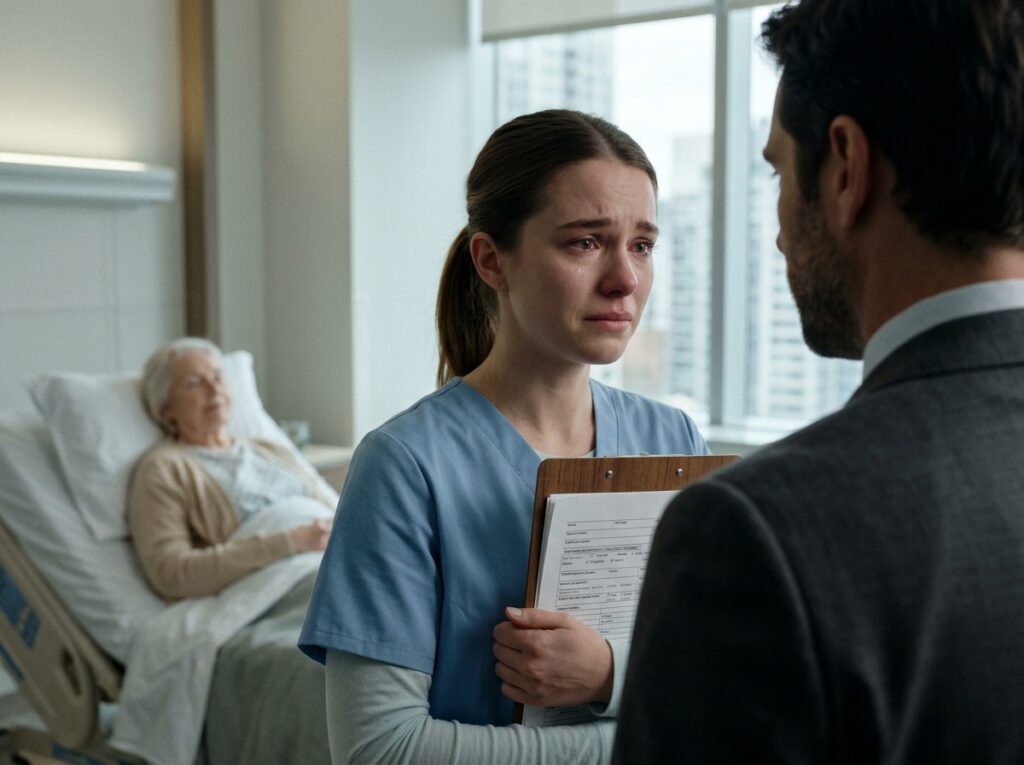
“Was she telling you about me?” Tristan asked softly.
Bianca stared at him.
“No,” she answered quickly. “We were discussing her medication.”
Eleanor chuckled from the bed.
“Bianca has been far too busy keeping me alive to gossip about my son.”
“I’m relieved to hear that,” Tristan replied.
But he wasn’t looking at his mother.
He was looking at Bianca.
And somehow, that made her feel as though she had just failed an examination she hadn’t known she was taking.
She turned toward Eleanor’s IV stand, pretending to check the drip rate.
“Your mother seems to be recovering well, Mr. Bellamy. If her bloodwork continues to improve, we may be able to discuss discharge in the next few days.”
“Tristan,” he corrected.
“Excuse me?”
“Call me Tristan.”
“I’d rather keep things professional.”
Something almost resembling a smile appeared at the corner of his mouth.
“Of course, Miss Bianca.”
The way he said her name made her fingers tighten around the chart.
Eleanor watched the exchange with quiet interest.
“Have you two met before?”
“No,” Bianca said immediately.
“Yes,” Tristan answered at exactly the same time.
Silence filled the room.
Bianca turned toward him so sharply that the pen slipped from her hand.
It hit the floor.
Tristan bent to retrieve it.
When he straightened, he held it out to her, his expression unreadable.
“She accidentally got into my car a few nights ago.”
Eleanor’s eyes widened.
“Oh, Bianca!”
“I was exhausted,” Bianca explained, her cheeks burning. “The vehicles looked identical, and I genuinely thought it was my rideshare. I apologized. Everything was fine.”
“Except you ran away before I could ask whether you were all right,” Tristan added.
“I didn’t run away.”
“You ran four blocks.”
Bianca’s mouth fell open.
“How would you know that?”
“Because my driver followed you to make sure you weren’t injured.”
For one horrifying second, Bianca imagined herself sprinting through Manhattan while a black SUV crawled behind her like something out of a criminal investigation.
She wanted the floor to swallow her whole.
Eleanor laughed.
Actually laughed.
It was the first time Bianca had heard her do so since her admission.
“Oh, Tristan. You always did have a talent for making a first impression.”
“I didn’t realize getting into the wrong car was a crime,” Bianca muttered.
“It isn’t,” Tristan replied. “But running away from a man who hasn’t even asked your name is certainly memorable.”
“You knew my name?”
The question escaped before she could stop it.
His expression changed.
Only slightly.
But she noticed.
“I learned it afterward.”
“How?”
“Your hospital badge.”
Bianca glanced down at the identification card clipped to her uniform.
That explained nothing about the look in his eyes.
It certainly didn’t explain why he had seemed so unsurprised when she woke up in his car.
Before she could ask another question, Eleanor interrupted.
“Tristan, darling, would you mind getting me some water? I’ve been talking far too much.”
He looked at his mother.
For the first time since entering the room, his attention left Bianca completely.
“Of course.”
He poured a glass of water and handed it to Eleanor.
She took a small sip, then glanced toward Bianca.
“Would you give us a few minutes, dear? I’d like to discuss something with my son.”
“Certainly.”
Bianca collected her chart and headed for the door.
She was almost relieved to escape.
Almost.
“Bianca?”
She stopped.
Tristan stood beside the window, one hand in his pocket.
“Do you finish your shift at seven tonight?”
She frowned.
“Why?”
“I’d like to apologize properly for making your first encounter with me so uncomfortable.”
“You didn’t make me get into your car.”
“No,” he agreed. “You managed that quite well on your own.”
She shot him a look.
His smile was brief, but unmistakable.
Then he became serious.
“Seven o’clock. The hospital’s south entrance.”
“I’m not getting into your car again.”
“I didn’t ask you to.”
“Good.”
“There’s a coffee shop across the street.”
Bianca hesitated.
She should have said no.
She had a twelve-hour shift ahead of her, laundry waiting at home, and absolutely no reason to have coffee with a wealthy stranger whose mother happened to be her patient.
Especially one who watched her as though she were a puzzle he had already solved.
“I’m working,” she said.
“Then another time.”
He didn’t push.
Somehow, that made refusing him more difficult.
Bianca left without answering.
But as the elevator doors closed, she caught herself wondering what he would look like without that perfectly controlled expression.
And that annoyed her more than anything else.
At six forty-five that evening, Bianca was ready to go home.
Her feet ached. Her back hurt. Two patients had pressed their call buttons simultaneously, and a third had spent twenty minutes insisting that someone had stolen his television remote.
She wanted a shower, a meal, and eight uninterrupted hours of sleep.
She definitely did not want Tristan Bellamy.
At least, that was what she told herself.
At six fifty-eight, she walked past the hospital’s south entrance.
A black SUV stood at the curb.
Bianca stopped.
Then she noticed the driver.
He wasn’t standing beside the vehicle or opening the door.
He was holding an umbrella over an elderly woman struggling with her shopping bags.
Tristan wasn’t there.
For reasons she couldn’t explain, Bianca felt disappointed.
She immediately hated herself for it.
She crossed the street toward a small coffee shop, ordered the cheapest latte on the menu, and sat beside the window.
Her phone vibrated.
An unknown number.
Unknown: You made it through your shift.
Bianca stared at the message.
Bianca: How did you get my number?
The reply came almost immediately.
Unknown: Your hospital has a directory. I called the main desk and asked whether you were still on duty. They gave me the number of the department, not your personal number.
She frowned.
Bianca: Then how are you texting me?
Three dots appeared.
Disappeared.
Appeared again.
Unknown: Your mother works in the billing department, doesn’t she?
Bianca’s stomach tightened.
She hadn’t told him anything about her family.
Bianca: What does my mother have to do with this?
The response took longer.
Unknown: Nothing. I’m sorry. That was an inappropriate question.
She read the message twice.
At least he had the sense to recognize when he’d crossed a line.
She was about to put her phone away when another message arrived.
Unknown: I’m across the street. If you’d rather not see me, I’ll leave.
Bianca looked through the window.
A man stood beneath the awning of the building opposite the café.
Dark coat. Broad shoulders.
Tristan.
He wasn’t approaching.
He was simply waiting, holding his phone in one hand.
For the first time, Bianca understood something about him.
He could have sent someone to bring her to him.
He could have insisted that he deserved an explanation.
He could have used his money to make an ordinary encounter feel like an obligation.
Instead, he had left the decision to her.
Bianca took a long breath.
Then she typed:
Bianca: You have fifteen minutes.
His answer came instantly.
Tristan: I’ll take twelve.
She almost smiled.
Almost.
Tristan entered the café three minutes later.
He had removed his coat, revealing a charcoal sweater beneath it. Without the suit, he looked younger. Less like someone who belonged in a corporate boardroom and more like a man who occasionally forgot to sleep.
He approached her table.
“May I?”
Bianca gestured toward the empty chair.
“Your fifteen minutes started when you walked through that door.”
“Then I’d better be efficient.”
He ordered a black coffee and sat opposite her.
For several seconds, neither spoke.
Then Bianca decided she was tired of wondering.
“Why did you look so unsurprised when I woke up in your car?”
Tristan’s fingers stopped around his cup.
There it was again.
That tiny change in his expression.
“I recognized you,” he said.
“From where?”
“Not from anywhere you’d remember.”
“That doesn’t make sense.”
“I know.”
“Then explain it.”
He looked toward the window.
Outside, taxis moved through the rain, their headlights streaking across the wet pavement.
“My mother has been in and out of hospitals for nearly a year,” he said. “During that time, she mentioned a nurse who treated her like a person instead of a diagnosis.”
Bianca’s expression softened despite herself.
“Eleanor talks about everyone. She’s lovely.”
“She mentioned you specifically.”
“That still doesn’t explain the car.”
“No. It doesn’t.”
He took a breath.
“The night you got into my SUV, I’d spent nearly two hours at the hospital. I was exhausted, irritated, and in no mood to speak to anyone. Then you climbed into the back seat, apologized to the driver for stepping on his umbrella, and fell asleep before he could tell you that the vehicle wasn’t yours.”
Bianca covered her face.
“Oh, please stop.”
“I haven’t even reached the interesting part.”
“There’s an interesting part?”
“You were holding a photograph.”
Her hands dropped.
“What?”
“A photograph slipped out of your bag when you fell asleep. I picked it up because I thought it might be an identification card.”
Bianca felt suddenly cold.
“What photograph?”
“A woman standing beside a little girl. They were in front of a house with a blue door.”
She stopped breathing for a moment.
That photograph had been in her bag for years.
It was the only picture she had of herself as a child with her mother.
And a third person.
A man whose face had been scratched out.
“Did you look at it?” she whispered.
“Yes.”
“Why?”
“Because I recognized the house.”
Bianca stared at him.
“What house?”
“My grandfather’s house in Connecticut.”
The café seemed to grow quieter around them.
“That isn’t possible,” she said. “My mother took that picture when I was little. We never lived in Connecticut.”
“I didn’t say you did.”
“Then how could you recognize it?”
Tristan reached into his wallet.
He removed a folded photograph and placed it on the table between them.
The image was old, its edges yellowed with time.
A large white house stood behind a garden. Beside the blue front door stood a tall man in a dark suit.
A little girl sat on his shoulders.
Bianca leaned forward.
The child had her eyes.
Her nose.
Even the small gap between her front teeth.
It was her.
But the man holding her was not her father.
She knew that because her father had died when she was six.
And because the man in the photograph looked exactly like Tristan.
Only younger.
Much younger.
Bianca looked up slowly.
“Who is that man?”
“My grandfather,” Tristan said.
She looked back at the photograph.
Then at him.
“Why do I look like that little girl?”
Tristan didn’t answer immediately.
Instead, he turned the photograph over.
On the back, written in faded blue ink, were four words.
For the child we lost.
Bianca’s fingers trembled.
“What does that mean?”
Tristan’s face had lost every trace of amusement.
“It means my family has spent twenty-two years believing a little girl died before her first birthday.”
Bianca could barely hear him.
“Twenty-two years?”
He nodded.
“My grandfather paid for a private investigation shortly before he died. He believed someone had falsified the child’s death certificate. My father thought grief had made him paranoid, so the investigation was abandoned.”
“Why are you telling me this?”
“Because three weeks ago, my mother found a letter among my grandfather’s belongings.”
He reached into his pocket and placed a second envelope on the table.
It was old and yellowed, sealed with brittle adhesive.
The handwriting on the front made Bianca’s heart stumble.
She knew that handwriting.
She had seen it on birthday cards, school notes, and the last letter her mother had written before she disappeared from Bianca’s life for six months when Bianca was seventeen.
It belonged to her mother.
Bianca pushed the envelope away as though it had burned her.
“No.”
“Bianca—”
“No. My mother has nothing to do with your family.”
“I hope you’re right.”
“You don’t get to walk into my life and tell me that my entire childhood was a lie.”
“I’m not asking you to believe me.”
“Then what are you asking?”
Tristan’s voice softened.
“I’m asking you to look at the letter before someone else realizes we’ve found it.”
She stood so quickly that her chair scraped against the floor.
“Someone else?”
He looked at the café window.
For the first time that evening, Bianca saw genuine fear in his eyes.
Not fear for himself.
Fear for her.
“Bianca, listen carefully. When I arrived at the hospital this morning, my mother told me something she has never told anyone before.”
She gripped the edge of the table.
“What?”
Tristan lowered his voice.
“She said the little girl in that photograph didn’t die.”
Bianca’s heart pounded.
“She said the child was taken away because someone in our family believed she would inherit everything.”
“That is insane.”
“Perhaps.”
“Who would do that?”
Tristan looked directly at her.
“My father.”
The words hung between them.
Then his phone vibrated.
He glanced at the screen.
Whatever he saw drained the color from his face.
“What is it?” Bianca asked.
He didn’t answer.
He turned the phone toward her.
It was a message from an unknown number.
Attached was a photograph of Eleanor Bellamy lying in her hospital bed.
Taken less than ten minutes ago.
Beneath it were eleven words.
Stop asking questions about the girl, or your mother will pay for it.
Bianca stared at the screen.
Then she looked up at Tristan.
“My mother isn’t in the hospital.”
He said nothing.
“My mother is at home. She’s perfectly fine.”
Tristan slowly put his phone away.
“Bianca, I need you to call her.”
She pulled out her own phone and dialed.
Once.
Twice.
Three times.
No answer.
She tried again.
This time, someone picked up.
But it wasn’t her mother.
A man’s voice came through the speaker, low and strangely familiar.
“Hello, Bianca.”
Her blood turned to ice.
“Who is this?”
A pause.
Then the man said something that made her knees weaken.
“Ask Tristan why his father was the last person to see your mother twenty-two years ago.”
The call ended.
Bianca looked at Tristan.
He was already standing.
And for the first time since she had met him, he looked completely unprepared for what was coming next.
Because he knew the voice.
He had heard it every day of his childhood.
It belonged to his father.
The man who was supposed to have died six years ago.
TO BE CONTINUED…