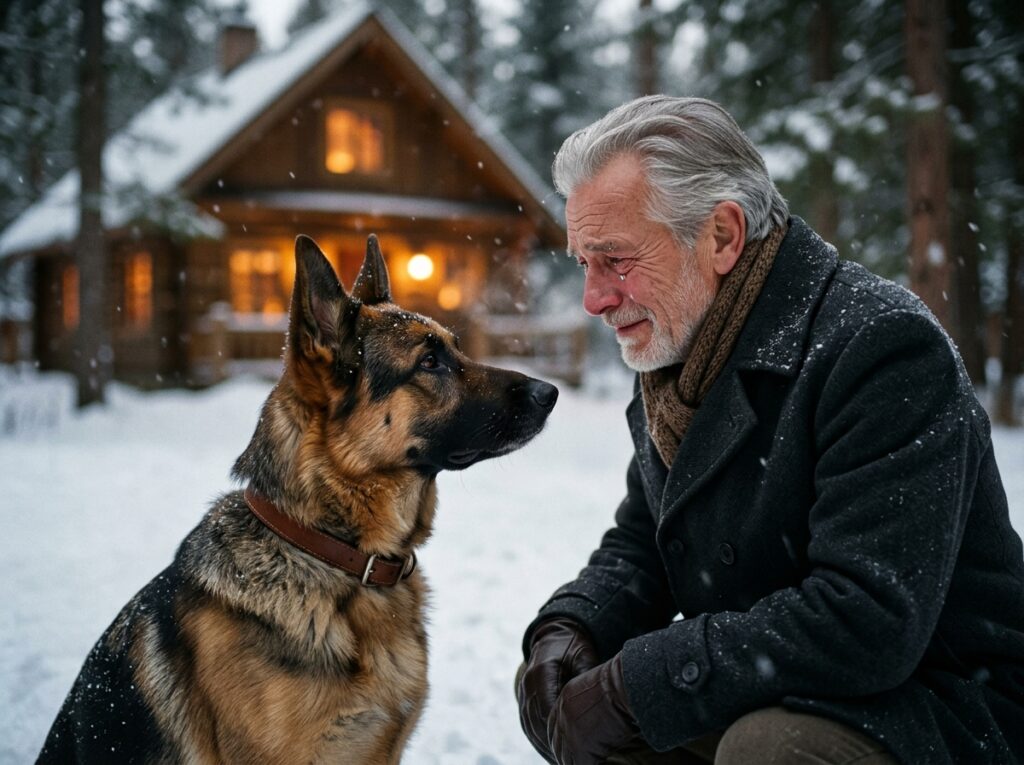
The storm did not stop until dawn.
By then, I was lying in a hospital bed with three broken ribs, severe hypothermia, and a doctor telling me that another fifteen minutes in the snow would have killed me.
But none of that mattered.
Because Max was gone.
The nurse told me they had brought us both inside. He had been placed in a heated kennel while the paramedics worked on me. His heart had stopped twice during the night, but somehow, the old dog had survived.
When I demanded to see him, the nurse hesitated.
“Sir, you need to rest.”
“Where is my dog?”
She exchanged a glance with the doctor.
Then she said something that made the blood drain from my face.
“He’s awake. But he’s behaving strangely. He keeps trying to get to you.”
I ripped the IV from my arm.
The doctor protested. A nurse shouted for security. I ignored them all.
I had spent fifty years running from a dead man.
I wasn’t going to let a locked hospital door keep me from him now.
They wheeled me down the corridor in a wheelchair, my chest burning with every breath. When we reached the veterinary recovery room, I saw Max standing behind the glass.
His bad hip trembled beneath him.
His gray muzzle was pressed against the kennel door.
And when he saw me, he did something I will never forget.
He raised his right paw.
Then he tapped the metal door three times.
Three slow, deliberate knocks.
My heart stopped.
In the jungle, fifty years earlier, my younger brother had used that exact signal whenever we became separated during patrols.
Three knocks meant I’m here.
Three knocks meant Don’t leave me.
Three knocks meant Wait for me.
I gripped the wheelchair so tightly my fingers hurt.
“Who taught you that?” I whispered.
Max stared at me.
Then, from somewhere deep in his throat, came a sound that was neither a bark nor a whine.
It sounded like a name.
“Miller.”
I fell forward.
The nurse caught me before I hit the floor.
“No,” I gasped. “No, that’s impossible.”
The veterinarian arrived moments later. She was a middle-aged woman named Dr. Elaine Foster, with tired eyes and a silver streak running through her dark hair.
She listened without interrupting as I explained about the three knocks, the jungle, and my brother.
When I finished, she didn’t laugh.
Instead, she asked, “What was your brother’s full name?”
“Miller James Carter.”
“Was he ever in the military?”
“He was a Marine. We served together in Vietnam.”
She looked down at the clipboard in her hands.
“That’s interesting.”
I stared at her.
“What is?”
“Max isn’t his original name.”
She turned the clipboard toward me.
The dog’s intake records showed that he had been transferred from a retired military working-dog program. His original service number had been partially erased, but the remaining digits were still legible.
Underneath them was a note from his previous handler.
Responds to the name MJ.
My brother had hated his first name, James.
When we were children, he insisted everyone call him Miller.
But our mother had a nickname for him.
MJ.
Only three people had ever called him that.
Our mother.
My father.
And me.
I looked through the glass at the old dog.
“MJ?” I whispered.
Max went perfectly still.
Then he lowered himself onto the floor, rested his head on his paws, and closed his eyes.
A tear slipped from the corner of his eye.
I know what you’re thinking.
Dogs don’t cry like people.
And old men who have spent half a century drinking themselves to sleep aren’t reliable witnesses.
Maybe you’re right.
But I saw what I saw.
And that was only the beginning.
Two days later, I was discharged.
The doctor ordered me to rest for at least a month. I ignored most of his instructions, hired a driver to take me home, and insisted that Max be released into my care as soon as the veterinarian approved it.
Dr. Foster met me at the entrance.
“I want you to understand something,” she said. “Max has a complicated medical history. His hip injury is old, and he has some neurological symptoms. Stress can trigger unusual behavior.”
“So you’re saying it’s all in my head?”
“I’m saying we should be careful about drawing conclusions.”
I looked at Max, who was standing beside her.
He was watching me.
Not the way a dog watches a stranger holding a treat.
The way a soldier watches the only person he trusts in a dangerous place.
“I’ve been careful for fifty years,” I told her. “Look where it got me.”
She didn’t argue.
Before we left, she handed me a folder containing Max’s military records.
“There’s something else,” she said. “His previous handler specifically requested that he be placed with a veteran. He wrote that Max had a remarkable ability to recognize people associated with his former assignments.”
“Did he say why?”
“Only that Max had been searching for someone.”
“Who?”
She shook her head.
“He didn’t know.”
I took the folder.
That night, I spread the papers across my kitchen table and read every page.
Max had served with a military working-dog unit for years. He had been trained to detect explosives, track missing personnel, and locate wounded soldiers.
His last recorded assignment had ended decades ago.
After that, the records became fragmented.
There were transfers.
Medical evaluations.
A disciplinary note involving an incident during a training exercise.
And then, near the bottom of the file, a handwritten remark that had been added years after his retirement.
Animal demonstrates persistent response to the sound of three knocks followed by the phrase “I’m here.” Cause undetermined.
I read it five times.
Then I noticed a name.
The veterinarian who had first evaluated Max after his retirement had been a man named Dr. Samuel Whitmore.
The same doctor who had treated my brother in the jungle.
I remembered him clearly: a thin, soft-spoken Navy physician who had accompanied our patrol for several days before being reassigned.
According to my memories, he had left our unit three days before Miller disappeared.
But the military records in my hands showed something different.
Dr. Whitmore had returned to the United States months later.
And he had continued working with military personnel for decades.
He had died six years ago.
But his obituary mentioned one surviving daughter.
A woman named Rebecca Whitmore.
I found her number in an old directory.
It was nearly midnight when I called.
A sleepy voice answered.
“Hello?”
“Miss Whitmore? My name is Thomas Carter. I’m trying to learn more about your father’s work with military dogs.”
Silence.
Then she asked, very quietly, “Did you adopt the German shepherd?”
I sat upright.
“How do you know about Max?”
“My father told me someone might come looking for him one day.”
My mouth went dry.
“What else did your father tell you?”
She breathed shakily.
“He told me about a Marine named Thomas Carter. He said that man had spent his entire life believing he had abandoned his younger brother.”
I couldn’t speak.
Then she said the words that shattered the last defense I had built around my memories.
“My father said your brother didn’t die in the jungle.”
Rebecca lived in a small house outside Harrisburg.
I drove there the following morning with Max lying on the passenger seat.
He had refused to eat breakfast. He had also refused to leave my side, following me from room to room with a determination that seemed impossible for a dog with his injuries.
When we arrived, Rebecca was waiting on the porch.
She was in her late fifties, with her father’s eyes and a nervous habit of twisting a silver ring around her finger.
The moment she saw Max, she covered her mouth.
“Oh, my God.”
“You’ve seen him before?”
She shook her head.
“No. But my father kept a photograph.”
She led us inside.
On the mantelpiece stood a framed picture of a young military doctor beside a German shepherd.
The dog was much younger, with a black muzzle and alert ears.
Beside the photograph was a handwritten note.
For the one who keeps waiting.
Rebecca removed a box from a cupboard.
“My father left me this before he died. He made me promise not to open it unless Thomas Carter ever contacted me.”
My hands began to shake.
Inside the box was a small leather notebook, a military identification tag, and a photograph so faded that the faces were almost indistinguishable.
I picked up the tag first.
It belonged to Miller.
His name was engraved across the front.
On the back were three letters.
T.C.
My initials.
I turned the tag over again, unable to understand.
“Why would he have my identification?”
Rebecca opened the notebook.
“My father wrote everything down. He wanted someone to know the truth if he never found a way to tell you.”
She began reading.
“‘June 17. Patrol separated during enemy fire. Carter refused to leave his brother. Both men were located near the ravine. Miller suffered a severe head injury. Thomas was wounded and unconscious.'”
I grabbed the edge of the table.
“No.”
Rebecca continued, her voice trembling.
“‘Extraction was delayed. Enemy forces were approaching. Miller was placed in a temporary shelter while the team attempted to evacuate Thomas. When we returned, the shelter was empty. No body was recovered.'”
I stared at her.
For fifty years, I had remembered Miller screaming as I crawled away from him through the mud.
I remembered reaching for him.
I remembered gunfire.
I remembered making a choice.
Except now, someone was telling me that my memories were wrong.
Or incomplete.
“Keep reading,” I whispered.
Rebecca swallowed.
“‘Thomas was suffering from severe blood loss and a traumatic head injury. He repeatedly asked where his brother was. Due to the circumstances, I believed Miller had died. I later learned that the unit’s official report listed him as missing, presumed dead.'”
I closed my eyes.
A memory flickered.
A white tent.
Someone holding my shoulders.
A voice telling me not to move.
And Miller’s face, pale and still, lying beneath a torn military blanket.
I had always believed it was the last thing I saw before I escaped.
But what if it wasn’t?
What if my mind had taken pieces of different moments and stitched them together into a punishment I could understand?
Rebecca turned another page.
The handwriting grew more hurried.
“‘There is evidence that Miller was removed from the area before the second evacuation. I cannot establish who took him or why. The dog was found days later, wounded and disoriented, near the route where Miller was last seen.'”
I looked at Max.
He was standing beside my chair, staring at the notebook.
“‘The dog refuses to leave the location where Miller was last heard calling for help. He responds to the name MJ and to three knocks on a hard surface. I believe he was present when Miller was taken.'”
I stopped breathing.
Rebecca lowered the notebook.
“My father spent the rest of his life trying to find your brother. He never did.”
“Then why didn’t he tell me?”
“He tried.”
She went to a desk and returned with a bundle of letters.
Every envelope carried my name.
Every letter had been returned.
The first had been sent fifty years ago.
The last, twenty-seven years later.
I stared at the pile.
I had moved several times. I had changed jobs. I had spent years refusing to speak about the war.
But there was one letter dated only six months after I returned home.
It had been sent to my childhood address.
The address where our mother still lived.
I opened it with trembling hands.
Inside was a single page.
Thomas,
Your brother may still be alive. I know what the report says, but I have reason to believe someone removed him from the jungle. I cannot explain everything in a letter. Please contact me.
Do not let your guilt become the only version of the story you remember.
—Samuel Whitmore
I lowered the page.
My mother had received that letter.
She had never shown it to me.
She had died twenty-three years ago, taking the secret with her.
For the first time in fifty years, I felt something other than guilt.
I felt anger.
And beneath it, something far more dangerous.
Hope.
That evening, I returned home and placed the military tag beside Max’s food bowl.
“Tell me where he is,” I whispered.
Max sniffed the tag.
Then he turned toward the back door.
He scratched once.
Waited.
Scratched twice more.
Three knocks.
I followed him outside.
The snow had melted, leaving the woods dark and wet. Max moved slowly along the tree line, stopping occasionally to sniff the ground.
After twenty minutes, he led me to an old storage shed behind my property.
I hadn’t opened it in years.
Inside were rusted tools, boxes of photographs, and the rucksack I had carried when I returned from Vietnam.
Max went straight to it.
He pushed his nose beneath the flap and began whining.
I knelt beside him.
“What is it, boy?”
He pawed at the bag.
Something fell from a torn inner pocket.
A small, folded piece of paper.
I had never seen it before.
The paper was brittle and stained, but the writing was still legible.
It was Miller’s handwriting.
I recognized the crooked letters immediately.
Tom,
If you ever find this, I need you to understand something. You did not leave me. You came back.
I remember you trying to reach me. I remember you screaming my name.
But the man who took me said you had already been evacuated. He told me you were safe. He told me you had gone home.
I believed him.
My vision blurred.
The note continued.
I don’t know who he was. I don’t know why he took me. But he knew our names. He knew about our mother. And he knew something about the operation that nobody outside our unit should have known.
If I ever get home, I will find you.
If I don’t, remember this: the dog knows the way.
The last line was written in a different hand.
Three knocks. The old station. Midnight.
There was no date.
No explanation.
Only a location written beneath the message.
A place I recognized immediately.
An abandoned railway station near the edge of the Pennsylvania woods.
It had been closed for more than forty years.
I looked at the clock.
11:17 p.m.
Max stood beside the shed door, his body trembling.
For the first time since I had brought him home, he looked afraid.
Not confused.
Not tired.
Afraid.
I took my old flashlight from the shelf.
Then I reached for my coat.
“Come on, soldier.”
Max followed me into the night.
The abandoned station stood beneath a canopy of dead branches.
The roof had partially collapsed, and weeds grew through the cracked platform. Moonlight spilled through the broken windows, illuminating the old ticket counter.
I checked my watch.
11:58 p.m.
Max walked toward the far end of the platform.
He stopped beside a rusted metal door.
Then he raised his paw.
Three knocks.
The sound echoed through the empty station.
For several seconds, nothing happened.
Then I heard a click.
A hidden latch released beneath the door.
I pulled it open.
Behind it was a narrow staircase leading underground.
The air rising from below smelled of damp earth and old metal.
I should have called the police.
I should have gone home.
Instead, I descended.
At the bottom was a small room containing a table, a chair, and a wall covered in photographs.
Some showed military personnel.
Others showed men in civilian clothing.
One photograph was dated 1973.
Another was dated 1989.
The most recent was dated 2018.
But it was the picture in the center that made my knees buckle.
It showed a man in his seventies sitting beside a German shepherd.
The man had silver hair, a deep scar across his left cheek, and eyes I had spent fifty years trying to forget.
My brother.
Miller.
Alive.
I reached toward the photograph.
A voice came from the darkness behind me.
“You’re late, Tom.”
I spun around.
A man stood in the doorway.
He was old, leaning heavily on a cane, with a scarred face and a military tattoo fading beneath his sleeve.
But his eyes were unmistakable.
I had seen those eyes in childhood photographs.
I had seen them across a dinner table.
I had seen them in nightmares that lasted longer than entire days.
“Miller?”
He didn’t answer immediately.
Instead, he looked at Max.
The old dog had lowered himself to the floor, his head resting against the man’s boot.
Miller bent slowly and placed a trembling hand on the dog’s head.
“Good boy,” he whispered. “You found him.”
I took a step forward.
“Where have you been?”
Miller’s expression hardened.
“That’s the wrong question.”
“Then what’s the right one?”
He looked at me for a long time.
Then he said, “Why did you believe them when they told you I was dead?”
My throat closed.
“I saw you—”
“No,” he interrupted. “You saw what they wanted you to see.”
He reached into his coat and withdrew a photograph.
It showed two men standing beside a military vehicle in the jungle.
One was our commanding officer.
The other was a civilian wearing a dark uniform without insignia.
On the back, someone had written a name.
Elias Voss.
I had not heard that name in fifty years.
But the moment I saw it, I remembered the man who had appeared at our camp two days before the patrol.
The man who had asked questions about our route.
The man who had spoken privately with our commander.
The man who had disappeared the morning Miller went missing.
Miller placed the photograph on the table.
“They weren’t trying to kill me, Tom.”
“Then what did they want?”
He looked toward the staircase.
“They wanted what our father hid before he died.”
I stared at him.
“Our father died when we were children.”
“That’s what Mother told us.”
The room seemed to tilt.
Miller reached into a locked drawer and removed a small metal case.
Inside lay a folded document, a military identification card, and a photograph of our mother standing beside a man I had never seen before.
On the back of the photograph were six words.
The boys must never learn the truth.
Miller pushed the document toward me.
“Read it.”
My hands shook as I unfolded the paper.
At the top was an official government seal.
Below it were two names.
Thomas Carter.
Miller James Carter.
And beneath our names was a designation I had never seen before.
Operation Second Son.
I looked up.
“What is this?”
Miller’s face had gone pale.
“It means our entire lives were built on a lie.”
He reached into his pocket and pulled out a final photograph.
It showed our mother holding two newborn babies.
Not one.
Two.
I stared at the image, unable to understand what I was seeing.
Then I noticed the handwritten caption.
Thomas and Miller — before the transfer.
“Transfer?” I whispered.
Miller nodded slowly.
“Our mother didn’t give birth to us in the same hospital. One of us was taken from her before we were a day old. She spent the rest of her life trying to find out which one.”
I felt the room spin.
“Which one of us?”
Miller looked at me.
For the first time that night, I saw tears in his eyes.
“That’s what I’ve been trying to find out for fifty years.”
Then Max suddenly stood.
His ears lifted.
His body stiffened.
From somewhere above us came the sound of footsteps.
One person.
Then another.
Then several more.
Miller grabbed my wrist.
“Don’t move.”
A voice echoed down the staircase.
“Step away from the dog, gentlemen.”
I recognized that voice, too.
It belonged to a man I had seen only once in my life.
A man whose photograph had been pinned to the wall beside our father’s.
A man officially declared dead in 1971.
Elias Voss.
He descended the stairs slowly, carrying a black leather case.
His eyes settled on me.
Then on Miller.
Finally, he smiled.
“Well,” he said, “the two brothers are finally together.”
He placed the case on the table and opened it.
Inside lay a pistol, a stack of classified documents, and a photograph of a young woman.
Our mother.
Standing beside him.
Pregnant.
Voss leaned forward.
“There’s one thing your brother hasn’t told you, Thomas.”
Miller stepped between us.
“Don’t listen to him.”
Voss smiled wider.
“Your brother wasn’t the one we took from the jungle.”
He turned the photograph over.
On the back was a date.
And a name.
Thomas Carter — original subject.
My blood turned to ice.
Voss looked directly into my eyes.
“Welcome home, son.”
Then he raised the pistol.
And Max, the old dog who had dragged himself through a blizzard to save my life, lunged between us.
The gunshot shattered the room.
And as Miller screamed my name, I finally understood the terrible truth.
The jungle had never been the place where my brother disappeared.
It was the place where someone had tried to make sure I never discovered who I really was.
TO BE CONTINUED…