“Get out of that seat. Now.”
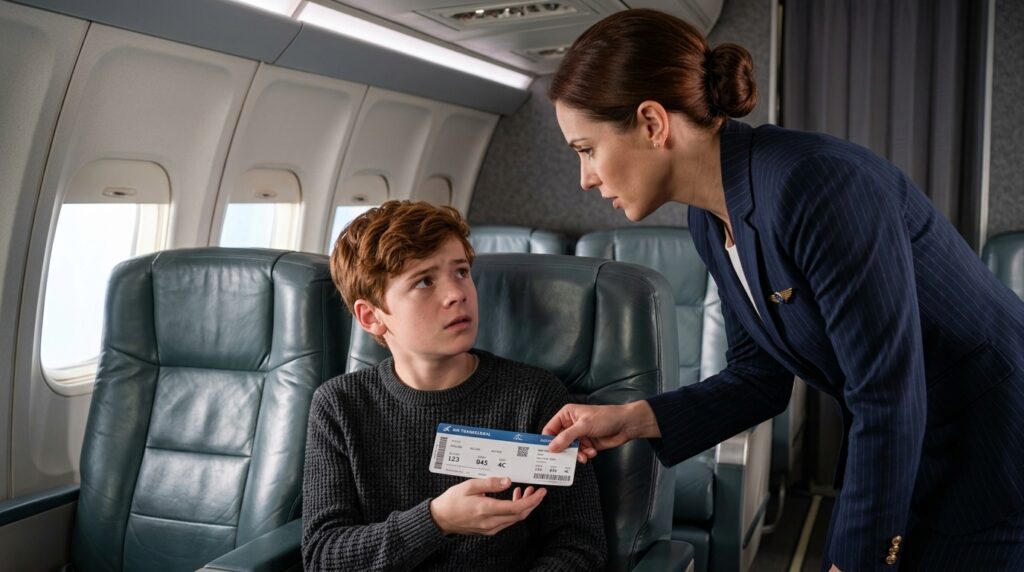
The order sliced through First Class aboard Mesa Airlines Flight 227, silencing conversations and turning every face toward eleven-year-old Malik Johnson.
Malik sat frozen in Seat 2A, his hands folded neatly over his navy sweater. His pressed slacks, polished shoes, and monogrammed leather backpack suggested a child accustomed to traveling carefully—not one causing trouble.
Yet lead flight attendant Catherine Ward stood over him as if he were an intruder.
“First Class is full,” she said, pointing toward the rear cabin. “Take your things and move.”
Malik glanced at the boarding pass beside him. Confusion tightened his young face.
“This is my seat.”
He lifted the ticket, showing her the bold black characters printed across it: 2A.
Catherine barely looked.
Around them, passengers shifted uncomfortably. One man lowered his newspaper. A woman stared at her phone without scrolling. Everyone could see what was happening, but no one seemed willing to become part of it.
Malik’s stomach knotted.
It was his first flight alone, and his father’s instructions echoed in his mind.
Keep your documents close. Stay calm. Call home if something feels wrong.
He raised the boarding pass again.
“I’m not asking for somebody else’s seat,” he said, keeping his voice steady. “This one belongs to me.”
Catherine’s expression hardened.
Without warning, she bent down, yanked Malik’s backpack from beneath the seat, and dropped it into the aisle.
The leather struck the floor with a heavy thud.
Malik stared at it. Heat climbed into his cheeks as the entire cabin watched. Tears threatened, but he refused to let them fall.
He knew how confirmed seating worked. He had flown First Class many times with his father. His ticket was valid, and the seat had been properly purchased.
That should have been enough.
What Catherine did not know was that Malik’s father, David Johnson, was the founder and CEO of Johnson Aerotech—a major aviation technology company and one of Mesa Airlines’ most valuable corporate partners.
Malik could have spoken his father’s name.
He didn’t.
He did not want special treatment. He wanted the same treatment any passenger with a valid boarding pass deserved.
Catherine pointed toward the back once more.
“Move.”
Malik remained seated.
Then he reached into his pocket and took out his phone.
Catherine narrowed her eyes. “Who exactly are you calling?”
“My dad.”
A dismissive laugh escaped her.
“Your father isn’t going to change the seating arrangement.”
Malik pressed the phone to his ear.
The call connected.
“Dad?”
David heard something in that single word—the restraint, the fear Malik was trying to hide.
“What happened?”
Malik looked directly at Catherine.
“She says I have to leave my seat.”
Silence came from the other end.
Then David asked one question.
“What flight?”
“227.”
Another pause followed, colder than the first.
“Stay exactly where you are.”
The call ended.
Catherine folded her arms. “Finished?”
Malik nodded. He picked up his backpack, slid it carefully beneath Seat 2A, and placed his hands back in his lap.
His sudden calm unsettled her.
For several minutes, no one spoke. The quiet grew so complete that the hum of the ventilation system seemed unnaturally loud.
Then hurried footsteps struck the boarding bridge.
A senior airport manager entered the aircraft, his face tight with alarm. Two Mesa Airlines executives followed, whispering urgently as they moved into First Class.
Catherine’s posture changed.
Behind them walked a tall man in a perfectly tailored charcoal suit.
He did not hurry. He did not need to.
His controlled stride and expression carried more authority than shouting ever could.
Catherine’s face drained of color.
“Mr. Johnson?” she whispered.
David Johnson passed her without answering.
He went directly to Seat 2A, crouched beside his son, and placed one hand gently on Malik’s shoulder. His eyes searched the boy’s face, noticing the humiliation Malik had fought so hard to conceal.
“You okay?”
Malik gave a small nod, but his fingers tightened in his lap.
David saw it.
So did the executives standing behind him.
The entire cabin had fallen silent. Passengers who had avoided looking before were watching now, while Catherine stood motionless beside the backpack she had thrown moments earlier.
David slowly rose.
He could have addressed the airline executives. He could have demanded explanations or invoked the millions of dollars tied to his company’s partnership.
Instead, he turned back to his son.
His voice remained quiet.
“Malik, is this the woman who tried to remove you from your seat?”
Malik lifted his eyes toward Catherine as everyone waited for his answer.
Malik’s breath trembled against his teeth.
His gaze dropped to the aisle, to the strip of gray carpet where his backpack had struck moments earlier. Catherine’s polished shoes stood inches from that spot.
“Yes,” he whispered.
The word traveled through the cabin.
Catherine’s mouth opened. “Mr. Johnson, there has been a misunderstanding.”
David kept his hand on Malik’s shoulder.
“Did she touch you?”
“No.”
“Did she take your bag?”
Malik looked beneath Seat 2A.
“She pulled it out and dropped it.”
Catherine lifted one hand. “I was attempting to resolve an operational seating problem, and your son refused a direct crew instruction.”
Malik’s shoulder tightened beneath David’s palm.
David felt the movement.
“He showed you his boarding pass?”
“I had several matters requiring my attention.”
“That wasn’t my question.”
The ventilation system breathed overhead. Somewhere behind First Class, an overhead bin slammed shut and a baby began crying.
Catherine’s eyes moved toward the executives.
“Yes,” she said. “He showed me a boarding pass.”
“For 2A?”
“Yes, but the cabin was full.”
“And he was already seated in 2A?”
Her jaw flexed. “Yes.”
David straightened.
One executive cleared his throat. “Mr. Johnson, perhaps we could continue this conversation privately on the boarding bridge.”
David looked at Malik’s bent boarding pass.
“No.”
The executive went still.
David’s voice remained level. “What happened to my son did not happen privately.”
The man holding the newspaper lowered it completely now. Across the aisle, the woman with the phone finally let her screen go dark.
Catherine folded her arms again, trying to recover the posture that had controlled the cabin before David arrived.
“You weren’t here,” she said. “You did not see how uncooperative he became.”
Malik looked up.
David’s hand left his shoulder, not in withdrawal but because his fingers had tightened.
“Uncooperative?”
“He repeatedly refused to move.”
“From the seat on his ticket.”
“Passengers cannot decide which crew instructions they will obey.”
“Crew authority does not make an invalid instruction valid.”
Catherine’s cheeks reddened. “I did not know who he was.”
The words escaped before caution could stop them.
Silence pressed into every row.
Even Catherine seemed to hear the admission hanging in the air.
David studied her face.
“That,” he said, “is the problem.”
Her arms fell to her sides.
“That isn’t what I meant.”
“Then explain what you meant to him.”
Catherine looked at Malik, but only briefly.
“I meant that I was unaware he had special travel arrangements.”
“He didn’t,” David said.
One executive shifted closer. “Mr. Johnson—”
“No priority note. No corporate escort. No request for favors. His ticket was purchased in his name, and his seat was confirmed like everyone else’s.”
David glanced down at Malik.
“He should not need my identity to make his boarding pass count.”
Malik blinked rapidly. The tears he had fought away earlier shone beneath the cabin lights, but he refused to lower his face.
The senior airport manager stepped forward with a handheld scanner.
“Malik, may I see your boarding pass?”
Malik hesitated.
The manager waited, keeping his hand open rather than reaching.
Malik finally gave it to him.
The barcode passed beneath the scanner. A clear electronic chime sounded.
The manager examined the screen.
“Confirmed First Class passenger,” he said. “Seat 2A. Checked in and boarded correctly.”
Catherine inhaled. “My manifest indicated an oversale.”
“First Class is not oversold.”
“It was when I checked.”
The manager turned toward her. “Show me.”
Catherine walked into the forward galley and removed the company tablet from its charging cradle. Her fingers moved too quickly across the screen. She tapped once, frowned, and tapped again.
The tablet nearly slipped from her hand.
“What is it?” one executive asked.
She did not answer.
The senior manager took the device and read the passenger count.
“There is an unassigned seat in First Class.”
“That must have changed.”
“It was released twelve minutes ago,” he said. “But even before that, Malik’s confirmed assignment could not be removed at your discretion.”
Catherine shook her head. “I was told 2A had to be made available.”
“By whom?”
She stared at the screen.
“Ms. Ward?”
Her lips pressed together.
The newspaper rustled across the aisle as the businessman folded it and placed it on his knees.
“She told someone outside she would clear the seat.”
Catherine turned sharply. “You misunderstood.”
“No,” he said. “You were standing in the galley before the boy boarded. You said, ‘Give me a few minutes and I’ll make 2A available.’”
The woman across from Malik slowly lifted her phone.
“I heard that too.”
Catherine looked from one passenger to the other. “Neither of you knows the context.”
“Then provide it,” the manager said.
David did not speak. His stillness left Catherine nowhere to direct her anger except toward the facts accumulating around her.
The manager scrolled through the digital manifest.
“There is a pending non-revenue upgrade attached to 2A.”
Catherine gripped the galley counter.
One executive stepped closer. “Whose request?”
The manager opened the passenger details. The glow from the tablet sharpened the concern in his face.
“This traveler is listed under Ms. Ward’s employee privileges.”
A murmur moved through First Class.
Malik looked at Catherine.
“You wanted my seat for someone you know?”
Catherine’s jaw tightened. “The request was not confirmed.”
“But you promised to clear it,” the businessman said.
“I was trying to accommodate a traveler.”
“By removing a child?” the woman asked.
Catherine’s professional smile appeared again, but it no longer reached any part of her face.
“This conversation has become inappropriate.”
David finally moved.
He reached beneath Seat 2A, lifted Malik’s backpack, and placed it gently on the boy’s lap. A faint gray mark streaked one corner of the leather.
David rubbed at it with his thumb.
It did not disappear.
“Show him,” he said.
Catherine stared at the bag. “Show him what?”
“Show him what justified throwing this into the aisle.”
“I did not throw it.”
A phone chimed in Row 3.
The passenger holding it stood just enough to make the screen visible.
“I recorded it.”
He pressed play.
Catherine appeared beneath the bright cabin lights, bending toward Malik’s seat. On the screen, she yanked out the backpack and dropped it beside his shoes.
The leather struck the floor again through the phone’s small speaker.
Then her voice followed.
Move.
The recording ended.
Catherine’s smile collapsed.
The passenger kept the phone raised.
“I started filming when she refused to read his boarding pass.”
The woman across the aisle unlocked her own phone.
“I recorded everything after the bag fell.”
Another passenger lifted a device from farther back.
Then another.
The adults who had tried to disappear behind their screens were no longer hiding. Their silence had become evidence.
Catherine looked around the cabin, and the first unmistakable panic entered her eyes.
“Recording crew members without consent may violate airline policy.”
“It doesn’t,” the senior manager said.
Her head snapped toward him.
He held out his hand.
“Ms. Ward, surrender your badge and company tablet.”
She stepped backward.
“You cannot remove me from duty because a wealthy passenger is angry.”
“This is not a request.”
“I have twenty-three years with Mesa.”
“And right now, you are being relieved pending investigation.”
Catherine appealed to the executives. “You are allowing him to dictate an employment action in front of a full cabin.”
David’s face hardened.
“I haven’t asked anyone to fire you.”
“Not yet.”
“I asked what happened to my son.”
The senior manager extended his hand again.
“Your badge.”
Catherine’s fingers rose toward the silver badge above her uniform pocket, then stopped.
“You are humiliating me.”
Malik’s grip tightened around his backpack.
David looked directly at her.
“You did not object to public humiliation when the person had less power than you.”
A flush spread from Catherine’s collar to her cheeks.
She unfastened the badge. The tiny metal clasp clicked loudly in the silence.
Before releasing it, she held it between two fingers as if its weight might restore her authority.
It did not.
She placed it in the manager’s palm.
The cabin exhaled.
Catherine turned toward Malik.
“I apologize that you found the interaction upsetting.”
David’s expression darkened, but Malik spoke first.
“I didn’t find it upsetting.”
Catherine blinked.
“You made it upsetting.”
His voice shook. He swallowed and continued.
“You threw my bag down while everybody watched.”
“I was under pressure.”
“So was I.”
The answer left Catherine without another prepared sentence.
One executive removed his phone and asked someone at the gate to preserve the manifest, boarding records, employee override history, and all footage from the jet bridge.
Catherine’s head lifted.
“My override history has nothing to do with this.”
The executive stopped speaking.
The senior manager looked at her.
“What override history?”
Catherine’s face changed.
It was a small mistake—four defensive words spoken too quickly—but everyone nearest the galley saw what they did to her.
The manager looked down at the tablet.
He opened the employee-action log linked to the pending upgrade. Lines of coded entries filled the screen.
Catherine moved toward him.
“That information is confidential.”
He stepped away.
One executive read over his shoulder.
His face went still.
“How many times?” he asked.
Catherine said nothing.
“How many passengers have you displaced to accommodate people traveling under your employee benefits?”
“That is not what those records show.”
The manager scrolled.
The tablet gave a soft tone each time another entry opened.
Seat maintenance.
Operational reassignment.
Cabin balancing.
Service recovery.
Different explanations, all bearing Catherine’s identification. Several coincided with upgrades issued to travelers under her privileges.
The executive raised his eyes.
“Sixteen incidents in eighteen months.”
The number struck the cabin harder than a shout.
Catherine gripped the seatback beside her.
“No. Some of those were legitimate.”
“Some?” the executive asked.
“I followed procedure.”
“Then why were three seat-maintenance reports closed without repairs?”
Her breathing shortened.
“I don’t handle maintenance.”
“But you entered the defect codes.”
“I was told to.”
“By whom?”
Catherine stared at him.
The executive waited.
No name came.
The manager opened another record.
“This passenger was moved from First Class because you reported a broken recline mechanism. The seat was then assigned to your companion seven minutes later.”
Catherine shook her head.
“The mechanism may have been inspected.”
“There is no inspection record.”
The woman across the aisle covered her mouth.
The businessman’s folded newspaper slid from his knee onto the floor, but he did not reach for it.
Malik looked at the tablet, then at the gray mark on his backpack.
This was no longer one cruel decision made under pressure.
Catherine had built a habit from choosing people she believed would surrender.
The executive’s voice lowered.
“You falsified operational codes.”
“I used available tools to solve seating conflicts.”
“You created the conflicts.”
“You don’t understand what crew members handle on full flights.”
“And those passengers didn’t understand why valid seats were taken from them.”
“I never forced anyone.”
Malik’s head lifted.
“You tried to force me.”
Catherine turned toward him, anger briefly overpowering caution.
“You refused to listen.”
David moved half a step between them.
The movement was enough.
Catherine’s anger faltered, but Malik leaned slightly to see past his father.
“I listened to every word,” he said. “You just weren’t telling the truth.”
No one spoke.
Catherine’s hands began to tremble.
The senior manager opened the most recent service note. “Today’s record says Seat 2A was unavailable because an unaccompanied minor had been incorrectly assigned to a restricted seat.”
David looked at the screen.
Malik went still.
The executive frowned. “Seat 2A is not restricted for an unaccompanied minor.”
“No,” the manager said. “It isn’t.”
Malik’s eyes widened as the hidden truth settled over him. Catherine had not merely ignored his ticket. She had used the fact that he was traveling alone as the excuse to erase it.
“You wrote that about me before you talked to me?”
Catherine looked away.
The manager checked the timestamp.
“Three minutes before Malik boarded.”
The entire cabin changed.
The explanation Catherine had offered—that Malik had been difficult, that the interaction escalated, that she had reacted under pressure—became impossible.
She had chosen him before he ever sat down.
David’s restraint nearly broke. His nostrils flared, and his hand closed at his side. Then Malik touched his wrist.
The small contact stopped him.
David looked down.
Malik’s face was pale, but his eyes were clear.
“I want her to answer me.”
David stepped back.
Malik looked directly at Catherine.
“Why did you choose me?”
Her lips parted.
No sound came.
“Was it because I was alone?”
Catherine glanced at the open aircraft door.
“Yes.”
“Because I’m a kid?”
She swallowed.
“Yes.”
Malik’s fingers pressed into the leather backpack.
“And because you thought nobody would stop you?”
Catherine closed her eyes for one second.
“Yes.”
Three quiet answers stripped away every excuse she had tried to keep.
Malik nodded slowly. His lower lip trembled, but he held Catherine’s gaze.
“That’s what you should have said the first time.”
Catherine’s expression twisted. “I made a mistake.”
“No,” David said. “A mistake is misreading the ticket. This required a false report entered before he boarded.”
The executive turned toward the security officers now visible at the aircraft door.
“Ms. Ward, your employment access is revoked effective immediately. You are suspended without pay pending a formal termination review and investigation into falsified operational records.”
Catherine stared at him.
“You cannot do this here.”
“It happened here.”
“Twenty-three years,” she whispered.
The executive’s face remained firm, but disappointment replaced anger.
“That should have taught you who needed your protection.”
The words struck deeper than the suspension.
Catherine looked around First Class, searching for one sympathetic face. The passengers who had remained silent for Malik did not remain silent for her.
The woman across the aisle shook her head.
The businessman bent to retrieve his newspaper, then stopped.
“I should have spoken when you first touched his bag,” he said. “But don’t mistake my silence for agreement.”
Catherine’s gaze fell.
The senior manager held out his hand once more.
“Your wings pin.”
Her fingers moved toward the small silver wings above her heart.
This time, they shook openly.
She unfastened the pin and stared at it in her palm. Whatever those wings had once meant—service, trust, responsibility—had been hollowed out by the authority she used against people unable to challenge her.
She placed them beside the badge.
Metal touched metal with a faint click.
Catherine’s shoulders sagged.
A security officer gestured toward the door.
She took one step, then looked back at Malik.
“I am sorry.”
Malik watched her carefully.
Not every apology deserved immediate forgiveness. His father had taught him that too, though never in words.
“I heard you,” he said.
It was acknowledgment, not absolution.
Catherine understood.
Her eyes dropped to the floor, and she walked off the aircraft while every passenger she had tried to deceive watched her go.
The senior manager remained at the doorway until she disappeared down the boarding bridge.
Only then did the cabin begin to breathe again.
One executive approached David.
“Mr. Johnson, Mesa Airlines accepts responsibility for what occurred.”
David glanced toward Malik.
His son was smoothing the bent edge of his boarding pass with his thumbnail.
“This is larger than one apology,” David said.
“We understand.”
“Do you?”
The executive looked at the tablet in the manager’s hand.
“We will audit every override tied to those records.”
“Independently.”
The executive hesitated, then nodded.
“Independently.”
“Every affected passenger receives the truth. Not a voucher with a vague service explanation.”
“Yes.”
“And no unaccompanied minor is moved from a confirmed seat without verification by a second employee and documented contact with the child’s guardian.”
The executive nodded again.
David looked through the open door toward the gate beyond it.
“Johnson Aerotech’s partnership is paused until your board receives the findings and corrective safeguards are active.”
The man’s expression tightened.
“That contract affects thousands of employees.”
“I know.”
“Ending it could—”
“I said paused, not ended. I will not punish thousands of people for Catherine’s choices. But I will not allow our partnership to become the curtain your airline hides behind.”
The executive absorbed the distinction.
“What determines whether it resumes?”
David looked at Malik.
“He does.”
Malik’s head snapped up. “Me?”
“You were the passenger they failed.”
“I don’t know anything about contracts.”
“You know whether an apology feels real.”
The executive slowly turned toward Malik.
“We failed you,” he said. “Your father’s company did not make your ticket valid. It was valid before we knew your name.”
Malik searched his face.
“Would you still be saying that if my dad hadn’t come?”
The man’s eyes lowered.
“No,” he admitted. “And that is the part we have to fix.”
The honesty did not erase anything, but it changed the air between them.
David crouched beside Malik again.
“We can leave,” he said. “We can take another flight, go home, or stay here. You decide.”
Malik glanced through the window. Sunlight spread across the wing while baggage carts moved over the bright concrete below.
This was supposed to be his first flight alone.
He had wanted to prove he could follow the signs, carry his own documents, and arrive without needing anyone to rescue him. Now his father stood beside him, two executives waited in the aisle, and half the cabin knew his name.
His cheeks warmed again.
David saw it.
“I didn’t come because you failed.”
Malik looked at him.
“I came because you called.”
The shame inside Malik loosened slightly.
“If I stay, she still has to answer for what she did?”
“Yes.”
“And the other people whose seats she took?”
“They’ll be contacted.”
Malik looked at Seat 2A.
“If I leave, it feels like she still took the flight from me.”
David waited.
“I want to stay.”
“You’re sure?”
Malik drew a slow breath.
“Yes. But I want you to come with me.”
David’s expression softened.
“Then I’m coming.”
One of the executives stepped back to arrange the adjacent seat. The passenger assigned there had already risen.
“He doesn’t need to move,” Malik said quickly.
The passenger gave him a gentle smile.
“I volunteered.”
He lifted his briefcase from the overhead bin.
“My seat farther back is beside my wife. I was upgraded at the gate and didn’t want to leave her alone anyway.”
The words carried no grand sacrifice, only an ordinary kindness.
Malik nodded.
“Thank you.”
The man paused beside him.
“You’re welcome, Mr. Johnson.”
Malik’s shoulders tightened.
The passenger noticed.
“Malik,” he corrected.
A small smile appeared on the boy’s face.
The replacement lead attendant arrived moments later. She introduced herself, then stopped a respectful distance from Seat 2A.
“Malik, may I check that your backpack is secured?”
He looked beneath the seat.
“Yes.”
She knelt, adjusted one twisted strap without removing the bag, and waited for his nod before standing.
The gesture lasted only seconds.
It mattered.
The senior manager returned Malik’s boarding pass with both hands.
“Your ticket should have been enough the first time.”
Malik accepted it.
“Thank you.”
The woman across the aisle leaned forward.
“I owe you an apology too.”
Malik looked at her.
“I saw what was happening,” she said. “I kept waiting for somebody else to speak.”
The businessman picked up his newspaper but did not open it.
“So did I.”
Another passenger raised his hand slightly from Row 3.
“And I did.”
Their admissions moved through the cabin, uncomfortable and unpolished.
The woman’s eyes glistened.
“I was afraid of making things worse.”
Malik considered that.
“I was afraid too.”
She nodded.
“That’s why I should have helped.”
She did not ask him to forgive her. She simply allowed the truth to remain between them.
The aircraft door closed with a heavy mechanical thump.
Malik flinched.
David sat beside him and rested one open hand on the armrest between them. He did not reach first.
Malik stared at the hand.
Then he placed his own inside it.
The engines deepened as Flight 227 pushed away from the gate. Sunlight flashed across the windows, and the terminal began sliding past.
The businessman folded his newspaper and put it away.
“I have a daughter your age,” he said to Malik. “All I could think was what I would want someone to do if she were sitting there.”
Malik looked at him.
“But you didn’t do it.”
The man accepted the words without defending himself.
“No. I didn’t.”
He glanced down at his hands.
“I will next time.”
Malik nodded once.
It was not forgiveness. It was something quieter—a promise being received.
The aircraft turned toward the runway.
David leaned closer. “You can still change your mind.”
Malik tightened his seat belt.
“I’m staying.”
The engines surged.
His fingers closed around David’s hand as the plane accelerated. The vibration traveled through the floor and into his polished shoes. Buildings blurred beyond the window.
Then the wheels lifted.
Malik held his breath as the ground fell away.
Only when the city became a grid beneath the wing did his fingers slowly relax.
The seat belt sign chimed off.
David reached toward the backpack, then stopped.
“May I?”
Malik nodded.
David pulled the bag onto his lap and opened the front pocket. From inside, he removed a narrow white envelope.
Malik frowned.
“What’s that?”
“I put it there this morning. You were supposed to find it when you landed.”
Malik opened the envelope.
A single sheet of paper waited inside, written in David’s familiar handwriting.
You were ready before you believed you were. Call me if you need me—not because you cannot handle things, but because you never have to handle them alone.
Malik read it twice.
His eyes filled again, but this time he did not fight the tears.
“You knew I might call?”
“I hoped you would if something felt wrong.”
“I thought calling meant I couldn’t do it by myself.”
David shook his head.
“Knowing when to ask for help is part of doing it yourself.”
Malik folded the note carefully.
Across the aisle, the woman quietly offered him a packet of tissues.
He took one.
“Thank you.”
She smiled, then looked out the window, giving him privacy without pretending not to see.
The replacement attendant arrived with an apple juice.
“No ice,” she said as she placed it on Malik’s tray. “Just as requested.”
Malik looked at David.
“You remembered?”
David frowned. “I didn’t order that.”
The attendant showed Malik the passenger preference card attached to his record.
Beside his name, a handwritten note read: Apple juice, no ice. First solo flight. Please congratulate him when he lands.
Malik recognized the writing.
His own.
He had completed the minor-traveler form beside his father weeks earlier. Embarrassed by how nervous he felt, he had added the message and then forgotten it.
Catherine had never bothered to read the card.
The replacement attendant had.
She raised her paper cup of water.
“Congratulations on your first solo flight, Malik.”
He glanced at his father beside him.
“It stopped being solo.”
David smiled. “Only after you handled the hardest part.”
The woman across the aisle raised her coffee cup.
The businessman lifted his water.
One by one, several passengers followed—not applauding, not turning him into a spectacle, simply acknowledging the boy they had failed to see when he first needed them.
Malik picked up his apple juice.
“To staying in my seat,” he said.
David touched his glass gently against Malik’s.
“To knowing it was yours.”
The quiet clink disappeared into the steady hum of the aircraft.
Malik slipped his father’s note into the front pocket of the backpack. As he did, his fingers touched something sewn inside the lining.
He pulled the pocket wider.
Beneath the monogram was a second, smaller line of stitching he had never noticed.
D.J. to M.J.—Your place is never something you have to earn.
Malik traced the words.
His father looked surprised.
“My mother had that added,” David said softly. “She gave me this backpack before my first flight alone. We changed the monogram when she passed it down to you.”
Malik looked at the gray mark Catherine had left on the leather.
The bag had already belonged to a frightened boy once.
It had carried David through his first journey alone, and all these years later, his father’s mother had still been speaking through it.
Malik slid the backpack securely beneath Seat 2A.
Then he leaned his head against David’s shoulder.
Far below, sunlight moved over the clouds like a wide golden road. David rested his cheek against his son’s hair, and together they flew forward in the place Malik had never needed anyone’s permission to claim.