Chapter 1 – The Porcelain Threshold
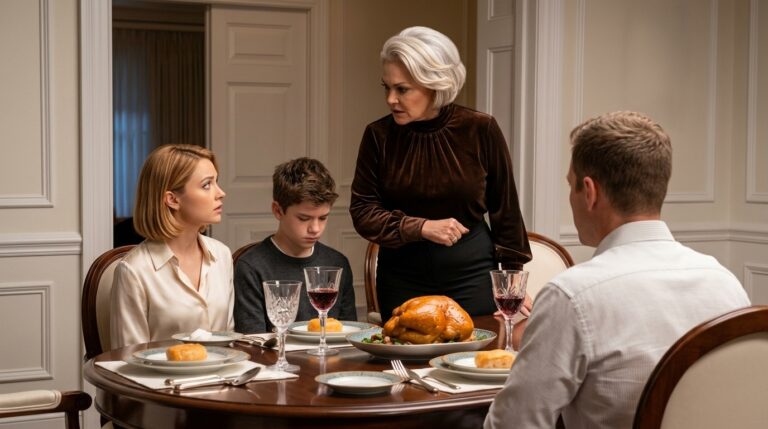
The limestone kitchen of the Whitaker estate in Buckhead was designed to look like a French country kitchen that had never seen a greasy pan or a burnt piece of toast. It boasted custom Carrera marble countertops, a La Cornue range in matte black and polished brass, and a walk-in pantry stocked with artisan vinegars and imported sea salt. Tonight, however, it smelled of panic, scorched rosemary from the catering trays, and the sharp, metallic tang of cold fear.
The slap had echoed off the vaulted brick ceiling like a pistol shot.
Sixteen-year-old Lily Carter had not fallen, but she had staggered backward against the cold edge of the marble island, her right hand flying up to cover the rising welt on her pale cheek while her left fingers still spasmed around the corner of a folded white linen napkin. Her breath hitched, catching somewhere behind her ribs, shallow and sharp.
For three terrifying seconds, the luxury of the room seemed to freeze.
Near the massive sub-zero refrigerator, a young man from the catering staff stood stock-still, a silver tray laden with champagne flutes tilted at a perilous angle, bubbles spilling over the rim to form small puddles on the oak flooring. By the door leading to the butlers’ pantry, Mrs. Gable, the head housekeeper who had worked for the Whitaker family for twenty-two years, had her hands clamped over her mouth, her knuckles white. Down the wide, art-hung corridor, an investment banker from New York—here to court Grant Whitaker for a multi-million-dollar downtown real estate venture—had frozen mid-stride, looking for the restroom and finding instead a domestic tableau straight out of a Greek tragedy.
And right in the center of it all stood Vanessa Whitaker.
At forty-eight, Vanessa maintained herself with the ruthless discipline of a woman who spent more time at the plastic surgeon’s office than most people spent at the dentist. Her blonde hair was swept into a lacquer-tight French twist, and her skin bore the tight, poreless sheen of expensive peels. Her left wrist was heavy with a diamond tennis bracelet that glittered under the recessed lighting as she slowly brought her right hand back down to her side, her fingers curling into a disappointed fist.
“You careless little—” Vanessa began again, her voice pitched in that sharp, aristocratic register that usually made servants scurry.
“Vanessa.”
The word dropped into the room like a block of dry ice.
It wasn’t raised. It didn’t vibrate with a theatrical rage. It was quiet, level, and entirely devoid of warmth.
Vanessa stopped dead. The insult died on her tongue.
Every head in the kitchen—and the half-dozen guests now crowding the hallway entrance—turned simultaneously.
Grant Whitaker stood in the doorway. He had shed his heavy charcoal overcoat, draping it over his arm, leaving him in a bespoke midnight-black tuxedo that looked like it had been painted onto his frame. At forty-one, Grant was the undisputed face of Whitaker Development Group, a conglomerate that had quietly reshaped half the Atlanta skyline, swallowing old brick warehouses and spitting out luxury high-rises and tech parks. The financial press frequently profiled him, calling him the “Cold Prince of Buckhead”—a man whose business acumen was as unyielding as structural steel.
People were used to seeing his face in the Atlanta Journal-Constitution, cutting ribbons with the mayor, shaking hands with institutional investors, or standing beside politicians at charity galas.
They were not used to seeing him look like a loaded gun.
His dark gray eyes didn’t sweep the room to assess the guests or manage his public image. They locked instantly onto the red, angry handprint blooming across Lily Carter’s cheek.
Grant’s phone still glowed in his left hand, an unread email from his chief financial officer flickering on the screen before he slowly, deliberately, set the device down on the marble counter.
“What,” Grant asked, his voice barely above a whisper, “did you just do?”
Vanessa lowered her arm further, her chin lifting in an immediate defensive posture. Her shock lasted less than the blink of an eye before indignation flooded her features.
“She ruined one of your father’s heirloom dinner plates, Grant. That’s what she did.”
Grant’s gaze shifted downward.
A porcelain plate lay on the dark wood floor beside Lily’s scuffed canvas sneaker. It wasn’t shattered into a thousand pieces; it was a Meissen hand-painted floral plate from Thomas Whitaker’s private collection, imported from Germany thirty years ago. A single, tiny triangular piece had chipped away from the gold-gilded rim.
“That plate cost nearly four thousand dollars,” Vanessa continued, her voice rising as she sought the silent approval of the spectators in the hallway. “And she was warned, explicitly, not to touch the delicate service in the china cabinet. She was supposed to stay upstairs until the dinner was over, but no—she had to wander down here and play kitchen maid.”
Lily swallowed hard, her throat working convulsively. Tears brimmed in her wide, dark eyes, but she refused to let them fall. “I’m sorry,” she whispered, her voice trembling so badly the words were nearly unintelligible. “I was just trying to help Mrs. Gable clear the second-course salad plates. I tripped on the rug. I didn’t mean to—”
Grant looked at her.
Something shifted behind his eyes—a rigid, calcified wall cracking down the middle.
“Don’t apologize,” Grant said.
Lily blinked, her eyelashes fluttering against her wet cheeks.
Vanessa scoffed, throwing her hands up in exasperation. “Grant, please. Look around you. You have forty VIP guests in the dining room. Your board members are here. Major institutional investors are mingling five feet away. Can we not turn a clumsy teenager’s mistake into a public spectacle?”
Grant didn’t look at Vanessa. He didn’t look at the investment banker who was now trying to slowly back away down the hall.
He walked past his stepmother, his heavy leather shoes making no sound on the hardwood floor.
Then, in front of the caterers, the trembling housekeeper, his stepmother, and the widening circle of wealthy guests peering through the doorway, the CEO of Whitaker Development dropped straight down to one knee on the dirty floor beside an orphaned girl wearing a cheap black dress she had bought off the rack at TJ Maxx and a stained white cotton apron.
“Lily.”
She wouldn’t look at him. Her chin was tucked tight against her chest, her fingers shredding the linen napkin into tiny, pathetic lint balls.
“Look at me.”
Slowly, agonizingly, Lily raised her chin.
Grant’s anger nearly cracked his teeth.
He had known Lily was living in the house for almost a year. When his father, Thomas, had taken her in after a horrific highway accident on I-85 wiped out her parents and her younger brother, Grant had viewed it as a charitable impulse typical of an aging man trying to find redemption for a lifetime spent chasing balance sheets. Grant had paid for her private school tuition, ensured her room on the third floor was comfortable, and left the day-to-day parenting to his father and the household staff. He had assumed Lily was simply another dependent under the Whitaker roof—quiet, provided for, and safe.
Yet in this exact moment, crouching on the kitchen floor, he realized he had barely known her at all.
He knew she earned straight A’s at Westminster. He knew she liked old mystery novels by Agatha Christie. He knew she spoke softly.
What he had never noticed—what he had deliberately chosen not to notice because his life was built around multi-billion-dollar deals and corporate strategy—was how quickly she flinched when an adult raised a hand. He hadn’t noticed how she kept her shoulders permanently hunched, as if trying to occupy as little space as humanly possible. He hadn’t noticed how carefully she studied every expression in the room before deciding whether she was even allowed to breathe.
“Did she hurt you before tonight?” Grant asked. His voice was no longer a whisper; it was a low, steady rumble that made the crystal glasses on the nearby tray vibrate.
Lily’s face changed.
It was a micro-expression—a tiny twitch of her eyelid, a microscopic tightening of her jaw.
Vanessa saw it too.
“Oh, for heaven’s sake!” Vanessa snapped, stepping forward, her heels clicking angrily against the floor. “You’re interrogating the child like I beat her every morning! She broke an antique! I tapped her wrist, and she pulled back like a startled cat! Don’t be melodramatic, Grant.”
Grant stood up.
He didn’t rush. He rose slowly, his six-foot-two frame towering over Vanessa, casting a long, dark shadow across her perfect makeup and her diamond-encrusted bodice.
“Did you?” Grant asked again.
Vanessa stared up at him, her mouth parting in genuine disbelief. “Excuse me?”
“Did you hit her before tonight?”
“I disciplined a disrespectful, clumsy dependent in my own home!” Vanessa hissed, her voice losing its polished composure as the onlookers in the hallway murmured among themselves. “She lives here for free! She eats our food, wears clothes bought with our money, and attends an elite private school because your father felt sorry for a charity case! And now I’m apparently supposed to tolerate insolence and property damage?”
Lily’s face turned the color of fresh milk. She shrank back against the marble island, her eyes darting toward the door as if looking for an escape route that didn’t exist.
Grant’s head turned slowly toward his stepmother. The single vertical crease between his dark eyebrows looked like a scar carved into dry stone.
“Our home?” Grant asked softly.
Vanessa blinked. “You know what I mean. The Whitaker estate.”
“No,” Grant said, his voice dropping into the register of a man preparing to execute a hostile takeover. “I don’t think I do.”
Vanessa folded her arms across her chest, her diamond bracelet clinking against her sleeve. “Don’t look at me like that, Grant. I’ve run this household for ten years. I made sure your father’s retirement was comfortable, I managed the staff, and I put up with your cold absence while you built your little empire. I have earned my place here.”
Before Grant could answer, a heavy, measured footstep sounded from the end of the hallway.
Thomas Whitaker appeared in the doorway.
At seventy-two, Thomas had officially retired from Whitaker Development five years earlier, handing the CEO title to his son. Everyone in Atlanta business circles knew the company still carried the old man’s instincts in its bones—he was a legend who had grown up poor in the red clay of rural Georgia, starting his first contracting business with one rusted pickup truck and two laborers, surviving two severe recessions, and building an empire.
Tonight, however, Thomas did not look like a titan of industry.
He wore a tailored velvet smoking jacket, but his shoulders were slightly rounded, and his face was pale. He looked like an old man who had suddenly realized he had invited a wolf into his sheepfold while he was busy looking at old photo albums.
“What happened?” Thomas asked, his voice rough and gravelly.
Nobody answered immediately. The silence in the kitchen was absolute.
Then, Lily whispered, her voice cracking with shame, “I chipped the plate, Mr. Whitaker. I’m so sorry.”
Thomas looked past her, his gaze falling upon the red, swollen imprint of Vanessa’s hand still burning across the teenager’s cheek.
The old man’s expression completely collapsed. The formidable patriarch of Whitaker Development looked like he had been struck in the chest with a sledgehammer.
“What,” Thomas whispered, pointing a trembling finger toward Lily’s face, “happened to your cheek?”
Chapter 2 – The Audit of the Estate
The silence that followed Thomas Whitaker’s question was so heavy that the hum of the industrial refrigerator sounded like a jet engine.
Thomas stepped past the frozen caterer and the gawking investment banker, his leather-soled shoes clicking heavily against the oak floor. He ignored the guests clustering in the hallway—people who had spent decades trying to curry favor with the Whitaker family, now witnessing a public fracturing of the household dynasty.
“Lily,” Thomas said, his voice dropping an octave as he stopped two feet from the terrified girl. He reached out a gnarled, age-spotted hand, his fingers hovering hesitantly near her face before gently, oh so gently, touching the edge of the red mark. “Did she do this?”
Lily couldn’t look at him. She stared fixedly at the floorboards between Thomas’s shoes, tears finally spilling over her lower lashes and tracking down her dusty cheeks. She didn’t nod, but she didn’t pull away either.
Thomas’s hand dropped.
When the old man turned around to face his wife, the transformation on his face was terrifying. The warmth and geniality that people usually associated with Thomas Whitaker—the philanthropic grandfather, the smiling donor at children’s hospitals—evaporated, leaving behind the cold, ruthless contractor who had once driven competing construction firms into bankruptcy during the 1990 real estate crash.
“Vanessa,” Thomas said. His voice wasn’t loud. It didn’t need to be. It had the weight of an anchor hitting the seabed.
Vanessa’s defensive posture faltered for a fraction of a second, but she quickly recovered, tossing her blonde head back with a brittle, defensive laugh.
“Oh, Thomas, don’t start with that look,” she scoffed, casting an appeal toward the hallway audience. “You’re acting like I committed a felony. The girl was clumsy, she ruined an irreplaceable antique from your precious German collection, and I lost my temper. It happens! We are all stressed tonight with the winter gala. You’re blowing this completely out of proportion.”
“Out of proportion,” Thomas repeated.
“Yes!” Vanessa stepped closer, lowering her voice into a conspiratorial hiss. “You brought her here a year ago. You said it was temporary—just until her aunt in Savannah got back on her feet. Well, her aunt never took her, did she? And now she’s a permanent fixture in our house, eating our food, tracking mud through the mudroom, and acting like she owns the place. Someone has to maintain standards, Thomas. If you won’t discipline her, I will.”
Grant stood motionless beside the marble island, watching his stepmother with a gaze so devoid of emotion it was chilling. He had spent his entire career dissecting balance sheets, looking for hidden liabilities, inflated assets, and structural rot in companies he planned to acquire. Right now, looking at Vanessa, he realized he had allowed the most toxic liability of all to fester inside his own family home while he was busy chasing square footage in Midtown.
“Standards,” Grant said quietly, pushing himself off the counter.
Vanessa turned her sharp gaze toward him. “Grant, tell your father to be reasonable. We have investors out there. If word gets out that we’re having a domestic brawl over a clumsy orphan, the stock price—”
“The stock price,” Grant interrupted, stepping into the space between his father and his stepmother, “can take care of itself. Right now, we’re going to talk about standards.”
He pulled his smartphone from his pocket, his thumb swiping across the screen with practiced speed. He didn’t look at Vanessa; he looked at Mrs. Gable, the head housekeeper, who was still standing paralyzed by the pantry door.
“Mrs. Gable,” Grant said.
The housekeeper jumped, her eyes wide. “Y-yes, Mr. Grant?”
“How long has Lily been sleeping in the basement annex?”
The kitchen seemed to drop another ten degrees.
Vanessa’s face went rigid. “Grant, don’t be ridiculous. She has the guest suite on the third floor—”
“Mrs. Gable,” Grant repeated, ignoring Vanessa entirely, his eyes locked on the housekeeper. “The truth. How long?”
Mrs. Gable looked between Grant, Thomas, and Vanessa. She swallowed hard, her hands wringing her apron until the fabric tore slightly at the seam.
“Since… since November, Mr. Grant,” the housekeeper whispered, staring at the floor. “Mrs. Whitaker said… she said the third-floor suite was needed for out-of-town guests and interior decorators. She had Miss Lily move her things down to the converted storage room behind the laundry facilities in the basement.”
Thomas’s head snapped toward his wife. “Basement? Vanessa, you told me she was in the north suite!”
“She wanted to be closer to the kitchen!” Vanessa stammered, her face flushing a mottled, angry red as the guests in the hallway began whispering loudly. “It’s a perfectly nice room! It has a small cot and a window facing the garden window-well!”
“It has no heating vents,” Grant said, his voice deadly calm. “It has a concrete floor, exposed water pipes, and a dampness index that would fail every health code in Fulton County. My father’s charity case—as you called her—has been living in a glorified utility closet for four months while you hosted charity galas upstairs.”
“She’s a charity case!” Vanessa shrieked, losing her grip entirely as her pristine social facade cracked wide open. “She’s a nobody! Her parents died with negative equity in a rusted-out Ford sedan! If Thomas hadn’t felt some sappy, senile stroke of misplaced guilt, she’d be in a state foster home right now eating institutional gruel! I gave her a roof, I gave her food, and I gave her a private school education! And you’re standing here treating me like a criminal over a cheap orphan who breaks four-thousand-dollar plates?!”
The silence that followed her outburst was absolute, suffocating, and final.
Nobody spoke. Even the caterers had stopped moving entirely.
Thomas Whitaker looked at his wife—the woman he had married twelve years ago after his first wife passed away, believing she brought grace and elegance to his twilight years. He saw not a partner, but a stranger wrapped in designer silk and buried in bottomless cruelty.
“Pack your bags, Vanessa,” Thomas said.
The old man’s voice didn’t shake. It had the terrible, unyielding authority of the man who had built Whitaker Development from the ground up.
Vanessa blinked, her expression shifting from rage to utter disbelief. “What did you say?”
“I said, pack your bags,” Thomas repeated, looking her dead in the eye. “You have two hours to gather your jewelry, your furs, and your clothes. The private driver will take you to the St. Regis downtown. By morning, my attorneys will have the divorce papers and the asset separation agreements ready for your signature.”
“You can’t do that!” Vanessa screamed, lunging forward, her manicured nails clawing at the air. “You signed a prenuptial agreement! You gave me rights to the Buckhead estate! You can’t throw me out like a piece of trash over an ungrateful, lying brat!”
“The prenuptial agreement,” Grant interjected smoothly, sliding his phone back into his pocket, “contained a moral turpitude and domestic abuse clause drafted by my own corporate counsel back in 2014. Physical assault of a minor residing under our legal guardianship constitutes an immediate breach of contract, forfeiting all spousal maintenance claims and residency rights.”
Vanessa stopped dead. She looked from Grant to Thomas, her chest heaving as the terrifying realization washed over her. She hadn’t just lost an argument; she had lost her entire empire in thirty seconds.
“You’re… you’re ruining me,” she whispered, her voice trembling. “Over her?”
“No,” Thomas said quietly, turning his back on her and walking over to where Lily was still standing against the marble island, trembling and clutching her ruined napkin. “We are finally fixing a mistake.”
Grant stepped past Vanessa without even glancing at her face, walking straight up to Lily. He knelt down once more, ignoring the murmurs of the stunned guests in the hallway.
“Lily,” Grant said softly, his voice carrying a gentleness that none of his business associates had ever heard in boardrooms or negotiation tables. “Look at me.”
Slowly, she raised her eyes.
“You are not a charity case,” Grant said, his gaze holding hers with absolute, unshakeable certainty. “You are a Whitaker. And starting tonight, nobody in this house will ever make you feel like anything less than that again.”
Chapter 3 – The Reconstruction
The morning sun filtered through the grand arched windows of the Whitaker estate, casting long, clean lines of golden light across the polished oak floors of the formal drawing room.
The chaos of the previous night had been swept away as efficiently as a corporate merger gone bad. By midnight, Vanessa’s designer luggage had been loaded into the trunk of a black sedan by two security guards, and she had departed the Buckhead property without a single tear being shed by anyone in the household. The guests had long since vanished, though the story had already begun filtering through Atlanta’s high-society gossip circuits—a dramatic downfall that would no doubt dominate the weekend brunch tables from Ansley Park to Tuxedo Park.
Inside the third-floor north suite—the actual guest suite that Vanessa had kept locked and empty under the pretext of ‘remodeling’—the heavy velvet drapes were pulled wide open.
Lily stood by the window, looking out over the manicured boxwood gardens and the sparkling blue water of the estate’s infinity pool. She was wearing a soft, oversized cashmere sweater that had belonged to Thomas’s late first wife—clean, warm, and smelling faintly of lavender and old paper.
A soft knock sounded at the open door.
Grant stood in the doorway. He had already changed into a tailored navy suit, but his tie was missing, and the top two buttons of his crisp white shirt were unbuttoned. He looked less like the “Cold Prince of Buckhead” and more like an exhausted man trying to figure out how to put a shattered puzzle back together.
“Morning,” Grant said.
Lily turned quickly, her hands instinctively smoothing the front of her sweater. “Good morning, Mr. Whitaker.”
“Grant,” he corrected gently, walking into the room and stopping a few feet away. He looked at the room—the vaulted ceiling, the antique mahogany dresser, the plush queen-sized bed with its pristine white duvet. “Is this better than the basement?”
A small, genuine smile tugged at the corner of Lily’s mouth. “It’s… it’s a little too big. I keep feeling like I’m going to ruin something.”
“You can’t ruin anything in this house that insurance or a checkbook can’t fix,” Grant said, though there was no arrogance in his tone—only a quiet, self-deprecating acknowledgment of his own past neglect. He shoved his hands into his trouser pockets, hesitating for a second before continuing. “My father wants to take you to breakfast in Midtown. He’s downstairs waiting by the Bentley, looking like a guilty schoolboy who wants to buy you a stack of pancakes the size of a manhole cover.”
Lily looked down at her sneakers. “Is he… is he okay? Last night looked really hard on him.”
“It was,” Grant admitted, walking over to stand beside her by the window. He looked down at the gardens, his brow furrowing slightly. “He spent ten years letting Vanessa turn this house into a museum of appearances because he thought keeping the peace was the same thing as keeping a family. He realized last night that he traded his soul for a quiet dinner party.”
“And you?” Lily asked softly, summoning the courage to look up into his gray eyes. “Why did you stop her?”
Grant turned his head, meeting her gaze with an unblinking intensity. “Because I spent my whole life believing that strength meant building walls high enough that nothing could touch you. I watched my father get old, I watched my stepmother turn this house into a cold corporate hotel, and I told myself it didn’t matter as long as the business kept growing.”
He reached out, his hand pausing just an inch from her shoulder before resting lightly, firmly, on the fabric of her sweater.
“When I walked into that kitchen last night and saw you standing there—taking the blame for a broken plate, apologizing for existing in a house your grandfather brought you into—I realized I had become everything I despised about the men I do business with every day,” Grant said, his voice dropping to a low, resonant rumble. “I was a spectator in my own home. That stops today.”
Before Lily could answer, a heavy, familiar cough sounded from the doorway.
Thomas Whitaker stood leaning against the doorframe, wearing a gray tweed jacket and a silver-buckled belt. He looked older in the morning light, the lines around his eyes etched deep with regret, but his shoulders were squared.
“Well,” Thomas grunted, offering a tentative, hopeful smile. “Are we going to get those pancakes, or are you two just going to stand there analyzing real estate philosophy all morning?”
Lily let out a breath that sounded half-laugh, half-sigh, and nodded. “I’m starving.”
“Good,” Thomas said, turning toward the stairs. “Because if we don’t leave in the next five minutes, Grant is going to start talking about quarterly earnings reports, and I need my breakfast syrup uncorrupted by corporate finance.”
As Thomas ambled down the hallway, Grant looked down at Lily, a rare, unreserved smile touching his lips.
“Come on, kid,” Grant said, offering his arm. “Let’s go face the world outside these gates.”
Chapter 4 – The Boardroom and the Classroom
The glass-walled conference room on the forty-second floor of the Whitaker Development tower offered a panoramic view of downtown Atlanta, stretching from the glittering skyscrapers of Peachtree Street all the way to the hazy green ridges of Stone Mountain in the distance.
Inside, twelve members of the board of directors sat in leather executive chairs, murmuring among themselves. The atmosphere was thick with tension. Word of Vanessa’s abrupt departure from the estate had leaked to the financial press by sunrise, and by mid-morning, gossip blogs and local news outlets were already speculating about whether the personal scandal would impact Whitaker Development’s upcoming $400 million mixed-use commercial acquisition in Midtown.
The double glass doors swung open.
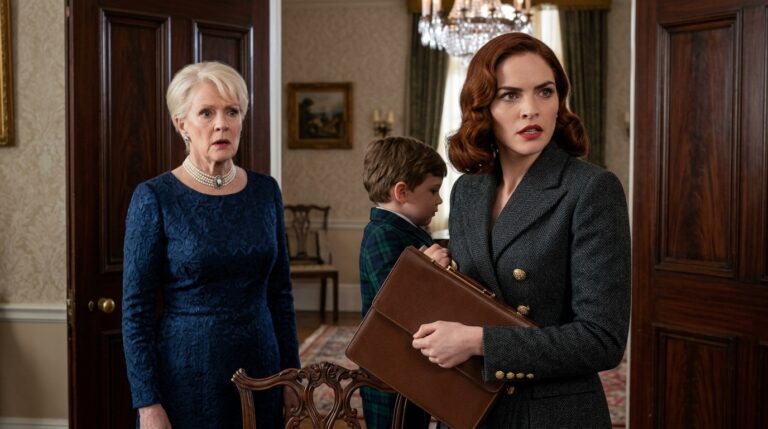
Grant Whitaker walked in. He didn’t look like a man whose personal life was being dissected on Twitter. He looked like an apex predator returning to his territory. Behind him walked Sarah Lin, his chief legal counsel, carrying a heavy leather briefcase filled with legal filings, prenuptial amendments, and corporate restructuring documents.
Grant took his seat at the head of the mahogany table, folding his hands on the surface. He didn’t offer a polite preamble or a CEO smile.
“I called this emergency session,” Grant began, his voice cutting through the murmurs instantly, “because I want to address the rumors regarding my household before they affect our market positioning.”
Arthur Sterling, a senior board member who had been with the company since Thomas Whitaker’s early days, cleared his throat. “Grant, with all due respect, the Constitution is running a column about your stepmother’s sudden eviction and a domestic dispute at the Buckhead estate. Institutional investors are calling my office asking if the family office is facing liquidity issues or instability.”
Grant’s eyes locked onto Sterling with a predatory chill.
“My family office,” Grant said, his voice dropping into a register that made several directors shift uncomfortably in their seats, “is more stable today than it has been in ten years. My father dissolved his marriage to a toxic liability who violated the moral and ethical covenants of our household trust. Furthermore, effective immediately, Whitaker Development’s philanthropic arm is establishing a permanent educational and housing trust for displaced orphans in the greater Atlanta area, named in honor of my grandfather’s original contracting foundation.”
A stunned silence fell over the boardroom.
Sterling blinked. “A philanthropic trust? Grant, we’re in the middle of closing the Midtown acquisition. Capital allocation—”
“Capital allocation,” Grant interrupted, leaning forward and placing his palms flat on the table, “is currently being directed toward projects that matter. If any investor, board member, or financial analyst believes my personal life compromises my ability to deliver double-digit returns, they are welcome to liquidate their shares before the bell rings at four o’clock. My legal team will gladly buy them out at a ten percent discount.”
Nobody spoke. Nobody moved.
Sarah Lin suppressed a small, professional smile behind her legal pad.
“Now,” Grant said, standing up and buttoning his suit jacket. “Let’s move on to the zoning permits for the Midtown project. I want those approvals finalized by Friday, or I’m replacing the entire development team.”
Miles away, in the quiet, tree-lined courtyard of Westminster Schools, the afternoon bell rang, signaling the end of the school day.
Students in plaid skirts and navy blazers streamed out of the brick academic buildings, laughing and chatting as they headed toward waiting SUVs and carpool lines.
Lily Carter walked down the stone steps of the upper school building, a heavy canvas backpack slung over one shoulder. For the first time in a year, her shoulders weren’t hunched. She wore her hair down, and when the cold March wind caught her face, she didn’t flinch.
“Lily!”
She turned around.
Maya, her lab partner in AP Chemistry, jogged up beside her, holding a stack of worksheets. “Hey, are you still coming over to my house on Thursday to work on the titration lab report? My mom is making tacos.”
“Yeah, I’d love to,” Lily smiled, genuine and bright. “I just need to check with my… with my grandfather.”
“Your grandfather is the coolest,” Maya gushed. “My dad said he saw him at the symphony last night with your uncle—wait, is Grant Whitaker your uncle or your cousin or what?”
Lily laughed—a light, musical sound that carried across the courtyard. “He’s… complicated,” she said cryptically.
“Well, tell him he owes me an autograph for my dad,” Maya grinned before darting toward her mother’s silver Range Rover parked by the curb.
Lily stood by the sidewalk as the last of the cars pulled away.
A sleek black Bentley Continental GT pulled up silently to the curb. The tinted rear window rolled down smoothly, revealing Thomas Whitaker’s smiling face behind his gold-rimmed glasses, and beside him, Grant, whose laptop was resting on his knees even as he closed a spreadsheet document.
“Get in, kid,” Grant said, looking up from his screen with a faint, welcoming grin. “Your grandfather threatened to fire me if we were late picking you up for ice cream.”
Lily opened the car door, sliding into the cool leather interior between the aging patriarch and the most feared CEO in Atlanta.
As the car pulled away from the school and merged into the afternoon traffic, Lily looked out the window at the passing city skyline—a skyline built by the men sitting beside her, a skyline that suddenly felt less like a cage and more like a foundation.
Chapter 5 – The Shadows of the Past
Spring in Atlanta arrived with a sudden explosion of pollen and dogwood blossoms, turning the city into a lush canvas of green and white.
At the Whitaker estate in Buckhead, the transformation was even more profound. Without Vanessa’s tyrannical obsession with white carpets and sterile, museum-like minimalism, the house had finally begun to breathe. Fresh flowers picked from the garden sat in heavy glass vases on the kitchen island; the smell of baking bread occasionally drifted from the ovens as Mrs. Gable experimented with old family recipes; and the third-floor suite had been fully unpacked, its shelves lined with paperback mystery novels, art supplies, and framed photographs of Lily’s parents—pictures Thomas had quietly recovered from a storage facility in Macon and framed in polished silver.
Yet, peace in a wealthy, high-profile family rarely goes undisturbed for long.
It started on a Tuesday morning in mid-April.
Grant was sitting at the massive mahogany dining table reviewing architectural renders for the Midtown project when his private security chief, Marcus Vance—no relation to the disgraced legal family—walked in without his usual bureaucratic knock.
“Boss,” Marcus said, keeping his voice low so as not to disturb Thomas and Lily, who were having breakfast in the sunroom. “We’ve got an issue at the perimeter gates.”
Grant didn’t look up from his tablet. “What kind of issue? Photographers?”
“Worse,” Marcus muttered, dropping a folded legal document onto the mahogany surface. “A process server. Accompanied by local counsel representing Julian Vale.”
Grant’s hand stopped scrolling.
The name—Julian Vale—hung in the air like the smell of sulfur. Julian was Vanessa’s brother, a slick, amoral corporate restructuring lawyer who had spent the last decade using shell companies, forged financial instruments, and regulatory loopholes to bleed dying real estate firms dry. Six months ago, during the disastrous fallout of the Plaza Hotel siege, Grant’s legal team had dismantled Julian’s primary network, stripping him of his partnership at his firm and freezing his domestic assets.
“Julian’s assets were liquidated under federal racketeering statutes,” Grant said coldly, his gray eyes narrowing as he looked at the legal paper. “What does he think he’s suing for?”
“He’s not suing Whitaker Development,” Marcus said grimly. “He’s filing an emergency guardianship petition in Fulton County Superior Court on behalf of his sister, Vanessa, and a distant maternal cousin of Lily Carter.”
Grant stood up so fast his chair screeched against the hardwood floor.
“A guardianship petition for Lily?” Grant’s voice dropped into that low, lethal register that made security guards check their sidearms. “Lily is sixteen. Her parents died intestate, and my father petitioned for formal legal guardianship with the consent of her court-appointed guardian ad litem a year ago. Julian has no standing.”
“He found a loophole,” Marcus explained, sliding a second paper forward. “A maternal second cousin living in rural Alabama—a man with three felony DUI convictions who hasn’t seen Lily since she was four. Julian tracked him down, paid his legal fees, and is using him as a proxy to challenge the estate’s guardianship on grounds of ‘undue influence, emotional isolation, and fraudulent domicile.’”
Grant stared at the paper, the single vertical crease between his eyebrows carving deep into his skin.
He didn’t care about Julian’s financial vendetta. He didn’t care about the PR nightmare. But the thought of some predatory lawyer and a deadbeat relative dragging Lily through family court, forcing her to testify, weaponizing her trauma to hurt the Whitaker family—it filled him with a cold, blinding rage that went far beyond business.
“Where is Lily right now?” Grant asked sharply.
“She’s in the sunroom with your father,” Marcus said. “They haven’t seen the papers yet.”
Grant snatched the documents off the table. “Keep that process server at the gate. Do not let him step one foot on this property. If he crosses the threshold, throw him in the trunk of a patrol car and dump him outside the city limits.”
“Done,” Marcus nodded, a grim smile touching his lips.
Grant walked briskly down the hallway toward the sunroom, his mind racing through tactical maneuvers, legal injunctions, and countermeasures. But as he reached the arched doorway, he stopped.
Through the glass panes, he saw Thomas and Lily sitting at the small wrought-iron table. Thomas was laughing, pointing at something in the morning newspaper, while Lily smiled, her dark hair catching the sunlight.
Grant’s grip on the legal papers tightened until his knuckles turned white.
They had survived Vanessa. They had survived the board room. But the vultures were circling again, smelling blood in the water, thinking the Whitaker family was vulnerable.
They were about to find out just how sharp a cornered wolf’s teeth could be.
Chapter 6 – The Courtroom Ambush
The fourth-floor courtroom of the Fulton County Courthouse smelled of floor wax, old paper, and institutional anxiety.
Judge Robert Vance—no relation to the legal Vales, thankfully—presided over Family Court Division 3 with a weary, no-nonsense demeanor born of thirty years handling messy divorces and broken custody battles.
When the double doors opened, Grant Whitaker walked in first, wearing a dark navy suit that looked like it had been tailored for an execution. Behind him walked Thomas, holding his cane with a steady, white-knuckled grip, and Lily, wearing a simple black dress and a pale blue cardigan, her hands trembling slightly as she clutched a leather-bound notebook to her chest.
Sitting at the opposing counsel table was Julian Vale.
Julian looked thinner than he had six months ago. His expensive Brioni suit was slightly rumpled, and the arrogant, triumphant smirk he usually wore in corporate boardrooms had been replaced by a desperate, hungry gleam in his eyes. Beside him sat a bulky, red-faced man in a stained plaid shirt—Arthur Higgins, Lily’s long-lost maternal cousin from rural Alabama, chewing furiously on a piece of nicotine gum.
“All rise for the Honorable Judge Robert Vance,” the bailiff announced.
Everyone stood. Judge Vance entered briskly, scanned the courtroom through his half-moon spectacles, and sat down.
“Be seated,” the judge commanded, shuffling a stack of files. “We are here this morning for an emergency hearing on Docket Number 2026-FC-8841: Higgins v. Whitaker, concerning the guardianship petition of minor child Lily Carter.”
Julian Vale stood up, adjusting his silk tie with theatrical grace.
“Your Honor, Julian Vale appearing for the petitioner, Mr. Arthur Higgins,” Julian began, his voice smooth and oily as a well-greased gear. “We are asking this court for an immediate writ of habeas corpus and an emergency transfer of custody. The minor child, Lily Carter, is currently being held in an isolated, conflicted household under the de facto control of Grant Whitaker—a corporate executive whose stepfamily has recently suffered severe criminal and domestic scandals.”
Grant didn’t flinch. He didn’t even look at Julian. He sat perfectly still, his eyes fixed on the judge’s desk.
“Furthermore,” Julian continued, raising his voice for dramatic effect, “Mr. Higgins is the blood-related legal next-of-kin. He wishes to bring young Lily back to her rightful family home in Alabama, away from the predatory influence of billionaires who treat orphaned children like household pets or PR props.”
Judge Vance frowned, looking down over his glasses at the petitioner’s table. “Mr. Vale, the court records show that Mr. Higgins has not had contact with the minor child in over a decade, and that his criminal record includes multiple driving under the influence convictions and unresolved child support warrants.”
“Technicalities, Your Honor!” Julian protested smoothly. “Blood ties outweigh financial power. The child is being emotionally manipulated—”
“Mr. Vale,” a cold, flat voice cut across the courtroom.
Grant stood up. He didn’t raise his voice, but the sudden drop in temperature in the room was palpable. He buttoned his jacket with slow, deliberate precision.
“May I approach the bench, Your Honor?” Grant asked.
Judge Vance nodded slowly. “Proceed, Mr. Whitaker.”
Grant stepped forward, placing a single manila folder on the judge’s podium. He didn’t look at Julian; he looked directly into the judge’s eyes.
“Your Honor, my legal team has conducted a comprehensive forensic audit of the petitioner, Arthur Higgins, and his legal representation, Julian Vale, over the past forty-eight hours,” Grant said, his voice ringing with absolute authority. “Exhibit A contains certified bank records from an offshore shell company in the Cayman Islands—the exact same shell company Julian Vale used to funnel embezzled funds during his tenure at Moretti Enterprises.”
Julian’s face went instantly pale. He took a half-step forward. “Objection! That document is irrelevant—”
“Sit down, Mr. Vale,” Judge Vance snapped, already opening the folder Grant had provided.
“Those bank records,” Grant continued smoothly, “show a wire transfer of exactly fifty thousand dollars deposited into Arthur Higgins’s personal checking account forty-eight hours ago, originating from an account held by a defunct LLC named Vale Holdings. In exchange for this sum, Mr. Higgins signed a notarized power-of-attorney agreement granting Julian Vale complete control over any prospective financial settlements or trust disbursements derived from Lily Carter’s deceased parents’ estate.”
The courtroom erupted into quiet murmurs.
Arthur Higgins turned red, glaring furiously at Julian. “Hey! You said this was about family!”
“Shut up, you idiot,” Julian hissed under his breath.
Judge Vance stared at the documents, his expression hardening into a mask of judicial fury. He looked up from the papers, glaring directly at Julian Vale.
“Mr. Vale,” the judge said, his voice dangerously quiet. “Are you telling this court that you fabricated a custody dispute using a straw-man petitioner simply to extort a financial settlement from the Whitaker estate?”
Julian’s mouth opened and closed like a fish out of water. “Your Honor, that’s a malicious mischaracterization—my client simply wants—this is a smear campaign by a corporate monopoly—”
“Mr. Vale,” Judge Vance interrupted, slamming his gavel down with a sharp, echoing crack. “You are currently disbarred from practicing corporate law in the state of Georgia pending federal investigations. Filing fraudulent family court petitions using suborned perjury and proxy litigants is a direct contempt of this court.”
The judge turned his gaze to the red-faced man in the plaid shirt. “Mr. Higgins, your petition is dismissed with prejudice. If you attempt to contact the minor child or enter Fulton County again without a federal marshal escorting you, I will personally sign a warrant for your arrest.”
“Now wait just a minute—” Higgins started.
“Bailiff,” Judge Vance commanded sharply. “Escort Mr. Higgins out of my courtroom. And take Mr. Vale into custody for questioning regarding fraudulent litigation and financial extortion.”
Two bailiffs stepped forward instantly. Julian’s face turned the color of curdled milk as his arms were wrenched behind his back, the expensive cuffs of his Brioni suit rumpled as he was dragged toward the side exit, sputtering incoherent protests.
Silence descended upon the courtroom once more.
Judge Vance adjusted his glasses, looking down from the bench toward the Whitaker table. His stern expression softened just a fraction as his eyes landed on Lily, who was sitting quietly beside Thomas, her hands no longer shaking.
“Miss Carter,” the judge said gently.
Lily looked up. “Yes, Your Honor?”
“You are safe,” the judge said. “The guardianship order granted to Thomas Whitaker is permanently sealed and protected against any future challenges. Case closed.”
He banged his gavel one final time.
Chapter 7 – The Final VerdictThe afternoon sun was warm and golden as the black Bentley pulled back through the wrought-iron gates of the Buckhead estate.
Inside the car, nobody spoke for the first few miles. Thomas was staring out the window with a faint, satisfied smile playing at the corners of his mouth, while Grant was methodically closing tabs on his laptop, his expression returning to that cool, controlled mask of corporate focus.
When the car parked by the front steps, Lily turned to Grant before opening her door.
“Thank you,” she whispered.
Grant stopped, looking over at her. The dark shadows of anxiety that had haunted her eyes for months were completely gone, replaced by a quiet, steady light.
“You don’t ever have to thank me for protecting my family, Lily,” Grant said, his voice dropping into that rare, gentle register he reserved only for her.
As they walked into the grand foyer of the estate, the heavy oak doors closing behind them with a solid, reassuring thud, the past finally felt like a closed chapter.
Upstairs in the north suite, the afternoon sunlight streamed across the hardwood floors, illuminating the bookshelves, the art desk, and the framed photographs of a family that had been broken, scattered, and finally rebuilt out of something stronger than blood or steel.
Grant walked into his study, sitting down behind his mahogany desk. He picked up his phone, opened his email, and deleted a calendar invitation from a nervous board member asking about the recent press coverage.
He didn’t care about the news anymore.
For the first time in his life, the empire was secure, the balance sheet was clean, and the home was truly his own.