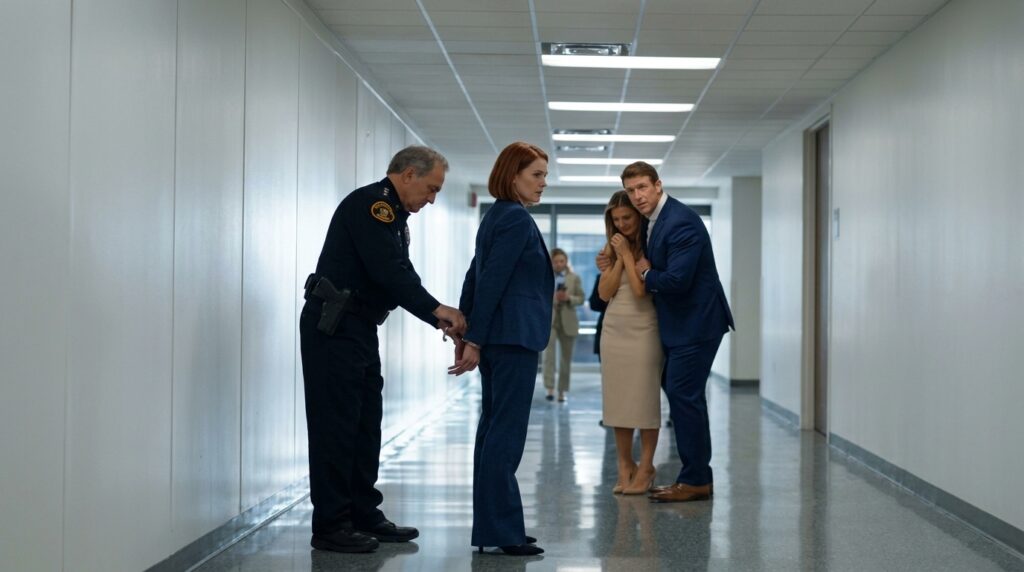
I didn’t scream. I didn’t beg the judge to reconsider, and I didn’t give Chad the satisfaction of seeing me collapse. I only looked past him toward the courthouse doors and thought about the folded piece of paper hidden inside my sleeve, because if I could get that note into the right hands, the man celebrating my destruction might discover he had stolen from the wrong woman.
The sentence had been ten years.
The words still echoed in my head as two bailiffs guided me away from the defense table inside the Saint Claire County Courthouse in Phoenix. Ten years for financial fraud totaling nearly two million dollars, committed through the company where I had served as chief financial officer for almost a decade.
Chad stood in the second row wearing the immaculate navy suit I had bought him for our seventh anniversary. His hair was perfectly combed, his expression relaxed, and one arm rested comfortably around Brenda’s waist. She was thirty, maybe thirty-one, almost ten years younger than me, and she had the nerve to look down as though she were embarrassed by the scene while a smile kept pulling at the corner of her mouth.
For seven years, that man had slept beside me. He had held my hand in the hospital when our son Toby was born, planned birthday dinners, complained about mortgage rates, kissed me before work, and sent me ridiculous messages whenever I traveled for quarterly meetings. I had believed that the ordinary details of our marriage were proof that our life was real.
Now I understood that ordinary details could be rehearsed.
Chad tilted his head as the bailiffs approached me.
“Enjoy your ten years, Genevieve. Brenda and I will figure out what to do with everything you leave behind.”
I stared at him for several seconds, searching his face for some trace of the man I had once loved. There was nothing there except satisfaction, and that frightened me more than anger would have.
“Take care of Toby.”
Chad actually laughed.
“We’ll see whether a judge thinks a convicted criminal should still be allowed to call herself a mother.”
Brenda lifted her fingers to her mouth, pretending to hide her reaction. I saw the amusement in her eyes anyway, and for one terrible second the courtroom disappeared around me because all I could picture was my eight-year-old son waking up and asking why his mother had vanished.
That hurt more than the handcuffs.
The prosecution’s case had looked almost perfect. Wire transfers carried my electronic signature, internal approvals were stamped with my credentials, access logs showed my account entering the company system late at night, and several phantom vendors had been created from a computer assigned to my office.
Even the forensic consultant hired by the prosecution had testified that there was no meaningful indication of outside manipulation. According to him, the evidence showed that I had slowly moved money into shell accounts over eighteen months, then covered the trail with false invoices and altered quarterly reports.
But I had never touched that money.
The most terrifying part was that I understood exactly how convincing the evidence looked, because I had spent my career building financial controls designed to prevent that kind of theft. Whoever had framed me knew the company, knew my routines, knew where our weaknesses were, and knew enough about my habits to imitate them.
For months, I had suspected Chad.
I just hadn’t been able to prove it.
During our marriage, I had occasionally worked from home using an encrypted company laptop. Chad knew my passwords to almost everything personal, but I had never knowingly given him access to the company systems. Still, he had spent years watching me work, listening to conversations, seeing authentication codes flash across my phone, and hearing me complain about vendors, compliance procedures, and accounting deadlines.
Then there was Brenda.
She had worked for one of the outside consulting firms that occasionally handled administrative projects for our company. Chad claimed they met at a charity fundraiser. I later learned they had been seeing each other for almost a year before my arrest.
By the time I discovered the affair, the investigation against me had already begun.
By the time I understood those two things were connected, no one wanted to listen.
The younger bailiff walked several steps ahead as I was escorted from the courtroom through a service corridor. The older guard beside me had a worn uniform, a lined face, and a slight limp that made his right shoulder dip with every third step.
His badge read HAROLD FOSTER.
I watched the ceiling carefully as we walked. Cameras covered nearly every section of the hallway, but I had been in that courthouse often enough during the trial to notice a narrow corner near an equipment door where one camera’s view ended before another began.
I waited.
When we reached it, I deliberately caught the toe of my shoe against the floor.
Harold grabbed my forearm immediately.
“Careful.”
I let my shoulder turn toward him and slipped the folded paper from inside my sleeve into his palm. His fingers tightened reflexively around it, and his expression changed when he realized I had given him something.
“Please,” I whispered. “Call the number on that paper. Tell Christopher Lindqvist that his daughter has just been sentenced for something she didn’t do.”
Harold’s eyes narrowed.
The name had landed exactly the way I hoped it would.
Almost everyone in Phoenix knew Christopher Lindqvist. He owned construction companies, industrial parks, commercial developments, luxury hotels, and enough real estate that local newspapers had once called him “the man who built half the city.”
What almost nobody knew was that Christopher Lindqvist was my biological father.
Not Chad.
Not Brenda.
Not my coworkers.
Not even most of the people who had known me for years.
My mother had spent my entire adult life making sure it stayed that way.
Harold glanced toward the camera at the far end of the corridor.
“And why should I believe you?”
I met his eyes.
“Because when you tell him my full name, he won’t ask you a single question.”
The younger guard looked back.
Harold closed his fist around the note.
“Keep moving.”
They placed me inside a transport vehicle ten minutes later. The doors shut with a heavy metallic sound, leaving me on a narrow bench with my hands secured and my thoughts racing faster than I could control them.
For the first fifteen minutes, I convinced myself Harold had thrown the note away. By twenty minutes, I imagined him showing it to his supervisor and laughing about the desperate prisoner pretending to be related to one of the wealthiest men in the state.
By thirty minutes, I was thinking about Toby again.
I pictured the dinosaur lamp beside his bed and the gap where his front tooth had fallen out two weeks earlier. I remembered promising him that no matter what happened in court, I would always find a way to come home.
I had no idea whether that promise was still possible.
Then the transport vehicle slowed.
At first I assumed we had reached the correctional facility, but there were no gates outside the narrow reinforced window. Instead, I saw black SUVs, courthouse personnel, and several people in suits moving quickly across a government parking area.
The vehicle stopped completely.
Voices rose outside.
One of the officers opened the rear door but did not tell me to get out. He looked confused, then stepped aside as a woman in a charcoal suit approached holding a folder.
Behind her stood two attorneys, a prosecutor, and a federal court clerk.
The woman introduced herself as Rebecca Sloan and immediately presented an emergency order. New evidence, she explained, had raised significant questions about the forensic examination used during my trial and the integrity of several digital records admitted against me.
My transfer had been temporarily suspended pending immediate judicial review.
I stared at her.
“So I’m free?”
“Not yet.”
The answer should have devastated me.
Instead, I almost laughed.
I wasn’t going into prison that night.
Then I saw the man standing behind them.
Christopher Lindqvist had turned seventy-two that spring. His hair was completely white now, and the cane in his left hand was new, but his posture was as rigid as I remembered it from the last time I had seen him nearly three years earlier.
He didn’t hug me.
He didn’t smile.
He only looked at the handcuffs around my wrists and then at the officers.
“Take those off.”
One of the attorneys quietly explained that the order permitted temporary release into supervised legal custody while the court reviewed the emergency filing. The restraints were removed several minutes later, and the first thing I did was rub the red marks around my wrists.
Christopher watched me without speaking.
We said almost nothing until we were sitting inside the back of his SUV. The privacy divider was raised, leaving us alone while downtown traffic slid past the tinted windows.
He kept his eyes forward.
“Your husband thinks he stole two million dollars from your company.”
“That’s what he did.”
Christopher slowly turned his head.
“No, daughter. That money came from one of my private investment vehicles. It was routed through your company as part of a larger development fund.”
I stared at him.
He tapped one finger against the handle of his cane.
“Chad has no idea whose money he actually stole.”
A chill moved through me.
For years, I had worked at a company that managed financial structures connected to hundreds of investors. I knew Christopher held interests in dozens of entities, but he had deliberately hidden his involvement from me because we had agreed that my career could never appear to benefit from our relationship.
I swallowed.
“How did you know which accounts were involved?”
“Because my people began reviewing them twenty-three minutes after Harold Foster called my office.”
That sounded exactly like him.
Christopher had always been able to turn concern into an operation before most people finished asking questions.
He looked out the window.
“But the stolen money is not the worst part.”
My stomach tightened.
“While you were being tried, someone sold your townhouse.”
For several seconds, I didn’t understand the sentence.
“What?”
“Your townhouse was transferred eight days ago using a power of attorney supposedly signed by you.”
I leaned forward.
“That’s impossible. I never signed a power of attorney.”
“I know.”
My first thought was Toby.
“Where is my son?”
“With Chad tonight, according to the temporary custody arrangement.”
I reached for my phone before remembering the police had taken it as part of my processing.
Christopher watched my hands.
“We’re getting you another one.”
“Who bought the townhouse?”
For the first time since he had appeared outside the transport vehicle, something in my father’s expression softened. It wasn’t tenderness exactly.
It looked closer to pity.
“Your mother.”
I stopped breathing.
The traffic outside continued moving, headlights sliding across the dark glass, but inside the SUV everything seemed frozen.
“My mother bought my house?”
“She purchased it through a limited-liability company registered six weeks ago.”
“That doesn’t make sense.”
“No,” Christopher said. “It doesn’t.”
My mother, Evelyn, had spent years insisting she wanted nothing from Christopher. She had left him before I was born, raised me mostly on her own, and taught me never to mention his name unless absolutely necessary.
According to her, secrecy protected me.
According to her, wealthy people turned affection into leverage.
According to her, I needed to build a life that belonged entirely to me.
For the first time, I wondered whether those warnings had ever truly been about protecting me.
And that was the moment I realized Chad’s betrayal might never have belonged to Chad alone.
Christopher’s attorneys moved me that night to a private apartment owned by one of his companies. I hated the idea of hiding behind his resources, but I had no home, no phone, no access to my bank accounts, and a husband who was already trying to use my conviction to obtain permanent custody of our son.
At 1:17 in the morning, Rebecca arrived carrying two laptops and a cardboard file box. She spread documents across the dining table while Christopher stood near the window and I sat opposite her in borrowed clothes.
The first discovery was the forensic consultant.
One of Christopher’s investigators had found a payment made three months before my trial to a consulting company controlled by the expert’s brother-in-law. The money had come from another shell company linked to Brenda.
Rebecca tapped the transaction.
“This alone doesn’t prove your husband framed you, but it’s enough to challenge the expert’s independence.”
I studied the page.
“How much?”
“Forty-eight thousand.”
I let out a slow breath.
The expert who had told the jury my computer showed no signs of manipulation had accepted indirect money from someone connected to my husband’s mistress.
Rebecca slid another file toward me.
“Then there’s this.”
It was the deed for my townhouse.
My supposed signature sat above the notary seal.
I stared at it for less than a second.
“That isn’t mine.”
“We know.”
The notary listed on the document had reported his seal missing four months earlier.
Christopher’s voice hardened behind me.
“Someone expected your conviction to make every other document look believable.”
I turned toward him.
“Who owned the company that bought the house?”
Rebecca hesitated.
“Your mother is the manager.”
“Manager isn’t owner.”
“No.”
“Then who is?”
She slid a corporate filing across the table.
A second name appeared beside Evelyn’s.
Brenda Mercer.
I felt my stomach turn.
Brenda.
My mother had formed a company with my husband’s mistress.
I stood so quickly the chair scraped backward.
“No.”
Christopher stepped toward me.
“Genevieve.”
“No. My mother hates Chad.”
“Apparently not enough.”
“You don’t understand. She was the one who warned me about him. She told me he was too interested in money. She told me to keep my finances separate.”
Rebecca looked at me carefully.
“Did you?”
“Mostly.”
That word suddenly felt dangerous.
Chad and I had a joint household account, but my investments, retirement funds, and inherited assets were separate. The townhouse had been mine before our marriage, purchased with money from a trust Christopher had quietly created for me years earlier.
Chad had never owned it.
Which meant my conviction alone would not have given him the property.
They had needed my signature.
Or something that looked like it.
I walked to the window and pressed my fingertips against the glass.
“Why would my mother help him?”
Christopher didn’t answer.
That silence told me he had already formed a theory.
I turned around.
“What aren’t you telling me?”
His jaw tightened.
“Your mother contacted me six months ago.”
My pulse jumped.
“For what?”
“Money.”
The room went completely still.
Christopher rested both hands on the top of his cane.
“She said you were in financial trouble. She claimed your company was under investigation and that you had made decisions that could destroy your career.”
“That’s a lie.”
“I know that now.”
“How much did she ask for?”
“Five million.”
I stared at him.
“She told you I needed five million dollars?”
“She said it would keep certain information from becoming public.”
A bitter taste filled my mouth.
“She was blackmailing you.”
“She was trying.”
I thought about every conversation I had shared with my mother during the investigation. Every time she had held me while I cried. Every time she had told me Chad’s behavior seemed suspicious.
She had encouraged me to trust my attorney.
She had urged me not to involve Christopher because, in her words, “Your father will only make everything uglier.”
Now I understood why.
She had needed him far away from the case.
I sat down again.
“What happened when you refused?”
“She disappeared for several weeks. Then your trial began.”
Rebecca turned the laptop toward me.
“There’s more.”
The investigator had recovered partial communication records from a cloud account Brenda apparently believed she had deleted. Most of the messages were fragmented, but several references kept repeating: G’s access, the house, custody, settlement, and one phrase that made my blood run cold.
After conviction.
I read it twice.
“What does that mean?”
“We don’t know yet,” Rebecca said.
I looked at Christopher.
He was staring at the screen.
I knew my father well enough to recognize anger when he became quiet.
At three in the morning, the emergency judge expanded the preservation order. Accounts connected to Chad, Brenda, and the company that purchased my townhouse were temporarily frozen while investigators reviewed whether assets had been moved using fraudulent documents.
At 6:40, Chad tried to access one of those accounts.
At 6:44, he tried another.
At 6:51, he called my former attorney and demanded to know why a transfer had been blocked.
By seven, he knew something had gone wrong.
He just didn’t know how much.
My temporary release became public shortly after eight in the morning. The news reports called it an extraordinary reversal less than twelve hours after sentencing, citing questions about digital evidence and possible misconduct involving an expert witness.
At 8:32, Chad called the temporary phone Christopher had given me.
I stared at his name flashing across the screen.
Rebecca shook her head.
“Don’t answer.”
I did anyway.
For two seconds, neither of us spoke.
Then Chad’s voice came through.
“What did you do?”
I almost smiled.
“What happened to ‘enjoy your ten years’?”
“Genevieve, listen to me. Whatever your father thinks he knows—”
My fingers tightened around the phone.
He knew.
Not everything.
But he knew enough to understand Christopher was involved.
“How long have you known who my father is?”
Silence.
That silence answered me.
My chest tightened.
Chad lowered his voice.
“It doesn’t matter.”
“It matters to me.”
“You need to stop this before it gets worse.”
I looked across the table at Rebecca, who was writing down every word.
“For whom?”
Chad exhaled sharply.
“You think your father is protecting you? Ask him what he did to your mother.”
Then he disconnected.
The room went quiet.
Christopher didn’t move.
I looked at him.
“What did you do to my mother?”
He met my eyes.
“Nothing that explains this.”
“That isn’t what I asked.”
Rebecca quietly gathered her papers and left us alone.
Christopher walked toward the window, and for the first time since arriving, he looked older than seventy-two. His shoulders had dropped slightly.
“Your mother and I were never married,” he said. “You know that.”
“Yes.”
“She was twenty-six when we met. I was thirty-three. I was already building the company.”
I waited.
“She became pregnant. I wanted you. She wanted a life that had nothing to do with my family or my business.”
“That’s what she told me.”
“She also wanted money.”
I felt anger rise.
“Don’t turn this into an attack on her because she betrayed me.”
“I’m not.”
He opened a drawer in the side table and removed a thin envelope.
“She accepted a settlement after you were born. Enough money to live comfortably, buy property, invest, and raise you without depending on me. In exchange, she insisted that contact between us remain private until you were old enough to decide for yourself.”
I knew most of that.
“What didn’t she tell me?”
“She spent nearly all of it.”
I frowned.
Christopher handed me several old statements.
Bad investments. Failed businesses. Loans. Property losses.
The numbers stretched across years.
Then I saw something else.
Repeated withdrawals from accounts opened in my name while I was a child.
I looked up.
“What are these?”
“Money intended for you.”
I felt suddenly nauseated.
“She took it?”
“Most of it.”
He sat across from me.
“When you turned eighteen, I confronted her. She told me if I exposed what she had done, she would tell you I had abandoned both of you.”
I remembered that birthday clearly.
My mother had spent the entire week crying.
She told me Christopher wanted to control my future.
She told me never to accept his money.
I had believed her.
Christopher continued.
“So I gave you a choice without telling you the full history. I offered to know you privately, without conditions.”
“And you let me believe she was protecting me.”
“I believed telling you the truth would destroy your relationship with your mother.”
I laughed once, but there was no humor in it.
“She managed that herself.”
By noon, investigators found the link that broke everything open.
The phantom vendors used in the fraud scheme had been registered through an online service that stored historical access records. One of the administrative accounts had been accessed repeatedly from an IP address assigned to Chad’s home office.
Our home office.
A second set of records showed Brenda approving vendor documents from her consulting firm.
Then came the detail none of them had anticipated.
The system had preserved device identifiers.
Chad had used his personal laptop.
The same laptop police had photographed during their original investigation but never seized because the prosecution believed I was the only relevant suspect.
Rebecca placed the report in front of me.
“This changes the case.”
“How much?”
“Completely.”
The state prosecutor requested an immediate hearing.
By late afternoon, my conviction was formally stayed while the court reviewed evidence of third-party manipulation, compromised forensic testimony, and possible fabrication of digital records.
I still wasn’t cleared.
But I was no longer a convicted prisoner waiting to disappear into the system.
Chad, meanwhile, was beginning to panic.
His attorney filed an emergency petition claiming I was unstable and should not be allowed near Toby until the criminal case was resolved. Less than an hour later, our family-court judge received the new evidence suggesting Chad himself might be connected to the alleged fraud.
The petition backfired.
Temporary custody of Toby was transferred to a neutral relative—my cousin Lydia—until the court could conduct an expedited hearing.
At six that evening, I saw my son for the first time since sentencing.
He ran toward me across Lydia’s living room so quickly that his socks slid against the hardwood floor. I dropped to my knees before he reached me.
He wrapped both arms around my neck.
“Mom.”
I closed my eyes.
For twenty-four hours, I had been afraid someone might convince him I was a criminal, a liar, or a mother who had simply disappeared.
Instead, he buried his face against my shoulder.
“I knew you’d come back.”
That sentence almost broke me.
I held him tighter.
“I’m going to keep coming back, Toby. No matter what anyone tells you.”
He pulled away and looked at me.
“Dad said you took money.”
I swallowed.
“Your dad is wrong.”
“Is he in trouble?”
I wanted to say yes.
I wanted to tell him his father had destroyed our marriage, stolen money, tried to steal our home, and was willing to let me spend a decade in prison.
Instead, I touched his hair.
“That’s something the adults have to figure out.”
The investigation moved faster after that.
Two days later, authorities executed search warrants connected to the shell companies. Financial records showed that part of the stolen two million had been transferred into accounts Chad controlled indirectly.
Another portion had gone to Brenda.
But nearly six hundred thousand dollars had moved through the company formed to purchase my townhouse.
My mother’s company.
When Rebecca showed me the transfer, I finally understood why Evelyn had become involved.
She hadn’t merely helped Chad.
She had invested in the scheme.
Christopher’s investigators reconstructed the timeline. Chad had discovered my connection to Christopher more than a year earlier after finding an old document among my personal files. He learned enough to suspect I had access to assets he had never known existed.
But he misunderstood almost everything.
He believed my job placed me close to Christopher’s investment money and that if I were blamed for stealing it, my father would quietly cover the loss to protect me.
Chad’s plan had never been merely to take two million dollars.
He believed he could frame me, destroy my credibility, gain custody of Toby, obtain control of our remaining marital assets, and then pressure my father into a private settlement to keep the family connection out of the press.
Brenda helped create the vendor accounts.
The forensic consultant helped ensure the digital evidence looked clean.
And my mother supplied the one thing Chad couldn’t easily obtain.
My signatures.
She had decades of birthday cards, school records, tax forms, old contracts, and personal correspondence. She knew how I signed documents and where older copies of my identification were stored.
In return, Chad promised her a share of the money and control of the townhouse after my conviction.
The same townhouse she had once watched me buy with tears in her eyes.
I asked Rebecca to arrange a meeting with her.
She resisted at first.
So did Christopher.
But eventually, under instructions from counsel, my mother agreed to meet at Rebecca’s office with attorneys present.
When Evelyn walked into the conference room, she looked smaller than I remembered. Her gray-blond hair was pinned neatly behind her head, and she wore the cream coat I had given her for Christmas.
For several seconds, neither of us spoke.
Then she sat down.
“You look tired,” she said.
I nearly laughed.
“You bought my house while I was being sentenced.”
Her eyes dropped.
“Genevieve—”
“You helped them use my signature.”
“That isn’t what happened.”
“Then tell me what happened.”
She looked toward her attorney.
He gave a small nod.
Evelyn folded her hands.
“Chad told me you had been moving money for years.”
I stared at her.
“And you believed him?”
“He showed me documents.”
“You had known me for forty years.”
Her mouth tightened.
“He said Christopher was involved.”
There it was.
My father.
Always the excuse.
“So you helped my husband send me to prison because you were angry at my father?”
“No.”
“Then why?”
Her eyes filled with tears.
“Because I was afraid.”
I leaned forward.
“Of what?”
“That he would take everything.”
“Who?”
“Christopher.”
I sat back.
Even now, she was trying to turn the room toward him.
My voice became quieter.
“You knew Chad was sleeping with Brenda.”
She closed her eyes.
That was answer enough.
“You knew.”
“I found out later.”
“How much later?”
She didn’t respond.
“Before my trial?”
“Yes.”
“Before you bought my townhouse?”
Her breathing changed.
“Yes.”
I stared at the woman who had raised me.
“You knew my husband was having an affair with the woman helping you take my property, and you still believed they were protecting you from my father?”
Evelyn finally looked at me.
“Chad said if the fraud came back to Christopher’s companies, investigators would start looking at all the money he had hidden over the years. He said you could lose everything anyway.”
“So you decided to take your share first.”
“No.”
“That’s exactly what you did.”
Her face crumpled.
“I was going to keep the house for Toby.”
I felt something inside me go cold.
“You don’t steal a child’s home to protect him.”
She flinched.
For the first time, I no longer needed her confession. I could see the truth in every excuse she chose.
Fear had been part of it.
Resentment too.
But beneath both was something simpler.
Money.
Chad had discovered the oldest weakness in my family and built his plan around it.
My mother had spent her life resenting Christopher’s wealth while insisting she wanted nothing from him. When Chad offered her a way to take something indirectly, she convinced herself it was justice.
I stood.
Evelyn looked up.
“Genevieve, please.”
I shook my head.
“I spent my whole life believing you kept my father secret because you wanted to protect me.”
“I did.”
“No. You kept him secret because secrets gave you control.”
Her eyes filled again.
“Don’t say that.”
“I almost went to prison for ten years.”
“I never thought it would go that far.”
I froze.
There it was.
Not denial.
Not innocence.
Regret about the consequences.
“You knew they were framing me.”
Her face changed.
Her attorney reached for her arm.
Too late.
Rebecca spoke for the first time.
“Mrs. Hart, I think we should end this meeting.”
My mother looked at her attorney, then at me.
I didn’t say another word.
The statement she had just made became part of the investigation.
Three weeks later, prosecutors moved to vacate my conviction.
The courtroom where I had once stood in handcuffs looked exactly the same. Same wooden benches. Same flag behind the judge. Same fluorescent light reflecting from polished tables.
But this time Chad wasn’t smiling.
He sat two rows behind his attorney, pale and exhausted. Brenda was nowhere near him; by then, she had obtained separate counsel and begun cooperating with investigators.
The judge reviewed the newly discovered evidence, the compromised expert testimony, the device records, the financial transfers, and the manipulation of my credentials.
Then he looked at me.
“Ms. Laurent, this court finds that the integrity of the original proceedings was fundamentally compromised. The conviction is vacated effective immediately.”
I closed my eyes.
For months, I had imagined that moment would feel like triumph.
Instead, I felt tired.
Deeply, painfully tired.
The judge continued speaking, but all I could hear was Toby breathing beside Lydia behind me.
When court adjourned, I turned.
My son ran toward me.
This time there were no handcuffs between us.
Outside the courthouse, reporters crowded behind the barriers. Christopher’s attorneys wanted to move me directly to the car, but I stopped on the courthouse steps.
Chad emerged from another door several minutes later.
Our eyes met across the crowd.
He looked nothing like the man who had laughed during my sentencing.
He came closer until a deputy stopped him.
“Genevieve.”
I waited.
His voice dropped.
“Brenda lied to me.”
I almost couldn’t believe what I was hearing.
“You’re blaming Brenda?”
“She handled the accounts.”
“You built the plan.”
“You don’t know everything.”
I stepped closer.
“No, Chad. For months, I didn’t. That was the advantage you had.”
His face tightened.
I continued.
“But I know enough now.”
He glanced toward Christopher’s SUV.
“Your father destroyed me.”
I shook my head.
“No. You destroyed yourself the moment you decided my silence meant I was powerless.”
His expression changed.
For a fraction of a second, I saw the arrogance that had once made him believe he could manufacture evidence, take my son, steal my home, and celebrate while I disappeared behind prison walls.
Then it vanished.
Deputies guided him away.
The criminal cases continued for months.
Brenda accepted a cooperation agreement and admitted helping create the false vendor accounts and arranging payments to the forensic consultant’s relative. Her testimony connected Chad directly to the digital manipulation and the movement of stolen funds.
My mother eventually pleaded guilty to charges connected to fraudulent documents and the attempted transfer of my townhouse. Her attorneys argued that Chad had manipulated her, and perhaps he had, but manipulation did not erase the choices she made after she knew I was innocent.
Chad fought everything.
Until investigators recovered backups from his laptop.
They found spreadsheets tracking transfers, scanned copies of my signatures, drafts of fabricated vendor contracts, and messages discussing how my conviction would affect custody and property negotiations.
One message from Chad to Brenda was only six words long.
Once she’s convicted, we own everything.
I stared at that sentence for a long time.
Not because it surprised me.
Because it finally reduced seven years of marriage to the truth he had been hiding.
He had stopped seeing me as his wife long before I realized our marriage was over.
I had become an obstacle between him and something he wanted.
The two million dollars were recovered in stages. Some had already moved through multiple entities, but Christopher’s financial team helped investigators trace most of it.
My townhouse transfer was voided.
The first evening Toby and I returned, the place smelled stale from being closed for weeks. Dust had collected along the kitchen counter, and several framed photographs were missing because Chad had taken them.
Toby ran upstairs to check his room.
I stood alone in the living room.
The last time I had been there, I still believed my biggest problem was convincing a jury I hadn’t stolen money.
Now I understood how much larger the betrayal had been.
Christopher entered behind me carrying a small box.
“You don’t need to stay here if you don’t want to.”
I looked around.
“I do.”
He nodded.
There was still distance between us. Too many years, too many omissions, too much history involving my mother that neither of us could repair quickly.
But the distance felt different now.
It felt honest.
He placed the box on the table.
Inside were documents from the trust he had established for me decades earlier, along with letters he had written over the years but never sent because my mother had asked him to stay away.
I touched the stack.
“You kept these?”
“All of them.”
I looked at him.
“You should have told me the truth.”
“Yes.”
No excuse.
No defense.
That simple answer mattered more than I expected.
“I’m still angry.”
“I know.”
“I might be angry for a long time.”
“I know that too.”
From upstairs, Toby shouted that he had found his baseball glove.
Christopher smiled faintly.
I hadn’t seen him smile since this began.
Six months later, Chad accepted a plea agreement rather than face a trial that could expose even more evidence. His sentence wasn’t mine to celebrate, and by then I no longer wanted to build my life around watching him lose his.
That had been his mistake.
He had believed destroying someone was the same thing as winning.
I wanted something else.
I returned to financial work, though not at my old company. I joined a smaller firm where no one cared who my father was and where I could rebuild my reputation on my own terms.
Toby spent most school nights with me.
He saw Chad through arrangements approved by the court, and I never asked him to choose between his parents. Whatever Chad had done to me, Toby deserved the chance to understand his father at his own pace.
My relationship with my mother was harder.
For nearly a year, I didn’t see her outside legally necessary meetings. She wrote letters apologizing, explaining, blaming fear, blaming Chad, blaming Christopher, then slowly—finally—blaming herself.
I read every letter.
I answered none of them.
Forgiveness, I learned, is not the same as pretending betrayal never happened.
Some wounds become scars.
Scars do not control your life, but they remind you where you were cut.
A year after my conviction was vacated, I drove past the courthouse with Toby in the passenger seat. We were on our way to dinner with Christopher, who had somehow become obsessed with teaching my son chess.
Toby pointed through the window.
“Is that where you had your trial?”
“Yes.”
He was quiet for a moment.
“Were you scared?”
I thought about the handcuffs.
Chad’s smile.
Brenda’s hidden laugh.
Harold Foster’s weathered hand closing around my note.
The transport vehicle stopping before the prison gates.
My father standing outside with his cane.
My mother’s name on the company that had purchased my home.
All of it had happened because people I trusted believed they understood exactly how helpless I was.
“Yes,” I told him. “I was terrified.”
He looked at me.
“But you won.”
I smiled slightly.
“No.”
He frowned.
I reached over and squeezed his hand.
“I survived long enough for the truth to catch up.”
That was the part Chad had never understood.
When he smiled in that courtroom and told me he was going to enjoy my money, he believed the story had already ended. He believed the handcuffs were proof that his lies had become permanent, that my silence meant surrender, and that by the time anyone questioned the evidence, I would be behind walls where no one important would hear me.
He never knew about the note hidden in my sleeve.
He never knew the guard would make the call.
And he certainly never knew that the two million dollars he had stolen were connected to the one man he had never expected to enter the story.
But the money was never what destroyed him.
The real mistake was believing that once he had taken my freedom, my home, my reputation, and nearly my son, there would be nothing left of me capable of fighting back.
He was wrong.
Because when everything was finally stripped away, the one thing he couldn’t steal was the truth—and eventually, the truth came for all of them.





