The last thing I remember clearly before the pain is my sister’s eyes.
Not angry eyes. Not even hateful eyes, though I would have understood hateful. These were calm. Almost satisfied. Like she had rehearsed this moment somewhere in her head for months and was finally getting to perform it.
“This is what you get,” Odette said, “for thinking you’re better than family.”
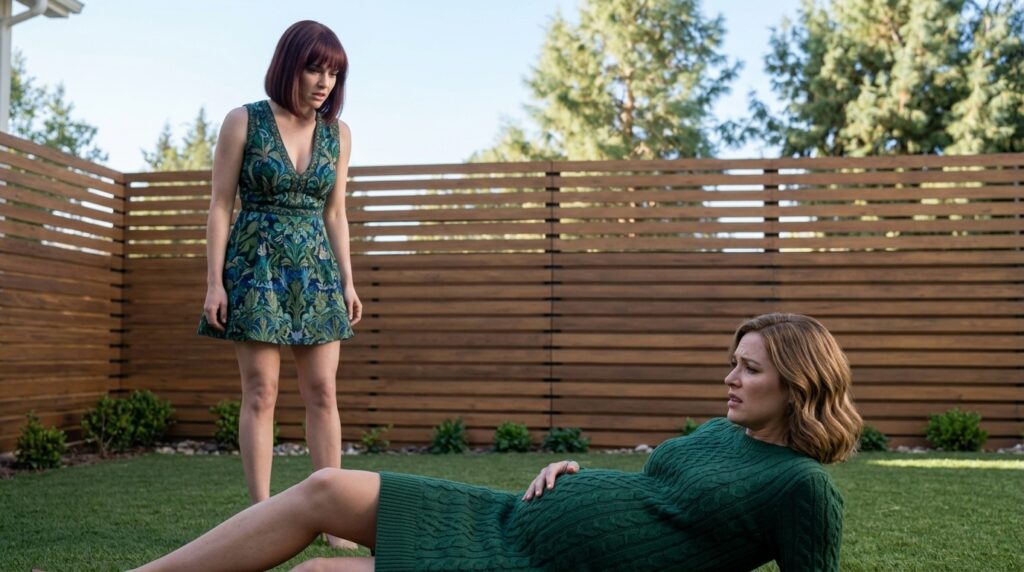
Then her foot connected with my stomach.
I want to tell you I saw it coming. I didn’t. One second I was standing on my in-laws’ back lawn in Asheville, North Carolina, holding a paper plate of potato salad I hadn’t touched, and the next I was on the ground, grass staining the knees of my maternity leggings, both hands flying to my belly on instinct before my brain had even processed what had happened.
I was six months pregnant. My daughter — we already had her name picked out, Juniper — had been kicking me every night for two weeks straight, strong enough that my husband Theo would laugh and press his palm flat against my stomach just to feel her.
On the grass, I waited for that kick.
Nothing.
I pressed my hands harder, like I could shake her awake. Nothing. Not a flutter, not a roll, not the stubborn little jab she gave me every time I lay on my left side.
Someone was screaming. It took me a moment to realize it was my sister, and that she wasn’t screaming out of guilt.
She was screaming because our seventeen-year-old cousin, Wren, had been filming the entire cookout on her phone for a family recap video, and the camera had been pointed directly at us when Odette’s foot left the ground.
“She came at me first!” Odette shrieked, backing away like the grass itself might report her to the police. “It was an accident, I swear, it was an accident—”
My mother, Priscilla, got to her before anyone got to me. She wrapped her arms around Odette like my sister was the one who’d been hurt. My father, Harlan, stood over both of them, glaring down at me like I was the one who’d caused a scene.
“Get up, Marisol,” he said. “You’re being dramatic.”
I couldn’t get up. I couldn’t breathe right. There was a tightness spreading low across my belly that felt entirely wrong, a hard, cramping pressure that had nothing to do with normal pregnancy discomfort.
Then Theo was there.
My husband doesn’t raise his voice often. In six years of marriage I had seen him lose his temper maybe twice. But he dropped to his knees beside me on that lawn, phone already against his ear, giving our address to a 911 dispatcher in a voice so level it scared me more than Odette’s kick had.
When the call connected, he set the phone down between us, still live, and looked up.
He looked at every single person standing on that lawn. My parents. My sister. My aunt and uncle. Three cousins. All of them frozen in a loose semicircle, all of them having watched a woman kick a six-months-pregnant woman to the ground and done nothing to stop it.
“Nobody moves,” Theo said.
Two words. Quiet. Cold. Absolutely final. I had never heard that voice come out of him before, and in that moment I understood, somewhere underneath the fear for my daughter, that something in our family had just ended permanently.
Nobody moved. Not because they respected the request. Because something in his tone made it clear that whoever moved first would answer for it.
Sirens, and a Missing Phone
The ambulance arrived twelve minutes later, though it felt like an hour. Paramedics loaded me on a stretcher while a police cruiser pulled up behind them, called in by a neighbor who’d heard the screaming over the fence.
That’s when my father made his second mistake of the day.
While the responding officer, a young woman named Deputy Alvarez, was taking initial statements, I watched — through the haze of pain and fear — my father walk casually toward Wren, my cousin, and hold his hand out.
“Let me hold onto that for you, sweetheart,” he said. “In case it gets damaged.”
Wren, God bless her, was seventeen and sharper than every adult on that lawn combined. She’d already airdropped the video to her own laptop the moment the kick happened, an instinct she later told me came from watching too many true crime documentaries. She handed my father her phone without argument.
He walked calmly toward the house.
Deputy Alvarez saw the whole thing. She followed him inside less than ninety seconds later and came back out holding both the phone and my father’s car keys, informing him — in front of the entire family — that attempting to destroy or dispose of evidence in an active assault investigation was itself a crime.
My father’s face went the color of old paper.
Meanwhile, my mother had quietly slipped inside through the side door. I didn’t find out what she’d taken until much later, but at the time, a neighbor mentioned to Deputy Alvarez that she’d seen Priscilla come out of the house carrying a manila folder pressed flat against her chest, walking fast toward her car.
That folder contained the paperwork that had started the entire argument in the first place — the documents laying out the terms of my grandmother’s trust.
What the Fight Had Really Been About
To understand why my sister kicked me hard enough to send me to the hospital, you have to understand what had happened twenty minutes earlier, before I ever walked out onto that lawn.
My grandmother, Eleanor Kendrick, had built a modest fortune over sixty years running a chain of dry-cleaning businesses across three counties. When she passed two years ago, she left behind a trust — the Kendrick Family Trust — structured in a way none of us fully understood until recently.
The trust named my father, Harlan, as sole trustee, controlling every distribution, every investment decision, every dollar, for as long as there was no living grandchild in the family.
The moment a grandchild was born — the actual moment a baby with Kendrick blood took its first breath — the trust would convert. Control would split three ways, equally, between my father, my sister, and me, with an additional protected share set aside directly for that grandchild’s future.
My father had run the trust as his personal account for two years. Vacations. A boat. A “loan” to Odette that everyone quietly understood would never be repaid. None of it required anyone’s approval but his own.
Juniper would have been the first grandchild.
The moment she was born, my father would lose sole control forever.
That afternoon, before the cookout even started, my mother had cornered me in the kitchen and asked — not for the first time — if Theo and I would consider “delaying things,” and if I would sign something making my father sole guardian of Juniper’s share “just until things settle.” I said no, the same way I’d said no every time they’d asked over the past six months.
Odette overheard. Odette, who had spent two years watching my father dole out money to everyone except her, who believed — correctly, it turned out — that once the trust converted, my father intended to freeze her out entirely and consolidate what remained under his control and mine, working together against her.
She didn’t confront my father about that. She came outside and confronted me.
What the Doctors Found
At the hospital, the obstetric team moved fast. An ultrasound tech named Priya worked in near silence, sliding the wand across my belly while I stared at the ceiling and begged whatever was listening to let me hear a heartbeat.
I heard it. Weak, but there.
Juniper had gone quiet from shock and a partial placental disruption caused by the blunt force of the kick, a condition the attending physician, Dr. Okonkwo, explained could resolve on its own with monitoring — or could deteriorate rapidly. They admitted me for observation, ran bloodwork, kept the fetal monitor strapped to my belly around the clock.
It was during that bloodwork, almost as an afterthought, that things stopped making sense.
My white blood cell count was elevated in a pattern Dr. Okonkwo said didn’t match trauma alone. There were markers in my liver panel that concerned him enough that he ordered additional toxicology screening, “just to be thorough,” he said, in the careful voice doctors use when they’re trying not to alarm a patient before they have answers.
Two days later, he came back with a different expression entirely.
The screening had picked up trace levels of a compound used in certain prescription blood thinners — a substance I had never been prescribed, and had no medical reason to have in my system.
Theo, sitting beside my hospital bed, went very still.
“How would that get into her system?” he asked.
Dr. Okonkwo didn’t have a definitive answer. What he had was a working theory, one he was required to report to the hospital’s risk management team, who in turn contacted Deputy Alvarez, who was already investigating an assault case involving the same family.
Someone, at some point in the days leading up to that cookout, had introduced a blood-thinning compound into something I’d eaten or drunk — something that, combined with sufficient blunt trauma to the abdomen, could cause catastrophic internal bleeding. The kick hadn’t been a spontaneous act of rage that happened to go wrong.
It had been the second half of a plan.
The Investigation Widens
Detective Marcus Feld, who took over the case once it moved beyond simple assault, pulled security footage from the grocery store where our family had shopped for the cookout two days prior. It showed my mother, Priscilla, standing at the pharmacy counter picking up a “refill” — a prescription that, when investigators checked, had been called in under a doctor’s name that didn’t match any doctor on record at that pharmacy chain.
They pulled phone records next. A string of calls between my mother and a woman named Sandra Petrakis, a former pharmacy technician who had lost her license eighteen months earlier for diverting medication, calls that had started almost exactly one week after Theo and I had announced Juniper’s due date.
The timeline detectives eventually built was this: once it became clear the pregnancy was healthy and progressing normally, my parents realized delaying tactics — asking me to sign away guardianship, guilt-tripping me at family dinners — weren’t going to work. The trust would convert the moment Juniper was born, full stop, regardless of what paperwork I did or didn’t sign.
There was only one outcome that would prevent that from happening.
They needed the pregnancy to end before it reached term.
Whether my mother intended a slow, deniable complication that would look like a tragic natural loss, or whether Odette’s outburst that afternoon was an unplanned catalyst that collided with an already-poisoned system, is something the district attorney’s office is still untangling. What isn’t in dispute is the toxicology report, the pharmacy footage, or the calls to Sandra Petrakis.
My sister was charged with felony assault causing serious bodily injury to a pregnant woman. My mother was charged with attempted murder and conspiracy. My father, for his attempt to destroy Wren’s phone and for financial records investigators later found showing years of undisclosed trust withdrawals, was charged with obstruction of justice and elder financial exploitation of my late grandmother’s estate, filed by the state attorney general’s office once auditors got involved.
Juniper
She’s fine. I need to say that clearly, because I know that’s what everyone reading this actually wants to know.
Juniper Eleanor Ashgrove was born eleven weeks after that afternoon on the lawn, seven days early but perfectly healthy, six pounds four ounces, with a scream Theo says he heard from the hallway before he’d even made it back into the delivery room.
The trust converted the moment she took her first breath, exactly as my grandmother had designed it to. A court-appointed trustee now oversees the portion that would have gone to my father, pending the outcome of the criminal case and the civil suit Theo and I have filed separately.
Odette wrote me a letter from county jail before her arraignment. I haven’t decided whether I’ll answer it. Wren, my cousin, still comes over every Sunday to hold Juniper and watch cartoons with her, the same seventeen-year-old whose reflexive habit of backing up her phone turned out to be the single most important piece of evidence in the entire case.
My mother still calls sometimes, from a number I don’t recognize, and I let it go to voicemail every time.
I think about that lawn a lot. About the exact moment my sister’s eyes locked on mine, calm and satisfied, right before her foot moved. I think about lying in the grass with my hands over my stomach, counting seconds, waiting for a kick that didn’t come.
Mostly, though, I think about Theo’s voice. Quiet. Cold. Final.
Nobody moves.
He wasn’t just talking to our family that day. He was drawing a line none of them would ever be allowed to cross again.