Some lies are told to escape punishment.
Others are told because the truth would reveal something so monstrous that an entire family might never recover from it.
The baby was only three months old.
Too young to speak.
Too young to understand danger.
Too young to know that the woman standing behind his stroller was supposed to be the one person in the world who would protect him at any cost.
His mother.
The afternoon looked almost peaceful.
A beautiful mansion.
A quiet swimming pool.
Sunlight across the pale stone patio.
A nanny standing only a few steps away.
Then the stroller suddenly moved toward the water.
The nanny saw it.
Her face changed instantly.
She ran.
No hesitation.
No time to remove her shoes.
No time to think about herself.
She plunged into the pool fully dressed and disappeared beneath the surface.
For several terrifying seconds, there was only splashing water.
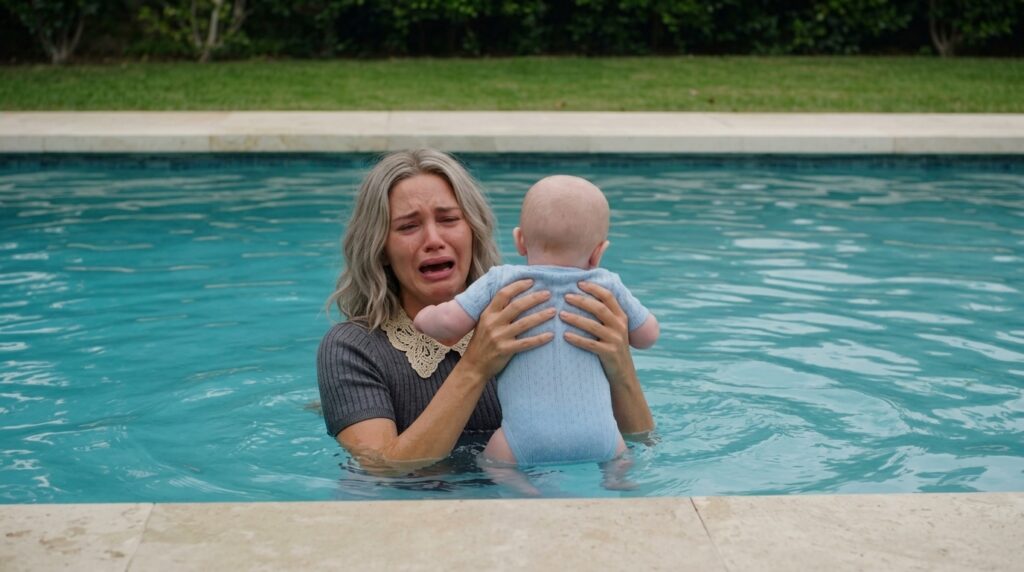
Then she surfaced with the tiny baby in her arms.
She held him above the water before pulling him tightly against her chest.
“I’ve got you,” she gasped.
“I’ve got you.”
The baby cried.
The nanny was shaking.
Her clothes were soaked.
Her hair clung to her face.
But the child was alive.
That should have made her the hero of the story.
Instead, it nearly made her a criminal.
Because the baby’s father had not seen the beginning.
He came running from inside the mansion only after hearing the commotion.
By the time he reached the pool, all he could see was his infant screaming in the arms of a drenched employee.
And then his wife pointed.
“What did you do?!”
Her voice sounded terrified.
Her face looked devastated.
Her finger trembled toward the nanny.
It was a perfect performance.
The same woman who had been standing beside the stroller now looked exactly like a mother who had just discovered someone trying to hurt her child.
The father didn’t ask enough questions.
He didn’t wait for an explanation.
He reacted.
His hand struck the nanny across the face while she was still holding his baby.
The force turned her head.
But even then, she did not loosen her grip on the child.
She twisted her body and put her own shoulder between the angry father and the baby.
“Sir, listen to me!”
Her voice broke.
“She pushed him into the pool!”
The mother answered immediately.
“She’s lying!”
Three words.
That was all it took.
The nanny had jumped into the water to save the baby.
Now she was the one being treated as the danger.
Police officers took hold of her arms.
She begged them to stop.
“I saved him!”
No one listened.
“Please! Check what happened!”
Still dripping pool water onto the expensive floor, she was escorted away while the baby’s mother remained beside her husband.
The mother cried.
She shook.
She played the role everyone expected her to play.
The devastated parent.
And that was what made the scene so disturbing.
She knew the nanny was innocent.
She knew exactly why the woman had jumped into that pool.
Yet she stood there and watched another person suffer for something she herself had allegedly done.
She watched her husband strike the nanny.
She watched police restrain her.
She watched the woman who had just saved her child’s life beg to be believed.
And she said nothing.
Outside, a paramedic checked the baby.
Inside, behind a wall of glass, the nanny stood alone.
She could see the family.
The family could see her.
But nobody wanted to hear her version anymore.
Then a little boy entered the room.
The baby’s older brother.
He was carrying a tablet.
“Dad.”
The father turned.
The boy looked nervous.
But he didn’t lower the screen.
“Wait.”
The room went quiet.
“I saw what happened.”
The father’s expression changed.
The boy raised the tablet higher.
A baby-monitor screen glowed in his hands.
“Mom pushed the baby.”
Silence.
“It’s on the monitor.”
The father stopped moving.
For the first time since running toward the pool, he wasn’t looking at the nanny.
He was looking at his wife.
The woman he had trusted without hesitation.
The woman whose tears had convinced him before he ever heard the other side.
Then he looked toward the glass.
At the nanny.
The woman he had slapped.
The woman police had restrained.
The woman who had jumped into the water while his baby’s own mother remained safely on the patio.
The nanny stared back at him.
Her face was wet with tears and pool water.
“I told you the truth.”
And suddenly the most frightening part of the story was no longer the swimming pool.
It was the woman standing beside it.
Because strangers are easy to fear.
A cruel employee can be fired.
A dangerous outsider can be kept away.
But what happens when the person willing to harm a helpless baby is the same person everyone calls his mother?
The same woman who tucks him into bed.
The same woman who smiles beside him in family photographs.
The same woman who can cry on command when someone begins asking questions.
The father’s face turned pale.
The tablet was still in his son’s hands.
There was evidence now.
A witness.
A story his wife could no longer control.
But strangely, she did not collapse.
She did not scream.
She did not beg him to believe her.
She simply became quiet.
Too quiet.
For one brief moment, the tears seemed to disappear.
Her breathing slowed.
And behind the frightened expression was something completely different.
Calculation.
Her eyes moved first toward the tablet.
Then toward the boy holding it.
Then toward the nanny behind the glass.
Three problems.
Three people who now knew too much.
The father was still trying to understand what he had just discovered.
But the nanny saw the change in the mother’s face.
And it terrified her.
Because exposing a cruel person does not always make them surrender.
Sometimes it only makes them more dangerous.
Later that night, after the baby had finally fallen asleep and the mansion had become silent, the mother walked downstairs alone.
She stood in the dark living room.
The security monitor glowed against her face.
For several seconds, she stared at the camera feeds.
Then she reached for her phone.
She dialed a number that was not saved under any name.
Someone answered.
The mother looked toward the staircase to make sure nobody was listening.
Her voice was almost a whisper.
No crying now.
No panic.
No frightened-mother performance.
Just five cold words.
“We have another problem now.”
Then she ended the call.
But who was on the other end?
Why would a mother want to harm her own three-month-old baby in the first place?
Was the incident at the pool really the first time she had tried?
And if the nanny and the little boy were now the only two people capable of exposing what she had done…
which one would she try to silence first?
Because sometimes the most terrifying person in a child’s life isn’t the stranger outside the house.
It is the person standing beside the crib…
smiling when everyone else is watching. 💔
The baby’s name was Leo.
His older brother was Mason.
The nanny was Elena Ruiz.
And the woman beside the pool was Camille Whitmore.
Her husband, Andrew, had believed her for less than three minutes.
That was long enough to strike an innocent woman.
Long enough for police to put Elena in handcuffs.
Long enough for Mason to see something about his father he would remember for years.
Andrew understood all of that before the tablet video had even finished playing.
“Stop.”
One of the officers looked at him.
“What?”
Andrew pointed toward Elena.
“Take those off.”
The officer did not move immediately.
“They stay until we establish what happened.”
Mason stepped closer with the tablet.
“I can show you.”
Another officer took it.
Camille said:
“Mason, give me that.”
Every head turned.
The boy backed away from her.
That small movement mattered.
Andrew saw it.
Not defiance.
Fear.
“Don’t go near him.”
Camille stared at her husband.
“Andrew.”
“I said don’t.”
For the first time that afternoon, he positioned himself between his wife and one of their children.
He would later wish he had done it earlier.
The monitor footage lasted only thirty-eight seconds.
That was enough.
The camera had been mounted under the patio roof months earlier because Leo often slept outside in his stroller while someone sat near the pool.
It pointed toward the shaded portion of the patio.
Wide angle.
No perfect close-up.
But clear enough.
Camille stood behind the stroller.
Elena was near the outdoor kitchen folding a blanket.
Camille looked toward Elena.
Then toward the glass doors.
Then placed one hand on the stroller.
A deliberate forward movement.
Not an accidental bump.
Not wind.
Not a brake failing on its own.
The stroller rolled.
Camille stepped backward.
Elena turned.
Saw it.
Ran.
The stroller crossed the stone.
Reached the pool.
Elena jumped before Camille did.
That was the part Andrew replayed once.
Only once.
His wife did not move toward the water until Elena was already submerged.
Then Camille ran to the edge.
Not to jump.
To scream.
The performance began there.
Officer Daniels looked toward Camille.
“Ma’am, stay where you are.”
Camille said:
“The video doesn’t show everything.”
Andrew stared.
“What doesn’t it show?”
“She had been threatening me.”
Elena laughed from behind the glass.
A broken sound.
“I was folding a blanket.”
Camille continued.
“She was angry because I was going to fire her.”
Andrew turned toward Elena.
“Were you?”
Elena looked at him.
“Yes.”
The answer surprised him.
“Why?”
“Because I told her I was going to talk to you tonight.”
Camille’s face changed again.
Andrew saw it.
There was more.
Leo was taken to the hospital for observation.
He had been submerged only briefly.
He cried strongly after rescue.
No major respiratory complication emerged.
No catastrophic injury.
No miracle.
A very small baby had been endangered and rescued quickly enough that the physical outcome was good.
Andrew accepted the relief.
He refused to let it shrink the act.
“He’s fine” would later become a sentence Camille’s relatives used.
Andrew learned to answer:
“His survival is not evidence that the risk was acceptable.”
That distinction mattered.
Elena was evaluated too.
She had swallowed pool water.
Bruising along one shoulder from striking the pool wall during the dive.
And redness across one cheek from Andrew’s hand.
The police photographed it.
So did Elena.
Andrew stood six feet away.
He could barely look at her.
“I’m sorry.”
Elena stared.
“That’s not enough.”
“I know.”
“You hit me while I was holding your son.”
“I know.”
“You didn’t ask me one question.”
“I know.”
She looked exhausted.
“So stop saying you know like that fixes it.”
Andrew closed his eyes.
She was right.
His guilt was not her job.
He later gave a full statement about striking her.
No:
I was protecting my child.
No:
I lost control because any father would.
He said:
“I believed my wife before checking what had happened and I hit Elena once. I was wrong.”
Explanation did not become excuse.
That mattered to Mason later.
Children watch how adults describe their worst choices.
Camille was questioned separately.
Her first story:
The stroller moved unexpectedly.
Elena panicked.
Camille believed Elena had caused it because the two women had argued earlier.
Then police showed her the monitor.
Story two:
She had nudged the stroller toward the shade.
It rolled farther than expected.
Why step backward instead of grabbing it?
Panic.
Why immediately accuse Elena?
Because Elena had been threatening her.
Why did the monitor show Elena several yards away when the stroller started moving?
Camille said the angle was misleading.
Then:
“I would never hurt my baby.”
Officer Daniels answered:
“You intentionally moved a stroller toward an open pool.”
Camille stared.
The word intentionally was now the battleground.
The larger explanation came from Elena.
Not that night.
The next morning.
She had worked for the Whitmores for nine months.
Long before Leo was born.
She helped with Mason.
School pickup.
Homework.
Meals.
Then with the baby.
At first, Camille treated her warmly.
Almost like a friend.
That was part of why the shift took Elena time to name.
The problems began during Camille’s pregnancy.
Camille started keeping what she called a care record.
Nothing unusual about that.
Families often track schedules.
Food.
Appointments.
Babysitter hours.
Then Elena noticed entries that did not match reality.
Andrew absent during pediatric appointment.
He had attended.
Elena failed to prepare Mason’s medication before school.
Mason did not take daily medication.
Andrew returned after midnight smelling of alcohol.
He had been at a charity dinner and returned at ten.
Elena thought Camille was careless.
Then she found her own name appearing more often.
Elena ignores instructions.
Elena leaves baby unattended.
Elena undermines maternal authority.
That frightened her.
Not because she had never made mistakes.
She had.
But these were not descriptions of mistakes.
They were creating a pattern that had not occurred.
One afternoon Elena asked:
“Why are you writing that I left Leo unattended?”
Camille answered:
“You did.”
“When?”
“Tuesday.”
“I was in the laundry room for thirty seconds while he was in the crib.”
“Exactly.”
“He was asleep in his crib.”
“You were not physically present.”
Elena stared.
“That is not leaving a baby unattended.”
Camille shrugged.
“It’s my record.”
That phrase stayed with her.
My record.
Not:
the truth.
Elena began keeping her own log.
Nothing dramatic.
A notebook.
Arrival.
Departure.
Feeds.
Naps.
Any incidents.
Standard nanny documentation.
Camille noticed.
“What is that?”
“My work log.”
“You don’t need one.”
“I do now.”
That was when the relationship changed.
Camille stopped treating Elena as help.
She began treating her as opposition.
Then Elena found a printed draft in the home office.
She had entered only to place a package on Andrew’s desk.
The page was visible.
Title:
CARE CONCERNS — ANDREW WHITMORE HOUSEHOLD
Under it:
Excessive reliance on household employee for infant care.
Father routinely delegates nighttime responsibility.
Unsafe supervision practices by nanny tolerated by father.
Older child emotionally aligned with nanny over mother.
Elena read enough to understand.
This was not merely a childcare log.
It was a future story.
She photographed the page.
Then told Camille that evening:
“I’m showing this to Andrew.”
Camille went very still.
“You went through our private things.”
“It was on the desk.”
“You had no right.”
“You’re writing lies about me.”
“I’m documenting concerns.”
“What concerns?”
“That you think you run this family.”
Elena stared.
“I work here.”
“Exactly.”
“Then stop writing my name into your marriage.”
That sentence was the first time Elena saw pure anger in Camille’s face.
Camille said:
“If you show him, you’re done here.”
Elena answered:
“I’m probably done anyway.”
“What does that mean?”
“I mean I’m not helping you build a false story about me.”
Then:
“And I’m not watching you build one about him.”
Camille smiled.
Not kindly.
“You think Andrew will believe the nanny over his wife?”
That question would become prophecy.
For three minutes beside the pool, he didn’t.
Camille had counted on that.
Investigators found more documents.
Not because Elena knew where they were.
Because Camille’s laptop was eventually examined under proper process.
She had consulted a divorce attorney six weeks earlier.
That was not wrongdoing.
Married people consult lawyers.
She had asked about custody.
Also not wrongdoing.
But her emails revealed an obsession with something specific:
credibility.
How do courts view household staff testimony?
What if a nanny is fired for safety violations?
Would a prior police incident affect credibility?
Could childcare records support a claim that one parent delegates too much?
The attorney, Bryce Harlan, answered cautiously.
Document facts.
Do not manufacture incidents.
Preserve communications.
Do not involve children in building a case.
One email from him was explicit:
Do not create or provoke a childcare incident to strengthen a future custody argument. That would be dangerous and could severely damage your position.
Camille had received that email eleven days before the pool.
Bryce Harlan was the number Camille called that night.
The mysterious person at the other end.
Not a hitman.
Not a lover.
Not a secret accomplice.
A lawyer she had consulted.
That truth was less cinematic.
And more useful.
Her five words—
“We have another problem now.”
—were not a command to eliminate witnesses.
They were the words of someone trying to manage exposure.
Call records showed the conversation lasted forty-three seconds.
Bryce later described it.
Camille said:
“The monitor caught something and Mason showed Andrew.”
He asked:
“What did it catch?”
She refused to answer clearly.
He said:
“Do not delete anything. Do not contact witnesses. Do not touch the device. You need criminal counsel if there’s an allegation involving the baby.”
Camille hung up.
That was the end.
There was no secret conspiracy waiting to clean up the problem.
Only an adult who had gone so far beyond the advice she received that even the person she called wanted distance from the facts.
So why push Leo toward the pool?
Camille eventually gave the answer in pieces.
She did not intend for her baby to die.
That distinction mattered.
It did not make the act safe.
Her plan depended on danger.
She knew Elena was close.
Knew Elena could swim.
Knew the stroller would draw her attention immediately.
Camille expected Elena to stop it before the baby went fully into the water.
Or jump after him.
Then Camille intended to claim Elena had caused the incident through negligence.
A dramatic event.
A frightened baby.
A wet nanny.
A mother screaming.
An employee fired.
Possibly investigated.
Credibility destroyed before Elena could show Andrew the fabricated care records.
Camille had turned her own infant into a prop in a story designed to discredit someone else.
That was the calculation.
Officer Daniels later asked:
“What if Elena hadn’t seen the stroller?”
Camille cried.
“She was right there.”
“What if she slipped?”
“She didn’t.”
“What if Leo inhaled water?”
“I didn’t think—”
“Exactly.”
Camille stopped.
She had thought extensively about who would be blamed.
Not enough about the body inside the stroller.
That was the moral center of the case.
Mason understood none of the custody documents at first.
He was nine.
He understood the monitor.
He had been upstairs playing a game when the baby-monitor app made a notification sound.
The tablet was old.
Shared.
Camille thought she had logged it out weeks earlier because she disliked Mason checking Leo constantly.
She had not.
Mason opened the feed.
Saw the stroller move.
Saw Elena run.
Saw his mother step backward.
He froze.
Then heard screaming downstairs.
He did not immediately run to his father.
That became his guilt.
“I waited.”
His therapist, Dr. Priya Shah, asked:
“How long?”
“I don’t know.”
“Minutes?”
“Maybe.”
“What were you thinking?”
“I thought maybe I saw wrong.”
There.
Even with video.
Even a child can doubt his own eyes when what he sees contradicts what family is supposed to mean.
Then Mason went downstairs.
Saw Elena restrained.
Saw his mother crying.
Saw Andrew furious.
For a moment, adult emotion outweighed the screen in his hands.
He almost believed his mother’s version.
Then Elena yelled:
“Check what happened!”
That sentence connected to what Mason had seen.
So he spoke.
“Dad.”
One word.
Then:
“I saw.”
That was enough.
Years later, Andrew told him:
“You saved Leo.”
Mason shook his head.
“No.”
Andrew understood the correction immediately.
“You showed us the video.”
“Yes.”
“Elena saved Leo.”
“Yes.”
“And adults handled the rest.”
Mason nodded.
Children can contribute evidence.
They should not be assigned responsibility for whether infants survive.
That burden belonged elsewhere.
Elena’s experience after the incident was complicated.
People called her a hero.
News stories.
Local interviews she refused.
Donations she did not ask for.
One headline:
NANNY RISKS LIFE TO SAVE MILLIONAIRE’S BABY
She hated it.
Not because she regretted jumping.
Because the hero story erased what came after.
The slap.
The handcuffs.
Being disbelieved.
The assumption that employee status made her easier to accuse.
She told Andrew later:
“Everyone wants the pool part.”
He looked at her.
“What do you want them to remember?”
“That I said the truth before there was a video.”
That mattered.
Evidence proved her.
It should not be necessary before adults are willing to listen.
Andrew apologized again.
Specific.
“I saw my baby in your arms and my wife pointing at you.”
Elena said nothing.
“I decided what happened before asking you.”
“Yes.”
“I hit you.”
“Yes.”
“I’m sorry.”
Elena looked at him.
“Do you know what scared me?”
“What?”
“That even while I was holding Leo, I had to turn my body because I thought you might hit again.”
Andrew looked down.
“I’m sorry.”
She continued.
“You were his father. In that moment I had to protect him from you too.”
That sentence stayed with Andrew longer than any criminal charge against Camille.
He had entered the scene intending to protect his son.
For several seconds, he became another source of danger beside him.
Intent did not erase impact.
Elena resigned.
Andrew offered more money.
A private settlement.
A promotion to household manager.
Whatever she wanted.
She said no.
“I saved your son.”
“Yes.”
“That doesn’t mean I owe your family the rest of my life.”
He nodded.
Correct.
She took time away.
Eventually worked with another family.
Only after extensive references and her own decision.
The Whitmores did not get to turn her rescue into permanent employment.
Camille’s family initially defended her.
Her sister said:
“She would never kill her baby.”
Andrew answered:
“No one said she wanted him dead.”
“Then why are you treating her like a monster?”
“Because she was willing to risk him.”
Different.
Important.
Camille herself clung to that distinction.
I knew Elena would get him.
As if confidence in another person’s courage made using a baby as bait less dangerous.
It didn’t.
The fabricated care records became important in family proceedings.
Not because they magically proved every bad motive.
Because they showed preparation.
Camille had been building narratives about:
Andrew’s parenting.
Elena’s competence.
Mason’s attachment.
Her own role as the “primary stable parent.”
One entry:
Mason increasingly relies on Elena rather than Camille after school.
True in part.
Elena handled pickup.
Another:
Andrew encourages children to bypass maternal authority by going to Elena.
Harder to support.
Another:
Elena positions herself as substitute mother.
Elena had never called herself that.
Mason called her Elena.
Camille supplied the interpretation.
That was the problem with the records.
Observation mixed with motive.
Then motive written as fact.
Dr. Shah later used one example with Andrew.
Record:
Mason manipulates Elena into giving second snack after Camille says no.
What could actually be known?
Mason asked Elena for food.
Elena gave it.
Maybe Camille had said no.
What could not automatically be known?
Manipulation.
That word described invisible intent.
Once invisible intent is written as fact, the child and employee become guilty before anyone asks them.
Camille’s file was full of that language.
Not because writing is bad.
Because certainty had outrun observation.
Mason’s relationship with his mother became the hardest part.
He still loved her.
That confused Andrew.
After temporary separation, Mason asked:
“Can I call Mom?”
Andrew almost said no.
Then stopped.
Professionals helped determine safe supervised communication.
Mason heard Camille’s voice.
Cried.
“Why did you do that?”
Camille also cried.
“I made a terrible mistake.”
“Did you want Leo dead?”
“No.”
“Then why pool?”
She hesitated.
The supervisor watched.
Camille said:
“I wanted Elena gone.”
Mason stared.
“So Leo was for getting her gone?”
Camille closed her eyes.
“Yes.”
The honesty was brutal.
But better than another lie.
Mason hung up early.
No one made him comfort her.
He later told Dr. Shah:
“That’s worse.”
“Why?”
“She was mad at Elena.”
“Yes.”
“Leo had nothing.”
Exactly.
The baby was not the target of the conflict.
He was the instrument.
That can feel especially violating.
Leo grew without memory of the pool.
That mattered.
Adults carried the memory.
He did not.
At three he loved water.
Andrew panicked the first time.
Swimming lessons.
Small pool.
Instructor.
Leo laughed.
Andrew’s body remembered what Leo’s could not.
Dr. Shah told him:
“Do not give him your fear as inheritance.”
So Andrew stayed nearby.
Appropriate safety.
No dramatic warnings about what happened as an infant.
Water became water.
At five, Leo asked why Camille did not live with them.
Andrew answered:
“Mom made a very unsafe choice when you were a baby.”
“Did she hurt me?”
“She put you in danger.”
“Why?”
“That’s something I’ll explain more when you’re older.”
Age-appropriate truth.
No:
Your mother tried to kill you.
Because that was not established.
Precision protects children from inheriting adult sensationalism.
Mason remembered enough for both of them.
At twelve, he became overprotective of Leo.
Pool party invitation?
“No.”
Andrew looked at him.
“You’re not his parent.”
“I know.”
“Then?”
“Pools.”
Andrew understood.
Still:
“Leo goes if he wants. There will be adults.”
Mason frowned.
“What if—”
“We assess this pool, not the old one.”
That distinction mattered.
Risk can be managed without turning the world into one continuous replay.
Leo went.
Had pizza.
Swam.
Came home sunburned because Andrew forgot to reapply sunscreen.
Mason said:
“Great parenting.”
Andrew laughed.
Normal failure.
Good.
Camille’s legal and custody consequences were serious.
But the family refused to narrate them as one dramatic verdict that solved everything.
Criminal proceedings addressed the pool incident and false accusations.
Family court addressed child safety and contact.
Professional evaluations addressed risk.
Civil issues involving Elena were separate.
Different systems.
Different questions.
A mother can remain biologically and emotionally significant while losing ordinary access because her behavior created unacceptable risk.
That is not contradiction.
Years into treatment, Camille wrote a statement.
Andrew read it before Mason.
I did not push Leo because I wanted him dead. I pushed the stroller because I believed Elena would save him and that the incident would make Andrew believe she was unsafe.
No euphemism.
Then:
I understood that Leo might be frightened. I convinced myself that brief fear was acceptable because I was solving a larger problem.
Andrew stopped there.
That sentence captured the calculation.
A helpless baby’s fear entered the plan as a cost.
Not a reason to stop.
Camille continued:
The larger problem was not Elena. It was that she had evidence contradicting the custody narrative I was creating.
Then:
I wanted Andrew to believe Elena was unreliable before Elena showed him my records.
There.
Story control.
Again.
I counted on my role as Leo’s mother to make my accusation more believable than hers.
Andrew read that twice.
Camille had understood hierarchy.
Mother versus employee.
Wife versus nanny.
Wealthy homeowner versus domestic worker.
She assumed those titles would decide credibility before facts arrived.
For several minutes, she was right.
That was uncomfortable.
Another line:
I also counted on Andrew reacting emotionally before he asked questions.
He closed his eyes.
He had.
Her plan included his temperament.
Not because she controlled his hand.
Andrew owned the slap.
But she knew how quickly he became protective.
She weaponized that predictability.
One person’s weakness can be anticipated without becoming the other person’s responsibility.
Again:
specific accountability.
Andrew showed the statement to Elena years later only because she requested a copy through attorneys.
She read it.
Then said:
“She knew you’d hit me?”
“No. She said she knew I’d react.”
Elena looked at him.
“You did more than react.”
“Yes.”
Good.
No comfort through softened language.
Camille’s late-night call also became less mysterious with time.
Mason once asked:
“Was the lawyer helping her?”
Andrew said:
“No.”
“But she called him.”
“Yes.”
“Why?”
“Because she thought he could tell her what to do next.”
“Did he?”
“He told her not to touch anything and to get another lawyer.”
Mason nodded.
“So no secret bad guy?”
“No.”
He almost seemed disappointed.
Real life often produces fewer villains than stories.
One person can cause enough damage alone.
The true secret was not the phone number.
It was the file.
Camille’s custody file.
The pool was designed to create one powerful entry:
Nanny involved in life-threatening safety incident.
If the monitor had not survived, that line might have become the official first impression.
Police report.
Emergency response.
Wet clothing.
Distressed mother.
Angry father.
Employee denying.
Then future court filings.
That was what Camille wanted.
Not Leo dead.
A documented event.
She wanted reality to become paperwork before anyone could challenge the story.
Mason’s tablet interrupted that.
Not because technology always saves people.
Because multiple records existed.
The baby monitor.
Elena’s notebook.
The office draft.
Emails.
Camille’s own messages.
When stories could finally be compared, the constructed version collapsed.
That became one of Andrew’s strongest lessons:
Never let one person become the sole historian of a family.
He changed household practices later.
Not surveillance everywhere.
That would be another kind of fear.
Instead:
Care logs accessible to both parents.
Nannies encouraged to communicate concerns directly.
Children allowed to call either parent.
No caregiver punished for documenting incidents.
No private “behavior file” built without review.
Transparency appropriate to the situation.
Not because everyone is dangerous.
Because healthy systems do not require one adult controlling the record.
Andrew eventually remarried.
Much later.
Her name was Rebecca.
Mason was seventeen.
Leo eight.
Before she moved in, Rebecca laughed at the amount of discussion Andrew wanted.
“Do I need a corporate onboarding packet?”
“Almost.”
Food rules.
Phone access.
Pool safety.
Caregiver authority.
Who can discipline whom.
What happens if a child says:
“Don’t tell Dad.”
Rebecca finally said:
“I understand why.”
Andrew nodded.
Then she added:
“But I’m not Camille.”
He stopped.
“You’re right.”
Important.
Safety planning should not make every new person stand trial for an old person’s actions.
Trust can be cautious without becoming punishment.
Leo liked Rebecca immediately.
Mason took longer.
Normal.
Rebecca never demanded equivalence.
No:
I’m your new mom.
No:
Why does Elena still get Christmas cards?
Yes, Elena still got cards.
Not because she remained employee.
Because she had become part of the family’s history on terms she chose.
One card a year.
Sometimes no response.
Fine.
At fifteen, Leo finally learned the full pool story.
Andrew told him before the internet did.
Leo listened without interrupting.
Then asked:
“Mom pushed me?”
“Yes.”
“On purpose?”
“Yes.”
“Wanted me dead?”
“No evidence of that.”
“Then what?”
Andrew hated the answer.
“She wanted Elena blamed for something dangerous.”
Leo stared.
“So she used me?”
“Yes.”
Silence.
Then:
“Did Elena really jump in?”
“Yes.”
“Did you really slap her?”
Andrew looked down.
“Yes.”
Leo stared even longer.
“You?”
“Yes.”
“Why?”
“Because I believed your mother before asking Elena what happened.”
Leo shook his head.
“That was stupid.”
“Yes.”
No defensiveness.
A father’s dignity could survive a teenager naming the obvious.
“Did Elena forgive you?”
Andrew answered:
“I don’t know.”
That surprised Leo.
“You never asked?”
“Not after a while.”
“Why?”
“Because whether she forgave me wasn’t something I had a right to make her manage.”
Leo nodded.
Good answer.
Leo later asked to meet Elena.
She agreed once.
Coffee shop.
Public.
He was sixteen.
She was older.
He expected something dramatic.
Instead Elena said:
“You look like Mason.”
Leo laughed.
“No one says that.”
They talked.
He asked:
“Were you scared?”
“In the pool?”
“Yes.”
“No time.”
“After?”
“Yes.”
“What part?”
Elena looked at him.
“When your father hit me and your mother lied.”
Leo went quiet.
Not the water.
The adults.
That mattered.
He asked:
“Why did you jump?”
Elena smiled slightly.
“You were a baby going into a pool.”
As if there were no philosophical answer.
No hero identity.
No:
Because I loved you more than your mother.
She refused that comparison.
“That’s it?”
“That’s it.”
Sometimes decency is simple.
See danger.
Move.
Before leaving, Leo said:
“Thank you.”
Elena answered:
“You’re welcome.”
No hug required.
No lifelong bond.
The rescue remained important without forcing a relationship.
Mason’s healing took another direction.
He hated being called “the boy who exposed his mother.”
At school, after the case became known, someone said:
“You turned your mom in.”
He punched the kid.
Not good.
Andrew dealt with it.
Suspension.
Therapy.
Mason shouted:
“He said I destroyed my family!”
Andrew answered:
“You still can’t hit him.”
“Mom destroyed it.”
“Yes.”
“And he—”
“Still no punching.”
Safe authority.
History does not cancel rules.
Mason served the suspension.
Dinner still happened.
No shame hierarchy.
Later Andrew said:
“You did not destroy this family.”
Mason looked away.
“You showed a video.”
“Same thing.”
“No.”
“Everyone changed after.”
“Because of what Mom did.”
Mason was quiet.
That distinction took years to settle.
Witnesses often mistake exposure for causation.
Especially children.
If I had stayed quiet, family would look intact.
True.
Looking intact is not the same as being safe.
Camille eventually had supervised contact.
Not quickly.
Both boys responded differently.
Mason wanted questions.
Leo wanted almost none.
At one visit, Mason asked:
“Why did you look at my tablet like that?”
Camille knew the moment.
“Because I realized you had evidence.”
“Were you mad at me?”
“Yes.”
The supervisor watched.
Mason swallowed.
“For showing Dad?”
“Yes.”
Then Camille corrected herself.
“I was angry because I had been exposed. That anger was mine. You did the right thing.”
Mason looked down.
That answer mattered.
Leo asked one question.
“Were you scared when I went in?”
Camille began crying.
“Yes.”
He frowned.
“Then why?”
“I thought Elena would get you.”
“She did.”
“Yes.”
“Could not?”
Camille closed her eyes.
“Yes.”
Leo nodded.
He did not need more.
The entire moral failure fit inside that possibility.
Could not.
Camille had allowed her baby’s safety to depend on another woman behaving perfectly inside a danger Camille herself created.
Camille never regained ordinary custody while the boys were young.
That was not narrated as revenge.
It was a safety decision shaped by legal evaluation, treatment progress, the children’s wishes and the seriousness of the conduct.
She remained their mother.
Biology remained true.
Access remained limited.
Those facts could coexist.
When Mason was twenty-one, he told Andrew:
“I think Mom changed.”
“I think so too.”
“Would you trust her with a baby?”
Andrew thought.
“No.”
Mason nodded.
“Same.”
Change is not restoration.
Insight is not erased risk.
Some doors stay narrower because history matters.
Camille accepted that eventually.
Her later apology to Leo said:
I am not asking you to make my growth meaningful by trusting me.
Then:
If I have become safer, that should matter in the life I live now. It does not create a debt you must repay with closeness.
Leo kept that page.
Not because he forgave everything.
Because the sentence felt mature.
The mansion was sold after the divorce.
Andrew did not want it.
Mason hated the pool.
Leo had no memory of it.
Rebecca asked:
“Do we have to sell because of the pool?”
Andrew stopped.
Good question.
He realized he might be turning property into trauma symbolism.
The real reason was financial and practical.
Too large.
Too expensive.
Too much maintenance.
They sold.
The new owners had three teenagers and a dog.
Life moved in.
The pool became somebody else’s pool.
That was healthy.
Elena’s notebook was returned after legal proceedings.
She kept it for a year.
Then shredded most of it.
One page remained.
Not evidence.
A feeding schedule for Leo from the week before.
6:10 bottle
7:00 nap
9:20 bottle
11:45 tummy time
Ordinary caregiving.
She eventually threw that away too.
She did not need paper to prove she had cared.
Andrew thought often about the moment he saw Elena holding Leo.
His brain had assembled a story instantly.
Wet nanny.
Crying baby.
Wife accusing.
Danger identified.
He acted before asking.
That became a lifelong warning.
Emotion produces speed.
Truth sometimes requires seconds.
Not endless hesitation when a child is in danger.
But enough to ask:
What happened?
Who saw?
What does the evidence show?
Who benefits from this version?
Andrew had skipped all of it.
His hand moved first.
He never celebrated that again as paternal instinct.
Protection without judgment can create another victim.
Mason learned the parallel lesson.
Technology can document.
It does not interpret itself.
His tablet showed Camille moving the stroller.
Adults still had to understand intent.
Context.
Sequence.
Camille could have bumped it accidentally.
The video alone did not prove the entire plan.
Emails.
Records.
Her statements.
Elena’s warning.
The custody file.
All together.
Evidence becomes stronger through comparison.
That became important when Mason grew up and encountered internet videos stripped of context.
He was unusually cautious.
Maybe because he knew how much one clip can show.
And how much it cannot.
Leo grew into a teenager who loved swimming.
At eighteen he became a lifeguard one summer.
Andrew almost laughed at the universe.
Leo said:
“Don’t.”
“I didn’t say anything.”
“You’re making pool face.”
Apparently every parent in this family eventually developed a face their children could identify.
Good.
Leo’s job was not destiny.
He wanted summer money.
The pool paid better than the grocery store.
That was all.
One afternoon a toddler slipped near the shallow end.
Leo blew his whistle.
Another guard reached the child first.
No dramatic rescue.
No family prophecy.
After work Leo texted Andrew:
Saved zero babies today. 10/10 shift.
Andrew replied:
Proud of you for doing almost nothing.
Ordinary safety often looks like nothing happening.
That lesson mattered.
Years later, Camille died unexpectedly after a short illness.
Mason visited near the end.
Leo did once.
Different relationships.
Both valid.
At the hospital Camille told Leo:
“I loved you when I did that.”
Leo looked at her.
“That’s hard to hear.”
“I know.”
“Then why say it?”
“Because I spent years believing love proved I couldn’t be dangerous to you.”
Leo stayed quiet.
Camille continued.
“I was wrong.”
That was perhaps her final insight.
Love is not a safety certificate.
A mother can love a child and still choose something profoundly unsafe.
That is why family roles cannot substitute for behavior.
Leo asked:
“Do you forgive yourself?”
Camille thought.
“Some days.”
“Should you?”
“I don’t know.”
Good.
No neat moral bow.
Then Leo said:
“I don’t need to decide that.”
Camille nodded.
Correct.
Her relationship with guilt belonged to her.
At the funeral, a relative said:
“She loved her boys more than anything.”
Mason looked at Leo.
Leo said:
“She did.”
No argument.
Because love had not been missing.
Judgment had.
Humility had.
Respect for other people’s autonomy had.
The ability to tolerate losing control of the story had.
That was more precise than pretending she had never loved them.
Years later, Mason became a father.
His daughter was four when she accused a babysitter of breaking her toy.
Mason felt an immediate surge.
Then stopped.
Asked:
“What happened?”
Daughter:
“She broke it.”
Babysitter:
“It fell when she pulled it.”
Mason checked.
No camera needed.
No interrogation.
He listened.
It turned out both had hold of the toy.
It snapped.
Nobody malicious.
His wife later said:
“You got very calm.”
Mason smiled.
“My family had enough people deciding before asking.”
That was the inheritance he chose to keep.
Not suspicion.
Process.
Leo had a son years later too.
At three months old, the baby slept in a stroller beside a family barbecue.
Leo checked the brake twice.
Then a third time.
His wife noticed.
“You okay?”
He laughed.
“Family history.”
“Want me to move him?”
Leo looked at the stroller.
Then at the grass.
“No.”
He checked once more.
Then forced himself to stop.
Appropriate caution.
Not captivity to the past.
The baby slept.
Nothing happened.
That was good.
The question people always asked was:
How could a mother do that to her own baby?
The family eventually stopped answering as though there were one magical motive.
Camille wanted control.
She feared divorce.
She feared losing status.
She feared Elena’s records.
She resented how much the children trusted Elena.
She believed Andrew would side with his wife over an employee.
She thought she could create a frightening incident without creating real catastrophe.
She thought she could manage the risk.
She thought she could manage the story afterward.
Every one of those beliefs contributed.
None transformed the act into something inevitable.
At multiple points, Camille could have stopped.
She did not.
That remained choice.
The most chilling part was not that she had an accomplice.
She didn’t.
Not that she wanted Leo dead.
The evidence did not show that.
Not that she had been secretly harming him every night.
Investigators found no support for that either.
The truth was narrower.
And terrible enough.
A mother intentionally created danger around her infant because she wanted to manufacture a story about another woman.
She assumed the nanny would save him.
She assumed her husband would believe her.
She assumed her son was too young to matter as a witness.
She assumed the monitor was no longer recording.
She assumed she controlled every version of what had happened.
Three assumptions failed.
Elena moved.
Mason spoke.
The camera remembered.
And that was why the late-night phone call ultimately mattered less than everyone first imagined.
“We have another problem now.”
Camille thought the problem was evidence.
The tablet.
The boy.
The nanny.
The lawyer.
The police.
But those were not the problem.
They were the things preventing her from continuing to control the story.
The real problem existed before any of them.
It was the belief that other people could be used.
Elena as scapegoat.
Andrew as predictable defender.
Mason as child too nervous to contradict his mother.
Leo as a helpless body placed into danger because someone else was expected to save him.
Once people become roles inside your plan, cruelty becomes easier.
You stop asking what they feel.
You ask whether they will behave as expected.
Elena behaved exactly as Camille predicted.
She saved the baby.
That did not make the plan less cruel.
It made the calculation clearer.
Camille had counted on another woman’s decency.
Then tried to punish her for it.
That was perhaps the ugliest part.
The nanny’s courage was not an unexpected interruption.
It was built into the scheme.
Camille needed Elena to be good.
Needed her to run.
Needed her to jump.
Needed her to hold Leo above the water.
Then intended to use the image of a soaked nanny with a screaming baby as evidence against her.
Goodness itself had been turned into a trap.
Years afterward, Andrew summarized it differently.
“Camille thought she knew everyone.”
Rebecca asked:
“What do you mean?”
“She knew Elena would run.”
“She knew I’d react.”
“She thought Mason would stay quiet.”
“And Leo?”
Andrew looked down.
“He was the only one she didn’t need anything from.”
A three-month-old could not contradict.
Could not refuse.
Could not accuse.
Could not preserve a record.
That was why using him was so easy inside the logic of the plan.
No agency.
Only risk.
The smallest person carried the largest cost.
But Leo did not grow up as the baby in the pool.
Mason did not remain the boy with the tablet.
Elena did not remain the drenched nanny behind glass.
Andrew did not remain the father whose hand moved before his questions.
Even Camille became more than the worst afternoon without that afternoon becoming less true.
Time made the story more complicated.
Not less accountable.
That was healthy.
The family eventually stopped asking:
Who was the hero?
Elena did something heroic.
That did not obligate her to remain heroic forever.
Mason spoke.
That did not make him responsible for exposing adults.
Andrew changed.
That did not erase the slap.
Camille developed insight.
That did not restore the trust she destroyed.
Leo survived.
That did not make the risk acceptable.
Precision gave everyone their own part back.
And perhaps that was the final lesson hidden inside the old mansion.
Danger did not come from the person everyone first suspected.
It came from the person whose title made suspicion feel almost impossible.
Mother.
Wife.
Homeowner.
The person standing beside the stroller.
The person expected to scream for help, not create the reason help was needed.
That role protected Camille for only minutes.
It could have protected her much longer if a child had not lifted a tablet and said:
“Wait.”
Not because Mason understood everything.
Because he understood enough to interrupt certainty.
And sometimes that is where protection begins.
Not with knowing the entire truth.
With refusing to let the loudest adult finish the story before everyone else has been heard.
Because a stranger can lie.
A nanny can lie.
A father can be wrong.
A child can misunderstand.
And a mother can create danger.
Family roles tell us who people are supposed to be.
Behavior tells us who is safe.





