PART 1: THE PUSH
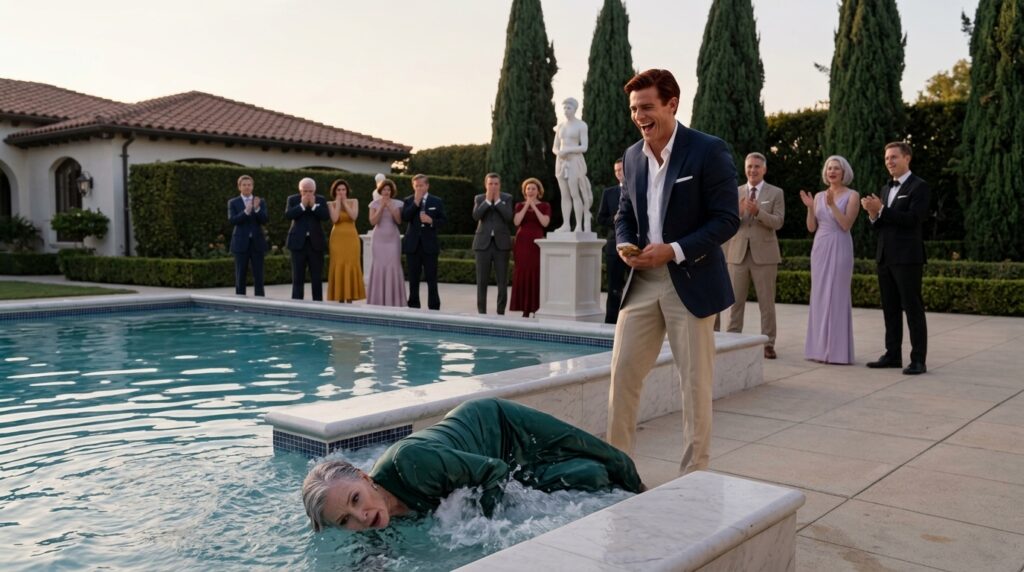
My grandson shoved me into the swimming pool at my seventieth birthday party.
There was no warning.
One moment I was standing beside the deep end in a pale blue dress, listening to Mason complain that I had ruined his attempt to take a family photograph because I had turned away at the wrong moment. The next, both his hands struck me between the shoulder blades.
I remember the blue water rushing toward me.
I remember somebody laughing before I even hit it.
Then the pool swallowed me whole.
For a few terrible seconds, I did not know which way was up. Chlorine burned my nose. My dress wrapped around my legs. One of my cream-colored shoes slipped from my foot and drifted beneath me like some ridiculous little boat before disappearing into the deeper water.
When my head finally broke the surface, I heard cheering.
Not screaming.
Not concern.
Cheering.
Mason stood at the edge holding his phone toward me.
My twenty-two-year-old grandson was laughing so hard he had to bend at the waist.
His girlfriend Chloe had one hand over her mouth and the other holding her own phone.
“Oh my God,” she shouted. “That video is going to go viral.”
I coughed until my chest hurt.
Nobody jumped in.
Nobody even reached for me at first.
I gripped the side of the pool and pulled myself toward the steps while water streamed from my hair into my eyes.
That was when my sister Carol pushed through the crowd.
“Are you people insane?”
Her voice cut through the laughter.
Behind her came Harold Greene, the man who had looked after the grounds at Willow Ridge for twenty-six years. Harold was sixty-eight, broad-shouldered, quiet, and normally impossible to rattle.
That afternoon, he looked furious.
He stripped off his work jacket and held it out as I climbed from the pool.
“Mrs. Carter.”
I wrapped the jacket around myself.
“Thank you.”
My voice sounded strange.
Small.
That frightened me more than the water had.
I had spent seventy years becoming a woman who knew how to stand upright through grief, illness, disappointment, business crises, funerals, sleepless hospital nights, and every other ordinary disaster life puts in your path.
But standing there while my family laughed at me, I felt seventy years old in the worst possible way.
Not experienced.
Not respected.
Just old.
Mason was still smiling.
“Grandma, come on. It was a joke.”
I looked at him.
“A joke.”
“You should’ve seen your face.”
Chloe laughed again.
Carol spun toward her.
“Put that phone down.”
Chloe’s smile disappeared.
“Excuse me?”
“You heard me.”
Before the argument could go any further, I saw my son.
Daniel was coming toward me.
For one foolish second, relief went through me so strongly that my knees almost weakened.
My son was fifty-one years old, but part of me still saw the little boy who used to crawl into my bed during thunderstorms.
I thought he had seen what happened.
I thought he was coming to defend me.
I thought he was going to tell Mason that he had crossed a line.
Daniel stopped three feet away.
He looked at his son.
Then he looked at me.
Water was dripping from the hem of my dress.
Harold’s oversized jacket hung from my shoulders.
My hair was plastered to my face.
I must have looked ridiculous.
Daniel lowered his voice.
“Mom, please don’t ruin everybody’s fun.”
Something inside me went perfectly still.
Carol made a sound of disbelief.
Harold stared at the ground.
Even Mason stopped laughing for a moment.
I looked at the man I had raised.
“What did you say?”
Daniel sighed.
That sigh told me more than his words had.
It was the sigh of a man dealing with an unreasonable child.
“I’m saying Mason shouldn’t have pushed you. Fine. He went too far. But everybody’s been having a good time all afternoon. Don’t turn this into some huge family drama.”
I almost laughed.
Not because it was funny.
Because sometimes cruelty is so absurd that the mind reaches for laughter before it understands what else to do.
The party Daniel did not want me to ruin had been paid for with my credit card.
The caterer.
The flowers.
The jazz trio.
The bar.
The tables.
The cake.
The rented lights strung through the oak trees.
All of it.
Even the twenty-eight acres beneath everyone’s feet belonged to the estate Robert and I had built together.
Willow Ridge.
Our home for almost forty years.
Daniel had learned to ride a bicycle on that driveway.
He had built forts behind the old barn.
He had broken his wrist falling from the oak tree near the guest cottage.
And he had learned to swim in the very pool where his son had just shoved me.
I could have reminded him of all that.
I could have reminded him that six years earlier, when his consulting company had nearly collapsed, I had given him $180,000.
Not lent.
Given.
I could have mentioned the checks I wrote when Mason was in college.
The deposit on his apartment.
The months when his parents insisted he needed a little help getting started.
I could have listed every family vacation Robert and I had paid for, every emergency we had quietly solved, every gift Daniel had accepted without embarrassment.
But I did not.
I looked at my son and said only two words.
“I understand.”
His shoulders relaxed.
That was almost worse than the sentence he had spoken.
He thought I meant I understood his point.
What I meant was that I finally understood him.
I turned toward the house.
All I wanted was to get away from the phones.
Then a man’s voice came from behind me.
“Daniel Carter?”
My son turned.
A man in a charcoal suit had stepped away from the crowd.
He was in his early sixties, tall and silver-haired, carrying a leather folder.
I recognized him immediately.
Samuel Whitaker.
Senior partner at Whitaker, Pierce and Lowe.
Daniel recognized him too.
I watched irritation disappear from my son’s face.
“Mr. Whitaker?”
Samuel extended his hand.
“Good afternoon, Daniel.”
Daniel shook it automatically.
“What are you doing here?”
Samuel glanced toward me.
His eyes stopped briefly on my wet dress.
Unlike almost everyone else at that party, he did not pretend not to notice.
“Mrs. Carter invited me.”
Daniel looked at me sharply.
“For what?”
Samuel did not answer immediately.
Whitaker, Pierce and Lowe had handled the sale of Robert’s company years earlier.
They had prepared our estate plan.
They had helped administer the Carter Family Trust after Robert died.
Daniel had tried more than once to get details about that trust.
He never admitted he was doing it.
He would phrase his questions casually.
How was the estate structured?
Was Willow Ridge technically inside the trust?
Would there be tax issues later?
Was Samuel still involved?
What would happen if I decided to sell?
The attorneys had always refused to discuss anything Daniel was not legally entitled to know.
He had never seemed especially worried.
Why would he?
He was Robert Carter’s only son.
In Daniel’s mind, whatever remained of his father’s fortune was simply waiting for me to finish using it.
And lately, he had started acting as though I was using it too slowly.
Two weeks before my birthday, Daniel and his wife Rebecca had sat at my kitchen island with a glossy brochure.
The cover showed smiling silver-haired couples drinking wine beside an artificial lake.
Hawthorne Hills Luxury Senior Living.
Rebecca had called it “long-term planning.”
“Eleanor, nobody is saying you have to move tomorrow.”
Nobody except the brochure sitting between my coffee cup and the fruit bowl.
Daniel had talked about how difficult Willow Ridge must be to maintain.
Twenty-eight acres.
The old barn.
The guest cottages.
The pool.
The orchard.
The fences.
“You shouldn’t have to worry about all this at seventy.”
I told him Harold worried about most of it for me.
Daniel said that wasn’t the point.
Rebecca leaned across the island.
“You deserve someplace where everything is done for you.”
I looked at her.
“Rebecca, when you turn seventy, perhaps you should move there.”
The conversation became considerably less cheerful after that.
Now, standing beside the pool, Daniel stared at Samuel’s leather folder.
“Why are you here?”
Samuel answered calmly.
“Because today is not only your mother’s seventieth birthday.”
Rebecca had joined us.
Her smile disappeared.
Mason lowered his phone.
Even Chloe seemed to understand that the atmosphere had changed.
Samuel continued.
“It is also the date designated by Robert Carter for the final administration review of the Robert and Eleanor Carter Family Trust.”
Daniel frowned.
“What review?”
Samuel looked at me.
“Mrs. Carter, would you prefer to change clothes before we discuss this?”
That small kindness almost broke me.
Not the trust.
Not the lawyer.
The kindness.
For nearly five minutes I had been standing there cold, soaked, and humiliated while people debated whether my feelings were inconvenient.
Samuel simply noticed I was wet.
“Yes,” I said. “I’d like that.”
I started toward the house.
“Wait.”
Daniel’s voice followed me.
I turned.
His face had changed.
The irritation was gone.
So was the embarrassment.
For the first time that afternoon, he looked worried.
“What does this have to do with us?”
Samuel rested one hand on the leather folder.
“That,” he said, “depends on what your father put inside this trust.”
The party became completely silent.
And for the first time all afternoon, my son stopped looking at me as though I were an embarrassing old woman standing in the way of everybody else’s good time.
He looked at me like someone whose answer might change his future.
I walked toward the house without saying another word.
But before I reached the back door, I heard Daniel behind me.
“Samuel.”
The lawyer stopped.
Daniel’s next question was barely louder than a whisper.
“Did my father change something before he died?”
Samuel looked at him for a long moment.
Then he said, “You should let your mother change clothes.”
And that was when I realized Daniel was afraid of an answer I had not even known existed.
PART 2: ROBERT’S LAST APPOINTMENT
Upstairs, I stood in front of my bedroom mirror and barely recognized myself.
My hair hung in wet strands.
Mascara had smudged beneath my eyes.
A red mark crossed one shoulder where Mason’s hand had struck me.
I took off the blue dress and dropped it into the bathtub.
For several seconds I simply stared at it.
That dress had been Robert’s favorite color on me.
I had bought it because I knew people would take photographs.
I had imagined looking at those pictures years later and remembering my seventieth birthday as one of those rare afternoons when three generations of family gathered in the same place.
Instead, somewhere downstairs, my grandson had a video of me falling into a pool while people laughed.
I sat on the edge of the bed.
Then I heard Robert’s voice in my memory.
Not anything dramatic.
Just one of the phrases he used so often that I had occasionally teased him about it.
Planning is just love wearing work clothes.
Robert planned everything.
He labeled circuit breakers.
He kept receipts for appliances we no longer owned.
He wrote the date of purchase inside instruction manuals.
During the seventeen months he lived with cancer, his need to organize became almost obsessive.
At first I thought it was how he fought fear.
If he could not control the tumors spreading through his body, he could control the paperwork.
Insurance.
Taxes.
Account passwords.
Property records.
The generator.
The irrigation system.
Even instructions for winterizing the guest cottages.
Then came the meetings with Samuel.
I rarely attended all of them.
That embarrassed me now.
Robert always told me not to worry.
“I’ll leave everything clean.”
I hated when he said things like that.
Clean sounded too much like after.
So I changed the subject.
I put on dark slacks, a cream blouse, and a soft gray sweater.
When I returned downstairs, Carol was waiting outside my bedroom door.
“You don’t have to go back out there.”
“Yes, I do.”
“Eleanor.”
I looked at her.
“If I hide in my bedroom, Daniel gets to believe he was right.”
Carol’s jaw tightened.
“He wasn’t.”
“I know.”
She followed me downstairs.
We did not return to the pool.
I asked Samuel to meet us in Robert’s library.
Daniel arrived before I invited him.
So did Rebecca.
Mason hovered in the doorway until Daniel motioned for him to enter.
Chloe did not come.
I was grateful for that.
Harold closed the French doors.
Samuel remained standing until I sat in Robert’s old leather chair.
I had not used that chair once in the six years since my husband died.
That afternoon, I did.
Daniel noticed.
“Mom, before we start—”
“No.”
He blinked.
“I was going to say Mason is sorry.”
I looked at Mason.
“Is he?”
My grandson’s face turned red.
“Yeah.”
“That wasn’t a difficult question.”
He looked at the floor.
“I’m sorry.”
“For what?”
Daniel exhaled.
“Mom.”
I raised my hand.
“No. If we’re going to pretend he’s apologizing, I’d like him to know what he’s apologizing for.”
Mason swallowed.
“For pushing you.”
“And?”
He glanced at his father.
Daniel said nothing.
Mason looked back at me.
“For laughing.”
“And filming me.”
His face changed.
“I wasn’t filming.”
“You were holding your phone.”
“I was taking pictures before.”
Samuel quietly opened the leather folder.
Mason stopped speaking.
Daniel immediately turned toward him.
“Can we get to this?”
I stared at my son.
Ten minutes earlier I had been thrown into a pool.
Now he was impatient to discuss money.
Samuel must have seen what I saw because he paused before removing the first document.
“Robert amended portions of the estate plan approximately nine months before his death.”
Daniel leaned forward.
“I knew it.”
Rebecca put a hand on his arm.
I said, “You knew what?”
Daniel hesitated.
“Dad mentioned reviewing things.”
“That isn’t what you just said.”
He looked irritated.
“It’s an expression.”
Samuel continued.
“The amendments did not reduce Mrs. Carter’s ownership rights.”
Daniel frowned.
“Ownership rights in what?”
“Everything she already owns.”
“That doesn’t answer my question.”
“No,” Samuel said. “It answers the legally relevant question.”
I had forgotten how good Samuel was at making a person feel foolish without ever being rude.
Rebecca spoke.
“Maybe it would help if you explained exactly what is being reviewed.”
Samuel turned to me.
“May I?”
I nodded.
He removed several pages.
“The estate consists of two primary components following Robert’s death. Mrs. Carter retained her separate property and the survivor’s portion of the marital assets. Robert’s share funded the Carter Family Trust under the terms established before his death.”
Daniel interrupted.
“And Willow Ridge?”
Samuel looked at him.
“Willow Ridge is owned by Mrs. Carter.”
Daniel went completely still.
“Personally?”
“Yes.”
I looked from Samuel to my son.
I had always known the house was mine.
What I had not known was that Daniel apparently did not.
He recovered quickly.
“Well, obviously Mom lives here.”
Samuel’s voice remained level.
“That is not what I said. She does not merely have the right to live here. She owns the property.”
Rebecca’s fingers tightened around Daniel’s arm.
He pulled away from her.
“Dad always said Willow Ridge would stay in the family.”
Samuel nodded.
“I remember.”
“So?”
“So Robert expressing a hope is different from Robert transferring ownership.”
Daniel looked at me.
“Mom knew that?”
“Yes.”
His face hardened.
“Then why didn’t you tell us?”
I almost smiled.
“Tell you what? That my house belongs to me?”
He opened his mouth.
Nothing came out.
Samuel returned to the documents.
“The family trust contains financial assets from Robert’s estate. During Mrs. Carter’s lifetime, those assets are administered primarily for her benefit. Daniel, you are not a present beneficiary with a right to demand distributions.”
“I never demanded anything.”
Nobody answered.
He looked around the room.
“I haven’t.”
Samuel said, “I am explaining the document, not accusing you.”
Daniel sat back.
“Fine.”
“There is another provision.”
His body tightened again.
Samuel lifted a sealed cream envelope from the folder.
My name was written across it.
Eleanor.
Robert’s handwriting.
I stopped breathing.
I would have recognized those letters anywhere.
His E always leaned too far forward.
His r looked almost like a v.
My hand rose automatically toward the envelope, but I did not touch it.
“When did he write that?”
“Nine months before his death.”
I looked at Samuel.
“You’ve had this for six years?”
“Yes.”
“Why?”
“Robert instructed me not to deliver it until today.”
“Why today?”
“Because he chose your seventieth birthday.”
Daniel laughed once, without humor.
“This is ridiculous.”
I turned toward him.
“What is?”
“Dad creating some theatrical mystery six years after he’s dead.”
The words hit me harder than I expected.
Robert was not theatrical.
He had been the least dramatic man I knew.
Even when the oncologist told us treatment had stopped working, Robert merely nodded and asked what paperwork needed to be completed.
Samuel looked at Daniel.
“Your father was very deliberate.”
Daniel’s face flushed.
“I know my father.”
Samuel did not respond.
That silence seemed to make Daniel angrier.
He turned to me.
“Are you seriously going to let a lawyer turn this birthday disaster into some kind of judgment session?”
I stared at him.
“My birthday disaster?”
“You know what I mean.”
“I don’t think I do.”
Rebecca stepped in.
“Eleanor, emotions are high. Maybe all Daniel means is that none of us expected legal business today.”
“Neither did I.”
Daniel pointed toward the envelope.
“Then open it.”
Samuel spoke before I could.
“That decision belongs to your mother.”
Daniel looked at him.
“It’s about our family.”
“It is addressed to Eleanor.”
“I am Robert’s son.”
“Yes.”
The word hung in the room.
Just yes.
No entitlement attached.
Samuel turned toward me.
“Robert gave you two choices. You may read this privately, or I can read it aloud in the presence of anyone you authorize.”
I stared at the envelope.
Part of me wanted to take it upstairs.
Part of me wanted to close the door and hear Robert’s words alone.
Then I looked at Daniel.
At Rebecca.
At Mason.
My grandson had finally put his phone away.
Three people who had spent years assuming my future belonged partly to them.
I suddenly did not want secrets.
“Read it.”
Daniel’s eyes moved to me.
“Mom—”
“Samuel will read it.”
The lawyer broke the seal.
For a moment, the only sound in the room was paper.
Samuel unfolded two handwritten pages.
My throat tightened.
He began.
“My Ellie.”
I closed my eyes.
That was what Robert called me when nobody else was around.
Samuel continued.
“If this letter reaches you under peaceful circumstances, I will be grateful to have worried for nothing.”
Daniel shifted in his chair.
“But if Daniel is sitting in that room asking what belongs to him before he has asked whether you are all right, then I am sorry.”
My eyes opened.
Nobody moved.
Samuel read the next sentence.
“I have begun to fear that our son may one day confuse what we gave him freely with what he believes he is owed.”
Daniel stood up.
“That’s enough.”
I looked at him.
“Sit down.”
His head turned toward me.
For the first time in my life, my son looked as though he did not recognize my voice.
I pointed to the chair.
“Sit down, Daniel.”
Slowly, he did.
Samuel looked at me.
I nodded.
“Keep reading.”
And as my dead husband’s words filled the room, I understood that Robert had seen this day coming long before I had.
PART 3: WHAT ROBERT SAW
Samuel read slowly.
Not for drama.
For me.
Every few sentences, he paused long enough for me to breathe.
Robert’s letter was not angry.
That made it harder.
Anger would have been easier to dismiss.
He wrote about Daniel with love.
He remembered the child who used to wait beside the driveway when Robert came home from work.
The teenager who called from college every Sunday night.
The young father who cried the first time he held Mason.
Then the letter changed.
“I do not believe Daniel is a bad man,” Robert had written. “But I believe comfort has made certain truths invisible to him.”
Daniel stared at the carpet.
Samuel continued.
“For years, we solved his problems before he fully felt their cost. We did it because we could. Then we did it because it became easier than saying no.”
I felt heat rise into my face.
That was true.
Painfully true.
Robert and I had argued about it.
Daniel’s first business loan.
His second house.
Mason’s private school.
The investment that went wrong.
Each time I had said the same thing.
Why should our child struggle if we can help him?
Robert would sigh.
Because sometimes struggle teaches the part money cannot.
I always accused him of sounding like a man who had forgotten how poor we were when we started.
He had not forgotten.
He was simply seeing something I refused to see.
Samuel reached the next paragraph.
“During my treatment, Daniel began asking questions that frightened me.”
My son raised his head.
“What questions?”
Samuel ignored him.
“He asked Samuel how property would pass after my death. He asked whether Willow Ridge could be sold without tax consequences. He asked the current value of the south acreage.”
Daniel stood again.
“This is unbelievable.”
Rebecca whispered, “Daniel.”
“No. He makes it sound like I was circling Dad’s deathbed with a calculator.”
Samuel folded the page slightly.
“Those were Robert’s words.”
“I know what they are.”
Daniel turned toward me.
“I asked because Dad talked about estate planning constantly.”
I said nothing.
“Mom.”
I looked at him.
“Did you ask?”
His jaw worked.
“Yes.”
“While he was dying?”
His face hardened.
“He was managing everything. He wanted me informed.”
Samuel spoke.
“Robert did not ask me to inform you.”
Daniel turned on him.
“You were his lawyer, not his son.”
“And because I was his lawyer, I documented his instructions.”
Rebecca stood.
“This is going nowhere.”
“No,” I said. “It’s going exactly where Robert wanted it to go.”
Daniel stared at me.
Something broke between us in that moment.
Not love.
Love does not always break when trust does.
Sometimes love simply becomes painful.
Samuel continued reading.
Robert wrote that he had no intention of punishing Daniel for asking questions.
That mattered to me.
He had not created some trap.
He had not sat in his study imagining revenge from beyond the grave.
He had done something much more like Robert.
He had created options.
“If my worries are wrong,” the letter said, “you may ignore them.”
I almost smiled.
“If my worries are right, I want you to know that nothing I built requires you to tolerate disrespect in order to preserve Daniel’s expectations.”
My eyes filled.
I lowered my head.
Carol quietly took the chair beside me.
Nobody spoke.
Samuel read on.
“Willow Ridge is yours, Ellie. Not symbolically. Not until somebody decides you are too old. Yours.”
Rebecca looked away.
Daniel did not.
“You may live there until one hundred and ten if you wish. You may sell it tomorrow. You may paint the barn purple. You may donate the land to a donkey sanctuary. Please do not do that last one unless the donkeys are unusually impressive.”
A laugh escaped me.
A wet, ugly little laugh.
It was so Robert.
Carol covered her mouth.
Even Samuel smiled.
For three seconds, my husband was in the room again.
Then came the part none of us expected.
“At seventy, Samuel will explain the final power of appointment contained in the family trust.”
Daniel leaned forward.
Samuel stopped reading.
My son spoke first.
“What does that mean?”
Samuel folded Robert’s letter and set it down.
“It means your father intentionally delayed one decision.”
“What decision?”
“The disposition of the remaining trust assets after Eleanor’s lifetime.”
Daniel’s face changed.
I heard my own voice.
“I don’t understand.”
Samuel turned toward me.
“Robert left the trust primarily for your support during your lifetime. But instead of fixing the remainder beneficiaries permanently, he granted you a power to determine how the remaining assets will ultimately be distributed.”
“Distributed to whom?”
“Within a defined group. Descendants, certain charitable organizations, and trusts established for descendants.”
Daniel stared at him.
“I’m the descendant.”
“Mason is also a descendant.”
“So it’s between us?”
“No.”
Daniel’s face tightened.
“What do you mean no?”
“I mean Mrs. Carter is not required to appoint the assets to either of you.”
Silence.
A very different silence from the one beside the pool.
Daniel’s mouth opened slightly.
Rebecca sat down.
Mason looked at his father.
Samuel continued.
“If Eleanor does nothing, the default provisions still apply.”
Daniel breathed again.
“There. Fine. What are they?”
Samuel looked at me before answering.
“Broadly, after Eleanor’s death, the remaining family trust would be divided into continuing trusts for Daniel and his descendants.”
My son sat back.
Relief.
Visible relief.
I watched it move across his face.
Then Samuel added, “Unless Eleanor exercises the appointment power Robert granted her.”
Daniel turned to me.
“Why would she?”
The question left his mouth before he could stop it.
Nobody needed Samuel to explain what was wrong with it.
Why would she?
Not, What do you want, Mom?
Not, Did Dad explain why?
Why would she?
As though my right existed only if I intended to use it against him.
Samuel returned to Robert’s letter.
“I chose seventy because I hope by then you will have had time to grieve me without making permanent decisions while grief is doing the thinking.”
I closed my eyes.
Again, Robert knew me.
“If Daniel remains the generous, affectionate son we raised, then bless him however you wish.”
Daniel stared at Samuel.
“If he begins treating you as the temporary administrator of property he considers his own, remember this: inheritance is a gift from the living to the future. It is not a debt the living owe the waiting.”
I felt Carol squeeze my hand.
Samuel finished the letter.
“Do not make your decision to punish him. Make it to protect your dignity. Those are not the same thing.
Love,
Robert.”
For several seconds nobody moved.
Samuel placed the letter on the desk.
Mason was the first to speak.
“Grandpa really wrote that?”
“Yes,” Samuel said.
Mason looked at me.
His face no longer held embarrassment.
It held something closer to shame.
Daniel stood.
This time I did not tell him to sit.
He walked toward the window overlooking the pool.
The party outside had started dissolving.
People were leaving quietly.
Good.
I wanted them gone.
Daniel turned.
“So this is what we’re doing?”
I stared at him.
“What are we doing?”
“You’re going to use something Dad wrote while he was sick to threaten me.”
Samuel said, “No one has threatened you.”
Daniel laughed.
“Please.”
“Daniel.”
Rebecca stood beside him.
“Maybe we should go.”
He ignored her.
“This whole thing is grotesque.”
I felt something inside me shift.
Not break.
Settle.
“You’re right.”
Daniel looked at me.
“What?”
“It is grotesque.”
I stood.
“It is grotesque that your father felt he needed to protect me from our own son.”
His face went white.
“You think that’s fair?”
“I don’t know yet.”
“Mom.”
“I said I don’t know.”
“You know exactly what you’re doing.”
“No.”
My voice stayed calm.
“That’s the difference between us today. You came into this room already thinking about what you might lose. I came in not knowing there was anything to take away.”
Daniel looked as though I had struck him.
Rebecca spoke softly.
“Eleanor, nobody wants your property.”
Carol made a sharp sound.
I raised my hand.
“Then we have nothing to argue about.”
Rebecca’s face tightened.
I turned to Mason.
“Give me your phone.”
He blinked.
“What?”
“The video.”
“I didn’t take it.”
“Then show me.”
He hesitated.
That was enough.
“Mason.”
Slowly, he unlocked his phone.
He handed it to me.
There it was.
A fourteen-second video.
The camera pointed at me as I stood near the edge.
Mason approached from behind.
His own laughter.
Then the shove.
The splash.
The camera jerking wildly as he laughed.
He had lied.
Not five minutes after saying he was sorry.
I watched it once.
I handed the phone back.
“Delete it.”
He swallowed.
“Okay.”
“In front of me.”
He deleted it.
Then I looked at him.
“Was it posted anywhere?”
“No.”
“Was it sent to anyone?”
He glanced toward the window.
“Mason.”
“Chloe posted hers.”
My stomach tightened.
“Where?”
“TikTok. Maybe Instagram.”
Daniel rubbed both hands over his face.
“Oh, for God’s sake.”
I looked at him.
He immediately knew what I was thinking.
“I’m saying we don’t need this online.”
“Why?”
“Because it’s embarrassing.”
“For whom?”
He did not answer.
I had spent the afternoon being told not to make a scene.
Now my son wanted control of the scene because strangers might see what had happened.
I turned to Samuel.
“I need time.”
“Of course.”
“How long do I have to make a decision?”
“There is no immediate deadline.”
“Good.”
Daniel stepped toward me.
“Mom, don’t do anything tonight.”
I stared at him.
“I wasn’t planning to.”
“I’m serious.”
“So am I.”
“You’re angry.”
“Yes.”
“You’ve been humiliated.”
“Yes.”
“And that’s exactly why Dad said not to make decisions emotionally.”
I almost admired the speed with which he had found the one sentence in Robert’s letter that served him.
“You listened very carefully to that part.”
His face flushed.
“I am trying to protect you from making a decision you’ll regret.”
I nodded.
“That sounds familiar.”
Rebecca closed her eyes.
Daniel understood.
The retirement brochure.
Willow Ridge being too much for me.
People deciding what I needed.
I walked toward the library doors.
“Everyone should leave.”
“Mom.”
“The party is over.”
Mason stood.
“Grandma—”
“Not now.”
He stopped.
I opened the doors.
Harold was in the hallway.
He did not pretend he had not been nearby.
“Would you help make sure the caterers are paid?”
“Already handled.”
“Thank you.”
Daniel followed me into the hallway.
“We need to talk.”
“Not tonight.”
“Tomorrow.”
“No.”
“Then when?”
I looked at him.
“When I want to.”
He stood there, genuinely stunned.
It occurred to me that I could not remember the last time I had said those words to my son.
Not when it involved money.
Not when it involved favors.
Not when it involved plans.
I walked away.
But before Daniel reached the front door, Mason caught up with me near the stairs.
“Grandma.”
I turned.
He looked younger than twenty-two.
“I’m sorry.”
I waited.
“For all of it.”
I said nothing.
He rubbed the back of his neck.
“Dad said you’d laugh.”
My chest tightened.
“What?”
Mason looked toward the foyer where Daniel was standing with Rebecca.
“He said before the party that you were always a good sport. Chloe thought the pool thing would be funny. Dad said you’d probably yell and then laugh.”
Daniel’s face changed.
“Mason.”
My grandson kept talking.
“And he said this place is going to be ours someday anyway, so you wouldn’t stay mad.”
The entire hallway went still.
I turned slowly toward my son.
Daniel looked at Mason as though he wanted to pull the words back into his mouth.
But it was too late.
I asked one question.
“Did you say that?”
Daniel did not answer.
He did not need to.
And in that silence, I finally understood how far the assumption had spread.
It was not only inside my son’s head anymore.
He had handed it to the next generation.
PART 4: WHAT THEY THOUGHT WAS THEIRS
The video went online before sunset.
By nine o’clock, it had been shared more than twelve thousand times.
Carol found it first.
She came into the kitchen holding her phone as though it smelled bad.
“Don’t read the comments.”
Naturally, that was the first thing I did.
Most people were angry.
Some thought the video had been staged.
Some called Mason spoiled.
Some called me dramatic because, apparently, standing silently after being shoved into a swimming pool was now considered dramatic.
Several people wanted to know why the young man laughing had not helped me out.
One woman wrote, “The saddest part isn’t the push. Watch the older woman’s face when her son speaks to her afterward.”
There was no audio of Daniel’s sentence in Chloe’s original clip.
But another guest had recorded it.
Someone had combined the two videos.
I watched myself climb from the pool.
I watched Harold wrap his jacket around me.
Then I heard Daniel’s voice.
Mom, please don’t ruin everybody’s fun.
I set the phone facedown.
Carol sat across from me.
“Are you okay?”
“No.”
“Good.”
I looked at her.
She shrugged.
“I’d be worried if you said yes.”
A laugh escaped me.
It surprised us both.
Then I started crying.
Not loudly.
I hated loud crying.
My mother used to call it advertising grief.
I sat at my kitchen table and cried quietly while my younger sister reached across and held my hand.
“I should have seen it,” I said.
“Seen what?”
“Daniel.”
Carol shook her head.
“He loves you.”
“That doesn’t answer me.”
“No.”
She squeezed my hand.
“It doesn’t.”
The next morning, I woke at five.
For six years after Robert died, I had slept on his side of the bed.
I told myself it was because the lamp was closer.
It was not.
His side still felt like him.
That morning I got up before sunrise and walked the property.
Willow Ridge looked different after a storm.
Leaves lay across the grass.
The pool was perfectly calm.
My missing shoe sat on one of the patio tables.
Harold must have fished it out.
It had been rinsed clean and placed in the sun to dry.
I picked it up.
There are moments when an object becomes more than itself.
That stupid shoe had been underwater while my family laughed.
Now it sat clean and quiet in my hands.
I carried it to the trash.
Then I stopped.
No.
I took it inside.
I was not going to throw away evidence of my own humiliation simply because looking at it hurt.
At eight, Samuel called.
“The video complicates matters socially,” he said.
“Not legally?”
“The shove could, but I am not advising you about that unless you ask.”
“I don’t want Mason arrested.”
“I did not assume you did.”
“I want him to understand.”
“That may take longer.”
We scheduled a meeting for that afternoon.
I drove to his office myself.
Daniel had called fourteen times.
Rebecca called four.
Mason sent three messages.
I read none of them.
At Whitaker, Pierce and Lowe, Samuel showed me the documents Robert had signed nine months before his death.
They were not dramatic.
Legal documents almost never are.
They were dry.
Numbered.
Precise.
That made them more powerful.
Robert had changed the successor administration of his trust so Daniel would never control my distributions.
That caught my attention.
“Was he originally going to?”
“Yes.”
I stared at Samuel.
“Why did Robert change it?”
Samuel folded his hands.
“He did not want Daniel in the position of deciding what you needed.”
I leaned back.
“That sounds very specific.”
“It was.”
“Why?”
Samuel hesitated.
“Robert had become concerned about several conversations.”
“What conversations?”
“You know some of them from the letter.”
“Property values.”
“Yes.”
“Taxes.”
“Yes.”
“What else?”
Samuel opened another file.
“These are notes from meetings with Robert.”
I read.
March 14.
Daniel asked whether Eleanor would likely remain at Willow Ridge if Robert predeceased her.
April 7.
Daniel requested general information about potential estate liquidity requirements.
May 2.
Daniel suggested it might make sense to sell acreage after Robert’s death “while market conditions remained favorable.”
I stopped reading.
“He was planning what to do after Robert died.”
Samuel chose his words carefully.
“He was discussing possibilities.”
“While Robert was alive.”
“Yes.”
My stomach turned.
Then I saw another note.
June 11.
Robert expressed concern Daniel sees future inheritance as guaranteed.
I touched the sentence.
“Did Robert say that exactly?”
“Yes.”
I whispered, “Why didn’t he tell me?”
Samuel was quiet for a moment.
“He believed you would defend Daniel.”
That hurt because it was true.
I would have.
I would have said Daniel was being practical.
I would have said Robert was sick and suspicious.
I would have reminded him how much Daniel loved him.
I might even have convinced Robert to undo the protections he put in place.
The thought made me ashamed.
Samuel seemed to read my face.
“Eleanor.”
I looked up.
“Robert was not asking you to punish yourself for trusting your son.”
“I know.”
But I did.
We spent three hours going through everything.
By the end, I understood one thing very clearly.
Daniel’s future was not mine to preserve.
Mine was.
The power Robert left me was broad but not unlimited.
I could direct the remaining trust property among Daniel, Mason, future descendants, and qualified charitable organizations.
I could create continuing trusts.
I could set different proportions.
I could leave the default unchanged.
“What happens if I die tomorrow without doing anything?”
“The default terms govern.”
“Daniel gets most of it.”
“Ultimately, yes.”
“And if I exercise the power?”
“The new direction controls.”
I looked out Samuel’s office window.
“What would Robert want me to do?”
Samuel did not answer immediately.
“That is one question I cannot answer for you.”
“You knew him.”
“Yes.”
“Very well.”
“Yes.”
“Then tell me.”
He shook his head.
“Robert deliberately gave the decision to you. If I replace your judgment with what I think he wanted, I defeat the purpose of everything he did.”
I smiled slightly.
“I hate good lawyers.”
“I know.”
Before I left, Samuel handed me a copy of Robert’s letter.
At home, I read it three more times.
Do not make your decision to punish him. Make it to protect your dignity.
That sentence became my compass.
At six that evening, someone knocked.
Mason stood on the front porch.
Alone.
No Daniel.
No Rebecca.
No Chloe.
He wore jeans and an old Vanderbilt sweatshirt.
He looked exhausted.
I almost did not let him in.
Then I opened the door.
“Ten minutes.”
He nodded.
We went to the kitchen.
He sat at the same island where his parents had shown me the retirement brochure.
For almost a minute, neither of us spoke.
Then Mason said, “Chloe and I broke up.”
I looked at him.
“I didn’t ask.”
“I know.”
“Is that why you’re here?”
“No.”
“Good.”
He swallowed.
“She kept saying the video was good for her account.”
I said nothing.
“She wanted to do a follow-up.”
“What kind of follow-up?”
“A reaction video.”
I stared at him.
“To me being pushed into a pool?”
He looked ashamed.
“Yes.”
“And you suddenly developed principles?”
He flinched.
I did not apologize.
Finally he said, “I watched the whole thing.”
“The video?”
“All the videos.”
He looked at his hands.
“I watched Dad talking to you.”
Something in his voice changed.
“He looked worse than I did.”
That surprised me.
“You pushed me.”
“I know.”
“He didn’t.”
“I know.”
“Then explain what you mean.”
Mason looked up.
“When I pushed you, I thought it was a prank. A stupid one.”
“It was.”
“I wasn’t thinking about you getting hurt.”
“That doesn’t make it better.”
“I know.”
His eyes filled.
“But Dad saw you after. He knew you were hurt.”
I said nothing.
“He still cared more about the party.”
The truth sounded different coming from him.
I sat across from my grandson.
“Why did you think I would laugh?”
He answered without hesitation.
“Because Dad said you would.”
“And why did that make sense to you?”
Mason struggled.
Finally he said, “Because Dad always says you don’t care about money or stuff.”
“That is true.”
“And he says everything here is basically family property.”
I felt my body go still.
“Basically.”
“He says you and Grandpa built it for all of us.”
“That is also true in one sense.”
Mason nodded quickly.
“Right.”
“No.”
He stopped.
“Building something for a family does not mean the family owns the builder.”
He looked down.
I continued.
“Your grandfather and I wanted Willow Ridge to be a place our family loved. That never meant anyone had the right to decide what happened to it while I was still alive.”
“I know that now.”
I studied him.
“Do you?”
He nodded.
I believed he believed it in that moment.
Whether he would still believe it when money became involved was another question.
He reached into his pocket.
For one absurd second I thought he was going to hand me another phone.
Instead, he placed a folded piece of paper on the counter.
“What is that?”
“I wrote down everything I remember.”
My stomach tightened.
“About what?”
“Dad talking about the property.”
I did not touch it.
“Why?”
“Because I think you should know.”
I looked at him.
“Know what?”
Mason took a breath.
“Dad has been talking to somebody about the south pasture.”
The room seemed to narrow.
“What somebody?”
“A developer.”
I stared at him.
“How do you know?”
“He had dinner with him twice. I went once.”
“When?”
“About a month ago.”
I felt cold.
“What did your father say?”
Mason’s eyes moved toward the window.
“He said nothing could happen yet.”
“Yet.”
“He said you’d probably move within a year or two.”
My hands went numb.
Mason continued.
“He said once you transitioned to someplace easier, there could be access from the highway.”
I heard the retirement conversation differently now.
Not concern.
Access.
Road frontage.
Development.
Land.
I leaned back.
“Did he say I had agreed?”
Mason shook his head.
“No.”
“Did he tell the developer he owned the property?”
“No. Not exactly.”
“What did he say exactly?”
Mason closed his eyes, remembering.
Then he looked at me.
“He said, ‘It’s family land. I’m the only son. Eventually I’ll control it.’”
I did not speak for a long time.
My grandson looked frightened.
Not of me.
For me.
I reached for the paper.
At the bottom, Mason had written one final sentence.
Dad said Grandma won’t fight us over it. She never fights family.
I read it twice.
Then I folded the page.
Mason whispered, “I’m sorry.”
I believed him a little more that time.
After he left, I called Samuel.
He answered on the third ring.
“I need to see you tomorrow.”
“What happened?”
I looked through the kitchen window toward the dark fields Robert and I had bought one acre at a time.
“My son has been planning the future of my land without me.”
Samuel was silent.
Then he said, “Bring me everything you have.”
I looked at Mason’s handwritten statement.
For the first time since my birthday, I was no longer asking whether Daniel had become entitled.
I was asking how long he had been building plans around the assumption that I would eventually get out of his way.
PART 5: THE HOUSE I WAS SUPPOSED TO LEAVE
Samuel did not overreact to Mason’s statement.
That irritated me at first.
I wanted him to look shocked.
I wanted a lawyer with forty years of experience to tell me my son’s behavior was outrageous.
Instead, he read Mason’s page twice and asked practical questions.
“Do you know the developer’s name?”
“No.”
“Has Daniel ever presented a contract?”
“No.”
“Have you signed anything?”
“Absolutely not.”
“Given anyone permission to negotiate?”
“No.”
“Then, at the moment, this is not a property crisis.”
I stared at him.
“It feels like one.”
“I know.”
He placed the paper on the desk.
“It is a family crisis.”
That was worse.
A fraudulent deed would have been simple.
Call lawyers.
Call authorities.
Fix title.
A son who had quietly built his future around your disappearance was more complicated.
“What should I do?”
Samuel leaned back.
“That depends on what you want.”
“I want him to tell me the truth.”
“Then ask him.”
“I did.”
“Ask him when he understands you already know enough that lying will cost him more than honesty.”
I thought about that.
Three days later, I invited Daniel and Rebecca to Willow Ridge.
Not dinner.
Not a family meeting.
I told them to come at eleven.
Daniel arrived at ten forty-five.
Rebecca came with him.
They sat at the kitchen island.
The retirement brochure was gone, but I could still see it in my mind.
I poured coffee for myself.
Not for them.
It was petty.
I enjoyed it.
Daniel noticed.
“Mom, can we not start like this?”
“Like what?”
“Hostile.”
I sat across from him.
“Mason told me about the developer.”
His face changed.
Rebecca looked at him.
That interested me.
She had not known.
Daniel recovered quickly.
“What developer?”
“Don’t.”
One word.
He stopped.
I placed Mason’s paper on the island.
Daniel glanced at it but did not touch it.
“What exactly did he tell you?”
“The truth would be a good place for you to begin.”
He leaned back.
“This is being blown completely out of proportion.”
Rebecca’s face tightened.
“Daniel.”
He rubbed his forehead.
“I had conversations.”
“With whom?”
“A commercial developer I know through work.”
“Name.”
“Richard Bell.”
“What did you discuss?”
“Nothing formal.”
“What did you discuss?”
“The area.”
“The area has thousands of acres.”
He stared at me.
“Willow Ridge came up.”
“How?”
“He asked about the land.”
“And?”
“I said someday there might be possibilities.”
I felt my heart pounding.
“Possibilities you don’t own.”
“I know I don’t own it.”
“Do you?”
His face flushed.
“Of course I do.”
“Then why did you tell him you would eventually control it?”
Daniel turned toward the window.
Rebecca whispered, “You said that?”
He snapped, “It was casual conversation.”
I laughed.
It came out colder than I intended.
“Casual conversation about the disposal of my property.”
“Nobody was disposing of anything.”
“You were discussing road access.”
His head jerked toward me.
“Mason shouldn’t have been listening to adult conversations.”
“He is twenty-two.”
“That’s not the point.”
“It is exactly the point. You taught your adult son that my land is already his family’s future asset.”
Daniel stood.
I stayed seated.
That surprised him.
When he was young, his anger used to make me move toward him.
Comfort him.
Calm him.
Fix things.
I no longer did.
“Sit down,” Rebecca said.
He looked at her.
“I’m not a child.”
“No,” I said. “That has become very clear.”
Daniel turned toward me.
“Do you want me to apologize for thinking about the future?”
“I want you to apologize for planning mine.”
His mouth closed.
There it was.
The center of everything.
Not money.
Not even Willow Ridge.
My future.
Daniel had begun arranging it without me.
A retirement community.
A land deal.
A future inheritance.
Even Mason’s stupid prank had rested on the same assumption.
Grandma will forgive it.
Grandma does not fight family.
Grandma will eventually move.
Grandma’s property will eventually be ours.
Grandma will eventually be gone.
I stood slowly.
“Your father died six years ago.”
Daniel looked away.
“I know.”
“For seventeen months I watched him disappear by inches.”
“Mom.”
“No. You are going to listen.”
Rebecca stared at the island.
“I changed his dressings. I tracked his medication. I slept in a chair beside him because lying flat hurt him. I learned the names of drugs I wish I had never heard of.”
Daniel’s face tightened.
“I was there too.”
“Yes.”
“I loved him too.”
“I know.”
“Then stop acting like grief belongs only to you.”
I went quiet.
That was fair.
Painfully fair.
I nodded.
“You’re right.”
He looked surprised.
“You lost your father. Mason lost his grandfather. I do not own that grief.”
Daniel exhaled.
Some of the fight left his shoulders.
Then I continued.
“But your grief does not give you ownership of what he left behind.”
The softness disappeared again.
“I’m not claiming ownership.”
“Then stop acting like my death is a delayed closing date.”
Rebecca whispered, “Eleanor.”
“No.”
I turned to her.
“You brought me a brochure for a retirement community two weeks before my birthday.”
Her eyes widened.
“That was because we were worried about you.”
“Were you?”
“Yes.”
“Did you know Daniel had been talking to a developer?”
She looked at him.
“No.”
I believed her.
That complicated things.
Rebecca had been part of the pressure, but maybe not the plan.
She turned toward her husband.
“You told me you wanted her to downsize because the property was becoming difficult.”
“It is.”
“For whom?” I asked.
Daniel threw up his hands.
“For everyone.”
“Name one problem it has caused me.”
“You call Harold every time something breaks.”
“That is his job.”
“You spend a fortune maintaining the place.”
“My fortune.”
He stopped.
The room became quiet.
For decades, money had made us generous.
Now I saw how easily generosity could erase boundaries.
If I paid, the family enjoyed it.
If I owned, the family expected access.
If I helped, the help slowly became infrastructure.
Daniel looked exhausted.
“I wasn’t trying to steal your house.”
“I know.”
His eyes met mine.
That surprised him too.
“I never thought you were.”
“Then what exactly are we doing?”
“We are talking about entitlement.”
He flinched.
“That word again.”
“Yes.”
“Dad used it, so now you use it.”
“Your father saw something before I did.”
He laughed bitterly.
“Dad was terrified of dying.”
The sentence landed heavily.
“He became obsessed with control. Every account. Every document. Every possible problem.”
I could not deny it.
Daniel continued.
“And Samuel encouraged it because lawyers love complicated trusts.”
“Careful.”
“I am not insulting Dad.”
“It sounds like you are explaining away his judgment.”
“I am saying he wasn’t infallible.”
“No.”
I took a breath.
“He wasn’t.”
Daniel stared at me.
I walked to the window.
For years I had turned Robert into a saint because death makes ordinary imperfections feel disrespectful.
He was not a saint.
He could be stubborn.
He could be controlling.
He once spent three months refusing to hire a plumber because he insisted he could repair a leak himself.
He was not always right.
But that did not mean he had been wrong about this.
I turned back.
“Your father made mistakes. So have I. One of mine was making it too easy for you to believe there would always be another rescue.”
Daniel’s face changed.
I had never said that aloud.
“The $180,000?” he asked.
“Yes.”
“You told me that was a gift.”
“It was.”
“So don’t use it now as a weapon.”
“I am not asking for it back.”
“Then why mention it?”
“Because gifts still have meaning.”
His jaw tightened.
I continued.
“I helped because I loved you. I paid for things because I wanted your life to be easier. Somewhere along the way, you stopped experiencing that as generosity.”
“That isn’t true.”
“Then tell me the last time I said no to you.”
He opened his mouth.
Nothing came.
“Tell me.”
“I don’t keep a list.”
“I do now.”
That hurt him.
I saw it.
Part of me wanted to take it back.
I did not.
Daniel sat down again.
Rebecca looked near tears.
Finally he whispered, “What are you going to do?”
There it was.
Not about the land.
About the trust.
I walked back to the island.
“I have not decided.”
“Mom.”
“I mean it.”
He watched me carefully.
“Samuel explained the power?”
“Yes.”
“And you can change what happens?”
“Yes.”
“To everything Dad left?”
“To the remaining trust property, within the terms he established.”
Daniel nodded slowly.
“So you’re deciding whether to cut me out.”
“No.”
“That’s what this is.”
“No. That’s what you hear because you are still measuring the conversation by what you might receive.”
His expression hardened.
“What else would you call it?”
“I would call it deciding what my husband asked me to decide.”
He stood again.
Rebecca touched his arm.
This time he did not pull away.
“What do you want from me?” he asked.
The question startled me.
Not because I had no answer.
Because for years I had wanted so little.
Calls.
Christmas.
A birthday dinner.
For him to bring Rebecca and Mason to Willow Ridge without treating the house like a private resort.
“I want you to see me.”
His face changed.
I continued.
“I want you to walk into my house and see your mother, not the current holder of your future property.”
“That’s not how I see you.”
“Then why was your first question to Samuel about the trust?”
He looked away.
“Why did you tell me not to ruin the party before asking if I was hurt?”
He closed his eyes.
“Why did you tell Mason this place would be his someday?”
Silence.
“Why did you discuss development plans before I had even decided whether I wanted to move?”
His shoulders lowered.
Rebecca was crying now.
Quietly.
I felt no satisfaction.
This was my son.
I wanted to win and lose nothing.
Life does not offer that bargain.
Daniel finally said, “I thought it was settled.”
“What?”
“The future.”
He looked at me.
His eyes were red.
“I thought Dad built all this for the family. I thought someday it came to me, then Mason. I never thought of that as taking something from you.”
“But you started living as though it had already happened.”
He nodded once.
A tiny motion.
Then he whispered, “Maybe.”
That word did more for me than a dramatic apology would have.
Maybe.
The first crack in certainty.
We sat in silence.
After several minutes, Rebecca spoke.
“The retirement place was my idea.”
Daniel looked at her.
She continued.
“He complained constantly about what would happen with the property. I thought if Eleanor liked Hawthorne Hills, it would solve the argument.”
I stared at her.
“You wanted to solve his problem by moving me.”
Her face crumpled.
“When you say it like that, it sounds terrible.”
“It was terrible.”
She nodded.
“Yes.”
That mattered too.
Not enough.
But some.
Before they left, Daniel stopped at the front door.
“Are you going to sell Willow Ridge?”
“No.”
His relief came too quickly.
I saw it.
So did he.
His face turned red.
I almost smiled.
“Daniel.”
“Yes?”
“If I ever sell this property, the decision will be mine.”
“I know.”
“Do you?”
He looked toward the fields.
Then back at me.
“I am beginning to.”
After they left, I called Samuel.
“I know what I want to do with the trust.”
He did not ask immediately.
He simply said, “Tell me.”
“I don’t want revenge.”
“Good.”
“I don’t want Daniel controlling anything that affects me.”
“He doesn’t.”
“I don’t want Mason inheriting a large amount at twenty-two simply because he expects it.”
“That can be addressed.”
“And I don’t want Willow Ridge treated as a prize.”
Samuel listened.
I continued.
“I want whatever remains of Robert’s trust divided differently.”
“How?”
I had spent three nights thinking about that.
“Part for Daniel in a protected trust. Enough to matter, not enough to make this the center of his life.”
Samuel said nothing.
“Part for Mason, but later. Much later.”
“What age?”
“Thirty-five before he controls anything substantial.”
Samuel made a note.
“And the rest?”
I looked through the window toward the guest cottage where Robert had spent his last good autumn.
“The hospital’s cancer support foundation.”
Samuel looked up.
Robert’s treatment had been brutal.
The nurses had kept me alive almost as much as they kept him alive.
“And a scholarship fund,” I said. “For students whose families can’t rescue them every time life gets expensive.”
Samuel smiled faintly.
“That sounds like Robert.”
“No.”
I shook my head.
“It sounds like me.”
His smile widened.
“Yes.”
Willow Ridge was separate.
Mine.
I updated my own will.
The property would not pass directly to Daniel.
After my death, the family would have six months to decide whether one of them wanted to purchase it at independently appraised value.
No discounts.
No automatic transfer.
If they did not, it would be sold.
A portion of the proceeds would go to the same charitable fund.
The rest would be divided among descendants through trusts.
It was not punishment.
Daniel was not disinherited.
Mason was not abandoned.
But nobody would spend the rest of my life waiting to receive Willow Ridge for free.
Samuel drafted the documents.
A week later, I signed them.
My hand did not shake.
When the final page was complete, Samuel closed the folder.
“Do you want Daniel informed now?”
I considered it.
“Yes.”
“All details?”
“No.”
“What should I tell him?”
I looked at Robert’s letter lying beside me.
“Tell him the default plan has been changed.”
Samuel waited.
“And tell him Willow Ridge is not part of his inheritance.”
The next morning, Daniel called at 7:14.
I watched his name appear on my phone.
For years I had answered on the first ring.
I let it ring four times.
Then I picked up.
“Hello.”
His voice was tight.
“Mom, what did you do?”
I looked out across the twenty-eight acres he had once assumed were simply waiting for him.
“I made a plan.”
He was silent.
Then he asked the question I had known would come.
“Did you cut me out?”
“No.”
His breath released.
“But I changed things.”
“How?”
“I am not discussing dollar amounts with you.”
“You’re my mother.”
“Yes.”
“I’m your only child.”
“Yes.”
“Then why won’t you tell me?”
I smiled sadly.
“Because I finally understand that being my son gives you a place in my heart.”
I paused.
“It does not give you a seat inside my bank account.”
He said nothing.
Neither did I.
For once, I allowed silence to do the work I had spent decades doing for him.
Then Daniel whispered, “Is this because of the pool?”
I looked at the blue water outside.
“No.”
“What, then?”
“The pool was just the moment I finally stopped making excuses for everything that came before it.”
He breathed in slowly.
I expected anger.
Instead he said something I did not expect.
“I don’t know how to fix this.”
My throat tightened.
“Neither do I.”
And that was the first honest conversation my son and I had had in years.
PART 6: WHAT REMAINS
For three months, Daniel stayed away from Willow Ridge.
At first I thought he was punishing me.
Then Rebecca called.
“He thinks you don’t want him there.”
I was trimming roses beside the east porch.
“I told him I needed space.”
“I know.”
“That is different.”
“I know.”
Rebecca hesitated.
“He doesn’t.”
I sat on the garden wall.
“How is he?”
“Angry.”
“At me?”
“At himself. At Robert. At Mason. At Samuel. At you. It changes by the hour.”
Despite myself, I smiled.
“That sounds like Daniel.”
Rebecca laughed softly.
Then her voice changed.
“He’s ashamed.”
That word hurt more than angry would have.
“What about Mason?”
“He started seeing a counselor.”
I was surprised.
“His idea?”
“Yes.”
“Good.”
“He also got a job.”
“He had a job.”
“A real one.”
I laughed.
Rebecca did too.
Mason had been doing occasional social-media marketing from his apartment and calling himself a brand strategist.
“What is he doing?”
“He’s working for a construction supply company.”
“That sounds unpleasant.”
“He hates waking up at six.”
“Excellent.”
Rebecca laughed again.
For the first time since my birthday, talking to her felt almost normal.
Then she said, “Eleanor, I owe you an apology.”
I looked down at the roses.
“You already apologized.”
“No. I said I was sorry.”
“Is there a difference?”
“There is to me.”
I waited.
“I treated your life like a logistics problem.”
The words were so accurate that I stopped trimming.
“I thought the house was too big. I thought Daniel worried too much. I thought if you moved, everyone would relax.”
She inhaled.
“I never asked whether you were happy.”
“I am.”
“I know that now.”
She paused.
“And I never asked what moving would cost you emotionally.”
I looked toward the old barn.
Robert and I had danced there at Daniel’s wedding after everybody else left.
Barefoot.
Badly.
I said, “Thank you.”
It did not erase what happened.
Apologies do not erase.
They do something better when they are sincere.
They mark the place where a person finally decides to stop pretending the wound is imaginary.
Winter came early that year.
Willow Ridge turned silver beneath frost.
I spent Thanksgiving with Carol.
Not because Daniel was excluded.
Because I wanted something different.
For decades I had hosted every major holiday.
I ordered flowers.
Planned meals.
Found extra chairs.
Changed sheets in the guest cottages.
Solved arguments before they began.
That year, I brought pie.
It was glorious.
Daniel sent a message at eight that morning.
Happy Thanksgiving, Mom. I love you.
I stared at it.
Then I typed:
I love you too.
Nothing more.
Nothing less.
At Christmas, Mason came to see me.
He stood on the porch holding a box.
“If this is another retirement brochure, I’m throwing you into the pool.”
His eyes widened.
Then he realized I was joking.
He laughed.
Carefully.
“Fair.”
Inside the box was a pair of cream-colored shoes.
I stared at them.
Mason’s face turned red.
“I know it’s probably stupid.”
I picked one up.
They were almost identical to the shoe I had lost in the pool.
“I had the brand from an old picture.”
I looked at him.
“Why?”
He shoved his hands into his coat pockets.
“Because I ruined the other pair.”
“The chlorine ruined the other pair.”
“I put you in the chlorine.”
Fair point.
I carried the shoes into the living room.
Mason followed.
He had changed.
Not dramatically.
Real change is rarely dramatic.
He listened more.
He reached for his phone less.
When he spoke about work, he sounded tired but proud.
After coffee, he wandered toward the mantel.
A photograph of Robert stood there.
Mason picked it up.
“Do you think Grandpa would’ve hated me?”
I almost dropped my cup.
“No.”
He looked at me.
“Even after what I did?”
“Especially after.”
He frowned.
“That doesn’t make sense.”
“Your grandfather was capable of being very angry with people he loved.”
I smiled.
“You should have seen him when your father put diesel fuel in the lawn mower.”
Mason laughed.
Then his expression became serious again.
“Dad says Grandpa didn’t trust him.”
I sat down.
“Your grandfather trusted your father with many things.”
“But not you.”
I looked at Robert’s photograph.
“He trusted Daniel to be his son.”
Mason waited.
“He didn’t trust him to decide my future.”
That distinction mattered.
Perhaps more than anything else Robert had done.
My husband had not stopped loving our son.
He had simply refused to confuse love with surrender.
I was learning the same lesson late.
In January, Daniel finally came home.
I call Willow Ridge home even though he had not lived there in thirty years.
Some places hold a person’s childhood long after the person leaves.
He arrived alone.
No appointment.
No warning.
He knocked.
That mattered.
Daniel had spent most of his adult life walking through my front door.
That afternoon, he knocked.
I opened it.
“Hi, Mom.”
“Hello.”
“Can I come in?”
Another thing that mattered.
“Yes.”
We sat in the library.
Robert’s room.
Daniel looked toward the leather chair where I had sat after the pool incident.
“I hated this room for a while.”
“Why?”
“Dad always called me in here when something was serious.”
I smiled.
“You broke many things.”
“I did.”
He laughed faintly.
Then his face changed.
“I drove past Hawthorne Hills yesterday.”
I groaned.
“Do not tell me you bought me a unit.”
“No.”
He smiled.
“I almost went inside.”
“For what?”
“To see what we were trying to send you to.”
I studied him.
“And?”
“It looked nice.”
“I am sure it is.”
“That isn’t the point.”
“No.”
He looked toward the bookshelves.
“I kept thinking about you sitting at the kitchen island while we explained your own life to you.”
I said nothing.
“I thought I was helping.”
“I know.”
“I really did.”
“I know that too.”
He looked at me.
“That almost makes it worse.”
I understood.
Villains are easy.
People who hurt you while believing they are helping are much harder.
Daniel rubbed his palms together.
“Richard Bell called me.”
My body tightened.
“The developer.”
“Yes.”
“What did he want?”
“He asked whether the situation had changed.”
“And?”
“I told him never to contact me about Willow Ridge again.”
I looked at my son.
“Thank you.”
“I should never have talked to him.”
“No.”
“I didn’t sign anything.”
“I know.”
“I didn’t promise anything.”
“I know.”
“But I liked talking about it.”
That confession surprised me.
Daniel stared at the floor.
“I liked imagining what could be done.”
“With my land.”
“Yes.”
He winced.
“When Dad was alive, he always made decisions. Then after he died, you owned everything, and I think part of me kept waiting for my turn.”
There it was.
Not greed exactly.
Not only greed.
A fifty-one-year-old man still waiting for his father to hand him adulthood.
I asked, “Why?”
Daniel thought.
“Because I spent my whole life being Robert Carter’s son.”
That was true.
Robert had been successful.
Very successful.
He built a regional manufacturing company from one rented warehouse and eventually sold it for more money than either of us had imagined when we married.
People admired him.
Daniel had spent his life being introduced in relation to him.
Robert’s boy.
Robert’s son.
The heir.
I had never considered the weight of that.
Daniel continued.
“When my company almost failed, I told myself it was the economy.”
He looked at me.
“It wasn’t only the economy.”
I stayed quiet.
“I expanded too fast.”
“I know.”
“You knew?”
“Your father knew.”
He laughed bitterly.
“Of course he did.”
“He did not think you were incompetent.”
“Did he say that?”
“Many times.”
Daniel’s eyes filled.
“He thought you were impatient.”
That made him laugh.
“That sounds more like him.”
We sat with Robert between us.
Invisible.
Still shaping the room.
Daniel finally said, “When you gave me the money, I told myself it proved I deserved another chance.”
“It did.”
“No.”
He shook his head.
“It proved I had parents who loved me.”
I felt tears rise.
He continued.
“I turned help into evidence that everything would always work out for me.”
I looked away.
Outside, frost still covered the field.
“Daniel.”
“Yeah?”
“You are not the only one responsible.”
He frowned.
“What do you mean?”
“I trained you too.”
“Mom.”
“I did.”
I faced him.
“Every time you fell, I rushed in before you hit the ground.”
“That is what mothers do.”
“Sometimes.”
I smiled sadly.
“Sometimes mothers should let grown men scrape their knees.”
He laughed.
Then we both cried.
Not dramatically.
Just quietly.
The way people cry when something long frozen begins to thaw.
After a while, Daniel asked the question I knew was still inside him.
“Did you change the trust because Dad told you to?”
“No.”
“Because of Mason?”
“No.”
“Because of me?”
I thought carefully.
“Because of me.”
He looked confused.
“I spent too many years believing boundaries were a form of rejection.”
I folded my hands.
“They aren’t.”
“No.”
“I changed the trust because I wanted money to stop being the thing holding this family together.”
Daniel nodded.
“Samuel wouldn’t tell me what you changed.”
“He shouldn’t.”
“I know.”
“Do you?”
He smiled.
“I’m learning.”
I told him part of it.
Not numbers.
Not percentages.
I told him he remained included.
I told him Mason did too.
I told him some of Robert’s money would help families dealing with cancer and some would fund scholarships.
Daniel looked surprised.
“Dad would’ve liked that.”
“Yes.”
“And Willow Ridge?”
I held his eyes.
“Mine.”
He nodded.
“Yours.”
Two words.
That was all.
But I had waited years to hear my son say them.
Spring came.
Then summer.
Willow Ridge turned green again.
The video disappeared from the internet eventually.
Not completely.
Nothing ever disappears completely anymore.
But people moved on.
The world found new outrage.
Chloe’s account found new content.
Mason stopped dating her.
I never asked whether the breakup lasted because of guilt, humiliation, or simply youth.
It was none of my business.
He visited more often.
Not every week.
Enough.
Sometimes he helped Harold.
Harold claimed this was character-building.
Mason claimed Harold was violating labor laws.
They liked each other.
The following September, I turned seventy-one.
I did not throw a large party.
No caterers.
No rented tables.
No jazz trio.
Carol came.
Harold and his wife came.
Mason came early.
Rebecca brought a lemon cake.
Daniel grilled steaks badly while insisting the grill was defective.
I sat beneath the oak trees and watched them argue over whether medium-rare meant blood should still be visible.
It was one of the happiest birthdays I had ever had.
Near sunset, Mason walked beside me toward the pool.
He stopped several feet from the edge.
I noticed.
“So cautious now?”
He grinned.
“I’ve learned boundaries.”
“Expensive lesson.”
“For everybody.”
We stood looking at the water.
He turned serious.
“Grandma?”
“Yes?”
“Do you forgive me?”
I had known that question would come eventually.
Forgiveness is a strange word.
People treat it as though it is a door.
Closed.
Then open.
My experience was different.
Forgiveness was more like rebuilding a house after a storm.
Some rooms became usable sooner than others.
Some damage remained visible.
Some things had to be replaced entirely.
“I am forgiving you.”
Mason nodded.
He understood the difference.
“That’s fair.”
We walked back toward the others.
Daniel was standing beneath the oak tree where he had once built a wooden platform at age eleven.
He called to me.
“Mom.”
“Yes?”
He held up a plate.
“Your steak is ready.”
I looked suspiciously at it.
“If it’s burned, I’m changing the trust again.”
His face froze.
Mason burst out laughing.
Rebecca nearly dropped the salad bowl.
Then Daniel realized I was joking.
He laughed harder than anyone.
That sound did something inside me.
Not because everything was healed.
It was not.
But because we could finally speak about the thing that had nearly destroyed us without pretending it had never happened.
After dinner, Daniel helped carry plates inside.
He stopped beside the library.
Robert’s photograph was visible through the open door.
Daniel stared at it.
“You think he knew this would happen?”
I followed his gaze.
“No.”
“But he predicted it.”
“He worried about it.”
“Same thing.”
“No.”
I shook my head.
“Your father never stopped believing we had choices.”
Daniel looked at me.
“That was the whole point of the trust.”
I had not realized it until I said it.
Robert had not built a trap.
He had built space.
Space between pressure and decision.
Space between entitlement and ownership.
Space where I could choose.
I walked into the library and picked up the copy of his letter.
The paper had softened along the folds because I had read it so many times.
There was one sentence I had once thought was about inheritance.
Now I understood it was about everything.
Do not make your decision to punish him. Make it to protect your dignity.
For most of my life, I thought dignity was something other people gave you.
Respect.
Courtesy.
Recognition.
I know better now.
Dignity is also what you refuse to surrender when people you love become careless with it.
I did not need to stop loving Daniel to tell him no.
I did not need to hate Mason to hold him accountable.
I did not need to give away my home to prove I was generous.
And I did not need to die in order for my family to start thinking about the future.
My future still belonged to me.
That autumn, I made one more decision.
I renovated the old guest cottage near the barn.
Not for Daniel.
Not for Mason.
For me.
I turned one room into a painting studio even though I had not painted since I was thirty-six.
Carol laughed when she heard.
“You don’t paint.”
“I used to.”
“Were you good?”
“No.”
She stared at me.
“Then why?”
I smiled.
“Because I want to.”
That became my favorite reason for many things.
I took a train trip through the Northeast.
Because I wanted to.
I stopped hosting Christmas every year.
Because I wanted to.
I hired a second groundskeeper so Harold could reduce his hours.
Because I wanted to.
I learned to swim again.
That surprised everyone.
Especially me.
The first time I stepped back into the pool after my seventieth birthday, I stood on the shallow steps for nearly ten minutes.
Harold pretended to work nearby.
He was watching.
Carol sat in a chair with a book she never turned a page of.
I lowered myself into the water.
Slowly.
My heart raced.
The pool itself had done nothing to me.
But the body remembers humiliation strangely.
I swam one length.
Then another.
When I climbed out, Harold handed me a towel.
“Good swim?”
“Yes.”
He nodded.
Neither of us mentioned the birthday.
We did not need to.
Two years after Robert’s letter was opened, Samuel called to tell me the amended trust documents had been fully integrated into the estate plan.
Nothing about that conversation was dramatic.
No one shouted.
No one lost a fortune overnight.
That is not how most important changes happen.
Sometimes a family changes because one woman finally says, “This belongs to me.”
Sometimes a son changes because the future he assumed was guaranteed suddenly requires humility.
Sometimes a grandson grows up because one cruel joke forces him to see the difference between being loved and being allowed to do anything he wants.
And sometimes a dead husband protects his wife not by controlling her future, but by making sure nobody else can.
I still live at Willow Ridge.
The barn still needs paint.
The pool filter still makes a strange noise every June.
The south pasture remains exactly where Robert left it.
No subdivision.
No access road.
No luxury retirement brochure on my kitchen island.
Daniel visits.
He knocks.
Not every time anymore.
Eventually I told him he did not have to.
But for almost a year, he always knocked.
I knew why.
It was his way of telling me he remembered.
This house was mine.
My life was mine.
And his place in it came from love, not ownership.
On what would have been Robert’s eighty-first birthday, I carried his letter to the bench beneath the oak tree.
The evening was warm.
I read the final paragraph once more.
Then I looked toward the pool.
I could hear Daniel and Mason arguing over something near the barn.
Rebecca was laughing.
Carol was inside opening wine.
Harold had already gone home.
It was not a perfect family.
I no longer wanted one.
Perfect families are usually families where somebody is swallowing the truth.
I wanted something harder.
A family capable of hearing no.
A family capable of apologizing.
A family capable of discovering that love survives boundaries.
I folded Robert’s letter.
“You were right,” I whispered.
Then I thought about it.
“No.”
I smiled.
“You were partly right.”
Robert would have appreciated the correction.
The sun dropped behind the south pasture.
For years after his death, sunset had been the loneliest part of my day.
That evening it wasn’t.
I stood and walked toward the house.
Halfway there, Daniel called from the barn.
“Mom?”
I turned.
He lifted an old wooden box.
“Can I throw this out?”
Years earlier, he would not have asked.
I smiled.
“Yes.”
Then I reconsidered.
“Wait. What’s inside?”
He opened it.
Old irrigation parts.
Nothing sentimental.
Nothing valuable.
Just pieces of a life built over decades.
“Throw it away,” I said.
Daniel nodded.
I took two more steps.
“Daniel.”
He looked up.
“Yes?”
“Thank you for asking.”
His face softened.
“Of course.”
I continued toward the house.
Behind me, the pool reflected the last light of evening.
For a long time, I thought the story of my seventieth birthday was about the moment my grandson pushed me into that water.
It wasn’t.
It was about the moment I climbed out.
The End