The mahogany front door of my Brooklyn brownstone swung open, letting in a gust of biting December wind along with the heavy scent of roasted pine and winter frost.
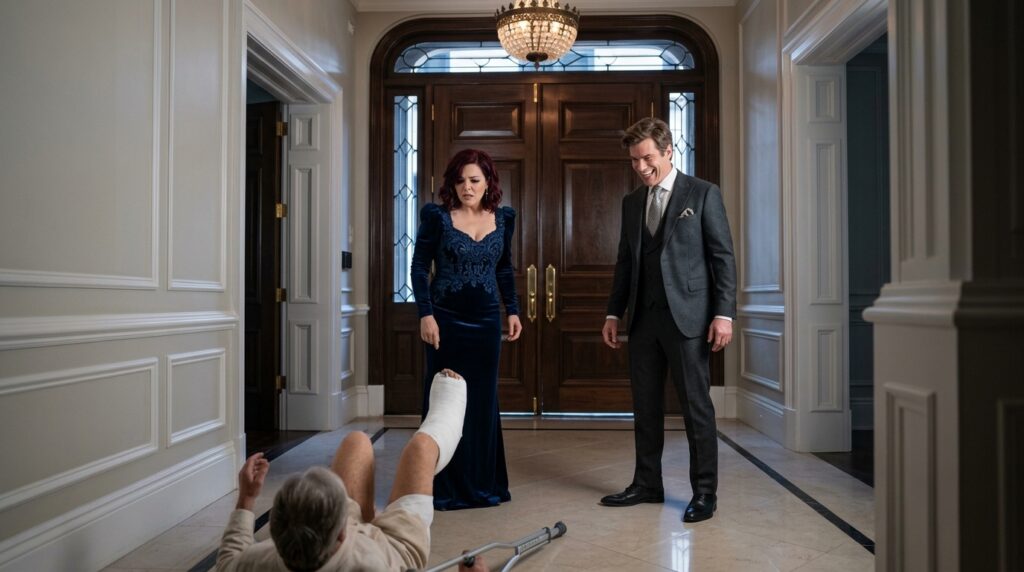
I stood in the foyer, leaning heavily on a pair of silver aluminum crutches, my left leg encased in a stark, blindingly white plaster cast that stretched from my toes to just below my knee.
In the pocket of my wool cardigan, my thumb rested on the smooth plastic edge of a digital voice recorder.
Its small red light was glowing steadily, silently capturing every breath, every whisper, every drop of venom in the air.
The living room was decorated to the nines.
A towering nine-foot Fraser fir glistened in the corner, wrapped in gold ribbon and hand-blown glass ornaments that my late husband Richard and I had collected across thirty-five years of marriage.
The dining table was set for twelve with fine porcelain, crystal wine glasses, and silver cutlery that polished the light of the chandelier into razor-sharp reflections.
My extended family was all there—my sisters-in-law, my nephews, family friends who had known Richard and me since our early days in Queens.
When I hobbled into the arched entrance of the dining room, a sudden, suffocating silence fell over the room.
Forks stopped halfway to mouths.
Conversations died mid-sentence.
Eyes darted from my pale face down to the heavy plaster cast dragging along the Persian rug.
“Sophia!
My God, what happened to your leg?” my sister-in-law Clara gasped, rising half out of her chair with genuine horror in her eyes.
“Are you alright?”
Before I could open my mouth to answer, my son Jeffrey stepped out from the head of the table.
He held a glass of expensive Cabernet in one hand, his designer suit fitted impeccably to his frame—a suit paid for with my money.
He looked down at me, his eyes cold, detached, and utterly devoid of pity.
A cruel, dismissive smirk tugged at the corner of his lips.
He let out a sharp, cold little laugh that bounced off the high plaster ceilings.
“Don’t worry about her, Aunt Clara,” Jeffrey said, his voice dripping with condescension.
He took a slow sip of his wine and gestured toward his wife, Melanie, who sat at the table looking like a pristine porcelain doll in an emerald silk dress.
“Mom just had a little incident at home.
She’s getting careless in her old age.
Honestly, my wife just wants you to learn from this, Mom.
Maybe now you’ll finally accept that you can’t manage on your own.”
Melanie offered a small, rehearsed, tragic smile to the room, patting her chest as if she were heartbroken.
“We just worry about her safety so much,” Melanie chimed in, her voice sweet as honey mixed with arsenic.
“She falls so easily now.
It’s such a tragedy when the mind starts to go before the body.”
The room murmured with uncomfortable sympathy.
They looked at me with pity, seeing a frail, broken 68-year-old widow who was losing her footing on reality.
They had no idea that at that exact second, the antique grandfather clock in the hallway struck 7:30 PM.
And right on cue, before the chiming died away, the front doorbell rang—loud, crisp, and demanding.
Jeffrey frowned, setting his wine glass down on the tablecloth with a soft thud.
“Who on earth could that be at this hour?
We aren’t expecting anyone else.”
He had no idea that the doorbell was the beginning of his nightmare.
He had no idea that I had spent the last two months meticulously stringing a net around his neck, waiting for this exact moment to pull it tight.
And as he walked toward the front door to answer it, I allowed myself the very first genuine smile I had worn in months.
Every single person in that room was about to get exactly what they deserved.
To understand how I arrived at that Christmas dinner with a cast on my leg and rage in my heart, you have to go back three years.
My name is Sophia Reynolds.
I am 68 years old, and for thirty-five years, I lived a life defined by hard work, deep devotion, and love.
My husband Richard and I started with nothing—just a small basement apartment in Astoria and a fierce determination to build something lasting.
Richard was a master baker, a man whose hands always smelled of vanilla, yeast, and brown sugar.
I was the strategist, the mind behind the books, the one who turned his talent into a business.
Together, through sweat, sixteen-hour workdays, and endless sacrifices, we built Four Corners Bakeries—a beloved chain of four artisanal bakeries located across prime neighborhoods in Manhattan and Brooklyn.
We weren’t billionaires, but we were prosperous.
We owned our 4,500-square-foot Victorian brownstone in Prospect Park South outright, maintained healthy liquid savings, and held real estate assets totaling roughly $4 million.
And then, three years ago, the sky fell.
Richard suffered a massive, fatal coronary right on the flour-dusted floor of our flagship Brooklyn Heights store at 5:00 AM.
In the span of a single heartbeat, my partner, my best friend, and the love of my life was gone.
When you lose someone after three and a half decades, the grief isn’t just an emotion; it’s a physical weight.
It crushed my ribs.
It made breathing feel like swallowing glass.
In those first few months, I was a ghost walking through a hollow house.
My only child, Jeffrey, was thirty-two at the time.
He had always been a somewhat distant boy—ambitious, easily frustrated by failure, always looking for shortcuts to wealth that didn’t require the backbreaking labor his father and I had put in.
Two years before Richard died, Jeffrey had married Melanie, a former marketing assistant whose ambition far outweighed her empathy.
At Richard’s wake, Jeffrey hugged me too tight, for too long.
He held me while I sobbed into his shoulder, whispering, “I’m here now, Mom.
I’ll take care of everything.
You don’t have to carry the weight alone.”
At the time, I thought it was the pure, unfiltered love of a son comforting his grieving mother.
Today, I know it was calculation.
He wasn’t holding me to keep me upright; he was measuring me for a coffin.
They lived in a cramped, rented two-bedroom apartment in Queens.
At first, they visited me once a week.
Then twice a week.
Then came the soft, persuasive speeches over tea in my kitchen.
“Mom, this house is way too big for one person,” Jeffrey would say, rubbing my shoulders.
“You’re isolated here.
You’re crying in empty rooms.
Let us move in.
We can look after you, handle the maintenance, help run the bakeries.
We can be a real family again.”
Melanie was right beside him, nodding earnestly, bringing me homemade soups she hadn’t cooked herself, filling my vases with fresh lilies.
“We just want to protect you, Sophia.
Richard would have wanted us to take care of you.”
Loneliness is a powerful weapon when wielded by ruthless people.
I gave in.
Four months after Richard’s death, Jeffrey and Melanie packed up their apartment and moved into my home.
At first, it felt like a blessing.
The silent hallways filled with sound again.
Jeffrey cooked dinners on weekends.
Melanie accompanied me to the farmers market.
I began to feel human again, believing that out of the ashes of my husband’s death, my relationship with my son had been reborn.
I was a blind, gullible fool.
The financial drain didn’t begin with a robbery; it began with a whimper of distress.
Six months after they moved in, Jeffrey sat down with me in the garden.
He looked defeated, his head in his hands, sighing heavily.
He told me his corporate logistics firm was downsizing.
He was on the chopping block unless he completed an executive certification course that cost $50,000.
“I hate asking you, Mom,” he mumbled, refusing to look me in the eye.
“Dad always handled things.
I feel like a failure.”
My maternal instinct obliterated any financial caution.
“You are not a failure, Jeffrey,” I told him, squeezing his hand.
“Your father and I built our business so you would have a safety net.”
I transferred $50,000 to his account the very next morning.
Three weeks later, Melanie came to my master suite in tears.
Her mother in Ohio had been diagnosed with a rare spinal condition and needed an urgent, specialized surgical procedure not fully covered by insurance.
The cost was $30,000.
I wrote the check without a second thought.
Family was family.
Then came September: $40,000 for a “can’t-miss private investment opportunity” that Jeffrey promised would double our family’s capital within six months.
In October: $25,000 to cover medical expenses and liability costs after Melanie allegedly got into a fender-bender with an uninsured motorist.
In November: $30,000 for an emergency buy-in to a boutique bakery supply partnership that Jeffrey claimed would save our business tens of thousands in shipping costs.
By the time the early December frosts coated the windows, I had transferred $230,000 of my personal liquid savings directly into Jeffrey and Melanie’s accounts.
Not a single penny had been returned.
Whenever I raised the topic, Jeffrey would kiss my cheek, tell me the returns were “compounding in escrow,” and pivot the conversation to my health or ask if I was feeling “forgetful.”
I began to feel a cold, creeping uneasiness in the pit of my stomach.
But the horrifying truth didn’t break through my denial until a freezing Sunday morning in mid-December.
I had woken up at 6:00 AM, my joints aching from the winter cold.
I threw on a thick cardigan and walked down the grand oak staircase to the kitchen to put the kettle on.
The house was dead quiet, save for the soft hum of the refrigerator.
As I stood near the brass stove waiting for the water to heat, I heard low, urgent voices coming through the vintage heating vent built into the floorboards above.
The vent connected directly to the guest suite where Jeffrey and Melanie slept.
The acoustics of the old house carried their words down with terrifying, crystal-clear clarity.
“I’m telling you, Jeffrey, she’s taking too long,” Melanie’s voice came through, sharp, brittle, and completely devoid of the sweet tone she used when speaking to me.
“She’s only 68.
She walks every day.
She eats clean.
She could easily live another twenty or thirty years!
We can’t live off hand-outs forever.”
I froze.
My hand hung suspended over the tea tin.
“Mel, keep your voice down,” Jeffrey’s voice replied, sounding tired but not protesting her words.
“She’s sleeping upstairs.”
“She’s deaf in one ear and sleeps like a log, stop being paranoid,” Melanie snapped.
“Look at the numbers!
We’ve already managed to pull around $200,000 directly from her savings, but the bank is starting to flag the large wire transfers.
We need full control.
We need the power of attorney signed, or we need her to… pass.”
A heavy silence hung in the air for a second.
My heart hammered against my ribs like a trapped bird.
“Don’t say things like that,” Jeffrey mumbled softly.
“She’s my mother.”
“She’s an obstacle!”
Melanie spat back with chilling intensity.
“She’s sitting on a four-million-dollar estate while we live on her allowances!
If we get her to sign the financial power of attorney, we can transfer the ownership of the Brooklyn Heights and Upper West Side properties into our LLC before she even realizes what happened.
And if she starts asking questions?
We just tell everyone she’s showing early signs of dementia.
Look at her—she grieves Richard like he died yesterday.
It won’t take much to convince a doctor or a judge that she’s mentally unfit.”
“What if she refuses to sign?”
Jeffrey asked.
“Then we make her life so miserable that she has no choice,” Melanie replied coldly.
“Or we speed things up.
An old woman slipping on the icy front porch steps?
Nobody questions that, Jeffrey.
Nobody.”
I stood in that silent kitchen, the kettle beginning to whistle softly on the stove.
My body trembled so violently that I had to grab the edge of the granite countertop to keep from collapsing.
The grief that had wrapped around my heart for three years didn’t just evaporate—it burned away in a flash flood of pure, unadulterated white-hot rage.
The naive, broken widow who spent her nights crying over old photo albums died right there next to the boiling kettle.
In her place stood Sophia Reynolds—the woman who had built a multi-million-dollar business from scratch in a cutthroat city, the woman who knew how to audit a ledger, spot a thief, and protect what was hers.
They wanted a war?
They were going to get one.
But I wasn’t going to fight it with screaming matches or emotional pleas.
I was going to fight it with cold, calculating, surgical precision.
The very next morning, I feigned a dental appointment and took a taxi to Wall Street to meet with Robert Morris.
Robert was a silver-haired, formidable man in his early sixties who had served as Richard’s and my corporate accountant and financial advisor for over twenty-five years.
He was more than a professional contact; he was a loyal friend who revered Richard’s memory.
Sitting in his glass-walled office overlooking the East River, I laid out my suspicions.
“Robert, I need a complete, unannounced audit of both my personal accounts and the Four Corners business ledgers for the past twelve months.
Everything.
Every line item, every wire, every signature.”
Robert’s face hardened.
He didn’t ask dramatic questions.
He simply opened his terminal and went to work.
Three hours later, the truth was laid out on his desk in black ink.
“Sophia…
I’m so sorry,” Robert said, his voice grave as he pushed a stack of printed spreadsheets toward me.
“It’s worse than you thought.”
It wasn’t just the $230,000 I had foolishly “lent” them.
Over the past ten months, Jeffrey had been systematically embezzling money directly from the operational accounts of our four bakeries.
Because I had naively added him as an authorized secondary signer on the corporate accounts after Richard passed—to “help with payroll”—Jeffrey had been issuing recurring checks to a bogus shell company called Apex Management Consulting LLC.
Small amounts at first: $2,500 here, $3,000 there.
Always on Thursdays—the exact day I took my weekly afternoon yoga and physical therapy class.
The total stolen from the business was $68,000.
Combined with the $230,000 in personal loans obtained under false pretenses (including the fake surgery for Melanie’s mother, which Robert confirmed via a quick background check was an outright fabrication—Melanie’s mother was healthy and living in a gated community in Florida), they had bled me of nearly $300,000.
“We need to call the District Attorney right now,” Robert said, his jaw tight with anger.
“This is grand larceny and corporate embezzlement.
I can have his signing authority revoked within ten minutes.”
“No,” I said, my voice dangerously calm.
“Not yet.”
Robert looked at me in shock.
“Sophia, he’s stealing you blind!
They are actively plotting against you!”
“If we arrest him today for embezzlement, his lawyers will tie it up in white-collar court for years.
He’ll claim it was a family business dispute, a misunderstanding between mother and son.
He’ll walk away with probation or a slap on the wrist,” I said, leaning forward.
“I don’t just want my money back, Robert.
I want them ruined.
I want them to face the full, unvarnished weight of their cruelty.
I want them caught so completely that no high-priced defense attorney in Manhattan can save them.”
Robert stared at me for a long moment, then a slow, approving nod spread across his face.
“What do you need me to do?”
“Quietly remove Jeffrey’s authorization from the corporate accounts, but leave his name on a dummy notification system so he doesn’t realize he’s been locked out until he tries to make a major move,” I instructed.
“And connect me with the best private investigator and criminal defense attorney in the city.”
That afternoon, I met with Ethan Vance, a former NYPD Senior Homicide Detective who now ran a high-end private security and investigative firm, and Eleanor Sterling, a fierce, razor-sharp estate and criminal attorney.
In a private conference room, we crafted The Plan.
For the next two months, I played the ultimate role.
I transformed myself into the exact victim Jeffrey and Melanie wanted to see: a confused, failing, frail old woman.
I began “forgetting” small things.
I would leave my reading glasses in the refrigerator.
I would ask Jeffrey the same question three times in one afternoon, looking at him with wide, unfocused eyes.
I would sigh and murmur about how “hard it was to keep track of the bills these days.”
You should have seen the predatory glee in Melanie’s eyes every time I faltered.
They thought their plan was working perfectly.
They thought I was slipping into senility.
Meanwhile, Ethan Vance turned my Victorian brownstone into a high-tech surveillance compound without Jeffrey or Melanie ever suspecting a thing.
Disguised inside smoke detectors, picture frames, and clock radios, tiny 4K pinhole cameras and directional microphones were installed in the kitchen, the living room, the study, and even the upstairs hallway.
Every whisper, every secret meeting between Jeffrey and Melanie, every time they searched through my desk drawers when they thought I was out—it was all recorded, timestamped, and uploaded directly to a secure cloud server managed by Ethan’s team.
The footage we collected over six weeks was sickening.
We caught Melanie picking the lock on my home office safe, searching for my original Will.
We caught Jeffrey on the phone with a shady real estate broker, discussing how much they could get for the Brooklyn Heights bakery location once they secured my power of attorney.
We caught them laughing over drinks in the living room, mocking me.
“She asked me where her tea tin was today,” Melanie laughed in one recording, pouring herself a glass of my late husband’s prized scotch.
“She’s losing it, Jeff.
Another month or two and we can have a doctor declare her incompetent.
Then the whole four million is ours.”
“Just make sure the lawyer has the power of attorney documents ready for Christmas,” Jeffrey replied in the video, grinning.
“We’ll get her to sign them right after dinner when she’s tired.”
Every piece of video was cataloged.
Every dollar stolen was traced.
The trap was laid.
All I needed was the final, undeniable catalyst.
And Melanie, in her boundless arrogance, gave it to me.
It happened on a snowy Tuesday evening, eight days before Christmas.
Jeffrey was out of the house, attending a “networking event” that was actually a high-stakes poker game in Manhattan.
It was just Melanie and me in the house.
I was sitting in my study, pretending to look over financial documents, when Melanie walked in.
She was holding a thick folder.
Her soft, polite smile was gone, replaced by a cold, imperious glare.
“Sophia, we need to talk,” she said, shutting the door behind her.
She dropped the folder onto my desk.
“Jeffrey and I have been discussing the business.
You’re stressed, you’re tired, and frankly, you’re making mistakes.
We need you to sign these documents.”
I picked up the papers, my eyes scanning the dense legal text.
It was an absolute, irrevocable Power of Attorney, along with a deed transfer agreement handing full control of the primary bakery property in Brooklyn Heights over to their newly formed holding company.
I looked up at her, letting my hands shake slightly, but my voice remained steady.
“Melanie… this gives you everything.
This takes away my right to my own business.
Richard built that store with his own hands.
I can’t sign this.”
Melanie’s eyes narrowed into slits.
The mask fell off completely.
“Listen to me, you old fool,” she snarled, stepping around the desk and towering over me.
“You are done!
You’re a lonely, useless widow dragging us down!
Jeffrey and I have given up three years of our lives staying in this ancient, dusty house to watch over you!
You owe us!”
“I owe you?”
I said, standing up slowly, leaning on the edge of the mahogany desk.
“I gave you a place to live.
I gave Jeffrey $230,000.
I covered your lies, Melanie.
I know about your mother.
I know there was no surgery.”
Melanie froze for a fraction of a second, shock flashing across her face, before her rage exploded.
“You sniveling little bitch,” she spat.
She grabbed my arm violently, yanking me out from behind the desk.
“You are going to sign those papers, or I will make sure you spend the rest of your miserable life rotting in a state-run nursing home!”
“Get your hands off me!”
I shouted, pulling back and stepping out into the grand hallway near the top of the oak staircase.
Melanie followed me, her face contorted with fury.
“You think you have a choice?
You have nothing!
Nobody cares about you!”
“Jeffrey knows what you are!”
I lied, raising my voice to play the scene out.
“He won’t let you do this!”
“Jeffrey wants you gone just as much as I do!”
Melanie screamed.
And then, she lost control.
With a look of pure hatred, Melanie lunged forward and slammed both of her hands violently into my chest.
The push was hard, intentional, and vicious.
I lost my balance, my slippers slipping on the polished hardwood floor at the top of the stairs.
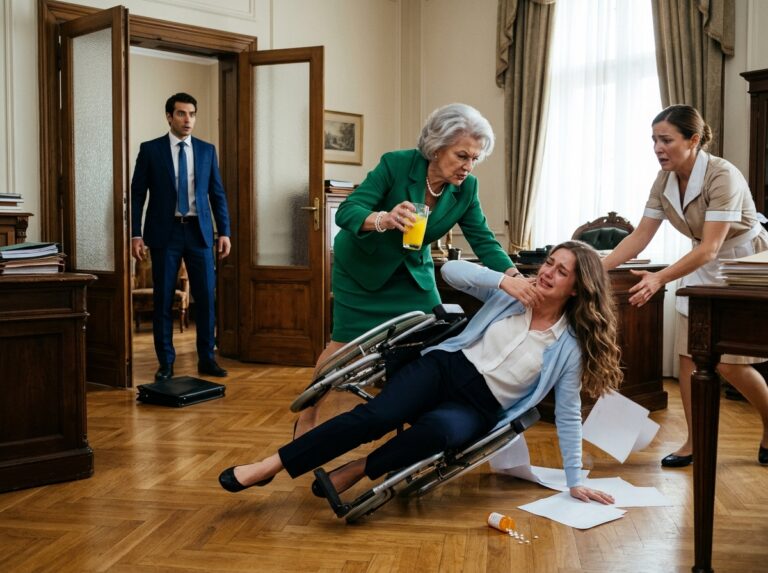
I fell backward, tumbling down six steep hardwood steps before my left foot buckled violently beneath me with a sickening CRACK that echoed through the empty house.
Pain exploded through my ankle—a blinding, white-hot agony that tore a scream from my throat.
I crumpled at the landing, clutching my leg, tears instantly springing to my eyes.
Melanie stood at the top of the stairs, looking down at me.
She didn’t panic.
She didn’t rush to help.
She slowly walked down the steps, stood over my writhing body, and looked down with utter disdain.
“Look at you,” she whispered coldly.
“Clumsy old woman.
You fell down the stairs.
That’s what happens when you don’t watch your step.”
At that exact moment, the front door unlocked, and Jeffrey walked in.
He saw me crumpled on the floor, weeping in pain, and saw Melanie standing over me.
“What happened?!”
Jeffrey gasped.
“She tripped,” Melanie said smoothly, without missing a beat.
“She was arguing with me about her medication and lost her balance.
I tried to catch her, Jeff, but she fell.”
Jeffrey looked down at me.
For a split second, I looked into my son’s eyes, praying—hoping against hope—that some remnant of the boy I raised would surface, that he would kneel down, hold his mother, and call an ambulance.
Instead, Jeffrey’s face hardened into a sneer.
“Jesus, Mom,” Jeffrey snapped, shaking his head with disgust.
“Can’t you do anything right?
You’re a complete embarrassment.”
They didn’t call 911 for forty-five minutes.
They sat in the kitchen, whispering and agreeing on their story, leaving me lying on the cold hardwood floor in blinding agony, clutching my broken ankle, before Jeffrey finally dialed emergency services and reported that his “elderly, confused mother had taken a bad spill.”
When the paramedics arrived, I let them lift me onto the gurney.
I didn’t accuse Melanie in front of the EMTs.
I kept my mouth shut, crying quietly, letting Jeffrey and Melanie play the devoted, worried children to the ambulance crew.
At the hospital, the X-rays revealed a severe compound fracture of the fibula and a shattered ankle joint.
The doctor put my foot in a heavy, permanent plaster cast and gave me crutches.
When Jeffrey and Melanie brought me home from the hospital the next day, they thought they had won.
They thought I was broken, terrified, and completely subjugated.
What they didn’t know was that during the entire confrontation on the staircase, I was wearing a high-definition body wire concealed as a silver brooch on my cardigan—a gift from Ethan Vance.
Not only had the pinhole camera in the hallway ceiling captured Melanie shoving me with maximum force, but my brooch had recorded her voice saying, “Clumsy old woman… That’s what happens when you don’t watch your step,” followed by Jeffrey’s refusal to call an ambulance for nearly an hour.
I had the assault on tape.
I had the attempted cover-up on tape.
I had the financial theft documented to the penny.
The trap was fully baited.
And Christmas Eve was the execution date.
For the next week leading up to Christmas, I played the helpless invalid to perfection.
I stayed in my room, speaking in hushed, trembling tones, letting Melanie handle the dinner arrangements.
They decided to throw a lavish Christmas Eve dinner at my house, inviting our entire extended family and several prominent community members.
They wanted to show off the estate they believed was now practically theirs, positioning themselves as the head of the Reynolds family while subtly establishing to everyone that I was “too frail” to govern my own life.
I let them invite everyone.
In fact, I secretly asked my lawyer to ensure a few special guests were added to the list.
Which brings us back to where we started: Christmas Eve, 7:30 PM.
I stood in the dining room, leaning on my crutches, my left foot encased in plaster.
Jeffrey had just delivered his cold, arrogant line—“My wife just wants you to learn from this, Mom”—to the horrified silence of the dining table.
And then, the doorbell rang.
Jeffrey scoffed, stepping out of the dining room into the foyer to open the front door.
“Probably some lost delivery driver,” he muttered.
He pulled the heavy oak door open.
Standing on the snow-dusted front porch were four people.
In the front was Detective Ethan Vance, holding a thick leather binder.
Beside him stood Assistant District Attorney Marcus Miller from the Kings County District Attorney’s Office.
Behind them stood two uniformed NYPD officers, their badges gleaming under the porch lights.
Jeffrey blinked, steeled his voice, and tried to assume an air of wealthy authority.
“Can I help you, officers?
We’re having a private family Christmas dinner.”
“Jeffrey Reynolds?”
Detective Vance asked, his voice echoing clearly into the silent dining room.
“Yes?”
Jeffrey replied, frowning.
“I am Detective Vance, and this is Assistant District Attorney Miller.
We have a warrant for your arrest, as well as an arrest warrant for Melanie Reynolds.”
A collective gasp rippled through the dining room behind Jeffrey.
Melanie shot up from her chair, her face draining of all color.
“What?!
This is insane!
What are you talking about?!” she shrieked, rushing toward the foyer.
Jeffrey backed up as the officers stepped inside the house, shutting the door behind them.
“This is a absurd mistake!
My mother is elderly and confused—did she call you with some crazy story?!”
“No, Mr.
Reynolds,” ADA Miller said coolly.
“Your mother didn’t just call us.
She provided us with two months of forensic accounting, bank records, and high-definition audio and video surveillance.”
Jeffrey turned around, his eyes wide with horror, looking at me where I stood at the edge of the dining room.
“What did you do?!”
Jeffrey yelled at me, his voice cracking.
“What lies did you tell them?!”
I didn’t answer him.
Instead, I calmly reached into my cardigan pocket, pulled out a small remote control, and pointed it at the massive 75-inch smart TV mounted on the living room wall—a TV visible to every single guest sitting at the dining table.
I pressed Play.
The TV screen flickered to life.
First, a crystal-clear audio recording filled the room through the home’s surround-sound speakers.
It was the recording from the kitchen vent:
Melanie’s voice: “When is the old woman actually going to die? She’s 68. She could linger until she’s 90. We can’t keep paying minimum balance on our debts while sitting on four million dollars… If we get her to sign the financial power of attorney, we can transfer the ownership into our LLC before she even realizes what happened.”
Jeffrey’s voice: “What if she refuses to sign?”
Melanie’s voice: “Then we make her life so miserable that she has no choice. Or we speed things up. An old woman slipping on the icy front porch steps? Nobody questions that, Jeffrey.”
The dining room erupted into chaotic gasps and cries of horror.
My sister-in-law Clara covered her mouth with both hands, staring at Jeffrey in absolute revulsion.
Uncle Thomas stood up, his face red with fury, glaring at my son.
“Jeffrey… my God…”
Clara sobbed.
“How could you?!”
“It’s fake!
It’s an AI voice generator!
She edited it!”
Melanie screamed, her voice reaching a hysterical pitch.
“Jeffrey, tell them it’s fake!”
“Press button two, Sophia,” Detective Vance said quietly.
I pressed the second button on the remote.
The screen shifted to 4K video footage—taken from two angles.
The main video showed the top of the staircase eight days ago.
The full room watched as Melanie snarled at me, grabbed my cardigan, and pushed me violently backward down the flight of stairs.
They watched me tumble down, heard the sickening CRACK of my ankle breaking, and heard my agonizing scream.
Then the video showed Melanie walking down the stairs, staring down at my crippled body, and saying: “Look at you. Clumsy old woman. You fell down the stairs.”
And finally, the video captured Jeffrey walking through the front door, looking at his mother weeping in blood and agony, and saying: “Jesus, Mom. Can’t you do anything right? You’re a complete embarrassment.”—before showing them waiting forty-five minutes to call 911 while they coordinated their lie.
The silence that followed in that house was heavier than a graveyard.
Every relative, every friend at that table looked at Jeffrey and Melanie not just with anger, but with absolute, irredeemable disgust.
They looked at them like they were monsters, venomous parasites who had tried to destroy the woman who had fed and sheltered them.
Jeffrey was shaking uncontrollably, his skin a sickly, ghostly grey.
He looked at the family members who were staring at him with pure hatred.
He looked at his wife, who was hyperventilating against the wall.
“Mom…”
Jeffrey stammered, stepping toward me, his hands outstretched, tears spilling down his cheeks.
“Mom, please… it wasn’t like that…
Melanie made me… she pushed me into this!
You know I love you, Mom!
I’m your son!
Your only child!”
“Don’t you dare touch her!”
Uncle Thomas roared, stepping in front of me, his fists clenched.
“You repulsive coward!”
I stepped around Thomas, leaning on my crutches, and looked my son dead in the eyes.
The love I had carried for him for thirty-two years was gone, replaced by the cool, unyielding clarity of a woman who had survived the fire.
“You aren’t my son, Jeffrey,” I said, my voice steady, ringing clearly through the grand hall.
“My son died the day he decided my life was worth less than a ledger balance.
You wanted me to learn a lesson?
Well, tonight, I’m teaching you one.”
Detective Vance stepped forward.
“Jeffrey Reynolds, Melanie Reynolds, you are under arrest for Grand Larceny, Corporate Embezzlement, First-Degree Assault, Reckless Endangerment, Fraud, and Elder Abuse.
Turn around and place your hands behind your back.”
Melanie lost her mind.
She shrieked, clawing at the officers as they grabbed her wrists.
“Get off me!
Jeffrey, do something!
You useless idiot, do something!”
Jeffrey didn’t move.
He sobbed openly as the cold steel handcuffs clicked around his wrists.
He looked back at me one last time as the officers marched him toward the door, his eyes begging for mercy he knew he didn’t deserve.
“Merry Christmas, Jeffrey,” I said softly as the door clicked shut behind them.
The legal fallout was swift, total, and merciless.
With the overwhelming mountain of video evidence, audio recordings, bank audits, and witness testimonies from that Christmas Eve, neither Jeffrey nor Melanie stood a chance in court.
Eleanor Sterling and the District Attorney’s office ensured that no plea bargains were granted without severe prison terms.
Melanie was convicted of First-Degree Assault, Fraud, Elder Abuse, and Conspiracy.
She was sentenced to twelve years in Bedford Hills Correctional Facility.
Jeffrey was convicted of Grand Larceny, Embezzlement, Conspiracy, and Criminal Negligence/Elder Abuse.
He received eight to ten years at Sing Sing Correctional Facility.
Furthermore, through civil litigation, Eleanor Sterling successfully asset-stripped everything Jeffrey and Melanie owned to repay the $298,000 they had stolen from my accounts and the bakeries, along with legal fees and punitive damages.
They were left bankrupt, disgraced, and imprisoned.
Six months later, the plaster cast was long gone from my leg.
After intensive physical therapy, I was walking again—unassisted, strong, and upright.
I sold the large Victorian brownstone in Brooklyn.
It had too many dark ghosts, too many lingering echoes of betrayal.
With the proceeds of the sale, I established The Richard & Sophia Reynolds Foundation—a non-profit organization dedicated to providing legal aid, emergency housing, and financial assistance to elderly victims of domestic abuse and financial exploitation.
I moved into a beautiful, light-filled penthouse apartment overlooking Prospect Park.
I returned to running Four Corners Bakeries full-time, expanding our staff, mentoring young bakers, and honoring the legacy that Richard and I built together with our own hands.
Sometimes, people ask me if I feel guilty about sending my only child to prison.
I look out over the green canopy of the park, hold my warm cup of tea, and think of that freezing Sunday morning in the kitchen.
I think of the sickening crack of my ankle on the oak stairs, and the cold laugh of a son who watched his mother bleed and called her an embarrassment.
Trust is a sacred gift.
It is earned through loyalty, nurtured through love, and protected through honor.
If you throw it away for greed, if you strike the hand that fed you, you had better be prepared for the moment that hand turns into a fist.
I am Sophia Reynolds.
I am 68 years old.
I am a survivor, a businesswoman, and a woman who took her life back.
And for the first time in three long years, I am finally at peace.