CHAPTER 1:
I knew I was late before my hand touched the front door.
The porch light was already on.
The windows glowed warm.
And through the crack under the door, I could smell roasted chicken.
My stomach twisted so hard it almost hurt.
I had not eaten since lunch.
Tutoring ran long because my math test was the next morning, and Mrs. Ellison stayed after school to help three of us review fractions and equations until the janitor started turning lights off.
Before tutoring started, I texted Vanessa.
Tutoring until 7. I’ll be home right after.
She replied with one word.
Fine.
That word had sat in my stomach for two hours.
Fine never meant fine with Vanessa.
It meant she was saving the punishment for later.
Still, when I opened the door and saw Caleb and Ava at the dining table, I tried to hope.
Their plates were almost empty.
Vanessa stood near the sink, stacking dishes with sharp, quiet movements.
One covered plate sat on the kitchen counter.
My shoulders loosened a little.
Maybe tonight would be different.
Maybe she really had saved me food.
I stepped inside and closed the door carefully.
“Sorry I’m late,” I said.
Nobody answered at first.
Caleb looked up from his plate.
He was fourteen, two years younger than me, and he had the kind of face that gave away the truth before his mouth could hide it.
Ava, who was eleven, stared at her fork like she wanted to disappear into it.
Vanessa turned.
She smiled.
That scared me more than if she had frowned.
“Hello, Nia.”
My backpack was still hanging from one shoulder.
My legs ached from walking home fast.
“Did you save me dinner?” I asked.
The words came out smaller than I meant.
Vanessa glanced at the covered plate.
“I did.”
Relief moved through me so quickly I almost smiled.
I walked toward the counter.
The smell hit me harder there.
Chicken.
Potatoes.
Green beans.
Still warm.
I had skipped the granola bar Mrs. Ellison offered because I thought I should not spoil dinner.
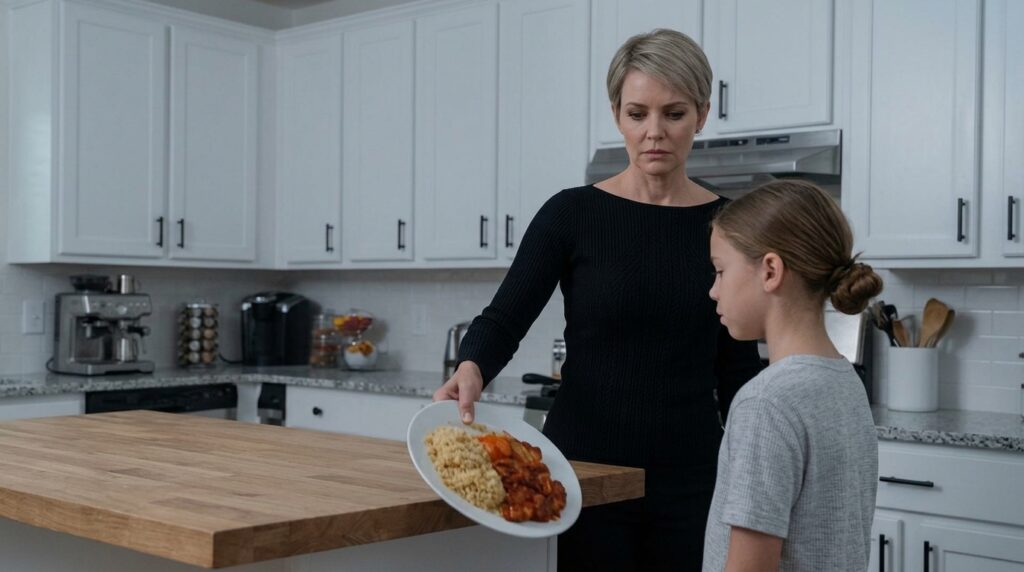
I reached for the plate.
Vanessa picked it up first.
For one tiny second, I thought she was handing it to me.
Then she turned away.
She walked to the trash can.
Pressed the pedal.
The lid opened.
And she dumped the whole meal inside.
The chicken hit the garbage with a soft, wet thud.
Potatoes rolled over a crumpled napkin.
Green beans scattered across a paper towel stained with coffee.
The lid fell shut.
The sound was small.
It still felt like a slap.
“You missed dinner,” Vanessa said.
I stood there with my hand still half-raised.
For a moment, I thought I had misunderstood what my own eyes had seen.
“I was at tutoring,” I said.
Vanessa wiped her hands on a towel.
“That does not change dinner time.”
Caleb’s fork stopped in the air.
“Mom, she told you.”
Vanessa looked at him.
One look.
Enough to make him lower his eyes.
“Stay out of it.”
Ava’s lips pressed together.
She looked like she might cry, and that made me feel worse.
I hated when they got pulled into it.
I hated that my hunger could become a whole room’s fear.
I looked at the trash can.
The lid had not closed all the way.
A piece of chicken showed near the top.
I was hungry enough that, for one terrible second, my body wanted to reach for it.
That shame burned hotter than anger.
I turned toward the refrigerator.
“I’ll just get something small.”
Vanessa moved faster than I expected.
She stepped in front of the refrigerator doors and folded her arms.
“Kitchen’s closed.”
I stopped.
“Please. Just yogurt or bread.”
“You should have been home when everyone else ate.”
“I texted you.”
“And I said fine.”
Caleb whispered, “This isn’t fair.”
Vanessa snapped her head toward him.
“I said stay out of it.”
Ava pushed back her chair a little.
“But Mom, she has a test tomorrow.”
Vanessa’s voice dropped.
“Ava.”
Ava froze.
I could feel the whole house tightening around us.
I lowered my eyes because I had learned that looking too hurt made Vanessa meaner.
“Okay,” I said.
The word tasted like dust.
I turned toward the stairs.
I told myself I could drink water from the bathroom sink.
I told myself I had gone hungry before.
I told myself morning was not that far away.
Then the front door opened.
Cold air rushed in.
My father stepped inside carrying his travel bag.
He was supposed to come home the next afternoon.
His final meeting had ended early.
For one second, he smiled.
Then he saw me.
My backpack.
My face.
Caleb and Ava’s stiff bodies at the table.
Vanessa standing in front of the refrigerator like a guard.
“Dad?” I whispered.
He set his bag down slowly.
“What’s going on?”
Nobody answered.
His eyes moved around the kitchen.
The empty plates.
The covered dish that was no longer there.
The trash can lid that had not shut completely.
The chicken visible on top.
His smile disappeared.
“Why is Nia’s dinner in the trash?”
Vanessa answered too fast.
“She already ate at school.”
My father looked at me.
“Nia?”
I looked at Vanessa first.
I hated myself for that.
Even with Dad standing right there, I still checked her face to see what truth would cost.
Then I looked back at him.
“No, Dad.”
The room changed.
Not loudly.
But completely.
Ava put her fork down.
Her voice trembled.
“Dad… she does this when you travel.”
Vanessa spun toward her.
“Ava.”
But Dad had already heard.
He turned toward the refrigerator again.
That was when he saw what I had stopped noticing because noticing hurt too much.
A small combination lock hooked through the two refrigerator handles.
Silver.
Tight.
Ugly.
My father walked toward it.
His steps were slow.
He touched the lock like he could not believe it was real.
Then he looked at Vanessa.
“Why is there a lock on my refrigerator?”
Vanessa said nothing.
Caleb looked at Dad.
His voice came out barely above a whisper.
“It’s not there for us.”
Dad turned to me.
I wanted to be angry.
I wanted to cry.
But all I felt was embarrassed.
Embarrassed that he saw.
Embarrassed that Caleb and Ava knew.
Embarrassed that the chicken in the trash was mine.
And when my father looked from the lock to my face, I saw something break in him.
That was the moment he understood.
The lock had been there far longer than tonight.
CHAPTER 2:
Dad did not shout at first.
That made it worse.
He stood in front of the refrigerator with his hand still resting on the small silver lock.
His face had gone pale.
Not confused anymore.
Not tired.
Pale in the way people look when the truth walks into a room and sits down without asking permission.
“Open it,” he said.
Vanessa lifted her chin.
“Marcus, let’s not do this in front of the children.”
Dad turned.
His voice stayed quiet.
“They are children. That is exactly why we are doing this in front of them.”
Caleb stared at the table.
Ava’s eyes filled with tears.
I could not move.
My backpack strap dug into my shoulder, but I could not make my hand let go of it.
Vanessa smiled tightly.
“Nia has been sneaking food at night. I put a lock on the refrigerator because she has no self-control.”
My face burned.
“That’s not true.”
Vanessa looked at me like I had disappointed her by breathing.
“Nia.”
Dad stepped between us.
“Don’t say her name like that.”
The room went silent.
Vanessa blinked.
It was the first time I had ever heard Dad use that tone with her.
She recovered quickly.
“She lies, Marcus. You know she lies when she feels cornered.”
“I know she looks terrified.”
His words hit me so hard I looked down.
Terrified.
Was I?
I thought I had hidden it better.
Dad pointed at the lock.
“Open it.”
Vanessa crossed her arms.
“No.”
Dad’s jaw tightened.
“Then give me the combination.”
“This is absurd.”
“Give me the combination.”
“She needs boundaries.”
“She needs dinner.”
I started crying then.
Not loud.
Just tears spilling before I could stop them.
I hated that.
Vanessa saw and sighed.
“There it is. The performance.”
Dad’s hand slammed flat against the refrigerator door.
Ava gasped.
Caleb flinched.
I did too.
Dad looked at all of us.
His anger vanished from his face for one second, replaced by horror.
“I’m sorry,” he said quickly. “I’m sorry. I should not have slammed it.”
That apology shocked me almost as much as the slam.
In our house, adults usually made loud sounds and waited for children to apologize for reacting.
Dad took a breath.
Then he pulled out his phone.
“What are you doing?” Vanessa asked.
“Calling a locksmith.”
Her face changed.
“It’s a refrigerator, Marcus.”
“It is food in my house being locked away from my daughter.”
“Our daughter,” Vanessa snapped.
Dad looked at her.
“No. Do not use that word tonight.”
The air left the room.
Vanessa’s cheeks went red.
“I raised her after her mother died.”
I closed my eyes.
There it was.
The sentence she always used when she wanted me to owe her.
Dad did not soften.
“You lived in the same house as her.”
Vanessa recoiled like he had slapped her.
“That is cruel.”
“No,” he said. “What you did is cruel.”
She pointed toward me.
“You have no idea what she is like when you are gone.”
Dad turned to Caleb and Ava.
His voice softened.
“Do you two know the combination?”
Caleb shook his head.
Ava whispered, “Mom changes it.”
Dad shut his eyes.
Changes it.
Not changed.
Changes.
Like it was a routine.
Like laundry.
Like grocery lists.
He looked at me.
“Nia, how long?”
My mouth opened.
No sound came.
Vanessa stepped forward.
“She is not answering that.”
Dad did not look away from me.
“How long has the refrigerator been locked when I travel?”
I swallowed.
“Since spring.”
His face collapsed.
Spring.
It was November.
Dad turned away for a moment, one hand covering his mouth.
I had never seen him look like that.
He looked like he might be sick.
Caleb spoke then.
“It started when you went to Chicago.”
Vanessa hissed, “Caleb.”
He lifted his head.
“No. I’m done.”
His voice shook, but he kept going.
“She said Nia ate too much cereal while you were gone. So she locked the fridge. Then the pantry. Then she started putting notes on the snacks.”
Dad looked at the pantry.
I wished Caleb had stopped.
I wished he had kept going.
Both feelings fought inside me.
Dad walked to the pantry door.
There was no lock there now.
Vanessa had taken it off that afternoon because Dad was supposed to come home tomorrow.
But when Dad opened the door, the truth was still there.
Sticky notes.
Names.
Caleb.
Ava.
Vanessa.
None for me.
Dad stared.
Ava began to cry.
“I gave her crackers sometimes,” she whispered. “But Mom said if I did, I couldn’t go to Mia’s birthday party.”
I turned toward her.
“Ava.”
“I’m sorry,” she sobbed.
My anger broke in half.
Ava was eleven.
She was not the one who made the rules.
Dad crossed the kitchen and knelt beside her chair.
“Ava, look at me.”
She shook her head.
He waited.
Finally, she looked.
“You are not in trouble for being scared of an adult,” he said.
She cried harder.
Vanessa laughed once.
“Oh, wonderful. Now you are teaching them to disrespect me.”
Dad stood.
“I’m teaching them they are safe to tell the truth.”
My whole chest hurt.
Safe.
That word did not fit inside our kitchen yet.
Dad called Uncle Darius, his younger brother.
Then he called a locksmith.
Then he called the hotel near the freeway.
Each call made Vanessa angrier.
“You are not leaving,” she said.
Dad put his phone down.
“Yes, we are.”
“We?”
“All three kids and me.”
Ava looked up, startled.
Caleb too.
I stared at Dad.
Vanessa’s face went white.
“You are not taking my children.”
Dad’s eyes hardened.
“I adopted Caleb and Ava three years ago. They are my children too.”
“You have no right to rip them from their mother.”
“I have every right to remove them from a house where food is used as punishment.”
Her mouth opened.
Closed.
Then she turned to Caleb.
“Tell him you want to stay.”
Caleb looked at her.
He was shaking.
Then he looked at me.
Then Ava.
Then Dad.
“I don’t,” he whispered.
Vanessa’s face changed like someone had cut a wire inside her.
“Ava?”
Ava cried harder.
“I want to go with Dad.”
For the first time all night, Vanessa looked truly afraid.
Not sorry.
Afraid.
Dad moved quickly after that.
He told us to pack overnight bags.
I went upstairs with shaking legs.
My room looked the same.
Bed made.
Desk neat.
Math book open.
But everything felt different.
I opened my backpack first.
Inside was an unopened granola bar Mrs. Ellison had forced into my hand.
I had forgotten it.
My hands trembled as I tore it open.
I ate half in three bites.
Then I cried because eating secretly still felt like stealing.
A soft knock came.
Caleb stood in my doorway holding a paper plate.
On it were two rolls wrapped in a napkin.
“I hid these,” he said.
I stared at him.
“For you.”
My throat closed.
“I’m sorry I didn’t say more sooner.”
I took the plate.
His eyes were red.
“I was scared too.”
“I know.”
I did not know if that was forgiveness.
But it was true.
Downstairs, I heard Vanessa yelling.
Dad did not yell back.
That scared her more.
Twenty minutes later, we stood in the entryway with bags.
Vanessa blocked the front door.
“You are destroying this family,” she said.
Dad held Ava’s backpack in one hand and my coat in the other.
“No,” he said. “I just finally saw what was destroying it.”
Then Uncle Darius arrived.
The doorbell rang.
Vanessa flinched.
Dad opened the door before she could stop him.
Uncle Darius stood on the porch, broad-shouldered and furious, with a paper grocery bag in his arms.
He looked at me first.
Then Caleb.
Then Ava.
Then the bag.
“I brought sandwiches,” he said.
And somehow, that was when I started sobbing.
CHAPTER 3:
I ate my sandwich in the back seat of Uncle Darius’s truck.
Turkey and cheese.
Too much mustard.
The bread was slightly crushed because he had probably thrown the bag together in a panic.
It was the best thing I had ever tasted.
Ava sat beside me with a blanket over her lap.
Caleb sat on her other side, staring at his hands.
Dad drove his SUV ahead of us.
Uncle Darius drove behind him like a guard.
Vanessa had stood on the porch as we left.
She did not cry.
She filmed us with her phone.
That scared me more than tears would have.
People who filmed pain were usually planning to edit it later.
At the hotel, Dad checked us into two connecting rooms.
He handed keys to everyone.
Even me.
Especially me.
“Your room key,” he said.
I stared at the plastic card in my palm.
A key.
Access.
A door I could open myself.
Ava leaned against my side in the elevator.
She was still crying silently.
Caleb kept looking at Dad like he expected him to change his mind.
The rooms smelled like soap and carpet cleaner.
Nothing like home.
That helped.
Dad set our bags down.
Then he ordered room service before anyone could say we were not hungry.
Burgers.
Soup.
Fruit.
Milk.
Fries.
Three desserts.
Ava whispered, “That’s too much.”
Dad looked at her.
“No food in this room is earned. No food in this room is punishment. If you are hungry, you eat. If you are full, you stop. No one gets in trouble either way.”
I had to sit down.
The words were too simple.
Too impossible.
Caleb turned away and wiped his face.
Uncle Darius stood near the window, arms folded so tight his knuckles looked pale.
He was trying not to explode.
I could tell.
Dad could too.
“Darius,” Dad said quietly.
Uncle Darius looked at him.
“Not now.”
“I need calm.”
“You need a lawyer.”
“I called one.”
“Good. Then I can be mad.”
Dad’s face tightened.
“I’m mad too.”
Uncle Darius looked at me, then Ava, then Caleb.
His voice dropped.
“I know.”
Room service arrived.
The man wheeled in the cart and smiled politely, unaware he was delivering proof that the world had not ended.
I stared at the food.
My body wanted all of it.
My shame wanted none of it.
Dad noticed.
He sat across from me.
“Nia.”
I looked down.
“Eat what you want.”
“What if I eat too much?”
His face broke.
“Then we will learn together that too much food is not a crime.”
I picked up a fry.
Nobody commented.
I ate it.
Then another.
Ava took a bite of soup.
Caleb ate half a burger in silence, then suddenly dropped it and covered his face.
“I let it happen,” he said.
Dad moved toward him.
Caleb shook his head.
“No. Don’t. I did. I watched.”
“You are fourteen.”
“I’m old enough to know wrong.”
“You are also young enough to be afraid.”
Caleb cried harder.
“She said if I told you, you’d think I was lying because I didn’t like sharing with Nia.”
I froze.
Dad looked at him.
“Sharing?”
Caleb nodded miserably.
“She said Nia already took Mom’s place in the house.”
Ava whispered, “She said Nia took your attention too.”
My stomach twisted.
Dad sat back slowly.
Vanessa had not only punished me.
She had taught them that loving me cost them something.
Dad rubbed both hands over his face.
“I need to ask questions,” he said. “But not tonight.”
Uncle Darius said, “Tonight they sleep.”
“I know.”
But none of us slept much.
I woke around midnight to voices in the connecting room.
Dad and Uncle Darius.
Low.
Tense.
I did not mean to listen.
I did anyway.
“How did I not see this?” Dad asked.
“You trusted your wife.”
“I left my daughter hungry.”
“You didn’t know.”
“I should have known.”
“Yes,” Uncle Darius said.
The honesty made me hold my breath.
Dad was silent.
Then Uncle Darius continued.
“And now you do. So don’t waste time drowning in guilt. Swim.”
I heard Dad make a broken sound.
“I saw the lock, Darius.”
“I know.”
“A lock. On the refrigerator. In my own house.”
“I know.”
“She looked embarrassed. Not angry. Embarrassed.”
My eyes filled in the dark.
Dad had noticed.
He had noticed the thing I wished nobody saw.
Uncle Darius’s voice softened.
“Then tomorrow, you make sure she never has to be embarrassed about needing food again.”
The next morning, Dad took photos of the pantry notes and the refrigerator lock before the locksmith removed it.
A locksmith actually came.
He cut the lock off and placed it in Dad’s hand.
Dad stared at it like it was evidence from a crime scene.
Maybe it was.
Then Ms. Reina Cole arrived.
She was Dad’s lawyer.
Small woman.
Gray suit.
No nonsense.
She sat with us in the hotel conference room, notepad open.
“I know this is difficult,” she said. “But I need to understand the pattern.”
Pattern.
That word made me cold.
Because pattern meant it was not one bad night.
Dad sat beside me.
Caleb and Ava sat across from us.
Uncle Darius stood at the back wall like a security guard.
Ms. Cole asked about food first.
When did the lock begin?
When Dad traveled.
When did Vanessa deny meals?
If I came home late.
If I talked back.
If my grades slipped.
If I did not finish chores before dinner.
If I “looked ungrateful.”
Dad’s hand tightened around his pen until it cracked.
Ink bled onto his thumb.
He did not notice.
Ms. Cole asked if Vanessa denied food to Caleb or Ava.
They said no.
Sometimes snacks were restricted.
But not like mine.
That made me feel worse.
Special.
Chosen.
Targeted.
Then Ms. Cole asked about Dad’s travel schedule.
I answered before I could stop myself.
“She got worse the day before he left.”
Dad turned to me.
“How?”
I picked at my sleeve.
“She would say, ‘Your father won’t be here to rescue your attitude.’”
Ava nodded.
“She said that a lot.”
Caleb added, “She kept a notebook.”
Everyone looked at him.
“What notebook?” Ms. Cole asked.
Caleb swallowed.
“In the laundry room cabinet. She wrote down what Nia ate, what time she came home, stuff she did wrong.”
My skin crawled.
Dad stood immediately.
“Marcus,” Ms. Cole said.
He stopped.
“Do not go alone. We will request retrieval with documentation.”
Dad sat down slowly.
His breathing had changed.
He looked at me.
“I’m sorry.”
I nodded once.
I could not absorb more apologies yet.
Ms. Cole continued gently.
“Were there other punishments?”
I looked at Caleb.
Then Ava.
Ava whispered, “Basement.”
The room went still.
Dad’s voice dropped.
“What about the basement?”
Ava began crying again.
Caleb reached for her hand.
Vanessa had always called it the quiet room.
It was just the basement storage area, with old furniture and holiday bins.
When Dad traveled, and I argued or cried or asked for food after the kitchen was closed, Vanessa made me sit down there on the old rug beside the furnace.
No phone.
No light except the pull-chain bulb.
Sometimes twenty minutes.
Sometimes longer.
“Only when I was being dramatic,” I said automatically.
Dad closed his eyes.
Ms. Cole leaned forward.
“Nia, whose words are those?”
I swallowed.
“Vanessa’s.”
The conference room seemed to shrink.
Dad whispered, “How many times?”
“I don’t know.”
“How many?”
I looked down.
“Enough that I stopped counting.”
That was when Dad got up and left the room.
Uncle Darius followed.
Through the glass wall, I saw Dad bend forward in the hallway with both hands on his knees.
I saw Uncle Darius put one hand on his back.
And for the first time, I understood that the truth did not only hurt the person who lived it.
It hurt the people who should have stopped it.
CHAPTER 4:
Vanessa started calling before noon.
Dad did not answer.
Then she started texting.
At first, the messages were angry.
You are humiliating me.
You are confusing the children.
Nia is manipulating you.
Then they turned soft.
Marcus, I love you. Please come home.
We can fix this privately.
You know how sensitive Nia is.
Then came the threat.
If you keep my children from me, I will tell everyone what really happened when Nia’s mother died.
My whole body went cold when Dad read that one.
He went still in a way that frightened me.
My mother had died when I was ten.
A car accident.
Rain.
A driver who crossed the center line.
That was what I knew.
That was what Dad told me.
That was what was real.
Right?
Dad looked at me, then back at the phone.
Vanessa had never known much about my mother, except what she could turn into a weapon.
Ms. Cole asked to see the message.
Her face hardened.
“What does she mean?”
Dad’s jaw worked.
“Nothing true.”
I stared at him.
“Dad.”
He looked at me.
“Nia, your mother’s death was an accident.”
“Then why would she say that?”
“Because she wants fear in the room.”
“But what does she think she knows?”
He rubbed his forehead.
“The night your mom died, we had argued.”
The air left my lungs.
Dad sat down across from me.
He looked older than he had yesterday.
“Not a huge argument. Not the kind people imagine. We were tired. Money was tight. I was supposed to pick up dinner. She said she would go because I had worked late all week. I let her.”
His voice broke.
“She died on the way back.”
I could not speak.
Dad’s eyes filled.
“For years, I blamed myself because if I had gone, maybe she would still be here. Vanessa knew that. I told her when we were first married.”
“And she told you it was your fault?”
His silence answered.
I felt sick.
Vanessa had used my hunger.
Caleb’s fear.
Ava’s obedience.
Dad’s grief.
Nothing was sacred to her.
Dad reached toward me, then stopped, asking without words.
I let him take my hand.
“Your mother loved you,” he said. “Her death was not caused by you. Not by me. It was caused by a driver who lost control in the rain.”
I nodded, but the room blurred.
“She used Mom?”
Dad’s voice turned rough.
“Yes.”
Something hardened inside me.
Not hatred.
Something cleaner.
Enough.
Ms. Cole recommended an emergency family court filing.
Because Caleb and Ava were legally Dad’s adopted children, he could seek temporary custody and exclusive use of the house if he proved emotional abuse and coercive control.
Those words sounded too big for our kitchen.
Too official for trash chicken and refrigerator locks.
But they fit.
Before the filing, Dad and Uncle Darius went back to the house with police standby and Ms. Cole’s assistant to collect essentials and preserve evidence.
I stayed at the hotel with Caleb and Ava.
We sat on the floor with takeout noodles none of us really ate.
Ava leaned against the bed.
“Do you hate us?” she asked suddenly.
I looked at her.
“What?”
“For eating when you couldn’t.”
My chest tightened.
“No.”
“But I did.”
“You’re eleven.”
“I knew it was wrong.”
“You were scared.”
She wiped her face.
“I should’ve saved more.”
I moved beside her.
“You saved what you could.”
Caleb stared at his noodles.
“I didn’t.”
“Yes, you did,” I said. “You gave me rolls.”
“One time.”
“More than one.”
“Not enough.”
I did not know how to comfort him without lying.
So I said, “Maybe we can be braver now.”
He nodded, crying silently.
When Dad returned, he had boxes.
My clothes.
School bag.
A framed picture of Mom I kept hidden in my closet.
And the notebook.
Vanessa’s notebook.
Dad placed it on the table like it might bite.
Ms. Cole opened it with gloves.
The first page had my name.
NIA — BEHAVIOR AND FOOD ISSUES.
My throat tightened.
Entries filled the pages.
Monday: refused tone correction. No dessert.
Thursday: came home late. Dinner withheld.
Saturday: excessive cereal. Pantry restriction.
Dad’s face went from pale to red to something empty.
Then Ms. Cole turned a page and froze.
“What?” Dad asked.
She looked at him.
“There are weight notes.”
I stood up.
“No.”
Dad reached for the notebook.
Ms. Cole closed it.
“Marcus, not in front of her.”
But I had already heard.
Weight notes.
That explained the bathroom scale Vanessa made me stand on every Sunday.
She called it “health accountability.”
I called it wanting to disappear.
Dad looked at me.
“Nia?”
I stepped backward.
“No.”
“Nia.”
“No. I can’t.”
I ran to the bathroom and locked the door.
Then I laughed because there was a lock on the bathroom door and for once it protected me.
I slid down to the floor and pressed my palms over my ears.
Through the door, I heard Dad.
“I’m outside. I won’t come in. I just want you to know I’m here.”
I cried harder.
Not because he pushed.
Because he did not.
After a while, Ava’s voice came softly.
“Nia?”
I wiped my face.
“Yeah?”
“I left water by the door.”
I looked down.
A paper cup sat just outside, pushed close enough that I could reach it.
Beside it was a wrapped cookie from room service.
I opened the door a crack.
Ava sat cross-legged in the hallway.
Caleb sat beside her.
Dad sat farther down, giving space.
Uncle Darius leaned against the wall.
Nobody was angry.
Nobody told me I was dramatic.
I picked up the cookie.
My hands shook.
“Can I eat this here?”
Dad’s voice broke.
“You can eat anywhere you feel safe.”
I ate the cookie sitting on the bathroom floor.
It tasted like sugar and grief.
Later that night, Ms. Cole filed the emergency petition.
Vanessa sent one more message before Dad blocked everything except legal communication.
You will regret choosing that girl over your wife.
Dad stared at it.
Then he typed back one sentence, under Ms. Cole’s guidance.
I choose all three of my children.
He sent it.
Then he turned off the phone.
CHAPTER 5:
The emergency hearing happened two days later.
I had never been inside family court before.
It did not look like television.
No dramatic wood-paneled room.
No shouting lawyers pacing around.
Just a small courtroom with beige walls, fluorescent lights, and a judge who looked tired before anyone even spoke.
Vanessa arrived wearing a navy dress and pearls.
She looked like she was attending church.
Not like a woman who had dumped a child’s dinner into the trash.
She rushed toward Caleb and Ava first.
“My babies.”
Ava stepped behind Dad.
Caleb stiffened.
Vanessa stopped mid-step.
Her face flickered.
Hurt.
Anger.
Calculation.
Then she looked at me.
Her eyes changed.
“You,” she whispered.
Dad moved in front of me.
“Do not.”
Her lawyer touched her arm.
She swallowed the rest.
Inside the courtroom, Ms. Cole spoke first.
She did not exaggerate.
She did not need to.
She showed photos of the refrigerator lock.
Photos of the pantry notes.
Texts from me telling Vanessa about tutoring.
The picture of my dinner in the trash, taken by Dad before he threw it out and then cried because throwing it out again hurt him.
She introduced Vanessa’s notebook.
Not all of it.
Enough.
The judge read silently.
The room became so quiet I could hear the air conditioner.
Vanessa’s lawyer stood.
He said Vanessa was a strict parent.
He said blended families were complicated.
He said teenagers exaggerated hunger and punishment when they resented authority.
He said I had trouble adjusting after my mother’s death.
My nails dug into my palms.
Dad leaned close and whispered, “Breathe.”
I did.
Barely.
Then the judge asked Vanessa one question.
“Did you place a lock on the refrigerator?”
Vanessa sat straighter.
“Yes, Your Honor, but—”
“Yes or no.”
“Yes.”
“Was the lock used to prevent all three children from accessing food?”
Vanessa hesitated.
Her lawyer shifted.
“No.”
“Which child?”
Silence.
Then Vanessa looked at me.
The judge said, “Answer verbally.”
“Nia.”
The word sounded small in the courtroom.
The judge looked down at the notebook again.
“Did you track her food intake and weight?”
Vanessa’s face reddened.
“I was concerned about her health.”
I almost stood.
Dad put a hand over mine.
The judge’s voice sharpened.
“Did a medical professional instruct you to do that?”
“No, but—”
“Did her father consent?”
“I manage the household.”
“That is not what I asked.”
Vanessa’s mouth tightened.
“No.”
Then Caleb asked to speak.
Everyone turned.
Dad looked surprised.
Ms. Cole looked at him gently.
“Caleb, you do not have to.”
He swallowed.
“I want to.”
The judge allowed it.
Caleb walked to the front with shaking hands.
He looked smaller than fourteen.
He looked like a kid carrying adult weight in a backpack no one else could see.
The clerk swore him in.
Ms. Cole asked what happened when Dad traveled.
Caleb told the truth.
His voice trembled, but he did not stop.
He talked about the locked fridge.
The pantry notes.
The basement.
The way Vanessa warned him not to interfere.
Then he looked at his mother.
“She said Nia was ruining the family. But Mom was the one making everyone afraid.”
Vanessa began to cry.
Not soft tears.
Angry ones.
“Caleb, how can you say that?”
The judge looked over her glasses.
“Mrs. Ellis, you will not address the child.”
Ava did not testify.
She was too upset.
But Ms. Cole submitted a written statement from the child advocate who interviewed her that morning.
I did not know what Ava said until later.
All I knew was that when the judge read it, her face changed.
Then Dad spoke.
He stood at the front, hands shaking.
“I failed to see what was happening in my home,” he said.
Vanessa stared at him.
“I traveled for work. I trusted my wife. I accepted explanations that made my life easier because asking harder questions would have forced me to face conflict.”
His voice cracked.
“I cannot undo that. But I can stop it now.”
The judge looked at him for a long moment.
Then she issued the temporary order.
Dad received exclusive use of the house.
Vanessa had to leave within four hours with police standby.
Temporary custody of all three of us stayed with Dad.
Vanessa’s contact with Caleb and Ava would be supervised through a family therapist.
No contact with me.
No direct calls.
No texts.
No messages through other people.
A full investigation by child protective services.
A psychological evaluation.
A court-appointed therapist for the kids.
Vanessa stood up too fast.
“This is insane. She is not even my daughter.”
The room froze.
There it was.
The truth under everything.
She had raised me when it helped her look noble.
Rejected me when she wanted power.
Dad stood slowly.
“No,” he said. “She is mine.”
His voice filled the room.
“And you will never use that against her again.”
The judge warned Vanessa once.
Her lawyer pulled her back into her seat.
I could not breathe.
Not because I was scared.
Because for years, I had waited for someone to say that.
Mine.
Not burden.
Not problem.
Mine.
After court, Vanessa tried to reach Caleb in the hallway.
“Please,” she said. “You know I love you.”
Caleb stopped.
For a second, I thought he would fold.
Then he said, “I know you think you do.”
Her face crumpled.
He walked away.
Ava held my hand all the way to the parking lot.
Her palm was sweaty.
Mine was too.
At the hotel, Dad told us we could go home the next day after Vanessa moved out.
Home.
The word felt dangerous.
That night, none of us wanted room service.
Dad took us to a diner.
We sat in a booth by the window.
The waitress handed us menus.
Too many choices.
My eyes moved over pancakes, soup, burgers, salad, pie.
I could not decide.
Panic rose in me, sudden and stupid.
Dad noticed.
“No wrong answer,” he said softly.
I looked at him.
“What?”
“Order what you want. Eat what you want. Leave what you don’t. No wrong answer.”
The waitress waited kindly.
I ordered chicken soup and a grilled cheese.
Then I added fries, almost as a dare.
No one blinked.
When the food came, I ate slowly.
Every bite felt like stepping onto new ground.
Ava dipped fries into her milkshake.
Caleb called it disgusting.
Dad ordered apple pie for the table.
For the table.
Not assigned.
Not measured.
Just placed in the middle with four forks.
I took the first bite because Dad pushed it toward me.
The pie was warm.
Too sweet.
Perfect.
And for the first time in months, I went to bed full.
CHAPTER 6:
Going home felt nothing like I imagined.
I thought the house would feel free without Vanessa inside it.
Instead, it felt bruised.
Her shoes were gone from the entryway.
Her coat was gone from the closet.
Her favorite vase was missing from the dining room table.
But the walls still remembered her voice.
I did too.
The kitchen was the worst.
The refrigerator stood unlocked.
Dad had removed the silver lock, but two faint scratches remained on the handles where metal had rubbed metal.
I stared at them until my stomach turned.
Dad followed my gaze.
“I’m replacing it,” he said.
I looked at him.
“The whole fridge?”
“Yes.”
“That’s expensive.”
“So was pretending it was fine.”
I did not know what to say to that.
Caleb opened the pantry.
The sticky notes were gone.
Dad had thrown them out.
But the shelf spaces still looked divided in my mind.
Caleb.
Ava.
Vanessa.
Not me.
Ava stood beside me and whispered, “Can we rearrange everything?”
Dad turned.
“Yes.”
So we did.
That afternoon, we emptied the entire pantry onto the counters.
Cereal boxes.
Crackers.
Pasta.
Cans.
Granola bars.
Peanut butter.
Everything.
Dad handed me a marker.
“New labels,” he said.
I looked at him suspiciously.
He smiled sadly.
“Not names. Categories.”
Breakfast.
Snacks.
Dinner.
Baking.
Treats.
Ava made the labels colorful.
Caleb drew terrible little pictures on them.
A fish on the pasta.
A cow on the cereal for no reason.
I laughed more than I expected.
Then Dad opened the refrigerator and placed a clear plastic bin on the middle shelf.
Inside were yogurts, fruit cups, cheese sticks, and small sandwiches.
“This is the always bin,” he said.
Ava tilted her head.
“What does that mean?”
“It means anyone can take from it. Always. No permission needed.”
I stared at the bin.
My throat tightened.
“What if it runs out?”
“I refill it.”
“What if we take too much?”
Dad’s eyes filled.
“Then I buy more and we talk about hunger like normal people, not criminals.”
Caleb grabbed a yogurt immediately.
Then froze.
Dad nodded.
Caleb opened it.
Ava took grapes.
I did not take anything.
Not yet.
Dad saw.
He did not push.
That night, we ordered pizza.
Dad placed the boxes on the coffee table in the living room.
Vanessa had never allowed food on the couch.
Crumbs were “proof of laziness.”
Dad took a slice and sat on the floor.
Ava gasped.
“Dad.”
“What?”
“Floor pizza?”
“Is that illegal?”
Caleb grinned.
“Probably.”
I sat on the floor too.
Then Ava.
Then Caleb.
We ate pizza and watched a movie none of us followed because we kept laughing at nothing.
Halfway through, I reached for a second slice.
My hand stopped.
Dad did not say anything.
Nobody did.
I took it.
Nothing happened.
No look.
No comment.
No notebook.
Just pizza.
The next morning, Child Protective Services came.
A woman named Ms. Harper sat at our kitchen table with kind eyes and a tablet.
She spoke to each of us separately.
When it was my turn, I almost lied.
Not because I wanted to protect Vanessa.
Because truth felt messy.
I did not want strangers knowing about the basement.
The scale.
The trash.
The refrigerator.
The way I had learned to drink water before bed so my stomach would stop hurting.
Ms. Harper asked, “Did you ever feel unsafe at home?”
I looked at the new labels on the pantry.
Then at the scratches on the fridge.
“Yes.”
She did not gasp.
She did not look shocked.
She simply nodded and wrote it down.
“What helped you survive when it was hardest?”
The question surprised me.
I thought she would ask what Vanessa did.
Not what helped me survive.
I thought about it.
“School,” I said.
“Tutoring.”
“Caleb sometimes.”
“Ava sometimes.”
“My dad when he was home, but I didn’t tell him enough.”
Ms. Harper looked up.
“Nia, children are not responsible for making adults notice abuse.”
I stared at her.
She let the sentence sit.
I wanted to reject it.
I wanted to hold onto blame because blame felt like control.
But a part of me wanted to believe her so badly it hurt.
After CPS left, Dad took the refrigerator measurements.
He ordered a new one online with overnight delivery.
Then he called a family therapist.
Then a nutrition counselor.
Then my school.
I heard him in the study.
“My daughter may need support returning after a family emergency.”
A pause.
“No, I do not want details shared.”
Another pause.
“She was not in trouble. I need every adult she sees to understand that.”
My eyes burned.
Not in trouble.
The phrase followed me everywhere now.
Like Dad was saying it to the whole world because I still could not fully say it to myself.
Two days later, Vanessa came back with police to collect more things.
We were not supposed to be there, but her time was delayed, and we returned from therapy early.
Dad told us to go upstairs.
I did.
Then I heard her voice.
“Nia?”
My body froze on the steps.
Dad said, “You are not allowed to speak to her.”
“I only want to apologize.”
Her voice was soft.
The old soft.
The dangerous soft.
I should have kept walking.
I turned.
She stood in the entryway holding a cardboard box.
Her eyes were red.
Her hair was pulled back.
She looked smaller.
For one weak second, I wanted to believe she had become smaller.
“Nia,” she said. “I am sorry you misunderstood my intentions.”
Dad stepped forward.
“That is not an apology.”
Vanessa ignored him.
“I was trying to help you develop discipline. The world is not kind to girls who cannot control themselves.”
There it was.
The knife wrapped in a napkin.
I gripped the railing.
Dad’s voice turned cold.
“Leave.”
Vanessa’s eyes stayed on me.
“One day you will realize your father cannot protect you from consequences.”
I looked at her.
My heart pounded.
My mouth went dry.
But I answered.
“He protected me from you.”
Her face changed.
The police officer near the door lifted his head.
Dad turned toward me, shock and pride mixing in his eyes.
Vanessa opened her mouth.
The officer said, “Ma’am, keep moving.”
She looked away first.
Not me.
Her.
When she left, my knees shook so badly I had to sit on the stairs.
Dad came close but did not touch me without asking.
“Can I sit?”
I nodded.
He sat one step below me.
I whispered, “I thought I’d be more scared.”
“You were brave.”
“I was scared too.”
“That still counts.”
Ava peeked from the hallway.
“Is she gone?”
Dad looked up.
“Yes.”
Caleb appeared behind her.
I looked at both of them.
Then at Dad.
“For real?”
Dad took a breath.
“For now. And if she comes back, we handle it together.”
Together.
That word was starting to feel less like a promise and more like a plan.
CHAPTER 7:
The new refrigerator arrived on Friday.
It was stainless steel, too shiny, and completely ordinary.
Dad made a ceremony of throwing away the old one.
Not dramatic.
Not loud.
He simply stood in the kitchen while the delivery men rolled it out, and when the scratches on the handles passed through the doorway, his shoulders dropped.
Like a weight was leaving the house.
Ava clapped.
Caleb said, “Rest in pieces, prison fridge.”
Dad gave him a look.
Then laughed.
I laughed too.
The delivery men looked confused.
That made it funnier.
When the new fridge was plugged in, Dad handed each of us a magnetic clip.
“What is this?” Ava asked.
“Everyone gets to put something on the fridge.”
Caleb clipped his soccer schedule.
Ava clipped a drawing of our family as stick figures.
Dad clipped an emergency contact list.
I stood there holding my clip.
I did not know what to put.
Then I went upstairs and brought down my math test.
The one I had been studying for the night Vanessa threw away my dinner.
A ninety-four.
I clipped it to the refrigerator door.
Dad stared at it.
“You got a ninety-four?”
I shrugged.
“Mrs. Ellison helped.”
His eyes filled.
“You studied while hungry.”
I looked away.
“I passed.”
He stepped beside me.
“You did more than pass.”
I wanted to feel proud.
Instead, I felt tired.
Recovery was strange.
People thought once the bad thing stopped, happiness rushed in.
It did not.
At first, what rushed in was memory.
Now that I had food, I remembered hunger more.
Now that doors stayed open, I remembered the basement.
Now that Dad listened, I remembered all the times I had stayed quiet.
Therapy made it worse before it made it better.
Our therapist, Dr. Laila Benton, had warm brown eyes and a voice that never hurried.
In our first family session, she asked us to describe dinner.
Ava said, “Stressful.”
Caleb said, “A test.”
I said, “Something I had to earn.”
Dad looked down.
Dr. Benton nodded.
“Then we will practice making meals safe again.”
Practice.
Like math.
Like piano.
Like breathing.
At home, we started with breakfast.
Dad made eggs, toast, and fruit.
He placed everything in the middle of the table.
No one served plates before people sat.
No one decided portions for anyone else.
We each served ourselves.
The first morning, I took almost nothing.
Dad noticed but did not comment.
The second morning, I took more.
Caleb slid the toast closer to me without looking.
That small gesture nearly broke me.
At school, things were harder.
I had missed several days.
People asked questions.
“Were you sick?”
“Did something happen?”
“Why did your dad come to the office?”
I said, “Family stuff.”
Most people accepted that.
One girl did not.
Her name was Brielle, and she loved pain as long as it was not hers.
“I heard your stepmom kicked you out,” she said at lunch.
The cafeteria went quiet around us.
My tray suddenly felt too heavy.
For months, Vanessa’s voice had lived inside my head.
Don’t make a scene.
Don’t be dramatic.
Don’t embarrass the family.
I almost walked away.
Then I thought of Dad saying, No more nothing in this family.
I looked at Brielle.
“You heard wrong.”
Her eyebrows rose.
“So what happened?”
“My family is handling it.”
“That’s not an answer.”
“It’s the only one you’re getting.”
My heart pounded so loudly I could barely hear.
Brielle rolled her eyes.
But she looked away.
My friend Tasha, who had been silent beside me, whispered, “That was kind of terrifying.”
I gave a shaky laugh.
“I feel like I’m going to throw up.”
“Still terrifying.”
At the end of the day, Mrs. Ellison asked me to stay back.
I braced for questions.
Instead, she handed me a granola bar.
“The drawer by my desk has snacks,” she said. “For any student. No questions.”
My throat tightened.
“Did my dad tell you?”
“He told the school you might need support. He did not give details.”
I looked at the granola bar.
“I’m okay.”
“I believe you.”
She placed it in my hand anyway.
“And okay people still get hungry.”
I cried in the girls’ bathroom after that.
Then I ate the bar before walking home.
Not secretly.
Not stealing.
Eating.
A week later, the investigation revealed Vanessa had been using money from Dad’s household account in ways he did not know about.
Special groceries delivered to her sister.
Clothes.
Spa appointments.
A storage unit.
That part confused me.
“A storage unit?” Dad asked Ms. Cole over speakerphone.
“Yes. Rented under her maiden name.”
“What’s in it?”
“We need legal access.”
My stomach tightened.
Vanessa always had layers.
A locked fridge was only one door.
There were more.
Two days later, Ms. Cole called again.
They had access.
The storage unit contained boxes.
Some of Vanessa’s clothes.
Old furniture.
And three plastic tubs labeled NIA.
Dad took me with him only because I insisted.
Uncle Darius drove.
Ms. Cole met us there.
The storage facility smelled like dust and metal.
The tubs sat against the back wall.
My name was written in Vanessa’s neat handwriting.
I opened the first one.
Inside were things I had thought I lost.
Birthday cards from relatives.
A blue sweater from my mom.
My old journal.
Photos of Dad and me before Vanessa.
The second tub had school awards, art projects, and a music box Mom gave me.
The third tub had food.
Not fresh food.
Wrappers.
Empty granola bar boxes.
Cracker sleeves.
A plastic bag full of snack trash.
Dad stared.
“What is this?”
Ms. Cole’s face went cold.
“Evidence collection.”
I felt dizzy.
“She kept wrappers?”
Caleb, who had come with us, whispered, “To prove Nia was sneaking food.”
Of course.
Vanessa had not just starved me.
She had saved proof that I tried not to starve.
Dad picked up my old blue sweater.
His hands trembled.
“I thought you outgrew this.”
I touched it.
“She said it got ruined in the wash.”
“She lied.”
The words came easily now.
Still hurt.
But easily.
Dad looked at Ms. Cole.
“I want everything documented.”
“It will be.”
I took the music box home.
That night, I wound it up.
The song played unevenly, a little warped from storage.
I sat on my bed and listened.
Ava appeared in the doorway.
“Can I hear?”
I nodded.
She sat beside me.
Then Caleb came.
Then Dad.
None of us spoke until the song ended.
Dad whispered, “What was your mom like?”
I looked at him, surprised.
He knew.
But maybe he was asking what I remembered.
So I told them.
“She sang badly. Like, really badly. She burned toast. She wore yellow when she was sad because she said sadness hated competition.”
Ava smiled.
“Can we wear yellow tomorrow?”
I looked at her.
“Yes.”
The next morning, all four of us wore yellow.
Dad’s tie.
Caleb’s socks.
Ava’s sweater.
My hair ribbon.
Vanessa had hidden my mother’s things in a storage unit.
But she had not erased her.
We carried her into breakfast like sunlight.
CHAPTER 8:
Vanessa’s lawyer changed tactics after the storage unit.
At first, she had been strict.
Then misunderstood.
Then stressed.
Now, according to her attorney, she was unwell.
Not responsible unwell.
Sympathy unwell.
Ms. Cole warned us before the next hearing.
“They may argue she needs treatment, not consequences.”
Dad’s jaw tightened.
“She can need both.”
I sat at the kitchen table with my hands around a mug of tea.
I was starting to like tea at night.
Warm things used to make me nervous because Vanessa said warm drinks after dinner were a trick to get snacks.
Now Dad made tea for all of us.
No one had to justify it.
“What happens if the judge believes her?” I asked.
Ms. Cole looked at me through the laptop screen.
“Then treatment may become part of the order. But evidence still matters.”
“What about Caleb and Ava?”
“Their therapist’s recommendations matter too.”
Caleb sat beside me.
Ava leaned against Dad.
None of us liked talking about Vanessa as if she were weather.
Something that happened.
Something difficult.
Something unfortunate.
She made choices.
Dr. Benton helped us say that sentence out loud.
Vanessa made choices.
The next hearing focused on supervised contact.
Vanessa wanted calls with Caleb and Ava.
Not me.
She did not request me.
I thought that would feel like relief.
It still hurt.
I hated that it hurt.
Dr. Benton said rejection can hurt even when the person rejecting you is unsafe.
That sounded unfair.
But true.
Caleb did not want calls.
Ava did not know.
The judge ordered that any contact would begin only if the children’s therapist approved.
Vanessa cried.
“I am their mother.”
The judge replied, “Then you will understand why their emotional safety comes first.”
Vanessa looked toward Caleb.
He stared at his shoes.
Ava held Dad’s hand.
I sat behind them, outside Vanessa’s reach by court order.
Still, I felt her eyes find me once.
Cold.
Accusing.
As if I had caused the judge to speak.
After court, Dad took us to lunch.
Not the diner this time.
A small place with soup and sandwiches.
I ordered without panic.
That felt like victory until the waitress forgot my side of fruit.
She apologized and said she would bring it.
I said, “It’s okay.”
Dad looked at me.
The waitress walked away.
He leaned closer.
“Nia.”
“What?”
“You wanted the fruit.”
“It’s fine.”
“Do you want the fruit?”
I froze.
Such a small question.
Such a large answer.
“Yes.”
“Then when she comes back, you can remind her. Politely. You are allowed to ask for what was missed.”
My face heated.
“It’s just fruit.”
He nodded.
“And asking is practice.”
When the waitress returned, my heart hammered.
“Excuse me,” I said. “I think my fruit didn’t come.”
She smiled.
“Oh, I’m sorry. I’ll grab it now.”
No anger.
No punishment.
No lecture about being greedy.
Just fruit.
When she placed the bowl beside my plate, Dad did not make a big deal.
Thank God.
But under the table, Ava squeezed my knee.
She knew.
After lunch, we visited the house Vanessa had moved into.
Not inside.
Just outside, with Ms. Cole and a process server.
Dad had to deliver some legal papers regarding property.
We stayed in the car.
Vanessa came to the door.
She looked thinner.
Her hair was loose.
For one second, she looked less powerful.
Then she saw me through the windshield.
Her mouth hardened.
Power returned to her face like a mask.
She took the envelope from the server and said something we could not hear.
Then she smiled at Dad.
The old smile.
Soft.
Fake.
Caleb whispered, “I hate that smile.”
Ava said, “Me too.”
I realized then that we had all been haunted by the same things separately.
That night, Caleb knocked on my door.
He held his phone.
“Can I show you something?”
I nodded.
He sat on the floor.
“I found old messages from Mom.”
His thumb hovered.
“Not to hurt you. I think Ms. Cole needs them.”
I sat beside him.
The messages were from last summer.
Vanessa telling Caleb not to share snacks with me.
Vanessa telling him I was “testing boundaries.”
Vanessa telling him Dad would be disappointed if he let me manipulate him.
Then one message made my stomach drop.
If Nia says she is hungry, ignore her. Hunger teaches gratitude.
Caleb’s face crumpled.
“I did sometimes.”
I could not answer.
He cried.
“I’m sorry. I’m sorry. I’m sorry.”
I looked at the message again.
Then at him.
“You were a kid she was training.”
“That doesn’t make it okay.”
“No,” I said. “It makes it something we both have to heal from.”
He looked at me.
“Do you forgive me?”
The question was too big.
Too soon.
I wanted to say yes because he was crying.
I wanted to be good.
Easy.
Kind.
But Dr. Benton’s voice lived in my head now.
Truth before comfort.
“I’m not all the way there,” I said.
His face fell.
“But I want to be.”
He nodded slowly.
“That’s fair.”
We sat in silence.
Then he sent the messages to Dad.
Dad forwarded them to Ms. Cole.
More evidence.
More truth.
More pain with timestamps.
The final custody and divorce hearing was scheduled for December.
The weeks before it felt like walking toward a storm.
Vanessa’s side submitted statements from friends who said she was generous.
Organized.
Devoted.
They said she hosted charity food drives.
That nearly made me laugh.
Food drives.
Of course.
Vanessa could feed strangers publicly and starve me privately.
Ms. Cole asked if I wanted to submit a statement.
I said no at first.
Then I changed my mind.
I spent three nights writing it.
Not dramatic.
Not angry.
Just true.
I wrote about the trash.
The lock.
The basement.
The scale.
The storage tubs.
The shame.
Then I wrote one final line.
I do not want revenge. I want every child in that house, including the ones who were not her target, to know food is not love when it is controlled.
Dad read it and cried.
Caleb read it and asked if he could write one too.
Ava drew a picture.
A house with an open refrigerator.
Inside the fridge, she wrote one word.
Always.
CHAPTER 9:
The final hearing lasted two days.
On the first day, Vanessa wore black.
Not funeral black.
Power black.
Her hair was perfect.
Her face was calm.
She looked like a woman who had practiced looking wounded in a mirror.
I sat beside Dad with my hands folded in my lap.
Caleb and Ava sat with Uncle Darius behind us.
Ms. Cole had told me I might not have to speak.
My statement could be submitted.
But when Vanessa’s lawyer suggested I had misunderstood “reasonable household structure,” something inside me stood up before my body did.
“I want to speak,” I whispered.
Dad turned to me.
“You don’t have to.”
“I know.”
Ms. Cole studied my face.
Then nodded.
The judge allowed it.
I walked to the front.
My legs shook.
I sat in the witness chair and raised my right hand.
My voice came out soft at first.
Then stronger.
I told the judge about tutoring.
About the text.
About the covered plate.
About watching Vanessa dump my dinner in the trash.
I told her how hungry I was.
How ashamed I felt for wanting food from the garbage.
Vanessa looked away.
Good.
I wanted her to hear it anyway.
I talked about the refrigerator lock.
How it appeared when Dad traveled.
How Vanessa removed it before he came home.
How the pantry notes made me feel like a guest in my own kitchen.
Then Ms. Cole asked about the basement.
My voice trembled.
But I answered.
“I sat near the furnace when I cried too much or asked for food after she said the kitchen was closed.”
“How did that make you feel?”
“Like I had to disappear before I could be loved again.”
Dad lowered his head.
Ms. Cole paused.
“Did your father know?”
I looked at him.
His eyes were wet.
“No.”
“Do you blame him?”
Vanessa’s lawyer objected.
The judge allowed the question in a limited way.
I swallowed.
“I was angry he didn’t see it. Sometimes I still am. But he believed me when he finally saw. He changed everything when he knew.”
Dad wiped his face.
Vanessa stared at the table.
Then her lawyer questioned me.
He was polite.
That made it worse.
“Isn’t it true, Nia, that you sometimes broke household rules?”
“Yes.”
“Isn’t it true you had conflict with Mrs. Ellis?”
“Yes.”
“Isn’t it true you resented her authority?”
I looked at Vanessa.
Then back at him.
“I resented being hungry.”
The courtroom went silent.
The lawyer blinked.
He moved on.
Caleb testified after me.
Then Ava, by video from another room with Dr. Benton beside her.
Ava held her drawing of the open refrigerator.
The judge asked her what it meant.
Ava whispered, “That food should not be locked away from people you love.”
Vanessa began to cry then.
Ava saw it on the screen and immediately looked guilty.
Dr. Benton touched her shoulder.
“You are safe,” she reminded her.
Ava nodded and finished.
Dad testified last.
He did not excuse himself.
He did not perform guilt.
He told the court what he missed.
What he found.
What he changed.
What he would keep changing.
Vanessa’s lawyer argued she should still have unsupervised contact with Caleb and Ava after parenting classes.
Ms. Cole argued against it.
The judge took a long recess.
We waited in a small room.
Nobody spoke much.
Dad gave us snacks from a bag he now carried everywhere.
Granola bars.
Crackers.
Apples.
Cheese.
Ava called it the Dad Pantry.
He pretended to hate the name.
He did not.
When court resumed, the judge read her decision slowly.
Dad received permanent primary custody of all three of us.
Vanessa’s contact with Caleb and Ava remained therapeutic and supervised, based on their therapist’s approval.
No contact with me unless I requested it in writing after turning eighteen.
The court found emotional abuse, food restriction, coercive control, and financial concealment.
Vanessa was ordered to complete therapy, parenting education, and pay for part of our counseling.
Dad received exclusive use of the family home.
The divorce would proceed separately, with Vanessa financially responsible for funds misused from household accounts.
Then the judge looked directly at Vanessa.
“Food is not a disciplinary tool. Isolation is not parenting. Humiliation is not structure.”
Vanessa’s face crumpled.
For once, no one rushed to comfort her.
Outside the courtroom, she tried one last time.
“Nia.”
Dad stepped in front of me.
The bailiff moved closer.
Vanessa looked past him.
“I did my best.”
I stepped around Dad just enough to see her.
“No,” I said. “You did what worked until someone stopped you.”
Her mouth opened.
Nothing came out.
I walked away before she could find another lie.
That night, we did not celebrate loudly.
No party.
No cheering.
Justice felt quieter than I expected.
It felt like taking off shoes that had hurt for years.
We went home.
Dad opened the refrigerator and took out leftovers.
Real leftovers.
Available leftovers.
He heated soup.
Made grilled cheese.
Cut apples.
We sat at the table.
All four of us.
Dad raised his glass of water.
“To truth,” he said.
Caleb lifted his.
“To unlocked fridges.”
Ava lifted hers.
“To always bins.”
They looked at me.
I lifted mine slowly.
“To not being embarrassed anymore.”
Dad’s eyes filled.
We clinked glasses.
After dinner, I walked to the refrigerator.
I opened it.
Just because I could.
Cold air touched my face.
The always bin was full.
I took a yogurt.
No one asked why.
No one watched how fast I ate.
I stood in the kitchen and ate it with a spoon, crying and laughing at the same time.
Ava came over and opened her own.
Then Caleb.
Then Dad.
Four people standing in front of an open refrigerator, eating yogurt like fools.
It was the strangest victory I could imagine.
It was ours.
CHAPTER 10:
Spring came slowly.
At first, healing looked like small things.
The basement door stayed open.
Then Dad had the old storage area cleaned out and turned into a music room for Ava.
He painted the walls yellow because she chose it.
The furnace corner where I used to sit became a shelf for board games.
The first time I walked down there after the change, I still felt my chest tighten.
Dad walked beside me but did not speak.
Ava sat at her keyboard and played three wrong notes proudly.
Caleb clapped like she was on stage.
I laughed.
The room did not own me anymore.
The refrigerator became ordinary.
That was the biggest miracle.
Some mornings, I opened it without thinking.
Some nights, I grabbed grapes while studying.
Sometimes I still paused before taking food.
When Dad noticed, he never made a speech.
He just asked, “Sweet or salty?”
Then he waited.
I started answering.
“Salty.”
“Sweet.”
“Both.”
He always smiled at both.
Caleb kept working through his guilt.
He went to therapy alone and with us.
Sometimes he apologized again.
Sometimes I told him I could not talk about it that day.
He learned not to crumble when I needed space.
I learned his sadness was not another chore for me.
Ava became fierce in quiet ways.
At school, when a boy made fun of another girl’s lunch, Ava stood up and said, “Don’t be weird about people’s food.”
She got a warning for being disruptive.
Dad took her for ice cream.
“Was I bad?” she asked.
Dad said, “You were loud in the wrong room for the right reason. We’ll work on strategy.”
Ava nodded seriously.
Then ordered double chocolate.
Vanessa followed the court order for two months.
Then she violated it.
Not by coming to the house.
Not by calling.
By sending Ava a birthday gift through a neighbor.
A pink bracelet.
A card that said, Mommy misses her good girl.
Ava stared at it for a long time.
Then she handed it to Dad.
“I don’t want gifts that make me feel like I owe something.”
Dad kissed the top of her head.
“I’ll handle it.”
He did.
Ms. Cole filed the violation.
The judge tightened the order.
Vanessa lost even supervised contact until she completed six months of therapy and demonstrated accountability.
Caleb was quiet that night.
I found him in the backyard sitting on the steps.
“She keeps choosing control,” he said.
I sat beside him.
“Yeah.”
“She might never stop.”
“Maybe.”
“That hurts.”
“I know.”
He looked at me.
“I used to think if I was good enough, she’d be softer.”
I looked at the grass.
“I used to think if I was smaller, she’d leave me alone.”
We sat in that truth together.
Not fixing it.
Just sharing the weight.
Dad joined us after a while with three mugs of cocoa.
He did not ask what we were talking about.
He just handed us warmth.
By May, I stopped hiding snacks in my room.
I had not realized I was still doing it until Dad found a stash of granola bars behind my books.
He did not scold me.
He sat on the floor beside the shelf.
“Emergency supply?” he asked gently.
My face burned.
“I guess.”
“Do you want to keep it?”
I stared at him.
“Can I?”
“Yes. But I also want your body to learn the kitchen is safe.”
I cried because he did not take it away.
A week later, I moved the granola bars myself.
Not all of them.
Half.
Into the always bin.
The other half stayed behind my books.
Healing did not need to be dramatic to be real.
The school year ended with an awards ceremony.
I received the math improvement award.
Mrs. Ellison hugged me.
“I knew you could do it.”
Dad recorded the whole thing, badly, with his thumb in the corner of the video.
Caleb cheered too loudly.
Ava made a sign that said NIA = MATH QUEEN.
For a second, walking across the stage, I remembered the night I came home from tutoring hungry and afraid.
Then I looked into the audience and saw Dad standing.
Standing.
Clapping.
Crying.
Not embarrassed by me.
Proud.
After the ceremony, we went to the diner.
The same one from the night after court.
This time, I ordered first.
Chicken soup.
Grilled cheese.
Fries.
Apple pie.
The waitress smiled.
“Hungry?”
I smiled back.
“Yes.”
One word.
No shame.
Just yes.
Summer arrived hot and bright.
Dad reduced his travel.
When he had to leave for work, Uncle Darius stayed with us, but not because we were helpless.
Because family showed up now.
Before Dad’s first overnight trip, he called a kitchen meeting.
“Rules,” he said.
Caleb groaned.
Dad pointed at him.
“Truth rules, not prison rules.”
Ava giggled.
Dad opened the refrigerator.
“Food stays open. Always bin gets refilled. Everyone has my number, Darius’s number, Ms. Cole’s number, and Dr. Benton’s. If anyone feels unsafe, we say it.”
Then he looked at me.
“Anything you need added?”
My old self would have said no.
My new self thought carefully.
“No comments about what anyone eats,” I said.
Dad nodded.
“Added.”
Caleb raised his hand.
“No guilt if someone finishes the last snack.”
“Added.”
Ava raised hers.
“Dessert can happen even on messy days.”
Dad smiled.
“Strong policy. Added.”
The meeting ended with ice cream.
Dad left the next morning.
I expected panic.
It came.
But smaller.
Uncle Darius made breakfast.
Caleb opened the fridge.
Ava spilled orange juice and nobody froze.
I ate toast at the table and realized the house could stay safe even when Dad was not inside it.
That was a new kind of breathing.
In July, Dr. Benton asked if I wanted to write a letter to Vanessa.
Not to send unless I chose.
Just to say what my body still carried.
I wrote one page.
Then five.
Then twelve.
I told Vanessa she had been wrong.
I told her hunger did not teach gratitude.
It taught fear.
I told her I was not greedy, dramatic, ungrateful, or broken.
I told her she had lost the right to define me.
I did not send it.
I folded it and placed it in my journal.
That was enough.
On my sixteenth birthday, Dad asked what kind of party I wanted.
I said small.
Then I changed my mind.
“I want dinner,” I said.
“At home?”
“Yes.”
“What kind?”
I looked at him.
“Roasted chicken.”
His face changed.
He understood immediately.
“You sure?”
“Yes.”
So on my birthday, Dad roasted chicken.
Not perfectly.
A little dry.
A little too much rosemary.
Perfect anyway.
Caleb made potatoes.
Ava made green beans.
Uncle Darius brought cake.
Mrs. Ellison came for dessert.
Dr. Benton sent flowers.
We set the table together.
No one’s plate was covered and waiting as a test.
No one’s food went in the trash.
Dad placed the chicken in the middle of the table.
He handed me the serving spoon first.
My hands trembled.
Everyone noticed.
Nobody rushed me.
I took a piece of chicken.
Then potatoes.
Then vegetables.
I passed the spoon to Ava.
We ate.
We laughed.
Halfway through dinner, Caleb knocked over his water glass.
It spilled across the table and into Dad’s lap.
Everyone froze for one breath.
Then Dad looked down at his wet pants.
“Well,” he said, “I have become soup.”
Ava burst out laughing.
Caleb laughed so hard he choked.
I grabbed towels.
No yelling.
No punishment.
No one lost dessert.
Just water.
Just towels.
Just a family learning the difference between accidents and danger.
After cake, Dad stood and lifted his glass.
My stomach fluttered.
“Short speech,” he promised.
“Liar,” Caleb said.
Dad ignored him.
He looked at me.
“Nia, one year ago, I thought providing a house meant I had built a home. You taught me that a home is not walls or groceries or bills paid on time. A home is where a child can tell the truth and still be loved.”
My eyes filled.
“I am sorry for the years I missed. I am grateful for the chance to spend every day proving I see you now.”
He lifted his glass.
“To Nia. Brilliant. Brave. Loved. Never an afterthought.”
Everyone lifted their glasses.
I cried.
But I smiled too.
Later, after everyone left, I stood alone in the kitchen.
The house was quiet.
Good quiet.
The refrigerator hummed softly.
The always bin was full.
The basement light glowed yellow downstairs.
My math award hung on the fridge beside Ava’s drawings and Caleb’s soccer schedule.
Dad came in carrying the last cake plate.
“You okay?”
I thought about the girl I had been that November night.
Hungry.
Ashamed.
Standing in front of a trash can, watching her dinner disappear.
Then I looked at the table still messy from a birthday meal nobody had earned, because love was not wages.
“I’m okay,” I said.
Dad studied me.
“Really?”
I opened the refrigerator.
Took out the leftover chicken.
Put it on a plate.
Then I sat at the counter and took a bite while he watched.
Not because I was starving.
Because I could.
Because it was mine.
Because nobody in this house would ever make me earn the right to eat again.
“Really,” I said.
Dad’s eyes filled with tears.
I smiled.
“Want some?”
He laughed softly.
“Yes.”
I handed him a fork.
A minute later, Caleb wandered in.
Then Ava.
Then Uncle Darius came back because he had “forgotten his keys,” though I was pretty sure he smelled leftovers through the door.
We stood around the kitchen island eating cold birthday chicken straight from the plate.
No shame.
No fear.
No locks.
Just us.
Full.
Safe.
Loved.
Home.





