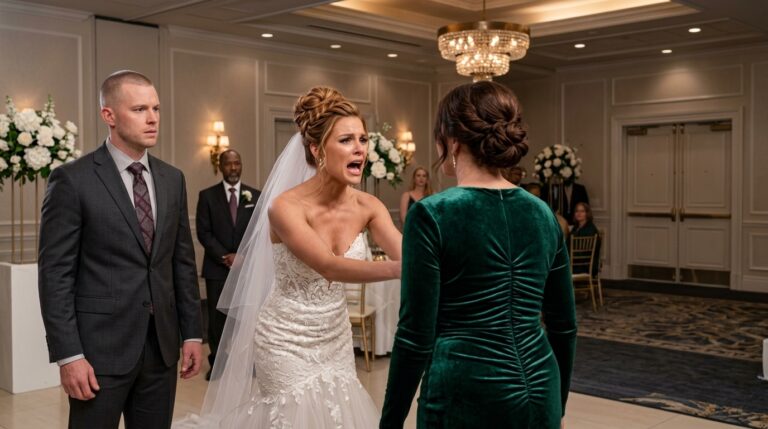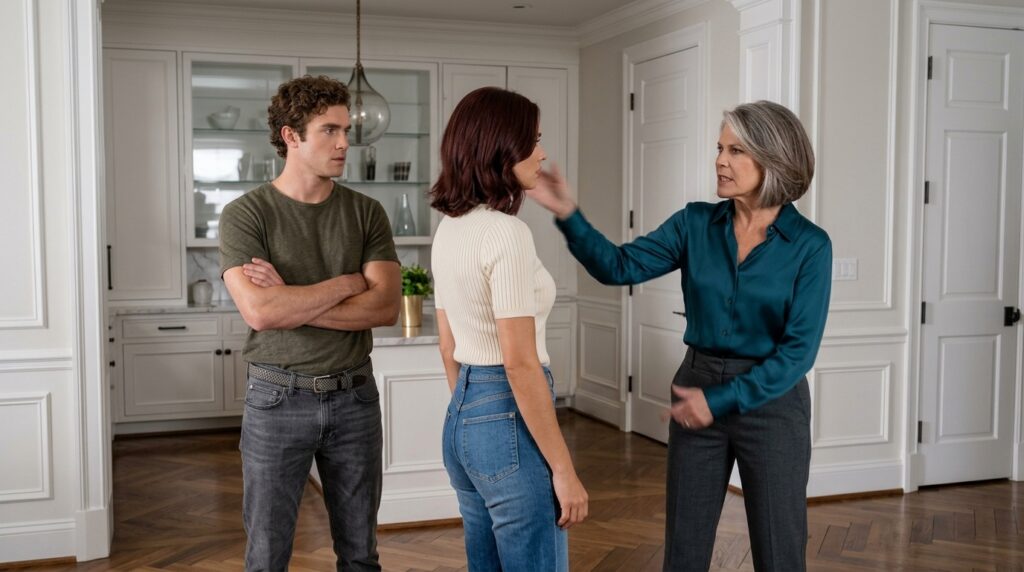
One second I was standing beside the kitchen island, staring at a room full of people who had suddenly gone silent. The next, my head snapped backward and pain shot across my scalp as she dragged me several steps across the tile.
“You little thief,” she hissed.
My palms struck the edge of the counter as I tried to keep my balance. Behind her, half a dozen members of my husband’s family stared at me with expressions ranging from shock to suspicion.
And Daniel—my husband of six years—stood beside the doorway with his arms folded.
He did nothing.
Not one step forward.
Not one word.
His mother released my hair and jabbed a trembling finger toward my face.
“You stole five thousand dollars from me!”
The accusation seemed to hang over the kitchen like smoke.
For several seconds, I could hear nothing except the refrigerator humming and the faint tick of the clock above the pantry.
I looked at Daniel.
He knew.
He knew I had not taken a cent from his mother.
Two nights earlier, I had been sitting beside him in bed when his mother called to complain that money had vanished from one of her accounts. Daniel had covered the phone and whispered, “She probably moved it and forgot. You know how she gets.”
Now his expression had changed.
There was no confusion in it.
There was fear.
“Daniel,” I said quietly.
His mother stepped between us.
“Don’t you dare try to drag my son into this.”
“I’m talking to my husband.”
“You should be explaining why five thousand dollars disappeared the same week you asked us about selling the lake property.”
The absurdity of it almost made me laugh.
Almost.
“I never asked you for money.”
“No, you just take it.”
A cousin near the dining room lowered her eyes.
Daniel’s younger brother shifted uncomfortably against the wall.
Nobody defended me.
I had spent six years trying to make these people accept me. Six years bringing food to holidays, remembering birthdays, helping with hospital visits, loaning Daniel’s brother money when his business nearly collapsed, and smiling through his mother’s little comments about my upbringing, my clothes, my job, and the fact that I had grown up without the kind of family wealth she liked to mention at dinner.
And in less than five minutes, all of that had become irrelevant.
They were willing to believe I was a thief because she had said the word loudly enough.
I turned toward Daniel again.
“Tell them.”
His mouth opened.
Nothing came out.
His mother laughed bitterly.
“Look at you. Still trying to manipulate him.”
Something inside me changed.
It wasn’t dramatic. There was no sudden burst of anger. No screaming.
It was colder than that.
I stopped needing anyone in that room to believe me.
I simply needed them to see.
My phone was lying on the counter beside my purse.
I picked it up.
His mother scoffed. “Calling someone to rescue you?”
“No.”
I opened my banking application.
Daniel’s face lost what little color remained in it.
That was when I knew.
Until that second, I had suspected there was something he wasn’t telling me.
His reaction confirmed it.
I walked toward the television mounted on the kitchen wall. Daniel’s mother had insisted on putting one there because she liked watching financial news while preparing breakfast.
My hands trembled as I connected my phone to the screen.
Daniel finally moved.
“What are you doing?”
I looked at him.
“Something you should have done ten minutes ago.”
I opened the transaction history I had discovered earlier that afternoon.
The first transfer appeared on the television.
$2,500.
Then another.
$2,500.
Both had left his mother’s savings account.
Both had gone into an account I had never seen before.
The account holder’s name appeared at the top.
Daniel Mercer.
No one spoke.
His mother’s mouth fell slightly open.
I enlarged the image.
“There’s your five thousand dollars.”
Daniel uncrossed his arms.
His brother stared at him.
One of his aunts whispered, “Daniel?”
His mother recovered first.
“That doesn’t prove anything.”
I almost admired how quickly she said it.
“You transferred it to his account,” I replied.
“I did no such thing.”
“The transfers came from your login.”
“Then she must have accessed it!”
I looked at Daniel.
He was staring at the floor now.
I didn’t raise my voice.
“Tell them.”
His throat moved.
“Daniel,” his mother warned.
That single word changed the entire room.
He looked at her.
She shook her head almost imperceptibly.
I saw it.
So did his brother.
Daniel rubbed a hand over his mouth.
Then he looked at me.
“Mom told me to blame you.”
The silence afterward felt enormous.
His mother spun toward him.
“What?”
Daniel’s shoulders collapsed.
“She told me to say you’d taken it.”
His mother’s face hardened. “You don’t know what you’re saying.”
“I know exactly what I’m saying.”
“Then explain why the money is in your account!”
Daniel didn’t answer.
And somehow that frightened me more than anything else.
I stared at the man I had shared a bed with for six years.
The man who kissed my forehead before work.
The man who knew how I took my coffee and which side of the couch I preferred and how I couldn’t sleep during thunderstorms without leaving the hallway light on.
He had watched his mother pull me across a kitchen by my hair.
He had watched her accuse me of stealing.
And he had remained silent because they had planned it.
When he stepped toward me, reaching for my shoulder, my body reacted before my mind did.
I knocked his hand away.
“Don’t.”
His hand froze in the air.
“Claire—”
“Don’t touch me.”
I slid my wedding ring from my finger.
For a moment, I held it between us.
Daniel stared at it.
Then I dropped it.
The small circle of gold struck the tile and bounced once before landing beside his shoe.
His mother made a sound of disbelief.
“You are not doing this in my house.”
I looked at her.
“No. I’m doing it in the house where you just attacked me and tried to frame me for stealing your money.”
“You’re destroying this family!”
I met her eyes.
“No. You did that when you decided I was easier to sacrifice.”
Then someone knocked hard on the front door.
Three times.
Everyone froze.
A second knock followed.
“Police!”
Daniel’s mother went white.
I had not called them.
Neither had Daniel.
His younger brother stared toward the hallway.
“Who called the police?”
A woman’s voice came from behind me.
“I did.”
Everyone turned.
It was Daniel’s aunt Rebecca.
She had been standing near the dining room the entire time, quiet and pale.
Now she held her phone against her chest.
“I saw her grab Claire,” Rebecca said. “I called before any of you started arguing about the money.”
Daniel’s mother looked at her sister as if she had been betrayed.
“You called the police on me?”
Rebecca swallowed.
“I called because you put your hands on her.”
Another knock shook the door.
Daniel moved first.
When he opened it, two officers entered.
Within minutes, the kitchen that had once hosted Thanksgiving dinners and birthday cakes had become a scene of questions, statements, photographs, and increasingly strained explanations.
One officer spoke with me near the breakfast table while the other questioned Daniel’s mother.
My scalp hurt where she had grabbed me. A red mark had appeared along my wrist from striking the counter.
The officer photographed both.
“Is there video surveillance in the home?” he asked.
I nodded.
“There’s a camera in the kitchen.”
Daniel’s mother’s head snapped toward us.
That tiny movement did not escape the officer.
“Where?”
I pointed above the pantry.
It was barely noticeable, a small black device tucked near the smoke detector.
I had bought it three months earlier after packages began disappearing from the side entrance.
Daniel’s mother hated it.
She had called it paranoid.
For the first time in my life, I was grateful I had ignored her.
The officer asked whether the camera recorded continuously.
“Yes.”
“Audio?”
“Yes.”
Daniel looked at me.
His expression was no longer guilty.
It was terrified.
The officers reviewed the footage on a tablet at the kitchen table.
At first, there was nothing we didn’t already know.
His mother grabbing me.
The accusation.
My phone connected to the television.
Daniel’s confession.
Then one officer dragged the timeline backward.
He stopped.
Replayed several seconds.
Then looked at his partner.
“What?” I asked.
Neither answered immediately.
The officer turned the volume higher.
The recording had been made approximately twenty minutes before I entered the kitchen.
Daniel stood beside the island.
His mother was directly in front of him.
Her voice came clearly through the speaker.
“We do this tonight.”
Daniel rubbed both hands over his face.
“I don’t want to.”
“You don’t have a choice.”
“What if she checks?”
“She won’t if everyone already thinks she took it.”
Daniel stared toward the hallway.
“This could ruin her.”
His mother stepped closer.
“That is the point.”
Every hair on my arms rose.
The officer paused the recording.
I could barely breathe.
“What are they talking about?” I whispered.
Daniel said nothing.
His mother crossed her arms.
The officer pressed play.
Her voice returned.
“We need Claire blamed before anybody finds where the money is actually going.”
Daniel whispered something.
The microphone barely caught it.
The officer replayed the section.
This time I heard him.
“What happens if the auditors call her?”
His mother answered immediately.
“Then she looks exactly like what we need her to look like.”
The officer stopped the video.
Nobody moved.
I turned slowly toward Daniel.
“What auditors?”
He looked at his mother.
She spoke before he could.
“This is ridiculous. You’re taking a private family conversation out of context.”
The officer’s expression changed.
It was subtle, but I saw it.
Until that moment, they had been responding to a domestic incident.
Now they were hearing evidence of something else.
“What auditors?” he asked.
Daniel’s mother said nothing.
The officer looked at Daniel.
“Sir?”
Daniel lowered himself into a chair.
“I need a lawyer.”
Those five words ended my marriage more completely than the ring on the floor ever could.
I did not sleep that night.
Rebecca drove me home because the police had advised me not to remain at the house while statements were being taken.
Home.
The word felt strange.
For six years, home had been wherever Daniel was.
That night, our bedroom felt like a furnished crime scene.
His toothbrush stood beside mine.
His jacket hung over the back of a chair.
The book he had been reading remained open on his nightstand.
Normal things.
Ordinary things.
Evidence of a life I had believed was real.
At two in the morning, I sat on the kitchen floor with my laptop and searched every financial record I could access.
Daniel and I maintained separate personal accounts plus one joint household account. It had been his suggestion when we married.
“Independence is healthy,” he had told me.
I had agreed.
Now the arrangement felt less progressive and more deliberate.
I searched six years of statements.
At first, nothing looked unusual.
Mortgage.
Utilities.
Groceries.
Insurance.
Then I began looking at transfers involving Daniel.
Small amounts.
Eight hundred dollars.
Twelve hundred.
Two thousand.
Always irregular.
Always disappearing into accounts whose final digits changed every few months.
I had never noticed because the money wasn’t coming from our joint account.
It was coming from places I had never been shown.
At 3:17 a.m., I found an old tax document accidentally saved inside our shared cloud folder.
The account number matched the hidden account displayed on the television.
Daniel had opened it four years earlier.
There had been more than five thousand dollars moving through it.
Much more.
I stared at one yearly interest summary.
The average balance made my stomach tighten.
$186,420.
I searched the routing information.
The bank was real.
The account was real.
And according to one forgotten attachment, it was linked to something called Mercer Family Holdings.
I had heard the name before.
Daniel’s grandfather had built the family’s wealth through commercial real estate. After he died, control passed to his wife, Eleanor, and eventually to their daughter—Daniel’s mother, Margaret.
At least, that was the story I had always been told.
Eleanor had died eight years before I married Daniel.
Margaret spoke about her rarely.
“She was difficult,” she once said when I asked about an old photograph. “Brilliant, but difficult.”
By four in the morning, I had created a spreadsheet.
By five, I had counted forty-three transfers.
More than nine hundred thousand dollars had moved through Daniel’s hidden account in four years.
My hands went numb.
At 5:26 a.m., someone knocked on my door.
I nearly screamed.
It was Rebecca.
She stood on the porch holding two coffees.
“I figured you weren’t sleeping.”
I let her inside.
For several minutes we sat silently.
Then I turned the laptop toward her.
“Do you know what Mercer Family Holdings is?”
Rebecca stared at the screen.
All the color left her face.
“Yes.”
“What?”
She didn’t answer.
“Rebecca.”
She looked toward the window.
“My mother’s trust.”
“Your mother?”
“Eleanor.”
I frowned.
“I thought Eleanor died.”
Rebecca’s fingers tightened around the coffee cup.
“That’s what Margaret tells people.”
A cold sensation moved through my chest.
“What do you mean?”
Rebecca looked at me.
“My mother is alive.”
I stared at her.
“No.”
“She’s eighty-seven.”
“Daniel told me she died before we met.”
“I know.”
“Why would everyone lie about that?”
Rebecca’s eyes filled with something I couldn’t identify.
Shame, perhaps.
Or fear.
“Because Margaret wanted people to stop asking questions about her.”
I leaned back.
“Where is she?”
Rebecca hesitated.
“A care facility two hours north.”
“What’s wrong with her?”
“She had a stroke about nine years ago. Margaret took over her finances afterward. She claimed Mom had severe cognitive decline.”
“Did she?”
Rebecca looked down.
“Not then.”
The room suddenly seemed smaller.
I pushed the laptop closer.
“Are these transfers from Eleanor’s trust?”
Rebecca scanned the dates.
Her expression changed.
“I think so.”
“How much money was in it?”
“Millions.”
My mouth went dry.
“Why didn’t you stop this?”
Her eyes snapped toward me.
“You think I didn’t try?”
“I don’t know what to think.”
“Margaret had legal control. Daniel helped her. Every time I questioned something, they told everyone I was bitter because Mom had chosen Margaret as trustee.”
“Did she?”
Rebecca’s laugh contained no humor.
“That depends on which version of the documents you believe.”
I stared at her.
“What does that mean?”
Before she could answer, my phone rang.
Unknown number.
I almost ignored it.
Rebecca nodded toward it.
“Answer.”
I did.
“Claire Mercer?”
“Yes.”
“This is Detective Rowan with the financial crimes unit. Patrol forwarded an incident report involving you and Daniel Mercer last night.”
I stood.
“Financial crimes?”
“Yes. We need to speak with you about several transactions and some documents associated with your name.”
My name.
The words hit harder than they should have.
“What documents?”
There was a short pause.
“Loan authorizations. Trustee instructions. Two property transfers.”
“I don’t know what you’re talking about.”
“That’s why we need to meet.”
I looked at Rebecca.
She had heard enough to understand.
The detective continued.
“And Ms. Mercer?”
“Yes?”
“Until we speak, please don’t contact your husband or his mother. Also, if you have access to any financial documents, don’t alter or delete anything.”
“I won’t.”
“One more thing.”
My grip tightened around the phone.
“What?”
“We found your signature on transactions totaling over two million dollars.”
For several seconds, I forgot how to breathe.
“I never signed anything.”
“That’s what we need to determine.”
I ended the call slowly.
Rebecca was staring at me.
“What did they say?”
I told her.
She closed her eyes.
“Oh, God.”
“What?”
Rebecca whispered, “They didn’t just want to blame you for five thousand dollars.”
I looked at the spreadsheet.
Forty-three transfers.
Four years.
Nine hundred thousand through Daniel’s account.
More than two million connected to my signature.
And suddenly the kitchen made sense in a way that terrified me.
The accusation had never been about five thousand dollars.
The five thousand dollars had been rehearsal.
They needed witnesses.
They needed Daniel’s family to hear Margaret accuse me.
They needed me to become the woman who stole from relatives.
Because somewhere, someone was already asking questions about millions.
Detective Rowan was a quiet man in his fifties who had the unnerving habit of letting silence do most of his work.
I met him and another investigator at a government office downtown.
For nearly three hours, they showed me documents.
Some carried my signature.
Some carried digital approvals supposedly made from my email address.
Several listed me as an authorized financial adviser to Eleanor Mercer.
“I’ve never met Eleanor Mercer,” I said.
Rowan watched me carefully.
“Never?”
“I was told she was dead.”
He slid an image across the table.
It showed a notarized document dated two years earlier.
Claire Mercer.
My name.
My signature.
I studied it.
It was good.
Very good.
But not perfect.
The person who forged it made the C too narrow.
I always looped mine farther left.
“That isn’t mine.”
“You’re certain?”
“Yes.”
He handed me a pen.
“Sign your name ten times.”
I did.
He compared them.
Then nodded to his colleague.
“Where were you on March fourteenth two years ago?”
I thought.
“I don’t know.”
He slid another paper toward me.
The date involved a property transfer worth nearly seven hundred thousand dollars.
Then I remembered.
“I was in Denver.”
“For what?”
“My company’s annual conference.”
“Can you prove it?”
“I have flight records. Hotel receipts. Photos.”
For the first time, Rowan looked satisfied.
“That helps.”
I stared at the forged document.
“Who notarized this?”
His colleague answered.
“A notary who worked for a law office used by Mercer Family Holdings.”
“Worked?”
“She disappeared six months ago.”
My stomach tightened.
“Disappeared?”
“She quit unexpectedly. Closed her apartment. No forwarding address.”
I looked from one detective to the other.
“What exactly is going on?”
Rowan folded his hands.
“We don’t know yet.”
“You know more than I do.”
“Yes.”
“Then tell me.”
He studied me for a moment.
“There appears to have been a long-term diversion of money from Eleanor Mercer’s trust and associated businesses. Some funds moved through accounts controlled by your husband. Other transactions were authorized in your name.”
“Why me?”
“That’s one of the questions we’re asking.”
I thought of Margaret’s recorded voice.
She needs to look exactly like what we need her to look like.
“Because they were planning to blame me.”
“Possibly.”
“Not possibly.”
My anger rose.
“They accused me in front of witnesses. Daniel admitted his mother told him to do it.”
Rowan nodded.
“That recording is important.”
“Then arrest them.”
“For the assault, charges are straightforward. The financial case is more complicated.”
“Why?”
“Because forged signatures do not automatically tell us who forged them. Transfers through your husband’s account do not automatically prove he knew the source was illegal.”
“He knew enough to frame me.”
Rowan leaned back.
“That may become very important.”
I stared at the documents.
One name appeared repeatedly at the bottom.
Westmere Legal Group.
“Who are they?”
The detective looked down.
“A firm that handled several trust changes.”
“Can I talk to them?”
“You can.”
“Should I?”
He paused.
“I would suggest you have your own lawyer first.”
By sunset, I did.
Her name was Maya Reynolds, and within fifteen minutes of meeting her, she had told me three things.
Do not speak to Daniel.
Do not speak to Margaret.
And do not assume five thousand dollars was the smallest lie in my marriage.
For the next two days, Maya and I reconstructed my financial life.
What we found made me physically ill.
A credit line had been opened using my information three years earlier.
A limited power of attorney bearing my signature had been filed eighteen months ago.
A corporate resolution claimed I had attended a board meeting for Mercer Family Holdings on a day I had actually been visiting my sister in Arizona.
Whoever had built the trail had been patient.
Careful.
They weren’t trying to steal my identity for quick money.
They were constructing a history.
One document at a time.
One transaction at a time.
A paper version of me was being created.
That woman was dishonest.
Financially reckless.
Secretive.
And apparently deeply involved in managing Eleanor Mercer’s money.
I understood why only when Maya placed three documents side by side.
“If regulators investigate the trust,” she said, “this gives them a ready-made suspect.”
“Me.”
“Yes.”
“But Daniel’s account received money too.”
“He could claim you directed the transfers.”
“That’s insane.”
“Not if they have your forged authorization.”
I stared at her.
“And the kitchen?”
Maya’s expression hardened.
“Imagine an investigation begins next week. Police interview Daniel’s relatives. What do they say?”
I knew immediately.
Claire stole from Margaret.
Claire was accused before.
Claire became angry when confronted.
Claire’s own marriage fell apart over money.
I felt sick.
“They needed a story.”
“They needed witnesses.”
A knock sounded on Maya’s office door.
Her assistant entered.
“There’s someone here asking to see Claire.”
“Who?”
“Rebecca Mercer.”
I looked at Maya.
“Let her in.”
Rebecca entered carrying a worn leather folder.
She looked as if she had aged ten years since the kitchen.
“I found something.”
She placed the folder on the desk.
Inside were photocopies of letters, trust statements, and handwritten notes.
The handwriting belonged to Eleanor.
Rebecca pointed to one letter.
“Read that.”
It was dated seven years earlier.
Rebecca,
If Margaret attempts to remove me from control, contact Arthur Vale. He knows where the original partnership records are kept. Do not let Margaret destroy them.
I read it twice.
“Who is Arthur Vale?”
Rebecca looked at me.
“Your father.”
The room seemed to tilt.
“My father?”
“Yes.”
I laughed once because the alternative was screaming.
“My father was an accountant.”
“He was more than that.”
“He worked for a manufacturing company.”
“He did. Before that, he worked for my parents.”
I stared at her.
“My father never mentioned your family.”
Rebecca sat down.
“He had reasons.”
My father had been dead for fourteen years.
Most people remembered him for one thing.
The scandal.
When I was sixteen, he had been accused of stealing nearly four hundred thousand dollars from his employer.
He denied it.
The company sued.
Newspapers printed his photograph.
Friends stopped calling.
Six months later, while the investigation was still unresolved, he suffered a heart attack.
He died at forty-nine.
My mother never recovered emotionally.
She sold the house, moved us to another state, and refused to discuss him.
I had spent half my life carrying embarrassment over accusations I never fully understood.
I looked at Rebecca.
“What does my father have to do with this?”
Her voice softened.
“Arthur discovered money missing from one of my father’s companies more than twenty years ago.”
“Your father?”
“My parents owned several businesses together. Your father handled audits for them.”
“What happened?”
“He accused Margaret.”
I felt the room go cold.
“No.”
Rebecca nodded.
“Mom believed him.”
“Then why wasn’t Margaret charged?”
“Because before they could prove anything, documents appeared showing Arthur had authorized several transfers himself.”
My mouth opened.
No sound came.
Rebecca continued.
“Your father was fired. Margaret threatened to sue him. Mom tried to defend him, but my father was already sick and Margaret had taken control of most of the company.”
I whispered, “The four hundred thousand.”
Rebecca nodded.
“It was the same missing money.”
I stood so abruptly the chair rolled backward.
“No.”
“Claire—”
“My father died believing everyone thought he was a thief.”
“I know.”
“You knew this?”
“I knew pieces.”
“And you never told me?”
Rebecca’s face crumpled.
“I didn’t know you were Arthur’s daughter until after you married Daniel.”
I turned away.
Memories came back with cruel clarity.
My father sitting alone at our kitchen table.
My mother crying behind a closed bedroom door.
A newspaper folded facedown because my photograph had appeared beside his.
The last conversation I ever had with him.
I had been sixteen and furious because classmates were whispering.
I asked him why he had done it.
He stared at me for a long time.
Then said, “I didn’t.”
I didn’t believe him.
Not fully.
He died three weeks later.
My knees weakened.
Maya guided me into the chair.
Rebecca slid another letter toward me.
“This one was written after your father died.”
It was addressed to Eleanor.
Arthur was telling the truth. I should have acted sooner. Margaret knew exactly what happened, and I allowed fear of scandal to silence me.
My vision blurred.
For fourteen years, I had carried shame that belonged to someone else.
And somehow, the same family was doing the same thing to me.
I wiped my eyes.
“Did Daniel know?”
Rebecca didn’t answer.
That was answer enough.
“Did my husband know my father had accused his mother of stealing?”
“Yes.”
“How long?”
“Before he met you.”
Something inside me cracked.
I stared at her.
“Before?”
Rebecca nodded slowly.
“Daniel knew your name.”
Maya leaned forward.
“What exactly are you saying?”
Rebecca looked miserable.
“Daniel didn’t meet Claire by accident.”
The room went silent.
I thought about the first time Daniel and I met.
A charity fundraiser.
He spilled champagne near my dress.
He apologized.
We laughed.
He asked for my number.
For years, I had told people fate had put us at the same table.
There had been two hundred guests that night.
“What do you mean?” I whispered.
Rebecca took a breath.
“Margaret had been trying to find out whether Arthur left records with his family.”
My hands began shaking.
“She found me.”
“Yes.”
“And Daniel?”
“She asked him to meet you.”
I couldn’t process the words.
“No.”
“Claire—”
“No.”
“He was supposed to find out whether your father left documents.”
I heard myself whisper, “So he dated me.”
Rebecca closed her eyes.
“At first.”
My chest hurt.
“At first?”
“I think he eventually loved you.”
I laughed bitterly.
“You think?”
“He married you.”
“That doesn’t prove love.”
“No.”
“Did he search my things?”
Rebecca was silent.
I thought of boxes from my childhood that had mysteriously moved after we married.
My father’s old briefcase.
A stack of tax records.
The small metal key I had found in one of his desk drawers and kept for years without knowing what it opened.
I stood.
“I need to go.”
Maya stopped me.
“Where?”
“My house.”
“Claire—”
“I know where the records are.”
Daniel was not there.
Police had advised him to stay with his brother, and for once he had listened.
I went upstairs with Maya beside me.
At the back of my closet sat a blue plastic storage container containing everything I had kept from my parents’ house.
School certificates.
Photographs.
Old birthday cards.
My father’s leather briefcase.
I pulled it out.
The lock had been broken.
I stared at it.
I had not broken it.
Inside were financial papers I barely understood.
But something was missing.
A small envelope.
I remembered because my father had written my name on it.
Claire — keep safe.
It had contained the metal key.
The envelope was still there.
Empty.
I sat back on my heels.
“He took it.”
Maya crouched beside me.
“Daniel?”
“He knew about the key.”
“How?”
“I showed it to him once. Years ago.”
“Did you know what it opened?”
“No.”
Maya pulled out her phone.
“Call Detective Rowan.”
The detective arrived within forty minutes.
He photographed the broken briefcase and took the remaining papers.
Then he asked me about the key.
I described it.
Small.
Silver.
Number 317 stamped near the top.
Rowan’s eyes sharpened.
“Safe-deposit key.”
“You recognize it?”
“Likely.”
“How do we know which bank?”
One of my father’s documents provided the answer.
A statement from a bank that no longer existed under the same name.
Its branches had been acquired twice.
By midnight, Rowan had traced the old location.
The next morning, with a court order and a bank representative, we opened box 317.
Daniel had not reached it.
The key was useful, but not enough without identification belonging to the registered holder’s estate.
Inside the box was not money.
There was a ledger.
A cassette tape.
A sealed letter.
And one photograph.
The photograph showed my father standing beside Eleanor Mercer.
Between them was a much younger Margaret.
On the back, my father had written three words.
She knows everything.
The letter was addressed to me.
My hands trembled so badly Maya offered to open it.
I shook my head.
I had waited fourteen years without knowing I was waiting.
I unfolded the pages.
Claire,
If you are reading this, then something has happened that prevented me from clearing my name.
First, I need you to know something I should have told you every day while I had the chance.
I did not take that money.
I know what people are saying, and I know what you have heard at school. I know you are angry with me.
You have every right to be angry.
But do not be ashamed of me.
I tried to stop something, and I trusted the wrong people.
Tears dropped onto the paper.
I kept reading.
Margaret Mercer has been moving money from family companies through false vendors and private accounts for years. When Eleanor discovered irregularities, Margaret altered records and used my access credentials to make it appear that I had approved the transactions.
Daniel is still a child as I write this. He knows nothing.
If you ever meet him someday, do not blame him for what his mother did.
I stopped.
The line blurred.
Daniel had been fourteen when my father wrote the letter.
He had known nothing then.
But years later, Margaret had sent him to find me.
I continued.
Eleanor believes there are enough original records to prove the truth. We have placed copies where Margaret cannot reach them.
If anything happens to me, Eleanor has promised to protect you.
The last sentence had been underlined twice.
Trust evidence, Claire. Never trust the loudest person in the room.
I pressed the letter against my mouth.
My father had died before clearing his name.
But he had left the truth waiting.
Rowan opened the ledger.
Within minutes, his expression changed.
“This goes back twenty-three years.”
Maya leaned closer.
“Enough to prove what happened?”
“If the records can be authenticated, this could prove a lot.”
I looked at the cassette.
“What’s on that?”
The bank brought us an old player from storage.
The audio crackled.
Then my father’s voice filled the small conference room.
I had not heard it since I was sixteen.
My knees nearly gave out.
He was speaking with a woman.
Eleanor.
They discussed transfers.
Shell companies.
Fake invoices.
And Margaret.
Then another voice entered.
Male.
Younger than Eleanor.
My father called him Stephen.
Rebecca’s father.
Daniel’s grandfather.
The conversation grew heated.
Stephen wanted the matter handled privately.
Eleanor wanted police involved.
My father insisted they could not hide theft simply because Margaret was family.
Then came a sound of a door opening.
Margaret’s voice.
Young but unmistakable.
“You should have minded your own business, Arthur.”
The recording ended minutes later.
Rowan looked at me.
“Your father just became our strongest witness.”
“He’s been dead fourteen years.”
“His records haven’t.”
For the first time since the kitchen, I felt something other than fear.
I felt fury with direction.
Daniel called me thirty-seven times over the next week.
I answered none.
He sent emails.
Claire, please let me explain.
Then:
My mother lied to me too.
Then:
I did love you.
That one hurt most.
Not because I believed him.
Because some part of me wanted to.
The police executed search warrants at Margaret’s home, Daniel’s office, and a storage facility owned by Mercer Family Holdings.
They found boxes of financial records.
They found electronic copies of my forged signatures.
They found the software used to create them.
And on Daniel’s laptop, they found a folder bearing my initials.
Inside were scans of my passport, driver’s license, tax records, signature samples, and old financial forms.
My lawyer showed me the inventory.
I read it twice.
Then closed my eyes.
There are betrayals so large they become abstract.
This one remained painfully ordinary.
Daniel had collected pieces of my identity while living beside me.
Perhaps while I was making dinner.
Perhaps after I fell asleep.
Perhaps on mornings when he kissed me goodbye.
The prosecution offered him a deal.
If he cooperated fully, charges against him could be reduced.
He accepted.
I expected relief.
Instead, I felt nothing.
His first formal statement lasted nine hours.
What he revealed made headlines.
Margaret had controlled the scheme for decades.
After my father’s death, Eleanor began gathering evidence against her own daughter.
Margaret responded by claiming Eleanor was mentally incompetent.
With Daniel’s assistance, she moved Eleanor into a private care facility and limited visitors.
Rebecca had fought the guardianship but lost.
Once Eleanor was isolated, Margaret took control of the trust.
Years later, when she discovered I was Arthur Vale’s daughter, she panicked.
She didn’t know whether I possessed his records.
So she sent Daniel to find out.
At first, according to Daniel, he had planned to date me briefly.
Search.
Ask questions.
Report back.
Then he stayed.
That was how he explained it.
He stayed because he fell in love.
The statement said he resisted his mother for years.
But when Eleanor’s trust began facing an external audit, Margaret reminded him that if investigators reopened the old fraud case, Daniel could lose everything.
Property.
Inheritance.
Reputation.
His career.
So he helped her.
One forged form became another.
One lie became twenty.
Eventually, the plan expanded.
If investigators discovered financial crimes, the documents would point to me.
Arthur Vale’s daughter.
A woman whose father had once been accused of nearly identical conduct.
It was elegant in the ugliest possible way.
The same accusation across two generations.
People would call it family history.
A pattern.
Inherited dishonesty.
And the five thousand dollars?
Margaret had deliberately transferred it into Daniel’s account that morning.
The plan was for him to move it later into an account carrying my forged credentials.
But before that happened, she intended to accuse me publicly.
They needed family witnesses.
Daniel had resisted the physical confrontation.
He had not known Margaret would grab my hair.
That detail was apparently important to him.
It meant nothing to me.
He had known she would accuse me.
He had stood there anyway.
The audit that frightened them had been triggered by an anonymous complaint.
Nobody knew who filed it.
Not Daniel.
Not Margaret.
Not Rebecca.
Even investigators could not identify the source at first.
The complaint had been mailed, not emailed.
It contained exact account numbers.
Transaction dates.
Names of shell companies.
And one sentence.
Ask why Eleanor Mercer is still alive.
That sentence led investigators to the care facility.
Eleanor had been living under her maiden name.
Eleanor Bishop.
She was frail but very much alive.
And according to doctors, although she had mobility problems and occasional memory lapses, she understood exactly what had been done to her.
I met her three weeks after the kitchen incident.
She was sitting near a window when I entered.
Tiny.
Silver-haired.
Wrapped in a blue cardigan.
For a moment, I could not reconcile this woman with the force that had once run a multimillion-dollar business.
Then she looked at me.
And I saw something familiar.
Not physically.
Something in the way she studied my face.
“Arthur’s girl,” she said.
My throat closed.
“Yes.”
She held out one hand.
I took it.
Her fingers were cool.
“I owe you an apology.”
“You don’t.”
“I owe your father one.”
I sat beside her.
“He left me a letter.”
Her eyes filled.
“Did he tell you he was innocent?”
“Yes.”
“Good.”
We sat quietly.
Then I asked the question that had been haunting me.
“Why didn’t you clear his name?”
Eleanor looked toward the window.
“Cowardice.”
I waited.
“My husband was dying. Margaret threatened to expose medical decisions, business debts, anything she could use. I told myself I needed time.”
Her voice trembled.
“Time became weeks. Weeks became months. Arthur died before I chose courage.”
I swallowed hard.
“He forgave you in the letter.”
That broke her.
She covered her eyes.
I did not comfort her immediately.
Some guilt deserves to be felt.
After a while, she lowered her hands.
“Daniel came here last year.”
My body stiffened.
“Why?”
“To ask where Arthur’s records were.”
“What did you tell him?”
“That I didn’t know.”
“Did you?”
Eleanor smiled faintly.
“Yes.”
I stared at her.
“You knew about the safe-deposit box?”
“I helped arrange it.”
“Why didn’t you tell me?”
“I tried.”
She pointed toward a drawer.
Inside were copies of three letters addressed to me.
All returned.
Wrong address.
My old apartment.
My college residence.
My mother’s former house.
Margaret had kept Eleanor isolated and monitored her mail for years.
One letter had been opened.
Then resealed.
I stared at the envelope.
“She knew you were trying to contact me.”
“Yes.”
“And that’s when she sent Daniel.”
“I believe so.”
I closed my eyes.
Eleanor squeezed my hand.
“He may have loved you.”
I looked at her.
“Please don’t.”
“I am not defending him.”
“Good.”
“Love does not make betrayal smaller.”
I let out a slow breath.
“No.”
“It makes it more painful.”
That, unfortunately, was true.
Before I left, Eleanor asked me one strange question.
“Did they find the red ledger?”
“Yes.”
“And the tape?”
“Yes.”
She nodded.
“Then Arthur kept his promise.”
I stood.
At the door, she called after me.
“Claire.”
I turned.
“There is something else.”
My stomach tightened.
“What?”
Her expression became troubled.
“Your father did not put everything in that box.”
“What do you mean?”
“He kept one thing.”
“What?”
“I don’t know.”
“But you just said—”
“He told me there was one piece of evidence he would never store with the others.”
“Why?”
“Because it was not about the money.”
I waited.
“What was it about?”
Eleanor looked directly at me.
“Margaret.”
The criminal case grew.
Reporters appeared outside my house.
Old articles about my father resurfaced.
This time, the headlines changed.
ACCOUNTANT ACCUSED DECADES AGO MAY HAVE BEEN FRAMED.
MERCER FAMILY FRAUD INVESTIGATION EXPANDS.
WOMAN ACCUSED OF THEFT HELPED EXPOSE MILLION-DOLLAR SCHEME.
I hated all of them.
My father had become interesting to strangers only because tragedy had become profitable again.
Maya encouraged me to stay away from cameras.
I did.
Instead, I focused on rebuilding my life.
I filed for divorce.
Daniel did not contest it.
He signed everything.
He gave up his claim to the house.
He returned property that belonged to me.
And he asked through his lawyer for one meeting.
I refused three times.
Then Detective Rowan called.
“You may want to hear what he has to say.”
“Why?”
“He remembered something.”
“About the financial case?”
“About your father.”
That changed my answer.
We met in a conference room at my lawyer’s office.
Daniel looked smaller.
He had lost weight.
His hair was longer.
For the first time since I had known him, he entered a room without confidence.
He sat across from me.
Neither of us spoke.
Finally, he said, “I’m sorry.”
I felt nothing.
“That isn’t why I’m here.”
“I know.”
“Then talk.”
He looked down.
“When my mother first asked me to meet you, she said your father had stolen from our family.”
I didn’t respond.
“I believed her.”
“You continued believing her after you saw the records?”
His face tightened.
“No.”
“When did you know?”
“Three years ago.”
My heart thudded once.
“Three years.”
“I found an old file.”
“And you stayed silent.”
“Yes.”
“You forged my signature.”
“Some of them.”
“Some?”
“My mother hired people for the rest.”
I stared at him.
His eyes filled.
“I kept telling myself I could fix it before you ever knew.”
“By framing me?”
“No.”
“That is exactly what you did.”
“I panicked.”
“You watched her attack me.”
“I know.”
“You knew I was innocent.”
“Yes.”
“You knew my father had been innocent too.”
His face broke.
“Yes.”
I leaned back.
There was nothing left to say about us.
“What did you remember?”
Daniel wiped his face.
“Your father’s briefcase.”
I went still.
“What about it?”
“The first time I searched it, years ago, there was a photograph taped inside the lining.”
“What photograph?”
“I don’t know. I never saw the front.”
“Why?”
“It was folded inside another envelope. Mom called while I was searching. I put everything back.”
“Was the envelope still there later?”
“No.”
“Who took it?”
“I assumed you.”
“I didn’t.”
He nodded.
“There was writing on the back.”
I stared at him.
“What did it say?”
Daniel closed his eyes, remembering.
“I remember because it scared me.”
“What?”
He looked at me.
“If Margaret ever says Arthur stole the money, ask her what happened on October 12, 2001.”
The date meant nothing to me.
Rowan, sitting beside Maya, wrote it down.
“What happened that day?” I asked.
Daniel shook his head.
“I don’t know.”
“Did you ask your mother?”
“No.”
“Why not?”
“Because beneath that sentence was another.”
My skin prickled.
“What?”
Daniel swallowed.
“It said, ‘She cannot lie about both.’”
Rowan leaned forward.
“Both what?”
Daniel looked at me.
“I don’t know.”
The meeting ended twenty minutes later.
I left without saying goodbye.
That night I searched the date.
October 12, 2001.
I was eleven years old.
Nothing obvious connected it to the Mercers.
No lawsuits.
No major business filings.
No newspaper articles about their company.
Then I searched my own family records.
My parents had moved houses that month.
My father changed jobs two weeks later.
One week after that, he opened the safe-deposit box.
October 12 had frightened him enough to hide records.
I called my mother.
She had remarried years ago and lived in Oregon.
We had avoided discussing my father for most of my adult life.
When I asked about the date, she went silent.
“Mom?”
“Where did you get that?”
Every muscle in my body tightened.
“You know it.”
“I don’t want to talk about this.”
“I need you to.”
“No.”
“Dad was framed.”
“I know.”
The words stopped me.
“You know?”
Silence.
“You knew he didn’t steal?”
“Yes.”
“And you let me believe—”
“I was trying to protect you.”
“From what?”
Her breathing changed.
“Claire, some things were bigger than your father’s job.”
“What happened October twelfth?”
She began crying.
“Mom.”
“He came home covered in blood.”
My entire body went cold.
“What?”
“It wasn’t his.”
I gripped the phone.
“Whose was it?”
“I don’t know.”
“Did he tell you?”
“He said there had been an accident.”
“What accident?”
“He wouldn’t explain.”
“Was Margaret there?”
Another pause.
“Your father told me never to say her name.”
I stood in my dark kitchen.
The camera above the pantry blinked faintly.
The same camera that had exposed Daniel.
The same room where a twenty-five-year-old secret had somehow returned.
“What did Dad do that night?”
“He burned his clothes.”
My hand tightened around the phone.
“And then?”
“He sat at the table until morning.”
“Did he call police?”
“I don’t know.”
“Mom, please.”
Her voice became barely audible.
“He kept saying one thing.”
“What?”
“She wasn’t supposed to be there.”
Detective Rowan reopened a missing-person file the next morning.
I did not know it existed until he showed me.
October 12, 2001.
A woman named Laura Bennett disappeared.
Thirty-four years old.
Financial analyst.
Employee of Mercer Development Group.
Last seen leaving the office at 8:10 p.m.
Her car was later found near a river.
No body.
No confirmed crime.
The investigation went cold.
I stared at her photograph.
Dark hair.
Serious eyes.
“What does she have to do with my father?”
Rowan turned a page.
“She worked with him.”
I looked at him.
“On the audit?”
“We think so.”
“Did Margaret know her?”
“Yes.”
“How?”
Rowan slid another document toward me.
Laura Bennett had worked directly under Margaret.
I felt sick.
“Was she the one who found the missing money?”
“Possibly.”
“And she disappeared the same day my father came home with someone else’s blood on him.”
“Yes.”
The room seemed to narrow around me.
“You think my father hurt her?”
Rowan did not answer immediately.
“No.”
“Why?”
“Because three days after Laura disappeared, your father made an anonymous call to police.”
My heart stopped.
“What did he say?”
“He said Laura was in danger before she vanished and investigators needed to look at Margaret Mercer.”
“Then why didn’t they?”
“They did.”
“And?”
“Margaret had an alibi.”
“Who gave it?”
Rowan’s expression told me before he answered.
“Eleanor.”
I closed my eyes.
Another lie.
Another silence.
Another decision made to protect family.
“Did Eleanor lie?”
“We don’t know.”
“I’ll ask her.”
We drove to the care facility that afternoon.
Eleanor listened as I described October 12.
Her hands began shaking.
“I wondered when this would come back.”
“What happened?”
She stared toward the window.
“Laura found evidence Margaret had been moving money.”
“So did my father.”
“They were working together.”
“Did Margaret know?”
“Yes.”
“What happened that night?”
Eleanor’s eyes closed.
“Margaret called me around nine.”
“And?”
“She said there had been an accident at an old development property.”
“What kind of accident?”
“She wouldn’t tell me.”
“Was Laura there?”
Eleanor began to cry.
“Yes.”
I felt every muscle tighten.
“Did Margaret hurt her?”
“No.”
“You’re sure?”
“Yes.”
“Then who did?”
Eleanor looked at me.
“No one.”
Rowan leaned forward.
“What does that mean?”
Eleanor whispered, “Laura didn’t disappear because someone hurt her.”
I stared.
“Then why did her car end up near the river?”
“Because we wanted people to think she was gone.”
The room went silent.
“You staged it?”
Eleanor nodded.
“Why?”
“To keep her alive.”
I couldn’t speak.
Eleanor explained.
Laura and my father had gathered enough evidence to expose Margaret’s fraud.
But Laura discovered something worse.
Margaret was moving money for people connected to a construction bribery network.
Powerful people.
Men who had already threatened employees.
Laura received threats.
That night, someone followed her from the office.
My father reached her first.
There was a confrontation at an unfinished property.
One of the men attacked him.
My father fought back.
The blood on his clothes belonged to the attacker.
Laura was unharmed.
Eleanor arranged for Laura to leave the state.
Her abandoned car was deliberate.
A false trail.
“Where did she go?”
Eleanor looked at Rowan.
“I don’t know where she is now.”
“Did Arthur?”
“For a while.”
“What did Laura know about Margaret?”
“Everything.”
My heartbeat quickened.
“Is she alive?”
Eleanor gave the smallest nod.
“She was the last time I heard from her.”
“When?”
“Three months ago.”
Rowan straightened.
“What?”
Eleanor looked at him calmly.
“She wrote to me.”
“From where?”
“No return address.”
“What did the letter say?”
Eleanor looked at me.
“That it was time.”
“Time for what?”
“To finish what Arthur started.”
The anonymous audit complaint.
Exact account numbers.
Transaction dates.
The sentence about Eleanor being alive.
I understood.
“Laura sent it.”
Eleanor nodded.
My father’s old partner had been the whistleblower.
After twenty-five years, the woman everyone thought had disappeared was bringing Margaret down.
It should have felt like the final answer.
It wasn’t.
Because Rowan still looked troubled.
“What aren’t you telling us?” he asked.
Eleanor’s gaze moved toward me.
“There is one reason Margaret became so determined to destroy Arthur.”
“The fraud.”
“No.”
My breath caught.
“What else?”
Eleanor stared at my face for a long moment.
Then she whispered, “Laura Bennett was your father’s sister.”
I blinked.
“No.”
“Half sister.”
“My father was an only child.”
“That’s what his family told people.”
I shook my head.
“This makes no sense.”
“She was born before your grandfather married Arthur’s mother. Arthur learned about her as an adult.”
“Why did nobody tell me?”
“Because Laura vanished.”
My voice sharpened.
“What does that have to do with Margaret?”
Eleanor reached for my hand.
“Laura had a daughter.”
I stared at her.
Something about her expression frightened me more than anything she had said so far.
“Okay.”
“The baby was born in 1992.”
“Okay.”
“Laura was struggling. She asked someone close to the family to raise the child temporarily.”
My heart began pounding.
I pulled my hand away.
“No.”
Eleanor continued gently.
“Arthur and his wife agreed.”
I stood.
“No.”
“Claire—”
“My mother gave birth to me.”
Eleanor’s face crumpled.
“She raised you.”
“No.”
“She loved you.”
“No.”
Rowan said my name.
I barely heard him.
The room shifted around me.
“My father was my father.”
“Yes,” Eleanor said.
“He was your uncle by blood.”
I backed away.
“You’re lying.”
“I wish I were.”
“Why would he never tell me?”
“To protect Laura. And later, to protect you.”
I thought of my mother refusing to discuss October 12.
My father’s letter calling me his girl but never writing the words biological daughter.
The strange family gaps.
The missing photograph.
“She’s my mother?”
Eleanor nodded.
“Laura Bennett is your biological mother.”
I could not breathe.
And suddenly the anonymous complaint was no longer anonymous in any meaningful sense.
A woman who had vanished when I was eleven had returned from the shadows to expose the family that destroyed the man who raised me.
But the revelation still wasn’t finished.
Eleanor spoke again.
“Margaret knew.”
My head snapped toward her.
“She knew Laura was my mother?”
“Yes.”
“How?”
“Because Margaret helped arrange the adoption.”
My stomach dropped.
Eleanor’s next words were barely a whisper.
“And that is why she chose you.”
For two days, I did not leave my house.
I turned off my phone.
Closed the curtains.
Sat among pieces of a life that no longer fit together.
My mother—the woman who raised me—finally flew in.
Her name was Susan.
She arrived crying.
I did not hug her.
We sat across from each other at my kitchen table.
The security camera watched silently overhead.
“Tell me everything.”
She did.
Laura became pregnant at twenty-four.
The father disappeared before the birth.
She was overwhelmed and struggling financially.
Arthur had only recently learned she existed.
He and Susan had been trying unsuccessfully to have a child.
At first, the arrangement was supposed to be temporary.
Then months passed.
Laura decided Claire would have a safer life with Arthur and Susan.
The adoption was private.
Legal.
Quiet.
Margaret knew because one of the lawyers involved worked with the Mercer family.
Years later, when Laura began investigating Margaret, the knowledge became dangerous.
“Did Dad know she was still alive after 2001?”
“For a while.”
“When did you last hear from her?”
Susan looked down.
“The week before your father died.”
My heartbeat changed.
“What?”
“She called.”
“What did she say?”
“That Margaret was coming after Arthur again.”
“And?”
“She said she had hidden enough evidence to protect us.”
“Where?”
“She wouldn’t tell me.”
“Why didn’t you tell police?”
“I was terrified.”
I stared at her.
“You let me think Dad might have stolen that money.”
“I thought if you believed the public story, you wouldn’t go looking.”
My eyes filled.
“You chose fear over him.”
Susan cried harder.
“Yes.”
The honesty hurt more than an excuse.
I looked away.
After a while, she whispered, “There’s something else.”
I almost laughed.
Of course there was.
“What?”
“The photograph Daniel mentioned.”
I went still.
“You took it.”
“Yes.”
“Where is it?”
Susan opened her purse.
From an inner pocket, she removed a plastic sleeve.
Inside was an old photograph.
Three women stood outside a hospital.
Eleanor.
Laura.
Margaret.
Laura held a newborn baby.
Me.
On the back, in my father’s handwriting, were the words Daniel remembered.
But below them was one additional line.
A line Daniel had never seen because part of the photograph had been folded.
She cannot lie about both.
Ask her who signed Claire’s birth certificate.
I stared at Susan.
“My birth certificate lists you and Dad.”
“The amended one does.”
My voice became thin.
“Who is on the original?”
Susan’s hands shook.
“Laura.”
“And the father?”
She began crying.
I knew before she said it that whatever answer came next would tear through everything again.
“Who?”
Susan whispered a name.
Stephen Mercer.
Daniel’s grandfather.
I could not move.
For one horrible second, my mind raced toward the obvious conclusion.
Then Susan shook her head quickly.
“No. Not biologically.”
“What?”
“Stephen signed the certificate because Laura refused to identify the real father. He was helping her.”
“Why would he do that?”
Susan looked at the photograph.
“Because the real father was married.”
“To whom?”
She swallowed.
I waited.
“Eleanor.”
The room went completely silent.
I stared at her.
“What?”
“Laura’s biological father was Eleanor’s husband from a previous relationship?”
Susan shook her head.
“No.”
I felt dizzy.
“You’re not making sense.”
She looked directly at me.
“Laura’s daughter—you—was fathered by someone who was married to Eleanor at the time.”
My voice cracked.
“Stephen?”
“No.”
“Then who?”
Susan closed her eyes.
“There was a short separation. Eleanor was briefly married to another man before reconciling with Stephen. Very few people knew.”
“Who?”
Susan whispered, “Arthur.”
My heart stopped.
I stared at her.
“Dad?”
“He was not your uncle.”
The world seemed to disappear.
Susan was crying now.
“Arthur was your biological father.”
I couldn’t speak.
“Laura was not his sister. That was the cover story Eleanor created years later when people asked why they were working together.”
I shook my head.
“No.”
“Claire—”
“No. He wrote Daniel was a child. He wrote—”
“He was your father.”
“And Laura?”
“Your biological mother.”
“Then why did they give me to you?”
Susan looked broken.
“Because Laura did not want to raise a child with a married man, and Arthur was terrified that the truth would destroy you, me, and everyone involved.”
My hands went cold.
“Dad cheated on you.”
Susan nodded.
“One time, he said.”
I stood.
Every version of my father was colliding inside me.
Innocent man.
Liar.
Protector.
Husband.
Biological father.
Victim.
Flawed human being.
Nothing was simple anymore.
“Did Margaret know?”
“Yes.”
“Everything?”
“Yes.”
That was when the final shape of the story began to emerge.
Margaret had not simply chosen me because I was Arthur Vale’s daughter.
She chose me because I was the child connecting two people who could expose her.
Arthur and Laura.
My existence was proof that Laura had remained close to Arthur long after Margaret claimed they barely knew each other.
If investigators ever found Laura, old statements and timelines would collapse.
And if I possessed my father’s hidden records, I could connect decades of fraud.
Margaret did not just need me discredited.
She needed me legally compromised before Laura came forward.
Because once Laura spoke, everything ended.
The kitchen accusation had been desperation.
Not planning measured in years.
Planning measured in days.
Someone had told Margaret that Laura Bennett was alive.
That someone was Daniel.
Laura contacted me one month later.
Not through police.
Not through a lawyer.
She mailed a letter.
No return address.
Claire,
I have watched your life from farther away than I had any right to.
There is no apology large enough for that.
I told myself distance protected you.
Perhaps sometimes it did.
Other times it simply protected me from facing what I had done.
I am ready now.
If you want to meet me, tell Detective Rowan.
If you do not, I will respect that.
There was no signature.
There did not need to be.
I met her three days later.
Police arranged the meeting at a quiet government building.
She was sixty-nine.
Her hair was gray.
Her hands shook slightly.
When the door opened, she stared at me and covered her mouth.
I had imagined anger.
Instead, I felt grief.
Not mine alone.
Hers too.
“You look like him,” she whispered.
I sat.
“So everyone keeps telling me.”
She almost smiled.
Then cried.
We spoke for four hours.
She told me about my father.
About their affair.
About the guilt.
About giving me to Susan and Arthur because Susan chose to raise me despite knowing the truth.
That detail changed something.
Susan had not been tricked into motherhood.
She had chosen me.
She had chosen my father too, even after betrayal.
People were messier than villains and victims.
All except perhaps Margaret.
Laura told me the anonymous audit complaint came from her.
She had spent decades keeping copies of transactions and monitoring the Mercer companies through public records.
When Eleanor secretly contacted her three months earlier, they realized Margaret had begun moving money rapidly.
Then Laura learned Daniel was married to me.
“I knew immediately why.”
My stomach tightened.
“Why didn’t you contact me?”
“I tried.”
“When?”
“Two years ago.”
I stared at her.
She opened a folder.
Inside were printed emails.
Sent to an address I had stopped using years earlier.
Claire, I knew your father. Please contact me.
Another.
There are things you need to know about the Mercer family.
Another.
Do not trust Daniel with Arthur’s papers.
I felt sick.
“Did Daniel see these?”
“I believe so.”
“How?”
“Someone replied.”
She slid over the page.
The response had come from my old account.
Do not contact me again. My father was a thief and I want nothing to do with his crimes.
I stared at the words.
“I never wrote this.”
“I know.”
Daniel had still known my old password.
He had helped me migrate photos from that account after we married.
He replied pretending to be me.
He had not merely searched my past.
He had actively prevented my biological mother from reaching me.
I closed my eyes.
Laura continued.
“That’s when I knew Margaret had gotten close to you.”
“Why didn’t you go to police then?”
“I did.”
I looked up.
“The fraud unit said I needed current evidence. Most of what I had was decades old.”
“So you kept watching.”
“Yes.”
“Who told Margaret you were alive?”
Laura’s expression changed.
“I assumed Daniel.”
“So did I.”
“But I was wrong.”
My heart tightened.
“What do you mean?”
“Daniel did not know where I was.”
“How do you know?”
“Because the person who warned Margaret contacted me first.”
I stared at her.
“Who?”
Laura reached into the folder.
She removed a printed message.
I read it.
I know who you are. Margaret knows you are preparing to come forward. If you care about Claire, stay away.
No name.
But beneath it was a technical trace produced by investigators.
The message originated from Rebecca Mercer’s home internet connection.
I looked up slowly.
“Rebecca?”
Laura nodded.
My mind rejected it.
Rebecca had called police.
Rebecca had helped me.
Rebecca brought me Eleanor’s letters.
Rebecca had seemed ashamed of her family.
“Why?”
Laura whispered, “Because Rebecca was never trying to save you.”
A terrible feeling moved through me.
“What was she trying to do?”
“Control which parts of the truth you found.”
Detective Rowan arrested Rebecca the next morning.
The evidence had been sitting in front of everyone.
We had simply assigned it the wrong meaning.
Rebecca had called police during the kitchen confrontation because she already knew the camera existed.
She knew the argument would be recorded.
She wanted officers inside the house.
She wanted them to review the footage.
She wanted Margaret and Daniel exposed.
At first, that sounded heroic.
Then investigators searched Rebecca’s finances.
She had been receiving money from the same shell companies Margaret used.
For nineteen years.
Not as much.
Enough.
Rebecca had participated in the original fraud.
She and Margaret had worked together when they were younger.
But years later, they turned on each other.
When Eleanor attempted to regain control of the trust, Rebecca saw an opportunity.
If Margaret fell, Rebecca believed she could take over the remaining estate.
She anonymously encouraged the audit.
She contacted Laura to frighten her away.
She gave me selective pieces of evidence, always pointing toward Margaret and Daniel while hiding her own involvement.
And on the night of the kitchen accusation, Rebecca realized Margaret was about to frame me.
So she made the police call.
Not to protect me.
To destroy Margaret before Margaret could destroy me first—and possibly expose Rebecca in the process.
It was a family war.
I had been ammunition.
When police searched Rebecca’s house, they found records connecting her to seventeen transactions.
They also found something else.
The original five-thousand-dollar transfer request.
Margaret had not initiated it.
Rebecca had.
She had accessed her sister’s account using credentials she had quietly retained from years earlier.
She moved five thousand dollars into Daniel’s hidden account.
Then she sent Margaret an anonymous message telling her the money was missing and suggesting Claire had discovered the trust fraud.
Margaret panicked.
She assumed I had moved the money while investigating her.
Then Daniel confirmed I had recently asked questions about family properties.
Within hours, Margaret decided to accuse me publicly.
Rebecca created the spark.
Margaret lit the fire.
Daniel stood beside it.
And I was supposed to burn.
When Rowan explained all of this, I sat in stunned silence.
“There’s more,” he said.
I almost laughed.
“There always is.”
He placed a small evidence bag on the table.
Inside was my wedding ring.
The ring I had dropped at Daniel’s feet.
Police had collected it during the initial scene processing because no one knew whether the confrontation would become relevant to criminal charges.
I stared at it.
“Why are you showing me this?”
“Your ring was custom-made, correct?”
“Yes.”
“Daniel ordered it?”
“Yes.”
Rowan leaned forward.
“When investigators searched Rebecca’s safe, they found the jeweler’s original invoice.”
I frowned.
“Why would she have that?”
“That’s what we wondered.”
He slid over a photocopy.
The ring had not been purchased by Daniel.
Rebecca purchased it.
Six weeks before Daniel proposed to me.
My skin prickled.
“She planned the proposal?”
“More than that.”
Rowan pushed another document across the table.
It was an email from Rebecca to Daniel dated shortly after our third date.
Stay close to her. If Margaret gets Arthur’s records first, we lose everything.
I stared at the words.
Daniel had always claimed his mother sent him to me.
That was true.
But incomplete.
Both sisters had wanted access to me.
Margaret wanted to know what my father left behind.
Rebecca wanted the same thing.
Daniel had been caught between them.
And he had chosen whichever lie benefited him at the moment.
Then Rowan handed me one final page.
The top showed an email from Daniel to Rebecca.
Sent two weeks before the kitchen confrontation.
I read it once.
Then again.
Aunt Rebecca,
I’m done.
Claire deserves the truth.
I copied everything I could find from Mom’s accounts. I’m going to tell Claire about Arthur, the trust, all of it.
If Mom finds out before I do, she’ll panic.
Please keep her away from Claire until Friday.
My pulse slowed.
I looked at Rowan.
“What is this?”
“Daniel was planning to confess.”
“No.”
“Yes.”
“He framed me.”
“He did.”
“Then this makes no sense.”
Rowan nodded.
“That’s what bothered us.”
He placed another timeline in front of me.
Friday was the day after the kitchen confrontation.
Daniel intended to tell me everything.
Rebecca knew.
So Rebecca moved the five thousand dollars on Thursday morning.
She anonymously alerted Margaret.
Margaret panicked exactly as Rebecca expected.
Then Rebecca made sure the family gathered at the house.
She had suggested dinner.
She had invited the cousins.
She had arrived early.
And when Margaret accused me, Rebecca stood back and watched.
She only called police after Margaret grabbed my hair.
Not because violence was part of the plan.
Because the physical confrontation guaranteed the officers would come immediately and review the camera footage.
Rebecca had engineered almost every person into the same room.
My stomach turned.
“Why?”
Rowan’s answer was quiet.
“Because if Daniel confessed privately to you, you might have gone directly to investigators with him. He could have negotiated cooperation before Rebecca’s role was discovered.”
“But if Margaret framed me first—”
“You’d expose Daniel publicly.”
“And the police would find Margaret.”
“Yes.”
“While Rebecca looked like the good sister who called for help.”
“Yes.”
I sat back.
The kitchen scene replayed in my head.
Rebecca near the dining room.
Quiet.
Watching.
Waiting.
Everything I thought had happened spontaneously had been arranged by someone else.
Almost everything.
One thing Rebecca had not predicted.
Me.
She had expected me to cry.
Beg.
Defend myself.
Perhaps leave.
She had not expected me to connect my phone to the television.
She had not known I had already found Daniel’s hidden account.
That single decision blew open the plan too quickly.
Daniel confessed before anyone could control him.
Police reviewed too much footage.
And eventually, the trail reached Rebecca too.
I looked down at the wedding ring.
A symbol purchased not from love, but strategy.
For six years, I had worn evidence of a conspiracy on my hand.
And yet, strangely, that realization did not destroy me.
It freed me.
Because the ring had never defined my marriage.
My choices had.
The way I had loved.
The way I had trusted.
The person I had been.
Their lies belonged to them.
Nine months later, Margaret pleaded guilty to multiple counts related to fraud, forgery, conspiracy, and financial exploitation.
Rebecca went to trial.
The evidence was overwhelming.
Daniel received a reduced sentence because of his cooperation, but not immunity.
The judge did not let him pretend cowardice erased participation.
At sentencing, he looked toward me.
I did not look back.
Eleanor regained control over part of the surviving trust, then immediately placed independent professionals in charge.
Her first act was to establish a fund in my father’s name for people falsely accused of financial misconduct.
When she told me, I cried.
Not because money could repair what happened.
It couldn’t.
But because his name was finally attached to something other than suspicion.
Arthur Vale was publicly cleared.
The old newspaper archive updated its digital articles.
Former colleagues wrote statements.
A retired detective apologized for failing to pursue the evidence.
My mother framed the first article clearing him and placed it beside his photograph.
Laura moved closer to me.
We did not become mother and daughter overnight.
Life does not work that way.
Some weeks we talked for hours.
Other weeks I needed distance.
She respected both.
Susan remained my mother.
Laura became something new.
Not a replacement.
Not a secret anymore.
A person.
Complicated.
Regretful.
Funny, surprisingly.
She hated olives.
Loved old jazz.
And laughed exactly like me.
One afternoon, nearly a year after the kitchen confrontation, we sat together on my porch.
Laura was reading.
Susan was inside making coffee.
Eleanor had sent flowers that morning because she had remembered my birthday without assistance for the first time in years.
My phone rang.
Detective Rowan.
I smiled when I answered.
“You only call when my life is about to become complicated.”
He laughed.
“This one is simpler.”
“I don’t believe you.”
“We finished reviewing the last group of records.”
“And?”
“There’s an account we couldn’t explain.”
I closed my eyes.
“Of course there is.”
“It was opened twenty-five years ago.”
“Margaret?”
“No.”
“Rebecca?”
“No.”
I looked toward Laura.
She noticed my expression.
“Whose?”
“Your father’s.”
I went still.
“What account?”
“Small investment account. Nothing suspicious. It had about twelve thousand dollars when he died.”
“Okay.”
“No activity for fourteen years.”
“Then why are you calling?”
“Because three days before the kitchen incident, someone deposited one dollar.”
I frowned.
“One dollar?”
“Yes.”
“Who?”
“That’s what took us so long.”
I sat upright.
“Rowan.”
“The deposit included a memo.”
“What did it say?”
He paused.
“Camera working?”
The porch seemed to disappear.
“What?”
“Those exact words.”
Camera working?
I looked through the window toward the kitchen camera.
My camera.
The device I had installed three months before the accusation because packages were disappearing.
Except suddenly I remembered something.
I had ordered a simple door camera.
Daniel had offered to install a better system instead.
Then Rebecca arrived one afternoon with a recommendation.
“My friend uses these,” she had said.
The kitchen camera.
The one that recorded audio.
The one positioned perfectly to capture the island.
The one everyone supposedly forgot about.
My heart began pounding.
“Who made the one-dollar deposit?”
Rowan spoke slowly.
“The account login came from a public library.”
“Who?”
“We pulled security footage.”
I stood.
Laura was watching me now.
Rowan continued.
“The woman on the recording is Laura Bennett.”
I turned toward her.
She lowered her book.
Our eyes met.
I could barely speak.
“You?”
Her face changed.
Not guilt.
Sadness.
Understanding.
She knew.
I held the phone away from my ear.
“You made the deposit?”
Susan appeared in the doorway behind her.
Laura slowly stood.
“Yes.”
“You knew about the camera?”
“Yes.”
“Did you send it?”
“No.”
“Then what does ‘camera working’ mean?”
Laura walked toward me.
“Your father created that account years ago as a signal.”
“A signal to whom?”
“To me.”
I stared.
“He told me that if I ever had to expose the Mercers without contacting you directly, I should deposit one dollar. It meant I had found a way to make their own house record them.”
My breathing stopped.
“You arranged the camera?”
“Indirectly.”
“How?”
Laura glanced toward Susan.
Susan looked confused too.
“I contacted Rebecca anonymously months before the confrontation. I told her Margaret was discussing financial crimes in the kitchen and that she should make sure the room was recorded if she wanted protection.”
“You manipulated Rebecca.”
“Yes.”
“And Rebecca manipulated Margaret.”
“Yes.”
“And Margaret manipulated Daniel.”
“Yes.”
I stared at her.
“Did you know they would accuse me?”
Laura’s eyes filled with tears.
“No. Never.”
“Did you know I would be there?”
“I knew there was going to be a family gathering. I hoped the camera would capture Margaret discussing the accounts before anyone arrived.”
I thought of the footage.
Margaret.
Daniel.
We do this tonight.
I don’t want to.
She needs to look guilty.
Laura whispered, “I was trying to record a confession.”
“Instead, I became the target.”
“Yes.”
Silence stretched between us.
For the first time, I understood the full truth.
There had never been one mastermind.
No single person had controlled everything.
My father had hidden evidence.
Eleanor protected secrets.
Laura planted a trap.
Rebecca hijacked it.
Margaret created a scapegoat.
Daniel chose cowardice.
And I walked into a kitchen where twenty-five years of lies had finally collided.
But there was still one question.
“Why did you send the one dollar three days before?”
Laura’s expression changed.
“Because I already knew the camera was active.”
“How?”
She looked through the window.
At the small black device above the pantry.
Then she said something that made every piece fall into place.
“Because I was the one taking your packages.”
I stared at her.
“What?”
“The packages that made you install surveillance.”
I couldn’t speak.
She wiped tears from her eyes.
“I needed you to want the camera. If someone simply gave you one, Daniel or Margaret might become suspicious. But if deliveries kept disappearing, installing surveillance would feel like your idea.”
My mouth fell open.
“You stole my packages?”
“I moved them.”
“Where?”
“To your neighbor’s recycling bins. Nothing valuable was lost.”
Despite everything, a disbelieving laugh escaped me.
“You created the problem so I’d install the solution.”
“Yes.”
“And Rebecca recommended the camera because you manipulated her.”
“Yes.”
“The camera that recorded Margaret.”
“Yes.”
“The camera that exposed Daniel.”
“Yes.”
“The camera that eventually exposed Rebecca.”
Laura nodded.
I stared at her for a long time.
Then I began laughing.
Not because it was funny.
Because the alternative was collapsing under the impossible machinery of it all.
Laura laughed too, through tears.
Susan stared at both of us like we had lost our minds.
Maybe we had.
A little.
I looked through the kitchen window.
For a year, I had thought the most important moment of my life was when Margaret dragged me across that room and called me a thief.
It wasn’t.
The most important moment came afterward.
When everyone expected me to defend myself.
When my husband expected silence to protect him.
When his mother expected humiliation to make me weak.
When Rebecca expected chaos to unfold according to her design.
I stopped begging to be believed.
I reached for my phone.
I put the truth on the screen.
And every lie they had built began collapsing under its own weight.
My father had written one sentence that stayed with me through the trials, the divorce, the headlines, and the revelations.
Trust evidence. Never trust the loudest person in the room.
He had been right.
Margaret had been loud.
Rebecca had been helpful.
Daniel had been loving.
Laura had been absent.
Susan had been afraid.
Eleanor had been silent.
None of those things told me who was telling the truth.
Evidence did.
A ledger.
A tape.
A photograph.
A one-dollar deposit.
A camera.
And one transfer followed by another on a television screen.
I glanced at the bare finger where my wedding ring once sat.
For months, I had thought dropping it at Daniel’s feet was the moment my life ended.
Now I understood differently.
That small circle of gold hitting the kitchen floor had not been the sound of my life breaking apart.
It had been the sound of a trap finally opening.
And for the first time in twenty-five years, the person walking out of it was me.