Chapter 1: Blue Chair
By the time Sophie Langford began whispering for her mother, the fever patch on her forehead had started to curl at one corner.
The conservatory had been built for summer dinners and charity photographs, not February nights. Tall panes of glass enclosed three sides of the room, exposing a black Connecticut sky and a terrace dusted with old snow, while the bluestone floor held the cold long after the rest of the house had warmed. Sophie knelt near the center of it in thin cream pajamas, her bare feet tucked awkwardly behind her and her hands pressed against her stomach as though she could keep herself from shaking if she held tightly enough. Every few breaths brought a dry little cough that made her shoulders contract beneath the fabric.
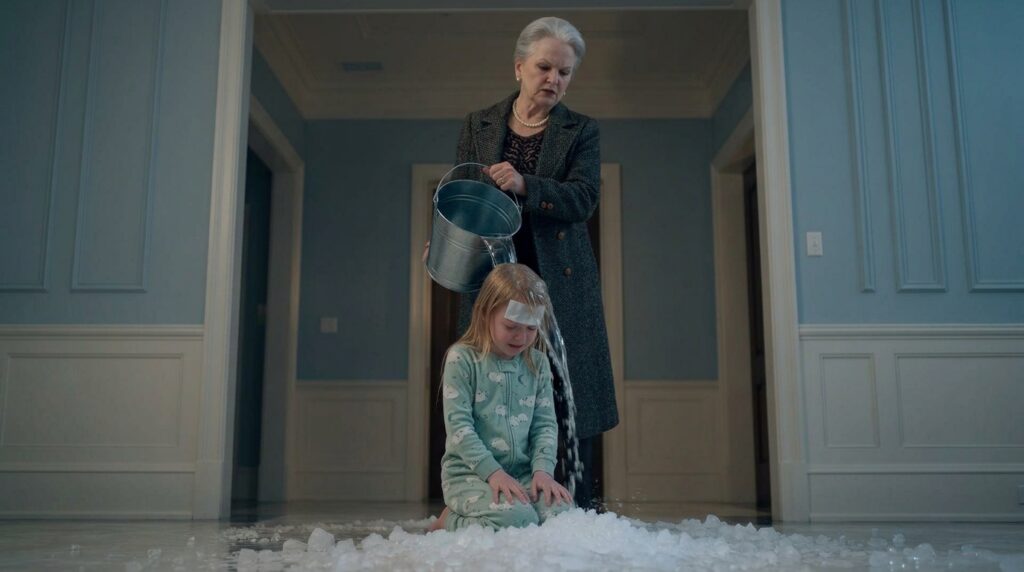
Constance Langford stood over her with the composure of a woman waiting for a lesson to take effect. Her silver hair had been pinned into the same immaculate shape she wore to foundation dinners, and nothing in her expression suggested that the child at her feet was sick enough to have glassy eyes and flushed cheeks. A metal bucket rested beside her polished shoe, its rim still damp from the ice water she had asked a member of staff to bring from the service pantry. Across the room, Spencer Langford sat in a navy armchair with one ankle crossed over the other, his phone dark in his hand.
Sophie lifted her face toward him first, as children often looked toward the person they still expected to make the world reasonable. Spencer met her eyes briefly, long enough for recognition to pass between them, before his gaze traveled to the windows and settled on the reflected lights of the house behind him. Sophie watched him for several seconds, then lowered her chin as another shiver moved through her body. When she finally spoke, the words came out blurred by exhaustion.
“I miss Mama. I want her to come now, because I don’t feel good and I don’t want to stay in this room anymore.”
Constance bent slightly, though there was no tenderness in the movement.
“Your mother has spent far too long teaching you that tears change the rules. They do not, Sophie. When you behave badly, you learn that unpleasant choices have unpleasant consequences, and the sooner you understand that, the easier your life will become.”
Sophie’s mouth trembled as she tried to swallow another cough. She looked toward Spencer again, searching his face with the stubborn patience of a child who had not yet learned that an adult could see distress clearly and still decide to leave it unanswered. His fingers tightened once around the phone, then relaxed. He remained in the blue chair.
Constance lifted the bucket.
The water struck Sophie across the head and shoulders with enough force to flatten her hair against her cheeks. Her breath disappeared into a sharp, strangled gasp as the cold soaked through her pajamas and spilled over the bluestone in quick silver streams. She tried to push herself upright, slipped on one knee, and caught herself with both palms while water dripped from her lashes. The bucket hit the floor beside Constance with a hard metallic sound that traveled through the glass room.
“Bad children have to be punished,” Constance said. “Perhaps next time you will remember that before you embarrass yourself.”
The sound Hannah Cole heard when she entered the front hall was not the splash. It was the bucket.
She had arrived twenty-three minutes early for her scheduled evening with Sophie because a client meeting in Stamford had ended sooner than expected, and for the first time in months she had felt grateful for an empty stretch of highway. The Langford house looked unchanged from the drive: pale stone, symmetrical windows, restrained winter decorations, every exterior light placed with the same precision Constance demanded from people. Hannah had walked through that front door for six years as a wife and for seven months as a visitor, but the metallic crash from the conservatory made her stop before she had removed her gloves.
Then she heard Sophie cough.
Hannah crossed the hall so quickly that her shoulder struck the edge of an antique console table, sending a silver-framed photograph crooked without slowing her. The conservatory doors stood open ahead of her, and what she saw inside arrived in fragments that her mind resisted arranging into a single explanation: Constance beside the empty bucket, Spencer in the navy chair, water spreading across the stone, Sophie on her knees with the fever patch still clinging to her forehead. For an instant Hannah remained in the doorway because recognition could not keep pace with what her eyes were giving her. Then Sophie turned and saw her.
“Mommy.”
The word carried none of the relief Hannah had imagined hearing during the drive. It sounded frightened, almost apologetic, and that was what moved her body before thought returned. Hannah went down on the wet floor without caring what it did to her coat, gathered Sophie under the arms, and lifted her against her chest. The child was shockingly cold on the outside and burning around the face and neck, her wet pajamas sticking to Hannah’s wrists as she tried to wrap the green wool coat around both of them.
“Oh, sweetheart, I have you. You don’t have to explain anything to me right now. Keep your face against me and let me get you warm.”
Sophie clutched the collar of Hannah’s blouse with both hands and began to cry in earnest, the exhausted, breathless crying of a child who had been trying to remain quiet for too long. Hannah pressed her cheek to the wet hair and felt something inside herself give way with such force that she had to concentrate on keeping her hold gentle. Behind her, Constance exhaled with audible impatience.
“This is precisely what I mean, Hannah. You arrive, you panic, and within thirty seconds she has learned that hysteria earns her exactly the response she wants. She had been warned repeatedly about her behavior this evening.”
Hannah turned slowly enough that Sophie remained secure against her chest. Constance’s face was calm, which made the empty bucket at her feet look more obscene than any expression of rage could have done. Hannah could smell Sophie’s shampoo beneath the cold water, and the familiar scent turned the room from something incomprehensible into something painfully real. She stepped toward Constance.
“She has a fever. There is still a fever patch on her forehead, and you poured ice water over her while she was kneeling on a stone floor.”
“You are making another scene because you have never learned the difference between protecting a child and indulging one. If Sophie is going to spend part of her life in this family, she will learn discipline whether you approve of it or not.”
Hannah struck her.
The slap landed across Constance’s cheek with a flat sound that seemed smaller than the bucket and more final. Constance rocked back one step, more shocked by the violation of her authority than by the force itself, and Hannah immediately tightened her arm around Sophie as though instinct had reminded her where her hands belonged. She did not apologize, but neither did she lift her hand again.
Spencer finally rose from the blue chair.
“Hannah, you need to control yourself. Whatever you think you saw, assaulting my mother while you are holding Sophie is not going to help you, and you are making this situation much more serious than it needs to be.”
The calmness of his voice turned Hannah toward him faster than anger alone could have managed. Sophie was still trembling between them, close enough that Spencer could see water dripping from the ends of her hair, and yet his first complete sentence had been about Hannah’s behavior. She looked at the chair behind him, then at the place on the floor where Sophie had been kneeling.
“You were sitting right there. She was sick, she was crying for me, and your mother poured freezing water over her while you sat three yards away and watched.”
Spencer’s jaw shifted, but he kept his voice measured.
“You have arrived in the middle of something you do not understand, and if you are capable of thinking beyond the next ten seconds, you will stop turning every disagreement into proof that everyone around you is dangerous.”
Hannah moved before she had decided to.
Her palm struck his face hard enough to turn his head. Sophie flinched against her, and Hannah felt the reaction immediately, a small recoil that cut through the anger more effectively than anything Spencer could have said. She lowered her hand, drew Sophie closer, and forced herself to step back.
Then the front doors of the house opened with enough force to echo through the hall.
Heavy footsteps followed, several sets at once, accompanied by voices that carried the unmistakable authority of people entering a situation they already expected to be dangerous. Red and blue light began flashing across the conservatory glass, transforming the elegant room into alternating bands of color. Constance stared toward the hall, while Spencer’s expression changed for the first time that evening.
“Police! Everyone stay where you are, and keep your hands visible. Ma’am, continue holding the child, but do not approach anyone else.”
Two officers entered first, followed by paramedics carrying medical bags and a folded thermal blanket. Hannah did exactly what she was told, partly because Sophie had tightened both arms around her neck and partly because the sight of uniforms made the room feel suddenly smaller. One officer positioned himself between Hannah and the Langfords while the other took in the bucket, the water, Sophie’s wet clothing, and the cooling strip on her forehead.
Constance recovered before anyone else.
“That woman assaulted me and my son in front of a child. I expect that to be documented accurately, because she has a history of creating instability wherever she goes.”
The officer did not respond to the accusation beyond asking Constance to remain on the opposite side of the room. A paramedic approached Hannah carefully, speaking to Sophie before touching her, and wrapped the thermal blanket around the child while checking her temperature and responsiveness. Hannah answered what she could, but there were questions she could not answer because she had arrived after the worst of it had already begun.
As the paramedics prepared to take Sophie to the emergency department, Hannah tried to follow with her still in her arms. One officer explained that everyone’s statements would need to be taken and that the existing parenting arrangement could not simply be rewritten in the conservatory, no matter how disturbing the scene appeared. Hannah heard the words without accepting their emotional logic, because every part of her body insisted that picking up Sophie should have ended the problem.
Sophie seemed to sense that hesitation. She pressed her wet face into Hannah’s neck, her voice muffled beneath the thermal blanket.
“Mama, please don’t leave me again. I can be good this time, and I won’t make Grandma angry anymore.”
Hannah closed her eyes for one second, then opened them before the paramedic could ask whether she was all right. She told Sophie she was going with her to the hospital and repeated it in a steady voice until the child’s grip loosened enough for them to move. Behind them, police remained with Spencer and Constance, and the blue chair sat empty beside the spreading water.
At the emergency department, Sophie was placed beneath warmed blankets while a pediatrician examined her and asked Hannah questions about the fever, when it had started, what medication Sophie had received, and how long she had been exposed to the cold. Hannah could answer almost none of them. She had last spoken to Sophie by video the previous evening, when her daughter had complained only that her throat felt scratchy.
The pediatrician leaned closer to the child’s forehead and gently touched the edge of the cooling patch.
“This was already on her before you arrived at the house?”
“Yes. I saw it when I walked into the conservatory, but I didn’t put it there.”
The doctor glanced toward Spencer, who had reached the hospital with an officer several minutes earlier and stood near the doorway with his attorney on speakerphone. His face had regained its practiced composure.
“I didn’t put it on her either,” he said. “I wasn’t aware Sophie had developed a significant fever until later this evening.”
Hannah looked at him across the hospital room, still unable to reconcile that answer with the image of him sitting in the blue chair.
Before she could speak, someone moved in the hallway behind him. Marian Pike, the Langfords’ longtime house manager, stepped into the doorway wearing the same dark uniform she had worn when Hannah arrived at the estate. Her face looked older than it had that afternoon, and her hands were clasped tightly together in front of her.
“I put the fever patch on Sophie,” Marian said, looking first at the doctor and then at Hannah. “I knew she was sick long before Mrs. Langford took her into that room.”
Chapter 2: Six Weeks, Seven Months
By three in the morning, the emergency department had settled into the strange quiet that belonged only to hospitals after midnight, when fluorescent corridors remained bright while the people inside them lost track of ordinary time. Sophie slept beneath two warmed blankets with her face turned toward Hannah, the fever patch removed and replaced by a cool cloth after the pediatrician completed the first examination. Her breathing had steadied, though every so often her fingers tightened around the sleeve of Hannah’s sweater as if some part of her remained alert to the possibility that her mother might disappear while she slept. Hannah stayed in the chair beside the bed and kept one hand close enough for Sophie to find without opening her eyes.
Marian had been taken down the corridor to give a formal statement, while Spencer remained somewhere near the nurses’ station with an attorney communicating through his phone. Hannah had not spoken to him again after the conservatory, and she had no desire to test whether his voice would still carry the same calmness now that strangers had seen the water on the floor and the fever in Sophie’s face. What unsettled her more was the efficiency with which the Langford machinery had already begun to move: counsel had been contacted, statements were being separated, and every word spoken in anger seemed capable of acquiring a second life once it entered a legal record.
Hannah understood that machinery because she had been living inside it for seven months.
The first time Spencer used the word temporary, they were sitting across from each other at the breakfast table in the Langford house. Their marriage had already deteriorated beyond the point where either of them pretended that another weekend away or another expensive dinner could repair it, yet the house itself remained immaculate around them, polished silver catching morning light while staff moved quietly beyond the doors. Hannah had spent weeks searching for an apartment close enough to Sophie’s preschool that the separation would not uproot every part of the child’s life at once. She found one in Stamford with two bedrooms, an uneven hardwood floor, and a small balcony that overlooked a parking lot rather than six acres of landscaped grounds.
Spencer had listened while she explained the plan, his expression attentive enough to make the conversation appear reasonable from a distance. He never shouted when he wanted control, which had once made Hannah believe that their arguments were more civilized than those of other unhappy couples. Over time she learned that his calmness could narrow a conversation until every choice left available was one he had already decided he could tolerate.
“You are free to move wherever you believe you will be comfortable, Hannah, but Sophie should not be made to absorb every consequence of your decision at the same time. She has her room here, her preschool is twelve minutes away, and her entire weekday routine is established. Keeping her primary residence here until the next hearing is the least disruptive option available to us.”
He had folded his hands on the table after speaking, waiting with the patience of someone who had made his position sound like concern rather than leverage. Hannah remembered looking through the window toward the garden, where Sophie’s yellow rain boots had been left upside down beside the back steps after the previous afternoon’s storm. She had wanted to take her daughter that day, yet she also knew Sophie woke several nights a week asking whether her stuffed rabbit was still in the same place and whether preschool would happen in the morning.
Hannah agreed to six weeks.
The arrangement looked manageable on paper. Sophie would remain at the Langford house on school nights while Hannah settled into the apartment and rebuilt the work schedule she had reduced during the marriage, then they would return to mediation before the next custody hearing. Hannah had evening parenting time twice during the week and alternate weekends, and she could call Sophie freely outside those hours. No sentence in the agreement said she was giving up her daughter, and no one in the conference room suggested that temporary routines had a way of hardening into evidence once enough time passed.
Six weeks became nine after Spencer’s counsel requested additional financial disclosures. Nine became twelve when a mediation date had to be moved because Spencer was traveling for a company acquisition, and the replacement date disappeared when his attorney developed a scheduling conflict with another matter. Hannah’s own lawyer at the time assured her that delays were common and that courts generally preferred continuity for young children while disputes were being resolved. Each postponement arrived with a reason that sounded acceptable on its own, and Hannah kept telling herself that reacting too aggressively would make the separation harder for Sophie.
The more patient Hannah became, the easier it was for the Langfords to describe the existing arrangement as stable.
Spencer also changed the atmosphere around her visits without openly violating the agreement. A dinner that had once ended at seven-thirty began ending at seven because Sophie supposedly needed more sleep; a requested extra afternoon became impossible because Constance had scheduled a family event; video calls that lasted fifteen minutes gradually shortened when someone announced that Sophie needed a bath or had already become tired. Spencer never told Hannah she could not see her daughter. He simply made every additional hour feel like a favor that required negotiation.
One Sunday evening, after Hannah brought Sophie back from a weekend at her apartment, the child had cried in the driveway and begged to return with her. Hannah crouched beside the car for nearly ten minutes while Sophie pressed both arms around her neck, promising that she would see her again on Tuesday. Spencer waited near the front steps without approaching until Hannah finally managed to loosen Sophie’s hands.
“You keep telling her goodbye as if something terrible is happening to her when she comes home. She watches your face, Hannah, and she learns what she is supposed to feel. If you genuinely want this transition to become easier for her, you need to stop turning every separation into a crisis.”
His tone had been soft enough that Hannah doubted her own anger for several hours afterward. By morning, she had convinced herself that perhaps he was right about one thing: Sophie should never feel responsible for comforting her mother. So Hannah began smiling through every handoff, even when Sophie looked over her shoulder as Spencer carried her inside.
Sitting beside the hospital bed seven months later, Hannah could still remember the weight of those small arms tightening around her neck in the driveway. The memory had changed shape after the words Sophie whispered in the conservatory. What Hannah had once interpreted as ordinary separation anxiety now carried the possibility that her daughter had been trying to tell her something without knowing how to say it.
The door to the hospital room opened shortly after four. Tara Whitcomb entered carrying a leather portfolio and wearing a dark coat over clothes that looked as though she had dressed without bothering to check a mirror, which Hannah took as evidence that Tara had come directly from home. Hannah had hired her three months earlier after finally accepting that patience was no longer producing movement in the custody case. Tara specialized in high-conflict family disputes and had warned Hannah during their first meeting that wealthy families did not need to break laws in order to exhaust someone with fewer resources; they only needed enough time, enough paperwork, and enough people willing to call delay a process.
Tara looked at Sophie first, then pulled the empty chair closer to Hannah without opening the portfolio.
“I spoke briefly with the officer assigned to the scene, and I have enough to start preparing an emergency application this morning. I want you to understand what that means before the day becomes crowded with people telling you what you should expect. Tonight matters enormously, but the court will still look at the broader custody history, the medical evidence, the police report, and whatever the child-protection investigation develops. We are going to ask for immediate protection, and we are going to do it without pretending the rest of the case has disappeared.”
Hannah kept her voice low so Sophie would not wake.
“I am not sending her back there. I will answer every question they have, I will show them every message Spencer has ever sent me, and I will sit in any courtroom they put me in. I agreed to temporary because I thought I was protecting her routine, and I am finished letting that decision be treated as permission for people to do whatever they want.”
Tara watched her for a moment before nodding, though there was no triumph in her expression.
“That is the position we will take, but I need you to separate conviction from impulse from this point forward. You have a child who needs you to become extremely predictable under pressure, because the other side will examine every moment in which you are not.”
The warning was not abstract. Less than twenty minutes later, Tara’s phone vibrated against the arm of the chair, and the message she read tightened her mouth before she handed the screen to Hannah. The email had come from Spencer’s attorney and was addressed to both counsel and several members of the custody case team. Its language was polished, almost courteous.
It referred to Hannah’s conduct at the Langford residence as “two incidents of physical aggression committed in the immediate presence of the minor child.” It requested preservation of all hospital, police, and security records and stated that Spencer remained concerned about Sophie’s emotional welfare following what the letter called “an already contentious period of parental conflict.” Constance’s use of cold water on a feverish child appeared only once, embedded in a sentence that described the underlying events as disputed.
Hannah read the email twice because the first reading produced more heat than comprehension. She wanted to call Spencer and force him to hear exactly how his language sounded beside the image of Sophie kneeling on wet stone, yet Tara had already taken the phone back and placed it facedown on her portfolio.
“They want your anger before they want your explanation. If you give it to them, they can spend the next three months making everyone discuss your reaction instead of the reason you reacted. You struck two people while holding Sophie, and we are not going to lie about that or pretend it was wise. We are also not going to allow seventeen seconds of your behavior to erase what was happening to a sick four-year-old before you entered that room.”
Hannah leaned back and looked at Sophie, whose face had lost some of its feverish color beneath the blankets. The distinction Tara was drawing felt brutally simple once it was spoken aloud. Hannah could regret the slaps without surrendering the larger truth, and she could refuse to let remorse become the rope Spencer used to pull the entire night into a different shape.
Morning arrived gradually through a narrow hospital window, turning the glass from black to washed-out gray. Sophie slept through the first change of nursing staff, while Hannah signed releases and answered questions about the current parenting plan, previous medical history, and who ordinarily made decisions for Sophie during Spencer’s custodial time. The more forms she completed, the more Hannah became aware of how thoroughly seven months of temporary arrangements had documented a life she had never intended to become permanent.
Just after seven, a woman from the child-protection team entered and introduced herself before taking a seat near the foot of the bed. She did not begin with the conservatory or the bucket. Instead, she confirmed Sophie’s age, asked Hannah to describe the custody schedule, and listened without interruption as Hannah explained when she had moved out and how often she had been seeing her daughter since then.
The woman glanced down at the tablet in her lap, then back at Hannah with a change in attention so subtle that Hannah almost missed it.
“Mrs. Cole, before we go any further, I need to clarify something in the record. Were you ever contacted about an earlier concern involving Sophie?”
Hannah felt Tara shift beside her.
“No. If there was an earlier concern about my daughter, no one told me about it.”
The investigator studied her for another moment, as though determining whether surprise could itself be useful information. Sophie moved beneath the blankets and tightened her fingers around Hannah’s sleeve without waking, while the room remained quiet enough for Hannah to hear the soft mechanical hum of the heating vent above them.
“There was a report before last night,” the investigator said. “And according to the file, the concern did not begin at the Langford house.”
Chapter 3: Good Girls Don’t Spill
The investigator did not answer Hannah immediately after revealing that someone had raised concerns about Sophie before the night at the Langford house. She asked a nurse whether the room could remain undisturbed for another twenty minutes, then waited until the door closed before turning the tablet so Hannah could see the date of the earlier report. It had been filed five weeks before the conservatory incident, at a time when Hannah had still been telling herself that Sophie’s reluctance during handoffs was part of an ordinary adjustment to divorce. The source was listed as a member of staff at Sophie’s preschool.
Hannah recognized the school name at once, though the realization brought no immediate relief. She had spoken to Sophie’s teachers at holiday events, exchanged brief emails about snacks and nap schedules, and once volunteered for a fall art morning when the class painted paper leaves across an entire classroom wall. Nothing in those encounters had suggested that someone was frightened enough about Sophie to make a formal report. The idea that another adult had been watching her daughter deteriorate while Hannah continued smiling through scheduled pickups settled into her with a different kind of shame than the guilt she had carried the night before.
The report itself was careful rather than dramatic. Jenna Morales, one of Sophie’s preschool teachers, had documented a pattern of behavior that had become more noticeable over several weeks: panic after small accidents, excessive apologizing, reluctance to remove outer clothing even in warm rooms, and repeated questions about whether adults were still pleased with her. None of those observations proved that Sophie was being physically harmed, and Jenna had apparently been cautious about assigning meaning beyond what she could personally observe. What had concerned her was not a single bruise or accusation, but the growing intensity of Sophie’s fear around mistakes.
The investigator explained that Sophie had once knocked over a paper cup of milk during snack time. Instead of reaching for a towel or waiting for help, she had gone rigid, stared at the spill, and begun apologizing with such urgency that the teacher had to move the other children away before she could calm her. On another afternoon, Sophie had refused to take off a cardigan despite the classroom being warm enough that several children were in short sleeves, and when Jenna gently encouraged her, Sophie had asked whether “good girls get to keep their things.” The phrases were not extraordinary by themselves, yet together they had made the teacher uneasy enough to begin writing down what she heard.
Hannah looked at Sophie sleeping under the hospital blanket and tried to remember whether her daughter had said anything similar during their weekends together. There had been small moments she had noticed without understanding: Sophie insisting on carrying her cup with both hands, becoming upset when crayons rolled off the kitchen table, asking permission before opening a toy box Hannah had bought specifically for her apartment. Hannah had interpreted those habits as caution after months of moving between two homes, because the alternative required her to imagine that something inside the Langford house had been teaching Sophie to fear ordinary mistakes.
The investigator scrolled to another note, then paused before reading it aloud.
“Ms. Morales documented a drawing activity in which Sophie placed her father and grandmother inside a house and drew you outside it. When she was asked why you were outside, Sophie said, ‘Grandma says Mommy chose outside.’ The teacher did not press her for an explanation, which was appropriate, but she included the statement because it appeared to reflect something Sophie had heard rather than something she had invented.”
Hannah felt Tara’s attention shift toward her, though the lawyer did not interrupt. The phrase had the polished simplicity of something Constance might say at dinner, dressed as fact while carrying an accusation underneath it. Hannah could almost hear the tone that would have accompanied it: measured, disappointed, convinced that words became neutral if spoken calmly enough. What disturbed her most was how easily Sophie had apparently absorbed the idea that her mother’s absence belonged to a moral category rather than a custody dispute.
Later that morning, Jenna agreed to speak with Hannah by phone once Tara confirmed that the conversation would not interfere with the ongoing investigation. Her voice was warm but restrained, the manner of someone who cared deeply about a child and had already been warned not to overstep the boundaries of what she had directly observed. She apologized only once, not for making the report, but for the fact that Hannah had learned about it under circumstances none of them would have chosen.
“I want to be careful because I do not know what happens in either home, and I would never tell you that I saw something I did not see. What worried me was that Sophie had begun treating very small mistakes as if they carried consequences far larger than the mistake itself. She was not simply embarrassed when she spilled something; she looked frightened of what the spill meant about her.”
Hannah pressed two fingers against her temple while listening, aware that anger would be easier to tolerate if there were one clear moment she could point to and say this was when everything changed. Jenna gave her no such comfort. The teacher described a child whose fear had accumulated gradually, almost politely, in ways adults could dismiss if they preferred a simpler explanation.
“I asked her once whether anyone was hurting her, and she told me no. I believed that she was answering honestly from the way she understood the question, but I also knew children do not always use adult definitions for what happens to them. She talked much more about being good, being punished, and whether people would still want her when she made mistakes.”
The words remained with Hannah after the call ended because they explained something she had been unable to reconcile. Sophie had never told her that Constance hurt her, and Hannah had repeatedly used that absence as evidence that whatever discomfort existed in the Langford house had not crossed into danger. Now she understood how much faith she had placed in a four-year-old’s ability to classify the behavior of adults who controlled the language around her.
By midday, the world outside the hospital had begun constructing its own version of the previous night. A local news site published a short item about police responding to a disturbance at the Langford residence, referring to Hannah as Spencer Langford’s estranged wife and noting that an altercation had occurred during a custody dispute. The article contained no mention of Sophie’s fever, the wet conservatory floor, or the bucket, because those details had not been released. Within an hour, two entertainment accounts had copied the story and added photographs of Hannah and Spencer from an old foundation event where they had still been smiling beside each other.
The timing was especially vicious because the Langford Children’s Foundation was less than a week away from its winter gala. Promotional material had already gone out across Fairfield County under the campaign line Every Child Deserves to Feel Safe, accompanied by a photograph of Constance standing beside a group of schoolchildren at a fundraising event. Hannah stared at the image longer than she intended, studying the practiced warmth in Constance’s face and the careful placement of her hand on one child’s shoulder. The same woman had stood over Sophie with a metal bucket less than twelve hours earlier.
Her first impulse was immediate and satisfying. If the police had preserved photographs from the scene, if the hospital records documented Sophie’s condition, if any part of the conservatory had been captured on security footage, then Constance’s public image could collapse before the gala doors opened. Hannah imagined posting one sentence beneath the foundation slogan and letting strangers do the rest.
Tara took the phone from her before she typed anything.
“You are allowed to hate the fact that they have the advantage of a clean public story right now, but do not mistake public speed for legal strength. If you post Sophie’s worst night because you need strangers to understand you today, that image may still belong to the internet when she is fifteen. Spencer’s side wants you reacting in public because every reaction gives them another opportunity to describe you instead of answering for themselves.”
Hannah leaned back, forcing herself to look away from the foundation page. The restraint felt humiliating because silence had already cost her so much, yet she also understood the difference Tara was asking her to recognize. Staying quiet for Sophie was not the same as allowing the Langfords to define the truth; one was a decision made for a child, while the other had been a pattern of surrender.
By late afternoon, the investigator returned with another update. Police had completed the first round of interviews at the Langford property and confirmed the identity of the person who had placed the emergency call. Hannah expected the name to belong to a neighbor, perhaps someone who had heard raised voices or seen emergency lights reflected across the estate.
Instead, it was Marian Pike.
For several seconds Hannah could only picture the woman as she had known her during the marriage: efficient, formal, almost invisible within the routines of the house. Marian had remembered which snacks Sophie liked, which coat needed dry cleaning, which rooms Constance wanted closed before guests arrived. Hannah had never thought of her as someone who would defy the Langford family, much less call police into their home.
The investigator did not elaborate on Marian’s full statement, but she confirmed one fact that changed the shape of the previous night. Marian had told police she passed the conservatory before Sophie was brought into it and saw Spencer already seated in the navy chair, alone with his phone in his hand. He had been there before the punishment began, before the bucket was carried in, and before Sophie was made to kneel on the stone.
Hannah looked toward the hospital window as evening settled over the parking structure outside. Until that moment, a small part of her had still been trying to imagine that Spencer entered too late, froze under pressure, or failed his daughter in the span of a few terrible minutes. Marian’s statement left less room for accident and opened a much darker question about what Spencer had been waiting for before Sophie ever crossed that doorway.
Chapter 4: Seventeen Minutes
Marian Pike asked to speak with Hannah the following afternoon, after Sophie had been moved from the emergency department into a quieter pediatric observation room and the police had finished another round of interviews. Tara stayed beside Hannah, not because Marian appeared threatening, but because nearly every conversation now had the potential to become part of something larger than the people having it. Marian had changed out of her Langford uniform and wore a plain gray sweater beneath a wool coat, yet she still carried herself with the same careful posture Hannah remembered from years inside the mansion. What had changed was her face, which no longer held the professional neutrality that had once allowed her to move through the Langford household without becoming part of its conflicts.
She began with Sophie’s fever because that was the detail Hannah had been turning over since the hospital. Sophie had been flushed before lunch, unusually quiet during the afternoon, and warm enough by three o’clock that Marian checked her temperature twice. She had tried to call the pediatrician’s nurse line from the service pantry, then stopped when Constance entered and demanded to know why she was “creating unnecessary alarm over a child who needed rest.” Marian had argued that Hannah should be informed, especially because Sophie was scheduled to see her that evening, but Constance refused and Spencer did not overrule her.
“I told him directly that Sophie had a fever and that I wanted her mother notified. He looked at the thermometer, so there is no possibility that he misunderstood me, and he told me not to create another problem before Hannah arrived. I remember the exact wording because I realized then that he was more concerned about what the evening would look like than about why Sophie was getting sicker.”
Hannah listened without interrupting, though every sentence made the image of Spencer in the blue chair harder to place inside any explanation that did not involve deliberate choice. She had already heard him tell the pediatrician he was unaware Sophie had developed a significant fever until later that evening. Marian’s account did more than contradict that claim; it placed knowledge in his hands hours before Hannah walked through the front door. Tara wrote nothing down in front of Marian, but Hannah noticed the lawyer’s attention sharpen at the mention of the thermometer.
Marian had eventually placed a cooling patch on Sophie herself and persuaded the child to drink a small amount of water. She also moved a portable heater closer to the upstairs sitting room where Sophie had been resting, only for Constance to order it removed because she believed the room had become “stuffy.” By early evening Sophie had begun asking repeatedly when Hannah would arrive, and each repetition seemed to irritate Constance more than the last. Marian had stayed close enough to hear the tone of those exchanges, although she had not been permitted to remain in the room once Constance decided Sophie’s behavior required correction.
Hannah’s hands tightened together in her lap when Marian reached that part of the evening. She remembered Sophie’s whisper in the conservatory, the way the words I miss Mama had sounded less like a complaint than a confession. Until now, Hannah had assumed Constance’s cruelty had erupted in response to something specific Sophie had done. Marian’s account suggested something worse: Sophie’s attachment to her mother had itself become the offense.
“She kept asking whether you would still come if she was sick, and Constance told her that respectable children did not manipulate adults with tears. Sophie became more upset after that, because she thought wanting you had somehow caused the trouble. I tried to take her upstairs and keep her with me until you arrived, but Constance told me to leave the room and reminded me that I was an employee, not a parent.”
Marian paused long enough to steady herself before continuing. Hannah could see how carefully she was choosing words, not because she wanted to protect the Langfords, but because she wanted every claim she made to survive scrutiny later. That discipline mattered more to Hannah than an emotional performance would have, and it explained why Marian had already been willing to speak to police despite knowing where her loyalty would be judged. The woman had spent eighteen years managing the household, yet she now seemed prepared to give up every privilege attached to that history.
The incident in the conservatory had not emerged from nowhere. Marian described smaller punishments that had become more frequent after Hannah moved out: desserts withheld for ordinary mistakes, toys removed when Sophie became tearful after video calls, prolonged standing in the hallway when she protested bedtime, and forced apologies that required her to repeat phrases Constance supplied. Marian had objected whenever she personally witnessed those punishments and had begun writing dates in a small notebook she kept in her room because she no longer trusted herself to remember every detail accurately. She had also saved two photographs of Sophie asleep in daytime clothes after crying through a visit cancellation, not as evidence of injury, but because she had become afraid the pattern would eventually matter.
Hannah looked at Tara, who gave the smallest nod, acknowledging the importance without interrupting Marian’s account. The notebook did not transform every unpleasant household rule into a crime, nor did the photographs prove what had happened around them. What they did establish was that Marian’s concern had been growing over time and that she had taken steps to preserve what she could. That distinction mattered because it separated her from the adults who had seen enough to understand the pattern and chosen convenience instead.
“I should have found a way to get you more information sooner, and I will live with that. But I did not believe I could simply take Sophie from the house without making things worse for her, and every time I challenged Constance directly, she made certain I had less access the next day. I started documenting because I knew there might come a point when someone outside that family needed to see that none of this began with one bad evening.”
Tara finally spoke, her voice measured and quiet.
“Did Spencer know you were documenting anything?”
Marian shook her head and folded her hands more tightly.
“No. If he had known, I believe the notebook would have disappeared. He was careful about what remained in writing, especially after Hannah moved out.”
That answer led naturally to the part of Marian’s statement the police had already hinted at. Around six-thirty, she passed the conservatory and saw Spencer inside by himself, seated in the navy chair with his phone in one hand. He was not reading or working at a laptop, and the room had not yet been opened to the terrace. Several minutes later, Marian saw him standing on a low stool near the upper corner of the room, adjusting one of the security cameras mounted where the molding met the wall.
She had not found the action suspicious at the time because Spencer frequently complained about the estate’s security system and sometimes handled minor technology himself rather than waiting for staff. What changed the meaning afterward was the direction of the camera. Marian remembered that it had previously covered the glass doors and exterior access point, but after Spencer adjusted it, the lens faced more directly toward the center of the conservatory. By then Sophie was still upstairs with Constance.
Hannah felt a coldness unrelated to the hospital air settle along her arms. The detail forced her to reconsider the sequence she had been building in her mind since Marian’s name appeared in the police report. Spencer had been in the room before Sophie arrived, and he had touched the camera shortly beforehand. Whatever explanation existed for those facts, it belonged to a period when he already knew his daughter was ill.
Marian continued carefully, describing the final minutes before the emergency call. She heard Sophie crying from the hallway and went toward the conservatory despite Constance having told her to stay away. Through the partially open door, she saw Sophie on her knees and Spencer seated several feet away, while Constance instructed the child to remain still and “learn some control.” Marian stepped back long enough to call 911 from her own phone because she believed confronting Constance first would risk having the phone taken or the call prevented.
“I told the dispatcher there was a sick four-year-old being punished in a way I believed was dangerous, and I told them the child’s father was present but was not stopping it. I stayed on the line until I heard you enter the house, and by then the officers were already on their way. I knew I would probably lose my position the moment I made that call, but Sophie had reached the point where preserving my job would have meant choosing the household over her.”
Hannah lowered her gaze for a moment, not because she doubted Marian, but because gratitude felt almost painful beside everything else she was processing. Someone inside the Langford house had finally chosen Sophie before reputation, employment, or obedience. That choice had not prevented the bucket from being lifted, yet it explained why police arrived quickly enough to see the room before anyone had time to restore its usual order.
Tara asked one final question about the security system, and Marian confirmed that recordings from the conservatory were normally stored through the estate’s cloud-based service. She knew that because staff had occasionally been asked to review exterior footage after delivery problems or damaged garden equipment. Marian had no access to the administrator account and had never downloaded video herself, but she knew the system preserved metadata even when clips were deleted from the standard household interface.
By early evening, police technicians had already begun examining the security logs recovered from the Langford estate. The first result did not include video, yet it established that the conservatory camera had been manually repositioned and remained active throughout the period Marian described. A recording had been created shortly before Sophie entered the room and ended only after Hannah arrived.
The file length was seventeen minutes and forty-two seconds.
According to the initial log, someone with administrator access deleted it after the police entered the property.
Tara read the update twice before handing the phone to Hannah, who stared at the timestamp until the numbers stopped feeling abstract. Somewhere inside those seventeen minutes was the part of the night Spencer had already tried to reduce to a custody dispute and two slaps, and whoever deleted the file had believed removing the recording would narrow the story back down to conflicting accounts.
The forensic technician’s note beneath the log was brief, technical, and far more unsettling than any dramatic promise could have been. Deletion from the household interface did not necessarily mean the underlying data was unrecoverable, especially if backups or synchronized storage still existed. Police had already sent the necessary preservation requests, and the next stage would determine whether the recording itself could be restored.
Chapter 5: Leverage
The recovered recording arrived two days later, not as a clean piece of evidence but as a damaged file reconstructed from synchronized cloud storage and fragments preserved on the estate’s security server. Tara warned Hannah before they watched it that parts of the image would freeze, several seconds of audio were missing, and the restoration might never become technically perfect enough to answer every question. None of those limitations mattered once Sophie appeared on the screen, because the room Hannah remembered as chaotic was suddenly reduced to a fixed camera angle in which every adult had enough time to make a choice.
The footage began before Sophie entered the conservatory. Spencer stood near the upper corner of the room adjusting the camera while the navy chair waited several feet behind him, and he remained there long enough to check the image on his phone before stepping down from the stool. He did not look hurried or confused. He tested the frame, moved the chair slightly toward the window, and sat with the deliberate ease of someone preparing to remain in place.
Hannah watched from Tara’s conference room with both hands wrapped around a paper cup of coffee she had stopped drinking nearly an hour earlier. The police had provided access through counsel because portions of the footage were directly relevant to the custody matter, although an investigator remained present and reminded them that the criminal inquiry was separate. Sophie was with Hannah’s sister for the afternoon, safely removed from any possibility of hearing the recording, and Hannah had insisted on that arrangement before agreeing to watch.
Constance entered several minutes later with Sophie beside her. The child looked smaller on video than Hannah remembered, her pajamas loose around her ankles and the pale rectangle of the cooling patch standing out against her flushed forehead. Sophie walked reluctantly, glancing once toward the hall before Constance placed a hand between her shoulder blades and directed her toward the center of the room. Spencer looked up from his phone and followed them with his eyes.
The first part of the audio was ordinary enough to make the later violence more disturbing. Constance spoke about manners, obedience, and the embarrassment of crying whenever Hannah’s visit approached, using the polished vocabulary of a woman who believed cruelty became respectable if expressed without raising her voice. Sophie tried to explain that her stomach hurt and that she wanted to lie down, but Constance treated the request as defiance. Spencer heard every word.
At one point Sophie turned toward him with the desperate confidence of a child who still believed one parent could cancel the decision of another adult.
“Daddy, I don’t feel good. Can I wait for Mama upstairs with Marian? I’ll be quiet, and I won’t bother anybody if you let me go back to my room.”
Spencer did not hesitate long enough for Hannah to mistake the answer for panic.
“Do what Grandma says, Sophie. You have spent the entire evening making this harder than it needed to be, and the quickest way to finish it is to stop arguing.”
Hannah had thought she was prepared for the recording because she had already seen the outcome. She had held Sophie while her hair dripped onto the floor, heard the child’s teeth chatter against her shoulder, and watched Spencer stand from the chair only after Hannah confronted him. What she had not seen was the moment before everything became visible, when Sophie asked her father for help in a clear, complete sentence and he used his authority to send her back toward the person hurting her.
Tara did not interrupt the footage. Her face remained composed, but Hannah noticed that she had stopped making notes and was watching Spencer with the concentration usually reserved for a witness whose testimony was beginning to contradict itself. The investigator beside them leaned forward only once, when Spencer briefly checked his phone after Constance ordered Sophie to kneel. Whatever he was looking at was not visible on the restored video, but the timing would later matter.
The bucket appeared after several more minutes. Marian was not visible inside the room, which matched her account that she had stepped back into the hallway to call 911, and the recording did not capture the dispatcher on her phone. It did capture Sophie shivering before the water was poured, her arms folding instinctively across her body as the cold from the floor seeped through her thin clothes. Constance watched the child’s discomfort with the same stern patience she might have brought to a disciplinary meeting.
Spencer remained in the navy chair.
He looked at Sophie more than once. On the clearest section of footage, his eyes followed Constance as she lifted the bucket and then moved back to his daughter, whose face had already tightened in anticipation. His hand shifted on the armrest, and for a fraction of a second Hannah saw the physical possibility of intervention: he could have stood, crossed three steps, and stopped the entire thing before the water fell.
He stayed seated.
The water struck Sophie, and even through damaged audio Hannah heard the child gasp. Constance spoke over her crying, repeating the language about bad behavior and consequences that Hannah remembered from the doorway. Spencer turned his face toward the glass.
Hannah looked down at her hands until the sound stopped. The horror was no longer contained in the fact that Spencer had failed to protect Sophie; the footage demonstrated that he had been given several opportunities to intervene before the punishment escalated and had rejected every one of them. His stillness no longer resembled weakness. It looked organized.
The investigator paused the video after Hannah entered the frame.
“We need to discuss something before we continue. The security metadata shows that Mr. Langford accessed the camera feed from his phone during the recording. That does not by itself establish why he was monitoring it, but we also recovered communications from the period leading up to this incident that provide context.”
The messages were between Spencer and a senior adviser connected to Langford Holdings. Most concerned the growing conflict between Spencer and Constance over control of the company’s voting structure and the future leadership of the family foundation. Constance had refused to relinquish authority, while Spencer had privately complained that her judgment was becoming erratic and that the board would never act without evidence strong enough to overcome decades of loyalty to her name.
One message, sent three weeks before the conservatory incident, made Hannah reread the line several times.
Spencer had written that his mother would eventually “cross a line in a way nobody can defend” and that when she did, he intended to have proof.
There were other messages discussing access to household security footage and the usefulness of demonstrating that Constance’s private conduct did not match the image she presented to trustees and donors. None of them explicitly said Spencer wanted Sophie harmed, and Tara was careful not to claim that they did. The darker conclusion required no exaggeration: Spencer had recognized that his mother’s treatment of Sophie was escalating, prepared to record it, and decided that allowing her to go too far might serve him better than stopping her early.
Hannah felt a kind of nausea that anger alone could not explain. During the marriage she had often accused Spencer of calculating consequences before responding to people, and he had dismissed that criticism as evidence that she resented his ability to remain rational. Now she understood the extreme form of that instinct. Even with his four-year-old daughter crying in front of him, he had evaluated the moment as something that could be useful later.
Tara finally spoke after the investigator finished summarizing the recovered messages.
“Spencer may try to argue that he was documenting his mother because he believed evidence was necessary to protect Sophie. The difficulty for him is that the recording shows multiple opportunities to intervene, and his own communications place corporate leverage in the background before the incident ever occurred. We do not need to invent a motive beyond what the evidence supports. We only need to make sure nobody is allowed to replace his choices with a more flattering version.”
The footage resumed.
Hannah entered the conservatory, crossed the wet floor, and lifted Sophie into her arms. Watching herself from above was more disorienting than she expected, because the woman on the screen moved with a speed Hannah did not remember possessing. She saw Constance step forward, saw her own body turn protectively around Sophie, and watched the first slap land.
Several minutes later, she watched herself strike Spencer.
The room remained quiet after the video paused.
Hannah had spent two days defending the larger truth of what happened, yet seeing Sophie recoil slightly against her shoulder after the second slap stripped away any temptation to romanticize those moments. Constance and Spencer had deserved consequences, but Sophie had already been terrified enough without watching her mother lose control in the same room.
“I wish I had picked her up and walked out without touching either of them. I can understand why I did it, and I still wish I had made a different choice, because Sophie was the only person in that room who should have mattered to me.”
Tara leaned back in her chair, studying Hannah with the same unvarnished attention she brought to every difficult conversation.
“That is exactly how you should think about it. Regret does not require you to pretend the events were equivalent, and accountability does not require you to surrender the truth. Spencer’s lawyer will want one frame of that recording to swallow the other seventeen minutes, because your reaction is easier for them to defend against than his conduct.”
Hannah nodded, though the distinction hurt more now that she had watched Sophie’s body react to the slap. She wanted to become the kind of mother who could protect her daughter without giving people like Spencer another opportunity to redirect the danger. That would require restraint she had not always possessed inside the marriage, and for the first time she understood restraint as something stronger than silence.
By late afternoon, Tara was reviewing the next procedural steps when Hannah’s phone showed a voicemail from an unfamiliar Connecticut number. She almost ignored it, assuming it belonged to another reporter, but the transcription preview contained Spencer’s name. Tara asked her to play it through the speaker so they could hear the complete message before deciding whether to respond.
The woman’s voice was controlled, older than Hannah’s but younger than Constance’s, and familiar enough around the edges that Hannah understood the family resemblance before the caller introduced herself.
“My name is Rebecca Langford. Spencer is my brother, and I know you have no reason to trust anyone with that last name right now. I am calling because there is something you need to understand before his lawyers start telling you that what happened to Sophie was impossible to predict.”
A short pause followed, filled by the faint sound of traffic in the background.
“Our mother used cold as punishment long before Sophie was born. Spencer knows exactly what it feels like to be the child on that floor.”
Chapter 6: Inherited Weather
Rebecca Langford chose a diner twenty miles north of Greenwich for their first meeting, far enough from the family’s usual restaurants that no waiter would recognize the name on the reservation and discreetly text someone at the estate. The place smelled of coffee, grilled onions, and the industrial lemon cleaner used on laminated tables between lunch and dinner, a setting so ordinary that Hannah understood immediately why Rebecca had picked it. Nothing in the room belonged to the Langfords, and for the first time since the conservatory, Hannah was about to hear their history without marble floors, polished silver, or a family employee standing within earshot.
Rebecca was already seated when Hannah arrived with Tara. She resembled Spencer around the eyes and nowhere else, wearing her dark hair loosely and keeping both hands around a ceramic mug that had long since stopped steaming. There was no attempt at small talk after introductions, and Hannah appreciated that more than an apology offered too early would have comforted her. Rebecca waited until the waitress moved away before placing a thin envelope on the table.
“My brother will eventually tell someone that he failed Sophie because our mother trained him to freeze whenever she became cruel. There is some truth in the history behind that explanation, but you should never let him use the history to erase the choice he made as an adult. Spencer knew exactly what cold punishment felt like before your daughter was born, and that knowledge should have made him move faster, not remain in the chair.”
Hannah did not touch the envelope. Since hearing Rebecca’s voicemail, she had spent most of the night imagining the version of Spencer who had once been small enough to fear Constance, and she resented the instinctive sympathy the image tried to create. The footage had shown a thirty-eight-year-old man with a phone in his hand, a company title behind his name, and complete physical freedom to stand between his mother and his daughter. Childhood could explain where he learned silence, but it could not turn seventeen minutes of deliberate inaction into helplessness.
Rebecca began with a winter from more than thirty years earlier. Spencer had been eight, she had been thirteen, and Constance had considered bed-wetting at that age evidence of laziness rather than fear. On two occasions Rebecca remembered clearly, their mother made him stand in an unheated mudroom in pajamas while the rest of the family ate breakfast, insisting that discomfort would teach him self-control. Their father sat in the adjoining breakfast room reading the financial pages and never challenged her.
“There was a blue chair beside the window in that room too. Different house, different fabric, but the position was almost identical. Our father would sit there with his newspaper while Mother carried out whatever lesson she had decided one of us needed, and he taught Spencer something almost as damaging as anything she taught us herself.”
Rebecca’s fingers moved once around the edge of the mug before she continued.
“He taught him that if you remain calm enough while somebody else suffers, people may eventually mistake your silence for innocence.”
The sentence stayed with Hannah because it explained the resemblance without softening it. Spencer had not grown into his father by accident; he had adopted the same useful distance and refined it into something more sophisticated. His father had hidden behind a newspaper, while Spencer had hidden behind legal language, corporate messages, and the conviction that composure made him the most reasonable person in every room.
Rebecca described other punishments without lingering over them. Cold showers followed tantrums, bedroom doors were removed after arguments about privacy, and affection disappeared for days whenever either child embarrassed Constance in front of guests. Nothing was permitted to look chaotic from outside the household, which meant Constance rarely shouted and almost never left visible injuries. Her methods were designed around obedience that could later be described as discipline.
By sixteen, Rebecca had begun fighting back openly. Spencer took the opposite path, studying their mother closely enough to predict what would anger her and what would earn approval, then learning to stand beside whichever source of power seemed most secure. Rebecca eventually left for college and built a life several states away, while Spencer remained close to the family company and became increasingly valuable to Constance. Their different responses to the same household had separated them long before adulthood made the distance official.
Hannah finally opened the envelope. Inside were copies of old emails Rebecca had exchanged with Spencer over the years, most of them mundane discussions about holidays, their father’s estate, or Constance’s interference in family decisions. Rebecca had marked several messages in which Spencer referred casually to their childhood punishments, proving that he remembered them clearly and did not dispute what had happened.
Tara scanned the pages without changing expression.
“These help establish that he cannot credibly claim he had no context for what cold punishment meant in that family. They do not prove what happened to Sophie by themselves, but they matter because they narrow the excuses available to him.”
Rebecca nodded, though she seemed less interested in strategy than in making sure Hannah understood the man she had married.
“Spencer always believed suffering mattered most when it could be converted into something useful. If Mother humiliated him, he learned what she wanted and used it next time. If Father disappointed him, he remembered which weakness to exploit later. By adulthood, he no longer thought in terms of whether something was cruel; he thought in terms of whether it produced leverage.”
The word landed differently now that Hannah had watched the footage. She remembered arguments during the marriage in which Spencer waited until she raised her voice, then calmly repeated only the harshest sentence back to her later, detached from everything that had preceded it. At the time she had thought he was merely defensive. She could now see the same structure in the conservatory, where Sophie’s suffering had become another event to preserve until it could be useful.
The meeting lasted less than an hour. Rebecca offered to provide a formal statement and made it clear she would testify if necessary, without asking Hannah to protect the Langford name or keep her involvement private. She did not ask forgiveness for Spencer, and she did not suggest that Constance’s childhood had somehow made the family history inevitable. Whatever damage had moved through the Langford generations, Rebecca treated the moment Sophie was harmed as the point where explanations stopped mattering.
Hannah returned home before dinner and found Sophie sitting cross-legged on the living-room rug with a box of wooden animals. The child was no longer feverish, though she still wore socks with rubber grips even indoors and had refused that morning to step onto the bathroom tile until Hannah laid down two towels. Sophie had also begun following Hannah from room to room, sometimes pretending she needed a toy from wherever Hannah was going, sometimes simply standing nearby without speaking until Hannah returned to the same floor.
That evening, Hannah noticed the pattern most clearly when she said she was going downstairs to switch a load of laundry. Sophie’s shoulders tightened before she asked whether Hannah would be gone long, and the question carried enough restraint that Hannah understood how hard the child was trying not to sound afraid. Her first instinct was to promise that she would never leave again, the same promise she had repeated since the hospital, but the therapist they had met that morning had encouraged something more concrete.
“I’m going downstairs for five minutes to move the laundry into the dryer. I’m setting the kitchen timer, and when it rings, I will be back right here with you. You do not have to be extra good while I’m gone, and you do not have to earn my coming back.”
Sophie looked at the timer Hannah placed on the coffee table, then at her mother.
“Even if I make a mess?”
Hannah sat beside her long enough to smooth one hand over the child’s hair.
“Even if you make a mess. Coming back is my job, not something you have to earn.”
Five minutes later, the timer sounded while Hannah was already climbing the stairs. Sophie was still on the rug, but she had moved closer to the hallway where she could see the staircase. Hannah did not celebrate the moment or tell her how brave she had been; she simply returned when she said she would, helped Sophie find the wooden horse that had rolled beneath the sofa, and continued with dinner.
The routine repeated the following day. Hannah went to collect the mail, told Sophie exactly where she was going, and returned before the timer finished. That evening she took the trash outside while Sophie watched from the kitchen window, and once again she came back when she said she would. Nothing about the process looked dramatic enough to belong in the stories people told about rescue, yet Hannah began to understand that safety was being rebuilt through ordinary promises kept so consistently that Sophie would eventually stop needing to measure them.
Two nights later, Sophie sat beside Hannah on the couch while a quiet cartoon played across the television. She had been unusually thoughtful since dinner, rubbing one thumb over the seam of her pajama sleeve in the repetitive way Hannah now recognized as preparation for a difficult question. When she finally spoke, her eyes remained on the screen.
“Did Daddy know I was cold before you came?”
Hannah felt the answer move through her before she allowed herself to speak. Anger would have been easy, especially after Rebecca’s account, but Sophie had not asked for a verdict on Spencer’s character. She had asked whether the person who was supposed to protect her had understood what was happening.
“He knew you were sick, and he was supposed to keep you safe. What happened in that room was never your responsibility, and there was nothing you could have done to make it acceptable.”
Sophie leaned against her side, absorbing the answer with the serious stillness children sometimes brought to information too large for their age.
“Why didn’t he help me?”
Hannah rested her cheek against the top of Sophie’s head and allowed the silence to remain honest rather than filling it with an explanation the child had not asked for.
“I don’t know how to give you an answer that would make his choice understandable. I only know that he should have helped you, and you deserved better from him.”
Later, after Sophie was asleep, Tara called with a message Rebecca had forwarded from an old family email archive. Unlike the earlier communications investigators had recovered about Constance eventually crossing a line, this one was direct enough to remove another layer of ambiguity. It had been sent by Spencer to Rebecca five weeks before the conservatory incident, after Rebecca challenged him about Constance’s increasing involvement in Sophie’s discipline.
Spencer had written that he already knew their mother was using “the same cold-room nonsense” with Sophie when the child became difficult. He added that Rebecca should stay out of it because interference would only make Constance more careful, and he needed her behavior to remain visible until he had something the board could not dismiss.
Hannah read the message twice while the house around her remained quiet. The footage had shown that Spencer chose not to stop one terrible night. The email proved that the choice had begun weeks earlier.
Chapter 7: Safe for Children
By the morning of the Langford Children’s Foundation winter gala, Hannah had received three separate requests for the conservatory footage and two offers of money for an interview. One came from a local investigative reporter who promised careful handling; another came from a producer who described the story as “an extraordinary collision of wealth, family power, and maternal courage.” The phrasing made Hannah feel faintly ill, not because it was inaccurate, but because Sophie’s worst night had already begun transforming into material other people could package, title, and sell.
The gala had been planned for months at a hotel overlooking Long Island Sound, with nearly six hundred guests expected to attend. Its campaign line, Every Child Deserves to Feel Safe, appeared across donor emails, auction materials, and large printed banners already installed in the ballroom. Constance was still scheduled to deliver the closing remarks, and the foundation had issued no public statement beyond acknowledging that “a private family matter” was under review. From the outside, the Langford name still occupied the same polished space it always had: charitable, disciplined, prosperous, and carefully untouched by whatever happened behind its own doors.
Hannah spent most of that morning at Tara’s office reviewing documents rather than watching coverage. The legal team had obtained authorization to preserve relevant security records, and investigators were continuing to separate what belonged to the custody matter from what might support other proceedings. Spencer’s old email about the “same cold-room nonsense” had tightened the timeline around his knowledge, while the recovered camera footage had already made it difficult for his attorneys to describe the conservatory as an isolated misunderstanding.
The temptation to release the recording came when Hannah saw a promotional clip for the gala. Constance appeared in a navy evening dress beside a row of smiling children from one of the foundation’s literacy programs, speaking about safety, dignity, and the responsibility adults carried toward those too young to protect themselves. Hannah watched the thirty-second clip twice, stunned by the perfection of the contradiction. The woman who had poured cold water over Sophie while she had a fever was preparing to stand beneath the words Every Child Deserves to Feel Safe and accept applause for protecting children.
Hannah picked up her phone and opened the message from the reporter. She could imagine exactly what would happen if she attached the video: the gala would implode before dinner, Constance’s face would spread across national feeds, Spencer’s silence in the blue chair would become a symbol before midnight. For several minutes the possibility felt less like revenge than correction, as though the public version of the Langfords had become so false that exposure itself was a moral duty.
Tara saw the open message before Hannah pressed anything.
“If you release that video today, you may win the public argument before sunset. You may also guarantee that Sophie’s humiliation remains searchable when she is old enough to understand what happened to her, and you will give Spencer’s team another reason to argue that you are using a child’s trauma as leverage in a custody dispute. I understand why you want the world to see it, but the question is whether Sophie deserves to become evidence for strangers simply because the people who hurt her have built their lives around public image.”
Hannah looked at the screen again, then at the still frame frozen inside the video file: Sophie’s small body at the edge of the image, the blue chair in the corner, the entire room turned into something Hannah now wished she could erase from her daughter’s future. The anger did not disappear when she closed the message. It changed direction.
She forwarded nothing to the reporter.
Instead, Tara helped route the evidence where it could produce consequences without turning Sophie into spectacle. The footage and related communications were already preserved for law enforcement and family court, while copies of the corporate-security records were sent through counsel to the compliance office of Langford Holdings and to outside counsel advising the foundation board. Spencer had used a company security employee to access, manage, and later interfere with footage from a private residence connected to an unfolding child-safety investigation. That fact carried implications unrelated to gossip, and unlike a viral leak, it required people with fiduciary responsibilities to answer questions on the record.
The corporate records revealed more than Tara expected. Spencer had contacted a Langford Holdings security manager after the police entered the estate and requested “immediate cleanup” of the household account, citing privacy concerns. Within minutes, an administrator credential associated with that employee had been used to remove the seventeen-minute file from the family-facing interface. Whether Spencer intended permanent destruction remained a matter for investigators, but the board no longer had the luxury of treating the scandal as merely a domestic dispute.
By late afternoon, Hannah was back at home with Sophie while the gala began without them. She made grilled cheese for dinner, cut the sandwich into four uneven squares because Sophie preferred the corners, and kept the television off. The ordinariness of the meal steadied her more than any courtroom strategy had. Sophie spent most of dinner telling Hannah about a classmate who had insisted purple crayons were luckier than red ones, unaware that several miles away donors were arriving beneath banners printed with language that had once belonged entirely to the Langford family.
Tara called just after seven.
“The board has the security records now, and outside counsel is reviewing them before the program ends tonight. Nobody can guarantee what action they will take, but they cannot plausibly say they were unaware that company resources were used around the same incident that now sits inside an active investigation. You did not have to put Sophie online to make them look.”
Hannah leaned against the kitchen counter and watched Sophie line up apple slices by size.
“I wanted Constance to feel what it was like to lose control of the story in public. I still do, if I am honest. But Sophie has spent enough time being useful to adults who wanted something from her. I do not want justice badly enough to repeat that pattern.”
Tara let the silence sit for a moment before answering.
“That distinction is going to matter more than any headline.”
At the hotel, Constance entered the ballroom shortly after eight beneath a wash of warm light and donor applause. The event photographer captured her greeting trustees, hospital administrators, and longtime family friends with the same composed expression she had worn throughout the investigation. Her speech remained on the program, and according to one board member later interviewed by counsel, she refused a private suggestion that she step aside until the family matter was resolved.
The ballroom itself had been designed to embody the Langford version of benevolence. Large photographs of children receiving school supplies and medical grants rotated across projection screens, while floral arrangements in pale winter colors framed the stage. The foundation had raised millions over the years, and many of its programs had genuinely helped families who would never know what happened inside the Langford conservatory. That contradiction made Constance’s position more corrosive rather than less, because the good done under the family name had also become part of the shield she believed entitled her to control the narrative.
When Constance reached the podium, she spoke with practiced warmth about responsibility, stewardship, and the moral obligation of adults to create safe environments for children. Several trustees already had copies of the compliance memo in their email. Phones began vibrating across the front tables, one after another, while the speech continued under the foundation slogan printed in white behind her.
“Safety is not an abstract promise we make to children when cameras are present. It is a responsibility we carry in private, in our homes, and in the decisions we make when no one is applauding.”
The irony was almost too complete to feel accidental, though Hannah would not hear the line until the following morning. Constance delivered it with complete confidence, unaware that the board’s outside counsel was reading an internal report describing the security-camera deletion associated with the night Sophie was hospitalized. She finished to applause, thanked the donors, and stepped away from the microphone with the same controlled smile she had practiced for decades.
What she did notice was the empty chair at the center of the Langford family table.
Spencer had been expected beside her.
He never entered the ballroom.
Halfway through the gala, Langford Holdings’ board secretary had called him into an emergency meeting at the company’s Stamford offices after receiving the security records. The succession fight Spencer had spent months constructing around his mother’s misconduct had finally reached the people whose approval he wanted most, but the evidence no longer pointed in only one direction. His own decisions had become part of the file.
Near nine-thirty, Tara received a final message from corporate counsel and forwarded only the portion Hannah was permitted to see. The board had opened a formal internal review into the use of company personnel and systems surrounding the Langford residence footage. Constance’s conduct remained under separate scrutiny, but Spencer had now been instructed to preserve every company device, message, and private communication related to his mother, the conservatory recording, and Sophie.
Hannah read the notice while Sophie slept upstairs beneath a lamp turned low enough to leave the room warm without making shadows move across the walls. For weeks Spencer had treated his daughter’s suffering as something he could preserve until it became useful against Constance. Now the same evidence had reached the institution he had been trying to control, and for the first time, he no longer controlled what happened next.