PART 2: The little green phrase book still folded at page 60. Still restaurant vocabulary. The zipper still catches on the third tooth. I’ve decided it never has to be fixed. One seat on one flight booked through Meridian Travel Collective by a woman with her own credit, her own passport, and nobody’s permission. I told Daniel we’d skip two Sundays. He said he’d read ahead. The laminated card is still in my wallet behind my library card. 164471. Active. Mine. Ray’s pharmacy receipt came off the refrigerator and went into the outside pocket of that bag where it is right now. They told me to give up my spot. It was never a spot. It was mine.
What I did not know when I zipped that duffel on November 9th was that leaving alone would feel harder than canceling a trip for seven people. Canceling had been a decision. Traveling was a test. Decisions happen at kitchen tables. Tests happen when you are standing under bright airport lights with your passport in your hand and nobody beside you to say where the gate is. At Charlotte, I arrived three hours early because Ray and I had spent forty years believing that being late was a character flaw. I checked the departure board four times. Rome was there in clean white letters. So was my name on a boarding pass I had bought with my own card. No group reservation. No family seating chart.
No one else’s preferences attached to it. I had one suitcase, one navy duffel, and a small envelope in the outside pocket holding the old pharmacy receipt with Ray’s handwriting on it: Rome before we can’t. The woman at the counter asked if I was traveling alone. She asked it the same way somebody might ask whether I wanted paper or plastic. I said yes. That was all. No explanation followed, and I noticed how much peace there was in not having to explain myself. At the gate, I bought coffee that cost more than it should have and sat facing the windows. Families kept arranging themselves around me. A father counted backpacks. A mother opened a plastic bag and handed out crackers. Two sisters argued over a charger.
I watched all of it without envy. There had been a time when I thought being useful was the same thing as belonging. That spring had taught me the difference. My phone buzzed once before boarding. It was Hallie. Have one ridiculous dessert for me. I smiled and wrote back, Two if the structural conditions allow. She sent a laughing face. Then another message appeared. Dad studied last night. For real. I read that one twice. Daniel had been coming to my kitchen on Sundays for three weeks before I left. The first night, he sat where Brooke had sat in March and stared at the code book as if it had personally insulted him. I asked him about load paths, fire separation, stair geometry, soil reports.
He knew more than he thought and less than he had spent years pretending. The second Sunday, he brought a legal pad. The third, he brought sharpened pencils and no excuses. I never asked whether Brooke knew he was coming. I never asked what Grant had said after leaving Yorkline. I never asked whether the office still had the old York Built photograph in the hall. I had finally learned that information can be another form of work, and not all work belongs to me. I put the phone away when they called my group. The flight was overnight. I slept maybe forty minutes. Somewhere over the Atlantic, the cabin went dark except for little blue lights along the floor.
I took Ray’s receipt from the outside pocket of the duffel and held it under the reading light. The paper had softened at the folds. The writing looked smaller than I remembered. Rome before we can’t. For years, I had treated those words like an unfinished instruction. That night, with a plastic cup of water on my tray and a stranger asleep against the window, I understood that Ray had not written our names on the receipt. He had not written Wendy and Ray. He had written Rome. Maybe I had been carrying the sentence too literally. When we landed, the morning was pale and wet. The driver from the hotel held a card with YORK written in black marker.
I almost looked behind me for the rest of the family. Nobody was there. The card was for me. I spent the first day walking badly and looking up too much. The streets seemed designed by people who had never heard of straight lines. Every corner opened onto another wall older than anything I had ever touched in North Carolina. I ran my fingers over stone that had outlived builders, owners, arguments, permits, governments, weather, and generations of people who once thought their own problems were permanent. At the Pantheon, I stood beneath the dome and stared at concrete poured almost two thousand years ago. A guide nearby was explaining compression rings to a group of college students. I listened from the edge. I could not help myself.
PART 3: The old habits came back immediately: span, thrust, load, transfer. The building did not care who had taken credit for it. It stood because the forces had somewhere honest to go. That sentence stayed with me all afternoon. At a small restaurant that evening, I opened the phrase book to page 60. I ordered fish in careful Italian. The waiter answered in English because apparently I had pronounced something with the confidence of a woman ordering roofing felt. I laughed so hard I had to put my napkin over my mouth. It was the first time in months I heard myself laugh without checking whether anyone else was comfortable. Back at the hotel, there was a voicemail from Daniel.
I did not listen to it until after I had taken off my shoes and set Ray’s receipt on the desk. “Mom. I know you’re gone. I just wanted to tell you I got forty-seven out of fifty on the practice section you gave me. I missed the two on foundations and one on accessibility. Don’t call me. You’re on your trip. I just wanted you to know.” There was a pause. I could hear paper moving. “Also, I found the old Hatcher Road notebook in Dad’s cabinet. Your handwriting was terrible.” Then the message ended. I sat on the edge of the hotel bed with the phone in my hand. That was the first thing my son had said to me in months that contained no request.
I did not call him back. I sent one text. Your grandfather said the same thing about my handwriting. Check Table R602.3 before Sunday. Then I turned the phone face down and went to sleep. The next morning I walked across the Tiber in a light rain and discovered that old stone gets slick in exactly the same way new concrete does. I moved slowly. At sixty-eight, I have learned that dignity is mostly the art of not pretending your knees are thirty. I toured a church, a market, and a construction restoration site where half a facade disappeared behind scaffolding. A small sign explained the work in Italian and English. I stood there longer than any tourist had a reason to.
Through the mesh, I could see workers taking measurements and passing materials hand to hand. One of the older men noticed me watching. He pointed toward the scaffold, then at the carpenter pencil still tucked behind my ear. “Builder?” I nodded. “Retired,” I said. He looked at the pencil again and shrugged in a way that required no translation. Maybe not, the shrug said. That bothered me for the rest of the day in a useful way. I had spent most of the spring telling myself that withdrawing from Yorkline meant stepping away. It did not. It meant refusing to lend my credentials to work I could not supervise. Those are different things. A boundary is not the same as disappearance.
That evening, back at the hotel, I opened my email and found a message from Cardinal Trust Bank. The subject line was ordinary: CREDIT FILE UPDATE. I almost deleted it. Then I remembered the application Brooke had placed on my kitchen table in March with my date of birth and the last four digits of my Social Security number already typed into the boxes. I opened it. The bank was confirming that an incomplete home-equity application associated with my information had been permanently closed after identity verification could not be completed. No funds had been issued. No account had been opened. The notice invited me to contact the fraud-prevention department if I had not initiated the application. I sat at the little hotel desk for a long time.
There are moments when anger arrives hot. This was not one of them. What I felt was colder and cleaner. I had told Brooke in March that nobody filled out paperwork in my name again. I had assumed the matter ended when I slid the form back across the table. It had not occurred to me that she had already started the process. I called the bank from Rome. The woman who answered asked me security questions, then transferred me to a specialist named Marcus. He explained that the application had never advanced beyond the preliminary stage. It had been flagged because the contact number supplied did not match the number on my existing account. “Do you want us to place an additional verbal password on your profile?” he asked.
“Yes.” “Do you want a note stating that no one may discuss new credit products with an authorized user?” “Yes.” “Would you like copies of the application record?” “Yes.” He paused. “Is there anything else you need today, Ms. York?” “No,” I said. “That’s exactly enough.” I did not call Brooke. I did not call Daniel. I did not send a photograph of the email into the family group chat because there was no family group chat that included me. I saved the records to a folder and went downstairs for dinner. That may sound anticlimactic. It was not. For most of my life, I thought strength had to be visible to count. You lifted the beam. You signed the payroll. You paid the bill.
You fixed the problem before anyone else even knew there was one. What I was learning, very late, was that sometimes strength is simply closing a door without standing in the doorway explaining why. On my fourth day in Rome, Hallie called. I answered because Hallie did not call unless she had something she could not fit into a text. “Grandma, are you busy?” “I am sitting in a square drinking coffee that could restart a tractor.” “Okay, so yes.” “I can be busy later.” She was quiet for a few seconds. Then she told me Brooke had deleted the old Marston Falls Neighbors post. I had forgotten about the post. Or at least I had become good at acting like I had forgotten.
“Why?” “People started commenting again after the school thing.” I looked across the square. A child was chasing pigeons while his grandfather pretended not to enjoy it. “What were they saying?” “Mostly that Dad had gotten the notices. Somebody posted a picture of the Ledger article. Mom got mad. Aunt Kelsey told her to take the post down.” I stirred my coffee. “That sounds like your mother’s problem.” “I know.” Another pause. “Grandma?” “Yes?” “People at school know about Pine Hollow.” There it was. Not my problem. Not Daniel’s problem. A seventeen-year-old girl’s problem, because adults are forever building messes and acting surprised when children have to walk through them. “What are they saying to you?” “Nothing terrible. Just stuff. That my dad lost the school project.
PART 4: That you did it. That Mom posted about you first. It’s embarrassing.” I did not tell her embarrassment builds character. That is something adults say when they do not want to admit a young person is carrying consequences they did not create. “You didn’t cause any of it,” I said. “I know.” “You also don’t have to defend me.” “I know.” “And you don’t have to defend your parents.” That one took longer. “I know,” she said finally. “Good.” She exhaled. “Dad says he’s going to pass the exam.” “Then he needs to study.” “He says you make him do calculations without a calculator.” “He has a calculator.” “He says you hide it.” “I move it six inches to the left.” She laughed. Then her voice got smaller.
“Are you having a good time?” I looked up at a building the color of warm bread. Laundry moved from a window four floors above me. Somewhere down the street, a man was singing badly while unloading bottles. “Yes,” I said. “I really am.” “Good.” That was all she needed. Before we hung up, I told her I had bought her something small. She asked what. I said she would find out. In truth, I had bought her a leather notebook from a shop near Campo de’ Fiori, dark green with plain paper and no inspirational saying stamped on the front. Hallie had enough adults telling her what to think.
The next day I went to the Colosseum and thought about Owen, who had once wanted to see the place because of the arena stories he had heard in school. I sent him a photograph of the arches. He replied thirty seconds later. THAT IS SO COOL. Then: Dad says the Romans invented concrete. Is that true? I wrote back: They made excellent concrete. Your father should be studying instead of giving history lessons. A minute later Daniel texted. I am studying. For the first time in months, the four words did not irritate me. I put the phone away and kept walking.
I came home with three things I had not left with: a blister on my right heel, a paper bag of coffee I could not pronounce correctly, and the firm understanding that I did not need anyone’s permission to enjoy what I had paid for. The house smelled closed when I unlocked it. I put the duffel on the kitchen floor, opened two windows, and made coffee before I unpacked. Ray’s receipt went back under the magnet for exactly one night. The next morning, I took it down again. I found a simple frame in the hall closet, the kind meant for a five-by-seven photograph. I trimmed a piece of cream paper, centered the receipt on it, and set the frame on the shelf above my desk. Not the refrigerator.
Not hidden under a magnet. Not waiting. Finished things deserve a different place than unfinished ones. Daniel came that Sunday at six. He had lost weight. Not enough to make a story out of, but enough that I noticed his belt was on a different hole. He carried the code book, two legal pads, a yellow folder, and a bag from a barbecue place on Route 12. “I brought dinner.” “That doesn’t improve your score.” “I know.” “Good.” We ate first. For almost twenty minutes, we talked about nothing that could hurt either of us. Owen’s science project. Hallie’s college applications. A leaking gutter at the office. The price of plywood. Then Daniel looked at the framed receipt above my desk. “You took it with you?” “Yes.” He nodded.
“I should’ve remembered Dad wanted to go.” “You were twenty-nine when he got sick. You had two kids and a company to learn. You’re allowed not to remember every scrap of paper in my kitchen.” He stared down at his plate. “I remembered after.” I waited. “After what?” I asked. “After the trip got canceled.” There are apologies that come dressed up as explanations. There are explanations that try to pass as apologies. I had learned not to do the listener’s half of the work anymore. So I waited again. Daniel rubbed his thumb along the edge of the paper plate. “I remembered him saying it,” he said. “Rome.
He used to joke that you two would go when the business stopped eating every weekend.” “Yes.” “I still didn’t call you.” “No.” He nodded once. That was all. Then we studied. He had improved. I could see it in the way he read questions. Before, he hunted for words that looked familiar and chose the answer that sounded most like something Grant would say on a job site. Now he slowed down. He found the requirement. He checked the exception. He wrote the units. He did not guess when he could verify. At 8:40, he missed a foundation question because he read too fast. I tapped the page with my pencil.
“Again.” “Mom, I know this.” “If you knew it, the answer wouldn’t be wrong.” He leaned back and covered his face with both hands. For half a second, I saw the boy who used to throw his spelling book under the sofa. Then he dropped his hands and started over. That was progress. At 9:17, headlights swept across the front window. Daniel looked toward the driveway. “Were you expecting someone?” “No.” A car door shut. Then another. Brooke knocked once and opened the door before I answered. She had Hallie’s old canvas tote over one shoulder and anger already arranged on her face. “There you are.” Daniel stood. “Brooke.” “No. Don’t Brooke me. You told me you were at the office.” He looked at me, then back at her.
“I said I had work.” “This is work?” She held up the code book as if it were evidence of something shameful. “Yes,” I said. “It is.” Her eyes moved to me. “I wasn’t talking to you.” “You’re in my kitchen.” That stopped her for one second. Daniel closed the book. “I didn’t tell you because every time I mention the exam, you say Grant had it handled.” “Grant did have it handled until she pulled the license.” Daniel’s jaw tightened. I stayed seated. He said, “Grant had a limited license. You knew that.” “I knew what you told me.” “I told you what he told me because I didn’t know any better.” Brooke laughed once. There was no humor in it.
“So now this is all your fault?” “No.” That answer came fast. Daniel looked at the table. “That’s the problem. I kept trying to find the person whose fault it was.” Brooke stared at him. He continued. “Mom gave me notice. Grant said it was a formality. I believed Grant because that was easier. Then Travis failed twice. We waited. I didn’t read the email. I didn’t call the board until six days before the deadline. I did that.” Brooke’s face changed, not softer, just less certain. “You’re really going to sit here and let her teach you after what happened?” Daniel looked at me then. I had not expected the question to reach me. It did anyway.
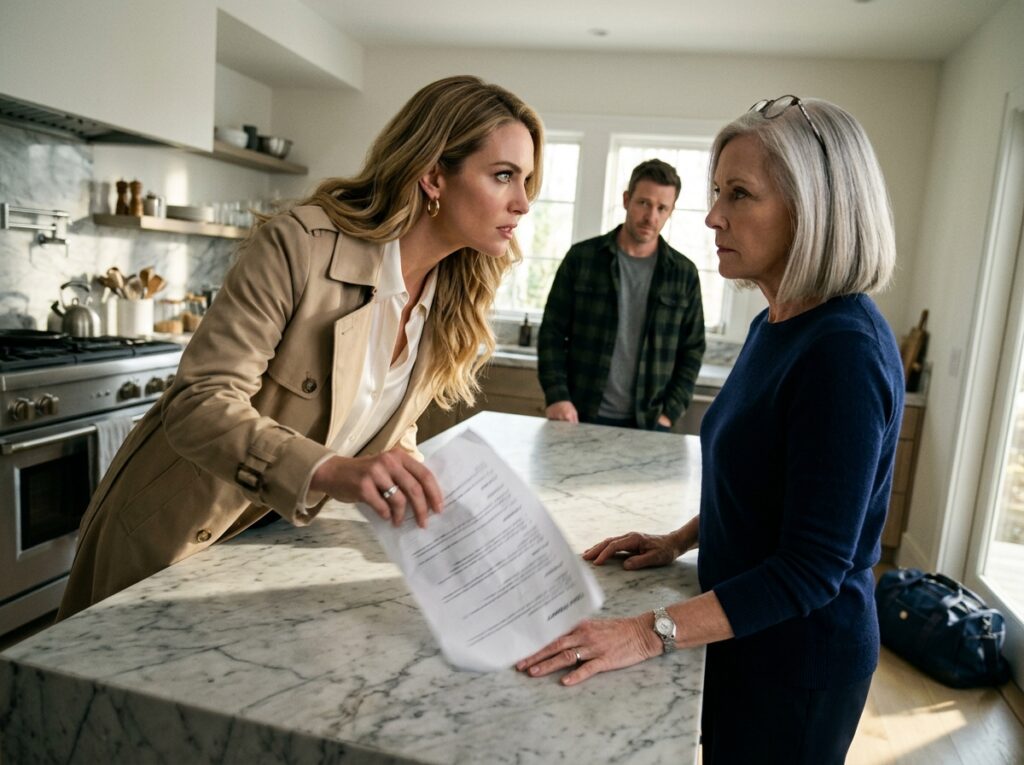
He said, “Who else should?” Brooke set the tote on the counter too hard. A metal water bottle inside it rolled and knocked against a cabinet. “Unbelievable.” “No,” I said. “It’s actually very believable. I took the exam. He needs to take the exam. That’s all this is.” “Nothing with you is ever just what it is.” I could have answered that. I had six answers ready before she finished the sentence. Instead I asked, “Did you start the home-equity application in March?” Her mouth closed. Daniel turned. “What?” Brooke looked at me for a long second. I got up, went to the desk, and brought back the bank letter I had printed after Rome. “The application never opened,” I said. “No money moved. The bank closed the file.
PART 5: I added security to my accounts. I am not making an accusation beyond the record. I am asking you one question. Did you start it?” Daniel looked from the letter to his wife. Brooke’s face went pale, then red. “I was trying to solve the trip.” “With my house?” “It wasn’t finished.” “That wasn’t my question.” She crossed her arms. “Yes. I entered the information. I didn’t submit the final verification.” The kitchen became so quiet I could hear the refrigerator cycle on. Daniel sat back down. “You told me it was just a paper form.” “It was.” “It was online?” “I stopped.” “Because the bank stopped you?” “Daniel, don’t do this.” He picked up the letter. I did not feel satisfaction. I want that understood.
Watching your adult son discover a new reason not to trust his wife is not satisfying. It is only sad in a different direction. Brooke looked at me. “You could have told me you found out.” “I told you in March not to use my name on paperwork again.” “You always make everything sound so final.” “It was final.” She grabbed the tote. At the door, she turned back toward Daniel. “Are you coming?” He looked at the open code book. Then at his wife. “I’ll be home after we finish the chapter.” Brooke left. The front door shut. Her headlights crossed the wall and disappeared. Daniel sat motionless for almost a minute. Finally he said, “What chapter are we on?” “Foundations.” He nodded.
“Okay.” I turned the book back toward him. We studied for another hour. Daniel sat for the December exam on a Thursday in Raleigh. I knew the date because he had written it on the inside cover of the code book in block letters. I also knew the reporting window, the test-center address, the parking situation, and the fact that he had packed two pencils even though the center supplied them. I knew all of that because I am his mother and because pretending not to care would have been another kind of performance. What I did not do was go with him. At 6:12 that morning, he texted me. Leaving now. I wrote back: Read the whole question. At 11:48, nothing. At 12:30, nothing. At 1:05, my phone rang.
“Hello?” He did not speak right away. I sat down at the kitchen table. “What did you get?” “Sixty-eight.” Passing was seventy. Two points. I looked at the pencil marks on the table from the night before. He had been there until 9:30 going through accessibility clearances and roof assemblies. “Okay,” I said. “That’s it?” “What would you like me to say?” “I don’t know.” “You got sixty-eight. Now we know exactly how close you are.” He exhaled sharply. “I missed it, Mom.” “Yes.” “By two.” “Yes.” “I studied for months.” “Yes.” He was getting angry, but not at me. I could hear that much. “Grant was right. Maybe I’m not built for tests.” “No.” The word came out harder than I intended. He went quiet.
“Grant told you a lot of things that saved Grant effort,” I said. “Don’t keep carrying them after he’s gone.” Daniel did not answer. “Go eat something. Drive home. Sunday at six.” “Mom—” “Sunday at six.” He hung up. At 5:40 Sunday, his truck pulled into my driveway. He came in without dinner and set the score report on the table. There were four category breakdowns. He had done well on planning and safety administration, well enough on general code, poorly on business law, and worse than expected on structural calculations. I circled two numbers. “Here.” He frowned. “What?” “This is good news.” He stared at me. “I failed.” “You found the leak.” He nearly smiled despite himself. For the next six weeks, we studied differently. Less broad reading.
More timed sets. More calculations. More questions that forced him to use the index instead of trusting memory. He hated the business-law section because it was paperwork, and Daniel had spent half his career acting as if paperwork was weather that happened to other people. So I made him do paperwork. I gave him imaginary change orders and had him identify what needed written approval. I made him calculate retainage. I gave him a made-up subcontract with three missing clauses and asked what he would want clarified before signing. I made him explain, in plain English, what a qualifier was supposed to do. The first time I asked, he said, “Supervise the work.” “Again.” “Be responsible for the work.” “Again.” He put down his pencil.
“Actually know what’s happening on the jobs carrying your name.” I nodded. “That one.” He looked away. We did not need to say Cranford. In January, Yorkline took a small kitchen renovation in a brick house near the courthouse. Nothing glamorous. No ribbon ceremony. No newspaper. Daniel told me the contract amount because old habits die slowly, then immediately corrected himself. “You don’t need to know that.” “No,” I said. “But I don’t mind knowing.” He was running the site himself. Jonas handled another remodel across town. For the first time since taking the president’s chair, Daniel was spending full days with a tape measure on his belt instead of half days in meetings talking about growth. One Tuesday, he called me from the job.
“I have a question.” “Is it your permit?” “Yes.” “Is my name on it?” “No.” “Then ask.” There was a pause, then a reluctant laugh. He described an existing wall and a header condition above a widened opening. I asked what the plans showed. He said the plans were vague. I asked what the engineer had approved. He said he had not called yet. “Call the engineer.” “I knew you were going to say that.” “Then why did you call me?” “Because I wanted you to say something cheaper.” I smiled. “Call the engineer.” He did. That was the first professional question he asked me after the collapse that did not require my signature. I did not realize until later how important that was.
PART 6: The second exam was scheduled for February. The night before, he came by for twenty minutes and did not open the book. “I can’t look at another table,” he said. “Then don’t.” He sat across from me with coffee. After a while, he asked, “Did you ever fail anything?” “All the time.” “No, I mean big.” I thought about it. “Yes.” “What?” “I kept a company alive by making myself necessary to everybody. Then I acted surprised when they treated necessity like an appliance.” He looked at me. “That isn’t an exam.” “No. It cost more.” He stared into his cup. “I don’t know how to fix what happened.” “You can’t fix March.” “I know.” “You can’t fix June.” “I know.” “You can be different in February.” He nodded.
The next morning, he drove to Raleigh alone. At 12:17, my phone rang. This time, he did not make me ask. “Seventy-six.” I closed my eyes. “Good.” “That’s all I get?” “You want a parade?” “I want at least one complete sentence.” I laughed. “All right. I am proud of you for going back.” He was quiet. Then he said, “Thank you.” Not for the license. Not for the company. Not for money. For going back. That mattered. The board still had its process. Passing an exam did not turn a company active by magic. Daniel submitted the paperwork, financial statements, and required forms. He answered questions. He waited.
When he called the board, he wrote down the name of the person he spoke with and the time of the call. That detail pleased me more than the score. In March, almost one year to the day after Brooke’s text about Rome, Yorkline received notice that Daniel had been approved as the new qualifier for the appropriate classification. He brought the letter to my house in a plain white envelope. I read it once. His name was where mine used to be. Daniel York. Qualifier. He watched my face like there was a correct reaction. I handed it back. “Make a copy for your records.” He laughed. Then he surprised me.
He folded the letter carefully and said, “I should’ve done this in 2019.” “Yes.” “I thought keeping you on was helping you stay connected.” “No. You thought it was easier.” He nodded. “Yeah.” There was no argument. That was new too. The license letter did not repair the family. Paper is good at proving dates, ownership, responsibility, and deadlines. It is terrible at repairing people. Brooke did not come to my house for another month. When she finally did, it was a Saturday morning in April. She parked at the curb instead of in the driveway, which told me before she reached the porch that she did not intend to stay long. I opened the door and waited. She held a manila envelope against her chest.
“I brought copies of the bank records.” I stepped aside. She entered the kitchen and sat at the table without asking for coffee. That was how I knew she was nervous. The envelope contained screenshots of the incomplete application, an email from Cardinal Trust confirming it had been closed, and a letter from Brooke stating that she had entered the information without my authorization and would not use my personal or financial information again. I read the letter. “You wrote this?” “Yes.” “Did someone tell you to?” “No.” I looked at her. She corrected herself. “Daniel said I needed to make it clear in writing. But the words are mine.” I put the letter back on the table. “Why now?” Her mouth tightened.
“Because Hallie won’t talk to me about college money.” That was not the answer I expected. Brooke looked toward the window. “She says every time money comes up, somebody in this family tries to turn it into leverage.” I said nothing. “She said she would rather take loans than have anyone use tuition to make her take sides.” Still I said nothing. Brooke gave a short, tired laugh. “She’s seventeen and apparently smarter than all of us.” “She has had good material to study.” Brooke looked at me sharply, then down at her hands. “I know what you think of me.” “I don’t think about you as much as you think I do.” That landed harder than an insult would have. Her shoulders dropped.
For fifteen years, Brooke and I had been doing a dance neither of us admitted was happening. She thought I judged her because she came into the family after York Built was already established. I thought she treated generosity like a resource to manage. She thought I made Daniel feel small. I thought she encouraged him to confuse independence with ingratitude. We had both collected evidence. We had both ignored anything inconvenient to the case. “I was angry about my mother,” she said. “I know.” “When she lost the house, I thought you could have done more.” “I gave her a room.” “For eleven weeks.” “Yes.” “She said you made her feel like a guest.” “She was a guest.” Brooke pressed her lips together. Then she nodded, slowly.
“I know how that sounds now.” I did not rescue her from the silence. She continued. “The trip was supposed to be something nice for Mom. That’s what I told myself. She had never been anywhere. You could afford to go again. I thought if we moved the seats around, everybody would get something.” “You moved my sister’s seats first.” She looked at me. I had not mentioned Ruth Anne since March. “Yes.” “And then mine.” “Yes.” “You never moved yours.” Her face changed. There it was. The whole thing in three facts. She looked down. “No.” I let the quiet stay. Finally she said, “I’m sorry.” Not “I’m sorry you felt excluded.” Not “I’m sorry things got out of hand.” Not “I’m sorry everyone was upset.” Just: I’m sorry.
I had imagined hearing it so many times that the real version felt almost small. “Thank you,” I said. She looked surprised. “That’s it?” “What did you expect?” “I don’t know. A speech.” “I used to give speeches. Nobody listened.” For the first time that morning, she smiled a little. Then I pushed the bank letter back toward her. “I accept the apology. The financial boundary does not change.” “I know.” “No cards. No credit line. No applications. If Hallie needs help with school and I choose to help, I will deal directly with the school or with Hallie.” Brooke nodded. “I know.” “And there will never be another group chat with my name in the title.” Her eyes came up.
FINAL PART: Hallie had never told me whether Brooke knew I had seen the chat. Now I knew. Brooke’s face went still. “Okay.” “You don’t need to explain it.” “I wasn’t going to.” “That would be new.” She almost smiled again, but this time it disappeared before it arrived. She picked up her purse. At the door, she stopped. “Daniel keeps the exam letter in his desk.” “Good.” “He made three copies.” “That sounds like him after a year with me.” She left. I stood in the kitchen after her car was gone and waited for relief. It came, but not in the dramatic way people describe forgiveness. I did not feel warm. I did not suddenly trust her.
I did not forget the text, the trip, the application, the Facebook post, or the way she had laughed when I asked for site access. I simply felt finished with carrying the conversation I had been having with her in my head. That was enough. Hallie graduated in June. The ceremony was held in the high-school gym because rain had moved it inside. The folding chairs were metal, the air-conditioning was losing a fight with six hundred people, and every family in the county seemed to have brought a balloon large enough to block somebody else’s view. I sat with Ruth Anne. Daniel and Brooke were six rows ahead with Owen and Cynthia. That seating arrangement was not planned. It was just where everybody ended up.
When Hallie’s name was called, all of us stood. All of us. For ten seconds, nobody was offended, excluded, owed, blamed, or correct. We were simply loud for the same girl. Afterward, Hallie found me near the side doors and wrapped both arms around me. “You came.” “I said I would.” “I know. I just like hearing myself say it.” She had been accepted to a state university two hours away. The first-year bill was not quite the number Brooke had used in my living room, but it was close enough to be serious. Two weeks before graduation, Hallie and I had sat at my table with her financial-aid letter between us. “I can cover part of this,” I told her. Her face changed immediately.
“Grandma, I don’t want—” “Listen first.” She did. “I am not paying so you will visit me. I am not paying so you will agree with me. I am not paying so you will take my side when your parents and I disagree. I am not paying through your mother. I am not paying through your father. If I help, the payment goes to the university, and every year we decide again. You owe me grades that reflect honest effort and one phone call if you are in trouble. That’s all.” Hallie looked at the letter. “Can I think about it?” “Yes.” That was another thing I had learned: a gift is only a gift if the other person is allowed to consider it.
Three days later, she came back and said yes. At graduation, after the pictures, Daniel walked over while Brooke was helping Cynthia find her purse. “Hallie told me what you’re doing.” “She shouldn’t have.” “I’m her father.” “That has never prevented a teenager from keeping information from a parent.” He ignored that. “Thank you.” “You’re welcome.” He looked across the gym at his daughter. “I can cover more next year if these jobs keep coming.” “Then cover more next year.” He nodded. No pride. No argument. No performance. The following month, Yorkline won a contract to renovate a small public library branch. The number would once have embarrassed Daniel. It was less than one-tenth the size of Pine Hollow.
He told me about it on Sunday while returning the code book. “It’s not a huge job,” he said. “Is it good work?” “Yes.” “Can you staff it?” “Yes.” “Can you bond it?” “Yes.” “Then what’s the problem?” He smiled. “There isn’t one.” He placed the 2018 code book on my table. The rubber band around it had snapped, so he had replaced it with a new one. “I bought the current edition,” he said. “About time.” “I thought you’d say that.” He left the old one with me. Inside the front cover, underneath the date of his first exam, he had written one sentence in pencil. Read the whole question. I left it there.
If a family can take your name off the sign and still stand on your signature, the kindest thing you can do for them and for yourself is stop signing. One text at 7:00 a.m. 90 days of written notice and shovels that never touch dirt. THE END !