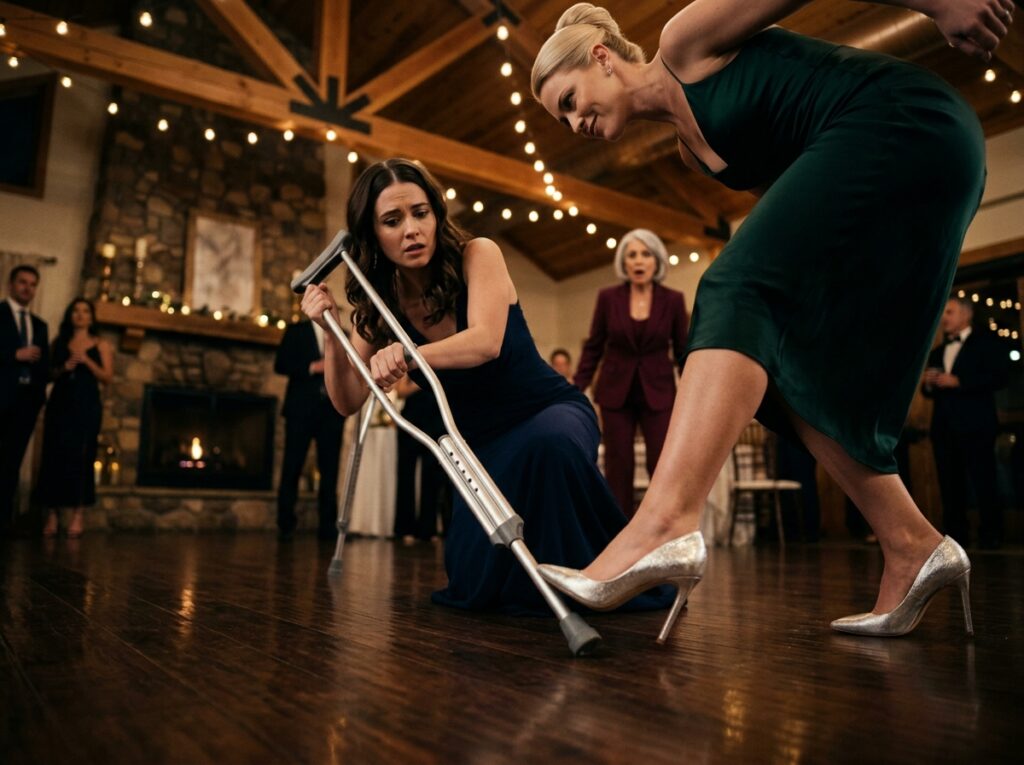
The older officer crouched beside me first.
“Ma’am, can you tell me where it hurts?”
“My right knee. My shoulder. My side.”
“Did you hit your head?”
“No.”
“Good. Don’t move yet.”
The younger officer turned toward the security manager.
“You said there’s video?”
The man nodded.
“Two cameras cover that area. One is ceiling-mounted. The other is above the photo booth. The first captured the impact. The second captured the approach.”
Vanessa’s face had gone completely still.
My father stood beside her.
“Officer, this is a family misunderstanding,” he said. “My daughter has a history of balance problems. She fell.”
The older officer looked at him.
“I’ll decide what happened after I review the evidence.”
Marisol folded her arms.
“Good.”
The security manager placed the tablet on a nearby cocktail table and played the recording.
The ballroom appeared from above.
There I was beside the flower wall, leaning on both crutches.
Vanessa stood directly in front of me.
The audio was faint at first.
Then the speakers caught her voice.
“Quit faking it, Audrey.”
A murmur passed through the room.
The video continued.
I could be seen trying to move around her.
Vanessa stepped sideways, blocking me again.
Then she looked down.
At my crutch.
Her shoe moved.
The rubber tip disappeared beneath it.
She pushed.
The officer paused the recording.
Nobody spoke.
“Play it again,” he said.
The security manager did.
This time, the moment seemed even worse.
Vanessa didn’t stumble.
She didn’t accidentally bump the crutch.
She watched it.
She waited until my weight was on it.
Then she kicked it away.
The younger officer turned toward her.
“Why did you tell everyone she threw herself down?”
Vanessa swallowed.
“I panicked.”
“You said it was an accident.”
“I thought—”
“You told the room she did it intentionally.”
“I was upset.”
The officer looked back at the screen.
“You had your foot on her crutch.”
Vanessa’s fiancé stepped forward.
“Look, this is being blown out of proportion. She has balance issues. Maybe Vanessa was trying to move the crutch out of the way.”
I looked at him.
“She knew exactly what she was doing.”
He didn’t answer.
The officer asked the security manager for the second recording.
This one showed the incident from the side.
It also showed something the first camera hadn’t.
Before kicking the crutch away, Vanessa had looked directly toward the nearest security camera.
She knew she was being recorded.
And she did it anyway.
My father’s expression changed.
Not because he suddenly understood what Vanessa had done.
Because he understood what the recording meant.
There would be no family version of the story anymore.
The officer crouched beside me again.
“Ms. Kincaid, do you want to press charges?”
I looked toward my mother.
She was crying.
For one ridiculous second, I almost felt sorry for her.
Then I remembered what she’d whispered while I was lying on the floor.
Tell them it was an accident.
Not, Are you okay?
Not, Does anything hurt?
Not, I’m here.
Just protect the family story.
I looked back at the officer.
“Yes.”
My father’s shoulders dropped.
Vanessa started crying.
“Audrey, please.”
I said nothing.
The paramedics arrived moments later.
They examined my knee and shoulder before carefully transferring me onto a stretcher.
One of them recognized the surgical scar on my knee.
“Previous reconstruction?”
“Twice.”
He nodded.
“Then we’re taking this seriously.”
As they wheeled me toward the ballroom entrance, I heard my mother say my name.
“Audrey.”
I stopped.
She stood beneath the anniversary banner.
Forty years together.
Four decades of photographs.
Four decades of carefully arranged stories.
“I didn’t know she would do that,” Mom whispered.
I looked at her.
“But you knew she was hurting me.”
Mom’s face crumpled.
“I thought if we kept everything calm—”
“You weren’t keeping things calm.”
I glanced at the frozen image on the tablet.
“You were keeping things quiet.”
Nobody answered.
Outside, cold mountain air hit my face.
For the first time that evening, I could breathe.
At the hospital, scans showed no new fracture, but the reconstructed knee had suffered a significant ligament injury. My shoulder was badly bruised.
The doctor told me I would need another round of physical therapy.
Maybe surgery.
Maybe not.
I stared at the ceiling.
Three years of rehabilitation.
Three years of rebuilding.
And one kick had almost sent me back to the beginning.
But something else had changed.
The hotel had given the police copies of both recordings.
Marisol had provided a statement.
And, without my knowing, one of my sister’s corporate guests had recorded Vanessa’s earlier conversation about me.
The next morning, the video began circulating through the family’s group chat.
Then someone forwarded it outside the family.
By Monday afternoon, Vanessa’s employer had placed her on administrative leave.
By Tuesday, Ridge North suspended the accessibility campaign she’d been preparing to represent.
The irony wasn’t lost on anyone.
The woman who had told me not to build an identity around my limitations was now being investigated for deliberately attacking a disabled family member.
But the biggest shock came on Wednesday.
My father called me.
I almost didn’t answer.
When I did, he didn’t say hello.
He said, “There was something else on the hotel footage.”
My stomach tightened.
“What?”
“A conversation between Vanessa and your mother.”
I sat up.
“When?”
“Before the party.”
“What conversation?”
Silence.
Then my father said quietly:
“They were talking about the accident.”
My hand tightened around the phone.
“What about it?”
“They knew.”
I couldn’t speak.
My father continued.
“Your mother knew Vanessa had grabbed the steering wheel that night.”
The room seemed to tilt.
For three years, I’d believed my mother had been fooled by the same story everyone else had heard.
She hadn’t.
She had known.
And she had chosen Vanessa anyway.
My father began crying.
“I should have told you.”
“Yes.”
“I was afraid of losing both my daughters.”
“You already lost one.”
He stopped breathing for a moment.
Then he whispered, “I know.”
I ended the call.
For the first time since the accident, I didn’t feel confused.
I felt clear.
That evening, I opened the old folder containing my medical records, insurance statements, photographs, and the police report from three years earlier.
I had never looked at it closely.
There had been one detail I remembered but never questioned.
The original report stated that I had lost control of the vehicle while attempting to avoid an exit.
It also stated that the passenger had suffered minor injuries.
Vanessa had told everyone that she had been asleep.
But now I knew she hadn’t been.
And if my mother had known, there was a possibility someone else knew too.
I requested the complete accident file.
Witness statements.
Emergency calls.
Vehicle inspection.
Hospital records.
Everything.
Three days later, an investigator called.
“Ms. Kincaid,” he said, “there’s something you should see.”
I met him at the station.
He placed an old photograph on the table.
It showed the interior of my wrecked vehicle.
The driver’s side airbag had deployed.
The passenger-side airbag had not.
The investigator pointed to a dark mark on the steering wheel.
“Your sister told the original investigators you lost control because you became dizzy.”
I nodded.
“She also said she never touched the steering wheel.”
The investigator slid another document across the table.
“That’s not consistent with the physical evidence.”
I looked down.
A supplemental report had been filed two weeks after the crash.
It had never been sent to me.
The report stated that the steering wheel showed evidence of a sudden lateral force from the passenger side.
There was also a witness statement from a motorist who had stopped after the crash.
The witness had told police she heard a woman inside the vehicle shouting:
“Let go of the wheel!”
My pulse began racing.
The investigator watched me carefully.
“Do you recognize this voice?”
He played the emergency call.
Static.
Then screaming.
Then my voice.
And beneath it—
Vanessa.
“Turn the wheel!”
I closed my eyes.
Three years disappeared.
The mountain road.
The argument.
Her hand reaching across the console.
The sudden jerk.
The guardrail.
The glass.
The pain.
The lie.
When the recording ended, I opened my eyes.
The investigator leaned back.
“We’re reopening the case.”
I looked at him.
“And the incident at the hotel?”
“That will be part of the evidence.”
He paused.
“But there’s something else.”
“What?”
He turned the next page.
“Your sister’s phone records from the night of the crash show she called your mother six minutes before the emergency call.”
My blood went cold.
“What did they talk about?”
“We don’t know yet.”
He pushed the document toward me.
“But we’re requesting the recording.”
I stared at my mother’s name.
Six minutes.
Six minutes before the crash.
Six minutes before my life changed.
And suddenly, the question wasn’t why Vanessa had kicked away my crutch.
It was why, after three years of silence, she had become desperate enough to do it in front of eighty witnesses and two security cameras.
Because she hadn’t been trying to hurt me.
She had been trying to stop me from standing beside that photograph table.
And I finally understood why.
The hotel photographer had taken a picture before the fall.
In the background of that photograph was a framed family picture from the year of my accident.
And beside it—
a woman I had never seen before.
A woman who had been standing on that mountain road the night my sister changed our story.
The investigator slid the photograph toward me.
“Do you know her?”
I stared at the face.
Then I remembered.
Not her name.
Not where we’d met.
Just one sentence she’d said while I was trapped inside the wrecked car.
A sentence I had spent three years believing I’d imagined.
“You don’t have to protect her anymore.”
I looked up at the investigator.
“I know who she is.”
And for the first time in three years, I was ready to tell the truth.





