My parents decided that my lake house belonged to the entire family.
I allowed them to keep believing it—
right up until they arrived with a moving trailer and discovered that the entrance gate would not open.
The first warning appeared on my phone at 7:12 on a Thursday morning.
The tile floor in my Charlotte kitchen felt cold beneath my bare feet, and the coffee in my hand smelled much better than it tasted.
My father’s message did not sound like a request.
It sounded like confirmation for a reservation he believed had already been approved.
Your lake house will be perfect for the family reunion. We’re coming next month.
There was no question.
No polite greeting.
Not even a meaningless,
Would that work for you?
Before I had time to answer, my mother called.
She used the bright, cheerful voice she always adopted after deciding how my time, money, or property would be used.
“And Melissa’s boys can probably stay there for most of the summer,” she added.
“You hardly use the place anyway.”
I stood beside the kitchen window, looking out at my quiet driveway while the coffee turned bitter in my mouth.
For several seconds, I remained silent.
The lake house was not an old family cabin inherited from my grandparents, filled with childhood photographs and several relatives’ names on the deed.
It belonged entirely to me.
I had purchased it nine months earlier for $680,000 after twelve years working in medical-device sales.
Twelve years of airport meals.
Aggressive sales targets.
Missed weekends.
Two promotions I had fought hard to earn.
And the kind of financial discipline my relatives mocked until they wanted access to what it had created.
The property stood beside Lake Norman, roughly forty minutes north of Charlotte.
It had a private dock, a coded gate, and enough peace that I could hear the lake gently striking the wooden pilings after dark.
I had bought it for one simple reason.
I needed one place in my life that no one else could gradually claim.
My family had always treated my possessions as shared property.
My first apartment after college became free lodging whenever my parents came to town.
Melissa borrowed my car after her transmission failed and returned it more than a month later.
My mother once filled my guest room with boxes of craft supplies because, according to her, I lived alone and had “plenty of unused space.”
In our family, ownership became negotiable whenever the owner was me.
Because I had no husband or children, everything I earned was considered available.
Flexible.
Shared.
So when Mom paused and waited for me to object, I gave her the opposite response.
“Sure,” I said.
The silence lasted only a moment.
She had clearly expected resistance and almost sounded disappointed that I had not given her any.
“See?” she called toward my father.
“I told you she would be reasonable.”
Reasonable.
People who profit from your silence often give it flattering names.
Patience.
Kindness.
Maturity.
But the moment you stop paying the price for their comfort, they call you selfish.
Over the following weeks, their plans expanded like water spreading beneath a closed door.
At first, the reunion would last one weekend.
Then it became ten days.
Soon afterward, Mom casually mentioned that everyone might remain for two full weeks.
Melissa asked whether her boys could leave their bicycles and summer equipment at the house because carrying everything back and forth would be inconvenient.
Dad announced that Uncle Ron might bring his fishing boat.
Mom informed several cousins that there would be enough room if they brought inflatable mattresses.
“We have plenty of space,” she told me.
We.
That single word was enough.
I contacted Wade, the retired contractor who handled landscaping, maintenance, and dock repairs at the property.
By Sunday evening, every exterior lock had been replaced.
The smart-entry system had been reset.
The old garage remotes were disabled.
A new gate code was installed.
The Wi-Fi administrator password was changed.
The security company adjusted the camera zones and activated an alert for repeated failed entry attempts.
I saved every invoice, property document, access record, and security report inside one folder on my phone.
May you like

Not because I wanted a confrontation.
Because my family had taught me that people often rewrite history whenever property and money are involved.
Then the first Friday in June arrived.
I was sitting in my Charlotte office, halfway through a quarterly report, when a security notification appeared on my screen.
Motion detected: Front gate.
I opened the live camera feed.
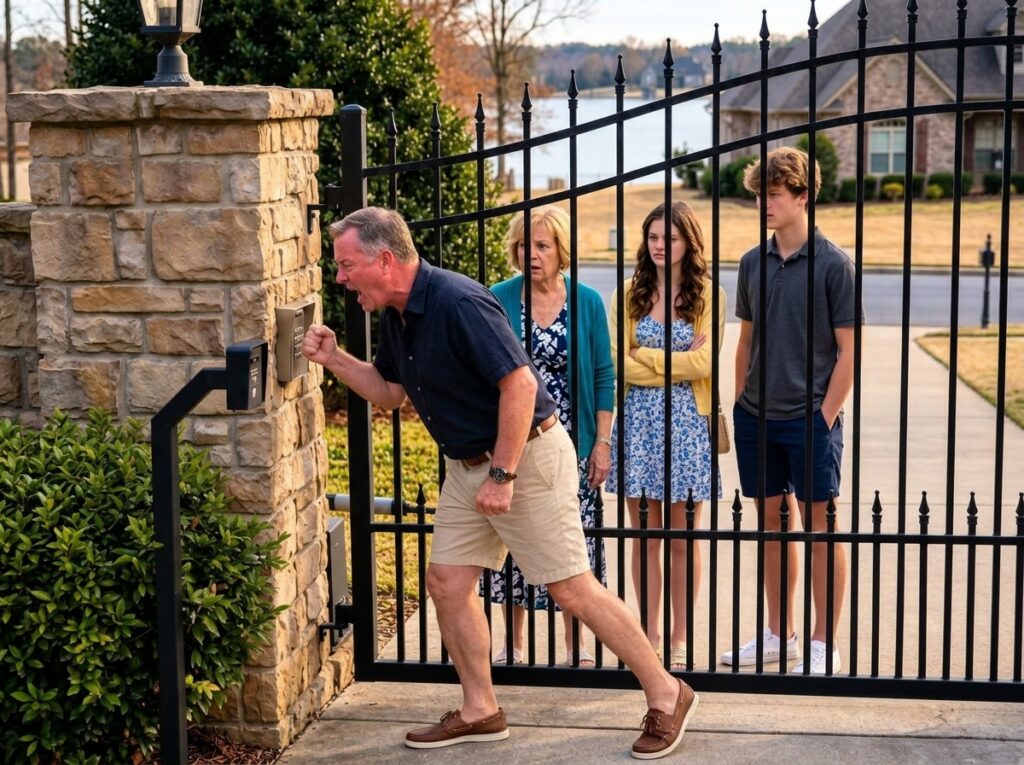
My father’s SUV was parked beside the keypad.
Melissa’s minivan waited directly behind him.
A rented U-Haul trailer was attached to the third vehicle, packed with storage containers, bicycles, coolers, folding chairs, suitcases, and enough belongings to make my stomach tighten.
They had not arrived for a family reunion.
They had come prepared to move into my house.
Dad climbed out first.
He entered numbers into the keypad with the confidence of a man who believed every locked gate would open simply because he expected it to.
Melissa stepped out of her van and immediately began directing her sons toward the luggage.
My mother stood on the gravel in oversized sunglasses, one hand resting against her purse.
She stared at the closed gate as though it had personally insulted her.
Then my phone began ringing.
Dad.
Mom.
Melissa.
I allowed every call to go directly to voicemail.
On the live feed, Dad entered the old code again.
Then a third time.
The security system counted four failed attempts.
Through the camera’s microphone, I heard his shoes grinding across the gravel as he stepped backward and stared directly into the lens.
“Open this gate!” he shouted.
For one furious moment, I wanted to answer and scream.
I wanted to remind them of every time they had used my homes as free storage.
Every time they treated my savings like the family’s emergency account.
Every time they called me difficult simply because I wanted control over the things I had earned.
Instead, I leaned back in my office chair.
I silenced my desk phone.
Then I opened the gate’s intercom system.
My mother slowly raised her face toward the small black camera.
Her expression shifted when she realized I had been watching the entire time.
For several seconds, nobody spoke.
Wind moved through the pines behind them, stirring the leaves above the gravel drive, and somewhere beyond the gate a cicada buzzed with the steady insistence of a power tool.
Dad stepped closer to the camera.
“There you are.”
His voice had changed.
The shouting was gone.
Now he sounded offended.
As if I had violated some family rule by witnessing what they were doing.
“Open the gate.”
I looked at the U-Haul again.
A blue plastic storage tote had been strapped near the back.
Melissa’s boys’ bicycles were secured beside it.
There were folding shelves.
Two lamps.
A rolled-up rug.
Those were not vacation supplies.
“Why is there a moving trailer?”
Silence.
Melissa stopped halfway through opening the rear door of her van.
Mom removed her sunglasses.
Dad glanced toward the trailer as though noticing it for the first time.
“It was easier than taking three cars.”
“You already have three cars.”
His jaw tightened.
“Don’t start.”
That sentence traveled through the intercom and reached something very old inside me.
Don’t start.
He had used it when I was nineteen and objected to Melissa taking clothes from my closet.
When I was twenty-six and asked Mom to remove the craft boxes from my apartment.
When I was thirty-three and wanted Melissa to return the car she had borrowed for “three days.”
In my family, “don’t start” had never meant stop creating conflict.
It meant stop noticing it.
I watched my father through the camera.
“I’m not opening the gate.”
Mom stepped forward.
“What?”
“You heard me.”
Her face changed in stages.
Confusion first.
Then disbelief.
Then the small, wounded expression she used whenever someone denied her something she had already mentally claimed.
“Honey, everyone is coming.”
“No.”
“Your aunt and uncle are already on the highway.”
“Then call them.”
“We bought groceries.”
“Take them home.”
Melissa slammed the van door.
“Oh, come on.”
She walked toward the intercom.
Her sons remained near the vehicle, suddenly still.
“This is ridiculous. The boys have been excited for weeks.”
I looked at them on the screen.
Caleb was fourteen.
Noah was eleven.
Neither boy looked excited.
They looked embarrassed.
That mattered.
“Melissa, did you tell them they were staying here all summer?”
Her mouth opened.
Then closed.
Mom looked at her.
Dad looked away.
There it was.
A tiny shift.
Not an answer.
Something better.
The truth trying to avoid eye contact.
“Melissa?”
She folded her arms.
“Mom said you were fine with it.”
“I agreed to a family reunion.”
“You said sure.”
“To a reunion.”
Mom stepped toward the camera.
“Oh, for heaven’s sake. Stop playing word games.”
“I’m looking at furniture strapped to a U-Haul.”
“It’s not furniture.”
“Mom, there are lamps.”
“They needed lamps.”
“For a reunion?”
Her lips pressed together.
Behind her, Noah slowly lowered his backpack to the gravel.
I could hear my own breathing through my headset.
Slow.
Measured.
I had spent most of my adult life believing boundaries required the perfect explanation.
The perfect wording.
Enough evidence.
Enough patience.
Some argument so reasonable that unreasonable people would finally respect it.
Standing there in my office, watching my family wait outside property I had purchased with my own money, I understood something embarrassingly simple.
The gate did not need to persuade them.
It only needed to stay closed.
“Turn around,” I said.
Dad gave a short laugh.
“You’re going to make your mother stand out here in ninety-degree heat because you’re having some kind of tantrum?”
“No. I’m telling you to leave.”
His smile vanished.
“We drove all this way.”
“Forty minutes.”
“Open the gate.”
“No.”
He stepped so close to the camera that his face filled half my screen.
“You gave us permission.”
“For a reunion. Not to move into my house.”
“Nobody is moving in.”
I enlarged the camera image and took a screenshot of the trailer.
“Then you won’t mind taking everything home.”
Melissa muttered something I couldn’t hear.
Dad turned toward her.
“What?”
“Nothing.”
“No. What did you say?”
Melissa’s face had gone pale.
“I said we can figure something else out.”
Mom spun toward her.
“Don’t be ridiculous.”
Something in Melissa’s expression made me sit straighter.
She wasn’t angry anymore.
She was scared.
“Figure what out?” I asked.
Nobody answered.
“Melissa.”
Mom looked directly into the camera.
“This is a family matter.”
“It became my matter when you brought a moving trailer to my property.”
“It isn’t what you think.”
“Then tell me what it is.”
Dad slapped his palm against the metal gate.
The sound cracked through the microphone.
“Enough.”
The boys flinched.
So did I.
But this time, I did not become quiet.
“Do that again and the security company will contact the sheriff.”
Dad stared at the camera.
“You’d call the police on your own father?”
“No. The system will call them if you damage my gate.”
That distinction seemed to infuriate him even more.
Because it removed the drama he wanted.
I wasn’t threatening him.
I was telling him how the property worked.
Mom turned toward Melissa.
“Call your realtor.”
Everything inside me went still.
Melissa’s head snapped toward her.
“Mom.”
“What realtor?”
“Nothing.”
“Melissa.”
“I said nothing.”
Mom reached for her arm.
“Don’t.”
But it was too late.
I heard the fear in that one word.
“Why do you have a realtor?”
Melissa looked at the camera.
For the first time that morning, she looked like my sister instead of someone standing on the opposite side of a locked gate.
Her eyes filled.
“I sold my house.”
The office around me seemed to lose its sound.
The air conditioner still hummed.
Someone laughed somewhere beyond my closed door.
A printer started down the hallway.
But those noises became distant.
“You what?”
Melissa rubbed both hands over her face.
“I sold the house.”
“When?”
“Closing was yesterday.”
I stared at the U-Haul.
The bicycles.
The storage containers.
The lamps.
The rolled rug.
And suddenly the entire picture rearranged itself.
They had not come prepared to spend the summer.
Melissa had nowhere else to go.
“Where were you planning to live?”
No one answered.
I already knew.
Still, I made them say it.
“Where, Melissa?”
She looked at Mom.
Mom looked at Dad.
Dad’s anger disappeared beneath something harder.
Calculation.
That frightened me more than the shouting.
Finally Melissa whispered, “Here.”
The word barely carried through the microphone.
My fingers tightened around the edge of my desk.
“For how long?”
“We didn’t know.”
“We?”
Mom stepped in.
“She needed help.”
“So you gave her my house?”
“No one gave anyone anything.”
“Then why did she sell her home before asking me whether she could move into mine?”
“We knew you’d make it complicated.”
I almost laughed.
Not because it was funny.
Because sometimes cruelty becomes so absurd that laughter is the only sound your body can find.
“You sold Melissa’s house based on the assumption that I would give her mine.”
“Not give,” Mom snapped. “Share.”
There it was again.
That word.
The family solvent.
The thing they poured over every boundary until ownership disappeared.
Dad leaned toward the intercom.
“Your sister’s divorce wiped her out.”
I knew about the divorce.
What I had not known was how bad things had become financially.
“She has two children,” he continued. “You have two houses.”
“I have one home in Charlotte and one property at the lake.”
“Exactly.”
“No. Not exactly.”
“You don’t need both.”
The sentence was so clean.
So effortless.
He said it as though need determined ownership.
As though anything beyond my minimum survival automatically belonged to whoever wanted it more.
Then another vehicle appeared behind the U-Haul.
A silver pickup.
Uncle Ron.
Behind him came Aunt Diane.
Then another SUV.
Cousins.
The reunion.
Except now they were arriving to witness something none of my parents had intended them to see.
Mom noticed them too.
Her shoulders stiffened.
“Open the gate,” she said quietly.
“No.”
“People are here.”
“I can see that.”
“Do not embarrass us.”
I looked at the screen.
For thirty-eight years, that sentence had worked.
At birthdays.
Thanksgiving dinners.
Graduations.
Any time someone in the family crossed a line and my reaction threatened to become more visible than their behavior.
Do not embarrass us.
Meaning:
Absorb it privately.
Protect us publicly.
I reached for my purse.
“I’m leaving the office.”
Mom exhaled.
“Good. Come open the gate.”
“No. I’m coming to the house.”
Dad stepped back.
“Finally.”
“You’re still not going inside.”
His face hardened.
I ended the intercom connection.
The drive north took forty-three minutes.
I remember every one of them.
Sunlight flashed across my windshield between rows of trees.
My hands remained at ten and two on the steering wheel.
At one red light, I realized I was trembling.
Not from fear exactly.
From the physical effort of not surrendering.
My phone filled with messages.
Mom.
This has gone far enough.
Dad.
We need to talk like adults.
Melissa.
Please.
Aunt Diane.
What is happening? Your mother says the gate is broken.
That one almost made me smile.
Of course she did.
The gate was not broken.
The gate was the first thing in our family working exactly as intended.
When I turned onto the private road, vehicles lined both shoulders.
Nearly twenty relatives had arrived.
Some stood in the shade.
Others clustered near the gate.
The U-Haul remained parked in front like an enormous orange confession.
I pulled into the maintenance entrance fifty yards down the property line.
Wade was waiting.
Gray hair beneath a faded Carolina Panthers cap.
Work boots dusty from the shoreline.
“You okay?” he asked.
“Yes.”
He looked toward the crowd.
“You sure?”
“No.”
That made him nod.
“Better answer.”
I unlocked the pedestrian entrance from inside.
Wade stayed several steps behind me.
Not threatening.
Just present.
The moment my family saw me, conversation stopped.
Mom walked toward me first.
“Open it.”
Not hello.
Not please.
Open it.
I stood on my side of the gate.
“No.”
Uncle Ron frowned.
“Is something wrong with the lock?”
“The lock is fine.”
Dad’s eyes narrowed.
“Don’t do this here.”
“Where would you prefer I do it?”
Melissa stood beside the minivan.
Her eyes were swollen.
The boys sat inside with the doors open.
Aunt Diane looked from me to the trailer.
“What exactly is happening?”
Mom answered quickly.
“Your niece has decided at the last minute that the reunion isn’t happening.”
“That isn’t what happened.”
Dad pointed at me.
“Enough.”
For once, nobody became quiet.
Aunt Diane turned toward him.
“Let her talk.”
The surprise on Dad’s face was almost imperceptible.
But I saw it.
So did Mom.
I unlocked the pedestrian gate and stepped through.
Then I locked it behind me.
The click sounded tiny.
It changed the entire morning.
I faced my family.
“I agreed to a reunion.”
Mom scoffed.
“She’s splitting hairs.”
“I did not agree to Melissa moving into my house.”
Silence spread across the gravel.
Uncle Ron slowly turned toward Melissa.
“What?”
Mom’s face drained.
Dad said my name in warning.
I didn’t continue.
I didn’t need to.
Melissa did.
“I sold my house.”
Aunt Diane blinked.
“You sold it?”
Melissa nodded.
“And you were moving here?”
Another nod.
The crowd changed.
Not dramatically.
No gasps.
No shouting.
Just bodies shifting.
Eyes moving.
People looking at my parents instead of me.
Mom tried to recover.
“Temporarily.”
“How temporarily?” Uncle Ron asked.
“We hadn’t decided.”
“You mean she hadn’t decided,” Aunt Diane said, pointing toward me.
Mom’s mouth tightened.
“She has plenty of room.”
Aunt Diane stared at her.
“That wasn’t my question.”
Dad stepped between them.
“This is nobody else’s business.”
Uncle Ron looked at the twenty relatives standing around him.
“You invited everybody here.”
Dad had no answer.
Then Melissa started crying.
Not loudly.
She covered her mouth and turned away.
Noah climbed from the van.
He walked toward his mother and took her hand.
That small gesture hurt more than anything my parents had said.
Because the children had been placed inside an adult gamble without even knowing it.
I walked toward Melissa.
She looked at me warily.
“Did you know I hadn’t agreed?”
Her chin trembled.
“Mom said you would.”
“That isn’t what I asked.”
Her eyes dropped.
“Yes.”
One word.
My parents lost more power in that moment than they had behind the locked gate.
Not because Melissa accused them.
Because she stopped protecting them.
“She told me you’d complain,” Melissa continued, “but that once we were here, you wouldn’t make the boys leave.”
Mom stared at her.
“Melissa.”
“She said you always give in eventually.”
“Stop talking.”
“No.”
Melissa’s voice cracked.
But she repeated it.
“No.”
Dad stepped toward her.
“You’re upset.”
“I sold my house.”
“You needed to sell it.”
“I know.”
“You needed somewhere to go.”
“I know.”
“We solved the problem.”
Melissa looked at him.
“No. You used her to solve it.”
Dad’s mouth opened.
Nothing came out.
The summer air seemed suddenly too bright.
Too exposed.
Aunt Diane crossed her arms.
“Did you tell everyone this was your place?”
Mom’s expression changed.
I noticed it immediately.
So did Melissa.
“What does that mean?” I asked.
Aunt Diane looked uncomfortable.
“Your mother told us you bought it for the family.”
I stared at Mom.
“She said what?”
Uncle Ron nodded slowly.
“She said you’d bought a lake property so everybody would finally have somewhere to gather.”
A cousin near the back spoke up.
“She told us not to bother asking you about dates because she and your dad were handling the calendar.”
Another cousin lowered her sunglasses.
“I thought they helped you buy it.”
The words landed harder than I expected.
Not because I cared whether my relatives knew I could afford the house.
Because suddenly I understood the scale of what my parents had been doing.
This had not begun with the reunion.
They had been quietly converting my property into family property through repetition.
A sentence here.
An assumption there.
Their authority depended on everyone believing ownership was ambiguous.
I took out my phone.
Mom’s eyes followed the movement.
“What are you doing?”
I opened the folder I had created weeks earlier.
The deed.
Closing statement.
Mortgage documents.
Wire confirmation.
Property-tax record.
I handed the phone to Aunt Diane.
She looked at the screen.
Then at me.
Then at my parents.
“Her name is the only one here.”
“Yes.”
Dad laughed bitterly.
“Nobody said otherwise.”
Three people answered at once.
“Yes, you did.”
The sound silenced him.
Uncle Ron’s face reddened.
“You told me you had money in the property.”
Dad looked away.
Mom began talking quickly.
“That is not what we meant. We helped her over the years. Parents help children. Children help parents. Families share. You people are turning this into something ugly.”
“No,” Aunt Diane said.
Her voice was quiet.
“You did that.”
Mom stared at her.
Aunt Diane handed my phone back.
“You let us show up here thinking she had invited us.”
“I did invite you.”
Everyone looked at me.
“For a reunion,” I said. “Originally. Before I learned what this actually was.”
My eyes went to the U-Haul.
Nobody needed more explanation.
The truth was sitting in orange and white steel ten feet away.
Dad shoved his hands into his pockets.
“So what now?”
I looked at Melissa.
“You and the boys are not moving into the lake house.”
Her face crumpled.
“I know.”
Mom stepped forward.
“Absolutely not.”
I turned to her.
“You don’t get a vote.”
She actually recoiled.
Not because I raised my voice.
I didn’t.
Because I finally said aloud the rule she had spent years pretending did not exist.
“You cannot promise my home to anyone. You cannot schedule it. You cannot store things here. You cannot give out access codes. You cannot decide I don’t use something enough to deserve it.”
Mom’s eyes filled.
“After everything we’ve done for you.”
There it was.
The invoice.
The invisible bill attached to every childhood meal, every school ride, every Christmas gift.
I shook my head.
“I’m your daughter. I was never supposed to spend adulthood repaying you for raising me.”
She looked around for support.
None came.
That was the public consequence she had never imagined.
Not humiliation.
Recognition.
Everyone could finally see the mechanism.
Dad’s anger returned because anger was the only tool he had left.
“You think a house makes you better than us?”
“No.”
“You think money means you don’t need family?”
“No.”
“Then what are you proving?”
I looked at the gate behind me.
“Nothing.”
He frowned.
“I’m protecting something.”
“From your own parents.”
“Yes.”
The word settled between us.
Dad’s face changed.
The rage remained, but underneath it something collapsed.
Certainty.
For the first time, he understood that being my father did not give him permanent authority over my adult life.
Mom wiped beneath one eye.
“So that’s it? You’re throwing your sister and nephews into the street?”
Melissa looked up sharply.
“Stop.”
Mom ignored her.
“Where are they supposed to sleep tonight?”
“I said stop.”
“Your sister has no home.”
Melissa released Noah’s hand and walked toward Mom.
“This was your idea.”
Mom blinked.
“What?”
“You told me to sell.”
“You needed the equity.”
“You told me not to renew the apartment application because you said she’d cave.”
My stomach dropped.
“What apartment?”
Melissa closed her eyes.
For a second, she looked ashamed enough to disappear.
“I had one.”
The entire group went silent again.
“A townhouse rental in Huntersville. Three bedrooms. Nothing fancy. I could afford it after the sale.”
“Could?”
“The landlord needed the deposit by Monday.”
“And?”
“Mom told me not to pay it.”
Mom shook her head.
“Because paying rent when your sister has an empty house is stupid.”
There it was.
The midpoint truth beneath the truth.
Melissa had not been stranded.
My parents had deliberately made her dependent on my surrender.
Aunt Diane whispered, “Oh my God.”
Melissa looked at Mom with tears running freely now.
“You told me she wanted the boys here.”
“I said she loves them.”
“You said she’d be happy once we settled in.”
“I was trying to help.”
“You were trying to make it impossible for her to say no.”
Mom’s mouth fell open.
Melissa’s next words came quietly.
“And you made me part of it.”
Mom reached for her.
Melissa stepped back.
That single step changed something permanent.
Dad looked at Mom.
For the first time all day, even he seemed uncertain.
“You told me the apartment fell through.”
Mom’s eyes flicked toward him.
“It basically did.”
“No.”
Melissa shook her head.
“It didn’t.”
Dad’s face hardened.
“You told me she had nowhere else.”
“I was trying to keep the family together.”
Aunt Diane let out a disbelieving breath.
“By lying to everybody?”
Mom looked around.
Every face she turned toward was closed.
No one rescued her.
No one changed the subject.
No one told me to be reasonable.
Her power had always depended on other people smoothing over the moment after she crossed a line.
Now nobody moved.
Her smile appeared briefly.
A strange, desperate reflex.
“Well, this has become ridiculous.”
Nobody laughed.
The smile disappeared.
I looked at Melissa.
“Call the landlord.”
“What?”
“The townhouse.”
“It’s probably gone.”
“Call.”
Mom immediately said, “Don’t.”
Melissa stared at her.
Then she took out her phone.
She walked several yards away.
The rest of us waited.
No dramatic music.
No speeches.
Just gravel crunching beneath her sandals while she paced.
A boat engine hummed somewhere across the lake.
Dad stared at the ground.
Mom stood rigid beside the SUV.
Three minutes later, Melissa stopped walking.
“Yes,” she said into the phone. “I understand.”
She listened.
Then covered her mouth.
When she returned, her eyes were wet again.
“He still has it.”
Noah smiled.
It was the first uncomplicated expression I had seen all morning.
“He does?”
Melissa nodded.
“He had another applicant, but they haven’t signed. If I send the deposit today, it’s mine.”
Mom started, “But—”
Dad raised one hand.
“Don’t.”
We all looked at him.
So did Mom.
His voice was tired now.
“Just don’t.”
Melissa sent the deposit from her phone.
Her fingers shook while she did it.
Then she stared at the confirmation screen.
For several seconds, she said nothing.
Finally she looked at me.
“I’m sorry.”
I believed she meant it.
That did not erase anything.
It did not make trust return.
But it mattered.
“I know.”
“I should have called you.”
“Yes.”
“I knew better.”
“Yes.”
She nodded.
No excuses.
That mattered too.
The reunion did not happen at my lake house.
Uncle Ron suggested a nearby park with picnic shelters.
Several relatives had already packed food, so they went there instead.
Before leaving, Aunt Diane hugged me.
Not the quick family hug people perform because everyone is watching.
She held on.
“I’m sorry I believed them.”
“You didn’t know.”
“I could have asked you.”
I looked at her.
“So could everyone.”
She nodded.
“That’s fair.”
One by one, cars pulled away.
The gravel road slowly emptied.
The U-Haul remained.
Melissa needed to wait until late afternoon to get keys to the townhouse.
I did something my mother clearly did not expect.
I let Melissa and the boys stay.
Outside the gate.
With me.
We drove to a diner ten minutes away.
Mom and Dad were not invited.
At first, Melissa and I barely spoke.
The boys ordered burgers.
Noah spilled ketchup onto his napkin.
Caleb kept checking his phone.
Ordinary things.
Beautifully ordinary.
Halfway through lunch, Melissa looked at me.
“Do you remember when I borrowed your car?”
I almost smiled.
“For thirty-eight days?”
“Thirty-six.”
“Thirty-eight.”
She winced.
“Okay. Thirty-eight.”
Caleb looked between us.
“You kept her car for a month?”
“Apparently your mother and I have different definitions of borrowing.”
Melissa stared at her fries.
“I thought you were uptight.”
“I know.”
“Mom always said you cared more about things than people.”
The sentence hurt.
She saw it.
“I believed her.”
I swallowed.
“She said the reason you had more was because you were selfish enough to keep everything.”
I looked through the diner window at cars moving along the highway.
“Melissa, I worked for what I have.”
“I know that now.”
“No. You always knew.”
She became still.
That distinction mattered.
She nodded.
“You’re right.”
We sat with it.
No instant forgiveness.
No childhood montage that magically repaired decades.
Just truth.
Sometimes that is the first honest form of love.
At four thirty, Melissa received the townhouse keys.
I followed the U-Haul to Huntersville.
Not because she asked.
Because Noah had fallen asleep against the van window, Caleb looked exhausted, and moving an entire household after your family explodes beside a lake is harder than anyone should have to do alone.
We carried boxes.
Uncle Ron came.
So did Aunt Diane.
Two cousins arrived with pizza.
Wade showed up unexpectedly in his pickup.
“I heard there was lifting,” he said.
I stared at him.
“How?”
He pointed at Uncle Ron.
“Family grapevine.”
By sunset, the boys’ beds were assembled.
The lamps from the trailer stood in a living room where they actually belonged.
Melissa unrolled the rug.
Noah dropped onto it dramatically.
“I live here now.”
Everyone laughed.
Even Melissa.
Especially Melissa.
Our parents did not come.
Three days passed before Dad called.
I almost let it go to voicemail.
Then I answered.
“Hello?”
Silence.
“I owe you an apology.”
I sat down.
Dad was not a man who apologized.
He explained.
He justified.
He occasionally admitted that “things got heated.”
But apology was different.
“I treated your property like I had authority over it.”
I said nothing.
“I didn’t.”
“No.”
“I know.”
Another silence.
Then he said, “Your mother isn’t ready to hear that.”
“That’s her problem.”
“Yes.”
The word surprised me.
“She’s angry at everybody.”
“I’m sure.”
“She says the family turned against her.”
“They didn’t.”
“I know.”
I waited.
Dad exhaled.
“I think I spent a lot of years backing her because it was easier than disagreeing with her.”
That was the closest he had ever come to naming the pattern.
“You backed her when it hurt me.”
“I know.”
“And Melissa.”
“I know.”
His voice broke slightly on the second word.
Not enough to absolve him.
Enough to tell me he finally understood.
“I’m not giving you the new gate code.”
“I didn’t ask.”
“I know.”
That was where we began.
Not with trust restored.
With him learning not to demand it.
Mom took longer.
Almost six weeks.
Then one Saturday morning, I found an envelope in my Charlotte mailbox.
No return address.
Her handwriting.
Inside was a note.
Three sentences.
I thought being your mother meant I could decide what was best for you.
I confused being needed with being entitled.
I am sorry.
I read it twice.
Then a third time.
I did not call her immediately.
An apology does not create an obligation to make the apologizer feel better.
But I kept the note.
By August, Melissa and I had dinner twice a month.
The boys began calling before visiting.
That tiny change affected me more than grand gestures could have.
“Can we come over Saturday?”
Not:
“We’re coming.”
Not:
“Mom said it was fine.”
Can we?
Sometimes I said yes.
Once I said no because I had work.
Nothing terrible happened.
No one accused me of abandoning family.
No one appeared anyway.
The world kept turning.
In September, Dad asked whether he could take me to lunch.
He arrived early.
He paid.
He did not mention the lake house until we were finishing coffee.
Then he slid something across the table.
A garage remote.
The old one.
The remote I had disabled months earlier.
“I found it in my truck.”
I looked at it.
“You know it doesn’t work.”
“I know.”
“Then why give it back?”
He rubbed his thumb along the edge of his coffee cup.
“Because it was yours.”
Four words.
That was all.
But I had spent my entire adult life trying to teach my family exactly that.
I put the remote in my purse.
“Thank you.”
He nodded.
No speech.
No demand for forgiveness.
Just a small returned object and a boundary finally understood.
By October, Mom and I were speaking again.
Carefully.
She still slipped sometimes.
She would say, “You should—”
Then stop.
Once she asked whether she could host Thanksgiving at the lake house.
My entire body tightened before I could stop it.
Then she added, “And it’s okay if the answer is no.”
I looked at her.
She looked embarrassed.
But she meant it.
“No,” I said.
She swallowed.
“Okay.”
That might have been the most important conversation we had ever had.
Thanksgiving was held at Aunt Diane’s.
Christmas happened at Melissa’s townhouse.
The place was crowded.
Warm.
The boys had decorated the railing with cheap battery-powered lights.
A folding table had to be added beside the dining table because there were too many people.
Nobody complained.
After dinner, I carried plates toward the kitchen.
Noah appeared beside me.
“I got it.”
“You got what?”
“Your plate.”
He took it from my hands.
Then he took my coffee cup.
“You don’t have to.”
“I know.”
He carried both into the kitchen.
I stood there watching him rinse my cup without being asked.
Something inside me loosened.
Not because a child washed a dish.
Because nobody in that room was treating my kindness as a debt anymore.
Near the tree, Melissa was laughing with Aunt Diane.
Dad sat on the floor helping Caleb untangle a controller cable.
Mom was beside the window.
She caught my eye.
For one second, neither of us moved.
Then she walked toward me.
“I have something for you.”
My stomach tightened automatically.
She noticed.
“It’s not a key.”
I laughed before I could stop myself.
So did she.
She handed me a small wrapped box.
Inside was a framed photograph.
The lake house.
But not the photograph I expected.
It had been taken the previous winter, shortly after I bought the property.
Snow dusted the dock.
The water was gray-blue beneath a pale morning sky.
One upstairs window glowed amber.
I recognized the picture.
I had sent it to Mom the first weekend I stayed there alone.
I turned the frame over.
On the back, beneath the glass, she had placed the original message I had sent with the photograph.
I had forgotten the words completely.
Finally found a place that feels like mine.
My throat tightened.
Mom stood beside me.
“I should have listened the first time.”
I looked at her.
She did not ask me to forgive her.
She did not tell me she had only wanted to help.
She did not explain.
She simply looked at the photograph.
“I think I saw that house and thought you were building something away from us.”
I waited.
“But you weren’t.”
“No.”
“You were building somewhere you could breathe.”
The room blurred slightly.
“Yes.”
She nodded.
“I’m sorry I tried to take that from you.”
That was the beautiful thing about the photograph.
She had possessed the truth before any of this happened.
I had told her exactly what the lake house meant.
Finally found a place that feels like mine.
The gate had never been about keeping my family out.
It had been about learning that love and access were not the same thing.
The following spring, almost a year after the morning with the U-Haul, I invited everyone back to Lake Norman.
Invited.
That word mattered.
There were twelve of us.
Not twenty.
No trailers.
No storage bins.
No assumptions.
Melissa called two days beforehand.
“Should we bring anything?”
“Dessert.”
“What kind?”
“Surprise me.”
Dad arrived with Uncle Ron.
He stopped at the keypad.
For a second, I watched him from the porch.
Then his phone rang.
He answered.
It was me.
“The code is 4172.”
He paused.
“You sure?”
I looked across the yard toward the water.
“Yes.”
He entered it.
The gate opened.
Dad drove through.
Then he stopped the SUV just inside, got out, and waited for the gate to close behind him.
He did not write down the code.
He did not ask whether it would work next weekend.
He did not ask whether Uncle Ron could have it.
He simply walked toward me carrying a bag of ice.
Mom came later with Melissa.
When she reached the porch, she stopped.
“May I come in?”
The question almost broke me.
Not because she needed permission.
Because she finally understood why asking mattered.
I opened the door wider.
“Yes.”
The afternoon unfolded quietly.
The boys fished from the dock.
Uncle Ron burned two hamburgers and insisted they were “charred.”
Aunt Diane brought too much potato salad.
Melissa sat beside me near the water while sunlight scattered across the lake.
Neither of us talked about the U-Haul.
We did not need to.
Near sunset, everyone began carrying things toward the cars.
Noah came running back down the path.
He held something in his hand.
My old garage remote.
The one Dad had returned months earlier.
I must have dropped it from my purse while looking for sunscreen.
“I think this is yours.”
He placed it in my palm.
I looked down at the useless little piece of plastic.
Once, it had represented everything my family believed they were entitled to.
Access.
Convenience.
Assumption.
Now it was simply something of mine that someone had found and returned.
“Thanks, buddy.”
He shrugged.
“Of course.”
Then he ran back toward his mother.
I stood beside the gate as the last car disappeared between the trees.
Nobody left belongings behind.
Nobody asked when they could return.
Nobody assumed.
The evening became quiet again.
I walked down to the dock carrying the framed photograph Mom had given me at Christmas.
For months, it had sat in my Charlotte bedroom.
That evening, I placed it on the small shelf beside the lake-house window.
Outside, the water turned gold beneath the sinking sun.
Behind me, the house was still.
Mine.
Not because nobody else had been allowed inside.
Because everyone who entered now understood they were guests invited by someone they loved.
My phone buzzed.
A message from Mom.
Thank you for having us.
Then another.
Drive safely tomorrow.
Nothing else.
No request.
No claim.
No plan for next weekend.
I set the phone down.
Beyond the window, the entrance gate slid shut after the final car.
The soft mechanical hum traveled through the evening air and disappeared beneath the sound of water touching the dock.
For the first time in my life, a closed gate did not feel like distance from my family.
It sounded like peace.