At Christmas, I was pulling a double shift in the ER.
My parents and sister told my 16-year-old daughter there was “no room for her at the table.”
So she drove home alone — to an empty house — and spent Christmas in silence.
I didn’t yell.
I didn’t text.
I acted.
The next morning, my parents found an envelope taped to their door.
They opened it, read the letter inside…
and started screaming.
…
The sterile light of the Emergency Room was its own kind of Christmas decoration.
It was 10:30 PM on Christmas Eve, hour fourteen of a sixteen-hour double shift I’d taken so a junior nurse with young kids could be home.
I pictured my daughter, Abby, walking into my parents’ house.
She’d be sixteen, newly licensed, and so proud to be driving herself to the family’s traditional Christmas Eve sleepover for the first time.
When I opened my front door, the scene was all wrong.
The house was dark, silent.
And there, sitting neatly by the door, were Abby’s snow-covered winter boots.
My heart seized.
Then I saw her coat, slumped over the armrest of the sofa.
Her overnight bag sat on the floor, still zipped shut.
And there she was.
Curled on the couch under a thin afghan, her knees tucked tightly to her chest.
It was the way a child sleeps when they’re trying to make themselves small.
“Abby?
Sweetheart?
Wake up.”
Her eyes fluttered open, clouded with sleep and something else.
Confusion.
Then, as she recognized me, it was replaced by a deep, weary sadness.
“Mom?” she whispered.
“Hey,” I said, keeping my voice soft, fighting the alarm bells screaming in my head.
“What are you doing here?
I thought you were at Grandma and Grandpa’s.”
She just shrugged, a small, defeated movement.
She wouldn’t meet my eyes.
“They said there wasn’t room,” she finally said.
The words were quiet, but they landed like stones in the silent room.
“No room?” I repeated, the phrase making no sense.
“What are you talking about?
They have a four-bedroom house.”
“I don’t know.”
She continued, her voice trembling now.
“When I got there, the house was… full.
Grandma opened the door and just… stared at me for a second.
Like she’d forgotten.”
“She said,
‘Oh, Abby.
We weren’t expecting you.’
She said she couldn’t just pull up another chair at the last minute, that the table was set perfectly and everyone was already sitting down to eat.
She looked so stressed, Mom.
Like I was a problem.”
The cold, glassy feeling in my chest began to solidify.
They hadn’t been expecting her.
Her own granddaughter.
“Did anyone say anything?” I asked, my voice dangerously low.
“Did Grandpa?
Or Janelle?”
Abby shook her head.
“Grandpa was watching the game.
Aunt Janelle just sort of… waved from the dining room.
Nobody got up.
Nobody offered to drive me home.
Nobody even asked if I had eaten.”
I waited, my breath held tight.
“What did you have for dinner, Abby?”
She finally looked at me, and I saw the sheen of unshed tears in her eyes.
“I came home and made some toast,” she whispered.
“And I had half a banana that was on the counter.”
That was it.
That was the detail that shattered the glass.
My daughter’s Christmas Eve dinner was a slice of cold toast, eaten alone in a dark house, after being turned away by her own family.
The family I had bent over backward to support for years.
The family living in a house I owned, under a roof I paid for.
The ember of warmth I’d been holding onto all night was extinguished, replaced by a glacial rage.
They hadn’t just forgotten.
They had made a choice.
I moved from the floor to the couch, pulling her into my arms.
As I held my child, I felt a switch flip deep inside my soul.
The part of me that made excuses, that smoothed things over, that played the dutiful daughter, died in that moment.
They had run out of second chances.
They had used my daughter to send a message.
The message wasn’t,
“there’s no space at the table.”
The message was,
“you are not welcome here.”
And I received it, loud and clear.
The next morning, my husband, Mark, got home from his holiday shift at the fire station.
I sat him down and told him everything.
He stood there for a long moment, his face a thundercloud.
“So,” he said, his voice quiet but full of iron.
“What do we do now?”
I already knew.
They had made their choice.
Now I would make mine.
We couldn’t stop reading this one. Comment ‘GO’ and you’ll find the full story waiting in the comments.
I reached across the kitchen table and slid my phone toward Mark.
He looked down at the screen.
Then back at me.
“You’re serious?”
“Yes.”
The Christmas tree lights blinked softly behind him.
Abby was upstairs asleep.
She had finally gone to bed around four in the morning after I made her scrambled eggs, hot chocolate, and the kind of ridiculous cinnamon toast she had loved when she was little.
I hadn’t slept at all.
Mark picked up my phone again.
On the screen was an email draft to our attorney, Daniel Price.
Attached were copies of the deed, tax records, insurance documents, and the occupancy agreement my parents had signed six years earlier.
Mark read everything.
Then he set the phone down.
“What exactly are you thinking?”
“I’m done subsidizing people who treat our daughter like she’s disposable.”
His jaw tightened.
“I’m not arguing.”
“I know.”
“But Abby can’t become the reason they blame this on us.”
That stopped me.
Mark leaned forward.
“They’re going to say you threw them out because of one Christmas dinner.”
“It wasn’t one dinner.”
“I know that.”
He reached across the table.
“But Abby needs to know that too.”
I looked toward the stairs.
He was right.
The house my parents lived in had belonged to my grandmother.
When she died, she left it to me.
Not my mother.
Not my father.
Me.
My parents had been struggling financially at the time, so Mark and I let them move in.
Temporary, they said.
Six years passed.
Temporary became permanent.
I paid the property taxes.
I paid the insurance.
When the furnace died, I replaced it.
When the roof leaked, I paid for that too.
My father covered utilities.
Sometimes.
My mother treated the place as though it were hers.
Janelle treated it as the family headquarters.
And because I hated conflict, I let them.
There was always a reason.
Dad’s health.
Mom’s anxiety.
Janelle’s divorce.
A bad year.
A difficult month.
An unexpected bill.
I was the daughter who fixed things.
Until Christmas Eve.
Until toast and half a banana.
At 7:12 that morning, I sent the email to Daniel.
At 8:03, he called.
“Merry Christmas,” he said carefully.
“Sorry.”
“Given what you wrote, I doubt this is a social call.”
“No.”
He had handled the original occupancy agreement.
He remembered everything.
My parents had no ownership interest in the property.
Their agreement had converted to month-to-month occupancy years earlier.
Daniel told me exactly what I could and could not do.
No changing locks.
No shutting off utilities.
No dramatic eviction.
Everything had to follow the law.
“Good,” I said.
He paused.
“You sound disappointed.”
“Actually, I’m relieved.”
“Why?”
“Because I don’t want revenge.”
I looked toward the stairs again.
“I want a boundary they can’t talk me out of.”
Daniel was quiet for a moment.
Then he said, “That I can help with.”
By 9:30, I was sitting at the dining room table with an envelope.
Mark stood behind me drinking coffee.
Inside were two things.
The first was a formal notice prepared exactly as Daniel instructed.
The second was from me.
It was shorter.
Mom and Dad,
Last night Abby drove to your house believing she was spending Christmas with her family.
You sent her away.
She drove home alone in winter weather.
She entered an empty house.
She ate toast and half a banana for Christmas dinner because no adult in that house cared enough to ask whether she had eaten.
I have spent years confusing financial support with love and tolerance with loyalty.
That ends now.
You will receive all legally required time and process regarding the house.
I will not argue about this by phone.
I will not debate what happened to Abby.
I will not allow anyone to blame her for the consequences of choices made by adults.
Further communication about the property goes through Daniel Price.
Do not contact Abby about this.
Merry Christmas.
Claire.
Mark read it twice.
Then he looked at me.
“Claire.”
“What?”
“You know they’re going to lose their minds.”
“I know.”
“Your sister too.”
“I know.”
He nodded.
“Okay.”
That was why I loved him.
He didn’t tell me to calm down.
He didn’t feed my anger either.
He simply stood beside me while I did something I should have done years ago.
We drove over together.
Snow had started falling again.
My parents’ neighborhood looked almost offensively beautiful.
Wreaths.
Lights.
Red bows around mailboxes.
The house glowed behind the bare trees.
The same house where my daughter had stood on the porch the night before.
I pictured Abby arriving with her overnight bag.
Probably smiling.
Probably holding the peppermint bark she had made herself.
Then my mother opening the door.
Oh, Abby. We weren’t expecting you.
I taped the envelope securely beside the front door.
Then I walked away.
I didn’t knock.
At 10:17, my phone rang.
Mom.
I let it ring.
10:18.
Dad.
10:19.
Janelle.
Then Mom again.
Then Dad.
Then Janelle.
Mark looked at my phone vibrating on the kitchen counter.
“That’s impressive.”
I almost smiled.
Then the voicemail notification appeared.
Another.
Another.
I didn’t listen.
At 10:31, someone started pounding on our front door.
Abby came halfway down the stairs.
“Mom?”
“Stay there, sweetheart.”
Mark was already moving.
I checked the doorbell camera.
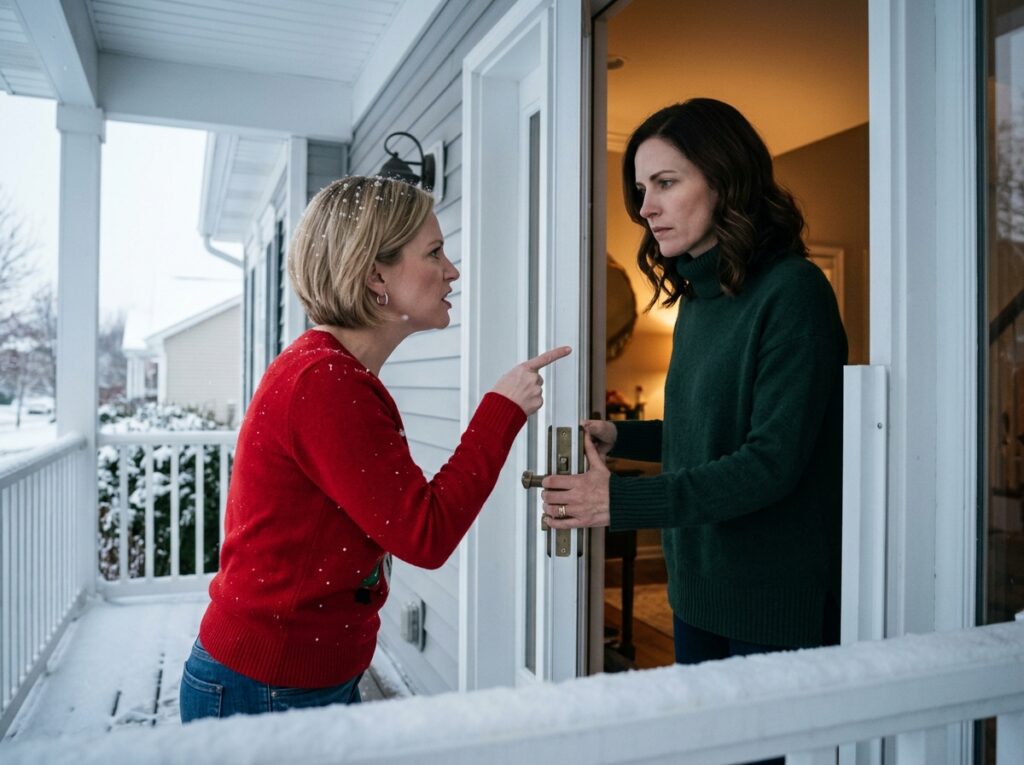
Janelle.
No coat.
Just a red Christmas sweater, jeans, and fury.
Mark looked at me.
“Want me to handle it?”
“No.”
I opened the door but left the storm door locked between us.
Janelle stared at me.
“Are you insane?”
“Merry Christmas, Janelle.”
“Don’t do that.”
“Do what?”
“This fake calm thing.”
Snow landed in her hair.
“You’re throwing Mom and Dad out of their house because Abby misunderstood something?”
Behind me, I heard a floorboard creak.
Abby.
I kept my eyes on Janelle.
“Go home.”
“You’re unbelievable.”
“Go home.”
“There literally wasn’t room.”
I stared at her.
She spread her hands.
“Mom had invited the Hendersons. Cousin Paul brought his girlfriend. Derek’s parents came. The table was full.”
I waited.
Janelle’s voice rose.
“What was Mom supposed to do?”
“Find a chair.”
She laughed.
“It wasn’t that simple.”
“Give Abby yours.”
Her mouth closed.
For one second, the only sound was snow tapping the metal awning.
I continued.
“You saw her.”
Janelle looked away.
“You waved.”
“I didn’t know what was happening.”
“You watched a sixteen-year-old girl leave on Christmas Eve.”
“Claire—”
“You had a chair.”
She stared at me.
“You had food.”
Her face tightened.
“You had a car.”
“Stop.”
“You had all three.”
“Stop making me sound like some monster.”
I heard movement behind me.
Then Abby spoke.
“You didn’t even say goodbye.”
Janelle froze.
I turned.
Abby stood at the bottom of the stairs.
Pajamas.
Hair tied loosely behind her head.
Her face pale.
Janelle’s anger disappeared.
“Abby.”
My daughter stayed where she was.
“I brought peppermint bark.”
Janelle swallowed.
“What?”
“I made it for everybody.”
Her voice shook.
“I left it on Grandma’s porch because I didn’t know what else to do with it.”
Janelle’s eyes filled.
“Sweetheart, I didn’t realize—”
“You waved at me.”
That sentence did more than anything I could have said.
Janelle looked down.
Abby turned and walked upstairs.
I looked at my sister.
“Go home.”
This time she did.
The family campaign began before noon.
Texts from cousins.
An uncle.
Two family friends.
Apparently the story was already that I was evicting my elderly parents on Christmas Day because my daughter had become “overly sensitive.”
I answered none of them.
Then, at 1:40, a message arrived from Cousin Paul.
Claire, I was there last night. Call me.
I almost ignored it.
Something made me call.
Paul answered immediately.
“I’m sorry.”
I closed my eyes.
“What happened?”
He exhaled.
“There’s something you don’t know.”
Mark looked over from the couch.
I put the phone on speaker.
Paul continued.
“Abby wasn’t unexpected.”
My hand tightened around the phone.
“What?”
“Your mom knew she was coming.”
The room changed.
Mark sat forward.
Paul’s voice dropped.
“I heard them talking before Abby arrived.”
“Who?”
“Your mom and Janelle.”
I couldn’t breathe.
“What did they say?”
Paul hesitated.
“Your mom was angry that you took another holiday shift.”
I stared at nothing.
“She said you always make work more important than family.”
My stomach turned.
Paul continued.
“Janelle said maybe if Abby felt left out, you’d finally understand how everyone else feels when you aren’t there.”
Mark stood.
Slowly.
I whispered, “Say that again.”
“Claire, I should’ve told you sooner.”
“Did they know Abby was driving herself?”
“Yes.”
I closed my eyes.
The rage I had felt the night before returned.
But now it was different.
Colder.
Cleaner.
This hadn’t been carelessness.
It had been punishment.
And they had used my daughter to deliver it.
Paul continued.
“When Abby rang the bell, your mom told everyone not to make a fuss.”
My eyes opened.
“What?”
“She said, ‘She can go home. Maybe Claire will think twice next year.’”
Mark walked away from the table.
Both hands went to the back of his head.
I couldn’t speak.
Paul’s voice cracked.
“I should’ve gotten up.”
“Yes.”
“I know.”
“You all should have.”
“I know.”
Silence.
Then Paul said, “I have something else.”
“What?”
“My girlfriend recorded part of dinner.”
“Why?”
“She was filming a Christmas video.”
My heartbeat slowed.
“She caught your mom saying it.”
Mark turned.
Paul continued.
“You can hear Janelle too.”
“Send it.”
A minute later, the video arrived.
Forty-seven seconds.
Christmas music in the background.
People laughing.
Glasses on the table.
My mother’s voice, clear enough.
“She’ll survive one night. Claire needs to learn that if she chooses the hospital every Christmas, her daughter can’t expect everyone else to rearrange things.”
Then Janelle.
“Exactly. Maybe this finally gets through to her.”
Someone asked where Abby would go.
My mother answered.
“Home, obviously.”
Then laughter from somewhere near the camera.
The video ended.
Mark stared at my phone.
I felt sick.
Not because I finally had proof.
Because Abby had been right.
She had stood on that porch sensing she was a problem because they wanted her to feel like one.
Mark whispered, “Does Abby need to know?”
I looked upstairs.
“No.”
Not then.
Not on Christmas.
But my parents needed to know that I knew.
I forwarded the video to Daniel.
Then I turned my phone off.
The formal consequences began after Christmas.
Not dramatically.
Legally.
Document by document.
My parents received proper notice.
Daniel handled everything.
My mother called relatives.
My father accused me of abandoning them.
Janelle sent paragraphs about family loyalty.
I answered none of it.
Then my mother made the mistake that finally dragged everything into the open.
She organized a family meeting.
Without asking me.
She invited relatives to the house one Sunday afternoon and told them she was going to expose what I was “really doing.”
I only went because Paul called.
“She’s telling everyone the house belongs to her.”
“It doesn’t.”
“I know.”
“She says your grandmother verbally promised it to her.”
“She didn’t.”
Paul hesitated.
“Claire, you need to come.”
So Mark and I did.
Abby stayed home.
That was non-negotiable.
When we arrived, twelve relatives were sitting in the living room.
My mother stood beside the fireplace.
Dad sat rigidly in his recliner.
Janelle was beside him.
On the coffee table sat my envelope.
My mother had kept it.
The moment I walked in, she held it up.
“Good. Now everyone can hear your explanation.”
I removed my coat.
“I don’t owe the room one.”
She laughed.
“See?”
I looked around.
Aunts.
Cousins.
People who had spent weeks hearing her version.
Mom continued.
“Your sister made one mistake.”
Janelle stared at the floor.
“Your father and I made one mistake.”
I said nothing.
“And you’re taking our home.”
“No.”
My mother’s voice rose.
“No?”
“I’m taking responsibility for mine.”
She frowned.
“My mistake was letting you believe generosity meant ownership.”
The room went quiet.
Dad stood.
“You don’t speak to your mother that way.”
Mark shifted beside me.
I touched his arm.
I had this.
Dad pointed toward the walls.
“I have maintained this home for six years.”
I looked at him.
“I paid the taxes.”
His finger lowered.
“I paid the insurance.”
Mom interrupted.
“That doesn’t make you family.”
“No.”
I nodded.
“It doesn’t.”
That surprised her.
I continued.
“But turning away your granddaughter does tell me what kind of family relationship we’re dealing with.”
Janelle suddenly stood.
“She wasn’t turned away because we hate her.”
I looked at her.
“Then tell everyone why.”
Silence.
Mom’s face changed.
Just slightly.
Janelle saw it.
I did too.
“Tell them,” I repeated.
My mother stepped in.
“We’ve already explained.”
“No.”
I pulled out my phone.
“You explained that Abby arrived unexpectedly.”
Paul lowered his eyes.
Mom’s face went pale.
I pressed play.
The room filled with Christmas music.
Then my mother’s voice.
“She’ll survive one night. Claire needs to learn…”
Nobody moved.
The video continued.
“…her daughter can’t expect everyone else to rearrange things.”
Then Janelle.
“Exactly. Maybe this finally gets through to her.”
My aunt covered her mouth.
Dad turned toward Mom.
“What is this?”
My mother stared at the phone.
The recording continued.
“Home, obviously.”
Then laughter.
The video stopped.
No one spoke.
My father looked at my mother.
“You told me there was a mix-up.”
Mom’s lips moved.
No sound.
“You told me Abby showed up without telling anyone.”
“I—”
“You knew?”
Dad’s voice cracked.
My mother reached toward him.
He stepped back.
That tiny movement changed everything.
Janelle started crying.
“It wasn’t supposed to go like that.”
I looked at her.
“How was it supposed to go?”
She shook her head.
“We thought she’d call you.”
My stomach dropped.
“You wanted her to call me from the driveway?”
Janelle wiped her face.
“We thought you’d get upset and maybe finally stop volunteering for holiday shifts.”
Mark’s jaw tightened.
I stared at my sister.
“You punished my daughter because I’m a nurse.”
“No.”
“That is exactly what you did.”
Mom suddenly snapped.
“You always choose strangers!”
Everyone turned.
There it was.
The truth.
Raw.
Ugly.
My mother was breathing hard.
“Every Christmas. Every Thanksgiving. Somebody at that hospital needs you and you run. Your family gets whatever is left.”
I looked at her.
“I worked Christmas Eve so a twenty-four-year-old nurse could put her two small children to bed.”
Mom scoffed.
“And what about your child?”
“My child was supposed to be with her grandparents.”
That silenced her.
I stepped closer.
“I thought she was safe with you.”
My mother’s anger disappeared.
I continued.
“I trusted you.”
Her eyes filled.
“And while I was treating strangers’ children, my own daughter was eating toast alone because her grandmother wanted to teach me a lesson.”
Dad sat down.
Slowly.
Like his legs no longer worked.
My aunt began crying.
Paul stared at the floor.
Janelle whispered, “Claire, I’m sorry.”
I looked at her.
“I believe you’re sorry now.”
Hope flickered across her face.
Then I continued.
“That doesn’t undo it.”
Her face collapsed.
Mom looked around the room.
Nobody defended her.
That seemed to frighten her more than the notice.
“I’m your mother.”
I nodded.
“And Abby is my daughter.”
Silence.
“That is why this ends here.”
Dad looked at me.
“Are we really losing the house?”
The question wasn’t angry.
Just tired.
“Yes.”
His shoulders fell.
“Why?”
“Because I can’t keep financing a relationship that hurts my child.”
He nodded slowly.
Unlike Mom, he didn’t argue.
Maybe because he’d finally heard the recording.
Maybe because he understood that his silence on Christmas Eve had been a choice too.
He looked toward the dark television.
“I saw her leave.”
Everyone became still.
Mom turned toward him.
“What?”
Dad’s voice was barely audible.
“I saw Abby through the window.”
My chest tightened.
He rubbed both hands over his face.
“I knew she was walking back to her car.”
“Dad…”
“I could’ve stopped her.”
He looked at me.
His eyes were wet.
“I didn’t.”
No excuse.
That hurt more.
But somehow, it was also the first honest thing anyone had given me.
“I’m sorry,” he said.
I swallowed.
“I know.”
My mother looked at him as though he had betrayed her.
Maybe in her mind, admitting the truth was betrayal.
Then Dad did something I never expected.
He stood and walked toward the mantel.
He picked up the spare house key.
The one I had given them six years earlier.
He placed it in my palm.
“We’ll find somewhere.”
Mom stared at him.
“Robert.”
He didn’t look at her.
“We should.”
That was the moment the fight ended.
Not because Mom agreed.
She didn’t.
Not because I forgave them.
I hadn’t.
It ended because the first person inside that house finally stopped pretending consequences were cruelty.
My parents moved six weeks later.
Into a two-bedroom apartment fifteen minutes away.
Smaller.
Ordinary.
Affordable with their retirement income.
Janelle helped them move.
For once, I didn’t pay.
The house stayed empty for nearly a month.
Then Mark and I made a decision.
We sold it.
Not because I needed the money.
Because I didn’t want Abby driving past that house for the rest of her life and remembering herself standing outside it.
Part of the proceeds went into her college account.
Another part went into savings.
And some of it paid for something Abby had wanted for years.
A family trip.
Nothing extravagant.
Just five days in a cabin after New Year’s the following winter.
No hospital.
No fire station.
No extended family.
Just us.
Healing with my parents came slowly.
Dad was easier.
He stopped defending himself.
That mattered.
The first time Abby agreed to meet him for coffee, he didn’t ask her to forgive him.
He simply said, “I should have gotten out of my chair.”
Abby stared at him.
He continued.
“I saw you leave. I knew something was wrong. And I stayed where I was because standing up would’ve meant arguing with your grandmother.”
His voice shook.
“I chose being comfortable over protecting you.”
Abby cried.
So did he.
Then she said something that stayed with me.
“Thank you for not saying you forgot.”
Dad nodded.
“I wish I had forgotten.”
He looked down.
“But I didn’t.”
That honesty became the first plank in a bridge between them.
Janelle took longer.
She sent Abby messages.
Abby ignored most.
Eventually, Janelle stopped asking for forgiveness and started showing change.
She came to Abby’s school play.
Sat in the back.
Didn’t approach her afterward.
She sent a card on Abby’s birthday with no guilt attached.
Just:
I love you. No response required.
Months later, Abby answered.
Thank you.
Two words.
But it was something.
My mother was different.
She apologized.
Then explained.
Then apologized again.
Then reminded me how much she had sacrificed raising us.
Every apology came with a hook.
So I kept distance.
I loved her.
But love was no longer permission.
Then Christmas came again.
I didn’t volunteer for a double shift.
Not because Mom had been right.
She hadn’t.
I simply wanted to be home.
At four in the afternoon, snow began falling.
Mark was making mashed potatoes.
I was burning rolls.
Abby had Christmas music playing too loudly.
Our table seated six.
There were only three of us.
At 4:37, the doorbell rang.
I looked at Mark.
He looked at me.
Abby turned down the music.
I checked the camera.
Dad.
Alone.
He stood on the porch holding a small paper bag.
I opened the door.
“Dad?”
“I’m not staying.”
Snow rested on his shoulders.
He held out the bag.
“This is for Abby.”
She appeared behind me.
Dad saw her.
His face softened.
“Merry Christmas, kiddo.”
Abby walked toward the door.
“What is it?”
“Open it later.”
She took the bag.
Dad started to turn away.
Then Abby said, “Grandpa?”
He stopped.
She looked at our table.
Then at him.
“We have room.”
I stopped breathing.
Dad looked at me.
He did not assume.
He waited.
That mattered too.
I looked at Abby.
“You sure?”
She nodded.
Dad stepped inside.
He removed his boots.
Mark quietly walked into the dining room.
Without saying anything, he pulled out the fourth chair.
That simple scraping sound across the floor almost broke me.
We ate.
Nobody talked about last Christmas.
Not during dinner.
Dad complimented Mark’s potatoes.
Abby made fun of my rolls.
For the first time in a year, Christmas felt ordinary.
After dessert, Abby remembered the paper bag.
She opened it.
Inside was a small glass container.
She stared.
Then laughed.
“What?”
Dad smiled nervously.
“Look underneath.”
At the bottom was a piece of toast.
Wrapped carefully in foil.
Beside it was a banana.
Whole.
Not half.
Abby stared at him.
Dad’s eyes filled.
“I know I can’t change that night.”
His voice cracked.
“But I wanted you to know I remember exactly what you told your mom you ate.”
Abby stopped smiling.
Dad continued.
“And I never want you to wonder whether anyone noticed what happened to you.”
He reached into the bag again.
There was one more thing.
A folded piece of paper.
Abby opened it.
It was the old seating card from my parents’ Christmas table.
Her name was written on it.
ABBY.
She looked at Dad.
“Where did you get this?”
He swallowed.
“I found it in your grandmother’s desk when we moved.”
My skin went cold.
Dad looked at me.
“She had made Abby a place card before Christmas.”
Silence.
The meaning arrived slowly.
My mother hadn’t merely known Abby was coming.
She had originally planned for her to sit at that table.
Then she had removed her place.
Abby looked at me.
Dad continued.
“I almost threw it away.”
His voice softened.
“But then I thought someday she might need to know something.”
“What?” Abby whispered.
“That there was always room.”
His eyes filled.
“The chair existed.”
He looked down.
“Adults chose to take it away.”
Abby’s lower lip trembled.
For a long moment, she stared at that little card.
Then she walked toward the table.
She placed it beside her plate.
Not like evidence.
Not like a wound.
Like something she had reclaimed.
Dad wiped his face.
Abby pulled out the chair beside her.
“Sit down, Grandpa.”
He did.
Mark brought fresh coffee.
I turned the Christmas music back on.
Outside, snow covered the street until every roof and driveway softened beneath white.
Inside, four chairs sat around our table.
One had been empty that morning.
Now it wasn’t.
And as Abby broke the untouched banana in half and handed one piece to her grandfather, I understood something I wished my family had understood a year earlier.
Making room for someone you love was never about the size of the table.
It was about whether, when they reached your door, you chose to open it.





