My family kicked me out, calling me a “burden”—then my brother’s boss revealed who had actually been helping them.
“FINALLY, WE’RE RID OF HER,” MY BROTHER WROTE UNDER A PHOTO OF MY BELONGINGS DUMPED ON THE SIDEWALK.
My mother celebrated. My father gave a thumbs-up of approval. My sister replied with a champagne bottle emoji.
They thought they had finally cast off the family burden from their lives.
I blocked them all and drove away without shedding a single tear.
But the next morning, my brother’s boss called me.
“Mara, I just saw what Dylan posted. Is it true?”
And suddenly, everything my family knew about me was about to change.
PART 1
The first thing I noticed when I walked into our townhouse that Tuesday evening was the silence.
No TV. No clattering dishes. None of the garlicky meals my mother usually cooked.
Instead, the air held a faint scent of packing tape and smoke from my father’s fireplace.
Then I saw the boxes.
Four cardboard boxes sat in the middle of the living room, filled with my things. My winter coat was carelessly folded on top, and my art portfolio leaned against the pile.
My younger brother, Dylan, stood by the fireplace, holding a glass of what looked like expensive bourbon. He was wearing a navy blue blazer, even though there was no reason for him to be dressed up at home.
My mother, Patricia, sat on the sofa. My father, Richard, sat in his usual armchair. My sister, Chloe, leaned against the dining room doorway, scrolling through her phone.
No one seemed surprised to see me.
That was when I realized this wasn’t a spur-of-the-moment family argument.
They had planned it in advance.
“What’s going on?” I asked, setting down my keys.
Dylan smiled.
“You have to move out tonight, Mara.”
I stared at him.
“What?”
“I need your upstairs bedroom for an office. The spacious closet is perfect for storing client clothes. Mom and Dad agree that it’s time everyone started contributing according to their means.”
I waited a moment to see if anyone would laugh.
No one did.
My father cleared his throat.
“Your brother finally has a stable career. We need to support the person with the best chance of moving this family forward.”
My chest tightened.
Moving this family forward?
For four years, I had been the one trying to keep this family from falling apart.
When my father’s construction supply business went under, I paid the overdue property taxes.
When his savings ran out, I paid off three mortgages.
When the furnace broke in January, I paid to replace it. Whenever Mom whispered that the grocery fund was running low, I would quietly transfer money to her.
I even paid to replace the refrigerator and repair the flooring.
No one called me a burden when the bank threatened to foreclose on the house.
“I’ve already contributed,” I said softly.
Dylan laughed.
“Come on, Mara. Freelance writing on a laptop isn’t the same as having a real career in the corporate world.”
I almost corrected him.
I almost explained that my supposedly insignificant freelance projects included commercial buildings worth more than anything Dad had ever owned.
But I looked around the room.
At my father’s cold expression.
At my mother’s deliberate silence.
At Chloe, who couldn’t even be bothered to put her phone down.
And I realized something.
They weren’t confused about what I did.
They simply didn’t care.
“This isn’t punishment, sweetheart,” Mom finally said. “Dylan has momentum right now. He’s meeting important people. He needs a proper space to work.”
“I work from that room.”
“You can work anywhere,” Chloe muttered.
That was when I noticed my drafting table was missing.
I turned toward the hallway and spotted its metal legs sticking out beneath a blanket near the front door.
One corner had been scraped from being dragged downstairs.
I stared at it.
Hundreds of nights.
That was how many nights I had spent working at that table while everyone else slept, wearing headphones so nobody would complain about my keyboard.
And now they had tossed it aside like an unwanted piece of furniture.
“How long have you been planning this?” I asked.
Dylan took another sip of bourbon.
“Long enough.”
Dad leaned forward.
“Don’t turn this into a scene, Mara. You’re twenty-eight. You’ve had plenty of time to establish yourself.”
I nearly laughed.
The reason I hadn’t bought my own home was sitting right in front of me.
I had stayed because I thought saving our childhood home was something we were doing together.
Apparently, I had been doing it alone.
“All right,” I said.
Mom blinked.
“All right?”
“I’ll leave.”
For the first time that evening, Dylan looked genuinely surprised.
He had expected a fight.
Maybe tears. Maybe pleading.
Instead, I walked upstairs and collected everything they had overlooked.
My passport.
Two framed photographs of my late grandmother.
A hard drive containing years of design work.
And a blue ceramic mug with a chipped handle.
Chloe followed me halfway up the staircase.
“You’re seriously not going to fight about this?”
I looked at her.
“What exactly would you like me to fight for?”
She opened her mouth.
Then closed it.
I finished packing without another word.
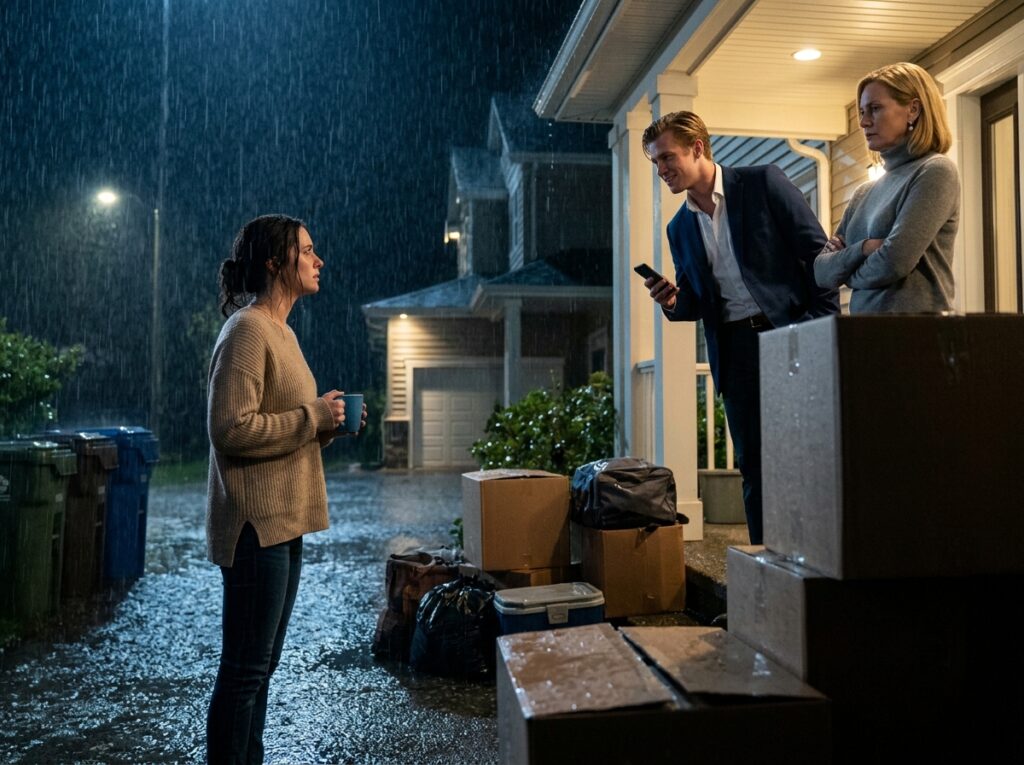
Outside, cold rain poured beneath the streetlights.
Dylan carried my boxes out, but instead of putting them in my car, he deliberately placed them beside the overflowing trash bins.
My mother stood beneath the porch roof.
“Don’t be dramatic, Mara. You’re making this harder than it needs to be.”
I reached for the first box.
Then I heard the unmistakable click of a phone camera.
Dylan had stepped backward to photograph my belongings sitting in the rain.
“What are you doing?” I asked.
“Nothing.”
But his thumbs were already moving across his screen.
Less than a minute later, my phone buzzed.
I opened the notification.
There it was.
A photograph of my boxes beside the trash bins, with my winter coats getting soaked.
Dylan had tagged the regional office of Mercer Freight Systems, the company where he had recently started working.
And above the photograph, he had written:
“Finally, we got rid of the dead weight. Now I can focus on building the life I deserve.”
My stomach dropped.
Then I saw the comments.
Chloe had posted champagne emojis.
Mom had written, “Fresh beginnings for everyone.”
Dad had added a thumbs-up.
Not one of them had defended me.
Not one of them had considered that the person they were publicly humiliating had spent four years keeping a roof over their heads.
For a second, I stared at the screen.
Then something inside me went completely still.
I didn’t reply.
I didn’t argue.
I simply picked up my boxes, carried them to my car, and carefully covered my drafting table with a plastic sheet.
When I finally slid behind the steering wheel, Dylan was still standing beneath the porch light.
My parents and Chloe stood behind him.
All four of them were watching.
Waiting for me to cry.
Waiting for me to beg.
I blocked Dylan first.
Then Chloe.
Then Mom.
Then Dad.
I started the engine and drove into the rain.
They thought they had just freed themselves from a burden.
They had no idea what they had actually done.
Because somewhere across the city, before I had even reached my temporary apartment, Dylan’s ridiculous little post was already being seen by someone he never expected.
Someone who knew exactly what my so-called freelance work involved.
Someone who understood the value of the projects I had spent years developing.
And someone who happened to have a very important connection to my younger brother.
The next morning, my phone rang.
I glanced at the unfamiliar number.
Then I answered.
“Hello?”
A man’s voice came through the speaker.
“Mara? This is Daniel Mercer, Dylan’s boss at Mercer Freight Systems.”
I sat up straight.
Why on earth was my brother’s boss calling me?
Before I could ask, he continued.
“I just saw what Dylan posted last night.”
His voice sounded unusually serious.
There was a brief silence.
Then he asked a question that made my blood run cold.
“Mara, is it true?”
Thank you for reading this far. 🙌📖 This is only the beginning… Part 2 is already in the comments. 👇🔥
For several seconds, I couldn’t answer.
Daniel Mercer wasn’t just some executive whose name I’d heard because Dylan worked for his company.
I knew him.
Not personally, exactly.
But professionally.
Six months earlier, an architecture firm I contracted with had brought me onto a distribution-center redevelopment project outside Columbus.
Mercer Freight Systems was the client.
My job had been to redesign the loading configuration, structural circulation, and expansion plans after the original proposal ran nearly nine million dollars over budget.
Daniel had attended two virtual design meetings.
My camera had been off during both.
Apparently, he remembered my name.
“Is what true?” I finally asked.
“That your family threw you out last night.”
Heat climbed into my face.
I looked around the small furnished apartment I’d rented after leaving.
My wet coats were draped across dining chairs.
My drafting case rested beside the sofa.
The blue mug sat on the counter.
“Yes.”
Daniel was quiet.
“And the photograph?”
“Also real.”
“Your brother put your belongings beside the garbage?”
“Yes.”
Daniel exhaled slowly.
“I was hoping there was context I was missing.”
“There probably is.”
“What context could make that reasonable?”
I didn’t answer.
He continued.
“Mara, I need to ask something else.”
“All right.”
“Does Dylan know you worked on our Columbus project?”
“No.”
There was a pause.
“He doesn’t know?”
“My family thinks I do freelance drafting.”
“You do.”
Despite everything, I almost laughed.
“Yes.”
“But that’s like saying a surgeon works with sharp objects.”
I rubbed my forehead.
“Daniel, I appreciate you calling, but whatever Dylan posted is a family issue. I don’t want his employment affected because he and I had a fight.”
Daniel became very quiet.
“This isn’t only about the post.”
My stomach tightened.
“What does that mean?”
“I’d rather explain in person.”
“Why?”
“Because your brother has been representing himself internally as someone with access to design expertise that I now have reason to believe came from you.”
I sat upright.
“What?”
Daniel continued carefully.
“Has Dylan ever had access to your project files?”
The room seemed to shrink.
My eyes moved toward the hard drive I’d carried out of the townhouse.
“He’s used my laptop before.”
“How recently?”
“I don’t know.”
“Did you ever give him permission to use your Mercer work?”
“No.”
Daniel didn’t respond.
“Daniel?”
“Can you come to our regional office this morning?”
I looked at the clock.
It was 8:17.
“Yes.”
“Bring whatever documentation you have showing your work on the Columbus project.”
I stared at my drafting case.
“Why?”
His answer came quietly.
“Because yesterday afternoon Dylan presented a proposal to our executive team.”
My skin went cold.
“And parts of it looked extremely familiar.”
An hour later, I walked into Mercer Freight Systems wearing the only blazer that hadn’t been soaked in the rain.
The receptionist recognized my name immediately.
That alone felt strange.
At home, my work had always been something vague happening upstairs.
Here, people knew exactly who I was.
Daniel met me outside a conference room.
He was in his late fifties, silver beginning to show at his temples.
His expression was kind but serious.
“I’m sorry we’re meeting under these circumstances.”
“So am I.”
He opened the door.
Two other people were inside.
A woman from corporate counsel.
And Dylan’s regional director.
On the screen at the front of the room was a presentation.
I recognized the first diagram immediately.
My stomach dropped.
“That’s mine.”
Nobody spoke.
I stepped closer.
It was a modified version of a loading-yard circulation plan I had developed three months earlier.
The colors were different.
The labels had been changed.
But the geometry was mine.
So was the traffic-flow logic.
I clicked to the next slide.
My work.
Next.
Mine again.
Then I saw a structural expansion concept I’d abandoned because it conflicted with a revised drainage requirement.
I stared at it.
“That version was never submitted.”
Daniel’s expression changed.
“What do you mean?”
“It was an internal draft.”
The corporate attorney leaned forward.
“Who had access?”
“Me. The architecture firm’s project lead. Two engineers.”
I stopped.
“And my home computer.”
Nobody said anything.
I suddenly remembered Dylan entering my room several weeks earlier.
I had been making coffee downstairs.
When I came back, he was standing near my desk.
He said he needed the printer.
At the time, I hadn’t thought twice.
Daniel asked, “Could he have copied the files?”
“Yes.”
My voice sounded distant.
“He could have.”
The attorney began taking notes.
I looked at Daniel.
“What exactly did he tell you?”
Daniel hesitated.
Then he turned the screen to a slide containing Dylan’s name.
DYLAN REEVES — STRATEGIC INFRASTRUCTURE INITIATIVE
“He represented these concepts as work he’d independently developed after studying our expansion problems.”
I felt sick.
“He doesn’t know how to produce these.”
“We know that now.”
“Didn’t anyone ask?”
Daniel’s regional director shifted uncomfortably.
“He presented confidently.”
That sentence almost made me laugh.
Of course he did.
Dylan had spent his entire life being rewarded for confidence.
I had spent mine learning that competence should speak quietly for itself.
Apparently, confidence had walked into a corporate conference room carrying my work and introduced itself as talent.
Daniel folded his hands.
“Mara, there’s something else.”
He pulled up an email.
The sender was Dylan.
The recipient was Daniel’s regional strategy team.
The message described having “years of informal exposure to commercial design and logistics planning through family business connections.”
I read it twice.
“Family business connections?”
Daniel nodded.
“He implied your father’s construction background had given him access to industry knowledge.”
I stared at the screen.
Dad’s construction supply business had sold drywall, fasteners, insulation, and commercial hardware.
He had never designed a distribution center in his life.
Then another line caught my attention.
I have also developed several proprietary layout concepts independently over the past few years.
My throat tightened.
“How many?”
Daniel looked at the attorney.
She opened a folder.
“That’s what we’re trying to determine.”
What followed was worse than I expected.
The Columbus material wasn’t the first.
Dylan had apparently been bringing ideas into meetings for months.
Small ones at first.
A loading-bay revision.
A warehouse staging concept.
A fleet-maintenance layout.
Nothing large enough to trigger suspicion.
But Daniel had noticed something unusual.
The quality of Dylan’s technical suggestions varied wildly.
Some were sophisticated.
Others revealed that he didn’t understand basic design constraints.
Then came yesterday’s presentation.
It was too polished.
Too technical.
Too good.
Daniel had planned to question him privately.
Then Dylan made the mistake of posting the photograph.
And tagging Mercer Freight Systems.
Daniel saw my name in the comments.
Then recognized it.
Dead weight.
The woman Dylan called dead weight was one of the independent designers Mercer had paid more than six figures over the previous eighteen months.
The irony had been enough to make Daniel start asking questions.
But irony wasn’t why I felt cold.
I was thinking about my room.
My laptop.
My files.
My family casually dragging my drafting table downstairs while Dylan had possibly been building his career from the work created on top of it.
“Did he get promoted because of this?”
I asked.
Nobody answered immediately.
That was my answer.
Daniel finally said, “His recent advancement was influenced partly by his perceived strategic contributions.”
I sat down.
For the first time since being thrown out, I wanted to cry.
Not because of the house.
Not because of the post.
Because suddenly my father’s words from the night before sounded different.
Your brother finally has a serious career.
And my mother’s.
He needs a proper space to work.
My room.
My desk.
My career.
My work.
They had thrown me out so Dylan could sit in the room where the work he’d been stealing from me had been created.
Daniel must have seen something change in my face.
“Mara?”
I looked at him.
“I need to know how much he took.”
The investigation began that morning.
I gave corporate counsel copies of my original files, timestamps, contracts, revision histories, and email records.
I didn’t embellish anything.
I didn’t ask them to fire Dylan.
I didn’t need to.
The evidence could speak for itself.
By noon, they had placed him on administrative leave pending review.
At 12:23, my phone began receiving calls from numbers I had blocked.
Then unknown numbers.
Then Mom used our neighbor’s phone.
I didn’t answer.
At 1:10, Chloe emailed me.
What did you do to Dylan?
I stared at the sentence.
Not:
What did Dylan do?
What happened?
Are you okay?
What did you do?
I deleted it.
At 2:40, Dad left a voicemail.
“Mara, whatever disagreement you have with your brother, don’t destroy his career over family drama.”
I saved that one.
Not because I intended to use it against him.
Because I needed to remember.
That evening, I returned to my temporary apartment.
My soaked winter coat had dried unevenly.
One sleeve smelled faintly of garbage.
I hung it near the window.
Then I made tea in Grandma’s chipped blue mug.
At 7:15, someone knocked.
Tasha, my closest friend from architecture school, stood outside holding pizza and a tool kit.
“What is that?”
I pointed at the tools.
She looked offended.
“You said your drafting table got damaged.”
“You drove across town to repair a table?”
“No.”
She stepped inside.
“I drove across town to insult your family and happened to bring tools.”
I laughed.
It was the first real laugh I’d managed in twenty-four hours.
We repaired the scraped corner together.
It wasn’t perfect.
Neither was I.
But when I sat behind the table afterward, something about seeing it standing again mattered.
A table could be dragged downstairs.
It could be left beside garbage.
It could get scratched.
That didn’t change what had been built on it.
Three days later, Daniel called.
“We found fourteen instances.”
I closed my eyes.
“Fourteen?”
“Some minor. Four significant.”
“How far back?”
“Approximately nine months.”
I gripped the phone.
“Is he admitting it?”
“Not exactly.”
Of course not.
Dylan claimed he had absorbed concepts through conversations with me.
That was almost funny.
We had never discussed technical work.
Whenever I tried, his eyes glazed over within thirty seconds.
Then Daniel told me something I wasn’t prepared for.
“Your father contacted our office.”
I went still.
“What?”
“He said the designs were created collaboratively within your household.”
I actually laughed.
“What does that even mean?”
“He claimed Dylan frequently helped you brainstorm.”
I closed my eyes.
There it was.
The family machine had activated.
Dylan had a problem.
Therefore reality needed adjustment.
“Daniel.”
“Yes?”
“My father has never seen one of my design files.”
“I suspected as much.”
“He couldn’t tell you the difference between a structural bay and a loading bay.”
Daniel was quiet.
Then he said, “Mara, corporate counsel may want a formal statement.”
“I’ll give one.”
This time, I didn’t feel guilty.
That frightened me at first.
Then I realized it wasn’t cruelty.
It was clarity.
The following Monday, Mercer Freight held an internal review meeting.
Dylan attended.
So did I.
Daniel sat at one end of the conference table.
Corporate counsel sat beside him.
Dylan entered wearing the same navy blazer he’d worn the night my family threw me out.
For one absurd moment, that detail nearly broke me.
He saw me.
His face hardened.
“What is she doing here?”
Daniel answered.
“Mara is here because we’re reviewing work belonging to her.”
Dylan laughed.
“She drafts things. She doesn’t own every warehouse idea in America.”
The attorney placed two sets of documents side by side.
My original files.
Dylan’s presentations.
Revision histories.
Creation dates.
Metadata.
Identical measurement errors I’d corrected in later versions.
Even a temporary note I’d typed to myself in one early draft:
CHECK TURNING RADIUS AGAIN — DON’T TRUST TOM’S NUMBERS.
Dylan had removed the sentence.
But the surrounding geometry remained identical.
Daniel looked at him.
“Would you like to explain?”
Dylan’s confidence lasted another twenty seconds.
Then it cracked.
“I found some files.”
“Where?”
“At home.”
“Whose computer?”
He looked at me.
“Mara’s.”
“Did she give you permission?”
Silence.
Daniel waited.
“No.”
That single word changed everything.
Dylan tried to recover.
He said he’d only borrowed concepts.
He said families shared ideas.
He said my work wasn’t confidential because I’d left my computer accessible inside a family home.
Corporate counsel corrected that immediately.
Then Daniel asked the question that ended it.
“If the work was freely shared, why did you remove Mara’s identifying information before presenting it?”
Dylan had no answer.
His employment was terminated.
Not because I demanded it.
Because he had misrepresented someone else’s professional work as his own and used it to advance within the company.
Daniel also informed him that Mercer reserved its rights regarding confidential client material.
Dylan stared at me.
“You happy?”
I looked at him.
“No.”
That seemed to anger him more.
“You’ve always hated that I was doing better than you.”
For once, I didn’t defend myself.
Daniel did.
“Mr. Reeves.”
Dylan looked at him.
Daniel’s voice was calm.
“Your sister’s firm billed Mercer Freight $184,000 for work during the period you’ve been employed here.”
Silence.
Dylan’s face emptied.
Daniel continued.
“Her work contributed to an estimated $8.7 million reduction in projected redevelopment costs on the Columbus project.”
Dylan stared at me.
For the first time in my life, my brother looked at me without already knowing who I was.
Daniel added, “She was doing better than you. She simply didn’t need everyone in the room to know it.”
That was the public consequence.
No cheering.
No triumphant music.
Just a conference room.
Documents.
Silence.
And the collapse of a story Dylan had spent years believing.
He gathered his things and left.
I thought that would be the worst part.
I was wrong.
That evening, Mom appeared at my temporary apartment.
I almost didn’t open the door.
Then I saw Dad and Chloe behind her.
No Dylan.
I stepped into the hallway and closed the apartment door behind me.
Mom stared.
“You aren’t inviting us inside?”
“No.”
Her face crumpled.
“Mara, please.”
“What do you need?”
Dad frowned.
“Is that really how you’re going to speak to your parents?”
“Yes.”
Chloe crossed her arms.
“Dylan lost his job.”
“I know.”
“Because of you.”
“No.”
I looked at her.
“Because he stole my work.”
“He’s your brother.”
“And I’m your sister.”
She stopped.
Mom started crying.
“He made a mistake.”
“Fourteen times?”
She looked away.
Dad stepped forward.
“You could have handled this privately.”
“How?”
“Talked to him.”
“He presented my work to his employer.”
“You could have given him a chance to correct it.”
I stared at Dad.
Then something occurred to me.
“Did you know?”
He froze.
Mom looked at him.
Chloe stopped moving.
“Dad.”
He said nothing.
My stomach tightened.
“Did you know Dylan was using my work?”
“No.”
Too fast.
I knew.
“Dad.”
He looked down.
Mom whispered, “Richard?”
Finally he exhaled.
“I knew he sometimes looked at your drawings.”
The hallway seemed to tilt.
“How?”
“I saw him upstairs once.”
“When?”
“A few months ago.”
“What was he doing?”
“Taking pictures of your screen.”
I couldn’t breathe.
“And you didn’t tell me?”
Dad became defensive.
“I asked him about it.”
“What did he say?”
“That he was learning.”
I laughed once.
A broken sound.
“And that was enough for you?”
“He’s trying to establish himself.”
There it was again.
Potential.
Momentum.
The son who might move the family forward.
I looked at my father.
“You knew.”
“I didn’t know he was presenting them as his.”
“You knew he was photographing my work without permission.”
Dad’s face reddened.
“I didn’t think it was serious.”
Mom turned toward him.
“You never told me this.”
He snapped, “Because I knew you’d overreact.”
I almost admired the irony.
Then Chloe said quietly, “I knew too.”
Everyone turned.
My sister’s face had gone pale.
“What?”
She swallowed.
“I saw him using your computer.”
“When?”
“Last month.”
I stared at her.
“He said you let him.”
“And you believed him?”
She began crying.
“No.”
That answer hurt more.
“Then why didn’t you tell me?”
Chloe wiped her face.
“Because he said he was up for a promotion.”
The hallway became completely silent.
There it was.
The truth beneath everything.
They hadn’t merely underestimated me.
They had decided Dylan’s success mattered more than protecting mine.
Mom looked horrified.
She turned toward Dad.
Then Chloe.
“You both knew?”
Dad muttered, “Not like this.”
I stepped backward.
Mom reached for me.
I moved away.
“Mara—”
“No.”
My voice shook for the first time.
“No more tonight.”
“You can’t shut us out.”
“I can.”
“We’re family.”
I looked at all three of them.
“You remembered that very quickly.”
Then I went inside and locked the door.
I cried that night.
Harder than the night they threw me out.
Because being underestimated was survivable.
Being mocked was survivable.
Even being evicted from a house I’d helped save was survivable.
But discovering that people who claimed to love me had seen something wrong happening and stayed silent because the wrong person benefited?
That required grieving.
So I grieved.
And then I changed my life.
First, I stopped paying anything connected to the townhouse.
The internet account was mine.
Canceled.
The streaming services were mine.
Canceled.
The grocery delivery membership.
Canceled.
The landscaping plan.
Canceled.
Then I called the mortgage company.
That conversation revealed something important.
My name wasn’t on the mortgage.
I’d known that.
But for four years, I’d been making direct payments whenever Dad fell short.
Three days after I stopped, Dad called from an unknown number.
“Mara, the mortgage is due.”
“I know.”
“We’re short.”
“I know.”
Silence.
Then:
“What are we supposed to do?”
I almost answered automatically.
I almost opened my banking app.
Instead, I said, “Figure it out.”
Dad went quiet.
I understood then how Dylan had learned.
The whole family had.
Whenever reality became uncomfortable, they handed it to me.
This time I handed it back.
They sold Dad’s second truck.
Chloe started contributing rent.
Mom canceled two expensive subscriptions.
Dad took part-time consulting work with a former supplier.
The house did not collapse.
Nobody died.
They simply adjusted.
Exactly as I had always been expected to.
Meanwhile, something unexpected happened at Mercer.
Daniel asked me to lunch.
I assumed it concerned the investigation.
Instead, he brought the Columbus expansion drawings.
“We’re opening a new infrastructure design unit.”
I stared at him.
“Okay.”
“I want you to lead the external design team.”
I laughed nervously.
“Daniel, I don’t work for Mercer.”
“I know.”
“I like being independent.”
“I know that too.”
“Then what are you asking?”
“A twelve-month consulting agreement. Your firm stays yours. You build your own team.”
I looked at the contract.
The number at the bottom was more than I’d earned during my first three years freelancing combined.
“Why me?”
Daniel looked genuinely confused.
“Because you’re good.”
The answer was so simple that I almost cried.
Not because you’re useful to your family.
Not because somebody else failed.
Not because we need rescuing.
Because you’re good.
I signed two weeks later.
Then I rented a real studio.
Not large.
Six desks.
Tall windows.
Exposed brick.
A small conference room.
And in the corner, my scratched drafting table.
Tasha helped me carry it upstairs.
“You know you can afford a new one.”
“I know.”
“So we’re keeping the damaged table for emotional symbolism?”
“Exactly.”
“Good. I was worried success had made you boring.”
Six months passed.
Dylan found another job.
Smaller company.
Lower salary.
No strategy title.
For the first time, he had to build credibility without my files.
I knew because he emailed me.
Not asking for help.
Apologizing.
The first apology was terrible.
Mostly explanations.
I didn’t answer.
The second was better.
He admitted he had resented me.
That surprised me.
According to Dylan, my quiet competence had always made him feel as though he had to be louder.
Mom and Dad praised his charisma.
His ambition.
His “potential.”
But whenever something in the house actually needed solving, everyone came to me.
He hated that.
So when he discovered my files, taking pieces of my work had felt almost justified.
He told himself I had plenty.
Plenty of projects.
Plenty of money.
Plenty of ability.
He only needed a little.
Then a little became fourteen times.
His final sentence was the only one that mattered.
You weren’t dead weight. I called you that because I needed everyone to believe I was carrying more than I was.
I read it several times.
Then I replied.
Thank you for finally saying it clearly.
I didn’t forgive him immediately.
He didn’t ask me to.
That mattered too.
Mom apologized next.
Not at my studio.
Not over the phone.
She wrote a letter.
She admitted something I had never understood.
When Dad’s business failed, she had known how much money I was contributing.
She had hidden the full amount from Dylan and Chloe.
“Why?” I asked when we eventually met.
We were sitting in a coffee shop.
Mom looked down.
“Shame.”
“About what?”
“That my daughter was supporting me.”
I stared at her.
“So you let everyone think I barely contributed?”
She nodded.
“It was easier for me if your help looked small.”
I sat back.
Suddenly, years of family history rearranged themselves.
Mom continued.
“When Dylan started doing well at Mercer, your father and I were proud in a way that felt easier.”
“Because you weren’t dependent on him.”
Her eyes filled.
“Yes.”
That didn’t excuse anything.
But it explained the strange imbalance.
My success had come with a mirror.
Every mortgage payment reminded Dad his business had failed.
Every grocery transfer reminded Mom she needed her daughter.
Dylan’s success cost them nothing.
So they celebrated his loudly.
Mine quietly embarrassed them.
“I am sorry,” Mom whispered.
I looked at her.
“For the boxes?”
“For making you believe being needed was the closest thing you were going to get to being valued.”
That was the apology that reached me.
We didn’t hug.
Not then.
Healing doesn’t always need physical proof.
Dad took longer.
Pride usually does.
Almost a year after they threw me out, he came to my studio.
He stood near the drafting table.
His fingers touched the scraped corner.
“I did that.”
“What?”
“When we dragged it downstairs.”
I looked at him.
“I caught the corner against the railing.”
He swallowed.
“I heard the wood scrape.”
His voice became quiet.
“I remember thinking you were going to be upset.”
“I was.”
“I know.”
He looked around the studio.
On the wall were photographs of completed projects.
Buildings.
Warehouses.
Distribution centers.
Commercial renovations.
Dad walked slowly from one to another.
“You did all these?”
“Yes.”
He stopped at the Columbus project.
“That one too?”
“Yes.”
For several minutes, he simply stared.
Then he said something I’d waited most of my life to hear.
“I didn’t understand what you did.”
I folded my arms.
“You never asked.”
“No.”
He nodded.
“I didn’t.”
No excuses.
That was new.
He reached into his coat and handed me an envelope.
Inside was a check.
Not huge.
Three thousand dollars.
“What is this?”
“The mortgage payments.”
“Dad—”
“Not all of them.”
He smiled sadly.
“Not even close.”
I tried to return it.
He wouldn’t take it.
“You spent years protecting my pride.”
His eyes filled.
“Let me be uncomfortable for once.”
So I deposited it.
The following Christmas, I didn’t go to the townhouse.
Not because I was angry.
Because I had plans.
Tasha and I hosted dinner at the studio for our small team.
We pushed two drafting tables together.
Everyone brought food.
One junior designer burned the rolls.
Someone spilled red wine on a set of old sample drawings.
We laughed until nearly midnight.
At one point, I looked around the room.
Nobody needed me to save them.
They wanted me there anyway.
That distinction felt enormous.
The final surprise came the following spring.
Daniel invited me to Mercer headquarters.
When I arrived, a crowd had gathered near the lobby.
Employees.
Executives.
Architects.
Contractors.
I immediately became suspicious.
“What is this?”
Daniel smiled.
“Relax.”
“I hate when people say that.”
“I know.”
A large rendering stood beneath a cloth.
Daniel asked me to pull it away.
Underneath was the completed Columbus distribution campus.
At the bottom was a small plaque listing the principal contributors.
My name was there.
MARA REEVES — LEAD INFRASTRUCTURE DESIGN CONSULTANT
I stared at it.
Daniel handed me a smaller object.
A framed photograph.
For one horrible second, I thought it was Dylan’s social-media post.
It wasn’t.
It was a photograph taken during construction.
I was standing at the edge of the site in a hard hat, rolled drawings beneath one arm, pointing toward the steel framework.
I didn’t remember anyone taking it.
On the back, Daniel had written:
For the woman somebody once called dead weight. This building disagrees.
I laughed.
Then cried.
A little.
Tasha later insisted on hanging the photograph above my scratched drafting table.
I objected.
She ignored me.
Some things never change.
Other things do.
Two years after the rainy night when my belongings were placed beside the garbage, I bought a small townhouse of my own.
Not enormous.
Two bedrooms.
A sunny kitchen.
A little brick patio.
On moving day, Dylan appeared.
I hadn’t asked him.
He stood beside his car looking awkward.
“I heard you were moving.”
“Mom?”
“Chloe.”
He opened his trunk.
Inside were moving blankets.
Tape.
Tools.
“I thought you might need help.”
For one second, I almost said no.
Then I noticed something.
He hadn’t brought his phone inside.
No photographs.
No performance.
No audience.
Just my brother.
“Okay.”
We carried boxes for three hours.
Near the end, he lifted one side of my drafting table.
I took the other.
Halfway through the doorway, he stopped.
“Mara.”
“What?”
His eyes settled on the scraped corner.
“I really am sorry.”
“I know.”
We carried it inside.
This time, nobody dragged it.
Nobody threw it beside the garbage.
Nobody needed to decide which sibling had more potential.
We simply carried it together.
That evening, after everyone left, I sat alone on my little patio.
My phone buzzed.
A family group chat.
I had eventually allowed a new one.
Different rules.
Different people, in some ways.
Chloe had posted a photograph from moving day.
It showed me standing in my kitchen surrounded by boxes, laughing while Dad tried unsuccessfully to assemble a bar stool.
The caption said:
Mara’s finally home.
Mom added a heart.
Dad wrote:
Proud of you.
Then Dylan responded.
No joke.
No champagne emoji.
No reference to dead weight.
Just:
She built it herself.
I stared at those words.
Then I put my phone down.
Through the kitchen window, I could see the old blue mug beside the sink.
Grandma’s photographs were waiting to be hung.
And in the second bedroom, beneath the window, stood my scratched drafting table.
The same table they had dragged downstairs.
The same table that had sat beside garbage in the rain.
The same table where I’d created work my family hadn’t bothered to understand.
I used to think the worst thing they did was throw me out.
It wasn’t.
The worst thing was teaching me for years that my value depended on how quietly I could carry everyone else.
And the best thing they ever did?
Strangely enough, that happened on the same night.
They put my belongings on the curb.
They closed the door.
They told themselves they’d gotten rid of the family’s dead weight.
And without meaning to, they finally forced me to stop carrying them.
I walked inside my own home and turned off the patio light.
For the first time in years, there was no one upstairs waiting for me to resolve a problem.
There was no one downstairs waiting to collect money.
No one was deciding whose future mattered more.
There was only the gentle hum of my refrigerator.
Rain began to patter against the window.
And a drafting table—with one damaged corner—still stood exactly where I had placed it.
I smiled.
Then I went to sleep.
Finally home.





