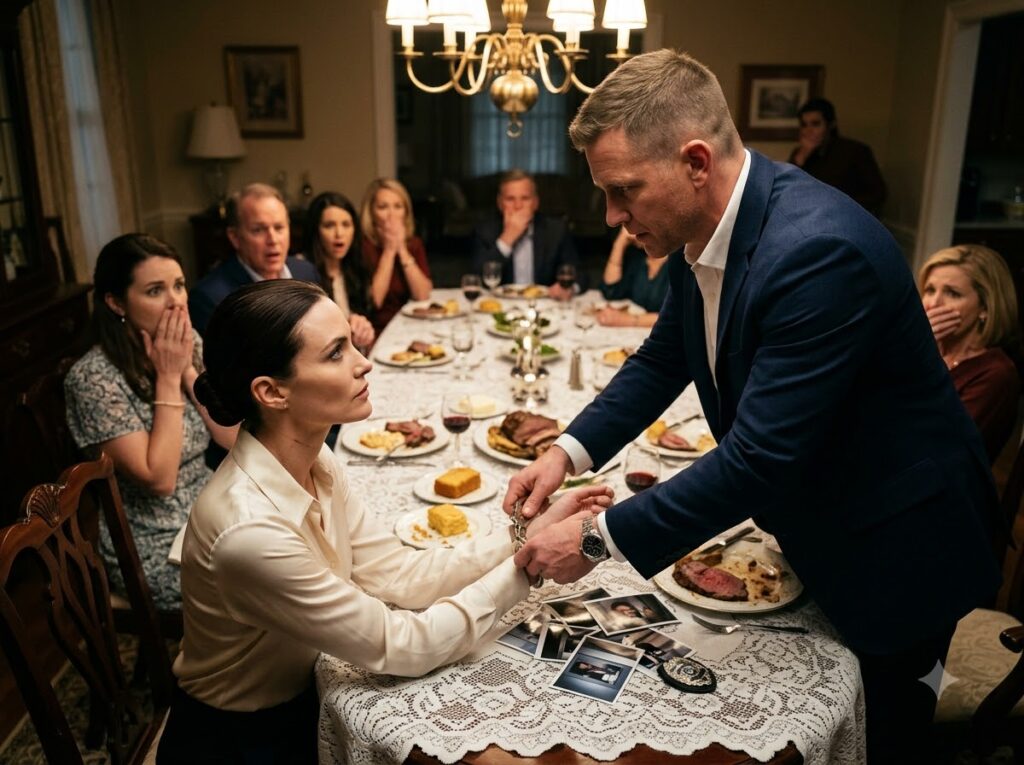
The front door struck the wall so hard that the wreath above it fell sideways.
“EVERYONE STEP AWAY FROM THE TABLE!”
The command came from a man in a dark tactical jacket standing in the doorway.
Behind him were four armed personnel, two men in plain clothes, and a woman holding an identification wallet open at chest height.
Nobody moved.
James turned sharply, one hand still gripping my arm.
“What the hell is this?” he demanded.
The man in the doorway didn’t answer him.
His eyes went straight to me.
Then to the handcuffs.
And something in his face changed.
“Ma’am,” he said, his voice suddenly controlled, “are you injured?”
James blinked.
“She’s under arrest.”
The woman beside the doorway stepped forward.
“By whose authority?”
“Mine. Officer James Whitmore, Greenville County Sheriff’s Office.” He lifted his chin. “I’ve got probable cause for impersonating a federal officer and unlawful possession of government property.”
She examined his badge, then looked at the handcuffs.
“Did you verify her identity through an authorized channel?”
James hesitated.
“I have photographic evidence.”
“That wasn’t my question.”
“I have a private investigator’s report.”
The woman slowly closed her identification wallet.
“Then you have a report from a private investigator. Not an identity verification.”
My aunt Linda stood so abruptly that her chair toppled backward.
“Who are you people?”
The man in the tactical jacket finally stepped fully into the room.
“Federal protective detail. Everyone remain where you are.”
The phrase federal protective detail seemed to drain the air from the dining room.
My father set his glass down.
My mother looked from the strangers to me, her lips moving without producing a sound.
And James—
James was staring at the woman holding the identification wallet.
She looked directly at him.
“I’m Special Agent Rebecca Lawson. We’re here for Claire Whitmore.”
He gave a short, nervous laugh.
“Good. Then you can take custody of her.”
Rebecca’s expression didn’t change.
“Remove those handcuffs.”
James tightened his grip on my arm.
“Excuse me?”
“You heard me, Officer. Remove the handcuffs.”
He looked at me, then back at her.
“She’s a suspect.”
Rebecca took one step closer.
“Claire Whitmore is a protected federal witness operating under an authorized security arrangement. Your actions have just created a situation you do not understand.”
The word witness landed harder than the word federal.
My grandmother began to cry.
Kyle whispered, “Oh my God.”
James’s face turned red.
“That’s impossible. She doesn’t even have a real job.”
For the first time that evening, I smiled.
Not because I was enjoying his humiliation.
Because he had finally said the quiet part out loud.
He had decided that my life was a lie simply because I had never given him the details he believed he was entitled to know.
“James,” I said softly, “I told you to check the rank of the person you were handcuffing.”
He stared at me.
Rebecca held out her hand.
“Keys.”
James didn’t move.
One of the federal officers stepped forward, but Rebecca raised two fingers to stop him.
“Officer Whitmore,” she said, “I am giving you a direct instruction to release her.”
His hand shook as he reached for the key.
The cuffs opened.
I rubbed my wrists once and stepped away from him.
No one in that room seemed to know where to look.
Then my brother made one final mistake.
He pointed at me.
“She manipulated all of you. She’s been lying to this family for years. You don’t know who she really is.”
Rebecca looked at him for a long moment.
Then she answered.
“Actually, Officer, that is precisely why we’re here.”
My name is Claire Whitmore.
And for the past eighteen months, my identity had been protected by people whose names my brother would never find in a public directory.
I had not been impersonating a federal officer.
I had not stolen government property.
And I had not been dishonorably discharged from the military.
The truth was considerably more complicated.
Eight years earlier, I had joined the United States Army. I served in military intelligence, eventually working on investigations involving procurement fraud, classified logistics, and financial networks that moved money through legitimate government contractors.
I learned early that the most dangerous people were not always the ones carrying weapons.
Some wore expensive suits.
Some signed charitable donations in front of cameras.
Some shook hands with senators and posed for photographs beside American flags.
And some knew exactly how to hide millions of dollars behind a stack of perfectly ordinary invoices.
Three years before that Sunday dinner, I had been assigned to assist with a classified investigation into a network of contractors suspected of diverting government funds. During the investigation, I discovered records linking several shell companies to a much larger operation involving compromised officials and falsified military supply contracts.
One of those records contained the name of a person who had been considered untouchable.
A senior government official.
I reported what I found.
Then the threats began.
At first, they were subtle. An unfamiliar vehicle outside my apartment. A stranger asking my neighbors questions. A message containing a photograph of my front door.
Then someone sent me a picture of my mother leaving a grocery store.
That was when the government moved me into a protective arrangement.
The details of my work became restricted. My public professional history was deliberately limited. My family received only the information necessary to protect them, and even that information was incomplete.
I was not allowed to discuss the investigation with anyone who lacked authorization.
Not my parents.
Not my brother.
Not even my grandmother, who had once held my hand through every childhood nightmare.
My family believed I had left the military and taken a consulting job.
That was the story I had been instructed to use.
And because I knew what could happen if the wrong person learned the truth, I let them believe it.
I had never imagined that my own brother would interpret my silence as evidence of a crime.
“Claire,” my mother whispered.
I turned toward her.
She looked smaller than I had ever seen her.
“What have you gotten yourself into?”
I could have explained everything.
I could have told her about the years of training, the nights spent studying documents that could ruin powerful people, the security briefings, the restrictions, the fear of saying one wrong sentence to the wrong person.
But the agents were still standing in her dining room.
The investigation was still active.
And my family was still not cleared to hear the details.
“I can’t explain everything,” I said. “But I can tell you this: I haven’t committed the crimes James accused me of.”
My father finally stood.
“Then why all the secrecy?”
“Because some information can put people in danger.”
James laughed bitterly.
“There it is again. Another excuse.”
Rebecca turned toward him.
“Officer Whitmore, stop speaking.”
“I have a right to—”
“You have a right to cooperate with the review of your conduct. You do not have a right to interfere with an active federal security operation.”
He went silent.
Rebecca looked at me.
“Claire, we’d like to get you out of here. Are you ready?”
I glanced toward Grandma Evelyn.
She was gripping the arms of her wheelchair, tears slipping down her cheeks.
“Grandma?”
She lifted her head.
“I’m sorry, baby.”
Those three words nearly broke me.
I walked over and knelt beside her.
“You don’t have to apologize.”
“Yes, I do.” Her voice trembled. “I watched him put those handcuffs on you. I knew he was being cruel, and I sat here because I was afraid of what he’d do if I challenged him.”
I took her hand.
“You don’t have to be afraid of him anymore.”
Behind me, James made a disgusted sound.
“Unbelievable. She’s got everyone wrapped around her finger.”
Grandma turned toward him.
“No, James.”
Her voice was quiet, but the whole room heard it.
“For once in your life, be quiet and listen.”
My brother stared at her as though she had slapped him.
Grandma had always defended him. When he was a boy, she called his temper passion. When he bullied other children, she said he was competitive. When he grew older and began treating every disagreement like a challenge to his authority, she told us he was under stress.
She had spent forty years making excuses for him.
Now she was looking at him with disappointment instead of fear.
“You have embarrassed this family far more than Claire ever could,” she said.
James’s face hardened.
“You’re taking her side?”
“No,” Grandma answered. “I’m taking the side of the truth.”
For the first time since I had entered that house, I felt as though someone had actually seen me.
Not my silence.
Not my job.
Not the rumors.
Me.
Rebecca escorted me toward the front door.
As we passed the dining table, my brother stepped into my path.
“You can’t just walk away,” he said.
I stopped.
He looked desperate now, his certainty collapsing under the weight of witnesses who had seen the entire scene.
“You’re my sister.”
I looked at him.
“That didn’t stop you from handcuffing me in front of Grandma.”
“I was doing my job.”
“No. You were performing for an audience.”
His mouth opened, but I continued.
“You didn’t call an appropriate contact to verify my identity. You didn’t ask a supervisor to review your evidence. You didn’t even give me a chance to answer your accusations. You decided what I was before you had proof, and you used your badge to make everyone else believe you.”
James shook his head.
“You’ve always thought you were better than me.”
I almost laughed.
There it was.
Beneath the badge, the photographs, and the accusation was the same old wound.
My brother couldn’t tolerate not being the most important person in the room.
“James,” I said, “I never needed to be better than you. I only needed you to stop trying to make me smaller.”
He stared at me.
I walked past him.
Outside, two black SUVs were parked along the curb. A third vehicle waited near the end of the driveway.
The evening air was warm, carrying the smell of wet grass and distant rain. The American flag on the porch fluttered in a sudden gust.
One of the officers opened the rear passenger door.
Before I got in, I turned back toward the house.
My mother stood in the doorway, one hand pressed against her chest. My father had moved beside Grandma’s wheelchair. Amanda was crying silently. Kyle looked as though he wanted to disappear into the floorboards.
James stood alone in the center of the dining room.
His badge was no longer on his belt.
Rebecca had asked him to surrender it temporarily while the circumstances of the incident were reviewed.
For the first time in his life, my brother had entered a room expecting everyone to obey him and discovered that authority had limits.
I climbed into the SUV.
The door closed.
And the convoy pulled away.
Twenty minutes later, we arrived at a secure federal facility outside Greenville.
Rebecca sat across from me in a small conference room while a medic examined the marks around my wrists.
“I’m sorry this happened,” she said.
“It’s not your fault.”
“No. But we should have anticipated that your family might react badly if someone discovered the protected photographs.”
I looked at her.
“James hired a private investigator?”
“That appears to be the case. We’re still determining how the photographs were obtained and whether any restricted information was accessed.”
I rubbed the inside of my wrist.
“Did he have any idea what he was looking at?”
“No. Based on what we know so far, he appears to have misunderstood the photographs and made assumptions about your identity.”
I leaned back.
“That’s James.”
Rebecca studied me.
“You don’t sound surprised.”
“I’ve spent my entire life watching him confuse confidence with competence.”
She didn’t smile.
“This is serious, Claire. Your brother is a law enforcement officer. His decision to arrest you without properly establishing the facts will be reviewed. We also need to determine whether the investigator he hired obtained any information unlawfully.”
“Will he lose his job?”
“I can’t predict the outcome. That will depend on the evidence and the appropriate authorities.”
I nodded.
I didn’t want revenge.
I wanted accountability.
There was a difference, even if my brother had spent his entire life pretending there wasn’t.
Rebecca placed a sealed folder on the table.
“There’s something else you need to see.”
I opened it.
Inside was a photograph of a man stepping out of a government building.
I recognized him immediately.
Deputy Director Richard Harlan.
He had been one of the senior officials whose name appeared in the financial records I had helped uncover.
“What is this?”
Rebecca placed another document beside the photograph.
“The investigation has expanded. A source recently provided information suggesting that someone may have been attempting to identify people connected to the original inquiry.”
My stomach tightened.
“You think James’s investigator was looking for me on someone else’s behalf?”
“We don’t know yet. But the timing concerns us.”
I stared at the photograph.
For eighteen months, I had believed that the greatest danger came from the people who wanted the investigation buried.
Now I had to consider the possibility that my own brother’s obsession with exposing me had created a new opening for them.
Rebecca lowered her voice.
“Claire, did you tell anyone in your family where you were working?”
“No.”
“Did anyone in your family know the names of your contacts?”
“No.”
“Did James ever have access to your personal devices, old records, or military paperwork?”
I thought back over the past few years.
James had visited my apartment once while I was away. He had helped my mother move some boxes from my old storage unit. He had asked questions about my service that I had refused to answer.
But nothing I could remember proved he had accessed anything sensitive.
“I don’t know,” I admitted.
“Then we’ll investigate that possibility without assuming he’s involved in anything beyond what we’ve already observed.”
I closed the folder.
Outside the conference room, a phone began ringing.
Rebecca listened to the brief message from the agent who had stepped into the hallway.
When she returned, her expression had changed.
“What happened?” I asked.
“Your brother just contacted the sheriff’s office. He claims the federal agents at your grandmother’s house were impostors.”
I stared at her.
For a moment, I genuinely had no words.
Then I let out a short, disbelieving laugh.
“He’s doubling down.”
“Apparently.”
“He’s going to make this worse for himself.”
Rebecca stood.
“That’s why we need to establish exactly what he knew, what he claimed, and what he did.”
She paused at the door.
“Claire, there’s one more thing.”
I looked up.
“The investigator James hired? We found a preliminary record of a payment to his firm from an account connected to a contractor already under scrutiny in our broader investigation.”
My laughter disappeared.
“Connected how?”
“We’re verifying the ownership records now. It could be an innocent connection. It could be something more.”
I looked down at the photograph of Richard Harlan.
For the first time that night, I wondered whether James had simply wanted to humiliate his little sister.
Or whether someone else had recognized an opportunity to use his arrogance against me.
At 8:15 the following morning, my mother called.
I nearly let it go to voicemail.
Then I answered.
“Claire?”
Her voice cracked on my name.
“Mom.”
“Your father and I need to talk to you.”
“About what?”
“James.”
I closed my eyes.
“What has he done now?”
“He went to the sheriff’s office this morning. He filed a statement claiming that the people who came into the house were impersonating federal agents. He says they threatened him and interfered with a lawful arrest.”
I sat up straighter.
“Did he mention the handcuffs?”
“He said you were resisting.”
I stared at the wall.
There was a security camera in Grandma’s dining room. My brother had known it was there for years. Grandma installed it after a caregiver stole money from her purse.
The camera had recorded everything.
Every accusation.
Every warning.
Every moment James had ignored his grandmother and forced the cuffs around my wrists.
“Mom,” I said, “did anyone preserve the footage?”
“Yes. Your father copied it before James could take the camera.”
That surprised me.
For once, my father had acted before silence became complicity.
“Good,” I said. “Give the original recording to the appropriate investigators. Don’t edit it, post it online, or send it around the family. Let them handle it.”
My mother began to cry.
“I don’t understand how this happened.”
“Because James believed he was entitled to decide who I was without asking whether he was right.”
“But he’s your brother.”
“I know.”
“He thinks you hate him.”
I looked out the window at the secure facility’s empty courtyard.
“No, Mom. I don’t hate him.”
I paused.
“But I’m not going to protect him from the consequences of what he did.”
For a long time, neither of us spoke.
Then she whispered, “I’m sorry we didn’t stand up for you.”
I swallowed the ache in my throat.
“I needed you to.”
“I know.”
This time, I believed she understood at least a little.
It didn’t erase what had happened.
But it was the first honest conversation we had shared in years.
Three days later, I returned to my grandmother’s house under federal escort to collect some personal belongings.
James was not there.
My father met us at the door.
He looked older than he had the previous Sunday, his shoulders bent and his eyes tired.
“Claire.”
“Dad.”
He stepped aside.
“Grandma’s been asking for you.”
I found her in the living room, wrapped in a blue blanket, watching an old movie with the volume turned low.
When she saw me, she held out both hands.
I crossed the room and knelt beside her chair.
“Hey, Grandma.”
She touched my cheek.
“I was so afraid.”
“I’m okay.”
“I know, baby. But I was afraid of what he would do to you.”
I rested my forehead against her hand.
“I know.”
She took a shaky breath.
“Your brother has always been so certain that being the loudest person means being right.”
I smiled sadly.
“He learned that somewhere.”
She gave me a knowing look.
“Perhaps we all helped him learn it.”
I couldn’t disagree.
Grandma reached toward the small table beside her chair and picked up a folded piece of paper.
“I want you to have this.”
“What is it?”
“Something your grandfather wrote years ago. I found it in his desk after he died.”
I unfolded the paper.
The handwriting was faint but familiar.
The measure of a person is not how many people stand when he enters a room. It is what he does when he believes nobody important is watching.
I read it twice.
Grandma squeezed my fingers.
“Your grandfather would have been proud of you.”
My eyes burned.
“I wish he were here.”
“So do I.”
For a moment, we sat together in silence.
Then Grandma looked toward the dining room.
“Will you ever forgive James?”
I folded the paper carefully.
“I don’t know.”
She nodded.
“That’s an honest answer.”
“I won’t lie to make this easier for everyone.”
“Good,” she whispered. “We have done enough of that.”
Two weeks later, the preliminary findings from the internal review of James’s conduct were submitted to the appropriate authorities.
The review included the dining room footage, the private investigator’s report, the communications surrounding the attempted arrest, and statements from the people who had witnessed the incident.
James was placed on administrative leave pending the outcome of the investigation.
The inquiry into the investigator’s payment records continued separately.
No one could yet prove that James had knowingly helped anyone target a protected witness. No one could say whether the suspicious payment represented an innocent business connection or something more deliberate.
But one thing was beyond dispute.
James had made an arrest based on assumptions he had not properly verified, ignored repeated warnings, and continued to challenge the legitimacy of federal personnel after being confronted with credentials and clear instructions.
His badge had not protected him from scrutiny.
It had made the scrutiny more serious.
When he finally called me, I was sitting at a desk reviewing documents for the investigation.
His name appeared on my screen.
I watched it ring.
Then I answered.
“Claire.”
His voice sounded different. Smaller. The certainty was gone.
“What?”
“I need to talk to you.”
“About what?”
“Everything.”
I leaned back in my chair.
“You can start with an apology.”
Silence.
Then he said, “I shouldn’t have handcuffed you.”
“No.”
“I shouldn’t have done it in front of the family.”
“No, James.”
He exhaled sharply.
“I was trying to protect them.”
“From what?”
“I thought you were lying.”
“You thought I was lying, so you decided you had the right to arrest me without properly checking the facts?”
“I thought I was doing the right thing.”
“And when the federal agents arrived?”
He didn’t answer.
“When they told you to remove the cuffs, you refused. When they identified themselves, you accused them of being impostors. Even after you knew you might be wrong, you filed another complaint instead of asking what had happened.”
His breathing grew uneven.
“I was angry.”
“You were humiliated.”
He went quiet.
I continued.
“You wanted to expose me in front of the family. You wanted everyone to see that you were right and I was a fraud. You didn’t care what would happen to me if you were wrong.”
“That isn’t fair.”
“Neither was what you did.”
For several seconds, I heard only the faint noise of traffic on his end.
Finally, he whispered, “Are you going to ruin my life?”
I closed my eyes.
There it was again.
Even now, he was asking me to manage the consequences for him.
“No, James. I’m not going to ruin your life. I’m going to tell the truth about what happened. What the authorities decide to do with that truth is not my decision.”
“You could help me.”
“I could lie for you. I could pretend the footage doesn’t exist. I could tell everyone that you made an honest mistake and that I forgive you.”
He said nothing.
“But I won’t do those things just to make you comfortable.”
“I’m your brother.”
“And I’m your sister. You should have remembered that before you put those handcuffs on me.”
I ended the call.
My hands were shaking, but I didn’t regret what I had said.
For years, I had believed that protecting my family meant carrying the truth alone.
Now I understood that sometimes the only way to protect a family was to stop protecting its lies.
That evening, Rebecca came into my office carrying a newly printed report.
“We’ve confirmed the ownership of the account that paid the investigator.”
I looked up.
“And?”
“The account belongs to a consulting company controlled by a former associate of Richard Harlan.”
I sat very still.
“Is that enough to establish that James was working with them?”
“No. The payment establishes a connection between the investigator’s firm and the company. It does not establish that your brother knew who funded the work, or why.”
“So what happens next?”
“We follow the evidence.”
She placed the report on my desk.
“There is something else. The people behind the original procurement investigation have become aware that your identity may have been compromised. Your protection detail is being reinforced.”
I looked at her.
“Because of my brother?”
“Because of the situation surrounding your brother. We don’t assume he acted on anyone’s behalf. But we won’t ignore a potential security risk.”
I nodded.
For eighteen months, I had lived with the knowledge that powerful people might want me silenced.
I had prepared for threats from strangers, hostile lawyers, and men who had spent their careers making inconvenient evidence disappear.
I had never prepared for the possibility that my own brother could create a security crisis simply because he couldn’t tolerate not knowing everything about me.
Rebecca pulled out a chair.
“Claire, you need to understand something. Your brother’s actions don’t change the value of your work. They don’t change the facts of the investigation. And they don’t make you responsible for his choices.”
I looked down at the report.
“I know.”
“Do you?”
I didn’t answer immediately.
Because the truth was that a small part of me still felt guilty.
James was facing consequences. My parents were devastated. My grandmother was frightened. The family that had once gathered around that dining table every Sunday was now divided by a single evening that none of them could forget.
But I hadn’t created the division by telling the truth.
I had simply stopped pretending it wasn’t there.
“Yes,” I finally said. “I’m beginning to.”
Six months later, the investigation into the procurement network produced its first major public charges.
Several contractors were accused of submitting fraudulent claims involving government supply agreements. Investigators continued examining the roles of additional individuals, including people whose names had appeared in the original records.
Richard Harlan resigned from his position after investigators executed search warrants connected to the case. His resignation was not an admission of guilt, and the legal proceedings remained ongoing.
The inquiry into the private investigator’s payment records also continued.
James’s own case followed a separate process. The review of his conduct resulted in disciplinary proceedings, and he was required to answer for his handling of the attempted arrest and his subsequent statements.
He did not become a villain in a national headline.
He did not suddenly confess to a conspiracy.
He faced something far less dramatic and far more difficult.
A record of his own decisions.
A video that could not be argued away.
And a family that had finally seen what happened when his certainty went unchecked.
My mother began visiting Grandma more often. My father stopped trying to mediate every disagreement by telling everyone to calm down. Amanda apologized for recording part of the confrontation on her phone before she understood what was happening.
Kyle sent me a message.
I shouldn’t have believed what James said about you. I’m sorry.
I wrote back.
You can learn from this. That’s what matters.
As for James, we did not reconcile.
Not yet.
Perhaps not ever.
But I stopped waiting for him to admit that my life was real before I allowed myself to live it.
On a warm Sunday afternoon, nearly seven months after the dinner, I returned to Grandma Evelyn’s house.
The same dining table stood beneath the same chandelier. The lace tablecloth had been washed and carefully pressed. The chipped white dish sat beside the roast beef, filled with steaming squares of cornbread.
Grandma smiled when I walked in.
“I saved you the corner piece.”
I laughed.
“Of course you did.”
My mother hugged me. My father helped Grandma adjust her chair. Amanda brought dessert, and Kyle was busy arguing with his cousin about a football game.
James wasn’t there.
No one announced his absence. No one demanded that I explain whether I had forgiven him. For once, the family allowed a difficult truth to exist without forcing someone to cover it with a comforting lie.
I sat down and reached for the cornbread.
The same ordinary gesture that had begun the worst evening of my life.
But this time, nobody was waiting for my brother to decide who I was.
I was not a fraud.
I was not a disgraced soldier.
I was not a family secret that needed to be exposed.
I was Claire Whitmore, a woman who had done her job, protected information she was entrusted with, and learned that being loved by a family did not mean surrendering the right to be treated with dignity.
Grandma raised her glass.
“To the truth,” she said.
My father lifted his.
My mother followed.
And one by one, the others joined them.
I looked around the table, at the people who had once watched me being handcuffed without knowing what to do, and felt something I had not expected.
Not triumph.
Not revenge.
Relief.
Because the most important thing Washington had sent people to protect was never my title, my clearance, or the secret files I carried.
It was the woman I had fought to remain beneath all of it.
And this time, when I reached for the cornbread, I did not have to wait for anyone’s permission.





