Part 2: Owen gave the dispatcher our room number and left the call connected.
A soft knock came at the door.
“Mom?”
Steven.
The same voice that had once called me from college because he didn’t know how long to cook chicken.
“Open the door. We just want to talk.”
Owen pointed toward a second door leading into a rear hallway.
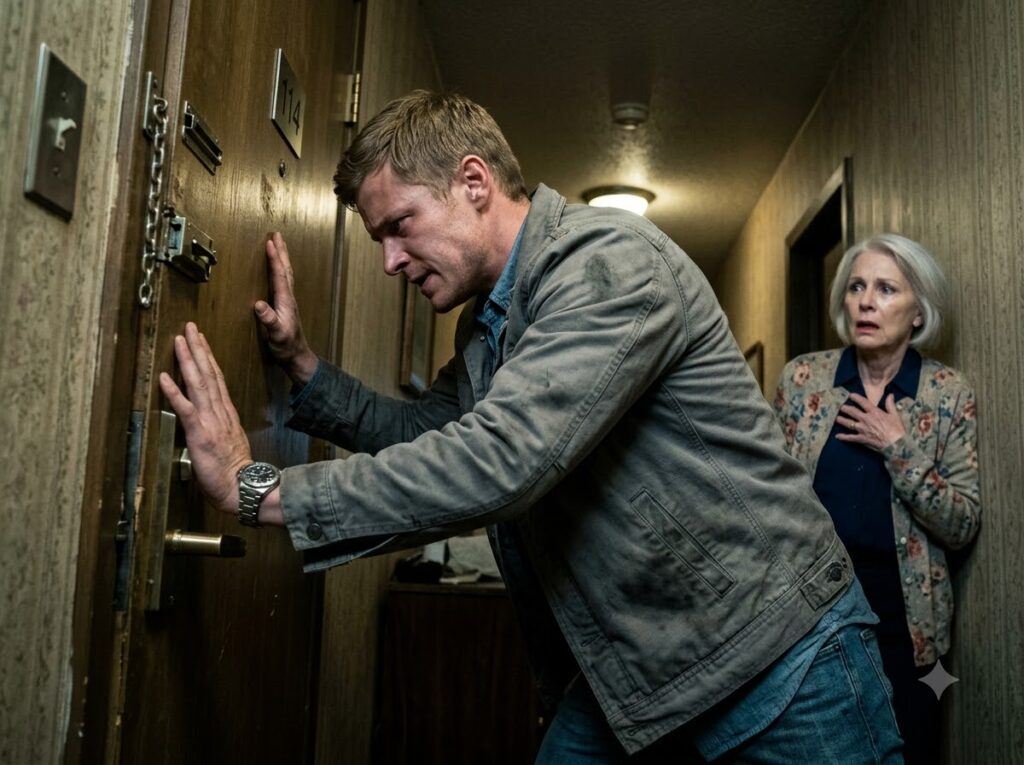
We had barely reached it when Steven began pounding.
“Mom, you’re making this worse!”
We ran.
Down the emergency stairs.
Out into the alley behind the hotel.
Then stopped.
Jessica was near the street.
Kelly—Steven’s wife—stood by the fence.
Steven came around the building.
We were boxed in.
He walked toward us slowly.
“Mom, you’re confused.”
“No.”
“The carbon monoxide affected your thinking.”
“Owen found the device.”
My grandson stepped in front of me.
“I photographed everything, Dad.”
Steven tried denying it.
Then something in him gave way.
“You don’t understand what we’re going through.”
Owen stared at him.
“So you decided to kill Grandma?”
Steven’s voice rose.
He had spent twenty years at Apex Aerospace.
Now he was facing unemployment with only a few months of severance.
Debt.
A mortgage.
A career he believed was disappearing.
Kelly started crying.
“We’re going to lose everything.”
Then she looked at me.
“Your mother has more than she needs.”
Your mother.
Not Claire.
Not Grandma.
An asset.
“She’s sixty-eight,” Kelly continued. “She has an $800,000 house paid off.”
I could barely recognize the woman speaking.
I had helped her choose her wedding dress.
Watched Owen when he was little so she could return to work.
“You thought you’d kill me for the house?”
Kelly wiped her face.
“We thought you’d die peacefully in your sleep. Older people die.”
Those words settled somewhere deeper than anger.
Then Jessica came closer.
My daughter reached into her coat.
She pulled out a syringe filled with clear liquid.
“I brought something to calm you down, Mom.”
Owen’s voice sharpened.
“What’s in it?”
“A sedative.”
“Then tell me what it is.”
She didn’t.
Steven went to Kelly’s car.
When he returned, he was carrying a tire iron.
“Owen, move away from her.”
“No.”
“This doesn’t concern you.”
“She’s my grandmother.”
Then Owen said something that seemed to hit his father harder than anything else.
“She’s your mother.”
Steven began talking about Walter.
About resentment.
About how Walter respected people who built things with their hands.
How Steven believed Owen had been favored because he chose construction instead of college.
“You always thought Grandpa’s work made you better,” Steven told him.
“I never thought that.”
“My father did.”
“No,” Owen said. “Grandpa thought honest work mattered.”
Then he pointed toward the hotel.
“You took what you learned as an engineer and used it to turn the house he built into a weapon.”
Steven swung the tire iron.
Owen ducked.
The metal struck a dumpster.
Then Owen tackled him.
Jessica rushed toward me with the syringe.
“I’m sorry, Mom.”
I backed against the dumpster.
“This is the only way.”
Then sirens exploded into the alley.
Two police cruisers entered from opposite directions.
Officers came out with weapons drawn.
Jessica dropped the syringe.
Owen stood.
His phone was still connected to 911.
“We kept the line open.”
An officer nodded.
“We heard everything.”
Steven was arrested for attempted murder.”
Part 3:
Kelly for conspiracy.
Jessica too.
I watched my children put into separate police cars.
For several minutes, I felt nothing.
Then, sitting in Owen’s truck afterward, I told him something I immediately regretted.
“You should’ve let them do it.”
His head turned sharply.
“Grandma.”
“Then you’d still have your father. Your aunt. Your family.
Owen looked at me with Walter’s eyes.
“You are my family.”
His voice was steady.
“Dad stopped being my father when he decided to murder you.”
Police searched my house that afternoon.
They found the modified system exactly where Owen photographed it.
Disabled detector.
Sealed vents.
Carbon-monoxide residue.
Gas line.
Timer.
Then came the searches of Steven’s, Kelly’s, and Jessica’s property.
Steven’s computer contained a folder labeled Project Timeline.
Inside were calculations for carbon-monoxide exposure.
My age.
Sixty-eight.
Projected symptom progression.
Notes explaining how gradual exposure could mimic cognitive decline.
My son had planned my death like an engineering assignment.
Kelly had a burner phone.
Messages discussed the house value and timing.
Jessica’s work notebook contained highlighted information about carbon-monoxide deaths in older adults and how medical examiners investigate them.
The evidence left little room for imagination.
Still, I asked to see Steven.
At the jail, he sat behind glass wearing orange.
“Why?”
“We were desperate.”
“That isn’t an answer.”
He finally looked at me.
“We were losing everything.”
“So you tried to kill me.”
He talked about debt.
His career.
Kelly’s problems.
Jessica’s medical expenses.
All the things they believed justified turning my remaining years into a financial solution.
Then I told him what mattered to me.
“Walter spent two years building that house to protect us.”
“It’s just a house.”
That sentence hurt almost as much as anything else.
“No.”
I looked through the glass at my son.
“It was his life’s work.”
Then I said:
“Owen saved me using everything Walter taught him.”
Steven’s jaw tightened.
“The skills you mocked. The values you dismissed.”
I stood.
“Your father would be proud of Owen.”
Then I left.
Three months later, all three accepted plea deals.
There was too much evidence for trial to offer much hope.
Steven received fifteen years.
Kelly twelve.
Jessica ten.
At sentencing, I spoke about Walter’s house.
About every vent he installed.
Every cabinet he built.
Every lesson he taught Owen about doing a job correctly because somebody’s safety might depend on it.
Then I looked at Steven.
“My son used his education to turn his father’s house into a weapon.”
I looked at Owen beside me.
“My grandson used his grandfather’s tools and values to save my life.”
That was the legacy I wanted the court to hear.
Six months after sentencing, I sold the house.
It brought $825,000.
I couldn’t live there again.
The bedroom was where Steven had poisoned me.
Final part:The basement was where Owen found the device.
Every familiar room now held two histories.
Walter building it.
Steven betraying it.
Before closing, Owen removed the oak kitchen cabinets Walter had made forty years earlier.
Dovetail joints.
Three coats of finish.
Still beautiful.
The new owners were a young couple with two children.
I watched those children run through the front door.
I hoped the house would become ordinary again.
“Goodbye, Walter,” I whispered.
Then Owen drove me to my new apartment.
Small.
One bedroom.
Third floor.
Safe.
The landlord usually prohibited modifications, but we received permission for Walter’s cabinets.
Owen spent an entire weekend installing them.
I listened from the living room.
Drill.
Level.
Wood settling into place.
The sounds were so much like Walter working that I had to close my eyes once.
Sunday afternoon, Owen called me into the kitchen.
The cabinets hung perfectly.
“Grandpa taught me to build things right.”
I ran my hand over the oak.
“He did.”
Life became smaller afterward.
That wasn’t a bad thing.
I went to therapy.
Learned to sleep without checking the lock over and over.
Owen came for dinner every Thursday.
He told me about construction projects.
Eventually, he brought a young woman named Sarah.
An artist with paint under her fingernails who worked with clay and wood.
She said Owen talked about Walter constantly.
“He says your husband was the best man he ever knew.”
“He was.”
After dinner, I watched Owen and Sarah wash dishes together.
Nothing dramatic.
One washed.
One dried.
They talked quietly.
That ordinary scene meant more to me than I can explain.
Later, Owen asked whether I thought about Steven and Jessica.
“Sometimes.”
“Do you hate them?”
“No.”
I thought about it.
“I pity them.”
They had spent years believing security meant money, status, property, and proving they were doing better than someone else.
When those things began disappearing, they convinced themselves my life could be exchanged for theirs.
Owen took my hand.
“I followed Grandpa instead.”
“Yes.”
“And it saved you.”
“Yes.”
That night, after Owen left, I wiped down the cabinets.
My fingers found the smooth joints Walter had cut by hand decades earlier.
Perfect fit.
Work built to last.
“Walter,” I said into my quiet kitchen, “you’re still taking care of me.”
Not through the old house.
Not through money.
Through Owen.
Through the values he had chosen to carry forward.
Integrity.
Care.
Doing work properly because people matter more than profit.
Morning light would reach those cabinets the next day and make the oak glow the way it always had.
Some things had been destroyed.
Some things had survived.
And the part of Walter worth keeping was never trapped inside that old house at all.
THE END.
I’ve shared the complete story, and I truly hope it touched your heart. If this story moved you, please leave a comment, like, and share the post. Thank you for reading!