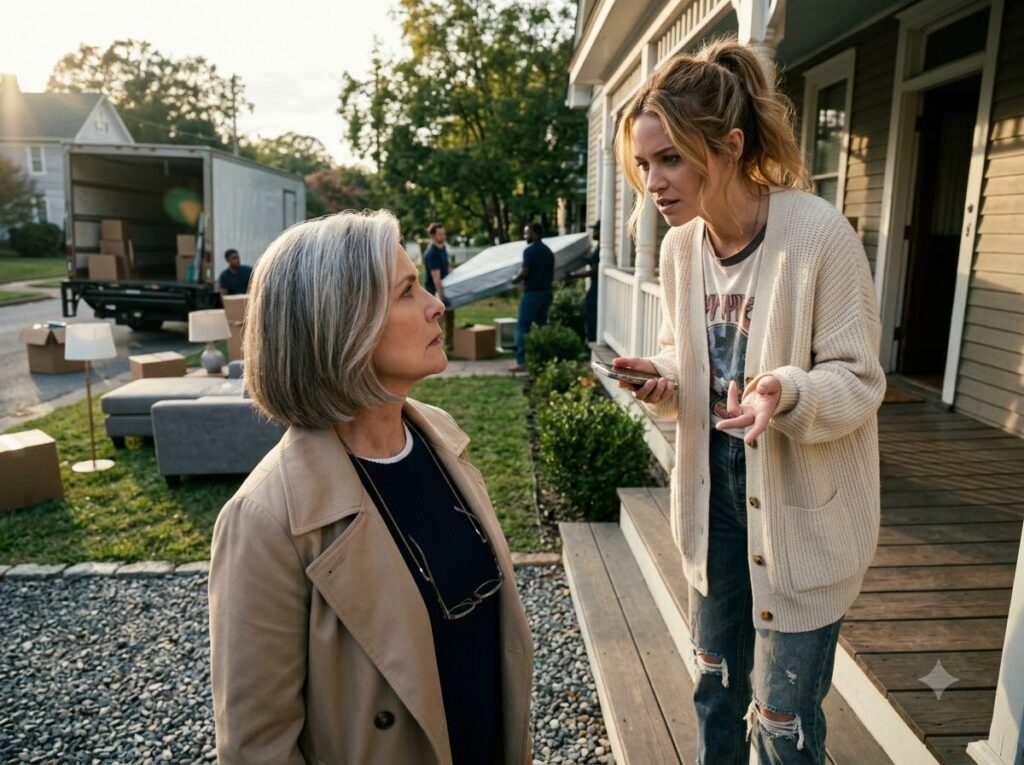
PART 3: WHAT MY HELP HAD TAUGHT HER
Sarah chose the diner.
Neutral territory, she called it.
I arrived ten minutes early and took a booth near the window.
She arrived twelve minutes late.
Greg wasn’t with her.
She sat down, placed her purse beside her and looked at me.
“You look tired.”
“So do you.”
“I wonder why.”
I ignored that.
A waitress brought coffee.
Sarah waited until she left.
Then she said, “I want you to listen without interrupting.”
I almost smiled.
“All right.”
She leaned forward.
“Greg and I are in a difficult situation.”
“I know.”
“Our rent increase was ridiculous.”
“I know.”
“We can’t afford another apartment like the one we had.”
“I understand.”
“And you have an empty house.”
“My house.”
Her jaw tightened.
“You said you’d listen.”
“I am.”
“You don’t need it.”
“I do.”
“For what?”
I took a sip of coffee.
“To live in.”
She stared at me.
“What?”
“I’m selling my current house.”
Her face went blank.
“When?”
“After I finish the cottage.”
“You’re moving there?”
“Yes.”
For the first time since the moving truck, Sarah had no response ready.
“You never told me.”
“I wasn’t required to.”
“I’m your daughter.”
“Yes.”
“You didn’t think I should know you were selling our family home?”
There was another phrase.
Our family home.
I understood the sentiment.
Sarah had grown up there.
David had lived there.
Christmas mornings had happened there.
Graduation pictures had been taken on the stairs.
But sentiment did not make a deed communal.
“It has been my home alone for five years.”
“That doesn’t mean it’s not our family home.”
“I’m not saying the memories don’t matter.”
“Then why sell it?”
“Because I don’t need it.”
She looked toward the window.
Then she asked the question I had expected.
“What are you doing with the money?”
I almost laughed.
Not because it was funny.
Because it was so predictable.
“I haven’t sold it yet.”
“But when you do?”
“I’ll decide.”
“Mom.”
“What?”
“You can’t just make these huge decisions without thinking about anyone else.”
I looked at her.
“Who else should I be thinking about?”
“Your family.”
“You mean you.”
“I mean your future.”
“My future is exactly what I’m thinking about.”
Her eyes narrowed.
“You’re sixty-two.”
“Yes.”
“You’re talking like you’re twenty-five.”
I set down my cup.
“What does that mean?”
“You should be thinking about stability.”
“I am.”
“Estate planning.”
“I have.”
That stopped her.
“You have?”
“Yes.”
“With who?”
“My attorney.”
Her face changed.
Only slightly.
But I saw it.
“What attorney?”
“Robert Hale.”
“Dad’s attorney?”
“He handled David’s estate.”
“What did you change?”
I stared at her.
“I didn’t say I changed anything.”
“You said estate planning.”
“Yes.”
“So what’s in your will?”
I sat back.
“Why are we discussing my will?”
“You brought it up.”
“You brought up estate planning.”
“Because I’m concerned.”
“No, Sarah. You’re curious.”
“That’s insulting.”
“Is it inaccurate?”
She looked away.
For several seconds, neither of us spoke.
Then her shoulders dropped.
“I don’t understand why you’re treating me like some greedy stranger.”
“I’m not.”
“You called the police.”
“Because you moved into my house.”
“You changed the locks.”
“Because you had a key I never gave you.”
She went still.
I watched her carefully.
“How did you get that key?”
“I don’t know what you’re talking about.”
“Yes, you do.”
“You must have given me one.”
“I didn’t.”
“Maybe Grandma did.”
“Mom died before I renovated.”
“She could have.”
“The locks were changed after she died.”
Sarah’s cheeks flushed.
There it was.
Not proof.
But enough.
“Did you copy my key?”
She pushed back from the table.
“This is insane.”
“Did you?”
“I’m not sitting here while you interrogate me.”
“You wanted to meet.”
“I wanted to talk about how we fix this.”
“There is nothing to fix.”
“Of course there is.”
“No. There is a problem you and Greg need to solve.”
Her eyes filled with tears.
Five years earlier, that would have ended the conversation.
Maybe even two years earlier.
Sarah crying had always activated something ancient in me.
I remembered scraped knees.
Nightmares.
Fevers.
The little girl who used to crawl into my bed and whisper, “Mommy, make it better.”
But the woman sitting across from me was thirty-five.
And somewhere along the way, I had confused love with permanent rescue.
“You really don’t care what happens to us,” she said.
“That’s not true.”
“It feels true.”
“I care very much.”
“Then help us.”
“I have helped you.”
“When?”
I stared at her.
She stared back.
And I realized she genuinely did not remember it the way I did.
So I opened my purse.
I had brought another sheet of paper.
Not to punish her.
To remind myself.
“Two thousand dollars for your security deposit in 2021.”
She looked down.
“Mom—”
“Fourteen hundred for Greg’s transmission.”
“That was an emergency.”
“Twenty-seven hundred when you left your job.”
“I was being harassed by my manager.”
“I’m not debating why. I’m telling you what I paid.”
She folded her arms.
“Three months of rent the following year. Your dental bill. The credit card balance you said you couldn’t manage. Another car repair. The moving deposit for the apartment you just left.”
“Are you seriously keeping score?”
“No.”
I looked at the page.
“That was the problem.”
She said nothing.
“I stopped counting after twenty thousand dollars.”
Her face reddened.
“You offered.”
“Sometimes.”
“You always said family helps family.”
“I did.”
“So now you’re punishing me because you regret being generous?”
“No. I’m recognizing that my generosity had consequences.”
She laughed bitterly.
“Oh, wow. So helping your daughter ruined her.”
“I didn’t say that.”
“That’s what you mean.”
“What I mean is that I made it too easy for you to believe my resources were always available to solve your problems.”
Her eyes flashed.
“So this is Dad talking.”
The mention of David hit me like a hand against my chest.
“What?”
“He was always like this.”
“Like what?”
“Judgmental.”
“Your father loved you.”
“He also thought Greg was irresponsible.”
“Sometimes Greg was irresponsible.”
“And there it is.”
“No, Sarah. There it is for you. Any consequence feels like judgment.”
She stood.
People turned.
“Sit down.”
“No.”
“Then leave.”
She looked shocked.
That shocked me too.
Old Ellen would have followed her.
Old Ellen would have apologized in the parking lot.
Old Ellen would have written a check just to restore peace.
Sarah grabbed her purse.
Before leaving, she leaned over the table.
“You’re going to regret this when you need me.”
I looked up at her.
“What does that mean?”
“You’re not getting younger.”
The words landed between us.
She walked away.
I sat there long after the door closed behind her.
That night, I cried.
Not because I wanted to give her the cottage.
Because I finally saw the shape of our relationship.
I had thought I was building a bridge between us every time I rescued her.
Instead, I had built a road with one direction.
From me to her.
Money.
Time.
Solutions.
Forgiveness.
Access.
And now, when I closed the road, she interpreted it as abandonment.
Two days passed without contact.
On Friday afternoon, Greg called.
“Can I come by?”
“To my house?”
“Yes.”
“Is Sarah with you?”
“No.”
I hesitated.
Then I agreed.
He arrived twenty minutes later.
He looked exhausted.
He sat at my kitchen table, the same table where David had once warned me about consequences.
For a moment, the symmetry felt almost cruel.
Greg rubbed his palms together.
“I told Sarah she needs to apologize.”
I said nothing.
“She thinks I’m taking your side.”
“This isn’t about sides.”
“I know.”
He stared at the table.
“I’ve been thinking about everything.”
“Good.”
“She told me the cottage was basically hers.”
“Basically.”
“That was the word.”
I nodded.
“She said you’d talked about giving it to her.”
“We never did.”
“I know.”
“Did she tell you I was moving there?”
“No.”
“Because she didn’t know.”
He looked up.
“She was furious when you told her.”
“I noticed.”
“She said you were doing it to spite her.”
“That plan existed long before Tuesday.”
“I told her that.”
I studied him.
“Why are you here, Greg?”
He swallowed.
“Because I owe you the truth.”
Something in my stomach tightened.
“What truth?”
He reached into his jacket pocket and took out his phone.
“About a month ago, Sarah asked me how much your current house was worth.”
I stared at him.
“What did you say?”
“I didn’t know.”
“Why did she ask?”
“She said if you moved into the cottage someday, maybe you’d sell your place and help us buy something.”
I almost smiled at the absurd precision of it.
Even my hypothetical future sale had already been assigned a purpose.
“She had this all mapped out,” Greg said.
“How much did you know?”
“Not enough.”
“That isn’t an answer.”
He looked embarrassed.
“I knew she thought the cottage would eventually be ours. I knew she wanted to move there. I knew she called your contractor.”
My anger rose.
“You knew that?”
“I knew she called him. I didn’t know she told him she was acting for you.”
“Did you know about the wall?”
“Yes.”
I stood.
“Then don’t sit there pretending you were completely deceived.”
“I’m not.”
“You were walking around my kitchen drinking coffee.”
“I know.”
“You gave up your apartment without speaking to me.”
“I know.”
“You were willing to believe whatever version of the story gave you free housing.”
His face tightened.
“Yes.”
The word stopped me.
Not because it excused him.
Because he accepted it.
“I’m sorry,” he said.
I sat down again.
“Why are you telling me this now?”
“Because Sarah still thinks she can wear you down.”
A cold sensation moved through me.
“What does that mean?”
“She thinks if she keeps pushing, you’ll feel guilty.”
I almost laughed.
“That isn’t news.”
“She says you always give in eventually.”
That hurt because it was true.
Greg continued.
“She thinks you’ll offer money if you won’t offer the house.”
I stared at him.
“How much?”
“I don’t know.”
“Yes, you do.”
He looked away.
“She mentioned enough for a down payment.”
Of course she had.
I thought of all the times I had mistaken peace for resolution.
All the times I had given money not because it was wise, but because I wanted the argument to stop.
Sarah knew my pattern better than I did.
“Are you asking me for money?”
“No.”
“Good.”
“I got us a month-to-month place.”
That surprised me.
“You did?”
“It’s small.”
“Can you afford it?”
“If we cut things.”
“What things?”
He gave a tired smile.
“A lot of things we should have cut a long time ago.”
For the first time, I wondered whether Greg’s greatest flaw had not been irresponsibility but convenience.
He had let Sarah manage their crises because Sarah could call me.
I had let Sarah call me because solving the crisis was easier than watching her struggle.
Three adults had participated in the same pattern.
Only one of us had finally stepped out of it.
Before Greg left, he paused at the door.
“She’s angry at me.”
“I’m sure.”
“I told her I won’t move into the cottage even if you change your mind.”
“I’m not changing my mind.”
“I know.”
After he left, I stood alone in my kitchen.
For the first time since Tuesday, I felt something other than anger.
I felt grief.
Because boundaries are easy when you stop loving someone.
They are much harder when you love them deeply.
That was the part nobody tells you.
Saying no to Sarah did not make me feel powerful.
It made me feel like a mother standing on one side of a locked door, listening to her daughter insist love should be proven by opening it.
But David’s voice returned to me.
Eventually she’ll think consequences belong to you.
I walked upstairs.
From the back of my closet, I took out an old box containing David’s papers.
Inside was a birthday card he had given me the year before he got sick.
On the front was a ridiculous cartoon of two old people racing wheelchairs.
Inside, beneath his usual joke, he had written:
Promise me we’ll keep choosing a life, not just maintaining one.
I sat on the floor holding that card.
For five years, I had maintained.
The house.
The accounts.
The memories.
Sarah.
The cottage had been my first real choice.
And that was when I decided something.
I was going to finish it.
I was going to move.
I was going to sell the big house.
And I was not going to ask my daughter for permission to live the rest of my own life.
The following morning, I called Robert.
“I want to review everything,” I told him.
“Everything?”
“My estate documents. Property arrangements. Financial authorizations. All of it.”
“All right.”
“And Robert?”
“Yes?”
“I want to make sure nobody can mistake being my daughter for having authority over me.”
There was a brief silence.
Then he said, “That’s something we can make very clear.”
For the first time all week, I breathed easily.
But Sarah wasn’t finished.
I learned that three days later when my phone lit up with a message from her.
It contained only six words.
You really went to a lawyer?
I stared at the screen.
I had never told her I had an appointment.
Which meant somehow, once again, Sarah knew something about my private life that I had never chosen to tell her.
And this time, I intended to find out how.





