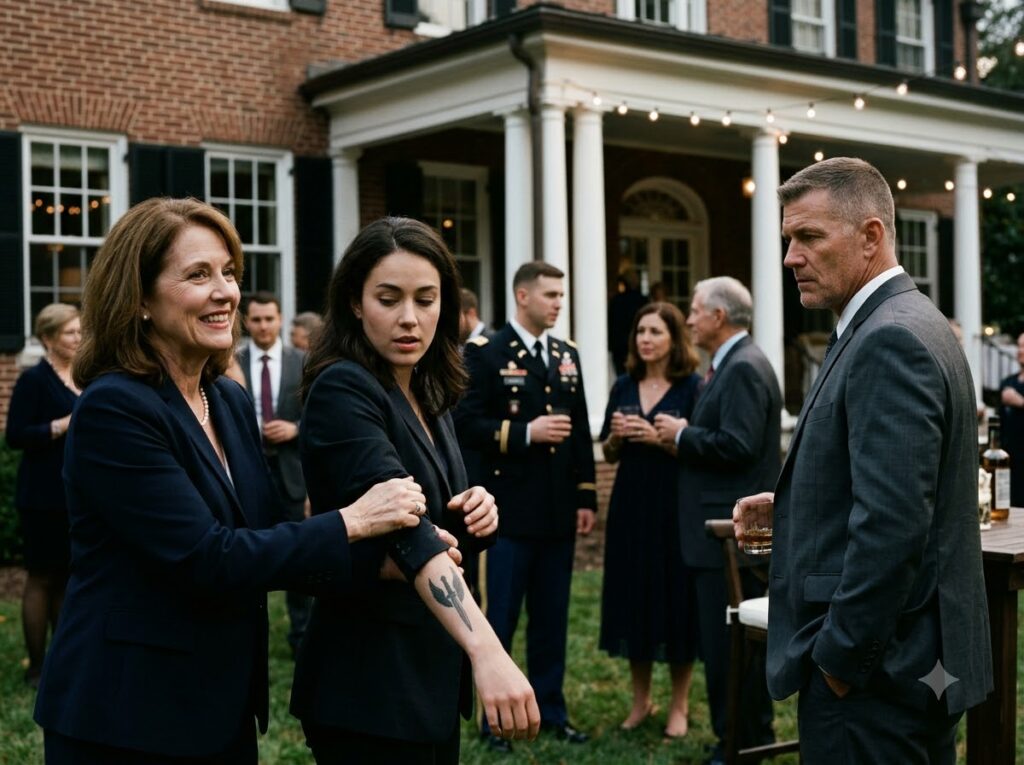
Colonel Ethan Graves looked at my exposed wrist as though he had just seen a dead woman walk into my parents’ backyard.
Then he did something I had never seen a Delta Force commander do.
He lowered his head.
Not much.
Barely an inch.
But it was unmistakable.
And somehow, that tiny movement frightened me more than if he had drawn a weapon.
“Colonel?” my father called from beside the photographer.
“Everything all right?”
Graves didn’t answer.
His eyes remained fixed on the black marking beneath my sleeve.
My mother released my wrist.
“Honestly, Claire,” she whispered sharply.
“Must you embarrass us in front of everyone?”
I pulled my sleeve down.
Too late.
The colonel had already seen it.
And judging by the sudden pallor beneath his weathered complexion, he knew exactly what it meant.
“Mrs.
Whitaker,” Graves said.
His voice was quiet.
Dangerously quiet.
“Where did your daughter get that tattoo?”
My mother blinked.
“Excuse me?”
“The marking on her arm.”
“Oh, that ridiculous thing?”
She laughed nervously.
“Claire went through a rebellious phase years ago.
We never understood half the strange decisions she made.”
Graves turned toward her.
“Rebellious?”
“Yes.
You know how young women can be.”
For the first time that evening, the colonel’s expression hardened.
“Ma’am, I assure you, that is not a tattoo someone gets during a rebellious phase.”
The conversations nearest us began to fade.
Ryan stepped forward, his polished boots clicking against the stone patio.
“Colonel, with respect, my sister has always been a little dramatic.
She probably found some military design online and thought it looked impressive.”
Graves looked at him.
“Captain Whitaker, I suggest you stop talking.”
Ryan froze.
My father straightened.
“Now, Ethan, there’s no need for that.
We’re celebrating my son’s return.”
“I understand that, General.”
My father had retired as a brigadier general twelve years earlier, but he still expected everyone to address him by rank.
Graves usually obliged.
Tonight, however, something had changed.
The colonel turned back toward me.
“Miss Whitaker,” he said carefully, “may I speak with you privately?”
I could feel nearly sixty pairs of eyes turning in our direction.
My mother recovered first.
“Of course not.
Claire has responsibilities in the kitchen.”
Graves didn’t even look at her.
“Claire?”
I swallowed.
For seven years, I had imagined this moment.
Not this exact backyard.
Not this party.
But the moment someone would recognize what I had spent so long concealing.
And now that it had arrived, I discovered I wasn’t ready.
“There’s nothing to discuss, Colonel.”
His expression shifted.
Something like sorrow crossed his face.
“Are you certain?”
“Yes.”
He held my gaze for another moment.
Then he said four words that made my blood run cold.
“The lantern still burns.”
My fingers went numb.
It was impossible.
Nobody outside a very small circle should have known that phrase.
Nobody alive, I had believed.
I took one involuntary step backward.
Graves noticed.
And suddenly, I was no longer standing beneath decorative lights in an Arlington backyard.
I was somewhere else.
Somewhere dark.
Somewhere the air smelled of burning insulation and wet concrete.
Somewhere a man’s voice was whispering through a damaged radio.
Lantern is fading.
And I was answering—
Then I’ll carry the flame.
“Claire?”
Graves’ voice brought me back.
I looked around.
My mother was frowning.
Ryan was watching me with growing suspicion.
My father had stopped smiling.
And the photographer was still standing behind his camera, uncertain whether to continue.
I forced my breathing to slow.
“Colonel,” I said, “you have the wrong person.”
Graves studied me.
Then he nodded once.
“If that’s what you need me to believe.”
He stepped aside.
But as I passed him, he whispered something only I could hear.
“We buried an empty coffin.”
I nearly stumbled.
Because seven years earlier, someone had told me that coffin contained the only person who knew the truth about what happened in Kandahar.
And that person had supposedly died saving my life.
I made it as far as the kitchen before my knees began shaking.
The caterers had finished preparing dessert.
Silver trays lined the marble counters.
Through the windows, I could hear laughter returning to the backyard.
My family was already trying to pretend nothing had happened.
They were good at that.
Pretending had always been the Whitaker family specialty.
I braced both hands against the sink and stared at my reflection in the dark window.
Thirty-three years old.
Brown hair pulled into a simple knot.
No jewelry except a plain silver ring I wore on a chain beneath my blouse.
A woman nobody at the party would remember tomorrow.
That was how I preferred it.
Or how I had convinced myself I preferred it.
Seven years earlier, I had been assigned to a classified interagency recovery operation under a different identity.
I had worked as a field communications specialist, trained to move through dangerous territory without drawing attention.
My family believed I was an administrative contractor.
I had never corrected them.
Not when my father mocked my career.
Not when Ryan called me a glorified secretary.
Not when my mother introduced me to guests as the daughter who had never quite found her direction.
They had never asked what I actually did.
And after a while, I stopped wanting them to know.
But the marking on my forearm was not a decoration.
It was a small black lantern enclosed inside an incomplete circle.
Beneath it were three tiny vertical lines.
The symbol of a unit that officially never existed.
Only eleven people had ever worn that mark.
Nine were dead.
One had disappeared.
And the last was me.
Or so I had been told.
I heard footsteps behind me.
“Quite a performance.”
Ryan.
Of course.
He leaned against the kitchen doorway, champagne glass in hand.
“You really couldn’t let me have one night?”
I kept my back toward him.
“What are you talking about?”
“You know exactly what I’m talking about.
Colonel Graves practically stopped the party because of you.”
“I didn’t ask him to.”
Ryan snorted.
“Right.
You just happened to flash some mysterious tattoo in front of a room full of special operations officers.”
I turned.
“Mom pulled my sleeve.”
“Mom was trying to get a decent picture.”
“By dragging me out of it?”
He shrugged.
“You know how she is.”
Yes.
I did.
That was the problem.
Ryan took another drink.
“Look, Claire, I don’t know what game you’re playing, but Graves is an important man.
Don’t embarrass Dad by pretending you’re connected to something you’re not.”
I stared at my younger brother.
There had been a time when I would have defended myself.
A time when I would have listed the things I had sacrificed, the years I had lost, the names I still heard in my dreams.
Instead, I asked a simple question.
“Ryan, when was the last time you asked me how I was?”
He frowned.
“What?”
“When was the last time you asked what I do for work?
Where I live?
Whether I’m happy?”
He opened his mouth.
Nothing came out.
I nodded.
“That’s what I thought.”
For a brief moment, something uncertain moved across his face.
Then the familiar arrogance returned.
“Don’t turn this into some emotional lecture.”
He pushed away from the doorway.
“And cover that thing up before Dad sees it again.”
When he left, I stood motionless for several seconds.
Then I reached beneath my blouse and touched the silver ring hanging against my chest.
It wasn’t a wedding ring.
It belonged to a man named Daniel Mercer.
And according to every official record I had ever seen, Daniel Mercer had died on November 17, seven years earlier.
The night the lantern went dark.
Twenty minutes later, I found Colonel Graves standing alone beside the garden fountain.
He wasn’t drinking anymore.
He was watching the house.
When I approached, he didn’t appear surprised.
“You shouldn’t have said that phrase,” I told him.
“I know.”
“You had no right.”
“I know that too.”
I folded my arms.
“Who told you?”
Graves looked toward the illuminated windows.
“Daniel.”
My heart seemed to stop.
For a moment, the sounds of the party vanished.
Then I heard myself ask, “What did you say?”
“Daniel Mercer.”
I shook my head.
“No.”
“Claire—”
“No.”
My voice came out louder than intended.
Graves lowered his tone.
“Listen to me carefully.”
“Daniel is dead.”
The colonel’s jaw tightened.
“That is what you were told.”
I stared at him.
Seven years of grief pressed against my ribs.
Seven years of waking in the middle of the night, hearing Daniel’s final transmission.
Seven years of carrying his ring because there had been nothing else to bury.
“You’re lying.”
“I wish I were.”
I stepped closer.
“If Daniel is alive, where is he?”
Graves hesitated.
And that hesitation told me something terrible.
“You don’t know,” I whispered.
“I know he survived Kandahar.”
“How?”
“He was extracted forty-six hours after your evacuation.”
I felt the blood drain from my face.
Forty-six hours.
For forty-six hours, Daniel had supposedly been trapped beneath the collapsed structure where I had last seen him.
And I had spent those hours begging for a rescue team.
Command had refused.
They told me the building was gone.
They told me no one could have survived.
They told me to accept the loss.
“Who authorized the extraction?”
I asked.
Graves’ eyes darkened.
“That is why I need your help.”
I gave a bitter laugh.
“My help?”
“Something happened during that operation that was never entered into the official report.”
“Most of it wasn’t entered into the report.”
“This is different.”
He reached inside his jacket.
My muscles tensed automatically.
Graves noticed and slowly withdrew a folded photograph.
He handed it to me.
The picture showed five people standing beside a military transport aircraft.
Four wore civilian clothing.
The fifth was Daniel.
Older.
Thinner.
A scar running from his temple toward his jaw.
But unmistakably Daniel.
My hands began trembling.
There was a date stamped at the bottom.
April 14, 2026.
Less than six months ago.
I stared at the photograph until the faces blurred.
“Where was this taken?”
“Germany.”
“Why wasn’t I told?”
Graves didn’t answer.
I looked up.
“Why wasn’t I told?”
His expression changed.
“Because someone convinced Daniel you were dead.”
The world tilted.
I caught the edge of the fountain.
“No.”
“He was shown a casualty report.
Your name.
Your photograph.
Your identification number.”
“That’s impossible.”
“Claire, someone falsified both of your deaths.”
I could barely breathe.
“Who?”
Graves glanced toward the house again.
And this time, I understood why he kept looking.
He wasn’t watching the party.
He was watching my father.
I followed his gaze.
Through the glass doors, General Robert Whitaker stood beside the fireplace, laughing with two retired officers.
My father.
The man who had never attended my college graduation because Ryan had a baseball tournament.
The man who had forgotten my thirtieth birthday.
The man who once told me that some people were born to lead and others were born to serve.
“What does my father have to do with this?”
I asked.
Graves looked genuinely troubled.
“I don’t know yet.”
“Then why are you watching him?”
“Because his name appeared in a document I received three days ago.”
My stomach tightened.
“What document?”
“A sealed authorization connected to your extraction.”
I stared at him.
“My father was retired.”
“Officially.”
“He had nothing to do with my operation.”
“That’s what I believed.”
I shook my head.
“No.
My father didn’t even know where I was stationed.”
Graves looked at me with an expression I couldn’t read.
“Are you sure?”
The question hit harder than I expected.
Because suddenly, I remembered something.
A conversation from seven years earlier.
I had returned to Arlington after six weeks in a military hospital.
My left shoulder was damaged.
Three ribs had healed badly.
I couldn’t sleep without medication.
I had lost twenty pounds.
My mother opened the front door, looked me over, and asked whether I could help prepare dinner for Ryan’s promotion celebration.
My father had been sitting in his study.
I remembered telling him I had been injured overseas.
He didn’t ask how.
He didn’t ask where.
He simply looked at me and said:
“Some assignments are better forgotten, Claire.”
At the time, I thought he was dismissing me.
Now, standing beside the fountain, I heard those words differently.
Some assignments are better forgotten.
Not some experiences.
Not some memories.
Assignments.
My father had used the precise word.
“Claire?”
Graves asked.
I looked at him.
“I need to see that authorization.”
“I can’t give it to you here.”
“Why?”
“Because the document is classified, and I haven’t established whether it’s authentic.”
“Then why tell me any of this?”
His face hardened.
“Because someone accessed your old personnel file yesterday.”
I went still.
“That file was sealed.”
“Yes.”
“Who accessed it?”
Graves hesitated.
“The request originated from an account connected to your brother’s current command.”
I stared at him.
“Ryan?”
“I don’t know whether he made the request himself.”
A terrible coldness spread through my chest.
I thought about Ryan’s expression when he saw my tattoo.
The mockery.
The irritation.
The way he had insisted I cover it.
Was he embarrassed?
Or afraid?
“Why would Ryan want my file?”
I whispered.
“That,” Graves said, “is exactly what I intend to find out.”
Before I could answer, a voice rang out behind us.
“Colonel Graves!”
We turned.
Ryan was approaching with my father.
Both men wore pleasant expressions.
Neither looked pleased.
“Dad says you’ve been monopolizing my sister,” Ryan said lightly.
Graves didn’t smile.
“We were discussing something private.”
My father studied me.
“Claire, your mother needs help serving dessert.”
I didn’t move.
For the first time in my life, I looked directly into my father’s eyes and refused to lower mine.
“Did you know about Kandahar?”
The change in his expression was almost invisible.
Almost.
But I had been trained to recognize involuntary reactions.
The tightening around his mouth.
The slight narrowing of his eyes.
The way his shoulders became perfectly still.
“Excuse me?” he said.
“Kandahar.
November seventeen.
Seven years ago.”
Ryan looked between us.
“What is she talking about?”
My father ignored him.
“Claire, this is neither the time nor the place.”
I felt something inside me fracture.
Not because he had answered.
Because he hadn’t.
“You knew,” I whispered.
His face hardened.
“Lower your voice.”
“You knew where I was.”
“Claire.”
“You knew what happened to me.”
Graves stepped forward.
“General, I think your daughter deserves an explanation.”
My father turned toward him.
“Colonel, you are a guest in my home.”
“And she is your daughter.”
The words hung between them.
My father looked back at me.
For one brief moment, I saw something I had never seen in his eyes before.
Not disappointment.
Not irritation.
Fear.
Then he said something that changed everything.
“Ethan, whatever you think you know about that operation, you are missing the most important part.”
Graves went completely still.
“What part?”
My father looked at me.
And his next words were barely audible.
“Claire wasn’t supposed to come home.”
Nobody spoke.
Even Ryan seemed to forget how to breathe.
I stared at my father.
“What?”
He closed his eyes briefly.
Then he looked toward the house.
“We need to talk inside.”
“No.”
“Claire—”
“You don’t get to order me around anymore.”
His expression hardened instinctively.
“I am still your father.”
“And I’m still the daughter you spent thirty-three years pretending didn’t matter.”
Ryan stepped between us.
“Okay, everyone needs to calm down.”
I turned toward him.
“Stay out of this.”
His face flushed.
“Excuse me?”
“You heard me.”
For the first time, Ryan had no immediate response.
My father looked older than he had an hour earlier.
“Claire, you don’t understand what you’re asking.”
“Then explain it.”
He glanced at Graves.
“Not here.”
“Why?
Because someone might hear the truth?”
“Because someone might die.”
The words stopped me.
My father looked toward the driveway.
A black SUV had just pulled up beyond the iron gates.
Its headlights remained on.
Graves followed his gaze.
His entire posture changed.
“General,” he said quietly, “are you expecting someone?”
My father shook his head.
“No.”
The SUV’s headlights switched off.
Two men stepped out.
Both wore dark suits.
Neither approached the house.
They simply stood beside the vehicle, looking toward the garden.
Graves touched the communication device beneath his collar.
I recognized the gesture immediately.
He was alerting his security detail.
My father turned toward me.
“Claire, listen very carefully.
I need you to go inside, find your mother, and stay away from the windows.”
I almost laughed.
After years of treating me like an inconvenience, he was suddenly concerned about my safety.
“Why?”
He looked at the black SUV.
“Because they found you.”
My heart hammered.
“Who?”
He didn’t answer.
Instead, he reached into his jacket and withdrew a small brass key.
I recognized it instantly.
It belonged to the locked cabinet in his study.
The cabinet he had forbidden both Ryan and me from touching when we were children.
He pressed the key into my palm.
“Behind the third shelf,” he whispered.
“There’s a steel box.
Take it.”
“What is inside?”
His hand closed around mine.
And for the first time since I was a little girl, my father looked at me without disappointment.
Without comparison.
Without contempt.
Only desperation.
“Everything I should have told you seven years ago.”
Then he looked at Graves.
“Get her out of here.”
Graves nodded.
But before either of us could move, Ryan spoke.
“Dad, what the hell is going on?”
My father turned toward him.
And the expression on his face changed.
“Ryan,” he said slowly, “did you invite anyone from the Directorate?”
Ryan’s face drained of color.
“What?”
“Answer me.”
“I—”
“Did you?”
Ryan looked toward the driveway.
Then toward me.
And I saw it.
Recognition.
Not confusion.
Recognition.
My brother knew the men outside.
“Ryan,” I whispered.
He swallowed.
“I didn’t know they’d come tonight.”
My father staggered backward as though someone had struck him.
“Oh, God.”
Graves stepped between us and the driveway.
“Captain Whitaker,” he said, “what have you done?”
Ryan raised both hands.
“Listen, I thought it was routine.
They said they needed confirmation.”
“Confirmation of what?”
I demanded.
Ryan looked at my forearm.
“That you were still alive.”
The world seemed to narrow around those words.
Still alive.
My own brother had helped someone verify whether I was alive.
And he had done it without knowing why.
Or perhaps without caring.
Graves was already speaking quietly into his radio.
My father grabbed my shoulders.
“Claire, go.
Now.”
I pulled away.
“Not until you tell me the truth.”
He looked at me.
Something broke in his expression.
“Your mother and I were told that if we acknowledged what you had done, they would kill you.”
I stared at him.
“What?”
“We were ordered to keep our distance.
Make you seem insignificant.
Unimportant.”
My chest tightened.
For one terrible second, I wanted to believe him.
Wanted to believe every cruel remark, every forgotten birthday, every humiliating family gathering had been part of some desperate attempt to protect me.
But then I remembered my childhood.
The comparisons.
The punishments.
The way my mother had always chosen Ryan.
That had started long before Kandahar.
“You were ashamed of me before any of this happened,” I said.
My father flinched.
I stepped back.
“Don’t rewrite my entire life just because you’re frightened now.”
He lowered his eyes.
And somehow, that was worse than another excuse.
“You’re right,” he whispered.
It was the first time I had ever heard him admit it.
“I failed you long before I had an excuse.”
For a moment, I saw the man beneath the general’s uniform.
A frightened father.
A flawed father.
A man who had made terrible choices and spent years convincing himself they were necessary.
But forgiveness was not something I could offer while strangers waited outside to decide whether I should live.
“Tell me about Daniel,” I said.
My father’s face changed.
Graves looked toward us sharply.
“General?”
I ignored him.
“Daniel Mercer.
Was he alive when I came home?”
My father closed his eyes.
“Yes.”
The answer nearly destroyed me.
“You knew?”
“Yes.”
“And you let me mourn him?”
A tear slid down my father’s cheek.
I had never seen him cry.
Not once.
“He asked me to.”
I couldn’t speak.
My father reached toward me.
I moved away.
“Why?”
His lips trembled.
“Because he believed that if you knew he survived, you would go looking for him.”
“Of course I would.”
“And that would have led you straight to the people who wanted both of you dead.”
I shook my head.
“Where is he now?”
My father looked at Graves.
Then back at me.
“I don’t know.”
“Don’t lie to me.”
“I’m not lying.”
The two men beside the SUV began walking toward the gate.
Graves’ security detail moved to intercept them.
My father squeezed the brass key into my hand again.
“Claire, whatever happens tonight, you must open that box.”
“What is in it?”
He swallowed.
“A letter.”
“From whom?”
My father looked at me with an expression I would remember for the rest of my life.
“From Daniel.”
I couldn’t breathe.
“He wrote it the day after your evacuation.”
“Then why didn’t you give it to me?”
My father stared at the ground.
“Because he told me not to open it unless the lantern was seen again.”
My fingers tightened around the key.
The lantern.
My tattoo.
The symbol that had brought Graves to a halt.
The marking my mother had accidentally exposed.
Nothing about this evening was an accident anymore.
I looked toward the driveway.
One of the men had stopped at the gate.
He was holding a phone.
Watching us.
Waiting.
Then my own phone vibrated inside my pocket.
An unknown number.
A single message.
DO NOT OPEN THE BOX IN FRONT OF GRAVES.
I froze.
Another message appeared.
HE KNOWS WHAT HAPPENED TO THE ELEVENTH MEMBER.
My breath caught.
The eleventh member.
There had been eleven of us.
Nine confirmed dead.
Daniel missing.
Me alive.
But the message suggested the count I had believed for seven years was wrong.
I slowly raised my eyes toward Colonel Graves.
He was standing beside my father, speaking into his radio.
Calm.
Controlled.
Professional.
The same man who had recognized my tattoo.
The same man who had told me Daniel was alive.
The same man who had urged me to trust him.
My phone vibrated a third time.
This message contained a photograph.
I opened it.
And every muscle in my body went rigid.
It showed a hospital room.
A woman lying unconscious beneath white sheets.
Medical equipment surrounding her bed.
Her left forearm exposed.
A black lantern tattoo clearly visible.
The woman’s face was turned toward the camera.
It was me.
But the date printed on the photograph was impossible.
October 9, 2026.
Yesterday.
I stared at the image.
Yesterday, I had been at my apartment.
I had spoken to my neighbor.
Bought groceries.
Driven to Arlington.
I had not been inside a hospital.
And yet there I was.
Unconscious.
Wearing the same silver ring I kept hidden beneath my blouse.
A final message appeared.
CLAIRE, YOU ARE NOT THE WOMAN THEY THINK YOU ARE.
Then another.
ASK YOUR FATHER WHO WAS BURIED UNDER YOUR NAME.
My hands began shaking so violently I nearly dropped the phone.
I looked at my father.
At Ryan.
At Graves.
At the strangers approaching the gate.
And suddenly, I understood why my father had said I wasn’t supposed to come home.
He hadn’t been talking about Kandahar.
He had been talking about something that happened afterward.
Something so terrible that my entire identity might have been built around a lie.
“Dad,” I whispered.
He turned.
“Who was buried under my name?”
His face went white.
Graves stopped speaking into his radio.
Ryan took a step backward.
And my father looked at me as though the dead had finally come to collect a debt.
“Claire,” he whispered, “who told you about that?”
Before I could answer, the glass doors behind us opened.
My mother stepped onto the patio.
She wasn’t smiling anymore.
She was holding a small, yellowed envelope.
And when she saw the photograph on my phone, she began to cry.
Not delicate tears.
Not the controlled emotion she displayed at funerals.
She broke.
“Oh, Claire,” she sobbed.
“We thought we’d have more time.”
I stared at her.
“More time for what?”
She looked at my father.
Then at Colonel Graves.
And finally, at me.
“To tell you why Daniel Mercer was never your real husband’s name.”
The garden fell silent.
Even Graves looked stunned.
My mother took one trembling step toward me.
“And why,” she whispered, “the woman in that hospital photograph has been asking for you for seven years.”
I could hear my own heartbeat.
“What woman?”
My mother covered her mouth.
My father whispered her name in warning.
But she was already speaking.
“Your sister, Claire.”
I couldn’t move.
I had never had a sister.
Not in photographs.
Not in family stories.
Not in a single memory from my childhood.
My mother looked directly into my eyes.
“Your identical twin.”
And somewhere beyond the iron gates, a car door slammed.
The colonel’s radio crackled.
A voice came through, strained and urgent.
“Sir, we have a problem.
The woman from the hospital is here.”
Graves turned toward the driveway.
I followed his gaze.
A second black vehicle had stopped behind the first.
Its rear door opened.
A woman stepped out.
Same height.
Same dark hair.
Same face.
My face.
She wore a pale hospital bracelet around her wrist.
And when she saw me standing beside the fountain, she stopped walking.
Her eyes filled with tears.
Then she raised her left arm.
There, beneath the sleeve of her coat, was the same black lantern.
Except hers had four vertical lines.
Not three.
She looked past me toward Colonel Graves.
And screamed a sentence that made every officer in the backyard reach for his radio.
“CLAIRE!
GET AWAY FROM HIM!
HE’S THE ONE WHO ORDERED DANIEL’S EXECUTION!”
Graves went perfectly still.
My father dropped to his knees.
And the woman who wore my face looked straight into my eyes.
“Please,” she whispered.
“You have to remember what you did to me.”
For seven years, I had believed my greatest tragedy was losing Daniel Mercer.
Now, as I stared at a stranger with my face and my tattoo, I realized something far worse.
The person I had been mourning might not have been the person who died.
And the person responsible for destroying my life might have been standing beside me all along.
…If you want to know what happened next, please type “YES” and like for more.