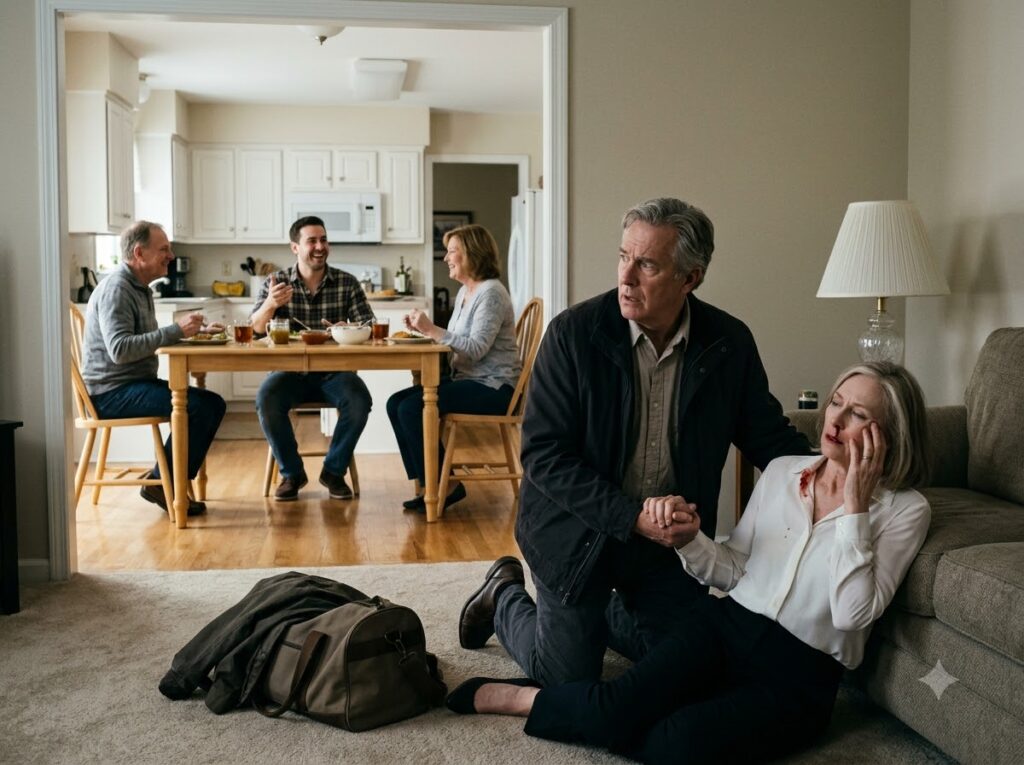
Xavier stared at the table for nearly a minute before he finally spoke.
“Dad, Dale and Patrice wanted to discuss the property on Willow Creek Road.”
I didn’t move.
“What property?”
He swallowed.
“The commercial building you own outside town. The one you said you might sell someday.”
I knew exactly which property he meant. I had purchased it twenty-two years earlier, when a struggling manufacturing company needed to sell its warehouse. The building now housed several small businesses and generated enough rental income to cover most of our household expenses.
It was one of the few investments I had never discussed in detail with Xavier.
“What did Dale want with it?”
“He has a buyer.”
“A buyer?”
“An investment group. They offered a good price.”
I looked at my son.
“Then why were they discussing my property in my kitchen while your mother was bleeding on the floor?”
Xavier rubbed his forehead.
“Things got complicated.”
“No. Things are usually complicated when someone is trying to explain something they know was wrong. Start again.”
He exhaled.
Three weeks earlier, Dale had approached Xavier with a business proposal. He claimed he knew investors willing to purchase my building at a premium, provided the sale could be completed quickly.
But there was a problem.
The investors wanted confirmation that I would sell before making a formal offer.
Dale had suggested that Xavier persuade me to sign a preliminary authorization allowing him to negotiate on my behalf.
Not a deed, Xavier insisted.
Not an actual transfer of ownership.
Just paperwork to get the process started.
“And you agreed?” I asked.
“I thought it was an opportunity.”
“For whom?”
He didn’t answer.
Dale had promised Xavier a substantial commission if the deal went through. More importantly, he had offered him a position in the investment company that would supposedly acquire the building.
My son had been promised a future built partly on an asset he did not own.
Then Xavier revealed the part that made my hands go cold.
Dale had brought the authorization papers to our house that afternoon.
He expected Angela to sign as a witness and help persuade me to approve the arrangement when I returned.
But Angela had refused.
She had told them I would never authorize a sale without reviewing every document myself.
Dale became irritated.
Patrice accused Angela of treating their family like strangers.
The argument grew louder.
Angela, who had been feeling unwell that morning, stood up to get some water. She became dizzy, stumbled, and fell against the edge of the living-room table.
Her nose began bleeding.
She told Xavier her head was pounding.
She asked him to call for medical help.
And my son looked at her, heard her asking for help, and went back to lunch.
“Why?” I whispered.
Xavier’s eyes filled with tears.
“Dale said she was probably having another one of her blood-pressure episodes. He said she’d be fine if she sat down.”
“Your mother was bleeding.”
“I know.”
“She asked you for help.”
“I know, Dad.”
“And you went back to eat.”
He covered his face.
I wanted to grab him by the collar. I wanted to demand an explanation that could somehow make those facts less terrible.
Instead, I remembered Angela squeezing my hand twice in the ambulance.
She had trusted us both to keep her safe.
Only one of us had shown up.
“Did you call anyone?” I asked.
“No.”
“Did you check on her?”
He hesitated.
“Once.”
“And?”
“She told me she needed help. I thought she was exaggerating because she was angry about the papers.”
For the first time in my life, I looked at my son and didn’t recognize the man sitting across from me.
I stood.
“Get out.”
“Dad, please.”
“Your mother is in an ambulance because you decided a business deal was more important than her life. I don’t want to hear another word until I’ve spoken to her doctors and reviewed every document you brought into this house.”
“Where am I supposed to go?”
I stared at him.
“You’re twenty-nine years old, Xavier. Figure it out.”
He left without finishing his lunch.
I watched his car disappear down the street before I returned to the hospital.
Angela was awake when I arrived.
Her blood pressure was still dangerously high, but the doctors had begun bringing it under control. They wanted to monitor her overnight and run additional tests.
I sat beside her bed and held her hand.
“I’m sorry,” I said.
She turned her head toward me.
“For what?”
“For not being here.”
Her eyes softened.
“You weren’t supposed to be here.”
“I should have been.”
“No, Paul. You were supposed to be on your business trip. I was supposed to be safe in our home.”
She paused, struggling to find the words.
“I kept asking Xavier to call someone.”
I closed my eyes.
“He told me Dale said I was being dramatic. Then Patrice told me not to ruin their lunch over something that happened to me all the time.”
Angela’s voice broke.
“I couldn’t even stand up, Paul.”
I pressed her hand against my forehead.
“I know.”
“No, you don’t.”
She wasn’t being cruel. She was telling me the truth.
I had spent thirty years believing that the family we built was strong enough to survive almost anything.
I had mistaken financial comfort for security, and familiarity for character.
Angela squeezed my fingers.
“Please don’t let them convince you that I caused this.”
I looked up immediately.
“Who would ever say that?”
“Xavier already did. He said I made everyone uncomfortable by refusing to sign.”
For a moment, I couldn’t speak.
Then I kissed her forehead.
“You don’t have to sign anything. You don’t have to explain anything. You just get better. I’ll handle the rest.”
That night, while Angela slept, I called my attorney, Margaret Collins.
Margaret had handled my property transactions for nearly fifteen years. She knew every major asset I owned and had repeatedly warned me against giving family members informal authority over business matters.
I had always told her Xavier was different.
Now I asked her to review everything connected to the Willow Creek property.
By nine the following morning, she was sitting across from me in my office with a folder thick enough to make me uneasy.
“Paul,” she said, “I need you to answer one question honestly. Did you ever authorize Xavier to negotiate a sale of this property?”
“No.”
“Did you sign anything giving him power of attorney over your business interests?”
“Absolutely not.”
She nodded and opened the folder.
“Then we have a serious problem.”
Inside were copies of documents Xavier had apparently obtained through a broker. One was a draft purchase agreement. Another was a proposed authorization bearing my name.
My signature appeared at the bottom.
It was convincing at first glance.
Almost convincing.
But I had never signed it.
Margaret leaned forward.
“This appears to be an attempt to represent that you approved negotiations you never authorized. We need to establish who prepared it, who circulated it, and whether anyone submitted it to a bank, buyer, or title company.”
I felt the room grow cold.
“Can they sell my building with this?”
“Not lawfully without the required authority and proper closing documents. But a forged or misleading authorization can still cause serious financial and legal trouble. We need to stop the process immediately and preserve every record.”
She made the necessary calls.
We notified the relevant parties that I had not authorized the proposed transaction and that no one was permitted to act on my behalf without independently verified written consent.
Then Margaret turned to the final page.
It was an email from Dale Dalton to Xavier.
The subject line read: WILLOW CREEK — FINAL STEPS.
I read it twice.
Dale had written that the buyer was willing to increase the offer if the paperwork could be completed before the end of the month.
He also mentioned that Xavier’s commission would be paid through a separate consulting agreement.
But the last paragraph was what made me stop breathing for a moment.
Once Paul signs, we can move the proceeds through the new company before he has time to reconsider. Keep Angela on board if you can. If she keeps interfering, make sure Xavier understands that she could cost him everything.
I placed the email on the desk.
Margaret watched me carefully.
“Paul, don’t contact Dale yet. We need to preserve the evidence and let the appropriate professionals determine exactly what happened.”
I nodded.
I wasn’t going to threaten anyone.
I wasn’t going to make a scene.
I was going to make sure no one could use my name, my money, or my wife’s suffering to finance their ambitions.
That afternoon, I contacted my financial adviser and accountant.
For years, I had quietly helped Xavier maintain the comfortable life he enjoyed.
I had guaranteed a business credit line when he wanted to launch a consulting firm. I had paid the deposit on his first apartment. I had introduced him to clients who trusted me. When his company struggled, I had arranged a private loan to keep it afloat.
I had never asked him to repay my affection.
But there was a difference between helping my son build a life and allowing other people to exploit that help.
I instructed my adviser to review every guarantee, loan, and financial arrangement connected to Xavier.
Any new discretionary support stopped immediately.
Any commitment that could lawfully be terminated would be reviewed and handled through the proper procedures.
Existing obligations would be honored according to their terms. I wasn’t going to destroy my own credibility by acting recklessly.
I was simply done creating new opportunities for someone who had treated his mother as an inconvenience.
At six that evening, my phone rang.
Xavier.
I let it ring twice before answering.
“Dad, Dale says you’ve frozen everything.”
“I’ve stopped unauthorized activity involving my property.”
“He says you’re ruining a deal worth millions.”
“Then he should have obtained the owner’s permission.”
“He told me you were going to sign.”
“Did you hear me say that?”
Silence.
Then Xavier lowered his voice.
“Dad, I made a mistake.”
“You made several.”
“I didn’t think Mom was in danger.”
“You heard her tell you she needed medical attention.”
“I know.”
“And you chose to believe the people who promised you money instead of helping her.”
He began crying.
For a moment, I heard the little boy who used to call me from his bedroom after a nightmare.
Then I remembered the blood on Angela’s blouse.
“I’m not going to decide the rest of your life tonight,” I told him. “But you will not use my property, my reputation, or my finances to support this arrangement. From now on, every business matter involving you goes through my attorney.”
“Are you cutting me off?”
“I’m ending the financial arrangements that allowed you to believe my support was something you could count on regardless of how you treated people.”
“I’m your son.”
“And Angela is your mother.”
He had no answer.
Before I hung up, I told him one more thing.
“If you want to repair what you’ve done, start by telling the complete truth. Not the version Dale wants you to tell. Not the version that makes you look better. The truth.”
Then I ended the call.
For the next three days, I stayed close to Angela.
Her condition improved, though the doctors wanted follow-up appointments and strict monitoring. She came home with me on Friday, and I made sure she had everything she needed.
I cooked meals she barely touched. I sat beside her during the quiet hours. Sometimes she talked about the hospital. Sometimes she wanted to discuss ordinary things, like the flowers in the garden or a television show we had watched together for years.
I let her decide.
On Sunday afternoon, a message arrived from Patrice.
She wrote that the family had been under tremendous stress and that everyone had made mistakes. She said Angela had always been sensitive about her health, and that perhaps the situation had been misunderstood.
I read it to Angela.
She looked at me for a long moment.
“Did she apologize?”
“No.”
“Then don’t answer.”
I deleted the draft I had started writing.
For thirty years, I had believed keeping the peace meant finding a way to understand everyone.
That afternoon, I learned that sometimes keeping the peace simply meant refusing to participate in someone else’s version of events.
On Monday morning, Margaret called.
The buyer’s representative had confirmed that the investment group had received the proposed authorization through Dale’s intermediary. They had paused the transaction after our notice and were cooperating with the review.
There was still a great deal to establish. We did not yet know who had created the signature, whether Xavier had known it was false, or how far Dale intended to take the scheme.
But Margaret had found something else.
The proposed consulting agreement named Xavier as a beneficiary of the transaction.
His commission wasn’t merely a bonus.
It was large enough to cover the outstanding balance on his business loan, pay off his personal debts, and leave him with a substantial amount of cash.
The agreement also included a clause requiring him to keep the proposed transaction confidential until closing.
Xavier had known much more about the deal than he had admitted at my kitchen table.
I asked Margaret to arrange a formal meeting with him, with all communications documented.
He arrived on Wednesday morning.
He looked exhausted.
For once, he came alone.
Margaret placed the email and consulting agreement in front of him.
“Before we discuss anything else,” she said, “we need to establish what you knew and when you knew it.”
Xavier stared at the papers.
Then he looked at me.
“Dad, I can explain.”
I leaned back in my chair.
“You’ve had eleven days.”
His face crumpled.
And then, finally, my son told us the part he had left out.
Dale hadn’t simply offered him a job.
He had shown Xavier a spreadsheet estimating the value of my property, my other investments, and the money I had available to lend.
At the bottom was a column labeled FUTURE FAMILY ASSETS.
Xavier had seen my name beside the figures.
He had seen Angela’s name beside mine.
And he had allowed Dale to convince him that helping move the property into the proposed investment structure was simply an early step toward the inheritance he believed would one day be his.
“I thought I was getting ahead,” Xavier whispered.
I studied him.
“You were trying to collect on a future that doesn’t belong to you.”
He nodded, tears slipping down his cheeks.
“I know.”
“No,” I said quietly. “You’re beginning to understand.”
Margaret closed the folder.
The meeting was over.
Xavier stood, but before he reached the door, I stopped him.
“Your mother may eventually decide she wants to see you. That will be her decision. You don’t get to demand forgiveness because you’re sorry now.”
He turned toward me.
“What do I do?”
I looked at the son I had spent twenty-nine years trying to prepare for the world.
“Tell the truth. Cooperate with the investigation. Make whatever restitution is legally required. And learn to stand on your own without expecting other people to pay for your choices.”
He left without asking for money.
That was the first honest thing he had done in weeks.
By sunrise the next morning, the financial doors I had quietly kept open for him were closed. The unauthorized property transaction had been stopped, the relevant records had been preserved, and the people involved were being required to answer questions they had once assumed no one would ask.
But the most important change happened at home.
Angela and I sat together on the back porch, watching the morning light spread across the garden.
She rested her head against my shoulder.
“Do you think he’ll change?” she asked.
“I don’t know.”
“He’s still our son.”
“Yes,” I said. “He is.”
I took her hand.
“And that’s why I’m not going to buy his way out of this.”
She was quiet for a while.
Then she squeezed my hand twice.
I squeezed back twice.
The same small promise we had shared for decades.
I had come home early expecting to surprise my wife.
Instead, I discovered what my son and his in-laws believed they could do when they thought no one was watching.
They had mistaken my generosity for weakness.
They had mistaken family for entitlement.
And they had mistaken silence for permission.
They were wrong about all three.
I didn’t know whether Xavier would ever become the man I had hoped to raise.
But I knew what I would never do again.
I would never confuse loving someone with protecting them from the consequences of their own choices.
And I would never allow anyone to make my wife feel unsafe in the home we had spent thirty years building.
Not even our son.