# PART 2 — THE SIGNATURE THAT WAS NEVER MINE. MY MOTHER STOLE MY HOME, BUT THE SECRET MY WIFE LEFT BEHIND WOULD DESTROY EVERYTHING.
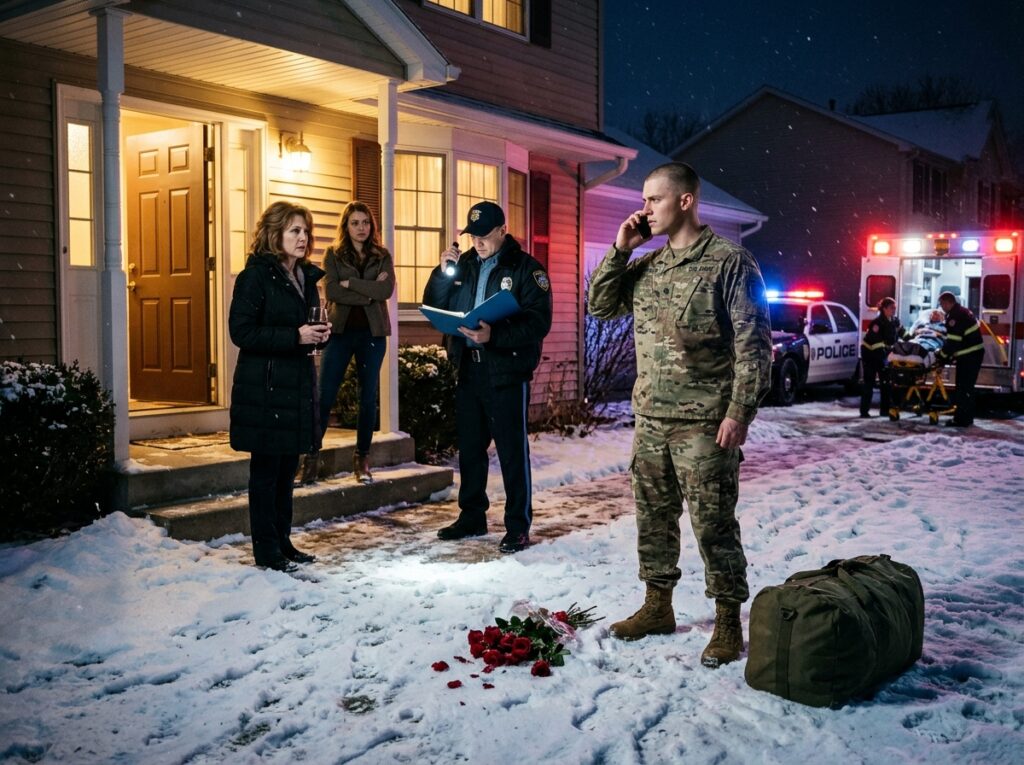
The police officer held the blue folder beneath the porch light, examining the signature at the bottom of the document.
My mother stood beside him, gripping her wineglass so tightly that her knuckles had turned white.
My sister Brooke had stopped smiling.
And I knew exactly why.
The signature on that document looked almost identical to mine.
Almost.
There was one tiny difference.
For as long as I could remember, I had signed my middle initial with a distinctive backward curve. It was a habit I developed in high school, something my father used to tease me about.
Whoever had signed this document hadn’t known that.
But the signature wasn’t what frightened me most.
It was the date.
The supposed transfer had been signed eleven months earlier, on a day when I was stationed thousands of miles away.
I looked at my mother.
“Where did you get this?”
She lifted her chin.
“From your attorney. You signed it before you left.”
“Eleven months ago?”
“Yes.”
“Mother, eleven months ago, I was overseas.”
Her expression tightened.
“You signed it electronically.”
The officer turned another page.
“Mrs. Bennett, this document states that the signature was witnessed and notarized in person.”
Silence.
Snow drifted between us.
For the first time since I had arrived, my mother seemed unable to find the right words.
Then Brooke stepped forward.
“Look, this is ridiculous. Elena knew about everything. She agreed to let us manage the property.”
I turned toward her.
“Then why was my wife lying unconscious outside in the snow?”
Brooke opened her mouth.
Nothing came out.
The officer closed the folder.
“Sir, I’m going to need everyone to remain available while we establish what happened here.”
My mother laughed nervously.
“Surely you aren’t treating us like criminals.”
The officer looked toward the ambulance, where the paramedics were still working on Elena.
“Ma’am, a woman has been found severely hypothermic with visible injuries. We’re treating this seriously.”
That was the moment my mother finally understood that her usual explanations weren’t going to make this disappear.
But I still didn’t understand how far she had gone.
Not yet.
I followed the ambulance to the hospital.
For the entire drive, I kept seeing Elena’s hand sticking out of the snow.
Her fingers had been almost completely white.
I had spent two years imagining our reunion.
I pictured her opening the front door, laughing, crying, wrapping her arms around my neck.
Instead, I had carried her unconscious body across our driveway.
At the emergency department, a nurse took me aside.
“Your wife is receiving treatment for significant hypothermia. She also has dehydration, bruising, and an injury to her head. The doctors are monitoring her closely.”
“Will she survive?”
The nurse’s expression softened.
“We’re doing everything we can.”
Those words were supposed to comfort me.
They didn’t.
I sat in the waiting room with my hands clasped together, staring at the wedding ring on my finger.
I remembered the day Elena and I bought our house.
It was a small two-story colonial with white shutters and a crooked maple tree beside the driveway.
Nothing extravagant.
But Elena had fallen in love with the kitchen window.
“Look,” she had whispered, standing in the empty room. “Morning sunlight.”
I had laughed.
“You’re buying a house because of sunlight?”
“No,” she said, turning toward me. “I’m buying a future.”
I had promised her that no matter where the Army sent me, that house would always be hers.
And while I was away, the people I trusted most had turned it into a prison.
My phone rang.
Daniel Mercer.
My attorney.
“I’m at the property,” he said. “The officers showed me the document.”
“Tell me it’s worthless.”
“It’s fraudulent, assuming what we’ve seen is accurate. The trust remains intact. But there’s something else.”
I closed my eyes.
“What?”
“Someone attempted to record a new deed six months ago.”
My stomach tightened.
“Attempted?”
“The county flagged a discrepancy involving the trust. The transfer wasn’t accepted. I wasn’t notified at the time because it never became effective.”
“Who submitted it?”
Daniel hesitated.
“Your mother appears to have been involved. I’m obtaining the complete filing history.”
I pressed my palm against my forehead.
“Daniel, why would she do this?”
“I don’t know. But I found something more troubling.”
“What?”
“Your wife contacted my office three weeks ago.”
I sat upright.
“Elena called you?”
“Yes. She asked whether anyone could remove her from the property without your permission.”
My throat tightened.
“What did you tell her?”
“That she was a beneficiary of the trust and had the right to live there.”
“Did she say why she was asking?”
Another pause.
“She said she was afraid of someone in the house.”
The waiting room seemed to tilt.
“Did she tell you who?”
“No. But she asked me to prepare an emergency petition in case she needed protection.”
I swallowed.
“Why didn’t she tell me?”
“She said you were still overseas. She didn’t want to distract you while you were serving.”
I looked at Elena’s last letter, still folded inside my pocket.
Whenever you come home, I’ll make your favorite dinner.
She had been terrified, and she had spent her final letters trying to make me happy.
An hour later, the doctor came into the waiting room.
“Mr. Bennett?”
I stood so quickly that my chair scraped the floor.
“Your wife is stable.”
My knees nearly gave way.
“Can I see her?”
“Briefly. She’s exhausted, and we’re still assessing her injuries.”
I followed him down a quiet hallway.
When I entered her room, Elena looked impossibly small beneath the blankets.
Her dark hair lay against the pillow.
A bandage covered part of her forehead.
There were bruises along her arm that I hadn’t noticed before.
I sat beside her and carefully took her hand.
“Hey, sweetheart.”
Her eyes remained closed.
“It’s me.”
I tried to smile.
“I’m home.”
For several seconds, nothing happened.
Then her fingers moved.
Barely.
But enough.
I leaned closer.
“Elena?”
Her eyelids fluttered.
She looked at me with a confused, frightened expression.
And then she whispered something that shattered me.
“Please don’t let them send me outside again.”
I felt my chest tighten.
“Never,” I said. “I promise.”
Her eyes filled with tears.
“Daniel?”
“I’m here.”
She stared at my face as though she couldn’t believe I was real.
“You came back.”
“Of course I came back.”
Her lips trembled.
“I tried to keep the house.”
I shook my head.
“Forget the house.”
“But I promised you.”
“Elena, listen to me. I don’t care about the house. I care about you.”
She began crying silently.
I leaned forward and kissed her forehead.
“I’m sorry I wasn’t here.”
She gripped my hand.
“No.”
Her voice was weak, but urgent.
“Don’t apologize.”
Then she looked toward the door.
Her entire body stiffened.
“Are they here?”
“No.”
“Your mother?”
“She’s not coming near you.”
Elena closed her eyes.
For a moment, I thought she had fallen asleep.
Then she whispered:
“Daniel, your mother didn’t just take the house.”
I froze.
“What do you mean?”
Her breathing became uneven.
“She took everything.”
I wanted to ask a hundred questions.
But the doctor had warned me not to overwhelm her.
So I sat quietly until Elena gathered enough strength to speak.
It started, she told me, six months after I deployed.
My mother had arrived with two suitcases.
She said her apartment was being renovated and she needed somewhere to stay temporarily.
Elena welcomed her.
Then Brooke arrived.
According to my mother, Brooke had lost her job and needed help getting back on her feet.
Again, Elena welcomed her.
At first, they were polite.
They cooked together.
They sent me photographs.
My mother even appeared in several video calls, smiling beside Elena as though they were one happy family.
Then the rules began.
Elena was told not to use the upstairs bedroom because Brooke needed more space.
Her clothes were moved into the guest room.
My mother’s furniture replaced ours.
The photographs from our wedding disappeared from the living room.
When Elena objected, Mother told her she was being ungrateful.
“She said you wanted her to take charge,” Elena whispered.
I shook my head.
“I never said that.”
“I know now.”
Her eyes filled again.
“She showed me emails. They looked like they came from you.”
My stomach dropped.
“What emails?”
“Messages saying you were tired of my spending. That you wanted your mother controlling the household finances.”
I stared at her.
“I never sent those.”
“I know.”
She looked down at the blanket.
“But at first, I believed them.”
I squeezed her hand.
“Elena—”
“She said you were angry because I hadn’t given you children.”
The words struck harder than anything I had heard that night.
Elena and I had wanted a family for years.
After two miscarriages, we had agreed to stop putting pressure on ourselves.
I had told her a hundred times that she was enough.
Apparently, my mother had spent two years convincing her otherwise.
“She told me you were embarrassed by me,” Elena continued. “That you only stayed married because you felt guilty.”
I shook my head.
“That’s a lie.”
“She said when you came home, you were going to ask for a divorce.”
I stood and turned away for a moment because I couldn’t trust my expression.
Then I sat beside her again.
“Look at me.”
She did.
“Elena, I have loved you every day I’ve been gone. Every single day.”
Her tears spilled over.
“I wanted to believe that.”
“You should have.”
She shook her head.
“After a while, I didn’t know what was true anymore.”
That was when I realized my mother hadn’t merely stolen Elena’s comfort. She had tried to steal her confidence in our marriage.
But there was more.
Much more.
“Three months ago,” Elena whispered, “your mother made me sign papers.”
I went still.
“What papers?”
“She said they were insurance documents. Something about protecting the property while you were overseas.”
“Did you read them?”
“I tried.”
Her face tightened.
“Brooke kept rushing me. Your mother said if I didn’t sign, the bank would take the house.”
I felt cold.
“Elena, the house doesn’t have a mortgage.”
She stared at me.
“What?”
“I paid off the mortgage before I deployed. You know that.”
“I did. But she said you’d borrowed against it secretly.”
I closed my eyes.
My mother had taken advantage of every fear Elena possessed.
And then Elena said something I wasn’t prepared for.
“She also made me give her access to our savings.”
My eyes opened.
“How?”
“She told me you needed money for a legal emergency overseas.”
I stared at her.
“How much?”
Elena’s voice broke.
“Everything in the joint savings account.”
For a moment, I couldn’t breathe.
That account held nearly eighty thousand dollars.
Money we had saved for a family.
For renovations.
For the life we planned to build when I came home.
“How much is left?” I asked.
She shook her head.
“Last time I checked, four hundred and twelve dollars.”
I stared at the wall.
My mother had spent years complaining that I never did enough for the family.
Apparently, she had decided to help herself.
But money could be traced.
Property could be recovered.
What they had done to Elena was something else entirely.
“Why were you outside tonight?” I asked gently.
Her face changed.
She looked toward the door again.
“I found something.”
“What?”
“A box in your father’s old desk.”
My pulse quickened.
My father had died seven years earlier.
His desk had remained in the study because neither Elena nor I could bear to move it.
“What was in the box?”
“Letters. Bank records. Photographs.”
She swallowed.
“Your mother caught me reading them.”
“What did they say?”
Elena gripped my hand.
“Daniel, I think your father knew what she was doing.”
I stared at her.
“Doing what?”
Her eyes filled with fear.
“Taking money from people.”
Before I could ask another question, the nurse entered.
“Mr. Bennett, your wife needs rest.”
I wanted to argue.
But Elena’s eyes were already closing.
I kissed her hand.
“I’m not going anywhere.”
She caught my sleeve.
“Wait.”
I leaned closer.
“There’s something else.”
“What?”
Her voice dropped to a whisper.
“Don’t trust Brooke.”
I frowned.
“I don’t.”
“No. You don’t understand.”
Her fingers tightened.
“Brooke was the one who pushed me outside. But your mother was the one who told her not to let me back in.”
My blood turned to ice.
Elena began trembling.
“She said if I stayed out there long enough, everyone would believe I’d run away.”
I felt my jaw tighten.
“And when I tried to come inside, Brooke hit me.”
I looked at the bruise on her cheek.
Elena nodded.
“Your mother watched.”
For several seconds, I couldn’t speak.
Then I said quietly, “They won’t hurt you again.”
She closed her eyes.
“I know.”
But just before she drifted off, she whispered one final sentence.
“The box is gone, Daniel. But I hid one thing before they found me.”
By morning, I had made three decisions.
First, Elena would never return to that house while my mother and sister were inside.
Second, every financial account connected to us would be reviewed and secured.
Third, I would stop trying to understand why my family had done this.
I would concentrate on proving what they had done.
Daniel arrived at the hospital shortly after eight.
He carried a leather briefcase and wore the grim expression of a man who had spent the entire night discovering bad news.
“We need to talk,” he said.
We stepped into an empty consultation room.
He placed several documents on the table.
“Your mother attempted to establish control over the trust by presenting a forged power of attorney.”
I looked at the paperwork.
“Can she be charged?”
“Potentially. But that’s for investigators and prosecutors to determine. The forged deed, the financial transactions, and Elena’s injuries are separate issues that all need proper investigation.”
He slid another document toward me.
“There’s also a bank account opened in your name.”
I frowned.
“I didn’t open another account.”
“I know.”
“How much money?”
“More than two hundred thousand dollars moved through it over the last year.”
I stared at him.
“That’s impossible.”
“Some of the deposits appear to have come from loans obtained using your personal information.”
I felt my stomach drop.
“Loans?”
Daniel nodded.
“Several applications list your military status and projected retirement benefits.”
I leaned back.
My mother hadn’t simply emptied our savings.
She had been using my identity.
And apparently, she’d been doing it for months.
“How did she get the information?”
Daniel hesitated.
“She had access to your personal files at the house. But some documents would have required additional information.”
“Such as?”
“Your military identification details. Certain account records. Information she shouldn’t have possessed.”
I thought about my mother’s sudden confidence when the police arrived.
The champagne.
The expensive dinner.
Brooke’s new car.
They hadn’t just been living in my house. They had been financing their lives with a future they expected me to pay for.
Then Daniel placed a final envelope on the table.
“This is what concerns me most.”
I looked at him.
“What is it?”
“A preliminary copy of a life insurance inquiry.”
I felt the blood drain from my face.
“Whose life insurance?”
He didn’t answer immediately.
Then he said:
“Yours.”
I stared at the envelope.
My mother had asked questions about my life insurance while I was deployed.
According to Daniel, the inquiry had been made through a financial adviser who believed she was acting with my authorization.
“She wanted to know who would receive the money if something happened to me,” he explained.
I rubbed my forehead.
“That’s normal for a parent to ask, isn’t it?”
“Perhaps. But she also asked whether a beneficiary designation could be changed without the policyholder appearing in person.”
I looked up.
“Could it?”
“Not lawfully without proper authorization.”
I thought about Elena’s bruises.
The forged signature.
The empty savings account.
The life insurance inquiry.
A horrible possibility began forming in my mind.
“Daniel, do you think my mother believed I wasn’t coming home?”
He studied me.
“I think we need to establish exactly what she believed.”
My phone vibrated.
A message from an unfamiliar number.
You need to stop asking questions about your mother.
I stared at the screen.
A second message appeared.
Elena was warned.
Then a third.
Your father should have listened too.
I stopped breathing.
My father had died of what doctors believed was a sudden heart attack.
He had been fifty-eight.
Healthy.
Active.
A man who walked three miles every morning and rarely complained about anything.
For seven years, I had accepted that his death was a terrible, random tragedy.
Now someone was suggesting otherwise.
I showed Daniel the messages.
His expression changed immediately.
“Don’t respond.”
“Who sent them?”
“I don’t know. Preserve the messages. We need to give these to the detective.”
I looked toward Elena’s room.
She had said my father knew what Mother was doing.
She had found a box.
And someone had threatened her.
For the first time, I wondered whether my father’s death and my wife’s suffering were connected.
I hated myself for even considering it.
But I couldn’t ignore the possibility.
That afternoon, Detective Rachel Morgan came to the hospital.
She was in her forties, with tired eyes and the careful manner of someone who had learned not to make promises she couldn’t keep.
She interviewed Elena privately.
Then she spoke with me.
“We’ve obtained footage from a neighbor’s security camera,” she said.
I leaned forward.
“What does it show?”
“Your sister forcing your wife through the front door shortly before you arrived.”
My hands curled into fists.
“And my mother?”
The detective paused.
“She’s visible in the doorway.”
“Doing what?”
“Watching.”
I closed my eyes.
Detective Morgan continued.
“Your wife tried to get back inside. Your sister prevented her. The footage also appears to show a physical confrontation.”
“How long was Elena outside?”
“We’re still establishing the timeline. But the footage is consistent with a substantial period of exposure.”
I stared at her.
“She could have died.”
“Yes.”
The word landed like a hammer.
The detective opened her notebook.
“We also searched the areas of the house covered by the warrant. Your mother’s room contained financial records, several identification documents, and a notebook with account numbers.”
“Did you find my father’s box?”
“Not yet.”
I leaned forward.
“Elena said it contained evidence.”
“We’re following that lead.”
Then the detective asked an unexpected question.
“Mr. Bennett, did your father ever mention concerns about your mother’s finances?”
I shook my head.
“Not to me.”
“Did he have any business partners?”
“He worked in property development. Why?”
She studied me.
“We’ve found records suggesting your mother may have been involved in financial activity connected to your father’s company.”
I frowned.
“My father’s company closed after he died.”
“That’s what we were told.”
Something in her voice made me sit straighter.
“What are you saying?”
She closed her notebook.
“I’m saying there may be more people involved than your mother and sister.”
That evening, I returned to the house with Daniel after investigators permitted me to retrieve essential belongings.
The dining room looked exactly as it had the night before.
Champagne glasses.
Candles.
The roast beef abandoned on the table.
My mother’s expensive coat hanging beside the front door.
I walked through the rooms slowly.
Everywhere I looked, I saw evidence that Elena had been pushed out of her own life.
Her books were missing from the shelves.
Her paintings had been replaced.
Our wedding photograph was gone from the mantel.
In the upstairs hallway, I found a small cardboard box.
Inside were Elena’s belongings.
A hairbrush.
Two sweaters.
A framed photograph of us on our honeymoon.
And the little ceramic angel I had bought her during our first Christmas together.
I picked it up.
One wing was broken.
For some reason, that hurt almost as much as seeing her in the snow.
I carried the box downstairs.
Daniel was standing beside my father’s desk.
“Daniel,” he said quietly.
I turned.
He pointed toward the bottom drawer.
“The lock has been forced.”
I knelt.
There were fresh scratches around the brass keyhole.
The drawer was empty.
But beneath the wooden lining, something caught my eye.
A folded piece of paper.
I pulled it free.
It was an old photograph.
My father stood beside a younger man in front of a building I didn’t recognize.
On the back, someone had written:
If anything happens to me, find Thomas Reed. He knows where the original records are.
My hands began trembling.
I showed Daniel.
He stared at the photograph.
“Do you know him?”
“No.”
Daniel looked again.
Then his face changed.
“What?” I asked.
He pointed to the younger man.
“Daniel, I’ve seen this man before.”
“Where?”
He swallowed.
“At your father’s funeral.”
I stared at him.
Daniel continued.
“He approached your mother near the cemetery gates. They argued. I remember because she looked terrified.”
I looked back at the photograph.
“Did you hear what they said?”
“Only one sentence.”
“What sentence?”
Daniel met my eyes.
“Your father told him that if he died, he should make sure you never trusted your mother.”
I drove straight back to the hospital.
Elena was awake.
She looked stronger than she had that morning, though exhaustion still shadowed her face.
When she saw me, she smiled faintly.
“You look terrible.”
I laughed despite everything.
“That’s supposed to be my line.”
I sat beside her.
“Elena, I found a photograph.”
Her smile disappeared.
“Your father?”
I nodded.
“And another man. Thomas Reed.”
She went completely still.
“You found his name?”
“Yes.”
Her eyes filled with tears.
“Then maybe it’s not too late.”
I frowned.
“Too late for what?”
She glanced toward the door.
Then she reached beneath her pillow.
Slowly, she withdrew a small silver key attached to a thin chain.
I recognized it immediately.
It had belonged to my father.
He wore it around his neck for years, though he never explained what it opened.
“Where did you get that?” I whispered.
“Inside the box.”
She placed it in my palm.
“Your father left instructions.”
My heart began pounding.
“What instructions?”
Elena swallowed.
“He wrote that if your mother ever tried to take the house, I should find Thomas Reed.”
I stared at her.
“Why?”
“Because the house wasn’t the thing she really wanted.”
I looked down at the key.
“Then what was?”
Elena took a shaky breath.
“Something your father hid before he died.”
I waited.
She looked directly into my eyes.
“Daniel, your father didn’t die believing his family was safe. He died trying to protect you from something he had discovered.”
Before I could respond, my phone rang.
An unfamiliar number.
I almost ignored it.
Then I answered.
“Hello?”
An elderly man’s voice spoke.
“Daniel Bennett?”
“Yes.”
“My name is Thomas Reed.”
I stood.
“How did you get this number?”
“Your father gave it to me.”
My heart stopped.
“My father died seven years ago.”
“I know.”
A long silence followed.
Then Thomas said something that made the room seem to spin.
“Your father left me a sealed letter. I was instructed to deliver it only if your mother attempted to take possession of your home.”
I gripped the phone.
“Where are you?”
“Somewhere safe. For now.”
“What does the letter say?”
“I haven’t opened it.”
“Then why are you calling?”
His voice lowered.
“Because I just learned your wife was attacked. And because someone has been searching for me since yesterday.”
I looked at Elena.
She was watching me with wide, frightened eyes.
Thomas continued.
“Listen carefully. Do not tell your mother about the key. Do not give it to anyone.”
“What does it open?”
He hesitated.
“A deposit box your father established shortly before his death.”
“What’s inside?”
“I don’t know everything.”
“Then tell me what you do know.”
There was a long silence.
When Thomas finally spoke, his voice shook.
“Your father discovered that someone had been stealing from military families for years. He collected evidence, and he was preparing to turn it over to federal investigators.”
I felt cold.
“Who was stealing?”
Thomas exhaled.
“Your mother was involved.”
I closed my eyes.
“And Brooke?”
“Your sister was too young to understand the original operation. But I believe she’s involved now.”
I looked toward the hospital window.
Snow was falling again.
“Thomas, why didn’t you come forward seven years ago?”
His answer was barely audible.
“Because your father made me promise to protect you. And because the last man who tried to expose them disappeared.”
I swallowed.
“Who?”
Thomas hesitated.
Then he said:
“Your father’s business partner. A man named Andrew Collins.”
I froze.
Andrew Collins.
I knew that name.
Not because of my father.
Because three months before my deployment, Andrew Collins had been listed as a civilian consultant on a military investigation connected to my unit.
An investigation involving missing government funds.
And now I remembered something else.
A conversation with my commanding officer.
A warning about compromised records.
A name that had appeared in an intelligence report.
My mother’s maiden name.
I slowly sat down.
“Thomas,” I whispered, “I think I know why they wanted control of my house.”
“What do you mean?”
I looked at Elena.
Then at the silver key in my hand.
“Because my father wasn’t the only person investigating them.”
Thomas went silent.
I continued.
“And I think someone knew I was coming home early.”
Suddenly, there was a loud crash on Thomas’s end of the call.
A door slammed.
Footsteps.
Then Thomas shouted:
“Daniel! Don’t go to the bank! They know about the—”
The connection died.
I stared at my phone.
Elena struggled to sit up.
“What happened?”
I looked at her.
Before I could answer, a new message appeared on my screen.
It contained a photograph.
A photograph taken less than an hour earlier.
It showed me standing outside our house beside Daniel Mercer.
Someone had been watching us.
Beneath the image were seven words.
YOUR FATHER WASN’T THE FIRST TO DIE.
Then another message arrived.
This one contained a video.
I pressed play.
The footage showed my mother sitting in a dimly lit room.
She wasn’t crying.
She wasn’t frightened.
She was smiling.
A man’s voice spoke from behind the camera.
“Your son found the key.”
My mother lifted her head.
For several seconds, she said nothing.
Then she replied:
“Good. That means he’ll lead us straight to what his father hid.”
I felt my blood turn to ice.
But the video wasn’t finished.
The camera shifted.
A second person stepped into view.
Someone wearing a dark coat.
Someone whose face I recognized immediately.
My breath caught.
Because standing beside my mother was the last person I ever expected to see.
The military officer who had personally approved my early discharge.
He looked directly into the camera.
Then he said:
“Welcome home, Sergeant Bennett. We’ve been waiting for you.”
The video ended.
I stood motionless, the phone trembling in my hand.
For two years, I had believed my deployment was keeping me away from the people I loved.
Now I understood something far more terrifying.
My return hadn’t been a surprise. It had been arranged.
And somewhere inside my father’s hidden records was a secret powerful enough to make my own family turn against me.
I looked at Elena.
Then at the silver key.
For the first time that night, I understood why my father had hidden it.
He hadn’t left me an inheritance.
He had left me a warning.
And the people who had nearly killed my wife were willing to do anything to keep me from discovering the truth.
# PART 3 — THE OFFICER WHO SENT ME HOME WAS WORKING WITH MY MOTHER. THEN MY DEAD FATHER’S SECRET CHANGED EVERYTHING.
The man standing beside my mother in that video was Colonel Richard Voss.
Three days earlier, he had shaken my hand, thanked me for my service, and personally approved the paperwork that allowed me to return home ahead of schedule.
Now he was standing beside the woman who had nearly killed my wife.
And he was smiling.
“Welcome home, Sergeant Bennett. We’ve been waiting for you.”
I watched the video three times.
Each time, my stomach tightened.
Elena lay in her hospital bed, watching my face.
“Daniel, who is that man?”
I lowered the phone.
“My commanding officer.”
Her eyes widened.
“The one who helped you come home?”
I nodded.
She looked toward the hospital door.
“Then how did he know your mother?”
That was the question I couldn’t answer.
I had served under Colonel Voss for nearly eighteen months. He was respected, decorated, and trusted by everyone in our unit.
He had written my final evaluation.
He had personally congratulated me when my discharge was approved.
And somehow, he was connected to the forged documents, the stolen money, and the secret my father had died protecting.
I immediately called Detective Morgan.
She listened without interrupting as I explained everything.
“Do not contact Colonel Voss,” she said firmly. “And don’t respond to those messages.”
“He’s a senior military officer.”
“That doesn’t make him untouchable.”
I looked at Elena.
“Someone has been watching us.”
“I understand. I’m sending officers to the hospital, and I’m contacting federal investigators.”
Before ending the call, she added something that made me uneasy.
“Daniel, your father may have been investigating something much larger than a financial crime.”
I stared at the darkened window.
“How much larger?”
“We don’t know yet.”
But I had a terrible feeling that we were about to find out.
The next morning, Daniel Mercer arrived with a woman I had never met.
She was tall, perhaps fifty, with silver-streaked hair and a calm expression.
“Daniel,” my attorney said, “this is Special Agent Rebecca Shaw.”
She showed me her credentials.
“I work with federal investigators handling financial crimes involving military personnel and government contractors.”
I glanced toward Elena.
“Are we in danger?”
Agent Shaw didn’t pretend otherwise.
“Potentially. But we’ve arranged additional protection.”
She placed a photograph on the table.
It showed my father standing beside Thomas Reed and another man.
Colonel Voss.
Only he looked much younger.
I stared at the picture.
“My father knew him?”
“For years,” Shaw replied.
“Why didn’t anyone tell me?”
“Because your father was helping document a fraud operation involving a defense contractor. Colonel Voss was one of the people he suspected.”
I felt the room grow colder.
“What kind of operation?”
“Payments intended for military housing assistance, survivor benefits, and emergency family support were being redirected through fraudulent accounts.”
My hands tightened.
“Families who had lost soldiers?”
“Some of them.”
I thought about my mother drinking champagne while Elena froze outside.
The stolen savings.
The forged signature.
And suddenly, her cruelty seemed even uglier.
“How was my mother involved?”
Shaw hesitated.
“She helped create false beneficiary records and identify vulnerable families.”
I looked away.
My father had spent his life teaching me that integrity mattered more than money.
And my mother had apparently spent years doing the opposite.
“Why did my father stay with her?”
Agent Shaw studied me.
“That’s something he addressed in a letter.”
My head snapped toward her.
“You have the letter?”
“Not yet. Thomas Reed was supposed to deliver it.”
“Thomas disappeared.”
“We found his vehicle abandoned near a warehouse. There were signs of a struggle.”
Elena squeezed my hand.
“Is he alive?”
“We believe so.”
I leaned forward.
“Then what do you need from me?”
Agent Shaw pointed toward the silver key resting on the table.
“We need to know what your father left behind. But we also need to make sure you’re not walking into the trap Colonel Voss has prepared.”
Two hours later, investigators confirmed that the key belonged to a private storage facility outside Richmond.
The rental agreement had been established under my father’s business name seven years earlier.
But there was a problem.
The facility had received instructions to release the contents only when two authorized individuals appeared together.
One was Thomas Reed.
The other was me.
Without Thomas, the box couldn’t be opened under the existing agreement.
“We can obtain legal authority to access it,” Shaw explained. “But that takes time.”
I looked at the photograph of my father.
“Voss knows about the key. He’s going to try to get there first.”
“Which is why we’re securing the facility.”
That afternoon, my phone rang again.
This time, the caller identification displayed a military number.
Colonel Voss.
Agent Shaw motioned for me to answer while she arranged to preserve the call.
“Sergeant Bennett,” Voss said pleasantly. “I heard you had a difficult homecoming.”
I said nothing.
“I hope your wife is recovering.”
“Why were you with my mother?”
A pause.
Then a quiet laugh.
“Your mother and I have known each other a long time.”
“How long?”
“Longer than you’ve been alive.”
My heart began pounding.
“What do you want?”
“The same thing your father wanted.”
“And what’s that?”
“To protect you from a mistake.”
I glanced at Agent Shaw.
“What mistake?”
Voss’s voice hardened.
“Opening something that should have stayed buried.”
Then he added, almost casually:
“Your father had a chance to walk away, Daniel. Don’t repeat his decision.”
The call ended.
I sat motionless.
For seven years, I had mourned my father’s death.
Now I was beginning to wonder whether he had been murdered.
And worse—
I was beginning to understand that my early discharge had been arranged to bring me directly into the hands of the people who feared what my father had hidden.
# PART 4 — MY SISTER CAME TO THE HOSPITAL CRYING. WHAT SHE CONFESSED MADE ME QUESTION EVERYTHING.
Brooke arrived at the hospital shortly after midnight.
I was sitting beside Elena when an officer knocked on the door.
“Mr. Bennett, your sister is downstairs. She says she needs to speak with you.”
My first instinct was to refuse.
Then the officer added:
“She’s asking for police protection.”
I looked at Elena.
Her face went pale.
“Don’t go alone.”
“I won’t.”
Detective Morgan met me in a private room.
Brooke sat at the table, wrapped in a gray coat.
Her makeup was smeared.
There was a bruise beneath her left eye.
For the first time in years, my younger sister looked frightened.
When she saw me, she began crying.
“Daniel.”
I remained standing.
“Why are you here?”
She covered her face.
“Mom lied to me.”
I stared at her.
“About what?”
“Everything.”
I wanted to shout.
I wanted to ask how she could possibly expect sympathy after what she had done to Elena.
Instead, I sat across from her.
“Start talking.”
Brooke swallowed.
“Mom told me Elena was stealing from you. She showed me bank statements and messages. She said Elena was planning to sell the house before you came home.”
“Those documents were forged.”
“I know that now.”
“You pushed my wife into the snow.”
Her face crumpled.
“I did.”
The room fell silent.
“Why?”
Brooke stared at her hands.
“Because Mom said Elena had taken something valuable from Dad’s desk. She said if Elena left with it, we’d all go to prison.”
I leaned forward.
“So you attacked her?”
“I grabbed her. She fought back. I hit her.”
My voice became dangerously quiet.
“And then?”
“Mom told me to put her outside until she agreed to return the box.”
I felt sick.
“Elena wasn’t wearing shoes.”
“I know.”
“It was below freezing.”
Brooke began sobbing.
“I know!”
I slammed my palm against the table.
“She almost died, Brooke!”
Detective Morgan raised a hand.
I forced myself to sit back.
Brooke wiped her face.
“Mom said she’d let her back in after a few minutes. But then Colonel Voss called.”
I froze.
“What did he say?”
“That Elena wasn’t supposed to leave the property.”
My stomach tightened.
Brooke continued.
“Mom told him Elena had found Dad’s papers. He got angry. Really angry.”
“What happened next?”
“Mom told me to stay upstairs. When I came down, Elena was still outside.”
I stared at her.
“And you did nothing.”
Brooke lowered her head.
“No.”
For a moment, I saw the little girl who used to follow me around our backyard.
The sister who cried when I left for basic training.
But that girl had become a woman who could watch another human being suffer and choose not to help.
Whatever happened next, forgiveness would not erase accountability.
Detective Morgan asked Brooke about the financial documents.
Her answers were devastating.
Mother had convinced Brooke that they were entitled to my house because our father had supposedly promised it to them.
She had also promised Brooke a share of money from a future sale.
“But there was something else,” Brooke whispered.
She reached into her coat pocket.
The officer immediately stepped closer.
Brooke slowly removed a small envelope.
“Mom kept this in her jewelry box.”
Inside was an old photograph.
It showed my father standing beside a woman holding a newborn baby.
On the back, written in my father’s handwriting, were four words.
For Daniel. When ready.
I stared at the photograph.
“Who is she?”
Brooke shook her head.
“I don’t know.”
The woman had dark hair and gentle eyes.
Something about her face seemed familiar.
Then I noticed the baby.
A tiny blue blanket.
A hospital bracelet.
And a birth date.
My birth date.
I looked at Brooke.
“Where did you find this?”
“In Mom’s jewelry box. She was burning old papers after the police came. I took it before she noticed.”
I stared at the photograph again.
My mother had always told me there were no photographs from the day I was born because the hospital had misplaced the film.
Yet here was one.
And the woman holding me wasn’t Diane.
I knew that much.
“Who is this woman?” I asked again.
Brooke’s voice trembled.
“Daniel, I think Dad was trying to tell you something.”
Agent Shaw arrived twenty minutes later.
She examined the photograph beneath a bright desk lamp.
Then she looked at me.
“Did your father ever tell you that you were adopted?”
The question struck me like a physical blow.
“No.”
“Did your mother?”
“No.”
Shaw turned the photograph over.
“There’s a name hidden beneath the adhesive on the back.”
A forensic technician carefully separated the old paper.
Beneath it was a handwritten inscription.
Margaret Collins and baby Daniel. September 14.
I stopped breathing.
Collins.
Andrew Collins.
The missing business partner.
The name from my military investigation.
I looked at Shaw.
“Who was Margaret Collins?”
She hesitated.
“We’re going to need to verify this.”
“Tell me.”
She placed the photograph on the table.
“Margaret Collins was Andrew Collins’s wife.”
My mouth went dry.
“And the baby?”
Shaw met my eyes.
“We believe the baby may be you.”
For several seconds, I couldn’t speak.
My entire childhood flashed before me.
My father’s stories.
My mother’s coldness.
Her constant complaints that I owed her everything.
The way she always treated Brooke differently.
The way my father sometimes looked at me with a sadness I never understood.
Then another memory surfaced.
I was twelve years old.
My father had been sitting beside me on the porch.
He’d said:
“Daniel, family isn’t always the people who give you life. Sometimes it’s the people who choose to protect it.”
I had assumed he was talking about love.
Now I wondered whether he had been telling me the truth in the only way he could.
The woman I had called Mother my entire life might not have been my mother at all.
# PART 5 — THE WOMAN IN MY BABY PHOTOGRAPH WAS SUPPOSED TO BE DEAD. THEN SHE WALKED THROUGH THE DOOR.
The following morning, Agent Shaw returned with a sealed folder.
I hadn’t slept.
Elena was sitting upright in bed when Shaw entered.
“Daniel,” she said, “we’ve confirmed something important.”
I stood.
“What?”
“Your birth records were amended when you were eighteen months old.”
I stared at her.
“Amended how?”
“Your legal father was Robert Bennett. But your original birth certificate names Andrew Collins as your biological father.”
The room went silent.
“And my mother?”
Shaw opened the folder.
“Margaret Collins.”
I gripped the edge of the bed.
“Diane isn’t my mother?”
“She’s your adoptive mother.”
I looked toward the window.
Thirty-four years.
For thirty-four years, I had believed Diane Bennett had given birth to me.
Now I was learning that my entire identity had been built around a secret.
“Why didn’t my father tell me?”
Shaw’s expression softened.
“We believe Robert intended to. But something happened before he could.”
I looked at Elena.
She reached for my hand.
“Daniel, he loved you.”
I nodded, unable to speak.
Because whatever my birth certificate said, Robert Bennett had been my father.
He taught me to ride a bicycle.
He sat through every school play.
He cried when I graduated from basic training.
He was my father because he had chosen to be.
And nothing could change that.
Agent Shaw continued.
“Andrew Collins disappeared shortly before your adoption was finalized. His wife Margaret was reported dead in a boating accident several months later.”
I frowned.
“Reported?”
Shaw hesitated.
“Her body was never recovered.”
My heart began pounding.
“Are you saying she might be alive?”
“We’re investigating that possibility.”
Before I could respond, Detective Morgan entered.
She looked unusually tense.
“Agent Shaw, we have a visitor.”
Shaw turned.
“Who?”
Morgan glanced at me.
“Someone claiming to be Margaret Collins.”
My entire body went numb.
For a moment, I couldn’t hear anything except the steady beeping of Elena’s heart monitor.
“Where is she?”
“In a secured room downstairs.”
I looked at Elena.
She squeezed my hand.
“Go.”
The woman waiting downstairs was sixty-two years old.
Her hair was silver.
Her hands trembled around a paper cup.
When I entered, she stood.
And I saw the eyes from the photograph.
My eyes.
She stared at me.
Then her lips began trembling.
“Daniel.”
I couldn’t move.
She took one hesitant step forward.
“I don’t expect you to believe me.”
I looked at Agent Shaw.
“Is it really her?”
“We’ve verified her identity. A DNA comparison will provide further confirmation of your relationship.”
The woman nodded.
“Of course.”
Then she looked at me again.
“You have Andrew’s smile.”
My throat tightened.
“Why did you leave me?”
She flinched.
For several seconds, she couldn’t speak.
Then she whispered:
“I didn’t leave you, sweetheart. I thought you were dead.”
The words seemed to empty the room of air.
“What?”
She began crying.
“Your father discovered that his business partners were stealing money from military families. He was preparing to testify. Then someone threatened us.”
She wiped her face.
“One night, our house caught fire.”
I stared at her.
“Fire?”
“Andrew disappeared that same week. I was told you had died in the fire.”
My hands began shaking.
“But I was alive.”
She nodded.
“Robert Bennett rescued you.”
I closed my eyes.
My father.
The man who raised me.
He had saved me before I was old enough to remember.
Margaret continued.
“Robert told me later that he couldn’t contact me because people were watching. He believed the only way to keep you safe was to raise you as his own son.”
“Why didn’t he tell you I was alive?”
“He tried. But by then I was living under another identity, and he couldn’t find me.”
I stared at her.
“How did you find me now?”
She reached into her purse.
An officer watched as she removed a folded letter.
“Thomas Reed contacted me three weeks ago. He said Robert’s old evidence was in danger.”
My pulse quickened.
“Thomas is alive?”
“Yes.”
I leaned forward.
“Where?”
She looked at Agent Shaw.
“In protective custody.”
I stared at her.
Shaw nodded.
“We located him this morning. He was injured, but he’s safe.”
For the first time in days, I felt something other than dread.
Relief.
But Margaret wasn’t finished.
She looked at me with tears streaming down her face.
“Daniel, there’s something you need to know about Diane.”
I swallowed.
“What?”
Margaret took a shaky breath.
“Diane didn’t adopt you because she wanted a son. She agreed because Robert threatened to expose her involvement in the fraud unless she helped keep you hidden.”
I closed my eyes.
Every cruel word.
Every cold glance.
Every time she told me I owed her for raising me.
Suddenly, it made terrible sense.
But then Margaret said something even more shocking.
“Robert wasn’t murdered, Daniel.”
I stared at her.
“What?”
“He died of a heart attack. The medical findings were correct.”
I felt my chest tighten.
“Then why did someone threaten me about his death?”
“Because they wanted you frightened enough to stop looking.”
She leaned closer.
“Robert knew his heart was failing. That’s why he prepared the evidence.”
I swallowed.
“And Andrew?”
Margaret’s expression changed.
She looked toward Agent Shaw.
Then back at me.
“Your biological father is alive too.”
# PART 6 — MY TWO FATHERS HAD PROTECTED ME FOR THIRTY-FOUR YEARS. NOW ONE OF THEM WAS READY TO TESTIFY.
I stared at Margaret.
“Andrew Collins is alive?”
She nodded.
“Yes.”
“Where has he been?”
“In hiding.”
I stood and walked toward the window.
For thirty-four years, I had believed my life was ordinary.
I had a father.
A mother.
A younger sister.
A house.
A wife.
Now every familiar piece of my history seemed to have shifted.
“My biological father was alive this entire time,” I said quietly. “And he never came for me?”
Margaret lowered her eyes.
“He believed coming near you would expose your identity.”
I turned.
“That’s not an answer.”
“No,” she whispered. “It isn’t.”
For the first time, her expression changed from grief to something firmer.
“Andrew made a terrible choice. He thought protecting you meant staying away. He was wrong.”
I stared at her.
She continued.
“He knows that now.”
Andrew Collins arrived that afternoon under federal escort.
He was sixty-five, with thinning gray hair and a scar across his left eyebrow.
He stopped when he saw me.
For several seconds, neither of us spoke.
Then he said:
“Hello, son.”
I felt nothing.
Not anger.
Not joy.
Just a strange emptiness.
“Don’t call me that.”
He nodded slowly.
“All right.”
We sat across from each other.
He explained that he had worked with Robert Bennett to uncover a financial scheme involving fraudulent military assistance accounts.
When Andrew discovered that Colonel Voss and several civilian contractors were involved, he tried to report them.
But someone leaked his identity.
His home was attacked.
His wife disappeared.
His infant son was presumed dead.
Andrew survived by going underground with help from a former federal investigator.
“Why didn’t you come back?” I asked.
His eyes filled with tears.
“Because I was afraid.”
The answer surprised me.
He didn’t claim to be a hero.
He didn’t pretend he had made the right decision.
He simply admitted the truth.
“I was afraid they’d kill Margaret. I was afraid they’d kill you if you were alive. And eventually, I was afraid to discover whether I’d been wrong about everything.”
I looked at him.
“You were.”
He lowered his head.
“Yes.”
For a long moment, silence filled the room.
Then he reached into his coat.
He placed a small photograph on the table.
It showed Robert Bennett holding me as a toddler.
On the back, in Robert’s handwriting, were the words:
He deserves a life without fear. Whatever happens, he is my son.
My vision blurred.
Andrew looked at the photograph.
“Robert was a better father to you than I was.”
I swallowed.
“He was my father.”
Andrew nodded.
“I know.”
Then he said something I would remember for the rest of my life.
“I’m not here to replace him, Daniel. I’m here to finish what he started.”
That evening, investigators opened the storage box using the appropriate legal process and Thomas Reed’s assistance.
Inside were financial ledgers, recorded conversations, original contracts, and years of correspondence.
There was also a sealed envelope addressed to me.
I recognized my father’s handwriting immediately.
My hands trembled as I opened it.
My son,
If you’re reading this, then the truth has finally found you.
I wanted to tell you everything while I was alive. But every time I looked at you, I saw the little boy I carried out of that burning house.
You were frightened. You were crying. And when I held you, you wrapped your tiny hand around my finger.
That was the moment I became your father.
Tears blurred the words.
Diane agreed to help me raise you, but she never forgave me for choosing your safety over the money she wanted.
I hoped time would soften her heart. I was wrong.
If she has hurt you, please understand that her cruelty is not a reflection of your worth.
You were never a burden.
You were the greatest gift of my life.
I covered my mouth.
Elena wrapped her arms around me.
I continued reading.
The evidence I’ve collected may someday protect families who have lost far more than money.
But there is something I want you to remember.
A man’s greatest inheritance is not property, wealth, or even a name. It is the courage to protect people who cannot protect themselves.
You already have that courage.
I have seen it in you since you were a boy.
Whatever happens, live a good life. Love your wife. Build the family you deserve.
And never let the people who hurt you convince you that you are incapable of happiness.
I love you, son.
Dad.
I folded the letter against my chest.
For seven years, I had wished for one more conversation with my father.
Now, somehow, he had given me one.
The documents in the box changed everything.
They identified a network of fraudulent accounts connected to Colonel Voss, two defense contractors, and several civilian intermediaries.
Diane’s name appeared repeatedly.
So did Brooke’s.
But there was one surprise.
Brooke had begun transferring money into a separate account six months earlier.
At first, investigators believed she had been stealing from the operation.
Then they discovered that the money had been used to make anonymous repayments to several affected military families.
Brooke had apparently discovered the fraud before Elena was attacked.
She had tried to correct part of the damage without confronting our mother.
It didn’t excuse what she had done.
But it revealed that even she had been struggling with the truth.
When Detective Morgan told me, I stared at the wall.
“She could have told me.”
“Yes,” Morgan replied.
“She could have helped Elena.”
“Yes.”
I closed my eyes.
“Instead, she chose Mother.”
Morgan’s voice softened.
“And now she’s cooperating.”
I nodded.
But cooperation wasn’t forgiveness.
Not yet.
The following morning, Agent Shaw entered Elena’s room with urgent news.
“Colonel Voss has disappeared.”
My heart sank.
“When?”
“Shortly after investigators began executing search warrants.”
I looked at Elena.
“He’s running.”
Shaw nodded.
“But we believe he intends to recover one remaining piece of evidence.”
“What evidence?”
She placed a photograph on the table.
It showed my father’s antique clock.
The one my mother had moved into the dining room.
I frowned.
“What about it?”
Shaw pointed to a handwritten note from my father’s records.
The last recording is where time stands still.
I stared at the photograph.
Then I remembered something.
My father had once told me the clock hadn’t worked properly since the day I was born.
He had never repaired it.
He always said he liked it that way.
I looked at Shaw.
“The clock stopped at 3:17.”
She nodded.
“And according to the records, a crucial meeting between Robert Bennett and Colonel Voss occurred at 3:17 p.m. on the day the financial scheme was first exposed.”
My heart began pounding.
My father had hidden the final recording inside the clock.
And Colonel Voss knew it.
# PART 7 — MY MOTHER THOUGHT THE CLOCK HELD MILLIONS. WHAT WE FOUND INSIDE SENT HER TO PRISON.
The antique clock stood in the evidence storage room beneath a bright fluorescent light.
For most of my childhood, it had been the loudest thing in our house.
Every hour, its chimes echoed through the hallway.
After my father died, the clock stopped.
I had assumed it was broken.
Now I knew better.
Agent Shaw stood beside me as a forensic technician examined the wooden casing.
“Your father was meticulous,” she said.
I almost smiled.
“He used to say every problem had a solution if you looked closely enough.”
The technician removed the rear panel.
Inside was a small metal compartment.
He carefully opened it.
A digital recording device rested inside, wrapped in protective material.
Beside it was a handwritten note.
For the families they stole from.
My throat tightened.
The technician secured the device for examination.
Several hours later, investigators confirmed that the recording was intact.
It contained a conversation between Robert Bennett, Colonel Voss, and Diane.
My mother.
Her voice was unmistakable.
“Robert, you’re making a mistake,” she said.
My father’s voice answered.
“No. My mistake was trusting you.”
Voss spoke next.
“You have no idea how powerful the people behind this operation are.”
My father replied calmly.
“I know exactly who they are. That’s why I made copies.”
Diane’s voice rose.
“What about Brooke? What about our family?”
My father answered:
“Our family will survive without stolen money.”
Then Voss said something that made every investigator in the room look up.
“If you expose us, you’ll destroy your son’s future.”
My father didn’t hesitate.
“My son’s future will never be built on the suffering of other families.”
I closed my eyes.
That was my father.
Even after death, he was still standing between innocent people and those who wanted to hurt them.
The recording contained more than a confession.
Voss discussed specific fraudulent transfers, dates, and accounts.
Diane acknowledged helping establish false beneficiary identities.
And most importantly, they discussed a reserve account holding money that had never been distributed.
The amount was staggering.
More than twelve million dollars.
Money stolen from military assistance programs over several years.
Money that should have helped widows, children, wounded service members, and families facing emergencies.
Instead, it had funded luxury homes, expensive cars, and lavish vacations.
I thought about my mother sitting in my dining room, drinking champagne while Elena lay outside in the snow.
And I understood something.
She had never been satisfied with what she had.
Not my father’s love.
Not our family.
Not the money she already possessed.
She always wanted more.
Colonel Voss was arrested two days later while attempting to cross the border using false identification.
Investigators had traced his movements through financial records and communications obtained during the investigation.
Diane was arrested that same afternoon.
She called me from custody.
I almost refused the call.
But Elena looked at me and said quietly:
“Maybe you need to hear what she has to say.”
I answered.
“Daniel.”
Her voice sounded smaller than I remembered.
“Mother.”
She began crying.
“Please. You have to help me.”
I said nothing.
“I raised you. I fed you. I gave you a home.”
I stared at the wall.
“You also stole from me.”
“That was a misunderstanding.”
“You forged my signature.”
“I was trying to protect the family.”
“You nearly killed my wife.”
Silence.
Then she whispered:
“Elena always turned you against me.”
Something inside me finally settled.
For years, I had tried to earn this woman’s approval.
I had sent money when she asked.
I had forgiven insults.
I had ignored the way she treated Elena.
And still, she believed she was the victim.
“No,” I said quietly. “Elena showed me what love looks like.”
Diane began crying harder.
“Daniel, I’m your mother.”
I looked at my father’s letter resting beside me.
Then I answered:
“You were given the chance to be my mother. You chose something else.”
I ended the call.
And for the first time in my life, I felt no guilt.
Brooke eventually entered a guilty plea to charges arising from her assault on Elena and her participation in the financial fraud.
Her cooperation helped investigators identify additional victims and recover funds.
But the court still held her accountable.
She received a prison sentence.
Before sentencing, she asked to speak with me.
I agreed to a brief meeting.
She looked thinner.
Older.
Nothing like the woman who had smiled while my wife lay freezing outside.
“I’m sorry,” she whispered.
I looked at her.
“Do you understand what you did?”
She nodded.
“I think about it every night.”
“Elena could have died.”
Tears filled her eyes.
“I know.”
I took a slow breath.
“I don’t know whether I’ll ever be able to forgive you.”
She lowered her head.
“I understand.”
“But I hope you become someone who would never do that again.”
She began crying.
I stood.
As I reached the door, she called after me.
“Daniel?”
I turned.
“Thank you for not hating me.”
I looked at her for a long moment.
Then I said:
“I don’t have to hate you to hold you responsible.”
And I walked away.
Months passed.
The criminal proceedings continued.
More victims were identified.
Millions of dollars were recovered or frozen for restitution.
Diane and Voss eventually pleaded guilty to multiple offenses connected to the fraud operation, while other charges were resolved through the courts.
The house remained legally protected by the trust.
Our stolen savings became part of the restitution process.
And Elena slowly began to heal.
Some nights, she still woke trembling.
Some mornings, she stood at the window and stared at the snow.
But little by little, the fear began to loosen its grip.
One evening, she was standing in our kitchen when I came home.
Sunlight streamed through the window.
She smiled.
“Remember why I wanted this house?”
I wrapped my arms around her.
“The morning sunlight.”
She nodded.
“I thought I’d lost everything.”
I kissed her forehead.
“You didn’t.”
She turned toward me.
Then she said something that made my heart stop.
“Daniel, there’s something I need to tell you.”
I pulled back.
“What is it?”
She reached into her pocket.
And placed a small photograph in my hand.
At first, I didn’t understand what I was seeing.
Then I recognized it.
A medical ultrasound.
I looked at her.
She was crying.
But this time, she was smiling.
“Daniel,” she whispered, “we’re going to have a baby.”
# PART 8 — THE WOMAN THEY LEFT TO DIE IN THE SNOW GAVE ME THE GREATEST GIFT OF MY LIFE. THE FINAL SECRET WAS WAITING IN OUR CHILD’S NAME.
For several seconds, I couldn’t speak.
I stared at the ultrasound photograph in my hand.
Then I looked at Elena.
“Are you serious?”
She nodded.
Tears rolled down her cheeks.
“I found out yesterday.”
I laughed.
Then I cried.
Then I pulled her into my arms so carefully that she began laughing through her tears.
“You’re going to be a father,” she whispered.
I pressed my forehead against hers.
After everything we had survived, those words felt almost impossible.
We had spent years hoping for a child.
We had endured loss.
We had learned to smile at baby showers while carrying private heartbreak.
Eventually, we had stopped talking about pregnancy because the disappointment had become too painful.
And now—
Now Elena was standing in the kitchen we had fought so hard to keep, telling me that our family was growing.
I looked down at the ultrasound again.
A tiny life.
A tiny heartbeat.
A future neither of us had dared to imagine.
The woman my mother had abandoned in the snow was carrying the child we had prayed for.
I dropped to my knees and wrapped my arms around Elena’s waist.
“Thank you,” I whispered.
She ran her fingers through my hair.
“For what?”
“For staying. For fighting. For believing in us when I wasn’t here.”
She knelt beside me.
“Daniel, you came home.”
I shook my head.
“Almost too late.”
She touched my face.
“But you came.”
We sat on the kitchen floor for a long time.
And for the first time since my return, neither of us was afraid.
The pregnancy wasn’t easy.
Elena’s doctors monitored her closely because of her medical history and the trauma she had experienced.
There were appointments.
Blood tests.
Long nights when she worried something would go wrong.
I attended every appointment I could.
I learned to recognize the sound of our baby’s heartbeat.
I memorized the doctor’s instructions.
I even bought three different pregnancy pillows because Elena couldn’t decide which one was comfortable.
She laughed when she found me assembling a crib at two in the morning.
“Daniel, the baby isn’t coming for another four months.”
I looked up from the instruction manual.
“I know.”
“Then why are you doing this now?”
I tightened another screw.
“Because I want everything ready.”
She smiled.
“You can’t prepare for everything.”
I looked at her.
“No. But I can try.”
She walked over and kissed my forehead.
“You’re going to be a wonderful father.”
I swallowed.
“I hope so.”
She took my hand and placed it against her stomach.
A tiny movement pressed against my palm.
I froze.
“Was that—”
She laughed.
“Yes.”
I stared at her stomach.
Then the baby kicked again.
And I began crying.
Elena laughed harder.
“You’re supposed to be the tough soldier.”
I wiped my eyes.
“I am.”
“Of course you are.”
She kissed me.
For the first time in years, our house was filled with laughter instead of fear.
Margaret Collins became part of our lives slowly.
I didn’t call her Mom.
Not at first.
I wasn’t ready.
But she never pushed.
She came to dinner.
She brought old photographs.
She told me stories about my childhood that I had never heard.
She described how I used to fall asleep whenever Andrew sang.
How I hated peas.
How I once pulled every book off a shelf because I wanted to see what was behind them.
Andrew visited too.
Our relationship was more complicated.
There were years of silence between us.
Years he could never return.
But he never demanded forgiveness.
He simply showed up.
When our porch railing needed repair, he brought tools.
When Elena needed groceries, he offered to help.
When I struggled with the nursery furniture, he sat beside me and quietly read the instructions.
One afternoon, we were painting the baby’s room.
Andrew looked at the empty crib.
“Robert would have loved this.”
I stopped painting.
“Yes.”
He nodded.
“He always wanted grandchildren.”
I swallowed.
“He would have spoiled them.”
Andrew smiled.
“Probably.”
We worked in silence for a while.
Then he said:
“Daniel, I know I can’t be the father Robert was.”
I looked at him.
“No. You can’t.”
He lowered his eyes.
I set down the paintbrush.
“But you can be someone my child knows.”
He looked up.
His eyes filled with tears.
“Really?”
I nodded.
“Really.”
He stepped forward and hugged me.
It was awkward.
Unfamiliar.
But genuine.
And somehow, that was enough.
Six months after Elena told me she was pregnant, we received the final restitution update from our attorney.
Most of our stolen savings had been recovered.
Additional property connected to the fraud operation had been seized.
A substantial fund was being established to compensate affected military families, subject to court approval and claims review.
But Daniel Mercer had one more piece of news.
“Your father left an additional instruction with the trust,” he said.
I frowned.
“What instruction?”
“He wanted part of the property’s future value dedicated to helping military families in crisis, if you and Elena ever chose to sell.”
I smiled.
“That sounds like him.”
Daniel nodded.
“He also left you something else.”
He handed me a small envelope.
Inside was a photograph of my father standing in front of our house.
On the back, he had written:
Home is not the place where you are born.
It is the place where someone is waiting for you with love.
I stared at the words.
Then I looked around the kitchen.
Elena was sitting beside the window.
Her hands rested on her growing stomach.
Sunlight warmed her face.
And I knew exactly what my father had meant.
Three weeks before Elena’s due date, a letter arrived from prison.
Diane.
I almost threw it away.
But something stopped me.
I opened it.
The handwriting was familiar.
Daniel,
I don’t expect forgiveness.
For years, I told myself that everything I did was for our family.
That was a lie.
I wanted money. I wanted control. I resented Robert for loving you in a way I never understood.
I blamed Elena because she saw through me.
And when I realized I was losing everything, I became someone capable of terrible cruelty.
I stopped reading.
Elena watched me quietly.
“Are you okay?”
I nodded.
Then I continued.
I know I cannot undo what happened.
I know I may never meet your child.
But there is one thing I want you to know.
Robert loved you more than anything.
And the last thing he said to me before he died was that he hoped you would become a better person than either of us.
My throat tightened.
The letter ended with a simple sentence.
He was right.
I folded the paper.
Elena reached for my hand.
“Do you want to write back?”
I thought for a long time.
Then I shook my head.
“Not now.”
She nodded.
And that was enough.
Forgiveness, I had learned, did not require reopening the door to someone who had nearly destroyed your life.
Sometimes peace meant leaving the past where it belonged.
Our daughter arrived on a rainy Thursday morning.
Elena had been in labor for nearly fourteen hours.
I held her hand through every contraction.
I whispered encouragement.
I reminded her to breathe.
At one point, she looked at me with exhausted fury.
“Daniel Bennett, if you tell me to breathe one more time, I swear—”
I immediately stopped talking.
The nurse laughed.
Elena glared at both of us.
Then, at 10:42 a.m., our daughter was born.
The moment I heard her cry, the entire world changed.
The doctor placed her against Elena’s chest.
She was tiny.
Pink.
Perfect.
Her dark hair stuck up in every direction.
Elena began crying.
I leaned over them.
“Hi, sweetheart,” I whispered.
Our daughter opened her eyes.
And I felt something inside me heal.
Not completely.
There were wounds that would always remain.
But suddenly, those wounds no longer defined my future.
I kissed Elena.
“You did it.”
She smiled through her tears.
“We did it.”
Then she looked at me.
“Are you ready to tell everyone her name?”
I nodded.
Because we had chosen it together.
And it meant more than anyone else could understand.
Two days later, Margaret and Andrew arrived at the hospital.
Daniel Mercer came too.
Even Detective Morgan stopped by briefly to congratulate us.
They gathered around Elena’s bed.
Our daughter slept peacefully in her arms.
Margaret wiped away tears.
“She’s beautiful.”
Andrew smiled.
“She has Daniel’s eyes.”
Elena looked at me.
“Tell them.”
I took our daughter gently into my arms.
Then I looked at the people standing around us.
“Her name is Clara.”
Margaret smiled.
“That’s lovely.”
I swallowed.
“Clara Margaret Bennett.”
Margaret covered her mouth.
Tears filled her eyes.
But I wasn’t finished.
I looked down at my daughter.
“And her middle name honors the woman who gave me life.”
Margaret began crying.
Then I looked toward the photograph of Robert Bennett that Elena had placed beside the hospital bed.
“But there’s something else.”
I reached into my pocket.
And removed my father’s old silver key.
The same key that had led us to the truth.
The same key my mother had wanted so desperately.
I placed it inside a small velvet box.
“One day,” I said, “when Clara is old enough, I’m going to tell her about the grandfather who saved my life.”
My voice broke.
“About the man who taught me that love is a choice.”
I looked at Andrew.
“And about the grandfather who found the courage to come back.”
Andrew lowered his head.
Then I looked at Margaret.
“And about the grandmother who never stopped hoping.”
Finally, I looked at Elena.
“And about the mother who survived something no one should ever have to endure.”
Elena began crying.
I kissed our daughter’s forehead.
“Most of all, I’m going to teach her that family isn’t measured by blood, money, or obligation. It’s measured by the people who protect you when the world turns cold.”
A year later, the house looked completely different.
Not because we had renovated it.
Not because we had bought expensive furniture.
But because it was finally filled with love.
Clara’s toys covered the living-room floor.
Her photographs lined the mantel.
The kitchen smelled of fresh bread.
And every morning, Elena stood beside the window with our daughter in her arms.
Sometimes I watched them from the doorway.
And I remembered the night I came home.
The snow.
The broken bracelet.
The blood on the doorknob.
The champagne glasses.
The terrible silence when I found Elena lying outside.
I remembered how close I had come to losing everything.
Then Clara would see me.
She would stretch out her little arms.
“Dada!”
And the past would loosen its grip.
One December evening, snow began falling again.
Elena stood beside the front window.
I walked up behind her.
“Thinking about that night?”
She nodded.
“A little.”
I wrapped my arms around her.
“Do you ever wish we’d moved away?”
She considered the question.
Then she shook her head.
“No.”
“Why?”
She turned toward me.
“Because I refuse to let what they did decide where we’re allowed to be happy.”
I smiled.
She looked out at the snow.
“Besides, this is our home.”
I kissed her forehead.
“Yes, it is.”
Then Clara began crying from the nursery.
Elena laughed.
“Your daughter wants you.”
I grinned.
“My daughter?”
“Absolutely. She’s yours when she’s loud.”
I kissed her again.
Then I went upstairs.
That night, after Clara fell asleep, I opened the drawer beside my bed.
Inside were three things.
My father’s letter.
The silver key.
And the photograph of Elena and me on our wedding day.
I looked at them for a long time.
For years, I had believed strength meant never showing weakness.
The military had taught me discipline.
My father had taught me courage.
But Elena had taught me something greater.
Strength wasn’t about how much pain you could endure. It was about what you chose to protect after the pain had passed.
I returned the letters to the drawer.
Then I heard Elena calling softly from downstairs.
“Daniel?”
“Coming!”
I walked toward the stairs.
The house was warm.
The lights were glowing.
Our daughter was safe.
And the woman I loved was waiting for me.
But just before I reached the bottom step, I stopped beside my father’s antique clock.
We had restored it months earlier.
Its hands moved smoothly now.
The pendulum swung.
And for the first time in years, it chimed again.
I smiled.
Then I noticed something tucked beneath the clock.
A small envelope.
I frowned.
It hadn’t been there that morning.
On the front were three words.
For my grandson.
My hands trembled.
I opened it.
Inside was a final letter from Robert Bennett, delivered through Daniel Mercer according to instructions my father had left years before.
The letter was short.
Daniel,
If you’re reading this, then you’ve finally found your way home.
I don’t know what your life will look like when this reaches you.
But I hope you have someone who loves you.
I hope your home is filled with laughter.
And if you’re fortunate enough to become a father, remember this:
The greatest thing you can ever give your child is the certainty that they will never have to earn your love.
I love you, son.
Always.
Dad.
I stood there with tears streaming down my face.
Then I heard Elena behind me.
“Daniel?”
I turned.
She saw the letter.
And somehow, without asking a single question, she understood.
She wrapped her arms around me.
I held her tightly.
Outside, snow fell softly over the lawn.
The same lawn where I had once found her nearly lifeless.
But tonight, there was no fear.
No cruelty.
No one waiting to hurt us.
Only warmth.
Only love.
Only the quiet promise of tomorrow.
And as I held my wife beneath the soft glow of our living-room lights, I finally understood something my father had spent his entire life trying to teach me.
The people who tried to destroy our family had lost everything chasing money and power.
But the woman they had left to die in the snow had given me something infinitely more valuable.
A daughter.
A future.
A home.
And a reason to believe that even after the darkest winter, life could become beautiful again.
I kissed Elena’s forehead.
“Welcome home,” she whispered.
I smiled through my tears.
“There’s nowhere else I’d rather be.”
Because sometimes the greatest victory isn’t watching the people who hurt you fall.
It’s building a life so full of love that their cruelty no longer has a place in it.
# THE END