The Unemployed Engineer Who Helped an Elderly Couple on I-95 Had No Idea Who Was Watching
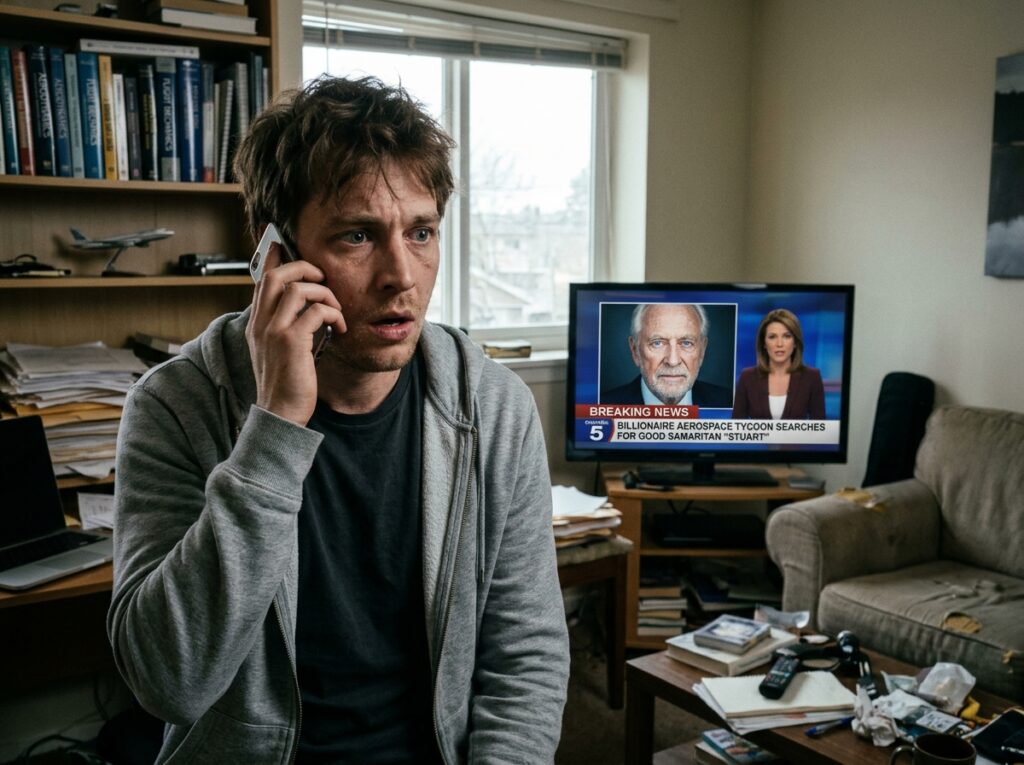
I stopped on the highway to help an elderly couple with a flat tire — just a small good deed, or so I thought. A week later, my mom called me, screaming into the phone: “STUART! Why didn’t you tell me? Turn on the TV. RIGHT. NOW.” That’s when everything flipped upside down.
The rain on I-95 was attacking. My name is Stuart. I am twenty-eight, and unemployed.
I was driving my 2012 Ford Focus. I was tired. I was broke.
Then I saw them. An ancient, beige Buick Century on the shoulder. Standing beside it, hunching against the wind, was an old man. He was wrestling with a tire iron.
Cars were whizzing past. BMWs. Mercedes. None slowed down.
I sighed. But then the old man slipped. He nearly fell into traffic.
“Dammit,” I whispered. I pulled over.
“Sir!” I shouted. The old man jumped. He looked like a drowned rat.
“I… I can’t get it loose!” he yelled.
“Get in the car!” I ordered. “You’re going to get hypothermia.”
I knelt in the mud. The lug nuts were seized. I used a metal pipe for leverage. Snap. The first nut broke loose.
It took twenty minutes. My suit was soaked. My hands were black.
I tapped on the window. “You’re all set,” I said.
The old man stared at me. Piercing blue eyes. “What is your name, son?”
“Stuart,” I said. “Stuart Miller.”
He pulled out a wallet. “I want to pay you. I have… forty dollars.”
I pushed his hand away. “Keep it. Buy your wife some hot soup.”
“But you ruined your suit,” the woman said. “You look like a businessman.”
I laughed bitterly. “I’m an unemployed engineer, Ma’am.”
The old man paused. “Unemployed? An engineer?”
“Aerospace,” I nodded.
A week passed. It was a bad week.
On Tuesday morning, my mom called. “Stuart! Turn on the television! Channel 5! Right now!”
“Mom, I don’t have cable—”
“Use your phone! Stuart, how could you not tell me you met Him?”
“Met who?”
My mother was breathing so hard into the phone that I could hear the television blaring behind her.
“Stuart Miller, open the news website. Right now.”
I was sitting at my kitchen table in sweatpants, staring at an overdue electric bill and a half-empty jar of peanut butter.
My laptop had died two days earlier.
My phone battery was at eleven percent.
And I hadn’t slept properly in almost a week.
“Mom, please. I’m trying to figure out how to pay rent.”
“Just look!”
I opened the browser.
Channel 5’s homepage loaded slowly.
At the top was a photograph of an elderly man standing beside a beige Buick Century.
I recognized the car immediately.
Then I recognized the man.
The piercing blue eyes.
The weathered face.
The gentle smile.
But the headline made absolutely no sense.
Billionaire Aerospace Founder Searches for Unemployed Engineer Who Saved Him and His Wife on I-95.
I stared.
Then I zoomed in.
The man’s name appeared beneath the photograph.
Arthur Whitmore, 79, Founder of Whitmore Aeronautics.
My mouth went dry.
Whitmore Aeronautics.
One of the largest privately held aerospace engineering companies in the country.
The company that manufactured precision components for commercial aircraft, satellite systems, and advanced flight-control technology.
The company whose research papers I had studied in college.
The company I had applied to three times.
And had been rejected by three times.
I pressed play.
A reporter stood outside a modern glass building.
Behind her, a large silver sign read WHITMORE AERONAUTICS.
Then the video cut to the old man.
He was sitting beside his wife.
Both looked warm and dry now.
He wore a navy sweater.
She wore a pale blue cardigan.
And between them, on a coffee table, sat a small framed photograph of a young man.
Arthur looked directly into the camera.
“Last Monday, my wife and I were stranded on Interstate 95 during a dangerous storm.”
My heart started pounding.
He continued.
“Dozens of vehicles passed us. We were frightened, cold, and beginning to lose hope.”
His wife touched his hand.
“Then a young man stopped.”
The screen changed.
A grainy photograph appeared.
It showed a soaked man kneeling beside an old Buick.
His back was toward the camera.
His suit jacket was covered in mud.
I stared at the image.
That was me.
Arthur continued.
“He spent twenty minutes helping two strangers in weather nobody should have been standing in.”
The reporter asked, “Did he know who you were?”
Arthur smiled.
“No. And that’s precisely why I want to find him.”
His wife leaned toward the microphone.
“He wouldn’t take our money.”
Arthur nodded.
“He told us to buy hot soup.”
My mother made a strange sound on the phone.
Half laughter.
Half crying.
“Stuart,” she whispered, “that’s you.”
I couldn’t speak.
On the screen, Arthur looked down briefly.
Then he said something I would remember for the rest of my life.
“I’ve spent sixty years working with brilliant people. I’ve met presidents, astronauts, inventors, and business leaders. But that young man reminded me of something important.”
He paused.
“Character is what remains when nobody is watching.”
My throat tightened.
Arthur looked back into the camera.
“His name is Stuart Miller. He’s twenty-eight, and he told me he’s an unemployed aerospace engineer.”
The reporter nodded.
“And you’re hoping to offer him a job?”
Arthur smiled slightly.
“I’d like to meet him first.”
The video ended.
I sat motionless.
My mother was still on the phone.
“Stuart?”
I stared at the blank screen.
“Mom.”
“Yes, baby?”
“I think I’m going to throw up.”
She burst into tears.
“Oh, Stuart.”
I covered my face.
I had spent the previous seven months being told I wasn’t good enough.
Not experienced enough.
Not connected enough.
Not the right fit.
And now the founder of Whitmore Aeronautics was looking for me because I’d changed a tire.
It felt impossible.
But the strangest part was that I hadn’t even recognized him.
Not once.
Not when he offered me forty dollars.
Not when he asked what kind of engineer I was.
Not even when his wife smiled and said, “You remind me of someone.”
I had simply seen two old people in danger.
And stopped.
My mother spoke again.
“Baby, you need to call them.”
I swallowed.
“Mom, what if it’s some publicity stunt?”
“Then at least you helped somebody.”
I looked at the photograph of Arthur and his wife.
Then at the overdue bills spread across my table.
And I realized something.
Whatever happened next, the good deed had already happened.
It didn’t need a reward to become worthwhile.
But I was still curious.
So I called the number listed beneath the news article.
A woman answered on the second ring.
“Whitmore Aeronautics executive office.”
I cleared my throat.
“Hi. My name is Stuart Miller.”
Silence.
Then the woman said, very carefully, “Could you repeat that?”
“Stuart Miller. I think Mr. Whitmore might be looking for me.”
There was another pause.
Then I heard movement.
A chair scraping.
A muffled voice.
“One moment, please.”
I waited.
My hand was trembling so badly that I almost dropped the phone.
Then a man’s voice came through.
“Stuart?”
I froze.
It was him.
The same voice I’d heard shouting over the rain.
“Mr. Whitmore?”
He laughed.
“There you are.”
I couldn’t help smiling.
“Sir, I just saw the news.”
“I was beginning to think you’d never call.”
“I’m sorry. I had no idea who you were.”
“Good.”
I blinked.
“Good?”
“Very good.”
He paused.
“How’s that suit?”
I looked toward the laundry basket.
The jacket was still stained.
“Honestly, sir? I think it’s finished.”
Arthur laughed.
“Then I owe you a new one.”
“No, sir. You don’t owe me anything.”
His voice softened.
“That’s what you said on the highway.”
For a moment, neither of us spoke.
Then he asked, “Stuart, would you come see me tomorrow?”
My heart raced.
“At your company?”
“Yes.”
“Why?”
He chuckled.
“Because I have a few questions about aerospace engineering.”
I swallowed.
“And because my wife insists on buying you lunch.”
I smiled.
“That sounds fair.”
“Good. My assistant will send the details.”
Then he added, “And Stuart?”
“Yes, sir?”
“Don’t buy a new suit.”
I looked down at my sweatpants.
“Wasn’t planning on it.”
He laughed again.
“See you tomorrow.”
When the call ended, I sat staring at my phone.
Then I called my mother back.
She answered immediately.
“Well?”
I swallowed.
“I’m going.”
She started crying again.
And I laughed.
For the first time in months, I actually laughed.
The next morning, I woke before sunrise.
I shaved carefully.
Ironed my only decent shirt.
And stood in front of the mirror wearing the same navy suit I’d ruined on the highway.
The dry cleaner had managed to remove most of the mud.
But there was still a faint stain near the knee.
I looked at it.
Then smiled.
Somehow, it felt appropriate.
My apartment was small.
One bedroom.
A narrow kitchen.
A living room with secondhand furniture.
The rent was $1,350 a month.
I had $412 in my checking account.
And I was two weeks away from needing to make decisions I didn’t want to make.
Sell the car.
Move back in with my mother.
Or take a job outside engineering and hope I could someday return.
I had been applying everywhere.
Aerospace companies.
Defense contractors.
Manufacturing firms.
Research laboratories.
Even entry-level mechanical design positions.
Nothing.
Seven months earlier, I’d been laid off from a small aerospace supplier when its largest contract was canceled.
The company had closed two departments overnight.
I remembered standing in the parking lot holding a cardboard box.
Inside were my notebooks.
A framed photograph of my mother.
And a little model airplane my father had given me when I graduated.
My supervisor had shaken my hand.
“You’re talented, Stuart. You’ll land somewhere.”
I had believed him.
For a while.
But rejection has a way of becoming personal when it happens often enough.
By the time I reached Whitmore Aeronautics, my stomach was in knots.
The headquarters stood outside Baltimore, a massive glass-and-steel complex surrounded by carefully maintained grounds.
Security guards monitored the entrance.
Employees moved through the lobby carrying laptops and coffee.
A large suspended model of a jet aircraft hung above the reception desk.
I stopped beneath it.
For a moment, I forgot why I was there.
I just stared.
The wing geometry.
The smooth composite surfaces.
The precision of the design.
This was the world I’d spent years trying to enter.
“Mr. Miller?”
I turned.
A woman in a charcoal-gray suit approached.
“I’m Helen Brooks, Mr. Whitmore’s executive assistant.”
I shook her hand.
“Nice to meet you.”
She smiled.
“He’s been looking forward to this.”
I followed her through a hallway lined with photographs.
Aircraft.
Engineers.
Test facilities.
Early satellite components.
And near the end, a black-and-white photograph caught my attention.
A young Arthur Whitmore stood beside a much older man in a machine shop.
Both wore grease-stained work clothes.
Helen noticed me looking.
“That’s Mr. Whitmore and his father.”
I smiled.
“His father was an engineer?”
“A machinist.”
She paused.
“Mr. Whitmore likes to say his father taught him more about engineering than any university ever did.”
I looked at the photograph again.
Then Helen opened a door.
“He’s ready for you.”
Arthur Whitmore stood beside a large window overlooking the campus.
He wasn’t wearing an expensive suit.
Just dark trousers and a pale blue shirt with the sleeves rolled up.
When he saw me, his face lit up.
“Stuart!”
He crossed the room and shook my hand with surprising strength.
“Look at you. Dry this time.”
I laughed nervously.
“Yes, sir.”
“Arthur.”
“Sir?”
“Call me Arthur.”
I hesitated.
He grinned.
“At least try.”
Then a familiar voice came from behind him.
“And I’m still waiting to buy you that soup.”
His wife entered carrying a small tray.
She was smiling.
I recognized her immediately.
“Mrs. Whitmore.”
“Eleanor,” she corrected.
She set the tray down.
“Sit, dear. You look nervous.”
I sat.
Arthur took the chair across from me.
For a moment, he simply studied my face.
Then he said, “You really didn’t know who I was.”
I shook my head.
“No, sir.”
“Why did you stop?”
I looked down.
The question seemed strange.
“Because you needed help.”
Arthur waited.
I shrugged.
“You were standing too close to traffic. It was raining hard. I thought somebody was going to get hurt.”
He nodded slowly.
“And you weren’t worried about being late?”
I smiled bitterly.
“I was coming back from a job interview.”
“How did it go?”
I hesitated.
“Not well.”
Arthur leaned back.
“Why not?”
I looked at my hands.
“They said I didn’t have enough experience with the exact systems they needed.”
“What systems?”
“Flight-control integration and structural analysis.”
Arthur’s expression changed.
“What have you worked on?”
I began explaining.
At first, cautiously.
Then more confidently.
I told him about my degree.
My previous job.
The composite bracket redesign I’d worked on.
The testing procedures.
The finite-element models.
The problems we’d encountered during vibration testing.
Arthur listened carefully.
He asked questions.
Real questions.
Technical questions.
Not the vague interview questions I’d heard a hundred times.
He wanted to know why I’d chosen one material over another.
How I’d handled conflicting test results.
What I’d done when a supplier’s specifications didn’t match the actual component behavior.
And somewhere in the middle of the conversation, I forgot I was unemployed.
I forgot I was sitting in a billionaire’s office.
I forgot about the bills waiting at home.
I was just an engineer talking about engineering.
Arthur noticed.
He smiled.
“There he is.”
I blinked.
“Who?”
“The young man who came alive the moment we started talking about airplanes.”
I looked down, embarrassed.
Eleanor smiled from her chair.
Arthur leaned forward.
“Stuart, I want to show you something.”
He stood and walked toward a cabinet.
Inside were several small aircraft components.
He removed a metal bracket and placed it on the table.
“What do you think?”
I picked it up carefully.
It was beautifully machined.
Lightweight.
Strong.
But something about the geometry bothered me.
I turned it over.
Arthur watched.
“Well?”
I hesitated.
“May I be honest?”
He laughed.
“Please.”
I pointed toward one corner.
“This transition is too abrupt.”
Arthur raised an eyebrow.
“Explain.”
I traced the edge.
“If this component sees repeated vibration, I’d want to examine the stress concentration here.”
He nodded.
“Anything else?”
“The machining is excellent. But depending on the load path, I’d consider changing the fillet radius or redistributing material.”
Arthur smiled.
“Interesting.”
I looked up.
“Am I wrong?”
He shook his head.
“No.”
Then he said something that made my pulse jump.
“Three of our engineers raised the same concern last month.”
I stared.
Arthur continued.
“Two others didn’t.”
He took the bracket back.
“And you spotted it in less than a minute.”
I swallowed.
“I’ve worked on similar parts.”
“Exactly.”
He placed the bracket in the cabinet.
Then returned to his chair.
“Stuart, I didn’t bring you here to give you a job because you changed my tire.”
My stomach tightened.
I nodded.
“I understand.”
He looked at me.
“I brought you here because you showed me your character. Now I wanted to see your ability.”
I sat very still.
Arthur smiled.
“And I think we should talk about both.”
Before I could answer, the office door opened.
A tall man in an expensive gray suit stepped inside.
He looked to be in his early forties.
His hair was perfectly styled.
His expression was sharp.
“Arthur, I need you to approve the board packet before—”
He stopped when he saw me.
His eyes moved from my suit to my shoes.
Then to Arthur.
“Sorry. I didn’t realize you had company.”
Arthur’s expression cooled slightly.
“Daniel, this is Stuart Miller.”
The man nodded.
“Stuart.”
I stood and offered my hand.
He shook it briefly.
“Daniel Price. Chief Operating Officer.”
I recognized the name.
Daniel Price was one of the company’s most prominent executives.
He had been featured in several industry magazines.
He looked at Arthur.
“Is this the highway guy?”
Arthur nodded.
“Yes.”
Daniel smiled.
But there was something unpleasant behind it.
“Well, that’s quite a story.”
I felt uncomfortable.
Arthur gestured toward the chair.
“Stuart is an aerospace engineer.”
Daniel’s smile tightened.
“Is he?”
“Yes.”
Arthur looked pleased.
“And a good one, from what I can tell.”
Daniel glanced at me.
“Where are you working now?”
I swallowed.
“I’m between positions.”
He nodded slowly.
“Ah.”
One small sound.
But it carried a judgment I’d heard too many times.
Arthur noticed.
“Daniel, Stuart has experience in structural analysis and composite systems.”
Daniel folded his arms.
“Interesting. We have very specific hiring requirements.”
Arthur looked at him.
“I’m aware.”
Daniel’s jaw tightened.
Then he smiled again.
“Of course.”
He turned toward me.
“Well, good luck.”
Then he left.
The door closed.
I stared at it.
Arthur sighed.
“Don’t mind Daniel.”
I tried to smile.
“He’s probably right. Companies have requirements.”
Arthur looked at me.
“Requirements are important.”
He paused.
“But so is recognizing talent when it walks through the door.”
Eleanor leaned forward.
“Arthur.”
He looked at her.
She smiled.
“You’re doing that thing again.”
“What thing?”
“Turning lunch into a board meeting.”
Arthur laughed.
“Right.”
He stood.
“Come on, Stuart. My wife has been waiting a week to feed you.”
Lunch was served in a small private dining room overlooking a garden.
Nothing extravagant.
Chicken soup.
Fresh bread.
Roasted vegetables.
And apple pie.
Eleanor insisted I take seconds.
Arthur told stories about the early days of his company.
How he had started in a rented workshop.
How he had borrowed money against his parents’ house.
How his first major contract nearly failed because a supplier delivered defective parts.
I listened, fascinated.
Then Eleanor asked about my family.
I told her about my mother.
How she had raised me after my father died.
How she worked as a nurse for nearly thirty years.
How she used to sit at the kitchen table helping me with homework after twelve-hour shifts.
Eleanor smiled.
“She sounds wonderful.”
“She is.”
Arthur asked, “What did your father do?”
I looked down.
“He was an aircraft mechanic.”
Arthur’s expression softened.
“Ah.”
“He worked at a regional airport. He used to take me there on weekends.”
I smiled faintly.
“He’d point at the planes and explain what every part did.”
Arthur nodded.
“That’s where it started.”
“Yes.”
I hesitated.
“He died when I was fourteen.”
Eleanor’s face softened.
“I’m sorry.”
I nodded.
“Thank you.”
For a moment, the room was quiet.
Then Arthur asked, “What was his name?”
“Michael Miller.”
Arthur stopped moving.
His spoon remained halfway to his mouth.
He stared at me.
“What did you say?”
I frowned.
“Michael Miller.”
Arthur slowly lowered the spoon.
“Did your father ever work at Chesapeake Regional Airfield?”
My heart skipped.
“Yes.”
Eleanor looked at Arthur.
His face had gone pale.
“Arthur?”
He didn’t answer.
He looked at me.
“Was your father a tall man with dark hair and a scar above his left eyebrow?”
I stared.
“Yes.”
Arthur leaned back.
For several seconds, he said nothing.
Then he whispered, “Good Lord.”
I looked between them.
“Sir?”
Arthur’s eyes filled.
“Your father saved my life.”
The room went completely silent.
I stared at him.
“What?”
Arthur swallowed.
“Thirty-one years ago.”
He looked toward the window.
“I was testing a prototype system at a small regional facility. We had a serious equipment failure.”
His voice trembled.
“Your father was one of the mechanics on duty.”
I leaned forward.
Arthur continued.
“There was a fire near the test stand. People were evacuating. I was trapped behind a damaged access door.”
He looked at me.
“Michael Miller came back for me.”
My throat tightened.
“He forced the door open. Got me out. Burned his hands doing it.”
I remembered my father having faint scars across two fingers.
He used to say he’d been careless with a hot engine.
Arthur shook his head.
“He never told you?”
I could barely speak.
“No.”
Arthur looked down.
“That sounds like Michael.”
Eleanor wiped her eyes.
Arthur continued.
“I tried to thank him. Offered him money. Offered him a job.”
He smiled sadly.
“He refused the money.”
My chest tightened.
Arthur looked at me.
“He said, ‘Just make sure the next guy gets home to his family.'”
I stared at him.
The words felt like something my father would say.
Exactly.
Arthur reached across the table.
“Stuart, I never forgot him.”
I looked down at my hands.
The same hands that had changed Arthur’s tire in the rain.
The same hands my father had once held while teaching me how to tighten a bolt.
And suddenly, the world felt impossibly small.
Eleanor whispered, “Arthur, maybe that’s why you kept saying Stuart reminded you of someone.”
Arthur nodded.
Tears slipped down his cheeks.
“Same eyes.”
He looked at me.
“Same stubborn refusal to accept help.”
I laughed through my tears.
“I guess it runs in the family.”
Arthur smiled.
“Apparently.”
For several minutes, none of us spoke.
Then Arthur stood.
“Come with me.”
He led us down a hallway to a small room filled with photographs and memorabilia.
Awards.
Early engineering drawings.
Letters.
And a large framed photograph of the company’s first prototype aircraft.
Arthur opened a drawer.
He removed a worn leather folder.
Inside was an old photograph.
Two men stood beside a test stand.
One was a young Arthur Whitmore.
The other was my father.
I recognized him immediately.
The same smile.
The same strong hands.
The same slightly crooked nose.
I reached for the photograph.
My fingers trembled.
“Dad.”
Arthur placed a hand on my shoulder.
“He was a good man.”
I nodded.
Tears blurred my vision.
“He really was.”
Arthur looked at me.
“And now his son stopped on a highway to help me.”
He shook his head slowly.
“Some things are bigger than coincidence.”
I couldn’t answer.
Arthur carefully removed the photograph from its sleeve.
“Take it.”
I stared.
“Sir, I can’t.”
“You can.”
He smiled.
“It belongs with you.”
I held the photograph against my chest.
For the first time in years, I felt close to my father in a way I couldn’t explain.
Not through memory.
Not through old stories.
But through something he had done when nobody expected a reward.
Something that had quietly traveled across three decades.
And somehow returned to me.
The next day, Arthur called.
“Stuart, I want you to come back.”
I hesitated.
“Why?”
“I’d like you to meet our engineering team.”
My heart raced.
“Is this an interview?”
“Yes.”
He paused.
“A real one.”
I swallowed.
“And I want you to understand something.”
“Yes, sir?”
“Your father was a remarkable man. And you did a remarkable thing on that highway.”
His voice grew firm.
“But if you work here, it will be because you earn it.”
I smiled.
“That’s exactly what I want.”
“Good.”
He laughed.
“Then be here Monday at nine.”
I spent the weekend preparing.
I reviewed technical papers.
Practiced explaining my previous projects.
Revisited finite-element analysis methods.
Read about Whitmore’s recent aerospace programs.
And for the first time in months, studying didn’t feel like punishment.
It felt like hope.
Monday morning, I arrived early.
The interview lasted four hours.
Three senior engineers questioned me.
They challenged my assumptions.
Asked me to analyze hypothetical failures.
Presented design tradeoffs.
And watched as I worked through a difficult structural problem on a whiteboard.
I didn’t know every answer.
But I explained what I knew.
Admitted what I didn’t.
And showed them how I would find out.
When it ended, I was exhausted.
One engineer shook my hand.
“Good work, Stuart.”
I smiled.
“Thank you.”
Then I went home.
And waited.
Two days later, Arthur called.
“Stuart?”
“Yes, sir?”
“How do you feel about starting as a structural design engineer?”
I stopped breathing.
“Sir?”
He laughed.
“You heard me.”
I gripped the kitchen counter.
“Are you serious?”
“Very.”
My eyes filled.
“We’ve reviewed your experience, your technical assessment, and the team’s recommendations.”
He paused.
“They want you.”
I covered my mouth.
For seven months, I’d imagined this moment.
A job offer.
A chance to work again.
A reason to wake up without dread.
But now that it was happening, I couldn’t speak.
Arthur waited.
Then he said softly, “Stuart?”
I swallowed.
“Yes.”
He laughed.
“Yes, you’ll take it?”
“Yes, sir.”
“Good.”
He paused.
“And Stuart?”
“Yes?”
“Your father would be proud.”
That broke me.
I sat down on the kitchen floor and cried.
Not because of the salary.
Not because of the company.
Not because a billionaire had noticed me.
But because after months of feeling worthless, someone had finally seen what I could do.
And somehow, my father’s kindness had been waiting for me on the other side of a storm.
I called my mother.
She answered immediately.
“Stuart?”
I couldn’t speak.
“Baby?”
I swallowed.
“I got the job.”
Silence.
Then she screamed.
I laughed through my tears.
“Mom!”
She started crying.
“Oh, Michael.”
I froze.
She had said my father’s name.
Not mine.
Then she whispered, “Your dad would have loved this.”
I closed my eyes.
“I know.”
My first day at Whitmore Aeronautics was terrifying.
I arrived thirty minutes early.
Wore a clean shirt.
Carried a notebook.
And tried not to look like a man who had spent seven months wondering whether his career was over.
My supervisor, Dr. Rachel Kim, greeted me warmly.
She introduced me to the team.
Showed me the laboratory.
Explained the project schedule.
And gave me my first assignment.
It was not glamorous.
A structural review of a small mounting assembly.
But I treated it like the most important task in the world.
Because to me, it was.
Weeks passed.
I worked hard.
Asked questions.
Made mistakes.
Corrected them.
And slowly found my confidence again.
Arthur occasionally stopped by the engineering floor.
He never treated me differently in front of the team.
Sometimes he asked about a project.
Sometimes he simply nodded.
But one afternoon, he found me working late.
“Stuart.”
I looked up.
“Sir.”
He smiled.
“Still calling me sir?”
I laughed.
“Sorry.”
He glanced at the drawings spread across my desk.
“Long day?”
“Good day.”
He nodded.
“That’s different.”
I smiled.
“Very.”
Arthur looked toward the window.
Then he said, “Come with me.”
He led me to the same hallway where the old photographs hung.
We stopped in front of the picture of him and his father in the machine shop.
Arthur looked at it.
“My father used to say something.”
I waited.
“He said a man’s worth isn’t measured by the number of people who know his name.”
He turned toward me.
“It’s measured by what he does when nobody does.”
I swallowed.
Arthur smiled.
“Your father understood that.”
I looked at the photograph.
“So did yours.”
Arthur nodded.
Then he placed a hand on my shoulder.
“Keep that with you, Stuart.”
“I will.”
Months later, Whitmore Aeronautics held its annual employee recognition dinner.
Hundreds of engineers, technicians, managers, and families gathered in a large ballroom.
I attended with my mother.
She wore a blue dress she’d saved for special occasions.
When we entered, she squeezed my arm.
“Look at this place.”
I smiled.
“Pretty impressive.”
She looked at me.
Then at the room.
And I saw tears gather in her eyes.
“Your father would have loved seeing you here.”
I swallowed.
“Mom, please. You’re going to make me cry before dinner.”
She laughed.
“Then cry. It’s allowed.”
We found our table.
My coworkers greeted her warmly.
She asked embarrassing questions.
Told stories about me building model airplanes at age eight.
And proudly informed everyone that I once tried to make a remote-controlled helicopter from a broken hair dryer.
I buried my face in my hands.
The table erupted in laughter.
For the first time in years, I didn’t mind being embarrassed.
Because my mother was happy.
And I was where I belonged.
After dinner, Arthur stepped onto the stage.
He spoke about innovation.
Teamwork.
The importance of engineering excellence.
Then his tone changed.
“Tonight, I’d like to recognize something beyond technical achievement.”
The room quieted.
Arthur looked toward our table.
My stomach tightened.
“A few months ago, my wife and I were stranded on Interstate 95 during a terrible storm.”
My mother grabbed my hand.
Arthur smiled.
“A young man stopped to help us.”
Several people turned toward me.
I felt my face burn.
Arthur continued.
“He didn’t know who I was. He didn’t ask for money. He simply saw two people in danger and chose to help.”
He paused.
“Later, I learned that his father had once done something very similar for me.”
The room became silent.
Arthur looked down briefly.
“Thirty-one years ago, Michael Miller saved my life during an industrial accident.”
My mother covered her mouth.
I stared at the stage.
Arthur continued.
“Michael never asked for recognition. He never asked for a reward.”
His voice trembled.
“But I have never forgotten him.”
He looked toward my mother.
“Mrs. Miller, would you stand?”
My mother froze.
I helped her rise.
Arthur smiled warmly.
“Your husband was a remarkable man.”
Tears streamed down her face.
The ballroom began applauding.
She pressed her hand against her heart.
Arthur waited until the applause faded.
Then he looked at me.
“And his son is becoming a remarkable engineer.”
I felt my throat tighten.
Arthur smiled.
“Stuart, would you join me?”
I stood.
My legs felt weak.
I walked toward the stage as the room applauded.
Arthur shook my hand.
Then he handed me a small wooden box.
Inside was a polished metal plaque.
It read:
THE MICHAEL MILLER AWARD FOR QUIET COURAGE
In recognition of character, service, and the belief that doing the right thing matters—even when nobody is watching.
I stared at it.
Arthur leaned closer.
“This will be an annual award.”
My eyes filled.
“For employees who demonstrate extraordinary integrity and service to others.”
He smiled.
“And tonight, you’re the first recipient.”
I couldn’t speak.
The room stood.
Applause filled the ballroom.
I looked toward my mother.
She was crying openly.
Then I looked at Arthur.
He was smiling through tears.
And for one extraordinary moment, I felt as though my father was standing beside me.
Not because his name was on a plaque.
But because his values had survived.
Through a son.
Through a stranger.
Through a simple act of kindness on a rainy highway.
When I finally spoke, my voice shook.
“Thank you.”
I looked out at the room.
“I didn’t stop that day because I thought something good would happen to me.”
I swallowed.
“I stopped because my dad taught me that if someone needs help and you can help, you should.”
The room grew quiet.
I looked toward my mother.
“After he died, my mom kept teaching me the same thing.”
She covered her face.
I smiled through my tears.
“So this award belongs to both of them.”
The applause returned.
But I wasn’t finished.
I looked at Arthur.
“And sir?”
He smiled.
“Yes?”
“Please tell Eleanor I still think she owes me that soup.”
The ballroom erupted in laughter.
Arthur laughed so hard he had to wipe his eyes.
“Done.”
After the ceremony, my mother and I stepped outside onto the hotel terrace.
The night air was cool.
The city lights shimmered in the distance.
She held the wooden box carefully.
For a while, neither of us spoke.
Then she looked at me.
“Your father used to worry about you.”
I smiled.
“Really?”
She nodded.
“Not because he thought you couldn’t succeed.”
She paused.
“Because he knew the world could be hard on good people.”
I looked toward the skyline.
“He was right.”
She squeezed my hand.
“But he also believed something else.”
I turned.
“What?”
She smiled through her tears.
“That kindness never disappears. It just travels until somebody needs it.”
I looked down at the plaque.
Then at my mother.
And suddenly, I understood.
My father had helped Arthur decades earlier.
Arthur had carried that memory.
I had stopped on the highway because of the values my father taught me.
And now Arthur was creating an award that would encourage others to do the same.
One act of kindness had become another.
And another.
And another.
Not because anyone planned it.
But because goodness has a way of moving forward.
A year later, I was still working at Whitmore Aeronautics.
I had moved into a slightly larger apartment.
Paid off my overdue bills.
Bought my mother a new washing machine.
And finally replaced the tires on my old Ford Focus.
I still drove it.
People teased me.
“Stuart, you work for one of the biggest aerospace companies in the country. Why are you still driving that thing?”
I always smiled.
“Because it still runs.”
But the real reason was simpler.
That car reminded me of the day everything changed.
Not because it led me to a billionaire.
Not because it got me a job.
But because it reminded me who I wanted to be when life was hard.
One Sunday afternoon, I drove to my mother’s house.
She was making chicken soup.
The kitchen smelled of carrots, onions, and fresh bread.
I walked in carrying flowers.
She looked up.
“What’s the occasion?”
I smiled.
“Nothing.”
She laughed.
“Then why flowers?”
I shrugged.
“Because you like them.”
She shook her head.
“Your father used to do that.”
I smiled.
“I know.”
We sat at the kitchen table.
The same table where she’d helped me with homework.
The same table where I’d cried after losing my job.
The same table where she’d told me not to give up.
She placed a bowl of soup in front of me.
Then she reached into a drawer.
“I found something.”
She handed me an old photograph.
It showed my father standing beside a small airplane.
I was about six years old, sitting on his shoulders.
We were both smiling.
On the back, in my father’s handwriting, were five words.
Always stop when someone needs you.
I stared at them.
My eyes filled.
My mother touched my hand.
“He wrote that after you helped an older neighbor carry groceries.”
I laughed softly.
“I don’t remember.”
She smiled.
“He did.”
I looked at the photograph.
Then toward the window.
Outside, the sky was turning gray.
Rain began tapping against the glass.
For a moment, I was back on I-95.
Kneeling in the mud.
Cold water running down my neck.
My hands aching as I fought with a stubborn lug nut.
I remembered thinking I couldn’t afford to stop.
That I had enough problems of my own.
That somebody else would help.
But nobody had.
So I did.
And that one decision had changed my life.
I looked at my mother.
“Mom?”
“Yes, baby?”
“Do you think Dad would be proud?”
She stared at me.
Then her eyes filled.
“Oh, Stuart.”
She reached across the table and took my hand.
“He was proud of you before you ever had a job.”
I swallowed.
“Before the award?”
She smiled.
“Before the award.”
“Before Whitmore?”
“Before Whitmore.”
I looked down.
She squeezed my fingers.
“Your father didn’t raise you to become important.”
Her voice trembled.
“He raised you to become good.”
I sat quietly.
Then I smiled.
Outside, the rain continued falling.
Inside, the soup was warm.
And the photograph of my father rested beside my bowl.
For the first time in a long while, I wasn’t worried about the future.
I had work I loved.
A mother who believed in me.
A memory of my father that felt closer than ever.
And a simple lesson I would carry for the rest of my life.
Sometimes, the biggest turning point in your life doesn’t arrive with applause.
Sometimes, it comes disguised as an old car on the side of a rainy highway.
A frightened couple.
A flat tire.
And a choice.
Keep driving.
Or stop.
I had stopped.
And somewhere, I liked to imagine, my father was smiling.





