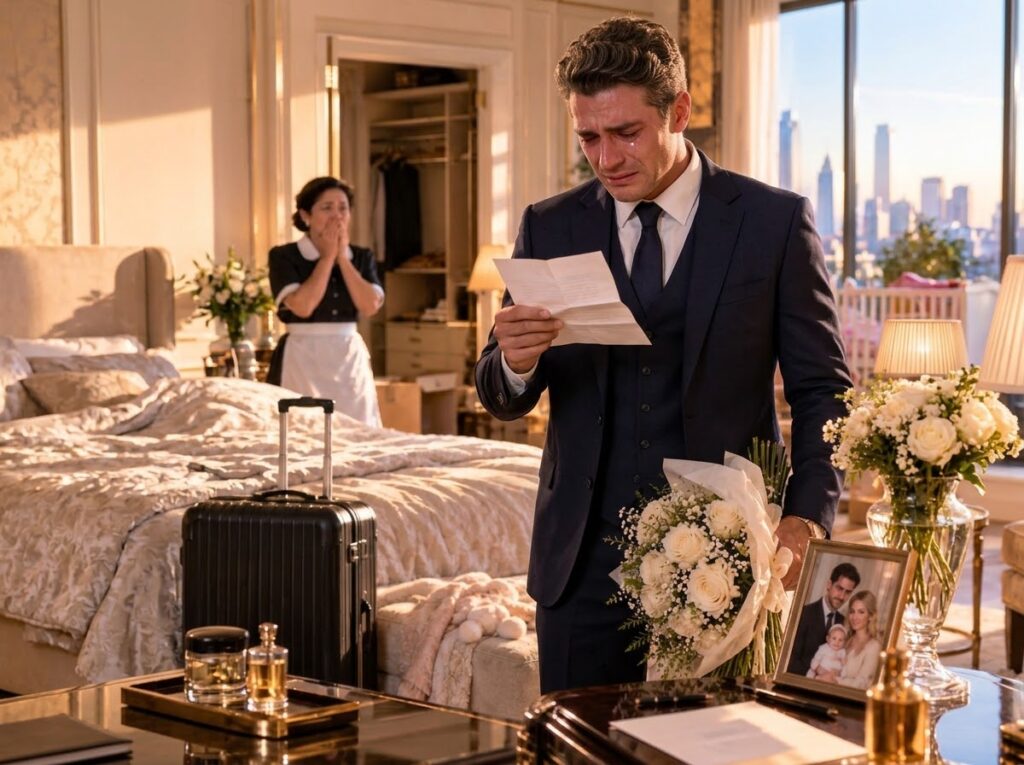
Our daughter was born at 2:14 in the morning, and the only thing her father sent me that night was a photograph of Paris.
In the photograph, the Eiffel Tower glittered against a velvet-black sky. Beneath it, a beautiful woman with chestnut hair smiled into the camera, her delicate hand resting on my husband’s arm.
The message underneath contained six words.
Sophia is feeling much better now.
I stared at the photograph while a nurse adjusted the blanket around my newborn daughter.
My body was trembling from fourteen hours of labor. There were stitches between my legs, bruises along my arms from the IV lines, and an exhaustion so deep that even breathing felt like work.
But none of that hurt as much as the photograph.
Because the man standing beside Sophia Bennett was Vincent Moretti.
My husband.
The father of the little girl sleeping against my chest.
And he had no idea she existed.
I had called him seventeen times when the contractions began.
Seventeen.
The first three calls went unanswered.
The next four rang until voicemail.
By the eighth call, I was crying so hard that I could barely tell the operator which hospital I needed.
By the seventeenth, I had stopped expecting him to answer.
Vincent had left Chicago three days earlier, telling me that Sophia, the woman he had loved before me, was experiencing a personal crisis in Paris.
She needed him.
Apparently, that was enough.
I was thirty-one years old, nine months pregnant, and carrying his child, but somehow Sophia’s tears mattered more than my approaching delivery.
“Mrs. Moretti?”
I looked up.
A young nurse named Natalie stood beside my hospital bed.
“Would you like me to take another photograph of you and the baby?”
I glanced down at the tiny face nestled against my breast.
Our daughter had Vincent’s dark hair.
She had his long eyelashes, his stubborn little chin, and the same faint dimple that appeared in his left cheek whenever he smiled.
But her eyes were mine.
Clear gray-blue.
The color of Lake Michigan before a storm.
I brushed one finger across her velvet-soft cheek.
“No,” I whispered. “Not yet.”
Natalie hesitated.
“Does her father know she’s here?”
My throat tightened.
“No.”
“Would you like us to call him?”
For one foolish second, I imagined Vincent answering.
I imagined his deep voice turning frantic when someone told him our daughter had arrived.
I imagined him abandoning Sophia, rushing to the airport, and crossing an ocean to hold the child we had waited nine months to meet.
Then I remembered his photograph.
Sophia smiling.
Vincent standing beside her.
His wedding ring hidden beneath the sleeve of his expensive coat.
“Her father knows where I am,” I said quietly. “That’s enough.”
Natalie said nothing.
She simply pulled another blanket over my legs and switched off the overhead light.
And for the first time in five years of marriage, I stopped making excuses for my husband.
My name is Emily Carter Moretti.
For five years, I had been married to Vincent Moretti, one of the most powerful and feared men in Chicago.
Vincent controlled luxury hotels, casinos, shipping companies, restaurants, and an underground empire that had made the Moretti name both famous and dangerous.
People called him the King of Chicago.
Politicians shook his hand.
Businessmen begged for meetings.
Men twice his age lowered their heads when he entered a room.
He could make a million-dollar problem disappear with one telephone call.
But he couldn’t find five minutes to speak to his pregnant wife.
When we first married, I believed Vincent loved me.
Not because he said it often.
He rarely did.
Vincent expressed affection through purchases.
When I admired a painting, he bought the entire collection.
When I mentioned wanting to visit Italy, he arranged a private flight to Florence.
When I said our bedroom felt cold, he hired an interior designer and spent nearly half a million dollars redecorating it.
Every anniversary brought diamonds.
Every birthday brought another extravagant gift.
And every time I tried to discuss something that truly mattered, he would kiss my forehead and tell me not to worry.
“You’re my wife, Emily. You’ll never want for anything.”
I eventually understood what he meant.
I would never want for anything money could buy. Everything else was negotiable.
Especially when Sophia Bennett was involved.
Sophia was Vincent’s first love.
They had met when he was nineteen and she was eighteen, long before I entered his life.
Their relationship had ended when Sophia moved to Europe, but it had never truly disappeared.
She called him when she was lonely.
She called him when she was frightened.
She called him when a boyfriend disappointed her.
She called him on our honeymoon because she had lost an expensive bracelet in Monaco.
Vincent spent ninety minutes on the phone with her while I sat alone on the terrace of our hotel suite overlooking the Mediterranean.
When he returned, I asked him whether he still loved her.
He looked genuinely offended.
“Don’t be ridiculous, Emily. You’re my wife.”
“That’s not what I asked.”
He touched my cheek.
“You’re making something out of nothing.”
That sentence became the soundtrack of our marriage.
You’re making something out of nothing.
When Sophia appeared unexpectedly at his birthday dinner, I was making something out of nothing.
When he missed our third anniversary to attend an exhibition in Paris with her, I was making something out of nothing.
When she called our house at two in the morning and whispered his childhood nickname, I was making something out of nothing.
And when I discovered I was pregnant, Vincent promised things would change.
He stood in our bedroom holding the ultrasound photograph, staring at the tiny shape on the paper.
“That’s our baby?”
I smiled through tears.
“Yes.”
For the first time in years, his expression softened.
He knelt in front of me, placed his palm against my stomach, and whispered, “I won’t make the mistakes my father made.”
I believed him.
God help me, I believed every word.
For eight months, Vincent made an effort.
He attended medical appointments.
He ordered an elaborate nursery.
He bought a ridiculous collection of stuffed animals that could have filled an entire toy store.
He talked about teaching our child to swim and taking family vacations in the mountains.
Sometimes he fell asleep with his hand resting on my stomach.
During those moments, I thought we might finally become a real family.
Then Sophia called from Paris.
Three weeks before my due date.
Vincent answered her call during dinner.
I watched his expression change.
First concern.
Then tension.
Then something I recognized too well.
Devotion.
Afterward, he pushed back his chair.
“I need to go to France.”
I lowered my fork.
“Why?”
“Sophia’s going through something difficult.”
“What kind of difficulty?”
“That’s private.”
I stared at him.
“Vincent, I’m nine months pregnant.”
“I know.”
“My doctor says the baby could arrive any day.”
“I know that too.”
“Then you can’t leave.”
He sighed as though I were being unreasonable.
“Emily, don’t start.”
Those three words struck harder than a slap.
I placed both hands over my enormous stomach.
“Your daughter could be born while you’re gone.”
“I’ll be back in forty-eight hours.”
“And if you’re not?”
He walked around the table and kissed the top of my head.
“Nothing’s going to happen.”
He left that evening.
His forty-eight-hour trip became four days.
Then seven.
Then ten.
Then thirteen.
And somewhere during those thirteen days, the woman who had spent five years begging Vincent Moretti to choose her finally disappeared.
I named our daughter Iris.
Not because Vincent liked the name.
Not because it appeared on his carefully prepared list of acceptable Italian family names.
I named her after the purple flowers my mother used to grow beneath our kitchen window.
My mother, Evelyn Carter, had died when I was twelve.
Before she died, she used to tell me that irises were remarkable because they could survive terrible winters and still bloom in spring.
“Remember that, my little skylark,” she would whisper. “The cold doesn’t get the final word.”
I thought about her constantly during my pregnancy.
Especially in the hospital.
When Iris was placed in my arms, I cried for everything my mother had never gotten to see.
My wedding.
My adulthood.
The birth of her granddaughter.
And then I cried because the man who should have been standing beside me was thousands of miles away, holding another woman’s hand.
On the second day after delivery, our housekeeper, Margaret Ellis, came to the hospital.
She entered carrying a paper bag filled with clean clothes, homemade soup, and a little knitted hat.
Margaret was sixty-four, with silver hair, gentle brown eyes, and a pale scar running from her left ear toward her jaw.
She had worked at the Moretti mansion for four years.
When I was pregnant, she made certain I ate breakfast.
When morning sickness left me trembling on the bathroom floor, she held my hair.
When Vincent forgot my birthday, she baked my favorite lemon cake.
She was the closest thing to a mother I had known in years.
The moment she saw Iris, tears filled her eyes.
“Oh,” she whispered. “She’s beautiful.”
I smiled weakly.
“Would you like to hold her?”
Margaret reached for the baby, then hesitated.
Her hand was trembling.
“Are you certain?”
“Of course.”
She took Iris into her arms with such care that something inside my chest ached.
For several moments, Margaret simply stared at her.
Then she began humming.
A soft melody.
Six notes, rising and falling like birdsong.
I recognized it immediately.
My mother used to sing the same tune when I was little.
“Where did you learn that?” I asked.
Margaret stopped.
“The song?”
“Yes.”
She lowered her eyes.
“It’s an old lullaby. My mother sang it.”
I nodded, though an inexplicable chill moved through me.
Margaret brushed Iris’s cheek with one finger.
“What a precious little bird.”
Then she looked at me.
“Has Mr. Moretti called?”
“No.”
Her expression hardened for an instant.
It was the first time I had ever seen anger on her face.
“Then he’s a fool.”
I laughed.
It came out broken.
Margaret settled beside my bed.
“Emily, there’s something I want you to understand.”
“What?”
She took my hand.
“A child doesn’t need a palace. She needs one person who will always come when she cries.”
I looked at Iris.
My tiny daughter was sleeping peacefully in Margaret’s arms.
And suddenly I knew.
I wouldn’t bring her home to a mansion where she might spend her childhood watching her mother wait by the telephone.
I wouldn’t teach her that love meant accepting whatever scraps someone offered.
I wouldn’t let her grow up believing that being chosen occasionally was the same as being cherished.
“I’m leaving him,” I whispered.
Margaret didn’t look surprised.
She simply squeezed my hand.
“Then we should make certain you have somewhere safe to go.”
Four days after Iris was born, I returned to the Moretti mansion.
Not to stay.
To collect our belongings.
Vincent still hadn’t called.
He had sent three short messages.
Busy today. Talk later.
Paris is complicated.
I’ll explain when I get home.
I hadn’t replied.
Standing in the enormous foyer with Iris sleeping in her carrier, I looked around the house I had once considered beautiful.
The marble floors gleamed.
Crystal chandeliers sparkled above the staircase.
An enormous arrangement of white orchids stood beneath a painting worth more than the house where I had grown up.
Everything was expensive.
Everything was immaculate.
And everything felt dead.
I called a moving company.
“How much are you moving, ma’am?” the woman asked.
“Two people’s belongings.”
“Do you have much furniture?”
“One crib.”
There was a pause.
“And anything else?”
I looked toward the grand staircase.
“No. Nothing else that matters.”
For the next several hours, I packed.
My ordinary clothes.
My college books.
The photographs of my parents.
My grandmother’s silver necklace.
Iris’s blankets, diapers, formula, tiny socks, and soft cotton dresses.
I took the wooden rocking chair my aunt June had given me before the wedding.
I took an old quilt embroidered with birds, a family keepsake I had kept since childhood.
And I took the small blue music box that had sat on my mother’s dressing table before she died.
But I left everything Vincent had purchased.
The diamonds remained in their velvet cases.
The designer handbags stayed in the walk-in closet.
The gowns remained on their hangers.
Even the enormous ruby necklace he had given me after missing our fourth anniversary stayed exactly where he had left it.
Those gifts had once made me feel loved.
Now I understood they were simply beautiful apologies for wounds he intended to keep reopening.
Margaret watched while the movers carried the crib downstairs.
“Where will you go?” she asked.
“My aunt owns a small house in Oak Park. She’s letting me stay there.”
Margaret nodded.
“Good.”
Then she glanced toward the nursery.
“Did you remember the bird quilt?”
“Yes. It’s in the second box.”
Her relief was almost visible.
I assumed she was sentimental about it.
Before leaving, I gave Margaret an envelope containing more than a year’s salary.
She immediately tried to return it.
“Emily, I can’t accept this.”
“You’ve been kinder to me than anyone in this house.”
Her eyes filled with tears.
“Money isn’t necessary.”
“I know.”
I pressed the envelope into her hand.
“That’s why I want you to have it.”
She embraced me.
And for one strange moment, she held me so tightly that I thought she might never let go.
“Be careful,” she whispered against my hair.
I drew back.
“Of Vincent?”
Margaret hesitated.
Then she said something that would haunt me later.
“Not everyone who smiles at your daughter is happy she was born.”
Before I could ask what she meant, Iris began crying.
Margaret turned away to fetch her bottle.
I assumed she was referring to Sophia.
I had no idea how terribly wrong I was.
That afternoon, I walked upstairs to the master bedroom one final time.
Vincent’s side of the bed remained untouched.
His expensive watch sat on the dresser.
His cologne lingered faintly in the air.
For five years, I had slept beside that man.
I knew the sound of his breathing.
I knew how he liked his coffee.
I knew which nightmares woke him and which memories he refused to discuss.
But somehow, I had never truly known his heart.
I opened the bedside drawer.
Inside was the divorce agreement my attorney had prepared while I was still in the hospital.
I had refused Vincent’s money.
I wasn’t asking for his mansion, his businesses, or his fortune.
My attorney, Eleanor Price, had insisted that I preserve my right to seek child support on Iris’s behalf.
“Your daughter is entitled to support from her father,” she reminded me. “That isn’t something you should surrender for the sake of pride.”
I agreed.
But I wanted nothing for myself.
No diamonds.
No property.
No luxurious settlement.
I signed the petition and placed it on Vincent’s nightstand.
Beside it, I left my wedding ring.
Five years of marriage reduced to a signature and a small circle of platinum.
Then I picked up my daughter’s carrier.
As I passed the nursery, I stopped.
The room was nearly empty.
Only the pale yellow walls remained, decorated with the stars Vincent and I had painted together.
For a moment, I remembered how he had stood behind me, his arms around my waist, guiding my hand as we drew the largest star above the crib.
“This one is hers,” he’d said.
“The brightest?”
“The brightest.”
I closed my eyes.
A tear slipped down my cheek.
Then Iris made a tiny noise in her sleep.
I looked down.
And the ache in my chest changed into something stronger.
Determination.
“Come on, sweetheart,” I whispered. “We’re going home.”
I carried her out of the mansion.
And I didn’t look back.
Vincent Moretti returned to Chicago thirteen days after leaving me.
I know exactly what happened when he entered the mansion because, three weeks later, he showed me the security footage himself.
At 9:17 that evening, his black Mercedes pulled beneath the entrance canopy.
He stepped out wearing a charcoal overcoat, carrying a small blue shopping bag from an expensive Parisian jeweler.
Apparently, he had bought another apology.
He entered the house.
“Emily?”
Silence.
He handed his coat to the butler.
“Where’s my wife?”
The butler, Thomas, looked uncomfortable.
“Mrs. Moretti isn’t here, sir.”
Vincent frowned.
“Where is she?”
“She left.”
“When will she be back?”
Thomas swallowed.
“I don’t believe she’s coming back, sir.”
Vincent stared at him.
Then he laughed once, sharply.
“Don’t be absurd.”
He walked upstairs.
The camera in the corridor captured him opening our bedroom door.
Twenty seconds later, he emerged.
His expression had changed.
He crossed the hallway and entered the nursery.
He stayed inside for almost a minute.
When he came out, he was holding a tiny stuffed rabbit.
Then he began shouting.
“Margaret!”
His voice echoed through the mansion.
“Margaret, where the hell are you?”
She appeared at the bottom of the staircase.
Vincent rushed down.
“Where is Emily?”
Margaret stood very still.
“She’s gone, Mr. Moretti.”
“Where?”
“I don’t know where she’s living now.”
“That’s impossible. She can’t just leave.”
Margaret looked at him.
And in a voice as cold as winter, she replied, “She already did.”
He took one step closer.
“Where are my daughter’s things?”
Margaret didn’t answer.
Vincent stared at her.
Then his face drained of color.
“Where’s the baby?”
“With her mother.”
He blinked.
“What?”
Margaret slowly folded her hands.
“Your daughter was born ten days ago, Mr. Moretti.”
For several seconds, Vincent said nothing.
The man who could command hundreds of armed men, who had negotiated with criminals and politicians without showing fear, stood in the middle of his enormous mansion looking as though someone had removed the floor beneath him.
“Ten days?”
“Yes.”
He shook his head.
“No. Emily would’ve called.”
“She did.”
“When?”
“While she was in labor.”
“She never—”
“Seventeen times.”
Vincent’s mouth closed.
Margaret stepped closer.
“Seventeen times, Mr. Moretti. She called you seventeen times while she was in pain and frightened and waiting for her husband.”
His eyes moved toward the upstairs bedroom.
“And you didn’t answer,” Margaret continued. “So she gave birth alone. She brought your daughter home alone. And when she finally understood that you weren’t coming, she left.”
Vincent gripped the stair railing.
“Is the baby healthy?”
“Yes.”
“And Emily?”
Margaret’s expression tightened.
“She’s alive.”
Then she added, “But the woman who loved you isn’t coming back.”
Vincent stumbled upstairs.
He entered the bedroom.
This time, he saw the papers.
The divorce agreement.
The pen.
And my wedding ring.
According to Thomas, Vincent remained in that room for almost two hours.
When he finally emerged, the blue jewelry bag was still in his hand.
He walked into the empty nursery and placed it on the floor.
Then he sat beside the wall beneath the brightest painted star.
And for the first time anyone in that mansion could remember, Vincent Moretti began to cry.
I didn’t know any of that at the time.
I was sitting in a little house in Oak Park, feeding our daughter beneath the soft light of an ordinary kitchen lamp.
My phone began vibrating.
Vincent.
I watched his name appear.
Once.
Twice.
Again.
I didn’t answer.
Then a message arrived.
Emily. Where are you?
Another.
Margaret says you had the baby.
Another.
Why didn’t you tell me?
I stared at that last message.
Then I laughed.
Not because anything was funny.
Because sometimes pain becomes so enormous that laughter is the only sound your body knows how to make.
I typed four words.
I tried seventeen times.
Then I switched off my phone.
For the first time in five years, I slept without waiting for my husband to come home.
I thought that was the end of our story.
I was wrong.
Because the next morning, a black car appeared across the street.
And inside the house, tucked beneath the edge of my daughter’s old quilt, I found something my mother had hidden nineteen years earlier.
Something that would explain why Vincent’s family had wanted me inside their mansion all along.
The black car had been parked outside my house for almost an hour.
It was a dark gray sedan with tinted windows and Illinois plates. Every twenty minutes, its engine started, but it never moved.
At first, I assumed Vincent had sent someone to watch me.
That was exactly the kind of thing he would do.
He had once assigned two bodyguards to follow me around Chicago after a man accidentally bumped into me outside a restaurant.
Back then, I had thought his possessiveness was romantic.
Now I found it suffocating.
But when I opened the living room curtains, the driver’s window lowered slightly.
A camera lens flashed.
Someone was photographing my house.
And suddenly, I wasn’t angry anymore.
I was frightened.
I stepped away from the window and checked the locks.
Iris was sleeping in her bassinet beside the sofa.
She looked impossibly small beneath her pink blanket.
I picked up my phone and called Vincent.
He answered before the first ring finished.
“Emily?”
His voice sounded different.
Rough.
Exhausted.
Almost desperate.
“There’s a car outside my house,” I said.
Silence.
Then, “What car?”
“A gray sedan. Tinted windows. Someone’s taking photographs.”
“Where are you?”
“That doesn’t matter.”
“Emily, if someone’s watching you, it matters.”
“Did you send them?”
“No.”
“Don’t lie to me.”
“I’m not lying.”
I heard movement on his end.
A chair scraping.
Then another voice asking him something.
Vincent ignored it.
“Tell me the license plate.”
I read it to him.
He repeated the numbers to someone nearby.
“Stay inside. Lock the doors.”
“They’re already locked.”
“Don’t open the door for anyone.”
“Vincent—”
“Please, Emily.”
That single word startled me.
Vincent Moretti didn’t say please.
He issued orders.
I heard him speak quietly to someone.
Then he returned to the phone.
“Where’s Iris?”
“Sleeping.”
He exhaled.
It sounded almost painful.
“Is she all right?”
“Yes.”
“Does she look like you?”
I closed my eyes.
Of all the questions he could have asked, that one hurt the most.
“She looks like both of us.”
A silence stretched between us.
“Emily,” he said eventually, “I need to see her.”
I looked at my daughter’s sleeping face.
“You had your chance.”
“That’s not fair.”
I laughed bitterly.
“Fair?”
“She’s my daughter too.”
“Then perhaps you should have remembered that before you boarded a plane to Paris.”
He said nothing.
I continued, my voice trembling.
“You weren’t there when she was born, Vincent. You weren’t there when she cried for the first time. You weren’t there when I was terrified something might go wrong. You weren’t there when I needed someone to hold my hand.”
“Emily—”
“And you know what the worst part is? I kept looking at the door.”
My throat tightened.
“Even after everything, some stupid part of me kept expecting you to walk through that door.”
He made a strangled sound.
“I didn’t know.”
“Because you didn’t want to know.”
“That’s not true.”
“Then why didn’t you answer?”
He remained silent for so long that I thought the call had disconnected.
Finally, he whispered, “I don’t have a good answer.”
For the first time, I believed him.
But belief wasn’t forgiveness.
“I’ve hired an attorney,” I said. “Anything involving Iris will go through her.”
“Don’t do this.”
“I already have.”
I ended the call.
Ten minutes later, the gray sedan drove away.
I thought Vincent had frightened its driver off.
But later, he told me something that made my blood run cold.
The license plate belonged to a security company controlled by his mother.
Beatrice Moretti had never liked me.
She was a tall, elegant woman with silver-blond hair, flawless posture, and a smile that always reminded me of a knife concealed inside a silk glove.
She had been born into money, married into power, and spent forty years teaching men that underestimating her was a fatal mistake.
Vincent’s father, Domenico Moretti, had died twelve years earlier.
Since then, Beatrice had maintained considerable influence over the family businesses.
Vincent controlled the organization publicly.
But his mother still knew where most of its secrets were buried.
When we married, Beatrice gave me a diamond bracelet and said, “I hope you understand how fortunate you are.”
I thanked her.
She glanced at my modest wedding dress.
“Most girls from your background never get opportunities like this.”
That was the beginning.
Throughout our marriage, she reminded me that the Moretti name was something I had been allowed to borrow.
She criticized my clothes.
My education.
My friends.
My inability to produce a grandchild during our first three years of marriage.
When I became pregnant, her attitude changed.
Suddenly, she wanted to attend every appointment.
She asked for copies of medical reports.
She tried to choose the baby’s name.
And when we learned we were having a girl, she became strangely interested in the nursery.
I remembered one particular conversation.
I was seven months pregnant when Beatrice appeared in the nursery carrying an enormous arrangement of white roses.
She examined the crib, the wardrobe, and the changing table.
Then she noticed the old quilt folded over the rocking chair.
“Where did you get that?”
I smiled.
“It belonged to my family.”
She approached it.
Four blue birds and one red bird had been embroidered across the fabric.
The stitching was slightly uneven, but I loved it.
“My mother made it,” I explained.
Beatrice reached toward the quilt.
“May I?”
Something in her voice made me hesitate.
“Of course.”
She ran her fingers along the embroidered birds.
Then she looked at me.
“Did your mother leave you anything else?”
“Some photographs. A music box.”
“And documents?”
I frowned.
“What kind of documents?”
She smiled.
“Oh, I don’t know. Old family papers. Your father had business interests, didn’t he?”
“My father worked in shipping.”
“Yes,” she murmured. “I remember.”
Her expression had changed so quickly that I barely noticed.
Then she folded the quilt and placed it back on the chair.
“Such a lovely keepsake.”
I thought nothing of the conversation.
Until the morning after Vincent’s return.
Because when I unfolded the quilt to wash it, I discovered that the stitching beneath the red bird felt unusually stiff.
At first, I thought something had become tangled in the seam.
Then I noticed a tiny line of dark thread that didn’t match the rest.
It looked newer than the surrounding embroidery.
Carefully, I fetched a pair of sewing scissors.
I cut three stitches.
Something slipped into my palm.
A narrow plastic sleeve.
Inside was a small brass key, a memory card, and a folded piece of paper.
My hands went cold.
I unfolded the paper.
The handwriting was my father’s.
I would have recognized it anywhere.
His letters leaned slightly to the right, and he always crossed his sevens.
There were only four lines.
For my little skylark.
If the birds ever lead you home, remember that water keeps the secrets fire cannot destroy.
Fourteen.
Trust no one who asks for the quilt.
I read the note three times.
My father had died nineteen years earlier.
He and my mother had been killed in a warehouse fire near the Chicago River.
At least, that was what I had always been told.
I sat down slowly.
Outside, a dog barked.
A car passed.
Iris stirred in her bassinet.
Ordinary sounds.
Ordinary life.
But I was staring at a message from a dead man.
And for the first time, I wondered whether the tragedy that had destroyed my childhood had been an accident at all.
My attorney, Eleanor Price, was not easily frightened.
She was fifty-three, with short black hair, sharp green eyes, and a reputation for making wealthy men regret assuming divorce courts belonged to them.
When I called her about the key and memory card, she told me not to touch anything else.
Twenty minutes later, I was sitting in her office.
Iris slept beside me in her carrier.
Eleanor examined the contents of the plastic sleeve without removing them.
“Where did you say this was hidden?”
“In my mother’s quilt.”
“And your parents died in a fire?”
“When I was twelve.”
“What was your father’s name?”
“Elias Carter.”
Her expression changed.
It was subtle.
But I saw it.
“Do you know him?” I asked.
She leaned back.
“I know the name.”
“Eleanor.”
She hesitated.
“Your father was involved in a federal investigation nearly twenty years ago.”
I stared at her.
“What investigation?”
“Shipping fraud. Customs violations. Money laundering.”
“That doesn’t make sense.”
“I’m not saying he committed those crimes.”
“Then what are you saying?”
She folded her hands.
“I’m saying he may have been helping expose them.”
The room seemed to tilt.
My father had been a quiet man.
He wore reading glasses.
He loved crossword puzzles.
He smelled of coffee and sawdust.
Every Sunday, he took me to the lake and bought me strawberry ice cream.
I could barely imagine him arguing with a parking officer.
“You must have the wrong person.”
Eleanor looked at me sadly.
“Emily, your father worked for Carter Maritime Holdings. That company controlled several valuable shipping contracts along the Chicago River.”
“I know.”
“One of its principal competitors was a company called Moretti Freight.”
My stomach tightened.
“Vincent’s family?”
“Yes.”
She paused.
“Six months before your parents died, your father allegedly discovered irregular transfers involving Moretti Freight and several offshore accounts.”
“What kind of transfers?”
“Millions of dollars moved through shell companies. Some were connected to customs officials. Others were connected to judges and politicians.”
I stared at the little brass key.
“Did my father report them?”
“Apparently. But the investigation collapsed after the fire.”
“Why?”
“The principal witness was dead. His records were destroyed. And several investigators were reassigned.”
My voice dropped to a whisper.
“Who was he investigating?”
Eleanor looked directly at me.
“Domenico Moretti.”
Vincent’s father.
My father-in-law.
The man whose portrait hung above the fireplace in the mansion where I had spent five years.
For several seconds, I couldn’t speak.
Then another thought occurred to me.
“Vincent knew my parents died in that fire.”
Eleanor nodded slowly.
“He must have.”
“But he never told me our families were connected.”
“Did he ever ask about your father’s business?”
I remembered our second date.
Vincent had taken me to a restaurant overlooking the river.
When I mentioned my father’s work, he’d become unusually quiet.
Then he’d asked whether I still had anything from my parents.
I had told him about the photographs and my mother’s music box.
He’d smiled and changed the subject.
At the time, I thought he was trying not to upset me.
Now I wasn’t sure.
Eleanor slid the plastic sleeve into an evidence envelope.
“I’m going to have this examined. And Emily?”
“Yes?”
“Until we know what it contains, don’t tell anyone about it.”
“Not even Vincent?”
“Especially not Vincent.”
Vincent came to my house that evening.
He didn’t arrive with bodyguards.
He didn’t arrive carrying expensive gifts.
He came alone.
When I opened the door, I almost didn’t recognize him.
His face was pale.
His dark hair was uncombed.
There were shadows beneath his eyes.
He looked like a man who hadn’t slept properly in days.
“Emily.”
I stood in the doorway.
“What do you want?”
“To talk.”
“We’ve talked.”
“Not about everything.”
His gaze moved past my shoulder.
He saw the bassinet.
His whole face changed.
“Is that her?”
I hesitated.
Then stepped aside.
“She’s sleeping. Don’t wake her.”
Vincent entered quietly.
The living room was small.
There was a secondhand sofa, a wooden coffee table, and a lamp with a slightly crooked shade.
Nothing matched.
Nothing was expensive.
But the room smelled of fresh laundry and baby powder.
Vincent stared at the bassinet.
He approached it slowly.
Then he stopped.
I watched him lower himself to his knees.
Our daughter was sleeping on her back, her tiny fists curled beside her cheeks.
Vincent covered his mouth.
For a moment, he didn’t move.
Then tears slipped down his face.
“She’s so small,” he whispered.
“She weighed six pounds and nine ounces.”
He looked up.
“Was she early?”
“Ten days.”
His expression crumpled.
“Was it difficult?”
I thought of the hospital.
The hours of pain.
The terrible moment when Iris’s heartbeat had dipped and three nurses rushed into my room.
“Yes.”
He bowed his head.
“I’m sorry.”
I said nothing.
He looked at the baby again.
“Does she have a name?”
“Iris.”
A faint smile touched his mouth.
“That’s beautiful.”
“It was my mother’s favorite flower.”
He nodded.
Then he reached toward our daughter’s hand.
I almost stopped him.
But Iris opened her little fist in her sleep and wrapped her fingers around his index finger.
Vincent went completely still.
The most feared man in Chicago was being held captive by a hand no larger than a walnut.
He began crying harder.
I had once dreamed of this moment.
The first time Vincent held our daughter.
The first time he looked at her.
The first time he understood that we had created something extraordinary together.
But my dream had included him standing beside my hospital bed.
Not kneeling on the floor of a rented house after thirteen days in Paris.
“Can I hold her?” he whispered.
I studied his face.
Part of me wanted to refuse.
I wanted him to feel a fraction of the helplessness I had endured.
But Iris was not a weapon.
And I would not use her as one.
“Wash your hands first.”
He obeyed immediately.
When he returned, I lifted Iris and carefully placed her in his arms.
He held her awkwardly, terrified of hurting her.
I adjusted his elbow.
“Support her head.”
He nodded.
Iris opened her eyes.
For one extraordinary second, she looked directly at him.
Vincent stared back.
“Hello, sweetheart,” he whispered.
His voice broke.
“I’m your daddy.”
I turned away.
Because that was the moment I realized something terrible.
I could still love the man standing in my living room and know with absolute certainty that I could never be his wife again.
After several minutes, Vincent placed Iris back in her bassinet.
Then he looked at me.
“Come home.”
I shook my head.
“Emily, we can fix this.”
“No.”
“I’ll never speak to Sophia again.”
“You’ve said that before.”
“This time I mean it.”
I looked at him.
“Why did you stay in Paris for thirteen days?”
He swallowed.
“Sophia told me she was in danger.”
“What kind of danger?”
“She said someone was threatening her.”
“Who?”
“She wouldn’t say.”
“And that required thirteen days?”
He looked away.
I folded my arms.
“Tell me the truth.”
After a long silence, he answered.
“I thought she still needed me.”
There it was.
Not a dramatic confession.
Not some extraordinary excuse.
Just the truth.
He had stayed because Sophia wanted him there.
And because part of him had wanted to stay.
“Did you sleep with her?”
His eyes snapped toward mine.
“No.”
“Did you kiss her?”
Silence.
My stomach dropped.
“Vincent.”
“Once,” he whispered.
The room suddenly seemed very small.
“When?”
“The second night.”
I nodded slowly.
It was strange how calm I felt.
Five years earlier, that confession might have destroyed me.
Now it simply confirmed what I already knew.
“I see.”
“Emily, it didn’t mean—”
“Don’t.”
He stopped.
“I spent years wondering whether you would choose me if it truly mattered,” I said.
My eyes filled with tears.
“Then I was in labor, and it mattered more than anything ever had.”
He stared at me.
“And you chose her.”
He reached toward me.
I stepped back.
“Please sign the divorce papers.”
“Emily—”
“That’s all I want from you.”
His expression hardened with pain.
“And Iris?”
“We’ll arrange a custody and visitation agreement through our attorneys.”
“You’re not taking my daughter away from me.”
“I’m not trying to.”
“Then why won’t you come home?”
I looked around my little living room.
At the secondhand furniture.
At the clean baby blankets.
At my daughter’s sleeping face.
Then I looked at the man who had given me everything except the one thing I needed.
“Because, Vincent, this is the first place I’ve lived in five years where I don’t feel alone.”
He left without another word.
But before he reached the door, he turned.
“Emily, there’s something you need to know about my mother.”
My heart began beating faster.
“What?”
He hesitated.
“She’s been asking questions about your family’s belongings.”
I forced myself not to react.
“What belongings?”
“Things your parents left you.”
“Why?”
“I don’t know.”
He looked genuinely troubled.
“But when she found out you’d moved, she became furious. Not about the marriage. Not about Iris.”
He swallowed.
“About an old blanket.”
Two days later, Sophia Bennett walked into my attorney’s office.
I had expected to hate her on sight.
And I did.
She was beautiful in the effortless way expensive women often are.
Her chestnut hair fell past her shoulders.
She wore a cream-colored coat, a silk scarf, and diamond earrings.
But she looked frightened.
Not embarrassed.
Not ashamed.
Frightened.
Eleanor had arranged the meeting after Sophia contacted her privately.
Sophia sat across from me.
For several seconds, neither of us spoke.
Then she whispered, “I’m sorry.”
I looked at her.
“For which part?”
She lowered her eyes.
“Emily—”
“For calling my husband while I was nine months pregnant? For convincing him to fly across an ocean? For kissing him? Or for smiling in photographs while I was giving birth?”
Her eyes filled with tears.
“All of it.”
I folded my hands.
“Then why are you here?”
She reached into her handbag.
Slowly, she removed an envelope.
Inside was a photograph.
A photograph of my parents.
They were standing beside a shipping warehouse near the river.
My father had one arm around my mother’s waist.
Beside them stood a younger Beatrice Moretti.
And behind her was a man I recognized from Vincent’s family portraits.
Domenico Moretti.
I stared at the photograph.
“Where did you get this?”
“Beatrice.”
“Why?”
Sophia swallowed.
“Because I wasn’t the only person she wanted Vincent away from.”
A chill moved through me.
“What are you talking about?”
Sophia gripped her handbag.
“Beatrice paid me to get Vincent to Paris.”
Eleanor leaned forward.
“Paid you how much?”
“Two hundred thousand dollars.”
I stared at her.
Sophia began crying.
“She told me Vincent needed time away from his marriage. She said Emily was becoming possessive and that the pregnancy had made things worse.”
I laughed bitterly.
“How convenient.”
“I believed her.”
“Because you wanted him back.”
She looked at me.
“Yes.”
At least she wasn’t pretending.
“But there was something else,” she continued. “Beatrice told me to keep him in Paris until she contacted me.”
“Why?”
“She said she needed access to certain things in his house without him asking questions.”
Eleanor’s eyes narrowed.
“What things?”
Sophia looked at me.
“Something that belonged to your mother.”
The room went silent.
I felt the blood drain from my face.
“The quilt?”
Sophia nodded.
“She kept asking whether I’d seen pictures of a blanket with embroidered birds.”
I gripped the edge of my chair.
“Why would Beatrice care about a quilt?”
“I don’t know. But I heard her on the telephone once.”
Sophia hesitated.
“She said, ‘If the Carter girl still has it, everything we’ve built could collapse.’”
Eleanor stood.
“Did you record that conversation?”
Sophia nodded.
“I started recording her calls after she threatened me.”
She removed a small digital recorder from her bag.
Then she looked directly at me.
“Emily, I wanted Vincent. I won’t lie about that.”
Her voice trembled.
“But I never wanted anyone to hurt your baby.”
I studied her.
“Then why are you afraid?”
Sophia wiped her cheeks.
“Because two nights ago, Beatrice told me I had become a liability.”
She opened her handbag again.
This time she removed a folded note.
Three words were printed across it.
Accidents happen in Paris.
Beneath the words was a photograph of Sophia entering her apartment.
I looked up sharply.
“Have you shown this to the police?”
“Not yet.”
Eleanor took the note.
“You will.”
Sophia reached across the table.
I pulled my hand away before she touched me.
“Emily, please believe me. I didn’t know what Beatrice intended.”
I looked at her for a long moment.
Then I asked the question that had been burning inside me.
“When Vincent found out I was pregnant, did he ever tell you he was happy?”
Sophia’s expression changed.
“Yes.”
My throat tightened.
“He talked about the baby?”
“At first.”
“What did he say?”
Sophia swallowed.
“He said he wanted to be a better father than his own.”
I closed my eyes.
That was what he’d told me.
Exactly what he’d told me.
“Then why didn’t he come home?”
Sophia was silent.
Finally, she whispered, “Because I kept asking him to stay.”
I opened my eyes.
“And he did.”
She nodded.
“Yes.”
I looked at the woman who had helped destroy my marriage.
For years, I had imagined confronting her.
I had rehearsed angry speeches.
I had dreamed of seeing her apologize.
But sitting across from her, I felt something unexpected.
Exhaustion.
I no longer wanted to compete with Sophia Bennett.
I no longer wanted to know whether Vincent had loved her more.
I simply wanted a life where another woman’s loneliness could never again become my emergency.
“Give Eleanor everything you have,” I said.
Then I stood and walked away.
That evening, Margaret came to my house carrying groceries.
She brought soup, fresh bread, and enough baby supplies to last two weeks.
When I opened the door, she examined my face.
“You look tired.”
“I have a newborn.”
She smiled faintly.
“That’s true.”
She washed her hands and offered to hold Iris while I ate.
I watched her settle into the rocking chair.
The same song returned.
Six soft notes.
The old lullaby.
I leaned against the kitchen counter.
“Margaret?”
“Yes, dear?”
“Did you know my parents?”
Her hands stopped moving.
Only for a second.
Then she resumed rocking Iris.
“Why do you ask?”
“Beatrice knew them.”
Margaret’s face went very still.
“Did she?”
“Apparently.”
I hesitated.
“There’s something else.”
She looked up.
“I found something inside my mother’s quilt.”
The color drained from her face.
“What?”
“A key. A memory card. A note from my father.”
For a moment, she looked as if she might faint.
Then she asked, almost inaudibly, “Where are they?”
“With my attorney.”
Her shoulders relaxed.
I frowned.
“Margaret, what’s going on?”
“Nothing.”
“That’s not true.”
She looked down at Iris.
Then she said, “Some things are safer when they’re left buried.”
My heart began pounding.
“That’s almost exactly what my father wrote.”
Margaret closed her eyes.
I stepped closer.
“How did you know there was something in the quilt?”
She didn’t answer.
“Margaret.”
The baby stirred.
Margaret held her closer.
Then she whispered, “Your mother was a very brave woman.”
I stared at her.
“How do you know?”
She opened her eyes.
There was so much grief in them that I almost couldn’t look away.
“Because brave women sometimes have to make terrible choices.”
Before I could ask another question, my phone rang.
It was Eleanor.
Her voice was tense.
“Emily, listen carefully.”
“What happened?”
“We recovered several files from the memory card.”
My pulse accelerated.
“And?”
“Your father’s records confirm that Moretti Freight was involved in a large-scale criminal operation.”
I looked at Margaret.
She had stopped rocking the chair.
“But that’s not the important part,” Eleanor continued.
“What is?”
“There are documents concerning your parents’ deaths.”
I gripped the counter.
“Tell me.”
Eleanor hesitated.
“Your father died in the fire. His remains were identified by dental records.”
I could barely breathe.
“And my mother?”
Silence.
“Eleanor?”
She spoke slowly.
“Emily, we can’t find any reliable evidence that your mother died that night.”
I stared at Margaret.
She was sitting perfectly still.
Her face had gone white.
Then Eleanor added something even more disturbing.
“There’s a record of a woman admitted to a private burn-treatment facility outside Chicago forty-eight hours after the warehouse fire.”
My voice trembled.
“Who was she?”
“The patient was registered under an alias.”
“What alias?”
There was a pause.
Then Eleanor answered.
“Margaret Ellis.”
The phone slipped from my hand.
For nineteen years, I had believed my mother was dead.
I had attended her funeral.
I had stood beside two closed coffins beneath a gray November sky.
I had watched the earth cover them.
For nineteen years, I had mourned the sound of her voice.
The warmth of her arms.
The smell of lavender on her clothes.
I had cried through birthdays, Christmas mornings, graduation ceremonies, and my wedding because she wasn’t there.
And now I was standing in my kitchen looking at the woman who had spent four years working inside my husband’s mansion.
The woman who had held my hair when I was sick.
The woman who had made lemon cakes.
The woman who had just finished singing my mother’s lullaby to my daughter.
“Margaret?”
She closed her eyes.
I heard the refrigerator humming.
A clock ticking.
Iris making little sleepy sounds.
Then Margaret whispered, “Emily.”
I knew that voice.
Not the voice itself.
Time and injury had changed it.
But the way she said my name.
The gentleness.
The unbearable sorrow.
I took one step backward.
“No.”
Tears streamed down her cheeks.
“My darling—”
“No.”
She stood carefully, holding Iris.
I reached for my daughter.
She placed the baby in my arms immediately.
Then she stepped away.
I stared at her scar.
The pale line beside her jaw.
The slightly stiff movement of her left hand.
The brown eyes I had somehow never allowed myself to recognize.
“Mom?”
Her face crumpled.
“Oh, my little skylark.”
The words shattered me.
My knees nearly gave way.
Margaret reached toward me.
I stumbled backward.
“Don’t touch me.”
She froze.
I stared at the woman who had been my mother.
Who was my mother.
Alive.
Standing in my kitchen.
“You’re dead.”
She began crying.
“Emily—”
“I buried you.”
“I know.”
“I spent nineteen years thinking you were dead!”
Her voice broke.
“I know, sweetheart.”
“Don’t call me that!”
Iris began crying.
I held her against my chest, trying to soothe her while my own breathing became ragged.
“How could you?”
My mother’s face twisted with pain.
“Let me explain.”
“Explain?”
I laughed hysterically.
“Explain why you watched me get married without telling me? Explain why you stood beside me when I was pregnant and let me talk about how much I missed my mother?”
She covered her mouth.
“Explain why you let me believe I was an orphan!”
She couldn’t answer.
Because there was no answer large enough to cover nineteen years.
Finally, she whispered, “I thought telling you would get you killed.”
I stared at her.
“What?”
She lowered herself into a chair.
And then she told me what had happened on the night my childhood ended.
My father hadn’t been a criminal.
He had been a whistleblower.
For nearly two years, Elias Carter had secretly collected evidence against Domenico Moretti and a network of corrupt officials who used Chicago’s shipping industry to move illegal cargo and launder money.
His work had brought him into contact with a federal investigator named Daniel Mercer.
Together, they had traced millions of dollars through shipping contracts, fraudulent insurance claims, and shell companies.
But someone betrayed them.
My mother never learned who.
One evening, my father received a warning that the warehouse containing his original records would be destroyed.
He went there to retrieve them.
My mother followed.
She had hidden a copy of the most important files inside the quilt she had made for me as a baby.
But some documents were too large and too sensitive to carry.
They were stored in a locked compartment beneath an old riverside warehouse.
My father had kept the key.
When my parents arrived, several men were waiting.
A fire started during the confrontation.
My father managed to push my mother through a side door before the roof collapsed.
He didn’t survive.
My mother suffered terrible burns.
She remained unconscious for days.
When she finally woke, a man from the federal investigation told her that someone had ordered her death.
Worse, he said the Moretti organization had people inside the local police department.
The official report claimed both my parents had died.
My mother’s body was never positively identified.
The investigators protecting her encouraged her to remain under another identity while the case continued.
Then the investigation fell apart.
Witnesses disappeared.
Records were destroyed.
Daniel Mercer was killed in what police called a robbery.
My mother remained hidden.
“Why didn’t you come for me?” I whispered.
She lowered her head.
“Because they were watching you.”
“Who?”
“The people who killed your father.”
I felt sick.
“Beatrice?”
My mother nodded.
“Domenico ordered the fire. Beatrice made sure no one would be prosecuted.”
I looked at the floor.
For five years, I had slept in a house decorated with the portrait of my father’s murderer.
My daughter carried his surname.
And I had never known.
“Did Vincent know?”
My mother hesitated.
“I don’t know how much his father told him.”
I wiped my face.
“And the quilt?”
“Your father hid the key there before the fire. I added the memory card later, before the quilt was returned to your aunt.”
“Why?”
“Because I needed the records preserved somewhere no one would think to look.”
“But why didn’t you tell me when I became an adult?”
Her expression grew more troubled.
“By then, you had met Vincent.”
I stared at her.
“What does that have to do with anything?”
She looked away.
And I suddenly understood.
“You knew who he was.”
“Yes.”
“You knew he was Domenico Moretti’s son.”
“Yes.”
“Then why didn’t you stop me from marrying him?”
My mother began trembling.
“Because I thought being close to the Moretti family might eventually give me access to what I needed.”
The words struck me like a physical blow.
I stared at her.
“You used my marriage?”
She shook her head.
“Not at first.”
“Not at first?”
“Emily, please—”
“Was I your daughter, or was I your way inside their house?”
She began sobbing.
“I loved you. I never stopped loving you.”
But I couldn’t hear anything beyond her earlier confession.
She had returned to my life wearing another woman’s face.
She had watched me marry the son of the man who killed my father.
And she had remained silent.
Because she wanted access.
Because she wanted revenge.
Because somehow, everyone around me believed they had the right to decide what I deserved to know.
I looked at Iris.
My daughter had finally stopped crying.
She was staring up at me, trusting me completely.
I kissed her forehead.
Then I looked at my mother.
“Leave.”
Her face crumpled.
“Emily.”
“Please leave.”
She rose slowly.
At the door, she turned.
“Beatrice knows the records are missing. You and Iris aren’t safe.”
I looked at her.
“Then tell the authorities everything.”
“I will.”
“And don’t come back until you’re ready to tell me the whole truth.”
Her eyes filled with tears.
“I understand.”
She left.
I locked the door.
Then I carried Iris into the bedroom, sat on the floor beside her crib, and cried until dawn.
The next morning, Vincent arrived with two detectives.
One was a woman named Lena Ortiz.
She was in her early forties, with dark eyes and a calm manner that immediately made me trust her more than I expected.
The other was a federal investigator named Samuel Brooks.
Eleanor had arranged the meeting.
Vincent remained near the doorway while the investigators spoke to me.
Detective Ortiz explained that the evidence recovered from the memory card had reopened the investigation into my parents’ deaths.
But they still needed the original records.
The documents on the card were copies.
The original accounting books, witness statements, and recorded conversations were believed to be hidden somewhere along the Chicago River.
“Your father’s note mentions the number fourteen,” Ortiz said.
I nodded.
“And water keeping secrets.”
Brooks spread several old photographs across the table.
One showed the building where my father died.
Another showed a row of warehouses near the river.
One warehouse had a faded number painted above its door.
14.
My heart began pounding.
“That’s it.”
Vincent stepped forward.
“I know that building.”
Everyone turned toward him.
“It belonged to Carter Maritime before my father acquired the property.”
Ortiz studied him.
“Is it still owned by Moretti Freight?”
“Through a subsidiary.”
“Who controls that subsidiary?”
Vincent’s expression darkened.
“My mother.”
The room went quiet.
Then Vincent looked at me.
“Emily, I need to tell you something.”
I folded my arms.
“What?”
“When we met, I knew who your father was.”
My stomach twisted.
“How much did you know?”
“I knew he’d worked in shipping. I knew there had been a fire. I knew my father had done business with his company.”
“Did you know your father killed mine?”
Vincent went pale.
“No.”
I studied him.
He looked genuinely horrified.
But I’d spent five years learning how little I understood the man I married.
“I need more than your word,” I said.
He nodded slowly.
“You’ll have it.”
He reached into his coat.
Then placed a folder on the table.
Inside were corporate documents, bank records, and internal correspondence from Moretti Freight.
“I had my accountants pull everything related to Carter Maritime,” he said. “Some of these records were hidden from me for years.”
Ortiz examined them.
“Why bring them to us?”
Vincent looked at Iris’s bassinet.
“Because whatever my father did, my daughter shouldn’t inherit it.”
For the first time since his return, I saw something in Vincent that wasn’t grief or desperation.
Responsibility.
It didn’t erase what he’d done.
But it mattered.
Ortiz closed the folder.
“We’re going to obtain a warrant for Warehouse Fourteen.”
She looked at me.
“Until then, I recommend that you stay somewhere secure.”
I glanced at Iris.
“Where?”
Vincent spoke immediately.
“I have a property outside the city.”
“No,” I said.
He stopped.
“I’m not going back into your world, Vincent.”
“I wasn’t suggesting—”
“Then don’t.”
Detective Ortiz intervened.
“We can arrange temporary protection through the investigation.”
I nodded.
“Thank you.”
Vincent watched me.
For a moment, I thought he might argue.
Instead, he lowered his head.
“Whatever you need.”
I looked at him.
And for the first time, I realized he was beginning to understand something I had spent years trying to teach him.
Love was not the power to keep someone. It was the willingness to respect them when they chose to leave.
Three nights later, everything collapsed.
I was staying at a secure apartment arranged through the authorities.
Iris slept beside me.
My aunt June had joined us, bringing enough homemade food to feed a small army.
For the first time in days, I had begun to feel safe.
Then my phone rang.
Detective Ortiz.
“Emily, we need you to listen carefully.”
I sat upright.
“What happened?”
“The warrant team entered Warehouse Fourteen this afternoon.”
My pulse quickened.
“Did they find anything?”
“Yes.”
She hesitated.
“We found a concealed storage compartment beneath the building.”
I gripped the phone.
“And?”
“Accounting ledgers, audio recordings, and documents connecting Domenico and Beatrice Moretti to the fire that killed your father.”
Tears filled my eyes.
For nineteen years, my father had been remembered as an unfortunate casualty of an industrial accident.
Now the truth was finally emerging.
But Ortiz wasn’t finished.
“Emily, there’s another problem.”
“What?”
“Someone was already inside the warehouse when our officers arrived.”
My breath caught.
“Who?”
“We don’t know. They escaped through a maintenance tunnel.”
I looked toward Iris.
“Was anything taken?”
“Some records appear to be missing.”
“Which records?”
Ortiz hesitated.
“Documents relating to an ownership trust established by your father.”
I frowned.
“What trust?”
“Your father owned a controlling interest in certain shipping assets before his death. Those interests were placed in a trust for his descendants.”
I stared at the wall.
“I never received anything.”
“Because the trust was concealed and its records were allegedly altered.”
“By whom?”
“Beatrice Moretti.”
My hands went numb.
Ortiz continued.
“The documents suggest she used forged signatures and fraudulent transfers to gain control of your family’s assets.”
I couldn’t speak.
“The trust may still be legally enforceable,” she said. “Your attorney will need to review that. But there’s something more urgent.”
“What?”
“We believe Beatrice has discovered that Iris is a beneficiary.”
I looked down at my daughter.
She was asleep, one tiny hand resting beside her cheek.
“What does that mean?”
“It means Beatrice may have another reason to want access to your child.”
A cold terror spread through me.
Then I heard movement outside the apartment.
A soft metallic click.
Followed by footsteps.
I froze.
“Detective?”
“Emily?”
“Someone’s outside.”
Ortiz’s voice sharpened.
“Stay on the phone. Lock the bedroom door.”
I hurried toward the bedroom.
My aunt June appeared in the hallway.
“Emily?”
I pressed one finger to my lips.
Then the front door opened.
Not with a crash.
Not with a gunshot.
With the quiet sound of a key turning in a lock.
Someone had access to the supposedly secure apartment.
A man’s voice called from the living room.
“Mrs. Moretti?”
I grabbed Iris’s carrier.
June reached for her phone.
Another voice spoke.
“Don’t make this difficult.”
I heard June gasp.
Then a loud crash.
“June!”
I started toward the hallway.
Ortiz shouted through the phone.
“Emily, don’t go out there!”
I stopped.
Iris began crying.
A shadow moved beneath the bedroom door.
Then someone knocked.
Three slow knocks.
“Mrs. Moretti,” a man said pleasantly, “Mrs. Beatrice Moretti would like to speak with you.”
My blood turned to ice.
“Tell her to call my attorney!”
A pause.
Then the man replied, “She isn’t asking.”
The doorknob turned.
I backed toward the window.
We were three floors above the street.
There was nowhere to go.
Then another voice sounded from the hallway.
A woman’s voice.
“Step away from that door.”
I froze.
Margaret.
My mother.
“Ma’am,” the man began.
A sharp crack interrupted him.
Someone shouted.
Then there was a scuffle.
I heard my mother say, “You will not touch my granddaughter.”
More footsteps.
A crash.
Then silence.
I clutched Iris against my chest.
The bedroom door opened.
My mother stood there.
Her face was pale.
Blood stained one sleeve.
But her eyes were steady.
“Come with me.”
I stared at her.
“How did you get here?”
“No time.”
“Where’s June?”
“She’s all right. Frightened, but all right.”
I looked past her.
Two men lay on the floor of the hallway.
One was groaning.
The other wasn’t moving.
My mother had a small pistol in her hand.
I stared.
“Mom?”
She glanced at the weapon.
Then at me.
And for the first time, I understood that the gentle housekeeper who had spent years folding towels and baking cakes was someone I had never truly known.
“There are things about your mother,” she said quietly, “that I should have told you a long time ago.”
Police sirens sounded outside.
My mother lowered the gun.
“Get your daughter downstairs. The officers are coming.”
I wanted to ask a thousand questions.
Instead, I carried Iris toward safety.
Beatrice Moretti was arrested the following morning.
The news broke across Chicago before breakfast.
Television stations showed federal agents entering the Moretti corporate headquarters.
Reporters gathered outside the family mansion.
Several executives were taken into custody.
A judge connected to the old shipping investigation was suspended pending further proceedings.
The evidence from Warehouse Fourteen implicated Beatrice in fraud, obstruction, and a conspiracy surrounding my father’s death.
The men who entered our apartment were arrested.
One eventually admitted they had been hired through a company linked to Beatrice.
Their orders had been to bring me and Iris to a private property outside Chicago.
By the afternoon, federal prosecutors were preparing additional charges.
Vincent called me once.
I answered.
“Are you both safe?”
“Yes.”
I heard him exhale.
“Thank God.”
There was a long silence.
Then he said, “My mother is asking for me.”
“Are you going?”
“No.”
I frowned.
“Why?”
“Because she has lawyers. And because my wife and daughter were almost kidnapped by men working for her.”
The word wife hurt.
I looked at Iris.
“Vincent, we’re still getting divorced.”
“I know.”
“Do you?”
He remained silent.
Then he said, “Yes.”
I closed my eyes.
“I’m sorry about your mother.”
He gave a short, humorless laugh.
“I’m beginning to think I never knew her.”
Neither of us spoke for a moment.
Then he whispered, “I never knew what happened to your parents, Emily.”
“I want to believe that.”
“It’s true.”
I thought of the folder he’d surrendered.
The records that would damage his own organization.
The way he had held Iris.
“I know you’re trying,” I said.
His breathing changed.
“Does that mean—”
“It means I see you trying.”
I paused.
“But it doesn’t mean I can come back.”
He said nothing.
Then, quietly, “I understand.”
Before ending the call, he asked if he could see Iris again.
I told him we would arrange it.
Through our attorneys.
In a place where I felt safe.
And he accepted that.
It was more respect than I had received from him during the last years of our marriage.
But the strangest part was what happened later that evening.
Detective Ortiz called.
“Emily, there’s something about your mother’s story that doesn’t fit.”
I sat up.
“What?”
“We’ve been reviewing the communications Sophia Bennett provided.”
“And?”
“The person who arranged Vincent’s extended stay in Paris wasn’t Beatrice.”
My heart began beating harder.
“What do you mean?”
“Beatrice arranged the original trip. Forty-eight hours. After that, another person began contacting Sophia.”
I stared at the wall.
“Who?”
Ortiz hesitated.
“Someone using an unregistered number. They told Sophia that if Vincent returned to Chicago too soon, certain evidence would be destroyed.”
My mouth went dry.
“Did Sophia recognize the person?”
“Not at first.”
A silence followed.
Then Ortiz spoke.
“But after we showed her several photographs, she identified the woman.”
I already knew.
Some part of me knew before Ortiz said the name.
“Margaret Ellis.”
My mother.
The woman who had helped me leave Vincent.
The woman who had held Iris in the hospital.
The woman who had watched me cry because my husband hadn’t come home.
My own mother had helped keep him away.
I confronted her the next morning.
She was sitting in a small interview room at the federal building.
Her left arm was bandaged.
Her silver hair had been pulled into a neat knot.
She looked tired.
When I entered, she stood.
“Emily.”
I remained near the door.
“Did you call Sophia?”
Her face changed.
I waited.
“Did you tell her to keep Vincent in Paris?”
My mother lowered her head.
“Yes.”
The word hit me harder than I expected.
I stared at her.
“Why?”
She drew a shaky breath.
“Because Beatrice was planning to recover the quilt.”
“Then why didn’t you take the quilt and tell me to leave?”
“Because the Morettis would have come after you. I needed time to move the evidence and find someone I could trust.”
I shook my head.
“That doesn’t explain why you wanted Vincent gone.”
She looked up.
“Because I couldn’t be certain whose side he was on.”
“Then you should have told me!”
“I was afraid you would tell him.”
I laughed in disbelief.
“So you decided to destroy my marriage instead?”
Her eyes filled with tears.
“Emily, your marriage was already destroying you.”
“That was for me to decide!”
She flinched.
I stepped closer.
“Do you know what happened while you were making your plans?”
She said nothing.
“I went into labor.”
“I know.”
“I called my husband seventeen times.”
Tears spilled down her cheeks.
“I know.”
“And you were here in Chicago, helping keep him in Paris.”
My voice broke.
“Did you know I was in the hospital?”
She closed her eyes.
“Yes.”
Something inside me went very still.
“Then why didn’t you tell him?”
She whispered, “I was afraid he would return and bring Beatrice’s people with him.”
I stared at her.
She continued desperately.
“I knew Vincent had been told to stay away for forty-eight hours. When he stayed longer, I realized I could use that time to get you out of the mansion.”
“Use that time?”
My voice rose.
“You used my childbirth, my marriage, and my daughter’s first days as part of your plan!”
She began sobbing.
“I thought I was saving you.”
“You were supposed to be my mother!”
The words echoed through the room.
For a long moment, she couldn’t speak.
Then she whispered, “I am your mother.”
I shook my head.
“A mother doesn’t get to decide that her daughter’s pain is an acceptable price for revenge.”
Her face crumpled.
I wanted to hug her.
I wanted to scream at her.
I wanted to be twelve years old again, with my mother’s arms wrapped around me and the world still making sense.
But that world was gone.
The woman before me had suffered terribly.
She had lost her husband.
Her identity.
Nineteen years of her daughter’s life.
And somewhere along the way, her love had become tangled with vengeance.
She had convinced herself that anything she did in the name of protecting me was justified.
Even allowing me to suffer.
I looked at her through tears.
“Did you ever plan to tell me who you were?”
“Yes.”
“When?”
“When it was safe.”
I shook my head.
“That’s what Vincent always said.”
Her eyes widened.
“What?”
“He always told me everything would be better later. That I should wait. That he knew what was best.”
My throat tightened.
“And I spent five years waiting for him.”
I looked directly at her.
“I’m not spending the rest of my life waiting for you to decide I’m old enough to know the truth.”
She covered her face.
“I’m sorry.”
I nodded slowly.
“I believe you.”
Hope flashed in her eyes.
Then I continued.
“But being sorry doesn’t erase what you did.”
I moved toward the door.
“Emily?”
I stopped.
“Will I ever see Iris again?”
The question nearly broke me.
I turned.
“I don’t know.”
Her shoulders sagged.
I swallowed.
“But if you want to be part of her life, you have to start by telling the truth. All of it.”
She nodded through her tears.
“I will.”
I left the room.
And for the first time, I understood that freedom wasn’t simply walking away from someone who hurt you.
Sometimes freedom meant refusing to let the people you loved most make your decisions for you.
The investigation continued for months.
My mother gave extensive testimony.
She surrendered old recordings, documents, and evidence she had collected under several identities over nearly two decades.
She also admitted her own misconduct, including deception and her unauthorized efforts to manipulate the events surrounding Vincent’s trip.
Her cooperation became an important part of the investigation, but it did not excuse every choice she had made.
The authorities reviewed her actions separately.
Some of the original evidence connected Beatrice and Domenico to the warehouse fire.
Other records exposed fraudulent transfers that had stripped my father’s company of valuable assets.
The corporate investigation widened.
Accounts were frozen.
Executives resigned.
Several business properties were placed under court supervision.
Vincent cooperated with investigators through counsel.
Some of his companies faced scrutiny, and he could no longer pretend that the legitimate and criminal sides of his empire were entirely separate.
When his attorneys advised him to remain silent about certain transactions, he refused to conceal records that might help establish the truth about my father’s death.
I didn’t know whether he acted from guilt, love, or a desperate desire to become someone Iris could respect.
Perhaps all three.
But I knew he was finally accepting consequences without expecting me to reward him.
Six months after Iris’s birth, Vincent signed our divorce agreement.
We met in Eleanor’s office.
He wore a simple black suit.
No bodyguards.
No expensive watch.
No flowers.
He looked at the papers for a long time.
Then he signed.
I watched his pen move across the page.
For five years, I had been Emily Carter Moretti.
Now I was becoming Emily Carter again.
Vincent placed the pen down.
“Is this really what you want?”
I looked at him.
“Yes.”
He nodded.
Then he removed his wedding ring.
For one painful moment, he held it between his fingers.
“I thought giving you everything would make you happy.”
I swallowed.
“You gave me everything except yourself.”
He closed his eyes.
“I know.”
We sat in silence.
Then he said, “I used to think Sophia was the great love of my life because she was the person I could never forget.”
I looked up.
“And?”
He gave a sad smile.
“I think I confused unfinished business with love.”
I didn’t answer.
He continued.
“With you, everything was real. The ordinary mornings. The arguments. The appointments. The baby.”
His voice broke.
“And I was so used to chasing something I couldn’t have that I didn’t recognize what I was destroying.”
Tears filled my eyes.
I hated that part of me still wanted to comfort him.
But I remained seated.
“Vincent, I hope you become a better man.”
He looked at me.
“I want to.”
“For Iris.”
He nodded.
“For Iris.”
Then, after a moment, he whispered, “And for you.”
I shook my head gently.
“No. Not for me anymore. Do it because that’s the kind of man you want your daughter to know.”
He stared at me.
Then he lowered his head.
“You’re right.”
We left the office separately.
There was no dramatic embrace.
No desperate kiss in the rain.
No promise that we would find our way back to each other.
Some love stories end with reconciliation.
Ours ended with two signatures.
And sometimes, that is the happier ending.
A year after Iris was born, I bought a small house near Lake Michigan.
Not a mansion.
Not a palace.
A house.
It had three bedrooms, a narrow front porch, and a garden full of irises.
The kitchen windows faced east, so every morning sunlight spilled across the wooden floor.
I bought mismatched dishes.
I planted tomatoes.
I painted Iris’s room pale yellow.
And above her crib, I drew a little blue bird.
Not because of the hidden documents.
Not because of the Moretti family.
But because birds had always reminded me of my mother before everything became complicated.
My aunt June moved nearby.
Eleanor became a friend.
Detective Ortiz visited occasionally, usually bringing books for Iris.
Vincent saw his daughter according to a court-approved parenting arrangement.
At first, the visits were supervised.
Later, as circumstances allowed and the court reviewed the situation, they became longer.
He never missed one.
Not a single one.
He learned how to change diapers.
How to prepare formula.
How to calm Iris when she cried.
How to recognize the difference between her hungry cry and her sleepy cry.
He discovered that she hated peas, loved bananas, and insisted on sleeping with one particular stuffed rabbit.
One afternoon, I watched him sitting on the floor of my living room while Iris tried to place a plastic crown on his head.
The crown was bright pink.
Vincent Moretti, who had once frightened half the city, sat perfectly still while his daughter crowned him king of her imaginary kingdom.
When she finished, he bowed.
“Your Majesty.”
Iris giggled.
For a moment, I saw the father he might become.
Not perfect.
Not absolved.
But present.
That was what mattered.
When the visit ended, Vincent stood at the doorway.
“Thank you,” he said.
“For what?”
“For letting me be here.”
I looked at him.
“She’s your daughter.”
“I know.”
He hesitated.
“How’s your mother?”
I glanced toward the garden.
“She’s trying.”
After the investigation, my mother had begun rebuilding her life under her real name.
Evelyn Carter.
She was cooperating with the authorities and receiving counseling.
We had started speaking again.
Slowly.
Carefully.
There were still questions.
There were still painful conversations.
Some days, I was angry enough that I couldn’t bear to hear her voice.
Other days, I missed her so intensely that it hurt.
Forgiveness, I was learning, was not a door that suddenly opened.
It was a process.
And trust, once broken, required far more than apologies.
Vincent nodded.
“I’m glad.”
Then he looked at me.
“Are you happy, Emily?”
I considered the question.
For years, happiness had been something I measured against Vincent’s moods.
If he came home early, I was happy.
If he remembered our anniversary, I was happy.
If Sophia didn’t call for a week, I was happy.
Now happiness was something different.
It was sunlight through my kitchen window.
It was a baby laughing.
It was paying my own bills.
It was making decisions without fear.
It was knowing that if someone left, my whole world wouldn’t collapse.
I smiled.
“Yes.”
Vincent looked at me for a long moment.
Then he smiled too.
A small, sad smile.
“I’m glad.”
He walked down the porch steps.
I watched him leave.
Then I closed the door.
And for once, closing a door didn’t feel like losing something.
It felt like protecting what I had found.
That evening, I was putting Iris to bed when my phone rang.
It was my mother.
I hesitated before answering.
“Hello?”
“Emily?”
Her voice was soft.
“Hi, Mom.”
There was a pause.
Even after everything, calling her that still felt strange.
“I have something for you,” she said.
“What is it?”
“A letter.”
I sat on the edge of Iris’s bed.
“From whom?”
“Your father.”
My heart skipped.
“You found another letter?”
“Not exactly.”
I heard her take a shaky breath.
“He wrote it before the fire. He asked me to give it to you when you became a mother.”
I closed my eyes.
For nineteen years, I had believed the last thing my father left me was the photograph on my bedside table.
Now there was a letter.
A letter he’d written knowing he might never see me grow up.
“Why didn’t you give it to me before?”
My mother was silent.
Then she whispered, “Because I couldn’t bear to read it.”
I understood more than I wanted to.
“Can you bring it tomorrow?”
“Of course.”
Then she added, “Emily?”
“Yes?”
“I know I don’t deserve to ask this, but…”
She stopped.
I waited.
“Can I see Iris?”
I looked toward the crib.
My daughter was standing, holding the railing.
Her dark hair curled around her ears.
Her gray-blue eyes were bright with curiosity.
I thought about everything my mother had done.
The lies.
The secrecy.
The years she had stolen from us.
Then I thought about the years she had lost.
The burns she had survived.
The husband she had buried.
The daughter she had watched from a distance.
I wasn’t ready to pretend everything was healed.
Perhaps I never would be.
But I was ready for one small step.
“You can come for lunch,” I said.
My mother began crying.
“Thank you.”
“And Mom?”
“Yes?”
“No more secrets.”
Her voice trembled.
“No more secrets.”
We ended the call.
I turned toward Iris.
She smiled.
Then she lifted both arms.
“Mama.”
It was the clearest she’d ever said it.
My heart melted.
I picked her up.
“That’s right, sweetheart.”
She patted my cheek.
“Mama.”
I kissed her forehead.
And suddenly, I understood something my mother had once tried to teach me.
The cold didn’t get the final word.
Spring always found a way.
The following afternoon, my mother arrived carrying a small wooden box.
She wore a pale blue dress.
Her silver hair was loose around her shoulders.
For the first time, she looked less like Margaret Ellis and more like the mother I remembered.
Not because her face had changed.
Because she had stopped hiding behind someone else’s name.
Iris toddled toward her.
My mother knelt.
“Hello, little flower.”
Iris touched her cheek.
Then stared at the pale scar beside her jaw.
My mother smiled.
“Yes, that’s part of Grandma.”
I watched them.
And something inside me softened.
Not completely.
But enough.
We ate lunch together.
We talked about ordinary things.
The weather.
Iris’s new teeth.
My plans to return to work restoring historical documents.
My mother’s garden.
Then she handed me the box.
“Your father wanted you to have this.”
Inside was a sealed envelope.
My name was written across the front.
To my little skylark, when she becomes a mother.
My hands trembled.
I opened it.
The paper smelled faintly of dust and age.
My father’s handwriting filled two pages.
I read slowly.
My darling Emily,
If your mother gives you this letter, it means you have a child of your own. I hope I am there to meet that child. I hope I get to hold your baby, spoil her terribly, and tell you that she has your beautiful eyes.
But life has taught me not to assume I will always have more time.
There are things I cannot explain to you yet. Some choices I made may have consequences that reach further than I ever intended.
If one day you discover that the people you trusted have disappointed you, I want you to remember something.
You are not responsible for making everyone else feel comfortable with the truth.
You do not owe anyone your silence.
You do not owe anyone your life simply because they once loved you.
And you do not owe anyone forgiveness before your heart is ready.
Tears blurred the page.
I continued.
When you become a mother, you will understand how frightening love can be. You will want to protect your child from every painful thing in the world.
But remember this, my little bird.
The greatest gift we can give our children is not a life without pain. It is the courage to know they can survive pain without losing themselves.
I hope you teach your child to be kind.
I hope you teach her to be brave.
And I hope, most of all, that you teach her never to confuse being needed with being loved.
Forever your proud father,
Elias Carter.
I pressed the letter against my chest.
For several minutes, I couldn’t speak.
My mother sat quietly across from me.
Then I looked up.
“Did he know what would happen?”
Her eyes filled.
“He knew he was in danger.”
“Why didn’t he run?”
“Because he believed the truth mattered.”
I glanced toward Iris.
She was sitting on the carpet, stacking colorful wooden blocks.
My father had never met her.
He would never see her first steps.
Never hear her laugh.
Never know that his daughter had finally built a life of her own.
But somehow, the words he wrote nineteen years earlier had reached me at the exact moment I needed them.
I folded the letter.
Then I looked at my mother.
“I want Iris to know about him.”
She smiled through tears.
“She will.”
“And about you.”
Her smile faltered.
“Emily—”
“All of it.”
I took a breath.
“The good. The bad. The mistakes. The courage.”
My mother nodded.
“All of it.”
I looked down at my daughter.
And suddenly I understood that the true inheritance my parents had left me wasn’t a shipping company.
It wasn’t hidden money.
It wasn’t a collection of records that could destroy the Moretti empire.
It was the chance to end a cycle.
To stop teaching children that love justified lies.
To stop protecting powerful people at the expense of the vulnerable.
To refuse the idea that loyalty required suffering.
And to build a family where the truth was not something to fear.
That night, after my mother left and Iris fell asleep, I stood by the bedroom window.
The lake was dark.
The city lights shimmered in the distance.
Somewhere in Chicago, Vincent Moretti was beginning another chapter of his life.
Sophia Bennett had left for Europe after cooperating with investigators.
Beatrice Moretti was awaiting trial.
My mother’s testimony had helped reopen an old murder case, but the courts would determine the consequences for everyone involved.
The Moretti empire was no longer untouchable.
Neither was the Carter name a forgotten footnote in the city’s history.
I had survived the betrayal of my husband.
The revelation of my father’s murder.
The discovery that my mother was alive.
And the knowledge that even the woman who loved me most had manipulated my life.
I had spent years believing that my story would only be complete if Vincent finally chose me.
But standing there in my little house, I knew something I couldn’t have understood thirteen months earlier.
The greatest victory wasn’t making Vincent regret losing me.
It wasn’t watching him cry.
It wasn’t seeing his mother arrested.
It wasn’t inheriting something that had once belonged to my father.
The victory was that none of those things defined me anymore.
I was Emily Carter.
A daughter.
A mother.
A woman who had loved deeply, suffered terribly, and finally learned that her happiness belonged to her.
Behind me, Iris stirred.
I went to her crib.
She opened her eyes and smiled sleepily.
“Mama.”
I lifted her.
“Yes, sweetheart.”
She rested her head against my shoulder.
I began humming the old lullaby.
Six gentle notes.
The melody my mother had sung to me.
The melody that had traveled through nineteen years of lies, grief, and survival.
As I rocked Iris, I thought about the night she was born.
The cold hospital room.
The empty chair beside my bed.
The photograph from Paris.
The seventeen unanswered calls.
If someone had told me then that losing my husband would lead me to the truth about my entire life, I wouldn’t have believed them.
If someone had told me my mother’s gentle housekeeper was the mother I’d mourned for nineteen years, I would have called them insane.
And if someone had told me the baby in my arms would give me the courage to walk away from everything I’d once begged to keep, I would have cried.
Because before Iris, I thought love meant holding on.
Now I knew that sometimes, the bravest act of love is knowing when to let go.
I kissed my daughter’s forehead.
“We’re home, sweetheart.”
She sighed against my chest.
Outside, the wind moved softly through the garden.
The first irises of spring were beginning to bloom.
And I smiled.
Because thirteen days after my husband abandoned me, I had walked out of his mansion believing I had lost everything.
But the truth was far more extraordinary.
I hadn’t lost my family.
I had finally begun to build one that was honest enough to survive.
And for the first time in my life, I wasn’t waiting for anyone to come home.
I was already there.





