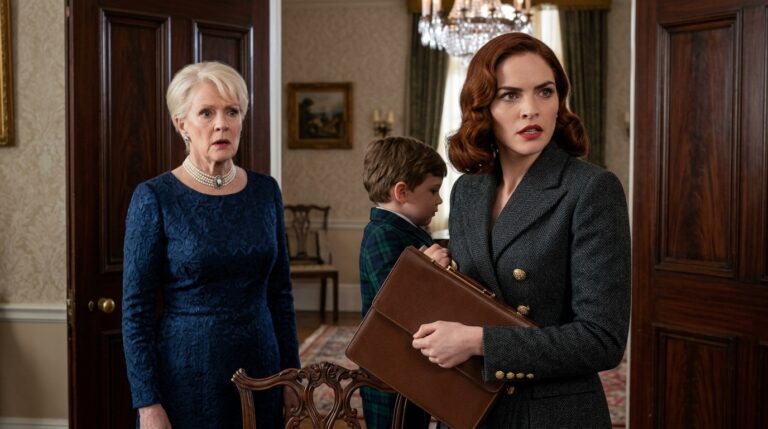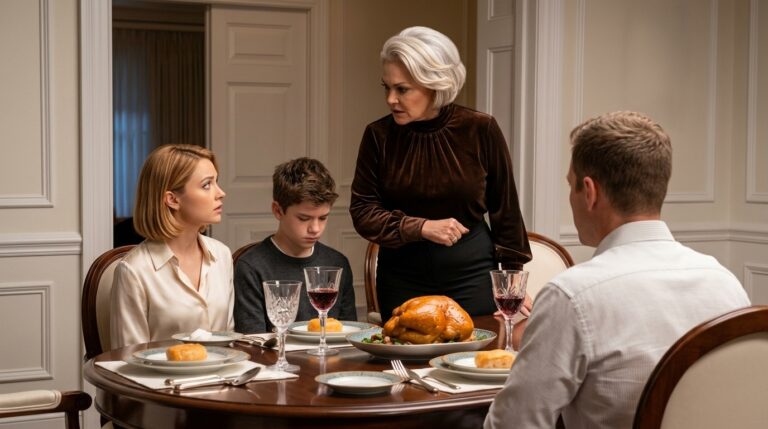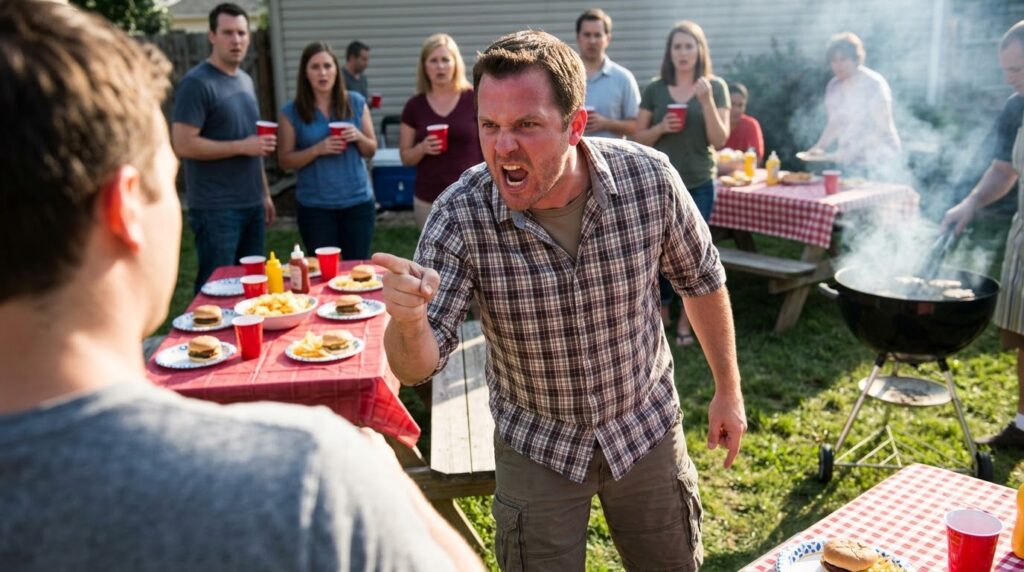
“Clean this mess up and get out of here,” my brother-in-law shouted after slapping me just because I accidentally brushed against his shoulder at the barbecue; my sister looked at the red mark on my face, walked straight over to stand beside her husband, and coldly told me to apologize or get out, so I left behind the tray I had bought—and a few hours later, they were the ones standing frozen in front of three people waiting outside their house.
Daniel’s hand struck my face before the tray even reached the ground.
For one second, the entire backyard went silent.
Paper plates stopped moving. The grill hissed behind us. Lemonade spread across the patio stones and soaked through my shoes.
Daniel stepped closer, his jaw tight.
“Don’t you ever touch me again.”
I pressed one hand to my cheek.
“I didn’t.”
I had only brushed against his shoulder while carrying drinks through the crowded yard.
“Clean this mess up,” he snapped, pointing at the cups scattered around my feet. “And get out.”
Everyone had seen it.
My cousins. My aunt. My uncle. My sister.
But nobody moved.
Then Melissa walked toward us.
Not to check my face. Not to ask what had happened. Not even to look at the tray lying beside my shoes.
She walked straight over to Daniel and stood beside him as though he were the one who had been wronged.
“Apologize to him,” she said.
I stared at her.
“Melissa, he hit me.”
Her eyes hardened.
“Apologize or leave.”
I looked around the barbecue I had helped prepare that morning.
The folding tables I had carried outside. The trays of food. The decorations I had bought after Melissa told me money was tight again.
My throat tightened, but my voice remained steady.
“No.”
A few people lowered their eyes.
Someone bent down and quietly picked up a cup.
Daniel gave a short, satisfied laugh, as though my refusal had proved whatever he had already decided about me.
Melissa stepped aside and pointed toward the gate.
“Then leave.”
I walked across the backyard while my cheek burned and my hands shook.
Behind me, Daniel muttered, “Always playing innocent.”
Nobody followed.
At my car, I struggled to fit the key into the door. My phone buzzed once inside my pocket, but I barely noticed it.
Through the fence, the barbecue slowly began again.
Chairs scraped against the patio. Someone forced a laugh. Daniel’s voice rose above the others, calm and confident now that I was gone.
I sat behind the steering wheel and looked back at the house.
My own sister had watched her husband humiliate me in front of the entire family, then demanded that I apologize to him.
And everyone else had allowed the afternoon to continue.
I drove home without turning on the radio.
At every traffic light, the rearview mirror caught the faint red mark on my face. I touched it once, then quickly lowered my hand.
“I didn’t even do anything,” I whispered.
My phone buzzed again.
I ignored it.
By the time I reached my townhouse, the anger had settled into something heavier.
Exhaustion.
I placed my keys on the kitchen counter and leaned against it. Beside the coffee maker sat an old framed photograph of Melissa, our grandfather, and me smiling in his garden.
Back then, Melissa used to put her arm around my shoulders and call me her favorite little sister.
When she returned to work after having her first child, I watched the baby almost every afternoon for nearly a year. I never accepted payment.
When Daniel was out of work and Melissa called me crying, I quietly covered two overdue utility bills.
“No one can know,” she had said.
“They won’t,” I promised.
I never mentioned the money again.
At birthdays, holidays, and family gatherings, I was always the one who arrived early. If decorations needed hanging, I hung them. If dessert was missing, I drove across town to buy it. If Grandpa needed a ride, I canceled my own plans.
I had become the person everyone relied on.
And somehow, the easiest person to dismiss.
Daniel’s behavior had not begun that afternoon.
For years, his remarks had arrived as jokes small enough for everyone to excuse.
“You still single?”
“You work too much.”
“You always try too hard.”
Whenever I looked uncomfortable, Melissa gave the same answer.
“That’s just Daniel.”
Over time, everyone else learned to say nothing too.
I had spent years convincing myself that swallowing one more insult was the price of keeping the peace.
That afternoon showed me what their peace actually required.
My phone vibrated for the third time.
This time, I picked it up.
There was one new voicemail.
I stared at the unfamiliar number for several seconds before pressing play.
“Good afternoon, Ms. Carter. This is Michael Harper from Harper and Lowe Estate Attorneys. Please return my call as soon as possible regarding the occupancy agreement connected to your grandfather’s estate. This matter requires your immediate attention.”
The message ended.
I stood very still in my kitchen.
The wall clock ticked over the sink. Outside, someone rolled a trash bin down the sidewalk. The ordinary sounds made the voicemail feel heavier.
I had known the call might come someday.
I just had not expected it to come while the side of my face still burned.
Six months earlier, Grandpa Harold had asked me to drive him to Harper and Lowe after one of his appointments. He had worn his brown cardigan even though the day was warm, and he had carried a manila envelope on his lap with both hands.
At the office, he asked me to wait in the lobby.
When he came back out, Michael Harper walked beside him.
Michael was in his early fifties, with silver at his temples and the careful voice of someone accustomed to delivering news people did not want to hear.
“Your grandfather would like you to join us for the last part,” he had said.
Inside the conference room, Grandpa slid a document toward me.
The house on Briar Lane—the one where Melissa and Daniel now lived—had belonged to him for nearly forty years. It was where Melissa and I spent summers as children. It was where Grandma taught us to roll pie crust. It was where Grandpa still kept pencil marks inside a pantry door showing how tall we had been at different ages.
After Grandma was gone, the house had become too large for him.
Melissa and Daniel had been renting a cramped duplex at the time. Their landlord raised the rent, Daniel had just started another temporary job, and Melissa called Grandpa crying.
Grandpa allowed them to move into the house while he relocated to a smaller apartment near his medical center.
Everyone assumed he had given the house to Melissa.
Grandpa never corrected them.
What none of them knew was that he had transferred the deed to me.
I had not asked him to.
When Michael explained it, I pushed the papers back.
“Grandpa, no.”
He placed one hand over mine.
“I know what I’m doing, Lizzie.”
“Melissa thinks the house will be hers.”
“Melissa thinks many things become hers if she stands near them long enough.”
I almost laughed, but Grandpa did not.
He looked tired that afternoon. Smaller than he had looked even a month earlier.
“I am not leaving you the house because you drove me to appointments,” he said. “I’m leaving it to you because you know the difference between caring for something and claiming it.”
I told him Melissa would be hurt.
He nodded.
“That is why she and Daniel can remain there under an occupancy agreement. They will have time. They will pay the utilities and maintain the property. No rent for the first two years. After that, they can make other arrangements.”
I read the first few pages but stopped when the language became dense.
Michael turned the document to a highlighted section.
“There are behavioral conditions,” he said. “Your grandfather was specific.”
I remember glancing at Grandpa.
He looked toward the window.
Months earlier, Daniel had shouted at me in Grandpa’s kitchen because I moved his cooler away from an electrical outlet. Another time, during a holiday dinner, he grabbed my wrist when I tried to take a serving spoon from him.
He released me almost immediately and laughed.
“Relax. I’m not hurting you.”
Grandpa saw it.
I had pretended not to notice the way his face changed.
Condition Seven of the occupancy agreement stated that Melissa and Daniel’s right to remain in the house could be terminated if either of them harassed, intimidated, threatened, or physically mistreated me.
I hated the clause.
It made the entire arrangement feel like an accusation waiting for evidence.
“Grandpa, this is unnecessary.”
He looked at me for a long moment.
“You always call preparation unnecessary when it protects you.”
I did not know what to say to that.
He squeezed my hand.
“I hope this page never matters.”
Three months later, he was gone.
After the memorial, Melissa talked about repainting the kitchen. Daniel discussed tearing out the garden to make room for a larger patio. I stood beside the polished wooden table in the service room and listened to them discuss the house as if Grandpa had already handed them the keys forever.
Michael had asked whether I wanted the ownership announced immediately.
I said no.
Melissa was grieving. Her children had settled into the school district. Daniel had finally found steady work. I told myself there was no reason to disturb their lives when the agreement allowed them to stay.
Michael warned me that silence could create assumptions.
I said assumptions were easier than conflict.
He did not argue.
Now I stood in my kitchen with the phone in my hand and understood why Grandpa had looked sad when I said that.
I played the voicemail again.
Then I called.
Michael answered on the second ring.
“Ms. Carter.”
“Hi.”
There was a pause.
“Are you all right?”
I looked at my reflection in the dark microwave door.
“No.”
His voice changed, becoming quieter.
“What happened?”
I sat at the kitchen table and told him.
Not dramatically. Not beautifully.
I told him I was carrying a tray. I told him I brushed Daniel’s shoulder. I told him what Daniel did. I told him Melissa made me choose between apologizing and leaving.
Michael asked who had been present.
I listed names.
“Did anyone contact you afterward?”
I checked my messages for the first time.
There were seven.
Aunt Carol: Are you safe?
Cousin Jenna: I’m sorry. I froze.
Uncle Robert: I should have stepped in.
Daniel’s younger brother, Luke: What he did was wrong. I saw everything.
I read the names aloud.
Michael let out a slow breath.
“As I explained when your grandfather’s estate was finalized, the occupancy agreement contains enforceable conditions.”
“I remember.”
“Condition Seven applies to conduct directed toward you.”
“I remember.”
“If the conduct can be verified, you are under no obligation to continue their occupancy.”
My fingers tightened around the phone.
“I don’t want to do this because I’m angry.”
“That is a reasonable concern.”
“I don’t want to become someone who uses a house to punish her sister.”
“Then don’t make the decision based on punishment.”
I closed my eyes.
“What should I base it on?”
“Whether you believe the agreement still serves its purpose.”
The question landed more gently than judgment would have.
Grandpa had created the agreement to give Melissa and Daniel time to stabilize their lives.
He had not created it to give Daniel a permanent stage.
He had not created it so Melissa could turn Grandpa’s house into a place where I was ordered to apologize for being mistreated.
“What happens if I enforce it?” I asked.
Michael explained that the agreement permitted immediate termination upon a verified breach, but the firm would still follow proper notice procedures. Daniel and Melissa would not be thrown into the street that evening. They would receive formal notice, supervised access to gather immediate necessities, and a defined period to remove the rest of their belongings.
“The locks can be changed to prevent an escalation,” he said. “Temporary access can be scheduled.”
“Can everything be done legally?”
“Yes.”
I looked again at the photograph beside the coffee maker.
Melissa had been twelve in that picture. I had been nine. Grandpa stood between us, one hand on each of our shoulders.
There had been no Daniel then.
No occupancy agreement.
No one standing in a backyard pretending not to see.
I thought of Melissa’s face when she pointed toward the gate.
There had been no hesitation in it.
“Please move forward,” I said.
Michael did not sound triumphant.
“I’ll begin immediately.”
After the call ended, I remained at the table.
My hands were still shaking, but not in the same way.
For the first time that day, I was no longer trying to understand how little I meant to them.
I was deciding what their behavior meant for me.
Back at the barbecue, Daniel had already rewritten the story.
He stood near the cooler with a soda in one hand while Melissa packed leftovers into plastic containers.
“She came at me from behind,” he said.
Aunt Carol stared at him.
Elizabeth had not come at him from anywhere. Carol had been standing six feet away. She had watched Elizabeth angle her body sideways to squeeze between Daniel and the table.
“She was carrying drinks,” Carol said.
Daniel shrugged.
“She should pay attention.”
Uncle Robert scraped a burger from the grill and placed it on an empty plate. He did not look at Daniel.
Melissa snapped lids onto containers harder than necessary.
“She always does that,” she said.
Carol frowned. “Does what?”
“Acts helpless after she pushes people.”
“She brushed his shoulder.”
“You don’t know what she meant.”
Carol looked at her niece.
There it was.
Not confusion. Not shock. A decision.
Melissa had already chosen the version of events that allowed her marriage to remain intact.
Daniel took another drink.
“I established a boundary.”
Luke, his younger brother, stood by the fence with his arms folded.
“You established it with your hand?”
Daniel’s eyes narrowed.
“Stay out of it.”
Luke had spent most of his life staying out of Daniel’s way. Daniel was six years older and had always spoken to him as if age had made him a permanent authority.
At family dinners, Daniel corrected Luke’s job choices, his clothes, the way he disciplined his son, even the route he took home.
Usually Luke let it pass.
That afternoon, he looked at the wet stain where the lemonade had dried on the patio.
“You hit her in front of everybody,” he said.
Daniel laughed once.
“You’ve always been dramatic too.”
Luke did not answer.
He took out his phone and walked toward the side yard.
Melissa saw him go.
“Who are you calling?”
“No one you need to manage.”
Her mouth tightened.
Daniel watched his brother disappear around the corner, then turned to the remaining guests.
“People are acting like I attacked her for no reason.”
No one responded.
The children had stopped running through the center of the yard. They stayed near the swing set, speaking quietly.
Melissa’s daughter, Sophie, stood on the lowest step of the porch.
At ten, she was old enough to understand that something bad had happened and young enough to believe adults would eventually explain it truthfully.
“Mom,” she said, “why did Aunt Elizabeth have to leave?”
Melissa’s face changed.
“Go play with your brother.”
“But Dad—”
“Now.”
Sophie looked at Daniel.
He pointed toward the grass without speaking.
She walked away.
Carol watched her go.
“You’re going to have to explain this to those children.”
Melissa turned sharply.
“No, I’m not. This was an adult disagreement.”
“Your daughter saw it.”
“Then maybe Elizabeth should have controlled herself.”
Carol placed the plate she was holding on the table.
For years, the family had treated Melissa’s excuses as the softer side of Daniel’s behavior. Daniel was difficult. Melissa kept things together. Daniel said too much. Melissa smoothed it over.
But Carol saw something else now.
Melissa was not smoothing anything over.
She was laying clean fabric across something rotten and asking everyone to admire the table.
“I’m going home,” Carol said.
Melissa blinked. “We haven’t done cake.”
“I don’t want cake.”
Robert turned off the grill.
“We’re leaving too.”
Within fifteen minutes, the yard began to empty.
There were no lingering conversations by the gate. No containers of leftovers passed around with jokes. People gathered purses, children, and folding chairs.
Daniel stood beside the cooler, irritated by the mood.
“What is everybody so quiet about?”
No one answered.
After the last car pulled away, Melissa carried food into the kitchen while Daniel loaded the SUV with the cooler and unused supplies.
“She’ll call tomorrow,” he said.
Melissa wiped the counter with short, fast movements.
“Probably.”
“She always comes around.”
Melissa looked toward the doorway.
The empty yard seemed larger without everyone in it.
“She’ll want to see the kids.”
“Exactly.”
Daniel shut the cooler.
“People like Elizabeth need to be needed. That’s why she does all this.”
“All what?”
“Shows up early. Buys things. Pays for stuff. Then waits for everyone to thank her.”
Melissa did not remind him that they had accepted every bit of it.
“She likes acting generous,” he continued. “It gives her leverage.”
Melissa nodded because agreement was easier than examining the alternative.
If Elizabeth’s help had been genuine, then Melissa had taken genuine love and repaid it by pointing toward a gate.
She sealed the last food container.
“She should not have touched you.”
Daniel glanced at her.
“That’s right.”
The certainty in his voice steadied her.
For ten years, Melissa had built her marriage around avoiding the moment when Daniel’s anger turned fully toward her.
She called it loyalty.
She called it understanding his stress.
She called it protecting the children from unnecessary conflict.
Every name was better than fear.
By the time they left the house where the barbecue had been held—Aunt Carol’s, not their own—Daniel had recovered his good mood.
He drove with one hand on the wheel.
Melissa sat beside him, scrolling through her phone.
The family group chat had gone quiet.
Usually after a gathering, pictures appeared immediately. Children holding paper plates. Daniel at the grill. Melissa beside the flower arrangements. Someone making a joke about leftovers.
That day, there was nothing.
She opened a private message from Carol.
You should call your sister.
Melissa locked the phone.
“What?” Daniel asked.
“Nothing.”
Twenty minutes later, they turned onto Briar Lane.
Daniel slowed the SUV.
A white sedan stood at the curb in front of their house. Behind it was a gray vehicle with a small company logo on the door.
Three people waited near the front walkway.
One was Michael Harper, wearing a navy suit and holding a leather briefcase.
Beside him stood a locksmith with a toolbox on the sidewalk.
The third person held a large sealed envelope.
Melissa leaned forward.
“Are they at the wrong house?”
Daniel gave a short laugh.
“They must be.”
He pulled into the driveway, parked, and climbed out.
“Can I help you?”
Michael stepped forward.
“Good afternoon.”
He handed Daniel a business card.
“My name is Michael Harper. I represent the owner of this property.”
Daniel glanced at the card.
“The owner?”
“Yes.”
“My wife owns this house.”
Melissa got out of the passenger side.
“There must be some mistake.”
Michael looked between them.
“Before we proceed, may I confirm that you are Daniel and Melissa Brooks?”
Daniel folded his arms.
“Yes.”
The courier handed Michael the envelope.
Michael offered it to Daniel.
“This is formal notice concerning your occupancy of the property.”
Daniel looked down at the first page visible beneath the envelope flap.
My name appeared near the top.
His expression changed.
“What is this?”
“Please read the first page.”
Daniel tore open the envelope.
Melissa moved beside him, reading over his shoulder.
At the top of the document were the words NOTICE OF TERMINATION OF OCCUPANCY AGREEMENT.
Daniel laughed, but there was no humor in it.
“This is ridiculous.”
He turned the page.
His eyes stopped.
Melissa reached for the papers.
“What does it say?”
He pulled them away.
Michael waited.
Daniel read the paragraph again, slower this time.
“The legal owner of the property is Elizabeth Carter, pursuant to the recorded deed and final probate order associated with the estate of Harold Carter.”
Melissa stared at him.
“What?”
Daniel looked at Michael.
“This is wrong.”
“It is not.”
“My wife inherited this house from her grandfather.”
“Your wife was granted temporary occupancy under an agreement executed by Mr. Carter and acknowledged by both occupants.”
Melissa’s face went pale.
“I signed something.”
Daniel turned toward her.
“What did you sign?”
“You were there.”
“I sign plenty of things.”
“It was after Grandpa moved.”
Michael opened his briefcase.
He removed certified copies and placed them on the hood of Daniel’s SUV.
“The recorded deed.”
Another page.
“The probate order.”
Another.
“The occupancy agreement bearing both of your signatures.”
Daniel leaned over the documents.
His signature appeared above the date.
He remembered the afternoon vaguely.
Melissa had told him Grandpa needed paperwork signed so they could keep living in the house. Daniel had been in a hurry to leave for a game. He signed where the notary pointed and asked whether they were finished.
He had never read the conditions.
Not because they were hidden.
Because he had assumed nothing concerning the house could matter more than his certainty that it was theirs.
Melissa touched Grandpa’s signature with one finger.
“Why would he give it to Elizabeth?”
Michael’s expression did not change.
“The purpose of today’s notice is to address the occupancy agreement.”
Daniel straightened.
“We live here. You can’t just change the locks.”
“The agreement permits protective measures after a verified breach. You will be allowed supervised access for immediate necessities today and scheduled access for the removal of your property.”
“Verified by who?”
“Multiple witnesses.”
Daniel’s voice sharpened.
“Witnesses to what?”
Michael opened the agreement to a highlighted section.
“Condition Seven.”
Melissa read silently.
Her lips parted.
Daniel took the page from her.
Occupancy shall terminate upon verified harassment, intimidation, threatened harm, or physically abusive conduct directed toward Elizabeth Carter by either named occupant.
He read it twice.
Then he looked up.
“That has nothing to do with today.”
Michael’s voice remained even.
“Our office received consistent statements from several people who attended the gathering.”
“Elizabeth called everybody?”
“No. Several witnesses contacted her independently.”
Daniel laughed.
“You weren’t there.”
“No.”
“Then you don’t know what happened.”
Michael removed a folder.
“I know what Aunt Carol Hayes reported. I know what Robert Carter reported. I know what Jenna Walsh reported. I know what Luke Brooks reported.”
Daniel’s face tightened at his brother’s name.
Michael continued.
“The accounts are materially consistent. Ms. Carter accidentally brushed against you while carrying a tray. You struck her. You ordered her to clean the spilled drinks and leave. Mrs. Brooks then required her to apologize to you or leave the gathering.”
Melissa lowered herself onto the front step.
“I told her to leave.”
Daniel looked at her.
“Don’t start.”
Her eyes stayed on the documents.
“I told her to leave.”
“She was causing a scene.”
“She said one word.”
Daniel stepped closer.
“She knew what she was doing.”
Michael closed the folder.
“The notice has been served.”
Daniel pulled out his phone.
“This is not happening.”
He called Uncle Robert first.
Robert answered.
“Tell this lawyer what actually happened.”
A pause.
Then Robert said, “I already did.”
“You made a statement against me?”
“I told the truth.”
“She pushed me.”
“No, she didn’t.”
Daniel paced toward the sidewalk.
“You’ve never liked me.”
“This isn’t about whether I like you.”
“You stood there and did nothing.”
Robert’s answer came quietly.
“Yes. I did. I’m ashamed of that.”
The line went dead.
Daniel stared at the phone.
He called Carol.
She answered on the second ring.
“What did you tell them?”
“What I saw.”
“You’re taking Elizabeth’s side.”
“I should have taken her side while she was still standing in the yard.”
“You don’t know what happened before the tray fell.”
“I watched it happen.”
Daniel ended the call before she could say more.
He called Luke.
No answer.
He called again.
Voicemail.
Melissa sat on the step with both hands pressed together between her knees.
The locksmith lifted his toolbox and waited for Michael’s signal.
Daniel turned back.
“You cannot lock my children out of their home.”
Michael looked toward the upstairs windows.
“The children may enter with Mrs. Brooks to collect clothing, school materials, medication, and personal items. Additional access will be scheduled.”
“This is their home.”
“It is the property covered by the agreement you signed.”
Daniel pointed toward the house.
“I maintain this place.”
Melissa looked up at him.
The porch railing Grandpa had asked Daniel to repair two summers earlier was still wrapped with gray tape.
The garden beds were dry except for weeds.
The back gutter sagged over the kitchen window.
Daniel called changing lightbulbs maintenance and treated every larger repair as a favor he had not yet decided to grant.
Michael did not mention any of it.
“The documents explain the next steps.”
Daniel took one step toward the front door.
“I’m going inside.”
The locksmith moved forward.
Daniel stopped.
The man did not challenge him or raise his voice. He simply placed the toolbox beside the door, removed a new lock cylinder, and began working.
The first metallic click carried across the quiet street.
Daniel stared at the door.
The house had always obeyed him.
The garage remote opened when he pressed it. The thermostat changed when he touched it. The dining room went silent when his voice rose.
Now a man Daniel had never met was removing his key from the meaning of the place.
“This is because of one argument,” he said.
Michael closed his briefcase.
“No.”
Daniel turned.
“Then what is it?”
“This is because the agreement anticipated conduct your grandfather had already observed.”
Melissa slowly stood.
“What do you mean?”
Michael took out one final document.
“Mr. Carter left written instructions authorizing our firm to explain his reasoning if Condition Seven was ever enforced.”
Melissa looked at Grandpa’s name at the top of the page.
Michael read only part of it.
“Mr. Carter believed Elizabeth should receive the property because she cared for him and the home without treating either as an entitlement. He also wished to give you time to establish stable housing. That is why the agreement allowed your family to remain.”
Melissa’s eyes filled.
“He was helping us.”
“Yes.”
Daniel scoffed.
“So he gave her the house because she drove him around?”
Michael looked at him.
“He gave her the house because he trusted her judgment.”
Daniel said nothing.
“He also documented prior concerns about your temper,” Michael continued. “He hoped the behavioral condition would never be needed.”
Melissa covered her mouth.
A memory returned with humiliating clarity.
Grandpa sitting at the kitchen table while Daniel complained that Elizabeth had moved his cooler.
Daniel had leaned toward me and said, “You need to learn when not to touch other people’s things.”
Grandpa had put down his coffee.
“This is still my house,” he said.
Daniel had laughed afterward.
“He’s getting old.”
Melissa had laughed too.
Now she looked at the porch where Grandpa used to sit every morning.
“He expected this,” she whispered.
“He prepared for the possibility,” Michael said.
Daniel’s shoulders stiffened.
“I never thought she’d actually do it.”
Michael’s reply was quiet.
“She did not create the condition today, Mr. Brooks.”
Daniel frowned.
“You chose the conduct. Ms. Carter chose not to absorb it.”
The locksmith removed the old cylinder.
For the first time that afternoon, Daniel had nothing to say.
Melissa took out her phone and called me.
I watched her name appear on the screen.
I did not answer.
A minute later, a voicemail arrived.
“Elizabeth,” she began.
Her voice cracked after my name.
I almost deleted it without listening.
Instead, I sat at my kitchen table and let the message play.
“I’m sorry. I should have stood beside you. I should have stopped him. I kept choosing peace with my husband instead of doing what was right.”
She stopped to breathe.
“You deserved a sister today. I wasn’t one.”
The message ended.
I placed the phone facedown.
For years, Melissa had apologized in ways that asked me to erase the thing she was apologizing for.
I’m sorry Daniel embarrassed you, but you know how he gets.
I’m sorry we forgot your birthday dinner, but the kids were tired.
I’m sorry I asked you for money again, but family helps family.
This apology was different because she did not defend herself.
But different did not mean enough.
I listened to it once more.
Then I saved it and made tea.
That evening, Aunt Carol came to my townhouse.
She carried the tray from the barbecue.
She had washed it.
The metal surface was clean, but one corner had bent when it hit the patio.
“I thought you might want it,” she said.
I looked at the tray.
“I don’t.”
Carol nodded as if she understood that I was not speaking only about the object.
She set it on the counter anyway.
“I’m sorry.”
I waited.
“I saw his face before he did it,” she said. “I knew he was angry. Then it happened, and I froze.”
“You all did.”
“Yes.”
The honesty hurt more than an excuse would have.
Carol sat across from me at the table.
“I told myself Melissa would step in because she was your sister.”
“So did I.”
“When she didn’t, I thought Robert would.”
I looked at her.
“And Robert probably thought you would.”
Carol lowered her eyes.
“That’s exactly what happened.”
The family had not decided together to abandon me.
They had done something easier.
Each person had waited for someone else to become brave first.
“What happens now?” Carol asked.
“They have to leave the house.”
Her eyes widened, but she did not ask whether I was sure.
“Was it yours?”
“Yes.”
“How long?”
“Since Grandpa transferred it.”
Carol looked toward the photograph beside the coffee maker.
“That explains some things.”
“What things?”
“He asked me once whether Melissa and Daniel treated you well.”
I sat straighter.
“When?”
“Last year. I told him families irritate each other.”
Carol’s face tightened.
“I think he was giving me a chance to tell the truth, and I gave him something polite instead.”
Neither of us spoke for a while.
Before she left, she touched the bent corner of the tray.
“I should have picked this up while you were still there.”
I looked at her hand.
“Yes.”
The following week unfolded without the explosion Daniel seemed to expect.
There was no shouting match in a courtroom. No dramatic public scene.
There were schedules.
Boxes.
Emails.
Michael’s office arranged times for Melissa and Daniel to enter the house and remove their belongings. A representative was present each time. The children were allowed to retrieve everything they needed immediately.
Daniel treated every limit as a personal insult.
He complained about the time slots. He argued that the dining table belonged to him, though Grandpa had purchased it before Daniel met Melissa. He claimed the lawn mower as compensation for “years of property upkeep.”
Michael responded with inventories and receipts.
Daniel disliked paper because paper did not become nervous when his voice rose.
He called me eleven times in two days.
I did not answer.
His messages shifted in tone.
The first was angry.
“You’re taking this too far.”
The second was practical.
“We need at least six months.”
The third was insulting.
“You’ve been waiting for a chance to use Grandpa’s money against us.”
The fourth was almost friendly.
“Let’s be adults.”
The fifth mentioned the children.
“They’re the ones you’re hurting.”
That message nearly worked.
I sat in my car outside the grocery store with my thumb hovering over his name.
Then I remembered Sophie on the porch, watching her father raise his hand and her mother point toward the gate.
Children were already being hurt.
They had simply been taught to call the source of the harm “family peace.”
I forwarded the messages to Michael and blocked Daniel’s number.
Melissa contacted me only once more that week.
She wrote:
I’m not asking you to reverse anything. I just want you to know I understand why you did it.
I read the sentence several times.
Then I replied:
I did not do this because you chose Daniel once. I did it because you have chosen his behavior for years and expected me to pay for that choice.
Three dots appeared.
Disappeared.
Returned.
Finally, she wrote:
You’re right.
It was the first time in years that Melissa agreed with me without attaching a reason I should forgive her.
I did not respond.
Within the family, silence began breaking in uneven places.
Jenna called to apologize.
Robert stopped by with a written statement he had already provided Michael.
Luke sent one message.
I should have challenged him years ago.
I thanked him for telling the truth.
I did not tell any of them that the statements had saved me.
The agreement itself had existed. The ownership documents were clear. Michael could have enforced the condition with formal evidence gathered later.
But their statements mattered for another reason.
At the barbecue, their silence had made Daniel look powerful.
On paper, their honesty made him look exactly as he had been.
A man surrounded by witnesses who had finally stopped protecting him.
Daniel’s place in the family changed quickly.
Not through a formal announcement.
People simply stopped inviting him.
Carol hosted a birthday dinner and invited Melissa and the children, but not Daniel.
Robert organized a fishing weekend and did not include him.
Luke stopped answering his brother’s daily calls.
Daniel complained that everyone had been manipulated by me.
But I had not asked anyone to exclude him.
For the first time, they were making decisions without waiting for me to absorb the discomfort.
Melissa and Daniel moved into a rental house across town.
The place was smaller than Briar Lane, with a narrow driveway and no garden.
During their final supervised visit, Melissa stood alone in Grandpa’s kitchen.
Most of the cabinets were empty.
On the pantry door, the pencil marks were still there.
MELISSA—AGE 8.
ELIZABETH—AGE 5.
SOPHIE—AGE 4.
Melissa ran one finger over the lines.
Daniel called from the hallway.
“Are you coming?”
She wiped her face.
“In a minute.”
He appeared in the doorway.
“We’re paying by the hour for the truck.”
Melissa looked at him.
For once, she did not hurry.
“This was never ours.”
Daniel rolled his eyes.
“We lived here.”
“That isn’t what I said.”
He stepped into the kitchen.
“Don’t start acting like Elizabeth’s version is the truth.”
Melissa looked at the pantry door again.
“It is the truth.”
Daniel’s face hardened.
“She set us up.”
“No. Grandpa wrote the condition before he was gone.”
“Because she got into his head.”
“She didn’t tell anyone the house was hers.”
“That proves she was waiting.”
“It proves she didn’t throw it in our faces.”
Daniel laughed.
“You’re defending her now?”
Melissa turned toward him.
“I defended you when I shouldn’t have.”
The words hung between them.
Daniel lowered his voice.
“Be careful.”
In the past, that tone would have ended the conversation.
Melissa would have looked toward the children, the neighbors, the clock—anything that gave her an excuse to postpone the truth.
This time, she stared at him.
“You said that to me before.”
He frowned.
“What?”
“Not those exact words. That voice.”
Daniel stepped back.
“You’re emotional.”
“No.”
She looked around Grandpa’s kitchen.
“I’ve been calling fear loyalty for a long time.”
Daniel picked up the last box.
“I’m taking this outside.”
He walked away before she could say more.
Melissa remained by the pantry door until the moving company representative told her their time was over.
A month after the barbecue, Michael handed me the new keys.
We stood on the front porch at Briar Lane.
The railing still shifted beneath the hand.
“Your grandfather left a repair estimate in the property file,” Michael said.
“Of course he did.”
“He was thorough.”
“He was stubborn.”
Michael smiled.
“That too.”
Inside, the house felt strange.
Not empty.
Interrupted.
Rectangles of cleaner paint marked where pictures had hung. Dust outlined the furniture that was gone. A single child’s hair tie lay near the stairs.
I picked it up and placed it on the kitchen counter.
The pantry door was open.
I stood in front of the pencil marks and found my own name.
ELIZABETH—AGE 5.
Beside it, in Grandpa’s handwriting, was a tiny note I had never noticed.
WOULD NOT STAND STILL.
I laughed.
Then I cried.
Not because I had won.
There was nothing victorious about standing in a house that had cost me the last illusion I carried about my sister.
I cried because Grandpa had known me before I learned to make myself smaller.
Before I mistook usefulness for belonging.
Before every family gathering became a test of how much disrespect I could swallow without ruining the day.
I repaired the porch railing first.
Then the gutter.
I hired someone to restore the garden beds rather than tear them out. We planted marigolds where Grandpa used to grow tomatoes and left one section open for vegetables the following spring.
Inside, I painted the kitchen the warm cream color Grandpa once pointed to in a hardware store.
“That would make morning light look kind,” he had said.
I had forgotten the sentence until the first coat dried.
I did not move into the house immediately.
For several weeks, I visited after work, opened windows, sorted old tools in the garage, and sat on the back steps with coffee.
The silence changed gradually.
At first it held Daniel’s voice.
Then Melissa’s.
Then the scrape of chairs from the moment the barbecue continued without me.
Eventually, it became only silence.
By the end of summer, Aunt Carol asked whether I would consider hosting a small family cookout.
My first answer was no.
The word came easily now.
Carol nodded.
“All right.”
She did not pressure me.
A week later, I called her.
“Small,” I said.
“Small.”
“No Daniel.”
“I understand.”
“And nobody pretends the last barbecue did not happen.”
Carol was quiet.
“We won’t.”
The gathering took place on a Sunday afternoon.
Robert brought corn. Jenna brought fruit salad. Luke came with his son and stood awkwardly near the gate until I invited him in.
Melissa arrived with Sophie and her younger brother.
She did not bring Daniel.
When she stepped into the yard, she looked toward the place where the tray had fallen.
I saw her notice it.
She walked over to me.
“Thank you for letting the kids come.”
“They love this house.”
“So do I.”
The sentence could have been a claim.
It was not.
She looked toward the garden.
“You fixed Grandpa’s railing.”
“Yes.”
“He asked Daniel to do that.”
“I know.”
Melissa lowered her eyes.
“I kept thinking there would be time.”
“For the railing?”
“For everything.”
I did not rescue her from the sentence.
Sophie ran toward me and wrapped both arms around my waist.
“I missed you.”
I held her.
“I missed you too.”
Over her shoulder, Melissa wiped beneath one eye.
The barbecue was quieter than the old gatherings.
Not tense.
Careful.
People listened when others spoke. No one laughed at someone else’s expense. When Luke accidentally knocked a cup from the table, three people reached for napkins.
He looked at me.
For a second, both of us remembered.
Then he said, “I’ve got it.”
And cleaned the spill himself.
Near sunset, Carol handed me a plate of grilled vegetables.
“Your grandfather would be proud.”
I looked around the yard.
At the repaired railing.
At Sophie drawing with chalk on the patio.
At Luke helping Robert fold a table.
At Melissa sitting alone beneath the maple tree, not forgiven, not banished, simply facing what remained after excuses stopped working.
The bent tray rested on a shelf inside the kitchen.
I had kept it after all.
Not because it was valuable.
Because the damaged corner told the truth about that afternoon.
Something had fallen.
Something had been bent.
And no amount of washing could make it exactly what it had been before.
But it could still carry something.
I set my plate on it and walked outside.
Leaving that first barbecue had not been the moment I lost my family.
It was the moment I stopped accepting a version of family that required me to disappear whenever someone stronger wanted the room.
Grandpa had not left me a weapon.
He had left me a door.
For years, I had believed love meant holding it open no matter who walked through.
That summer, I finally learned I was allowed to decide when it closed.
Disclaimer: This story is fictional and created for entertainment purposes only. Any names, characters, places, or events are fictitious or used fictitiously. No real person or organization is intended to be portrayed.