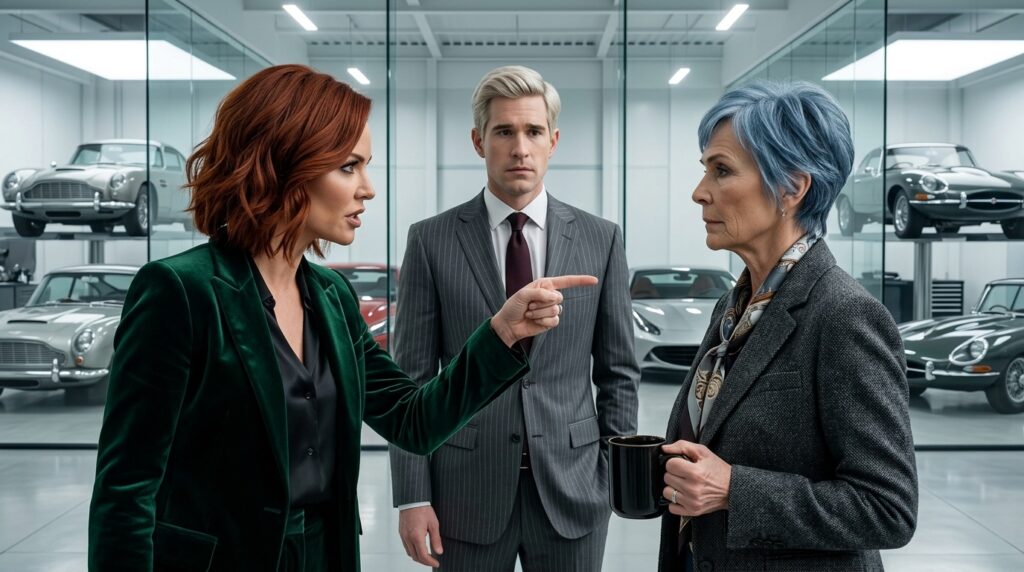
“Take her key fob and lock her out of the VIP suite—she looks like a valet driver who took a wrong turn into the showroom.”
My daughter-in-law, Brittany, didn’t even care to lower her voice. Her words echoed off the floor-to-ceiling glass of the flagship Manhattan luxury dealership, cutting right through the quiet jazz and murmurs of high-net-worth buyers.
She was standing next to a brand-new, six-figure electric supercar, draped in a mink coat she’d charged to my son’s account last month. She had invited city council members, press, and high-profile influencers to celebrate her appointment as the brand’s main brand ambassador and regional partner.
I was sitting quietly in a leather armchair in the corner, wearing my worn flannel shirt, grease-stained denim jacket, and work boots. I’d driven two hours in my old Ford to bring my son, Tyler, the original title deed to his first auto shop. Brittany scoffed, waving a hand in front of her nose like I smelled of exhaust fumes.
“Honestly, Tyler, I don’t know why you let her come,” Brittany said loudly, turning to the camera crew filming her live stream. “She’s ruining the aesthetic of our launch. Someone call security to clear the lobby before the mayor arrives.”
I looked at Tyler. He swallowed hard, his face flushed red under the bright showroom lights. He knew I ran a commercial fleet company for thirty years and funded his entire dealership network. But instead of saying a word, he stared down at his Italian leather shoes, completely silent, letting his wife humiliate me in front of fifty wealthy guests and a live internet audience.
Brittany smirked, snapping her fingers at a valet. “Hand her a twenty and tell her to wait by the curb.”
I didn’t argue. I didn’t raise my voice. I calmly took a sip of my black coffee, stood up, and pulled a black leather folio from my jacket.
“You’re right, Brittany,” I said, my voice quiet but carrying effortlessly across the silent room. “Image is everything in the automotive business.”
I pulled out my phone and dialed my managing director on speaker.
“Harrison,” I said clearly. “You know the master distribution rights and property lease for this Manhattan flagship location?”
“Yes, Mrs. Vance,” Harrison’s sharp voice rang out from the speaker. “Vance Commercial Holdings owns the real estate and controls the regional dealership franchise license.”
“Terminate the franchise agreement immediately,” I instructed, looking straight into Brittany’s eyes. “Lock down the inventory, revoke her brand ambassadorship, and repossess every demo vehicle on the floor by nightfall.”
Brittany’s smug expression shattered. “What? You can’t do that! My investors are on their way!”
“I am the investor, Brittany,” I replied softly. “Vance Commercial Holdings isn’t a third-party group. It’s my company. I own the land under this building, the cars on this floor, and the credit line paying for that mink coat.”
The entire showroom went dead silent. The live stream camera operators lowered their rigs.
I adjusted my denim jacket, patted Tyler’s paralyzed shoulder, and turned to leave. Behind me, Brittany’s phone began screaming with notifications as the dealership’s corporate credit cards declined, her face turning as white as the marble floor under her feet.
PART 2 — The Silence That Cost My Son Everything
I had taken only three steps toward the revolving glass doors when Brittany finally found her voice. It wasn’t the polished, honeyed tone she used for cameras. It was shrill, raw, almost childish. “Stop her!” she shouted. “She’s bluffing. Tyler, tell everyone she’s bluffing.” I kept walking until I heard the one voice I had been waiting for.
“Mom.”
I stopped, but I didn’t turn around immediately. For thirty-seven years, that word had been enough to make me drop anything. A wrench. A contract. A meal. Sleep. Pride. I had answered Tyler when he called from kindergarten, college, his first failed business loan, and the hospital the night his daughter was born. This time, I made him wait three seconds.
When I finally turned, Tyler looked smaller than he had ten minutes earlier. His expensive suit suddenly seemed like a costume someone had dressed him in. Behind him, Brittany stood frozen beside the electric supercar, one manicured hand pressed against its roof as though touching six figures of polished machinery could somehow transfer ownership into her bloodstream.
“Tell her,” Brittany demanded. “Tell your mother she can’t walk in here and destroy our company because she got offended by a joke.” Several guests shifted uncomfortably. One of the camera operators, who had lowered his rig earlier, quietly raised it again. Brittany noticed. Her posture changed instantly. Even cornered, she remembered the audience.
I looked at her and almost admired the reflex. Almost. “A joke?” I asked. “Which part was the joke? The part where you called me a valet driver? The part where you ordered someone to hand me twenty dollars? Or the part where you asked security to throw me out of a building I paid forty-eight million dollars to acquire?”
A low murmur moved through the showroom. Brittany’s eyes flicked toward the guests, calculating damage. “You’re twisting my words,” she said quickly. “I was protecting the brand environment. That is literally my job.” Then she smiled at the nearest camera, as if she had just discovered a path out. “Luxury requires standards. Everyone here understands that.”
“No,” a gray-haired man near the champagne tower said. “I understand manners.” I recognized him as Arthur Bell, an investor Brittany had spent months trying to impress. He placed his untouched glass on a tray. “And if Mrs. Vance owns the property and the distribution rights, I’m beginning to wonder exactly what you told us you owned.”
Brittany’s expression tightened. “Arthur, this is a private family misunderstanding.” He gave her a tired smile. “You invited three reporters, two council members, forty influencers, and a livestream crew. You surrendered the right to call this private sometime between the velvet ropes and the ice sculpture.” A nervous laugh rippled through the room.
My phone buzzed. Harrison had sent one message: FRANCHISE SUSPENSION INITIATED. LEGAL TEAM EN ROUTE. DO NOT SIGN ANYTHING. I read it, locked my phone, and slipped it into my pocket. Brittany watched every movement. “You planned this,” she whispered. “You came here dressed like that because you wanted to humiliate me.”
That one almost made me laugh. I glanced down at my old denim jacket. The left cuff still had a burn mark from an engine fire in 2004. “I dressed like this because I was repairing a diesel pump at five this morning,” I said. “Some of us still work inside the businesses we claim to understand.”
Her cheeks flushed. “You think grease under your nails makes you morally superior?” “No,” I said. “But thirty years of payroll, debt, lawsuits, breakdowns, employee funerals, recessions, and twelve-hour shifts taught me something your branding seminars apparently skipped.” I stepped closer. “Never confuse appearing successful with building something that can survive you.”
Tyler closed his eyes for a moment. He had heard versions of that sentence his whole life. When he was nineteen, I made him work six months in dispatch before I allowed him into management. At twenty-four, I refused to guarantee his first luxury showroom until he could explain cash flow without looking at a spreadsheet.
Brittany, however, had never heard “no” from Tyler for longer than forty-eight hours. She turned on him now. “Say something.” Tyler opened his mouth. Nothing came out. “Say something!” she repeated. “Your mother is threatening our employees, our investors, our future, because she couldn’t handle being asked to leave one room.”
That finally made me angry. Not because of what she said about me, but because she had dragged the employees into it. “Every employee’s paycheck is protected,” I said. “Harrison has already ring-fenced payroll and benefits. No technician, receptionist, salesperson, cleaner, valet, or porter will lose a dollar tonight because of your behavior.”
Brittany blinked. She hadn’t expected that. Neither had half the room. I continued, “The people who actually work here are not collateral damage. The suspension applies to executive authority, promotional spending, vehicle movement, and franchise representation.” I looked directly at her. “Your title is frozen. Their livelihoods are not.”
Arthur Bell nodded slowly. One of the reporters typed rapidly into her phone. Brittany’s carefully constructed story—that an emotional old woman was burning down a business out of spite—had just lost its easiest victim. Her mouth opened, then closed. For the first time that afternoon, she had no sentence ready for the camera.
That was when the elevator doors opened. Three people stepped out: Harrison, our corporate counsel Naomi Price, and Daniel Cho, the head of internal audit. Harrison was sixty-two, silver-haired, and so calm that people often underestimated him until they discovered he had already read every document they were hoping to hide.
“Mrs. Vance,” he said. “The regional license has been placed under temporary administrative control.” Then he looked at Tyler. “Mr. Vance, all executive access has been suspended pending review.” Tyler’s head snapped up. “Mine too?” Harrison’s face did not change. “All executive access means all executive access.”
Brittany actually laughed. “Good. There. See?” she said, turning toward Tyler. “Your mother is punishing you too. Finally understand what she’s doing?” Tyler looked at me, hurt spreading across his face. “Mom, why am I locked out?” I studied the son I had spent decades protecting from consequences.
“Because you were standing beside her,” I said. “Not when she insulted my clothes. Not when she called me a valet.” I pointed toward the showroom around us. “You were standing beside her while she represented herself as controlling assets she does not own, using a brand license she does not control, while spending corporate money without answering basic questions.”
Tyler’s confusion looked genuine. That worried me more than guilt would have. “What questions?” he asked. Harrison glanced at Naomi. She opened a slim folder. “Over the past eight months,” she said, “regional promotional expenses have increased two hundred and eighty percent. Several payments were routed through outside lifestyle consulting companies.”
Brittany went perfectly still. It was subtle, but I saw it. Daniel saw it too. “That’s normal,” she interrupted. “We expanded marketing.” Daniel looked at her. “One of those companies shares a mailing address with your personal stylist.” The room seemed to shrink around us. Tyler stared at his wife.
“That proves nothing,” Brittany said quickly. “Creative agencies share addresses all the time.” Daniel nodded. “Perhaps. Another vendor was incorporated eleven months ago by your college roommate.” Brittany folded her arms. “And?” “And that vendor received four hundred and twelve thousand dollars for regional influencer strategy without submitting a measurable campaign report.”
Phones came up across the showroom like flowers turning toward sunlight. I hated that part. However angry I was, I did not enjoy watching private betrayal become public entertainment. “Turn the livestream off,” I told the camera crew. Brittany whipped around. “No! Keep it running.” I looked at the producer. “This is private corporate review now.”
The producer hesitated, then signaled his operators. Red lights went dark. Brittany stared at me as though I had stolen her oxygen. She wanted witnesses when she believed they favored her. Now that facts were arriving, she wanted the performance more than ever. “You can’t control what people record on their phones,” she said.
“No,” I replied. “And neither can you.” That landed harder than I expected. Around us, several guests quietly lowered their devices anyway. There was suddenly something indecent about filming. The spectacle had stopped being glamorous. We were no longer watching an arrogant executive get embarrassed. We were watching a marriage discover it might contain financial secrets.
Tyler turned toward Brittany. “Did you hire Madison’s company?” She exhaled sharply. “Madison is qualified.” “That wasn’t my question.” His voice cracked slightly. Brittany softened her expression immediately. “Baby, we talked about expanding my team. You told me I should stop asking permission for every decision.” Tyler frowned. “Four hundred thousand dollars is not a decision. It’s a department.”
She reached for his hand. He pulled it back. I watched something move across her face—not heartbreak, exactly, but offense. She had expected loyalty as an automatic service. Maybe that was why she had mistaken my silence for weakness earlier. Some people spend so long surrounded by compliance that they begin to believe obedience is evidence they are right.
Naomi cleared her throat. “There is another issue.” I looked at her. I had not known about this one. “Three weeks ago, an application was submitted to extend the Manhattan property lease from the operating company to a newly formed management entity.” She paused. “The application contains Tyler’s electronic signature.”
Tyler turned pale. “What management entity?” Naomi handed him a printed page. He scanned it. His jaw tightened. “B&K Luxury Management?” Brittany’s voice became careful. “It was a restructuring proposal. We discussed restructuring.” Tyler looked up. “Who is K?” Nobody spoke. Brittany’s fingers tightened around the belt of her mink coat.
Daniel answered. “Kenneth Rowe.” I knew the name vaguely. A nightlife promoter who had appeared in photographs with Brittany at charity events. Tyler clearly knew him better. His face hardened. “Ken?” Brittany stepped forward. “Don’t do this here.” “You used my signature to create a management company with Ken Rowe?”
“I did not use your signature,” she snapped. “You gave me access to DocuSign.” Tyler stared at her. “To sign routine marketing approvals while I was traveling.” “And this was routine.” “Transferring control of a forty-eight-million-dollar property lease into a company I didn’t know existed is not routine!”
The argument exploded so suddenly that several guests moved toward the exits. I lifted my hand. “Enough.” They both stopped, more from old instinct than respect. “No one accuses anyone of forgery in a showroom,” I said. “The audit will determine what was authorized, what wasn’t, and who signed what.”
Brittany turned on me. “Of course. Because this is what you wanted.” Her eyes were wet now, but the tears came with anger. “You never accepted me. From the first day Tyler introduced us, you treated me like I was trying to steal something.” I felt every eye in the room return to me.
There was some truth buried inside the accusation, and truth is dangerous precisely because it gives lies something solid to stand on. I had not trusted Brittany. Not because she came from less money, as she often suggested. I came from less money than anyone in that showroom. I mistrusted her because every conversation with her eventually became a transaction.
Still, I answered carefully. “I gave you a seat on the regional marketing committee. I approved your first two campaigns. I put you in front of the manufacturer’s national team when they didn’t know your name.” Brittany laughed bitterly. “You never gave me anything without reminding me it belonged to you first.”
I nodded. “Because it did belong to me first.” The room went silent again. “Not forever. That was the point. I wanted Tyler to inherit a healthy company, not a fantasy funded by debt and appearances.” I looked at my son. “I thought I was building a bridge for you. I didn’t realize you were decorating it while someone removed the bolts.”
Tyler stared at the floor. That hurt more than Brittany’s insults ever had. For months, maybe years, he had chosen peace inside his marriage over honesty inside the company. I could understand the temptation. I could even forgive fear. But I could not pretend fear became responsibility simply because it wore a suit.
Naomi asked the remaining guests to leave. Staff escorted them gently toward the elevators and front doors. Arthur paused near me. “For what it’s worth,” he said quietly, “she told several of us the Manhattan site would soon be controlled entirely by the next generation.” I thanked him. “Did she say when?”
“After the family transition,” he replied. “I assumed that meant you were retiring.” He looked embarrassed. “She made it sound agreed.” I glanced toward Brittany. She was pretending not to listen. “There has been no family transition,” I said. Arthur nodded once. “Then I think you have a larger problem than tonight’s insult.”
When the doors finally closed behind the last guest, the showroom felt enormous. Without the music, conversations, and flashing cameras, I could hear the climate system humming above us. The champagne tower still glittered under spotlights. A ten-foot banner displayed Brittany’s face beside the words: THE FUTURE OF LUXURY HAS ARRIVED.
Harrison followed my eyes. “Do you want that removed?” he asked. “Not yet,” I said. Brittany gave me a strange look. “Why not?” I walked toward the banner and stood beneath her enormous photographed smile. “Because everyone in this room should remember how easy it is to mistake advertising for reality.”
Tyler rubbed both hands over his face. “Mom, what do you want?” It was a simple question, but I had been waiting years to hear it asked sincerely. Not what did I want to spend. Not what did I want him to sign. Not what did I want for Christmas. What did I want from him?
“I wanted you to speak,” I said. He dropped his hands. “Back when?” “Twenty minutes ago.” I pointed toward the chair where I had been sitting. “Before Harrison. Before the audit. Before any of this. I wanted my son to say, ‘Don’t speak to my mother that way.’ Five seconds. Seven words.”
His face crumpled slightly. “I froze.” “I know.” “Brittany was live. There were investors. The mayor’s office was coming. I thought if I corrected her in front of everyone—” “You thought embarrassing your wife would be worse than humiliating your mother.” He didn’t answer. He didn’t have to.
Brittany stepped between us. “This is emotional blackmail.” I looked at her. “No. Emotional blackmail would be threatening to withdraw love unless he obeys me.” I turned back to Tyler. “I love you whether you become CEO or spend the rest of your life changing tires. But love does not entitle you to control my company.”
Tyler’s eyes filled. Brittany scoffed. “There it is. Control.” She turned toward him. “She will always hold the money over your head. She will never see you as a man while she owns everything.” For the first time all evening, I saw the sentence work. Tyler’s jaw tightened. Old resentment surfaced.
I knew that resentment. Success casts long shadows over children. Tyler had grown up hearing people call him lucky, privileged, the owner’s son. Every achievement was treated as inherited. I had tried to make him work harder because of it, but perhaps my solution had created a different wound. He wanted something nobody could say his mother had given him.
“Is that what you believe?” I asked. He looked away. “Sometimes.” That single word hurt worse than Brittany calling me a valet. “Sometimes I feel like none of this is mine,” he continued. “Every lease, every credit line, every major decision eventually leads back to your signature.”
I nodded slowly. “That is because every major debt eventually leads back to my collateral.” He looked at me. “I wanted you to own these businesses, Tyler. But ownership is not a ceremony. You asked me to guarantee expansions before the first stores were profitable. You wanted freedom without first removing the risk from my shoulders.”
His eyes reddened. “So what now?” I took the black leather folio from under my arm and placed it on the hood of a sedan. Inside was the document I had driven two hours to give him: the original title to his first auto shop, a small brick building in New Jersey.
“I came here to give you this,” I said. Tyler recognized it immediately. His mouth parted. Years ago, he had signed a purchase agreement for that property, but I had quietly paid off the remaining lien after his business survived its first recession. Today, I had intended to transfer my final legal interest to him.
Brittany moved closer. “Then give it to him.” Her urgency was too fast. Too sharp. I looked at her. “Why?” “Because it’s his.” “You didn’t know what was in the folder five seconds ago.” Her expression changed. Tyler looked from her to me. Something clicked behind his eyes.
I opened the folio but kept my hand over the document. “When I arrived, Brittany asked security to remove me before I could give this to you.” Tyler swallowed. “Mom—” “Maybe that saved us all.” I closed the folder again. “Because after tonight, I am not transferring anything until the audit is complete.”
Brittany lunged verbally before Tyler could respond. “You’re stealing his property!” Naomi spoke calmly from behind her. “Mrs. Vance cannot steal property currently titled to Mrs. Vance.” Brittany spun around. “Stay out of this.” Naomi raised one eyebrow. “You invited corporate assets into your marriage. Corporate counsel is already in it.”
Tyler stared at the folio. I could see years of memory in his expression—the old shop with the leaking roof, the crooked office door, the winters when the heater died, the first month he sold enough vehicles to pay everyone without my help. That place mattered to him because he had suffered there.
“I don’t want it tonight,” he said finally. Brittany turned toward him in disbelief. “What?” He took a shaky breath. “I said I don’t want it tonight.” Then he looked at me. “Not like this.” For the first time since I entered the showroom, I saw something in my son that looked like the boy I raised.
Brittany stared at him as though he had betrayed her. “Do you hear yourself? She just shut down our flagship.” “Our flagship?” he asked quietly. “Brittany, how much of it do we actually own?” She recoiled. “That is exactly what she wants you asking.” “No,” he said. “It’s what I should have asked a year ago.”
Her face changed completely. The tears vanished. “Fine,” she said. “You want numbers? Let’s talk numbers. I built this brand. Before me, your dealerships were glorified warehouses with coffee machines.” Harrison looked offended. I nearly smiled. Tyler didn’t. “You improved the marketing,” he said. “That doesn’t mean you built everything.”
“I made people care,” she snapped. “I made us aspirational. I got athletes, actors, designers, politicians into these rooms.” Tyler nodded. “And apparently Ken Rowe into a management company.” Silence fell. Brittany’s eyes flashed. “You think I’m sleeping with him?” “I didn’t say that.” “You wanted to.”
I stepped between them before the argument could become uglier. “Enough. Personal accusations stop now. Audit first. Conclusions later.” I looked at Brittany. “You will receive copies of every document concerning your authority and spending. You may retain counsel. No one will interfere with your personal accounts.”
She laughed without humor. “How generous.” “It isn’t generosity. It’s procedure.” I had survived too many lawsuits to confuse anger with evidence. If Brittany had broken rules, the records would show it. If she hadn’t, I would not manufacture wrongdoing merely because she had humiliated me. That distinction mattered, especially when nobody else in the room felt calm.
Harrison’s phone rang. He answered, listened, then looked at me. “The manufacturer’s national office has acknowledged the temporary suspension. They’re sending a compliance team tomorrow morning.” Brittany’s color drained. “Tomorrow?” “Nine o’clock.” “I have a television interview at nine.” Harrison’s expression remained polite. “I suspect your schedule has changed.”
She looked at Tyler. “We’re leaving.” He didn’t move. “Tyler.” “I’m staying.” Her mouth opened. “Excuse me?” He removed his dealership access badge from his jacket and set it on the reception desk. “If my authority is suspended, then I’m staying to answer whatever questions they have.”
Brittany stared at him for several seconds. Then she whispered, “You coward.” The word landed differently this time. Earlier, silence had made him one. Now she was using the same accusation because he had finally refused to follow her. Tyler flinched, but he stayed where he was.
She turned toward me. “You win.” “This isn’t a game.” “Everything is a game to people like you,” she said. “You get to call your power responsibility because you had it first.” She pulled the mink coat tighter around herself. “Enjoy watching your son crawl back to you.”
She walked toward the elevators, heels striking marble like a countdown. Just before the doors closed, she turned around. “By tomorrow morning,” she said, “everyone in New York will know exactly what kind of mother you are.” Then the doors slid together, leaving her reflection divided by a thin line of steel.
Tyler exhaled. “She’s going online.” “Of course she is,” Harrison said. “Her livestream already has clips everywhere.” Tyler looked panicked. “Mom, we need a statement.” I shook my head. “No emotional statement tonight.” “But she’ll control the story.” “For a few hours,” I replied. “Facts have survived worse things than social media.”
At eleven forty-three that night, sitting in the back office with cold coffee and four decades of contracts spread around us, I watched Brittany’s video appear on my phone. She was crying beautifully beneath soft lighting. Her makeup was flawless. Her voice trembled just enough. The caption read: WHEN FAMILY POWER BECOMES ABUSE.
Tyler watched beside me. Brittany told the internet I had “ambushed” her celebration because I resented a younger woman becoming the public face of the business. She said I had weaponized money to punish independence. She described herself and Tyler as entrepreneurs trapped under the control of a “vindictive family matriarch.”
Then she said something that made Tyler stop breathing. “For years, Tyler has privately told me how desperately he wants freedom from his mother.” The video cut to photographs of them smiling on yachts, at galas, inside dealerships. “Tonight,” she continued, “I finally understood why he has always been afraid to stand up to her.”
Tyler set his phone down. “I told her that once.” I didn’t look at him. “When?” “After we argued about the Miami expansion.” “You told her you were afraid of me?” He swallowed. “I said I was afraid you’d never believe I could do this without you.” I nodded, though something inside me cracked quietly.
He stared at me. “Mom, I’m sorry.” “Don’t apologize because you’re embarrassed.” “I’m not.” “Then wait.” I closed one of the folders. “Tomorrow, you will have plenty of chances to decide what you mean when you say you’re sorry.” He looked confused. “What happens tomorrow?”
I stood and slipped on my denim jacket. “Tomorrow, you sit in front of the compliance team without me beside you. You answer every question. You explain every expense you approved, every document you ignored, and every time you chose not to know.” His face went pale. “And you?”
“I’ll be across the table,” I said. “Not as your mother.” I picked up the black folio containing the title deed. “As the woman whose company you were supposed to protect.”
PART 3 — I Thought Losing the Dealership Would Break Him. I Was Wrong.
By eight thirty the next morning, Brittany’s video had been viewed nearly three million times. Half the comments called me a controlling billionaire mother-in-law. The other half had discovered clips from the showroom and were calling Brittany a gold digger. I disliked both versions. The internet wanted a monster and a saint. Real families rarely provide either cleanly.
I arrived at headquarters wearing the same work boots. Not as a statement. I simply had no interest in dressing for strangers who had decided my morality based on thirty-second videos. When I entered the conference room, Tyler was already there in a plain blue shirt, no tie, no watch, no executive badge.
Brittany arrived five minutes later with two attorneys, a publicist, and a cream-colored suit that probably cost more than my first truck. She did not look at Tyler. She looked directly at me, smiled coldly, and placed her phone face down on the table. “Good morning, Evelyn.” It was the first time in years she had used my first name.
The manufacturer’s compliance team spent six hours reviewing contracts. They asked questions without drama. Dates. Approvals. Vendor relationships. Expense categories. Permissions. That is the thing about consequences: television teaches us to expect shouting, but the most dangerous moments in business often arrive in quiet rooms when someone asks, “Who authorized this payment?”
Some of Brittany’s decisions were entirely legitimate. I want that understood. Her marketing campaigns had increased showroom traffic. Several influencer partnerships had produced measurable sales. She had modernized events, improved our digital presence, and convinced younger buyers to consider a brand they had previously viewed as old-fashioned. I had never denied her talent.
But talent had slowly become entitlement. The audit showed Brittany had approved luxury travel, wardrobe purchases, private dinners, and “image development” expenses far beyond her contractual allowance. Some could arguably be business related. Others could not. A forty-eight-thousand-dollar anniversary trip to Saint-Tropez was particularly difficult to explain as regional automotive promotion.
Her attorney argued that executive discretion had historically been broad. Naomi agreed. Then she asked the simplest question of the day. “Why was the trip invoiced through Madison Creative rather than submitted as an executive expense?” Brittany’s attorney requested a break. The room emptied slowly.
Tyler remained seated. He looked sick. “Did you know?” I asked him. He shook his head. “Not about Saint-Tropez.” “What did you know?” He stared at the tabletop. “That she moved expenses around sometimes because finance challenged them.” I waited. “And?” His voice dropped. “I told finance not to give her a hard time.”
There it was. Not theft. Not conspiracy. Something far more ordinary and, in its own way, more dangerous: convenience. Tyler had not designed the system that failed. He had simply taught honest employees that asking his wife questions would make their jobs unpleasant. Eventually, they stopped asking. Businesses rarely collapse because everyone is evil. Sometimes they collapse because good people become tired.
“Why?” I asked. Tyler rubbed his forehead. “Every time they pushed back, Brittany said they were disrespecting her authority. Then she’d call me. We would fight. I started approving things just to make the fighting stop.” He laughed bitterly. “I guess peace got expensive.”
I wanted to comfort him. The instinct rose automatically, almost physically. I wanted to tell him marriage was complicated, leadership was hard, everyone made mistakes. Instead, I remembered every employee who had been placed in an impossible position because my son wanted quiet dinners at home. “Yes,” I said. “It did.”
He nodded slowly. “I know.” That was new. Tyler had spent years explaining why his failures made sense. This time, he did not defend himself. “What happens to me?” he asked. “I don’t know yet.” “You could fire me.” “Yes.” He swallowed. “Would you?” I met his eyes. “If the company requires it.”
He looked wounded, then strangely relieved. “Okay.” “Okay?” “For once, I don’t want you to decide based on being my mother.” I studied him. Twenty-four hours earlier, those words would have sounded like rejection. Now they sounded like the first mature request he had made in years.
When the meeting resumed, Daniel presented the B&K Luxury Management documents. The evidence did not support the most dramatic rumors spreading online. There was no proof Brittany and Ken Rowe were having an affair. There was no secret plan to steal the building overnight. Reality, again, was less cinematic and more revealing.
Brittany had intended B&K to become an event and lifestyle management company. She believed the Manhattan flagship could generate revenue from private events, fashion launches, celebrity parties, and hospitality partnerships. On paper, the idea was not ridiculous. The problem was that she had begun positioning the company to control those events without disclosing her personal financial interest.
Ken owned fifty-one percent. Brittany owned forty-nine percent through a holding entity established by her attorney. Tyler had received documents electronically, but evidence suggested he had clicked approval packages without reading individual attachments. His signature was authentic. His understanding was not.
“You signed it,” Brittany said, finally turning toward him. “You cannot pretend I tricked you because you didn’t read.” Tyler looked devastated, but he nodded. “You’re right.” Her expression flickered. She had expected denial. “I signed it,” he repeated. “That part is on me.”
Then he looked at the compliance officers. “I signed dozens of documents that year without reading them because I trusted my wife and because I was lazy about oversight. I also instructed finance not to challenge several expenses. I did not understand the B&K structure, but that doesn’t erase my responsibility for approving it.”
I felt my throat tighten. There are moments when a parent wants to applaud growth, but adulthood does not deserve applause merely for arriving late. So I stayed quiet. Tyler was not doing something heroic. He was finally doing something necessary.
Brittany stared at him. “So now you’re throwing me under the bus to impress your mother?” “No,” he said. “I just admitted I failed at my job.” He looked at her. “Can you admit anything?” Her face hardened. “I built your public profile.” “That wasn’t the question.”
Her attorney touched her arm, but Brittany pulled away. “Fine. I spent too much. I pushed too aggressively. I created B&K because your family moves at the speed of a funeral procession and I saw an opportunity.” Her voice rose. “But I was trying to grow something, while all of you worship contracts written before Instagram existed.”
Harrison folded his hands. “The contract governing conflicts of interest was revised last year.” Brittany glared at him. “You know what I mean.” “Unfortunately,” he said, “the documents know what you signed.” I nearly smiled. Harrison had always possessed the rare ability to insult someone using administrative language.
The compliance team left at four fifteen to deliberate. Our internal board stayed behind. Brittany paced near the window, staring forty floors down at Manhattan traffic. Tyler sat alone. I watched them both and felt suddenly exhausted. I had built companies because I wanted security for my family. Somehow the security had become the battlefield.
My father had owned one tow truck. He died with fourteen thousand dollars in debt and hands so damaged by arthritis he could barely button his shirt. When I started Vance Fleet Services, I promised myself my children would never fear the electric bill the way I had.
But there is a difference between giving children a floor and building walls around every fall. I had rescued Tyler from three bad loans, one reckless expansion, and countless smaller mistakes. Perhaps Brittany was right about one thing: my money had always been there. Sometimes safety prevents people from learning what weight feels like.
At five twenty, the compliance team returned. The regional franchise would remain under Vance Commercial Holdings, but the Manhattan operating license would be suspended for seventy-two hours while governance changes were implemented. Inventory could not be sold or transferred during that period. Employees would remain paid.
Brittany’s brand ambassadorship was terminated immediately for undisclosed conflicts of interest and violation of promotional-expense policies. B&K Luxury Management was barred from contracting with any Vance-controlled dealership. Further repayment obligations would be negotiated based on a forensic review of disputed expenses. No criminal accusation was made.
Then came Tyler’s consequence. His appointment as regional president was revoked. He would no longer have authority over dealership operations, finance, licensing, or executive hiring. He could remain with the company only if the board approved a non-executive role after a six-month review period.
He closed his eyes. Brittany looked almost triumphant. “There,” she whispered. “She got what she wanted.” I turned toward her. “I didn’t vote.” Brittany frowned. Harrison explained, “Mrs. Vance recused herself from the decision concerning her son.” Tyler opened his eyes and stared at me.
“You didn’t vote?” “No.” “Why?” I looked at him. “Because whichever way I voted, you would spend the rest of your life wondering whether your mother saved you or punished you.” He absorbed that quietly. “The board judged your work. You need to live with their answer.”
He nodded. Then he stood, removed the office key from his ring, and placed it beside his old access badge. “Understood.” No argument. No request for another title. No reminder that he was my son. He simply gathered his papers and thanked the compliance officers for their time.
Brittany followed him into the hallway. I did not intend to listen, but their voices carried through the glass. “You’re seriously accepting this?” she demanded. “What do you want me to do?” “Fight! Call the investors. Call the press. Sue them. Sue her.”
“For what?” Tyler asked. “For taking your birthright!” There was a long silence. When Tyler answered, his voice was low. “A job isn’t a birthright.” Brittany laughed sharply. “God, she finally broke you.” “No,” he said. “I think I was broken before yesterday. I just had better clothes.”
I looked away from the glass. Whatever happened next belonged to their marriage. I could control licenses, property, money, and titles. I could not decide whether two adults loved each other enough to survive the truth.
Three days later, Tyler moved out of the penthouse he shared with Brittany. He did not move into my house. I did not offer. Instead, he rented a small apartment above a bakery in New Jersey, twenty minutes from the first auto shop. He paid the deposit from his personal checking account.
Brittany remained in Manhattan while her attorneys negotiated the separation of her personal brand from Vance dealerships. She posted twice more online, but the tone changed after reporters obtained portions of the public corporate filings involving B&K. Her first video had portrayed the conflict entirely as an abusive mother-in-law punishing independence. The documents complicated that story.
I refused every television request. One morning show offered me an entire segment called THE MOTHER-IN-LAW WHO FOUGHT BACK. I declined before the producer finished the pitch. I did not want to become famous for humiliating another woman, even one who had tried enthusiastically to humiliate me.
People found that disappointing. They wanted me to wear the mink coat on television. They wanted me to drive Brittany’s former demo car past her apartment. Someone suggested I buy a valet company and name it after her. Revenge is endlessly creative when strangers do not have to live with the aftermath.
Instead, I went back to work. At six fifteen the following Monday morning, I pulled into our Newark maintenance yard and found Tyler standing beside the service entrance. He wore old jeans, steel-toed boots, and a gray sweatshirt. For one absurd second, I wondered whether he had come to apologize again.
“What are you doing here?” I asked. “Looking for work.” I stared at him. “You know I can’t put you back into management.” “I’m not asking for management.” He pointed toward the maintenance building. “Is Carlos still short two technicians?” “You aren’t a certified technician.” “Then maybe he needs someone who can sweep.”
I almost laughed. “You’re forty-one years old.” “I know.” “You have an MBA.” “Apparently it didn’t teach me to read documents before signing them.” I tried not to smile. He noticed anyway. “So? Does Carlos need someone?” “Carlos decides who Carlos hires,” I said.
Tyler nodded and walked inside. He did not use my name. He did not ask me to call ahead. Carlos later told me Tyler spent forty minutes filling out the same application every hourly worker completed. Under previous employment, Tyler wrote: Regional President — removed for failure of executive oversight.
Carlos hired him temporarily as a parts runner. Not because he was my son, Carlos assured me three times. “Honestly, Evelyn, I almost didn’t hire him because he is your son.” I told him that was fair. Tyler started at seven the next morning for an hourly wage that Brittany once spent on lunch.
For the first month, he barely spoke to me. That was fine. Apologies are often loud because words are easy. Change is quieter. Tyler arrived early. He learned inventory systems he had previously approved budgets for without understanding. He ate with mechanics. He stopped parking in executive spaces.
One Friday, I watched him help an apprentice named Jamal locate a shipment that had been entered under the wrong fleet code. Tyler spent nearly two hours crawling through records. When they found it, Jamal thanked him. Tyler shrugged. “I’m the idiot who designed part of that reporting structure.”
Word traveled through the company faster than any memo. Some employees mocked him. Others respected him. A few were openly angry about years when they had felt executives ignored their concerns. Tyler did something I had never seen him do as president. He let people criticize him without reminding them who he was.
Meanwhile, the forensic review of Brittany’s expenses concluded. The result was messy, not theatrical. Roughly a third of the questioned spending was approved under vague policies. Another portion was legitimate business promotion documented poorly. The remaining amount was deemed personal or conflicted and became part of a civil repayment settlement.
There were no handcuffs. No dramatic arrest. No screaming courtroom confession. Brittany agreed to repay the disputed amount over time, relinquished all corporate titles, and formally withdrew from B&K’s relationship with Vance businesses. Sometimes justice does not arrive with sirens. Sometimes it arrives as signatures beneath paragraphs nobody posts online.
Her marriage to Tyler did not survive. I stayed out of the divorce except where company assets were involved. Brittany blamed me publicly for the separation once. Tyler surprised everyone by releasing one short statement: My marriage ended because of decisions made inside my marriage. My mother is not responsible for those decisions.
He showed me the statement only after posting it. “You didn’t have to defend me,” I said. “I wasn’t defending you.” He put his phone away. “I was taking responsibility for myself.” That answer pleased me more than any praise he could have written.
Six months after the launch disaster, the board reviewed Tyler’s employment. They did not restore him as regional president. I did not ask them to. Instead, Carlos recommended him for assistant operations manager at the original New Jersey shop, responsible for parts, service scheduling, and fleet intake.
The salary was less than one quarter of his former compensation. Tyler accepted before anyone could ask whether he considered the offer insulting. When Harrison told me, I looked out my office window and cried for perhaps thirty seconds. Then I wiped my face before anyone noticed.
On a rainy Thursday that autumn, I drove to the old shop carrying the same black leather folio. The building looked almost exactly as it had when Tyler first bought it. The sign was newer. The roof no longer leaked. But the office door still stuck when humidity rose.
Tyler was underneath a delivery van helping diagnose a brake-line problem when I arrived. Only his boots were visible. “You’re getting oil on your shirt,” I called. His voice came from beneath the chassis. “Apparently that builds character.” I laughed before I could stop myself.
He rolled out and sat up. There was grease across his cheek. For a moment I saw him at twenty-six again, exhausted and excited, convinced that owning one struggling repair shop made him the richest man alive. Back then, he had called me after every sale. Somewhere along the way, success had made ordinary victories invisible.
“I brought something,” I said. His eyes moved to the folio. He stood slowly. “Mom.” “Don’t get sentimental yet.” “I wasn’t.” “You have grease in your eyelashes.” “Very masculine grease.” “Naturally.” He wiped his face with a shop towel and only made it worse.
We went into the tiny office. I placed the folio on the desk where, fifteen years earlier, Tyler had signed his first purchase agreement. The desk itself was different, but I could still remember his hand shaking as he wrote his name. He had been terrified of failing.
I opened the folder and slid the original title deed toward him. “The audit is finished. The property is clean. The lien is gone. The transfer documents are prepared.” He stared down at them but did not touch them. “Why now?” “Because I think you finally understand what this is.”
“A building?” he asked. “Responsibility,” I replied. “A building is concrete and steel. Ownership is knowing that when the furnace fails in January, forty people do not care whether you had a difficult morning. They expect heat. When payroll arrives, nobody accepts your personal problems as currency.”
Tyler nodded. “I didn’t understand that before.” “You understood parts of it.” “Not enough.” He looked at me. “Are you sure?” I considered the question carefully. “No.” He blinked. “That’s reassuring.” “Nobody who transfers something important should be completely sure. Certainty is usually vanity wearing a clean shirt.”
He smiled. Then his expression grew serious. “If I sign this, I want one condition.” “You’re negotiating with the woman giving you property?” “You taught me to negotiate everything.” “Fair point. What condition?” He placed his palm on the folio but still did not take the deed.
“I don’t want the shop folded back into the luxury dealership network.” I raised an eyebrow. “Why?” “I want it independent. Repairs, used cars, fleet service. Boring things.” “Boring businesses pay beautiful bills.” “Exactly.” He took a breath. “And I want a profit-sharing plan for the employees.”
That surprised me. “How much?” “I’m still modeling it.” “Then you don’t have a proposal.” “I have a bad proposal.” “Those are usually where good ones start.” We spent forty minutes arguing percentages on a yellow legal pad. It was the best conversation we had shared in years.
When we finished, Tyler signed the transfer. No photographers. No champagne. No politicians. The only witness was Carlos, who wandered in halfway through looking for a socket wrench and complained that we were blocking the filing cabinet.
After Carlos left, Tyler held the deed carefully. “I thought this would feel bigger.” “It will when the property-tax bill arrives.” He laughed. Then his eyes filled. “Mom, about that night—” I raised my hand. “You already apologized.” “I know. I need to say something else.”
He looked directly at me. “When Brittany told security to remove you, I knew it was wrong immediately. I didn’t freeze because I was confused. I froze because correcting her would have cost me something socially, and letting you absorb the humiliation seemed easier.” His voice shook. “I need you to know I understand that.”
I felt the old wound open, but differently this time. Cleaner. “Thank you for saying it accurately.” He nodded. “I was a coward.” “You behaved cowardly.” He looked surprised. “There’s a difference?” “Yes. One describes what you did. The other decides what you are forever.”
His mouth tightened. “Do you forgive me?” There it was, the question everyone online had been arguing about without knowing either of us. Forgive him. Cut him off. Disinherit him. Make him earn it. Families had become sporting events for strangers who wanted final scores.
“I forgave you months ago,” I said. His shoulders dropped. “But forgiveness did not make you regional president again. It did not erase the audit. It did not hand you this deed sooner.” I touched the folder between us. “Forgiveness means I stopped needing your mistake to hurt you.”
He stared at me for a long moment. Then he nodded, tears slipping down his face. I looked away long enough to give him privacy, because mothers learn that dignity sometimes means pretending not to notice the exact thing we understand best.
A week later, the New Jersey shop held a small employee barbecue to announce the profit-sharing plan. Tyler invited me. I arrived in my Ford, wearing the same denim jacket Brittany had once called unfit for a luxury showroom. Nobody asked me to change.
Jamal, the apprentice Tyler had helped months earlier, was working the grill. Carlos argued with three mechanics about whether charcoal or propane counted as real cooking. Someone had put folding chairs between service bays. It was loud, imperfect, inexpensive, and more joyful than the Manhattan launch had ever been.
Tyler stood on an overturned crate and made a short speech. He did not mention Brittany. He did not mention the viral videos. He thanked the employees who had stayed through the management mess and acknowledged that leadership had failed them. Then he explained how the profit-sharing plan would work.
“This place doesn’t exist because one Vance owns the deed,” he said. “It exists because everyone here keeps the doors open.” I stood near the back with a paper plate in my hand and felt something settle inside me. Not pride exactly. Pride can become dangerous when parents use it to rewrite history.
It was gratitude. Gratitude that consequences had done what my protection never could. They had introduced my son to himself without a title, without a credit line, without a wife polishing his image, and without a mother stepping between him and discomfort.
Near sunset, Tyler walked over carrying two bottles of water. He handed me one. “You know what’s funny?” “Usually when you ask that, the answer is no.” He smiled. “Brittany thought your clothes made you look poor.” I looked down at my jacket. “To be fair, this thing has survived two fires.”
“She never understood why you kept it.” I ran my fingers over the burned cuff. “Your father bought me this jacket the year we purchased our second truck.” Tyler looked surprised. “Dad bought that?” “At a farm store. Twenty-nine dollars.” “You remember the price?” “We could barely afford twenty-nine dollars.”
My husband had died twelve years earlier. He never saw the Manhattan flagship. Never saw our company reach nine figures in annual revenue. But he had stood beside me when the bank repossessed our first office copier and when we ate peanut-butter sandwiches for dinner because every available dollar went toward payroll.
“I wore it that day because I had been working,” I told Tyler. “But maybe part of me also wore it because I like remembering who I was before anyone cared what I looked like.” Tyler nodded. “I think I forgot who I was before people cared.”
“You can remember.” “I’m trying.” We stood there watching employees laugh beneath fluorescent service-bay lights. Nothing sparkled. Nothing needed to.
As I prepared to leave, Jamal jogged toward me. “Mrs. Vance?” “Yes?” He held up a small electronic key fob. “Mr. Vance said you might know who should get this.” I looked toward Tyler. He was standing beside a newly purchased service van.
Tyler called across the lot, “Company vehicle for the apprentice program. Jamal passed his certification yesterday.” Jamal looked embarrassed by the attention. I took the key fob, turned it over in my palm, and remembered Brittany snapping her fingers inside the Manhattan showroom.
Take her key fob and lock her out.
Funny how certain sentences remain alive long after the people who spoke them lose their power. I looked at Jamal, a twenty-two-year-old kid with grease on his hands and nervous hope in his eyes. Then I placed the key fob in his palm.
“You earned it,” I said.
He grinned. “Seriously?” “Seriously. But scratch that van and Carlos will make your life miserable.” From behind us, Carlos yelled, “Correct!” Everyone laughed.
I walked toward my old Ford. Tyler followed me. “Mom, you could take one of the new cars, you know.” “I know.” “You own several.” “Technically.” “Then why do you keep driving this thing?” I opened the driver’s door. “Because it starts every morning.”
He leaned against the truck. “Very inspiring.” “Reliability is underrated.” “That sounds like something you should put on a company poster.” “If you ever put my face on a ten-foot banner, I’m taking the shop back.” He laughed so hard he had to step away from the door.
Before I climbed in, he became serious again. “Do you ever regret shutting down the Manhattan launch?” I thought about the humiliation, the headlines, the divorce, the audit, and the months of pain that followed. I thought about how easily I could have swallowed the insult and allowed everything beneath it to remain hidden.
“I regret that it had to happen,” I said. “That isn’t the same as regretting that it did.”
He nodded.
I started the engine. Through the windshield, I could see Jamal admiring his new key fob while Carlos warned him about maintenance schedules. I could see mechanics eating barbecue from paper plates and my son carrying folding chairs back into the shop instead of waiting for someone else to do it.
For years, I had thought leaving Tyler a successful empire would be my greatest gift to him. I was wrong. The empire had become so comfortable that he stopped noticing the hands holding it together. Losing his place at the top forced him to look down and finally see them.
As for Brittany, I never celebrated her downfall. She was talented, ambitious, and reckless, and for a while those qualities had looked identical from a distance. She built a new career eventually, separate from our company. I heard she became far more careful about contracts.
I wished her well from a distance.
That surprises people when I tell them.
They expect hatred to be the final reward after humiliation. They expect revenge to taste sweeter than peace. But hatred is simply another expensive thing you continue paying for after the person who sold it to you has left the room.
What I wanted was simpler.
I wanted my company honest.
I wanted my employees protected.
I wanted my son to become a man who could stand beside someone he loved without surrendering his judgment.
And I wanted to enter any room I owned—or didn’t own—without believing my clothes determined whether I deserved respect.
Brittany had looked at my stained jacket and decided I was nobody. Tyler had looked at the crowd and decided defending me would cost too much. For several painful minutes, both of them forgot that dignity does not come from ownership, money, titles, cameras, or invitations.
That night in Manhattan, I had enough power to lock Brittany out of a showroom.
But that was never the most important thing I did.
The important thing was refusing to use that same power to protect Tyler from what came afterward.
Because sometimes the cruelest thing a parent can do is rescue an adult child from every consequence. Sometimes love means leaving the door unlocked but refusing to carry them through it.
I drove home with the window cracked, autumn air rushing through the cab, my old jacket smelling faintly of smoke and engine oil.
On the passenger seat sat the empty black leather folio.
For the first time in fifteen years, the deed was no longer inside it.
I had finally given my son the building I once thought he needed.
And somewhere between losing a luxury empire and learning to run parts across a greasy shop floor, he had finally become the man capable of owning it.
That was worth far more than any showroom.
And no key fob in the world could unlock it for him.





