
Four hours after the keys to my dream beach cottage were placed in my hand, my daughter-in-law informed me that twenty-two people were coming to stay there.
Not asked.
Not suggested.
Informed.
Brooke expected the same Dorothy Hale she had known for years—the woman who rearranged dinner reservations when Brooke disliked a restaurant, surrendered holidays when Brooke’s parents had “more complicated schedules,” and smiled politely when she was introduced as Bradley’s harmless little mother who never made trouble.
So when Brooke ordered me to clean the rooms, prepare dinner, and make space for her guests, she expected resistance to last no longer than a few seconds.
Instead, I looked at the brass key lying in my palm and answered quietly.
“Of course.”
Brooke heard surrender.
She had no idea I had just begun making a plan.
1. THE HOUSE HAROLD SAID I WOULD NEVER OWN
I worked as a librarian for thirty-two years. People imagine that meant stamping books, shelving novels, and telling children to lower their voices, but the job taught me something much more useful.
Librarians notice things.
We compare dates. We locate missing records. We recognize when a page has been added where it does not belong. We learn that paperwork can tell a story people desperately want hidden.
I started at the Eastham Public Library when my son Bradley was six. By then, my marriage to his father, Harold, had already become something I was too embarrassed to describe honestly.
Harold never struck me, and he used that fact as proof that he was a good husband. His control was quieter. He managed every dollar, mocked my ambitions, corrected me in front of friends, and made me feel foolish whenever I wanted something for myself.
When I mentioned taking evening classes in archival science, he asked who I was trying to impress.
When I wanted to repaint the kitchen, he told Bradley that Mommy had another one of her expensive fantasies.
And when I once said I hoped to own a cottage near the ocean someday, Harold laughed until whiskey spilled onto his shirt.
“A beach house?” he said. “With what money?”
“I could save.”
“You can barely make a decision without asking me first.”
Bradley was thirteen. He sat at the table staring at his dinner.
Harold glanced toward him.
“Your mother will still be chasing that dream when she’s ninety.”
I never forgot the way Bradley lowered his eyes.
Children learn the rules of a family before they understand what those rules cost. Bradley learned that silence kept his father calm. He also learned, unfortunately, that staying silent allowed him to avoid responsibility.
I divorced Harold four years later.
He told everyone I had become selfish and unstable. He kept the larger house and most of our savings. I left with a rented apartment, my job at the library, and one promise to myself.
I would never again ask another person for permission to want something.
For eight years, I saved for the cottage.
I worked extra inventory weeks, catalogued private collections on weekends, skipped vacations, bought used coats, and drove the same old blue Honda long after the passenger window stopped closing properly.
Every month, I transferred whatever I could into an account labeled ATLANTIC.
Sometimes it was thirty dollars.
Sometimes three hundred.
Once, after cataloguing a valuable collection of maritime journals for a retired professor, I deposited four thousand dollars and cried when I saw the new balance.
My dream became smaller as I grew older.
I no longer needed four bedrooms or a grand porch. I wanted two bedrooms, a deck, an ocean-facing window, and enough quiet to hear myself think.
Then I found Blue Heron Cottage.
Its cedar shingles were weathered. Its shutters were faded blue. The upstairs floor leaned slightly toward the water, and the roof would need replacing within a few years.
I loved every imperfect inch.
At closing, the attorney slid the documents toward me.
“Congratulations, Mrs. Hale.”
I signed carefully.
Dorothy Mae Hale.
My name.
Not Harold’s.
Not Bradley’s.
Mine.
The attorney gave me two brass keys and a thick blue folder containing the deed, survey, title paperwork, and older property records.
I drove to the cottage alone.
For an hour, I wandered through the empty rooms, imagining books beneath the windows, a yellow blanket over the sofa, grandchildren building castles in the sand.
Then my phone rang.
Brooke.
I answered happily.
“Hello?”
“Change of plans,” she said immediately.
No congratulations.
No question about the closing.
“We’re not helping you move tomorrow. Bradley landed the Westfield account, so we’re celebrating at your place.”
I looked around the empty living room.
“My place?”
“Yes. Have the rooms ready and get food. Twenty-two people are coming.”
I laughed because I thought I had misunderstood.
“Brooke, this cottage has two bedrooms.”
“People can use air mattresses. Bradley said you have a deck.”
“I do, but—”
“The weather is perfect. We’ll need dinner tonight, breakfast tomorrow, and something elegant for lunch. Nothing too heavy.”
Then she added, “And please don’t make one of those casseroles.”
I sat down slowly.
“You invited twenty-two people to a house I bought today?”
“This is important for Bradley’s career. Surely you don’t want to damage that.”
There it was.
The old hook.
Bradley needed support.
Bradley needed calm.
Bradley was under pressure.
Bradley’s career required sacrifice.
And somehow, the sacrifice was always mine.
Years earlier, I would have rushed out for groceries, sheets, wine, towels, and inflatable mattresses. I might even have slept in my car so strangers could enjoy my ocean view.
Instead, I looked at the key in my hand.
“Of course,” I said. “I’ll have everything ready.”
“Good. We’ll arrive before noon.”
She hung up.
I listened to the ocean for several seconds, then called Bradley.
“Mom!” he said cheerfully. “How does the new place feel?”
“Brooke says twenty-two people are coming.”
He hesitated.
Then laughed nervously.
“Yeah. Great, right?”
“Who are they?”
“The Westfields, senior partners, Brooke’s parents, Tiffany and Patrick, and some friends.”
“When was this planned?”
Silence.
“Brooke thought of it after my deal closed.”
“Your deal or my property closing?”
“My deal.”
“So she invited everyone before asking me?”
“Mom, when you say it like that…”
“How else should I say it?”
He sighed.
“This account could change everything. Jonathan Westfield is difficult to impress. Brooke is helping me.”
“By offering him my bedrooms?”
“No one expects anything fancy.”
“She asked for three meals and elegant accommodations.”
“She gets excited.”
I closed my eyes.
“Did you tell her she could use my house?”
“I said you’d probably be happy to celebrate.”
“That wasn’t my question.”
“Mom, please don’t make this a conflict.”
The sentence struck me harder than he knew.
I had heard versions of it throughout my marriage.
Do not challenge the strongest person.
Do not make things uncomfortable.
Just cooperate.
“It’s fine,” I said. “I’ll deal with it.”
Relief entered his voice immediately.
“I knew you’d understand.”
When the call ended, I placed my phone beside me.
I did understand.
Finally.
I opened my laptop.
2. WHAT LIBRARIANS NOTICE
I started with Jonathan and Diana Westfield.
Within twenty minutes, I learned they were wealthy but intensely private. Jonathan had transformed a regional construction company into a national investment business. Diana ran a foundation focused on coastal restoration, historic preservation, and affordable housing.
They rarely attended extravagant social events.
Diana had once ended a professional relationship because a consultant photographed the interior of her home without permission.
So why would these people suddenly agree to sleep on air mattresses in a stranger’s two-bedroom cottage?
I researched Bradley’s firm next.
Hale, Morrison and Burke handled development consulting, commercial property negotiations, and environmental permitting. The Westfield account involved a sixty-four-acre coastal parcel near Wellfleet.
One planning document caught my attention.
The parcel bordered Blue Heron Lane.
My lane.
I pulled the survey from my blue closing folder.
Along the eastern edge of my property was a narrow strip labeled:
PIKE ACCESS WAY—STATUS DISPUTED.
I searched the phrase in the town archives.
Eleven years earlier, a development proposal involving the sixty-four acres had failed because there was no legally established vehicle route from the parcel to the main road.
The only practical route crossed the strip beside my cottage.
My pulse quickened.
Then I checked Brooke’s public social-media account.
At 8:43 that morning—before my closing—she had posted the listing photograph of my cottage.
Her caption read:
Celebrating Bradley’s biggest professional victory at our new Cape retreat! So proud of everything we are building.
Our new Cape retreat.
A friend had commented, Can’t wait to see it!
Brooke’s mother replied, You deserve every inch.
Then Patrick asked whether the “signing ceremony” would happen before dinner.
Brooke responded with a champagne emoji.
Signing ceremony?
I searched municipal filings associated with my address.
Two days earlier, someone had submitted an event application.
Applicant: Dorothy M. Hale.
Attendance: Twenty-five.
Purpose: Private corporate hospitality and executive document signing.
The signature looked like mine.
It was not.
My hands went cold.
Attached to the application was a site map with Pike Access Way highlighted yellow.
Another attachment was called:
PRELIMINARY FAMILY CONSENT AND ACCESS ACKNOWLEDGMENT.
According to the document, I intended to grant Bradley’s client temporary and future access across my land.
Buried in paragraph four was the real prize.
The temporary access could convert into a ninety-nine-year easement after consideration and review.
The consideration listed was ten dollars.
I read it three times.
This was never a celebration.
Brooke wanted me surrounded by Bradley, clients, senior executives, relatives, and friends. She wanted a document placed in front of me while everyone watched.
She knew I hated embarrassing Bradley.
She expected me to sign.
I downloaded everything.
Then I called my friend Meredith.
We had worked together at the library for twenty-three years. She was seventy, silver-haired, sharp-tongued, and unimpressed by expensive people.
After I explained everything, she said, “Please tell me you are not making these people dinner.”
“No.”
“Calling the police?”
“Not yet.”
“Why?”
“Because Brooke will call it a misunderstanding. Bradley will ask me to protect his career. Richard will blame an assistant. I need witnesses who know exactly what they are looking at.”
There was a pause.
Then Meredith’s tone changed.
“What do you need?”
“Call Naomi Bell at the clerk’s office. Tell her a permit was filed in the name of a woman before she legally owned the property.”
“All right.”
“Call Marshall at Coastal Rentals.”
“For mattresses?”
“Twenty-two folding chairs.”
Meredith laughed.
“Oh, Dorothy.”
“Then call Greta at the market. Enough food for a community meeting.”
“What kind?”
“Definitely not elegant.”
I contacted Martin Vale, the attorney who had handled my closing.
After reviewing the documents, he called me.
“This is more serious than you think.”
“How serious?”
“The Pike strip is one reason the cottage stayed on the market. Agnes Pike, the former owner, refused every developer who tried to claim access.”
“Could this easement unlock the sixty-four-acre development?”
“It could increase that land’s value by tens of millions.”
I looked around my little cottage.
Brooke expected me to make breakfast for people attempting to obtain control of the most valuable part of my property.
“Martin, can you come tomorrow?”
“Yes.”
“Bring every record you have about Pike Access Way.”
“Dorothy, do not confront them alone.”
“I won’t.”
By midnight, everything was arranged.
Naomi Bell would come with two members of the conservation commission. Martin would attend. Marshall would deliver chairs. Greta would supply chowder, bread, fruit, coffee, and boxed lunches.
I also needed the library printer.
By three in the morning, twenty-five identical packets sat stacked on my table.
The cover read:
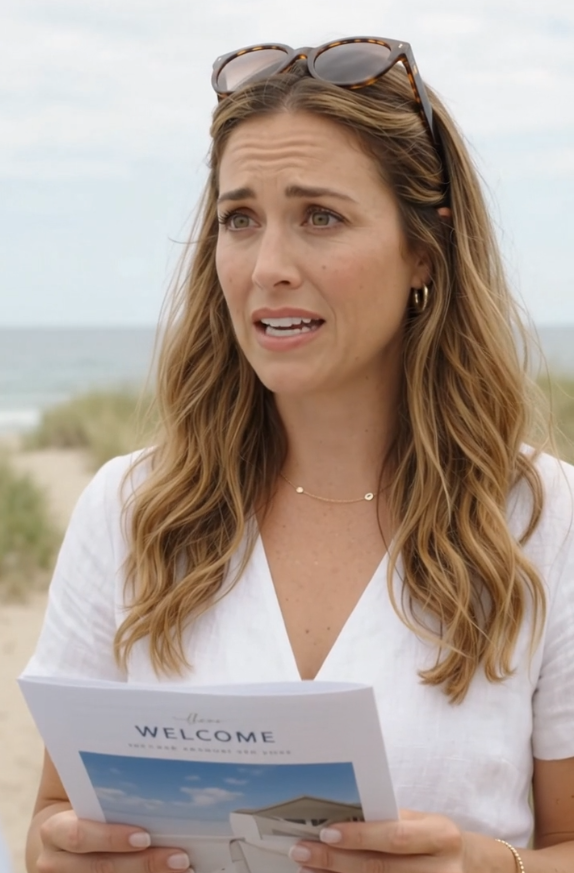
WELCOME TO BLUE HERON COTTAGE
PRIVATE PROPERTY STATUS AND COASTAL ACCESS REVIEW
Page one identified me as sole legal owner.
Page two contained Brooke’s post calling the cottage “our new Cape retreat.”
Page three showed the event permit filed under my name.
Page four contained the ninety-nine-year easement.
Page five showed the actual survey.
Page six explained town rules regarding false filings.
Page seven contained one sentence:
NO DOCUMENT WILL BE SIGNED ON THIS PROPERTY TODAY.
Below that I added:
Lunch will be served outdoors at noon. Donations to the Wellfleet Coastal Preservation Fund are welcome.
Meredith arrived at seven with coffee.
She read the packet slowly.
When she reached the final page, she looked at me.
“You have been underestimated for a very long time.”
“Yes.”
“Are you scared?”
“Terrified.”
She placed her hand over mine.
“Good. Fear means you understand what could happen. Courage is what you do anyway.”
At 11:47, a black SUV entered the driveway.
3. THE WELCOME PACKET
Brooke stepped out wearing white linen trousers and enormous sunglasses. She looked like a woman arriving at a resort she already considered hers.
Bradley climbed out with two bottles of champagne.
Then came another SUV, three luxury cars, and a rented van.
Twenty-two guests poured into my driveway carrying luggage, wine, flowers, beach umbrellas, coolers, and garment bags.
Jonathan and Diana Westfield arrived with little more than a canvas bag. Brooke’s parents, Richard and Elaine Thompson, followed. Tiffany and Patrick came next, along with Bradley’s senior partners and several friends.
Brooke walked toward me.
She did not hug me.
She did not say congratulations.
She surveyed the deck and lawn.
“Perfect. Where should everyone put their bags?”
I smiled and handed her a welcome packet.
She glanced down casually.
Then read the first page.
Her smile disappeared.
“What is this?”
Jonathan leaned toward the packet.
His expression changed too.
Conversations stopped behind them.
Bradley stepped closer.
Brooke stared at me.
“Dorothy, what exactly have you done?”
Three more cars turned into the driveway.
Meredith drove the first, with Naomi Bell beside her.
The conservation officials occupied the second.
Martin Vale arrived in the third, carrying his briefcase.
Brooke lowered the packet.
“Why are they here?”
Naomi approached.
“Mrs. Hale asked us to examine an event application filed under her name.”
Jonathan took the packet.
“What application?”
Brooke spoke quickly.
“Jonathan, it’s a technical matter.”
He ignored her and kept reading.
By page four, Bradley had forgotten the champagne hanging at his sides.
He looked at Brooke.
“What is this easement?”
“A preliminary document.”
“Why is Mom’s name on it?”
“We needed the permit ready.”
“You filed paperwork as her?”
“It was administrative.”
Naomi answered calmly.
“Using another person’s identity is not an administrative shortcut.”
Brooke’s cheeks reddened.
“My assistant probably misunderstood.”
I looked at her.
“Which assistant?”
“This is unnecessary.”
“Name the assistant.”
“I don’t remember.”
“The application came from your personal email.”
Her mouth tightened.
Richard stepped forward.
“Dorothy, perhaps this should be handled privately.”
“No.”
Even I was surprised by how easily the word came out.
His polished smile became stiff.
“This involves complicated business matters.”
“It involves my name and my property.”
Graham Morrison, one of Bradley’s senior partners, asked to see the packet.
After reading the easement, he turned to Bradley.
“Did you authorize this?”
“No.”
Brooke snapped toward him.
“We discussed the access problem.”
“We discussed that the road was unresolved.”
“And you said your mother would help.”
“I said she might listen.”
“You said she never refuses you.”
The driveway went silent.
Bradley stared at her.
Something inside me broke then.
Not my heart.
An illusion.
Diana lifted the packet.
“Brooke, you told us Dorothy had offered to host.”
“She did.”
“I purchased this house yesterday,” I said.
Brooke turned toward me.
“She agreed when I called.”
“After you had already filed the permit.”
She had no answer.
Jonathan looked at Graham.
“I was told Mrs. Hale requested a private introduction.”
“So was I,” Graham said.
Another partner nodded.
“Brooke said Dorothy wanted to participate in the access negotiations.”
Brooke’s mother closed her eyes.
Bradley finally put the champagne down.
“What did you tell everyone?”
“I created an opportunity,” Brooke said. “That’s what supportive wives do.”
“You used my mother’s identity.”
“I knew she would agree.”
“You never asked.”
Brooke’s composure fractured.
“Because she questions everything! She wants time. She wants explanations. We didn’t have time.”
Jonathan’s voice became very quiet.
“Why?”
Brooke glanced at her father.
Only for a second.
Everyone saw it.
Richard cleared his throat.
“The acquisition is at a delicate stage. Demonstrating access would show progress.”
Diana stared at him.
“By using a false signature?”
“No one said false.”
Naomi raised the application.
“I am saying it.”
Brooke leaned toward me.
“You’re destroying Bradley’s future over paperwork.”
“No, Brooke.”
I met her eyes.
“I’m refusing to purchase his future with my property.”
Behind us, twenty-two folding chairs faced the Atlantic.
Greta’s staff had laid out chowder and bread.
The luxury weekend now looked like a public hearing.
Exactly as intended.
I addressed the guests.
“You were invited here under false pretenses. I apologize. No one will be staying overnight, and there will be no private signing. But lunch is ready, the conservation commission is here, and Mr. Vale will explain the ownership records. Anyone who wishes to leave may leave.”
Jonathan looked at the chairs.
“I’m staying.”
Diana nodded.
“So am I.”
Graham set his luggage beside the car.
“I think we all need to hear this.”
Brooke stared at them.
“This is ridiculous.”
Diana held up my packet.
“No. This is the first honest document anyone has handed me all week.”
4. THE TEN-DOLLAR ROAD
Martin placed an enlarged survey at the front of the lawn.
“The blue boundary is Mrs. Hale’s property,” he explained. “The yellow strip is Pike Access Way, whose legal status has been disputed for decades.”
Jonathan studied the map.
“Our consultants told us access was nearly resolved.”
Graham frowned.
“That was what our revised report said.”
“Revised by whom?” Martin asked.
Bradley shook his head.
“My original report said the road required title review.”
Brooke crossed her legs.
“I helped improve the language.”
“You don’t work for our firm,” Graham said.
“I work in strategic communications. Bradley asked for my perspective.”
“I asked you to proofread,” Bradley said.
“You were overwhelmed. I fixed it.”
Graham removed his glasses.
“Did you alter client documents without authorization?”
“I strengthened weak wording.”
Jonathan leaned forward.
“What did the original wording say?”
Bradley swallowed.
“That no developer had established a valid right across Pike Access Way.”
“And the revised report?”
Graham answered.
“That family consent had been secured.”
Everyone looked at me.
I lifted the fraudulent acknowledgment.
“This was the family consent.”
Brooke stood.
“Dorothy verbally agreed to help.”
“After you created the document.”
“The document anticipated cooperation.”
Martin raised an eyebrow.
“That is a creative description of forgery.”
Naomi produced another attachment.
It named Thompson Coastal Holdings as an advisory participant.
Jonathan looked at Richard.
“You told me Thompson Coastal had no financial interest.”
“It does not own the property.”
“That was not what I asked.”
Diana turned to him.
“Do you profit if this road becomes valid?”
“The situation is complicated.”
“How much?”
No answer.
Jonathan repeated the question.
Richard adjusted his jacket.
“Certain investors would receive compensation.”
“How much?”
“Roughly eight million dollars.”
Bradley went pale.
“Eight million?”
Brooke looked at her father.
“You told me four.”
The words escaped before she could stop them.
Richard whipped toward her.
Diana laughed once in disbelief.
“Well. That clears up one thing.”
Bradley stepped away from his wife.
“You knew your father could make millions?”
“It was an investment.”
“You told me this was about my promotion.”
“It was about our future.”
“Whose future?”
“Ours!”
Bradley pointed at the papers.
“You put my career at risk.”
“I was securing it.”
“By misleading my client?”
“By doing what you were too cautious to do.”
Bradley stared at her.
I understood Brooke more clearly in that moment.
To her, caution meant weakness.
Respect meant hesitation.
Boundaries were obstacles that disappeared if enough people pushed at once.
Martin opened another file.
“There is more.”
Paragraph sixteen of the easement granted whoever controlled it the right to widen, pave, light, maintain, transfer, and commercially use the corridor for ninety-nine years.
Jonathan stared at the page.
“That was not in the summary we received.”
“No,” Martin said. “It was not.”
Bradley found the consideration clause.
“Ten dollars?”
Martin nodded.
“For ten dollars, your mother would lose control over the most strategically important section of her land.”
Brooke stood again.
“She would have been paid later.”
“Where?” I asked.
“In another arrangement.”
“Show it to me.”
Her eyes flashed.
“Why are you being so difficult?”
“I’m asking for the agreement you say protects me.”
“You know we would take care of you.”
Bradley whispered, “We?”
I folded my hands.
“How much had you planned to pay me?”
Brooke looked at Richard.
He remained silent.
I repeated the question.
Finally, Brooke snapped.
“You have a pension. Savings. No mortgage. How much money do you actually need?”
The words hung in the air.
There was the truth.
Brooke believed that because I had enough to survive, anything beyond survival belonged to someone younger and more ambitious.
Diana stood.
“We’re leaving.”
Brooke immediately softened.
“Diana, please.”
“We came because you told us Dorothy wanted a conservation partnership.”
“She does.”
“No,” I said. “I don’t.”
Diana continued.
“You also told us this cottage belonged to Bradley.”
Bradley stared at Brooke.
“You said that?”
“It was shorthand.”
“For what?”
“Family ownership.”
“My mother bought this yesterday.”
“And eventually you’ll inherit it!”
Even Brooke seemed to realize too late what she had said.
I took the deed from Martin.
“My house belongs to me while I am alive. My life is not a waiting room where you sit until my possessions become available.”
Brooke laughed bitterly.
“This is why I had to manage things. You make everything emotional.”
“You copied my signature because I might become emotional?”
“I used a sample.”
Several people gasped.
Martin stepped closer.
“A sample from where?”
“I don’t remember.”
“Was it provided by Bradley?”
“No.”
“Your father?”
“No.”
“Then how did you obtain Dorothy Hale’s signature?”
Brooke grabbed her handbag.
“This conversation is over.”
She headed for the cottage.
I stepped in front of the door.
“You are not going inside.”
“My things are in there.”
“No one has put anything inside.”
“I need the bathroom.”
“There are public facilities at the beach lot.”
She stared at me.
“You’re humiliating me.”
Years before, that accusation would have made me apologize.
Not now.
“I didn’t lie to your guests. I didn’t use your name on false paperwork. I didn’t promise away your property.”
I held her gaze.
“You are not being humiliated, Brooke. You are being witnessed.”
Something changed in her expression.
Not remorse.
Calculation.
She walked toward the road with Richard.
Elaine remained behind.
Bradley remained too.
So did the Westfields.
Meredith began serving chowder.
For one strange hour, people ate lunch beside the Atlantic while my family quietly rearranged itself around the truth.
I thought the worst part was over.
I was wrong.
5. THE RELOCATION FILE
After lunch, most of the guests departed.
Tiffany and Patrick left without speaking to Brooke. Bradley’s senior partners informed him he was suspended during an internal investigation.
Jonathan and Diana stayed with Martin and the conservation officials.
Bradley sat on the deck steps beside his unopened champagne.
I wanted to comfort him.
That instinct had ruled me for decades.
Fix it.
Tell him everything will be okay.
Make his pain smaller.
I stopped myself.
Bradley was forty-three. Brooke had done terrible things, but Bradley had helped create the environment in which she believed I would always absorb the cost.
Diana approached.
“I owe you an apology.”
“You didn’t forge anything.”
“No. But we trusted the wrong people.”
“So did I.”
She explained that the Westfield Foundation had actually been considering acquiring the sixty-four-acre parcel for conservation, not development. Environmental studies had convinced them the dunes needed protection.
Richard had approached them later with a resort proposal.
They had rejected it.
Diana now believed Brooke’s plan was to obtain my easement first and present commercial access as a completed fact. Once the road had value, Richard could use it to pressure the Westfields—or another buyer—into reviving the project.
“How did they know I was buying this cottage?” I asked.
“I don’t know.”
A voice behind us answered.
“Harold.”
Elaine stood near the deck.
“My ex-husband?”
She nodded.
“Richard and Harold have known each other for more than thirty years.”
Bradley stood.
“What?”
Elaine looked exhausted.
“I should have said something a long time ago.”
Before she could continue, Meredith hurried toward us holding a black leather folder.
“Dorothy. Look at this.”
She had found it beneath Brooke’s chair.
B.T. was embossed on the front.
Bradley recognized it.
“That belongs to Brooke.”
Inside were development projections.
Then copies of my bank statements.
My pension deposits.
Savings.
Investment accounts.
Photographs of my apartment, my Honda, the library, and the cottage.
Then I saw a document titled:
DOROTHY HALE TRANSITION STRATEGY.
Objective: Establish family oversight of assets while minimizing resistance and public conflict.
My hands began to shake.
The next section recommended documenting examples of confusion, unsafe driving, emotional instability, poor financial judgment, and social withdrawal.
It suggested encouraging me to sign a broad power of attorney.
If I refused, Bradley should arrange a medical evaluation.
My cottage purchase was listed as possible evidence of “late-life financial recklessness.”
There was even a proposed assisted-living facility near Bradley and Brooke’s home.
Once I was relocated, my cottage could be “managed for family benefit.”
Beside that line Brooke had written:
Seasonal rental potential: $12,000–$18,000 monthly.
She had turned ordinary moments into evidence.
Dorothy forgot Bradley’s anniversary.
Brooke had changed the date.
Dorothy became confused driving to Thanksgiving.
Brooke had texted me the wrong address.
Dorothy repeated a question at lunch.
The restaurant had been too loud for me to hear.
Dorothy displays unhealthy emotional attachment to unnecessary items.
Those unnecessary items were letters from my mother.
Then came sample messages for Bradley.
Mom, we’re worried about you.
Mom, this isn’t about control.
Mom, we only want what’s best.
Bradley reached the final page.
His voice broke.
“She planned for me to petition for guardianship.”
Elaine began crying.
Bradley looked at her.
“You knew?”
“Not this.”
“The easement?”
“Yes.”
“And Harold?”
“Yes.”
“Why didn’t you tell us?”
“Because I spent forty years telling myself silence was how you kept a family together.”
She explained that Richard had been chasing this development long before Brooke met Bradley. Harold had owned an interest through another entity.
When Bradley told Harold that I was finally buying a Cape cottage, Harold passed the information to Richard.
I remembered an unexpected phone call from Harold six weeks earlier.
He had asked where I was looking.
I had been foolishly pleased by his interest.
“What did Harold want?” I asked.
“The Pike access strip.”
Martin asked, “Through what company?”
“Atlantic Heritage Holdings.”
Martin’s face changed.
“That company was dissolved twenty-four years ago.”
“Officially,” Elaine said.
Jonathan stepped closer.
“What does that mean?”
“Richard never stopped collecting investor money.”
“How much?”
“At least fourteen million.”
The land could never be developed without valid access.
Without my property.
A vehicle entered the driveway quickly.
Brooke stepped out.
Richard followed.
Then Brooke saw the black folder in Bradley’s hands.
Real fear crossed her face.
“That is private.”
Bradley held up the transition plan.
“You were trying to have my mother declared incompetent?”
“I was protecting her.”
“By taking over her assets?”
“She’s seventy-one and just spent most of her available savings on an old cottage.”
I stood.
“My finances are none of your business.”
“You let Bradley access some accounts.”
“For emergencies.”
“We’re family.”
“No, Brooke. Family is not a password.”
Richard stepped between us.
“This has gone far enough.”
Elaine turned to him.
“No. It has not gone nearly far enough.”
Brooke pointed at her mother.
“Don’t listen to her. She’s confused.”
Elaine went perfectly still.
Brooke immediately realized she had chosen the wrong word.
“Is that what you’ll write in my file too?” Elaine asked.
Richard grabbed his wife’s arm.
“We’re leaving.”
She pulled away.
“No.”
“Elaine.”
She moved beside me.
“No.”
Richard stared at us.
Then turned toward Brooke.
“Find the original deed packet.”
Martin stepped forward.
“Why?”
Richard immediately changed expression.
“I never said that.”
Everyone had heard him.
I looked toward my cottage.
The front door was slightly open.
I had locked it.
And the thick blue folder from closing was gone.
6. THE STORM
We searched everywhere.
The deed packet had vanished.
Nothing else had been disturbed.
Only the ownership documents.
Then the weather changed.
Dark clouds rolled over the Atlantic. Rain began striking the windows. Thunder sounded offshore.
Naomi and the conservation officials left before the storm worsened, but Jonathan and Diana stayed.
Elaine sat shaking at the kitchen table.
Then she said, “I saw Harold’s car earlier.”
Bradley turned.
“When?”
“Near the end of the lane. Before lunch.”
Fear returned in a form I knew very well.
Harold had always been skilled at entering places as though he belonged there.
Bradley and Jonathan went outside to look.
Brooke stood in my kitchen complaining that everything had become insane.
“You made a file to have me declared incompetent,” I said.
“I gathered options.”
“You photographed my home.”
“You never answer questions about your finances.”
“Because they are not your finances.”
She crossed her arms.
“You behave like everyone wants to steal from you.”
I looked at the empty window seat.
“Someone just stole my deed packet.”
Meredith stepped toward Brooke.
“You committed fraud.”
“This is family business.”
“No,” Meredith replied. “Family business is deciding who brings dessert. Fraud is fraud.”
Richard was speaking quietly on his phone.
Martin asked, “Calling your attorney?”
“Yes.”
“Probably a sensible decision.”
When the call ended, Richard tried another approach.
“Dorothy, this can still be resolved. Sign a limited easement for fair market value. Bradley keeps his account. You recover what you spent on the cottage. Everyone wins.”
“I don’t want my money back.”
“You overpaid.”
“How do you know what I paid?”
He hesitated.
Brooke answered too quickly.
“Property transactions are public.”
“My sale price isn’t public yet.”
Silence.
“You knew before closing,” I said.
Neither answered.
“Did you arrange the sale?”
“No,” Richard said.
“Did Harold?”
“No.”
Elaine whispered from behind me.
“Agnes told them.”
I turned.
“Agnes Pike?”
“She called Richard after accepting your offer.”
“Why?”
“To warn him.”
Richard moved toward her.
“That’s enough.”
Elaine ignored him.
“Agnes knew what Richard and Harold had been trying to do. She told them she was selling the house to someone who would never cooperate.”
“How did she know me?”
Elaine looked toward the rain.
“Agnes was Harold’s first cousin.”
I stared at her.
Harold had never once mentioned her.
But I remembered meeting Agnes during the viewing. She had been eighty-six, frail, and unusually interested in why I wanted the house.
I told her about Harold laughing at my dream.
She squeezed my hand.
“Then perhaps it’s time somebody stopped laughing.”
At the time, I thought it was kindness.
Now I knew there was history behind it.
“Why did she sell to me?”
“Because she hated Harold,” Elaine said.
Richard snapped, “She was a bitter old woman.”
Elaine faced him.
“She knew what you did to her father.”
Martin looked over.
“What did he do?”
Elaine explained that Agnes’s father had created the Pike Community Trust to preserve the access strip for fishermen, residents, and emergency crews.
Years later, Richard and Harold produced a deed claiming the land had been transferred to Atlantic Heritage Holdings.
“But he never transferred it,” Elaine said.
“How do you know?” Martin asked.
“Because I watched Richard create the document.”
Lightning flashed.
Brooke stared at her mother.
“You never told me that.”
“I tried.”
“You hinted. You cried whenever you were angry.”
“I was afraid.”
“Of Dad?”
Elaine looked at Richard.
“Yes.”
Richard laughed.
“You certainly enjoyed the houses and vacations.”
“I survived them.”
“You signed the tax returns.”
“Because you told me you would take my children if I didn’t.”
The lights went out.
The cottage fell dark.
Rain hammered the roof.
I found a flashlight in the kitchen.
Then the front door opened.
A soaked man stepped inside carrying my blue closing folder beneath one arm.
Harold.
He looked at me and smiled.
“You always did know how to create a scene, Dorothy.”
For one second, I felt like the old version of myself.
Then I remembered whose name was on the deed.
“You stole my documents.”
“I protected them.”
“From whom?”
He glanced dismissively toward my friends.
“From your little committee.”
Bradley and Jonathan entered behind him.
Bradley stared.
“Dad?”
Harold handed the folder to Richard.
Martin stepped forward.
“That belongs to my client.”
Richard held it behind his back.
Harold removed his wet coat.
“Stop treating this as criminal.”
“It is criminal,” I said.
Harold sighed.
“You’ve always become dramatic when you feel ignored.”
“And you’ve always called me dramatic when facts became inconvenient.”
Bradley looked between us.
“Dad, were you part of the easement plan?”
“I was protecting your future.”
“With a forged signature?”
“No one intended to hurt your mother.”
I laughed.
“You wanted control of my land for ten dollars.”
“That’s standard legal consideration.”
“And Brooke’s guardianship file?”
Harold looked at her.
“That was not my idea.”
Brooke’s confidence faltered.
“You told me Dorothy would eventually need to be managed.”
“I said she could be persuaded.”
“You said Bradley should control the cottage.”
“I did not tell you to build a psychiatric case.”
Brooke stared around the room.
“You all wanted the same thing.”
Bradley shook his head.
“Do not include me in that.”
“You wanted the promotion.”
“I wanted to earn it.”
“You said your mother would do anything for you.”
Bradley looked at me.
“I did say that.”
The admission hurt.
Then he stepped forward.
“I’m sorry.”
Harold scoffed.
“Stop groveling. Your mother loves playing the martyr.”
I lifted the flashlight toward him.
“You still believe you know me.”
“I was married to you for twenty-two years.”
“You were married to the version of me you worked very hard to keep afraid.”
Richard put my folder on the counter.
“Enough. Dorothy signs the easement. Westfield proceeds. Bradley keeps the account. Everyone benefits.”
Jonathan spoke from the doorway.
“Our foundation will do no business with you.”
Richard turned.
“You have investors.”
“We have conservation donors.”
Harold stared at me.
“Dorothy will sign.”
There it was again.
The old certainty.
I placed my hand on the folder.
“No.”
“You don’t understand what this will cost.”
“No.”
“Bradley could lose his job.”
“No.”
“You could spend years in court.”
“No.”
“You could lose your savings.”
“No.”
His jaw tightened.
“What are you trying to prove?”
I smiled.
“That you arrived twenty-four hours too late.”
7. THE DOCUMENT BENEATH THE DEED
I opened the closing folder.
Beneath the deed, title policy, survey, and tax papers was a cream-colored envelope.
Richard moved closer.
I placed my hand over it.
“This is why you took the folder.”
Harold’s eyes shifted.
Martin noticed.
“You knew this envelope was here.”
Harold said nothing.
Inside was a letter from Agnes Pike.
But Agnes had contacted me before.
Six weeks earlier, an anonymous envelope arrived at the library containing a photocopy of a 1978 town record about the Pike Community Trust.
At the bottom someone had written:
The road beside your future house does not belong to the men claiming it. Look in Box 14 of the maritime archive.
I did.
Box 14 contained the original trust charter, letters from Agnes’s father, and a notarized map.
It also contained evidence that the supposed transfer to Atlantic Heritage Holdings had been created three years after Agnes’s father died.
I reported what I found to the state historical records office and contacted a land-trust attorney.
Then Blue Heron Cottage came onto the market.
I made an offer.
Agnes accepted mine even though it was not the highest.
Now I finally knew why.
I unfolded her letter.
Dorothy,
If you are reading this, the cottage is yours.
Harold and Richard will assume you bought it accidentally. Let them.
They have spent their lives underestimating quiet women.
My father established the Pike Community Trust to preserve sixty-four acres of dunes, marsh, and shoreline.
Richard Thompson and Harold Hale attempted to take that land with a false deed.
I have spent thirty years stopping them.
You found the original records. You understood their importance.
The enclosed instrument appoints you successor trustee of the Pike Community Trust, effective when ownership of the cottage transfers to you.
The cottage is not simply adjacent to the trust.
It is its administrative seat.
Protect it.
Protect yourself.
—Agnes Pike
When I finished, Harold’s face was gray.
Martin removed the accompanying court document.
It contained a registry seal and a judge’s signature.
“Successor trustee appointment,” he said.
Brooke frowned.
“What does that mean?”
Martin unfolded the map.
“It means Dorothy does not merely control the road.”
The trust boundaries extended across the dunes, marshland, and woods surrounding the proposed project.
“She controls the sixty-four acres.”
The room went silent.
Harold gripped a chair.
“That trust was dissolved.”
“No,” Martin said. “Dormant. Agnes petitioned to reactivate it after Dorothy located the original charter.”
“You can’t reactivate a dead trust.”
“A judge disagreed.”
Richard stared at me.
“You knew?”
“Not everything.”
“But enough to trap us.”
“I suspected someone might approach me about Pike Access Way.”
“So you invited the officials.”
“After Brooke used my identity.”
“You let everyone come.”
“You invited yourselves.”
Harold stared at the document.
“You bought the cottage to gain control.”
“I bought it because I loved it.”
“Don’t pretend you were innocent.”
“I wasn’t entirely innocent.”
That surprised him.
“For most of my life,” I said, “I confused goodness with passivity. I thought preparing for someone’s cruelty made me cruel too.”
I held Agnes’s letter.
“I don’t believe that anymore.”
Elaine admitted she had contacted Agnes years earlier because Richard had intended to destroy protected land.
Harold became furious.
“How much money did you cost us?” he demanded.
That word caught my attention.
Us.
I looked at him.
“How much did you take from investors for a project you knew had no legitimate access?”
“You think some library papers make you an expert?”
“No. I think financial-crimes investigators can decide.”
His expression changed.
Then vehicles entered the driveway.
Not guests this time.
Investigators.
Lena Morales from the financial-crimes unit stepped onto the porch.
Martin had contacted authorities after reviewing the forged filing.
Morales collected the documents and began asking questions.
Richard wanted his attorney.
Harold insisted nothing illegal had happened.
Brooke clutched her handbag.
Elaine watched her daughter.
Then Morales asked Brooke to surrender the bag.
“No.”
One of the officers stepped forward.
Bradley spoke quietly.
“Brooke. Give it to her.”
For the first time, Brooke looked truly frightened.
She stared at me.
“You did this.”
“No,” I said. “I stopped protecting you from the consequences of doing it yourself.”
Her fingers released the bag.
Inside, beneath cosmetics and a wallet, Morales found a small silver flash drive.
Brooke began crying.
Richard closed his eyes.
Harold looked away.
“What’s on it?” Bradley asked.
Elaine answered.
“Bank records. Names. Payments. Investors.”
Brooke spun toward her mother.
“You said you destroyed it.”
“I told you what I needed to tell you so you wouldn’t search for the other copy.”
Morales sealed the drive as evidence.
Richard pointed toward Elaine.
“You were involved too.”
“Yes.”
Her voice shook.
“For years, I was.”
Then she stood straighter.
“But not today.”
8. THE STORY BROOKE TOLD THE WORLD
No one was marched away in handcuffs that afternoon.
Financial crimes built over decades do not unravel in a single dramatic scene.
Devices were seized.
Interviews were conducted.
Richard and Harold were warned not to destroy evidence or contact certain investors.
Brooke was questioned separately.
By evening, the storm had moved out to sea.
Elaine went home with Meredith.
Bradley stayed.
We sat on the deck in silence.
Eventually he said, “I knew Brooke could be controlling.”
“I knew the same thing about your father.”
“I convinced myself she was different.”
“So did I.”
“I thought she pushed me because she believed in me.”
“Perhaps sometimes she did.”
He lowered his head.
“Why didn’t I see what she was doing?”
“You saw pieces.”
“And ignored them.”
“Yes.”
He winced.
I refused to soften the truth just to make him comfortable.
“She told me you were getting forgetful,” he said.
“I know.”
“She said you nearly caused an accident.”
“She sent me to the wrong address.”
“She said you wouldn’t admit you were lost.”
“I was standing outside the restaurant she told me to meet you at.”
He closed his eyes.
“I believed her.”
“You wanted to believe her.”
“Because then I didn’t have to confront her.”
“Yes.”
He started crying.
“I’m sorry, Mom.”
I took his hand.
“I believe that.”
“Do you forgive me?”
“Eventually.”
He looked surprised.
I had spent most of my life giving forgiveness before anyone had earned it.
Not anymore.
“I need time.”
He nodded.
The following morning, Brooke left their townhouse.
By noon, her version of the story was online.
Tiffany called me.
“You need to see what she posted.”
Brooke’s video began with my recorded voice.
“Of course. I’ll make sure everything is ready.”
Then it showed guests arriving.
It cut to me refusing Brooke access to my cottage.
Then came footage of town officials, attorneys, and investigators.
Every document proving why they were there had been edited out.
Her caption claimed I had invited twenty-two people, changed my mind, and staged a public ambush to punish my son.
She accused me of using wealth and property to control Bradley.
Then she added:
Elder abuse can go both ways.
The post exploded.
Thousands shared it.
People called me jealous, vindictive, manipulative, narcissistic.
Brooke appeared on a podcast and cried beautifully while describing herself as a wife trying to support her husband.
The forged permit became a “clerical misunderstanding.”
The guardianship file became “concern for my cognitive health.”
She never mentioned the ninety-nine-year easement.
Never mentioned Richard’s millions.
Never mentioned Harold.
Her story spread because it was simple.
The truth was complicated.
Complicated truths move slower.
Bradley’s firm put him on unpaid leave.
Reporters called the library.
One photographed me buying groceries.
For three days, I stayed inside my cottage with the curtains closed.
On the fourth morning, someone threw red paint across the front door.
EVIL MOTHER.
I stood outside with a brush, scrubbing.
Meredith took it from me.
“Photograph it first.”
“I don’t want evidence. I want it gone.”
“Dorothy.”
“I should have cancelled the gathering. Called the police quietly.”
“And then Brooke would claim you had agreed.”
“I had paperwork.”
“She had twenty-two people prepared to say you cooperated.”
“I embarrassed Bradley.”
“Bradley helped create the situation.”
I looked at the red paint.
“What if part of me wanted Brooke to feel humiliated?”
Meredith considered it.
“Then you’re human.”
“That doesn’t make it right.”
“Anger and justice aren’t always opposites. Sometimes anger tells us exactly where justice has been absent.”
Later that morning, Diana Westfield arrived with a cardboard box.
Inside were emails from Brooke with full timestamps.
One, sent weeks before I bought the cottage, said:
Dorothy is delighted to make her new property available. She only wants the arrangement informal until the family transfer is complete.
Another said:
Bradley’s mother will sign during the celebration. She responds best when the family presents decisions positively and avoids too much technical information.
Then Diana handed me an email from Harold.
She will sign if Bradley seems disappointed. Do not argue the merits. Make refusal feel maternal.
I sat down.
Harold had reduced me to a set of instructions.
A lock he still believed he knew how to open.
Diana sat beside me.
“Brooke’s version works because she included your real words.”
“Of course.”
“Yes.”
“I knew she would misunderstand them.”
Diana studied me.
“Did you intend to trap her?”
I answered truthfully.
“Yes.”
“Then when the time comes, say that.”
“You think I should admit it?”
“Do not pretend to be helpless. Tell the complete truth.”
She touched the box of evidence.
“Including the part where you were afraid.”
9. THE HEARING
Six weeks later, the Wellfleet Conservation Commission held a public hearing on the Pike Community Trust.
The room was packed.
Reporters filled the back row. Residents stood against the walls. Atlantic Heritage investors arrived with lawyers.
Bradley sat beside Martin and me.
He had lost his job at Hale, Morrison and Burke. The firm did not accuse him of forgery, but concluded he had failed to secure sensitive documents and allowed an unauthorized person—his wife—to alter client materials.
Bradley accepted responsibility.
Brooke sat across the aisle with two attorneys.
Richard and Harold sat separately.
Elaine was in front with Meredith.
Brooke’s lawyer played my recording.
“Of course. I’ll make sure everything is ready.”
Then he questioned me.
“You said those words?”
“Yes.”
“Did you intend to house twenty-two guests?”
“No.”
“Did you intend to sign an easement?”
“No.”
“Then why agree?”
“Because the permit had already been filed in my name. I needed the people involved to see what was happening.”
“So you deceived my client.”
“I allowed her to believe the deception she had already created.”
“You planned to humiliate her.”
“I planned to document what she did.”
“You brought officials.”
“To review a false government filing.”
“You arranged chairs and food.”
“Yes.”
He smiled.
“So this was theater.”
I looked around the room.
“Yes.”
His smile faded slightly.
“Brooke created an audience because she wanted that audience to pressure me. I changed what the audience would witness.”
“Revenge motivated you.”
“Anger motivated me.”
I paused.
“But anger is not forgery. Anger did not create a ninety-nine-year easement worth millions and value it at ten dollars.”
Martin introduced the permit, the posts, Brooke’s emails, Harold’s instructions, the easement, and the guardianship file.
Then a digital-forensics expert showed where my copied signature came from.
My divorce settlement.
Signed nineteen years earlier.
Brooke’s lawyer suggested she might have found a copy in Bradley’s files.
Bradley took the stand.
“Did you ever authorize Brooke to use your mother’s signature?”
“No.”
“Did you tell Brooke your mother would cooperate?”
Bradley looked at me.
“Yes.”
“What did you say?”
“That my mother would do anything for me.”
“Did you believe that?”
“Yes.”
“Then why would your wife think Dorothy would object?”
Bradley took a breath.
“Because loving me was never permission to steal from her.”
He continued.
“I allowed Brooke to see my mother as a resource. I didn’t forge anything, but I helped create the belief that there would be no consequences for crossing her boundaries.”
His voice cracked.
“That is my responsibility.”
It was not perfect.
But it was honest.
The hearing continued.
Jonathan testified that his foundation had never authorized a commercial resort.
Diana submitted Brooke’s emails.
Naomi established that the false permit had been filed before I even owned Blue Heron Cottage.
Then Richard’s lawyer introduced a certified 1987 deed allegedly transferring Pike Access Way to Atlantic Heritage Holdings.
The document looked legitimate.
It bore Agnes’s father’s signature and a notary seal.
Martin’s expression tightened.
If it was real, the trust’s ownership could collapse.
For the first time, I did not know what happened next.
During recess, I found Elaine sitting in the hallway.
“You recognize that deed.”
“Yes.”
“Is it real?”
“The paper is.”
“And the signature?”
“False.”
“Can you prove it?”
“I thought so.”
She explained Richard kept a ledger recording documents he created, payments, borrowed seals, and signature samples.
But he had emptied the safe-deposit box two days earlier.
My heart sank.
Then Elaine squeezed my hand.
“He did not know there were two boxes.”
The doors opened.
Lena Morales entered beside a court officer carrying a sealed archival container.
Inside was a leather ledger.
Richard stood.
“That was stolen.”
Elaine faced him.
“No. Preserved. My name was on the account too.”
The ledger recorded decades of transactions.
Then Morales reached September 14, 1987.
Pike transfer prepared. H.H. supplied signature sample. Notary seal borrowed. Payment: $5,000.
H.H.
Harold Hale.
Attached was a practice sheet showing Agnes’s father’s signature copied repeatedly.
Beneath it was a photocopy of the authentic signature.
And among the other samples was mine.
Harold had kept a collection of signatures from people he thought were easier to reproduce than persuade.
The hearing room erupted.
Richard was arrested on fraud, conspiracy, falsification, and obstruction-related charges.
Harold tried to leave.
An officer stopped him.
Brooke remained seated.
She stared at Elaine.
“You kept this for years?”
“Yes.”
“You knew who Dad was?”
“I tried to protect you.”
Brooke laughed bitterly.
“Everyone says that.”
Elaine’s eyes filled.
“I protected you so completely that you grew up believing consequences only happened to other people.”
Brooke had no answer.
10. THE LAST FILE
The investigation expanded quickly.
The ledger identified more than forty investors and several shell companies.
Some had understood the project was speculative.
Others had been told permits were almost complete.
Several were elderly.
The flash drive from Brooke’s handbag contained financial spreadsheets, account numbers, and communications among her, Harold, and Richard.
Brooke claimed she had gathered them because she suspected her father.
The timestamps proved otherwise.
She had helped rewrite investor updates and conceal failed permits. She had described Pike Access Way as “secured through family cooperation.”
Prosecutors offered her reduced consequences in exchange for testimony.
She accepted.
Her supporters online claimed this proved she had been an innocent whistleblower.
Then the complete recording of our phone call was released.
It contained everything Brooke had cut.
Her order to prepare three meals.
Her demand that I house twenty-two guests.
My question:
“So you invited twenty-two people to my home before asking me?”
Her answer:
“Don’t make this difficult.”
Public opinion changed almost overnight.
People deleted old comments.
Podcasters who had praised Brooke suddenly discussed coercion.
Reporters asked me for interviews.
I refused nearly all of them.
Outside the library, I made one statement.
“I am not a heroine. I was afraid, angry, and at times vindictive. But none of those emotions made my home belong to somebody else. Older parents do not become public resources because their children expect an inheritance.”
Messages arrived from around the country.
Widows whose children controlled their cars.
Retired teachers pressured into refinancing homes.
Older parents whose families catalogued every forgotten appointment while quietly changing the schedule themselves.
Different families.
The same pattern.
Concern turned into control.
Love turned into debt.
Age treated as evidence of incapacity.
So I created a new file.
Not a relocation file.
A resource guide.
Meredith and I worked with legal-aid groups, advocates, and librarians to compile information on powers of attorney, guardianship, property rights, financial exploitation, and digital security.
We named it:
YOUR LIFE IS NOT AN INHERITANCE.
Bradley moved to a modest apartment after his divorce began.
He found a lower-paying job at a smaller environmental consulting company.
He started therapy.
He began visiting me without asking for anything.
The first time he came, he brought tools.
“What are those for?”
“The deck railing is loose.”
“It’s been loose since I moved in.”
“I know.”
He fixed it quietly.
Later we drank tea.
“I thought Dad was strong,” he said.
“So did he.”
“I thought you were weak because you always gave in.”
“Sometimes I was weak.”
“No. You were surviving.”
“Survival can become a habit even after the danger disappears.”
He looked at his hands.
“I learned your habit.”
Our silence no longer felt like avoidance.
It felt like repair.
Richard eventually pleaded guilty.
Harold refused.
His case went to trial.
I testified for two days.
His lawyer asked why I had waited so long to describe Harold’s control.
“I didn’t understand it while I was living inside it.”
“You benefited from the divorce settlement.”
“I received less than one-third of our assets.”
“But enough to begin again.”
“Yes.”
“Perhaps Mr. Hale was generous.”
I looked directly at Harold.
“No. The law was.”
His smile disappeared.
The jury convicted him.
The sentence was long enough that he was unlikely to see the Atlantic again as a free man.
Brooke received probation, community service, and a suspended sentence because of her cooperation.
Her career collapsed.
For almost a year, I did not see her.
Then one cold October afternoon, she appeared at Blue Heron Cottage.
She wore a gray coat and carried no handbag.
I stayed on the porch.
“What do you want?”
“To give you something.”
She placed an envelope on the railing.
“I found another file Harold kept.”
“What’s inside?”
“Letters from Agnes.”
“Why did Harold have them?”
“Agnes offered him a deal before selling you the cottage.”
“What deal?”
“She said she would transfer control of the trust to him if he told Bradley the truth about something he did during your divorce.”
“What truth?”
“He refused.”
She turned.
“Why are you giving this to me?”
Brooke looked back.
“I spent my life watching my father hide evidence and call it protection.”
She paused.
“I don’t want to become him completely.”
I opened the envelope later with Bradley.
Three letters.
The third revealed Harold had hidden marital assets during our divorce.
More than two million dollars had gone into Atlantic Heritage Holdings.
Half should legally have been mine.
The discovery changed the meaning of eight years of extra shifts, patched coats, and missed vacations.
I had struggled to buy my dream while Harold knew he had hidden enough money to make it possible years earlier.
Agnes had also traced an account containing assets tied specifically to our marriage.
The money had continued growing.
Its value was now more than six million dollars.
Bradley read the accounting.
“Dad stole this from you.”
“Yes.”
“What will you do if you get it back?”
Once, my first thought would have been Bradley.
His lost job.
His mortgage.
His future.
I looked toward my window seat.
“I don’t know.”
For the first time in my life, not knowing felt like freedom.
11. THE OFFER
Nine months later, the court recognized my claim.
After restitution, taxes, and legal expenses, I received a little more than four million dollars.
The moment the news became public, advice arrived.
Distant relatives called.
Old acquaintances proposed investments.
Strangers mailed business ideas.
Bradley asked for nothing.
He sent flowers.
The note said:
Whatever you decide, make sure some of it brings you joy.
Jonathan and Diana made an offer through the Westfield Foundation.
They would finance permanent preservation of the Pike land, restore the marsh, create walking paths and reading spaces, and build an environmental education center.
The trust would keep ownership.
I would remain trustee.
Blue Heron Cottage would become its administrative headquarters.
They suggested the name Agnes Pike Coastal Preserve.
I accepted.
I used some of the recovered money to renovate an abandoned building near my old library.
Downstairs became a legal-resource center for older adults experiencing financial exploitation.
Upstairs held temporary apartments for women over sixty leaving controlling homes.
Meredith suggested Dorothy House.
I refused.
We called it:
THE QUIET WOMEN CENTER.
Not because quiet women are weak.
Because quietness often hides observation, endurance, and plans nobody else sees coming.
Elaine became one of its first volunteers.
After Richard’s conviction, she moved into a small apartment and began rebuilding the life she had postponed for decades.
One afternoon, I found her teaching a class titled:
CONCERN IS NOT CONSENT.
She looked happier than I had ever seen her.
Bradley attended the center’s opening.
That evening we had dinner at my cottage.
Six people.
Not twenty-two.
Meredith, Elaine, Bradley, Jonathan, Diana, and me.
Chowder.
Warm bread.
Apple cake.
No air mattresses.
No secret papers.
No one issuing commands.
After dinner, Bradley followed me onto the deck.
“I brought you something.”
He handed me a wooden frame.
Inside was a child’s drawing of a blue house beside an enormous ocean. A woman sat on the porch reading.
Below it, in uneven handwriting, were the words:
MOM’S HOUSE AT THE BEACH.
My throat tightened.
“When did you draw this?”
“When I was fourteen.”
The year after Harold mocked my dream.
“I gave it to Dad first,” Bradley said. “I asked him to help me buy you a beach house someday.”
“What did he say?”
“That you’d never own one.”
Bradley looked at the cottage.
“I think I stopped believing in things after that.”
“You believed enough to draw it.”
“I should have remembered.”
“You were a child.”
“I wasn’t a child when Brooke called.”
“No.”
The honesty still hurt, but we no longer avoided it.
“I don’t expect you to leave this house to me,” he said.
I looked at him.
“Your life isn’t a waiting room. I understand that now.”
“What changed?”
“Brooke’s divorce lawyer wanted a clause releasing any future interest she might claim in your estate.”
“And?”
“I signed it.”
“You didn’t have to.”
“I did.”
He looked toward the ocean.
“I spent years loving you as if love were an advance payment.”
Tears filled my eyes.
“I didn’t mean to teach you that.”
“But you taught me you would always pay.”
We stood beside the railing he had repaired.
“I’m trying to learn another kind of love,” he said.
“So am I.”
That winter, crews conducting an environmental survey found something beneath the northern dunes.
Stone foundations.
Iron tools.
Ceramic fragments.
Then a sealed metal container.
The site had belonged to nineteenth-century fishing families largely absent from official histories—immigrants, widows, and laborers who owned little property elsewhere.
Inside the container were journals and records wrapped in oilcloth.
The oldest belonged to Abigail Pike, Agnes’s great-grandmother.
In 1889, she had helped local families purchase coastal land collectively.
Her final journal entry read:
Land is safety when the law recognizes your name. Until then, keep the records where greedy men cannot find them.
The discovery transformed the preserve.
Our education center became partly an archive dedicated to people erased from official property histories.
Children read Abigail’s journals while looking across the same dunes her family had protected.
My cottage had begun as a private dream.
Now it protected something larger.
But I kept the upstairs bedroom for myself.
Some victories should remain personal.
12. WHAT “OF COURSE” MEANT
Two years after Brooke first ordered me to prepare Blue Heron Cottage for twenty-two people, the Agnes Pike Coastal Preserve held its dedication.
Nearly three hundred people came.
This time, every person had been invited with the owner’s permission.
Rows of folding chairs faced the ocean.
Children carried books.
Fishermen sat beside environmental scientists.
Former investors sat near residents who had opposed the development.
Elaine spoke about silence.
Bradley spoke about accountability.
Diana announced a scholarship for students studying conservation and archival history.
Then I approached the podium.
My cottage stood behind the crowd with restored blue shutters.
Beside the door was a bronze plaque.
ADMINISTRATIVE HOME OF THE AGNES PIKE COASTAL PRESERVE
TRUSTEE: DOROTHY MAE HALE
My full name.
Recognized by law.
Recognized by the community.
And, finally, recognized by me.
“When I bought that cottage,” I began, “I believed I was completing a private dream. I imagined reading beside the window, drinking coffee near the ocean, and putting my cup wherever I wanted without anyone correcting me.”
The audience laughed.
“But property is more than wood and paper. Property is power. It determines whose permission matters.”
I looked toward the front row.
Bradley.
Elaine.
Meredith.
Then I saw Brooke.
I had not known she would come.
She wore a simple blue dress and sat alone.
Our eyes met.
Neither of us smiled.
“I spent much of my life believing kindness meant keeping the door unlocked,” I continued. “I thought loving people meant making room even when I had to move myself outside.”
I paused.
“Then twenty-two people appeared at my new home because somebody else had invited them.”
A few people laughed.
“They brought champagne, luggage, business papers, and expectations. My daughter-in-law asked if everything was ready.”
I looked toward the rows of chairs.
“It was.”
The audience grew quiet.
“The chairs were ready. The records were ready. The officials were ready. The truth was ready.”
Applause rose.
I waited.
“But I was not completely ready. I was frightened. I was angry. Part of me wanted the people who had underestimated me to feel ashamed.”
Brooke lowered her eyes.
“Justice did not happen because I was morally perfect. It happened because people preserved records, witnesses spoke, and women who had remained quiet finally decided that silence was costing too much.”
After the ceremony, Brooke approached me near the beach path.
“Your speech was good.”
“Thank you.”
“I wasn’t sure I should come.”
“Neither was I.”
She accepted that.
After a moment, she said, “I used to think you were weak.”
“I know.”
“I hated watching you give in all the time.”
“Why?”
“Because my mother did the same thing.”
She looked through the education-center windows toward Elaine.
“I promised myself I would never become her. I thought strength meant controlling the decision before someone else controlled me.”
“You became your father instead.”
“Yes.”
No excuse followed.
“I’m not asking you to forgive me.”
“Good.”
A sad smile crossed her face.
“I deserved that.”
“You deserve the consequences of what you did. That isn’t the same as deserving misery forever.”
She looked at me.
“Do you believe people change?”
“I believe people can change their behavior.”
“That’s not exactly the same.”
“No.”
“Do you think I’ve changed?”
“I don’t know you anymore.”
She nodded.
“Fair.”
Before leaving, she handed me a card.
It had an address.
Brooke was now doing administrative work for a nonprofit that helped victims of real-estate fraud. She was not allowed to handle client funds.
At the bottom she had written one sentence.
I tell them to keep every document.
I put the card in my pocket.
That evening, after everyone had left, the cottage became quiet again.
Bradley had washed the dishes.
Meredith took the leftover cake.
Elaine folded the rented linens.
I sat alone in the window seat holding Abigail Pike’s journal and the brass keys I had received at closing.
They were no longer shiny.
I remembered Brooke’s original phone call.
Her certainty.
Her command.
And my answer.
“Of course.”
For years, people heard those words from me and assumed they meant yes.
Yes, I’ll surrender the room.
Yes, I’ll change the plans.
Yes, I’ll spend the money.
Yes, I’ll keep quiet.
But words take their meaning from the person who speaks them.
That day, “of course” meant something completely different.
Of course I heard what was hidden inside your request.
Of course I recognized the pattern.
Of course I would protect what belonged to me.
I had not known about the millions hidden by Harold.
I had not known Elaine had preserved a second ledger.
I had not known Agnes intended to make me trustee of sixty-four acres.
I certainly had not known that beneath the dunes, Abigail Pike had hidden records proving that quiet women had been confronting the same kind of entitlement for generations.
But I had understood one thing from the beginning.
A house does not become family property simply because someone expects to inherit it.
A mother does not become incompetent because she says no to her child.
And a kind woman does not become cruel because she locks the door when people enter without permission.
I closed Abigail’s journal.
Moonlight stretched across the Atlantic.
For most of my life, I had tried to become smaller so other people could remain comfortable.
Sitting inside the cottage Harold once promised I would never own, I finally understood what Agnes had known all along.
Sometimes the strongest thing a quiet woman can do is allow everyone to believe she has surrendered while she calmly puts the evidence in order and waits for them to arrive.
I turned off the lamp.
The preserve belonged to the community.
Bradley’s future belonged to Bradley.
My money belonged wherever I decided it should go.
And the cottage—the faded blue shutters, the sloping floorboards, the ocean-facing window seat, the sandy path, and every peaceful room I had worked so long to earn—
belonged to me.





