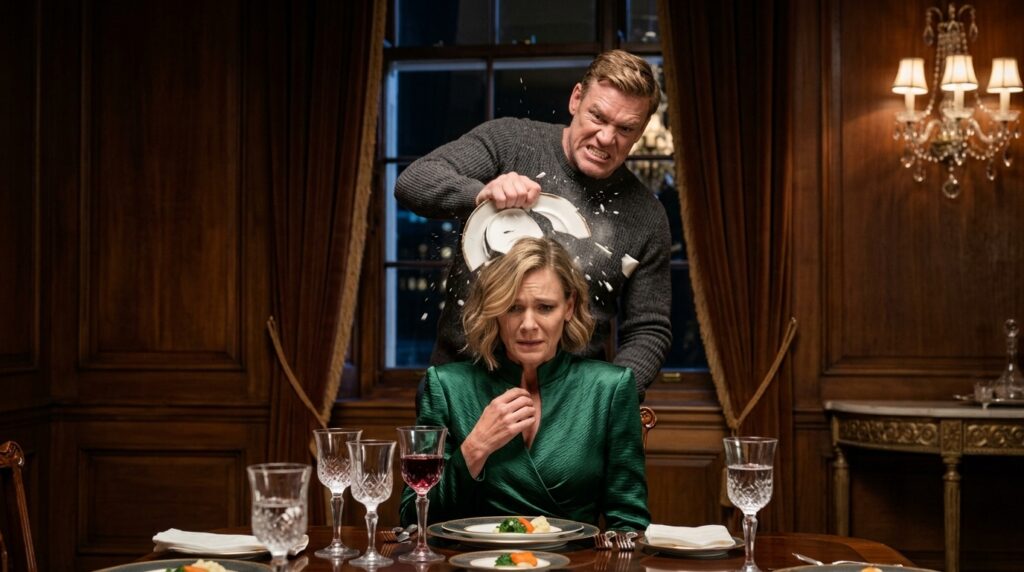
The moment my husband smashed a porcelain dinner plate against my head, twenty members of his family watched me bleed and not one of them moved to help.
That was when I understood the dinner had never been about celebrating his mother.
It had been about breaking me.
My name is Claire Morgan.
I was thirty-eight years old, married for seven years, and until that night I had spent an embarrassing amount of time convincing myself that Adrian’s family merely had unusual boundaries.
They were wealthy.
Old wealthy, or at least that was the image they cultivated.
Charles Whitmore, Adrian’s father, owned vineyards north of San Francisco and spoke in the measured voice of a man accustomed to people lowering theirs when he entered a room.
Adrian’s mother, Eleanor, wore pearls to breakfast, referred to department stores as though they were public transportation, and had once returned a wedding gift because the silver pattern was “aggressively ordinary.”
Adrian had grown up inside that world.
I had not.
My father had been an electrician.
My mother taught third grade.
I built my career in corporate restructuring, spending fifteen years helping troubled companies understand exactly where their money had gone.
By thirty-five, I was earning more than Adrian.
By thirty-six, I had purchased a two-bedroom condominium overlooking the bay entirely with my own money.
The deed was in my name alone.
Adrian had never contributed a dollar toward the down payment.
That fact had apparently become an unbearable problem for his family.
The dinner took place at Charles and Eleanor’s vineyard estate on a warm September evening.
There were twenty-three people around the long walnut table.
Candles flickered between crystal glasses.
Beyond the windows, vineyard rows disappeared into darkness.
For nearly an hour, everything appeared normal.
Then Charles put down his wineglass.
“We have reached a decision about your condo,” he said.
At first, I thought I had misunderstood him.
“My condo?”
Eleanor smiled.
Her expression reminded me of someone delivering pleasant news to an employee.
“The city is becoming difficult for me,” she said.
“The vineyard is too isolated when Charles travels.”
“Your apartment would be perfect.”
I waited for the punch line.
None came.
Charles continued.
“You and Adrian can rent a smaller place.”
He dabbed his mouth with his napkin.
“A young married couple does not need two bedrooms.”
Several relatives nodded.
One of Adrian’s aunts leaned forward with sudden enthusiasm.
“Eleanor’s antique furniture would look beautiful beside those windows.”
Another relative began discussing which bedroom should become Eleanor’s dressing room.
Someone suggested replacing my dining table.
Someone else wondered whether the building allowed decorators on weekends.
They were redesigning my home while I was sitting three feet away.
Then Charles added almost casually, “Claire will also transfer twenty-eight hundred dollars into Eleanor’s account every month for living expenses.”
I stared at him.
“Twenty-eight hundred dollars?”
“It is hardly unreasonable,” Eleanor said.
“You earn more than enough.”
I slowly turned toward my husband.
Adrian sat beside me in an expensive charcoal suit, rotating his wineglass between two fingers.
He refused to meet my eyes.
“Adrian.”
He lifted the glass.
He drank.
That silence was his answer.
For fifteen minutes, they dismantled my life as though discussing a corporate acquisition.
They selected a moving date.
They discussed storage companies.
They decided Adrian and I could rent a one-bedroom apartment in Oakland.
One cousin recommended giving Eleanor access to my bank account so she would not need to “ask” for her monthly transfer.
Not one person asked whether I agreed.
Because apparently my permission had never been part of the plan.
Finally, I placed my fork beside my plate.
“No.”
The room fell silent.
Eleanor blinked.
“I beg your pardon?”
“My condo is not being transferred to you.”
I looked directly at her.
“You are not moving into it.”
“You will not be given access to it.”
“And I will not pay you twenty-eight hundred dollars every month.”
Her smile vanished.
“You would deny an older woman a safe place to live?”
“You own three homes.”
Several relatives shifted uncomfortably.
Eleanor’s jaw tightened.
Charles leaned forward.
“This family has supported you since Adrian brought you into it.”
“No.”
My voice remained calm.
“This family has tolerated me because you assumed my income would eventually become yours.”
Adrian slammed his palm against the table.
Silverware jumped.
Wine trembled inside the glasses.
“How dare you speak to my parents that way?”
I turned toward him.
“They just divided up my property in front of me.”
I paused.
“And you said nothing.”
“My mother needs that condo.”
“Then buy her one.”
His face changed.
“You are my wife.”
“I am not your family’s bank account.”
The room went painfully still.
Adrian shoved back his chair and stood.
The wooden legs scraped across the floor.
“You’re humiliating me in front of everyone.”
I held his gaze.
“No, Adrian.”
“You’re doing that all by yourself.”
Something inside him snapped.
His hand closed around the heavy porcelain dinner plate.
I saw his shoulder turn.
I saw his fingers tighten.
I saw the fury in his eyes.
But I did not have enough time to move.
He swung.
The plate struck the side of my head.
Porcelain cracked.
Pain exploded behind my eyes.
Food and broken ceramic scattered over the white tablecloth.
Someone gasped.
A child began crying.
Yet no one rushed toward me.
Not Charles.
Not Eleanor.
Not Adrian’s brother.
Not his cousins.
One woman quietly gathered her children and led them into the hallway.
Charles stared into his wineglass.
Eleanor turned away.
Blood began dripping onto the tablecloth.
One drop.
Then another.
Then another.
Adrian stood over me breathing heavily.
And incredibly, for a fraction of a second, he looked satisfied.
He believed he had frightened me.
He believed pain would make me obedient.
But when I looked around that table, something inside me became extraordinarily calm.
They were not horrified by what Adrian had done.
They were waiting to see whether it had worked.
I pulled a fragment of porcelain from my hair.
I placed it carefully beside Adrian’s plate.
Then I pressed a napkin against my bleeding temple.
My hand trembled.
My voice did not.
“You have no idea who you just made an enemy of.”
For the first time that evening, fear crossed Eleanor’s face.
I reached into my handbag.
I pulled out my phone.
I called 911.
“My husband attacked me,” I told the dispatcher.
“He struck me in the head with a ceramic dinner plate.”
Adrian’s rage disappeared immediately.
Panic replaced it.
“There are approximately twenty adult witnesses.”
“I am bleeding.”
“I am dizzy.”
“And I am still inside the house with him.”
I gave the dispatcher the address.
Suddenly everyone started talking.
“Claire, stop this,” Eleanor hissed.
“You are making it sound worse than it was.”
“He lost his temper.”
“It was an accident.”
“Accidents do not involve picking up plates and swinging them at someone’s head.”
Charles stood.
“We can handle this privately.”
“That is exactly what you were counting on.”
“You do not want to destroy your marriage over a misunderstanding.”
“There is nothing to misunderstand.”
I pressed the napkin harder against my head.
“Your son attacked me.”
“You watched him do it.”
“And now you are trying to protect him.”
Adrian stepped toward me.
“Give me the phone.”
The dispatcher heard him.
“Ma’am, is he approaching you?”
“Yes.”
Adrian stopped.
“Claire.”
His voice carried a warning.
“Take another step and I will tell them you are attempting to attack me again.”
That stopped him.
Then Maya stood.
Maya was married to Adrian’s older brother, Daniel.
She had barely spoken all evening.
Now she shoved back her chair so violently it toppled onto the hardwood.
She stepped between Adrian and me.
“Do not come any closer to her.”
Adrian stared at her.
“Maya.”
“Move.”
“No.”
Her voice trembled.
Her body did not.
“You have done enough.”
Something passed between them.
Something old.
Maya’s face had turned pale.
Charles noticed.
“Maya.”
She flinched.
Then she looked toward the hallway where her two children had disappeared.
Eleanor stepped forward.
“This conversation is over.”
“No,” I said.
“It is finally beginning.”
Sirens sounded in the distance.
Red and blue lights began flickering against the tall windows.
Charles looked toward Adrian.
Adrian looked toward Maya.
And Maya looked at me like a woman who had spent years waiting for somebody else to make the call she had been too afraid to make herself.
Then she whispered six words.
“He did this to Rachel too.”
I forgot the pain in my head.
“Who is Rachel?”
Adrian’s face went white.
Charles spoke immediately.
“That is enough.”
Maya turned toward him.
“No.”
“Maya.”
“No.”
She looked back at me.
“Rachel Mercer.”
I had heard the name.
Only once.
Years earlier, while sorting old photographs with Adrian, I had found a picture of him standing beside a smiling blonde woman at a university graduation.
When I asked who she was, Adrian had taken the photograph from my hand.
“College friend.”
Later I discovered she had died at twenty-nine.
A fall from a second-story balcony.
A tragic accident.
At least that was what Adrian had told me.
Maya swallowed.
“She was Adrian’s fiancée.”
The room seemed to tilt again.
I reached for the table.
Adrian shouted, “Shut up.”
Maya continued.
“They were engaged for almost two years.”
“And three weeks before their wedding, Rachel told him she wanted to leave.”
Adrian moved toward Maya.
Two uniformed officers entered the dining room before he reached her.
“Sir, stop right there.”
Everything happened quickly after that.
One officer moved toward Adrian.
Another came to me.
Paramedics followed.
Questions filled the room.
People began contradicting one another almost immediately.
Eleanor insisted the plate had slipped.
Charles claimed he had been looking elsewhere.
One cousin said she could not remember what happened.
Another suddenly needed the restroom.
But Maya did not change her story.
Neither did I.
And unfortunately for Adrian, the dining room contained something no one had considered.
A security camera.
Charles had installed it after several bottles disappeared from his wine collection.
The camera pointed directly at the dining table.
When one officer asked about surveillance footage, Charles said the system had been disconnected months earlier.
Maya looked at him.
“No, it wasn’t.”
Charles froze.
“The recorder is in your study.”
Every head turned toward her.
Maya folded her arms.
“I saw Daniel checking it last weekend.”
Charles stared at his daughter-in-law with naked hatred.
The officer noticed.
“So the camera works?”
“Yes.”
The officer immediately called another unit inside.
I was taken to the hospital.
Six stitches closed the wound above my temple.
The CT scan showed no skull fracture.
I had a concussion.
And sometime shortly after midnight, while I lay beneath fluorescent hospital lights with dried blood still beneath my fingernails, an officer told me Adrian had been arrested.
The camera had captured everything.
The family planning to take my condo.
The argument.
The threats.
Adrian picking up the plate.
Adrian swinging it.
And Eleanor telling me afterward that it was an accident.
For the first time in seven years, I slept without my wedding ring.
By morning, the adrenaline was gone.
Reality arrived.
I had married a man capable of striking me in front of his entire family.
Worse, he had expected them to protect him.
My phone contained forty-seven missed calls.
Most were from Adrian’s relatives.
I listened to none of the voicemails.
Instead, I called Rebecca Sloan.
Rebecca was a divorce attorney.
She had been my roommate during graduate school.
When she entered my hospital room ninety minutes later, she carried coffee in one hand and a legal pad in the other.
She looked at the stitches.
Then she looked at my bare ring finger.
“I assume we are not discussing reconciliation.”
“No.”
“Good.”
She pulled up a chair.
“Then we start before his family understands how much trouble they are in.”
By noon, Rebecca had filed for an emergency protective order.
By three o’clock, she had contacted the condominium management company and instructed them not to provide access to Adrian.
By four, I had removed him as an authorized user from every account that belonged exclusively to me.
And by evening, I discovered something strange.
Adrian had tried to refinance my condo six months earlier.
He had failed because his name was not on the deed.
I stared at the report on my laptop.
Rebecca read it twice.
“Did you know about this?”
“No.”
“He tried using your property as collateral.”
“For what?”
She leaned toward the screen.
“That is an excellent question.”
The answer came from Maya.
She visited me two days later.
She arrived alone.
No makeup.
Dark circles beneath her eyes.
A small flash drive rested in her palm.
“I should have done this years ago,” she said.
I invited her inside.
For several minutes, she simply stared at the floor.
Then she told me about Rachel.
Rachel Mercer had met Adrian when they were twenty-four.
According to Maya, Rachel came from money and owned a townhouse inherited from her grandmother.
Adrian moved in.
Within eighteen months, Charles began encouraging Rachel to invest in one of the vineyard companies.
She refused.
Then Eleanor began asking Rachel to help with monthly expenses.
Rachel refused that too.
Three weeks before her wedding, she ended the engagement.
Two nights later, Rachel fell from her balcony.
Adrian told police she had been drinking.
The family supported his account.
The death was ruled accidental.
My stomach turned.
“Are you saying Adrian killed her?”
“I don’t know.”
Maya rubbed her palms together.
“I truly don’t know.”
“But I know something happened before she fell.”
Maya inserted the flash drive into my laptop.
A folder appeared.
Inside were scanned letters.
Bank statements.
Photographs.
And an audio file.
Maya hesitated before opening it.
“I found this on Daniel’s old laptop four years ago.”
A woman’s terrified voice filled the room.
Rachel.
“You hit me, Adrian.”
Silence followed.
Then a man answered.
Adrian.
“You pushed me.”
“No.”
“You threw a plate at me.”
“You embarrassed me.”
My skin went cold.
Rachel began crying.
“I’m leaving tomorrow.”
“You are not taking that house away from me.”
“It is my house.”
Then Adrian said something I would remember for the rest of my life.
“Nothing is yours once you marry into this family.”
The recording ended.
I could hear my own breathing.
Maya closed the laptop.
“Rachel sent the audio to Daniel the night before she died.”
“Why?”
“She trusted him.”
“What did Daniel do?”
Maya’s eyes filled with tears.
“Nothing.”
That single word felt worse than everything else.
“Why?”
“Charles convinced him the recording would destroy Adrian’s life.”
Maya wiped her cheek.
“Then Rachel died.”
“Daniel kept the file.”
“And eventually you found it.”
She nodded.
“I confronted him.”
“He begged me to stay quiet.”
“Charles told me Rachel had been unstable.”
“Eleanor said bringing it up would only hurt everyone.”
“And you believed them?”
“For a while.”
Her shame was immediate.
“Then Adrian hit me.”
I stared at her.
“When?”
“Five years ago.”
She touched the side of her jaw unconsciously.
“We were arguing because I told Daniel I wanted to show the recording to police.”
“Adrian cornered me in the kitchen.”
“He shoved me against a cabinet.”
“Charles walked in.”
“Do you know what he asked me?”
I shook my head.
“He asked what I had said to provoke Adrian.”
Maya began crying.
“That was when I understood they would protect him from anything.”
I reached across the table and took her hand.
“Why now?”
“Because my daughter was in that hallway.”
Her voice broke.
“She heard the plate hit you.”
“She asked me afterward why Uncle Adrian was allowed to hurt women.”
Maya covered her mouth.
“And I did not have an answer I could live with.”
We gave the recording to police that afternoon.
Detectives reopened questions surrounding Rachel’s death.
But the financial documents on Maya’s flash drive exposed something even bigger.
The Whitmores were not rich.
Not anymore.
They were nearly insolvent.
The vineyard had been losing money for nine years.
Charles had mortgaged almost everything.
One property was already facing foreclosure.
Eleanor’s supposed three homes were heavily leveraged.
Adrian owed more than $600,000 across business loans, credit cards, and private debts.
Even Daniel had apparently been hiding problems from Maya.
My condo, worth nearly $2.4 million, was the cleanest asset anywhere near the family.
Suddenly the dinner made sense.
Eleanor did not need somewhere to live.
They needed my property as collateral.
The monthly $2,800 payment was not for groceries or utilities.
Rebecca found a recurring debt obligation for almost exactly that amount connected to one of Eleanor’s private loans.
“They weren’t asking you to support his mother,” Rebecca said.
“They were asking you to service her debt.”
I felt physically sick.
Then Rebecca discovered something that turned disgust into fury.
Adrian had been emailing Charles about my condo for almost a year.
We obtained the messages during discovery.
One read:
If Claire refuses voluntarily, Mom moving in establishes the family connection to the property.
Another said:
Once Claire agrees to the monthly support, it becomes easier to argue financial commingling.
And Charles had replied:
Do not push too hard until everything is documented.
My marriage had become a strategy meeting.
But the worst email came from Adrian.
She loves me enough that she will eventually give in.
I read that sentence ten times.
Seven years.
Birthdays.
Vacations.
Sunday mornings.
Christmas photographs.
The night my mother died when Adrian had held me while I cried.
Our anniversary in Napa.
The promises whispered in bed.
How much had been real?
Rebecca seemed to read my thoughts.
“Manipulative people can still have genuine emotions.”
“That does not make what they do less manipulative.”
I closed the laptop.
“I don’t want to understand him anymore.”
“I want to finish this.”
And we did.
Adrian was charged with felony assault.
The security video destroyed his claim that the plate had slipped.
His attorneys negotiated.
He eventually pleaded guilty to a reduced but still serious charge rather than risk trial.
The judge issued a long-term protective order.
The divorce became far uglier.
Adrian demanded spousal support.
He demanded equity in the condo.
He claimed his emotional contributions to our marriage entitled him to compensation.
Rebecca nearly laughed when she read the filing.
Then forensic financial discovery began.
That was when Adrian made his final mistake.
Because he had forgotten what I did for a living.
I spent my career finding money people thought they had successfully hidden.
Working with Rebecca’s forensic accountant, I traced Adrian’s transfers through six companies.
We found money moved from the vineyard into shell entities.
We found loans guaranteed using falsified financial statements.
We found signatures.
Dozens of signatures.
Some belonged to Charles.
Some belonged to Adrian.
And several supposedly belonged to me.
Except I had never signed them.
My name had been forged.
The matter moved far beyond divorce court.
Federal investigators became involved.
Banks began asking questions.
Creditors surfaced.
The Whitmore image collapsed with astonishing speed.
The vineyard was placed into receivership.
Two properties were sold.
Eleanor moved out of the estate she had once considered beneath her and into a rented townhouse forty minutes away.
Charles was indicted on financial fraud charges.
Daniel finally left the family business.
Maya filed for divorce after learning he had concealed the full extent of the fraud from her.
But Rachel remained the unresolved piece.
Detectives interviewed everyone who had attended Adrian and Rachel’s final dinner years earlier.
Memories had faded.
People contradicted one another.
No physical evidence survived.
The balcony had been renovated.
Rachel’s death could not be turned into a homicide case merely because Adrian had abused her the night before.
I tried to accept that.
Then, eight months after my own assault, I received a call.
The detective investigating Rachel asked me to come to the station.
Maya was already there.
So was Rebecca.
On the table sat a small plastic evidence bag.
Inside was an old phone.
“What is that?”
The detective looked at me.
“Rachel Mercer’s phone.”
Apparently Rachel’s mother had kept a box of her daughter’s belongings untouched for nearly a decade.
The original investigation had copied some data from the device but failed to extract several corrupted files.
New software had recovered one.
A video.
Recorded at 11:43 p.m.
Fourteen minutes before Rachel fell.
The detective pressed play.
The image shook.
Rachel was holding the phone low.
Adrian stood near the balcony door.
Charles stood beside him.
I stopped breathing.
Charles.
He had been there.
That had never appeared in the police report.
Rachel’s voice came from behind the camera.
“You both need to leave.”
Charles answered.
“Think carefully.”
“The townhouse is your grandmother’s.”
“The money is yours.”
“But marriage means partnership.”
“I’m not marrying him.”
Adrian stepped toward her.
“You don’t get to decide that tonight.”
“Yes, I do.”
Then Charles spoke.
His voice was calm.
Terrifyingly calm.
“Adrian, go downstairs.”
Adrian stared at him.
“Dad—”
“Now.”
Adrian left.
For years, everyone had suspected Adrian might have killed Rachel.
He had not.
The final thirty seconds changed everything.
Rachel backed toward the balcony.
Charles followed.
She said, “I’m going to the police.”
Charles reached toward the phone.
The image spun.
Rachel screamed.
Then came the unmistakable sound of a struggle.
The phone struck the floor.
For three seconds, the camera showed nothing except carpet.
Then Charles’s voice said:
“You should have taken the deal.”
A scream followed.
The balcony doors rattled.
Then silence.
The video ended.
No one in the room moved.
Maya began shaking.
Rebecca reached for my hand.
I stared at the black screen.
All this time, I had believed Adrian was the monster at the center of the family.
He was a monster.
But he had learned from someone.
Charles had killed Rachel.
And Adrian had spent nine years protecting him.
The district attorney moved quickly.
Charles was arrested for Rachel’s murder.
When confronted with the recovered recording and financial evidence, Daniel finally broke.
He admitted his father had called him that night.
Charles told him there had been “an accident.”
Adrian helped establish the false timeline.
Eleanor encouraged everyone to describe Rachel as emotionally unstable.
The family closed ranks.
And because Rachel had been drinking and there was insufficient evidence of a struggle, they had gotten away with it.
Until now.
Charles eventually went to trial.
I attended only one day.
Rachel’s mother sat three rows ahead of me.
She was a small woman with white hair and trembling hands.
After court adjourned, she approached.
“You’re Claire?”
“Yes.”
She took both my hands.
“My daughter tried to leave him.”
Tears filled her eyes.
“You did what she never got the chance to do.”
I could not think of anything to say.
So I hugged her.
Charles was convicted.
Adrian’s cooperation reduced some of the additional charges connected to the cover-up, but it did not save him from the financial crimes that followed.
Eleanor avoided prison but lost nearly everything.
The vineyard was sold.
The family name disappeared from the gate.
And the people who had once sat around a candlelit table discussing how to take my home scattered the moment there was nothing left to inherit.
I kept the condo.
Of course I kept it.
But a year after the divorce became final, I did something no Whitmore expected.
I sold it.
Not because they had frightened me out of it.
Not because Eleanor had ruined it.
And not because Adrian had ever had the slightest claim to it.
I sold it because I realized something while standing beside those windows one final morning.
For years, I had treated that condo as proof of success.
Then Adrian’s family treated it as proof of value.
They had reduced my entire existence to an asset column.
I did not want to spend the rest of my life protecting the place where they had imagined imprisoning me financially.
So I sold it for $2.65 million.
I purchased a smaller house overlooking the Pacific.
There were no relatives choosing curtains.
No husband calculating equity.
No mother-in-law demanding keys.
There was just sunlight.
Ocean.
Silence.
And freedom.
Maya and I remained friends.
She rebuilt her life with her children several towns away.
One afternoon, almost two years after the dinner, she visited me.
We sat on my back deck watching waves strike the cliffs.
She brought an envelope.
“What is this?”
“Something Rachel’s mother wanted you to have.”
Inside was a handwritten note.
Rachel had written it years before her death.
It had been found between the pages of an old book.
The note contained only four lines.
I read them slowly.
If something happens to me, do not believe them.
They will make Adrian look innocent.
They will make me look unstable.
Follow the money.
I stared at the final sentence.
Follow the money.
The exact principle that had guided my entire career.
The principle that had ultimately destroyed the Whitmores.
But there was something else inside the envelope.
A photograph.
Rachel was standing outside my old condo building.
My old building.
I turned it over.
A date was written on the back.
Nine years before I purchased the unit.
My chest tightened.
“Maya.”
She nodded.
“I found out yesterday.”
“What?”
“That condo belonged to Rachel’s grandmother.”
I stared at her.
“No.”
“Not your exact unit.”
“The unit directly above it.”
I looked again at the photograph.
Maya continued.
“Rachel grew up visiting that building.”
“She wanted to live there after she married.”
My skin prickled.
“But that is not the strangest part.”
She handed me another document.
It was an email.
The sender was Adrian.
The date was three months before Adrian and I first met.
The recipient was Charles.
Attached was the real-estate listing for my condo.
Underneath Adrian had written one sentence.
This one could finally replace what Rachel cost us.
I stopped breathing.
Three months before we met.
Before the restaurant where Adrian supposedly noticed me across a crowded bar.
Before he supposedly gathered the courage to introduce himself.
Before our first date.
Before everything.
I looked at Maya.
“He knew about my condo before he knew me?”
She nodded.
“No.”
Her expression had changed.
“He knew about you too.”
She handed me the final page.
It was a background report.
My name appeared at the top.
My age.
My employer.
My salary range.
My parents.
My estimated assets.
My condo purchase.
Even my photograph.
At the bottom was a handwritten note in Charles’s unmistakable script.
No siblings.
Parents deceased or financially modest.
High independent income.
Property solely titled.
Low family interference risk.
And beneath that, one final sentence.
Ideal candidate for Adrian.
My marriage had not slowly become financial exploitation.
It had begun as financial exploitation.
Adrian had not happened to meet me.
He had been sent to meet me.
The romantic coincidence I had treasured for seven years had been an assignment.
The anniversary story he told friends about seeing me across the restaurant and “knowing immediately” was technically true.
He had known exactly who I was.
Because his father had given him a file.
For several minutes, I could hear nothing except the ocean.
Then Maya said softly, “I’m sorry.”
I looked toward the horizon.
And strangely, I began to laugh.
Not because it was funny.
Because after everything they had done, the Whitmores had still failed to understand the most important fact about me.
They thought my condo was my strength.
They thought my salary was my strength.
They thought my bank accounts were my strength.
They thought taking those things would make me powerless.
But the condo was gone.
The marriage was gone.
The money had changed accounts.
My forehead still carried a thin white scar where Adrian’s plate had broken against my skull.
And I was still standing.
I folded Charles’s background report in half.
Then I tore it.
Once.
Twice.
Again.
Tiny pieces drifted into the fire pit between us.
Maya watched the pages curl into black ash.
“Does knowing how it started change anything?” she asked.
“Yes.”
I watched Adrian’s photograph disappear into flame.
“It means I spent seven years thinking I had married into their family.”
I looked at the ashes.
“Now I know they spent seven years trying to marry themselves into mine.”
The wind lifted the final scraps into the air.
And for the first time, the truth did not feel like another wound.
It felt like a door opening.
Because Adrian’s family had chosen me for my money.
They had studied my assets.
They had planned my marriage.
They had tried to take my home.
They had attacked me when I refused.
And they had protected a murderer for nearly a decade.
But they had made one catastrophic mistake.
They chose a woman whose entire career was built on uncovering what other people tried to hide.
And in the end, I did not merely keep them from taking my home.
I followed the money all the way back to a dead woman’s final warning.
I uncovered a murder.
I exposed a fraud empire.
I ended my husband’s carefully constructed life.
And I watched the family that had once divided my possessions over dinner lose everything they believed made them untouchable.
The scar beside my temple eventually faded.
The lesson never did.
Sometimes the moment someone tries to destroy you is not the end of your life.
Sometimes it is simply the moment you finally see clearly enough to destroy the lie they built around you.
And the night Adrian raised that plate, believing fear would finally make me surrender, he had no idea what he was really doing.
He was handing me the first piece of evidence.
part 2
I Thought Exposing My Husband’s Family Had Finally Set Me Free. Then a Woman I Had Never Met Knocked on My Door Holding My Wedding Photograph.
Three weeks after I learned that my husband had been sent into my life like a financial predator, a stranger appeared at my door carrying a photograph from my wedding.
She did not knock twice.
She did not ring the bell.
She simply stood beneath the porch light while rain soaked through her gray coat, holding the photograph against her chest as though it were evidence from a crime scene.
I saw her through the security camera at 10:17 on a Thursday night.
My first instinct was not to open the door.
After Adrian, Charles, Eleanor, forged documents, hidden debts, and a murder covered up for nearly a decade, I had learned that unexpected visitors rarely arrived carrying good news.
I spoke through the intercom.
“Can I help you?”
The woman looked directly into the camera.
“My name is Natalie Mercer.”
My breath stopped.
Mercer.
Rachel Mercer.
The woman Adrian had abused.
The woman Charles had killed.
The woman whose warning had eventually helped destroy the Whitmore family.
The stranger lifted the photograph toward the camera.
“I’m Rachel’s sister.”
I unlocked the door.
She stepped inside dripping rainwater onto the hardwood.
Natalie appeared to be in her early forties.
She had Rachel’s eyes.
That was what struck me first.
I had seen enough photographs during the investigation to recognize them immediately.
Large.
Blue-gray.
Watchful.
But where Rachel had looked open and warm in the old photographs, Natalie carried something harder.
Something sharpened by grief.
I handed her a towel.
She ignored it.
Instead, she placed the wedding photograph on my kitchen counter.
It showed Adrian and me standing beneath white roses.
I was smiling.
Adrian’s hand rested around my waist.
Charles and Eleanor stood behind us.
Daniel was beside Maya.
Everyone looked happy.
Normal.
Natalie tapped one person near the edge of the photograph.
A man I barely remembered.
Tall.
Silver-haired.
Dark suit.
“You know him?”
I shook my head.
“He was at the wedding.”
“So were almost two hundred people.”
“Look again.”
I did.
The man stood slightly apart from everyone else.
He was not smiling.
His eyes were fixed on me.
“His name is Victor Lang.”
The name meant nothing.
Natalie removed a folder from beneath her coat.
“My sister mentioned him before she died.”
I felt the old uneasiness return.
“What did she say?”
“That Victor knew what Charles was doing.”
“With the vineyard?”
“With women.”
I stared at her.
Natalie lowered herself into a chair.
For several seconds, she said nothing.
Then she looked toward the windows.
“You think Rachel was the beginning.”
My stomach tightened.
“She wasn’t?”
Natalie gave a humorless smile.
“Rachel wasn’t even the second.”
The kitchen suddenly felt colder.
I sat across from her.
“Start at the beginning.”
Natalie opened the folder.
Inside were three photographs.
Three women.
The first was Rachel.
The second was a brunette I had never seen.
The third was a woman with auburn hair standing beside Charles Whitmore at some charity event decades earlier.
Natalie pointed to the brunette.
“Rebecca Dale.”
“She dated Daniel before Maya.”
“She disappeared from California twenty years ago.”
“Disappeared?”
“Officially she moved overseas.”
“And unofficially?”
“No one in her family has heard from her since.”
Then Natalie touched the third photograph.
“Laura Bennett.”
“Charles’s assistant.”
“She died in a car accident in 1998.”
My mouth went dry.
“You believe Charles killed both women?”
“I believe Charles spent thirty years solving problems the same way.”
Rain tapped against my windows.
I looked at the photographs again.
“What does Victor Lang have to do with this?”
“He worked for Charles.”
“As what?”
Natalie leaned back.
“That is the problem.”
“No one seems able to answer that.”
According to Natalie, Victor had never officially been employed by Whitmore Vineyards.
Yet he appeared in family photographs stretching back twenty-five years.
At parties.
At weddings.
At funerals.
Always at the edge.
Always watching.
Rachel had once told Natalie that Victor “fixed things” for Charles.
She had assumed Rachel meant business problems.
Then Rachel died.
Years later, Natalie found an old voicemail Rachel had left.
In it, Rachel had whispered one sentence.
“If anything happens, find Victor before Charles does.”
Natalie slid her phone across the table.
I listened.
Rachel’s voice was shaky.
Breathing fast.
Then the sentence.
Nothing more.
I replayed it twice.
“When was this recorded?”
“The afternoon before she died.”
“And you never gave this to police?”
“I did.”
“What happened?”
“They could not locate Victor.”
“Now?”
Natalie looked at me.
“I found him.”
My heart thudded.
“Where?”
“Thirty miles from here.”
Victor Lang was living under another name in a nursing facility outside Santa Rosa.
He had suffered a stroke two years earlier.
According to Natalie, he could speak only in short phrases.
His right side was partially paralyzed.
But he was alive.
And when Natalie showed him Rachel’s photograph, he began crying.
She returned the next day.
This time, she showed him Charles.
Victor became agitated.
He repeated two words.
“Ledger.”
And then:
“Claire.”
I stared at Natalie.
“My name?”
“Yes.”
“He said your name.”
“That’s impossible.”
“I thought so too.”
“How would he even know who I am?”
Natalie’s eyes moved toward my wedding photograph.
“You were not chosen by Adrian.”
The silence between us seemed to expand.
“What?”
“Rachel’s background report was not created by Charles.”
My pulse quickened.
Natalie pushed another document across the counter.
It looked similar to the report Maya had shown me.
Different header.
Same structure.
Employment.
Property.
Family relationships.
Financial assets.
At the bottom was a company name.
Lang Strategic Advisory.
Victor’s company.
I looked up.
“You think Victor investigated me?”
“I think he investigated all of them.”
“All of whom?”
Natalie hesitated.
Then she opened another folder.
There were eleven files.
Each bore a woman’s name.
Rachel Mercer.
Laura Bennett.
Rebecca Dale.
Claire Morgan.
And seven others.
Some names had photographs.
Others contained only financial records.
I felt nauseated.
“What was Charles doing?”
Natalie shook her head.
“I don’t know.”
“But Victor does.”
The next morning, Rebecca came with me to the nursing facility.
Maya joined us.
She said nothing during the drive.
When we reached Victor’s room, he was sitting beside a window watching birds peck at wet grass.
He looked smaller than he had in the wedding photograph.
Age had hollowed his face.
One hand rested motionless in his lap.
The other trembled.
Natalie walked forward.
“Victor.”
His eyes moved toward us.
She pointed at me.
“Do you remember Claire?”
His expression changed instantly.
His functioning hand grabbed the armrest.
“Claire.”
His speech was rough.
Forced.
I stepped closer.
“How do you know me?”
His lips moved.
Nothing came.
Then:
“Charles.”
“Yes.”
“Charles what?”
Victor shut his eyes.
He seemed exhausted.
Rebecca crouched beside him.
“Victor, did Charles ask you to investigate Claire?”
He nodded.
“Why?”
Victor swallowed.
“Money.”
That answer was not surprising.
Then he added another word.
“Baby.”
Every person in the room froze.
I looked at Rebecca.
“What did he say?”
Victor repeated it.
“Baby.”
I leaned closer.
“What baby?”
He struggled for breath.
Then his fingers moved toward a drawer beside the bed.
Natalie opened it.
Inside was an old brass key.
Attached to the key was a metal tag.
A number.
314.
Victor pointed at it.
“Station.”
“What station?”
“Train.”
Maya inhaled.
“Santa Rosa station lockers?”
Victor nodded.
Then he looked at me.
His eyes filled with tears.
“Sorry.”
Before I could ask another question, his heart monitor began shrieking.
A nurse rushed inside.
We were pushed into the hallway.
Victor survived.
But he did not speak again.
Locker 314 was inside a private storage facility near the old train depot.
The brass key opened it.
Inside was a black leather case.
Rebecca insisted we call police before touching anything else.
Detectives photographed the contents.
There were financial ledgers.
Photographs.
Cash payment records.
Copies of marriage licenses.
Medical records.
And envelopes labeled with women’s names.
Eleven women.
Eleven investigations.
But one file was thicker than every other.
Mine.
Inside was the background report I had already seen.
Then photographs of me leaving work.
Buying groceries.
Visiting my parents.
Running near the waterfront.
Taken months before Adrian supposedly met me.
There were notes about my routines.
My income.
My relationships.
Then one document made my hands begin to shake.
A hospital record.
Not mine.
My mother’s.
I read the date.
Fourteen years earlier.
Long before I had ever heard the name Whitmore.
“How did Charles have this?”
Rebecca did not answer.
The document concerned an emergency surgery my mother had undergone.
Her blood type was listed.
So was mine.
A handwritten note appeared at the bottom.
Possible match confirmed.
I looked at the detective.
“Match for what?”
Nobody knew.
Then Maya pulled another page from the envelope.
It was a letter.
Addressed to Victor.
Signed by Charles.
The handwriting was unmistakable.
Locate the daughter.
Do not approach.
Confirm employment, assets, and medical history.
Adrian can handle the rest when the time is appropriate.
My mouth went dry.
“The daughter?”
Rebecca looked at me.
“Claire, we need to find out what Charles meant.”
I laughed once.
It sounded wrong.
“He meant me.”
“Yes.”
“But whose daughter?”
No one answered.
Two days later, we got the answer.
And it tore apart the only family history I thought I could still trust.
My father had died six years earlier.
My mother had died four years before that.
I had no siblings.
No living grandparents.
I had always believed my parents were ordinary people who had built an ordinary life.
Then Rebecca called me into her office.
Natalie and Maya were already waiting.
There was a DNA report on the table.
“We tested an item from Charles’s archived evidence against the DNA profile police already had from you after the assault investigation.”
I stared at her.
“Why?”
“Because of the phrase possible match.”
Rebecca slid the report toward me.
I read the percentages.
I did not understand them.
Then I understood them perfectly.
“No.”
Nobody spoke.
I read it again.
The biological relationship probability was overwhelming.
Charles Whitmore was not merely my former father-in-law.
Charles Whitmore was my biological father.
I pushed myself away from the table.
“No.”
“Claire—”
“No.”
My chair struck the wall.
“My father was Samuel Morgan.”
Rebecca stood.
“Samuel Morgan raised you.”
“He was my father.”
“Yes.”
“But biologically—”
“No.”
I walked toward the window.
My hands had gone numb.
Memories assaulted me.
My father teaching me to ride a bicycle.
My father building shelves in my bedroom.
My father crying at my graduation.
My father squeezing my hand in the hospital shortly before he died.
Charles had none of that.
DNA did not get to rewrite love.
But it could rewrite history.
Natalie spoke softly.
“My sister knew.”
I turned.
“What?”
“Not everything.”
“But Rachel discovered that Charles had a daughter outside his marriage.”
“How?”
“She found payments to your mother.”
I felt dizzy.
“Payments?”
“Small ones.”
“Years ago.”
“Before you were born.”
“Then they stopped.”
Rebecca opened another file.
My mother had worked briefly as a bookkeeper for one of Charles’s early companies.
She had been twenty-three.
Charles had been thirty-one.
Already married to Eleanor.
There had been an affair.
When my mother became pregnant, she left.
Samuel Morgan knew.
That discovery hurt almost as much.
My father had known I was not biologically his.
And he had loved me anyway.
Apparently he had insisted Charles stay away.
Charles agreed.
For decades.
Then something changed.
“What?”
I asked.
“Why find me after all those years?”
Rebecca slid forward another document.
Charles’s father had created a family trust in 1989.
A badly drafted family trust.
It provided that a significant block of Whitmore land and company shares would eventually pass equally to all biological descendants of Charles Whitmore, not merely legitimate children or children formally acknowledged by him.
At the time, no one thought the language mattered.
Charles had two recognized sons.
Daniel.
Adrian.
But Charles knew there was another child.
Me.
And if my biological relationship ever became legally established, part of the trust belonged to me.
Not Adrian.
Not Eleanor.
Me.
The estimated present value was staggering.
Almost fourteen million dollars.
Suddenly the entire shape of my marriage changed again.
“They did not want my condo.”
Rebecca shook her head.
“Not originally.”
“That came later.”
“Then why did Adrian marry me?”
Maya answered.
“To control your claim before you discovered you had one.”
I could barely breathe.
Adrian had not simply married a wealthy woman his father had identified.
He had married his own half-sister.
The realization struck the room at exactly the same moment.
Natalie covered her mouth.
Maya whispered, “Oh my God.”
Rebecca closed her eyes.
I felt my knees weaken.
“No.”
The word barely escaped.
“No.”
Charles knew.
Victor knew.
Maybe Eleanor knew.
But had Adrian?
That became the question that consumed me.
Had my husband known I was his biological half-sister when he married me?
The answer arrived in an email recovered from Victor’s storage files.
It was sent from Charles to Victor six months before Adrian first approached me.
Adrian must never know the biological connection.
He only needs to believe Claire is financially valuable and potentially useful regarding the trust.
I stared at those words until they blurred.
Adrian had known I was targeted.
He had known my finances were being studied.
He had knowingly participated in a calculated marriage.
But he had not known we shared a father.
Charles had manipulated his own son into marrying his own daughter.
Why?
Because marriage provided the perfect mechanism for Charles to keep my assets and legal claims inside the Whitmore family without publicly acknowledging me.
If I discovered the trust and asserted my rights, Adrian could influence me.
If I died without discovering it, depending on estate arrangements, Adrian might inherit from me.
And if children had resulted from our marriage—
I could not finish the thought.
Fortunately, Adrian and I had never had children.
We had tried.
For almost three years.
There had been fertility appointments.
Tests.
Medication.
Two devastating miscarriages.
I ran to the restroom and vomited.
When I finally returned, Rebecca looked furious in a way I had never seen before.
“There is more.”
“I don’t want more.”
“You need to know.”
She placed medical paperwork on the table.
Fertility reports.
My reports.
Adrian’s reports.
Except something was wrong.
The physician listed on one document did not match the clinic we had used.
I looked at Rebecca.
“What is this?”
“Victor kept correspondence showing Charles paid someone at the clinic.”
My throat closed.
“For what?”
“To alter certain information.”
I could barely make myself ask.
“Why?”
Rebecca swallowed.
“Because your genetic screening would likely have revealed the familial connection.”
The room became silent.
Charles had not merely arranged a marriage between two people he knew were related.
He had interfered with medical testing to keep us from finding out.
One of my miscarriages had required emergency treatment.
I remembered Charles visiting the hospital.
Flowers in his hands.
Concern on his face.
He had kissed my forehead and called me brave.
I wanted to tear every memory out of my brain.
Police questioned Eleanor.
At first, she denied everything.
Then investigators showed her the DNA results.
The payments.
The trust.
Charles’s emails.
She stopped speaking.
Her attorney requested a break.
Four hours later, Eleanor asked for an agreement.
She wanted immunity from certain financial charges in exchange for testimony.
Her statement was almost fifty pages long.
And it contained one final betrayal.
Eleanor had known about me since the day I was born.
Charles had confessed the affair to her because he feared my mother might expose him.
Eleanor had insisted that he choose.
Her or me.
He chose his marriage.
But when his father later established the trust, Eleanor understood that I could one day claim part of the family fortune.
For decades, she checked occasionally to see where I lived.
When my parents were alive, she considered me too difficult to approach.
Then my mother died.
Then my father died.
I became exactly what Charles’s report eventually called me.
Low family interference risk.
Six months later, Adrian “accidentally” met me.
That phrase destroyed something in me.
Not because I still loved Adrian.
I did not.
But because I remembered how lonely I had been after losing my parents.
I remembered telling him that he had arrived at precisely the moment I needed somebody.
I remembered thinking fate had sent me comfort.
Instead, Charles had waited until there was nobody left to warn me.
The trust case went to probate court.
Eleanor challenged my claim at first.
Then withdrew it when DNA evidence became impossible to contest.
Daniel did not challenge me.
Neither did Adrian.
Adrian was still serving his sentence when Rebecca visited him with the results.
I never asked what his first reaction had been.
I did not want it.
Weeks later, I received a letter from him.
I almost burned it unopened.
Instead, I read three lines.
Claire, I swear I didn’t know.
I knew Dad wanted your money, but I never knew why.
I am sorry for everything.
That was all I needed.
The sentence was intended as a defense.
Instead, it was a confession.
I knew Dad wanted your money.
So Adrian admitted the marriage had been a setup.
He simply had not known how monstrous the setup truly was.
I gave the letter to Rebecca.
Then I never read another one.
Charles’s second criminal trial became national news.
The murder conviction had already made him infamous.
Now prosecutors added fraud, conspiracy, falsification of medical records, identity-related offenses, and several financial charges.
Eleanor testified against him.
So did Daniel.
So did Victor, through a recorded deposition taken during a brief period when his speech improved.
Victor admitted accepting money for surveillance and background investigations.
He also admitted something that surprised everyone.
He had hidden the locker because Rachel had changed him.
The night Rachel died, Charles called Victor and asked him to “clean up a problem.”
Victor refused.
That was why he disappeared from Charles’s world soon afterward.
For years, he carried the evidence but lacked the courage to release it.
He had been afraid of prosecution.
Afraid of Charles.
Afraid of what he had helped create.
His silence cost people dearly.
But eventually his hidden files exposed everything.
The trust was divided.
Daniel received his share.
Adrian’s portion became subject to judgments and legal claims.
And I received mine.
$13.8 million.
For two weeks, I could not touch the money.
It felt contaminated.
Blood money.
Rachel’s money.
My mother’s silence.
Samuel’s sacrifice.
My own stolen marriage.
Then Natalie came to see me.
We sat at the same kitchen counter where she had first shown me Victor’s photograph.
“I know what you’re thinking,” she said.
“That taking the money makes you one of them.”
I looked at her.
“Yes.”
“It doesn’t.”
“It came from them.”
“No.”
She shook her head.
“It came through them.”
“There’s a difference.”
I said nothing.
Natalie continued.
“My sister spent her final months trying to prevent Charles from using money to control people.”
“If you refuse what legally belongs to you because Charles poisoned it, he controls you one last time.”
That sentence stayed with me.
So I made a decision.
I kept enough to secure my future.
Then I used part of the trust to create the Rachel Mercer Foundation for Financial Abuse Survivors.
The foundation provided emergency housing.
Legal assistance.
Forensic accounting support.
Help for women whose partners controlled property, debt, businesses, or bank accounts to trap them.
Maya became one of its first board members.
Natalie joined six months later.
Our first office opened in San Francisco.
On the wall near the entrance hung no photograph of me.
There was only one small plaque.
It read:
FOLLOW THE MONEY.
Three years passed.
My life became quiet in ways I had once thought impossible.
Then, one spring morning, I received a package with no return address.
Inside was a small wooden box.
There was no threat.
No letter from Adrian.
No Whitmore family crest.
Only a photograph of my mother.
She was young.
Maybe twenty-two.
She stood outside a diner laughing at whoever held the camera.
Behind the photograph was a handwritten message.
Claire deserves the truth when she is ready.
The handwriting belonged to Samuel.
My father.
My real father in every way that mattered.
Beneath the photograph was a cassette tape.
I found an old player online.
Two days later, I sat alone in my living room and pressed play.
Samuel’s voice filled the room.
Older than I remembered.
Gentle.
“Claire, if you’re hearing this, then something I hoped would stay buried probably didn’t.”
I covered my mouth.
He continued.
“I want you to know one thing before anything else.”
“You were never a secret to me.”
Tears blurred my vision.
Samuel explained that my mother had told him the truth before they married.
He knew she was pregnant.
He knew Charles was the biological father.
And he married her anyway.
Not out of obligation.
Not pity.
Because he loved her.
And because, as he said on the tape:
“A father is not the man whose blood happens to arrive first.”
“A father is the man who stays.”
I began sobbing.
Samuel described the night I was born.
How he held me first.
How my tiny hand wrapped around his finger.
How he promised my mother that Charles Whitmore would never define my life.
Then his voice became more serious.
“There may come a day when the Whitmores find you.”
“If they do, they will tell you blood makes you one of them.”
“Do not believe it.”
“They may offer you money.”
“They may demand loyalty.”
“They may tell you family means obligation.”
He paused.
Then he said the words I had spent years learning on my own.
“Family is not who owns part of your blood.”
“Family is who refuses to own you.”
The tape clicked.
But it was not finished.
Samuel added one last message.
“And Claire?”
“You were the best thing that ever happened to me.”
I sat there until the sunlight disappeared from the room.
For years, the Whitmores had tried to turn biology into ownership.
Charles believed blood entitled him to my property.
Eleanor believed marriage entitled her to my money.
Adrian believed being my husband entitled him to obedience.
But Samuel Morgan had known something they never understood.
Love does not take possession.
It gives freedom.
I placed his photograph beside the window overlooking the Pacific.
Then I looked at my reflection in the glass.
There was still a faint scar beside my temple.
It no longer embarrassed me.
It reminded me of the exact moment the Whitmore family lost control.
They thought Adrian striking me with that plate was the moment they would finally make me afraid enough to surrender.
Instead, it caused me to call the police.
That call exposed Adrian.
Adrian exposed Charles.
Charles exposed the murder.
The murder exposed Victor.
Victor exposed my parentage.
My parentage exposed the trust.
And the trust eventually funded a foundation designed to protect people from families exactly like theirs.
Every attempt they made to control me became another piece of evidence that destroyed them.
Years later, reporters would sometimes ask which revelation had shocked me most.
That Charles killed Rachel?
That Adrian knowingly targeted me?
That Charles was my biological father?
That my husband had unknowingly married his half-sister?
That my medical records had been manipulated?
That the entire relationship had been engineered?
My answer was always the same.
None of those truths changed my life as much as one much simpler discovery.
Samuel Morgan knew I was not his biological daughter from the beginning.
And he chose me anyway.
Charles had spent decades believing DNA made me his.
Samuel spent one lifetime proving DNA did not matter.
That was the difference between possession and love.
Between inheritance and family.
Between the man who created me and the man who raised me.
On the fifth anniversary of the night Adrian attacked me, Maya, Natalie, and I stood together at the opening of the foundation’s fourth emergency residence.
Thirty-two apartments.
Secure entrances.
Legal offices downstairs.
Child-care rooms.
Counselors.
Financial advocates.
A woman approached me after the ceremony.
She looked exhausted.
A little boy held her hand.
She whispered, “I left yesterday.”
I knew immediately what she meant.
“Do you have somewhere safe tonight?”
She glanced toward the building.
“They said I could stay here.”
“Yes.”
She started crying.
“My husband told me I would have nothing without him.”
I looked at the keys in her hand.
Then at her son.
Then at the building Charles Whitmore’s money had helped pay for without ever intending to.
“You already proved him wrong.”
She hugged me.
And as I watched her walk through those doors, something inside me finally settled.
Rachel had never escaped that balcony.
My mother had spent decades hiding from Charles.
Samuel had carried a secret because he believed silence protected me.
Maya had remained frightened too long.
Victor had waited too long to speak.
And I had spent seven years mistaking manipulation for marriage.
But the story did not end with any of us.
It continued every time another woman walked through those doors.
Every time somebody opened a bank account in her own name.
Every time someone learned that being married did not mean surrendering ownership of herself.
Every time fear lost.
I looked upward at the plaque beside the entrance.
RACHEL MERCER HOUSE.
Natalie stood beside me.
“You think she would like it?”
I smiled.
“No.”
Natalie looked surprised.
Then I laughed.
“I think she would complain that we should have built more apartments.”
Natalie laughed too.
Maya joined us.
And for the first time, Rachel’s name existed inside laughter instead of tragedy.
That evening I returned home alone.
Not lonely.
Alone.
There was a difference.
The Pacific was dark beyond my windows.
I poured a glass of wine.
Not Whitmore wine.
I had standards.
Then I noticed an envelope beneath my front door.
For one terrible second, my entire body tightened.
Old instincts.
Old fear.
I picked it up.
There was no postage.
My name was handwritten across the front.
Inside was a single page.
I recognized the handwriting instantly.
Adrian.
My first impulse was to tear it apart.
Then I saw the first sentence.
My father lied to you about one final thing.
I stopped.
The second sentence made my blood run cold.
The Whitmore trust was never the reason he chose you.
I read faster.
Adrian wrote that Charles had visited him in prison two months before his death.
During that visit, Charles confessed something Adrian had never told investigators because he assumed it was another manipulation.
But after Samuel’s tape surfaced publicly during a foundation interview, Adrian began wondering whether it had been true.
Charles claimed my mother had left behind something worth far more than the family trust.
Something Samuel had hidden.
Something Charles had spent decades trying to locate.
According to Adrian, Charles believed I had inherited it without knowing it existed.
I turned the page.
There was only one final line.
Ask yourself why your father worked as an electrician when he secretly owned half of Whitmore Vineyards.
I stared at the sentence.
Then I looked toward Samuel’s photograph by the window.
The room became completely silent.
Because my father had never owned a vineyard.
At least that was what I had believed.
I walked to the cabinet containing the few boxes I had kept after my parents died.
Tax records.
Photographs.
Letters.
Samuel’s old tools.
At the bottom of one box was a sealed envelope I had never opened.
My name was written across it.
Underneath were four words.
For after Charles is gone.
My hands began to tremble.
I opened it.
Inside was a single deed.
Then another.
Then twenty-three pages of corporate records.
And when I reached the final page, I understood why Charles Whitmore had spent half his life watching my family.
Why he had sent Adrian.
Why he had paid Victor.
Why he had feared Rachel.
Why he had forged documents.
Why he had been willing to manipulate his own children.
The Whitmore fortune had never truly belonged to Charles.
Half of it belonged to Samuel Morgan.
My father had not merely protected me from Charles.
For thirty-seven years, he had been quietly protecting Charles from me.





