PART 1: THE SLAP
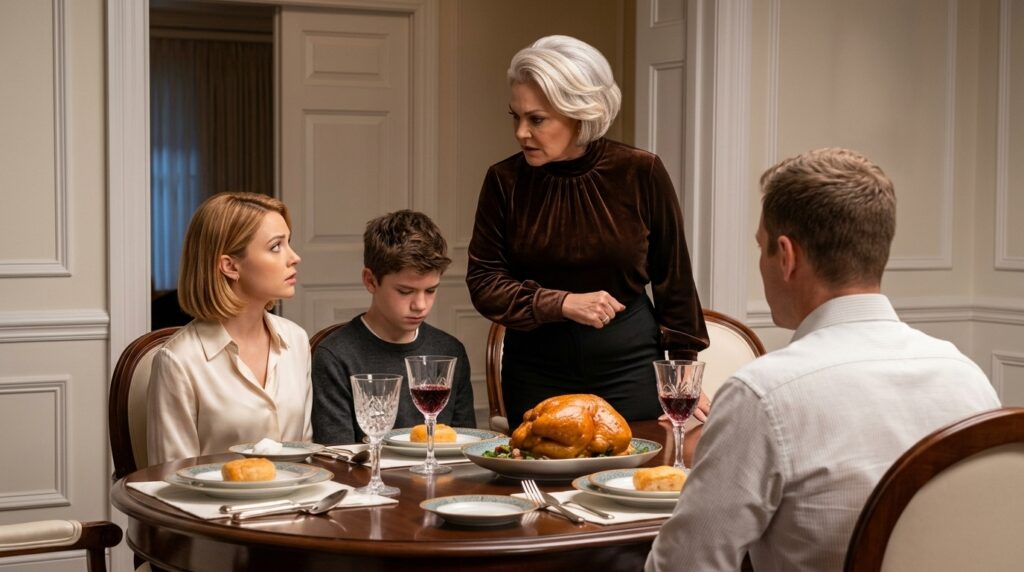
The slap cracked across my dining room just as my eighteen-year-old brother reached for one piece of chicken.
For half a second, nobody moved.
Noah’s head had turned sharply to the side. His hand remained suspended above the platter, fingers curled around nothing, while a red mark began spreading across his left cheek.
My mother-in-law, Diane, stood beside him with her palm still raised.
“You greedy little freeloader,” she said.
I remember every detail of that moment.
The roasted chicken cooling between us.
The glass of iced tea beside Ethan’s elbow.
The yellow light from the pendant fixture over the table.
The ridiculous little bowl of rosemary potatoes Diane had complained were “too oily” ten minutes earlier.
And my husband.
Ethan was sitting directly across from Noah.
He had seen everything.
He had watched his mother slap my eighteen-year-old brother in the face over a piece of chicken.
Yet the first person he spoke to was me.
“Claire,” he warned quietly. “Don’t make this worse.”
For several seconds, I just stared at him.
I actually wondered if I had misunderstood.
“What?”
Ethan glanced toward his mother, then back at me.
“Everybody’s upset. Just don’t turn it into something bigger than it needs to be.”
Something bigger.
Noah slowly touched his cheek.
That movement snapped me out of my shock.
I pushed my chair back so hard it scraped against the hardwood floor.
Diane sighed.
“Oh, here we go.”
I walked around the table and stopped beside my brother.
Noah was eighteen, but sometimes I could still see the twelve-year-old boy he had been when our mother died.
He had been skinny then, all elbows and frightened eyes, standing beside me at the cemetery in a suit that was too large because Mom had bought it six months earlier and said he would “grow into it.”
He never really got the chance to be a child after that.
Neither of us did.
I was twenty-four when Mom died. Old enough to live independently, but nowhere near prepared to become the person Noah called when he was sick, scared, confused, broke, or simply needed someone to tell him everything would be okay.
I had helped him with homework.
Taught him how to drive.
Sat in the bleachers at his high school graduation.
Helped him fill out financial-aid forms.
And eleven days earlier, I had driven him and three boxes of belongings into Chicago because he was preparing to begin community college.
He wasn’t supposed to stay forever.
He wasn’t even supposed to stay long.
The college dorm arrangement he had originally expected hadn’t worked out, so I had offered our guest room while he looked for something affordable nearby.
Eleven days.
That was how long he had been in my house.
I touched his cheek carefully.
He flinched.
Something inside me went cold.
“Get away from him,” I told Diane.
She laughed.
Actually laughed.
“Excuse me?”
“You heard me.”
“This is my son’s house.”
“No,” I said. “It isn’t.”
Silence.
Diane’s eyes narrowed.
Then, automatically, she looked at Ethan.
That was what she always did whenever I challenged her.
For four years, I had watched that look pass between them.
Diane would insult me.
I would object.
She would look at Ethan.
And somehow, within ten minutes, the conversation would no longer be about what Diane had done.
It would be about my reaction.
My tone.
My sensitivity.
My inability to understand “how she is.”
At first, I had believed Ethan when he told me his mother didn’t mean to hurt me.
Then I started noticing that Diane somehow managed not to speak that way to people whose approval she wanted.
She never accidentally insulted Ethan’s boss.
She never accidentally criticized wealthy relatives.
She never accidentally mocked people at church.
Her honesty seemed to appear only around people she believed couldn’t make her pay for it.
Mostly me.
And now Noah.
“Mom shouldn’t have hit him,” Ethan finally said.
I waited.
He should have stopped there.
Instead, he added, “But Noah could have asked before taking the piece she wanted.”
I stared at my husband.
There were five pieces of chicken still sitting on the platter.
Five.
I looked down at them, almost expecting some explanation to materialize between the drumsticks.
Nothing did.
I had bought the groceries.
I had cooked dinner.
I paid most of the mortgage.
And my little brother had just been physically punished for taking food from my table.
“Ethan,” I said slowly, “did you seriously just blame Noah for your mother hitting him?”
“I didn’t blame him.”
“You said he should have asked.”
“He knows Mom wanted the thigh.”
“No,” Noah whispered. “I didn’t.”
Everyone looked at him.
His voice was so quiet it nearly broke me.
“I didn’t know,” he repeated.
Diane rolled her eyes.
“Oh, please. I mentioned it.”
“When?” I asked.
“Earlier.”
“To Noah?”
“At dinner.”
“You said you preferred dark meat.”
“Exactly.”
“That doesn’t reserve every chicken thigh in the house.”
She gave me a look of pure disbelief.
“Listen to yourself.”
“No. You listen to me.”
My voice sounded unfamiliar.
Calm.
Almost frighteningly calm.
“You hit my brother.”
“It was a slap.”
“You hit him.”
“He grabbed something I was reaching for.”
“I didn’t see you reaching for it,” Noah said.
Diane turned on him.
“Nobody asked you.”
I stepped between them.
“Don’t speak to him.”
“Claire,” Ethan said.
I turned toward him.
He stopped.
Maybe he finally saw something in my face.
“Get up, Noah,” I said.
He looked frightened.
“Claire, I’m okay.”
“You’re not staying at this table.”
He swallowed.
“Get your things together.”
Diane folded her arms.
“Yes. Maybe that’s best.”
I turned toward her.
“You too.”
Her satisfaction vanished.
“What?”
“You’re leaving my house.”
Ethan pushed back his chair.
“Claire, you can’t just throw my mother out.”
“I can tell someone who assaulted my brother to leave.”
Diane threw both hands into the air.
“Oh, stop being dramatic! Assaulted? It was one slap.”
Noah lowered his eyes.
That hurt more than anything.
He looked ashamed.
As though he had done something wrong by being hit.
As though his presence had caused this.
I knew exactly what was happening inside his head because I had watched him do it after Mom died.
Whenever money was tight, Noah ate less without being asked.
Whenever I looked tired, he stopped asking for help.
Whenever something went wrong, he tried to make himself smaller.
Less expensive.
Less noticeable.
Less trouble.
I put my hand on his shoulder.
“Look at me.”
He did.
“You are not a freeloader.”
His mouth tightened.
“You’re my brother. I invited you here.”
“I know.”
“This isn’t your fault.”
Diane scoffed.
“Of course not. Nothing is ever that family’s fault.”
That family.
My family.
Noah’s shoulders folded inward.
And suddenly the hypocrisy became so enormous I couldn’t understand how I had tolerated it.
Diane had moved into our townhouse four months earlier.
She had asked for three weeks.
Her lease had ended after her landlord sold her apartment building, and she said she needed somewhere temporary while she found another place.
I had agreed.
Not Ethan.
Me.
I had cleaned the guest room, moved boxes into storage, bought extra towels, cleared a bathroom drawer, and told her she could stay as long as she genuinely needed.
Three weeks became six.
Six became ten.
Then fourteen.
Every apartment was wrong.
Too expensive.
Too small.
Too old.
Too modern.
Too far from Ethan.
Too close to traffic.
No elevator.
Bad parking.
Ugly kitchen.
Wrong neighborhood.
She had rejected a perfectly nice one-bedroom apartment because the living-room windows faced north.
Meanwhile, her clothes migrated from the guest closet into the hall closet.
Her dishes appeared in my kitchen.
She moved my coffee machine because she didn’t like where I kept it.
She replaced two framed photographs in the hallway with pictures of Ethan as a child.
She began referring to the guest bathroom as “my bathroom.”
But Noah had spent eleven days in our house.
Eleven.
And he was the freeloader.
I pulled out my phone.
“You have ten minutes to gather what you need for tonight,” I told Diane. “If you refuse to leave after hitting Noah, I’ll call the police.”
That frightened her.
I saw it.
Her face changed.
Ethan stood.
“You would call the police on my mother?”
“If she refuses to leave, yes.”
“You’re blowing up our family over a piece of chicken.”
“No,” I said. “Your mother hit my brother over one.”
Diane shoved her chair back.
“Fine!”
She marched toward the stairs.
“I hope you’re happy, Claire. I really do. Because after tonight, everyone is finally going to see exactly what kind of woman Ethan married.”
She disappeared upstairs.
A bedroom door slammed.
I looked at Ethan.
He stared at me like I was someone he had never seen before.
Then he stepped closer.
“If Mom leaves tonight, I’m going with her.”
There it was.
The threat.
Quiet.
Controlled.
Familiar.
Not those exact words, perhaps, but the same mechanism he had used for years.
If I challenged Diane, I was threatening our marriage.
If I set a boundary, I was forcing him to choose.
If I refused to apologize, I was making home unbearable.
He waited.
I knew what he expected.
He expected me to soften.
To look at the wedding ring on my hand.
To remember our vacations and Sunday mornings and private jokes and the first apartment we had shared.
He expected me to calculate the cost of losing him and decide, once again, that Diane’s behavior was cheaper.
Then I looked at Noah.
At his swollen cheek.
And something became painfully clear.
Ethan had never truly been trapped between his wife and his mother.
He stood beside his mother.
Every time.
He simply expected me to walk toward them.
So when he said, “If she leaves, I’m leaving too,” I didn’t beg.
I didn’t bargain.
I didn’t cry.
I looked at my husband and said one word.
“Okay.”
For the first time since I had known him, Ethan looked genuinely afraid.
“What?”
“You heard me.”
His expression changed.
“Claire.”
“If that’s your choice, pack a bag.”
“I’m trying to make you understand how serious this is.”
“So am I.”
“No, you’re angry.”
“Yes.”
“You’re going to regret making permanent decisions because you’re angry.”
I looked toward the staircase.
“Your mother hit Noah five minutes ago, and you’re still explaining me to myself.”
“I’m trying to stop this family from falling apart.”
“Then you should have stopped your mother when she raised her hand.”
He opened his mouth.
Nothing came out.
Behind me, Noah whispered, “Claire, I can leave.”
I turned.
“No.”
“I can get a hotel.”
“You’re eighteen.”
“I have money.”
“That’s not the point.”
“I don’t want you and Ethan—”
“Stop.”
He looked at me.
“You did not do this.”
“But if I hadn’t—”
“If you hadn’t taken a piece of chicken?”
His eyes filled.
That nearly destroyed me.
“Noah, listen to me. Adults don’t get to hit you because they’re angry. And people who love you don’t ask you to accept it because standing up for you is inconvenient.”
Ethan flinched.
I hadn’t meant the second sentence for him.
Not consciously.
But we both knew it belonged to him.
Ten minutes later, Diane came downstairs dragging a suitcase.
Ethan carried a duffel bag.
She stopped at the front door and turned toward me.
“This marriage is finished if you make him walk through that door.”
I looked at Ethan.
He looked back at me.
For one impossible second, I hoped he would put down the bag.
Not because I wanted everything to return to normal.
Normal had become unbearable.
But I wanted him to choose correctly once.
Just once.
I wanted him to look at Noah’s face and understand.
Instead, Ethan reached for the door.
“Claire,” he said quietly. “Last chance.”
I almost laughed.
My last chance.
I looked at the man I had loved for six years and married for four.
Then I opened the door for him.
“No,” I said.
“It’s yours.”
He walked out.
Diane followed.
I closed the door.
The lock clicked.
And from behind me, I heard Noah start crying.
That was when I finally let myself cry too.
I barely slept.
Noah and I sat in the living room until after midnight.
He apologized six times.
The first time, I told him to stop.
The sixth time, I finally understood that he wasn’t apologizing because he believed he had done something wrong.
He was apologizing because he thought he had cost me my marriage.
“I don’t want you thinking that,” I told him.
He stared at his hands.
“What?”
“That Ethan left because of you.”
“He did.”
“No. Ethan left because I stopped letting him make his mother’s behavior my responsibility.”
Noah looked unconvinced.
I reached across the couch.
“He could come home tomorrow and apologize.”
“Will he?”
I didn’t answer.
At 12:43 a.m., Ethan texted.
I hope you’re calmer tomorrow. Mom is devastated.
I stared at the screen.
No mention of Noah.
No question about his cheek.
No apology.
I put my phone facedown.
At 1:06, another message arrived.
I love you. But I won’t let you disrespect my mother.
That sentence hurt more than I expected.
Because I loved him too.
That was the problem with moments that change your life.
Love doesn’t disappear just because clarity arrives.
Sometimes clarity simply tells you that love isn’t enough.
The next morning, I woke to the sound of the front door.
I sat up.
Noah was already standing in the hallway.
Ethan came inside.
Alone.
For one stupid, hopeful second, relief flooded me.
Then I saw what he was carrying.
Two empty suitcases.
“I’m getting some clothes,” he said.
I folded my arms.
“Where’s Diane?”
“At a hotel.”
“Good.”
“She cried all night.”
I said nothing.
He stared at me.
“Do you even care?”
“Did you ask how Noah was?”
His jaw tightened.
“This isn’t about Noah.”
I almost couldn’t believe it.
“You’re right,” I said. “It stopped being only about Noah the moment you told me not to make your mother hitting him worse.”
He walked upstairs.
I followed.
He began pulling shirts from our closet.
“I don’t recognize you right now,” he said.
I leaned against the doorway.
“Maybe you’re finally seeing me without assuming I’ll surrender.”
He stopped.
“This is what you wanted, isn’t it?”
“What?”
“My mother gone.”
“I wanted your mother not to hit people in my house.”
“You’ve hated having her here.”
“Yes.”
He turned.
The honesty surprised him.
“Because she was supposed to stay three weeks, Ethan. It’s been four months.”
“She needed us.”
“So does Noah.”
“That’s different.”
“Why?”
“Because Mom is sixty-two.”
“And Noah is eighteen.”
“He can take care of himself.”
“So can she.”
Ethan stared at me.
Then he said something I would remember for years.
“Mom doesn’t have anyone else.”
I felt something inside me settle.
Neither had Noah.
Not really.
He had me.
And apparently Ethan had never counted that.
“I understand,” I said.
“Understand what?”
“Why you’ve always expected me to give way.”
He zipped the first suitcase.
“Claire, I don’t have time for another speech.”
“No. You don’t.”
I stepped aside.
He carried the suitcase downstairs.
Then the second.
At the door, he turned.
“I’ll give you a few days.”
I almost asked, For what?
Instead, I waited.
“Then we need to decide how we’re going to fix this.”
He left.
That afternoon, while I was stripping the sheets from the room Diane had occupied for four months, I found something under the bed.
Three apartment brochures.
All for buildings within ten minutes of our townhouse.
All places Diane had told us were unavailable.
Each brochure had handwritten notes.
One had a circle around a one-bedroom unit.
Beside it Diane had written:
Available immediately.
On another:
Good building. Ask Ethan whether Claire would cover deposit?
And on the third:
Wait until spring? Easier staying here.
I sat on the edge of the bed.
For months, I had listened to Ethan tell me his mother was trying.
She hadn’t been unable to leave.
She simply hadn’t wanted to.
And judging by that note, she had expected me to pay for the privilege of finally getting my own house back.
I took pictures.
Then I opened the nightstand.
Inside was an envelope.
My name was written across the front.
Not in Diane’s handwriting.
In Ethan’s.
I stared at it for several seconds before opening it.
Inside were printed mortgage statements.
And suddenly the fight over one piece of chicken began to look like only the smallest part of what had been happening inside my house.
PART 2: THE HOUSE I PAID FOR
I knew exactly how much of our townhouse I had paid for.
That wasn’t something I had ever used against Ethan.
Until that weekend, I had never even thought of our home in percentages.
We were married.
It was ours.
But the numbers existed.
I had put down $146,000 from savings I had built before the marriage.
Ethan had contributed $24,000.
Our mortgage payments came from a joint account, but because I earned considerably more than Ethan, roughly seventy percent of the money flowing into that account came from my salary.
I worked as a senior project manager for a healthcare technology company. Ethan worked in commercial insurance.
He wasn’t poor.
He wasn’t dependent on me.
We simply had different incomes.
I had never cared.
Money wasn’t supposed to be a weapon between us.
But as I sat on the stripped mattress in the guest room and looked at the documents Ethan had apparently hidden in his mother’s nightstand, I realized someone else had been thinking very carefully about my money.
The first page was an ordinary mortgage statement.
The second contained handwritten calculations.
The handwriting was Ethan’s.
Current equity.
Estimated sale price.
Claire initial contribution.
Remaining balance.
Then:
If Mom contributes after sale?
I stared at the words.
After what sale?
I turned the page.
There was a printout from a real-estate website estimating our townhouse’s value.
Another page showed listings for larger suburban homes.
Three bedrooms.
Finished basement.
First-floor bedroom.
One listing had been circled.
Diane had written beside it:
Perfect for all of us.
I felt physically sick.
Noah appeared in the doorway.
“You okay?”
I held up the papers.
“Did Ethan ever say anything to you about us moving?”
“No.”
“Did Diane?”
He hesitated.
That was enough.
“What?”
“Nothing important.”
“Noah.”
He came into the room.
“She asked me once how long I was planning to stay.”
“When?”
“Like… my third day.”
“What did you say?”
“Until I found somewhere.”
“And?”
“She said I shouldn’t get comfortable because you and Ethan were probably moving.”
I stared at him.
“Where?”
“She didn’t say.”
“Why didn’t you tell me?”
“I thought you knew.”
Of course he did.
Why wouldn’t he?
Diane had been speaking as though plans involving my home had already been decided.
I looked back at the circled listing.
A five-bedroom house in a suburb forty minutes from my office.
One first-floor bedroom.
Perfect for Diane.
Not for Noah.
Not for me.
For Diane.
My phone rang.
Ethan.
I almost ignored it.
Then I answered.
“Hello?”
“We need to talk.”
“We do.”
“Mom wants to come by and get the rest of her things.”
“She can come tomorrow afternoon.”
“Why not today?”
“Because I’m busy.”
“Doing what?”
“Cleaning out the room she occupied for four months.”
Silence.
“Claire.”
“I found the apartment brochures.”
Another silence.
Then, “You went through her things?”
“They were under my guest-room bed.”
“That’s still her private property.”
“I also found the mortgage statements.”
This time, the silence lasted much longer.
“What mortgage statements?”
“The ones in the envelope with my name on it.”
“Claire—”
“And the listings for houses.”
“I can explain.”
“I would love that.”
“It wasn’t a plan.”
“You calculated our equity.”
“It was hypothetical.”
“Your mother wrote ‘perfect for all of us’ on a five-bedroom house.”
“She was browsing.”
“Why did she have our mortgage statement?”
He exhaled.
“Because we talked about options.”
Without me.
The words landed with a strange softness.
Almost no impact at first.
Then the meaning spread.
“You discussed selling our house with your mother.”
“No. We discussed whether moving eventually might make sense.”
“Without me.”
“It wasn’t serious.”
“You calculated how much equity we’d have.”
“I work in insurance, Claire. I calculate things.”
“Did you intend for your mother to live with us permanently?”
He didn’t answer quickly enough.
My fingers tightened around the phone.
“Ethan.”
“She can’t afford the kind of place she needs.”
“The kind she needs?”
“Something safe.”
“I showed her six safe apartments.”
“They were small.”
“She is one person.”
“She’s my mother.”
I closed my eyes.
There it was again.
Not an explanation.
A rank.
His mother.
A title that apparently placed her needs above negotiation.
“Did you tell her we’d sell this house?”
“No.”
“Did you tell her we’d buy one together?”
“I said it was something we could discuss.”
“With whom? Because you weren’t discussing it with me.”
“I was going to.”
“When?”
“Claire, everything doesn’t have to become an interrogation.”
I laughed once.
“Your mother slapped my brother last night. Today I found out you’ve been discussing selling the house I mostly paid for so we can apparently buy another one where she can live permanently. I think I’ve earned a few questions.”
“You’re connecting things that aren’t connected.”
“They’re completely connected.”
“How?”
“Because Diane thinks my house is hers.”
“She doesn’t.”
“She told me it was your house immediately after hitting Noah.”
“She was angry.”
“She rearranged my kitchen.”
“Seriously?”
“She replaced photographs in our hallway.”
“You’re listing decorations now?”
“She told Noah he was a freeloader while she had been living here for four months.”
“She contributes.”
I stopped.
“What?”
“Mom contributes.”
“How?”
“She buys groceries.”
I almost laughed.
Diane had bought groceries exactly three times.
Each time she bought food she preferred and complained when anyone else ate it.
“Does she pay you?”
Silence.
“Ethan?”
“No.”
“Utilities?”
“No.”
“Mortgage?”
“No.”
“Then don’t use the word contributes as though she’s paying rent.”
“She’s family.”
“So is Noah.”
“Again, that’s different.”
“No. It’s only different to you.”
He lowered his voice.
“Mom is listening.”
I went still.
“You’re having this conversation with your mother sitting beside you?”
“She’s upset.”
“Then put me on speaker.”
“Claire.”
“Put me on speaker.”
A pause.
Then Diane’s voice.
“You don’t need to perform for me.”
“Good. Then I’ll keep this simple. You can collect your belongings tomorrow between two and four. Ethan can accompany you. You are not staying here again.”
“You don’t have the authority to ban me from my son’s home.”
“I absolutely have the authority to tell someone who struck my brother that she isn’t welcome in my home.”
Diane laughed bitterly.
“You really think this house belongs to you because you make more money.”
“No. I think it’s my home because I own it with my husband and live here.”
“My son’s name is on that deed.”
“So is mine.”
“Then maybe Ethan should force a sale.”
Everything stopped.
Ethan said, “Mom.”
But he said it too late.
Diane had revealed something.
Not a legal secret.
Not some dramatic hidden document.
Something simpler.
She had already imagined what happened if I refused.
A sale.
The house.
My money.
Her future.
“Thank you,” I said quietly.
“For what?”
“For finally saying it.”
I ended the call.
Noah stood across the room staring at me.
“Claire…”
“I’m okay.”
I wasn’t.
But I would be.
That distinction mattered.
The next day, Diane arrived at 2:17.
Ethan came with her.
I had boxed everything she had left downstairs and placed it near the front door.
Her bedroom was untouched.
She walked past me without speaking.
Ethan stopped.
“Can we talk?”
“After she finishes.”
“Claire.”
“Not while she’s here.”
His eyes hardened.
“This is my home too.”
“Then you should understand why I won’t be shouted at in it.”
Diane heard that from the stairs.
“I haven’t shouted at you.”
I looked up.
“No. You just hit an eighteen-year-old.”
She disappeared.
Ethan rubbed his forehead.
“Can you stop saying it like that?”
“Like what?”
“As if Mom walked up and attacked him for no reason.”
I stared at him.
“What reason would make it acceptable?”
“That’s not what I said.”
“Then explain what you said.”
He couldn’t.
That was becoming a pattern.
Twenty minutes later, Diane came downstairs carrying two suitcases.
She looked at Noah, who was sitting on the couch.
“You know,” she said, “none of this would have happened if you’d had basic manners.”
I stepped between them.
“Don’t.”
Noah stood.
But this time he didn’t lower his eyes.
“I didn’t know you wanted that piece.”
Diane scoffed.
“It isn’t about chicken.”
“No,” he said.
His voice trembled, but he kept going.
“I think it’s about you not wanting me here.”
Diane looked surprised.
So did I.
Noah swallowed.
“You kept asking when I was leaving. You told me Claire had responsibilities now and couldn’t keep rescuing me. You told me adults shouldn’t depend on relatives.”
Diane’s face changed.
I turned toward her.
“You said that?”
“He misunderstood.”
“No, I didn’t,” Noah said.
Ethan stepped in.
“Everybody needs to stop.”
Noah looked at him.
“I thought you liked me.”
That silenced the room.
Ethan blinked.
“I do.”
“Then why didn’t you say anything?”
“Noah—”
“When she hit me.”
Ethan’s face reddened.
“I told her she shouldn’t have done it.”
“After Claire asked.”
“I was trying to calm everyone down.”
“You told Claire not to make it worse.”
Noah’s voice broke slightly.
“You didn’t tell your mom that.”
Ethan had no answer.
Diane grabbed the handle of her suitcase.
“I am not standing here being lectured by a teenager.”
She headed toward the door.
Then she turned toward me.
“You’ll regret this.”
Maybe she expected the words to frighten me.
They didn’t.
“What I’ll regret,” I said, “is how long I let you convince me that keeping you comfortable was the same thing as keeping my marriage healthy.”
She left.
Ethan remained.
For several seconds, neither of us spoke.
Then he looked at Noah.
“Can Claire and I have some privacy?”
Noah looked at me.
I nodded.
He went upstairs.
Ethan waited until his bedroom door closed.
Then he said, “Mom was wrong.”
It was the first unqualified sentence he had spoken since the slap.
I waited.
“She shouldn’t have hit him.”
“No.”
“And she shouldn’t have said those things.”
“No.”
He sat down.
“I don’t know what you want from me.”
“That’s the problem.”
“What does that mean?”
“You think this is about finding the right sentence to make me calm down.”
“It isn’t?”
“No.”
I sat opposite him.
“It’s about four years.”
His expression tightened.
“Don’t turn one bad night into our entire marriage.”
“One bad night?”
I began counting.
“The Christmas she told my aunt that my salary was the only impressive thing about me.”
“She was joking.”
“The birthday dinner where she told everyone I was delaying children because I cared more about work.”
“She didn’t know that was private.”
“You told her.”
He looked away.
“The weekend she rearranged our kitchen and threw away my mother’s chipped mixing bowl because she called it junk.”
“That was an accident.”
“She put it in the trash.”
“She didn’t know what it meant to you.”
“Exactly.”
My throat tightened.
“She never needed to know what mattered to me because you always taught her that I would be the one expected to recover.”
He looked at me.
I continued.
“Every time she hurt me, you translated. Every time I got angry, you moderated. Every time she crossed a line, you explained why the line was unreasonable.”
“That’s not fair.”
“It is.”
“I defended you plenty of times.”
“Privately.”
“What?”
“You defended me privately.”
I had only just realized it.
“You’d wait until she left, then tell me you agreed she had gone too far. But in front of her, you softened everything. So she never had to experience you standing beside me.”
He stared at the floor.
I could see him remembering.
So was I.
Dozens of moments.
Tiny ones.
Large ones.
All connected.
“I love my mother,” he said.
“I know.”
“She’s had a difficult life.”
“I know.”
“After Dad left, it was just us.”
“I know.”
“She sacrificed everything for me.”
“And somewhere along the way, you decided repaying her meant never disappointing her.”
His head lifted.
That landed.
I hadn’t planned to say it.
But the second I did, I knew it was true.
Ethan stood.
“I need time.”
“Take it.”
He walked toward the door.
Then stopped.
“What are you saying, Claire?”
I looked at him.
“I’m saying you shouldn’t come home until you understand why you left.”
He stared at me.
“You threw me out.”
“No. You told me if your mother left, you were leaving with her.”
“You said okay.”
“Yes.”
“So that’s it?”
“I don’t know.”
For the first time, my voice shook.
“I genuinely don’t know.”
He left.
And when the door closed, I finally understood why the papers in Diane’s room had frightened me so much.
It wasn’t because Ethan had discussed another house.
It was because he had been planning a future around his mother’s needs while assuming I would eventually agree.
Just as he had always assumed.
That evening, Noah came downstairs carrying his backpack.
“I’m leaving tomorrow.”
I looked up sharply.
“No.”
“I found a room.”
“What room?”
“There’s a student renting out the second bedroom in his apartment.”
“You haven’t even met him.”
“We video-called.”
“Noah.”
“I need to do this.”
I stood.
“Because Diane made you feel unwelcome?”
“No.”
“Then why?”
He looked at me for a long moment.
“Because I need to know I can stand on my own.”
I started to protest.
Then he added quietly, “And you need to figure out your marriage without looking at me every day and remembering why it exploded.”
My eyes filled.
“Noah…”
“I’ll still come for dinner.”
I laughed through tears.
“Are you going to ask permission before taking chicken?”
He smiled.
Then we both cried.
But later that night, something else happened.
I received an email from our bank.
An automatic alert.
Someone had requested information about increasing the home-equity line attached to our townhouse.
The request had come from Ethan.
Three days before Diane slapped Noah.
PART 3: WHAT PEACE HAD COST ME
I didn’t call Ethan immediately.
That surprised even me.
Six months earlier, I would have called within seconds.
I would have demanded an explanation while angry, listened while he reassured me, and probably ended the conversation wondering whether I had overreacted.
That night, I did something different.
I read.
The email wasn’t approval for a loan.
It wasn’t evidence that Ethan had taken money.
It was simply confirmation that he had requested information about what options were available to us.
I called the bank the next morning.
Because both our names were on the mortgage, the representative couldn’t discuss Ethan’s private inquiries beyond what had been sent to the joint email account.
But she could answer one important question.
“No funds have been drawn,” she told me.
I exhaled.
“Thank you.”
“So nothing changed?”
“Not on the account, ma’am.”
That mattered.
I didn’t want to turn Ethan into something he wasn’t.
He hadn’t stolen money.
He hadn’t secretly mortgaged our home.
But he had been investigating our equity without discussing it with me.
And when I put that beside the listings in Diane’s room, I could see the shape of the conversation they had been having.
A bigger house.
A room for Diane.
Possibly using our equity.
Possibly asking me to agree later.
Once the emotional groundwork had already been laid.
I took screenshots of everything and placed the original documents in a folder.
Then I went to work.
For eight hours, I answered emails, reviewed project timelines, and sat through meetings while half my mind replayed the previous forty-eight hours.
At lunch, my friend Maya found me sitting alone.
She knew something was wrong immediately.
“What happened?”
I told her.
Not everything.
Just the slap.
Ethan leaving.
Diane.
Noah.
Maya listened without interrupting.
When I finished, she asked one question.
“What do you want?”
I stared at her.
“I don’t know.”
“Do you want a divorce?”
The word frightened me.
“I don’t know.”
“Do you want Ethan home?”
That frightened me too.
“I don’t know.”
She nodded.
“Then maybe stop trying to decide the ending.”
“What?”
“Decide what would have to be true for him to come home.”
I thought about that all afternoon.
By the time I left work, I had an answer.
I didn’t need Ethan to stop loving his mother.
I didn’t even need him to stop helping her.
I needed him to understand that helping Diane could not require sacrificing me.
I needed him to stop treating her discomfort as an emergency and mine as a personality flaw.
I needed him to understand that “keeping the peace” had always meant keeping Diane peaceful.
Everyone else simply paid the price.
Noah moved out that Saturday.
I hated it.
His new apartment was tiny.
The carpet had seen better decades, the refrigerator made a strange clicking noise, and his roommate owned exactly one frying pan.
But Noah looked proud when he showed me his key.
“I bought towels,” he announced.
“I can see that.”
“They match.”
“They’re gray.”
“Exactly.”
I laughed.
Before I left, I slipped grocery money into his backpack.
He discovered it before I reached my car and came running outside.
“Claire!”
“No refunds.”
“I have money.”
“Then save yours.”
He stared at the bills.
“I don’t want to be a burden.”
I walked back toward him.
“Never use that word with me again.”
His eyes dropped.
I lifted his chin.
“You living your life is not a burden to me.”
He nodded.
Then he hugged me.
“I love you.”
“I love you too.”
On the drive home, I cried so hard I had to pull over.
Not because Noah had moved out.
Because I suddenly realized how close I had come to teaching him the wrong lesson.
If I had apologized to Diane that night to save my marriage, Noah would have learned something from it.
He would have learned that family could hurt him if they were powerful enough.
That boundaries disappeared when enforcing them was inconvenient.
That the person who made the most noise got protected.
I couldn’t undo what had happened to him.
But at least I hadn’t taught him to accept it.
Ethan came home Sunday afternoon.
He texted first.
Can we talk alone?
I agreed.
He arrived without Diane.
That mattered.
He sat at the dining table.
The same chair.
The same room.
I couldn’t stop looking at the place where Noah had been sitting.
Ethan noticed.
“How is his face?”
It was the first time he had asked.
“The swelling’s gone.”
He nodded.
“I called him.”
I looked up.
“When?”
“Yesterday.”
“What did you say?”
“That’s between us.”
I respected that.
“What did he say?”
“Mostly nothing.”
A sad smile crossed Ethan’s face.
“I apologized.”
I waited.
“Without explaining Mom.”
That mattered too.
I sat across from him.
“I found the bank email.”
His expression changed.
“Claire—”
“No. Before you explain, tell me what you were planning.”
He rubbed his palms together.
“Mom’s savings are smaller than I thought.”
“How much smaller?”
“That’s her business.”
“Fine.”
“She was panicking about rent. I thought maybe instead of paying for an apartment indefinitely, we could eventually move somewhere with enough space for her.”
“Eventually?”
“Yes.”
“You requested home-equity information three days before the slap.”
“I requested information.”
“I know.”
“I didn’t take money.”
“I know.”
“I would never do that without you.”
I believed him.
That almost made it harder.
Because this wasn’t a story about discovering my husband was secretly evil.
It was about discovering the hierarchy inside his heart.
“Why didn’t you tell me?”
“Because I knew you’d say no.”
The honesty stunned me.
He looked miserable.
“At least at first.”
“So you were going to wait?”
“I thought if I found a house that made sense, I could show you.”
“And convince me.”
“Talk to you.”
“After discussing it with Diane.”
He looked away.
I leaned back.
“Do you understand how that feels?”
“Yes.”
“Do you?”
“I’m starting to.”
That was the first answer he gave me that didn’t make me angrier.
He looked around the dining room.
“Mom has always been… a lot.”
I almost laughed.
“That’s one way to describe it.”
“When I was a kid, if she was upset, the whole house changed.”
He stared at his hands.
“I learned how to prevent it.”
There it was.
Not an excuse.
A history.
“My dad would leave,” he continued. “He’d work late or go somewhere. So I would calm her down.”
“You were a child.”
“I know.”
“Do you?”
He looked at me.
“You were responsible for managing an adult’s emotions when you were a kid. Now you’re still doing it.”
He nodded slowly.
“And I made you do it too.”
My throat tightened.
“Yes.”
He closed his eyes.
“I’m sorry.”
I wanted those words.
For four years, I had wanted them.
But once they arrived, I discovered apologies don’t automatically restore trust.
“I’m glad you understand,” I said.
His face fell slightly.
“But?”
“But understanding what happened isn’t the same as changing it.”
“What do you need?”
I thought about Maya’s question.
Then I answered.
“Your mother doesn’t live here again.”
He nodded.
“Okay.”
“She doesn’t get a key.”
“Okay.”
“You don’t discuss our finances, our house, or major decisions with her before discussing them with me.”
He hesitated.
Only for a second.
But I saw it.
“Ethan.”
“Okay.”
“And if she insults me, you don’t wait until we’re alone to tell me you agree.”
He nodded.
“You say it then.”
“Okay.”
“And you don’t ask me to forgive her because she’s upset.”
He looked at me.
“Okay.”
I exhaled.
Then came the hardest part.
“I also think you should stay somewhere else for now.”
His face changed.
“For how long?”
“I don’t know.”
“Claire.”
“I need to see whether these changes exist when your mother is angry about them.”
He understood.
That was exactly the test.
Anyone could promise boundaries in a quiet dining room.
I needed to see whether Ethan could hold them when Diane cried.
When she accused him of abandonment.
When she blamed me.
When she made him feel like a terrible son.
He stood.
“I can do that.”
“I hope so.”
He walked toward the door.
Then turned.
“Do you still love me?”
The question nearly broke me.
“Yes.”
His eyes filled.
“That’s why this hurts so much.”
Diane called me that night.
I didn’t answer.
She left a voicemail.
“Claire, I’m willing to put this unpleasantness behind us for Ethan’s sake. I understand that emotions became heightened, and perhaps I reacted too strongly to Noah’s behavior. I hope eventually you’ll be mature enough to acknowledge your part as well.”
I listened twice.
Then deleted it.
The next morning, Ethan called.
“Did Mom contact you?”
“Yes.”
“I’m sorry.”
“What did she tell you?”
“That she apologized.”
“She didn’t.”
Silence.
“What did she say?”
I repeated it.
Ethan sighed.
“I’ll handle it.”
Three words.
Normally they would have terrified me because “I’ll handle it” usually meant Ethan would ask Diane to be nicer and then ask me to move on.
This time, I waited.
Two hours later, Diane called again.
I ignored it.
Then a text appeared.
I don’t know what you’ve done to my son, but congratulations. He has chosen you.
I stared at the message.
There was a time when those words would have made me feel victorious.
Instead, they made me sad.
Because Ethan shouldn’t have had to choose between loving his mother and respecting his wife.
Diane had simply built a world where respect for anyone else felt like betrayal of her.
That evening, Ethan texted:
I told her she cannot contact you until she’s ready to apologize without blaming you or Noah.
I read the message several times.
Then I wrote:
Thank you.
Nothing more.
Change needed room to prove itself.
Three weeks passed.
Ethan rented a furnished studio.
Diane moved into an apartment.
Not one of the luxury buildings she preferred.
A perfectly safe one-bedroom twenty minutes away.
Ethan helped with the deposit from his personal savings.
He told me before he did it.
I didn’t object.
That surprised him.
“I’m not trying to punish your mother,” I said. “I just won’t build my life around preventing her from being disappointed.”
He nodded.
Noah started classes.
He came over every Sunday.
The first Sunday, he stood dramatically beside the chicken platter.
“May I?”
I threw a napkin at him.
He laughed.
For the first time since the slap, the dining room felt like mine again.
But the real test came six weeks later.
It happened at Ethan’s aunt’s birthday dinner.
I almost didn’t go.
Ethan and I had begun seeing each other again—coffee, dinner, long walks by the lake—but he had not moved home.
When his aunt invited me, I agreed mostly because I loved her.
Diane was already seated when we arrived.
She looked at me.
Then at Ethan.
“You brought her.”
Ethan pulled out my chair.
“She’s my wife.”
Diane’s mouth tightened.
Dinner remained civil for forty minutes.
Then someone asked about Noah.
I said college was going well.
Diane put down her fork.
“I suppose living independently has finally taught him not to take whatever he wants.”
The table went silent.
My pulse jumped.
Old instinct told me to ignore it.
Old Ethan would have squeezed my knee beneath the table and whispered later that Diane was still hurt.
Instead, Ethan set down his glass.
“Mom.”
She looked at him.
“Don’t talk about Noah that way.”
Her face changed.
“I was joking.”
“No.”
“Ethan.”
“You hit him. You were wrong. Claire was right to make you leave. If you can’t accept that, don’t mention him.”
Nobody moved.
Diane stared at her son.
Then she looked at me.
Her eyes filled with fury.
“You’ve turned him against his own mother.”
Ethan answered before I could.
“Claire didn’t make me say that.”
Diane pushed back her chair.
“After everything I’ve done for you.”
“I love you.”
“If you loved me—”
“I do.”
His voice shook.
“But loving you doesn’t mean telling you you’re right when you’re wrong.”
Diane stared at him.
Then she left.
Nobody followed.
Ethan looked devastated.
I reached beneath the table and took his hand.
Not because he had chosen me.
Because for the first time, he had chosen himself.
And I thought perhaps our marriage still had a chance.
Then his phone rang.
He looked at the screen.
Diane.
His thumb hovered over the answer button.
And for several seconds, I watched the hardest battle of our marriage happen silently in his hand.
He declined the call.
PART 4: THE THINGS WE STOPPED EXCUSING
Ethan didn’t move home the next day.
That was his decision.
“I don’t want one good dinner to become proof that I’ve changed,” he told me.
I respected him for that.
For the next three months, we rebuilt our marriage in pieces.
There was no dramatic montage.
No magical apology.
No single conversation where everything became clear.
Real change was much less cinematic.
It looked like Ethan calling before making plans that affected both of us.
It looked like me saying what I wanted before resentment accumulated.
It looked like him refusing to tell Diane details about our arguments.
It looked like me learning that a boundary wasn’t an attack simply because someone disliked it.
And sometimes it looked like failure.
One Thursday, Ethan canceled dinner with me because Diane had called crying about a leaking kitchen faucet.
I was furious.
“It’s flooding,” he explained.
“Did she call maintenance?”
“She says nobody answered.”
“Then go.”
He heard the coldness in my voice.
“Claire.”
“Go help her.”
He did.
Twenty minutes later, he called.
“Maintenance is here.”
“Good.”
“I’m leaving.”
I softened.
“Okay.”
“I almost stayed.”
“I know.”
“She asked me to.”
“I know.”
“But she doesn’t need me.”
That sentence mattered.
Not because Diane never needed her son.
Sometimes she did.
Everyone needs people.
But Ethan was learning the difference between being needed and being summoned.
So was Diane.
She didn’t like it.
For a while, she became more dramatic.
Headaches became emergencies.
Minor apartment problems became crises.
Loneliness became proof that Ethan had abandoned her.
Every boundary produced another test.
But Ethan kept returning to the same sentence.
“I love you, Mom, but I can’t do that.”
Sometimes she hung up.
Sometimes she cried.
Sometimes she called him selfish.
And every time he survived it, something inside him became steadier.
I watched him grieve too.
That part surprised me.
He wasn’t only changing his relationship with Diane.
He was losing the version of himself that believed he could keep everyone happy if he worked hard enough.
One night, sitting on my couch, he said, “I used to think if you and Mom got along, everything would be okay.”
“I tried.”
“I know.”
“I really did.”
“I know that now.”
He looked toward the dining room.
“I should have known before she hit Noah.”
I didn’t answer.
He swallowed.
“I keep thinking about what I said.”
“Don’t make this worse.”
He nodded.
“I hate that sentence.”
“So do I.”
“I wasn’t thinking about him at all.”
“I know.”
“I was thinking about what would happen if you got angry. Mom would get angrier. Then she’d threaten to leave. Then I’d have to deal with—”
He stopped.
“Her.”
“Yes.”
I looked at him.
“So you tried to control the person you thought was easier to control.”
His eyes filled.
“Yes.”
That was probably the most painful truth of our marriage.
Ethan hadn’t pressured me because he thought I was wrong.
He pressured me because I was safer.
I was reasonable.
I loved him.
I could be persuaded.
Diane couldn’t.
So the cost of keeping peace always landed on me.
“Never do that to me again,” I said.
“I won’t.”
“If I’m the safer person, don’t punish me for it.”
He nodded.
“I understand.”
Noah was changing too.
He got a part-time job at the campus library.
His grades were good.
He started cooking.
Badly.
One Sunday he brought over a pasta dish that contained so much garlic Ethan claimed he could feel it behind his eyes.
Noah laughed harder than I had heard him laugh in months.
He and Ethan were careful around each other at first.
Then one afternoon, Ethan asked Noah if he wanted help replacing the brakes on his old Honda.
They spent four hours together in the garage.
When Noah came inside, his hands were black with grease.
“He apologized again,” he told me.
“What did you say?”
“I told him I heard him the first time.”
“That’s fair.”
Noah hesitated.
“Then I told him I forgive him.”
I looked at my brother.
“Do you?”
“Mostly.”
“Mostly counts.”
He nodded.
Then his expression became serious.
“But I told him I won’t ever stay quiet if Diane talks to me like that again.”
“Good.”
“He said I shouldn’t.”
That mattered too.
Forgiveness without restored boundaries would only have recreated the same problem.
Four months after the slap, Diane asked to meet me.
Not through Ethan.
Directly.
Her text was short.
I owe you and Noah an apology. If you are willing, I would like to speak to both of you.
I showed Noah.
“What do you think?”
He shrugged.
“I’ll listen.”
We met at a coffee shop.
Public.
Neutral.
Ethan didn’t come.
Diane arrived early.
For the first time since I had known her, she looked nervous around me.
She didn’t order anything.
Noah and I sat across from her.
She looked at him first.
“I hit you.”
No excuses.
No chicken.
No “but.”
Just that.
“I had no right to do it.”
Noah watched her.
“I was angry because I felt like I was losing control of a house that wasn’t mine.”
I hadn’t expected that.
Neither had Noah.
Diane looked down at her hands.
“I had been telling myself I was helping Ethan. Helping with meals. Helping around the house. Helping make things comfortable.”
She gave a small, bitter laugh.
“But really, I had started behaving as if I belonged there more than you did.”
She looked at Noah.
“I resented you because when you arrived, I realized Claire was willing to open her home to someone else too. And instead of being grateful she had opened it to me, I became territorial.”
Noah swallowed.
Diane continued.
“I called you a freeloader when I was the one who had overstayed.”
Silence.
Then she looked at me.
“I also owe you an apology.”
I waited.
“I treated your patience like permission.”
That sentence hit me.
She took a breath.
“I knew you disliked some of the things I said. I knew you didn’t want me staying as long as I did. And I knew Ethan would try to smooth things over.”
Her eyes filled.
“I used that.”
Ethan had never said those words about her.
Neither had I.
But hearing Diane admit it changed something.
Not everything.
Something.
“I was angry when Ethan started setting boundaries,” she continued. “I blamed you because that was easier than admitting my son had reasons to be angry with me.”
Noah looked at her.
“Why did you hit me?”
Diane’s face crumpled slightly.
It was such a simple question.
She didn’t hide.
“Because I was angry, embarrassed, and entitled.”
Noah nodded.
“Okay.”
“I’m sorry.”
He stared at the table.
Then said, “I accept your apology.”
Diane looked relieved.
“But I don’t want you touching me.”
Her relief disappeared.
“Of course.”
“And I don’t want jokes about it.”
“Of course.”
“And if you ever call me a freeloader again, I’m leaving.”
Diane nodded.
“That’s fair.”
Then she looked at me.
“I’m sorry, Claire.”
I believed she meant it.
That didn’t erase anything.
But I believed her.
“Thank you.”
Her eyes flickered with disappointment.
Perhaps she had hoped for forgiveness.
Maybe someday.
But an apology is not a vending machine where you insert the correct words and receive reconciliation.
She had offered what she owed.
What happened next would depend on time.
Ethan moved home two weeks later.
We did not celebrate.
There was no champagne.
No dramatic reunion.
He carried two suitcases upstairs and placed them beside our bed.
Then he stood there awkwardly.
“Feels weird.”
“It does.”
“Do I still get my side?”
I looked at the bed.
“Depends.”
“On?”
“Whether you still snore.”
He smiled.
I hadn’t realized how much I missed that smile.
That night, lying beside him, I expected relief.
Instead, I felt afraid.
He must have sensed it.
“You okay?”
“I don’t know.”
He turned toward me.
“What if we go back?”
“We won’t.”
“You can’t promise that.”
“No.”
He reached for my hand.
“But you can tell me if you see it happening.”
“I did before.”
He closed his eyes.
“I know.”
That was the wound.
Not that I had never spoken.
I had.
Many times.
He simply hadn’t treated my words as urgent until something became impossible to ignore.
“I need you to hear me before I reach the point where I’m ready to let you leave,” I whispered.
He squeezed my hand.
“I will.”
For months afterward, I watched.
Not suspiciously.
Carefully.
Trust doesn’t return because someone asks for it.
It returns through repetition.
He told Diane no.
He told me the truth.
He stopped triangulating us.
When Diane complained about me, he refused to carry the complaint home.
When I was angry with Diane, I stopped making Ethan responsible for changing her personality.
Slowly, we became two adults again instead of three people trapped in a triangle.
Then, almost exactly one year after the slap, Noah called me.
“Are you home?”
“Yes.”
“Good. Don’t cook.”
“Why?”
“I’m bringing dinner.”
I laughed.
“Should I be afraid?”
“Extremely.”
An hour later, he arrived carrying two grocery bags.
Ethan opened the door.
“What are we eating?”
“Chicken.”
The three of us stared at each other.
Then Noah grinned.
“Too soon?”
I laughed so hard I had to lean against the wall.
But before dinner was finished, the doorbell rang.
Ethan went to answer it.
When he returned, Diane was standing behind him holding a pie.
For one second, the entire room froze.
Diane looked at the chicken.
Then at Noah.
Then at me.
Her face went pale.
“I can leave.”
Noah surprised all of us.
“No.”
She looked at him.
He pulled out a chair.
“You can stay.”
Diane sat.
Nobody said anything about the previous year.
Not at first.
We passed potatoes.
Salad.
Chicken.
Then the platter reached Noah.
There was one thigh left.
Diane looked at it.
Noah looked at her.
I held my breath.
Then Diane picked up the platter and held it toward him.
“You take it.”
Noah studied her face.
Then he smiled slightly.
“We can cut it in half.”
And something inside me finally loosened.
Not because everything was forgotten.
Because it wasn’t.
Because this time, nobody needed to pretend it hadn’t happened in order to move forward.
But the evening wasn’t finished.
After dinner, Diane asked Ethan and me to sit down.
She reached into her purse.
“I need to tell you something about the house.”
My stomach tightened.
Ethan frowned.
“What house?”
“Yours.”
She placed a folded piece of paper on the table.
And when Ethan opened it, I saw his face change.
PART 5: THE FAMILY WE CHOSE TO BECOME
The paper wasn’t a deed.
It wasn’t a secret loan.
It wasn’t evidence of another betrayal.
It was a handwritten letter.
Diane had written it to Ethan almost a year earlier, before the slap.
He read the first lines silently.
Then stopped.
“Mom.”
“I know.”
He handed it to me.
I hesitated.
Diane nodded.
So I read.
She had written it while living in our guest room.
In it, she told Ethan that she believed the “best solution” was for us to sell the townhouse and buy a larger suburban house where she could have a private bedroom and bathroom.
She wrote that my income made it “financially realistic.”
She suggested that if I resisted, Ethan should remind me that marriage required compromise.
Then came the line that made my chest tighten.
Claire will be angry at first, but she always comes around once you give her time.
I stopped reading.
Diane looked ashamed.
“I found that when I unpacked after moving into my apartment.”
“Why are you showing us?” I asked.
“Because I need you to know how I was thinking.”
Ethan looked sick.
“Did you give this to me?”
“No.”
“Then why—”
“I planned to.”
She looked at me.
“But before I could, everything happened.”
Noah sat quietly across the table.
Diane folded her hands.
“When I found it again, I almost threw it away.”
“Why didn’t you?” Ethan asked.
“Because I realized it was easier to apologize for the slap than for everything underneath it.”
The room went still.
That was true.
The slap had been obvious.
Ugly.
Impossible to reinterpret.
But it had grown from something quieter.
Entitlement.
Resentment.
Years of unchallenged behavior.
Diane looked at me.
“I had convinced myself that because Ethan was my son, his home was partly mine. Then I convinced myself that because you earned more, you could afford to make room for me. I never asked what you wanted.”
She looked at Ethan.
“And I expected you to make her agree.”
Ethan’s face tightened.
“I probably would have tried.”
“I know.”
Diane’s eyes filled.
“That’s why I’m showing you.”
She took the letter from my hand.
Then tore it in half.
Once.
Twice.
She placed the pieces on the table.
“I don’t want that version of our family.”
Neither did I.
Later, after Diane left and Noah went home, Ethan and I stood in the kitchen washing dishes.
For several minutes, neither of us spoke.
Then Ethan said, “She was right.”
“About what?”
“I would have tried to convince you.”
I handed him a plate.
“I know.”
“I wouldn’t have thought I was manipulating you.”
“I know.”
“I would have called it compromise.”
“I know.”
He looked at me.
“That doesn’t make it better.”
“No.”
He dried the plate.
Then smiled sadly.
“You’re really enjoying making me finish my own thoughts tonight.”
“A little.”
He laughed.
Then became serious.
“Thank you for saying okay.”
I frowned.
“What?”
“That night.”
He put down the towel.
“When I said I’d leave with Mom.”
I stared at him.
“For months, I thought that was the moment you almost ended our marriage.”
“Wasn’t it?”
“No.”
He shook his head.
“It was the moment you stopped helping me avoid the truth.”
I didn’t know what to say.
He stepped closer.
“I had spent years believing I was protecting everyone. But really, I was protecting myself from feeling guilty.”
His voice cracked.
“If Mom was happy, I didn’t feel like a bad son. If you stayed calm, I didn’t feel like a bad husband. So I kept asking you to absorb whatever made Mom unhappy.”
I felt tears rise.
“And then she hit Noah.”
“Yes.”
“And I still tried to make you absorb it.”
I nodded.
“I’m sorry.”
“I know.”
He touched my hand.
“Do you forgive me?”
I looked at him.
A year earlier, I couldn’t have answered.
Now I could.
“Yes.”
His eyes closed.
“But Ethan?”
He opened them.
“Forgiveness isn’t permission to forget.”
“I know.”
“I don’t ever want us to become those people again.”
“We won’t.”
This time, when he said it, I believed him.
Not because promises had become more powerful.
Because behavior had.
Two years later, Noah graduated with his associate degree.
I sat in the second row beside Ethan.
Diane sat on Ethan’s other side.
When Noah crossed the stage, I cried before his name was even announced.
“You’re going to embarrass him,” Ethan whispered.
“I raised him. I’ve earned this.”
“You didn’t raise me,” Diane said, “and you’re embarrassing me too.”
I looked at her.
For one dangerous second, none of us knew whether she was joking.
Then she smiled.
I laughed.
That was another thing that changed.
Diane had learned humor required everyone to be allowed to laugh.
After the ceremony, Noah found us outside.
He hugged me first.
Always me first.
I didn’t mind.
Then Ethan.
Then Diane.
She handed him an envelope.
He raised an eyebrow.
“What is this?”
“Graduation money.”
“I can’t take your money.”
She looked offended.
“Don’t ruin my moment.”
He laughed.
“Thank you.”
Then Diane added, “Spend it irresponsibly.”
Ethan stared at her.
“Who are you?”
She ignored him.
We took photographs.
In one, Noah stood between me and Ethan with his arms around us.
Diane stood beside Ethan.
Four people who, two years earlier, had sat around a dining table and discovered just how badly a family could misunderstand love.
I sometimes think about that night.
People assume the slap was what changed everything.
It wasn’t.
The slap revealed everything.
There is a difference.
It revealed what Diane believed she was entitled to.
It revealed how quickly Noah blamed himself when someone treated him badly.
It revealed how much resentment I had swallowed in the name of peace.
And most painfully, it revealed what Ethan did when protecting me required disappointing his mother.
For a while, he failed.
Completely.
But that wasn’t the end of his story.
Nor mine.
Nor Diane’s.
Families are strange that way.
Sometimes the most important moment isn’t when somebody hurts you.
It’s what happens after everyone can finally see the wound.
Some people deny it.
Some blame you for bleeding.
Some insist it wasn’t deep enough to matter.
And occasionally, if you’re lucky—and if they’re willing to do the painful work—people stop asking you to hide the wound and start asking what they did to cause it.
Diane never lived with us again.
That boundary remained.
She built a life in her apartment.
She joined a walking group.
Then a book club.
She discovered, somewhat to her horror, that she actually enjoyed having her own space.
Ethan visited her.
So did I.
Sometimes.
She came to our house for holidays.
She knocked.
Always.
It became a small ritual.
Even when she knew the door was unlocked, she knocked.
And I always answered.
That mattered to both of us.
Ethan and I eventually sold the Chicago townhouse.
But not because Diane wanted us to.
Not because someone had calculated the equity behind my back.
We sold it four years later because we both wanted a house with a yard.
We chose it together.
Every listing.
Every appointment.
Every financial decision.
Together.
When we finally moved, there was a guest room.
One guest room.
Diane saw it during our housewarming party and smiled.
“Very nice.”
Then she pointed toward the hallway.
“Where’s my room?”
The entire room went silent.
Ethan nearly dropped his drink.
Diane held the expression for two seconds.
Then burst out laughing.
“No,” she said. “Absolutely not. I finally have my closets exactly the way I want them.”
Even I laughed.
Noah eventually transferred to a four-year university.
Before leaving Chicago, he came over for dinner.
I made chicken.
On purpose.
Six pieces.
Four people.
When I set the platter down, Noah looked at me.
“You’ve got issues.”
“I know.”
Diane sat across from him.
She pointed toward the platter.
“Take whatever you want.”
He reached slowly toward a thigh.
Then stopped.
Diane raised an eyebrow.
Noah took two.
She stared at him.
He stared back.
Then she laughed.
“Greedy.”
The room went silent.
Her face immediately changed.
“I’m sorry. That was stupid.”
Noah held her gaze.
Then smiled.
“A little.”
She nodded.
“A lot.”
He put one piece back.
“Peace offering.”
She pushed it toward him again.
“Keep it.”
“No.”
“Take it.”
“I don’t want it.”
“Neither do I.”
Ethan looked at me.
“Should we stop them?”
“No.”
“They could be here all night.”
“Let them.”
Eventually Noah cut the piece in half.
Diane accepted.
It was ridiculous.
Ordinary.
Beautiful.
And maybe that was what healing looked like.
Not forgetting the table where everything broke.
Being able to sit around another one without pretending it never happened.
Years after that first dinner, Noah once asked me a question I still think about.
We were sitting on my back porch while Ethan grilled.
Diane was inside criticizing his seasoning, which he was cheerfully ignoring.
Noah looked toward the kitchen.
“Would you really have divorced him?”
I knew exactly what he meant.
That night.
The suitcase.
Ethan standing at the front door saying if his mother left, he would go too.
I thought carefully.
“Yes.”
Noah looked surprised.
“Even though you loved him?”
“Yes.”
“How?”
I looked at my brother.
“Because loving someone and being able to live with them aren’t always the same thing.”
He considered that.
“That’s depressing.”
“No.”
I smiled.
“I think it’s the opposite.”
“How?”
“Because once you understand that, you stop treating love like permission.”
He waited.
“Permission for what?”
“Anything.”
I looked through the window.
Ethan was laughing as Diane tried to steal a roasted pepper from the cutting board.
“He loved his mother. That didn’t give her permission to hurt people.”
I looked at Noah.
“I loved Ethan. That didn’t mean I had to accept being second in my own marriage.”
Then I pointed toward him.
“And you loved me enough that you almost moved out immediately because you thought staying would save my marriage.”
He smiled sheepishly.
“That was dumb.”
“It was eighteen.”
“Same thing.”
I laughed.
Then I became serious.
“Love matters. But love without boundaries becomes something people can use against you.”
Noah nodded.
Inside, Ethan called, “Dinner!”
We went in.
The table looked nothing like the one from that night.
Different house.
Different plates.
Different light.
But sometimes, when a platter of chicken landed in the center, I remembered.
The sound.
The red mark on Noah’s cheek.
Diane’s raised hand.
And Ethan’s voice.
Don’t make this worse.
For years, I had believed making things worse meant confronting them.
I know better now.
Sometimes silence is what makes things worse.
Sometimes compromise is only surrender wearing nicer clothes.
Sometimes keeping the peace means protecting the person most willing to destroy it.
And sometimes one word changes your entire life.
Not because it’s loud.
Not because it’s cruel.
But because after years of giving in, you finally mean it.
Ethan had stood at our front door with his suitcase and told me that if his mother left, he was leaving too.
He expected tears.
Negotiation.
Fear.
Instead, I looked at the husband I still loved, understood exactly what his choice meant, and said:
“Okay.”
That word did not destroy my marriage.
It was the first honest thing strong enough to save it.
PART 6: THE PHONE CALL AT 2:13 A.M.
Four years after my mother-in-law slapped my eighteen-year-old brother over a piece of chicken, my phone rang at 2:13 in the morning.
I almost didn’t answer.
Ethan was asleep beside me, one arm stretched across the empty half of his pillow, while rain tapped softly against the bedroom windows of the house we had bought together two years earlier. The number on my screen wasn’t saved, and for one sleepy second I assumed it was a wrong number.
Then it rang again.
I answered.
“Hello?”
A man’s voice said, “Is this Claire?”
“Yes.”
“My name is Paul. I live across the hall from Diane.”
I sat up immediately.
Ethan opened his eyes.
“What?”
I raised one finger.
Paul continued.
“I think you should come.”
My stomach tightened.
“What happened?”
“She’s okay. I mean, physically, I think she’s okay. But there are people outside her apartment, and she’s crying, and she gave me your number because she doesn’t want Ethan to know.”
Ethan was already sitting up.
“What happened to Mom?”
I couldn’t answer yet.
“Paul,” I said, “who are the people?”
“I don’t know. Two men. They’re not threatening her exactly. They keep asking her to open the door and talk about money.”
Money.
That word woke me faster than anything else could have.
“Don’t let her open the door,” I said.
“I won’t.”
“We’re coming.”
I hung up.
Ethan was already pulling on jeans.
“What did he say?”
“Two men are outside your mother’s apartment asking about money.”
His face changed.
“What money?”
“I don’t know.”
We were in the car seven minutes later.
During the drive, Ethan called Diane three times.
She didn’t answer.
On the fourth attempt, she finally picked up.
“Mom?”
I could hear her crying through the car speakers.
“Ethan, I’m sorry.”
“What happened?”
“I made a mistake.”
“What mistake?”
“I didn’t want you involved.”
“Mom, there are apparently two men outside your apartment at two in the morning. I’m already involved.”
Silence.
Then she whispered, “Please don’t be angry.”
Ethan looked at me.
That sentence carried history.
Years earlier, Diane’s tears could have turned Ethan into a frantic little boy desperate to solve whatever made his mother unhappy.
I saw the old instinct flash across his face.
But he didn’t surrender to it.
“Tell me what happened,” he said.
“I borrowed some money.”
“From whom?”
“It isn’t what you think.”
“How much?”
Another silence.
“Diane,” I said.
She heard my voice.
“Oh.”
“How much?”
“Claire, please.”
“How much money?”
She whispered the number.
“Thirty-eight thousand.”
Ethan almost missed the turn.
“What?”
“I can explain.”
“You borrowed thirty-eight thousand dollars?”
“Not all at once.”
“From who?”
“A friend.”
“What friend?”
“I said I’ll explain when you get here.”
When we reached Diane’s building, the hallway was quiet.
The two men were gone.
Paul, a retired electrician in his late sixties, stood outside Diane’s door wearing pajama pants and a Chicago Bears sweatshirt. He looked relieved when he saw us.
“Thank God.”
“Where did they go?” Ethan asked.
“I told them I’d called family. They left.”
“Did they threaten her?”
“No. Not exactly.”
That phrase again.
Paul lowered his voice.
“They said they wanted what she promised.”
I looked at Ethan.
He knocked.
“Mom.”
Nothing.
“Open the door.”
The lock turned.
Diane stood there in a robe.
She looked smaller than I remembered.
Not physically.
Emotionally.
Her hair was messy, her face was pale, and her eyes were swollen from crying.
For a second, I remembered another Diane.
The woman standing in my dining room with her arms folded, calling Noah a freeloader.
The woman who believed the entire house should rearrange itself around her feelings.
That woman had changed.
But she had not disappeared completely.
People rarely become entirely new.
They become more aware of the old parts.
Sometimes.
Diane stepped aside.
Her apartment looked normal.
Too normal.
A mug sat beside the couch.
A book was open on the coffee table.
The television was paused on some home renovation program.
Nothing about the room explained why two strangers had been knocking on her door after two in the morning.
Ethan sat across from her.
“Start talking.”
Diane looked at me.
“Claire, could Ethan and I—”
“No.”
Ethan said it before I could.
Diane blinked.
“If this affects our finances or our home, Claire stays.”
“I wasn’t going to ask you for money.”
“Then why did you tell Paul not to call me?”
Diane looked down.
“Because I was ashamed.”
Ethan leaned forward.
“Mom.”
She sighed.
“Do you remember Patricia Lane?”
I did.
Patricia was one of the women from Diane’s walking group.
Sixty-five.
Widowed.
Always perfectly dressed.
She had attended our housewarming party and spent twenty minutes explaining why our backyard needed hydrangeas.
“What about her?” I asked.
“She introduced me to someone.”
“Who?”
“His name is Martin.”
Ethan’s expression hardened.
“Martin what?”
“Bell.”
“What does he do?”
Diane hesitated.
“He invests.”
I closed my eyes.
Of course.
“What kind of investments?” I asked.
“Real estate.”
“Actual real estate?”
“Yes.”
“Properties you have seen?”
“Some.”
“Properties you have verified?”
Diane didn’t answer.
Ethan stood.
“Mom.”
“Don’t yell.”
“I’m not yelling.”
“You have that look.”
“What look?”
“The one where you’re trying not to yell.”
“Because you just told me you borrowed thirty-eight thousand dollars for some investment scheme.”
“It isn’t a scheme.”
“Then why were two men at your door at two in the morning?”
“They weren’t from Martin.”
That stopped us.
“Who were they?” I asked.
Diane pressed her hands together.
“The money wasn’t from a bank.”
I felt cold.
“Where was it from?”
She whispered, “Someone Patricia knew.”
Ethan stared at her.
“You borrowed thirty-eight thousand dollars from private lenders?”
“I thought I’d pay it back quickly.”
“With what?”
“The return.”
“What return?”
“The investment was supposed to pay within ninety days.”
I sat down.
“How much did you invest altogether?”
“Claire.”
“How much?”
Diane looked toward the window.
“Sixty-two thousand.”
Ethan stared at her.
“You don’t have sixty-two thousand dollars.”
“I had twenty-four.”
“And borrowed thirty-eight.”
She nodded.
“Where is the money now?”
“Martin has it.”
“When was the last time you spoke to him?”
Diane began crying again.
That answered the question.
Ethan stood and walked into the kitchen.
I could see him gripping the counter.
Years earlier, he would have immediately promised to fix everything.
I waited.
So did Diane.
Finally he came back.
“How long?”
“Nine days.”
“Nine days since what?”
“Since he answered me.”
“Where’s Patricia?”
“She isn’t answering either.”
I looked around the apartment.
“Diane, do you have paperwork?”
“Some.”
“Show us.”
She brought out a folder.
The documents looked professional enough to fool someone who wanted to believe them.
There were logos.
Addresses.
Projected returns.
Photographs of renovated properties.
But even without being a lawyer or investment professional, I saw things that bothered me.
Different company names.
Different mailing addresses.
Signatures without titles.
Promises of returns that sounded absurdly high.
Then I saw something else.
A photocopy of Diane’s driver’s license.
A bank statement.
And a form containing Ethan’s name.
I picked it up.
“What is this?”
Diane froze.
Ethan looked over my shoulder.
It was labeled Family Financial Reference.
Ethan’s full name appeared beneath it.
His employer.
Our home address.
My name.
My employer.
And an estimate of our household income.
For several seconds, nobody spoke.
Then Ethan looked at his mother.
“Why do they have this?”
Diane’s face went white.
“They asked whether I had family support.”
“So you gave them our financial information?”
“Not account numbers.”
“That’s not what I asked.”
“They said it was only a reference.”
“You gave strangers our address.”
“They already knew where I lived.”
“Our address, Mom.”
“I’m sorry.”
I kept reading.
Then I reached the bottom.
One sentence had been handwritten beside a box marked Secondary repayment source.
My stomach dropped.
Son owns substantial home equity. Family will cover if necessary.
I turned the page toward Diane.
“What does this mean?”
She stared at it.
“I didn’t write that.”
“Did you tell them that?”
“No.”
“Diane.”
“I may have said Ethan would never let me lose everything.”
Ethan’s face changed.
There it was.
The old assumption.
Different circumstances.
Same pattern.
Diane had changed enough to apologize.
Changed enough to knock before entering our house.
Changed enough to understand that Noah deserved respect.
But under pressure, some ancient belief had survived.
Ethan would fix it.
And because Ethan was married to me, I would eventually help.
I placed the paper on the table.
“No.”
Diane looked at me.
“What?”
“We are not paying this.”
“I didn’t ask you to.”
“You didn’t have to. You told these people your son wouldn’t let you lose everything.”
“I was embarrassed.”
“That’s not an explanation.”
Ethan spoke quietly.
“Claire.”
I looked at him.
He wasn’t warning me.
Not this time.
He wasn’t saying, Don’t make this worse.
He looked devastated.
But he was beside me.
“She’s right,” he said.
Diane stared at him.
“Ethan.”
“I’ll help you figure out what happened. I’ll help you make calls. I’ll help you organize documents. But Claire and I are not taking thirty-eight thousand dollars out of our house because you made a decision without us.”
“I never asked you to.”
“Good.”
His voice remained calm.
“Then we agree.”
Diane’s mouth tightened.
For a moment, I saw anger.
Then fear replaced it.
“What if they come back?”
“We deal with that properly.”
“What if I lose my apartment?”
“We’ll figure out what options you actually have.”
“What if I lose everything?”
Ethan’s eyes filled.
“I love you.”
Diane waited.
“But I am not going to save you by creating a financial emergency in my marriage.”
I almost stopped breathing.
It was the sentence I had waited years to hear.
Not because I wanted Diane to suffer.
I didn’t.
But Ethan had finally learned the difference between helping and rescuing.
Diane looked away.
Then she whispered, “I understand.”
I wasn’t sure she did.
Not yet.
We spent the next two hours organizing papers.
At 5:17 a.m., I found an email printout.
It was from Martin Bell.
The subject line read:
FINAL FUNDING PHASE
Most of the message was ordinary sales language.
Then one paragraph caught my attention.
Once the family bridge amount is secured, we can release the full position and return principal plus projected gains.
I read it twice.
“Family bridge amount?”
Diane looked confused.
“I don’t know.”
Ethan took the page.
“Did Martin ask you for more money?”
“No.”
“Are you sure?”
“Yes.”
I looked through the folder again.
Then I found another page.
A handwritten note.
Diane’s handwriting.
Ask Ethan? 50K HELOC possible. Claire will say no. Wait until after closing?
The room became completely silent.
I stared at those words.
Four years earlier, I had found another note in another room.
Another plan involving our home equity.
Another assumption that I would say no.
And once again, someone had considered simply waiting for the right moment to ask Ethan instead.
Diane saw what I was holding.
Her face collapsed.
“Claire.”
I couldn’t speak.
Ethan took the paper from my hand.
He read it.
Once.
Then again.
“Mom.”
“It wasn’t a plan.”
“You wrote it down.”
“I was desperate.”
“You were considering asking me for fifty thousand dollars from our home.”
“I didn’t ask.”
“Because Martin disappeared first?”
She began crying.
“Ethan, please.”
He stood.
And for one terrifying second, I thought history was about to repeat itself.
Not exactly.
Worse.
Because this time Ethan knew better.
This time Diane knew better.
This time all of us understood the rules.
And yet here we were again.
Ethan walked to the window.
He stayed there for almost a minute.
Then he turned.
“I’m going home with my wife.”
Diane stared at him.
“You’re leaving me alone?”
“Yes.”
“After this?”
“Especially after this.”
“Ethan.”
“We’ll come back this afternoon.”
“What if those men return?”
“Call the building manager. Call me. Don’t open the door.”
Her expression hardened.
“So that’s it?”
“No.”
He picked up the folder.
“I’m taking copies of these documents so we can figure out what happened.”
“You’re taking my paperwork?”
“Copies.”
He looked at her.
“But I’m not sitting here all morning while you turn your fear into my obligation.”
Diane’s eyes filled.
“You sound like Claire.”
Years earlier, those words would have been an accusation.
This time Ethan nodded.
“Good.”
We drove home in silence.
At 6:02 a.m., just as we turned onto our street, Ethan’s phone rang.
Unknown number.
He answered.
“Hello?”
A man spoke.
I couldn’t hear every word.
But I heard enough.
“Your mother gave us your information.”
Ethan pulled the car to the curb.
“Who is this?”
The man said something.
Ethan’s face drained of color.
Then he looked at me.
“What?”
He covered the phone.
“They know our address.”
I felt my stomach tighten.
“How?”
He returned to the call.
“What exactly did my mother sign?”
The answer lasted less than twenty seconds.
When Ethan hung up, he didn’t move.
“What did he say?”
He looked straight ahead.
“Mom didn’t just borrow money.”
My throat tightened.
“What did she do?”
Ethan swallowed.
“She listed me as guarantor.”
I stared at him.
“Did you sign anything?”
“No.”
“Then she can’t just—”
“I know.”
He finally looked at me.
“But whoever has those documents apparently thinks I did.”
And suddenly I understood that the crisis wasn’t only Diane losing sixty-two thousand dollars.
Someone had paperwork carrying my husband’s name.
Someone had our address.
Someone believed our home was connected to Diane’s debt.
And before we could figure out who had written Ethan’s name on those papers, we first had to answer a question I never imagined I would ask my mother-in-law again.
Exactly what had she signed?
PART 7: THE SIGNATURE THAT WASN’T HIS
Ethan did not sign the guarantee.
I knew that before anyone examined the paperwork.
Not because husbands and wives possess some magical ability to detect lies.
Because Ethan showed me everything.
His email.
His calendar.
His banking history.
His phone.
He didn’t become defensive when I asked questions.
He became furious that questions were necessary.
That distinction mattered.
At eight that morning, after two hours of sleep, we sat at our kitchen island with coffee neither of us drank.
“Show me your signature,” I said.
He looked at me strangely.
“You’ve seen my signature.”
“I know.”
He signed a blank sheet of paper.
Ethan’s real signature was ugly.
Always had been.
The E looked like a sideways number three, and the last letters of his surname collapsed into one long stroke.
The signature on the photograph the caller texted him looked cleaner.
Almost elegant.
Someone had tried too hard.
“That’s not yours.”
“No.”
“Does your mother know what your signature looks like?”
He looked at me.
“Of course.”
Neither of us said the next thought.
Knowing someone’s signature wasn’t the same as forging it.
But it mattered.
At 8:37, Diane called.
Ethan put the phone on speaker.
“Did you sign anything using my name?”
“No!”
Her answer came instantly.
“Ethan, I swear.”
“Did Martin ever ask for a copy of something with my signature?”
“No.”
“Did you give him anything from us?”
Silence.
“Mom.”
“An old Christmas card.”
I closed my eyes.
“What?” Ethan asked.
“He was asking about family. I showed him pictures.”
“Why would you give him a Christmas card?”
“I didn’t give it to him.”
“Then how did he get it?”
“He photographed it.”
The room went silent.
“When?”
“At lunch.”
“Why?”
“He said your handwriting was beautiful.”
I looked at Ethan.
His handwriting was not beautiful.
He knew it too.
“Oh my God,” Diane whispered.
Finally.
The truth was beginning to reach her.
Not the financial truth.
The manipulation.
Martin had asked questions that seemed harmless.
Family.
House.
Son.
Income.
Photographs.
Christmas cards.
And Diane, flattered by his attention and excited by the investment, had supplied pieces.
Not because she wanted to hurt us.
Because she wanted to believe him.
That didn’t erase responsibility.
But it changed the shape of it.
“Mom,” Ethan said, “I need you to tell us everything.”
“I have.”
“No. You’ve told us the parts you weren’t too embarrassed to admit.”
Silence.
Then Diane began.
Martin had approached Patricia first.
He was charming.
Widowed, supposedly.
Former developer.
He said he had made enough money and now preferred helping “ordinary people participate in opportunities banks kept for the wealthy.”
He took Patricia to lunch.
Then Diane.
He showed photographs.
He knew construction terminology.
He knew neighborhood prices.
He talked about permits and contractors.
He never asked for money during the first meeting.
Or the second.
That was what made him believable.
By the third meeting, Patricia had supposedly already made a small return.
“Did you see the money?” I asked.
“She showed me a bank deposit.”
“From Martin?”
“I assumed.”
“Did you verify?”
Diane closed her eyes.
“No.”
Then came the worst part.
Martin had made Diane feel selected.
Not sold.
Selected.
He told her most investors weren’t eligible.
He praised her judgment.
He asked about her years raising Ethan.
He told her she deserved financial independence.
And when she hesitated about using her savings, he asked one simple question.
“Would your son let you become homeless?”
Diane had laughed.
“Of course not.”
That answer became leverage.
“Did you tell him about our house?” I asked.
“Not at first.”
“Eventually?”
“Yes.”
“How much?”
She began crying.
“Enough.”
I looked away.
Ethan remained calm.
“Mom, what does enough mean?”
“I told him you and Claire had done well.”
“What else?”
“That your house was probably worth over seven hundred thousand.”
I closed my eyes.
“What else?”
“That Claire had a good job.”
“What else?”
“That you had equity.”
There it was.
Again.
Our home had become the invisible safety net beneath Diane’s decisions.
She didn’t own it.
She didn’t pay for it.
But somewhere inside her, the knowledge that Ethan and I had resources made risk feel less dangerous.
I understood something then.
Boundaries aren’t tested only when people are angry.
They’re tested when people are afraid.
Diane had learned not to insult me.
She had learned to knock.
She had learned not to assume she could live in our guest room.
But she had not fully learned that our financial stability did not belong to her.
“We’re going to help you document everything,” I said.
She looked relieved.
“But we are not paying the debt.”
Her relief faded.
“I understand.”
“Do you?”
“Yes.”
“Because this may get ugly.”
She nodded.
“And if it does, you cannot promise anyone our money.”
“I won’t.”
“You cannot give anyone information about our finances.”
“I won’t.”
“You cannot use Ethan’s name.”
“I won’t.”
“And you tell us the truth the first time.”
Diane looked at me.
“I will.”
I wanted to believe her.
By noon, Ethan had contacted an attorney.
Not because we were launching some dramatic courtroom battle.
Because someone was using his name on a financial document.
We needed to understand what was real.
The attorney’s name was Rachel Morgan.
She was practical.
Calm.
And unimpressed by panic.
Her first instruction was simple.
“Do not pay anyone.”
Diane looked relieved.
Rachel continued.
“Do not promise anyone payment. Do not acknowledge the debt as Ethan’s. Do not sign anything new. Preserve every message, email, contract, photograph, and bank record.”
Then she looked at Diane.
“And stop deleting things because they embarrass you.”
Diane froze.
Rachel noticed.
“So you’ve deleted messages.”
“A few.”
“How many?”
“I don’t know.”
“With Martin?”
“Yes.”
“Why?”
“I was angry.”
Rachel leaned back.
“Can they be recovered?”
“I don’t know.”
“Give me the phone.”
Diane did.
Rachel didn’t accuse her.
She simply wrote it down.
That calmness made Diane more honest.
Within twenty minutes, we learned something else.
Patricia hadn’t disappeared.
She had blocked Diane.
“Why?” I asked.
Diane stared at the table.
“Because I accused her.”
“Of what?”
“Introducing me to a thief.”
“Did she know?”
“I don’t know.”
That mattered.
We couldn’t assume Patricia was part of anything.
She might have been another victim.
Or something else.
We needed facts.
That afternoon, Patricia finally called Ethan.
Not Diane.
Ethan put her on speaker.
“I need to tell you something,” she said.
Her voice shook.
“Is Martin with you?” Ethan asked.
“No.”
“Do you know where he is?”
“No.”
“Did you invest with him?”
A long pause.
Then:
“No.”
Diane stood so quickly her chair scraped backward.
“What?”
Patricia heard her.
“Diane?”
“You told me you invested.”
“I did at first.”
“Then what do you mean no?”
“I got my money back.”
“When?”
“Before you gave him yours.”
Diane’s face went blank.
“Why?”
Patricia began crying.
“Because something felt wrong.”
Diane stared at the phone.
“And you didn’t tell me?”
“I tried.”
“No, you didn’t.”
“I told you to slow down.”
“You showed me the deposit.”
“That was my refund.”
Diane’s face crumpled.
“You told me it was profit.”
Silence.
Patricia whispered, “I know.”
That was the first true betrayal.
Not Martin.
We already knew he had lied.
Patricia was Diane’s friend.
She had become suspicious.
She had pulled her own money out.
But instead of admitting she had nearly made a mistake, she let Diane believe the returned money was proof the investment worked.
“Why?” I asked.
Patricia cried harder.
“I was embarrassed.”
There it was again.
Shame.
The quiet accomplice.
Diane had hidden things because she was ashamed.
Patricia had hidden things because she was ashamed.
And Martin had built his entire operation inside the space their shame created.
“Did Martin ask you about Diane’s family?” Ethan asked.
“Yes.”
“What did you tell him?”
“That she had a successful son.”
“Anything else?”
“That you owned a house.”
Diane covered her face.
Patricia continued.
“I didn’t know what he was doing.”
“Did you give him my information?”
“No.”
“Did you see him copy my signature?”
“No.”
“Did you sign anything involving me?”
“No.”
Rachel, who had been listening, wrote something down.
Then she asked one question.
“Patricia, did Martin ever mention someone named David Cole?”
Silence.
Diane looked confused.
“Who’s David Cole?”
Patricia didn’t answer.
Rachel repeated the question.
“Patricia?”
Finally she whispered, “Yes.”
“Who is he?”
“I don’t know exactly.”
“Try.”
“He was at two meetings.”
“What meetings?”
“Investor dinners.”
Diane looked at us.
“I never met him.”
Patricia continued.
“Martin said David handled private financing.”
My stomach tightened.
The men at Diane’s door.
Private lenders.
Rachel leaned forward.
“Did David Cole provide the thirty-eight thousand dollars?”
Patricia whispered, “I think so.”
“Do you have contact information?”
Another silence.
Then Patricia said something none of us expected.
“I have his address.”
Rachel stopped writing.
“Why?”
“Because Martin asked me to drop something there once.”
“What?”
“An envelope.”
“What was inside?”
“I don’t know.”
“When?”
“Three months ago.”
“Before Diane invested?”
“Yes.”
Rachel looked at Ethan.
Then me.
Then Diane.
“What address?”
Patricia gave it.
I knew the street.
Not personally.
But I knew the neighborhood.
It was less than fifteen minutes from our old Chicago townhouse.
Rachel typed something into her laptop.
Her expression changed.
“What?” Ethan asked.
She turned the screen.
The property was registered to a limited liability company.
That didn’t mean much by itself.
But the company name did.
I had seen it before.
On one of the investment documents from Diane’s folder.
“Martin’s company?” I asked.
Rachel shook her head.
“No.”
“Then whose?”
She scrolled.
The registered mailing address led to another company.
Then another.
Nothing conclusive.
Just layers.
But one name appeared on an older filing.
Daniel Mercer Bell.
Diane leaned closer.
“Bell.”
“Martin Bell,” Ethan said.
Rachel nodded.
“Could be a relative. Could be unrelated. Bell isn’t rare.”
She kept searching the public records available to her.
Then stopped.
“Interesting.”
“What?”
“Daniel Mercer Bell transferred his interest in the property two years ago.”
“To who?”
Rachel turned the laptop toward us.
The name meant nothing to me.
But it meant something to Diane.
I watched the blood drain from her face.
“No.”
Ethan looked at her.
“What?”
Diane stood.
“No.”
“Mom.”
She backed away from the table.
“I need to go.”
“Diane.”
“I can’t do this.”
I stood.
“What name did you see?”
She looked at me.
For the first time since the night of the chicken dinner, I saw the old Diane try to hide behind anger.
“This has nothing to do with you.”
I almost laughed.
“Someone forged my husband’s name and listed our home as a repayment source.”
She looked away.
“It has everything to do with me.”
Ethan turned the laptop toward himself.
He read the name.
Then frowned.
“Who’s Raymond Walsh?”
Diane closed her eyes.
No answer.
“Mom?”
Nothing.
Then Ethan asked again.
“Who is Raymond Walsh?”
Diane opened her eyes.
And whispered:
“Your father.”
The room went silent.
Ethan didn’t move.
I didn’t breathe.
Because Ethan’s father wasn’t named Raymond Walsh.
At least, according to every story I had heard during our marriage, he wasn’t.
His father’s name was Thomas Bennett.
Thomas Bennett had left Diane when Ethan was thirteen.
Thomas Bennett had moved west.
Thomas Bennett had disappeared from Ethan’s life.
That was the story Ethan had lived with for more than thirty years.
Yet Diane was staring at a property record carrying the name Raymond Walsh and calling that man Ethan’s father.
Ethan slowly turned toward her.
“What did you just say?”
Diane’s face collapsed.
And suddenly the forged signature wasn’t the only family secret sitting at that table.
PART 8: THE NAME MY HUSBAND HAD NEVER HEARD
Ethan didn’t yell.
I almost wished he had.
Anger would have been easier to watch than the stillness that came over him.
He stared at Diane as though she had spoken in another language.
“My father’s name was Thomas.”
Diane sat down.
“Thomas raised you.”
The words seemed to physically strike Ethan.
He stepped backward.
“What?”
“Thomas was your father in every way that mattered.”
“That’s not what I asked.”
Diane looked at me.
I said nothing.
This was not my truth to drag from her.
But it was Ethan’s truth to demand.
“Who is Raymond Walsh?”
Diane pressed both palms against the table.
“A man I knew before Thomas.”
“Knew how?”
She looked at her son.
“We were together.”
Ethan’s face changed.
“How long?”
“Not long.”
“Was Thomas my biological father?”
Diane began crying.
Ethan repeated the question.
“Was Thomas my biological father?”
“No.”
The word was barely audible.
But it changed thirty years of memory.
Ethan walked out of the room.
I followed him into the hallway.
He stood with both hands against the wall.
I didn’t touch him immediately.
“Do you want me here?”
He nodded.
So I stood beside him.
For several minutes, that was all.
Eventually he whispered, “She lied to me.”
“Yes.”
“My whole life.”
“About this, yes.”
“He left thinking I was his son.”
“I don’t know.”
He looked at me.
“Did he know?”
That question was worse.
We returned to the room.
Diane was crying silently.
Ethan sat down.
“Did Thomas know?”
“Eventually.”
“When?”
“When you were eleven.”
Ethan looked sick.
“He left when I was thirteen.”
Diane closed her eyes.
“Yes.”
“Was that why?”
“Partly.”
Ethan stood again.
“You told me he left because he didn’t want a family anymore.”
“He was angry.”
“You told me he chose another life.”
“He did.”
“After finding out I wasn’t his biological son?”
Diane didn’t answer.
Ethan’s voice rose.
“Did he leave me, or did he leave you?”
That question broke something.
Diane covered her mouth.
“I don’t know.”
“You don’t know?”
“He loved you.”
“Then why didn’t he contact me?”
“I asked him not to.”
Silence.
Absolute silence.
Ethan stared at his mother.
“You what?”
“I thought it would be easier.”
“For who?”
“For you.”
“No.”
His voice cracked.
“Don’t do that.”
“Ethan—”
“Don’t tell me you did it for me.”
Diane cried.
“I was afraid.”
“Of what?”
“That he would tell you.”
“Tell me what?”
“The truth.”
Ethan laughed once.
It wasn’t humor.
“So you kept him away to stop him from telling me he wasn’t my biological father.”
“I thought you’d hate me.”
“How did Raymond fit into this?”
Diane looked toward the laptop.
“He knew.”
“That I existed?”
“Yes.”
“Did he want contact?”
“Not then.”
“Later?”
She hesitated.
That hesitation told us enough.
“When?” Ethan asked.
“When you were twenty-six.”
I watched my husband absorb another lost piece of his life.
“What happened?”
“He contacted me.”
“And?”
“He wanted to meet you.”
“What did you say?”
“I said no.”
Ethan closed his eyes.
“Did you tell me?”
“No.”
“Why?”
“You were engaged.”
His eyes opened.
“To Melissa?”
“Yes.”
That was years before me.
“What does that have to do with anything?”
“I didn’t want him disrupting your life.”
“My life.”
“I was protecting you.”
“No.”
Ethan stood.
“You were controlling what I was allowed to know.”
Diane didn’t answer.
And I realized the old pattern was older than our marriage.
Much older.
Diane had always believed that if she loved someone, she was entitled to decide which truths they could handle.
Which relationships they needed.
Which choices were best.
With me, it had appeared as criticism and entitlement.
With Ethan, it had shaped his entire identity.
“Why is Raymond connected to Martin?” I asked.
Diane shook her head.
“I don’t know.”
“Have you spoken to Raymond recently?”
“No.”
“How recently?”
“Years.”
“How many?”
“Maybe six.”
Ethan laughed bitterly.
“You said you hadn’t spoken to him since before I was born.”
“I know.”
“Anything else?”
Diane looked at him.
“What?”
“Any other truths you’re saving until they become impossible to hide?”
“Ethan.”
“Anything.”
She shook her head.
“I don’t think so.”
“You don’t think so?”
“I mean no.”
But trust had already fractured.
Not between Ethan and me.
Between Ethan and the story of his own life.
Rachel brought us back to the immediate problem.
Raymond Walsh’s name appearing in the property history did not prove he was involved with Martin.
The transfer was old.
Companies changed ownership.
Addresses overlapped.
There could be innocent explanations.
We needed facts.
Ethan wanted to call Raymond immediately.
Diane begged him not to.
That alone convinced him to do it.
We found a number through public records.
He dialed.
A man answered on the fourth ring.
“Hello?”
Ethan put the phone on speaker.
“Is this Raymond Walsh?”
“Who’s asking?”
“My name is Ethan Bennett.”
Silence.
Long enough that my skin prickled.
Then the man whispered:
“Ethan?”
Diane began crying.
Raymond heard her.
“Is Diane there?”
Ethan stared at the phone.
“Yes.”
Another silence.
Then Raymond said, “I wondered if this day would ever come.”
Ethan’s face hardened.
“I need to ask you about Martin Bell.”
That changed everything.
Raymond stopped sounding emotional.
“Where did you hear that name?”
“My mother invested money with him.”
“How much?”
“Why?”
“How much?”
“Sixty-two thousand.”
Raymond cursed quietly.
Diane covered her face.
Ethan leaned closer to the phone.
“You know him.”
“Yes.”
“How?”
“He’s my wife’s nephew.”
Another connection.
Not proof of conspiracy.
But no longer coincidence.
“Where is he?” Ethan asked.
“I don’t know.”
“Is he using your property?”
“What property?”
Ethan gave the address.
Raymond became silent.
“That building hasn’t been mine for years.”
“We know.”
“How did Martin get involved with Diane?”
“Through a friend.”
Raymond sighed.
“I warned him.”
“About what?”
“Using my name.”
Rachel leaned toward the phone.
“I’m an attorney representing Ethan and Claire concerning documents apparently carrying Ethan’s forged signature. Are you saying Martin has previously used your name in financial dealings?”
Silence.
Then Raymond said, “I think we should meet.”
Diane shook her head violently.
“No.”
Raymond heard her.
“Diane.”
“No.”
“Thirty-four years is enough.”
“You stay away from my son.”
Ethan stood.
“Stop.”
Diane froze.
“Do not decide that for me again.”
Her face crumpled.
Ethan turned back to the phone.
“When?”
“Tomorrow.”
“Where?”
Raymond suggested a café downtown.
We agreed.
After the call ended, Diane looked at Ethan.
“Please be careful.”
He stared at her.
“I spent my whole childhood thinking my father abandoned me.”
“I know.”
“I spent my twenties believing my biological father never wanted me.”
She looked away.
“And now the first thing you’re asking me to do after I learn both of those things may be false is trust your judgment about the man you hid from me?”
“I deserve that.”
“Yes.”
He didn’t say it cruelly.
That made it heavier.
Raymond Walsh was seventy-one years old.
He had Ethan’s eyes.
That was the first thing I noticed.
Not exactly.
Age had changed them.
But the shape was unmistakable.
Ethan noticed too.
I saw it in the way he stopped walking when Raymond stood from the café table.
For several seconds, neither man spoke.
Then Raymond said, “Hello, Ethan.”
Ethan sat down.
No handshake.
No hug.
I sat beside him.
Rachel sat on his other side.
Diane had wanted to come.
Ethan said no.
That boundary was necessary.
Raymond looked at me.
“You must be Claire.”
“Yes.”
“I’ve heard about you.”
Ethan stiffened.
“From who?”
“Your mother.”
“When?”
“Years ago.”
Of course.
Another contradiction.
“How often did you talk to her?” Ethan asked.
“Not often.”
“Define not often.”
“Maybe once every year or two.”
“My entire life?”
“After you turned twenty-five.”
Ethan stared at him.
“Why?”
“I wanted to know how you were.”
“Why didn’t you contact me directly?”
Raymond looked down.
“Because Diane asked me not to.”
“That didn’t stop you from contacting her.”
“No.”
“So why did it stop you from contacting me?”
Raymond considered the question.
“Because I was a coward.”
That answer surprised all of us.
He continued.
“When Diane told me she was pregnant, I was twenty-three. I panicked.”
Ethan said nothing.
“Thomas loved her. I knew that. She went back to him. They married. I told myself that was better for everyone.”
“You abandoned me.”
“Yes.”
No excuse.
Just yes.
Ethan looked almost disappointed.
Maybe he had wanted someone else to blame.
Raymond continued.
“Years later, I regretted it.”
“Convenient.”
“Yes.”
“When I was twenty-six, you wanted to meet me.”
“I did.”
“Why?”
“Because I had survived a heart attack.”
Ethan stared at him.
“I realized I could die without ever seeing you.”
“So you called Mom.”
“Yes.”
“She said no.”
“Yes.”
“And you accepted that.”
“For a while.”
“Why?”
“Because she told me you believed Thomas was your father and that knowing the truth would destroy you.”
Ethan looked away.
Raymond continued.
“Later she told me you knew Thomas wasn’t your biological father.”
Ethan’s head snapped back.
“When?”
“About six years ago.”
“She lied.”
Raymond’s face changed.
“You didn’t know?”
“No.”
Raymond closed his eyes.
There were so many lies at that table that none of us knew where to put them.
Finally Rachel interrupted.
“Martin Bell.”
Raymond nodded.
“Martin is my late wife’s sister’s son.”
“Does he run a real estate investment business?”
“Sometimes.”
“Meaning?”
“He has worked in property. He also has a history of borrowing money against deals that aren’t as solid as he claims.”
“Fraud?”
“I don’t know.”
“Have you invested with him?”
“Once.”
“What happened?”
“I got my money back after threatening legal action.”
“When?”
“Three years ago.”
“Did you warn anyone?”
“His mother.”
“Anyone else?”
“No.”
Rachel leaned back.
“Why was a company associated with you connected to the address Patricia visited?”
“Because Martin used to work from there.”
“Did he have permission?”
“At the time.”
“Does he know Diane?”
Raymond hesitated.
That was the moment everything shifted again.
“Yes.”
Ethan leaned forward.
“What do you mean yes?”
Raymond looked at him.
“Martin asked me about her.”
“When?”
“Last year.”
“Before the investment?”
“Yes.”
“Why?”
“He said he’d met a woman named Diane Bennett and wondered whether she was related to you.”
Ethan went still.
“How did he know my name?”
Raymond looked confused.
“I’ve talked about you.”
“To Martin?”
“Yes.”
“How much?”
“Not much.”
“My job?”
“Maybe.”
“My house?”
“I don’t think so.”
“My wife?”
Raymond looked at me.
“Your first name.”
I felt cold.
This was no longer random.
Martin hadn’t simply met Diane through Patricia and accidentally discovered she had a financially secure son.
He may have recognized the connection before Diane ever invested.
“Did you tell him Diane was my mother?” Ethan asked.
“Eventually.”
“When?”
“Months before she invested.”
Rachel leaned forward.
“Did Martin know Raymond was Ethan’s biological father?”
“Yes,” Raymond said.
Diane didn’t know that Martin knew.
Patricia probably didn’t know.
Ethan certainly didn’t know.
But Martin did.
And suddenly his interest in Diane’s family wasn’t casual.
He hadn’t simply discovered a safety net.
He may have selected one.
Ethan’s phone buzzed.
A text.
Unknown number.
He opened it.
There was a photograph attached.
Our house.
Taken from across the street.
My breath stopped.
Below it was one sentence.
Tell Diane the deadline is Friday.
Ethan showed Rachel.
Raymond’s face changed.
“That’s Martin.”
“How do you know?”
“The number.”
“You have it saved?”
“Not anymore. But I recognize the last four digits.”
Rachel immediately told Ethan not to respond.
I stared at the photograph.
Our front porch.
Our windows.
The maple tree I had planted.
The home Ethan and I had chosen together precisely because it represented a fresh start.
Someone had turned it into leverage.
And that made something inside me harden.
I had spent years learning that protecting peace did not mean surrendering boundaries.
Now someone had mistaken our family connection for financial weakness.
They believed Diane’s fear would control Ethan.
They believed Ethan’s love for his mother would control me.
They believed our home was the easiest pressure point.
They were wrong.
But before we could decide what to do, Raymond looked at the photograph again.
Then he said quietly:
“There’s something else you need to know about Martin.”
Ethan looked at him.
“What?”
Raymond hesitated.
“He didn’t learn about your house from me.”
“Then who?”
Raymond looked directly at Ethan.
“Your mother.”
Ethan’s face hardened.
“We know that.”
Raymond shook his head.
“No.”
He pointed toward the photograph.
“I mean she showed it to him.”
I felt my stomach drop.
“When?”
“Before she invested.”
And suddenly we had to ask Diane one more question.
Had Martin found our family by accident?
Or had Diane brought him directly to our door?
PART 9: THE SECOND TIME I SAID NO
Diane denied giving Martin our address intentionally.
She didn’t deny showing him the house.
That distinction became important.
We met at her apartment that evening.
Ethan placed the photograph on her kitchen table.
“Have you ever shown Martin our house?”
Diane looked at it.
Her face changed.
“Maybe.”
“Maybe?”
“I showed him pictures.”
“Why?”
“He asked about you.”
“What pictures?”
“Family pictures.”
“Our house isn’t a family member.”
“I had pictures from your housewarming.”
“Did you tell him where we lived?”
“No.”
“Did you tell him the neighborhood?”
“I may have mentioned it.”
“Street?”
“No.”
“Are you sure?”
“Yes.”
“Did he ever drive you home from our house?”
Silence.
There it was.
“When?” I asked.
“Christmas.”
“Which Christmas?”
“Two years ago.”
I remembered.
Diane had left early.
She told us Patricia was picking her up.
Apparently Patricia hadn’t.
“Martin drove you?”
“Yes.”
“Why did you lie?”
“I didn’t lie.”
“You told us Patricia was taking you.”
“Plans changed.”
“And you didn’t mention the man you were considering investing with was sitting outside our house?”
“We weren’t discussing investments then.”
Ethan rubbed his forehead.
“Mom.”
“What?”
“Was this relationship only financial?”
Diane looked offended.
“Yes.”
But her face told me something else.
“Diane.”
She looked at me.
“What?”
“Did you date him?”
“No.”
Too fast.
Ethan noticed too.
“Mom.”
“We had dinner.”
“How many times?”
“A few.”
“How many?”
“Six or seven.”
“Alone?”
“Sometimes.”
“Did he kiss you?”
Diane’s face reddened.
I looked away.
This wasn’t about shaming her.
It was about understanding access.
“Yes,” she whispered.
Ethan closed his eyes.
“So Martin wasn’t just an investment contact.”
“It wasn’t serious.”
“Did Patricia know?”
“Yes.”
“Did Raymond know?”
“No.”
“Did Martin know Raymond was my biological father while he was seeing you?”
“I didn’t know Raymond had told him.”
The manipulation became clearer.
Martin knew Diane’s history.
He knew Raymond.
He knew Ethan existed.
He knew Diane had a financially stable son.
He knew she was lonely.
And he knew enough about family fractures to present himself as someone safe.
But there was still a question.
Why forge Ethan’s signature?
If the goal was simply to take Diane’s sixty-two thousand dollars, why create a guarantee tied to us?
Rachel believed the answer was pressure.
“If Diane discovers the investment is gone,” she explained, “Martin or whoever funded the loan can point to Ethan. That keeps Diane from immediately accepting the loss. She thinks there’s still a way to recover everything if the family contributes.”
“Family bridge amount,” I said.
Rachel nodded.
“The additional fifty thousand.”
The number from Diane’s note.
The number Martin wanted next.
This wasn’t finished.
The sixty-two thousand may have been only the first stage.
The next stage required us.
That explained the photograph.
The deadline.
The guarantee.
They weren’t trying merely to collect a debt.
They were trying to create another payment.
And Diane had almost helped them do it.
Not deliberately.
But fear makes people useful.
Friday came.
We did not pay.
Nobody lost our house.
Nobody arrived with magical authority to seize property.
That was the point Rachel kept emphasizing.
Fear wanted everything to happen instantly.
Reality moved through documents.
Verification.
Records.
Processes.
So we followed those.
Diane reported the suspected fraud.
Ethan documented the signature issue.
The lenders’ claims were disputed.
Martin’s communications were preserved.
And then we waited.
Waiting was harder than confrontation.
Diane called Ethan constantly.
“What if they sue?”
“Then we respond.”
“What if I lose?”
“Then we deal with what actually happens.”
“What if they come to your house?”
“We don’t give them money because we’re afraid.”
“What if—”
“Mom.”
Eventually he had to tell her:
“You cannot call me every time your anxiety creates a new ending.”
She cried.
He didn’t change the boundary.
That was growth.
Painful growth.
Then came Sunday dinner.
Noah was twenty-four now.
He had graduated, found a job in logistics, and recently become engaged to a woman named Emily.
He knew something was wrong because Diane barely spoke.
Finally he asked.
“Okay, what’s happening?”
Diane looked at Ethan.
Ethan looked at me.
I nodded.
So we told him.
Not every detail.
Enough.
Noah listened.
When we reached the part about our home being listed as a possible repayment source, his expression changed.
“She did what?”
“I didn’t list it,” Diane said quickly.
“The paperwork did.”
“Because Martin—”
“But you told him about their equity.”
Diane stared at him.
“How do you know?”
“Because Claire just said you did.”
He looked at me.
Then at Ethan.
“Are you paying?”
“No,” I said.
“Good.”
Diane looked hurt.
Noah noticed.
“I’m not saying that because I want you to suffer.”
“Sounds like it.”
“No.”
He leaned forward.
“I’m saying it because I remember what happened when I was eighteen.”
Silence.
“I remember thinking Claire should let everything go because I didn’t want her marriage destroyed over me.”
Diane looked down.
“But it wasn’t over me.”
Noah continued.
“It was about everyone assuming Claire would eventually give in.”
He looked at Diane.
“You’re doing it again.”
“I’m not.”
“Maybe not on purpose.”
That landed harder.
Diane’s eyes filled.
Noah softened.
“You taught me something that night.”
She looked at him.
“What?”
“That being scared doesn’t give someone the right to make their problem belong to somebody else.”
Nobody spoke.
Then Noah reached across the table and took her hand.
“I don’t want you to lose your money.”
Diane began crying.
“But Claire and Ethan shouldn’t lose theirs either.”
She squeezed his hand.
“I know.”
This time, I believed she was starting to understand.
Two weeks later, Raymond contacted Ethan again.
Not about Martin.
About Thomas.
The man who had raised Ethan.
The man Ethan had believed abandoned him.
Raymond had found an old address.
Then a phone number.
Thomas was alive.
Seventy-three.
Living in Wisconsin.
Ethan stared at the information for almost an hour.
“Do you want to call him?” I asked.
“I don’t know.”
“That’s okay.”
“What if he doesn’t want to hear from me?”
“Then you’ll know.”
“What if he does?”
“Then you’ll know something different.”
He laughed sadly.
“You make it sound easy.”
“It isn’t.”
He called the next morning.
Thomas answered.
Ethan said his name.
Silence.
Then a sound came through the phone.
A man crying.
“Ethan?”
My husband closed his eyes.
“Yeah.”
Thomas couldn’t speak for several seconds.
Then:
“I’ve waited thirty years for this call.”
Ethan looked at me.
Everything Diane had told him began collapsing again.
“Why didn’t you call me?”
Thomas went silent.
“Your mother said you didn’t want me to.”
Ethan’s face went white.
“What?”
“She said you knew.”
“Knew what?”
“About Raymond.”
“I didn’t.”
Thomas stopped breathing for a moment.
At least it sounded that way.
“She told me you knew.”
“No.”
“She said you hated me for lying to you.”
“I didn’t know.”
“Oh, God.”
Thomas began crying again.
Two men.
Thirty years.
Each told the other had rejected him.
Diane had not simply hidden a biological father.
She had severed Ethan from the man who raised him.
Not because Thomas stopped loving him.
Because she was afraid of what Ethan might learn if they remained connected.
When the call ended, Ethan sat at our kitchen table.
The same kind of table where years earlier he had defended Diane after she slapped Noah.
I sat beside him.
He whispered:
“I don’t know who my mother is.”
I understood.
And yet I didn’t.
Because I knew exactly who Diane was.
She was not a monster.
That would have been easier.
She was a woman who loved fiercely and controlled fiercely.
A woman who could apologize sincerely and still fall back into old behavior when frightened.
A woman capable of growth.
And capable of causing enormous damage before she grew.
“Are you going to confront her?” I asked.
“Yes.”
“When?”
“Tonight.”
Diane listened without interrupting.
Ethan told her about Thomas.
The phone call.
What Thomas claimed she had said.
When he finished, Diane looked exhausted.
“I thought I was protecting you.”
Ethan laughed bitterly.
“No.”
She nodded.
“I know.”
“Do you?”
“Yes.”
“You stole thirty years.”
Diane began crying.
“I know.”
“Stop saying that.”
She looked at him.
“You don’t get to say ‘I know’ like that covers it.”
“What do you want me to say?”
“The truth.”
“I was afraid!”
Finally.
Her voice broke.
“I was terrified you would learn what I had done and leave me.”
There it was.
The deepest truth.
Not protection.
Fear.
“I lied to Thomas because I thought if you stayed close to him, eventually he would tell you Raymond was your biological father. Then you’d ask questions. You’d realize I had lied. And I thought I’d lose you.”
“So you made sure I lost him.”
Diane covered her face.
“Yes.”
Ethan stood.
I thought he might leave.
Instead, he said:
“I’m going to meet Thomas.”
Diane looked up.
“When?”
“Saturday.”
“Can I come?”
“No.”
“Ethan—”
“No.”
She nodded slowly.
“What about Raymond?”
“I don’t know.”
“What about me?”
That question broke my heart.
Not because it was fair.
Because it revealed Diane’s oldest fear.
If Ethan built relationships she couldn’t control, what place remained for her?
Ethan looked at his mother.
“You are my mother.”
She cried harder.
“That isn’t changing.”
He paused.
“But being my mother doesn’t give you ownership of every relationship in my life.”
Diane nodded.
He continued.
“I’m not cutting you out.”
Relief crossed her face.
“But I am stepping back.”
It vanished.
“For how long?”
“I don’t know.”
“Ethan.”
“I need space.”
“You said you weren’t cutting me out.”
“I’m not.”
“This feels like punishment.”
“No.”
He looked at her.
“This is consequence.”
That word silenced the room.
Ethan met Thomas that Saturday.
I went with him but stayed in the car for the first hour.
He wanted the beginning alone.
When he finally texted me, I entered the small restaurant.
Thomas stood when he saw me.
He was taller than Ethan.
Thinner.
White-haired.
But when he smiled, I saw my husband.
Not genetically.
Something else.
The same tilt of the head.
The same way they rubbed their thumb against the edge of a coffee cup while thinking.
Behavior.
Memory.
Years of childhood imitation still alive in Ethan’s body.
Thomas hugged me.
“Thank you for bringing him.”
“I didn’t.”
He looked confused.
“He brought himself.”
Ethan smiled.
That mattered.
We talked for three hours.
Thomas had photographs.
Ethan at six.
Eight.
Ten.
Twelve.
Baseball games.
Birthdays.
A fishing trip Ethan barely remembered.
Thomas had kept everything.
Then he pulled out one photograph.
Ethan stared at it.
It showed thirteen-year-old Ethan standing beside Thomas in front of a cabin.
On the back, Thomas had written:
My son. Always.
Ethan cried.
So did Thomas.
I looked away.
Some moments don’t belong to witnesses.
That evening, as we drove home, Ethan said:
“I forgive her.”
I looked at him.
“Already?”
“No.”
He shook his head.
“I mean eventually.”
“That’s different.”
“I don’t want to hate her.”
“You don’t have to.”
“But I can’t trust her.”
“Not right now.”
He nodded.
Then his phone rang.
Rachel.
He answered.
“Hi.”
She spoke for less than a minute.
Ethan pulled the car over.
“What?” I asked.
He put the phone on speaker.
Rachel repeated herself.
Martin Bell had been located.
More importantly, records connected to the disputed guarantee had been recovered.
The signature on Ethan’s guarantee had not been written by Diane.
I exhaled.
Then Rachel continued.
“But there’s a problem.”
“What?”
“The document contains a witness signature.”
“Whose?”
Rachel paused.
“Diane’s.”
Ethan stared at the phone.
I felt cold.
“What exactly did she witness?”
“The form says she witnessed Ethan sign.”
Ethan’s face went completely blank.
“But I wasn’t there.”
“I know.”
“Then why is my mother’s signature on a document saying I was?”
Rachel’s answer was simple.
“That’s what you need to ask her.”
And for the second time in less than a week, Ethan turned the car around.
PART 10: THE LAST THING SHE HID
Diane was sitting at her kitchen table when we arrived.
She knew.
I could tell immediately.
No confusion.
No questions about why we were there.
She looked at Ethan and said:
“Rachel called me.”
Ethan remained standing.
“Did you witness my signature?”
“No.”
“Then why did you sign a form saying you did?”
Diane stared at her hands.
“Martin told me it was procedural.”
Ethan laughed.
One sharp sound.
“Procedural.”
“He said you would sign later.”
“So you signed first?”
“Yes.”
“Why?”
“He said they needed the paperwork completed to release the investment.”
“And you believed him?”
“I wanted to.”
That answer was devastating because it was probably the most honest answer she had given us.
Not I believed him.
I wanted to.
“What did he tell you about me?” Ethan asked.
“That the guarantee wouldn’t matter unless something went wrong.”
“Something went wrong.”
“I know.”
“And then someone forged my signature.”
“I didn’t know he would do that.”
“I believe you.”
Diane looked surprised.
So was I.
Ethan continued.
“I don’t think you forged my signature.”
She began crying.
“But you gave someone permission to build a document around a signature I had never agreed to provide.”
Her relief disappeared.
“Yes.”
“Why didn’t you tell us?”
“Because after everything happened, I was terrified.”
“That we’d be angry?”
“That you’d leave.”
Again.
Always.
Diane’s greatest fear had shaped everything.
Fear Ethan would leave.
Fear Thomas would expose her.
Fear Raymond would disrupt her life.
Fear she would lose money.
Fear she would lose status.
Fear she would lose control.
And every time Diane became afraid, she tried to control the people around her before they could choose for themselves.
Ethan sat down.
“I’m tired, Mom.”
“I know.”
“Please don’t say that.”
She stopped.
“I’m tired of discovering the truth in layers.”
“I’ve told you everything now.”
“How do I know?”
She had no answer.
That was the cost.
Not punishment.
Not revenge.
The simple inability to know whether “everything” really meant everything.
Diane looked at me.
“Claire.”
I waited.
“I need you to believe me.”
“I believe you didn’t forge Ethan’s signature.”
She exhaled.
“But?”
“I don’t trust your judgment when you’re frightened.”
Her face fell.
I hated saying it.
But love had stopped being the place where I hid truth.
Years earlier, I would have softened that sentence.
Not anymore.
Diane nodded.
“That’s fair.”
“Trust can come back.”
“How?”
“The same way it did before.”
She looked at me.
“Behavior.”
She began crying.
Not dramatically.
Quietly.
And for the first time, I didn’t feel responsible for stopping it.
The investigation into Martin’s scheme took months.
There was no single dramatic moment where everyone gathered in a courtroom and applauded while justice arrived.
Real life was slower.
Documents.
Interviews.
Disputed claims.
Bank records.
Phone records.
Attorneys.
Insurance questions.
Civil proceedings.
The private lender who had supplied Diane’s thirty-eight thousand dollars turned out to be another investor connected to Martin, not some mysterious criminal organization.
He had been misled too.
The two men who came to Diane’s apartment were working for him.
Their behavior had been inappropriate and frightening, but the larger story was less cinematic and more ordinary.
People had trusted the wrong person.
Money had moved.
Documents had been manipulated.
Shame kept victims silent.
And Martin relied on that silence.
Diane did not recover all her money.
That was important.
Consequences remained.
She recovered part of it eventually, but she lost enough that her life changed.
She canceled a planned cruise.
Cut expenses.
Stopped eating out three times a week.
Sold jewelry she no longer wore.
And, for the first time in her life, she accepted the financial consequences of one of her decisions without asking Ethan to erase them.
One afternoon, months later, she came to our house.
She knocked.
I opened the door.
She held a small box.
“What’s this?”
“Something I should have done a long time ago.”
Inside were copies of every document she still possessed containing information about Ethan and me.
Old mortgage printouts.
Our former address.
Employment information.
Photographs of paperwork.
She had gathered everything.
“I don’t need these.”
“Why give them to me?”
“Because they aren’t mine.”
Simple.
Late.
But meaningful.
I hugged her.
Not because everything was fixed.
Because change deserves acknowledgment when it’s real.
Ethan rebuilt relationships with both fathers.
That sentence sounds strange.
It felt strange too.
Thomas was the man who had raised him.
Raymond was the man whose blood he carried.
Neither relationship became perfect.
Thomas had his own guilt.
He admitted that even after Diane told him Ethan wanted no contact, he should have tried harder.
“I let my anger at your mother become distance from you,” he told Ethan.
That mattered.
He accepted responsibility for his part.
Raymond did too.
He didn’t pretend being young excused disappearing when Diane became pregnant.
“I was scared,” he said. “And I let fear make the decision.”
Ethan laughed sadly when he told me.
“Apparently that’s our family motto.”
“What?”
“Fear makes the decision.”
“Then change it.”
He looked at me.
“To what?”
I thought about it.
“Ask before assuming.”
He smiled.
“Not very poetic.”
“It’s kept us married.”
“Fair.”
Noah and Emily married the following spring.
The wedding was small.
Beautiful.
Diane cried more than anyone.
At the reception, Noah found me standing near the windows.
“Hey.”
“Hey.”
He looked nervous.
“What?”
“I need to ask you something.”
“What?”
He held out an envelope.
Inside was a card.
On it he had written:
For Mom, because that’s what you were when I needed one.
I couldn’t speak.
“Noah.”
“I know you’re my sister.”
I started crying.
“But after Mom died, you didn’t get to just be my sister.”
He hugged me.
“You raised me.”
I held him so tightly he laughed.
“Can’t breathe.”
“Too bad.”
When I finally released him, Ethan was standing several feet away.
His eyes were wet.
Diane stood beside him.
So did Thomas.
Raymond had been invited too.
That had been Noah’s decision.
Not because Noah knew him well.
Because Noah understood what it meant to have family relationships decided for you.
He refused to repeat that pattern.
Later that evening, Diane approached me.
“I owe you something.”
“If it’s money, keep it.”
She smiled.
“No.”
She looked across the reception hall.
At Ethan.
At Thomas.
At Raymond.
At Noah dancing badly with Emily.
“I owe you an apology I didn’t understand how to give before.”
I waited.
“The night I hit Noah, I thought you were trying to take Ethan away from me.”
I stared at her.
“I know that sounds insane.”
“It sounds honest.”
“I had been living in your house for months. I was already imagining moving with you. I was treating your life like an extension of mine.”
She looked ashamed.
“When Noah arrived, you took care of him without asking anyone’s permission.”
“He was my brother.”
“I know.”
“But I was jealous.”
That surprised me.
“Of Noah?”
“Of what he represented.”
“What?”
“That you had a family bond Ethan couldn’t control.”
I frowned.
She corrected herself.
“That I couldn’t control.”
There it was.
She continued.
“I think I wanted to prove that my place in the house mattered more than his.”
My throat tightened.
“The chicken.”
She nodded.
“It wasn’t about chicken.”
We both laughed softly at the absurdity.
“No,” I said. “It really wasn’t.”
“I hit him because he ignored a claim I thought I had made.”
“The chicken thigh?”
“The house.”
That sentence stayed with me.
Diane had believed she was defending territory.
Her son.
His house.
Her future.
Her place.
Noah taking one piece of chicken had simply triggered something ugly enough to expose everything else.
“I’m sorry,” she said.
“I know.”
She smiled.
This time those words didn’t mean stop talking.
They meant exactly what they were supposed to mean.
I know.
A year later, Ethan and I were sitting on our porch when he received a letter.
Not an email.
A real letter.
From Diane.
He opened it.
Read silently.
Then handed it to me.
It contained no dramatic confession.
No hidden crime.
No final twist.
It was a list.
At the top, Diane had written:
Things I used to call love that were actually fear.
I read the first line.
Knowing everything.
Second:
Being needed.
Third:
Making decisions for people before they could disappoint me.
Fourth:
Giving help nobody asked for and expecting loyalty in return.
Fifth:
Believing Ethan choosing someone else meant he was rejecting me.
Sixth:
Believing apologies should erase consequences.
Seventh:
Believing family meant automatic access to money, homes, information, and forgiveness.
Then the final line.
I am still learning.
I folded the letter.
Ethan stared across the yard.
“Do you think people really change?”
I thought about Diane.
About Noah.
About Ethan.
About myself.
“Yes.”
“Completely?”
“No.”
He looked at me.
“I think people learn what they’re capable of.”
“And?”
“Then they decide whether to keep doing it.”
He nodded.
Three years later, Diane turned seventy.
We held dinner at our house.
Nothing extravagant.
Chicken.
Of course.
Noah insisted.
He arrived with Emily and their baby daughter, Grace.
Thomas came.
Raymond came.
That had taken time.
The first few meetings between Thomas and Raymond were painfully awkward.
Then something strange happened.
They discovered they both loved baseball.
Men, apparently, can survive decades of complicated family history if someone gives them statistics to argue about.
Diane complained they were becoming friends purely to annoy her.
Thomas replied, “That’s exactly why.”
She laughed.
That mattered.
The old Diane would have felt threatened.
The new Diane occasionally did too.
But she knew what to do with the feeling now.
She let it pass.
Dinner was loud.
Grace threw peas.
Noah accused Ethan of overcooking the chicken.
Ethan blamed the grill.
Thomas blamed Ethan.
Raymond defended the grill.
Diane told all of them to stop acting twelve.
I sat there watching.
Not a perfect family.
Something better.
A family that knew perfection was dangerous because it required hiding too much.
After dinner, Diane stood.
“I want to say something.”
Everyone groaned.
She frowned.
“I’m seventy. Respect your elders.”
Noah whispered, “Dangerous philosophy.”
Diane pointed at him.
“I heard that.”
He grinned.
Then she became serious.
“I spent most of my life believing family meant holding people close.”
She looked at Ethan.
“Sometimes too close.”
He smiled.
“I thought if I knew where everyone was, what everyone was doing, what everyone was thinking, then nothing could surprise me.”
She looked at Thomas.
“I was wrong.”
At Raymond.
“Very wrong.”
Then at me.
“Painfully wrong.”
Finally Noah.
“Violently wrong once.”
The room went quiet.
Noah looked at her.
Then nodded.
She continued.
“But Claire taught me something.”
I raised an eyebrow.
Diane smiled.
“Not politely.”
Everyone laughed.
“What did I teach you?”
“That a door isn’t rejection just because someone asks you to knock.”
The room became quiet again.
I felt my eyes sting.
She continued.
“A boundary isn’t someone saying they don’t love you. Sometimes it’s the only reason they can keep loving you without losing themselves.”
Ethan reached for my hand.
Diane lifted her glass.
“To knocking.”
Noah raised his.
“To not slapping people over chicken.”
Diane closed her eyes.
“Must we?”
“Forever.”
Everyone laughed.
Even Diane.
Especially Diane.
Much later that night, after everyone had left, Ethan and I cleaned the kitchen.
I found one chicken thigh left on the platter.
I held it up.
“Want it?”
Ethan stared at it.
“Absolutely not.”
“Coward.”
“I’ve seen what that thing can do.”
I laughed.
He wrapped his arms around me from behind.
For a while, we stood there.
Quiet house.
Dirty plates.
Baby peas under the table.
Ordinary life.
The kind of ordinary life I once thought peace was supposed to look like.
But I understood peace differently now.
Peace wasn’t nobody getting angry.
It wasn’t everybody agreeing.
It wasn’t preventing Diane from crying.
It wasn’t preventing Ethan from feeling guilty.
It wasn’t making Noah smaller so someone else could feel bigger.
Peace was being able to tell the truth without fearing that truth itself would destroy the family.
“Claire?”
“Hmm?”
“Do you ever think about that night?”
“The slap?”
“Yeah.”
“Sometimes.”
“Do you ever wish it hadn’t happened?”
I thought about it.
The easy answer was yes.
Of course I wished Noah had never been hit.
Of course I wished Ethan hadn’t failed him.
Of course I wished I hadn’t spent four years swallowing resentment before that moment.
But that wasn’t exactly what Ethan was asking.
“Do I wish Noah hadn’t been hurt? Yes.”
He nodded.
“But?”
“But I don’t wish we’d kept pretending.”
He rested his chin against my shoulder.
“Neither do I.”
I looked around our kitchen.
The house we chose together.
The mortgage we discussed together.
The life nobody else owned.
Years earlier, Ethan had stood at another front door and told me:
“If Mom leaves, I’m leaving too.”
He thought he was forcing me to choose between my marriage and my dignity.
I thought I was watching my marriage end.
Neither of us understood that the most important word in our marriage would be the smallest one.
“Okay.”
That word had followed us for years.
It taught Ethan that threats worked only when someone was afraid to lose him.
It taught Diane that love didn’t guarantee access.
It taught Noah that being family didn’t mean accepting humiliation.
And it taught me something I wish I had understood much earlier.
You can love someone deeply and still say no.
You can forgive someone and still remember what happened.
You can help someone without rescuing them from every consequence.
You can understand someone’s childhood without letting it excuse what they do to you.
You can let people cry.
You can let them be disappointed.
You can let them think you’re difficult.
You can let them walk away.
And if they come back differently—not with promises, not with explanations, but with changed behavior—you can decide whether to open the door.
The decision is still yours.
That was what Diane had never understood.
That was what Ethan had to learn.
That was what I had forgotten.
And that was what Noah learned much younger than any of us.
I placed the leftover chicken in a container and closed the refrigerator.
Ethan turned off the kitchen light.
As we walked upstairs, he stopped.
“What?”
He smiled.
“Nothing.”
“No. What?”
“I was thinking about Mom’s birthday toast.”
“To knocking?”
“Yeah.”
He looked back toward the dark kitchen.
“You know what’s funny?”
“What?”
“The first house we lived in, she never knocked.”
I smiled.
“No.”
“She just walked in.”
“Constantly.”
“And now?”
“Now she knocks even when the door is open.”
Ethan nodded.
“That’s change.”
I thought about Diane’s letter.
I am still learning.
Maybe that was the best ending any family could honestly promise.
Not we’re healed.
Not everything is forgiven.
Not nothing bad will ever happen again.
Just:
We are still learning.
Because people don’t become perfect after one confrontation.
Marriage doesn’t become safe after one apology.
Parents don’t stop being complicated because their children finally understand them.
Old patterns wait.
Fear waits.
Entitlement waits.
Guilt waits.
And life eventually creates another moment where you must decide whether everything you claimed to learn was real.
For us, that moment came at 2:13 in the morning when Diane called with thirty-eight thousand dollars of borrowed money, a vanished investment, and my husband’s name on a document he had never signed.
Years earlier, Ethan would have tried to save his mother first and explain it to me later.
Years earlier, Diane would have expected him to.
Years earlier, I might have paid simply because losing money felt less frightening than losing my marriage.
But that wasn’t who we were anymore.
We helped Diane.
We did not surrender to her.
We protected ourselves.
We did not abandon her.
Ethan found the father who raised him and the father whose blood he carried.
He did not let his mother’s fear choose those relationships for him again.
Diane lost money.
She faced consequences.
She discovered that being loved did not mean being rescued from every bad decision.
And she survived.
More importantly, she grew.
So did Ethan.
So did Noah.
So did I.
The slap at that dining table had once seemed like the worst moment in our family.
It wasn’t.
It was the moment the pretending stopped.
Everything afterward—every boundary, every apology, every painful truth, every second chance—grew from that one terrible dinner.
And sometimes I still picture eighteen-year-old Noah sitting at my table with his hand against his cheek.
I wish I could go back and protect him one second earlier.
I can’t.
But if I could speak to the woman I was before Diane raised her hand, I would tell her something.
Don’t wait for the slap.
Don’t wait for the betrayal to become undeniable.
Don’t wait until someone you love gets hurt badly enough that your own pain finally feels legitimate.
When someone repeatedly teaches you that keeping the peace requires your silence, believe what the pattern is telling you.
When someone calls your boundaries cruelty because they benefited from you having none, don’t argue forever.
When love becomes a reason you’re expected to surrender your voice, remember that love isn’t supposed to erase you.
And when someone stands at your front door with a suitcase and demands that you choose between dignity and keeping them—
Sometimes the bravest answer is still the smallest one.
“Okay.”
Because the people who truly want to remain in your life may eventually learn something important.
An open door means very little if you were never allowed to close it.
And the family worth keeping isn’t the family that never forces you to draw a line.
It’s the family that finally learns how to stand on the other side of that line—
and knock.