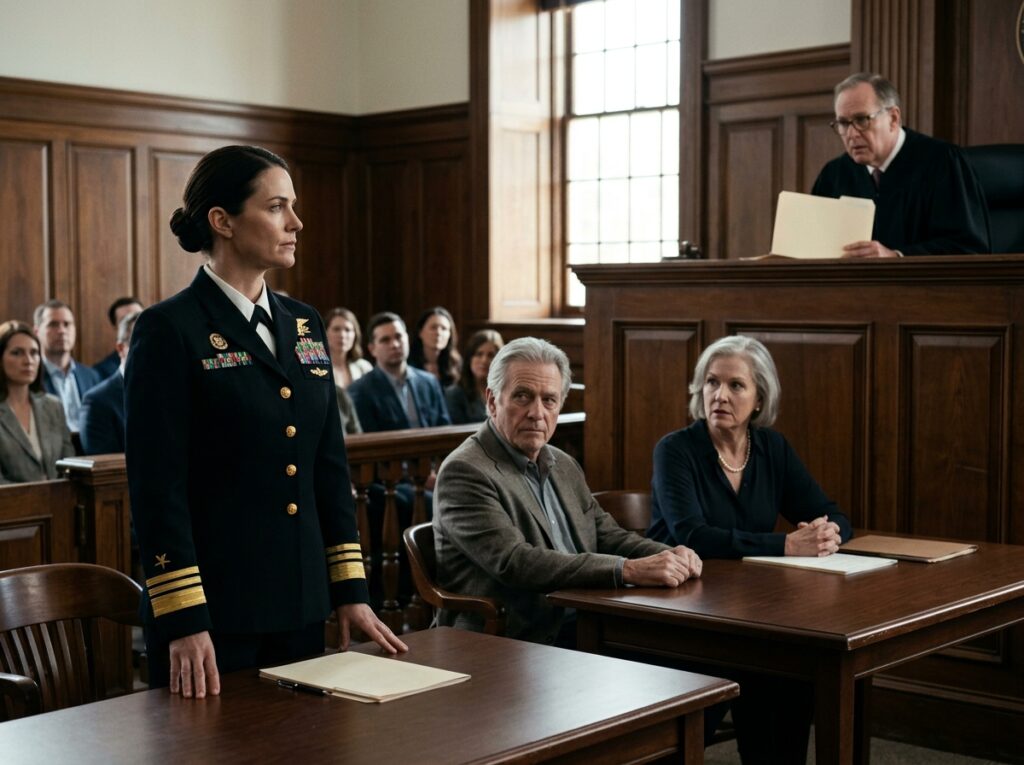
My parents dragged me into court to steal the farmhouse my grandfather left me. But the moment the judge recognized my Navy SEAL uniform, he revealed a secret that made my father turn pale—and exposed a betrayal far more devastating than anything I had imagined.
“Before you answer, Commander Carter,” Judge Simmons said quietly, “there is something I believe this court needs to establish.”
His voice was steady, but his hand trembled against the cream-colored folder.
My father leaned back in his chair, wearing the satisfied expression of a man who believed the outcome had already been decided.
“Your Honor,” he interrupted, “my daughter has always had a flair for dramatics. The uniform is simply another attempt to distract everyone from the facts.”
Judge Simmons slowly turned toward him.
“Mr. Carter, I strongly suggest you stop speaking.”
The courtroom went silent.
My mother pressed her lips together.
I remained standing, my right knee throbbing beneath the carefully pressed fabric of my uniform.
Then the judge looked directly into my eyes.
“Commander Evelyn Carter, were you the commanding officer responsible for the evacuation of twenty-three American personnel during Operation Silent Harbor?”
The question struck me harder than I expected.
For a moment, I could hear the explosions again.
The screaming.
The terrible sound of metal twisting beneath fire.
And Lewis calling my name through the smoke.
I swallowed.
“Yes, Your Honor.”
Judge Simmons removed his glasses.
“Then you are the woman who saved my son’s life.”
A gasp moved through the courtroom.
My father stopped smiling.
My mother’s fingers froze against her pearls.
I stared at the judge, searching his face for something familiar.
“Your son?”
“Lieutenant Daniel Simmons.”
My heart seemed to stop.
Daniel.
A young communications officer with sandy hair, a crooked smile, and a photograph of his newborn daughter tucked inside his helmet.
I remembered carrying him through a burning corridor while shrapnel cut into my leg.
I remembered Lewis staying behind to cover our escape.
And I remembered the moment the helicopter lifted away without my closest friend.
“Daniel survived?” I whispered.
Judge Simmons nodded, tears gathering in his eyes.
“He survived. He has three children now. He became a doctor. And every year, on the anniversary of that operation, he tells them about the woman who refused to leave him behind.”
My throat tightened.
For twelve years, I had carried that night like a stone inside my chest.
I had never known what happened to Daniel after the military transferred him to another hospital.
The judge took a breath.
“My son told me your name. But until this morning, I had never seen your face.”
I looked down.
“I was doing my job, sir.”
“No, Commander. According to my son, you went back into a burning building after you had already been ordered to withdraw.”
I said nothing.
Because that was true.
Because Lewis had been inside.
And because some memories were too painful to explain in a courtroom.
Judge Simmons carefully replaced his glasses.
“However, my personal connection to the defendant creates a concern about impartiality. I will disclose it formally and arrange for another judge to hear this case.”
My father suddenly found his voice.
“Exactly! Your Honor, whatever my daughter claims she did overseas has absolutely nothing to do with our property!”
The judge’s expression hardened.
“Mr. Carter, your daughter’s service is not evidence of property ownership. Neither is your opinion of her character.”
He looked toward the clerk.
“Before this matter is reassigned, I want the existing filings preserved. There are irregularities in the documents that must be addressed.”
My father’s face changed.
Just slightly.
But I noticed.
I had spent too many years studying frightened men to miss the moment confidence became panic.
Something in that folder terrified him.
And for the first time since receiving the summons, I understood that this lawsuit might not be about the farmhouse at all.
## THE FIRST LIE
The replacement judge, Judge Rebecca Whitmore, took the bench after a recess.
She was a silver-haired woman with sharp eyes and the kind of quiet authority that made people sit straighter without being asked.
She studied the file for several minutes.
Then she looked at my father.
“Mr. Carter, your petition states that you and your wife have maintained the disputed property since 2013.”
“Yes, Your Honor.”
“You further claim that your daughter abandoned the property and contributed nothing toward its expenses.”
“That’s correct.”
Judge Whitmore turned toward me.
“Commander Carter, do you dispute those statements?”
“Completely.”
“Do you have documentation?”
I opened the leather portfolio I had brought from home.
“Yes, Your Honor.”
I placed twelve years of property tax receipts on the evidence table.
Every payment.
Every confirmation number.
Every electronic transfer from my Navy Federal account.
I had organized them chronologically, just as I once organized operational reports.
The judge examined the first page.
Then the second.
Then the third.
“According to these records,” she said, “the defendant has paid the property taxes continuously.”
My father shifted in his seat.
“She may have paid some taxes, but we handled the maintenance.”
I reached into my portfolio again.
“Your Honor, I also have insurance records, contractor invoices, and bank statements.”
My mother’s face reddened.
“Evelyn, this is ridiculous.”
I turned toward her.
“What’s ridiculous, Mother?”
“You’re humiliating us!”
I looked at her for a long moment.
“You brought me here.”
Those four words silenced her.
Judge Whitmore examined the documents.
There were payments for roof repairs, electrical inspections, tree removal, and emergency plumbing.
I had authorized every expense from overseas.
Sometimes from ships.
Sometimes from temporary military facilities.
Sometimes from places I was not permitted to name.
I had never considered those payments extraordinary.
The farmhouse belonged to me.
More importantly, it had belonged to the only man in my childhood who had ever made me feel wanted.
My grandfather, Thomas Carter.
He taught me how to repair a fence, change engine oil, and recognize the sound of rain before clouds appeared over the fields.
When my father called me stubborn, Grandpa called me determined.
When my mother complained that I behaved like a boy, Grandpa handed me a toolbox.
And when I announced that I wanted to serve my country, he hugged me so tightly I could barely breathe.
“Never make yourself smaller just because someone else is afraid of how strong you might become,” he told me.
I had carried those words through every difficult year of my life.
Now I was sitting in court, defending the home where he had first spoken them.
Judge Whitmore turned another page.
“Mr. Carter, can you explain why your petition claims that you personally paid these expenses?”
My father cleared his throat.
“We were under the impression that—”
“Under what impression?”
“That Evelyn had stopped making payments.”
The judge looked down at the bank statements.
“Yet the payments continued without interruption.”
My father said nothing.
“Do you have records supporting your claims?”
He glanced toward my mother.
She stared at the floor.
Finally, he muttered, “Not with us.”
The judge made a note.
I should have felt victorious.
Instead, I felt exhausted.
Because even then, some small part of me had hoped my parents would admit the truth.
That they would say they were sorry.
That they would acknowledge what they had done.
But my father was not finished.
He leaned forward.
“Your Honor, there is something my daughter has neglected to mention.”
My stomach tightened.
He smiled.
“The farmhouse was never legally hers in the first place.”
## THE DOCUMENT THAT SHOULD NOT HAVE EXISTED
Judge Whitmore raised her eyebrows.
“Explain.”
My father reached into his briefcase and removed a yellowed document.
“My father was elderly when he supposedly transferred the property to Evelyn. His health was failing. His judgment was questionable.”
I stared at him.
Grandpa had been seventy-eight when he signed the deed.
He was sharp-minded, stubborn, and perfectly capable of managing his affairs.
He still beat me at chess.
He still repaired his own tractor.
And he still remembered every birthday in the family.
My father continued.
“We believe Evelyn manipulated him into signing the property over to her.”
I felt something cold move through my chest.
“That’s a lie.”
My father ignored me.
“She was desperate for financial security. Military life had made her unstable. She knew my father was vulnerable.”
Judge Whitmore interrupted.
“Mr. Carter, unless you have evidence supporting those allegations, I suggest you refrain from making them.”
He pushed the document forward.
“We do.”
The clerk delivered it to the bench.
Judge Whitmore studied the page.
Her expression changed.
“This appears to be a notarized statement signed by Thomas Carter in 2012.”
My pulse quickened.
2012\.
The year Grandpa died.
The judge continued reading.
“According to this statement, Thomas Carter intended to revoke the transfer and return ownership to his son, Robert Carter.”
I stared at the document.
“That isn’t possible.”
My father smiled again.
“I’m afraid it is.”
I stepped forward.
“Your Honor, may I see that?”
The judge permitted me to examine a copy.
The paper was old.
The signature looked familiar.
The notary seal appeared authentic.
But something about the date bothered me.
June 18, 2012.
I remembered that week.
I remembered it because I had been home on emergency leave.
Grandpa was hospitalized after suffering a stroke.
For six days, I sat beside his bed.
He could barely speak.
His right hand was paralyzed.
He could not hold a spoon.
He certainly could not sign a legal document.
I lifted my eyes.
“Your Honor, my grandfather was in the intensive care unit on the date this statement was supposedly signed.”
My father’s smile faltered.
“He had good days and bad days.”
I looked straight at him.
“He couldn’t move his right hand.”
The courtroom fell silent.
I continued.
“He was right-handed.”
Judge Whitmore studied the signature again.
Then she looked at my father.
“Mr. Carter, where did you obtain this document?”
“From my father’s personal files.”
“When?”
“Several years ago.”
“Why wasn’t it presented during probate?”
My father hesitated.
“We didn’t realize its significance.”
The judge placed the document carefully on her desk.
“I am directing that the original be preserved and made available for forensic examination.”
My mother’s breathing became shallow.
My father opened his mouth.
Then closed it.
And I knew.
Not with certainty.
Not yet.
But with the terrible instinct that had kept me alive overseas.
My father had brought a document into court that he never expected anyone to examine closely.
## THE WOMAN IN THE HALLWAY
The hearing recessed until the following morning.
Outside the courtroom, reporters had begun gathering.
Someone had recognized my uniform.
Someone else had heard Judge Simmons mention Operation Silent Harbor.
I wanted none of it.
I wanted to go home, remove my medals, feed Knox, and sit on the porch until the shaking in my hands stopped.
Instead, I heard my mother’s voice behind me.
“Evelyn.”
I stopped.
She stood near a marble column, clutching her handbag.
My father was speaking angrily into his phone farther down the hallway.
For a moment, my mother looked older than I remembered.
“Why are you doing this?” she asked.
I stared at her.
“Doing what?”
“Dragging our family through this humiliation.”
I almost laughed.
“You sued me.”
“We only wanted what was fair.”
“Fair?”
My voice rose despite my efforts to control it.
“Grandpa left me that house. I’ve paid for it, protected it, and kept it insured for years. You told a court I abandoned it.”
My mother glanced toward the reporters.
“Lower your voice.”
“No.”
Her eyes widened.
I had spent my childhood lowering my voice.
Lowering my expectations.
Lowering my head.
Not anymore.
“Tell me something,” I said quietly. “Did you know about the document Dad brought?”
She looked away.
That was enough.
“Mom.”
Her fingers tightened around her handbag.
“Your father said it was necessary.”
“Necessary for what?”
She swallowed.
Then whispered something I barely heard.
“Because of the money.”
I froze.
“What money?”
Her eyes filled with panic.
“Forget I said that.”
She turned away.
I caught her sleeve gently.
“Mother, what money?”
Before she could answer, my father appeared.
“Margaret.”
One word.
That was all it took.
My mother stepped away from me immediately.
My father looked at my hand on her sleeve.
“Don’t touch your mother.”
I released her.
He leaned closer.
“You’ve made your point, Evelyn. Drop the case.”
I stared at him.
“You filed the case.”
“Then agree to a settlement.”
“What settlement?”
He lowered his voice.
“Sign over the farmhouse. We’ll withdraw everything.”
For several seconds, I could only look at him.
Then I understood something that frightened me more than his anger.
He wasn’t trying to win an argument anymore.
He was trying to make the evidence disappear.
“No,” I said.
His jaw tightened.
“You have no idea what you’re getting involved in.”
I stepped closer.
“Then explain it.”
He stared at me.
For the first time in my life, my father seemed uncertain what to say.
Finally, he whispered, “Your grandfather should have kept his mouth shut.”
Then he walked away.
## THE LETTER BENEATH THE FLOORBOARDS
That evening, I drove to the farmhouse.
The sky above Portsmouth had turned the color of bruised steel.
Rain tapped against the windshield as I pulled into the gravel driveway.
Knox sat in the passenger seat, his ears raised.
“Come on, buddy,” I whispered.
He followed me onto the porch.
The boards creaked beneath my boots.
Inside, the house smelled of old wood, dust, and the faint sweetness of dried lavender.
I had visited often enough to maintain it, but I had avoided staying overnight.
Too many memories lived there.
I walked through the living room, touching the familiar furniture.
Grandpa’s rocking chair.
His battered radio.
The framed photograph of him standing beside his first truck.
Then I remembered something.
A conversation from the summer before he died.
We had been sitting in the kitchen, drinking lemonade.
Grandpa had looked unusually serious.
“Evelyn, if anything ever happens and someone starts asking questions about the land, remember where I kept your grandmother’s letters.”
I had laughed.
“Grandpa, nobody’s going to start asking questions about the land.”
He hadn’t smiled.
“Promise me.”
So I promised.
Now, fourteen years later, I stood in his bedroom, staring at the old oak wardrobe.
Grandma’s letters.
She had died when I was eleven.
Grandpa kept her correspondence inside a tin box beneath a loose floorboard.
I moved the wardrobe with difficulty.
My damaged knee protested.
Knox watched as I knelt and pried up the narrow plank.
There it was.
A small blue tin box.
My hands trembled as I lifted it.
Inside were faded envelopes tied with ribbon.
A photograph of Grandma in her wedding dress.
A silver locket.
And beneath everything else, a sealed brown envelope.
My name was written across the front.
EVELYN — ONLY IF THEY COME FOR THE HOUSE.
My breath caught.
I sat on the floor.
For several minutes, I couldn’t bring myself to open it.
Then I broke the seal.
Inside was a handwritten letter.
My brave girl,
If you’re reading this, then I’m afraid your father has done exactly what I feared.
There are things about this property that Robert does not understand. There are also things he understands far too well.
The farmhouse is yours. That was my decision, made freely and with a clear mind.
But the house itself is not what he wants.
He wants what is beneath it.
I stopped reading.
Beneath it?
My eyes moved down the page.
Years ago, I made a promise to a man who saved my life. I have kept that promise as best I could.
Your father discovered part of the truth. He believes it will make him rich.
But if he gets what he wants, innocent people will suffer.
Do not trust the documents he shows you.
Do not trust anyone who claims to speak for me.
And whatever happens, do not let them open the cellar’s north wall.
My heart pounded.
The cellar.
I remembered the cellar.
A cold, stone-walled room where Grandpa stored preserves and old tools.
There was a section along the northern wall that had always been covered by wooden shelving.
He never allowed anyone to move it.
I had assumed the masonry was unstable.
Now I wasn’t so sure.
The final lines of the letter were written more shakily.
There is one person who knows the whole story.
His name is Samuel Reed.
If he is still alive, find him.
And Evelyn, whatever your father tells you, remember this: I chose you because I knew you would protect people, even when protecting them cost you everything.
Love, Grandpa.
I lowered the letter.
Outside, thunder rolled across the fields.
Knox suddenly growled.
I looked toward the window.
Headlights appeared at the end of the driveway.
A black SUV.
Then another.
Both vehicles stopped near the oak tree.
My military instincts returned before I could think.
I turned off the lamp.
Slipped the letter inside my jacket.
And moved away from the window.
Two men stepped out of the first vehicle.
A third remained behind the wheel.
One carried a flashlight.
The other held something rectangular.
A metal case.
They walked toward the farmhouse.
Then my phone vibrated.
An unknown number.
A text message appeared.
LEAVE THE PROPERTY. YOU WERE NEVER SUPPOSED TO FIND THAT LETTER.
My blood ran cold.
I had told no one I was coming.
And yet someone knew.
## THE MAN WHO KNEW MY GRANDFATHER
I didn’t confront the strangers.
I had learned long ago that courage and recklessness were not the same thing.
Instead, I slipped through the rear entrance with Knox, crossed the dark orchard, and reached my truck parked beside the equipment shed.
I drove away without headlights until I reached the main road.
Ten minutes later, I called the sheriff’s office and reported suspicious activity at the property.
Then I made another call.
A number I hadn’t dialed in eight years.
It rang twice.
“Mercer.”
The voice was deep, familiar, and irritated.
“Still answering your phone like you’re on deployment?” I asked.
Silence.
Then—
“Evelyn?”
Captain Jack Mercer.
Former Navy intelligence officer.
One of the few men who knew what happened during Operation Silent Harbor.
“Jack, I need help.”
His tone changed immediately.
“Are you safe?”
“For now.”
“What happened?”
I told him about the lawsuit.
The suspicious document.
The letter.
The SUVs.
He listened without interrupting.
When I mentioned Samuel Reed, he went completely silent.
“Jack?”
“Say that name again.”
“Samuel Reed.”
I heard movement on the other end.
Then a door closing.
“Evelyn, where did you hear that name?”
“My grandfather wrote it in a letter.”
Jack exhaled slowly.
“Your grandfather was Thomas Carter?”
“Yes.”
Another silence.
Then he said something that made my skin prickle.
“Evelyn, Samuel Reed died twenty-six years ago.”
I gripped the steering wheel.
“Are you certain?”
“That’s what his official record says.”
“Official record?”
Jack hesitated.
“Reed was a civilian intelligence specialist. He disappeared during an investigation involving military procurement fraud.”
My mouth went dry.
“What does that have to do with my grandfather?”
“I don’t know.”
But I knew Jack well enough to recognize when he was withholding something.
“Jack.”
“Listen carefully. Don’t go back to that farmhouse alone. And don’t tell your parents what you found.”
“Why?”
His answer came quietly.
“Because if your grandfather’s letter is genuine, somebody has been protecting a very dangerous secret for decades.”
The call ended.
I pulled onto the shoulder.
Rain hammered the roof of my truck.
Knox rested his head against my arm.
For the first time, I understood that my parents might be only one small part of something much larger.
And somewhere in that realization was a question I didn’t want to ask.
Had Grandpa left me the farmhouse because he loved me—or because he needed someone trained to defend what was hidden inside it?
## THE SECOND DAY IN COURT
The following morning, I arrived at the courthouse carrying a new folder.
I had slept less than two hours.
My knee was swollen.
My uniform felt heavier than ever.
But my mind was clear.
Judge Whitmore resumed the hearing at nine.
The forensic examiner had submitted a preliminary report concerning the disputed document.
My father sat rigidly beside his attorney.
My mother looked as though she had been crying.
The judge opened the report.
“Mr. Carter, the examiner has identified several concerns regarding the statement you submitted.”
My father stared ahead.
“The paper appears consistent with the claimed period,” the judge continued. “However, the signature shows characteristics inconsistent with known examples of Thomas Carter’s handwriting.”
His attorney rose.
“Your Honor, we would request additional examination before any conclusions are drawn.”
“That is appropriate,” Judge Whitmore replied. “No final finding has been made.”
Then she turned toward me.
“Commander Carter, you indicated that you have additional evidence concerning your grandfather’s intentions?”
“Yes, Your Honor.”
I submitted the original letter.
My father saw it.
And his face went completely white.
He rose so suddenly that his chair scraped against the floor.
“Where did you get that?”
The judge looked up.
“Mr. Carter, sit down.”
He ignored her.
“Evelyn, where did you find that letter?”
I met his eyes.
“In Grandpa’s house.”
He gripped the edge of the table.
“You had no right to go looking through his things!”
I felt a strange calm settle over me.
“It’s my house, Dad.”
He opened his mouth.
Nothing came out.
Judge Whitmore ordered him to sit.
Then she read the letter.
Her expression became increasingly serious.
When she reached the final paragraph, she stopped.
“Commander Carter, this letter refers to something concealed within the property.”
“Yes, Your Honor.”
“Have you located it?”
“No.”
My father released a breath.
A tiny movement.
But I noticed.
Judge Whitmore studied him.
“Mr. Carter, do you know what your father was referring to?”
“No.”
The answer came too quickly.
“Are you certain?”
“Absolutely.”
Then my mother spoke.
Barely above a whisper.
“Robert, please stop lying.”
Every head turned.
My father looked at her with naked fury.
“Margaret.”
She flinched.
But this time, she didn’t fall silent.
Tears streamed down her cheeks.
“I can’t do this anymore.”
Her attorney leaned toward her, but she shook her head.
“Your Honor, I need to speak with my lawyer before I say anything else.”
Judge Whitmore immediately granted a recess.
My mother stood.
My father reached for her arm.
She pulled away.
And for the first time in my life, I saw my mother walk away from him without asking permission.
I wanted to believe it meant something.
But I had learned to be careful with hope.
## THE SECRET MY MOTHER COULDN’T KEEP
An hour later, my mother asked to speak with me.
Her attorney accompanied her.
We met in a small conference room inside the courthouse.
No reporters.
No cameras.
Just three chairs, a table, and a box of tissues.
My mother looked at my uniform.
“I hated that thing,” she whispered.
I said nothing.
“Not because you served.”
She wiped her eyes.
“Because every time I saw you wearing it, I remembered how much braver you were than I had ever been.”
I looked away.
She reached across the table.
I didn’t take her hand.
“Tell me about the money,” I said.
She nodded slowly.
“Your father borrowed against everything we owned.”
“How much?”
“Almost eight hundred thousand dollars.”
I stared at her.
“For what?”
“He invested in a company that promised enormous returns. The company collapsed. Then the people he borrowed from started demanding repayment.”
“Who?”
“I don’t know their real names.”
My jaw tightened.
“Mom.”
“I’m telling you the truth.”
She opened her handbag and removed a folded piece of paper.
It was a photocopy of a purchase agreement.
The property description matched Grandpa’s farmhouse.
The proposed purchase price was astonishing.
Four million eight hundred thousand dollars.
I looked at her.
“For that old house?”
She nodded.
“Your father found a buyer.”
“Who?”
“A company called Blackwater Meridian Holdings.”
I examined the agreement.
The buyer wasn’t interested in the buildings.
The contract specifically required unrestricted access to the cellar and subsurface structures.
My stomach tightened.
“Why would anyone pay nearly five million dollars for a farmhouse?”
My mother began crying again.
“Robert said your grandfather had hidden something valuable there.”
“What?”
“He wouldn’t tell me.”
I looked at the paper.
The proposed closing date was three weeks away.
My father had promised to deliver clear title before then.
Suddenly, everything made sense.
The lawsuit.
The forged document.
The accusations of abandonment.
He wasn’t trying to punish me for becoming a Navy SEAL.
He was trying to steal the property before his secret buyer discovered he didn’t own it.
My mother reached for my hand again.
This time, I let her touch my fingers.
“Evelyn, I’m afraid.”
I studied her face.
For years, I had wanted her to understand what fear felt like.
Now that she did, I found no satisfaction in it.
“What are you afraid of?”
She looked toward the closed door.
Then whispered—
“Your father told me that if he doesn’t deliver the farmhouse, they’ll come for us.”
## THE NAME ON THE CONTRACT
I left the conference room carrying a copy of the agreement.
Jack Mercer was waiting outside the courthouse.
He looked older than I remembered.
Gray touched his temples.
A scar crossed his left eyebrow.
But his eyes were the same.
Sharp.
Watchful.
He embraced me carefully.
“Good to see you, Commander.”
“Wish it were under better circumstances.”
He glanced at my knee.
“You holding up?”
“I’ve had worse mornings.”
He gave me a tired smile.
Then I handed him the purchase agreement.
He studied it.
His expression darkened.
“Where did you get this?”
“My mother.”
He read the company name twice.
Blackwater Meridian Holdings.
Then he looked at me.
“Evelyn, this company has been connected to several investigations.”
“What kind?”
“Fraud. Shell corporations. Illegal transfers of sensitive technology.”
I felt a chill.
“Military technology?”
“Some of it.”
He looked around before continuing.
“Years ago, Samuel Reed was investigating a network that diverted restricted equipment through civilian contractors.”
I thought of Grandpa’s letter.
The hidden cellar.
The warning about innocent people suffering.
“Was my grandfather involved?”
Jack hesitated.
“Possibly.”
My chest tightened.
“In what way?”
“We don’t know yet.”
I stared at him.
“Jack, my grandfather was a farmer.”
“People can be more than one thing, Evelyn.”
I thought of my own life.
A daughter my parents dismissed.
A woman who tended flowers.
A veteran who walked with a limp.
A commander whose name was still classified in reports she had never been allowed to read.
Jack was right.
People could be more than one thing.
But Grandpa?
He had spent his evenings listening to baseball on the radio.
He baked terrible biscuits.
He cried when his old dog died.
Could that gentle man have been protecting something dangerous?
Jack touched my shoulder.
“We need to find out what’s behind that wall.”
Before I could answer, his phone rang.
He glanced at the screen.
Then stepped away.
I watched his expression change as he listened.
“Understood,” he said.
He ended the call.
“What is it?” I asked.
He looked directly at me.
“The sheriff’s deputies searched the farmhouse this morning. Someone broke into the cellar last night.”
My heart hammered.
“Did they find anything?”
Jack shook his head.
“The north wall has been opened.”
I stared at him.
“And?”
He hesitated.
“Whatever was hidden behind it is gone.”
## THE EMPTY ROOM
By late afternoon, Jack and I stood inside the farmhouse cellar.
Two deputies had already documented the scene.
The old wooden shelving lay broken on the floor.
Behind it, someone had removed a section of stonework.
A narrow chamber extended several feet into the earth.
It was empty.
Almost.
A rectangular patch of dust marked where a large metal container had rested for years.
Nearby lay fragments of rotted canvas.
Jack crouched beside the opening.
“Someone knew exactly where to look.”
I nodded.
“Those men last night.”
“Probably.”
He examined the floor.
Then reached into the narrow gap between two stones.
His fingers closed around something.
A small brass identification plate.
He wiped away the dust.
Three words were engraved across the surface.
PROJECT HARBOR LIGHT
Jack went completely still.
I looked at him.
“What?”
He didn’t answer.
“Jack.”
He slowly stood.
“Evelyn, where did your grandfather serve during the war?”
“The Navy. Why?”
“What did he do afterward?”
“He worked for a shipping company before buying this farm.”
Jack closed his eyes briefly.
I felt the ground shifting beneath everything I thought I knew.
“Tell me.”
He opened his eyes.
“Harbor Light was the name of an old classified investigation into diverted military equipment. Samuel Reed was assigned to it.”
I stared at the brass plate.
“And my grandfather?”
Jack shook his head.
“I need to verify something before I answer that.”
I hated those words.
I hated how often secrecy had taken people away from me.
Lewis.
Daniel.
Now Grandpa.
“Jack, don’t protect me from the truth.”
He looked at me with an expression I couldn’t read.
“I’m trying to make sure the truth doesn’t get you killed.”
A floorboard creaked overhead.
Knox growled.
Jack immediately turned toward the staircase.
“Who’s there?”
No answer.
Then footsteps.
Slow.
Deliberate.
Someone was inside the house.
Jack moved toward the stairs while I reached for my phone.
A man’s voice called down.
“Commander Carter?”
I froze.
The voice was elderly.
Rough.
Unfamiliar.
“I believe,” he continued, “you’ve been looking for Samuel Reed.”
Jack stopped moving.
The man descended into the cellar.
He was tall but stooped, with white hair and a weathered face.
A walking cane rested in his right hand.
He looked at Jack.
Then at me.
His eyes filled with tears.
“My God,” he whispered. “You look just like your grandmother.”
I stared at him.
“Who are you?”
He reached into his coat and produced a faded photograph.
Two young men stood beside a Navy aircraft.
One was my grandfather.
The other was the stranger standing before me.
On the back of the photograph, written in Grandpa’s familiar handwriting, were four words.
Thomas and Samuel. 1974.
My mouth went dry.
“Samuel Reed?”
The old man nodded.
Jack looked stunned.
“But you’re supposed to be dead.”
Samuel gave a humorless smile.
“That’s what they wanted everyone to believe.”
He looked toward the broken wall.
His expression crumpled.
“Oh, Thomas,” he whispered. “You kept your promise.”
Then he turned to me.
“Commander, I need you to listen carefully.”
I couldn’t move.
“The people who took that container believe it contains the original Harbor Light records.”
“Doesn’t it?”
Samuel shook his head.
“No. Your grandfather moved those records years ago.”
“Where?”
The old man studied me.
Then said something that made my entire body go cold.
“He gave them to the one person nobody would ever suspect.”
I stared at him.
“Who?”
Samuel’s eyes dropped to the ribbons on my chest.
Then to the silver locket I had taken from Grandma’s tin box.
“Your grandmother,” he whispered, “wasn’t merely Thomas Carter’s wife.”
He reached toward the locket.
“May I?”
I hesitated.
Then handed it to him.
His fingers trembled as he opened the tiny clasp.
Inside was Grandma’s photograph.
Samuel pressed a hidden catch along the rim.
A narrow compartment sprang open.
Something metallic fell into his palm.
A tiny key.
He held it up.
“This,” he said, “is why your grandfather left you the house.”
I could barely breathe.
“What does it open?”
Samuel looked at Jack.
Then back at me.
“The evidence that could destroy Blackwater Meridian—and prove who ordered the attack that killed Lieutenant Lewis.”
The world seemed to tilt.
Lewis.
My closest friend.
The man whose folded flag rested inside my Navy chest.
The man I had mourned for twelve years.
I grabbed the edge of the workbench.
“What did you say?”
Samuel’s face was full of sorrow.
“His death wasn’t an accident, Evelyn.”
My voice came out barely audible.
“Lewis died in an IED attack.”
Samuel nodded.
“Yes.”
“During an operation overseas.”
“Yes.”
I stepped closer.
“How could my grandfather possibly have known anything about that?”
Samuel’s expression changed.
And for the first time, I saw genuine fear in his eyes.
“Because the attack wasn’t planned overseas.”
Silence swallowed the cellar.
Jack stood motionless beside me.
Samuel looked toward the staircase before continuing.
“The order came from someone here in Virginia.”
I shook my head.
“No.”
“Evelyn—”
“No. Lewis died protecting us. He died because our convoy was ambushed.”
Samuel’s voice broke.
“And someone made sure that convoy would be there.”
I felt tears burn behind my eyes.
For twelve years, I had believed Lewis died because war was unpredictable.
Because sometimes the wrong vehicle crossed the wrong road at the wrong moment.
Because terrible things happened to good people.
Now a stranger was telling me that someone had deliberately arranged the circumstances of his death.
I looked at Jack.
He didn’t meet my eyes.
And that frightened me most of all.
“Jack?”
He swallowed.
“Evelyn, there were questions about the intelligence that directed your convoy.”
I stared at him.
“You knew?”
“Not enough to prove anything.”
“How long?”
He said nothing.
“HOW LONG, JACK?”
“Twelve years.”
The words hit me like a physical blow.
I stepped backward.
For a moment, I could not hear anything except my own breathing.
Then Samuel spoke.
“There’s something else.”
I turned toward him.
He looked as though the next words might destroy him.
“Your grandfather discovered who authorized the diversion that placed your team in danger.”
“Who?”
Samuel hesitated.
I moved closer.
“Tell me.”
He lowered his eyes.
“The person was connected to your family.”
I felt my stomach drop.
“No.”
Samuel nodded slowly.
“Thomas tried to expose him. But he was threatened. So he hid the evidence and made arrangements to protect you.”
My father’s words returned to me.
Your grandfather should have kept his mouth shut.
I remembered the false document.
The secret buyer.
The nearly five-million-dollar agreement.
My mother’s fear.
And suddenly, a terrible possibility formed in my mind.
I whispered, “My father?”
Samuel did not answer.
Instead, he looked at the small key in his palm.
“Before I tell you the rest, Evelyn, there’s something you need to see.”
He reached into his coat and removed a sealed envelope.
My name was written across it.
Not in Grandpa’s handwriting.
In Lewis’s.
I recognized it immediately.
The slightly slanted letters.
The heavy pressure of his pen.
The way he crossed the number seven.
My knees nearly gave way.
Samuel caught my arm.
“This was entrusted to me with instructions that it should reach you only if the Harbor Light evidence was discovered.”
I stared at the envelope.
Lewis had been dead for twelve years.
Yet there was his handwriting.
His name.
His final message.
With trembling fingers, I opened it.
Inside was a photograph.
Lewis stood beside a black military transport vehicle.
He was smiling.
Alive.
Behind him stood three men.
One wore civilian clothing.
One wore a military uniform.
And the third—
I recognized the third man instantly.
My father.
Robert Carter.
The photograph slipped from my fingers.
On the back, Lewis had written a single sentence.
“Evelyn, if anything happens to me, don’t trust the man who raised you.”
I couldn’t breathe.
Samuel placed a steadying hand on my shoulder.
But I barely felt it.
Because beneath the photograph was another piece of paper.
A document bearing a date six months after Lewis’s supposed death.
It contained a hospital identification number.
A confidential relocation authorization.
And a name.
LIEUTENANT LEWIS ANDERSON — STATUS: ALIVE.
I looked up at Samuel, my entire body trembling.
“What is this?”
The old man stared at me with tears in his eyes.
“Evelyn,” he whispered, “there is something your grandfather wanted you to know before he died.”
My voice cracked.
“What?”
Samuel took a deep breath.
“Lewis survived the explosion.”
I stared at him.
“No.”
“He was badly injured. His identity was changed for his protection.”
I shook my head.
“I saw his flag. I attended his memorial.”
“I know.”
“I mourned him for twelve years!”
Samuel’s eyes filled.
“I know, child.”
My hands shook so violently that I could barely hold the document.
“Where is he?”
Samuel looked toward Jack.
Then back at me.
“He has been trying to reach you for twelve years. And three days ago, he finally learned that your father was taking you to court.”
My heart stopped.
Samuel stepped closer.
“He’s coming to Portsmouth, Evelyn.”
I whispered, “When?”
The old man looked at his watch.
Then toward the farmhouse entrance.
“Unless something has happened to him…”
He paused.
“He should be here tonight.”
At that exact moment, headlights swept across the cellar window.
A vehicle stopped outside.
Then another.
Jack reached for his phone.
Knox began barking.
Samuel’s face turned white.
“That isn’t him,” he whispered.
Heavy footsteps sounded on the porch.
A man’s voice called through the front door.
“Evelyn Carter! We know you’re inside!”
I stood motionless, Lewis’s photograph clutched against my chest.
Then my phone lit up.
A message from an unknown number.
EVELYN, IT’S LEWIS. DO NOT OPEN THAT DOOR. YOUR FATHER ISN’T THE PERSON RUNNING THIS. THE REAL TRAITOR IS STANDING BESIDE YOU.
I slowly raised my eyes.
Jack was watching me.
Samuel stood perfectly still.
And somewhere upstairs, the front door began to open.
For twelve years, I had believed the most painful betrayal of my life was my parents rejecting me.
I was wrong.
Because the man I trusted most was about to reveal a secret that would change everything I knew about my grandfather, my military service, and the friend I had buried.
And when I finally learned who had arranged the ambush that destroyed my team, I would discover something even more impossible.
The person who saved Lewis’s life was the same person who had spent twelve years making certain I believed he was dead.
# PART 3: THE DEAD MAN’S WARNING — THE TRAITOR STANDING BESIDE ME
The man I had buried twelve years ago had just sent me a text message—and the warning on my phone made me realize that one of the two men standing beside me was about to betray me.
EVELYN, IT’S LEWIS. DO NOT OPEN THAT DOOR. YOUR FATHER ISN’T THE PERSON RUNNING THIS. THE REAL TRAITOR IS STANDING BESIDE YOU.
I read the message three times.
My fingers went numb.
Across the farmhouse cellar, Captain Jack Mercer stood near the staircase. Samuel Reed, the elderly intelligence officer who had supposedly died twenty-six years earlier, watched me with frightened eyes.
Upstairs, the front door creaked open.
“Commander Carter!” a stranger shouted. “We know you’re down there!”
Knox growled beside my injured leg.
I slowly lowered my phone.
Jack noticed.
“Evelyn? What’s wrong?”
I studied his face.
Twelve years ago, Jack had been my intelligence liaison. He had helped coordinate the operation that ended with an explosion, seventeen casualties, and the supposed death of my closest friend.
He had visited me in the military hospital afterward.
He had stood beside Lewis’s empty coffin.
He had watched me cry.
And he had never once told me that Lewis might still be alive.
“Jack,” I said quietly, “who authorized the route change before our convoy was attacked?”
His expression hardened.
“What?”
“Operation Silent Harbor. We were supposed to travel north. Thirty minutes before departure, intelligence redirected us east.”
“Evelyn, this isn’t the time.”
“Who gave the order?”
The footsteps upstairs stopped.
Jack glanced toward the staircase.
“Put your phone away.”
That was when I knew.
I stepped backward.
“Don’t come any closer.”
Samuel suddenly moved between us.
“Mercer,” the old man whispered, “you told me you were helping her.”
Jack’s face changed.
The familiar warmth disappeared.
In its place was something cold and exhausted.
“I was helping her,” he said. “Until you started digging up things that should have stayed buried.”
My stomach twisted.
“You knew Lewis was alive.”
Jack said nothing.
“You knew all these years.”
He lowered his eyes.
“Yes.”
The word nearly brought me to my knees.
I had survived explosions, surgeries, and months of rehabilitation.
But that single admission hurt worse than all of them.
“Why?”
Jack’s jaw tightened.
“Because Lewis was supposed to disappear permanently.”
A metallic click sounded behind him.
Samuel had drawn a small pistol from his coat.
“Step away from her.”
Jack raised his hands.
“Samuel, you don’t understand.”
“I understand enough.”
Suddenly, the cellar door slammed open.
Two men appeared on the staircase.
“Federal agents!” one shouted. “Hands where we can see them!”
Jack smiled faintly.
“Perfect timing.”
But the taller man descending the stairs wasn’t looking at Samuel.
He was looking at Jack.
“Captain Mercer,” he said, “you’re under arrest.”
Jack’s smile vanished.
“What?”
The agent displayed his credentials.
“Special Agent Nathan Brooks. Department of Defense Criminal Investigative Service. We’ve been monitoring your communications for six months.”
Jack took a step backward.
Then looked at me.
“You set me up?”
I shook my head.
“No, Jack.”
A familiar voice answered from the top of the staircase.
“I did.”
My heart stopped.
A man stepped into the light.
Tall.
Broad-shouldered.
A pale scar crossed his left cheek.
His dark hair was threaded with gray.
He walked with a slight stiffness in his left leg.
But I recognized his eyes immediately.
Those impossible blue eyes.
The same eyes that had looked at me through smoke twelve years earlier.
“Hey, Evie,” he whispered.
The world disappeared.
Lewis Anderson was alive.
And he was standing ten feet away from me.
I tried to speak.
Nothing came out.
He took one uncertain step forward.
“I know you probably hate me.”
My knees buckled.
He caught me before I hit the floor.
And for the first time in twelve years, I heard the heartbeat of the man I had believed was dead.
I gripped his jacket.
“You were alive,” I whispered.
His arms tightened around me.
“Yes.”
“All this time?”
“Yes.”
I pulled away and struck his chest with my fist.
“YOU LET ME BURY YOU!”
He didn’t defend himself.
He simply stood there as tears streamed down my face.
“I know.”
“You let me stand at your grave!”
“I know.”
“Do you have any idea what that did to me?”
His own eyes filled.
“Every single day, Evelyn.”
Behind us, agents escorted Jack Mercer upstairs.
But Jack stopped at the doorway.
He turned toward Lewis.
“You think this is over?”
Lewis’s expression hardened.
“It is for you.”
Jack laughed bitterly.
“No. You still don’t understand who started Harbor Light.”
Then he looked directly at me.
“Ask your precious grandfather why he chose you. Ask him what happened to the first little girl.”
My blood turned cold.
“What little girl?”
Jack smiled.
And the agents led him away.
Lewis went pale.
Samuel closed his eyes.
I looked from one man to the other.
“What is he talking about?”
Neither answered.
And I realized the worst secret was still waiting to be uncovered.
# PART 4: THE GIRL WHO DISAPPEARED — MY GRANDFATHER’S IMPOSSIBLE CONFESSION
The morning after Lewis returned from the dead, I discovered that the farmhouse I had inherited was connected to a missing child—and that my grandfather had spent forty years hiding her identity.
I didn’t sleep.
Lewis sat across from me at my kitchen table while Knox rested his head on his boots.
Between us lay twelve years of silence.
Finally, Lewis spoke.
“I wanted to come back.”
I stared at him.
“Then why didn’t you?”
He looked at the scar running beneath his collar.
“Because after the explosion, I discovered our convoy had been deliberately targeted. The people responsible believed I had died. Intelligence investigators convinced me that remaining legally dead was the only way to protect the evidence.”
“And me?”
His voice broke.
“They said contacting you would put you in danger.”
I laughed bitterly.
“So you believed them?”
“At first.”
“And afterward?”
He lowered his head.
“Afterward, I tried. Every attempt was blocked. My messages disappeared. I was told you had moved on and wanted nothing to do with the investigation.”
I stared at him.
“I visited your grave every year.”
A tear slipped down his cheek.
“I know that now.”
For a long moment, neither of us spoke.
Then he reached into his jacket and removed a folded photograph.
It showed us standing together outside a military transport aircraft.
I was laughing.
Lewis was looking at me.
Not at the camera.
At me.
“I kept this,” he whispered.
I recognized the photograph immediately.
It had been taken three weeks before the ambush.
“Why?”
He hesitated.
Then answered softly.
“Because I was going to ask you to marry me when we came home.”
My breath caught.
Lewis looked away.
“I bought a ring. I carried it through every deployment. I was waiting for the right moment.”
I covered my mouth.
For years, I had buried feelings I never dared confess.
I had loved him.
Quietly.
Hopelessly.
And when he died, I had believed that part of my heart died with him.
Now he sat across from me, alive, carrying the same grief.
But before I could answer, my phone rang.
Samuel Reed.
“Evelyn,” he said urgently, “you need to come to the hospital.”
“What happened?”
“Your mother collapsed.”
I was already reaching for my keys.
Margaret Carter lay in a hospital bed, pale and exhausted.
My father had been detained for questioning concerning the property documents and his financial dealings.
For the first time, my mother was alone.
When she saw me, she began crying.
“Evelyn, there’s something I should have told you years ago.”
I sat beside her.
“About Grandpa?”
She nodded.
“And about you.”
My stomach tightened.
“What about me?”
She reached beneath her pillow and produced an old photograph.
Two little girls stood in front of the farmhouse.
One had dark curls.
The other had lighter hair and a wide, mischievous smile.
They looked almost identical.
I stared at the picture.
“Who are they?”
My mother began shaking.
“The little girl on the right is you.”
I examined the photograph.
I recognized my childhood dress.
The oak tree.
Grandpa’s old pickup truck.
But the other girl—
She had my eyes.
My nose.
My smile.
“Who is she?”
My mother closed her eyes.
“Your sister.”
The room seemed to tilt.
“I don’t have a sister.”
“You did.”
My pulse raced.
“What happened to her?”
My mother began sobbing.
“Her name was Caroline.”
I stared at her.
“Caroline Carter?”
She shook her head.
“No.”
Then she whispered the words that changed everything.
“Caroline Reed.”
I felt the air leave my lungs.
“Reed?”
My mother nodded.
“Samuel Reed’s granddaughter.”
I stood.
“That doesn’t make sense.”
She reached for my hand.
“Evelyn, when you were four years old, Samuel’s family was threatened because of the Harbor Light investigation. Your grandfather agreed to hide Caroline at the farmhouse.”
I stared at the photograph.
“Why does she look like me?”
My mother hesitated.
“Because you were born only eleven days apart. Everyone thought you were twins.”
I swallowed.
“What happened to her?”
My mother’s face crumpled.
“One night, men came looking for Samuel. Your grandfather hid both of you in the cellar.”
I remembered something.
A flash.
Darkness.
A little hand holding mine.
A girl whispering, Don’t be scared, Evie.
Then screaming.
My heart hammered.
“I remember.”
My mother looked at me in horror.
“You remember?”
“Someone took her.”
She began crying harder.
“Yes.”
I stepped backward.
“Why didn’t anyone tell me?”
“Because the people who took Caroline threatened to come back for you.”
I looked down at the photograph.
For decades, I had believed I was an only child.
Now I remembered a little girl who used to share my pillow.
Who stole strawberries from Grandpa’s garden.
Who called me her sister.
And suddenly I remembered the promise we made beneath the oak tree.
If one of us gets lost, the other one comes looking.
I looked at my mother.
“Is Caroline dead?”
She shook her head.
“I don’t know.”
Then she reached for my wrist.
“But your grandfather never stopped searching.”
I stared at her.
“And neither did Samuel.”
My mother swallowed.
“There’s something else, Evelyn.”
I waited.
“Your father knew Caroline was alive.”
My entire body went cold.
“How?”
She began trembling.
“Because three weeks ago, a woman came to our house.”
“What woman?”
My mother’s eyes filled with terror.
“She looked exactly like you.”
# PART 5: THE WOMAN WITH MY FACE — THE SECRET BEHIND THE FIVE-MILLION-DOLLAR DEAL
Three weeks before my parents sued me, a stranger with my face walked into their house—and offered my father nearly five million dollars for the farmhouse.
I left the hospital with the photograph clenched in my hand.
Lewis was waiting beside my truck.
One look at my face told him something had happened.
“Evelyn?”
I handed him the photograph.
He studied it.
“Who’s the other girl?”
“Caroline Reed.”
His expression changed.
“You found her?”
“No.”
I swallowed.
“But someone has.”
Within an hour, Samuel joined us at a secure federal office in Norfolk.
He stared at the photograph for a long time.
Then tears began sliding down his weathered cheeks.
“My little Caroline.”
I sat across from him.
“Why didn’t you tell me?”
He closed his eyes.
“Because I didn’t know whether she was alive. And because Thomas begged me never to burden you with what happened.”
“She was my friend.”
Samuel nodded.
“She loved you like a sister.”
I leaned forward.
“Who took her?”
Samuel’s expression darkened.
“A man named Victor Hale.”
Lewis stiffened.
I noticed.
“You know him?”
Lewis nodded slowly.
“Victor Hale was the financial architect behind Blackwater Meridian Holdings.”
Samuel continued.
“Forty years ago, Hale’s father operated a network that sold stolen military technology. I uncovered evidence. Thomas helped me preserve it.”
“And Caroline?”
Samuel’s voice broke.
“They took her to force me into silence.”
My stomach twisted.
“What happened afterward?”
“I was told she died.”
He looked at me.
“I believed them.”
I reached across the table and held his trembling hand.
“She’s alive, Samuel.”
He stared at me.
“My mother saw her.”
Samuel began crying.
For a moment, the old intelligence officer looked like nothing more than a grandfather who had spent forty years grieving a child.
Then Lewis placed a file on the table.
“We’ve identified the woman who approached Robert Carter.”
He opened it.
A surveillance photograph appeared.
A woman in a charcoal business suit stood outside a bank.
Dark hair.
Brown eyes.
A familiar face.
My face.
Except for a small scar above her eyebrow, she could have been my reflection.
Beneath the photograph was a name.
DR. CAROLINE REED — CHIEF FINANCIAL OFFICER, BLACKWATER MERIDIAN HOLDINGS.
I stared at the page.
“She works for them?”
Lewis nodded.
“Apparently.”
Samuel shook his head.
“No. That isn’t possible.”
But the documents were clear.
Caroline had spent fifteen years working for companies connected to Victor Hale.
She had negotiated acquisitions.
Managed offshore accounts.
Authorized enormous transfers.
And now she wanted my grandfather’s farmhouse.
My heart sank.
“She’s one of them.”
Lewis looked at me carefully.
“We don’t know that.”
I pointed at the photograph.
“She works for the people who destroyed her family.”
Samuel suddenly spoke.
“Or she’s doing exactly what Thomas taught her.”
I turned.
“What?”
He looked at the picture.
“Surviving.”
That evening, I received an unexpected phone call.
An unfamiliar woman’s voice spoke.
“Commander Carter?”
“Yes.”
“My name is Caroline Reed.”
I couldn’t breathe.
For several seconds, the only sound was Knox shifting beside my chair.
Then I whispered, “Caroline?”
Her voice trembled.
“Hello, Evie.”
My eyes filled.
Nobody had called me that in years except Lewis.
“Where are you?”
“Somewhere safe.”
“Why did you approach my father?”
“Because I needed him to lead me to the records.”
“You offered him nearly five million dollars.”
“I knew he would betray anyone for money.”
I closed my eyes.
“Do you work for Victor Hale?”
A long silence.
“Yes.”
My chest tightened.
“Why?”
Her voice broke.
“Because he raised me.”
I stared at the wall.
“He kidnapped you.”
“I know that now.”
The words were barely audible.
“For thirty-six years, I believed he rescued me after my parents died. He told me Samuel Reed was a criminal and Thomas Carter had abandoned me.”
I began crying.
“Grandpa searched for you.”
“I know.”
“He never stopped.”
Caroline sobbed.
“I found his letters last year.”
I pressed my hand over my mouth.
She continued.
“I’ve been collecting evidence against Victor ever since. But the final records are locked inside a secure archive that requires two authorization keys.”
I looked toward Grandma’s locket.
“One key was hidden in the farmhouse.”
“Yes.”
“Where’s the other?”
Caroline hesitated.
Then whispered—
“Victor Hale has it.”
I stood.
“Caroline, don’t go near him.”
Her answer terrified me.
“I’m already with him.”
In the background, I heard a door opening.
A man’s voice called her name.
Caroline lowered her voice.
“Evie, listen carefully. Tomorrow night, Victor is holding a private gathering at his estate. He’s bringing everyone involved in Harbor Light.”
“Why?”
“Because he believes the stolen container contains the evidence that could destroy him.”
I gripped the phone.
“What do you want me to do?”
“Come to the estate.”
“No.”
“Please.”
I heard her take a shaky breath.
“If we don’t expose him tomorrow, he’s going to destroy the records—and everyone who can identify the people responsible for Lewis’s ambush.”
Then she whispered something I hadn’t heard since childhood.
“Remember our promise beneath the oak tree?”
Tears spilled down my cheeks.
“If one of us gets lost…”
Caroline finished softly.
“The other one comes looking.”
The call ended.
I stood motionless.
Then I turned toward Lewis.
He had heard enough to understand.
“You’re going,” he said.
“Yes.”
He nodded.
“Then I’m coming with you.”
I looked at him.
“Lewis, I just got you back.”
He stepped closer.
“And I’m not disappearing again.”
# PART 6: THE NIGHT OF THE BLACKWATER GALA — THE WOMAN WHO BETRAYED A BILLIONAIRE
At midnight, I walked into the mansion of the man who had stolen my childhood friend, destroyed my military team, and turned my father into a desperate criminal—and discovered that my missing sister had prepared a trap more dangerous than any battlefield.
Victor Hale’s estate stood behind iron gates on the outskirts of Richmond.
Crystal chandeliers illuminated the enormous entrance hall.
Luxury cars lined the circular driveway.
Men in expensive suits gathered around a marble fountain.
I entered wearing a black evening gown that concealed the scars on my knee.
Lewis accompanied me in a tailored tuxedo.
Federal investigators monitored the gathering from a distance, acting on evidence Caroline had secretly provided.
But we had one problem.
Caroline had stopped answering her phone.
Inside the ballroom, a string quartet played softly.
I recognized several faces from the financial records.
Contractors.
Executives.
Former government officials.
Then I saw him.
Victor Hale.
Seventy years old.
Silver hair.
A pleasant smile.
He stood near the fireplace, holding a glass of champagne.
Beside him was Caroline.
She wore a midnight-blue gown.
Her dark hair fell over her shoulders.
Seeing her in person stole my breath.
It was like looking into a mirror from another life.
She noticed me.
For one brief moment, her professional smile disappeared.
Then she looked away.
Victor approached.
“Commander Carter,” he said warmly. “What an extraordinary pleasure.”
I forced myself to remain calm.
“Mr. Hale.”
He examined me.
“Your grandfather was a remarkable man.”
My jaw tightened.
“You knew him?”
“Very well.”
He smiled.
“Unfortunately, he never understood the value of what he possessed.”
I glanced toward Caroline.
She stood motionless.
Victor continued.
“I believe your father made you a reasonable offer for that old farmhouse.”
“Five million dollars?”
“Generous, wouldn’t you say?”
“Not if you’re buying something stolen.”
His smile faded.
Lewis moved closer.
Victor noticed him.
For the first time, genuine shock crossed his face.
“Lieutenant Anderson.”
Lewis smiled coldly.
“Surprised?”
Victor recovered quickly.
“I was told you were dead.”
“So was everyone else.”
Victor set down his champagne.
“How unfortunate.”
Then he looked toward the ballroom entrance.
Two security guards stepped into position.
I felt the familiar tightening in my chest.
The atmosphere had changed.
Victor leaned closer.
“You should have accepted the settlement, Commander.”
I stared at him.
“And you should have left my family alone.”
His smile returned.
“Your family?”
He glanced toward Caroline.
“My dear, would you come here?”
She approached.
Victor placed a hand on her shoulder.
“Caroline is the daughter I never had.”
I looked into her eyes.
She gave no sign of recognition.
Victor continued.
“She understands loyalty.”
Caroline smiled faintly.
“Yes, Father.”
The word cut through me.
Then she reached into her evening bag.
Victor watched with approval.
“I believe Caroline has something to show you.”
She withdrew a small black device.
My pulse quickened.
A security guard moved toward Lewis.
Victor leaned forward.
“Commander, I suggest you cooperate.”
Caroline raised the device.
Then pressed a button.
The ballroom lights dimmed.
Every screen around the room illuminated.
A video appeared.
Victor Hale sat in a private office, discussing illegal financial transfers.
Then another recording played.
A voice described the deliberate rerouting of an American military convoy.
I recognized the voice immediately.
Jack Mercer.
The screen displayed bank records, encrypted communications, and photographs of secret meetings.
Guests began murmuring.
Victor turned pale.
“What is this?”
Caroline stepped away from him.
“Thirty-six years of evidence, Father.”
His face twisted.
“You ungrateful little—”
She interrupted.
“My name is Caroline Reed.”
Silence fell.
She continued, her voice trembling but clear.
“You stole me from my family when I was four years old. You lied about my grandfather. You used me to manage the very accounts that financed your crimes.”
Victor stared at her.
Caroline looked toward me.
Then smiled through her tears.
“And tonight, my sister came looking for me.”
The ballroom erupted.
Victor lunged toward her.
Lewis moved instantly, placing himself between them.
Federal agents entered through the main doors.
“Victor Hale! Federal agents! Do not move!”
Victor backed toward the fireplace.
Then he began laughing.
“You think this proves anything?”
Caroline raised her chin.
“It proves enough to begin.”
Victor’s eyes narrowed.
“You still need the original records.”
She nodded.
“Yes.”
He smiled triumphantly.
“And without my authorization key, you’ll never access them.”
Caroline turned toward me.
“Evie?”
I reached into my clutch.
And removed Grandma’s silver locket.
Victor’s smile vanished.
I held up the tiny key.
“My grandfather always said the smallest things can protect the greatest treasures.”
Caroline smiled.
Then she reached beneath her necklace.
A second key hung against her skin.
Victor stared.
“How did you—”
She looked at him.
“You gave me the key when I turned twenty-one. You told me it opened my inheritance.”
Her voice hardened.
“You never imagined I’d use it to give everyone else theirs.”
An agent approached Victor with handcuffs.
But before he was taken away, he looked directly at me.
“You think your grandfather was a hero?”
I said nothing.
Victor smiled.
“Ask Samuel what happened to your real parents.”
My heart stopped.
“My real parents?”
Victor laughed.
“That’s right, Commander.”
Then he delivered the words that shattered everything.
“Robert and Margaret Carter aren’t your biological parents.”
# PART 7: THE TRUTH ABOUT MY BIRTH — THE SECRET THAT BROKE MY FAMILY
I had spent my entire life trying to earn my parents’ love. Now the man responsible for destroying my military team was claiming that the people who raised me had never been my parents at all.
I stood in Victor Hale’s ballroom, unable to move.
Lewis reached for my hand.
“Evelyn.”
I barely heard him.
Victor watched me with cruel satisfaction.
“Didn’t they tell you?”
I stepped closer.
“What are you talking about?”
He smiled.
“Ask Samuel Reed.”
Before I could demand another answer, federal agents escorted him away.
Caroline rushed toward me.
“Evie, don’t listen to him.”
But I couldn’t stop thinking about the photograph.
Two little girls beneath the oak tree.
The same eyes.
The same smile.
The same childhood memories.
Caroline had been taken.
But what if I had been brought there, too?
The following morning, Samuel Reed sat across from me at the farmhouse kitchen table.
My mother was there.
Lewis stood near the window.
Caroline sat beside me, holding my hand.
For the first time in decades, the two little girls from Grandpa’s photograph were together again.
Samuel placed a faded birth certificate on the table.
My name appeared across the top.
Evelyn Grace Reed.
I stared at it.
“Reed?”
Samuel nodded.
My mother began crying.
I looked at her.
“Tell me.”
She wiped her eyes.
“Your biological parents were Jonathan and Rebecca Reed.”
I turned toward Samuel.
“Your son?”
He nodded.
“Jonathan was my youngest boy.”
I felt my chest tighten.
“What happened to them?”
Samuel’s voice trembled.
“They were killed in a car accident when you were six months old.”
Caroline squeezed my hand.
Samuel continued.
“Your father had been helping me investigate the Harbor Light network. We later discovered the accident had been deliberately arranged.”
I closed my eyes.
Another life destroyed.
Another family stolen.
“Why did Robert and Margaret raise me?”
My mother spoke.
“Thomas Carter and Samuel were lifelong friends. When your parents died, Thomas promised to protect you.”
I stared at her.
“Grandpa wasn’t my grandfather?”
Samuel smiled sadly.
“Not by blood.”
I felt tears gathering.
“But he loved you as fiercely as any grandfather could.”
I looked toward Grandpa’s empty rocking chair.
Of course he had.
Love had never required a matching surname.
My mother continued.
“Thomas’s son Robert and I had recently lost a baby. We agreed to adopt you.”
Her voice broke.
“At first, we were happy.”
I stared at her.
“What changed?”
She looked down.
“Robert began resenting the responsibilities. He believed Thomas had forced him into a life he didn’t choose.”
I swallowed.
“And you?”
Tears streamed down her cheeks.
“I was afraid of losing my marriage. So I followed him. Even when he was cruel.”
I looked away.
For thirty-two years, I had wondered why nothing I did was enough.
Why good grades weren’t enough.
Why medals weren’t enough.
Why surviving wasn’t enough.
Now I understood something painful.
Their rejection had never been proof that I was unworthy of love. It was proof that they had failed to give the love they promised.
Samuel reached across the table.
“Evelyn, there’s something else.”
I looked at him.
He placed another document before me.
A legal adoption record.
Then a handwritten letter from Thomas.
My dearest Evelyn,
You came into our lives when the world had already been terribly unkind to you.
I promised your father that you would grow up safe.
I could not give you back the parents you lost.
But I could give you a home.
And when you became old enough to choose your own path, I saw the same courage in you that I had admired in Jonathan.
The farmhouse is yours because it is the place where you were loved first.
Never let anyone convince you otherwise.
I pressed the letter against my chest.
And cried.
Not quietly.
Not carefully.
I cried for the little girl who had spent her childhood trying to become someone her parents would approve of.
I cried for the soldier who had returned home wounded and unwanted.
I cried for Grandpa.
For Lewis.
For Caroline.
For every year stolen by lies.
Lewis knelt beside my chair.
He wrapped his arms around me.
And I finally allowed myself to be held.
Three weeks later, Robert Carter entered a plea agreement in connection with the fraudulent property documents and his financial dealings with Blackwater Meridian.
Margaret cooperated with investigators.
Victor Hale faced federal charges involving fraud, conspiracy, kidnapping, and the criminal network that had targeted my military unit.
Jack Mercer agreed to testify against the remaining conspirators.
The original Harbor Light records were recovered through Caroline’s evidence.
And the investigation confirmed that Lewis’s convoy had been deliberately redirected.
For the first time, the families of those who died had a path toward the truth.
But the farmhouse case wasn’t finished.
A final hearing remained.
And my father had requested one last opportunity to speak.
I almost refused to attend.
Then Lewis took my hand.
“Go,” he said gently.
“Why?”
“Because you’ve spent your whole life listening to what he thinks of you.”
He kissed my forehead.
“Maybe it’s time he hears what you think of yourself.”
# PART 8 — THE END: THE FINAL VERDICT — THE FARMHOUSE THAT BECAME A HOME FOR HEROES
My father stood before the judge expecting one final chance to control me. Instead, he watched the daughter he had rejected walk into court surrounded by the family he never knew she had.
The courtroom was crowded.
Reporters lined the back wall.
Federal investigators sat near the entrance.
Caroline held my hand as we walked inside.
Samuel Reed followed us.
Lewis walked beside me.
And Knox, wearing his service-dog harness, stayed close to my injured leg.
I wore my Navy dress uniform.
Not to intimidate anyone.
Not to prove my worth.
But because I had finally stopped apologizing for the woman I had become.
Judge Whitmore entered.
Everyone stood.
The final property hearing began.
The court reviewed the recorded deed, the verified payment history, and the findings concerning the fraudulent documents.
The result was clear.
The farmhouse belonged to me.
The competing claim had no legal basis.
My father’s petition was dismissed.
The disputed documents had been referred to the appropriate authorities.
And the property title remained in my name.
Judge Whitmore looked toward me.
“Commander Carter, this court recognizes your lawful ownership of the property.”
I closed my eyes.
For a moment, I heard Grandpa’s voice.
Never make yourself smaller.
Then the judge continued.
“Before we conclude, Mr. Carter has requested permission to address the court regarding his conduct.”
My father stood.
He looked older.
Smaller.
The arrogance I remembered had disappeared.
He turned toward me.
“Evelyn.”
I said nothing.
He swallowed.
“I spent my life believing that being a father meant being obeyed.”
His voice trembled.
“When you joined the Navy, I thought you were rejecting everything I had tried to teach you.”
I watched him carefully.
“I told myself you were stubborn. Ungrateful. Difficult.”
He lowered his eyes.
“But the truth is that I was ashamed of my own failures, and I punished you for becoming stronger than I was.”
Tears gathered in his eyes.
“I lied about the property. I allowed people to use me because I wanted money and status. And I nearly destroyed the one thing my father had left you.”
He looked toward Samuel.
Then Caroline.
Then Lewis.
“I can’t undo what I did.”
His voice broke.
“But I am sorry.”
For years, I had dreamed of hearing those words.
I had imagined they would heal something inside me.
Instead, I felt a quiet sadness.
Because apologies mattered.
But they did not erase consequences.
I stood.
“Dad, I spent thirty-two years waiting for you to be proud of me.”
He began crying.
“I know.”
“I survived training that nearly broke me. I served my country. I lost friends. I came home with injuries that still hurt every morning.”
My voice trembled.
“And through all of it, I kept wondering what I needed to accomplish before you would finally love me.”
He covered his face.
I took a breath.
“But I don’t need to accomplish anything to deserve love.”
The courtroom was silent.
I continued.
“I hope you become a better man. I hope you tell the truth. And I hope you make amends to the people you’ve hurt.”
I looked directly into his eyes.
“But I won’t give you another opportunity to destroy my life.”
He nodded slowly.
“I understand.”
For the first time, I believed he did.
Six months later, the farmhouse looked completely different.
The peeling paint was gone.
The porch had been repaired.
The oak tree had been treated by an arborist and was growing new branches.
Flowers surrounded the front steps.
And above the entrance hung a wooden sign.
THE THOMAS CARTER HOUSE
Honor. Healing. Home.
I had used the farmhouse and surrounding land to establish a nonprofit retreat for wounded veterans, surviving military families, and children who had lost parents in service.
There were accessible cabins.
A rehabilitation garden.
A small library.
And a workshop where veterans could teach woodworking, mechanics, and practical skills.
The cellar had been transformed into an archive honoring those whose courage had been hidden by the Harbor Light conspiracy.
Caroline became the organization’s financial director.
Samuel served as an adviser.
Daniel Simmons—the judge’s son whose life I had saved—helped organize medical support for the veterans who visited.
And Lewis?
Lewis refused to leave my side.
Not because he thought I needed protection.
But because, after twelve stolen years, he wanted to be present for every ordinary moment.
Every sunrise.
Every terrible cup of coffee.
Every walk through the orchard.
Every quiet evening beside the fireplace.
One afternoon, I found him standing beneath the oak tree.
He was holding a small velvet box.
My heart stopped.
“Lewis?”
He smiled nervously.
“Before you say anything, I need to confess something.”
I folded my arms.
“That sounds dangerous.”
He laughed.
“Probably.”
Then he lowered himself onto one knee.
My hands flew to my mouth.
“Evelyn Grace Reed Carter,” he said, his voice trembling, “I loved you when we were young and foolish enough to believe we had forever.”
Tears blurred my vision.
“I loved you when I thought I would never see you again.”
He opened the box.
Inside was a simple diamond ring.
The same ring he had carried twelve years earlier.
“And I love you now, knowing exactly how precious an ordinary lifetime can be.”
He swallowed.
“Will you marry me?”
I didn’t hesitate.
“Yes.”
His eyes widened.
“Yes?”
I laughed through my tears.
“YES, YOU IDIOT!”
He stood and swept me into his arms.
Knox barked excitedly.
Caroline appeared on the porch, screaming with happiness.
Samuel wiped his eyes.
And somewhere inside the farmhouse, someone began playing an old love song.
For the first time in my life, I felt completely at home.
We married three months later beneath the oak tree.
It was a small ceremony.
No extravagant ballroom.
No wealthy guests.
No family members pretending to love us for appearances.
Just the people who had stood beside us when the truth was hardest to bear.
Caroline was my maid of honor.
Samuel walked me down the aisle.
Daniel Simmons officiated the ceremony as a longtime family friend who had obtained the necessary authorization.
And Knox carried the rings in a little pouch attached to his collar.
When Lewis saw me approaching, he began crying.
I laughed.
“You’re supposed to be the tough one.”
He wiped his eyes.
“I was. Then I met you.”
We exchanged vows beneath the branches Grandpa had once climbed to rescue my childhood kite.
And when Lewis kissed me, the guests erupted in applause.
I thought that was the happiest moment of my life.
I was wrong.
Because the greatest surprise came six months after our wedding.
It began with a telephone call from a social worker.
A little girl named Grace had lost both parents in a tragic accident.
Her father had been a wounded veteran who once attended our retreat.
Her mother had volunteered in the rehabilitation garden.
Grace was seven years old.
She had dark curls.
Brown eyes.
And a habit of carrying a stuffed rabbit everywhere she went.
Her parents had named Lewis and me as the people they hoped would care for her if anything happened to them.
When the social worker explained, I couldn’t speak.
Lewis took my hand.
We discussed the responsibilities, the grief Grace was experiencing, and what it would mean to become parents.
Then we began the legal process.
Months later, after the necessary assessments and court proceedings, Grace came to live with us permanently.
On her first evening, she stood in the farmhouse doorway, holding her rabbit.
“Is this really my room?” she asked.
I knelt beside her.
“Yes, sweetheart.”
“Can I paint the walls purple?”
“Absolutely.”
She looked at Lewis.
“Can Knox sleep in my room?”
Lewis smiled.
“I think Knox would insist on it.”
Grace giggled.
Then she looked at me with an expression I recognized.
Fear.
Hope.
The terrible uncertainty of a child who had already lost too much.
“Are you going to send me away someday?”
My heart broke.
I wrapped my arms around her.
“No, sweetheart.”
She looked into my eyes.
“Promise?”
I thought of Grandpa.
Of the farmhouse.
Of the years I had spent believing that love had to be earned.
Then I kissed her forehead.
“I promise that you will always have a place in our family, Grace. No matter what.”
She hugged me tightly.
And whispered a word I had never expected to hear.
“Mom.”
I began crying.
Lewis knelt beside us.
Grace reached for him.
“Dad?”
He closed his eyes.
“Yes, sweetheart.”
She pulled us both into a hug.
And beneath the roof of the house my parents had tried to steal, the three of us became a family.
One year later, we held a celebration at the Thomas Carter House.
More than two hundred veterans and their families attended.
Children ran through the gardens.
Music drifted across the fields.
The smell of barbecue filled the warm Virginia air.
Caroline stood beside Samuel, laughing as he taught Grace how to plant tomatoes.
Lewis wrapped an arm around my waist.
“Happy?” he asked.
I looked around.
At the restored farmhouse.
At the veterans finding friendship again.
At my sister, whose childhood had been stolen but whose future was finally her own.
At the grandfather who had spent decades searching for his family.
At the little girl chasing Knox across the grass.
And at the man I had mourned for twelve years, now standing beside me as my husband.
“Yes,” I whispered.
“More than I ever thought possible.”
Lewis kissed my temple.
Then Grace ran toward us.
“Mom! Dad! Come quick!”
We followed her toward the oak tree.
She had found something tucked inside a hollow in the trunk.
A small wooden box.
My breath caught.
Grandpa used to hide treasures there when I was little.
Inside was a faded photograph.
Thomas Carter stood beside Samuel Reed.
Between them were two little girls.
Caroline and me.
We were holding hands.
Beneath the photograph was a note written in Grandpa’s familiar handwriting.
To my girls,
If you ever find this together, it means the world finally became kind enough to bring you home.
I hope you have forgiven yourselves for the things you could not change.
I hope you have learned that family is not simply the people who share your blood.
Family is the people who come looking when you are lost.
And most of all, I hope this old house is filled with laughter again.
Love always, Grandpa Thomas.
Caroline began crying.
Samuel covered his mouth.
I pressed the photograph against my chest.
For a moment, the years disappeared.
I was a little girl again, sitting on the porch while Grandpa taught me how to whistle.
Only this time, I wasn’t alone.
Caroline slipped her hand into mine.
Just as she had done forty years earlier.
“We found each other,” she whispered.
I smiled through my tears.
“Yes.”
Lewis wrapped his arms around us.
Grace squeezed between our legs.
Knox barked.
And somewhere above us, the old oak tree rustled in the summer wind.
I looked toward the farmhouse.
The house my parents had tried to take.
The house my grandfather had fought to protect.
The house that had carried secrets, grief, betrayal, and love across generations.
I finally understood why Grandpa had left it to me.
Not because he expected me to spend my life defending its walls.
But because he believed I could turn those walls into a place where broken people learned how to live again.
My father had once laughed when I walked into court wearing my Navy SEAL uniform.
He thought I was a failure.
He thought I was alone.
He thought taking my inheritance would destroy me.
Instead, his betrayal led me to the truth about my birth, reunited me with my lost sister, brought the man I loved back from the dead, and gave me the family I had always dreamed of.
And as I watched my daughter run laughing beneath the oak tree, I realized something that made me smile.
The greatest victory of my life had nothing to do with medals, military rank, or winning a courtroom battle.
It was the simple, extraordinary privilege of coming home to people who loved me.
People who never asked me to become smaller.
People who never made me prove I deserved a place at their table.
People who would come looking if I ever got lost.
I looked up at the sky and whispered the words I wished I could say to Grandpa one last time.
“You were right. I finally found my way home.”
And this time, when I walked through the farmhouse door, I wasn’t carrying the weight of everything I had lost.
I was carrying the joy of everything I had found.
# THE END ❤️





