My Sister Called Grandma’s House a Gold Mine—Then Police Found What Our Family Had Hidden Behind the Wall
After my grandmother passed away, I hired a company to renovate the house.
A week later, the foreman called and said, “ma’am, we found something. Come here immediately, but don’t tell your parents or sister about it.”
When I arrived, the police were already there, and my hands started shaking…
After Grandma Evelyn Hart passed, the house on Juniper Lane became mine on paper and, somehow, my responsibility in real life.
It was a modest two-story in a quiet Ohio suburb—oak banister worn smooth by decades of hands, a backyard garden she’d coaxed through every drought.
My parents, Diane and Mark, called it “the old place,” like it was already a burden.
My younger sister, Chloe, called it “a gold mine” and started sending me Zillow screenshots before the funeral flowers had wilted.
I moved back for the summer to sort the estate.
The will was clear: the house to me, because I’d been the one driving Evelyn to appointments, fixing her porch light, sitting with her on long evenings when her arthritis made sleep impossible.
Still, my mother’s voice tightened whenever she said my name.
“You’re going to sell, right? It’s only fair,” she’d insist.
“We all helped.”
I didn’t want a fight.
I wanted the house to feel like Evelyn again, not like a contested prize.
So I hired a renovation company—Beacon Ridge Remodeling—to repair water damage in the kitchen and replace the crumbling plaster in the dining room.
The foreman, a broad-shouldered guy named Sam Alvarez, seemed straightforward.
He walked me through the timeline and costs, nodded at my notes, and even complimented Evelyn’s built-in bookshelves.
A week into demolition, I was in the probate attorney’s office signing routine paperwork when my phone buzzed.
Sam’s name lit up the screen.
“Ms. Hart? It’s Sam,” he said, voice low and clipped.
“Ma’am, we found something. I need you to come here immediately.”
My stomach tightened.
“Is someone hurt?”
“No. But… it’s serious.”
A pause, then he added, “Don’t tell your parents or your sister about it.”
The words landed like a cold hand on my spine.
“Why would—”
“Please,” he cut in.
“Just come.”
I drove to Juniper Lane with my knuckles white on the steering wheel, rehearsing every worst-case scenario.
Gas line?
Mold?
Some hidden hazard that would bankrupt me?
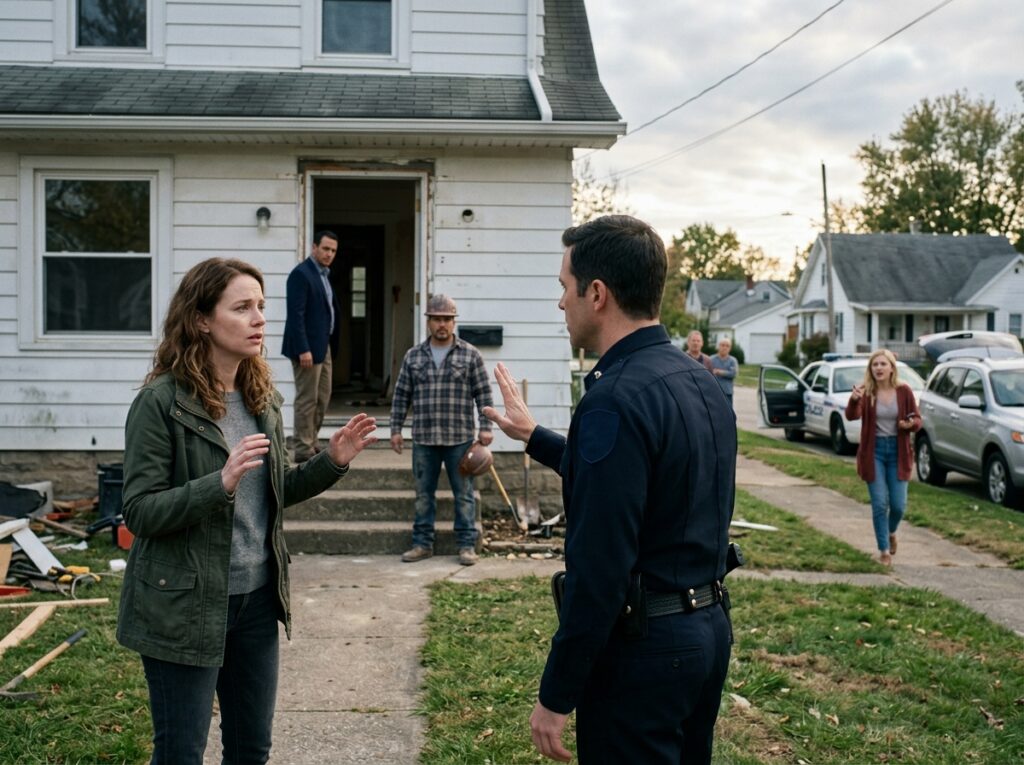
When I turned onto the street, I saw two patrol cars parked in front of the house, lights off but doors open.
A third vehicle—a plain sedan—sat behind them.
Neighbors watched from porches like it was a slow-motion parade.
My pulse hammered.
I parked at the curb and hurried up the walkway.
A uniformed officer stepped toward me, palm up.
“Ma’am, you need to stay back.”
“I’m the owner,” I blurted.
“What’s happening?”
Behind him, Sam stood in the gutted dining room, dusty hardhat in hand.
A detective in a navy blazer was speaking to him, notepad out.
Sam looked up and met my eyes with an apology I didn’t understand.
Then Chloe’s silver SUV screeched to a stop behind my car, tires spitting gravel.
She jumped out, face flushed, phone in her hand.
“What did you do?” she shouted at me, marching toward the officers.
“That house is supposed to be ours!”….
To be continued in C0mments
The officer turned toward Chloe, his raised hand still between us.
“Ma’am, lower your voice.”
Chloe stopped so abruptly that her sunglasses slipped down her nose.
“Excuse me?”
“This is an active investigation. I need you to remain behind the walkway.”
“Investigation?” Her eyes darted toward the open front door.
“Into what?”
The detective in the navy blazer stepped out of the dining room.
He was a lean man in his early fifties, with silver at his temples and a patient expression that suggested he had spent years listening to people explain things they wished they hadn’t done.
“I’m Detective Daniel Mercer,” he said.
“Which one of you is the property owner?”
“I am,” I answered.
Chloe pointed at me.
“She inherited it. That doesn’t mean the rest of us don’t have rights.”
Mercer didn’t look at her.
“Ms. Hart, I’d like you to come inside.”
Chloe immediately moved forward.
“I’m her sister.”
“And I’m asking you to wait here.”
For the first time since Grandma’s funeral, Chloe had nothing to say.
I followed Mercer through the front door.
The house smelled of plaster dust, old wood, and the faint lavender scent that somehow still lingered in Grandma’s curtains.
The dining room looked wounded.
Half the wall beside the built-in bookshelves had been opened, exposing wooden studs and insulation darkened by age.
Sam stood beside a worktable.
On it sat a rectangular metal box.
It was about the size of a shoebox, painted dark green, with rust along the hinges.
A police evidence marker rested beside it.
I stared.
“What is that?”
Sam rubbed his forehead.
“We found it inside the wall. Someone had built a little compartment behind the plaster.”
Mercer studied my face.
“Have you ever seen this box before?”
“No.”
“Do you know why anyone would conceal documents inside your grandmother’s house?”
My throat tightened.
“Documents?”
He opened a folder containing photographs.
The first showed the box exactly where the workers had discovered it.
The second showed several envelopes wrapped in plastic.
The third made my knees weaken.
A photograph of Grandma Evelyn.
She was standing beside a younger version of my mother, outside a bank.
Across the bottom, in Grandma’s unmistakable handwriting, were five words.
I tried to stop them.
I gripped the edge of the worktable.
“What does that mean?”
Mercer didn’t answer immediately.
Instead, he turned another photograph toward me.
It showed a thick envelope.
On the front was written:
FOR MY GRANDDAUGHTER.
DO NOT GIVE THIS TO DIANE.
I looked toward the doorway.
Outside, Chloe was arguing with the officer.
Her voice carried through the empty rooms.
“Call my mother. She’ll straighten this out.”
Mercer followed my gaze.
“Ms. Hart, we need to establish what these materials are before anyone handles them. But there’s something you should know.”
He lowered his voice.
“Your grandmother appears to have documented a financial crime.”
The floor seemed to shift beneath me.
“Against whom?”
He hesitated.
“Against herself.”
I stared at him.
Then at the box.
Then at Grandma’s photograph.
And I remembered something.
Three months before she died, Grandma had been sitting at the kitchen table, turning her wedding ring around her finger.
She’d asked me whether I thought people could love someone and still do terrible things to them.
I’d laughed nervously.
“Of course, Grandma. Families are complicated.”
She’d looked toward the dining room.
“Yes,” she’d whispered.
“Sometimes much more than they should be.”
I had assumed she was talking about old arguments.
Now I wasn’t so sure.
Mercer pulled out a chair.
“Please sit down.”
I didn’t.
“What did my parents do?”
He glanced toward Sam.
Sam quietly stepped into the kitchen, giving us privacy.
“We’re still reviewing the contents,” Mercer said.
“But the preliminary documents indicate that someone may have used your grandmother’s identity to obtain loans secured against this property.”
My mouth went dry.
“Loans?”
“Multiple transactions.”
“How much?”
He turned a page.
“The records we’ve identified so far suggest approximately two hundred and eighty thousand dollars.”
I felt the breath leave my lungs.
Grandma had spent her last winter wearing sweaters indoors because she worried about heating bills.
She had clipped grocery coupons.
She had apologized whenever I bought her medication.
Two hundred and eighty thousand dollars.
“Where did the money go?”
Mercer’s expression hardened slightly.
“That’s what we’re investigating.”
From outside came the slam of another car door.
My mother’s voice followed.
“Chloe, what’s going on?”
I closed my eyes.
Of course.
Chloe had called her.
Mercer stepped toward the window.
Diane Hart stood beside Chloe’s SUV, wearing a cream blouse and carrying her expensive leather handbag.
My father, Mark, emerged from the passenger side.
He looked annoyed.
Not frightened.
Not yet.
“Don’t discuss the box with them,” Mercer said quietly.
“Not until we’ve had a chance to speak with everyone separately.”
I nodded.
Then my mother saw me through the window.
Her expression changed.
For one brief second, she looked genuinely terrified.
It was so quick I might have missed it.
But I didn’t.
She knew.
Somehow, before anyone had told her what was inside that wall, my mother knew.
Mercer noticed too.
He walked toward the entrance.
I followed.
Diane immediately reached for my arm.
“Sweetheart, what happened? Chloe said the police were here.”
Her fingers tightened around my wrist.
“Did they find something dangerous?”
I looked at her.
“What do you think they found?”
Her hand went still.
Mark stepped between us.
“Enough. Whatever this is, we can handle it privately.”
Mercer stopped beside him.
“Mr. Hart, I’m going to need you and your wife to answer some questions.”
My father straightened.
“About what?”
“Financial records.”
A muscle jumped in Mark’s jaw.
Diane looked away.
Chloe frowned.
“What financial records?”
Nobody answered.
For the first time, I saw uncertainty spread across my sister’s face.
She looked at our parents.
“Mom?”
Diane forced a smile.
“It’s probably some misunderstanding involving your grandmother’s paperwork.”
Mercer spoke calmly.
“We haven’t described the paperwork yet, Mrs. Hart.”
The smile disappeared.
Silence settled over the porch.
Somewhere across the street, a lawn sprinkler clicked steadily against the pavement.
My father cleared his throat.
“Detective, my mother-in-law was elderly. She became forgetful near the end.”
I turned toward him.
Grandma had never been forgetful.
She remembered birthdays, grocery prices, the names of neighbors who had moved away thirty years earlier.
She could tell you exactly which rosebush Grandpa planted the year they married.
“She knew what she was doing,” I said.
Mark gave me the familiar warning look.
The one that had silenced me at family dinners since childhood.
“Not now.”
But I wasn’t a child anymore.
And we weren’t at his dinner table.
“Yes,” I said.
“Now.”
Mercer asked the officers to keep the family separated while he arranged formal interviews.
My parents were not arrested.
They were told not to interfere with the investigation or attempt to remove anything from the property.
Before leaving, my mother turned toward the dining room.
Her gaze stopped on the exposed wall.
Her lips parted.
Then she whispered something so softly I almost missed it.
“She really kept it.”
My father grabbed her elbow.
“Diane.”
Mercer looked up.
“Kept what?”
My mother shook her head.
“Nothing.”
But everyone had heard her.
And the house suddenly felt smaller.
By early evening, the police had finished documenting the hidden compartment.
Sam’s crew had been instructed to leave the wall untouched until investigators released it.
He walked me through the remaining rooms while the last officer carried sealed evidence containers toward a patrol car.
“I’m sorry,” Sam said.
I looked at the empty dining room.
“For what?”
“For being the person who made that phone call.”
“You didn’t do anything wrong.”
He stared at the floorboards.
“My mother died when I was twenty-six. We found letters in her dresser afterward. Things she’d never been able to say out loud.”
I looked at him.
“Were they bad?”
“Some of them.”
He paused.
“But knowing the truth was better than spending the rest of my life guessing.”
I wanted to believe him.
Instead, I sat on Grandma’s old kitchen chair and watched the sun turn the garden fence orange.
My phone vibrated.
A message from Chloe.
Mom says you accused them of stealing. This is getting ridiculous.
Then another.
You always wanted Grandma to yourself. Now you’re trying to destroy the family.
I stared at the screen.
A third message appeared.
Just sell the house before you ruin everything.
I turned the phone facedown.
And for the first time, I wondered whether my sister’s obsession with selling had ever really been about inheritance.
The next morning, I met with my probate attorney, Rebecca Collins.
Rebecca had represented Grandma for years.
She was a careful woman who never wasted words and always wore the same small silver watch.
When I explained what had happened, she listened without interrupting.
Then she opened Grandma’s estate file.
“There was something Evelyn asked me to hold until probate reached a particular stage,” she said.
My pulse quickened.
“What?”
“A sealed statement. I was instructed to release it if anyone challenged the will or attempted to force a sale.”
I leaned forward.
“Why didn’t you tell me?”
“Your grandmother specifically requested confidentiality until those conditions were met. I was preparing to contact you after your mother began asking about the property.”
Rebecca opened a locked cabinet.
She returned with a thick envelope.
Grandma’s handwriting covered the front.
My name.
Only my name.
Rebecca placed it between us.
“Before you read this, understand something. Evelyn was fully competent when she signed these instructions. I documented that carefully.”
I opened the envelope.
Inside was a handwritten letter.
My darling girl,
If you’re reading this, then the peace I hoped to leave behind has probably been disturbed.
I’m sorry for that.
I wanted to give you a home, not a battle.
But I also wanted you to know that kindness does not require blindness.
I stopped reading.
My eyes burned.
Rebecca waited.
I continued.
Your mother and father made choices I could not protect them from forever.
I tried to help them when they were struggling.
I believed promises that should have been put in writing.
When I finally understood what had happened, I was ashamed.
Not because I had done wrong.
Because I had raised a daughter who could watch me suffer and still ask for more.
I covered my mouth.
There were several more pages.
Grandma described discovering unfamiliar bank notices.
She described confronting Diane and Mark.
She described being told that the money had been borrowed temporarily to rescue their struggling business.
And she described learning that the business had closed long before the borrowing stopped.
Rebecca watched me carefully.
“Did you know your parents had financial difficulties?”
“They told us the business was doing fine until it closed.”
“Your grandmother believed the money was being used to keep it operating.”
I looked down.
The next paragraph made my chest tighten.
When I refused to sign any more papers, they told me I was becoming confused.
They said perhaps I needed someone to manage my affairs.
I was frightened—not of losing the house, but of losing the right to decide what happened inside it.
I remembered Grandma insisting on attending her own appointments.
Her refusal to let my mother collect her prescriptions.
The way she always asked me to stay while she spoke to the doctor.
I’d thought she simply preferred my company.
Now those small requests had another meaning.
Rebecca slid a tissue box toward me.
“There’s more,” she said.
I read the final page.
I have left the house to you because you treated me like a person, not a problem to be managed.
Please don’t spend your life apologizing for receiving something that was freely given.
And please remember this: a home is not valuable because of what someone can sell it for.
It is valuable because of what happens when someone is safe inside it.
Love,
Grandma Evelyn.
I folded the letter with trembling fingers.
Rebecca gave me a moment.
Then she said, “Your grandmother also authorized me to preserve copies of financial correspondence. I provided what I had to investigators this morning.”
“Did she know about the box?”
“I knew she had secured records somewhere. She never told me where.”
I looked toward the window.
Cars passed through the intersection below.
People carried coffee cups, answered phones, hurried toward ordinary days.
My family was coming apart.
And the world hadn’t even slowed down.
Rebecca leaned forward.
“There’s one more issue. Your sister contacted my office yesterday.”
I looked up.
“What did she want?”
“She asked whether a property sale could proceed if the beneficiary was declared unable to manage the estate responsibly.”
My stomach turned.
“She asked what?”
Rebecca’s expression was grim.
“She wanted to know whether someone could challenge your authority.”
I thought of Chloe’s messages.
The Zillow screenshots.
The accusation that I was destroying the family.
“Does she know about the loans?”
“I don’t know.”
But I intended to find out.
I called Chloe from Rebecca’s parking lot.
She answered on the second ring.
“Finally.”
“Why did you ask my attorney about having me removed from the estate?”
Silence.
Then a sharp breath.
“Mom said you were making irrational decisions.”
“Hiring contractors?”
“Spending money on a house you’re going to sell anyway.”
“I’m not selling it.”
“You can’t just decide that.”
“Yes, Chloe. I can.”
She laughed bitterly.
“You always think you’re better than everyone because you spent more time with Grandma.”
“No. I spent time with Grandma because I loved her.”
“So did I.”
“Then why did you call her house a gold mine?”
Chloe didn’t answer.
I waited.
Finally she said, “You don’t understand what Mom and Dad are dealing with.”
A cold sensation moved through me.
“What are they dealing with?”
“Bills.”
“What bills?”
“Just bills.”
“Chloe.”
She lowered her voice.
“They said if the house sells, everything can finally be settled.”
I gripped the steering wheel.
“Settled with whom?”
Another silence.
Then she whispered, “I thought you knew.”
The next sound was my mother’s voice in the background.
“Chloe, who are you talking to?”
The call ended.
I sat motionless.
Grandma had left me the house.
But my family had apparently already assigned its value to debts they hadn’t told me existed.
And they were counting on me to cooperate.
The following afternoon, Detective Mercer asked me to return to Juniper Lane.
He had arranged a meeting with Rebecca and the family because my parents wanted to provide an explanation and investigators had additional questions.
He made it clear that the gathering was voluntary, not a substitute for formal interviews.
When I entered the living room, Diane and Mark were already there.
Chloe sat on the sofa, her phone clutched in both hands.
Sam stood near the dining room entrance, present because he had discovered the compartment and could identify the condition in which it had been found.
Rebecca sat beside the fireplace.
Mercer remained standing.
The room looked exactly as it had during Grandma’s last Christmas.
Except nobody was smiling.
My mother spoke first.
“This has gone far enough.”
Mercer turned toward her.
“Mrs. Hart, you requested an opportunity to explain the documents.”
“Yes. And I’d like my daughter to understand that families sometimes make difficult financial arrangements.”
I stayed near Grandma’s armchair.
Mark folded his arms.
“Evelyn agreed to help us.”
Rebecca opened a folder.
“Some of the earliest transactions appear to have been authorized. Later ones are disputed.”
My father frowned.
“Disputed by whom? She’s dead.”
The words struck the room like a slap.
Chloe looked at him.
“Dad.”
He ignored her.
“Evelyn knew we were borrowing money.”
Mercer placed several photocopies on the coffee table.
“These are records of three loans secured against the property. Two contain signatures your mother-in-law later challenged in writing.”
Diane’s face tightened.
“She changed her mind about everything toward the end.”
Rebecca looked up.
“Evelyn was evaluated independently. She was competent.”
My mother shifted.
“She could be very stubborn.”
“She could,” I said.
Everyone turned toward me.
“She was stubborn about keeping her house. About paying her own bills. About making her own decisions.”
Diane gave a brittle laugh.
“And you encouraged that because you knew she’d leave you everything.”
I felt the old instinct to defend myself.
To explain.
To make my mother less angry.
But Rebecca spoke before I could.
“Mrs. Hart, your mother executed her will before the final disputed transactions. There is no evidence that your daughter manipulated her.”
Diane looked away.
Mercer placed another document on the table.
“We also have correspondence showing Evelyn demanded an accounting of the borrowed funds.”
Mark leaned forward.
“She got one.”
“Not according to the records we’ve reviewed.”
“Then your records are incomplete.”
Mercer studied him.
“That’s possible. You’re welcome to provide the missing documentation.”
My father said nothing.
The detective turned toward Chloe.
“Ms. Hart, when did your parents first discuss selling this house with you?”
Chloe glanced at Diane.
“Last winter.”
My heart stopped.
Grandma had still been alive.
“What?”
Chloe swallowed.
“Mom said Grandma would probably want us to sell eventually.”
“Did Grandma say that?” Mercer asked.
“No.”
“Did you discuss how the proceeds would be used?”
Chloe looked at the floor.
“Mom said there were debts.”
Diane interrupted.
“Chloe, that’s enough.”
Mercer raised his hand.
“Let her finish.”
My sister’s eyes filled.
“She said we’d all get a fresh start.”
Mark stood abruptly.
“This is ridiculous. We’re being treated like criminals for trying to keep a family together.”
He reached for his jacket.
And that was when Rebecca placed one final sheet on the table.
“Before anyone leaves,” she said, “there’s a document everyone needs to understand.”
My father stopped.
Rebecca looked directly at him.
“This is the notice your mother-in-law received from the lender regarding an attempted modification of the property debt.”
Mark’s face drained.
My mother whispered, “Rebecca.”
But Rebecca continued.
“The request included a proposed authorization to sell the property and apply the proceeds toward the outstanding balance.”
Chloe looked confused.
“So?”
Rebecca turned the page.
“The request was submitted while Evelyn was alive. It included an authorization bearing her name.”
I stared.
Grandma had never told me.
Rebecca’s voice remained steady.
“Evelyn formally denied signing that authorization.”
Mercer added, “The original is being examined. We are not treating the signature as authenticated.”
Mark’s hands curled into fists.
“That’s an accusation.”
“No,” Mercer said.
“It’s a disputed document. We’re determining who submitted it.”
Then Chloe spoke.
Very quietly.
“I submitted it.”
Nobody moved.
Even the ticking clock seemed suddenly loud.
Diane turned toward her.
“Chloe, stop.”
My sister stared at the paper.
“Mom gave it to me.”
My mother’s face went white.
“That’s not what happened.”
Chloe’s voice shook.
“You told me Grandma had signed it.”
Mark took a step toward her.
“Think carefully about what you’re saying.”
Chloe recoiled.
And in that small movement, something broke.
I had seen my sister argue with our parents a thousand times.
I’d seen her demand favors, slam doors, throw dramatic fits.
But I had never seen her afraid of our father.
Mercer moved between them.
“Mr. Hart, stay where you are.”
Chloe began crying.
“Mom told me Grandma wanted the house sold but didn’t want to deal with the paperwork. She said I was helping.”
Diane shook her head.
“You knew we needed the money.”
“I didn’t know the signature wasn’t hers!”
My mother went silent.
And the truth became visible before anyone said another word.
Chloe stared at her.
“Mom?”
Diane looked toward Mark.
He looked away.
My sister’s voice cracked.
“You told me she agreed.”
No answer.
“You made me send it.”
Mark snapped, “Nobody made you do anything.”
Chloe flinched.
Then she looked at me.
And I saw something I hadn’t expected.
Not jealousy.
Not anger.
Horror.
She had helped move forward a plan that Grandma had refused.
And she was only now understanding what that meant.
Mercer asked Chloe whether she would provide her emails and messages voluntarily.
She nodded.
My mother reached for her handbag.
“We’re leaving.”
“Diane,” Rebecca said, “there’s another document.”
My mother stopped.
Rebecca lifted a letter bearing Grandma’s signature.
“This was delivered to my office after Evelyn received the disputed authorization.”
She read only one sentence.
“I will not permit my home to be sold to satisfy obligations I did not knowingly accept.”
My mother sank onto the sofa.
For several seconds, she stared at the floor.
Then she whispered, “She was supposed to help us.”
I felt something inside me turn cold.
“She did help you.”
Diane looked up.
“She helped you for years.”
My voice trembled.
“She went without things she needed because she believed you were struggling.”
My mother began crying.
But I couldn’t stop.
“She trusted you.”
Mark stepped forward.
“That’s enough.”
I turned toward him.
“No.”
He stopped.
One word.
That was all it took.
For the first time in my life, my father’s anger did not decide when I was finished speaking.
I looked at my mother.
“You didn’t just take money. You made her afraid that telling the truth would cost her the right to live in her own house.”
Diane covered her face.
Mark stared at the carpet.
Mercer closed his folder.
“Mr. and Mrs. Hart, we’ll be arranging separate formal interviews. We also need you to preserve all relevant records and communications.”
Mark’s voice was suddenly small.
“Are we being arrested?”
“Not at this time.”
The detective paused.
“But this investigation is continuing.”
My father looked toward me.
For one terrible second, I thought he might apologize.
Instead, he said, “You could stop this.”
I stared at him.
“What?”
“You could tell them it was a family misunderstanding.”
Rebecca rose.
“Mark, don’t ask her to misrepresent evidence.”
He ignored her.
“Think about your mother.”
I looked at Diane.
Then at Chloe, sitting with tears running silently down her face.
Then at Grandma’s empty chair.
“I am thinking about my mother,” I said.
My father’s expression softened with sudden hope.
“And I’m thinking about the woman she hurt.”
The hope vanished.
I stepped away from him.
“I won’t lie for you.”
Mark opened his mouth.
Nothing came out.
And that silence was the first consequence he couldn’t argue his way out of.
The detective’s investigation continued through bank records, handwriting examination, interviews, and the messages Chloe provided.
I did not have to invent a story about my parents.
Their own records told one.
Some loans had begun with Grandma’s genuine consent.
Later applications and authorizations contained signatures she had disputed.
Investigators traced the borrowed funds through accounts connected to my parents.
The money hadn’t gone entirely toward saving their business.
A substantial portion had paid personal debts, including credit cards and expenses they had concealed from both daughters.
The hidden box contained the notices, correspondence, copies of checks, and Grandma’s written account of what she had discovered.
Those records did not establish every legal conclusion on their own.
But they gave investigators dates, transactions, and names to verify.
Eventually, prosecutors filed charges connected to the disputed financial documents and the use of Grandma’s identity.
My parents retained attorneys.
The lender reviewed the contested obligations, and Rebecca began the separate legal work of protecting the estate from debts Grandma had not authorized.
It was neither quick nor simple.
But one thing changed immediately.
My parents stopped telling everyone that I was being selfish.
Because the relatives they had approached about the house were now asking questions of their own.
Aunt Linda called me one evening.
She had always sided with Diane.
“Your mother told me Evelyn wanted the property sold,” she said.
“She didn’t.”
“I know that now.”
I waited.
Linda’s voice broke.
“Evelyn called me last spring. She asked whether I thought she was being unreasonable about keeping her house.”
I closed my eyes.
“What did you tell her?”
A long pause.
“I told her she should listen to her daughter.”
The words hurt more than I expected.
Linda began crying.
“I didn’t know.”
I looked toward Grandma’s photograph on the mantel.
“She needed someone to believe her.”
“I know.”
There was nothing else to say.
Linda didn’t ask me to forgive her.
She simply promised to tell the truth if anyone asked what Grandma had said.
And she kept that promise.
At a later court hearing, I sat beside Rebecca while my parents appeared with their attorneys.
Chloe sat two rows behind me.
She had provided investigators with the original email chain and messages from Diane instructing her to submit the sale authorization.
The courtroom was quiet.
No dramatic shouting.
No sudden confession.
Just documents being discussed, attorneys speaking carefully, and the slow dismantling of the version of events my parents had insisted everyone believe.
When the prosecutor described Grandma’s written objections, Diane lowered her head.
Mark stared straight ahead.
Chloe began crying again.
I didn’t.
Not because I wasn’t hurting.
But because I was finally hearing Grandma’s words treated as evidence instead of dismissed as confusion.
The criminal case ultimately ended with guilty pleas to offenses arising from the unauthorized financial transactions.
The court imposed restitution obligations and sentences that included supervised probation and restrictions tied to their financial conduct.
The separate civil proceedings addressed the disputed debt against the property.
The consequences were real.
My parents could no longer pretend nothing had happened.
They could no longer ask me to quietly sell Grandma’s home and make the evidence disappear beneath a bank transfer.
They had to acknowledge what they had done in a room where their daughters, their attorneys, and the court could hear them.
At sentencing, my mother turned toward me.
Her eyes were swollen.
“I never wanted your grandmother to be frightened of me.”
I looked at her for a long moment.
“But she was.”
Diane began to cry.
“I know.”
It was the first time she had said those words without adding an excuse.
My father didn’t look at me.
Not until the judge spoke about the harm caused by exploiting the trust of an elderly family member.
Then his shoulders lowered.
For the first time, he looked old.
Not powerful.
Not intimidating.
Just a man facing the consequences of choices he could no longer control.
I felt no triumph.
Only a deep, exhausted relief.
Grandma had told the truth.
And now the world had heard it.
When the hearing ended, Chloe approached me in the hallway.
She looked thinner than I remembered.
Her expensive handbag was gone.
She carried a plain canvas tote.
“Can I talk to you?”
I hesitated.
Then nodded.
We stood near a window overlooking the courthouse parking lot.
Chloe twisted the strap of her bag.
“I thought if the house sold, Mom and Dad would stop fighting about money.”
I watched her.
“They told me everything would be okay.”
“Did you ever ask Grandma what she wanted?”
Chloe’s eyes filled.
“No.”
The answer was barely audible.
“I didn’t want to hear her say no.”
That honesty hurt.
But it mattered.
She wiped her face.
“I was jealous of you.”
“I know.”
“Grandma always called you. She trusted you with everything.”
“She called you too, Chloe.”
My sister looked away.
“I know.”
I remembered Grandma’s birthday dinners.
The empty chair beside her.
The excuses Chloe made about being busy.
“She wanted you there.”
Chloe nodded.
“I thought there would always be another Sunday.”
Neither of us spoke.
Cars moved through the parking lot below.
Finally, Chloe asked, “Do you hate me?”
I looked at her.
“No.”
She started crying harder.
“But I don’t trust you right now.”
She nodded again.
“I understand.”
“Trust isn’t something you get back because you feel sorry.”
“I know.”
I believed that she was beginning to understand.
That was enough for that day.
I didn’t hug her.
Not yet.
But when she reached for a tissue and couldn’t find one, I handed her mine.
She took it with both hands.
It was a small beginning.
The renovation resumed once investigators released the dining room.
Sam returned with his crew on a cool morning when the maple leaves were beginning to turn.
He stood beside the open wall.
“You sure you want us to close it?”
I looked at the exposed wooden studs.
For months, that empty space had represented everything my family had hidden.
Now it was simply a wall.
“Yes,” I said.
“But I want one thing changed.”
Sam waited.
“Can we make a little recessed shelf here? Something simple.”
He smiled.
“Absolutely.”
The work took another few weeks.
Fresh plaster covered the damaged sections.
The kitchen ceiling was repaired.
The dining room walls received a soft cream color close to the one Grandma had chosen years earlier.
I kept the oak banister.
I kept the bookshelves.
I kept the old kitchen table, even though one leg still needed a folded piece of cardboard to stop it wobbling.
Some things didn’t need replacing.
They needed care.
One afternoon, Aunt Linda came over carrying a casserole.
She stood awkwardly on the porch.
“I wasn’t sure you’d want me here.”
I stepped aside.
“Come in.”
She walked slowly through the house.
When she reached the dining room, she touched the new plaster.
“She used to stand right here when she called me.”
I nodded.
Linda swallowed.
“I keep thinking about what I said to her.”
I didn’t rescue her from the memory.
She looked at me.
“I should have listened.”
“Yes,” I said.
She nodded.
Then she set the casserole on the table and asked whether I needed help cleaning the kitchen.
I handed her a dish towel.
We worked quietly.
It wasn’t forgiveness spoken aloud.
It was two people choosing to do something useful with regret.
Chloe came by the following Sunday.
She had called first.
That mattered.
She arrived carrying a small box.
“I found these in my apartment.”
Inside were photographs.
Grandma at a county fair.
Grandma holding Chloe as a toddler.
Grandma laughing beside a birthday cake with too many candles.
My sister touched one picture.
“I forgot she used to make pancakes shaped like hearts.”
I smiled despite myself.
“She made mine shaped like stars.”
Chloe looked up.
“Because you were obsessed with astronomy.”
I laughed softly.
“You remember that?”
“Of course.”
We sat at the kitchen table.
For a while, we talked about Grandma without talking about the investigation.
It felt strange.
And good.
Then Chloe reached into the box again.
“There was something else.”
She handed me a small folded card.
On the front was Grandma’s handwriting.
For my two girls.
I opened it.
Inside was a recipe.
Her cinnamon apple cake.
The one she made every autumn.
At the bottom, she’d written:
One of you always measures too carefully.
The other never measures at all.
Between you, you might get it just right.
I laughed.
Then I cried.
Chloe covered her mouth.
“She wrote that after we tried making it together.”
I remembered.
We’d been teenagers.
I’d insisted on following every instruction.
Chloe had dumped in extra cinnamon.
Grandma had eaten two slices and declared it the best cake she’d ever tasted.
We sat there smiling through tears.
And for the first time in months, my sister didn’t ask about the house’s value.
She asked whether we could make the cake.
I looked at the recipe.
“Not today.”
Her smile faded slightly.
Then I added, “Next Sunday. Bring the apples.”
She nodded.
“I will.”
And she did.
We burned the first batch.
Grandma would have laughed until she couldn’t breathe.
The second one came out golden.
Chloe washed the mixing bowls without being asked.
I dried them.
Neither of us mentioned how much that ordinary afternoon meant.
We didn’t have to.
My relationship with my parents remained different.
Diane wrote letters.
Some were apologies.
Some still tried to explain why she’d been desperate.
I answered only when I could.
I told her I would not discuss selling the house.
I told her I would not pretend Grandma had misunderstood.
And I told her that any relationship we might rebuild would have to begin with respecting those boundaries.
My father sent one short note.
I was wrong to ask you to lie.
It was the first apology I’d ever received from him without a justification attached.
I kept the note.
I didn’t mistake it for a repaired relationship.
But I didn’t throw it away either.
As autumn settled over Juniper Lane, the garden began to fade.
Grandma’s roses dropped their last petals.
The mornings grew cold.
One evening, I stood beside the new recessed shelf in the dining room.
I’d placed Grandma’s photograph there.
Beside it sat her old gardening gloves and a small ceramic bird she’d kept on the windowsill.
Sam had finished installing the final trim that afternoon.
Before leaving, he’d handed me a small paper bag.
“Almost forgot. We found this behind the bottom shelf when we removed the damaged wood. It wasn’t in the sealed compartment. Just tucked beneath a loose board.”
Inside was a little envelope.
No documents.
No financial records.
Only a photograph and a note.
The photograph showed me at eight years old, asleep on Grandma’s sofa beneath a patchwork blanket.
Grandma had written on the back:
The first night she said she felt safe here.
My breath caught.
I remembered that night.
My parents had been arguing.
I’d called Grandma crying.
She’d picked me up in her old blue sedan and brought me home.
She’d made cocoa.
She’d let me sleep on the sofa while she read beside me.
I’d forgotten what I’d said.
She hadn’t.
I unfolded the note.
It was only three sentences.
Someday, I hope this house belongs to someone who knows what it feels like to be safe here.
I think I already know who that will be.
Love, Grandma.
I sat down in her armchair.
For so long, I’d believed she left me the house because I had cared for her.
Because I’d driven her to appointments.
Because I’d fixed things.
Because I’d stayed.
But the photograph told me something more.
Long before Grandma needed me, she’d been the person who made me feel safe.
And she’d never forgotten.
The house wasn’t payment.
It was a promise she’d quietly kept.
I held the photograph against my chest.
Outside, the wind stirred the last leaves along the garden path.
The doorbell rang.
Chloe stood on the porch holding two paper cups of hot cider.
“I was nearby,” she said.
“Thought you might want one.”
I stepped aside.
She entered without looking around for anything to claim.
We sat at Grandma’s kitchen table.
I showed her the photograph.
She read the note.
Then she reached across the table and placed her hand over mine.
Not to ask for anything.
Not to persuade me.
Just to stay.
The old house creaked gently around us.
The radiator clicked.
The scent of cinnamon lingered from the cake we’d made that morning.
And in the fading light, with Grandma’s photograph resting between us, I realized that the most valuable thing she’d left behind had never been hidden inside a wall.
It was the simple, extraordinary knowledge that a home could be a place where nobody had to earn the right to feel loved.
Chloe squeezed my hand.
I squeezed back.
And for the first time since Grandma Evelyn died, the house on Juniper Lane felt like home again.