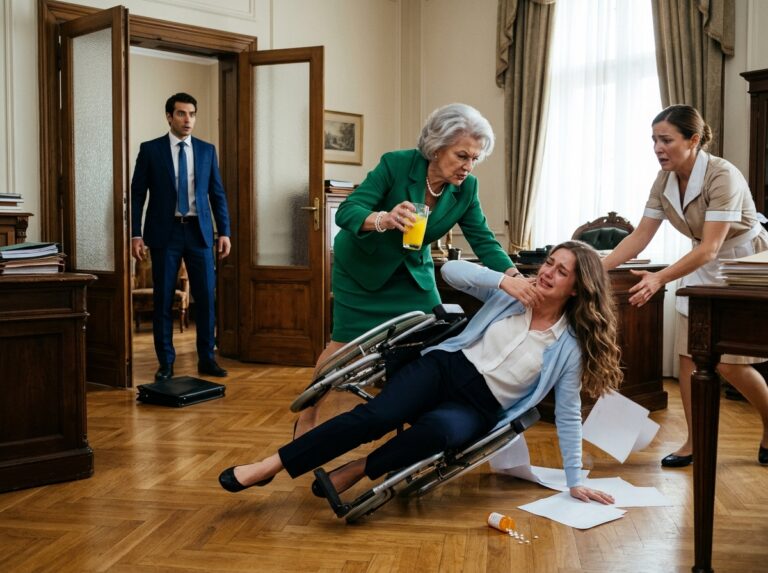
My Soldier Son Came Home to Find Me Scrubbing Our Family Floor—Then Exposed the Betrayal That Stole My House
After five years of military service, my son finally returned to see me. The surprise turned into shock when he saw me living as a maid in the very house my late husband and i once owned. Staring at me, he asked softly, “mom, is that you?” When he discovered how i lost everything, he stormed into the room and shouted, “This ends now.” No one saw what came next….
The strong smell of bleach made me cough. My aching knees pressed against the hardwood floor—the same floor my late husband and I had worked so hard to build. Now, I was scrubbing it for the people sitting on the sofa, who wouldn’t even lift their feet to let me pass.
The front door opened. I panicked, keeping my head down and scrubbing faster, terrified that Vanessa—my daughter-in-law—would scold me again if the floor wasn’t spotless.
“Mom?”
The familiar voice made me freeze. Thaddius. My son. He stood there, still wearing his dusty traveling clothes. But his homecoming smile vanished the moment he saw me: hair messy, wearing an old apron, crouched at Vanessa’s feet like a maid.
Behind me, Vanessa’s mother was lounging with her feet up, sipping tea. “You’re back early?” Vanessa stammered, dropping the glass in her hand.
Thaddius didn’t answer. He walked over, knelt beside me, and took my rough hands in his.
“What is going on here?” his voice trembled, suppressing a wave of intense emotion.
“She likes doing chores,” his mother-in-law quickly explained. “Old folks need to stay active, you know.”
“Active?” Thaddius stood up. His presence seemed to fill the room. He glanced at his brother-in-law lounging on the sofa, then turned to me, his voice firm:
“Mom. Go pack your things. Immediately. We are leaving.”
“Thad, you’re being unreasonable!” Vanessa shouted. “We are taking good care of her! Reic won’t agree with this!”
Vanessa’s brother stood up to block the door: “Hey man, calm down. Nobody is going anywhere.”
Thaddius paused. He looked straight into the man’s eyes. The sharp, authoritative gaze of a grown man made the other guy step back.
“Step aside,” Thaddius said, his voice quiet but heavy with authority. “Don’t make me say it twice.”
The room fell silent. Vanessa went pale, screaming in desperation: “If you walk out that door with her, Reic won’t let this slide! He’s a police officer, remember?”
Thaddius turned back to give her one final look…
“Then call him.”
His voice was so calm that Vanessa stopped breathing for a moment.
“Call Reic,” my son repeated. “Tell him I’m taking my mother out of this house. Tell him he can meet us at the police station if he has something to say.”
Vanessa’s mother lowered her teacup.
“You have no idea what you’re getting involved in, young man.”
Thaddius looked at her.
“I know my mother is on her knees scrubbing a floor while three healthy adults sit and watch.”
“That’s not fair,” Vanessa snapped.
He turned toward her.
“Then explain it.”
She opened her mouth.
Nothing came out.
I reached for my son’s sleeve.
“Thad, please. Don’t make trouble.”
His expression changed when he heard my voice.
Not anger.
Something worse.
Recognition.
He looked down at my trembling fingers, at the cracked skin around my knuckles, at the faded apron tied around my waist.
“Mom,” he whispered, “why are you afraid of them?”
I tried to answer.
I couldn’t.
Vanessa recovered first.
“She’s confused. She’s been getting forgetful, and we’ve been doing our best to manage her.”
Thaddius looked at me.
“Is that true?”
My eyes moved toward Vanessa.
She gave me a look I knew too well.
The warning was silent.
But I had learned to understand it.
If I contradicted her, there would be consequences.
There always were.
Thaddius followed my gaze.
Then he gently took my hand.
“Mom, look at me.”
I did.
For a moment, I saw the little boy who used to run through this very living room with scraped knees and muddy shoes.
The boy whose father had taught him to ride a bicycle in the driveway.
The boy who cried the night before leaving for military training because he was afraid I would be lonely.
Now he was standing in front of me, older and broader, with tired eyes and a voice that had learned how to give orders.
“Nobody gets to punish you for telling me the truth,” he said.
My lips trembled.
“Your father would be so ashamed of what happened here.”
The words escaped before I could stop them.
Thaddius went completely still.
Then he looked around the room.
At the polished furniture.
At the framed photographs that no longer included my husband.
At the expensive curtains Vanessa had purchased after moving in.
And finally, at the hardwood floor beneath my knees.
“What happened to Dad’s house?”
Vanessa stepped forward.
“Thad, this really isn’t the time.”
He didn’t look at her.
“Mom?”
I swallowed.
“Reic said there were papers I needed to sign.”
“What papers?”
“The house. After your father passed, there were bills, and Reic said he could take care of everything if I put the property in his name.”
Thaddius stared at me.
“You signed the house over to Reic?”
Tears burned behind my eyes.
“I thought it was temporary.”
Vanessa made an impatient sound.
“That’s not what happened.”
I flinched.
Thaddius saw it.
He turned toward his wife.
“Stop.”
One word.
She fell silent.
Then he crouched beside me again.
“Mom, where have you been sleeping?”
My heart began pounding.
“Upstairs.”
“Which room?”
I looked toward the staircase.
“The little one.”
He frowned.
“The sewing room?”
I nodded.
His face changed.
“That’s a storage room.”
“It’s comfortable enough.”
“Show me.”
Vanessa stepped between us.
“Absolutely not. You’re not going upstairs and tearing through our things.”
Thaddius looked at her.
“Your things?”
She hesitated.
Then she said, “This is our home now.”
He stared at her for several seconds.
“Our home?”
“Thad—”
“Since when?”
Vanessa’s mother rose from the sofa.
“Your brother Reic owns this property legally. Your mother agreed to the arrangement. You can’t just come home after five years and start making accusations.”
Thaddius looked toward the staircase.
Then he offered me his arm.
“Come on, Mom.”
I stood slowly.
My knees protested.
He noticed.
His jaw tightened.
And without another word, he helped me climb the stairs.
The sewing room was at the end of the hallway.
Once, it had been my favorite place in the house.
My husband, Daniel, had installed shelves along one wall so I could keep my fabric organized.
There had been a sewing machine beneath the window, a comfortable chair, and a little table where I made birthday dresses for neighborhood children.
Now the shelves were filled with Vanessa’s old decorations.
Cardboard boxes crowded the corners.
A narrow folding cot stood beneath the window.
Beside it was a plastic bin containing my clothes.
Thaddius stopped in the doorway.
He looked at the cot.
Then at the boxes.
Then at me.
“Where’s your bed?”
I lowered my eyes.
“Reic sold it.”
He swallowed.
“Mom and Dad’s bed?”
I nodded.
The room seemed to shrink around us.
He stepped toward the window.
On the sill sat a framed photograph of Daniel and me on our thirtieth wedding anniversary.
The glass was cracked.
Thaddius picked it up.
“Why is this in here?”
“Vanessa said the downstairs rooms needed a more modern look.”
He closed his eyes.
For a long moment, he didn’t speak.
Then he turned toward me.
“Where are Dad’s other things?”
I looked down.
“Most of them are gone.”
He inhaled slowly.
“His tools?”
“Reic sold some.”
“His watch?”
“I don’t know.”
“The cedar chest he made for you?”
My face crumpled.
I tried to answer, but only a small sound came out.
Thaddius crossed the room and wrapped his arms around me.
I had spent so many months trying not to cry in front of anyone.
But the moment my son held me, the strength I had been forcing into my tired body finally gave way.
I cried against his chest.
He held me without moving.
“I’m sorry,” he whispered.
I shook my head.
“No, baby. You didn’t know.”
“I should have.”
“You were serving your country.”
“And you were here alone.”
I pulled back enough to look at him.
“Your father was proud of you.”
His eyes filled.
“I wanted him to see me come home.”
“He did, in every way that matters.”
Thaddius looked at the photograph again.
Then he carefully placed it inside my handbag.
“Pack what you want to keep,” he said.
I looked around the room.
There was so little.
A few dresses.
My Bible.
A knitted sweater Daniel had given me.
And a small metal box containing letters my husband had written during the early years of our marriage.
I placed them inside an old suitcase.
Thaddius carried it downstairs.
Vanessa was waiting near the front door with her phone in her hand.
“Reic is coming,” she announced.
Thaddius nodded.
“Good.”
Her brother stood beside the staircase, arms folded.
“You think your uniform makes you special?”
Thaddius looked at him.
“I’m not wearing a uniform.”
The man flushed.
“Whatever. You know what I mean.”
“I know exactly what you mean.”
Thaddius placed my suitcase beside the door.
Then he turned toward Vanessa.
“Where are the documents?”
She frowned.
“What documents?”
“The papers my mother signed.”
“Reic has them.”
“Then he’ll bring them.”
Vanessa laughed nervously.
“You can’t just demand private financial records.”
Thaddius looked at her wedding ring.
Then at the house around us.
“Vanessa, how long have you known my mother was sleeping on a cot?”
Her smile vanished.
“That’s not fair.”
“How long?”
She glanced toward her mother.
“She’s comfortable there.”
“That wasn’t my question.”
Vanessa looked away.
I watched my son study his wife.
Five years earlier, he had married her in a small ceremony before leaving for an extended military assignment.
I remembered how happy he had looked.
How Vanessa had promised to help look after me while he was away.
How she had hugged me and said, “You’ll never be alone, Mom.”
Now he was standing across from her as though he barely recognized her.
“Did you know?” he asked quietly.
She said nothing.
“Did you know Reic had taken the house?”
Her eyes flickered.
“Thad, your mother needed help.”
“Did you know?”
“Yes.”
The word landed heavily.
He nodded once.
Then he asked, “And you didn’t tell me?”
Vanessa’s voice rose.
“You were overseas! What was I supposed to do? Call you every time your family had a problem?”
Thaddius looked at me.
I couldn’t meet his eyes.
He turned back to her.
“My mother losing her home isn’t a small family problem.”
Before Vanessa could answer, headlights swept across the front windows.
A car door slammed.
Then another.
Reic had arrived.
My oldest son entered wearing dark trousers and a police department polo shirt.
He was forty-one, nine years older than Thaddius, and had always carried himself like a man who expected people to listen.
He stopped when he saw his younger brother.
“Well,” he said. “Look who’s finally home.”
Thaddius didn’t smile.
“Where are the house documents?”
Reic’s expression hardened.
“Excuse me?”
“The deed. The transfer paperwork. Whatever Mom signed.”
Reic glanced at Vanessa.
She looked down.
Then he turned back to Thaddius.
“That’s none of your business.”
“She’s our mother.”
“And I’m the one who’s been here taking care of her.”
I felt my stomach twist.
Thaddius glanced at the bucket still sitting in the middle of the living room.
“Is that what you call taking care of her?”
Reic followed his gaze.
His face tightened.
“Mom likes to stay busy.”
I almost laughed.
The same words.
The same excuse.
Thaddius stepped closer.
“Show me the documents.”
Reic crossed his arms.
“You come back after five years and think you can tell me how to run my house?”
Thaddius looked toward me.
Then back at his brother.
“That’s the question, isn’t it?”
Reic frowned.
“What?”
“How did Dad’s house become yours?”
Silence.
The grandfather clock in the hallway ticked loudly.
Reic finally said, “Mom signed it over. Completely legal.”
I looked at him.
“Reic, you told me it was temporary.”
His head snapped toward me.
“Mom, don’t start.”
I lowered my eyes automatically.
Thaddius noticed.
“Don’t speak to her like that.”
Reic laughed.
“You going to arrest me, soldier?”
“No.”
Thaddius reached for his phone.
“I’m going to make sure the right people examine what happened.”
For the first time, Reic looked uncertain.
Then he smiled.
“Good luck proving anything.”
He turned toward me.
“Mom knows what she signed.”
I stared at my oldest son.
The boy I had carried through fevers.
The boy whose father had worked overtime to pay for police academy expenses.
The boy who once promised he would always protect me.
And suddenly, something inside me shifted.
“Do I, Reic?”
He blinked.
“What?”
I took a small step forward.
“You told me I was signing papers so you could help pay the property taxes.”
His face changed.
“Mom—”
“You told me I could stay here for the rest of my life.”
“That’s exactly what I’ve allowed.”
My throat tightened.
“On a cot?”
Nobody moved.
Reic looked toward Vanessa.
Then at his mother-in-law.
Then back at me.
“You’re being dramatic.”
I felt Thaddius’s hand settle gently against my back.
And for the first time in months, I didn’t retreat.
“No,” I whispered. “I’m telling the truth.”
Reic’s expression darkened.
“Fine. You want the truth? Dad left debts. The house was going to be lost. I stepped in. I saved it.”
Thaddius frowned.
“What debts?”
Reic hesitated.
“Medical bills. Property taxes. Repairs.”
“Show us.”
“I don’t have to show you anything.”
Thaddius nodded.
“Then we’ll get the records.”
Reic gave a short, humorless laugh.
“You think it’s that easy?”
“No,” Thaddius answered. “I think it’s going to be difficult.”
He picked up my suitcase.
“But we’re doing it anyway.”
Reic moved toward the door.
“Mom isn’t leaving until we settle this.”
Thaddius stopped.
I felt my heart racing.
Then my youngest son looked at his brother.
“She’s an adult. She can decide where she lives.”
Reic looked at me.
“Mom?”
I had heard that tone before.
The warning beneath the question.
For months, it had been enough to silence me.
But now Thaddius stood beside me.
And Daniel’s photograph was safe in my handbag.
I took a breath.
“I’m leaving.”
Reic stared.
Then he stepped aside.
The cool evening air touched my face as Thaddius guided me onto the porch.
I hadn’t realized how long it had been since I had walked out of that house without asking permission.
Behind us, Vanessa called his name.
“Thad!”
He turned.
She stood beneath the porch light, her eyes wet.
“Are you really leaving me over this?”
He looked at her for a long moment.
“I’m leaving because my mother needs somewhere safe to sleep tonight.”
“And what about us?”
His voice broke slightly.
“I don’t know what ‘us’ means anymore.”
Then he helped me into his car.
We drove away beneath a sky heavy with clouds.
I watched the house disappear through the rear window.
The porch Daniel had built.
The rosebushes I had planted.
The upstairs bedroom where both my sons had slept as children.
I pressed my hand against the glass.
Thaddius glanced at me.
“Mom?”
“Yes?”
“We’re going to find out what happened.”
I nodded.
But I didn’t tell him what frightened me most.
I wasn’t sure I could bear discovering that my oldest son had betrayed me deliberately.
We spent the night at a small hotel near the interstate.
Thaddius ordered soup and sandwiches.
I couldn’t eat much.
He sat across from me at the little table, watching as I carefully folded the paper napkin beside my plate.
“Mom, can I ask you something?”
I nodded.
“Why didn’t you tell me?”
I looked down.
“I tried.”
He went still.
“What?”
I swallowed.
“I called you last Christmas. Remember?”
He nodded slowly.
“You said you were fine.”
“Reic was standing beside me.”
Thaddius closed his eyes.
I continued.
“I wrote you letters, too.”
He looked up.
“I never got any letters.”
My hands began to shake.
“I gave them to Vanessa to mail.”
The room fell silent.
Thaddius stared at me.
Then he reached for his phone.
He opened an old message thread.
I watched his thumb move across the screen.
He turned the phone toward me.
There were messages from Vanessa.
Your mom is doing great.
She’s been keeping busy.
Reic says she’s happier than ever.
Don’t worry about home. Focus on your assignment.
I looked at the screen.
My stomach sank.
Thaddius whispered, “She told me you didn’t want to bother me.”
Tears filled my eyes.
“I thought you were too busy to answer.”
He shook his head.
“Mom, I would have answered.”
I reached across the table.
“I know that now.”
He held my hand.
For a long time, neither of us spoke.
Then he said something that made my chest ache.
“I thought you were safe because the people I loved were taking care of you.”
I looked at him.
“So did I.”
The next morning, Thaddius contacted a local attorney who specialized in elder financial exploitation and property disputes.
Her name was Margaret Ellis.
She listened carefully while I explained the transfer.
Then she asked whether I still had copies of anything I had signed.
I shook my head.
“Reic kept everything.”
She nodded.
“We can obtain recorded property documents. We also need to review the circumstances of the transfer, any promises made to you, and whether there was coercion, deception, or abuse of a position of trust.”
Thaddius leaned forward.
“Can we get the house back?”
Margaret looked at me.
“I can’t promise an outcome. But there are serious questions here, and we’re going to investigate them.”
Then she asked about my late husband’s estate.
I explained that Daniel had left the house to me through his will.
Margaret wrote something down.
“Did your husband leave any other documents?”
I thought for a moment.
“He had a blue folder.”
Thaddius looked at me.
“Dad’s blue folder?”
I nodded.
“He kept important papers in the cedar chest.”
Thaddius’s expression changed.
“The cedar chest Reic sold?”
I swallowed.
“Yes.”
Margaret looked between us.
“Do you know who purchased it?”
I shook my head.
But Thaddius was already reaching for his phone.
“Reic listed some of Dad’s furniture online,” he said. “I remember seeing photographs years ago.”
He scrolled through an old family message thread.
Then he stopped.
“Here.”
On the screen was a photograph of the cedar chest.
Beneath it, Reic had written:
Clearing out some old furniture. Let me know if anyone wants it.
I touched the screen.
Daniel had carved our initials into the lid.
D and M.
Daniel and Margaret.
My name.
Margaret, the attorney, looked at the photograph.
“Let’s not assume the folder is still there. But we should trace the chest if possible.”
Thaddius nodded.
And that was how the first piece of truth began to return.
Not through a dramatic confession.
Not through a sudden miracle.
Through an old photograph, a furniture listing, and a woman who had never stopped remembering what her husband built.
The recorded deed arrived two days later.
Margaret spread the pages across her desk.
I recognized my signature.
But the document said something I had never understood.
The transfer had been recorded as an outright gift.
No purchase price.
No written life-estate protection.
No documented obligation for Reic to support me.
I stared at the paper.
“He told me I could live there forever.”
Margaret nodded.
“That promise matters, especially if it induced the transfer. But it isn’t written into this deed.”
Thaddius leaned forward.
“What about the debts?”
Margaret opened another file.
“We’ve obtained preliminary records. The property taxes were current when the deed was signed. There were some medical expenses associated with Daniel’s illness, but we haven’t found evidence of a lien or foreclosure threat against the house.”
I felt cold.
Reic had told me the house was about to be taken.
He had made me afraid.
And I had signed because I thought I was saving the last thing Daniel left me.
Thaddius looked at the records.
Then at me.
“Mom, he lied.”
I stared at the papers.
I wanted to defend Reic.
Some part of me still wanted to believe there was an explanation.
But the numbers were sitting in front of me.
Clear.
Ordinary.
Impossible to ignore.
Margaret gently turned another page.
“There’s something else.”
It was a copy of a mortgage recorded against the property.
The date was eight months after I signed the deed.
Reic had borrowed a substantial amount against the house.
I looked at the figure.
$184,000.
My breath caught.
“What did he need that much money for?”
Margaret shook her head.
“We don’t yet know how the proceeds were used.”
Thaddius stared at the document.
Then he asked, “Does Mom owe that money?”
“She’s not listed as a borrower on this instrument,” Margaret replied. “But the lien affects the property. If we pursue a challenge to the transfer, we’ll need to address the lender’s rights as well.”
I looked toward the window.
Rain was sliding down the glass.
For years, Daniel and I had worked to pay off that house.
We celebrated the final mortgage payment with takeout chicken and a cheap bottle of sparkling cider.
He had danced with me in the kitchen.
“No more payments, Maggie,” he’d whispered. “This house is yours. Whatever happens to me, you’ll always have a roof.”
I had believed him.
Now I was staring at a debt I had never agreed to create.
And the man who created it was my own son.
Thaddius reached for my hand.
I pulled away.
Not because I was angry with him.
Because I couldn’t bear being touched.
Not yet.
“Mom?”
I shook my head.
“Please. Just give me a minute.”
He sat back.
And he did.
The next discovery came from Vanessa.
Not because she suddenly became honest.
Because her lies had begun contradicting one another.
Margaret sent a formal request for relevant records and notified Reic that we were challenging the circumstances of the transfer.
Reic responded through an attorney.
He insisted I had voluntarily given him the house in gratitude for his care.
He claimed I had chosen to sleep in the sewing room.
He even described the chores as activities I performed willingly.
But Vanessa had been sending Thaddius photographs for years.
Photographs of holidays.
Family gatherings.
Renovations.
New furniture.
And in several of them, I appeared in the background.
Carrying trays.
Cleaning dishes.
Standing alone near the kitchen while everyone else sat at the table.
Thaddius printed them.
He placed them in chronological order.
I watched him examine one photograph from Thanksgiving.
Vanessa was smiling beside a beautifully decorated dining table.
Her mother sat at the head.
Her brother was raising a glass.
Reic stood behind them.
And I was visible through the kitchen doorway, wearing the same faded apron.
Thaddius stared at it.
“Where were you sitting?”
I looked at the picture.
“I wasn’t.”
His jaw tightened.
“Mom.”
“They said there wasn’t enough room.”
He closed his eyes.
I touched his arm.
“Please don’t blame yourself.”
He looked at me.
“I’m trying not to.”
Then he pointed toward the photograph.
“But I keep wondering how many times I looked at these pictures and never noticed you weren’t at the table.”
I couldn’t answer.
Because I had wondered the same thing.
How many people had seen me disappear?
How many had accepted it because it was easier than asking questions?
The real shock came during a meeting at Margaret’s office.
Reic arrived with his attorney.
Vanessa came with him.
Her mother waited outside.
Thaddius sat beside me.
The atmosphere was tense from the beginning.
Reic wouldn’t look directly at me.
His attorney placed a folder on the table.
“My client maintains that the transfer was voluntary and that Mrs. Margaret—”
“Mom,” Reic interrupted sharply.
Everyone looked at him.
He cleared his throat.
“My mother knew what she was doing.”
Margaret remained calm.
“Then perhaps your client can explain the circumstances surrounding the transfer.”
Reic leaned back.
“I explained the bills. She wanted me to handle the property.”
“Did you tell her the house was at risk of foreclosure?”
He hesitated.
“I told her we had financial problems.”
“Did you tell her the property taxes were delinquent?”
“I don’t remember the exact conversation.”
Margaret placed the tax records on the table.
“The taxes were current.”
Reic looked at them.
Then away.
Thaddius sat perfectly still.
Margaret continued.
“Did you tell your mother she would retain the right to live in the home for life?”
Reic shrugged.
“She was always welcome.”
I looked at him.
“Then why did you move me out of my bedroom?”
He turned toward me.
“Mom, we needed the space.”
“For what?”
He didn’t answer.
Vanessa shifted in her chair.
Margaret looked at her.
“Mrs. Vanessa, were you involved in arranging Mrs. Margaret’s living accommodations?”
Vanessa glanced at Reic.
Then at Thaddius.
“Yes.”
Thaddius’s face tightened.
Margaret asked, “Why was she moved to the sewing room?”
Vanessa swallowed.
“Because my mother needed the downstairs bedroom.”
I stared at her.
That was the moment.
The moment everything became clear.
My bedroom had not been taken because of medical needs.
Or financial hardship.
Or necessary renovations.
It had been given to Vanessa’s mother.
A woman who had never paid a mortgage on that house.
A woman who sat drinking tea while I scrubbed the floor.
Margaret looked toward Reic.
“And you agreed?”
He rubbed his forehead.
“Vanessa’s mother has back problems.”
I looked at him.
“So do I.”
Silence.
Then Vanessa spoke.
“She never complained.”
I turned toward her.
My voice came out barely above a whisper.
“Because every time I complained, you told me Reic could put me in a nursing home.”
Vanessa went pale.
Thaddius looked at his wife.
“What?”
She shook her head.
“That’s not what I said.”
I looked at her.
“You said nobody would believe me if I told anyone.”
Vanessa’s lips parted.
No sound came out.
Margaret leaned forward.
“Mrs. Margaret, did anyone threaten to remove you from the home if you refused to perform chores?”
I nodded.
“Yes.”
Reic stood abruptly.
“This is ridiculous.”
His attorney touched his arm.
“Sit down.”
But Reic was already looking at me.
“After everything I’ve done for you, this is how you repay me?”
I flinched.
Thaddius rose halfway from his chair.
Then stopped.
He looked at me.
And sat back down.
He understood.
This was my moment to speak.
Not his.
I looked at Reic.
My firstborn.
The child who used to crawl into my bed during thunderstorms.
The young man whose father had taught him that a badge was a promise to protect people, not a license to frighten them.
And I asked the question that had been living inside me for months.
“Reic, when did you stop seeing me as your mother?”
His face changed.
For a moment, he looked almost young.
Almost frightened.
Then his expression hardened.
“That’s not fair.”
I nodded slowly.
“No. It isn’t.”
Margaret asked whether we needed a break.
I shook my head.
“No.”
Then I reached into my handbag.
I removed a small envelope.
Inside were the notes I had written during the months I lived in the sewing room.
Dates.
Times.
Tasks.
Arguments.
Threats.
I had written them on scraps of paper because I was afraid I would eventually begin believing their version of my life.
I placed the envelope on the table.
“These are the things I remember.”
Reic stared.
Vanessa’s face drained.
Thaddius looked at me.
“Mom, you kept notes?”
I nodded.
“Your father always said that when something matters, write it down.”
Margaret opened the envelope carefully.
She read the first page.
Then the second.
Her expression grew serious.
Reic’s attorney leaned forward.
“May we see copies?”
Margaret nodded.
“Through the appropriate process.”
Reic looked at Vanessa.
For the first time, she wouldn’t meet his eyes.
And I realized they were beginning to understand something.
I had been frightened.
I had been isolated.
I had been humiliated.
But I had not forgotten.
The legal process moved forward.
Margaret filed a civil action challenging the transfer and seeking appropriate relief based on the alleged deception and undue influence.
She also referred the circumstances to the relevant adult protective services authorities.
Because Reic was a police officer, the allegations involving his conduct were reported through the department’s professional standards process.
No one promised an immediate outcome.
No one pretended that a uniform automatically made him guilty or innocent.
But the questions were now being asked by people he couldn’t simply silence.
The department placed Reic on administrative leave while reviewing the allegations and any connection to his official position.
The civil case continued separately.
And for the first time, my oldest son had to answer questions without being able to frighten me into changing my story.
Meanwhile, Thaddius moved into a small rental house with me.
He was transitioning out of active service and considering his next steps.
He took me to medical appointments.
Helped me find a comfortable bed.
Bought groceries without making me feel guilty about the cost.
But the most important thing he did was much smaller.
Every morning, he made coffee.
Two mugs.
One for him.
One for me.
And he sat at the kitchen table until I joined him.
At first, I kept trying to wash his dishes before he finished eating.
One morning, he gently took the sponge from my hand.
“Mom.”
I looked up.
“You don’t have to earn breakfast.”
I stared at him.
He placed the sponge beside the sink.
“Sit down.”
I sat.
He poured my coffee.
Then he pushed the sugar bowl toward me.
And for the first time in a very long while, I drank a full cup while it was still hot.
The hearing that changed everything took place several months later.
The courtroom was small.
The benches were hard.
The air smelled faintly of old paper and furniture polish.
I sat beside Margaret and tried to keep my hands still.
Thaddius was behind me.
Vanessa sat across the aisle with her mother.
Reic was at the opposing table with his attorney.
The judge had already reviewed the written evidence.
The recorded deed.
The tax records.
The mortgage documents.
The correspondence.
My notes.
And the sworn testimony gathered during the case.
But one piece of evidence changed the atmosphere in the room.
It came from the cedar chest.
Thaddius had managed to trace the old furniture listing to a retired schoolteacher named Mrs. Eleanor Brooks.
She had purchased the chest from Reic several years earlier.
When Thaddius contacted her, she remembered the carved initials.
She also remembered finding a sealed blue folder wedged behind the bottom drawer.
She had kept it because the papers appeared personal.
And because she had always intended to return them if she found the family.
Inside were copies of Daniel’s estate documents.
Property records.
Insurance information.
And a handwritten letter addressed to me.
But there was something else.
A dated statement Daniel had prepared with his estate attorney during his final illness.
It described his wish that I remain secure in the family home and explained why he had arranged for the property to pass to me.
It wasn’t a magical document that automatically reversed the deed.
Margaret made that clear.
But it provided powerful context.
Daniel had understood exactly what he wanted.
And his intentions were nothing like the story Reic had told me.
When the letter was read, I stared at the floor.
I could almost hear Daniel’s voice.
He had written about the years we spent saving for the house.
About the repairs we completed ourselves.
About the sacrifices I made while raising our sons.
And about his hope that the home would remain a place of safety for me.
Then came the sentence that broke me.
Margaret has spent her life making sure everyone else has a place to rest. I want her to have one too.
I covered my mouth.
Behind me, Thaddius began crying quietly.
I didn’t turn around.
I couldn’t.
Across the room, Reic stared at the document.
His expression was unreadable.
Then the attorney presented another record.
A bank statement showing that the money Reic claimed had been used to rescue the property from debt had largely gone toward unrelated personal expenses.
There were withdrawals.
Transfers.
Payments connected to a vehicle purchase and home renovations.
The financial trail was not as simple as Reic had claimed.
The judge asked several questions.
Reic answered some.
Avoided others.
And eventually admitted that he had exaggerated the danger of losing the house when persuading me to sign.
The courtroom became very quiet.
The judge looked at him.
“You represented to your mother that the property was at immediate risk?”
Reic swallowed.
“I was trying to get her to understand the seriousness of the situation.”
“Was that representation accurate?”
He stared at the table.
“No.”
I closed my eyes.
There it was.
The truth.
Not whispered in a hallway.
Not denied in a family argument.
Spoken under oath.
In front of everyone.
Vanessa’s mother lowered her head.
Vanessa began crying.
Thaddius sat motionless behind me.
And Reic finally looked at me.
For the first time since Daniel died, he seemed unable to hide behind anger.
The judge ultimately ruled in my favor on the central challenge to the transfer, finding that the evidence supported setting aside the deed because of the deceptive circumstances in which it had been obtained.
The remaining mortgage and financial issues required further proceedings and negotiated resolution involving the lender.
But the most important part was settled.
Reic could no longer claim that I had knowingly and freely given away my home under the circumstances he described.
The truth had been recognized.
And the legal path toward restoring my ownership was open.
When the judge finished speaking, I didn’t cheer.
I didn’t smile.
I sat perfectly still.
Then I felt Thaddius’s hand on my shoulder.
“Mom,” he whispered.
I turned.
His eyes were wet.
“You did it.”
I shook my head.
“We did.”
Across the aisle, Vanessa stood.
She looked toward Thaddius.
He didn’t move toward her.
Their marriage had already been strained beyond what apologies could easily repair.
She had admitted withholding my letters.
She had acknowledged misleading him about my living conditions.
And although she had tried to explain her choices as loyalty to her family, Thaddius had asked a question she could never answer.
“Why wasn’t my mother your family too?”
Their separation became permanent.
They eventually divorced.
Not because Thaddius wanted revenge.
Because trust, once deliberately broken over years, could not be restored by tears in a courtroom.
Reic’s professional consequences continued through the department’s disciplinary process.
The review ultimately resulted in his dismissal after findings concerning dishonesty and conduct incompatible with departmental standards.
He lost the position that had once made him so proud.
But I knew the deepest loss wasn’t his job.
It was the way his family looked at him.
The way Thaddius no longer trusted his promises.
The way I could no longer hear his voice without remembering the fear I had felt in my own home.
One afternoon, Reic asked to see me.
Margaret advised me that I could decline.
I considered it carefully.
Then I agreed to meet him in a quiet public room at the attorney’s office.
Thaddius waited nearby.
Reic arrived without his badge.
Without his confident posture.
Without the sharp tone he had used for so long.
He sat across from me.
For several seconds, he said nothing.
Then he looked at my hands.
The skin was healing.
The cracks had begun to disappear.
He swallowed.
“Mom.”
I waited.
“I’m sorry.”
The words were small.
Almost painfully small.
I looked at him.
“What are you sorry for?”
His eyes filled.
He rubbed his palms together.
“For the house.”
I said nothing.
“For the way I treated you.”
Still, I waited.
He looked down.
“For making you afraid of me.”
My throat tightened.
He began crying.
“I don’t know how I became that person.”
I looked at my oldest son.
And for a moment, I remembered him at six years old, standing in the kitchen with a broken vase, crying because he thought I would stop loving him.
I had knelt beside him.
Told him that telling the truth mattered more than hiding a mistake.
Now he was a grown man.
And the damage was far greater than a broken vase.
“Reic,” I said softly, “you didn’t become that person in one day.”
He nodded.
Tears fell onto his hands.
“You made choices. Again and again. And every time I was hurt, you chose to protect yourself instead of me.”
He covered his face.
“I know.”
I looked toward the window.
The afternoon sunlight lay across the floor.
“I love you,” I said.
He looked up.
“But I don’t trust you.”
His face crumpled.
“I understand.”
“Maybe one day we can have a different relationship.”
He nodded desperately.
“But that will take time. And it will depend on what you do, not what you promise.”
He wiped his eyes.
“I’ll try.”
I stood.
“Then start by becoming a man your father would recognize.”
He lowered his head.
I left him sitting there.
And for the first time, I understood that loving my child did not require allowing him to hurt me.
The house was eventually returned to my name after the remaining financial and title issues were resolved.
The day I received the final documents, Thaddius drove me there.
The yard had grown wild.
The rosebushes needed pruning.
The porch steps creaked.
Inside, the rooms looked strangely empty.
Vanessa’s family had moved out.
The furniture was gone.
The curtains had been taken down.
But sunlight still came through the same windows.
The hardwood floors still held the marks Daniel and I had made while building our life.
I stood in the living room.
Thaddius placed the keys in my hand.
“Welcome home, Mom.”
I looked at them.
Then at him.
“Are you sure you want to stay here with me?”
He smiled.
“Where else would I go?”
I laughed through my tears.
We spent the following weeks cleaning and repairing the house.
Not because anyone demanded it.
Because we wanted to make it ours again.
Thaddius replaced the broken porch railing.
I planted new flowers.
We painted the kitchen a warm cream color.
And one Saturday, he carried a large wooden box into the living room.
I stared.
It was the cedar chest.
Daniel’s cedar chest.
Mrs. Brooks had returned it after learning what had happened.
Thaddius had carefully restored the hinges and polished the wood.
The carved initials were still there.
D and M.
I ran my fingers over them.
Then I opened the lid.
Inside were Daniel’s old photographs.
A folded quilt.
Several handwritten cards.
And a small envelope.
My name was written across the front.
I recognized his handwriting immediately.
My hands trembled as I opened it.
Inside was a note.
Not a legal document.
Not a will.
Just a few lines written by the man I had loved for nearly forty years.
He had tucked it beneath the quilt years earlier, long before his final illness.
My Maggie,
If you ever find this while I’m not around to make you laugh, remember that this house was never beautiful because of the walls.
It was beautiful because you were in it.
Don’t spend your life taking care of everybody else and forgetting yourself.
Sit down sometimes.
Let somebody bring you a cup of coffee.
And know that wherever you are loved, you are home.
I pressed the letter against my chest.
Thaddius stood beside me.
He didn’t ask to read it.
He simply waited.
Then I handed it to him.
He read slowly.
When he finished, he wiped his eyes.
“Dad always knew what to say.”
I smiled through my tears.
“Usually after saying three things he shouldn’t have.”
Thaddius laughed.
And suddenly, the living room felt less empty.
That evening, we ate dinner at the old dining table Raymond, one of Daniel’s former coworkers, had helped us find in storage.
Thaddius cooked chicken.
I made mashed potatoes.
The food wasn’t fancy.
The plates didn’t match.
And the kitchen still smelled faintly of fresh paint.
But when we sat down, Thaddius pulled out the chair at the head of the table.
The chair Daniel used to occupy.
I stopped.
“That’s your father’s chair.”
He nodded.
“I know.”
Then he gently pushed it toward me.
“Sit here, Mom.”
I stared at him.
For months, I had been made to feel that there wasn’t a place for me in my own home.
Now my son was standing beside the table, waiting for me to sit in the chair that had always represented safety, family, and belonging.
I touched the backrest.
Then I sat.
Thaddius smiled.
“There.”
He took his place beside me.
And we ate.
No one ordered me to clear the plates.
No one criticized the food.
No one told me I was in the way.
After dinner, I instinctively reached for the dishes.
Thaddius caught my hand.
“I’ve got them.”
I looked at him.
“You cooked.”
“And now I’m washing.”
I laughed.
“Your father would be impressed.”
He grinned.
“Dad taught me.”
I watched him carry the plates into the kitchen.
The faucet ran.
The dishes clinked.
And I sat at the table, listening to the ordinary sounds of a home where nobody was afraid.
Later, as the sun disappeared behind the trees, I walked onto the porch.
The evening air smelled of fresh grass and damp earth.
Thaddius joined me carrying two mugs of coffee.
He handed me one.
I looked down at it.
Then at him.
“Your father wrote about this.”
Thaddius smiled.
“I know.”
I turned toward him.
“What do you mean?”
He reached into his pocket and removed a folded piece of paper.
It was an old letter Daniel had written to him before his first deployment.
Thaddius opened it.
He showed me the final paragraph.
Your mother has spent her whole life taking care of us. When you come home, don’t just thank her. Make sure she gets to rest. Bring her coffee. Sit with her. Let her know she never has to carry everything alone.
I stared at the words.
Then at my son.
“How long have you had that?”
“Five years.”
My eyes filled.
“And you’ve been making me coffee every morning.”
He nodded.
“I promised Dad.”
I couldn’t speak.
Thaddius stepped closer.
“He told me something else before I left.”
I looked up.
“He said the strongest person in this family wasn’t the man who built the house.”
My breath caught.
“He said it was the woman who made everyone feel safe inside it.”
I covered my mouth.
Thaddius wrapped his arm around my shoulders.
And for the first time since Daniel died, I felt the strange, beautiful certainty that his love had not disappeared.
It had simply found another way to reach me.
Through a letter.
Through a promise.
Through a son who came home and finally saw what had been happening.
We stood together as the porch light flickered on.
The same porch Daniel had built.
The same house I had nearly lost.
But everything inside it had changed.
I no longer measured my worth by how much I could endure.
I no longer confused silence with peace.
And I no longer believed that being a mother meant accepting cruelty from the children I had raised.
I loved both my sons.
One was learning how to rebuild what he had broken.
The other was helping me rebuild what I had lost.
And I was learning something too.
That my life had not ended when Daniel died.
That my dignity had not disappeared when I was forced onto my knees.
That I was still allowed to have a future.
Thaddius squeezed my shoulder.
“You okay, Mom?”
I looked out at the yard.
The roses were beginning to bloom again.
A warm light glowed through the kitchen window.
Two coffee mugs rested on the porch railing.
And beside me stood the son who had come home expecting a reunion and found a truth neither of us could ignore.
I smiled.
“Yes, sweetheart.”
He looked at me carefully.
“Really?”
I nodded.
“For the first time in a long while.”
Then I reached for his hand.
And as the last sunlight slipped across the wooden porch, I sat down in the chair Daniel had built for me, held my warm coffee between both hands, and watched my son settle into the chair beside mine.
No one asked me to get up.
No one told me there was work to do.
And when the evening breeze moved through the roses, I could almost hear Daniel’s familiar voice reminding me that this was what he had wanted all along.
Not a perfect house.
Not a perfect family.
Just a place where I could finally rest.
So I leaned back, closed my eyes, and let the people who loved me take care of me for a change.