PART 1
My future daughter-in-law shaved my head while I slept on my son’s wedding morning—and still expected me to arrive smiling, stay silent, and hand her twenty-two million dollars.
I woke to a strange burning across my scalp.
Still caught between sleep and consciousness, I reached for the thick silver hair that had fallen past my shoulders the night before.
My fingers touched nothing.
Not tangled strands.
Not a ruined haircut.
Bare skin.
I sat upright so quickly that the bedroom tilted around me. Cold morning light leaked through the curtains as I stumbled toward the bathroom, one hand pressed against my head.
Before I switched on the light, I smelled antiseptic.
Sharp. Clinical. Deliberate.
Then I faced the mirror.
For one suspended second, I did not recognize the woman staring back.
Her scalp was raw and unevenly flushed. Tiny fragments of silver hair clung near one ear where the razor had missed them. Her eyes were wide, but the rest of her face had gone frighteningly still.
Someone had entered my room while I slept.
Someone had stood over me.
Someone had removed every strand of my hair.
A white note had been taped to the center of the mirror.
“Congratulations—you finally have a hairstyle that suits your age.”
A tiny heart had been drawn beneath the sentence.
The handwriting was neat.
The cruelty was effortless.
I peeled the note from the glass.
A familiar perfume rose from the paper—sweet, expensive, and impossible to mistake.
Sabrina.
My future daughter-in-law.
The woman my son Michael would marry in only a few hours.
I stared at that cheerful little heart until the shock inside me hardened into something cold and precise.
She wanted me to scream.
She wanted me to call Michael in tears and beg him to confront her.
She wanted Beatrice Langford—the widow who had built half a Boston real estate empire from grief, debt, and sleepless nights—to hide from the wedding because she was ashamed to be seen.
But I did not scream.
I folded the note once and placed it beside the sink.
Then I walked barefoot across the cold marble floor to the safe in my bedroom.
Inside rested an ivory envelope I had prepared the night before.
The documents authorized a twenty-two-million-dollar transfer to Michael and Sabrina.
Their wedding gift.
It was not merely money. It was a penthouse, investments, security, and the beginning of a life most people could never imagine.
It was also my final attempt to keep my son close.
For years, I had convinced myself that generosity could repair what silence had damaged. Every check had been an apology for working too much, grieving too long, or failing to become the mother Michael believed he deserved.
Now the envelope felt different in my hands.
It no longer felt like a gift.
It felt like a weapon I had nearly placed in Sabrina’s hand.
I returned it to the safe.
The metal door closed with a soft, final weight.
I turned the dial until the lock clicked.
Quiet.
Dry.
Final.
Not one dollar would move.
I called Avery Whitman, our family attorney.
He answered on the second ring.
“Beatrice,” he said, calm and professional. “Ready to finalize the transfer?”
“No.”
The word came out steadier than I expected.
A pause followed.
“I want everything placed on hold immediately,” I continued. “No transfer. No access. No exceptions.”
His voice sharpened. “Has something happened?”
I looked at my reflection.
At the burning skin.
At the silver fragments near my ear.
At Sabrina’s note beside the sink.
“At the reception tonight, I want you to come to my house,” I said. “We’re rewriting the entire will.”
Silence filled the line.
“Beatrice—”
“Only one thing is wrong,” I told him. “I finally woke up.”
Lucia, my hairstylist of twenty years, arrived less than half an hour later.
When I opened the door, her eyes lifted to my scalp.
Her hand flew to her mouth.
She did not ask who had done it.
Perhaps she saw the answer in my face. Perhaps she understood that speaking the horror aloud would give it more power than it deserved.
Instead, she opened her case.
Lucia fitted me with a soft gray-silver wig that moved naturally around my face. She adjusted it with careful fingers until every sign of what had happened disappeared beneath it.
Then she helped me into my navy silk dress and gray wool coat.
When she finished, I stood before the mirror again.
The woman looking back was no longer stunned.
She was composed.
Elegant.
And dangerous.
St. Andrew’s Church glowed beneath the morning sun. Stained-glass colors drifted across the polished pews while guests whispered and admired the flowers.
I sat near the front as the organ played.
No one knew what was beneath my silver hair.
No one knew what Sabrina had done.
As I waited for my son to marry her, memories returned with merciless clarity.
I saw Richard’s death certificate trembling in my hands when I was thirty-two.
I heard twelve-year-old Michael asking where his father had gone and why he could not come home.
I remembered skipping meals so my son could have schoolbooks and new shoes. I remembered unanswered applications, humiliating meetings, and nights spent crying where Michael could not hear me.
Then I remembered waking before dawn and trying again.
One duplex became three.
Three properties became buildings.
Building by building, deal by deal, I dragged the Langford name out of grief and turned it into an empire.
I had built a crown for my son.
Somewhere along the way, he forgot what it had cost me.
Michael rarely demanded anything directly.
He did not have to.
He mentioned a condo, and I bought one.
He spoke about Europe, and I paid for the trip.
He sighed over an expense, and a check appeared.
I gave because I loved him.
I kept giving because I feared that the moment I stopped, he would stop loving me.
Then Sabrina entered his life.
Her insults always arrived disguised as humor.
She joked about my age, my clothes, my habits, and the way I spoke. Her eyes moved over me as though I were outdated furniture occupying space in a room she intended to redecorate.
Michael never defended me.
He smiled.
Sometimes he laughed.
Each time, something between us broke a little more.
But shaving my head while I slept was not humor.
It was not teasing.
It was a declaration.
Sabrina believed she had already won.
At the reception, crystal chandeliers poured warm light over white flowers and polished glassware. Music drifted through the ballroom while cameras followed the newlyweds from table to table.
Sabrina looked flawless at the head table.
Her gown glittered beneath the lights. Her smile was radiant, practiced, and perfectly controlled.
When she looked at me, satisfaction flashed briefly in her eyes.
She believed the wig proved that I had accepted my humiliation.
Michael barely glanced in my direction.
I sat through the speeches.
I applauded when everyone else applauded.
I smiled when the cameras turned toward me.
Inside my purse, the recorder felt heavier than its size should have allowed.
So did Sabrina’s note.
For years, fear had occupied a permanent place inside me—the fear of losing Michael, disappointing him, or being left alone after sacrificing everything to give him a future.
That fear was gone.
In its place was clarity.
The emcee raised his microphone.
“And now, a special moment from the groom’s mother, Mrs. Beatrice Langford.”
Applause swept across the ballroom.
I rose slowly.
Sabrina’s smile tightened.
Michael turned toward me, confusion crossing his face.
I walked beneath the chandeliers as conversations faded and every camera followed me.
At the microphone, I removed one folded piece of paper from my purse and placed it on the podium.
Even from across the room, Sabrina recognized it.
The color drained from her face.
I looked directly at my son.
Then I raised one hand, touched the edge of my silver hair, and began to speak.
Nobody in that room was prepared for what came next.
PART 2
“I had prepared a wedding gift for my son and his wife worth twenty-two million dollars,” I said, and the ballroom instantly became silent.
Michael’s expression changed first, because he recognized the amount and understood that I would never mention it publicly without a reason.
Sabrina remained perfectly still, although her hand tightened around the stem of her champagne glass until her knuckles turned white.
“I believed today would celebrate family, trust, and a new beginning,” I continued, watching Michael instead of the crowd.
“Mom,” Michael murmured from the head table, and the warning inside that single word struck me harder than Sabrina’s smirk.
For decades, one disappointed syllable from my son could make me surrender money, dignity, sleep, and sometimes my own judgment.
That morning had cured me.
“I also believed nobody invited into my home would enter my bedroom while I slept,” I said.
A murmur moved across the nearest tables.
Sabrina’s father lowered his glass.
Her mother stopped smiling.
Michael stood halfway before Sabrina caught his wrist and pulled him back toward his chair.
I unfolded the note and held it beneath the ballroom lights.
“This was attached to my bathroom mirror when I woke this morning,” I said.
I read Sabrina’s message slowly, including the sentence about having a hairstyle suitable for my age.
Several guests laughed nervously at first, because wealthy people often mistake cruelty for comedy until consequences enter the room.
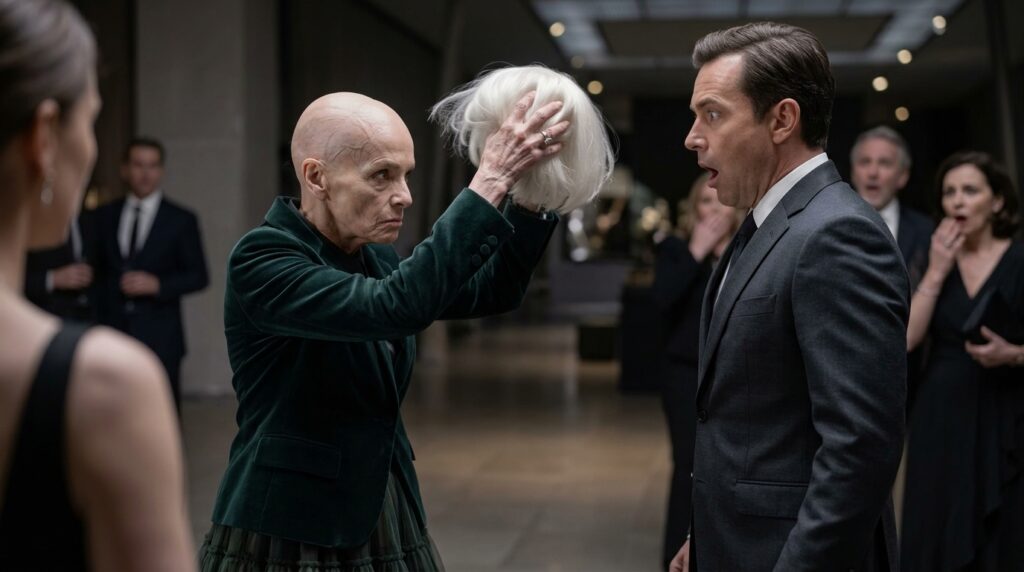
Then I reached for my wig.
Sabrina whispered something to Michael.
I lifted the silver hair away from my head.
Gasps exploded across the ballroom.
Someone dropped a fork.
Another guest whispered my name.
Cameras rose almost simultaneously, but I no longer cared whether anyone photographed the truth.
My scalp still showed irritated red lines where the razor had scraped too close.
Lucia had covered the worst cuts with makeup, although nothing could disguise what had been taken.
“This is what Sabrina did to me while I was unconscious,” I said.
Michael stared at my head as though he had never seen evidence of his fiancée’s cruelty before that moment.
Sabrina recovered faster.
“That is insane,” she said loudly.
Her voice carried beautifully across the room.
She had spent years mastering that voice.
It was the voice she used when insulting me before immediately claiming everyone had misunderstood.
“You shaved yourself,” Sabrina said, rising from her chair.
Several guests turned toward her.
“Why would I shave myself on my only son’s wedding morning?” I asked.
“For attention,” she replied.
The ease of her answer drew another murmur.
Michael finally stood.
“Mom, please put the wig back on,” he said.
Not please tell me who hurt you.
Not please explain what happened.
Put the wig back on.
I looked at the child whose scraped knees I had bandaged and whose tuition I had paid without ever mentioning the cost.
Something inside me finally broke cleanly instead of bending.
“No,” I said.
Michael’s jaw tightened.
“This is our wedding,” he whispered.
“And this is my body,” I answered.
The applause began somewhere near the back wall.
It started with one pair of hands, uncertain and brief.
Then another guest joined.
Sabrina looked around in disbelief as the sound spread through the room.
I raised one hand, and the applause faded.
“There is more,” I said.
Michael closed his eyes.
That reaction told me something before the next evidence ever left my purse.
Forty minutes earlier, during the cocktail hour, I had asked Sabrina to speak privately beside the closed terrace doors.
She arrived smiling because she believed I intended to discuss the transfer.
The recorder inside my purse had already been running.
I had asked whether she liked my hairstyle.
She laughed.
Then she leaned close enough for me to smell the same perfume that remained on the note.
“You should thank me,” she had whispered.
I had forced myself to remain expressionless.
“For what?” I asked.
“For making you presentable,” Sabrina replied.
I had asked whether Michael knew.
She glanced toward the ballroom before answering.
“He knows you needed a lesson.”
I pressed the recorder’s playback button.
Sabrina’s recorded voice filled the ballroom.
“You should thank me.”
The room froze.
Then my recorded voice asked, “For what?”
“For making you presentable.”
Sabrina lunged toward the podium.
Avery Whitman stepped between us before she reached me.
I had not noticed him enter from the side doors.
He wore a charcoal suit and carried the leather folder he reserved for serious meetings.
Sabrina stopped so abruptly that the skirt of her wedding gown swung forward.
“You recorded me without permission,” she snapped.
Avery did not react.
“This is not the moment for legal improvisation, Mrs. Langford,” he said.
The new surname sounded almost ironic.
Michael looked at Avery and immediately understood why my attorney had appeared at his wedding reception.
“Mom,” Michael said, “whatever you’re planning, don’t do it here.”
I studied his face.
His fear was not for me.
It was not even for his marriage.
It was financial.
“Were you aware Sabrina entered my home before dawn?” I asked.
Michael hesitated.
Sabrina turned sharply toward him.
That hesitation answered me.
My chest tightened anyway.
“I gave her the spare key,” he admitted.
The ballroom disappeared around me.
For one terrible instant, I was back in our old apartment after Richard died, holding Michael through another nightmare.
He had been twelve then.
He had trusted my arms more than walls.
Now the same child had handed another person a key to the bedroom where his widowed mother slept alone.
“Why?” I asked.
Michael swallowed.
“Sabrina wanted to talk to you before the wedding.”
“At five in the morning?”
“She said you would be awake.”
“I was not awake.”
“I didn’t know she would shave your head.”
Sabrina’s eyes flashed toward him.
Michael realized too late that his attempt to defend himself had placed her inside my house.
“You knew she planned something,” I said.
Michael looked at the floor.
“I thought it was a prank.”
The word hit the ballroom like broken glass.
I nodded slowly.
“A prank requiring access to my sleeping body.”
“That isn’t what I meant.”
“It rarely is.”
Sabrina folded her arms.
“This family has treated me like some gold digger since Michael proposed,” she said.
Nobody answered her.
“I have swallowed your judgment for two years, Beatrice.”
I almost admired the audacity.
“I paid for your engagement party,” I said.
“You controlled it.”
“I paid for this wedding.”
“You controlled that too.”
“I offered you twenty-two million dollars.”
“Because you wanted leverage.”
The accusation might have wounded me yesterday.
That morning, it sounded almost educational.
Sabrina had interpreted every gift through the same lens she used herself.
Money was not generosity to her.
Money was ownership.
“So you punished me?” I asked.
“I humbled you.”
Several guests audibly inhaled.
Michael grabbed Sabrina’s arm.
“Stop talking.”
She pulled away.
“No, Michael, I am tired of pretending she is some saint because she owns buildings.”
Avery glanced at me.
I understood the question in his eyes.
I nodded.
He opened his folder.
“The proposed twenty-two-million-dollar transfer was suspended at eight twelve this morning,” Avery announced.
Michael went pale.
Sabrina stared at him.
“What does suspended mean?” she demanded.
“It means nothing was transferred,” Avery said.
Sabrina blinked.
Then she laughed once.
It was not amusement.
It was disbelief.
“We already signed the penthouse contract,” she said.
Michael turned toward her.
“Sabrina.”
She ignored him.
“The deposit clears Monday.”
Michael’s face emptied.
“What deposit?”
Sabrina finally realized her mistake.
Nobody moved.
I lowered the microphone slightly.
“What penthouse?” I asked.
Michael stared at his new wife.
“I thought we were waiting until after the honeymoon.”
Sabrina’s eyes darted between us.
“We needed to move quickly.”
“Using what money?” Avery asked.
Sabrina said nothing.
Michael’s voice rose.
“Using what money?”
“The wedding gift.”
“You did not have the wedding gift.”
“We were going to.”
Michael actually laughed.
The sound was hollow.
“You signed something for millions because my mother said she planned to give us money?”
Sabrina stepped closer to him.
“You agreed we needed a real place.”
“I agreed after the transfer.”
“You said your mother never changes her mind.”
Michael looked at me.
Shame finally reached his face.
That sentence revealed more about our relationship than anything he could have confessed himself.
He had built plans around my inability to say no.
Avery removed another document.
“There is another problem,” he said.
Sabrina’s attention snapped toward him.
“At nine fourteen this morning, someone contacted Langford Capital’s private banking desk and asked whether the transfer could be expedited.”
I stared at Michael.
He shook his head immediately.
“That wasn’t me.”
Avery continued.
“The caller identified herself as Sabrina Langford.”
Sabrina’s mother whispered her daughter’s name.
“I was checking the timing,” Sabrina said.
“The representative told you the transfer had been frozen,” Avery replied.
Sabrina said nothing.
“You then asked whether Michael could authorize it instead.”
Michael looked physically ill.
“You called my mother’s bank during our wedding?”
“Our future depended on that money.”
“Our future?”
Sabrina lowered her voice.
“You wanted it too.”
Michael flinched.
She was right.
That truth mattered.
He had expected the money as confidently as she had.
The difference was that Sabrina had said the quiet part aloud.
I replaced the wig on my head because my scalp had begun to sting beneath the ballroom’s cold air.
Sabrina mistook the movement for weakness.
“See?” she said.
Everyone looked at her.
“She loves drama.”
I laughed.
For the first time that day, I genuinely laughed.
Sabrina’s expression hardened.
“You think this is funny?”
“No,” I said.
“I think I spent too many years afraid of people who became powerless the moment my wallet closed.”
Michael recoiled.
“Is that what I am to you?”
I faced him.
“No, Michael.”
My voice trembled for the first time.
“That is what I allowed myself to become to you.”
His anger faltered.
I stepped away from the podium.
The room watched us.
“I trained you to believe love arrived as checks.”
Michael looked down.
“I trained myself to believe your affection depended on writing them.”
“Mom.”
“I am sorry for that.”
The words surprised him.
They surprised me too.
“I am not sorry for stopping.”
Sabrina’s face twisted.
“So this whole spectacle is revenge.”
“No.”
I held up her note.
“This is consequence.”
A man near Sabrina’s family table began quietly gathering his coat.
Then another guest did the same.
Sabrina noticed.
“Sit down,” she snapped.
Nobody obeyed.
The illusion of her perfect wedding began collapsing without anyone needing to announce it.
Avery approached me and lowered his voice.
“There is one more issue.”
His tone changed the temperature inside my chest.
“What?”
He handed me his phone.
An email appeared on the screen.
The sender was my chief financial officer, Daniel Mercer.
I read it twice.
Then a third time.
At six thirty-seven that morning, somebody had attempted to access an archived authorization file containing samples of my electronic signature.
The request came through a guest account previously assigned to Michael.
My hand tightened around the phone.
Michael noticed.
“What happened?”
I showed Avery the screen.
He nodded grimly.
“We are still investigating.”
Sabrina moved toward us.
“What are you whispering about?”
Avery stepped aside.
“Michael, when did you last use your guest credentials at Langford headquarters?”
Michael frowned.
“Months ago.”
“Who else knows the password?”
“Nobody.”
Sabrina stared at the floor.
Michael saw it.
“Sabrina?”
She looked up.
“You gave it to me.”
“For restaurant reservations.”
“The passwords were saved on your tablet.”
Michael’s shoulders dropped.
“What did you do?”
“Nothing.”
Avery’s expression did not change.
“Then you will have no objection to preserving your devices.”
Sabrina laughed bitterly.
“You cannot take my phone.”
“Nobody said we would.”
Avery closed his folder.
“However, deleting relevant material after receiving notice may create additional problems.”
Sabrina looked at Michael.
He stepped away from her.
For the first time during their wedding, they stood like opponents.
Her mother came forward.
“Sabrina, tell me you did not touch Beatrice’s accounts.”
“I didn’t steal anything.”
Nobody had used the word steal.
Avery noticed.
So did I.
Michael covered his mouth.
Sabrina realized what she had said.
“I meant money,” she added quickly.
Her father’s face darkened.
“What did you access?”
Sabrina turned toward him.
“Dad, stay out of this.”
“You made it my business when you did this in front of three hundred people.”
“She did this,” Sabrina shouted, pointing toward me.
I almost pitied her.
Even now, she needed my reaction to be the crime.
The photographer lowered his camera.
The band had stopped playing entirely.
Staff members stood near the walls pretending not to listen.
Michael walked toward me.
His eyes were red.
“Did you cancel everything?”
“Yes.”
“The penthouse too?”
“I never bought you a penthouse.”
“You know what I mean.”
“I know exactly what you mean now.”
He looked away.
Sabrina came beside him.
“Tell her she cannot do this.”
Michael turned slowly.
“She can.”
Sabrina stared at him.
“It was promised.”
“It was never ours.”
I watched something shift inside Michael.
It was small and late, but it was real.
Perhaps hearing Sabrina claim ownership of my money finally forced him to hear his own assumptions.
She grabbed his sleeve.
“We signed contracts because of your mother.”
“You signed contracts.”
“For us.”
“Without telling me.”
“You would have agreed.”
“That is not consent.”
The irony was almost unbearable.
Sabrina heard it too.
Her eyes moved toward my covered head.
Michael followed her gaze.
His face collapsed.
He stepped toward me again.
“Mom, I swear I never told her to do that.”
“I believe you.”
Relief flickered across his face.
Then I continued.
“But you gave someone who despised me a key to my house.”
His relief disappeared.
“You knew she wanted to teach me a lesson.”
Michael’s eyes filled.
“You still opened the door.”
He could not answer.
I remembered every time he had watched Sabrina insult me.
Every laugh.
Every shrug.
Every request that I avoid making things awkward.
Silence had always been his method of opening doors.
Sabrina turned toward the exit.
Avery spoke before she reached it.
“Mrs. Langford.”
She stopped.
“Beatrice filed a police report this morning.”
Michael’s head jerked toward me.
Sabrina went motionless.
I had made the report from Lucia’s car before entering the church.
I had not wanted officers interrupting the ceremony.
That mercy suddenly felt excessive.
“The report includes photographs, the note, and information from the home security system,” Avery said.
Sabrina turned.
“What security system?”
For the first time all day, I saw genuine fear.
My house contained no cameras inside bedrooms.
It did contain entry sensors, exterior cameras, and electronic logs recording every use of every authorized key.
The system showed Michael’s spare key opening the side entrance at five twelve that morning.
A camera showed Sabrina arriving alone.
Another showed her leaving thirty-eight minutes later carrying a white cosmetic bag.
Sabrina stared at me.
“You had cameras?”
“Outside my home.”
Her lips parted.
The perfect bride disappeared.
A frightened woman remained.
Michael shook his head.
“Thirty-eight minutes?”
Sabrina looked at him.
“It did not take that long.”
The sentence escaped before she could stop it.
My stomach turned.
“What else did you do?” I asked.
Sabrina’s face hardened again.
“Nothing.”
“You were inside my house for thirty-eight minutes.”
“I looked around.”
“In my bedroom?”
She remained silent.
Avery’s phone vibrated.
He checked the screen.
His brows tightened.
“What?” I asked.
He looked at Sabrina.
“Daniel’s team found the archived access history.”
The ballroom seemed to contract.
Michael stepped closer.
“What did she access?”
Avery hesitated.
I told him to continue.
“The guest account opened folders containing Beatrice’s estate summary, trust schedules, and signature authorization procedures.”
My skin went cold.
Sabrina shook her head.
“That proves nothing.”
“No,” Avery said.
“It proves the files were opened.”
Michael stared at her.
“You were looking at my mother’s will?”
“I wanted to understand what we were dealing with.”
“What we were dealing with?”
Sabrina’s voice sharpened.
“Do you know how humiliating it is waiting for your mother to decide whether we deserve our own life?”
Michael took another step backward.
I almost laughed again.
Their own life had apparently required my properties, investments, and signature.
Sabrina saw the judgment around her.
Then her expression changed.
The anger vanished.
Tears appeared.
They came almost instantly.
She turned toward Michael.
“I did all of this because I was terrified.”
Michael said nothing.
“Your mother never accepted me.”
“I gave you twenty-two million dollars.”
“You offered it.”
“I paid for your wedding.”
“You wanted everyone to know.”
“I told nobody until today.”
Sabrina opened her mouth.
Nothing came.
Her tears continued anyway.
Michael looked exhausted rather than moved.
“Why were you in her estate files?”
“I wanted security.”
“You had me.”
“That is not security.”
The words struck him visibly.
Sabrina immediately regretted them.
I knew that expression because I had worn it myself after saying something true before I was ready to admit it.
Michael removed his wedding ring.
A ripple moved through the guests.
Sabrina stared at his hand.
“What are you doing?”
“I don’t know.”
“Put it back.”
He closed his fingers around the ring.
“We have been married for six hours.”
“Exactly.”
“And I already don’t know what you did this morning.”
“You are choosing her.”
“No.”
Michael looked at me.
“For once, I am choosing to look.”
I felt no triumph.
Only grief.
Some victories arrive wearing the face of everything you wished had never needed to happen.
Sabrina’s father approached her.
“We are leaving.”
She snapped toward him.
“I am not going anywhere.”
“Yes, you are.”
“This is my reception.”
“Not anymore.”
He looked toward me.
“I am sorry, Beatrice.”
I nodded.
An apology from him could not restore my hair, but it did prove Sabrina’s cruelty was no longer invisible.
Sabrina gathered her gown and moved toward Michael.
“You promised me forever.”
He flinched.
“You promised me honesty.”
“I made one mistake.”
I looked at the note.
Michael looked at my scalp.
Avery looked at the financial records.
Nobody needed to answer.
Sabrina’s mother began crying quietly.
Her father guided her toward the doors.
Sabrina pulled away before reaching them.
She turned back toward me.
“This is not over.”
I met her stare.
“No.”
I touched the wig covering my head.
“It is finally beginning.”
The doors closed behind her.
Nobody applauded.
I was grateful.
This was not entertainment.
It was the public collapse of lies that had been privately poisoning my family for years.
Michael remained beneath the chandeliers with his wedding ring clenched inside his fist.
Guests began leaving quietly.
Some hugged me.
Some avoided my eyes.
A few people whispered congratulations as though canceling twenty-two million dollars were my greatest achievement.
It was not.
My greatest achievement that morning had been believing myself.
Lucia appeared beside me carrying my coat.
“You ready?” she asked.
“Yes.”
Michael stepped forward.
“Mom, can I come with you?”
I looked at him.
The boy I remembered was gone.
The man before me looked frightened, ashamed, and suddenly much younger.
“No,” I said.
His face fell.
“Avery and I have work tonight.”
“What kind of work?”
“The kind I should have done years ago.”
He nodded slowly.
Then he reached toward me.
I stepped back.
His hand stopped in midair.
That hurt both of us.
I could see it.
But boundaries often resemble cruelty to people who benefited from their absence.
“I love you,” Michael whispered.
The words nearly destroyed my resolve.
I had waited years to hear them without a request following.
“I love you too,” I said.
His eyes lifted.
“That does not erase today.”
He nodded.
I turned away before maternal instinct could negotiate with pain.
Avery, Lucia, and I left through the ballroom’s side entrance.
Cold Boston air struck my face.
For once, I welcomed it.
The city moved around us as though nothing had happened.
Cars passed.
Church bells rang somewhere beyond the buildings.
Pedestrians hurried beneath coats and scarves.
I had spent decades believing my private suffering could destroy the world.
The world had survived Richard’s death.
It had survived my poverty.
It had survived loneliness.
It would survive my son’s anger.
So would I.
At my house, Avery opened his laptop at the dining room table.
Lucia made coffee.
I removed my wig and placed it beside Richard’s old photograph.
He smiled from the frame with the same quiet confidence I remembered.
“I finally made a mess,” I told him.
Lucia laughed softly.
Avery almost smiled.
Then his phone rang.
He answered.
The expression on his face changed before he spoke.
“Send everything securely,” he said.
He listened for another minute.
Then he ended the call.
“What happened?” I asked.
Avery looked at me.
“Daniel recovered a deleted document from the guest account.”
My stomach tightened.
“What document?”
“A draft authorization bearing your name.”
I felt the room tilt again.
Avery turned his laptop toward me.
The document authorized temporary financial control over several Langford family accounts during my supposed incapacity.
My signature appeared at the bottom.
I had never signed it.
Lucia whispered, “Oh my God.”
I stared at the forged signature.
Above it sat a date.
Tomorrow.
Michael’s wedding had never been the end of Sabrina’s plan.
It had only been the first step.
PART 3
For several seconds, I heard nothing except the refrigerator humming beyond the dining room and the blood pounding inside my ears.
Avery enlarged the document.
My forged signature looked disturbingly convincing.
Whoever created it had copied the slight upward stroke I made when finishing the final letter of Langford.
“What exactly would this have done?” I asked.
Avery leaned back.
“Nothing by itself.”
I waited.
“But combined with supporting documents, it could have been presented as evidence that you voluntarily delegated temporary authority.”
“To whom?”
He scrolled upward.
My stomach dropped.
Michael Langford.
Lucia sat beside me.
“Does Michael know?”
“I don’t know,” Avery said.
That answer hurt worse than certainty.
My son’s name sat on the document like a knife left deliberately on a table.
I wanted to call him immediately.
Avery stopped me.
“Let Daniel finish tracing the file history first.”
I hated the advice.
I followed it anyway.
Waiting had always been difficult for me because action was how I survived fear.
After Richard died, grief gave me problems I could solve with invoices, contracts, and impossible working hours.
This was different.
No amount of work could make betrayal less intimate.
Avery downloaded the metadata.
The draft had been created three weeks earlier.
The author field contained no recognizable name.
It had been edited repeatedly through Michael’s guest account.
The final revision occurred at five twenty-nine that morning.
Sabrina had entered my house at five twelve.
I closed my eyes.
Seventeen minutes after entering, she had opened a forged document designed to place my finances under my son’s authority.
The timing was too precise to dismiss.
My phone rang.
Michael.
His name glowed across the screen.
I stared until the ringing stopped.
It began again seconds later.
Avery said nothing.
On the third call, I answered.
“Mom.”
Michael sounded breathless.
“Where are you?”
“At home.”
“I need to see you.”
“Why?”
A pause followed.
“Because Sabrina disappeared.”
I opened my eyes.
“What do you mean?”
“She left the hotel after her parents took her upstairs.”
“Did you call her?”
“She blocked me.”
I looked at Avery.
He was already opening another screen.
“Michael, did Sabrina ever discuss my estate documents with you?”
Silence answered.
My hand tightened around the phone.
“Michael.”
“She asked questions.”
“What questions?”
“About trusts.”
My stomach hardened.
“What else?”
“She wanted to know who controlled things if you got sick.”
Lucia closed her eyes.
Avery began taking notes.
“What did you tell her?”
“I said Avery probably handled everything.”
“That is not an answer.”
Michael exhaled shakily.
“I told her I had emergency authority for some properties.”
He was correct.
Years earlier, I had granted him limited emergency powers concerning maintenance decisions after an accident hospitalized me briefly.
Those powers never included personal accounts.
They never included estate control.
“Did you give her my signature?”
“No.”
“Did you help create a document transferring control to yourself?”
“What?”
His shock sounded genuine.
I wanted desperately to believe it.
Avery watched my face.
“There is a forged authorization with your name on it,” I said.
Michael stopped breathing for a moment.
Then he whispered Sabrina’s name.
“Come here,” I told him.
He arrived seventeen minutes later.
He entered without using his key.
That detail mattered to me.
Michael rang the bell.
I opened the door.
His tuxedo jacket was gone, and his white shirt hung partly untucked beneath an abandoned bow tie.
He looked like a groom after a disaster because that was exactly what he was.
His eyes moved immediately toward my bare head.
He flinched.
I did not cover it.
“Dining room,” I said.
Michael followed me.
Avery rotated the laptop toward him.
Michael read the document.
His face lost color.
“I never signed this.”
“You are not listed as signing,” Avery said.
“You are listed as recipient of authority.”
Michael looked at me.
“I swear I did not know.”
I believed that he believed what he was saying.
That was not enough.
“Did Sabrina know your guest password?” Avery asked.
“Yes.”
“Did you know she accessed Beatrice’s financial materials?”
“No.”
“Did you tell her where those materials were located?”
Michael rubbed both hands across his face.
“Maybe indirectly.”
My chest tightened.
“How do you indirectly tell someone where financial records are?”
“She kept asking questions about the company.”
“What questions?”
“Where records were stored, what happened if you died, how trusts worked.”
“And that did not concern you?”
He looked ashamed.
“I thought she wanted to understand the family.”
“You mean the money.”
He did not argue.
Avery asked whether Sabrina had ever used Michael’s tablet without him present.
Michael laughed bitterly.
“Constantly.”
“Did it contain saved passwords?”
“Yes.”
“Did it contain access to your email?”
“Yes.”
“Financial accounts?”
“Yes.”
Avery stared at him.
“Michael, change every password you have immediately.”
Michael reached for his phone.
Then he froze.
“What?”
His face changed.
“Our joint account.”
Avery leaned forward.
“What about it?”
“We opened one for wedding expenses.”
“How much is inside?”
“About six hundred thousand.”
Lucia nearly dropped her cup.
“That was from gifts and some of my savings,” Michael said.
He opened his banking application.
The room went silent.
His face answered before he spoke.
“It’s gone.”
“How much?” Avery asked.
“Five hundred eighty-four thousand.”
“Transferred where?”
Michael scrolled.
“I don’t recognize the destination.”
Avery moved beside him.
“Call the bank.”
Michael did.
His voice shook while he confirmed security information.
The bank representative placed him on hold.
I watched my son sit at the table where he had once done homework while visiting me between college semesters.
He suddenly looked nothing like the entitled man from the reception.
He looked terrified.
The representative returned.
Michael listened.
“When?” he asked.
His eyes lifted toward me.
“Today?”
Another pause followed.
“What time?”
Michael closed his eyes.
He ended the call several minutes later.
“The transfer was initiated at five forty-one this morning.”
Nobody spoke.
Twelve minutes after the forged authorization’s final revision.
Sabrina had shaved my head, accessed financial records, altered a forged document, and moved money from her joint account before leaving my house.
The cruelty had not been the plan.
It had been camouflage.
“She wanted everyone focused on my hair,” I said.
Avery nodded slowly.
“She may have expected chaos.”
Michael looked sick.
“She knew Mom would call me.”
I looked at him.
“And what would you have done?”
He did not answer immediately.
Then he did.
“I would have defended Sabrina.”
The truth entered quietly.
That made it worse.
Michael lowered his eyes.
“She knew that too.”
For once, nobody rescued him from his shame.
Avery contacted the bank’s fraud department while Michael changed passwords.
I sat beside Richard’s photograph.
I kept thinking about Sabrina standing above my sleeping body.
She had held a razor near my skin.
She had done it while stealing access to my family’s financial life.
I had mistaken her cruelty for arrogance.
It had also been strategy.
My humiliation was supposed to become noise.
She wanted me emotional.
She wanted Michael angry at me.
She wanted everyone distracted until the transfer arrived and the forged paperwork became useful.
Then a message appeared on Michael’s phone.
Sabrina.
His hands shook.
“What does it say?” I asked.
He read it silently first.
Then he handed me the phone.
“I did everything for us, and your mother ruined it again.”
Another message appeared.
“You know where your loyalty belongs.”
Michael stared at those words.
Something inside him seemed to die.
He typed a response.
Avery stopped him.
“Do not threaten, accuse, or warn her about what we discovered.”
Michael deleted his draft.
“What do I say?”
“Ask whether she is safe.”
Michael looked furious.
“That’s it?”
“That’s it.”
He sent the message.
Sabrina replied almost immediately.
“I’m safe when nobody controls me.”
Avery photographed the exchange.
Michael looked at me.
“I married someone I don’t know.”
I answered carefully.
“You knew parts of her.”
He looked wounded.
“You chose not to examine them.”
His eyes filled.
I felt the familiar urge to soften everything.
I resisted.
Love without truth had nearly destroyed both of us.
“What do I do now?” he asked.
The question reminded me of twelve-year-old Michael after Richard’s funeral.
Back then, I always had an answer.
This time, he needed his own.
“You decide what kind of man you want to be when nobody pays you for choosing correctly.”
He nodded.
Avery’s phone rang again.
Boston police had located Sabrina’s car at Logan Airport.
She had not boarded a flight.
Airport footage showed her entering a parking structure and leaving in a rideshare.
The destination was unknown.
Michael looked frightened.
“Could she come back here?”
My security system was already being reset.
Every access code linked to Michael had been disabled.
He accepted that without complaint.
At midnight, Avery and I began rewriting my estate plan.
Michael remained in the living room.
He did not ask what he would inherit.
That was new.
I changed the structure carefully rather than angrily.
My companies would remain professionally managed.
Longtime employees would receive expanded protections.
Several properties would fund affordable housing and educational grants.
Michael would no longer receive unrestricted control merely because he was my son.
His future inheritance would be placed within an independently managed trust.
The amount was still significant.
The conditions were no longer sentimental.
Michael would have income.
He would not have authority over my life.
Most importantly, nobody could treat my death like a business opportunity.
At one thirty, Michael entered the dining room.
“I need to tell you something.”
Avery looked at me.
I nodded.
Michael sat across from us.
“Six months ago, Sabrina asked whether you had ever been evaluated for memory problems.”
My stomach turned.
“Why?”
“She said rich families usually plan for cognitive decline.”
Avery’s face hardened.
“What did you say?”
“I told her your memory was better than mine.”
Despite everything, Lucia laughed from the kitchen.
Michael did not.
“She asked whether I could become your power of attorney if something happened.”
Avery wrote quickly.
“Did she define something?”
“No.”
“Did she ever suggest something was already wrong with Beatrice?”
Michael hesitated.
“Once.”
I felt cold.
“What did she say?”
“She said you repeated stories.”
I stared at him.
“Did you believe her?”
“No.”
“Did you correct her?”
Michael looked down.
“No.”
That silence hurt almost as much as the key.
“Why?”
“I was tired of fighting.”
“You never fought.”
His eyes snapped upward.
I had never said that aloud.
He absorbed it silently.
“You called neutrality peace because I was the person paying its price,” I said.
Michael began crying.
Not dramatically.
Not loudly.
Tears simply moved down his face while he stared at the table.
“I am sorry.”
I wanted to hold him.
I remained seated.
“I believe you are sorry tonight.”
He understood.
“That does not mean you will be different tomorrow.”
“I know.”
“Prove it to yourself before asking me to believe it.”
He nodded.
At two fifteen, the police called again.
Sabrina had been found at a friend’s apartment in Cambridge.
She was not arrested immediately.
Investigators wanted statements, digital records, and confirmation regarding the financial transfer.
Michael gave permission for investigators to access the joint account documentation.
Then he removed his wedding ring completely.
He placed it on the table.
“I want an annulment.”
Avery shook his head slightly.
“Family counsel will explain your options tomorrow.”
Michael nodded.
“I don’t care what it is called.”
His voice cracked.
“I cannot stay married to her.”
I looked at the ring.
Hours earlier, it symbolized the family I feared losing.
Now it looked like a small circle of metal.
That realization freed me more than I expected.
By four in the morning, Avery finally closed his laptop.
My new estate documents were drafted but not signed.
I wanted daylight before making permanent decisions.
For once, urgency would not make choices for me.
Michael slept on the sofa.
I remained awake.
At sunrise, I walked into my bathroom.
Sabrina’s note still rested where I had left it.
Evidence photographs had already been taken.
I lifted the paper.
The little heart looked ridiculous now.
I tore nothing.
Destroying evidence would serve only emotion.
Instead, I placed it inside a clear folder.
Then I faced my reflection.
My scalp looked bruised.
A few silver fragments remained behind my left ear.
I touched them gently.
Yesterday, I would have hidden.
That morning, I opened the curtains.
Sunlight filled the room.
My doorbell rang shortly after eight.
Lucia arrived carrying breakfast and three different wigs.
I laughed when I saw them.
“No.”
She stopped.
“No wig?”
“Not today.”
Lucia studied me.
Then she smiled.
“Good.”
I showered carefully.
I dressed in a cream blouse, dark trousers, and Richard’s old watch.
When Michael woke, he stared at my uncovered head.
“You’re going out like that?”
The question sounded automatic.
His face changed immediately.
“I’m sorry.”
I smiled faintly.
“Growth may be painful for both of us.”
He almost smiled back.
Avery returned at nine.
With him came Daniel Mercer, my chief financial officer.
Daniel had worked beside me for fourteen years.
He looked furious.
“I found something else.”
Michael straightened.
Daniel opened a laptop.
The forged authorization had not originated from Michael’s device.
It had first been created on an account linked to Sabrina.
That account belonged to a consulting company formed eight months earlier.
The company’s registered address led to a mailbox.
Its bank records were not ours to access.
However, its name appeared elsewhere.
A real estate broker had emailed Langford Capital two weeks earlier requesting proof of funds for a luxury Boston penthouse.
The broker referenced the consulting company as Sabrina’s purchasing entity.
Michael stared at the screen.
“She was buying it herself?”
“That is how the email reads,” Daniel said.
I looked at him.
“Not jointly?”
Daniel shook his head.
“Michael’s name does not appear.”
Michael stopped moving.
The room became painfully quiet.
Sabrina had told him the penthouse was theirs.
On paper, it belonged only to her company.
Michael laughed once.
It sounded like something breaking.
“She was stealing from me too.”
Nobody corrected him.
The realization mattered more than terminology.
Daniel opened another document.
The penthouse deposit exceeded four million dollars.
The six hundred thousand from their joint account covered only part of the initial requirement.
The remaining amount was expected from my wedding gift.
Sabrina had arranged bridge financing contingent upon proof of incoming funds.
Michael looked at me.
“What happens now?”
“Her contract is her problem,” I said.
The answer felt extraordinary.
For years, every problem touching Michael had automatically become mine.
Not anymore.
Daniel had one final discovery.
An email from Sabrina’s consultant referenced a planned transfer of several million dollars overseas after the expected wedding funds cleared.
Avery immediately contacted investigators.
Michael stood and walked outside.
I watched him through the window.
He sat on the garden wall Richard had built decades earlier.
His shoulders shook.
I wanted to follow him.
Instead, I waited.
Ten minutes later, he returned by himself.
His eyes were swollen.
“I need a job.”
I blinked.
Daniel looked at me.
Michael continued before anyone answered.
“A real one.”
“You have a title at Langford Holdings,” I said.
“I have a title you gave me.”
That was true.
“I show up to meetings, pretend to understand reports, and receive more money than most employees.”
Daniel wisely remained silent.
Michael looked ashamed.
“I want to know whether I can actually do anything.”
I studied him.
“Why now?”
“Because everything I thought belonged to me never did.”
I understood that sentence.
It described more than money.
It described maturity.
“You may apply,” I said.
Michael looked surprised.
“Apply?”
“Yes.”
“To your company?”
“To a position.”
“What position?”
“Property operations coordinator.”
Daniel nearly smiled.
Michael knew exactly what that meant.
It was an entry-level management role involving tenant calls, contractors, inspections, and emergency maintenance.
The salary was less than he spent yearly on restaurants.
“Fine,” he said.
“You have not been hired.”
Michael nodded.
“Right.”
“You will interview with Daniel’s team.”
“Okay.”
“They can reject you.”
His mouth tightened.
Then he nodded again.
“Okay.”
For the first time, I saw him confronting a door my money could not automatically open.
I hoped someone made him knock.
The following weeks were brutal.
Sabrina denied forging anything.
She claimed Michael had authorized her financial research.
Michael denied that accusation through counsel.
Digital records became increasingly important.
The police recovered Sabrina’s cosmetic bag from her friend’s apartment.
Inside were disposable razors matching the irritation patterns photographed on my scalp.
They also found the perfume bottle I recognized.
Neither item alone proved everything.
Together with the entry logs, recording, note, and financial records, they created a much clearer picture.
Then the most unexpected evidence came from Sabrina’s maid of honor.
Her name was Celeste.
I barely knew her.
She contacted Avery through her own attorney.
Sabrina had sent videos to a private bridesmaids’ group the morning of the wedding.
Celeste had saved one before Sabrina deleted the thread.
Avery showed it to me privately.
I nearly refused to watch.
Then I decided Sabrina would no longer control what I could face.
The video showed my bedroom.
My stomach turned immediately.
Sabrina stood beside my sleeping body holding her phone toward the mirror.
My hair still covered the pillow.
She whispered into the camera.
“Last chance to see the queen before retirement.”
Laughter came from someone receiving the livestream.
Then the video cut.
Another clip began minutes later.
My head was partly shaved.
Sabrina smiled into the camera.
“Twenty-two million buys a lot of forgiveness.”
I stopped the video.
My hands shook.
Avery closed the laptop.
I went outside and vomited into the rose bushes.
Humiliation returned like fever.
For several minutes, I was no longer composed.
I screamed.
I cried.
I cursed Sabrina.
I cursed Michael.
I cursed myself for ever confusing generosity with protection.
Lucia found me sitting on the garden steps.
She did not tell me to be strong.
She sat beside me.
“I hate that people saw me like that,” I whispered.
Lucia took my hand.
“They saw her.”
I looked at her.
“Not you.”
I remembered those words.
They became important later.
The evidence altered everything.
Sabrina’s attorneys stopped calling the incident a misunderstanding.
The financial investigation continued separately.
The wedding vanished from society pages almost immediately.
I refused every interview request.
Reporters waited outside Langford headquarters for three days.
I used the garage entrance.
Not because I was ashamed.
Because I refused to let strangers own my recovery.
Michael interviewed for the coordinator position.
Daniel rejected him.
When Michael told me, I almost intervened.
Old habits are astonishingly persistent.
I forced myself to ask why.
“He wasn’t prepared,” Daniel said.
Michael had failed basic questions concerning leases, building systems, and operating expenses.
Six months earlier, I would have ordered Daniel to create something easier.
Instead, I told Michael to study.
He did.
Three weeks later, he interviewed again.
This time, Daniel hired him.
Michael started at eight every morning.
Nobody called him Mr. Langford.
His supervisor was a woman named Priya who had worked for us nine years.
She gave him no special treatment.
He hated the first month.
I knew because he told me.
He also stayed.
That mattered.
Sabrina’s marriage to Michael ended quickly.
Their lawyers negotiated the separation while investigators examined the financial activity.
The penthouse deal collapsed.
The developer retained part of the deposit under the contract.
Michael recovered only a portion of the joint funds after months of disputes.
I gave him nothing to replace what he lost.
He never asked.
That mattered more.
The criminal proceedings concerning the assault and financial records moved slower than anyone wanted.
Eventually, Sabrina accepted responsibility for unlawfully entering my home and assaulting me.
The financial allegations produced separate consequences involving restitution, restrictions, and a lengthy negotiated resolution.
I did not attend every hearing.
Justice did not require my constant presence.
At sentencing, Sabrina requested permission to address me.
I almost declined.
Then I agreed.
She stood several yards away.
Without the wedding gown and perfect makeup, she looked smaller than I remembered.
“I hated you,” she said.
The judge watched silently.
“Not because you were cruel.”
Sabrina swallowed.
“Because Michael always acted like your money could solve anything.”
I listened.
“I thought if I controlled the money, I controlled our future.”
Her eyes filled.
“That morning, I wanted you frightened.”
She looked at my short regrown hair.
“I wanted you humiliated.”
There was no excuse hidden inside her words.
That was why I believed them.
“I am sorry,” she finished.
Everyone waited for me.
I stood.
“I believe you are sorry about what happened afterward.”
Sabrina flinched.
“I hope someday you become sorry for the person you chose to be before consequences arrived.”
I sat down.
I did not forgive her.
I did not hate her either.
Both emotions required more space inside me than I wanted to give.
Months passed.
My hair grew slowly.
At first, it returned like silver dust.
Then soft curls appeared.
Lucia celebrated every centimeter.
I stopped measuring.
Something else had begun growing faster.
Peace.
I slept with my bedroom door unlocked again.
Not because I had forgotten.
Because fear no longer deserved permanent residence.
Michael and I rebuilt differently.
He no longer called every time something went wrong.
I no longer solved everything before he finished explaining.
Sometimes he came for dinner.
Sometimes we argued.
Sometimes he apologized without using the word but.
That word had ruined many apologies between us.
One evening, he brought an old photograph.
Richard stood beside me outside our first duplex.
I was thirty-four.
My hair was dark.
My coat was cheap.
My smile looked exhausted.
Michael placed the photograph on the table.
“I never understood this picture.”
“What do you mean?”
“I thought you looked happy because we finally had money.”
I laughed softly.
“We had almost none.”
He nodded.
“I know that now.”
He had been reading the old company records.
Not for inheritance planning.
For work.
“You built everything while raising me.”
“Yes.”
“I acted like it just existed.”
“Yes.”
He winced.
I did not soften the answer.
Then he surprised me.
“Thank you.”
Two words.
No request followed.
I cried afterward.
Not in front of him.
Some tenderness remains private even after fear leaves.
A year after the wedding, Langford Holdings completed a development in Roxbury.
The project included mixed-income apartments and a childcare center.
Years earlier, I would have named the building after Michael.
Instead, I created something broader.
The Richard Langford Home Fund began with twenty-two million dollars.
Exactly twenty-two million.
The money Sabrina expected became permanent capital supporting widowed parents, displaced families, and emergency housing assistance.
Avery asked whether I chose the amount deliberately.
“Of course.”
Some numbers deserve better stories.
At the groundbreaking ceremony, reporters attended.
I almost wore a wig from habit.
Lucia threatened to disown me professionally.
My natural hair had grown into short silver curls.
I left them uncovered.
Michael stood several rows behind me wearing a company jacket instead of a tailored Italian suit.
He had dirt on one sleeve.
Priya had sent him to inspect a plumbing issue before the ceremony.
I loved him more for arriving dirty than I had ever loved him arriving polished.
When I approached the microphone, cameras lifted.
For a moment, I remembered the wedding ballroom.
The lights.
The whispers.
Sabrina’s white dress.
The note.
The razor marks.
Then the memory passed.
I looked at the families standing beside the construction site.
“This fund exists because homes should create safety,” I said.
My voice remained steady.
“Money can buy buildings.”
“It cannot purchase loyalty.”
“It cannot manufacture love.”
“And it should never become permission for someone to surrender dignity.”
Michael lowered his head.
Then he looked back at me.
I continued.
“For many years, I believed giving people whatever they wanted was the same thing as loving them.”
“It was not.”
“Love sometimes gives.”
“Love sometimes refuses.”
“Love sometimes closes the door.”
“And sometimes love changes the locks.”
The crowd laughed.
So did Michael.
After the ceremony, a young reporter approached me.
She looked nervous.
“Mrs. Langford, may I ask about your hair?”
I almost said no.
Then I smiled.
“You may.”
“Do you regret revealing what happened publicly?”
I looked toward Michael.
He was helping Priya carry rolled construction plans toward a trailer.
“No.”
“Why?”
“Because shame survives when the wrong person carries it.”
The reporter lowered her pen for a moment.
I touched the short silver curls above my ear.
“They shaved my hair.”
“They did not shave away my judgment.”
“They did not shave away my work.”
“They did not shave away my name.”
“And they certainly did not shave away twenty-two million dollars.”
The reporter laughed.
So did I.
That evening, Michael came to my house carrying groceries.
“I’m cooking,” he announced.
I inspected the bags.
“You bought canned tomato sauce.”
His face fell.
“You still have much to learn.”
We cooked together anyway.
He burned the garlic.
I criticized his knife technique.
He complained that Priya had assigned him two Saturday inspections.
I told him Saturdays were traditional in real estate.
He accused me of inventing traditions.
For the first time in years, our conversation contained no money.
After dinner, Michael stood near Richard’s photograph.
“Do you think Dad would hate me?”
The question stunned me.
I placed my glass down.
“No.”
Michael looked relieved.
Then I continued.
“He would have expected better from you.”
Michael nodded.
“That sounds worse.”
“It probably is.”
We both laughed.
Then his expression became serious.
“Do you trust me again?”
I thought carefully.
“Not completely.”
He accepted the answer.
“Will you?”
“I don’t know.”
He nodded.
The old Michael would have demanded reassurance.
This one remained quiet.
I touched his arm.
“Trust is not a wedding gift.”
He looked at me.
“You do not receive it because somebody loves you.”
“You build it.”
“I’m trying.”
“I know.”
That was enough for both of us.
Before leaving, Michael handed me his old spare key.
I looked at it in his palm.
“The locks were changed.”
“I know.”
“Then why give me this?”
“Because it was never mine to give away.”
I closed my fingers around the useless key.
That gesture meant more than any apology he had offered.
After he left, I carried the key upstairs.
I placed it beside Sabrina’s note inside the evidence box.
One object represented access taken for granted.
The other represented cruelty disguised as humor.
Neither controlled my future anymore.
I walked into the bathroom.
The same mirror remained above the sink.
For months, I had considered replacing it.
I never did.
I wanted the mirror to stay.
Not as a memorial to what Sabrina did.
As evidence of what failed.
I stood before it and studied the woman looking back.
She was older than the widow who once skipped meals to keep her son comfortable.
She was softer in some places.
Harder in others.
Her hair was shorter.
Her eyes were clearer.
I thought about the ivory envelope once waiting inside my safe.
Twenty-two million dollars had almost become another apology.
Instead, it became apartments, childcare, emergency rent, and hundreds of second chances.
I thought about Michael.
He had lost a wife.
He had lost money.
He had lost access to a future he believed was guaranteed.
Then, slowly, he began finding himself.
I thought about Sabrina.
Her punishment was never losing twenty-two million dollars.
She had never owned it.
Her real loss was discovering that humiliation could not create control once its victim stopped cooperating.
I switched off the bathroom light.
Before leaving, I glanced once more at my reflection.
That wedding morning, Sabrina believed shaving my head would make me feel powerless.
For several minutes, she succeeded.
Then I opened my safe.
I canceled a transfer.
I raised my voice.
I told the truth.
And for the first time in years, I stopped confusing fear with love.
My hair eventually grew back.
My old life never did.
I am grateful for that.
Because the woman who entered that bathroom expected to lose her son if she stopped paying for his happiness.
The woman who walked out eventually learned something far more valuable.
Anyone who requires your silence as the price of staying never truly stayed beside you.
And twenty-two million dollars could not have taught me that lesson better than one stolen head of silver hair.
Sabrina thought she had shaved away my dignity before becoming my daughter-in-law.
Instead, she shaved away the last excuse I had for surrendering it.





