My Twin Sister Arrived Bruised and Terrified, So We Switched Places—and Her Husband’s Secrets Finally Came to Light
My twin sister came to visit me at night, her face covered in bruises.
After learning that her husband had done it, we decided to switch places and teach him a lesson he’d never forget. 😊😨
It was raining again outside.
It had been pouring for several days now, making everything around me feel gray and sticky.
I sat in the kitchen, mechanically stirring my long-cold tea and thinking of anything to escape that nagging unease.
The doorbell rang unexpectedly.
The cat twitched and jumped off the windowsill.
I immediately tensed.
No one comes to me at this hour without a reason.
I looked through the peephole and froze.
Emma was standing on the landing.
My sister.
Her hair was wet, her raincoat thrown hastily over her housedress, her face pale.
Even through the cloudy glass, it was clear something bad had happened.
I opened the door.
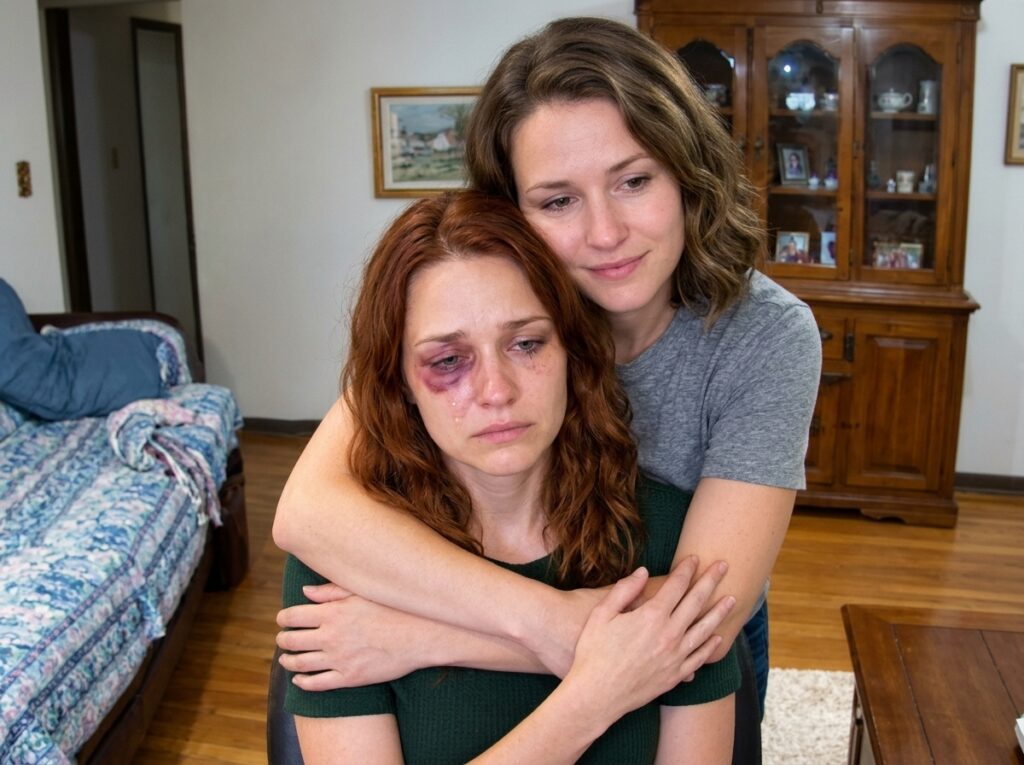
When she stepped into the apartment, the light fell on her face, and my stomach sank.
One eye was barely open, a dark bruise spreading around it.
There was a fresh cut on her cheek, and her lips were cracked.
She was trying to hold on, but it was difficult.
I helped her take off her coat and only then noticed her hands.
Her wrists were bruised, as if someone had squeezed them and wouldn’t let go.
An all-too-familiar sight.
“Is that him?” I asked quietly.
“Your husband?”
Emma looked at me.
There was weariness and pain in her gaze, a look that made me want to turn away.
We were twins, and I knew that face all too well.
Seeing it like that was especially hard.
We had always been almost identical.
With age, small differences had appeared, but to strangers, we were still like reflections in a mirror.
People confused us in stores, on the street; even old acquaintances sometimes made mistakes.
And just then, a thought popped into my head that made me feel uneasy.
Dangerous, wrong, but surprisingly clear.
What if we switch places?
What if I’m in his place?
What if this time her husband encounters not a frightened woman, but someone who isn’t afraid of him at all?
I looked at Emma and realized she was thinking the same thing.
The decision was made without further ado.
Emma’s fingers closed around my wrist.
“Wait.”
Her voice was barely louder than the rain tapping against the kitchen window.
I stopped halfway toward the bedroom.
“What?”
She glanced at the front door, then at the phone lying beside my untouched tea.
“He checks everything,” she whispered. “My messages. My calls. Sometimes he drives past places I’ve told him I’m going.”
“Then he won’t know you’re here.”
“You don’t understand.”
She pulled her hand away and folded both arms across herself. The movement made her wince.
“He doesn’t just get angry. He makes people believe I deserve it.”
For the first time that evening, I saw something worse than the bruises.
I saw how carefully my sister had learned to measure every word.
I sat down across from her.
“Tell me what happened tonight.”
Emma stared at the steam rising from the fresh cup I had placed in front of her.
“He found a receipt.”
“What receipt?”
“From the bank. I went there yesterday.”
“Why?”
Her lips trembled.
“I wanted to open an account in my own name.”
I waited.
“He said married people shouldn’t keep secrets. He asked whether I was planning to leave him.”
“And you said?”
“Nothing.”
She looked up.
“That was enough.”
The refrigerator hummed behind us. Somewhere upstairs, a chair scraped across the floor.
I wanted to ask how long this had been happening. I wanted to know why she had hidden it, why I had believed her explanations about clumsiness and migraines and canceled visits.
But the questions suddenly felt cruel.
Instead, I reached across the table.
“You’re not going back tonight.”
Emma shook her head.
“He’ll come looking.”
“Then we’ll make sure you’re somewhere he can’t reach.”
Her expression changed.
“But the plan—”
“We’re still going to find out what he’s hiding,” I said. “But I’m not walking into that house without a way out, and you’re not sitting here waiting for him to discover you.”
For several seconds, she studied my face.
Then she nodded.
We had spent our childhood trading places for harmless reasons. School photographs. Birthday surprises. Once, when we were twelve, I had taken a piano lesson for Emma because she was terrified of disappointing our teacher.
This was different.
The thought of wearing her clothes and entering her marriage made my skin feel cold.
I called a domestic violence hotline while Emma sat beside me. The advocate listened without interrupting. She explained how dangerous confrontations could become when an abusive partner believed he was losing control.
She helped us think through a safety plan, preserving evidence, emergency contacts, and a safe place for Emma to stay.
When I hung up, I looked at my sister.
“We can stop.”
Emma stared at the table.
Then she said something I will never forget.
“I’ve been stopping myself for six years.”
Her husband was named Daniel.
When Emma first introduced us, he had been charming in the effortless way that makes people feel chosen. He remembered birthdays, brought flowers to family dinners, and always seemed to know when someone needed help carrying groceries or fixing a broken appliance.
At their wedding, he cried during his vows.
I remembered teasing Emma afterward.
“You found yourself a movie husband.”
She had laughed.
Now, sitting beneath the harsh kitchen light, she said, “He was wonderful until I started saying no.”
The words settled between us.
She told me about the little things first.
The clothes he disliked.
The friends who supposedly disrespected him.
The way he corrected her stories at dinner.
How he would take her phone during arguments and return it only when she apologized.
Then came the money.
Her paycheck went into their joint account. Daniel handled the bills. Whenever she asked to see statements, he told her she was terrible with numbers.
“He says we barely have enough,” she whispered. “But he bought himself another expensive watch last month.”
“Have you seen the accounts?”
“No.”
“Do you have access to your documents?”
“Some.”
Her gaze shifted toward the window.
“There’s a folder in his study. He gets furious if I touch it.”
I remembered that room.
Dark wooden shelves. A heavy desk. A door Daniel always closed when guests arrived.
“What kind of folder?”
“Blue. He keeps it in the bottom drawer.”
“Why does it matter?”
Emma swallowed.
“Because I saw my name on something inside it.”
Before I could ask another question, her phone vibrated.
Daniel.
The screen lit up again.
And again.
Finally, a message appeared.
Where are you? Don’t make this worse.
Emma’s breathing changed immediately.
She pressed her hands against her knees as though trying to hold herself in place.
I turned the phone facedown.
“Look at me.”
She did.
“You’re in my kitchen. The door is locked. He’s not standing here.”
Her eyes filled.
“I know.”
But her body didn’t believe it yet.
We arranged for Emma to stay with someone Daniel didn’t know personally. Before leaving, she let me photograph her injuries and save copies of the messages she had received. She also agreed to get medical attention and tell the clinician what had happened.
Then she opened her handbag.
Inside was her wedding ring.
She placed it on the table.
“I took it off in the taxi,” she said. “I couldn’t stand looking at it.”
The small gold circle rolled once and stopped beside my cup.
I looked at it for a long time.
Then I asked her one final question.
“Does he know we’re still mistaken for each other?”
A faint, exhausted smile crossed her face.
“He thinks it’s ridiculous.”
“Good.”
I didn’t smile back.
Because what I had in mind was no longer a prank.
It was a way to let Daniel reveal himself while someone else was prepared to believe every word.
The next evening, I stood outside Emma’s house beneath a narrow porch roof, wearing her dark coat.
The rain had weakened to a mist.
My hair was arranged the way she usually wore hers. Her familiar handbag hung from my shoulder.
I had told the advocate where I would be, and a trusted friend was waiting nearby. My phone was ready to call for help. I had no intention of staying if Daniel became threatening.
Still, when I reached for the doorbell, my fingers felt strangely numb.
Daniel opened the door before I touched it.
He was taller than I remembered.
Or perhaps I had never noticed how much space he tried to occupy.
He looked at my face.
His expression flickered.
“Where have you been?”
I lowered my eyes slightly.
“Out.”
His jaw tightened.
“Out?”
I stepped across the threshold.
The house smelled of furniture polish and coffee. A lamp burned beside the staircase. Everything looked painfully ordinary.
Daniel closed the door.
“Do you have any idea what you put me through?”
I turned.
“What did I put you through?”
He stared at me.
“Don’t start.”
I said nothing.
He approached, stopping just close enough to make his intention clear.
“You disappear all night. You ignore my calls. Then you walk in here like nothing happened.”
I looked directly at him.
“Did you think I wasn’t coming back?”
His expression changed.
For a moment, he seemed uncertain.
Then he laughed sharply.
“You’re getting brave.”
I let the silence stretch.
Daniel hated silence.
Emma had told me that.
He needed an answer, an apology, a reaction he could shape into proof that he was right.
Instead, I walked toward the living room.
“Where are you going?”
“To sit down.”
“I haven’t finished talking.”
“Then talk.”
He followed.
The sofa was cream-colored. A vase of white flowers stood on the coffee table. Above the fireplace hung their wedding portrait.
Emma looked radiant in it.
Daniel had one hand around her waist.
I wondered how many people had admired that photograph without knowing what happened beneath the same roof.
“Your sister has been filling your head with nonsense,” he said.
I looked toward the portrait.
“What nonsense?”
“That I’m controlling.”
“Are you?”
He gave a disbelieving laugh.
“Listen to yourself.”
“That’s what I’m doing.”
His smile disappeared.
He stood beside the sofa, watching me as if I had become an unfamiliar object in his home.
Then he reached toward my handbag.
“Give me your phone.”
“No.”
The word was quiet.
Daniel stopped.
“What?”
“I said no.”
He looked almost amused.
“Since when do you tell me no?”
I felt a cold pressure beneath my ribs.
Not because I was surprised.
Because I finally understood how a single word could become dangerous in this house.
Daniel leaned closer.
“Don’t test me tonight.”
I stood.
“Then don’t threaten me.”
For one suspended second, neither of us moved.
His right hand tightened.
I took a step toward the hallway.
“I’m leaving.”
He shifted toward the doorway.
And I saw it.
The practiced movement.
The effortless assumption that he could decide whether his wife was allowed to walk out.
My hand moved toward my phone.
“Move, Daniel.”
Something in my voice made him hesitate.
He stepped aside.
I walked out.
The damp evening air struck my face like cold water.
I didn’t stop until I reached the waiting car.
Only when the door closed did I realize my hands were shaking.
My friend looked at me.
“Are you okay?”
I stared through the windshield at Emma’s beautiful house.
“No,” I whispered.
Then I called my sister.
She answered immediately.
“Did he recognize you?”
“No.”
There was a long silence.
“What happened?”
I swallowed.
“He asked for your phone.”
Emma made a small sound.
“And when you refused?”
“He tried to stop me leaving.”
She didn’t seem surprised.
That hurt more than anything.
“Emma,” I said, “we’re not doing this again.”
“But the folder—”
“We’ll find another way.”
She was quiet.
Then she asked, “Do you believe me now?”
The question broke something inside me.
“Every word.”
I heard her crying.
Not loudly.
Just one exhausted breath after another.
And I realized that believing her was something I should have done long before she arrived at my door.
The next morning, we met with an attorney recommended by the advocate.
Her office was small, with a narrow window overlooking a parking lot and a stack of legal pads arranged beside a brass lamp.
Emma sat beside me, wearing a soft scarf and oversized sunglasses.
The attorney, Ms. Carter, spoke directly to her.
“You don’t need to convince me that you’re frightened. I need to understand what steps will protect you.”
Emma slowly removed her glasses.
Ms. Carter’s expression remained professional, but her eyes softened.
She asked about the house, the accounts, the threatening messages, and the documents Emma believed Daniel was hiding.
When Emma mentioned the blue folder, Ms. Carter paused.
“Have you signed any recent financial paperwork?”
Emma frowned.
“Daniel brings things home sometimes.”
“What things?”
“Insurance forms. Tax documents. He says they’re routine.”
“Do you read them?”
Emma lowered her gaze.
“He gets impatient.”
Ms. Carter placed her pen down.
“Emma, I want you to think carefully. Has your husband ever asked you to sign something without letting you keep a copy?”
Emma’s fingers tightened around her handbag.
“Yes.”
“How often?”
“I don’t know.”
The attorney nodded.
“We can request records through appropriate channels. Don’t return to the house to search for documents.”
Emma looked at me.
The blue folder was still there.
But for the first time, I saw her considering the possibility that she didn’t need to risk herself to reach it.
Ms. Carter also explained options for protective orders and documenting the assault.
Emma listened, occasionally pressing her lips together.
Then she asked a question so softly that I almost missed it.
“If I leave him, can he take everything?”
Ms. Carter answered carefully.
“He can make threats. That doesn’t mean he has the legal right to carry them out.”
Emma stared at her.
It was as if she had never heard those two ideas separated before.
Threats.
And rights.
For years, Daniel had made them sound identical.
By the time we left, Emma had decided to pursue legal protection and begin the process of separating from him.
But Daniel had already begun constructing his own version of events.
My phone rang that afternoon.
It was our mother.
“What’s going on with Emma?”
I closed my eyes.
“What did Daniel tell you?”
“He said she’s having some kind of breakdown.”
I gripped the edge of the kitchen counter.
“Did he tell you what he did to her face?”
Silence.
Then my mother said, “He told me she fell.”
“She didn’t.”
“Sweetheart, marriages are complicated.”
I stared at the rain-darkened window.
“No. Assault isn’t complicated.”
My mother inhaled sharply.
“There’s no need to speak to me like that.”
“Then please stop defending him.”
She began crying.
And for a moment, I felt the familiar pull to comfort her.
But I didn’t.
Because Emma had spent years protecting everyone else’s feelings.
I was finished helping them do it.
That evening, Daniel sent a message to our family group chat.
I love Emma more than anything. I’m worried about her mental state. Please don’t encourage her to destroy our marriage over a misunderstanding.
Within minutes, relatives began responding.
Praying for you both.
Marriage takes work.
Hope she comes to her senses.
I showed Emma.
She read every message without speaking.
Then she handed the phone back.
“That’s why I never told anyone.”
I sat beside her.
“Then we’ll stop letting him speak for you.”
She shook her head.
“No.”
I turned.
Emma was looking at her wedding ring, still resting in a small dish on my kitchen shelf.
“I want to speak for myself.”
The following afternoon, she wrote a message.
It took nearly an hour.
She deleted sentences, rewrote them, and twice put the phone down because her hands wouldn’t stop trembling.
Finally, she sent it.
Daniel hurt me. I did not fall. I am safe, and I am getting help. Please stop asking me to return to him.
The group chat went silent.
Then Daniel called.
Emma let it ring.
A second call followed.
Then a third.
And then came the message that changed everything.
You’d better remember what you signed before you start making accusations.
Emma stared at the screen.
Her face drained of color.
“What does he mean?” I asked.
She shook her head.
“I don’t know.”
But I could see that she was remembering something.
Something she had tried very hard not to remember.
She reached into her handbag and took out a folded envelope.
“I found this in my coat pocket yesterday.”
Inside was a bank notice.
It had been mailed several weeks earlier.
Emma unfolded it with unsteady hands.
I watched her eyes move across the page.
Then she stopped breathing for a moment.
“What?”
She pushed the letter toward me.
It concerned a substantial loan secured against the house.
The balance was far larger than anything Emma had ever mentioned.
Her name appeared as a borrower.
I looked up.
“Did you know about this?”
She shook her head.
“No.”
“Did you sign for it?”
“I don’t remember.”
Then her eyes widened.
“Wait.”
She pressed a hand to her mouth.
“Last winter. Daniel brought home a stack of papers. He said we were changing our mortgage rate.”
She looked at the letter again.
“He told me not to worry about the details.”
I felt the room tilt.
“Emma, how much money did he borrow?”
She pointed at the number.
Nearly two hundred thousand dollars.
For several seconds, neither of us spoke.
Then Emma whispered, “Where did it go?”
I had no answer.
Ms. Carter did.
Or at least she knew where to begin looking.
She reviewed the notice, asked Emma to preserve the envelope, and arranged for the appropriate records to be requested.
Daniel’s threat had exposed something he had apparently believed Emma would never question.
And the records, when obtained, revealed the truth.
The loan proceeds had not gone toward household repairs or refinancing expenses.
A substantial portion had been transferred into a business account connected to Daniel.
Other amounts had been used to settle debts Emma knew nothing about.
The documents also raised serious questions about whether Emma had been properly informed of the transaction.
But the most devastating discovery was not the money.
It was an email.
One Daniel himself had sent to the loan officer.
Emma doesn’t need to be involved in the details. I handle all our financial decisions.
Beneath it was a response requesting her direct confirmation.
And then another message from Daniel.
I’ll take care of her signature.
Emma read those words in Ms. Carter’s office.
Once.
Twice.
Then she placed the paper on the desk.
“He told me I was stupid.”
Neither of us spoke.
“He told me I couldn’t manage money. He said I was lucky he handled everything.”
Her voice grew quieter.
“And he was doing this.”
Ms. Carter leaned forward.
“These records give us important questions to pursue. They don’t establish every legal conclusion by themselves, but they are significant.”
Emma nodded slowly.
Then she asked, “Can I see the original documents?”
“Yes. We’ll seek them through the proper process.”
Emma looked at me.
For the first time since that rainy night, there was something different in her expression.
Not happiness.
Not relief.
Clarity.
“He wasn’t protecting me from money problems,” she said.
“He was protecting himself from me finding out.”
I reached for her hand.
She didn’t need me to finish the thought.
Daniel had built his authority on convincing Emma she couldn’t trust her own judgment.
Now his own written words were beginning to undo him.
The confrontation happened in a conference room at the attorney’s office.
It was not the dramatic setting Daniel would have chosen.
No polished dining table.
No family gathering where he could charm everyone with a story.
Just a rectangular table, a water pitcher, two attorneys, and the documents he had spent months keeping away from his wife.
Emma had chosen to attend a scheduled legal meeting about their separation and financial disclosures. Her attorney had arranged safeguards, and Daniel had been informed that the discussion would be documented.
I waited nearby.
Daniel arrived wearing a charcoal suit.
He smiled at the receptionist.
He thanked Ms. Carter for her time.
Then he saw Emma.
His smile became smaller.
“Sweetheart.”
Emma did not answer.
He sat opposite her.
“Can we please stop this nonsense?”
Ms. Carter opened the folder.
“We’re here to address the financial records.”
Daniel gave a dismissive wave.
“There’s nothing complicated about our finances.”
Emma looked at him.
“Then explain the loan.”
His fingers stopped moving.
“What loan?”
She slid the notice across the table.
He glanced down.
“Oh, that.”
“Yes,” Emma said. “That.”
“It’s a business matter.”
“My name is on it.”
“Because we’re married.”
“Did you tell me what I was signing?”
Daniel looked toward his attorney.
“This is ridiculous.”
Emma didn’t move.
“Did you?”
He leaned back.
“I explained everything.”
Ms. Carter placed the email beside the notice.
Daniel’s eyes moved to the sentence about handling Emma’s signature.
For the first time, he stopped speaking.
The silence was extraordinary.
I had heard him dominate dinner conversations, interrupt Emma, and correct her memories.
Now he stared at a single sheet of paper as though it had become an enemy.
His attorney leaned closer and quietly asked him a question.
Daniel answered too softly for Emma to hear.
Then his attorney looked at the documents again.
Emma’s hands rested flat on the table.
“Where did the money go?”
Daniel rubbed his forehead.
“You wouldn’t understand.”
She gave a small nod.
“There it is.”
“What?”
“That sentence.”
He frowned.
“You wouldn’t understand,” she repeated. “You said it every time I asked about our bills.”
“Emma—”
“You said it when I asked why my paycheck disappeared.”
He shifted in his chair.
“Can we talk privately?”
“No.”
His expression hardened.
“You’re embarrassing yourself.”
Emma looked directly at him.
“No, Daniel. I’m asking where our money went.”
His attorney interrupted.
“We should pause before discussing the transfers further.”
Ms. Carter agreed that the financial questions would need formal review.
Daniel seemed to welcome the interruption.
He reached for his water.
But Emma had one more question.
“Why did you tell my family I was having a breakdown?”
He set the glass down.
“Because you’ve been acting irrationally.”
“Was I irrational when I asked to open my own bank account?”
He stared at her.
“Was I irrational when I asked you not to take my phone?”
“You’re twisting everything.”
Emma’s voice trembled.
“Was I irrational when I asked you to stop hurting me?”
The room became very still.
Daniel looked toward the door.
Then toward his attorney.
Then back at Emma.
He opened his mouth.
Nothing came out.
Ms. Carter gently reminded everyone that allegations of violence would be handled through the appropriate legal proceedings.
Emma nodded.
She wasn’t trying to win an argument.
She was refusing to let him change the subject.
Daniel’s composure finally cracked.
“You’ve always been ungrateful,” he said.
His attorney touched his sleeve.
Daniel pulled away.
“I gave you everything. That house, that lifestyle, all those vacations.”
Emma stared at him.
“With money borrowed in my name?”
He stood abruptly.
The chair legs scraped across the floor.
“Enough.”
Nobody moved.
Daniel looked around the table.
His attorney was watching him with a strained expression.
Ms. Carter remained seated.
Emma did not lower her eyes.
“Sit down, Daniel,” his attorney said.
Daniel looked at his wife.
For one moment, I think he expected her to apologize.
To smooth over his embarrassment.
To rescue him from the consequences of his own words.
Instead, Emma picked up her handbag.
“I don’t have anything else to say to you today.”
And she walked out.
I was waiting near the reception desk when she appeared.
Her face was pale.
Her shoulders were shaking.
But she was walking steadily.
“How did it go?” I asked.
She stopped in front of me.
For several seconds, she couldn’t speak.
Then she whispered, “I didn’t apologize.”
I felt my throat tighten.
“No,” I said. “You didn’t.”
She began crying.
I held her while the receptionist quietly turned away to give us privacy.
And behind the closed conference room door, Daniel was left to explain himself without the woman he had always expected to protect him.
The legal consequences did not arrive as a single dramatic verdict.
They came through records, sworn statements, financial reviews, and decisions Daniel could no longer control.
Emma pursued a protective order with legal assistance. The court considered her testimony and supporting evidence, and protective restrictions were put in place.
The financial investigation continued separately.
Daniel’s business dealings faced scrutiny. His attorney could no longer simply dismiss Emma’s questions as confusion. The disputed loan and the circumstances surrounding the signatures became central issues in the separation proceedings.
But the moment that mattered most to Emma happened in front of our family.
Our mother had asked to meet.
Emma agreed only after making clear that Daniel would not be present.
We gathered in our mother’s living room on a cold Sunday afternoon.
The same room where Daniel had once charmed everyone with expensive Christmas gifts and stories about how hard he worked to provide for his wife.
Our mother sat in her usual armchair.
Two relatives occupied the sofa.
I sat beside Emma.
On the coffee table lay printed copies of the messages Daniel had sent to the family group.
Our mother looked at them.
“I didn’t know,” she whispered.
Emma watched her.
“You didn’t ask.”
The words were not loud.
That made them harder to escape.
Our mother wiped her eyes.
“I thought you were having marital problems.”
“I was.”
“Emma—”
“He hurt me, Mom.”
Our mother’s hand stopped halfway toward her tissue box.
Emma continued.
“And when I finally told you, you asked me whether I had tried being more patient.”
Our mother lowered her gaze.
I remembered that conversation.
Emma had called her months earlier after Daniel shouted at her during a family dinner.
Our mother had told her not to provoke him.
Now those words hung in the room without anyone needing to repeat them.
One of our relatives shifted forward.
“Daniel told us you were exaggerating.”
Emma looked at him.
“Did you believe him?”
He hesitated.
“Yes.”
“Why?”
He stared at the carpet.
“I don’t know.”
Emma nodded.
“That’s what hurts.”
Nobody rushed to fill the silence.
Then our mother stood.
She approached Emma slowly.
“Can I sit beside you?”
Emma looked at the empty space on the sofa.
After a moment, she moved her handbag.
Our mother sat down.
“I’m sorry,” she said.
Emma’s lips trembled.
“I needed you.”
“I know.”
“No,” Emma whispered. “I don’t think you did.”
Our mother began crying again.
But this time she didn’t ask Emma to comfort her.
She listened.
And that was the first honest thing she had done in a long time.
The separation proceedings continued, and Daniel eventually had to provide financial disclosures under legal supervision.
The disputed transactions remained subject to formal review, but his attempt to control the narrative had already failed.
He could no longer present himself as the reasonable husband rescuing an unstable wife while withholding records and sending threatening messages.
People who had once praised his devotion began asking questions.
Some apologized to Emma.
Others remained silent.
She learned that silence could mean many things.
Shame.
Cowardice.
Uncertainty.
But she no longer treated every silence as a verdict against herself.
One afternoon, Daniel sent a letter through the attorneys.
Emma read it at my kitchen table.
He wrote about their wedding.
Their first apartment.
The vacations they had taken.
He said he missed her laughter.
He said he had made mistakes.
Then came the sentence that made Emma set the letter down.
I hope someday you’ll understand how much pressure I was under.
She looked at me.
“He’s still explaining why he did it.”
I nodded.
“He hasn’t said what he did.”
Emma folded the letter.
“Then I don’t need to answer.”
She placed it back in its envelope.
For six years, she had believed every accusation required a defense.
Now she was learning that some conversations could simply end.
Her recovery was not graceful every day.
Some mornings, she woke frightened by a noise outside.
Sometimes she checked the locks twice.
Sometimes a ringing phone made her hands tremble before she remembered she could choose not to answer.
She worked with a counselor.
She began managing her own accounts.
She learned how to read financial statements without hearing Daniel’s voice telling her she was incapable.
And slowly, the small things returned.
She laughed at terrible television commercials.
She sang while washing dishes.
She bought a bright yellow sweater Daniel would have called ridiculous.
The first time she wore it, she stood in front of my hallway mirror.
“Too much?”
I looked at her.
The yellow brought warmth into her face.
“It’s perfect.”
She smiled.
Then she laughed.
And for a moment, I saw the sister who used to steal my clothes and pretend she hadn’t.
One evening, while we were cooking dinner, she reached for a saucepan and stopped.
“Do you remember when we were little and switched places at school?”
I smiled.
“The piano lesson?”
“No. The spelling test.”
I laughed.
“You got us both in trouble.”
“You spelled everything correctly.”
“That was the problem.”
Emma leaned against the counter.
“We thought being identical meant we could get away with anything.”
I looked at her.
“We were terrible criminals.”
She smiled.
Then her expression softened.
“When you went to my house, were you scared?”
I considered lying.
I wanted to tell her I had been fearless.
That Daniel hadn’t frightened me.
That I had walked through his house with perfect confidence.
But she deserved something better than another comforting fiction.
“Yes,” I said.
She looked down.
“I’m sorry.”
“Don’t.”
“I put you in danger.”
“We both agreed to something risky. And we stopped when we understood how dangerous it was.”
She nodded slowly.
Then she whispered, “I thought if you could stand up to him, it would prove I was weak.”
I turned off the stove.
“Emma, I was in that house for minutes. You lived there for years.”
Her eyes filled.
“That doesn’t make you weak.”
She looked toward the window.
The rain had finally stopped.
“I wish I’d left sooner.”
I took her hand.
“I’m glad you left when you could.”
She held on.
And neither of us said anything for a while.
Our mother began changing too.
Not with dramatic promises.
With ordinary actions.
She accompanied Emma to an appointment when I couldn’t go.
She stopped passing along messages from relatives who wanted Emma to reconcile.
When someone suggested Daniel deserved another chance, she answered, “Emma deserves to be safe.”
It was a simple sentence.
But I knew how difficult it had been for her to learn.
One Saturday, she came to my apartment carrying a small cardboard box.
Inside were photographs from our childhood.
Emma and I sat on the floor while our mother sorted them.
There we were at five, wearing matching red dresses.
At eight, missing our front teeth.
At twelve, standing beside the piano teacher whose lessons we had so enthusiastically sabotaged.
Our mother picked up one photograph and laughed.
“I could never tell you two apart in this one.”
Emma leaned closer.
“That’s me.”
“How do you know?”
“Because she’s wearing my bracelet.”
I looked at the picture.
She was right.
I had borrowed it that morning and forgotten to return it.
Our mother smiled.
Then she grew quiet.
“I spent so much time telling everyone how alike you were.”
She looked at Emma.
“I think I forgot how different your lives could become.”
Emma rested her hand over the photograph.
“We were always different, Mom.”
Our mother nodded.
“I know that now.”
Near the bottom of the box, beneath a faded school program, lay a small envelope.
Our mother handed it to me.
“I found this in your father’s things.”
Inside were two photographs and a note written in his familiar handwriting.
Our father had died several years earlier.
Emma touched the edge of the paper.
The note was dated from our childhood.
It described the day we had switched places at school.
Our father had known immediately.
He had written that he could always tell which daughter was which, not by our faces, but by the way we reached for each other’s hands when we were nervous.
Emma read the line twice.
Then she began to smile through her tears.
“He knew?”
Our mother laughed softly.
“He always knew.”
I looked at the photograph.
Two little girls stood side by side, pretending to be each other.
And there, almost hidden at the bottom of the frame, our hands were clasped together.
For years, I had remembered our childhood tricks as proof that nobody could distinguish us.
But our father had seen something else.
Not two interchangeable girls.
Two sisters who instinctively reached for each other.
Emma folded the note carefully.
“Can I keep this?”
Our mother nodded.
“Of course.”
That evening, we ate dinner at my kitchen table.
Nothing elaborate.
Roasted chicken, potatoes, and a salad Emma had insisted on making herself.
Our mother washed the dishes.
I dried them.
Emma sat by the window, reading our father’s note one more time.
Then she looked up.
“Do you know what I want?”
I set down a plate.
“What?”
“My own place.”
I smiled.
“You already have somewhere to stay.”
“I know.”
She looked around my kitchen.
“And I’m grateful.”
Then she took a breath.
“But I want a door that belongs to me. A kitchen where I can leave a cup in the sink without anyone getting angry. A room where I can sleep without listening for footsteps.”
I walked over and sat beside her.
“Then that’s what we’ll work toward.”
She nodded.
For the first time, she spoke about the future without asking whether Daniel would allow it.
When our mother finished washing the dishes, she placed three clean cups on the table.
Emma reached for one.
Then she stopped.
“Wait.”
She moved the chair beside hers slightly away from the table.
“Sit here,” she said to me.
I looked at her.
“Why?”
She smiled.
“Because I want my sister next to me.”
I sat down.
Our mother poured the tea.
Outside, the last clouds were breaking apart, and a thin strip of evening sunlight stretched across the windowsill where my cat had returned to sleep.
Emma placed our father’s note between us.
Then, beneath the table, she reached for my hand.
I took it.
And this time, neither of us needed to pretend to be the other to feel strong.