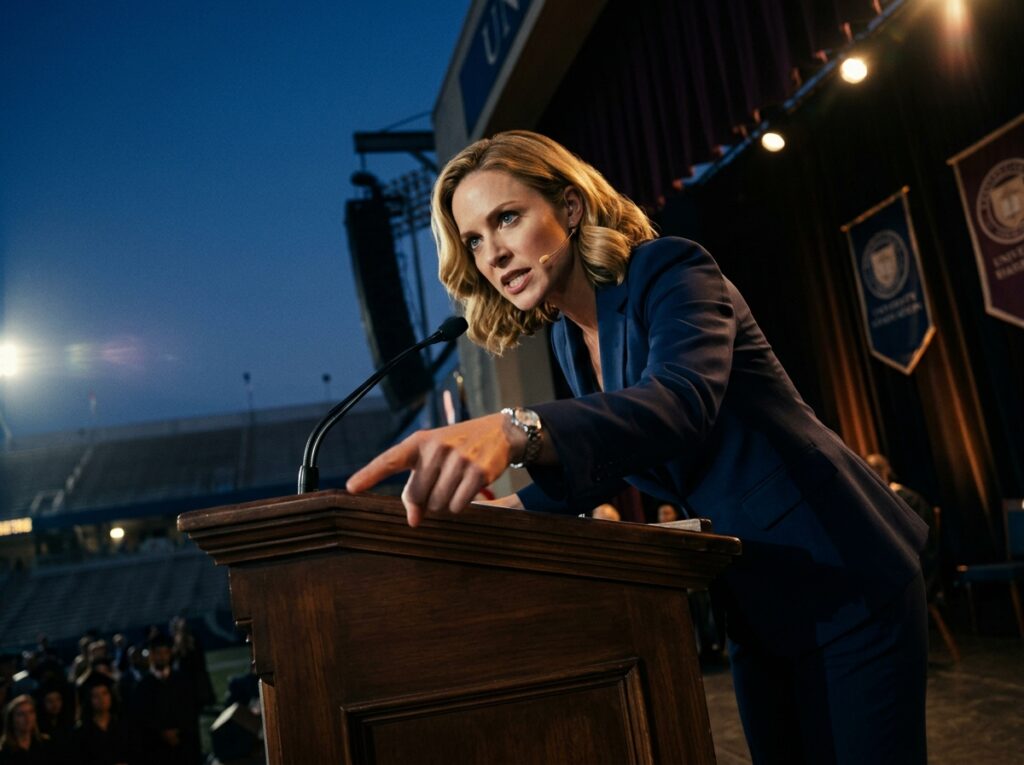
PART 2
The dean’s whisper struck me harder than the stadium lights.
“There’s someone here asking to speak.”
For one frozen second, I thought he meant my mother.
I pictured her stumbling down from Section 114, wiping her face, finally ready to say the words she had withheld for almost a decade. I imagined my father following behind her, shoulders lowered by shame. I even imagined Derek standing there, confused and embarrassed, discovering in real time that the daughter he had always treated like background noise had somehow become the name glowing across a stadium screen.
But the dean’s face told me it was not them.
His expression was too careful.
Too formal.
Too shocked.
I leaned slightly away from the microphone. “Who?”
He swallowed.
“Eleanor Whitmore.”
The name moved through me like cold water.
I gripped the sides of the podium.
Behind the dean, near the stairs leading up to the stage, stood an elderly woman in a pearl-gray suit, one hand resting on a polished cane. Her silver hair was pinned neatly at the back of her head. A thin gold necklace glimmered at her throat. She looked fragile from a distance, but the moment her eyes met mine, there was nothing fragile about her.
Eleanor Whitmore.
The woman who had funded my first failed prototype.
The woman who had written a check when every investor told me rural energy wasn’t profitable enough.
The woman whose foundation turned Solar Reach from a desperate idea in a Stanford basement into a company that kept lights on in clinics, schools, and homes across the world.
And, as of three months ago, the woman I had been told was too ill to travel.
I stared at her, stunned.
The stadium had gone quiet, waiting.
The dean leaned closer. “She insisted.”
I turned back to the microphone, trying to steady my breathing.
“Before I continue,” I said, my voice slightly softer now, “I’ve just been told that someone very important to my journey is here today.”
A murmur rose through the crowd.
I turned toward the stairs.
“Mrs. Eleanor Whitmore.”
The applause began slowly, uncertain at first, then growing as people recognized the name from the Solar Reach introduction on the giant screen. Eleanor stepped onto the stage with the help of a young assistant, but halfway across, she gently waved him back. She wanted to walk the rest of the distance alone.
That was Eleanor.
Always graceful.
Always stubborn.
Always arriving exactly when people thought she could not.
When she reached me, she did not speak into the microphone at first. She simply took my hands in hers.
Her fingers were cool.
Her grip was firm.
“My dear,” she said quietly, “you didn’t think I would miss this, did you?”
My throat tightened.
“I was told you were in the hospital.”
“I was,” she said. “Then I left.”
Despite myself, I laughed through the sudden ache in my chest.
The stadium responded with warm laughter too, as if everyone had been holding their breath and was grateful for permission to exhale.
The dean handed Eleanor a microphone.
She turned to face the crowd, and instantly the entire stadium settled.
There are people who demand attention.
Eleanor Whitmore simply received it.
“I apologize for interrupting,” she began, her voice delicate but clear. “But I have learned, after eighty-two years on this planet, that there are moments when silence becomes a form of dishonesty.”
My eyes moved toward Section 114.
My mother was staring at Eleanor.
My father looked deeply uncomfortable.
Derek was leaning forward now, his graduation cap tilted slightly, his expression caught somewhere between fascination and dread.
Eleanor continued.
“Eight years ago, I received a letter from a young woman named Sarah Mitchell. Not an email. A letter. It was printed on cheap paper, with diagrams attached, some of them hand-marked in blue ink. She was not asking for recognition. She was not asking for fame. She was asking for a chance to prove that poor communities deserved innovation as much as wealthy ones.”
The giant screen shifted behind us, showing an old photograph I had almost forgotten existed.
Me at twenty-two.
Hair pulled back messily.
Safety goggles on my head.
Standing beside a solar battery unit that looked like it had been assembled by a sleep-deprived raccoon with access to spare wires.
The crowd laughed gently.
I covered my mouth.
“Oh no,” I whispered.
Eleanor smiled. “Yes, dear. That one.”
Another photo appeared. Then another.
Me in a lab coat stained with dust.
Me kneeling beside children in a village classroom as a row of small lights flickered on above them.
Me standing beside a clinic refrigerator that could finally preserve medicine overnight.
Each image pulled a different memory from me.
The heat.
The exhaustion.
The smell of solder and rain.
The first time an old woman touched a working light bulb and whispered a blessing in a language I did not understand.
Eleanor’s voice deepened.
“When I first met Sarah, people told me she was unrealistic. They told me she was too emotional about the problem. Too idealistic. Too young. Too focused on places that would never return enough profit.”
She paused.
“And then I asked her what her family thought.”
My breath stopped.
I knew where this was going.
Eleanor turned slightly toward me, not unkindly, but with the sharp tenderness of someone willing to cut where healing had been delayed too long.
“She smiled,” Eleanor said. “And she lied.”
The stadium was silent again.
“She told me they were proud.”
My mother’s crying became visible even from the stage.
My father lowered his gaze.
I stood completely still.
I had forgotten that conversation. Or maybe I had buried it so deep that only Eleanor could have found it.
She looked out at the graduates.
“I knew it was a lie because people who are loved loudly do not apologize for taking up space. And Sarah, back then, apologized for everything. For speaking too long. For sending too many documents. For needing funding. For dreaming bigger than the room allowed.”
My hands trembled slightly around the podium.
I tried to hide it.
Eleanor noticed anyway.
She always noticed.
“But here is what I have come to say.” She lifted her chin. “No one builds something like Solar Reach alone. But sometimes, the first thing a person must survive is not failure. It is being underestimated by the people whose approval they wanted most.”
The words landed everywhere.
On the graduates.
On the parents.
On my family.
On me.
Then Eleanor turned fully toward Section 114.
And somehow, without pointing, without naming them, everyone understood who she was addressing.
“I do not know Sarah’s family personally,” she said. “But I know absence. I know what it does to a person. I know how it teaches brilliant people to clap for themselves in empty rooms.”
My mother bent forward, shaking.
Derek looked at her, then at my father, as if seeing an old family story change shape before his eyes.
Eleanor faced me again.
“And I know this: Sarah Mitchell did not become extraordinary because she was ignored. She became extraordinary despite it.”
The applause came like thunder.
It rose from every side of the stadium until the stage vibrated beneath my feet.
I could not stop the tears this time.
I looked down, blinking hard, but the tears fell anyway.
Eleanor placed one hand over mine.
“Finish your speech, dear,” she said. “They came to hear you.”
I nodded, though I wasn’t sure I could speak.
She stepped back and sat in the chair the dean quickly brought for her. The crowd slowly quieted, but the air had changed. What had started as a commencement ceremony had become something else entirely.
A reckoning.
I turned back to the microphone.
For a moment, I looked at my prepared speech on the screen in front of me.
It was polished.
Professional.
Safe.
I had spent weeks writing it.
Then I closed the folder.
The crowd stirred.
I looked out over thousands of faces.
“I was going to give you a speech about innovation,” I said. “About persistence, design thinking, global systems, and the future of sustainable infrastructure.”
A few people laughed softly.
“But the truth is, most of you will forget that speech by dinner.”
More laughter.
“So I’m going to tell you something else.”
I looked at the graduates in their caps and gowns. They were young, shining, impatient for the rest of their lives. Some were sitting beside proud parents. Some were searching the crowd for someone who had promised to come and didn’t. Some were smiling because they had made it. Others looked frightened because they had made it and still didn’t know what came next.
“I want to talk to the person here today who feels invisible.”
The stadium became still.
“The one who worked twice as hard and was praised half as much. The one who learned to make their own celebrations quiet because expecting people to show up hurt too much. The one who has been told, directly or indirectly, that their dream only matters if it makes other people comfortable.”
My voice steadied.
“I see you.”
A breeze moved across the stadium, lifting the tassels on thousands of caps.
“And I need you to understand something. Being unseen is painful, but it is not proof that you are small. Being unsupported is lonely, but it is not evidence that you are wrong. And being dismissed by people you love may break your heart, but it does not get to define the size of your life.”
I paused.
My eyes drifted again to my family.
My mother’s face was wet with tears.
My father looked older than he had when I first entered the stadium.
Derek stared at me as though the world had tilted.
“For years,” I continued, “I believed recognition would heal me. I thought if I won enough awards, built enough systems, earned enough degrees, helped enough people, then one day my family would look at me and finally understand.”
I inhaled slowly.
“But healing didn’t come when they understood. Healing came when I stopped needing their understanding to believe in myself.”
The applause was softer this time.
Not explosive.
Personal.
I saw graduates wiping their eyes. Parents holding hands. Faculty members bowing their heads.
“So here is my advice to you,” I said. “Do the work that makes your soul stand up. Not the work that looks impressive at holiday dinners. Not the work that earns applause from people who only value what they can brag about. Do the work that makes you feel honest.”
I smiled faintly.
“And when no one claps, keep building.”
The crowd rose before I finished.
One section stood, then another, then another, until the stadium became a sea of people on their feet.
The applause rolled over me in waves.
I stepped back from the podium, overwhelmed.
The dean came forward, smiling broadly, and shook my hand. Eleanor remained seated, clapping slowly, her eyes shining with pride.
And in Section 114, my mother stood too.
So did my father.
So did Derek.
But their applause looked different from everyone else’s.
It looked like apology.
It looked like regret.
It looked far too late.
After the ceremony, everything became noise.
Graduates hugged one another. Families took pictures. Faculty members congratulated me. Reporters asked questions. Alumni donors wanted introductions. Someone handed me flowers. Someone else handed me a bottle of water. The dean thanked me three times.
Through it all, I kept seeing my mother at the edge of the crowd.
She was trying to reach me.
My father was behind her.
Derek stood a little apart, still in his cap and gown, looking less like the golden son and more like a boy who had misplaced the script of his life.
I turned away twice.
Not because I wanted to punish them.
Because I was not ready to become the version of myself they suddenly needed.
Eleanor noticed.
She always did.
We were seated in a quiet reception room inside the stadium, away from the public crowd, when she touched my arm.
“They’re waiting,” she said.
“I know.”
“Will you speak to them?”
I looked through the glass wall.
My mother stood with both hands clasped in front of her, crying again. My father’s mouth was tight. Derek kept checking his phone, then locking it, then checking it again.
“I don’t know,” I said honestly.
Eleanor studied me.
“Then don’t decide as their daughter,” she said. “Decide as yourself.”
That was the trouble.
For so long, I had been only a daughter in relation to them.
The disappointing one.
The difficult one.
The one who moved too far, cared too much, chose wrong, spoke wrong, wanted wrong.
Who was I now, standing on the other side of all that?
Before I could answer, the door opened.
My mother stepped inside.
She didn’t wait for permission.
That was also familiar.
“Sarah,” she said.
My name sounded strange in her mouth. Soft. Broken.
I stood slowly.
For several seconds, neither of us moved.
Up close, she looked smaller than I remembered. Her makeup had streaked beneath her eyes. Her hands were trembling. She wore the cream dress she saved for important occasions, the one I had last seen at Derek’s undergraduate awards banquet.
She looked at me like she wanted to touch me but knew she had lost the right.
“I didn’t know,” she whispered.
The words came out fast and desperate.
“I didn’t know it was like this. I didn’t know you had done so much. I didn’t know about the villages, or the award, or Stanford inviting you—”
“You didn’t ask,” I said.
She flinched.
My father stepped in behind her. “Sarah—”
I looked at him.
One look was enough to stop him.
My mother pressed her lips together, trying to hold herself steady.
“You’re right,” she said. “We didn’t ask.”
Derek entered last, closing the door behind him. The room felt suddenly too small.
Eleanor remained seated near the window, quiet but watchful.
My mother took one step toward me.
“I am so sorry,” she said. “For missing your graduation. For making you feel like your work didn’t matter. For all of it.”
For years, I had imagined those words.
I had imagined hearing them and feeling something open inside me.
Relief.
Vindication.
Peace.
Instead, I felt tired.
So unbelievably tired.
“You missed more than a graduation,” I said.
My mother’s face crumpled.
“I know.”
“No,” I said. “You don’t.”
The room fell silent.
I looked at all three of them.
“You missed phone calls where I tried to tell you I was struggling. You missed research presentations because Derek had games. You missed my first grant announcement because Dad said solar panels weren’t a real career yet. You missed my birthday three years in a row and sent flowers to the wrong address twice.”
My father closed his eyes.
“You missed the year I almost quit,” I continued. “You missed the professor who told me my project was too ambitious. You missed me crying in a grocery store parking lot because I had eighty-seven dollars in my account and a lab full of equipment I couldn’t afford to fix. You missed all the parts where I was still becoming someone.”
Derek’s face changed.
That was the moment he finally understood that this was not about one ceremony.
It was never about one ceremony.
My mother whispered, “Why didn’t you tell us?”
I laughed once, not because it was funny, but because the question was so fragile it almost broke itself.
“I did.”
She covered her mouth.
“I told you in emails. I told you on holidays. I told you in the kitchen when you were packing Derek’s care package and said, ‘That’s nice, honey,’ without looking up.”
My father swallowed hard.
“I remember that,” he said quietly.
I turned to him.
The admission surprised me.
He stared at the floor.
“I remember you standing there,” he said. “You had a folder in your hand. Blue folder. You said you’d been selected for some kind of pilot program.”
“International rural infrastructure fellowship,” I said.
He nodded slowly.
“And I said we’d talk later.”
“We never did.”
“No,” he whispered. “We didn’t.”
My mother was crying openly now.
Derek shifted uncomfortably. “Sarah, I didn’t know they were doing that to you.”
I looked at my brother.
For most of my life, Derek had been a weather system the whole house revolved around. His tournaments, his injuries, his interviews, his victories, his moods. He had not created the favoritism, not entirely. But he had benefited from it, and he had rarely questioned it.
“You didn’t want to know,” I said.
He looked wounded.
Then he looked ashamed.
“Maybe not,” he admitted.
That honesty, more than anything else, unsettled me.
My mother reached for my hand.
I let her take it.
Her fingers wrapped around mine like she was afraid I would disappear.
“I don’t expect you to forgive us today,” she said. “I don’t. But please don’t disappear again.”
Again.
The word hit harder than I expected.
Because in their version of the story, I had disappeared.
In mine, I had survived.
I gently pulled my hand back.
“I didn’t disappear,” I said. “I stopped standing where I wasn’t wanted.”
My mother covered her face.
My father put an arm around her, but he was crying too now, silently.
Derek looked at me, his voice low.
“What happens now?”
I stared at him.
The honest answer was that I didn’t know.
A younger version of me might have wanted them to suffer. Might have wanted them to feel every empty chair, every ignored email, every holiday where my achievements were treated like side notes between Derek’s stories.
But standing there, I realized something strange.
Their regret did not feel like victory.
It felt like looking at a house I had once lived in after a storm had taken the roof.
Familiar.
Damaged.
Not mine anymore.
“I’m having dinner with Eleanor and the Solar Reach board tonight,” I said. “Tomorrow I fly to Nairobi. After that, Singapore. Then Geneva.”
My mother looked panicked. “So soon?”
“My work didn’t pause because you started paying attention.”
The words were not cruel.
They were simply true.
My father nodded slowly, as if accepting a sentence.
“Can we call you?” he asked.
I hesitated.
“Yes,” I said finally. “But I won’t perform being okay to make you feel better.”
My mother nodded quickly. “Of course.”
“And I won’t shrink my life so you can understand it.”
“We won’t ask you to,” my father said.
I looked at Derek.
He looked back.
For the first time in years, he didn’t seem to be waiting for the room to return to him.
“I’m proud of you,” he said.
The sentence landed awkwardly.
Late.
Imperfect.
Still, it landed.
I nodded once.
“Thank you.”
A knock sounded at the door.
One of the dean’s assistants stepped in, nervous. “Dr. Mitchell? I’m sorry to interrupt. There’s an urgent call for you from Geneva.”
Eleanor’s expression sharpened.
“Geneva?” she asked.
The assistant held out a phone.
“It’s Ambassador Leclerc’s office. They said it concerns the emergency energy initiative.”
I took the phone, confused.
The emergency energy initiative was not supposed to be public yet. It was a sealed proposal involving three governments, two humanitarian organizations, and Solar Reach. We had designed rapid-deployment power grids for disaster zones, but the program was still months away from approval.
I stepped toward the window.
“This is Dr. Mitchell.”
The voice on the other end was clipped and tense.
“Dr. Mitchell, this is Claire Rousseau from the International Energy Council. I’m sorry to contact you during the ceremony, but we have a situation.”
Eleanor stood slowly.
“What situation?” I asked.
There was a pause.
Then Claire said, “Your prototype units were accessed last night.”
My blood chilled.
“Accessed how?”
“Someone copied the deployment architecture.”
The room seemed to tilt.
“That’s impossible,” I said. “Those files are encrypted.”
“They had internal credentials.”
I looked through the glass wall at the crowd outside, smiling, laughing, taking photos, unaware that the ground beneath my life had just cracked open.
Claire continued, “We believe someone is preparing to present your system as their own under a private defense contract.”
Defense contract.
The words struck like a match in a room full of gas.
Solar Reach technology was designed for clinics, schools, disaster relief, and rural infrastructure.
Not militarized zones.
Not private contractors.
Not profit built on crisis.
Eleanor’s eyes locked onto mine.
She had heard enough to understand.
Claire lowered her voice.
“Dr. Mitchell, we need to know who else had access.”
I turned slowly.
My mother stared at me, frightened.
My father looked confused.
Derek had gone pale.
Too pale.
My eyes narrowed.
“Derek,” I said.
He froze.
The room changed instantly.
My mother looked at him. “What?”
Derek’s mouth opened, then closed.
I stepped toward him.
“Why do you look like that?”
“I don’t know what you’re talking about,” he said too quickly.
My father released my mother’s shoulder.
“Derek?”
The phone remained pressed to my ear.
Claire’s voice was distant now. “Dr. Mitchell?”
I stared at my brother.
At the sweat gathering near his temple.
At the guilt he was trying and failing to hide.
“Sarah,” Derek whispered, “I can explain.”
My heart began to pound.
Eleanor moved beside me, her face hard as stone.
I said into the phone, “I think I know who had access.”
My mother made a small sound, almost a gasp.
Derek took one step back.
And then the assistant at the door spoke again, her voice shaking.
“Dr. Mitchell… security just found a man backstage with a badge from your company.”
She held up a plastic ID card in trembling fingers.
The name printed on it was not mine.
Not Derek’s.
Not anyone currently employed by Solar Reach.
But I recognized the face immediately.
It was the man who had vanished from my lab five years ago.
The man everyone believed had died in the fire that destroyed my first prototype.
Eleanor looked at the badge.
Her cane slipped from her hand and struck the floor.
“My God,” she whispered. “He’s alive.”
…If you want to know what happened next, please type “YES” and like for more.





