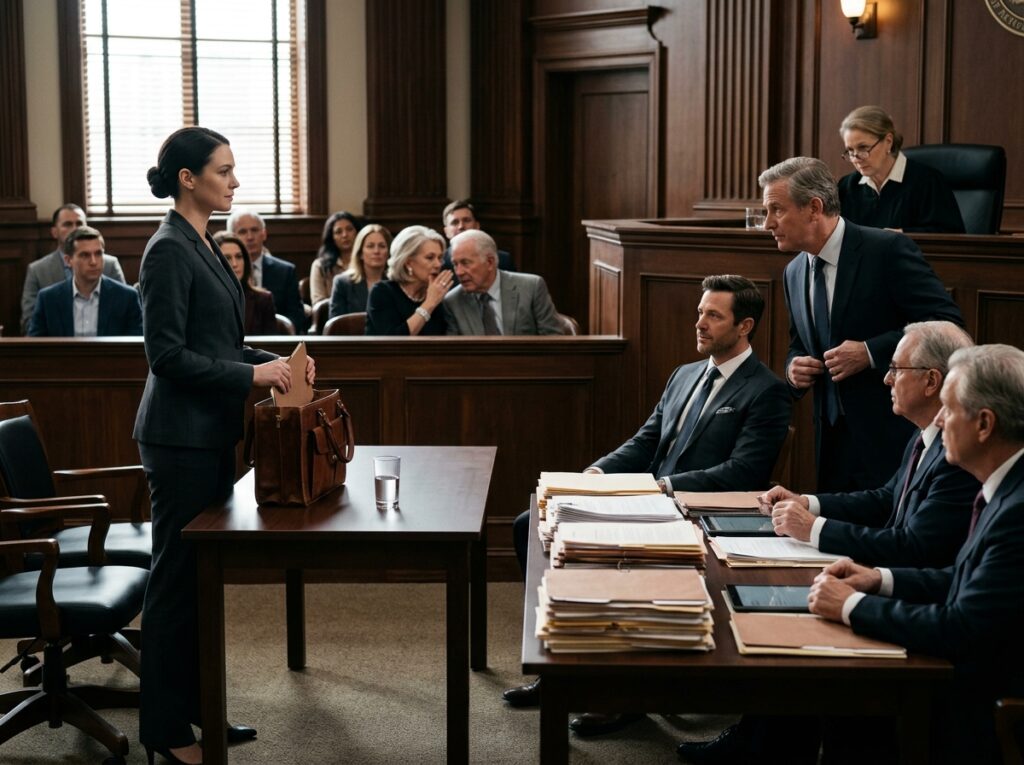
THEN ONE SENTENCE EXPOSED A SECRET THAT COULD DESTROY THE ENTIRE HALE FAMILY.
“For the record, Your Honor, my name is Amelia Carter Hale.
Before my marriage, I served as a captain in the United States Army Judge Advocate General’s Corps.
And I would like to begin by asking opposing counsel one very simple question.”
The silence that followed was almost beautiful.
Martin Voss stopped halfway through adjusting his jacket.
Across the aisle, Preston’s smile disappeared.
And my father-in-law, Richard Hale, who had spent the previous twenty minutes laughing at the woman he believed couldn’t afford an attorney, slowly lowered his coffee cup.
Judge Rebecca Morrison leaned forward.
“Go ahead, Mrs.
Hale.”
I turned toward Martin.
“Mr.
Voss, did your client disclose that the financial statement submitted to this court contains the signature of a woman who was legally dead three years before she supposedly signed it?”
Nobody moved.
Not Preston.
Not his parents.
Not even the court reporter, whose fingers hovered momentarily above her keyboard.
Martin stared at me.
“I’m sorry?”
I opened my folder.
“Page forty-seven of your client’s financial disclosure.
Exhibit D.
The transfer authorization for the Hale Family Investment Trust, dated March 14, 2023.”
I lifted a certified document.
“The signature belongs to Eleanor Margaret Hale.”
Richard’s face turned white.
“Eleanor Hale died on November 6, 2020.”
I paused.
“So unless your client has discovered how to obtain signatures from the dead, someone has committed fraud.”
A sharp gasp came from the gallery.
Vivian gripped her husband’s arm.
Preston leaned toward Martin and whispered something urgently.
But the attorney didn’t answer.
For the first time that morning, the man who had entered the courtroom expecting an effortless victory looked genuinely frightened.
Judge Morrison extended her hand.
“Mrs.
Hale, bring that document forward.”
I walked to the bench.
My heels sounded against the polished floor.
Seven years.
Seven years of swallowing insults, smiling through humiliation, and allowing the Hale family to believe I was nothing more than a decorative wife.
Now every step felt like a piece of my life returning.
The judge examined the certificate.
Then she looked at Martin.
“Counsel, how do you explain this discrepancy?”
Martin cleared his throat.
“Your Honor, I haven’t had an opportunity to verify the authenticity of Mrs.
Hale’s document.”
“It’s a certified death certificate,” I replied.
“Issued by the state of Virginia.
The original is available for inspection.”
Martin glanced at Preston.
Preston stared at the table.
The judge’s expression hardened.
“Mr.
Voss?”
“We may need a brief recess.”
I shook my head.
“Your Honor, I respectfully oppose a recess at this stage.”
Richard let out a disbelieving laugh.
“Of course she does.”
The judge looked toward him.
“Sir, another interruption and you will be removed.”
His smile vanished.
I continued.
“The issue is not limited to one suspicious signature.
That document is the foundation of the petitioner’s claim that certain marital assets were transferred into a family trust before our separation.”
I placed another sheet on the bench.
“However, the bank records indicate those assets remained under my husband’s control until eleven days after he filed for divorce.”
Judge Morrison studied the page.
“And what are you alleging?”
I looked directly at Preston.
“That my husband is attempting to conceal marital property through a fraudulent transfer, and that the documents submitted to this court were created to support that concealment.”
Preston suddenly stood.
“That’s ridiculous!”
“Sit down, Mr.
Hale,” the judge ordered.
“But she’s lying!”
“Sit.
Down.”
He obeyed.
And I realized something extraordinary.
The man who had controlled every conversation in our marriage was discovering what it felt like when nobody cared how loudly he spoke.
Three weeks earlier, I had cried over those divorce papers.
Not because I couldn’t survive without Preston.
Because I couldn’t understand how someone who had once promised to protect me could become so determined to destroy me.
We had met at a charity dinner in Washington, D.C.
I was thirty-one.
He was thirty-four.
He wore a navy suit, had an easy smile, and listened when I spoke.
That last detail had mattered more than I wanted to admit.
At the time, I was preparing to leave active military service after years of demanding legal assignments.
I was tired of courtrooms.
Tired of conflict.
Tired of living with my suitcase half-packed.
Preston seemed to offer something different.
A home.
A future.
A place where I could finally stop fighting.
“I don’t care what you did before,” he told me during our third date.
“I care about who you are when you’re with me.”
I thought it was romantic.
Years later, I would understand that he meant he preferred the version of me who never challenged him.
When we married, I stepped away from practicing law.
Preston was expanding Hale Development Group, a real estate company his father had founded.
He needed someone to manage the complicated life surrounding his business.
At first, I was happy to help.
I organized investor dinners.
Reviewed contracts when Preston asked.
Caught accounting discrepancies that saved the company thousands.
Helped coordinate negotiations when his executives couldn’t agree.
But every time I contributed something meaningful, Preston presented the result as his own.
And I let him.
Because I thought marriage was a partnership.
Because I believed recognition didn’t matter when two people were building something together.
Because I loved him.
Then the small humiliations began.
At dinner parties, Vivian introduced me as “Preston’s little homemaker.”
Richard joked that his son had married someone who “looked pretty and didn’t ask expensive questions.”
When I corrected an error in a proposed commercial lease, Richard laughed.
“Careful, Amelia.
You might start thinking you’re a lawyer.”
Everyone chuckled.
Including Preston.
I smiled.
That night, I told my husband the joke had hurt.
He rolled his eyes.
“Amelia, don’t be so sensitive.
Dad was teasing.”
“He was humiliating me.”
“He’s an old-fashioned businessman.
Stop making everything a battle.”
So I stopped arguing.
Not because I agreed.
Because I was exhausted.
And somewhere along the way, I began mistaking silence for peace.
Back in the courtroom, Martin requested permission to approach the bench.
Judge Morrison allowed it.
After a quiet exchange, she called a fifteen-minute recess.
The moment she left, Preston crossed the aisle.
His expensive cologne reached me before his voice did.
“What the hell are you doing?”
I closed my folder.
“Representing myself.”
“Don’t play games, Amelia.”
“I’m not.”
His eyes flickered toward the gallery.
“You’re embarrassing my family.”
I looked at him.
“You filed documents claiming I contributed nothing to our marriage.
You demanded the house, our savings, and nearly every asset we acquired together.”
“That’s not what this is about.”
“Then what is it about?”
His jaw tightened.
“You don’t understand how complicated the family business is.”
I almost laughed.
“Preston, I reviewed half your contracts.”
“You read things I put in front of you.”
“No.
I corrected things you didn’t understand.”
His expression changed.
For the first time, I saw something behind his anger.
Fear.
“Where did you get those records?” he whispered.
I held his gaze.
“From documents your attorneys produced during discovery.”
He stepped closer.
“Listen carefully.
You need to stop.”
“Or what?”
His mouth opened.
Then closed.
Behind him, Richard approached.
“Amelia.”
His voice was cold.
“Come outside.
We need to talk.”
“No.”
He blinked.
Richard Hale was not accustomed to hearing that word.
“I wasn’t asking.”
“And I wasn’t negotiating.”
Vivian appeared beside him.
“Oh, for heaven’s sake.
Stop acting like some courtroom heroine.
You married into this family with nothing.”
I stood.
“Actually, Vivian, I married into this family with a career, savings, professional credentials, and a clean conscience.”
Her face reddened.
“You ungrateful little—”
“And I gave up my career because your son asked me to.”
Richard leaned forward.
“You think a few papers make you powerful?”
I looked at the man who had called me useless for seven years.
“No, Richard.”
I picked up my briefcase.
“I think the truth makes your lawyers very nervous.”
When court resumed, Judge Morrison announced that she would hear limited testimony concerning the disputed financial disclosures.
Martin stood.
“Your Honor, my client maintains that all relevant assets have been properly identified.”
“Then your client should have no difficulty answering questions,” the judge replied.
Preston was called to testify.
He took the witness stand wearing the same expression he used at business meetings when he wanted employees to believe everything was under control.
I approached with my folder.
“Mr.
Hale, are you the chief executive officer of Hale Development Group?”
“Yes.”
“Did you receive a salary during our marriage?”
“Yes.”
“Did you receive additional compensation through distributions, bonuses, and equity awards?”
Martin stood.
“Objection.
Relevance.”
“Overruled,” Judge Morrison said.
“Answer the question.”
Preston shifted.
“Yes.”
“Did you disclose all those payments in your sworn financial statement?”
“To the best of my knowledge.”
I looked at the judge.
“Permission to show the witness Exhibit Twelve?”
“Granted.”
I placed a document before Preston.
“Do you recognize this?”
He glanced down.
“A compensation summary.”
“Your compensation summary?”
“Yes.”
“For the previous fiscal year?”
“Yes.”
“Please read the total compensation amount.”
His throat moved.
“Three million, eight hundred and forty thousand dollars.”
I waited.
Then I asked, “And what annual income did you report in your financial affidavit?”
He didn’t answer.
“Mr.
Hale?”
“Four hundred and twenty thousand.”
A murmur traveled through the gallery.
He had disclosed less than one-ninth of the compensation shown on his own company records.
Martin stood again.
“Your Honor, these figures may include noncash compensation and deferred equity.”
“That’s possible,” I agreed.
“Which is why I am asking the witness to explain the difference rather than assuming all amounts are immediately available income.”
The judge nodded.
“Proceed.”
I turned back to Preston.
“Did you disclose the deferred equity separately?”
He stared at me.
“No.”
“Did you disclose the additional cash distributions?”
“No.”
“Did you inform your attorneys that the compensation summary existed?”
Martin’s face stiffened.
Preston looked toward him.
Then toward his father.
Finally, he whispered, “I don’t remember.”
I returned to my table.
I could have stopped there.
The missing compensation alone justified serious scrutiny.
But that wasn’t the worst thing I had discovered.
Not even close.
Two nights after Preston served me with divorce papers, I had been packing my belongings when I found an old wooden box beneath our bed.
Inside were photographs, wedding invitations, and letters from the early years of our marriage.
At the bottom lay a folded envelope addressed to me.
The handwriting belonged to Eleanor Hale.
Richard’s older sister.
She had been the only member of Preston’s family who treated me like an equal.
Eleanor had been a retired mathematics professor with sharp blue eyes and a habit of saying exactly what she thought.
She disliked Richard’s arrogance.
She distrusted Vivian’s polished manners.
And she had once told me, during a Thanksgiving dinner, that the Hale family had become wealthy by forgetting the people who helped them.
I remembered the last time I saw her.
She had squeezed my hand and said, “Amelia, promise me something.”
“What?”
“Never let anyone convince you that kindness and weakness are the same thing.”
She died six months later.
I had assumed the envelope contained an old birthday card.
Instead, I found a letter.
My dear Amelia,
If you are reading this, I hope it is because you are sorting through happy memories.
But if circumstances have become difficult, there is something I need you to know.
You are the only person in this family who ever asked me what I wanted instead of what I owned.
I have made arrangements that Richard will not appreciate.
When the time comes, ask for the blue ledger.
There was no explanation.
Only a signature.
And beneath it, a telephone number.
I called the number the next morning.
A woman answered.
“Office of Margaret Ellison.”
“My name is Amelia Hale.
I believe Eleanor Hale left me a letter.”
Silence.
Then the woman asked, “Are you alone?”
“Yes.”
“Good.”
Another pause.
“Mrs.
Hale, I’ve been waiting almost six years for you to call.”
In court, Preston was still on the witness stand when I introduced the next subject.
“Mr.
Hale, are you familiar with the Eleanor Hale Family Trust?”
He glanced at his father.
“Yes.”
“Was your aunt Eleanor its original settlor?”
“Yes.”
“Did she authorize the transfer document dated March 14, 2023?”
“I assume so.”
I looked at him.
“Despite having died in 2020?”
His cheeks flushed.
“I didn’t handle those details.”
“Who did?”
“My father.”
Richard straightened in his seat.
Martin rose.
“Objection.
My client lacks personal knowledge.”
I nodded.
“I’ll withdraw the question.”
Then I asked another.
“Did you personally sign the certification attached to that transfer document?”
Preston hesitated.
“Yes.”
“And does the certification state that you reviewed the supporting records and believed them to be accurate?”
“Yes.”
“Did you review them?”
He swallowed.
“Not every page.”
I held up the certification.
“Then why did you sign a statement saying you had?”
Martin objected.
The judge allowed Preston to answer.
He stared at the document.
“My father told me everything was in order.”
Richard muttered something under his breath.
I heard it.
So did the judge.
“Mr.
Hale,” she warned from the bench, looking toward Richard, “this is your final warning.”
I returned to my table.
My hands were steady.
But inside, something hurt.
I had once loved Preston enough to imagine growing old beside him.
I had defended him when his father belittled him.
Encouraged him when business deals failed.
Sat awake with him through sleepless nights.
And now he was sitting under oath, admitting he had signed financial documents he hadn’t properly reviewed.
I wasn’t looking at a stranger.
I was looking at the man I had loved, finally stripped of the excuses I had spent years making for him.
The next witness was Margaret Ellison.
She was seventy-two, with silver hair and a walking cane.
When she entered the courtroom, Richard Hale stood so abruptly that his chair scraped against the floor.
“What is she doing here?”
Judge Morrison looked sharply at him.
“Mr.
Hale, sit down.”
Margaret walked past him without acknowledgment.
She took the oath.
I approached.
“Mrs.
Ellison, how did you know Eleanor Hale?”
“I was her attorney and longtime friend.”
“Did you assist with her estate planning?”
“Yes.”
“Did she execute a will and trust documents before her death?”
“Yes.”
“Did you retain copies?”
“I did.”
Martin stood.
“Your Honor, we have not received notice of any estate-related claims.”
I answered calmly.
“This witness’s testimony concerns the authenticity of a document used by the petitioner to characterize disputed assets.
I am not asking this court to adjudicate Eleanor Hale’s estate.”
Judge Morrison considered the objection.
“I will permit limited testimony on authenticity and reserve other issues.”
Margaret opened her leather case.
She removed a thick blue binder.
My heart beat faster.
The blue ledger.
Richard looked as though someone had opened a grave.
Margaret testified that Eleanor had created a detailed record of her assets, transfers, and charitable commitments.
She identified her original signature.
Then she examined the disputed 2023 authorization.
“Is this Eleanor Hale’s signature?”
I asked.
“No.”
“Can you explain your answer?”
“Eleanor signed her name differently after a hand injury in 2018.
More importantly, she was deceased when this document was dated.”
“Did she ever authorize this particular transfer before her death?”
“Not to my knowledge, and I retained the executed documents from her estate plan.”
Martin rose.
“Objection.
The witness cannot establish that no other authorization existed.”
“Sustained as to any broader conclusion,” the judge said.
I nodded.
“Mrs.
Ellison, did you locate such an authorization among the records you maintained?”
“No.”
I looked toward Richard.
He was staring at Margaret with open hatred.
Then she said something I hadn’t expected.
“Amelia, there’s another document.”
The courtroom went still.
I turned.
“What document?”
Margaret looked toward the judge.
“Your Honor, I brought it because I believe the court should know why the original records may have been altered.”
She removed a sealed envelope.
Across its front was Eleanor’s handwriting.
FOR AMELIA CARTER HALE — TO BE OPENED ONLY IF THE FAMILY ATTEMPTS TO TAKE WHAT BELONGS TO HER.
My breath caught.
I had never seen that envelope.
Margaret hadn’t mentioned it during our phone conversations.
Judge Morrison examined it before returning it to the witness.
“Mrs.
Ellison, what is inside?”
Margaret’s eyes filled with tears.
“A letter and a copy of a trust amendment.”
Richard surged to his feet.
“This is absurd!”
“Mr.
Hale!” the judge thundered.
He froze.
Margaret continued.
“Eleanor was concerned that Richard had been using family-controlled entities to move assets without adequate disclosure.”
Martin immediately objected.
The judge sustained the objection as to the unproven allegation.
But Margaret wasn’t finished.
She looked at me.
“Eleanor believed Amelia was the only person who would protect the people those assets were meant to help.”
I stared at her.
“What people?”
Margaret took a trembling breath.
“The scholarship recipients.
The veterans’ families.
The children whose medical expenses Eleanor promised to support.”
A strange pressure formed in my chest.
I remembered Eleanor talking about wounded service members.
About widows waiting months for benefits.
About children who lost parents in wars they were too young to understand.
She had often asked about my work as a military attorney.
I thought she was simply interested.
I hadn’t realized she was planning something.
The judge admitted the relevant authenticated records for the limited purpose of examining the financial disclosures, subject to further objections.
Margaret identified a trust amendment dated August 2019.
Under its terms, a portion of Eleanor’s estate had been placed in a charitable trust intended to fund education, rehabilitation, and emergency assistance for military families.
A separate provision named me as a successor trustee, subject to the conditions in the instrument.
Not Preston.
Not Richard.
Me.
I stared at the page.
“I never accepted that appointment.”
Margaret nodded.
“Correct.
Eleanor wanted you to have the choice when the time came.”
Richard was shaking his head.
“She’s manipulating this.”
The judge ordered him to remain silent.
I looked at Margaret.
“Why didn’t you tell me?”
“Because Eleanor instructed me not to pressure you while you were married.
She hoped the trust would operate properly without requiring your involvement.”
“And did it?”
Margaret’s expression changed.
“That’s what we need to find out.”
I glanced at the financial records.
At the suspicious transfers.
At the missing distributions.
Then the truth began arranging itself into a terrifying shape.
The family wasn’t merely trying to reduce my divorce settlement.
They were trying to prevent me from discovering that I might have legal authority to question transactions involving a trust worth millions.
Preston had filed for divorce shortly after I asked about inconsistencies in company accounts.
His lawyers had demanded a broad waiver of future financial claims.
And buried inside the settlement agreement was a provision requiring me to release any claims connected to Hale-controlled trusts.
At the time, I thought it was aggressive drafting.
Now I understood why it mattered.
I turned to Preston.
“Did you know Eleanor named me as a successor trustee?”
He wouldn’t meet my eyes.
“Preston?”
Martin stood.
“Your Honor, this is beyond the current scope.”
The judge looked at the witness.
“Mr.
Hale, you may answer whether you knew of the provision.”
Preston stared at his hands.
Finally, he whispered, “Yes.”
My stomach dropped.
“How long have you known?”
He hesitated.
“Since before we got married.”
I felt the air leave my lungs.
Seven years.
Seven years of dinners, anniversaries, whispered promises, and mornings waking beside him.
He had known.
My husband had married me knowing I held a possible future role in his family’s financial affairs—and he had never said a word.
I stepped backward.
For the first time all morning, I needed a moment to breathe.
Judge Morrison noticed.
“Mrs.
Hale, would you like a recess?”
I looked at Preston.
His eyes were wet.
I couldn’t tell whether he was ashamed or simply afraid.
“No, Your Honor.”
My voice sounded unfamiliar.
“I’d like to finish.”
The hearing continued for another hour.
By its end, Judge Morrison had declined to approve the proposed settlement.
She ordered additional financial disclosure, directed the parties to preserve relevant records, and scheduled a further evidentiary hearing.
She also stated that the questionable signatures and certifications warranted examination through the appropriate legal channels.
Nothing had been conclusively decided about fraud.
No one had been convicted.
The trust dispute would require separate proceedings.
But Preston’s attempt to rush through a settlement had failed.
Completely.
As the judge prepared to adjourn, Martin Voss stood.
“Your Honor, may I make one final statement?”
“Briefly.”
He looked toward me.
“Opposing party’s presentation raises serious issues that my firm will need to investigate independently.
We were not previously aware of several documents introduced today.”
Richard exploded.
“You’re supposed to be defending my son!”
Martin turned.
“Mr.
Hale, I represent Preston.
I do not represent you.”
A stunned silence followed.
Then the judge adjourned.
I began gathering my papers.
My hands finally trembled.
Not from fear.
From the sudden release of everything I had held inside.
Preston approached slowly.
“Amelia.”
I kept packing.
“Please look at me.”
I closed the briefcase.
“What?”
He looked older than he had that morning.
“I didn’t know Dad was going to use Eleanor’s money that way.”
I studied his face.
“But you knew about the trust.”
“Yes.”
“And you knew about my appointment.”
“Yes.”
“Why didn’t you tell me?”
He swallowed.
“Because Dad said you’d leave if you knew.”
I stared at him.
“Why would I leave?”
His eyes moved toward the courtroom doors.
“Because of what happened before our wedding.”
A cold sensation traveled down my spine.
“What happened?”
He shook his head.
“I can’t explain it here.”
“Then don’t.”
I walked past him.
He caught my sleeve.
“Amelia, please.
There’s something you need to understand.”
I pulled away.
“You’ve had seven years to explain yourself.”
His voice cracked.
“I didn’t marry you because I loved you at first.”
I stopped.
The hallway seemed to tilt.
Behind him, Vivian stood motionless.
Richard was nowhere to be seen.
Preston continued, barely above a whisper.
“Dad told me to meet you.
He arranged the charity dinner.”
I remembered that night.
The navy suit.
The smile.
The man who seemed to understand exactly what I needed.
My mouth went dry.
“Why?”
Preston looked toward Margaret, who was approaching with her cane.
“Because Eleanor had already chosen you.”
I stared at him.
“What are you talking about?”
His eyes filled.
“Dad needed you close.
He needed to know whether Eleanor had told you anything.”
I felt sick.
“You pursued me because your father told you to?”
“At first.”
The words struck harder than any insult Richard had ever thrown at me.
“At first?”
I repeated.
“I fell in love with you, Amelia.
I swear I did.”
I shook my head.
“You let me build an entire life on a lie.”
“I know.”
“And when your father told you to take everything from me, you did it.”
He began crying.
I had never seen Preston cry.
Not at Eleanor’s funeral.
Not when his business nearly collapsed.
Not when I begged him to tell me why our marriage was falling apart.
But I couldn’t comfort him.
Not anymore.
I turned away.
Then Margaret reached us.
“Amelia, we need to leave.”
Her expression frightened me.
“What’s wrong?”
She lowered her voice.
“Richard just called someone.
I heard him say the ledger had surfaced.”
“So?”
Margaret tightened her grip on her cane.
“He said they needed to get to the storage unit before we did.”
I frowned.
“What storage unit?”
Margaret glanced around the hallway.
“Eleanor kept more than financial records.”
My pulse quickened.
“What else?”
“Original correspondence.
Copies of contracts.
Evidence of transactions she couldn’t explain.”
I stared at her.
“Why wasn’t any of that presented today?”
“Because I didn’t have it.”
“Where is it?”
Margaret reached into her handbag and handed me a small brass key.
Attached was a paper tag.
UNIT 314 — WESTBROOK STORAGE.
“Eleanor gave me this key before she died,” Margaret said.
“She instructed me to give it to you only if someone attempted to use her trust against you.”
I looked at the key.
Then at Preston.
He had gone completely pale.
“Amelia,” he whispered, “don’t go there.”
Margaret turned sharply.
“Why?”
Preston backed away.
“Because Dad knows what’s inside.”
I felt a terrible chill.
“What is inside, Preston?”
He looked directly at me.
And for one brief second, I saw the frightened young man he must have been before Richard taught him to confuse obedience with loyalty.
“Something Eleanor found about your last military assignment.”
My heart stopped.
“What?”
He swallowed.
“Dad wasn’t only interested in the trust.”
I couldn’t speak.
Preston’s voice became almost inaudible.
“He was interested in the investigation you worked on before you left the Army.”
The hallway noise faded.
Suddenly, I was back in a military legal office, staring at classified case references and a stack of procurement records.
I remembered an investigation involving a defense supplier.
A missing payment.
A witness who had abruptly withdrawn a statement.
And a file that had been reassigned before I could complete my review.
I had never forgotten it.
But I had believed it was finished.
I looked at Margaret.
“Did Eleanor know about that case?”
Margaret’s face crumpled.
“She knew enough to be afraid.”
My phone vibrated.
An unknown number.
One message.
Captain Carter, do not open Unit 314 alone.
A second message arrived immediately.
The man you investigated seven years ago is still alive.
My fingers went numb.
Because I remembered that man.
I remembered his photograph.
His name.
And the official report stating that he had died in a private plane crash before investigators could question him.
I read the message again.
Then a third appeared.
Your father-in-law knows where he is.
I lifted my eyes.
Across the courthouse lobby, Richard Hale stood near the revolving doors.
He was watching me.
But he wasn’t smiling anymore.
He was speaking urgently into his phone.
And when he noticed the brass key in my hand, his expression changed into something I had never seen before.
Pure terror.
Then Margaret touched my arm.
“Amelia, there’s one more thing Eleanor told me.”
I turned toward her.
Her eyes were shining.
“She said if you ever discovered the truth, you would finally understand why she chose you.”
“Why?”
Margaret opened her mouth.
But before she could answer, a man in a dark suit approached us.
He was tall, gray-haired, and carried a worn leather portfolio.
He stopped directly in front of me.
“Captain Amelia Carter?”
I stared at him.
“I haven’t used that name professionally in years.”
He reached into his jacket and showed me a federal credential.
“My name is Special Agent Daniel Reeves.”
My pulse hammered.
“What’s going on?”
He looked toward Richard.
Then back at me.
“We’ve been investigating the Hale family’s financial network for eighteen months.”
Margaret gasped.
Preston stepped backward.
Agent Reeves continued.
“Your testimony today confirmed several discrepancies we’ve been examining.”
I gripped the brass key.
“Then you know about Unit 314?”
His expression darkened.
“Yes.”
“What’s inside?”
He hesitated.
Then he opened his portfolio.
He removed a photograph and placed it in my hand.
It showed Richard Hale standing beside a man outside a military contracting facility.
The picture was dated seven years earlier.
I recognized the man immediately.
My breath caught.
It was the supposedly dead witness.
But that wasn’t what terrified me.
Standing between the two men was someone else.
Someone wearing an Army uniform.
Someone I had trusted more than almost anyone during my military career.
My former commanding officer.
The man who had personally recommended that I leave the investigation behind.
The man who had signed my final assignment papers.
The man who had attended my wedding.
I looked up at Agent Reeves.
“What does this mean?”
His voice was quiet.
“It means your divorce may have been the smallest part of what the Hale family planned.”
Then he said seven words that made my knees nearly buckle.
“Captain, your marriage was part of it.”
Before I could respond, his phone rang.
He answered, listened for several seconds, and turned toward the courthouse entrance.
His expression changed.
“Amelia, stay with me.”
“Why?”
He lowered the phone.
“Officers just reached Westbrook Storage.”
My heart pounded.
“And?”
“Unit 314 has been opened.”
“By Richard?”
“We don’t know.”
He hesitated.
Then spoke the words that made everything I had learned that day seem insignificant.
“There’s a woman inside.
She says she’s Eleanor Hale.”
I stared at him.
“That isn’t possible.”
Agent Reeves didn’t blink.
“She has identification.
And she says the woman buried under Eleanor’s name six years ago wasn’t her.”
The brass key slipped from my fingers and struck the marble floor.
Behind me, Preston whispered, “Oh, God.”
I turned toward him.
He was staring at the agent.
Not surprised.
Not confused.
Terrified because he already knew.
And that was when I realized the truth.
The forged signature.
The hidden trust.
My carefully arranged marriage.
The military investigation.
The divorce.
They weren’t separate betrayals.
They were pieces of the same secret.
And somewhere across the city, a woman I had mourned for six years was waiting to tell me why my husband had been ordered to marry me.
But what I didn’t know yet was that Eleanor hadn’t come back to reclaim her fortune.
She had come back to reveal who had really died in her place—and why my name was written on the original death order.
…If you want to know what happened next, please type “YES” and like for more.





