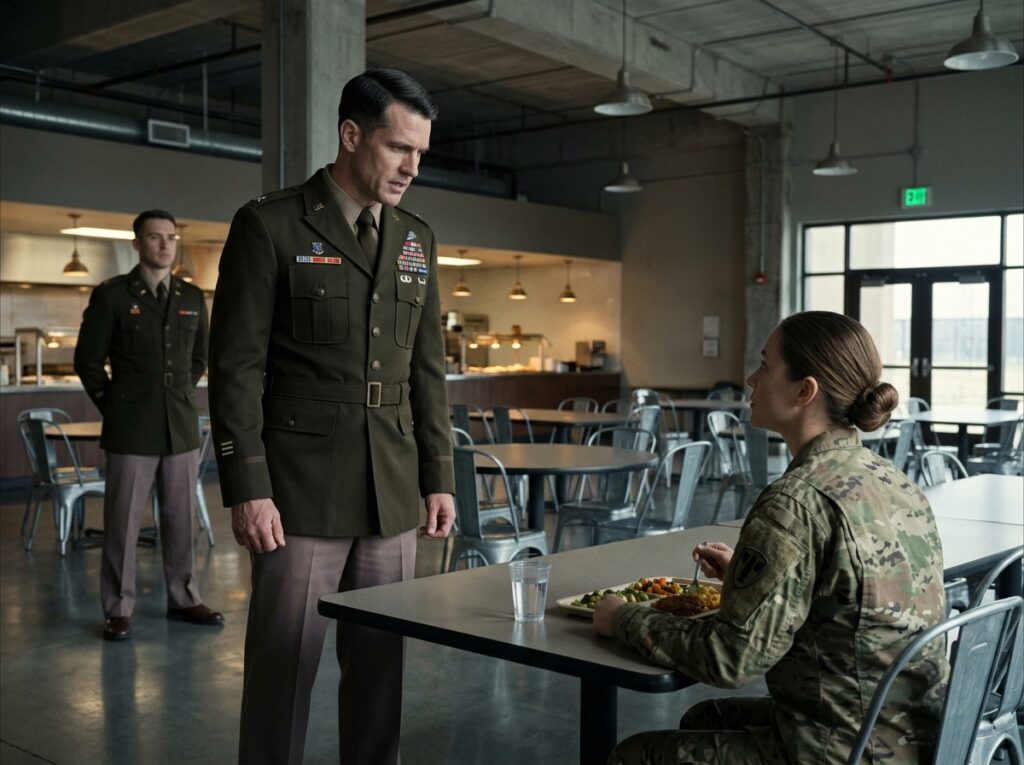
The entire Fort Ridgeline cafeteria went silent when Captain Derek Stone uttered four words that no one expected to hear.
“Get out of that chair.”
Sarah Collins froze for a moment, her fork hovering above her breakfast plate. Around her, coffee machines hissed, trays moved across counters, and service members continued their morning routines as if nothing unusual had happened. But the table suddenly felt different.
It was no longer just a place to eat breakfast. It had become a stage, and everyone nearby knew it. Sarah slowly lowered her fork.
“Why?”
Derek stared at her as though she had asked a question that should never have been spoken aloud. Behind him stood two younger officers, watching with expressions that were almost amused. The captain looked at the empty chairs surrounding Sarah. Then he looked back at her.
“This area is reserved for command officers.”
Sarah glanced around the table.
There was nothing unusual about it. No sign hung above the chairs. No plaque marked the surface. No nameplate separated it from the dozens of identical tables spread throughout the cafeteria. She looked back at Derek.
“I didn’t see anything saying that.”
One of the younger officers exchanged a quick smile with the other. Derek noticed.
For a moment, satisfaction crossed his face. He had an audience now. He seemed to believe that made his position stronger.
“You shouldn’t need a sign.”
Sarah remained seated.
The cafeteria kept moving, but slower. Conversations became quieter. People looked away while still paying attention.
Military communities were built on routine, but they were also built on observation. Everyone noticed when someone crossed a line. Derek stepped closer.
“The problem is knowing where you belong.”
Sarah studied him carefully. She recognized the confidence. She recognized the assumption behind it.
She had seen people confuse rank with respect before. She had watched leaders earn trust through actions and watched others demand obedience because they had the authority to do so. Derek had not yet realized which one he was becoming. Sarah picked up her coffee.
“I’m having breakfast.”
Derek’s expression tightened.
“You heard me.”
“Yes.”
“Then stand up.”
Sarah took one calm sip.
“No.”
The answer was quiet. Not angry. Not insulting. Not challenging. And somehow, that made it worse.
Derek expected embarrassment. He expected her to look around, notice the attention, and decide the easiest path was to leave. Instead, she simply continued sitting. The young lieutenant behind him covered a grin. Not because Sarah was making a joke. He believed he was watching Derek win.
Derek placed one hand on the table.
“You clearly do not understand how things work here.”
Sarah looked at his hand. Then she looked at him.
“I understand perfectly.”
A nearby corporal stopped eating. A civilian employee near the coffee station slowed down while pretending to organize supplies. The atmosphere had shifted. Derek lowered his voice.
“You are making this difficult.”
Sarah looked at the empty chairs around her.
“Are these seats occupied?”
“That is not the point.”
“Then what is the point?”
The question stayed between them. The second officer finally spoke.
“She might be new, Captain.”
Derek did not look away from Sarah.
“That does not excuse ignoring standards.”
Sarah tilted her head slightly.
“Eating breakfast is ignoring standards?”
The lieutenant laughed softly. Derek remained serious.
“You are taking a place meant for people with responsibilities.”
Sarah looked around the cafeteria again. Every table looked the same. Every chair looked the same.
The only difference was the meaning Derek had decided to attach to one of them.
She had spent years watching how small moments revealed larger truths. Not during ceremonies. Not during speeches. During ordinary situations when people believed nobody important was watching. This was one of those moments. Derek reached toward the plastic cup beside Sarah’s tray. Sarah followed his hand with her eyes.
For a second, she assumed he only wanted to move the cup aside. Then his fingers closed around it.
And the entire cafeteria realized they were about to witness something that could not be undone. “Get out of that chair.”
Captain Derek Stone’s voice cut through the Fort Ridgeline cafeteria before Sarah Collins could finish her breakfast. The fork stopped halfway between her plate and her mouth.
Around them, coffee machines hissed, trays moved across counters, and dozens of service members continued their morning routines. The room had not stopped. It was still full of movement, conversation, and the ordinary rhythm of a military morning. But the table suddenly felt like the center of the entire cafeteria.
Sarah slowly lowered her fork.
“Why?”
Derek stared at her as if she had asked the strangest question imaginable. Behind him stood two younger officers, both watching with quiet amusement. The older captain looked at the empty chairs surrounding Sarah, then back at her.
“This area is reserved for command officers.”
Sarah glanced around the table.
“I didn’t see anything saying that.”
The younger lieutenant behind Derek exchanged a quick smile with the officer beside him. Derek noticed. The faint satisfaction in his expression told Sarah that the audience mattered to him.
“You shouldn’t need a sign.”
Sarah remained seated.
The cafeteria continued moving, but more slowly now. People were listening without appearing to listen. Military communities had a way of noticing everything while pretending they noticed nothing. Derek stepped closer.
“The problem is knowing where you belong.”
Sarah studied his expression.
She knew that look. She had seen it in meetings, in training rooms, and in quiet conversations where someone believed a title gave them permission to stop listening. Some people carried authority because they had earned trust. Others carried it because nobody had challenged them yet.
Sarah picked up her coffee.
“I’m having breakfast.”
Derek’s expression tightened.
“You heard me.”
“Yes.”
“Then stand up.”
Sarah took one calm sip.
“No.”
The answer was quiet. It was not aggressive. It was not disrespectful. That was exactly what bothered him.
Derek expected fear. He expected embarrassment. He expected someone who would immediately move once challenged by a captain in uniform. Instead, Sarah simply continued sitting.
The young lieutenant covered a grin. Not because Sarah was entertaining. He was enjoying what he thought was a display of control. Derek placed one hand on the table.
“I understand perfectly.”
A nearby corporal stopped eating. A civilian employee near the coffee station glanced over. Conversations lowered by a few degrees.
Derek noticed the attention, and rather than stepping away, he seemed to settle into it.
“You are making this difficult.”
“Are these seats occupied?”
“That is not the point.”
“Then what is the point?”
For a moment, Derek had no answer ready. The question was simple. That made it harder. The second officer finally spoke.
“She might be new, Captain.”
Derek did not look away from Sarah.
“That does not excuse ignoring standards.”
Sarah tilted her head slightly.
“Eating breakfast is ignoring standards?”
The lieutenant laughed softly. Derek remained serious.
She had spent years studying leadership failures. She knew the moments that revealed people were rarely the dramatic ones. They happened in ordinary situations, when nobody expected consequences.
A person’s character appeared in the small choices they believed nobody would remember. Derek reached toward the plastic cup beside Sarah’s tray. Sarah watched his hand move.
For a brief second, she assumed he intended to move the cup aside. Then his fingers closed around it. The cafeteria changed in an instant. Derek lifted the plastic cup. Cold water spilled across Sarah’s uniform. The room stopped.
The cup struck the table with a sharp sound, and the ice shifted inside the abandoned cup. The conversations disappeared so quickly that even the coffee machines seemed too loud. Sarah did not move.
Water ran down her sleeve. Drops fell onto the floor beneath her chair. Derek looked at her.
“Now do you understand?”
The first lieutenant laughed. His friend joined him. The sound traveled through the silent cafeteria. Sarah slowly reached for a napkin. She wiped the water from her sleeve. Derek watched her carefully. He had expected anger.
He had expected her to shout, to accuse him, to give him the emotional reaction he could point to afterward. Instead, she gave him something far more uncomfortable. Calm.
Sarah continued wiping her uniform while dozens of eyes remained fixed on the table. Some people looked at her with sympathy.
Some looked away because they did not want to admit what they had witnessed. A few looked at Derek differently than they had a minute earlier. The captain had created a public moment.
Now everyone in that cafeteria had to decide what they were going to do with what they had seen.
Sarah folded the wet napkin in her hand and placed it beside her tray. Derek waited. He seemed to believe the next move belonged to him. Sarah finally looked up.
And when she spoke, her voice was quiet enough that only the people closest to the table heard her.
“Captain Stone, I need you to understand something.”
Derek’s face hardened. But Sarah did not look away.
“I am not the person you think you are dealing with.”
The lieutenant behind Derek stopped smiling. For the first time that morning, the captain seemed uncertain. Sarah reached for her coffee cup again. She took another sip, even with water still dripping from her sleeve.
And around them, Fort Ridgeline began to realize that the woman sitting in that chair was not refusing to move because she was stubborn. She was waiting.
The cup lifted from the table.
Sarah watched, still believing for a fraction of a second that Derek was only moving it away. Then the cold water struck her uniform. The sound was small.
A plastic cup. A few pieces of ice. Water hitting fabric and the tabletop. But inside the cafeteria, it landed like a siren. No one moved. Derek released the empty cup and stared at her, waiting. Waiting for anger. Waiting for embarrassment. Waiting for the reaction that would prove he still controlled the moment.
Sarah slowly looked down at the water dripping from her sleeve. Then she looked back at him.
“Now do you understand?” Derek asked.
His voice was quieter than before. That was what made it worse.
Behind him, Lieutenant James shifted uncomfortably. The amusement that had been on his face earlier was gone. He looked at the cup on the table, then at Sarah’s soaked uniform. The cafeteria remained frozen. Sarah reached for a napkin from her tray. She did not shout.
She did not insult him. She simply wiped the water from her sleeve while everyone watched.
Derek’s expression changed slightly. He had prepared himself for a confrontation. He had not prepared himself for silence. The silence made the room remember.
Every person who saw it now carried the same uncomfortable truth: this had happened in front of them. Sarah folded the wet napkin and placed it beside her tray.
“Captain,” she said calmly, “we need to talk about what just happened.”
Derek straightened. For the first time, uncertainty crossed his face.
“You should think carefully before making this bigger than it is.”
Sarah held his gaze.
“I think it already became bigger when you picked up that cup.”
A few feet away, the corporal who had stopped eating looked down at his tray. The civilian employee near the coffee station quietly stepped away, pretending to return to work. Derek looked around and noticed the eyes on him.
The audience he had wanted was no longer giving him the reaction he expected.
“Lieutenant,” he said sharply.
James immediately looked up.
“Come with me.”
The order was clear. Escape the room. End the moment. James hesitated. Just for a second. That second was enough for Sarah to notice.
Derek walked away from the table, expecting James to follow. James did, but slower than usual. Neither man spoke until they reached the hallway outside the cafeteria. Derek stopped and lowered his voice.
“You saw what happened.”
James looked back through the cafeteria doors. Sarah was still seated at the table, finishing the process of cleaning herself while people quietly returned to their breakfasts.
“Yes, sir.”
“Then you understand this was a misunderstanding.”
James looked at him. A misunderstanding. That word felt heavier than it should have.
“Sir…”
Derek waited. James swallowed.
“I saw the cup.”
The captain’s expression hardened.
“And?”
James knew what Derek wanted. He wanted agreement. He wanted the story shaped before anyone else could tell it. But James had also seen Sarah’s face afterward. She had not looked defeated. She had looked like someone who had already decided what came next.
“I saw everything,” James finally said.
Derek stared at him.
For the first time that morning, the captain seemed to realize the problem was no longer the chair. It was the witnesses.
And one of them was no longer certain he wanted to protect him.
The words stayed with the people closest to the table long after Sarah stopped speaking.
Derek looked around the cafeteria, searching for the same certainty he had carried in with him. A few minutes earlier, he had expected everyone to see a subordinate being corrected by a superior officer. Instead, they had seen something else.
They had seen a captain spill a drink on someone who refused to be intimidated. Derek straightened his uniform and took a step back.
“This conversation is over,” he said.
His voice was firm, but it lacked the confidence it had before. Sarah watched him carefully.
“No, Captain,” she replied. “The conversation is just moving somewhere more appropriate.”
For the first time, he seemed unsure which side of the moment he was supposed to stand on. Derek noticed the hesitation.
“Lieutenant, come with me.”
James immediately followed.
As the two officers walked away from the table, the cafeteria slowly returned to motion. Trays began moving again. Conversations restarted in low voices. The coffee machines continued their steady hiss. But the story had already begun spreading.
By the time Sarah entered the administrative building an hour later, people she had never met already knew something had happened. She did not hear rumors directly. She did not ask for them. She simply noticed the way conversations stopped when she passed. The way people looked at her, then quickly looked away.
Sarah had spent enough time around military organizations to understand that silence was rarely empty. Sometimes silence meant uncertainty. Sometimes it meant fear.
And sometimes it meant people were deciding whether the truth was worth saying out loud.
At the office of command review, Sarah sat across from Major Elaine Porter, who listened without interrupting as Sarah explained what happened. She did not exaggerate. She did not describe Derek’s attitude with dramatic words. She described actions. The order to leave. The lack of any posted restriction.
The refusal to accept a reasonable question. The cup being lifted. The water being spilled. When Sarah finished, Major Porter remained quiet for several seconds.
“Did Captain Stone apologize?” she asked.
“No.”
“Did anyone intervene?”
“No.”
“Did anyone threaten you after the incident?”
Sarah shook her head.
“No. But that is not the issue.”
Major Porter leaned forward slightly.
“Then what is?”
Sarah looked through the office window toward the distant cafeteria building.
“The issue is what people believe they are allowed to do when nobody stops them.”
Before Major Porter could answer, the office phone rang. A few minutes later, another report arrived. Then another. Not about the cafeteria table. Not yet. But about Captain Derek Stone. Small incidents. A training schedule changed without explanation. A junior service member publicly corrected and embarrassed during a briefing.
A request denied without proper review because Derek claimed his rank made the decision unnecessary. Nothing large enough to create a formal complaint. Nothing dramatic enough to force action.
Just repeated moments where people had walked away uncomfortable and convinced themselves it was easier to stay quiet. Meanwhile, Derek was already working to control the story.
Inside his office, he spoke with two senior officers and described the cafeteria incident as a misunderstanding caused by a new arrival who did not understand command structure.
“She challenged a direct instruction,” Derek said.
Lieutenant James stood near the door, listening. Derek continued.
“She made it public.”
James looked down. Because he knew that was not what happened. He had watched Sarah ask questions.
He had watched Derek create the audience he later blamed her for having.
“Captain,” James finally said, “she did not raise her voice.”
Derek turned toward him.
“What did you say?”
James hesitated.
“She was calm.”
The room became quiet. Derek stared at him.
“You were laughing.”
James looked uncomfortable.
“Yes.”
“And now you are concerned?”
James had no answer. Because the truth was beginning to bother him. He had not laughed because Sarah was wrong. He had laughed because he thought Derek was untouchable. Later that afternoon, Sarah received a message requesting a follow-up meeting. But before she left her office, another person appeared at the doorway.
A corporal from the cafeteria. He stood there holding his cap in both hands.
“Ma’am,” he said quietly, “I saw what happened.”
Sarah looked at him. The corporal swallowed.
“I should have said something.”
Sarah did not answer immediately. Because she understood what was happening.
The moment Derek created was no longer only about one chair or one cup of water.
People were beginning to decide whether staying silent was still easier than telling the truth.
Derek’s eyes narrowed.
“What exactly is that supposed to mean?” he asked.
The question sounded controlled, but the confidence behind it had weakened. The room had changed. A few minutes earlier, he had been the person everyone expected to obey. Now he was the person everyone was watching. Sarah set her coffee down carefully.
“It means I know the difference between a regulation and someone’s personal preference.”
Lieutenant James shifted behind him.
“Captain,” he said quietly, “maybe we should just let this go.”
Derek turned slightly.
The movement was small, but everyone near the table noticed it. James had spent the entire exchange standing behind Derek, smiling when he thought the captain was proving a point. Now he was the first person suggesting that the point had gone too far. Derek looked back at Sarah.
“You’re threatening me?”
Sarah shook her head.
“No.”
She looked down at the wet sleeve of her uniform, then back at him.
“I’m telling you that this conversation is no longer about a chair.”
For a moment, nobody spoke. The sentence landed harder than an argument would have. Derek opened his mouth, but before he could respond, Sarah stood up. Not because he ordered her to. Because she had decided the conversation at the table was over.
She picked up her tray and moved it to the side, leaving the chair empty. The same chair Derek had demanded she leave only minutes before. But now it was her choice. The distinction was obvious to everyone watching.
Sarah walked toward the exit of the cafeteria without rushing. She did not look back. The room slowly returned to motion, but the whispers began almost immediately.
“What happened?”
“Did he really pour that on her?”
“Did anyone report it?”
Derek remained standing beside the table, his hand still resting on the edge where the cup had fallen. Lieutenant James watched Sarah disappear through the doorway.
“She didn’t even get angry,” he said.
Derek gave him a sharp look.
“Be careful, Lieutenant.”
James lowered his eyes. But the warning did not erase what he had seen.
Later that morning, Sarah sat alone in a small office near the administrative wing. Her uniform had dried, but the stain from the water remained visible. Across from her sat a blank incident report form. For several minutes, she did not write anything. She knew what would happen next.
People would choose sides before they knew the facts. Some would say Derek was enforcing standards. Some would say she should have avoided the situation. Others would pretend they had seen nothing at all. That was how these moments survived. Not because nobody noticed. Because people convinced themselves it was easier not to speak.
Sarah picked up the pen. At the top of the form, she wrote one sentence:
“Captain Derek Stone used his position to force compliance where no standard existed.”
She paused, then continued documenting every detail. The time. The location. The witnesses. The exact words spoken. Meanwhile, inside the command office, Derek was already telling his version.
He stood across from another senior officer with his uniform perfectly arranged and his voice calm.
“There was a misunderstanding,” Derek said. “A new person challenged a simple command decision.”
He did not mention the cup first. He did not mention the silence that followed.
He did not mention Sarah remaining calm while he lost control of the room. He described a disagreement. He described a misunderstanding. He described himself as the person trying to maintain order. And because he was Captain Derek Stone, people listened.
But outside that office, Lieutenant James stood in the hallway, replaying the moment again and again. The smile he had worn earlier was gone.
For the first time, he wondered if he had been watching leadership fail right in front of him and mistaken it for authority. By the end of the day, Sarah’s report had entered the system.
And Derek realized the cafeteria table was no longer just a place where he had tried to prove his power.
It had become the place where everyone would remember what happened when someone finally refused to move.
The report moved quietly at first.
There were no announcements. No dramatic confrontation. No immediate judgment handed down in the hallway. That was how Sarah wanted it.
She had not filed the complaint to embarrass Derek. She had filed it because standards only mattered when they applied to everyone.
Over the next several days, investigators began reviewing the details. They spoke with the people who had been in the cafeteria that morning. They checked the security footage. They compared statements. At first, many people gave careful answers.
They remembered the water.
They remembered the silence.
They remembered Derek standing over Sarah while she stayed seated.
But when asked whether they had seen anything similar before, the room changed. A corporal who had been eating nearby looked down at his hands.
“There were other things,” he finally admitted.
The investigator looked up from the notes.
“What kind of things?”
The corporal hesitated.
“Small things.”
But small things had a way of becoming patterns.
A junior officer described how Derek had once moved a training schedule without explanation, then blamed the confusion on the people who followed the original instructions.
A maintenance worker explained how Derek regularly used his rank to skip normal procedures that everyone else was required to follow. None of those moments alone had seemed important enough to challenge. That was what made them dangerous. They had become normal.
Meanwhile, Lieutenant James sat across from the investigation team with a statement he had rewritten three times before finally signing it.
“I laughed,” he said quietly.
The investigator waited. James swallowed.
“I thought it was funny because I thought Captain Stone was proving a point.”
He looked at the table between them.
“I didn’t realize the point was that he believed nobody would stop him.”
The statement stayed with him long after the interview ended.
Across the base, Sarah continued her duties without discussing the investigation. Some people expected her to enjoy the attention or use the situation to gain influence. Instead, she did the opposite. She kept showing up. She kept working. And that made people even more curious about who she really was.
Eventually, one of the investigators asked her directly.
“Why didn’t you move?”
Sarah looked through the office window toward the training fields outside.
“Because the question was never about a chair,” she said.
The investigator waited for more. Sarah continued.
“It was about whether the rules mean anything when the person enforcing them believes they are above them.”
The answer revealed something Derek had not expected. Sarah was not simply another service member caught in an argument. Her presence at Fort Ridgeline had a purpose.
She had been studying leadership failures and command culture for months, observing how authority was used when nobody thought anyone was watching. And now, the cafeteria incident had provided something impossible to ignore. A clear moment. A clear choice. And a growing list of people who were finally ready to speak.
By the end of the week, the investigation file on Captain Derek Stone contained far more than one spilled cup of water. It contained a pattern.
And for the first time, Derek could no longer control the story by simply being the highest-ranking person in the room.
The command review began three days later in a small conference room inside Fort Ridgeline headquarters.
For the first time since the cafeteria incident, Captain Derek Stone was not the person controlling the room.
He sat across from a panel of senior officers with his hands folded on the table. The confidence he usually carried into every conversation was still there, but it looked different now. It no longer filled the room. A folder rested in front of the lead investigator.
Inside were statements. Not rumors. Not assumptions. Statements.
The corporal who had stopped eating during the confrontation had submitted one. The civilian employee near the coffee station had submitted another. Several service members had come forward with memories they had previously dismissed as small incidents. A training request denied without explanation.
A junior officer publicly corrected for a mistake that had not been his.
A maintenance worker ordered to redo a task simply because Derek disliked being questioned. None of the moments alone seemed large enough to challenge a captain. Together, they told a different story. The investigator placed the reports on the table.
“Captain Stone, do you recognize these incidents?”
Derek looked down at the pages.
“Some of them.”
“Do you believe your actions were appropriate?”
Derek leaned back slightly.
“I maintained standards.”
The investigator did not react.
“Standards require written expectations, consistent enforcement, and accountability. Several witnesses describe something different.”
Derek’s jaw tightened. Across the room, Lieutenant James sat quietly.
He had not spoken much during the first meetings. Every time someone mentioned the cafeteria, his eyes lowered. Because he remembered his smile. He remembered standing behind Derek and enjoying the moment. At the time, he had thought he was watching someone demonstrate authority. Now he understood he had been watching someone misuse it.
The investigator turned toward him.
“Lieutenant James, you were present during the cafeteria incident. Is there anything in your statement you would like to clarify?”
James swallowed. The room waited.
“I laughed,” he said quietly.
Derek looked at him.
“Lieutenant—”
James continued before he could finish.
“I laughed because I thought Captain Stone was making a point.”
His voice became heavier.
“But I was wrong.”
Nobody moved.
“I saw her sitting there. I saw him standing over her. I saw everyone watching. And instead of asking if it was right, I was entertained by it.”
Derek looked away.
For the first time, the people around him were not treating him like the person with the answer. They were treating him like someone who needed to answer.
The investigation continued through the afternoon. Witness after witness described the same pattern: Derek expected obedience before respect, compliance before understanding. But the cafeteria incident remained the moment everyone returned to. Because that was where the difference became visible. A leader could have explained a rule.
A leader could have asked a question. A leader could have corrected a misunderstanding. Derek had chosen humiliation instead.
When the final witness left the room, the lead investigator closed the folder.
“Captain Stone, your actions on that day will be considered alongside the full record. This review is no longer about one table.”
Derek stared forward.
“It never was,” he said.
But the words sounded different coming from him. Not like a defense. Like a realization.
Outside the headquarters building, Sarah walked past the training fields as the afternoon sun moved lower across the base. A few service members greeted her. Others simply nodded. The atmosphere around her had changed. People were no longer watching to see what she would do next.
They were watching because they had finally decided to do something themselves. Inside the review room, Derek received the next notice. The command board had reached its preliminary decision. His position was no longer protected by his rank.
And for the first time in years, Captain Derek Stone had to face a question he had always demanded others answer. Did he actually understand what leadership meant?
Three days later, the answer arrived in the command briefing room.
Sarah sat across from the review board with a folder closed in front of her. Derek stood near the window, no longer at the head of the room. His uniform was the same, but the confidence behind it had changed. The commanding officer placed a document on the table.
“Captain Stone, the board has completed its review.”
Derek looked up.
“Based on the cafeteria incident, witness statements, and the previous complaints confirmed during this investigation, your command authority at Fort Ridgeline is being removed effective immediately.”
The room stayed quiet. Derek swallowed.
“My entire career is being decided over a chair?”
Sarah looked at him.
“No,” she said. “It was never about the chair.”
Derek turned toward her.
“Then what was it about?”
Sarah opened the folder for the first time. Inside were her official assignment papers.
“I was sent here to evaluate leadership culture at Fort Ridgeline.”
Derek stared at her. The commanding officer continued.
“Sarah Collins is part of a leadership standards review team. Her assignment was to observe how authority was used in daily situations, not just during formal evaluations.”
Derek looked back at the papers.
“You knew this entire time?”
“I knew what I was there to study,” Sarah replied. “I did not know what I would find.”
The room remained still. Sarah closed the folder.
“The moment mattered because it was ordinary. No ceremony. No cameras. No prepared speech. Just a person deciding what they believed they were allowed to do when they thought nobody would challenge them.”
Derek looked away. For once, he had no audience to impress.
Lieutenant James sat outside the briefing room when Sarah walked past. He stood quickly.
“Sarah.”
She stopped. He looked uncomfortable.
“I should have said something that day.”
Sarah studied him.
“Yes,” she said quietly. “You should have.”
James nodded, accepting the answer.
“But you did eventually,” she added.
The lieutenant looked up.
“Does that matter?”
“It matters what you do after you realize you were wrong.”
Later that morning, the cafeteria returned to its normal rhythm.
Coffee machines hissed. Trays moved across counters. Service members filled the tables again. But the table in the center of the room was different. There was no sign claiming ownership. No reserved marker. No special nameplate.
A young service member approached it hesitantly, looking around as if expecting someone to stop them. Sarah, passing by with her breakfast tray, noticed. She placed her tray on the table and sat down. The service member smiled and took the seat across from her. No one ordered anyone away.
No one asked who belonged there.
On the empty space where the plastic cup had once fallen, Sarah placed a small card from the leadership office. It contained only one sentence:
“Respect is earned through actions.”





