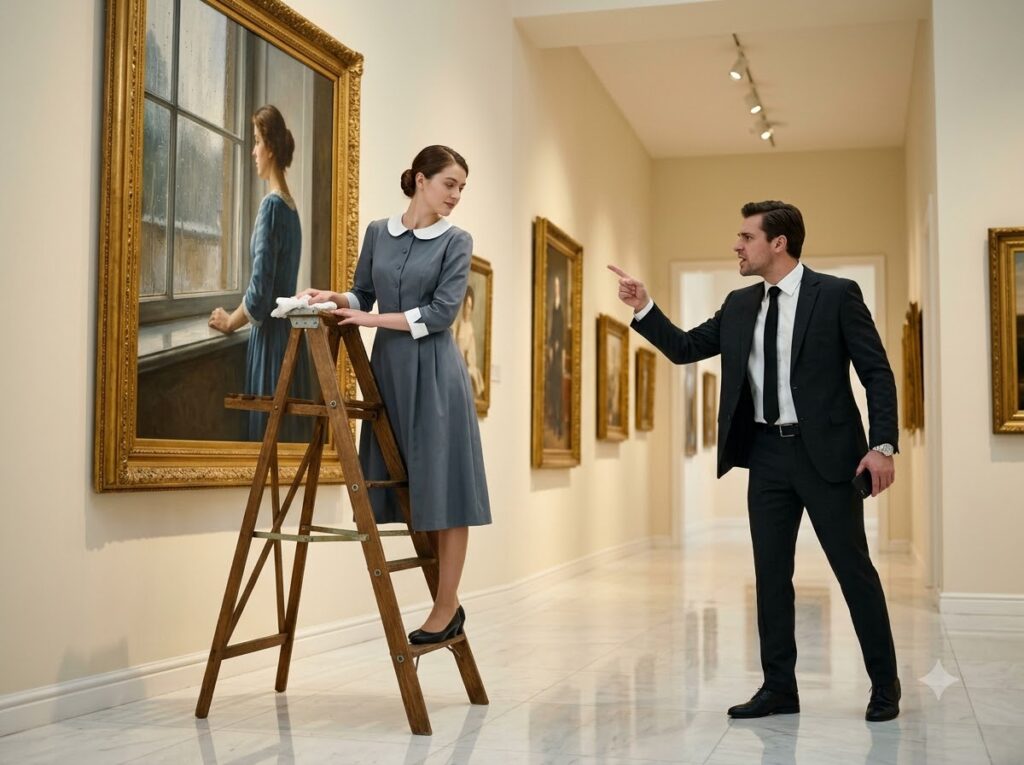
The billionaire laughed at the cleaning woman for touching his most valuable painting.
Ten seconds later, he was no longer laughing.
“Careful with that!”
Julian Blackwood’s voice sliced through the golden stillness of his private gallery. His polished shoes struck the marble floor as he marched toward the ladder, every step carrying the authority of a man accustomed to being obeyed.
“That painting is worth more than your entire yearly salary.”
The woman standing halfway up the ladder froze with a white dusting cloth in her hand.
Her name was Lila Thorne, though Julian did not know that.
To him, she was simply part of the machinery that kept his estate immaculate—a quiet cleaner in a plain gray uniform who polished the floors, emptied the silver wastebaskets, and disappeared before senators, investors, and foreign dignitaries arrived.
He had passed her dozens of times.
He had never once asked her name.
But Lila knew exactly what she was touching.
She slowly turned toward him.
Afternoon sunlight poured through the tall gallery windows, surrounding her with drifting particles of dust. Behind her hung The Silent Echo, a haunting portrait of a sorrowful woman standing beside a rain-streaked window. The woman’s face was turned toward fading blue light, her eyes carrying a grief so profound that strangers often looked away before they understood why they were crying.
Julian had paid twelve million dollars for it.
He had called it the crown jewel of his collection.
Lila called it something else.
Her last goodbye to her father.
“Do you even know what that is?” Julian demanded.
Lila descended one rung.
“Yes,” she said quietly. “I know what it is.”
“Then act like it.”
She reached the marble floor and stood before him, still holding the cloth.
Julian towered over her in his tailored charcoal suit. His silver watch alone probably cost more than everything Lila owned. His expression held the familiar mixture she had seen in wealthy homes for years—impatience wrapped in certainty, contempt softened only by the assumption that the person beneath it would never answer back.
Lila looked past him at the painting.
She remembered mixing the twilight blue in the corner. She remembered painting the woman’s eyes after crying until her own vision blurred. She remembered her father’s hand trembling as he touched the unfinished canvas.
“Paint the truth,” he had whispered. “Not what people want to see. Paint what they are afraid to feel.”
Then she looked directly at Julian.
“I painted it,” she said. “When I was sixteen.”
The color vanished from his face.
For several seconds, he did not speak.
He looked at Lila.
Then at the painting.
Then back at the cleaner in the gray uniform.
A short laugh escaped him, but there was no humor in it.
“That isn’t possible.”
“It is.”
“This painting is attributed to Matthias Varen.”
“There was never a Matthias Varen.”
Julian’s jaw tightened.
“Do you understand what you’re claiming?”
“I understand better than anyone.”
“You’re saying that a masterpiece authenticated by three international experts was created by a teenage girl in a one-bedroom apartment?”
“Yes.”
“And then you became a cleaner?”
The question was meant to expose the absurdity of her story.
Instead, Lila’s face became very still.
“Three weeks after I finished it, my father died. I sold the painting to pay the hospital bills and keep our apartment for another month.”
Julian stared at her as though she had begun speaking another language.
Before he could respond, voices drifted from the corridor.
The doors to the Grand Gallery opened.
A silver-haired woman entered first, followed by six elegantly dressed guests. Behind them walked Sebastian Creel, Julian’s longtime art adviser—a narrow man in his late fifties with carefully styled gray hair, a burgundy tie, and the smooth confidence of someone who had spent his life deciding what other people should believe.
The evening’s private reception was beginning earlier than expected.
Dr. Mara Ellison, director of the New York Institute of Fine Arts, smiled as she approached.
“Julian, I hope we’re not intruding. Sebastian insisted we see the Varen before dinner.”
Her gaze moved to Lila and the ladder.
Julian remained silent.
Sebastian stepped forward, his expression shifting the instant he saw the cleaner standing beside the painting.
For one fraction of a second, fear passed through his eyes.
Lila saw it.
Then it disappeared behind a polished smile.
“Is there a problem?” he asked.
Lila’s fingers tightened around the cloth.
She knew that voice.
Twelve years had passed since she heard it in the cramped office of a failing neighborhood gallery, but she remembered every word.
It may find a small audience someday.
He had been younger then. His hair had been dark, his glasses thicker, his suit cheaper. But there was no mistaking the small crescent-shaped scar beneath his right ear.
Sebastian Creel was the man who had bought her painting for eight hundred dollars.
“You,” Lila whispered.
Sebastian’s smile did not move.
“I’m sorry?”
“You bought it.”
The guests turned toward him.
Julian’s eyes narrowed. “Sebastian?”
“I have never met this woman.”
Lila stepped closer.
“You called yourself Simon Crane. You worked out of the Bellweather Gallery on Mercer Street. The office smelled like turpentine and cigarettes. You gave me eight hundred dollars in an envelope and said my painting might find a small audience one day.”
Sebastian chuckled softly.
“This is becoming embarrassing.”
“For whom?”
His smile sharpened.
“For you, I’m afraid.”
Julian looked between them. “Lila, do you have proof?”
It was the first time he had spoken her name.
She noticed.
So did he.
Lila turned toward The Silent Echo.
“In the lower-left corner, beneath the blue glaze, there is a fingerprint.”
Sebastian’s expression changed.
“It belongs to me,” she continued. “I touched the canvas before the paint dried. My father tried to repair it, but the ridge pattern remained under the final layer.”
Dr. Ellison stepped closer to the painting.
“That could be examined.”
“There is also a thin crescent of raw canvas beneath the inner frame,” Lila said. “I cut the linen too short because it was the first large canvas I had ever stretched by myself.”
Julian glanced at Sebastian.
The art adviser spread his hands.
“Anyone could invent details that cannot be checked without removing the frame.”
Lila ignored him.
“The blue pigment in the window is wrong for a nineteenth-century European painting. It contains synthetic phthalocyanine blue mixed with cheap student-grade ivory black. I couldn’t afford cobalt.”
Dr. Ellison’s face had gone pale.
She turned toward Julian.
“Do you have the conservation report?”
“In my office.”
“I want to see it.”
Sebastian intervened. “Mara, surely we are not going to disrupt an important evening because a member of the cleaning staff has invented a fantasy.”
The words hung in the room.
Lila looked at him.
She had been dismissed before. Mocked before. Spoken over by people who assumed poverty had erased intelligence from her face.
But never by the man who had stolen the grief from her hands and transformed it into his fortune.
“You changed the title,” she said.
Sebastian’s nostrils flared.
“What?”
“I called it The Silent Echo. That title appeared nowhere on the canvas and nowhere on the receipt you gave me. Yet when it surfaced in Europe three years later, it had the same title.”
No one spoke.
Lila’s voice remained calm.
“You could forge the artist. You could forge the history. But you kept my title because you were never creative enough to invent your own.”
Dr. Ellison slowly removed her glasses.
Julian’s gaze hardened as it settled on Sebastian.
“Tell me she’s wrong.”
Sebastian’s smile disappeared.
“She is confused.”
“Tell me why the title remained the same.”
“I don’t know.”
“You handled the acquisition.”
“I handled hundreds of acquisitions.”
“This one cost me twelve million dollars.”
“And it remains worth every cent.”
“That is not the question.”
One of the guests moved toward the door, but Julian raised his hand.
“No one leaves.”
The atmosphere changed instantly.
Julian Blackwood might have been arrogant, but he had not built a global investment empire by ignoring danger once he recognized it.
He crossed the gallery and pressed a discreet panel beside the doorway.
The doors locked with a quiet metallic click.
Sebastian stared at him.
“Julian, don’t be theatrical.”
“You brought this painting into my house. You presented its provenance. You recommended the experts.”
“All of whom authenticated it.”
Julian looked at Dr. Ellison. “Can we examine it tonight?”
“Yes.”
“How quickly?”
“A preliminary ultraviolet inspection can be done immediately if your conservation room is equipped.”
“It is.”
Sebastian laughed again, though sweat had appeared near his temple.
“This is madness.”
Julian turned to Lila.
“What exactly will we find?”
She looked up at the woman in the painting.
“My initials.”
Sebastian’s hand moved toward his pocket.
Julian noticed.
“So help me,” Julian said softly, “if you touch your phone, security will remove it from your hand.”
Sebastian’s fingers stopped.
Within fifteen minutes, the Grand Gallery had been transformed.
The guests were moved behind a velvet barrier while Julian’s private conservator, Helen Ward, arrived carrying portable ultraviolet equipment. Two security guards remained near the doors.
Lila stood at the edge of the room, suddenly aware of her uniform, her worn shoes, and the dust cloth still clenched in her hand.
Julian approached her.
“If this is a lie,” he said, keeping his voice low, “you understand there will be consequences.”
Lila met his eyes.
“There already were.”
Something in her answer silenced him.
The gallery lights dimmed.
Ultraviolet illumination passed over the painting.
The dark surface bloomed with ghostly violet patches where varnish and restoration materials reacted. Dr. Ellison leaned closer. Helen guided the light downward, examining the layered glazes.
At first, there was nothing.
Sebastian’s confidence returned.
Then Helen stopped near the lower-left corner.
“Wait.”
Julian stepped forward.
“What is it?”
“There’s an interruption beneath the surface.”
She adjusted the light.
A faint mark appeared under the blue-black paint.
Two letters.
Almost invisible.
L.T.
Beneath them was a date from twelve years earlier.
A collective breath moved through the gallery.
Julian did not blink.
Sebastian spoke first.
“Those could have been added during a later restoration.”
Helen shook her head.
“They are beneath the original paint layer.”
“That’s impossible.”
“No,” Lila said. “It isn’t.”
Helen examined the left edge of the canvas.
“There’s exposed linen beneath the frame. A crescent-shaped gap.”
Dr. Ellison looked at Sebastian with open disbelief.
He backed away.
“This proves nothing about authorship. The girl may have worked in the studio of the true artist.”
“I was sixteen,” Lila said. “There was no studio.”
“You expect us to accept that you created one of the most emotionally sophisticated portraits of the modern era as a child?”
Lila’s eyes flashed.
“No. I expect you to accept evidence.”
Julian walked to the center of the gallery.
His entire collection surrounded him—paintings he had used to impress kings, rivals, politicians, and women whose names he no longer remembered.
For the first time, those objects did not look like symbols of victory.
They looked like witnesses.
“How much did you pay her?” he asked Sebastian.
“I told you, I never met her.”
“Eight hundred dollars,” Lila answered.
Julian turned.
“You paid eight hundred dollars for a painting you later sold into the European market under a false identity?”
Sebastian’s face hardened.
“You have no record of that.”
“I have the receipt.”
Lila’s declaration stunned even Sebastian.
She had kept the faded paper through twelve years of eviction notices, temporary rooms, failed job applications, and nights when she had considered burning every reminder of the girl she used to be.
The receipt was folded inside her father’s old sketchbook, locked in a metal box beneath her bed.
Sebastian recovered quickly.
“A receipt from a nonexistent gallery signed by an alias proves nothing.”
“It proves fraud,” Dr. Ellison said.
“It proves she sold a painting to someone.”
“It bears the title,” Lila replied. “And the dimensions.”
Julian faced Sebastian.
“You told me the painting had remained in a Belgian family collection since 1894.”
“It had.”
“The paint contains modern synthetic pigment.”
“Restoration.”
“The initials are beneath the original layer.”
“A studio assistant.”
“The title appears on a receipt from twelve years ago.”
Sebastian’s control finally cracked.
“You’re letting a cleaner manipulate you.”
The insult echoed through the gallery.
Julian’s expression became cold enough to silence the room.
“No,” he said. “I’m listening to the only person here whose story is supported by the painting.”
Sebastian looked as if Julian had struck him.
Julian ordered security to take his phone and escort him to the library until the authorities could be contacted.
As the guards approached, Sebastian turned toward Lila.
The hatred in his face was no longer hidden.
“You have no idea what you’re doing.”
Lila’s heart pounded, but she did not step back.
“I’m telling the truth.”
“You think truth protects people?”
“No.”
She glanced at the portrait.
“But silence didn’t protect my father.”
Something changed in Sebastian’s eyes.
Not anger.
Recognition.
Then the guards took him away.
By midnight, Julian’s reception had collapsed into controlled chaos.
His attorneys arrived. So did representatives from his insurance company and two detectives specializing in art fraud. Guests surrendered their phones temporarily while Julian’s staff attempted to prevent rumors from escaping the estate.
They failed.
By one in the morning, a journalist had posted that the famous Blackwood Varen might be a modern forgery painted by an unidentified domestic worker.
By two, the story was spreading internationally.
Lila sat alone in the servants’ kitchen, still wearing her uniform.
No one had told her to leave.
No one had told her to stay.
She stared at a cup of tea that had long since gone cold.
The door opened.
Julian entered without his jacket or tie. The top button of his white shirt was undone, and exhaustion had softened the harsh lines of his face.
For the first time, he looked less like the owner of everything around him and more like a man who had discovered ownership was an illusion.
He sat across from her.
“You were telling the truth.”
Lila said nothing.
“I owe you an apology.”
“Yes.”
The direct answer surprised him.
Most people rushed to protect Julian from discomfort. They accepted incomplete apologies, laughed at jokes they disliked, and pretended his cruelty was confidence because his name appeared on buildings.
Lila did none of those things.
He leaned back.
“I humiliated you.”
“Yes.”
“I judged you by your uniform.”
“Yes.”
His mouth tightened. “Do you plan to make me list every failure?”
“I think you know them.”
Silence settled between them.
Julian studied her face.
“Why didn’t you come forward when you first saw the painting?”
“Who would have believed me?”
“I might have.”
“You didn’t believe me when I told you while standing in front of it.”
He looked away.
That answer landed more deeply than the others.
Lila wrapped her hands around the cold cup.
“I had spent years trying to prove what happened. The Bellweather Gallery disappeared. Simon Crane never existed. The address became a restaurant. Every letter I sent to auction houses was ignored.”
“You contacted auction houses?”
“Seven.”
“And?”
“Two sent automated replies. One threatened legal action if I continued making fraudulent claims. The others said nothing.”
Julian’s face darkened.
“Why become a cleaner?”
“I didn’t become one because I lacked ambition.”
“I didn’t mean—”
“Yes, you did.”
He fell silent.
Lila looked toward the narrow kitchen window.
“I received a scholarship to an art academy after my father died. It covered tuition, not rent or food. I worked nights. Then the scholarship board learned I had accused respected dealers of theft. Someone called me unstable. The funding disappeared.”
“Sebastian?”
“I could never prove it.”
“You think he ruined your career.”
“I think he made sure I never had one.”
Julian’s expression hardened.
“What else did your father know?”
The question made Lila look up.
“What do you mean?”
“When Sebastian warned you, you mentioned your father’s silence.”
“He taught me not to mistake silence for safety.”
“That isn’t what you said.”
She replayed the confrontation in her mind.
Sebastian’s reaction had been strange.
Too immediate.
As though he had known her father.
Lila felt a chill.
“My father worked as a painter and occasional restorer,” she said. “He repaired damaged canvases for small galleries. He never had important clients.”
“What was his name?”
“Elias Thorne.”
Julian’s face went blank.
The refrigerator hummed.
Somewhere beyond the kitchen, a clock struck two.
“What?” Lila asked.
Julian stood so abruptly that the chair scraped the floor.
“Come with me.”
He led her through the sleeping mansion and into his father’s former study, a room no member of the cleaning staff was normally permitted to enter.
Dark wood shelves climbed to the ceiling. Old financial ledgers stood behind glass. A portrait of Arthur Blackwood hung above the fireplace—a broad-shouldered man with Julian’s severe expression and none of his uncertainty.
Julian opened a locked cabinet and removed a leather album.
“My mother collected photographs of artists,” he said. “Before she died.”
Lila watched his hands turn the pages.
“Your mother was interested in art?”
“She was the only person in my family who actually loved it.”
He stopped.
A black-and-white photograph showed a young man standing beside a damaged Renaissance panel. His sleeves were rolled to the elbows. Paint stained his hands. Though younger and healthier, his face was unmistakable.
Lila touched the page.
“My father.”
Beneath the photograph, written in elegant blue ink, were four words:
Elias understands what others hide.
The handwriting belonged to Julian’s mother.
Lila looked at him.
“You knew him?”
“No. My mother did.”
“What was her name?”
“Celeste Blackwood.”
The name stirred something in Lila’s memory.
Not a person.
A sound.
She had heard her father whisper it during the last week of his life while fever twisted his dreams.
Celeste, forgive me.
At the time, Lila assumed he was speaking to her dead mother, though he had always told her that her mother’s name was Anne.
“My father knew your mother,” she said.
Julian turned another page.
Several photographs were missing. Only pale corners remained where they had once been attached.
“My mother died when I was twelve,” he said. “A car went off a cliff during a storm. They never recovered her body.”
Lila stared at him.
“What year?”
He told her.
It was the year before Lila was born.
A faint pressure began behind her ribs.
Julian closed the album.
“Your painting,” he said, “looks like her.”
The words seemed to alter the air in the room.
Lila shook her head.
“I never met your mother.”
“Are you certain?”
“I painted the woman from an old photograph my father gave me.”
“What photograph?”
“A blurred picture of a woman beside a window. He said he found it in a box of discarded studies.”
“Do you still have it?”
“It may be in his sketchbook.”
Julian retrieved his keys.
“We’re going to your apartment.”
“At two in the morning?”
“If Sebastian Creel knew your father, and if your father possessed a photograph of my mother after she supposedly died, we cannot assume your belongings are safe.”
Lila almost refused.
Then she remembered Sebastian’s face when she mentioned Elias.
Twenty minutes later, Julian’s car sped through the sleeping city.
They arrived to find Lila’s apartment door open.
The lock had been broken.
She rushed inside.
Her small living room had been torn apart. Drawers lay overturned. Books had been thrown onto the floor. The mattress had been slashed open, and the metal box beneath the bed was gone.
“My sketchbook,” she whispered.
Julian called security.
Lila moved through the wreckage, shaking.
The apartment contained no jewelry, no expensive electronics, nothing a normal thief would want.
Only memories.
Her father’s brushes had been snapped.
His letters were scattered across the floor.
One unfinished portrait had been cut through the face.
She crouched and lifted a broken wooden paint box.
Julian stood behind her.
“I’m sorry.”
“Stop saying that.”
His expression tightened.
“I don’t know what else to say.”
“Then help me find who did this.”
Sirens sounded outside.
Julian knelt beside her, ignoring the dust on his trousers.
“We will.”
It was the first promise he made her that she believed.
Sebastian Creel disappeared before the police reached the Blackwood estate.
The guards stationed outside the library claimed they had heard glass breaking near the east wing. When they investigated, Sebastian escaped through a concealed service corridor known only to senior staff and family.
His confiscated phone contained nothing useful.
Every message had been remotely erased.
By morning, his accounts were empty.
His penthouse was abandoned.
But he had made one mistake.
A traffic camera captured a dark sedan leaving Lila’s neighborhood eleven minutes before Julian arrived. The vehicle belonged to a shell company connected to an art storage facility Sebastian had used for years.
Julian’s legal team urged him to distance himself from Lila.
His public-relations advisers recommended describing the painting as a sophisticated forgery and presenting Julian as another victim.
His board wanted him to deny any knowledge of Sebastian’s activities.
Julian rejected all three suggestions.
At a press conference that afternoon, he stood before dozens of cameras and made a statement that stunned the financial and art worlds.
“Preliminary evidence indicates that The Silent Echo was painted twelve years ago by Lila Thorne, who was sixteen at the time. My collection acquired it under a fraudulent provenance. Ms. Thorne’s occupation has no relevance to her authorship, her talent, or her right to be heard. I treated her with contempt before I knew who she was. That failure belongs to me.”
Lila watched the statement from a secure guest room in his mansion.
She had expected denial.
She had expected him to sacrifice her reputation to save his own.
Instead, he had placed himself directly inside the scandal.
It did not erase what he had done.
But it changed what she believed he might become.
That evening, Dr. Mara Ellison returned with a team of conservators. Julian authorized a full scientific examination of the painting.
Infrared imaging revealed earlier lines beneath the visible portrait.
X-rays showed dense shapes hidden behind the woman’s body.
And under magnification, Helen Ward discovered something embedded in the varnish near the window.
Numbers.
Not painted on the surface.
Scratched into the underlayer before Lila applied the final glaze.
Lila stared at the magnified image.
“I didn’t put those there.”
“Could your father have?” Julian asked.
“He helped me stretch the canvas. He mixed some of the varnish when my hands were shaking.”
The sequence contained letters and numbers:
S.A.—14—C.B.—N17
Julian recognized the initials.
“C.B. could mean Celeste Blackwood.”
Dr. Ellison pointed to the first letters.
“St. Agnes?”
Julian’s expression changed.
St. Agnes had been a private psychiatric hospital outside the city. It closed eighteen years earlier after allegations of illegal patient confinement and falsified records.
“My father donated millions to that hospital,” he said.
Lila felt cold.
“What does N17 mean?”
No one knew.
The search moved from the gallery into the Blackwood archives.
For three days, Julian and Lila examined old foundation records, trust documents, medical donations, photographs, and correspondence.
The more they uncovered, the less Julian recognized his own family.
Arthur Blackwood had financed St. Agnes through several anonymous companies. Sebastian Creel’s father had served on the hospital board. Large payments had been made shortly after Celeste disappeared.
One transfer was labeled N17 permanent care.
Julian stared at the document for a long time.
“My father told me my mother died instantly.”
Lila sat beside him in the archives.
“You were twelve.”
“He made me identify her jewelry. They found it near the cliff.”
“Jewelry can be planted.”
“I spent twenty-eight years believing she was dead.”
His voice broke on the final word.
Lila wanted to comfort him, but she did not know how.
They were still almost strangers.
Yet they were connected by a dead painter, a stolen masterpiece, and a woman whose sorrow had somehow passed through Lila’s hands long before she understood whose face she was painting.
Julian rubbed his eyes.
“My last conversation with her was an argument.”
“What happened?”
“She wanted to take me somewhere. She had packed suitcases. I told her I wasn’t leaving my father or my school. I said she was embarrassing me.”
“You were a child.”
“I told her I hated her.”
Lila looked at the portrait across the room.
“Children say cruel things when they’re frightened.”
“So do billionaires.”
She turned toward him.
There was no self-pity in his face, only recognition.
For the first time, Julian understood that wealth had not made him different from his father.
It had simply given his worst instincts more room.
On the fourth night, someone tried to destroy the painting.
The fire alarm erupted shortly after midnight.
Lila woke to smoke filling the guest corridor.
She ran toward the Grand Gallery before security could stop her.
Flames climbed the velvet curtains beside The Silent Echo. A masked figure stood near the painting, pouring liquid from a metal container across the floor.
Julian appeared through the opposite entrance.
“Get away from it!”
The intruder struck a lighter.
Lila grabbed the nearest object—a brass sculpture—and threw it.
The sculpture hit the man’s wrist. The lighter spun across the marble.
Julian tackled him before he could reach it.
They crashed against the ladder.
The intruder pulled a knife.
Lila screamed as the blade flashed toward Julian.
Julian caught the man’s wrist, but the knife sliced through his sleeve and opened his forearm.
Security rushed in.
The intruder broke free and ran toward the burning curtains. He kicked over the metal container, sending a ribbon of accelerant toward the painting.
Lila did not think.
She seized the emergency release built into the display wall.
The painting dropped behind a fireproof panel an instant before flames swept across the frame.
Sprinklers exploded overhead.
Water hammered the gallery.
The intruder disappeared through a service door, but security cameras captured part of his face.
He was one of Sebastian’s former drivers.
Julian sat against the wall, blood running down his hand.
Lila crouched beside him.
“You’re hurt.”
“It’s shallow.”
“You don’t know that.”
She pressed part of her uniform sleeve against the wound.
His eyes remained fixed on the fireproof panel.
“You saved it.”
“So did you.”
“I was protecting evidence.”
“So was I.”
He looked at her.
Neither of them believed their own answers.
The painting was no longer merely evidence.
It was the last surviving voice of two families whose histories had been deliberately buried.
Paramedics treated Julian’s arm while firefighters cleared the gallery.
At dawn, he and Lila stood together in the ruined room. Water covered the marble floor. Smoke blackened the wall, and the gold frame had been scorched along one edge.
But the painting survived.
Helen examined it behind the protective panel.
“The canvas is intact.”
Lila closed her eyes.
Julian watched relief pass across her face.
“I’ll return it to you,” he said.
She opened her eyes.
“What?”
“When the investigation is over. The painting is yours.”
“I sold it.”
“You sold it under fraud.”
“You paid twelve million dollars.”
“For a lie.”
She studied him.
“Why?”
“Because it belongs to you.”
“No,” Lila said softly. “It belongs to the truth now.”
Police found Sebastian Creel two days later.
He was attempting to cross the Canadian border using a false passport. In his car were encrypted drives, cash, provenance stamps from six European galleries, and photographs of dozens of paintings believed to have been stolen, forged, or illegally exported.
He refused to speak.
Then investigators showed him the St. Agnes documents.
His attorney requested a private meeting with Julian.
The meeting took place in a federal interview room. Lila watched through one-way glass with the lead detective.
Sebastian looked older without his tailored suit and cultivated confidence. Gray stubble covered his face. His hands trembled.
Julian sat across from him.
“Is my mother alive?”
Sebastian smiled faintly.
“You finally ask the right question.”
“Answer it.”
“Your father spent his entire life preventing you from doing that.”
“Where is she?”
Sebastian leaned forward.
“If I tell you, I want immunity from the attempted murder charge.”
“You sent a man to burn my house.”
“I sent him to destroy a painting. Your presence was unfortunate.”
Behind the glass, Lila’s stomach turned.
Julian remained still.
“You also sent him to Lila’s apartment.”
“Yes.”
“Why destroy her father’s belongings?”
“Because Elias Thorne never understood when to stop preserving things.”
“What did he preserve?”
Sebastian’s eyes moved toward the mirror.
He knew Lila was watching.
“The wrong child.”
Julian’s face changed.
“What does that mean?”
Sebastian leaned back.
“Find N17.”
“Where?”
“St. Agnes closed. Its patients were transferred.”
“To which facility?”
“I want an agreement.”
Julian stood.
“You will receive nothing from me.”
“Then your mother will die under another woman’s name.”
Julian crossed the table so quickly that the chair overturned.
Guards entered before he could reach Sebastian.
Sebastian laughed as they pulled Julian away.
“Ask Elias’s daughter who she really is!”
Lila stopped breathing.
Sebastian turned toward the mirror.
“And ask Julian why Arthur Blackwood never allowed a blood test.”
N17 was found at a private nursing facility in Vermont.
Her registered name was Nora Bell.
She had lived there for twenty-eight years, transferred from institution to institution under a court order sealed by a judge who had died long ago.
The photograph in her file showed an elderly woman with white hair, hollow cheeks, and distant blue eyes.
Julian recognized her immediately.
“My mother.”
He sat down.
Lila stood beside him, staring at the photograph of the woman whose younger face she had painted without ever knowing her name.
They traveled to Vermont the next morning.
Neither spoke during most of the flight.
Lila carried her father’s photograph from Celeste’s album.
Julian carried nothing.
The nursing facility stood among pine trees beneath a pale winter sky. Its director led them down a quiet hallway where patients sat near windows or watched television without sound.
Nora Bell occupied a private room at the end.
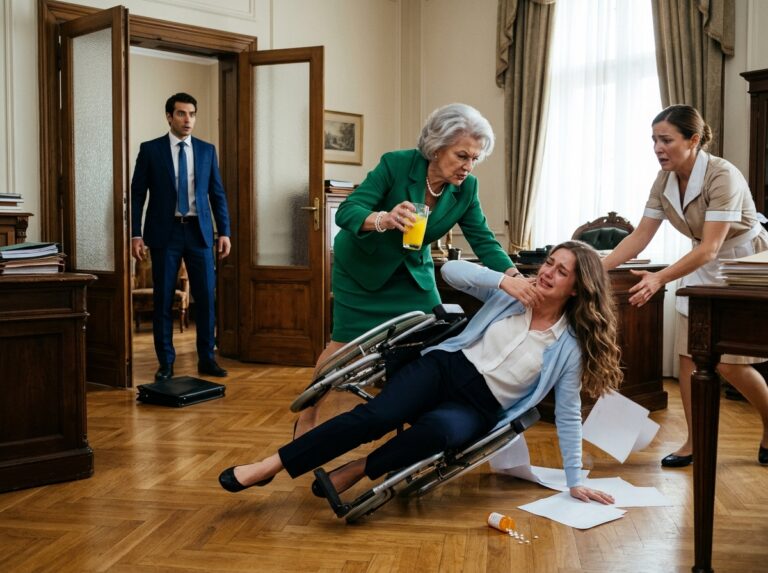
She sat in a wheelchair facing the rain.
For one terrible moment, the scene looked exactly like The Silent Echo.
The same turned face.
The same blue-gray light.
The same impossible sorrow in the eyes.
Julian stopped at the doorway.
“Mother?”
The woman did not move.
He crossed the room slowly and knelt beside her.
“It’s Julian.”
Her fingers tightened around the blanket.
He touched her hand.
She recoiled.
Julian’s face crumpled.
Lila had seen powerful men lose money, marriages, elections, and companies. She had watched them curse, threaten, and negotiate.
She had never seen a man become twelve years old again.
“My name is Julian,” he whispered. “You had a son named Julian.”
The woman turned toward him.
Her cloudy eyes searched his face.
Then she lifted one trembling hand and touched his cheek.
“Elias,” she breathed.
Julian froze.
“No. I’m Julian.”
Tears filled her eyes.
“Elias’s boy.”
The room became completely still.
Lila stepped forward.
The woman saw her.
A sound rose from deep in her throat—half gasp, half sob.
She reached toward Lila.
“Arthur’s child.”
Julian stood slowly.
“What did you say?”
The woman began to tremble.
“Elias’s boy,” she repeated, pointing at Julian. Then she pointed at Lila. “Arthur’s girl.”
Lila’s pulse thundered in her ears.
“No.”
The woman gripped her wrist with surprising strength.
“Little Lila.”
Lila could not breathe.
“How do you know my name?”
The woman pulled her closer.
“Your father wanted you.”
“My father was Elias Thorne.”
The woman shook her head violently.
“No. Elias saved you.”
Julian stepped back as if the floor had shifted beneath him.
Celeste Blackwood looked from one to the other.
Her mind had been damaged by trauma, medication, and twenty-eight years of imprisonment, but the truth emerged in broken fragments.
Elias.
Arthur.
The storm.
The baby.
The trust.
Sebastian.
Julian called the facility’s physician. Records were opened. DNA testing was arranged.
The results arrived forty-eight hours later.
They did not merely change two lives.
They reversed them.
Julian Blackwood was not Arthur Blackwood’s biological son.
He was the son of Celeste Blackwood and Elias Thorne.
The billionaire who had mocked a poor cleaner for standing near his masterpiece was the biological child of the forgotten painter.
Lila Thorne was not Elias’s biological daughter.
She was the daughter of Celeste and Arthur Blackwood.
The cleaning woman Julian had treated as invisible was Arthur Blackwood’s only biological child—and the true blood heir to the Blackwood family trust.
Julian read the report three times.
Then he placed it on the table between them.
Lila stared at her own name until the letters lost meaning.
“This is wrong.”
“It was performed by two laboratories.”
“My father was Elias.”
Julian’s voice softened.
“He raised you.”
“He loved me.”
“That makes him your father.”
“But he lied.”
“He protected you.”
“From what?”
Celeste answered that question over the following weeks.
As her medication changed and familiar objects awakened fragments of memory, the buried history emerged.
Before Celeste married Arthur Blackwood, she had loved Elias Thorne.
Elias was a young conservator from a poor family. Arthur was the heir to an empire.
Celeste became pregnant with Julian.
Her father threatened to destroy Elias and take the baby unless she married Arthur. Arthur agreed to claim Julian publicly as his son because the marriage strengthened two powerful families and concealed Celeste’s “scandal.”
For twelve years, Elias remained at the edge of their lives, employed occasionally as a restorer. Celeste secretly allowed him to see Julian from a distance, but Arthur forbade any contact.
Then Celeste gave birth to Arthur’s biological daughter.
Lila.
Arthur wanted to use the child to secure a family trust written by his grandfather. Under its terms, controlling shares would eventually pass to Arthur’s biological descendants. Julian, though publicly recognized as Arthur’s son, could lose control if his parentage were exposed.
At the same time, Celeste discovered that Arthur and Sebastian’s father were using the Blackwood art collection to launder money, traffic stolen antiquities, and bribe officials.
She planned to escape with both children and reveal everything.
Arthur discovered the plan.
On a stormy night, Celeste placed infant Lila in Elias’s care and told him to run. She promised to collect Julian and meet him later.
She never arrived.
Arthur’s men forced her car from the road. Sebastian, then a young assistant working for his father, removed her from the wreckage and delivered her to St. Agnes under a false identity.
Arthur told Julian she was dead.
Elias raised Lila as his own.
He gave her his name, taught her to paint, and hid every trace connecting her to the Blackwoods.
But he never stopped searching for Celeste.
Years later, dying and desperate, he discovered she had survived St. Agnes. He encoded the location inside the underlayer of Lila’s painting, believing a written record could be stolen or destroyed but a great work of art might survive.
Lila listened to Celeste’s fractured confession with tears streaming down her face.
“Why didn’t he tell me?”
Celeste touched her hand.
“Because Arthur watched him.”
“Arthur was dead by the time my father became ill.”
“But Sebastian wasn’t.”
The room seemed to narrow.
Julian stood by the window, looking out at the rain.
“My entire life belonged to another man’s lie.”
Celeste turned toward him.
“No.”
He faced her.
“You are Elias’s son.”
“I never knew him.”
“He knew you.”
She pointed at The Silent Echo, which Julian had temporarily transferred to Vermont under armed protection.
“He asked Lila to paint my face so you would remember me.”
Lila shook her head.
“I didn’t know who you were.”
“You didn’t need to know. You had my eyes.”
Lila looked at the painting.
For years, she had believed she invented the woman’s sorrow from her own grief.
Now she understood why the face had always felt familiar.
She had been painting her mother.
And, unknowingly, herself.
The Blackwood board attempted to remove Julian within a week.
News of his parentage leaked before the family could decide how to disclose it. The company’s stock price fell. Reporters surrounded the mansion. Commentators debated whether Julian had any legal right to the empire he had controlled for fifteen years.
The family trust complicated everything.
Because Arthur had legally acknowledged Julian as his son, Julian remained an heir to his personal estate.
But the controlling voting shares had been placed in a bloodline trust.
Those shares now belonged to Lila.
A woman who, until days earlier, had earned barely enough to pay rent now possessed legal control over one of the largest private investment groups in the country.
Attorneys descended upon her.
Some offered money.
Some offered protection.
Some suggested Julian had manipulated the DNA results.
Others advised her to remove him immediately and seize the company.
Lila refused to sign anything.
She returned to the Grand Gallery alone.
The fire damage had been repaired, but faint scorch marks remained on one section of wall.
Julian found her standing before the painting.
“You should have security.”
“I do. They’re outside.”
He stopped several feet away.
The distance between them felt different now.
Not employer and cleaner.
Not billionaire and unknown artist.
Brother and sister.
The words were still too strange to speak.
Julian looked at the portrait.
“The board meets tomorrow.”
“I know.”
“They expect you to vote.”
“I know.”
“If you remove me, no one will blame you.”
She turned toward him.
“Do you want me to?”
“No.”
At least he was honest.
“But I would understand.”
“Would you?”
He considered.
“No.”
Lila almost smiled.
Julian looked down at his hands.
“I spent my entire life believing power was proof of worth. My father—Arthur—taught me that everyone in a room had a price or a function. I looked at you and saw a function.”
“A cleaner.”
“Yes.”
“And now?”
He looked at her.
“My sister.”
The word struck them both.
Lila’s eyes filled.
“Elias was your father,” she said.
“He was yours too.”
“He chose me.”
“He protected you.”
“He died believing the world had forgotten him.”
Julian glanced at the painting.
“Maybe it hadn’t.”
The next morning, every seat in the Blackwood boardroom was occupied.
Directors, lawyers, trustees, and financial advisers watched Lila enter wearing a simple navy dress. She had refused the designer wardrobe a consultant offered her.
Julian sat at the far end of the table.
He did not look away as she took the chair beside him.
The chairman cleared his throat.
“Ms. Thorne, as the confirmed biological descendant of Arthur Blackwood, you control fifty-one percent of the voting trust. We require your decision regarding Mr. Blackwood’s position.”
Lila looked around the table.
Many of these people had attended dinners where she cleaned their glasses.
Some recognized her.
Most avoided her eyes.
She placed a folder on the table.
“My first decision concerns the company’s art holdings.”
The chairman frowned.
“We are discussing leadership.”
“So am I.”
She opened the folder.
“For decades, the Blackwood collection was used to conceal stolen property and illegal transactions. Every work will be independently examined. Objects with fraudulent provenance will be returned to their rightful owners or nations.”
Several directors shifted uncomfortably.
“The financial exposure could be enormous,” one warned.
“So was the theft.”
“This company cannot be managed according to emotion.”
Lila looked at him.
“That sentence has excused cruelty for generations.”
She turned toward Julian.
“My second decision is that Julian Blackwood will remain chief executive for twelve months under independent oversight.”
A murmur moved through the room.
Julian stared at her.
“During that period,” she continued, “the company will separate its legitimate operations from criminal assets connected to Arthur Blackwood and Sebastian Creel. At the end of twelve months, leadership will be reviewed.”
The chairman adjusted his glasses.
“And your role?”
“I will serve as chair of the trust.”
“You have no corporate experience.”
“No,” Lila said. “But I know what happens when powerful people assume the person cleaning the room understands nothing.”
No one answered.
She slid a second document across the table.
“My third decision is the creation of the Elias Thorne Foundation for Young Artists. It will provide housing, medical support, legal representation, and education to artists who would otherwise be forced to abandon their work to survive.”
Julian looked down, blinking rapidly.
Lila’s voice trembled only once.
“My father died believing he had failed me because he could not afford to keep me in school. No gifted child should ever have to sell the most personal thing they have created to pay a hospital bill.”
The resolution passed.
Not because the board believed in it.
Because Lila controlled the votes.
For the first time in her life, power entered her hands.
She discovered that power itself was neither noble nor corrupt.
It simply revealed the person holding it.
Sebastian Creel eventually accepted a plea agreement.
Facing charges for art fraud, conspiracy, kidnapping, attempted destruction of evidence, and his role in Celeste’s illegal confinement, he agreed to identify hundreds of stolen works and reveal the officials who had protected the scheme.
Arthur Blackwood’s reputation collapsed.
Museums removed his name from galleries.
Institutions returned his donations.
The empire he had built to make himself immortal became evidence against him.
Celeste moved to a private residence near Lila and Julian. Recovery came slowly. Some mornings she remembered everything. On others, she called Julian by Elias’s name and mistook Lila for the infant she had lost.
Neither corrected her cruelly.
They learned to accept whatever fragments she could give them.
Julian changed too.
Not suddenly.
Not perfectly.
He still issued orders when requests would have worked. He still mistook urgency for importance and silence for agreement. But now people challenged him, and he listened more often than he defended himself.
He sold several of his most extravagant properties.
He opened the Blackwood archives to investigators.
And he removed Arthur’s portrait from the study.
In its place, he hung a small unfinished sketch by Elias Thorne.
Lila returned to painting.
At first, she could not touch a brush without remembering eviction notices, hospital corridors, and the envelope containing eight hundred dollars.
Then one evening, Celeste sat beside a window while rain traced the glass.
Lila placed a blank canvas on an easel.
“What will you call it?” Julian asked from the doorway.
“I don’t know yet.”
Celeste looked toward the light.
This time, her expression did not carry only sorrow.
There was exhaustion, survival, forgiveness, and something fragile beginning beneath them all.
Hope.
Lila began to paint.
Months later, the finished portrait was displayed at the opening of the Elias Thorne Foundation.
It was titled After the Echo.
The art world came expecting spectacle.
They found Lila standing beside her work in a simple black dress, answering questions with quiet confidence.
Critics called the portrait extraordinary.
Collectors offered millions.
She refused every offer.
“It isn’t for sale,” she said.
Across the gallery, Julian watched her speak to a group of young scholarship recipients. He remembered the woman on the ladder whom he had treated as though her entire life could be measured by a salary.
He approached her after the guests left.
“The conservators finished repairing the original frame,” he said.
“Of The Silent Echo?”
He nodded.
“They found something.”
Lila followed him into a private room where Helen Ward waited beside the painting.
The scorched outer frame had been carefully separated from the canvas. Behind the lower wooden rail, concealed beneath an old strip of linen, was a narrow envelope.
The paper had yellowed.
Lila recognized the handwriting immediately.
Her knees weakened.
For Lila.
She opened it with trembling fingers.
Inside was a letter from Elias.
She read aloud.
“My dearest girl,
“If you are reading this, then the painting survived longer than I did.
“I know you may one day believe I sold your work because I did not understand its value. The truth is the opposite. I understood its value before anyone else did.
“Sebastian Creel had been searching for anything connected to Celeste. When he saw the woman in your painting, he wanted it immediately. He believed he was stealing a masterpiece from a frightened child.
“I allowed him to believe that.
“I needed the painting to leave our apartment. Written records could disappear. Photographs could burn. Poor men could be silenced. But vain men display the things they steal.
“I knew Sebastian would invent a famous artist. I knew the price would rise. And I believed that one day, the portrait would enter the Blackwood collection, where Julian might finally stand before his mother’s face.
“I placed the location of Celeste’s records beneath your paint. Forgive me for touching your work without permission. I had no time left, and no safer witness.
“You may think I gave away your painting.
“I did not.
I sent it home.
“You were never invisible to me, Lila. You were the greatest thing I ever helped bring into this world, even if you did not come from my blood.
“Tell Julian that I watched him from a distance every year on his birthday. Tell him I was proud of him before he became powerful, and I remained hopeful after power taught him to forget himself.
“And tell both my children that a name is not a cage.
“You may choose what it means.
“Your father,
“Elias.”
By the time Lila finished, tears had blurred the page.
Julian stood beside her, one hand covering his mouth.
For years, Lila believed her father had sold the painting because poverty had defeated him.
The truth was far more astonishing.
He had used the greed of powerful men against them.
He had trusted their vanity to preserve what their cruelty would have destroyed.
Sebastian had believed he was erasing a poor artist.
Arthur had believed he was burying his wife and stealing her children’s futures.
Julian had believed wealth gave him the right to decide the value of everything he saw.
But Elias Thorne—a forgotten painter with no money, no influence, and almost no time—had quietly defeated them all.
He had hidden a mother inside a portrait.
A location beneath a layer of blue.
A confession behind a frame.
And two lost children inside the future of a painting the world could not stop looking at.
Julian touched the final line of the letter.
“He called us both his children.”
Lila folded the paper carefully.
“He was right.”
They carried The Silent Echo back into the Grand Gallery together.
The painting returned to the same wall where Julian had once humiliated her.
But the brass plaque beneath it had changed.
It no longer named a fictional European master.
It read:
THE SILENT ECHO
LILA THORNE, AGE SIXTEEN
Painted in memory of Elias Thorne and in witness to Celeste Blackwood.
Not for sale.
The following Tuesday, sunlight spilled across the marble floor.
Lila stood before the painting while Julian watched from several feet away.
A cleaner entered carrying fresh cloths and stopped nervously when she noticed him.
“Mr. Blackwood, should I come back later?”
Julian looked at the woman.
Years earlier, he would not have known her name.
Now he did.
“No, Rosa. Please continue.”
She smiled and approached the next painting.
Julian turned to Lila.
“Do you think people can truly change?”
Lila considered the question.
“No.”
His face fell.
Then she smiled faintly.
“I think they can choose differently. Every day.”
Julian nodded.
Together, they looked at the sorrowful woman beside the painted window.
For twelve years, the world had admired her grief without knowing her name.
Now the truth stood beneath her in permanent letters.
Lila lifted her hand, not quite touching the canvas.
Once, she had been told the painting was worth more than she would earn in her entire lifetime.
But its true value had never been twelve million dollars.
Its value was a mother recovered from the dead.
A brother returned to his father.
A daughter restored to her own name.
And a poor painter’s final act of love, hidden where only the truth could survive.
Outside, rain began tapping gently against the tall gallery windows.
Inside the portrait, the woman continued looking toward the fading blue light.
But she no longer seemed to be waiting for someone to find her.
She had finally been found.